




Abstract
One of the main debates within journalism research during the last decade has been the role of citizens as contributors or, conversely, as threats to the practice of journalism. While participation has been explored from many different theoretical, empirical, and methodological perspectives, one perspective remains noticeably underexplored – the perspective of the citizens themselves. Using social contract theory as a backdrop, this study draws on a representative survey (N = 2091) and focus groups (N = 82) in Sweden. The results show that although citizens do not bring up participation as an important element of journalism, they become more skeptical the more participation affects journalism. Furthermore, they expect journalists to moderate citizen contributions according to established journalistic standards. From the perspective of social contract theory, participation in journalism appears to be more of a problem than a benefit to citizens.
Keywords
Introduction
Citizens have an ambivalent position in journalism studies. On one hand, citizens are important by virtue of their need to be informed and as a basis for the business of journalism, either as paying customers or as drivers of advertising revenue. On the other hand, citizens are on the fringe of journalism studies since their views or behaviors are rarely investigated (Madianou, 2009). Relatedly, one of the main debates within journalism research over the last decade has been the role of citizens as contributors or, conversely, as threats to the practice of journalism. While participatory journalism has been explored from many different theoretical, empirical, and methodological perspectives, one perspective remains noticeably underrepresented – the perspective of the users themselves (Borger et al., 2013, 2016; Heise et al., 2014; Hujanen and Pietikäinen, 2004; Loosen and Schmidt, 2012). Although citizens’ inclination to post or partake in user contributions has, indeed, been explored sporadically, few studies have so far aimed to assess citizens’ perspectives. The purpose of this study is to explore and measure citizens’ outlooks on user contributions in different parts of the journalistic process. This study is situated within a larger project on transparency and credibility in journalism. In the larger project, participation is one dimension of transparency, as an open exchange between parties with a stake in the journalistic performance (e.g. journalists and the public) (Plaisance, 2007; Karlsson, 2010).
Participation in journalism as a social contract
The main theoretical argument concerning participation in journalism is that the development of digital technologies now enables participation on a scale not previously possible, thus affecting various dimensions of journalism (Chung, 2008; Lewis, 2012; Netzer et al., 2014). In this account, technology may serve as a catalyst for dormant needs, desires, or demands from citizens to partake in journalistic processes that they have previously been excluded from. From this follow, as research has theorized thoroughly, repercussions for, among other things, the practice, roles, norms, quality, power, and status of journalists and journalism. However, the scope of this looming change and its impact on various forms of journalistic practice and research are dependent on how the citizens themselves partake of and view participation in journalism. With this in mind, researchers must study citizens themselves (Borger et al., 2016; Loosen and Schmidt, 2012) rather than imply their standpoint or assume an even distribution among various sectors of the population. One theoretical framework that is useful in balancing views from various stakeholders on participation is social contract theory (SCT). SCT is particularly well suited to studying the wants and needs of various actors since, more than many other theoretical approaches, it acknowledges that people have (some) autonomy, agency, and free will and use them in order to be able to determine ‘the terms of their association’ (Merrill, 2011: 26). As a consequence, with an SCT perspective it is imperative to explore the wants and needs of different stakeholders since these are predicted to affect the relationship between the various actors involved in a social contract, as well as the nature of the contract itself.
SCT is rooted in political philosophy and dates back to ancient Greece (Dunfee and Donaldson, 1995; Snyder et al., 2007; Thompson and Hart, 2006), but it has also been applied in media and journalism studies (Merrill, 2011; Sjøvaag, 2010; Ward, 2005; Wilkins, 1990). In summary, the fundamental idea of SCT is that the societal agreement (e.g. contract) between a state and its citizens, a business and its customers, or, as in our case, media organizations and their publics must be characterized by consent (Cunningham, 1999; Dunfee and Donaldson, 1995; Merrill, 2011). This may entail mutual expectations on how a news organization will provide ‘… adequate and pluralistic information, truthfulness, reliable and credible social exposition, and a meaningful context, with social good as a guiding ethical principle’ (Merrill, 2011: 27). Furthermore, Dunfee and Donaldson (1995) argue, the existence of a social contract cannot be assumed, unless supported by evidence.
Journalism and the journalistic profession can be viewed as a social contract between not only journalists and citizens but also academics, policy-makers, and other stakeholders (Sjøvaag, 2010; Ward, 2005). A contractual prerequisite, in the journalistic context, is an explicit or implicit mutual agreement, or at least an overlap, on what journalism delivers and what citizens expect or demand. Since this contract is constructed by people and grounded in a social context, it will vary to some extent across time and space (Snyder et al., 2007; Thompson and Hart, 2006; Ward, 2005).
Within the context of SCT, the essential question, then, is to what extent the different parties (the key actors for the purpose of this article being scholars, journalists, and citizens) have reached a mutual agreement regarding participation. Or, put more directly, is the concept of participation something that will change the (news) media’s social contract with the public? We will limit the contractual discussion to the area of participation in journalism, here defined, following Nip (2006), as collaboration between journalists and citizens on a platform provided and controlled by a media organization.
Hitherto, this ground has mostly been covered by research focusing on the perspectives of producers or alternatively on features of content and how the participatory potential has been limited for various reasons. With that in mind, this study will focus on the perspectives of citizens. At the heart of this debate lie the gatekeeping function of the media and the question of who is, and should be, in control of and shape the different parts of the news production process (Domingo et al., 2008; Netzer et al., 2014; Scott et al., 2015; Singer et al., 2011). Borger et al. (2013) aptly summarize much of the previous research through four phases (with the first three being the most dominant): (1) enthusiasm about new democratic opportunities, (2) disappointment with professional journalists’ obduracy, (3) disappointment with the economic motives to facilitate participatory journalism, and (4) disappointment with news users’ passivity. There is also an evident normative strand running through much of the research, implying that both journalists and citizens could and should engage in participatory practices, as this would improve journalism and flatten analogous flavored barriers (Borger et al., 2013). Since researchers can be viewed as stakeholders in journalism’s social contract, this normative outlook is also a claim with respect to how the social contract between journalists and citizens, specifically, should be constituted.
Previous research has convincingly highlighted the limitations of participation in the production side of journalism, while significantly less attention has been given to users and the limitations at their end. Logically, there must be limitations here, too, in terms of what users want to contribute, to what extent they appreciate participation, and how this varies across different sections of the population. What becomes interesting from a social contract perspective, then, is to map the overlaps and gaps in participatory practices between journalists and citizens. The study will, based on the review of previous research by Borger et al. (2013), work with the assumption that journalists’ interest in participation is limited and we will not study this empirically.
To summarize the argument so far, there needs to be some common ground between journalists and their organizations vis-a-vis the members of the public, regarding what citizens can and should contribute. Next, we will review previous research on citizens and participation in journalism.
Previous research on citizens’ perspectives on participatory journalism
Any social contract must include the perspectives of the subjects (in our case citizens). In the following section, we will review research on citizens’ perspectives on participatory journalism. The review will serve as a proxy for an SCT perspective on participation in journalism since it will review whether citizens subscribe to the ideals of participation and what their expectations concerning participation are (Merrill, 2011). This will be practically equivalent to user comments since they have been in focus.
In the literature, we have identified three research themes – theorizing participation, usage patterns, and views and attitudes – with respect to citizens and participation. The first theme consists of variants of an argument that details the conflict between the need for professional control by journalists and the participatory potential of digital media. In these studies, the perspectives of the citizens themselves are an empirically anecdotal, peripheral, or implied factor, waiting in the background to become active if and when journalists open up their spaces to outsiders (Canter, 2013; Lewis, 2012; Reich, 2011; Robinson, 2007). This argument is elegantly summarized by Lewis (2012): In the struggle between the professional logic of control, embedded in journalism’s ideology, and the participatory logic of free engagement, embedded in the substance and culture of digital media, surely something has to give, especially as journalists increasingly work with and through social/participatory media spaces. (p. 850)
Indeed, framed this way, it seems that journalists will eventually have to give in to participation. However, there is an essential distinction between potential and outcome and to what extent citizens appreciate participation from other citizens. Put differently, the extent to which citizens will embrace the participatory logic is an open question. It is far from certain that the social contract of participation will have its equilibrium at higher levels than today. There might be a, for lack of a better word, a ‘citizen logic’ that needs to be taken into consideration as well in this equation. Consider, for instance, Schudson’s ‘monitorial citizen’ (Schudson, 2000; Zaller, 2003), who follows the news media and public life out of necessity and interest, rather than engaging fully. With the monitorial citizen in mind, it appears that journalism’s social contract is already rather weak, as basic attention to news is sufficiently demanding for many citizens. In this context, engaging in participation will demand more, not less, commitment from citizens. A key factor and empirical question is to what extent and how participation appeals to citizens, as participation entails increased citizen engagement in their relationship with journalism.
Furthermore, there is a difference between assuming interest in participatory journalism in a public or the public (see, for instance, Larsson, 2011; Robinson, 2010, for illustrations of this). Or, phrased differently, to what extent is participation in journalism a marginal or key element for contemporary publics? From an SCT perspective, the space between actual evidence for and assertion of consent (with respect to participation) is problematic as empirical evidence is a necessary condition for social contracts (Dunfee and Donaldson, 1995). This bridges to the other two research themes.
Empirical studies have also probed a second theme: usage patterns. While usage patterns do not say explicitly how citizens view participation, it can be argued they are a proxy for interest. High use can be interpreted as citizens subscribing to participation as a part of journalism’s social contract, while low use would imply the opposite. From this line of research, we find that a rather small share of the citizenry is active in contributing through participatory features, while a larger share are passive users or lurkers (Chu, 2010; Chung, 2008; Hujanen and Pietikäinen, 2004; Karlsson, Bergström, Clerwall and Fast, 2015; Larsson, 2011). Furthermore, it does not appear that usage patterns increase over time, either for lurkers or active users, indicating that participation has reached its peak (Karlsson et al., 2015). Several studies point to the fact that the use of participatory features varies between different citizens, with men and younger people, in general, being more active (Bergström, 2008; Chu, 2010; Chung, 2008; Larsson, 2011), suggesting that interest in participation is not evenly distributed.
Finally, there are studies that probe citizens’ views and attitudes toward participation. While the studies do not necessarily utilize an SCT perspective, they do explicitly probe citizens’ expectations of the role of participation in journalism. Some of these studies indicate a conflict between how journalists and the audience value comments: The audience wants a freer space to roam in, while journalists want more control (Bergström and Wadbring, 2015; Robinson, 2010). Another study (Heise et al., 2014) points toward a congruence between the audience and journalists. Although many in the audience support comments, a large portion of the public does not have any opinion on the matter (Bergström and Wadbring, 2015), and one study (Larsson, 2011) concluded that the audience showed rather low levels of appreciation, while other studies (Chung and Nah, 2009; Yoo, 2011) found positive correlations between participatory features and how news sites were perceived.
It seems that the users (Bergström and Wadbring, 2015) like the idea of comments but not the actual outcome. Similarly, in an interview study (Borger et al., 2016), the respondents thought that their own contributions were valuable and interesting, while the contributions of others were not. Overall, users seem supportive of traditional values in journalism, such as moderation and editorial involvement (Bergström and Wadbring, 2015; Heise et al., 2014; Van der Wurff and Schoenbach, 2014).
In summary, previous research points to a gap between participation as an ideal construct and its actual practice. It is in this space that this study is situated in and contributes to. If, indeed, digital media enable a participatory culture, and many citizens subscribe to the idea in theory but shun it in practice, we need more detailed knowledge about how citizens view participation in journalism. Described from an SCT perspective, we seek to learn more about what citizens expect and demand regarding participation in journalism (Merrill, 2011). Without this information, the contractual relationship can never be evaluated or an agreement reached (Cunningham, 1999; Dunfee and Donaldson, 1995).
Most previous research has been quantitative, and often respondents have been asked to evaluate or rank a number of interactive/participatory features in a deductive manner, thus sidestepping the crucial issue of their view on participation as a phenomenon itself or how they reason about various forms of participation. Furthermore, in several studies, users of news sites or user-generated content (UGC) are overrepresented. Being a user of a news site may even be a selection criterion (Heise et al., 2014; Larsson, 2011; Robinson, 2010). Within this line of research lies an evident risk of trigger effects and of a too strong focus on participation that could, ultimately, mean that citizens’ expectations are misread. Thus, more open and qualitative approaches are needed to complement earlier research, putting participation into context and commencing from the citizens’ perspective in the contractual relation.
While indeed the digitalization of journalism ‘encourage[s] and enable[s]’ (Lewis, 2012: 837) participation, we know little, the previously mentioned research aside, concerning to what extent and how this participation are appreciated by citizens. Consequently, in order to bring the citizen perspective more deeply into the discussion about participation in journalism, the purpose of this study is to explore and measure citizens’ outlook on participation. Since the debate about citizen participation is often centered around power and control (Lewis, 2012) over the journalistic process and its different parts – collecting, selecting, processing, distributing, and interpreting (Domingo et al., 2008; Netzer et al., 2014; Scott et al., 2015) – this will be used as a backdrop. More specifically, we ask the following research questions:
RQ1a. What attitudes do citizens have toward participation in different parts of the journalistic process?
RQ1b. How is this related to background variables (e.g. age, gender, education, media trust)?
These research questions measure attitudes toward explicit forms of participation (e.g. comments, collaboration, and replacing journalists entirely) and to what extent there are differences between different groups of citizens. Would, for instance, those who trust the media the least become more inclined to do so if journalists had less and citizens more control over the process? Or, can we expect younger generations, as some of the previous research suggests, to be more accustomed to the idea of participation and, therefore, more positive toward it?
Research Question 2 is in two parts, the first part of which asks the following:
RQ2a. What outlook do citizens have on participation in journalism?
Previous research primed respondents for their views on participation by asking explicitly about it, as if there is and should be an articulate view on participation. This research question, by using the rather open term ‘outlook’, takes a more inductive approach, where the point is to let people talk freely and openly about journalism and see if, when, and how they bring up participation. This provides an opportunity to see whether participation is something that is given priority in the citizens’ contractual relationship with journalism.
Finally, citizens were asked (RQ2b) about their views on certain forms of participation in different parts of the journalistic process in order to probe how they felt about the tension between journalistic control and open participation. In addition, this also allows for a deeper understanding of the quantitative data reported in relation to RQ1. Thus, RQ2b asked the following:
RQ2b. What are the views of citizens on what different forms of participation (comments, reader images, reader news) bring to journalism?
Method
Situated in a larger project on transparency and credibility in journalism, this article reports specifically on how one dimension of transparency – participatory transparency (Karlsson, 2010) – is viewed by citizens. The study uses two methods – survey and focus groups – to answer the research questions. They were both conducted by the Swedish opinion research institute TNS Sifo. The survey was designed to measure attitudes toward participation in different parts of news production stages, as previous research (Domingo et al., 2008) has shown that the news media become more reluctant to include participation the closer to the core journalistic function it is. Hence, the survey asked for attitudes toward comments (low involvement in journalism), user photos/images published in the news (medium involvement, for example, supplementing journalists/professional photographers), and reader news (high involvement, for example, replacing the journalists). The measurements also focused on different parts of the journalistic process (e.g. Domingo et al., 2008). Comments represent an interpretation after the core journalistic work has been done. Images relate to collecting information, and pure reader news put the citizen also in charge of selecting and processing information.
These specific measurements were chosen as they are quite easy to get across in a survey and Swedish news sites rather frequently use the first two, so the respondents should be accustomed to them. The survey (N = 2091) was conducted in 2014 and was based on a representative panel of the Swedish population, aged 16 to 79 (M = 51). The respondents were evenly distributed between male and female respondents (male = 48%, female = 52%). The sample was skewed toward older respondents (M = 51 compared to the average for Sweden, M = 41) and slightly skewed toward more women (52% in the sample compared to approximately 50% in Sweden), and the response rate was 26 percent. In order to investigate RQ1a and RQ1b, the respondents were asked to what degree they think it is good (or bad) when the news media allow for comments, user images/pictures, and reader news. For the assessment, the survey used a 7-point Likert-type scale where 1 = very bad and 7 = very good. The statistical analysis was done in SPSS.
For RQ2a and RQ2b, we used focus groups. The focus groups were carried out in 13 sessions in the spring of 2015 with six to eight participants in each focus group (with one exception where the group comprised only three participants), yielding in total 82 participants, evenly distributed between male/female participants, and with an average age of 45. The interviewees were recruited via a panel that was representative of the Swedish population, aged 18 and over. The recruitment process included a screening survey focusing on news consumption (high/low) and trust in the media and journalism (high/low). The sessions were carried out in the Swedish cities Karlstad and Stockholm in a neutral environment (a conference room at a hotel and at TNS Sifo in Stockholm). Each interview was approximately 90 minutes long and was conducted by a professional moderator following a predetermined line of questioning, developed by the researchers. One of the researchers monitored the first eight sessions through a live feed and could communicate with the moderators during the sessions. After a while, it became evident that the interviews ran well and that the presence of the researchers was not required. All the sessions were recorded with audio and visuals.
A potential problem with surveys and interviews is the risk of putting thoughts into the minds of the interviewees – for example, by asking questions about something, that ‘something’ is brought to the forefront of the interviewees’ consciousness. For the interviews, an approach was used where the moderator started off with a very broad and general discussion about the respondents’ view of news and their news consumption. All interviewees were asked to say something about what news they usually consumed, and why. After that, the interviews followed a path from the general questions to questions about what the interviewees considered to be ‘good’ journalism. Not until the end of the interviews (approximately 60–70 minutes in) were the interviewees asked specific questions regarding participation (and transparency) in journalism. Figure 1 illustrates the ‘funneling down’ process of the interviews.
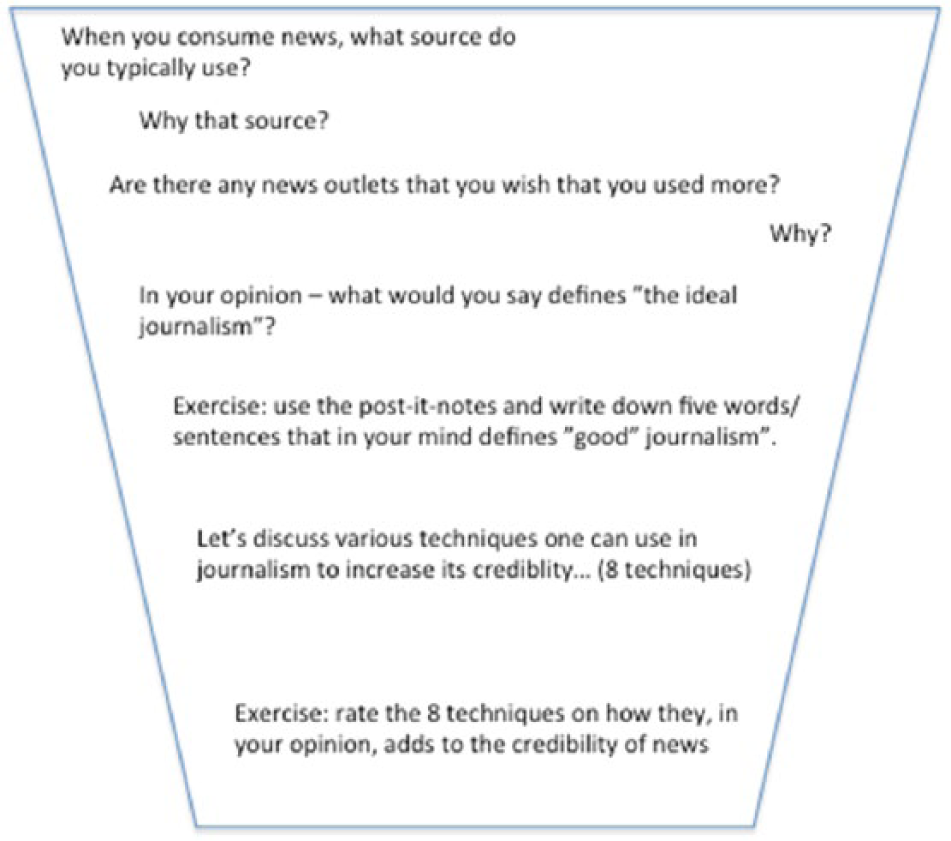
Illustration of the ‘funneling down’ process used for the focus group interviews.
Thus, the sessions initially had a very open process in which the respondents themselves were allowed to express what they expect from journalism. At the very end of the interview, the interviewees were also asked to rate various transparency techniques, among other things not relevant to the purpose of this study, comments, entirely citizen-created news article, and news photos taken by citizens by how they, in the minds of the interviewees, contribute to a sense of quality and credibility in news. Consequently, the focus groups allowed the researchers to see both to what extent different forms of participation would come to mind when the respondents thought about journalism (without being primed for them) and to get qualitative data on the specific forms of participation that was posed in the survey.
As mentioned above, the sessions followed a preset structure, and the part about various ways of working with transparency began with the moderator saying something like ‘There are different things that may or may not increase transparency, we will now talk about a few of them’. When discussing participation, the discussions were focused on allowing for user comments, using images from readers (reader images), publishing news texts written by readers (reader news), and it would start with ‘What do you think about allowing user comments on articles?’ (or something quite similar). Usually the responses from the participants were rather brief and did not spark any lengthy discussions.
The data were broken down and analyzed using NVivo in three levels: (1) participation, (2) specific form of participation, and (3) overall negative/positive or mixed view on each specific form. Given that the data to start with were not particularly exhaustive, this approach gives a good general idea of the participants’ views on the specific forms of participation.
Results
In order to answer RQ1a and RQ1b, the survey asked the respondents about their attitudes toward user participation in news production. The respondents were asked how they viewed the possibility for users to comment, to get images published, and to contribute with reader news (i.e. news written by the readers). For the answers, we used a 7-point Likert-type scale (1 = very bad, 7 = very good).
Figure 2 shows the general distribution in attitudes toward the three types of participation asked for in RQ1a.
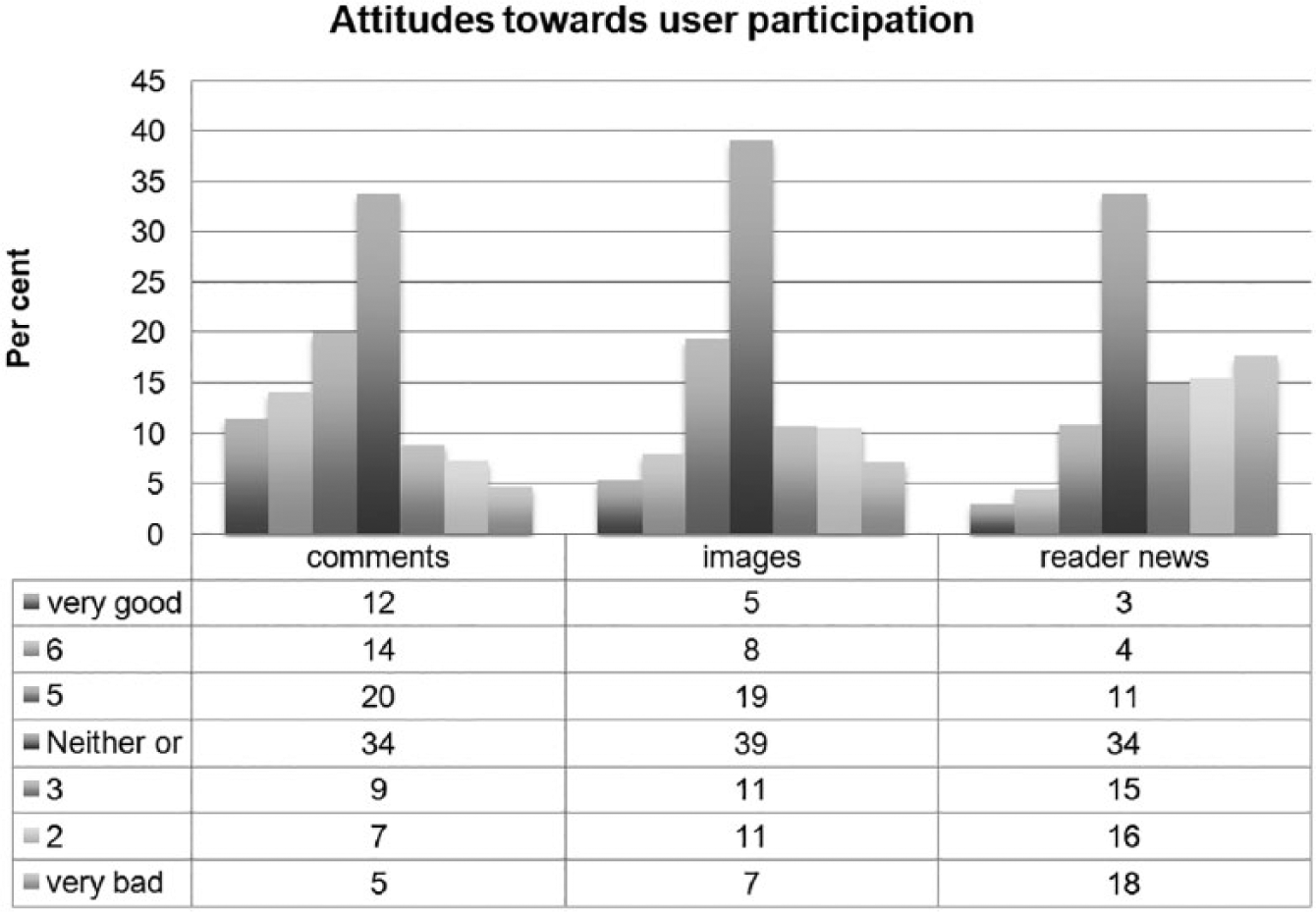
Distribution of attitudes toward reader comments, reader images, and reader news in journalism.
The survey points to two interesting findings. First, as pointed out in the ‘Method’ section, the three types of participation are related to how much and in what part of the journalistic process the user is involved. The higher the level of participation and inclusion in the journalistic process, the more skeptical the respondents become. Regarding comments – which have the least citizen involvement – most respondents think it is a, at least somewhat, good idea. When it comes to reader images – the middle involvement option – a clear majority of the respondents choose the middle options. Exclusive reader news, with the largest citizen involvement, then, is largely considered bad.
Second, in all three scenarios, the prevalent option for the respondents is that it is, intriguingly, neither good nor bad that journalists let go of control. This can, on one hand, be viewed as the truly neutral position that is ‘OK’ or it can be interpreted, on the other hand, as that the respondents do not really have an attitude toward these forms of participation and chose to tick the most neutral option for that reason.
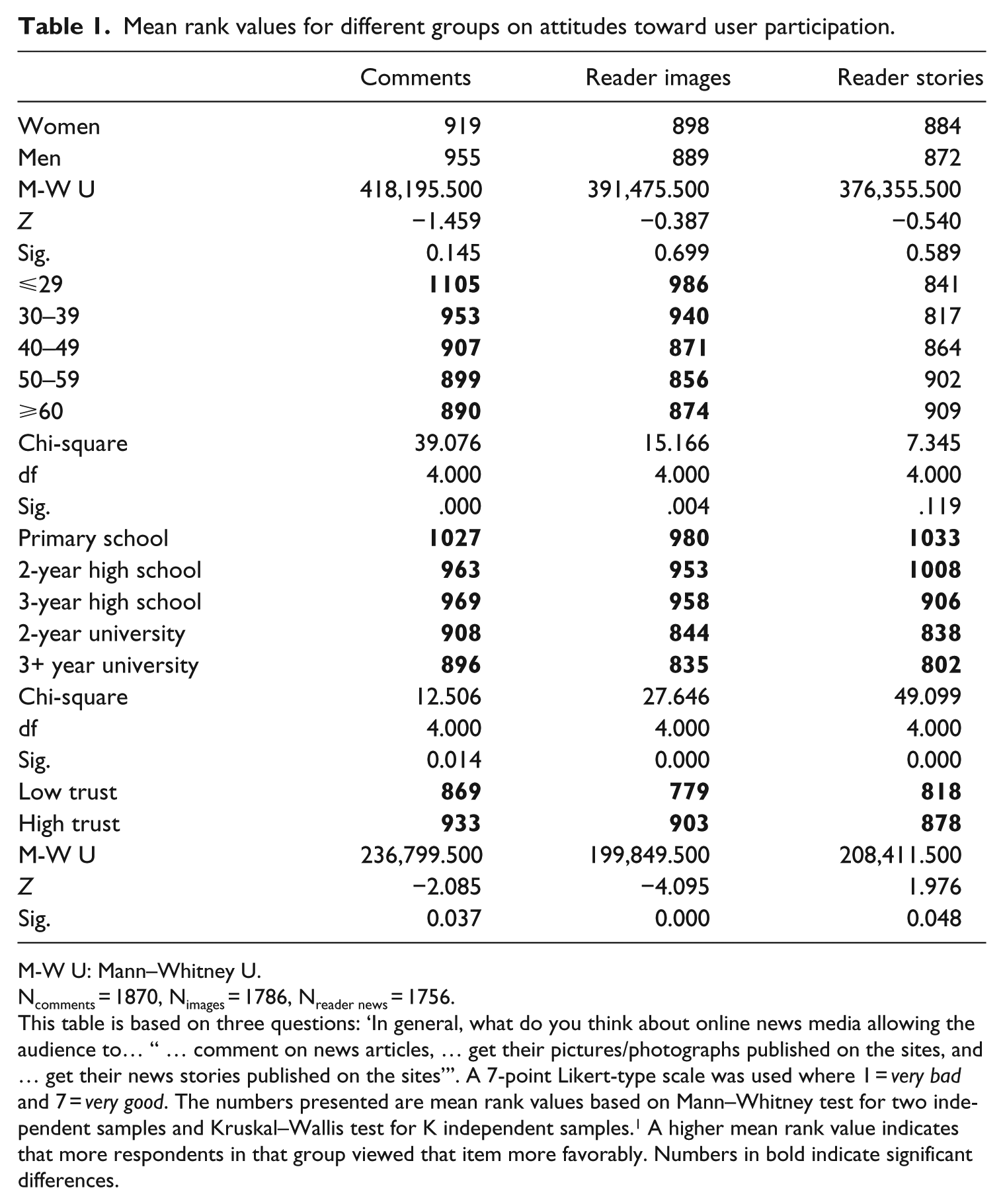
RQ1b asks how the citizens’ attitudes are related to the background variables gender, age, education, and trust in the media. Table 1 presents the results.
Mean rank values for different groups on attitudes toward user participation.
M-W U: Mann–Whitney U.
Ncomments = 1870, Nimages = 1786, Nreader news = 1756.
This table is based on three questions: ‘In general, what do you think about online news media allowing the audience to… “ … comment on news articles, … get their pictures/photographs published on the sites, and … get their news stories published on the sites”’. A 7-point Likert-type scale was used where 1 = very bad and 7 = very good. The numbers presented are mean rank values based on Mann–Whitney test for two independent samples and Kruskal–Wallis test for K independent samples. 1 A higher mean rank value indicates that more respondents in that group viewed that item more favorably. Numbers in bold indicate significant differences.
As shown in Table 1, there are no significant differences between men and women with respect to any of the types of participation. However, for age, there is a clear significant difference; younger respondents seem, as previous research has illustrated (Bergström, 2008; Chung and Yoo, 2008; Larsson, 2011), to be more positive toward comments (mean rank = 1105 for people under 30, and 890 for people over 59) and reader images (mean rank = 986 for people under 30, and 874 for people over 59). When it comes to reader stories, there are no significant differences, and hence, all age groups converge on the view that the audience should be kept out of selecting and processing news. Furthermore, education seems to be an important factor. The data indicate that the more educated the respondents are, the more skeptical they are toward user participation – of all three types. The last background variable is trust in the media. The data indicate that people with a higher level of trust in the media have a more positive view of citizen participation. There are significant differences between people with low trust and people with high trust in the media for all three types of participation.
RQ2a asked for citizens’ outlook on user participation in the news. As mentioned in the ‘Method’ section, the focus groups started with a broad discussion about news consumption, sources (why some are seen as better than other), news, journalism, and so on, only to get into more detailed discussions about participation at the end of the sessions. Given this design of the sessions, it is quite interesting to see that none of the participants in the focus groups mentioned participation in journalism in any form at all before the moderators brought up the subject explicitly. Consequently, the respondents went past the issues on what media they use and why and what constitute good journalism, without mentioning participation in journalism. Hence, a general, and very important, result from the focus groups is that participation (or lack thereof) is not on the top of the minds of our Swedish respondents when asked about what guides their news consumption and what constitutes good journalism. The results from the focus groups, then, suggest that the high proportion of survey respondents who chose the middle option did this probably because they were indifferent toward citizen participation in journalism, confirming the results from the Bergström and Wadbring (2015) study. Although the main finding from this part of the study is that citizen participation is not a key or very valued practice, the respondents had some thoughts on the different forms of participation, as posed in RQ2b. In the following section, we will present the results of those discussions in more depth.
Comments
An overall assessment is that a majority of our respondents were negative toward comments. Common statements were that comments only lead to discussions that lose their thread after two to three comments. Issues were raised about the maturity of the participants: ‘It can easily turn into kindergarten level [discourse]’; ‘The public can’t handle it, they start to offend people’ (Group 1). Another theme concerned the intelligence of the comments: ‘Most of what is written is not thought through, you never get an intelligent discussion’.
The more positive respondents focused on the possibility of a dialogue between the readers and the journalists: ‘I think it’s valuable if there’s a dialogue where the journalist, or someone in the newsroom, answers the comments, so that you get some kind of feedback’ (Group 1). Respondents also pointed out that comments allow for people with certain knowledge to add information and/or dispute the reporting in an article ‘It can be positive, since it allows for further facts to be presented’ (Group 13). As for the more ambivalent respondents, they usually conditioned their view, that is, they would say that comments can be good, if they, for example, are moderated, if they are made by informed people, and so forth. It is evident that the respondents would appreciate a knowledge-based, rational, and level-headed dialogue, much in line with participatory ideals, but that the comments rarely provide that kind of discourse.
Reader images
To a certain extent, the results from the focus groups contradict the survey data, in the sense that the participants in the focus groups were quite positive toward reader images. However, and this is important, they saw it as an advantage that you can get pictures from events where the journalists have not been at the location: ‘If someone [not a journalist] is at the site of a crisis or extreme event, then it’s good since we can get pictures we wouldn’t get otherwise’ (Group 1). Thus, when the knowledge of journalists is absent, citizens can fill in. Tellingly, the participants emphasized the editorial control over the publishing of reader images – the reader images need to be subject to a journalistic evaluation, the editor needs to approve (and stand behind) the publishing decision – thus, it should be ‘based on an editor who checks it [the image] and makes an assessment of news value’ (Group 5). For those who found reader images more problematic, the focus was on the media (or the journalists) not fulfilling their duty, that is, the media is leaving parts of the journalistic work over to the public: ‘I think it is bad for the credibility’; ‘It’s like you [as a news organization] sellout when you ask the audience for images – then you have not put enough effort into the job’ (Group 4). In this context, participation becomes a problem, something the news organizations resort to when their own capabilities are limited.
The results point toward the overarching importance of journalistic knowledge and the need for professional approval and control.
Reader news
It seems that the higher the level of participation, the higher the level of controversy, as news solely produced by citizens was viewed the most negatively. On one hand, reader news might be something good, if it is subjected to editorial evaluation and control, if there is a need for knowledge that can bring added value to the news, and so on. On the other hand, it is negative in the sense that it seems to imply that the journalists are abdicating their mission. Reader news could be OK for local news: ‘Let’s say that the local newspaper wants to write a story about a new playground. Then it might be relevant, and it doesn’t matter if the text is bad’ (Group 1). This participant seems to assume that news articles written by readers will be of poorer quality than if it is written by a professional journalist. In this context, knowledge is attributed to the skill of writing. Furthermore, if the topic is appropriate for a reader’s area of knowledge to contribute to, it may also be OK ‘if a teacher writes a text about a school, then it is more trustworthy’ (Group 4). Another participant, who during the session had been critical toward journalists in general, said, ‘given what I have said earlier about journalists, I think it could be a fresh thing to have the readers also write’ (Group 7).
A common theme in regard to reader news was that journalists are trained professionals, whereas the common reader is not, and journalism is too important to be handed over to amateurs, again pointing to the importance of journalistic knowledge. Furthermore, our respondents indicate that if participation in form of reader news are published, it should be distinctly marked in order for the reader to be able to assess the story properly: ‘Then [if clearly marked] you enter the text from a different angle than if it is written by a journalist, which would make it more believable’ (Group 6).
The importance of editorial control was emphasized: ‘I don’t buy it [the concept of reader news], there needs to be a journalist who edits the text so that you get good language before it’s published’; ‘It is not credible if it’s written by a reader, unless it’s been edited by a journalist’ (Group 11); and ‘It’s not so much the fact that you publish texts from someone else as the fact the news companies do not have reporters on site to write the texts’ (Group 4). The last quote to a certain extent mirrors the views on reader images, in that it focuses on the journalistic mission, which is failing when the public is brought in to do parts of the journalistic work.
Our general impression from the focus groups are that the respondents are happy to take a seat in the stands and let people with relevant knowledge participate in the production of news, and that they, for most of the time, expect and trust journalists to be those people.
The presentation above tries to illustrate the lines of arguments, both negative and positive. However, as mentioned before, the participants were, in general, quite skeptical toward participation when they were explicitly asked about it. There is no carte blanche for participation, instead it is conditioned by, for example, if comments are used as a tool for discussion (where the users can, for example, point out errors and get answers) and if the commenters were to refrain from cursing, bashing, foul language, letting the discussion diverge from the original topic of the article, and so on, then comments are (or could be) a good thing. Since, according to the respondents, this is rarely the case, they argue that participation in the form of comments does not add value to journalism.
This also points to the respondents’ more general point that participation can merely be justified if it adds something that journalists could not provide themselves, either by lack of opportunity or competence. However, all information needs to be vetted by journalists and, ideally, it should be the journalists doing this kind of work too. Thus, the respondents have rather appreciative thoughts about journalists, their standards (at least in theory), and appreciate their editing and gatekeeping work.
Gates ajar and few tensions
Concerning user participation in journalism there has been, as previous research has forcefully illustrated, a conservative approach from journalists. Previous studies (Bergström and Wadbring, 2015; Chu, 2010; Chung, 2008; Larsson, 2011) indicate that there is limited interest from citizens, which our Swedish respondents confirm.
Indeed, the respondents were skeptical in general about participation and became more skeptical the further involved in the news process users are – although younger (also predicted by previous research), less educated, and participants with a high level of trust in the media were a little less negative. Instead, according to our respondents, journalists should focus on their core functions and only include citizen contributions when it enhances the traditional and professional journalistic practice or when journalists fall short in terms of time or expertise. In that sense, the findings suggest that our respondents value and trust the journalistic profession and how the gate is currently guarded and staffed. Participation is not an end in itself. In fact, participation was not something that came easily to mind for our focus group respondents. It was only when they were explicitly asked for their views on participatory practices that they began to speak of them. While these results are from a limited number of people in focus groups and, thus, cannot be generalized to a larger population, the findings are still interesting enough to stress that participation has to be placed in a larger journalistic context in future research. On a methodological note, it is interesting that the survey and focus group approach provided rather ambiguous results. The survey results might be interpreted to suggest that the respondents were somewhat interested and positive toward participation, while the results from the focus groups showed rather the opposite. Given the fact that most of the few previous studies relied on survey results, more qualitative data are needed, especially since the focus groups in this study indicated an even lower appreciation for participatory journalism than could be gleaned from earlier quantitative data. As some research has shown (e.g. Van der Wurff and Schoenbach, 2014), participation is not ranked highly by citizens when it is put in relation to other dimensions of journalism. Thus, having participation as the sole focus in studies risks trigger effects and confirmatory bias.
Our findings, like some of the previous research (Bergström and Wadbring, 2015; Heise et al., 2014; Van der Wurff and Schoenbach, 2014), indicate that journalistic gatekeeping is still to a large extent appreciated by the audience. There is not much tension between controlled and open participation when it comes to how citizen contributions are viewed and there seem to be more ‘traditionalists’ than ‘convergers’ to paraphrase Robinson (2010). Most appear to be happy with the ways things are and prefer the gates to be ajar and the keys to be in the hands of the journalists. On the other hand, some previous studies indicate that participation may be highly appreciated by users if it is perceived as valuable and responsive to users’ needs (Costera Meijer, 2013; Costera Meijer and Bijleveld, 2016) and, in this study, when participants can contribute with their knowledge. Audiences may also be more positive in their attitudes toward participation if the journalism in which participants get involved is more reciprocal (Borger et al., 2016). With this in mind, adjusting to the participatory logic of digital media might have different effects on users’ perceptions.
In the context of SCT, participation does not seem to increase citizens’ engagement with news, nor do they think that participation adds much value to journalism. Instead, open participation was mostly framed by our respondents as a problem to journalism, its standards and practices – as a potential breach in the social contract. Taken together, participation might weaken, not strengthen, the social contract. Similarly, participation cannot be viewed as an instrument to attract those alienated from journalism either, since it is those who already have high trust who are most positive in the survey.
The results from previous studies demonstrate the limitations of concrete participatory practices on behalf of journalists. The results from our study suggest participation has little appeal to citizens, although caution has to be applied since this study has a limited sample and there was a low response rate in the survey. Borger et al. (2013) point out that much of the previous research is marked by enthusiasm and disappointment. Yet, this says more about scholastic dispositions than practices and expectations from journalists and citizens who, overall, seem to have their social contract, as far as participation is concerned, intact. The strong overall focus in research on various forms of participation in journalism seems, in the context of a social contract, somewhat misguided.
We would call for, following Borger et al. (2013), three strands of future research in relation to participatory journalism. The first dimension would critically explore the limitations (rather than be enthusiastic about possible positive effects, followed by disappointment of the lack thereof) of participatory journalism in different geographical, political, and cultural contexts. Sweden, our setting, is an exception in the world with highly trusted and well-functioning social and political institutions, including the news media. Other contexts may show different findings and, in turn, point to the importance of the political culture, in a broad sense, rather than technology’s role in one specific social practice. The second dimension would begin with citizens and their needs and put participation in the wider context of journalism, preferably with richer qualitative data. The third dimension would critically engage with normative and theoretical assumptions in participatory journalism research, especially considering the gap in journalisms’ social contract between researchers, on one hand, and journalists and citizens on the other. Why is the absence of participation a problem and why do we, as researchers, spend so much time dwelling on and anticipating it? Participation is, indeed, considered a democratic good, but so is useful and verified information, which is a superior goal for our respondents. Journalism scholars are obviously free to research whatever they want, but if we are misreading our object of study, we might neglect or underestimate other issues, more relevant and pressing, than participation.
Footnotes
Acknowledgements
The authors would like to thank the anonymous reviewers for their comments and suggestions.
Funding
The author(s) received no financial support for the research, authorship, and/or publication of this article.