




Abstract
The ‘Humans of New York’ social media feed, featuring photographs of people in New York City – and in recent years also Iran, Syria, and other locations – has amassed nearly 18 million Facebook followers, spawned multiple books, and inspired various copy-cat projects. Over the 6 years since its creation, the feed has evolved from an assortment of photos of individuals in New York to an intentional, morally conscious portrait of the perspectives and lived experiences of the inhabitants of New York and other places, and has resulted in real-life consequences for the subjects, ranging from donations to projects to invitations from the president of the United States. This article analyzes the ‘Humans of New York’ posts in the context of public service ideals of modern journalism as laid out by scholars, professional journalism societies, and leading news organizations. This analysis considers the perspective of the posts through the captions that accompany each post and finds that, since 2011, the feed has changed its narrative focus from the photographer to the subjects, who share their stories in their own words. In this way, the ‘Humans of New York’ feed satisfies several aspects of the public service ideal of journalism, lending support to the idea that new media sites created by non-professionals, or citizen journalists, may be able to satisfy some of the social responsibilities of the press, and offer lessons for both professionals and amateurs.
Introduction
The growth of social media and digital tools has enabled new voices to reach broad audiences without the resources and institutions that supported, and were often requisite for, traditional media. This facility has threatened the dominance of media messages by traditional media organizations, such as those employing professional journalists, and contributed to the economic challenges facing the news media. It has also allowed entrepreneurial journalists, citizen journalists, and other amateurs to gain strong followings and even develop their work to be financially viable. These new entrants into the media sphere must hold to the same standards to which we have held the press, as they benefit from the same freedoms, and therefore have the same responsibilities. To the extent they are successful in satisfying those responsibilities, they may serve as a model for professional and citizen journalists looking for new strategies to reach and serve the public. This article examines the evolution of the immensely popular social media feed, ‘Humans of New York’ (HONY) – which began as a non-traditional, amateur media project and eventually became a full-time profession for creator Brandon Stanton – in the context of professional journalism ethics and practices.
Professional journalists and journalism scholars lament the decline of the mainstream news media, particularly newspapers, warning about the threat to an informed public and the democratic process posed by a weakened or reduced profession of journalism (see, for example, McChesney and Nichols, 2009). These arguments assume that professional journalists are better able to provide the public with the information it needs to be self-governing, and that the public good and a successful democracy are best served by a dedicated profession of information-gathering gatekeepers. Meanwhile, some academics and new media producers have hailed the contributions of citizen journalists or the ‘crowd’ on social media, lauding user-generated content for its potential to empower citizens to take more control of the information relationship from institutions (see, for example, Goode, 2009). Scholars such as Bruns (2008) have pointed out that the information-production process of new media is different and requires a new kind of evaluation. Although ‘produsage’ lacks editorial oversight, for example, it may produce good, accurate information through the process of mass collaboration. Proponents of new media are quick to point to the proliferation of blogs and social media that have enabled a larger number of participants to contribute content, analysis, and commentary to public information. Others point out that simply sharing information or analysis is not sufficient to satisfy the social responsibilities of journalists in a democracy. Skeptics note that social media often spread misinformation, permit bullying, and encourage mob mentality.
Few studies, however, have examined the extent to which user-generated content, amateur new media, or citizen journalism have successfully filled the gap that journalists argue is created by job cuts in the journalism industry and the closure of major newspapers. HONY is analyzed in this article because it began as an amateur project and has developed into a professional endeavor. Stanton started HONY in 2010 with a plan to photograph 10,000 people in New York by approaching them on the street, taking their portrait, and posting it on his Facebook page, and later Tumblr and Instagram accounts. He posted each photograph with a caption, sometimes providing information about or commentary on the subject of the photograph, or a story of the encounter that led to the photograph, and other times simply a quotation from the subject or an exchange between the subject and photographer. This analysis tracks Stanton’s perspective in the captions in the posts on his feed over time and asks whether his media feed satisfies the same responsibilities of professional journalists, specifically the public service ideals which journalists and academics have suggested ought to guide the work of professional journalists. Finally, it discusses what Stanton’s evolution reveals about citizen and professional journalism, and what lessons might be learned from it.
Literature review
The public service ideal in journalism
Current ethics for professional journalism evolved over the course of a century through the work of professional societies, ombudsmen, journalists, and scholars, as well as jurisprudence. The particular ethics of individual journalists or news organizations may vary from more objective, truth- and fact-based standards, such as those in the Society of Professional Journalists, to theories of social responsibility and even the public journalism movement in the 1990s, which promoted an advocacy role for journalists. Outside of public journalism, the public service ideal has been promoted by a variety of journalists and scholars, such as Deuze (2005), who described the ideology of journalism as including five ideal-typical values: public service, objectivity, autonomy, immediacy, and ethics. Despite some agreement that journalists have a responsibility to the public, there is wide disagreement about how to best serve the public, and to what extent journalists are obligated to do so.
The public service ideal is rooted in the Walter Lippmann-John Dewey debate about journalism’s democratic responsibilities and the Hutchins Commission’s report, ‘A Free and Responsible Press’. The Commission on Freedom of the Press, better known as the Hutchins Commission, in its 1947 report laid out a social responsibility theory of the press, which posited that the press had an obligation to promote the greater good in society. The Commission charged the press with the responsibility to ‘create a world community by giving men everywhere knowledge of the world and of one another, by promoting comprehension and appreciation of the goals of a free society that shall embrace all men’ (Commission on Freedom of the Press, 1947: 4). Similarly, Kovach and Rosenstiel (2001) suggested several norms journalists should follow, including an obligation to the truth, loyalty to citizens, and, like the Hutchins Commission, an obligation to keep the news comprehensive and proportional. They argue that comprehensive and proportional coverage ‘should include news from all our communities, not just those with demographics that are attractive to advertisers’ (Kovach and Rosenstiel, 2001: 243).
The public journalism movement in the 1990s embraced an active role for journalists in communities, one that included organizing citizen panels and town halls to identify issues and possible solutions. While journalists were concerned that public journalism would interfere with the oft-cited objective stance of journalists and some critics worried that it would ‘compromise journalists’ standing as detached professionals’ (Steiner and Roberts, 2011), Schudson (2013) described the ‘hands-off’ approach of objective journalism as ‘riddled with self-deception’ and Haas and Steiner (2006) argued that ‘a liberal democratic framework minimizes the strong sense of shared purpose needed to undergird participation in joint deliberation and action’. Steiner and Roberts (2011) point out that the response of scholars was mixed: ‘Some scholars accepted public journalism’s philosophical commitment to enhancing civic participation but doubted that, in practice, it could overcome commercial media’s profit constraints’.
The divide between objectivity and advocacy continues to be problematic for many professional journalists, but most embrace some level of obligation to the public while also claiming or promoting an objective stance that positions the journalist as a disinterested observer. This article accepts the public service ideal in journalism as one that has value in providing guidance for journalists, as a way to separate the mere distribution of information from a professional activity endowed with rights and responsibilities related to democratic function.
Implicit in these norms about representation is the assumption that by making people visible to one another, journalists and mass media generally can contribute to a stronger society, improving the state of those underrepresented in professional media. In a cross-national comparison, Muller (2014) included representation as one of two normative functions used to define media performance, arguing that mass media should provide a public forum that reflects the diversity of society. Representation was identified as an important aspect of the public service ideal by both the Hutchins and Knight commissions. The Hutchins Commission (1947) listed ‘the projection of a representative picture of the constituent groups of society’ among its requirements of a free press, stating, ‘The Commission holds to the faith that if people are exposed to the inner truth of the life of a particular group, they will gradually build up respect for and understanding of it’ (Commission, 1947: 27). The Knight Commission’s (2009) report on the Information Needs of Communities in a Democracy identified qualities of healthy democratic communities as including ‘Local media – including print, broadcast, and new media – reflect the full reality of the communities they represent’. Schudson (2013: 167) called this ‘social empathy’, which he described as ‘stories that–often in a human-interest vein–inform citizens about neighbors and groups they may not know or understand’.
Conversely, the lack of representation in media may have a negative effect. Gerbner and Gross (1976: 182) used the term ‘symbolic annihilation’ to describe the erasure of those at the bottom of power hierarchies through relative invisibility: ‘Representation in the fictional world signifies social existence; absence means symbolic annihilation’. Little research has examined the effectiveness of representation or ‘social empathy’ stories in influencing the perceptions of people about particular groups, but where there is evidence, it is promising: Meyer and Potter (2000) found that in addition to several other positive effects, public journalism features increased knowledge of community issues and people’s stands. However, Nemer (2016) points out, ‘there is no consensus about how technology could better be deployed to serve marginalized people in particular’ (p. 365).
Street photographers and photojournalism
As far back as Riis’ (1890) efforts to document the living conditions of the poor in New York, journalists have recognized the power of visual representation to make visible marginalized populations, affect social attitudes and behavior, and promote social reform. Jacobs (1981) suggested that
we use snapshots to communicate to ourselves, and to those around us, and to those who will succeed us, that in fact we exist. With snapshots we become our own historians, and through them we proclaim and affirm our existence. (p. 104)
Hariman and Lucaites (2007) argue that photojournalism ‘might be the perfect ideological practice: while it seems to present objects as they are in the world, it places those objects within a system of social relationships and constitutes the viewer as a subject within that system’ (p. 2). Street photography may exemplify this more than any other type of photojournalism. ‘Because the medium [photojournalism] was thought to be a transparent mode of representation, they were assumed to be as they looked’ (Hariman and Lucaites, 2007: 126).
Street photography places the everyday citizen (who might not otherwise satisfy the criteria for newsworthiness) in the public eye and connects the citizen and the viewer. Of course, as Hariman and Lucaites (2007) point out, ‘We cannot see our actual, individual selves there – even those who are represented regularly see not themselves but their roles or performances’ (p. 33). Regardless of whether actual selves or roles are represented, ultimately, who is represented, and how they are represented in media, is significant in the construction of the public. Street photography expands the imagined public because the street photographer does not wait for a news event to motivate coverage of people, but captures images of citizens on the street as they are encountered.
Citizen journalists and ethics
Citizen journalism is a contested term that has been used to describe a variety of information-sharing activities by non-professionals, generally including sharing news by individuals not professionally employed as journalists. Holton et al. (2013) called both participatory journalism and citizen journalism ‘subcategories within UGC [user-generated content] that refer to journalistic behavior undertaken by nonprofessionals’ (p. 721). They defined citizen journalism as ‘A news-oriented version of UGC … one which also refers to sharing and commenting on news, as well as creating content from scratch’ (Holton et al., 2013: 722). Early advocates of citizen journalism, such as Rosen (2006), Bruns (2008), Gillmor (2004), and Allan (2006) celebrated the democratization of the information-creation process. Allan (2006) wrote, ‘The familiar dynamics of top-down, one-way message distribution associated with the mass media are being effectively, albeit unevenly, pluralized’ (p. 2). Likewise, Gant (2007) claimed,
Much of what is worth knowing, and worth thinking about, is neglected by the mainstream media. Now, with the rise of citizen journalism, many more people are passing on their observations and ideas, playing a role previously occupied only by members of the institutional press. (p. 45)
The growth of social media and creation of user-generated content has somewhat confused the term, or at least indicated the need for a more clear distinction between all online content creation, and the creation, analysis, and distribution of news or information of public interest. As Gleason (2015) noted, the ability of citizens to reach large audiences
does not make all information-sharing activity ‘journalism’, nor does it make everyone a ‘journalist’. The challenge is to draw meaningful distinctions in this new environment that fully recognise and honour the democratisation of the information ecosystem, while at the same time preserving the ethical and legal standards and practices that distinguish journalism and journalists. (pp. 375–376)
These distinctions are important in examining a project like HONY, which may satisfy the social responsibilities of journalists without the work routines or institutional hierarchies of professionals.
Critics have expressed concern about the journalistic skills of untrained citizens (see Dowd, 2009; Skube, 2007), the lack of accountability, and the ambiguity of ethics governing citizen journalists operating online. Roberts and Steiner (2012) examined the ethics of sites dedicated to curating or publishing citizen journalism content and found that few sites ‘took ethics seriously, regardless of whether they are organized by mainstream news organizations, individuals with professional journalism, citizen groups, or individual citizens’ (p. 91). However, Johnson and St. John (2015: 12) surveyed citizen journalists in the United States and found they ‘do hold true to traditional notions of journalism and agreed or strongly agreed with most of the statements regarding traditional journalistic work orientations’, such as objectivity, verification, gatekeeping, and balance.
HONY
Brandon Stanton began posting photos on a Facebook page he called “Humans of New York” in 2010. Stanton says his goal was to ‘create an exhaustive catalogue of New York City’s inhabitants’ (Stanton, 2015), and he aimed to photograph 10,000 people and plot them on a map. The feed featured photographs of individuals, couples, or groups of people Stanton encountered as he walked around New York City, documenting the diverse population of the city. Each photograph had a caption. Early posts commonly featured Stanton’s descriptions of the subject, his experience getting the photo, his observations about the quality of the image, or quotations from the subjects about their experiences or views on social or political issues, love and romance, work, parenting, daily lives, art, and other topics of personal or public concern. As Eldoliefy (2015) described it, ‘these subjects’ cultural and ideological dimensions were re-constructed in the virtual, special, temporal and digital worlds that prevail our daily lives’.
Fueled by social media ‘likes’ and shares, the HONY Facebook page amassed 18 million followers as of November 2016. Daily posts get hundreds of thousands of likes and are shared thousands of times on Facebook. The portraits now number more than 5000, and posting to the feed is a full-time pursuit for Stanton, who earns money from his books and occasional grants. In 2013, he published a collection of the portraits and captions as a book, and in 2014 and 2015, two more books. The site has inspired several copy-cat sites in other cities and universities around the world.
Many of Stanton’s strategies are similar to professional journalism practices. The profile was an existing journalistic form, but Stanton borrowed from it in creating his posts, and trimmed it down: one photo with one quotation posted at a time. The posts can be read quickly, telling a story or providing commentary on a single issue in a paragraph or less, alongside a compelling photograph, and are well-suited to social media platforms. The photographs generally show people on the street, where Stanton met them, looking directly into the camera, which contributes to the perception of authenticity of the subjects. Adhering to common social media practices, the images are shared soon after they are taken. They are quickly understood as stand-alone messages, easily shared and liked, and provide a kind of information about the world that is pleasant for viewers – generally the stories are personal, not political, and provoke empathy. Arapakis et al. (2014) found that both interest in and positive affect about news stories increase with sentimentality. A Boston Globe study of user engagement concluded that ‘Lighter news seemed to drive engagement’ (Karolian, 2016), which may explain why HONY has been successful using Facebook to drive engagement and build an audience.
Little research to date has examined the content of HONY, but some commentary has criticized the feed as being self-serving and limited in its perspective. D’Addario (2014) called several of the posts dehumanizing: ‘In the world of Humans of New York, however, humans are actually caricatures. The people Stanton photographs are reduced to whatever decontextualized sentence or three he chooses to use along with their photo’. D’Addario (2014) also suggested that Stanton’s presentation is affected by his personal perspective:
It appears that Stanton sees people not as people but as vectors of how young, white New Yorkers see them … the sentences he chooses are never surprising or enlightening. They’re designed to confirm safe assumptions about the inner lives, or lack thereof, of everyone in New York.
Method
This study analyzed the captions accompanying 5499 photos posted to the HONY social media feed from 2011 to 2014. Posts from 2009 to 2010 and 2015 to 2016 were viewed but not coded or included in the analysis, as there were too few photos prior to 2011 to contribute to the understanding of the photographer’s perspective, and from 2015, the captions were consistently of the same type. The sample was gathered from the HONY Facebook feed, although initial searches of the humansofnewyork.com site were conducted to ensure that the images collected from the Facebook feed represented a complete set. The Facebook feed is the medium of distribution that featured most interaction (comments and likes from followers) and therefore offered clear evidence of reach.
The analysis specifically included only the captions because they give the photograph meaning and context that is not evident from the image of a person alone. They also make evident the photographer’s positioning of himself relative to the photograph, whether as the interpreter or creator of meaning, or only by implication as a listener. Content analysis was therefore concerned with the text accompanying the images. Captions were categorized according to the content included (whether about the subject or the photographer or something else), as well as the perspective (whether written from the point of view of the subject or the photographer).
This study employed ethnographic content analysis, a qualitative research method in which the researcher examines key texts multiple times and from that analysis generates themes inductively (Altheide, 1996). These themes can guide the data analysis, but through the process of analysis and comparison, more themes can emerge. Altheide (1987) described this as ‘reflexive movement between concept development, sampling, data collection, data coding, data analysis, and interpretation’, claiming that ‘The aim is to be systematic and analytic, but not rigid’ (p. 68). Altheide (1987) also noted, ‘while items and topics can still be counted and put in emergent categories, ECA also provides good descriptive information’ (p. 69).
The first categories identified were as follows: the photographer describing how he got the photo, describing the story of the photo and a quote from the subject, a quoted exchange between the subject and photographer, a few words to describe the subject or scene, dialogue about the photographer between people not included in the photograph, and the photographer’s reflections on photography or blogging. These categories were expanded in subsequent months as additional types of captions appeared. Categories were created and expanded as the analysis demanded. Given that the feed evolved over the course of several months and years, the types of captions changed, and therefore, the categorization of those captions evolved as a result. Additionally, evidence of Stanton’s self-image was noted, through posts in his blog that promoted his own activities, awards, media appearances, and other activities that might provide some insight into his perception of his role. These posts were categorized as part of the coding of captions, but also noted separately to give context to the broader change in perspective. A second coder analyzed a sample of 100 captions to establish coder reliability and matched on 97 percent of captions.
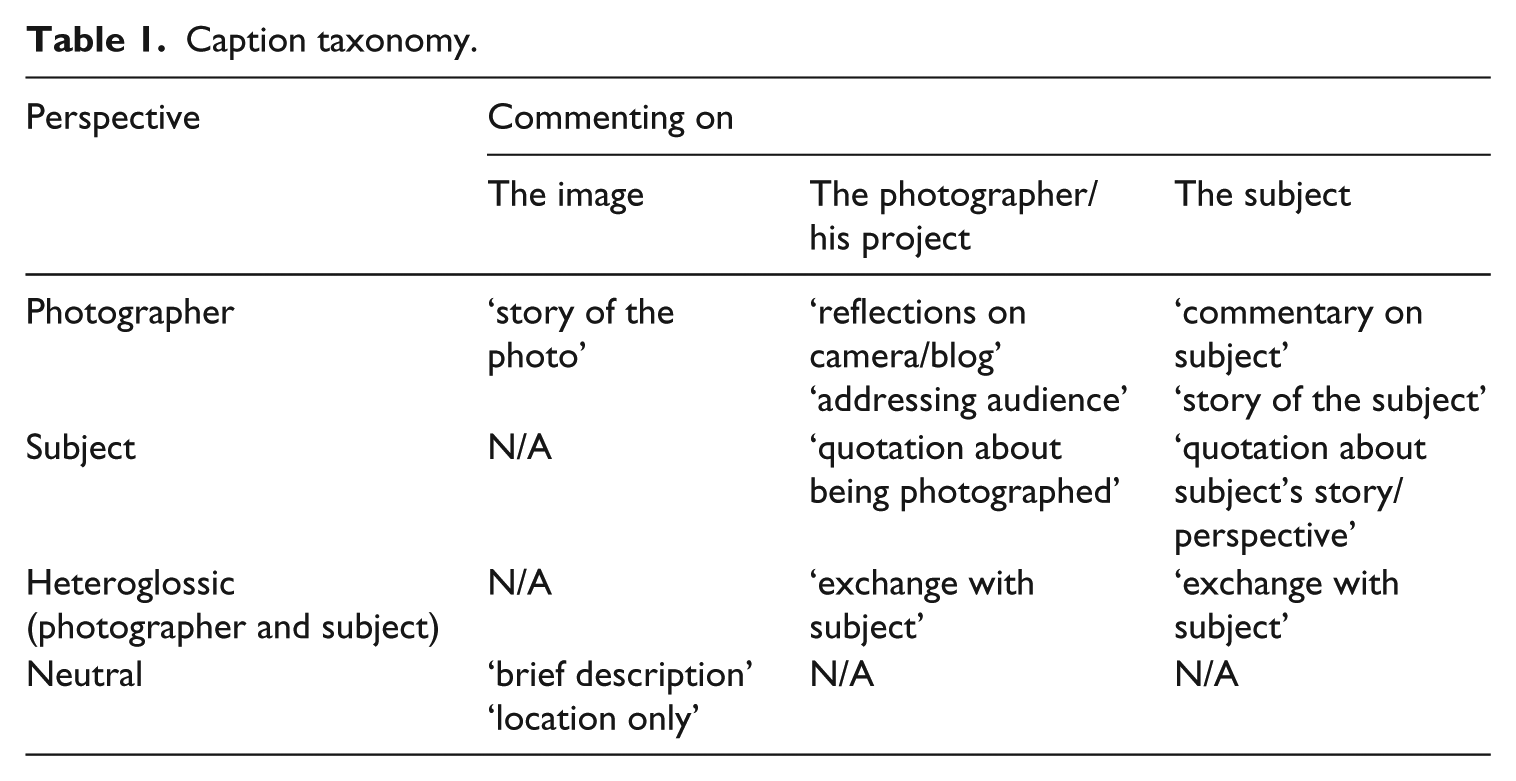
The categories were then situated within the taxonomy in Table 1, which indicates the various voices/perspectives and the subjects they discuss. In addition to the captions, the analysis noted evidence of Stanton’s self-identification.
Caption taxonomy.
Analysis
2011
There were 567 photos posted in 2011. The first photo on the Facebook feed is dated 10 January 2011 and features several kids, with a caption explaining it was taken in a McDonald’s in Queens, and that in the scramble to get in the photo, ‘There was a lot of screaming. $1000 in cash was pulled out of a sock. The cops were called. Everyone in this picture was escorted out two minutes later’. This is an example of a caption telling the story of the photo – what was involved in taking it or what happened leading up to it. Other captions contained Stanton’s thoughts about what the person was doing, his experience asking for permission to take the photo, his reflections on the image or his blog, a short exchange with the subject, or just a title.
Stanton’s commentary accounted for nearly 30 percent of captions, as in this example: ‘I’m always interested in the mannerisms, gestures, and attitudes that adolescents adopt in their attempts to leapfrog into adulthood’ (8 December 2011). Some commentary was more general: ‘New York City provides a reason to be optimistic./It shows that the world can live together in one place’ (26 December 2011). The second-most common type of caption in this first year was a brief title or description. This type of caption was generally a factual description of the number of people, or what they were doing, with no commentary from the photographer. The next most common category, 13 percent of posts, was captions that told the story of how he got the photograph, as here: ‘I was photographing in Washington Square when a Frenchman tapped me on the shoulder, pointed across the park, and said: “Marriage! Marriage!”’ (27 August 2011). The fourth-most common category, accounting for 11 percent of posts in 2011, was Stanton’s reflections on the quality of the photograph, as here: ‘Looks like there was a bit of fog on the lens unfortunately, but something about this woman, combined with this scene, I find enchanting’ (26 January 2011). In other posts, he reflected on his experience maintaining HONY: ‘When I first started HONY, I had a lot of ordinary, everyday worker portraits./But then the demand for children, old ladies, and eccentrics just kept growing. I guess you could say I kind of “sold out”’ (21 December 2011).
Quotes from the subject alone were only used as captions in 5 percent of his posts, and exchanges with the subject were just slightly more common, used in 7 percent of posts. Some of the quotations at this stage were of the photographer speaking to the subject. Those from the subject were often about the photographer and the experience of having their picture taken.
Two percent of posts told the story of the subject, as here: ‘This is Noah. He lives in Harlem. He’s retired now, but he’s looking to get into television and modeling’ (24 March 2011). As Stanton posted more photos, the stories got longer, although often they were accompanied by his opinion, or an explanation of how he encountered them or convinced them to allow him to take their photograph. Even when the caption was about the subject, the photographer’s experience seemed to feature centrally in it, as here:
This is RJ. I liked how he looked with his owner’s tattooed hands wrapped around him. The lady kept saying ‘RJ is famous, he has his own website’. I was already 50 ft down the sidewalk when I realized she had said the dog had a website. So I went back. http://www.jodihead.com/rjandfriends.html. (28 March 2011)
2012
Stanton posted 2019 photos in 2012. The captions followed the same trends as in the first year, although there was an increase in the number of captions that were stand-alone quotes from subjects and exchanges with subjects, particularly later in the year, and in the number of captions that merely stated the location. Stanton remained central to the posts – he frequently inserted his own story or comments after quotations.
The portion of captions featuring only quotes from subjects doubled, to 10 percent, as did captions featuring exchanges, to 12 percent, and these numbers grew over the course of the year. Although Stanton often quoted exchanges with subjects, many exchanges were still about the experience of being photographed, as here: ‘“May I take your photo?”/“Is it because I look like an alien?”/“… yes.” – at Lower East Side’ (1 March 2012). There were some captions that revealed details about the subjects’ lives or experiences. A common caption used that year was an exchange with couples, in which Stanton asked each partner their favorite thing about the other, as here: ‘“What’s your favorite thing about her?” “She’s sensitive. I always say she’s like a flower, you have to be delicate because she’s easily ruffled.” “What’s your favorite thing about him?” “He doesn’t take ‘no’ for an answer”’ (20 April 2012). This type of caption appeared often in the following years. Stanton’s commentary still accounted for 30 percent of captions, but brief titles dropped to 13 percent. Some commentary was about the subject of the photograph, and some more broadly about the city: ‘One thing I love about New York is that you pass by all these people with ultra-modern clothing and haircuts, then turn the corner and see someone who looks like he just stepped out of the Ancient World’ (23 April 2012).
Captions relating the story of the photo remained about the same, at 13 percent, as in this example: ‘Noticed this guy doing an epic curved handstand on top of a picnic table. I said: “Can you do that anywhere?”’ (10 March 2012). Captions featuring only the location grew from 2 percent the previous year to 10 percent in 2012. Reflections on the experience of maintaining the blog, or photography in general, dropped from 11 to 3 percent of captions. As HONY grew in popularity in its second year, there was an increase in self-referential posts. Even exchanges with subjects were often about his blog, or subjects recognizing him, as here: ‘One thing that’s been really neat for me lately is seeing the diversity of people who have heard of HONY. Two months ago, it was mostly teens and college kids. Today it was this guy’ (4 May 2012).
At this point, the majority of captions were still focused primarily on Stanton’s perspective – how difficult the photo was to get, what he had to ask or say to the subject to get them to cooperate, his commentary on the subject, the neighborhood, some social issue or event, or the practice of photography, the process of finding interesting subjects, or the status of his blog/feed. Other captions share the photographer’s view of the subject, or the issue or situation he feels the picture illustrates.
On 18 October 2012, he posted a photograph with a caption explaining that it was a self-portrait of a woman he had photographed earlier that day and telling her story about the abuse she received online in response to the self-portrait. The following day he posted the photo he had taken of her with further commentary about the incident. Later that month, he posted a photo of himself with the woman and her mother in the green room on ‘The Today Show’ and another of the girl and her mother together. This was the first example of Stanton’s posts having an observable effect on the lives of subjects after the photograph was taken and posted on his feed.
In November 2012, Stanton posted several photographs of Hurricane Sandy recovery efforts, with captions telling the story of the volunteers. On 11 November 2012, Stanton posted a message to his audience explaining a fundraising effort involving HONY and Tumblr. This new category of captions, which promotes a particular cause, accounted for a small portion of the posts, but nonetheless indicates an important shift in Stanton using the feed for advocacy. In December 2012, he visited Istanbul, Turkey, and Tehran, Iran, photographing people there on the street much as he did in New York.
The increasing emphasis on the stories of the subjects also reveals more about their diversity in terms of employment, socioeconomic level, relationship status, country of origin, childhood experiences, and so on. He captures food service workers, artists, bankers, professors, students, social workers, homeless people, addicts, children, and others. While in the early years of the feed there was evident diversity on the basis of the physical characteristics of the subjects, or their dress, activity, or location, the additional information about their personal lives reveals a greater and deeper diversity than was apparent before.
2013
Stanton posted 1415 photos in 2013. The two most common types of captions in 2013 were those featuring an exchange between the subject and the photographer, which accounted for 38 percent of posts, and quotes alone, which accounted for 32 percent. Over the course of the year, the captions shifted such that almost all were in these two categories. About 10 percent of posts had captions naming only the location, meaning that in a combined 80 percent of posts, captions did not privilege the photographer’s perspective. Commentary captions were down to 7 percent, brief titles or descriptions to 6 percent, and stories about how the photographer got the image were less than 6 percent.
Early in 2013, Stanton promoted a YMCA (Young Men’s Christian Association) fundraiser, encouraging his audience to contribute, sometimes posting photos of children at the YMCA. In April 2013, he posted 41 photos from Boston following the bombing of the Boston Marathon. A few months later, after posting the photo of a man with a caption of an exchange in which he talked about his adopted daughter and hopes to adopt another, Stanton encouraged his audience to contribute to a fund to help the man adopt the second child. Around Thanksgiving, he offered to connect people in his audience so they could celebrate the holiday together.
In February 2013, Stanton described himself as a ‘street photographer’ in a caption. Later that month, he was awarded a Webby for ‘People’s Voice’ and ‘Best Use of Photography’. The next month, May 2013, he posted a link to a November 2012 TEDx talk he gave at Columbia College, in which he explained the value of sharing people’s stories that do not commonly appear in the mainstream media. In November, he shared a link to a New York Times story about HONY, in which the author described Stanton as ‘a hybrid of interviewer, photographer and eager chronicler of street life’ (Bosman, 2013, November 6). In the article, Stanton was quoted saying, ‘there’s a comfort, an affirmation, a validation in being exposed to people with similar problems’ (Bosman, 2013).
2014
Stanton posted 1498 photos in 2014. By 2014, more than half the captions on posts featured only quotations from the subjects, while another 33 percent of captions were exchanges between the subject and the photographer. No other category amounted to more than 3 percent of captions. Also that year, a new style of post appeared: several multi-part portraits of the same subject or subjects, whose story was told over several posts, each with a paragraph of quotations from the subject.
In August 2014, Stanton partnered with the United Nations, posting on Facebook, ‘The point of the trip is not to “say” anything about the world. But rather to visit some faraway places, and listen to as many people as possible’ (Stanton, 2016). From August to October, he posted 263 photos of people in Iraq, Jordan, Zaatari Refugee Camp, Democratic Republic of Congo, Kenya, Uganda, South Sudan, Internally Displaced Persons Site in South Sudan, Ukraine, India, Nepal, Vietnam, Mexico, and Jerusalem, using the same types of captions that had become standard for the feed by that time: stand-alone quotations or exchanges with the subjects of the photos.
2015–2016
No coding of captions was done for these years because the posts had become standard – the subject looking at the camera accompanied by a single quotation from the subject, with no question from the interview or other element from the interviewer’s perspective. The quotations range from just a few words to an entire paragraph. In the first 3 years of the feed, subjects’ quotations were mostly limited to one sentence, but in these years, they are often a short paragraph, and sometimes Stanton posts a series of the same subject. The subjects are generally on the street, outside their places of employment or homes, walking to work or on the subway, in parks or cafés. The captions are about their hopes and dreams, their fears and failures, their frustrations and challenges. They are often intensely personal, about family or romantic relationships, work and self-improvement, or struggles with addiction, mental illness, immigration, parenthood, starting businesses, or juggling multiple jobs. The posts show a broad range of emotions and life experiences.
In 2015, Stanton made a trip to document the lives of Syrian refugees at a time when the issue of refugee settlement in the United States became contentious, often associated in the news media with the risk of terrorist attacks. In 2016, the feed featured a series of photographs and posts about inmates in a New York state penitentiary. That same year, Stanton described himself as a journalist in an ‘open letter’ to a presidential candidate he shared on the HONY Facebook page, and following the election, he posted a series of photos from Macomb County, a suburb of Detroit where a Republican candidate won the majority vote for the first time in 30 years – although Stanton noted he did not ask about politics.
Figure 1 indicates the portion of captions from each perspective over time, showing the clear evolution from mostly photographer-centric to mostly subject-centric, and often heteroglossic, but almost never photographer-centric.
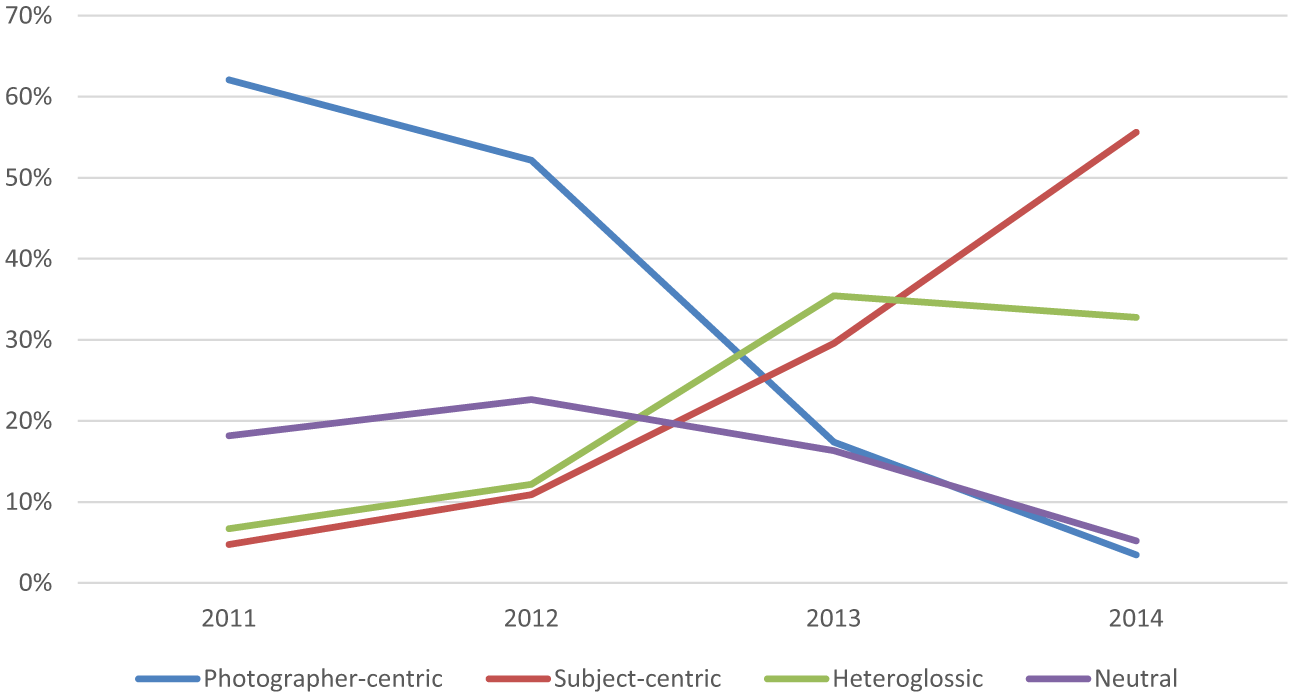
Perspective in captions.
Conclusion
Over the 6 years since he created the HONY feed, Stanton has evolved from a street photographer and blogger sharing his personal perspective into a professional journalist with an alternative approach and platform, providing his subjects a place to tell their stories. This evolution from amateur street photographer to professional demonstrates the potential for both citizen and professional journalists. Citizen journalism sites may grow into professional endeavors, and, more importantly, may satisfy the same public service ideals to which journalists aspire. Professional journalists may also look to Stanton’s model for ideas about how to successfully use social media to reach their audience, while remaining committed to serving the public.
Today, Stanton’s feed serves as a forum for its subjects, making them visible to the audience by sharing experiences, opinions, and concerns both monumental and mundane – in short, connecting them. The feed provides what the Hutchins and Knight commissions identified as a crucial role of a socially responsible press, ‘a representative picture of the constituents of society’ (Commission on Freedom of the Press, 1947) speaking about their hopes, dreams, and concerns, one that could foster ‘social empathy’ (Schudson, 2013). The subjects of his feed have included residents of New York, but also other American and international cities. They are diverse in terms of physical markers of identity, age, socioeconomic status, education, and other characteristics. His selection of subjects and stories reflects an awareness of groups whose perspectives and stories are not prominent in mainstream media, such as refugees and prisoners. This awareness demonstrates a sense of obligation to use the platform of his social media feed to serve the public, the large audience that is following, liking, and commenting on his photos.
Capturing the subjects looking into the camera creates a self-conscious portrayal, imbued with the sense that the subject is an active, willing participant in the creation of the image. The setting and often the poses of the subjects contribute to the authenticity of the portraits. The captions featuring quotations from the subjects further contribute to the impression that the subjects are speaking to the audience, sharing their stories. The quotations accompanying their photographs are about the joys and difficulties in their lives, observations about social issues, and a wide array of emotional states and stages of life, all uncommon in popular media. By sharing these stories and images, Stanton exposes his audience to each other, and the stories behind their faces.
While the style of photo has remained relatively consistent, the shift in Stanton’s approach is evident in the captions, which, for the first few years, primarily gave Stanton’s perspective rather than the subjects’. The captions concerned the photo from the photographer’s perspective – how difficult it was to get, what he had to ask or say to the subject to get them to cooperate – or offered the photographer’s commentary on the subject, on the neighborhood, on some social issue or event, or on the challenges of photography, the process of finding interesting subjects, or the status of his blog/feed. Even those that offered some part of the subject’s view included it only as part of an exchange with the photographer, or made the photographer’s perspective primary in the construction of the story. This approach, which made the photographer visible and familiar to the audience and allowed them to see his perspective, may have been useful in creating a following and growing his audience, but also made the subjects of the photos secondary.
Now the feed is more subject-centric, allowing the subjects and their stories or perspectives to stand alone. While Stanton maintains editorial control – he acts as a gatekeeper through the subjects he selects, the framing of the photograph, the questions he asks, and the quotation he selects – he has removed himself from the frame, not imposing his voice to provide context, commentary, or guidance. Certainly, Stanton still shapes the representation of the public constructed on HONY by selecting subjects and images and quotations, but he is no longer a visible interpreter or arbiter of meaning. There may be some validity to the critique that Stanton’s subjects are simply caricatures, as they appear in the feed (almost always) only once, with a quotation summarizing one concern or perspective, and a photograph capturing one moment of their lives. They are one-dimensional. But together, as a mass of thousands of photos and quotations, they show a diverse public with a myriad of experiences and identities. This kind of presentation has the potential to expand the imagined public and create social empathy and may do so more effectively than photos with commentary from the photographer.
Stanton’s self-identification as a journalist in 2016 indicates an evolution in his self-perception that may explain the greater concern for telling people’s stories rather than sharing his experiences as a street photographer. Stanton did not begin as a journalist: he did not work with a traditional journalism organization and its hierarchical structures and ethics codes, and he was not supervised by an editor who demanded accountability or provided guidance. He witnessed or experienced positive effects after posting images, and used his influence over the growing HONY audience to encourage donations to needy causes and to bring attention to vulnerable social groups. He developed an understanding of his roles and responsibilities that aligns with several values of the social responsibility theory of the press, and gradually came to realize how much power he had due to the size of his audience, and likely because of the audience’s response to his posts. According to his TEDx talk in 2013, he views himself as outside the mainstream press and identified several problems with news coverage that he believes HONY counters, indicating a strong sense of responsibility to the public. Whether his evolution was motivated by audience demands or a recognition on his part, or both, the effect has been to allow subjects to tell their stories in their own words.
Stanton is now employed full-time in the creation of the HONY feed, but remains distinct from professional journalists in that he lacks the hierarchical structure of news organizations, and does not support his work with advertising. He receives travel grants, and has generated revenue from sales of his books. The lack of hierarchy is a key distinction – one that journalists often cite in boundary work (Coddington, 2012) – and, while the distinctions between citizen and professional journalists are often blurry, Stanton is perhaps best described as an alternative journalist. The key is to measure his work by the same ethical standards used to judge professional journalists, and this analysis suggests that Stanton is fulfilling one of the social responsibilities journalists are posited to have. This is not to suggest that every amateur journalist who uses new media will develop a similar ethic or that guidance or training is not necessary or helpful. It does suggest that some amateurs using new media may be able to serve the public in the same way journalists have been expected to, which may be of comfort to those concerned about the public good and the demise of professional journalism. Of course, simply presenting a population to each other, in all their diversity and complexity, may be inadequate. Public journalism and social responsibility theory might suggest that empowerment happens when people have the capacity to make choices and act on them. The objectivity ideal in journalism may complicate any explicit effort on the part of journalists to empower citizens, but Stanton, like many citizen and alternative journalists, is not limited by objectivity; he is unabashedly an advocate for social causes, and his subjects.
Professional journalists, who often criticize citizen journalism and social media, may find possible solutions to economic challenges, as well as opportunities for growth in a model like Stanton’s. His effective use of social media to develop a large and loyal following provides a good example of how professionals might use those tools, while, importantly, still satisfying public service ideals. The packaging of content in images and captions that can be consumed and shared quickly and easily may offer ideas for different distribution methods on social media.
Adopting the trappings of a professional journalist is not necessary to fulfill the social responsibilities of the press, and it may be helpful to resist comparisons based on superficial characteristics. Alternative and citizen journalists should be judged on how well they satisfy ethical responsibilities, rather than their professionalism or adherence to journalistic routines and structures. In this regard, Stanton has succeeded. Further research is needed to determine how citizen journalists might be encouraged to adopt this sense of social responsibility. Additionally, research is needed to determine to what extent exposure to a more proportional and comprehensive representation of the diverse constituents of society influences the public’s perceptions and behaviors.
Footnotes
Funding
The author(s) received no financial support for the research, authorship, and/or publication of this article.