



Abstract
Amid the changing communication environment, there has been a growing interest from practitioners, policy makers, and scholars in harnessing the potential of hyperlocal news to strengthen communities and revitalize the condition for civic action. Hyperlocal news is often taken to signify a form of information provision by and for the community, leaving the boundaries, meaning, and assumed normative value of community unquestioned and uncontended. This article highlights the blind spots in the current research in hyperlocal news and argues that increasing ethnic diversity in local communities requires confronting the challenge of communication in and across difference. Citing empirical evidence from a small multiethnic city, this article argues that the concept of community is ultimately unproductive for positively thematizing the role of hyperlocal news in the context of ethnic diversity, and recasting hyperlocal news as a public discursive realm with differently situated publics points to new normative values and directions for research.
Keywords
Amid the changing communication environment, there has been a growing interest from practitioners, policy makers, and scholars alike in harnessing the potential of hyperlocal news to strengthen communities and revitalize the condition for civic action. A Pew report in 2014 identified 438 digital organizations in the United States that regularly produce locally oriented original news and found that these smaller, often nonprofit, news sites are the ‘biggest component of a growing US digital news sector’ (Jurkowitz, 2014). Often incorporating citizen contribution and adopting an intensive local gaze (Metzgar et al., 2011), this broad genre of news provision is sometimes seen as inheriting similar ethos and practice as community journalism and has gained attention for its promise in informing local citizens and promoting participation (Friedland et al., 2012; Williams et al., 2014). Yet, little consideration has been given the contested nature of community and diverse groups making up the collective life of a community, especially for communities comprising various ethnolinguistic layers. With growing diversity in the demographic makeup of communities around the world, ethnic heterogeneity and difference becomes an inevitable but often overlooked condition for discourse and collective action and indeed for communities located in space. Given that the emerging practice of hyperlocal news is likely to be most intimately connected with the individuals and institutions of the locality it is grounded in, it is important to interrogate the work it does to constitute this community and how it grasps the reality of ethnic diversity in its community.
Acknowledging that there is substantial vagueness around the definition and typology of hyperlocal news, this article uses this term to designate the genre of communication form to highlight the spatial and symbolic relationship that hyperlocal news bears with the practice and ideal of community and situate the research alongside prevailing discussions of in a topic area that is gaining traction within policy circles. As will be elaborated later, hyperlocal news is often taken to signify a form of information provision by and for the community, leaving the boundaries, meaning, and assumed normative value of community unquestioned and uncontended. Beginning with prevailing perspectives in hyperlocal news, I trace the blind spots in the current literature in its conflation of the local and community as well as its inattention to the ethnic composition of the community. Citing empirical evidence from a small multiethnic city, this article argues that the concept of community is ultimately unproductive for positively thematizing the role of hyperlocal news in the context of ethnic diversity, while theories of publics offer helpful tools for conceptualizing hyperlocal news as a discursive realm drawing together differently situated groups, and along with the shift to multiple publics rather than singular community, an ethic of inclusion is necessary to assess and guide geographically situated news initiatives in their civic work. This article recasts hyperlocal news as a public realm of discourse that has a stake in how social groups, identities, and interests in a locale appear to each other. This, in turn, calls for a research agenda that examines the extent to which the operation, linkages, and content of hyperlocal news provide the conditions for communicating across difference. This article suggests the utility of communication infrastructure theory (CIT), in conjunction with normative theory of the public sphere, in guiding the design and research of hyperlocal news for constructing place-based publics.
Hyperlocal news and its civic promise: Existing research and blind spots
From individually operated blogs to foundation-supported professional journalism, the practice of hyperlocal news varies along many dimensions, including journalistic form, geographical scale, organizational capacity, and so on. Rather than dwelling on its typology, the term ‘hyperlocal’ is used as a metonym to signify the focal tensions around its relationship with the community and its civic function. The definition of hyperlocal news by Metzgar et al. (2011), formulated based on review of extant research and emerging practices, helps structure the parameters of these tensions. According to these authors, hyperlocal news are (1) geographically based, (2) community-oriented, (3) original news reporting organizations indigenous to the web, intended to (4) fill perceived gap in coverage of an issue or region and (5) to promote civic engagement (Metzgar et al., 2011: 775, emphasis added). These five aspects both capture important components in the conception of hyperlocal news and imply the assumptions entailed in that conception. In particular, as this article will argue, when the civic outcomes of hyperlocal news (5) are what is at stake, assumptions about its relationship with the geographically based community (1 and 2) need to be interrogated.
To date, prevailing perspectives on the civic value of hyperlocal news take the first and second aspects of the definition as given and focus on the third and fourth aspects as the axes of analysis, exploring the extent to which the technological and journalistic forms of hyperlocal news enable citizen engagement. The digital nature of hyperlocal news (3) has received specific attention as part of a larger conversation on digital forms of participation, location-based reporting, and citizen journalism platforms (Weiss, 2014). The emphasis can also be seen in such funding initiatives as Nesta UK’s hyperlocal innovation program and Knight Foundation’s support for mobile journalism prototypes. More broadly, the promises of hyperlocal news have been assessed in terms of the type of content and its civic value. Usually with traditional journalism as a yardstick, these studies assess the type of content generated through participatory means (Carpenter, 2010; Paulussen and D’heer, 2013) and the sourcing (St. John et al., 2013; Williams et al., 2014), in promoting informed citizenry and giving citizens voice. Some studies also show the capacity of hyperlocal news for traditional investigative journalism to monitor political institutions and empower citizens as partners in local decision making (Firmstone and Coleman, 2014; Williams et al., 2014). Although conclusions vary, the assumed mechanism is premised on the model of watchdog journalism and citizen participation, substantiated in hyperlocal’s enhanced capacity to create and consume hyperlocal content and facilitate engagement with local affairs and community formation through interaction online. Together, the emphasis is on informing, monitoring, and participation.
Glossed over in these discussions are the fundamental assumptions about the community – otherwise generally referred to as citizens or audiences – who the community constitutes and what vision of community is reflected as well as constructed. To begin with, ‘geographically based’ (1) and ‘community oriented’ (2) are taken to be referring to the same place-based unit and collection of individuals. While these terms implicitly acknowledge the persisting importance of place that underlies and distinguishes the work of hyperlocal news, this elision of distinction between local and community, or the identification of local with community, treats community as a given, a preexisting single entity, with limited recognition of the internal fragmentation that constitutes the locality. This is true even for studies that attempt to capture the different layers of the locality. For example, the hyperlink network study (Gordon and Johnson, 2010, 2012) undertaken by the Chicago-based Community News Matters initiative maps the connections across various mainstream and hyperlocal news sites in the local communication system, but missing from the selection of news sites are ethnically oriented, non-English, and minority media. Such absence was not discussed in the subsequent analysis as a methodological oversight. In depicting and assessing the flow of local information, then, what emerged was a semblance of local totality that, in fact, excludes significant subgroups and their communicative relationship with the local community.
An example that illustrates the importance of this neglect can be found in the different pictures painted by two research reports originating from the same locality. Research conducted by London School of Economics in the Harringay borough of London reveals a significant discrepancy between its White British residents and Turkish residents in awareness and use of Harringay Online, the local news and discussion website (Georgiou et al., 2016). In total, 91 percent of White British residents surveyed have heard of the website and 72 percent regularly check it, while only 11 percent of the Turkish residents are even aware of its existence. In contrast, another study on the efficacy of hyperlocal news that includes the same borough as a case study derives a more promising conclusion based on a survey that sampled primarily White British residents (Flouch and Harris, 2010). Citing survey results, they contend that the news forum improves neighborly relations and strengthens the capacity of collective action and a sense of community, neglecting the fact that the 21 percent of the area’s Turkish residents are by and large disconnected from this collectivity. Given that the content of Harringay Online is primarily generated by user contributions and those who participate in forum discussions, it would be a better reflection of the perspectives and interests of a structurally determined group (e.g. those who speak English and has ties with the local place) than an image of the community that incorporates the voices of all groups that make up the community.
Such mismatch and negligence in representation has been well documented. In analyzing trade releases by local UK newspapers, Aldridge (2003) found that there was no indication that ‘the cities served by evening daily papers are typically multi-ethnic and multicultural’ (p. 493). A wealth of work on race and news has shown the under- or hegemonic representation of race in mainstream news, as a result of newsroom, market, and cultural dynamics (Heider, 2000). The repercussions of these issues are certainly profound, and many have engaged with ways to support diversity of news as well as critiques of their inadequacy (Glasser, 2014). Yet, mainstream news does not typically operate with the explicit claim and goal of constructing ‘community’. And often with the capacity for digital peer production in hyperlocal news, it is easy to assume an enhanced participatory potential without accounting for the disparity in participation. From a survey of 210 staff from 144 US-based hyperlocal sites demonstrated, 82 percent of the respondents identified as White or Anglo (Chadha, 2015). It is the combination of a drive to build community, the promise for community members to represent themselves, and the lack of reflection on who this process excludes that this article problematizes.
As the foregoing discussion begins to demonstrate, engagement with the civic potential hyperlocal news so far has paid scant attention to the heterogeneous ethnic groups residing in the locality, who may have different levels of access to and representation in the hyperlocal news. To be sure, Hess (2013) and Ali (2016) stand out in their call to problematize and clarify the meaning and work of ‘local’ in local news. Employing the concepts of geo-social media and regionalism, respectively, both argue that the local is more productively seen as a combination of the geographical unit as well as the constellation of social relations whose boundaries may extend the spatial confines of the local, such that the local is based in place but not bound by it. The main tension these authors grapple with are oriented around the definition of local amid changing configurations of technology, audience, and market. While I align with and signal to these works in my subsequent problematization and deconstruction of community, this article has the more pointed goal of clarifying the role of hyperlocal news for local democratic communication in the context of ethnic diversity. To do that, I contrast two ways of conceptualizing this relationship: (1) community, to which the theory and practice of local journalism has always had a close relationship and has been embedded in the definition of the hyperlocal news, and (2) publics, which constitute a strand of political theory on its own terms but have also been applied consistently to the practice of journalism. Citing empirical evidence from a small multiethnic city, I highlight how reality of ethnic diversity renders the concept of community ultimately unproductive for the civic purpose of hyperlocal news, and an understanding of hyperlocal news as a public discursive realm drawing together differently situated groups points to new normative values and directions for research.
Community: Function, ideal, and new realities
The relationship between journalism and community has a long history and distinguished place in the work of the Chicago School. Foundational work by Janowitz (1967 [1952]) established the role of community press as a social mechanism for strengthening ‘community ties’ and integrating an individual into the local social structure. Since then, the research trajectory has pursued the cluster of relationships between local news, community integration, and democracy (e.g. Finnegan and Viswanath, 1988; Friedland and McLeod, 1999; Shah et al., 2001). The importance of community news is attributed to the two processes it can (and should) facilitate: (1) revealing the social structure to the residents and (2) cultivating a collective sense of belonging and a cohesive set of identities by providing discursive resources for the symbolic construction of community (Janowitz, 1967 [1952]; Lowrey et al., 2008). As an exercise of civil society and self-governance, communities have developed, and correspond with, a set of structures, including political institutions as well as civic ones, such as neighborhood associations and community-based organizations. As a functional unit, then, the place-based community does signify an identifiable structure for action that requires revealing to the residents. The work of hyperlocal news gathers traction in part because social, political, and cultural institutions and processes are tied to localities and, as a rich body of sociological studies on neighborhood effects can attest to, are variable and distinctive from locale to locale (e.g. Sampson, 2012). However, as shall be discussed, multiethnic communities challenge the extent to which there is a uniform set of structure even within the local area, as well as the assumptions underlying how this functional unit should be self-governed. This is one way in which ethnic diversity challenges the conception of a singular or stable community.
Under the framework of community integration, the principal role of the community news was ‘to maintain local consensus through the emphasis on common values rather than on the solution of conflicting values’ (Janowitz, 1967 [1952]: 72). Such explicit rejection of conflict in community news in the 1950s has since been reconsidered, but a meta-analysis on literature pertaining to community and news media (Lowrey et al., 2008: 285) reveals that while some recognize the tension between pluralism and cohesion, the emphasis in a majority of the studies was placed on promoting consensus, ‘bringing readers together in a common cause’ and fostering collective identity. Here, one detects a normative value placed by the research literature on the ideal of community itself, such that cohesion becomes the primary variable of interest and a goal that should be pursued. Lowrey et al. (2008) ultimately argued that community news should value both pluralism and cohesiveness. In constructing a scale to measure the work of community news, they specified three main dimensions: revealing community structure, listening/pluralism, and leading/cohesiveness in problem solving. However, it is unclear whether such a scale indicates a cumulative progression, as community news can provide problem-solving capacity without listening and reflecting plural views.
Indeed, without resolving the tension between pluralism and cohesion, a premium on consensus often resonates with and underpins the image and practice of community news. Writing from the perspective of and for practitioners, Lauterer (2006: 46) argues that the practice of community news should affirm ‘a sense of community, a positive and intimate reflection of the sense of place, a stroke for our us-ness, our extended family-ness and our profound and interlocking connectedness’ (emphasis added). The emphasis on commonality is also reminiscent with the communitarian ethos that has supported the advancement of the public journalism movement in the 1990s, which also often works on the basis on convening communities (Coleman, 2000). Although not necessarily an outright rejection of cultural difference, this inclination toward the collective ‘we’ evades the process of how conflicting visions of the common good and different affective relationships with the community can and should be resolved. For example, absent from the 1952 study of Janowitz was an otherwise vibrant African American press in Chicago, and he justified this exclusion by arguing that the ethnic press served to orient its readers toward an African American community, while his research focused on a place-based community (Rosenberry, 2012). This assertion of the boundary of his ‘research area’ implicitly ejects an ethnically oriented sense of belonging from the social and symbolic boundaries of the local and raises the question of whether cohesion requires the subjugation of these identities.
These problematic notions of cohesion in community structure and norms may be concretized with an illustrative case. The city of Alhambra, a satellite city of Los Angeles County’s San Gabriel Valley, has seen tremendous demographic shifts over the years. In a few decades, the White Anglo majority has dwindled, and the present ethnic composition of the city is 53 percent Asian, 29 percent Latino, and 19 percent Anglos. As with many immigrant settlements, there exists a set of ethnic infrastructure consisting of business, media, civic, cultural, and religious organizations catering to the specific population (Logan et al., 2002; Ramakrishnan and Bloemraad, 2008). Research in Alhambra has found that residents from the three major ethnic groups are connected with different communication networks, with each group nominating a different set of local, regional, and ethnic media as top ways to stay on top of their living environment, as well as a different set of community organizations they are affiliated with (Chen et al., 2013). The ethnically Chinese residents, many of whom are first generation and live in linguistically isolated households, tend to exclusively consume Chinese-language newspapers and TV. Should a hyperlocal news be charged with revealing the community structure, it has to recognize fragmentation in the structure itself, as well as who it is revealing the structure to, if different cross sections of the community are disconnected in their discursive networks along ethnic lines.
In addition, the boundary of community, as a subjective locus of belonging, is highly porous and variable for different groups living in Alhambra. It is challenged by a transnational and multilocal sense of belonging (Cheng, 2005) for immigrants, where both physical ties and emotional ties with another place – often across national borders for immigrants – define the parameters of place. This can be reflected in how ethnic and immigration media narrate place and locality. A content analysis done by Lin and Song (2006) found that ethnic media in Los Angeles engaged little in local coverage and focused more heavily on stories taking place in the home country. Similarly, Cheng’s (2005) analysis of an immigrant newspaper in Canada revealed a construction of both Vancouver and Hong Kong as local and a locus of belonging. In addition to suggesting that the concept of local cannot be bound by geographical boundaries, multilocal or translocal relations and meanings challenge the very ideal of community. When the locus of subjective experience, tied to a sense of identity, is shared between multiple localities, questions of what imperative the place-based community has in enforcing a collective ‘we’ and when and how it can do this become vital. For example, should the hyperlocal news website cover stories on how Mexico-origin hometown associations mobilize for elections in the home country, because that is what ‘we’ care about?
The multiethnic city also experiences tension points that reflect how pressing issues of the community and visions of community may be constructed differently for ethnic groups residing in the same locality and how consensus about the collective interest requires much hard work. For example, in recent years, the city of Alhambra and the larger San Gabriel Valley region it is in has seen development efforts fueled by overseas Chinese capital. Redevelopment seems to especially touch the nerve of the primarily Caucasian ‘old timers’, as the construction of new condominiums is considered to attract even more Asian businesses and residents to the city. As an area has seen a considerable amount of submerged racial tension surrounding the changing face of the city, with spaces, architectures, and signages codified as ‘Asian’ (Cheng, 2010), this issue of development extends beyond a simple matter of overcrowding, traffic congestion, and property values. Similarly, on the surface, the debate around ‘monster houses’, which wealthy Chinese immigrants have been known to build in region, hinges on aesthetic objections and environmental concerns. But given Chinese immigrants are not alone in this practice, some have questioned whether the debate is more about ‘unneighborly houses’ or ‘unwelcome Chinese’ (Li, 1995). In these instances, ethnic differences in cultural practice and history in relation to community change underlie divergent understandings of community issue and notions of what is desirable. A ‘community’ website that does not provide ways for the layers of perspectives to be made known and discussed would have a hard time developing a legitimate consensus that represents a common good vision for the community.
As the brief example of Alhambra begins to demonstrate, the spatially situated community is a container for different identities, cultural affiliations, interests, and discursive networks that do not always intersect or cohere. Indeed, in any local community, sense of place is variable and individualized (Hess, 2013; Massey, 1994), depending on, for example, years residing in the area or social relationship with the area. Yet, the sense of incoherence and multiplicity does not always sit well with the concept of community underlying the practice of local journalism, and the process of immigration and movement, by its very definition, problematizes a singular conception of place. Especially for place-based communities located at small geographical scales, common interests and identifications may be too readily assumed. At the extreme end, groups perceived as threats within the community, such as Muslims (Pollock et al., 2005) and immigrants, are at constant risk of being marginalized and excluded. One needs to ask how cohesion and unity may be attained without replicating existing relations of power and without subjugating the relevance of certain perspectives and interests for the functioning of community. At the most fundamental level, this involves questioning what it means to make civic life go well in a place-based community, whether a blanket effort to inform and encourage participation is sufficient or whether the ideal should contain some recognition of the different groups, identities, and interests that constitute the local collectivity. Given its ‘community-oriented’ nature, hyperlocal news has a natural affinity with the practice of community news and has indeed been assessed for the ‘classic function’ it plays for community support (Rosenberry, 2010b). To be sure, the practice of hyperlocal news is not inherently one that tends toward or embraces consensus and cohesion, but without positively thematizing its relationship with a multiplicity of groups, identities, and belongings within the community, research cannot be directed to distill the conditions and processes that enable or constrain equitable participation, representation, and mutual understanding of difference. The taken-for-granted mechanism of community integration is one that leaves unarticulated the possibility of a plurality of values, identities, and interests. As the next section demonstrates, tapping into the normative theory of publics could provide a way to elucidate the role and mechanism for hyperlocal news to enable communication across differently situated groups.
Hyperlocal news and its publics: Toward an ethic of inclusion
In circumventing the unifying tendencies in the language of community and articulating an ethic for hyperlocal news, I turn to the theories of publics for a positive thematization of the relationship between difference and communication. This is a vast body of literature, but when placed in juxtaposition with community, publics signify the possibility of dealing with difference that rectifies the pursuit of cohesion in community. Public life, in contrast to community, requires engagement with and care for ‘the needs of strangers’ (Calhoun, 1998). Although this is commonly applied to mediated interconnections with social groups on a larger and more abstract scale, in contemporary communities composed of multiple ethnic groups that live side by side but do not always interact, familiarity and connection cannot be assumed either. In fact, when one examines closely the descriptions and prescriptions for publics, it becomes clear that a recognition of the multiethnic context of communities, such as the case of Alhambra discussed above, would necessitate an approach that makes viable the differently socially situated groups, interests, and claims. A normative requirement of publics, even on a local scale and within a place-based community, then, involves enabling meaningful communication across lines of difference, not just founded on unity and common interest, or relying on appeals of alleged similarity attributed to a shared locale. If public life at large requires recognition of different communities, the same should be said for small place-based communities that are increasingly containers for difference internally. Therefore, when a community is inherently made up of heterogeneous parts, the characterization of public – ‘a realm or realms of discourse and contestation within which both identities and interests are constituted’ (Calhoun, 1998: 20) – more productively describes the reality and requirement of communication.
Recent theories of publics have seen a considerable engagement with cultural diversity, inequality, and the role difference plays in participation, deliberation, and determination of collective interest (Fraser, 1992; Young, 1995). They can be drawn on to provide alternative lens in locating a normative value for the contested discursive realm that hyperlocal news is situated in. More so than a blanket call to participation, these theories contend with the inclusivity of voice in the public realm and the challenge of difference in the starting position of participants, in shaping both the opportunity to participate and legitimacy of voice (Couldry, 2010; Fraser, 1992). This model of the public begins with the understanding that a multiplicity of different identities and social perspectives exist and can take up valid positions within the public realm. A normative conception of how they should relate to each other calls for two things. First, it entails the recognition that difference in social perspectives begins from a specific set of experiences and assumptions that define a social position but does not dictate the conclusions drawn (Young, 2000). Difference is affirmed but not ossified and can and should become ‘mutually comprehensible and politically sustainable’ (Husband, 1998: 136). This is what Glasser (2014) has in mind when he identifies the need to move beyond the ‘tolerance of difference’ and closer to a deeper ‘insight into difference’. Seen this way, the imperative of communication shifts from cohesion to a sense of mutual obligation and reciprocity in understanding that does not aim at reducing differences or essentializing them. Second, and relatedly, such comprehension requires linkages that build connections between different publics (Young, 2000: 53). This first of all recognizes and legitimizes a system of communication for minority groups to articulate their needs and interests. At the same time, the separate spheres require channels for cross-cutting exchange to keep differently situated social perspectives from becoming mutually unintelligible. Ultimately, the premium is placed on capacity of individuals to participate in a realm of discourses through which their perspectives – interests as well as identities – can be made known and rendered acceptable to others (Glasser et al., 2009).
Distilled from these is an ethic of inclusion that treats difference as a basic condition of public life, the articulation and understanding of which is a mutual obligation, and a collective project that requires equal opportunities of participation. To be sure, this is not a vision of the public that is free-floating and disassociated from place. Inclusion and mutual understanding are necessary and possible precisely because place-specific institutions, issues, and social relations motivate such effort. At the level of the place-based community, inclusion would mean the social groups, identities, and interests are part of the discursive repertoire that make up the various images and norms that constitute a place. Rather than community news or local news, hyperlocal news is recast as a component of the public discursive realm – a component of the local communication system surrounding the formation and constitution of different groups of participants, identities, and interests – that can express and exercise normative values of democracy. Ultimately, this article argues that those who are invested in the potential of hyperlocal news to strengthen local democracy should engage with the notion of inclusion as normative values of the public sphere and to disentangle the relationship between hyperlocal news and its community, as well as the assumptions embedded in these relationships.
Translating normative values into practice
While normative theory is often associated with the realm of critique, it offers criteria against which to evaluate current practices, and some have applied it purposively to extract specific implications for practice (Dreher, 2009; Haas and Steiner, 2001). Making precise a set of normative values can clarify the ideal and apply it to assess and guide the practice of hyperlocal news. To further illustrate how such application can be performed, I introduce the Communication Infrastructure Theory (CIT) as a parallel to normative theories. CIT aligns with normative theories in its change orientation and offers a theoretically driven but applied framework for designing the research and practice of hyperlocal news to approach the ethic of inclusion. As a communication theory that is explicitly rooted in place, it is sensitive to variations in social and physical environment in each local context and, therefore, particularly germane to the discussion on hyperlocal news. In its simplest formulation, CIT advances a storytelling network perspective in understanding the local public sphere, by proposing that the activation and integration of communication agents operating at multiple levels offer the most robust conditions for discourse and civic engagement. Correspondingly, CIT provides grounded and empirical guidance in assessing conditions of existing communication agents, the connection among them, and the connection they have with their publics.
I use the hyperlocal news site of Alhambra Source (AS), established in 2009 in the city discussed above, as an example of a hyperlocal discursive realm that employs CIT as its guiding framework to enable the practice of bridging different place-based publics and rendering difference comprehensible. The basic propositions of CIT that are relevant to the present case are (1) storytelling networks, consisting of communicative agents at multiple levels (primarily media, local organizations, and residents), operate in any given locality; (2) multiple storytelling networks may be present depending on the social, cultural, and structural characteristics of the local context, which can be identified from the ground up; and (3) an integrated storytelling network, not just one with many communicative agents, enhances the capacity for the narrative and discursive construction of issues and action strategies. A CIT perspective, therefore, highlights the need to activate and construct linkages among different levels of storytelling agents as well as among different storytelling networks.
Developed by university researchers as a response to empirical findings of low civic engagement in the area and lack of local reporting (Chen et al., 2012), the AS was guided by CIT in its design in three primary ways, which map onto the requirements of positioning the hyperlocal as discursive realm invoking multiple publics. To begin with, CIT suggests the importance of identifying and unmasking the existing storytelling networks operating in the local area, which are geo-ethnically specific (Kim et al., 2006). This is to say that different groups residing in the same geographical area, or the same ethnolinguistic group across different geographical areas, may not have the same set of communication resources. To achieve this understanding, a multilingual survey was done with the local population to understand their communication practices, supplemented by database exploration and fieldwork to identify newspapers, brochures, micro-media, and organizations that operate in the local area. Census data also lent an overall understanding of the ethnolinguistic, immigration, and socioeconomic stratifications of the local area. Together, these approaches revealed the presence of ethnically segmented storytelling networks, as well as enabled identification of the primary agents in each storytelling network. Such CIT-guided assessment of the local communication environment is fundamental to locating differently situated groups and the corresponding discursive networks that make up the local arena (Chen et al., 2012).
Second, activation of micro- and meso-level storytellers that reflect the differently situated groups provides a starting point for reflecting plural perspectives and rendering difference comprehensible. Content generation on AS is supported by community contributors, who largely reflect the ethnic composition of Alhambra (although many are bilingual, new immigrant and non-English speakers are missing from this group). These community members, micro-level storytellers in the CIT formulation, are encouraged to feature individual experiences in cross-cultural interactions and divide in immigration generations and negotiations of identity. In addition, volunteers monitor stories first covered by ethnic media and local organizations and repost them on the AS, translating them from other languages where necessary. A constellation of local organizations serving different populations and issues has posted announcements and becomes story sources on AS. Examples of stories thus generated include one about moving to China as an American-born Chinese, achievement gap between Latino and Asian students in local schools, navigating cultural differences in local ethnic restaurants, and the impact of rising price of green onions (a staple in Asian cooking) in the region. These stories enable difference to emerge and potentially be understood, instead of bracketed or submerged under a generic image of the collective ‘we’.
Finally, but perhaps most importantly, a key focus of CIT is on the integratedness of storytelling agents. To that effect, the AS has sought to connect with local organizations, regional media, and ethnic media. On the formal end, partnerships with ethnic media organizations to collaborate on reporting have been initiated. Most recently, AS has opened a Wechat account to connect ethnic Chinese residents with its content in a language and platform they prefer. Between AS and organizations, linkages have taken the form of co-hosting events, such as multilingual forums discussing issues of health and education with immigrant-serving organization Asian American Advancing Justice. It is through these linkages and mutual connectivity that AS can draw together different publics and extend the boundary of inclusion for the storytelling network it is part of.
Table 1 summarizes key aspects of how the ethic of inclusion translates into practice in the AS, as guided by the CIT framework. This summary is not meant to codify a protocol but to highlight illustrative examples of this translation process that can spark adaptation and extension. Notably, each of the normative requirements translates into a verb under CIT, denoting possible action and change that a hyperlocal news operation can perform.
Mapping normative values onto practice via the CIT framework.

CIT: communication infrastructure theory; AS: Alhambra Source.
Correspondingly, a research agenda that seeks to understand the present landscape of hyperlocal news through the lens of publics means assessing emerging practices in terms of their relationship with different publics and the scope of inclusion and to identify concrete possibilities for change. It means a different set of questions than the current research agenda exploring the information provision and citizen mobilization mechanisms of hyperlocal news, questions that focus on who participates, what insight into difference is enabled, what linkages are built, and how this boundary of inclusion is drawn. In the case of AS, evaluation of its work consciously included inquiries along these lines. I provide a few examples of the evaluation work, not to report how successful AS has been per se but to illustrate the type of research undertaken. Table 2 presents a summary of questions and methods that can be instructive for research into the relationship between hyperlocal news and its various place-based publics.
Questions and methods that may guide research of hyperlocal news as a public discursive realm.
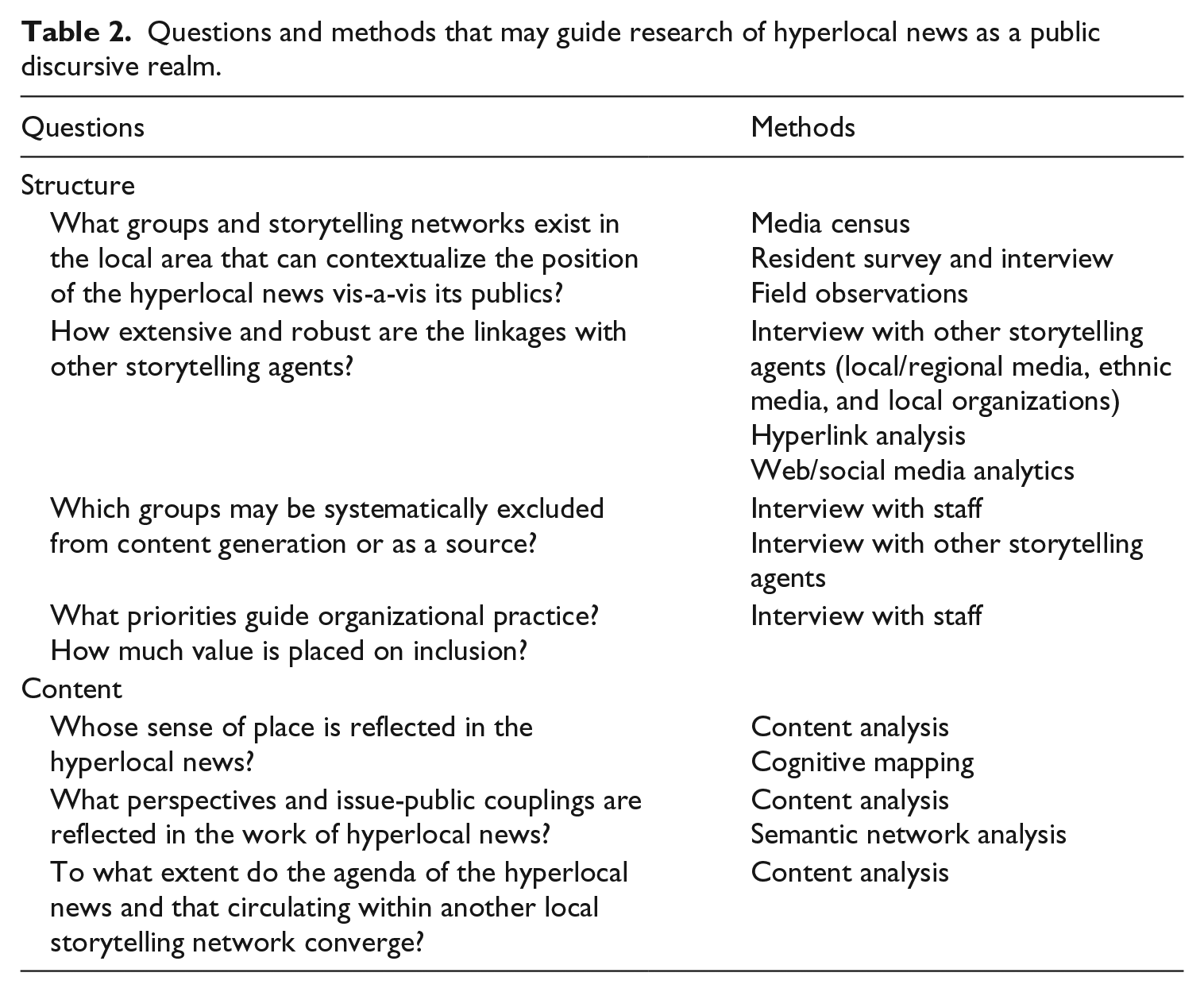
To understand the extent and nature of cross-cutting linkages, several methods and indicators were used. This is important because while reader surveys easily demonstrate who the audience constitutes, the different publics are not limited to direct interactions with the hyperlocal site itself, especially linguistically isolated populations who have a preferred set of communication resources. Interviews with meso-level storytellers – ethnic media and other local/regional media producers – about their perceptions and relationship with AS revealed that some have started relying on AS as a story source. Ethnic Chinese media and local media from adjacent areas, in particular, monitor the reporting of AS for news tips and story ideas, giving the possibility of content produced by AS feeding back to groups who otherwise may not interact with AS directly (Chen et al., 2017). Google analytics also showed that several ethnic media and web forums are driving traffic to AS, suggesting a degree of mutual connectivity. Hyperlink analysis and metrics from other AS-operated outfits such as Wechat would also constitute evidence of how much different publics and discourses have the opportunity to converge in the same system of communication.
Analysis of the content produced by AS is still in its planning stages, but several questions and analytical strategies have been identified to assess how perspectives, issues, and interest of differently situated groups are reflected. At its simplest, content analysis can be directed at answering questions such as how often are stories cross-posted from ethnic and local media, and whose voices are heard or neglected as a source or as a writer. Semantic network analysis can be added to identify the co-occurrence of issues and ethnic groups. Media monitoring of other meso-level storytellers also allows for the comparison of their news agendas with the hyperlocal news operation. Notably, given the importance of place in the work of hyperlocal news, the combination of cognitive mapping (Matei et al., 2001) and content analysis has been identified as an analytical strategy. Comparison between cognitive maps by different groups and the frequency of coverage of local places can serve as indication of how different relationships with place are reflected and constructed by hyperlocal news.
Broadly speaking, research may probe structure and content to understand the role of hyperlocal news in relationship to its publics and the work it does to define the boundary of inclusion.
Conclusion
This article has argued for an alternative lens to examine the civic work of hyperlocal news by highlighting how increasing ethnic diversity requires seeing local communities as contested and heterogeneous political space. Recasting hyperlocal news as having different publics would prompt research in other directions, such as how diverse the audience is, how strong linkages with media and community organizations serving different ethnic groups are, what social perspectives are reflected and neglected, and what practices could facilitate more inclusive communication between different groups.
Ultimately, tracing the boundary of inclusion means discerning who, what identities, and what interests are part of the discursive repertoire that make up the community. The focus on both hyperlocal news and its relationship with its publics, then, requires and permits one to approach with care the empirical context of a place-based community and the increasingly diverse cultures and ethnicities that it comprises. Such understanding of context immediately dispels the simple notion of community as an entity with one single collective action orientation and unveil the unevenness with which groups within the community relates with the place, the issues, and the vision of community. It is only when equipped with these understandings that the boundary of inclusion in hyperlocal news may be redrawn.
Footnotes
Acknowledgements
The author thanks the Alhambra Source and USC Metamorphosis Project, Professor Sandra Ball-Rokeach, and Professor Mike Ananny for their support and feedback. Comments by two anonymous reviewers greatly helped to improve an earlier version of this article.
Funding
The author(s) received no financial support for the research, authorship, and/or publication of this article.