




Abstract
This study seeks to give a timely perspective on understanding how business news covers corporate social responsibility in light of heavy criticism financial journalists have faced since the latest economic depression in the United States. Building upon previous research and using agenda setting, framing, and agenda building as a theoretical base, a content analysis was conducted to examine how business news portrays corporate social responsibility and the tone used in coverage both before and after the economic crisis. Results indicated that business journalists are now taking a more neutral approach. Additionally, corporate sources did not lead to an increased use of a positive tone in post-crisis coverage, which could mean they are less likely to have an agenda-building influence over business news since the economic downturn.
Introduction
The economic downturn, spanning from December 2007 to June 2009 (Rampell, 2010), has made public attention to business news, defined as the practice of ‘gathering, selecting, packaging and presenting information on various aspects of the economy’ (Lindén, 2013: 128), particularly salient (Elliot, 2011; Lewis, 2010). According to the Pew Research Center (2014), the financial crisis is ranked as the leading news story in the United States 4 years running. It also took first or second place as a top story of interest 41 of the 52 weeks in 2011, and 40 percent of Americans surveyed reported paying close attention to the topic (Pew Research Center, 2014). However, with this increased attention has come a lot of criticism, mainly for not getting the public’s attention sooner by forecasting the arrival of an economic crisis of this magnitude (Starkman, 2014).
In his book, The Watchdog That Didn’t Bark, Starkman (2014) claimed that US business news publications failed to investigate the Wall Street banks and mortgage lenders responsible for sparking the financial crisis. More specifically, following Lehman’s bankruptcy in 2008, while most people were debating the causes of the crisis, ‘a smaller fight broke out over the business press’s role’ (Starkman, 2014: 2). The issue did not gain public attention until 2009 when a video went viral of popular political comedian Jon Stewart saying, ‘Business journalism presents itself as providing wall-to-wall, 24/7 coverage of Wall Street but somehow managed to miss the most important thing ever to happen on that beat’ (Starkman, 2014: 3). Starkman (2014) offered reasons why business journalists might have missed the warning signs, including financial pressures; however, research on business news provides an alternative explanation.
In comparison with general newspapers (even ones with a business section), whose responsibility is first and foremost to the overall public interest (Moon and Hyun, 2009), business-specific newspapers are intended for corporate audiences (Davis, 2000; Do, 2013; Hollified, 1997). More specifically, the goal of business publications is to provide business leaders with management knowledge and information about how their businesses should behave (Abrahamson and Fairchild, 1999; Chen and Meindl, 1991; Mazza and Alvarez, 2000; Pollock and Rindova, 2003; Westphal et al., 1997). As a result, business media often ascribe meaning to corporate activities and events, causing them to take on active roles as agenda setters, legitimizing corporate behavior (Carroll, 2010; Carroll and McCombs, 2003; Vaara and Tienari, 2002), but this has also led to attempts from businesses to control how they are portrayed in business news (Davis, 2000; Grümberg and Pallas, 2013).
The latest financial crisis, famously known for costing 23 million Americans their jobs and 10 million their homes through foreclosures (Starkman, 2014), also caused the meltdown of many companies’ reputations, which gained a lot of attention from mass media (Eisenegger and Kunstle, 2011). This expanding visibility is of particular importance to companies looking to manage their reputations, as well as how consumers and stakeholders perceive them (Carroll and McCombs, 2012). One of the ways businesses create strong relationships with their publics and enhance their corporate reputations is through corporate social responsibility communication or communicating their good deeds to the public (Ihlen et al., 2011). More specifically, the World Business Council for Sustainable Development defines corporate social responsibility (CSR) as ‘the commitment of business to contribute to sustainable economic development, working with employees, their families, the local community, and society at large to improve their quality of life’ (Dahlsrud, 2006: 7).
Organizations communicate CSR, usually through press releases, to journalists in hopes to influence how they write their stories (Maat and de Jong, 2012). Ultimately, the goal is to influence news coverage in a positive direction, as to foster or enhance a business’ reputation and create a more favorable opinion of the corporation in the eyes of stakeholders and the public. The few studies that have examined mass media coverage of CSR (e.g. Grafström and Windell, 2011; Tang, 2012; Tench et al., 2007; Zhang and Swanson, 2006) have found that these efforts work as most journalists portray CSR in a positive way. Furthermore, corporate sources may have even better luck getting business media to publish their CSR efforts positively because research (e.g. Davis, 2000; Grümberg and Pallas, 2013) has discovered that businesses have more control over how they are portrayed in business news.
However, the purpose of this study was to see if this is still happening since coming under fire in light of the economic downturn. A content analysis comparing how CSR has been portrayed by major business news outlets, like The Wall Street Journal, Bloomberg, Bloomberg Businessweek, and Forbes, as well as general newspapers with business sections (e.g. The New York Times and The Washington Post) before and after the financial crisis could give insight into whether business journalists are nourishing corporate reputations or if they are being more watchful since receiving criticism. Using the theoretical base of agenda setting, framing, and agenda building, this study aimed to (1) examine how business outlets depict CSR; (2) see whether CSR is being portrayed in a positive, neutral, or negative way; and (3) find out whether using corporate sources leads to an increased use of a positive tone in business news coverage of CSR. It was ultimately anticipated that business news outlets would take a more neutral stance and that outside sources would have less of an impact on the tone used in these post-crisis times.
Theoretical framework
Agenda-setting theory and framing state that mass media can impact public opinion (McCombs and Shaw, 1972). More specifically, agenda setting is broken up into two parts. The first level of agenda setting argues that the media influence what topics the public are thinking about; therefore, mass media coverage does not necessarily reflect reality but create one because the more a topic is covered in the media, the higher its salience will be (Weaver, 1984). Second-level agenda setting then states that the media can influence how people think about these topics. Furthermore, by highlighting certain aspects of a topic and downplaying or ignoring others, framing posits that mass media can alter how people remember and understand the news (McCombs and Ghanem, 2001; Valkenburg et al., 1999).
Agenda-building theory switched the approach of agenda setting from saying that ‘the media can shape the public’s agenda’ to asking ‘who sets the media’s agenda?’ (McCombs, 1992). It explains that outside groups, such as policymakers, interest groups, and corporations, as well as information subsidies, like press releases, news conferences, and public relations campaigns, can shape news content (Kiousis et al., 2007). Agenda setting, framing, and agenda building have become major areas of mass communications research (McCombs and Reynolds, 2002). While the majority of it focuses on political communication (Carroll and McCombs, 2012), these theories can help explain how business news brings attention to and covers CSR, as well as expose the outside forces that have the potential to influence this coverage.
Literature review
Agenda setting and CSR
Following first-level agenda setting, before examining how mass media are portraying CSR to the public, it was important to analyze how important the media think CSR, as an agenda, is to cover. Tench et al. (2007) surveyed and interviewed media professionals to examine their perceptions of CSR and found that journalists deemed CSR coverage as irrelevant; therefore, they said they were unlikely to cover it. Multiple reasons were cited, including that CSR stories were not relevant to their readerships, that companies wanting their initiatives published failed to make it interesting for audience members, and that too much of CSR coverage focused on company donations and fundraising events (Tench et al., 2007). However, in the case of business news, if CSR is an important agenda to corporate sources, CSR might show up more often in business-specific media.
Research has shown that strong relationships exist between business news outlets and their corporate sources. For example, to test the embeddedness of news production in business news organizations, Grümberg and Pallas (2013) used qualitative and ethnographic analysis to study how financial analysts and public relations practitioners from Swedish corporations contributed to and participated in the production of business news during the release of quarterly figures from corporations on the Stockholm Stock Exchange in 2006. In comparison with traditional news organizations, it was concluded that news production did develop outside of the newsroom by giving corporate sources the opportunity to actively participate in production and the final news outcome. Ultimately, business news production was basically just a recirculation of news material from these outside sources.
Similarly, Davis (2000) found that while typical journalists try to maintain independence from corporate sources, the opposite occurs in business news. Because corporations support business news outlets with high levels of advertising, business journalists often respond by including them as dominant sources and by incorporating their corporate interests into business news coverage. This is much different from general publications with business sections because business news coverage at most newspapers is given low priority and lacks the depth of business-specific publications (Carroll and McCombs, 2004). Additionally, when business news does make the front page of a typical daily, it is often simplified to allow for a general readership’s understanding, which is why business journalists often prefer their stories to be allocated to the business section (Sumpter, 2000).
Because of these findings, business-specific publications were expected to actively discuss CSR more often than general news sources, especially before the financial crisis when they were not receiving criticism for failing to predict the economic downturn:
H1. Business-specific news publications actively discuss CSR more often than business sections in general newspapers.
H2. Business media actively discuss CSR more often before the crisis than afterward.
Second-level agenda setting and CSR
Besides examining whether CSR is an important topic in business news, it is also important to understand how they are presenting it. As second-level agenda setting suggests, how CSR is presented could influence the public’s understanding of the topic. Tang (2012) identified common stakeholders and themes of CSR often discussed in mass media coverage. These included companies’ responsibilities toward communities, which entails contributions to education, disaster relief, arts and culture, health and disability, poverty reduction, environmental conservation, and sponsoring sporting events; companies’ responsibilities toward customers (e.g. product quality and product safety); companies’ responsibilities toward employees, including providing jobs, employee health and safety, employee equal opportunity, and employees’ rights to participate in decision-making; as well as shareholders (e.g. corporations’ responsibility to make profit) and suppliers.
Related to this, Tench et al. (2007) discovered that the majority of journalists, which included perceptions of both general news and business journalists, agreed that CSR is about community development. Additionally, research from Grafström and Windell (2011), who analyzed how CSR was presented in the United Kingdom’s most widely read publications, the Financial Times and The Guardian, found that stories most often associated CSR with societal relations. These findings led to the following hypothesis and research question about which beneficiaries and themes of CSR are commonly depicted in business news across publications (business-specific and general news), as well as time frames (pre- and post-crisis):
H3. Community is the most prominent beneficiary mentioned in business news coverage of CSR.
RQ1. What are the major themes of CSR covered in business news?
Framing effects on CSR
One way framing theory has been applied to research (in order to show how the media can influence people’s viewpoints of news topics) is by examining the tone used in reporting (Kiousis and Wu, 2008). Tang (2012) defined a positive tone in CSR coverage as reporting that praised an organization for its CSR activities. A negative tone applied to the portrayal of companies engaging in unethical behavior. Additionally, Tench et al. (2007) associated negative tone with a conformist attitude, meaning corporations only engage in CSR because ‘everyone else is’ (p. 355), and a cynical view that businesses only engage in CSR to make themselves look good. Finally, Tang (2012) applied a neutral or mixed tone to declarative news coverage without any evaluations or news stories that used both positive and negative discussions of CSR.
The earliest study examining how mass media represents CSR (Zhang and Swanson, 2006) found that in a sample of 84 articles from January to February 2005 across 51 national and international newspapers, the majority adopted a positive tone, followed by a neutral or mixed tone, and a negative tone. While these findings were based on a small sample size, the aforementioned survey of journalists (Tench et al., 2007), which included business reporters, also concluded, despite the fact that they saw CSR coverage as irrelevant, a majority of news professionals said they would likely cover CSR in a positive manner. Similarly, Buhr and Grafström (2007) found that 80 percent of their analyzed Financial Times coverage depicted CSR positively, while only 17 percent was neutral and 3 percent opposed it. Also, a lot of business publications highlight corporations’ CSR activities with special award sections and issues, for example, Fortune Magazine’s ‘Most Admired’ list (Fombrun and Shanley, 1990). This is why business news coverage of CSR in the United States, regardless of the publication, was anticipated to cover CSR positively before the criticism business news has gained for not forecasting the financial crisis.
Many leading financial journalists defended themselves against such claims, asserting their pre-crisis coverage gave clear warning signs. More specifically, in speeches and interviews, business journalists have presented examples of stories occurring before the crisis that depicted problems looming in the lending system before the crash while, instead, claiming it was the public’s fault for not paying attention (Starkman, 2014). For example, in an article titled ‘Unheeded Warnings’, Chris Roush (2009) said, ‘Anybody who has been paying attention has seen business journalists waving the red flag for several years’. Similarly, in a speech, New York Times business and investigative reporter Diana Henriques said, ‘If they had only paid attention, (the public) would have gotten ample warning about this crisis from us, years in advance, when there was still time to evacuate and seek shelter from this storm’ (Starkman, 2014: 241).
Still, Starkman (2014) was not convinced. As a result, he decided to conduct a study for Columbia Journalism Review in the spring of 2009 to see whether business news, as journalists had claimed, did warn of an oncoming financial crisis. To do this, Starkman compiled a list of business publications, known for investigative work, in order to find the best business reporting during the period. The list included The Wall Street Journal, Fortune, Forbes, Businessweek, The Financial Times, Bloomberg, The New York Times, the Los Angeles Times, and The Washington Post. He asked them to volunteer what they perceived to be their best work prior to the crisis from 2000 to 2007. Ultimately, Starkman found that business journalists did not provide adequate warning, and they did not take on the companies blamed for causing the crisis.
The literature contends that business news outlets often echo what is given to them from corporate sources (Davis, 2000; Grümberg and Pallas, 2013), meaning business news is often likely to cover CSR in a positive way (Buhr and Grafström, 2007; Tench et al., 2007; Zhang and Swanson, 2006). However, because of criticism and the results from Starkman (2014), business news coverage was expected to take a more neutral approach after the financial crisis in order to soften criticism yet still maintain strong relationships with sources, as reflected in the following hypothesis. In addition, a research question was posed to see whether there was a difference in the tone of business-specific and general news publications used both before and after the economic crisis:
H4. Business media adopt a more positive tone in their coverage of CSR before the crisis, while coverage afterward is more neutral/mixed.
RQ2. Is there a difference in tone used by business-specific news outlets and the business sections of general newspapers in their coverage of CSR?
Agenda building and CSR
The findings from the Davis (2000) and Grümberg and Pallas (2013) studies also shed light on agenda building by examining the role outside sources can have in the development of business news coverage. According to research, commercialization of the press has led corporate organizations to use media as a mouthpiece to advance their own interests (McChesney, 2003), and in terms of outside influencers of CSR coverage, Tang (2012) argued that many stakeholders would like to have their voices heard. This followed the survey from Tench et al. (2007) that asked who journalists saw as the key influencers at setting the agenda for CSR communication. Journalists cited multiple sources, including the media themselves, government sources, and both public and private companies.
For content analysis research, in order to understand who has the potential to influence mass media coverage of CSR, Tang (2012) argued it is important to see who is successfully getting their stories into the news, which can be done by examining the sources of direct quotes in news coverage. While this is not the ideal way to examine agenda building (Tang, 2012), examining the stakeholders represented in direct quotes can give insight into whose voices and interests get heard in mass media (Burch and Harry, 2004). For example, Grafström and Windell (2011) found that sources representing business organizations and their perspectives dominated coverage pertaining to CSR.
Echoing these results, corporations were expected to the biggest influencers across time frames and publications, prompting the following hypothesis. Additionally, a research question was posed as to whether there would be a correlation between the use of corporate sources and the tone taken by business news in its coverage of CSR both before and after the financial crisis:
H5. Corporations are the most prominent source in business news coverage of CSR.
RQ3. Will using corporate sources increase the use of a positive tone in business news coverage of CSR?
Method
Research design and sample
To address these research questions and hypotheses, a quantitative content analysis was conducted comparing business news coverage before and after the economic crisis. Starkman’s (2014) commonsense list of the leading business news outlets, including major business-specific news outlets (The Wall Street Journal, Bloomberg, Bloomberg Businessweek, and Forbes) and general newspapers with business sections (The New York Times and The Washington Post), was adopted for this study in order to see whether these sources were taking a more skeptical look toward corporations and CSR since the financial crisis. Starkman’s list also included The Financial Times and Fortune; however, The Financial Times, which is based in London, was excluded because this study aimed to examine business news coverage of CSR in the United States. Fortune was also excluded because its coverage was not available in online databases.
The articles were found by searching Factiva for articles between 1 December 2002 and 20 November 2007 (5 years before the crisis) and between 1 July 2009 and 20 June 2014 (5 years afterward; Rampell, 2010) using the following keywords: corporate social responsibility, corporate citizenship, and social responsibility. These keywords were chosen based on previous content analyses that examined media portrayal of CSR (Tang, 2012; Zhang and Swanson, 2006), and the dates were chosen because according to the Business Cycle Dating Committee of the National Bureau of Economic Research, the official arbiter of economic recessions, the latest financial crisis began in December 2007 and lasted 18 months, officially ending in June 2009 (Rampell, 2010).
Once a sample was identified, letters to the editor and obituaries, which are typically written by readers, were excluded from the sample because the goal was to see how the media were portraying CSR and whether corporate sources were having an impact on the content. In addition, articles that included this study’s keywords but did not actually pertain to corporate social responsibility were also eliminated. Examples of such stories include ones that discussed an individual’s or the government’s social responsibility, the social responsibility of artists to improve the public’s taste in art, and articles referring to corporate citizenship as a company’s efforts to relocate to another country. This led to a total sample of 636 articles.
Measures
Discussion of CSR
To measure business news’ discussion of CSR, each article was coded as either only mentioning CSR once without elaboration or engaging in active discussion of CSR. This method was adopted from Tang (2012).
Major beneficiaries of CSR
To find out the major beneficiaries of CSR efforts included in business news coverage, Tang’s (2012) list of stakeholders was used. These beneficiaries included community, customers, employees, shareholders, and suppliers. Each beneficiary was coded as either ‘mentioned’ or ‘not mentioned’ in order to allow each article the possibility of more than one beneficiary. Additionally, an ‘other’ category was included to make sure the list was exhaustive.
Major themes and topics of CSR
The themes of CSR discussed in Tang (2012) were also used in this study. Five themes were identified and further exemplified. These topics included companies’ responsibilities toward communities, which entailed contributions to primary and secondary education, higher education, disaster relief, arts and culture, health and disability, poverty reduction, environmental conservation, and sponsoring sporting events; companies’ responsibilities toward stakeholders (e.g. product quality and product safety); companies’ responsibilities toward employees, including providing jobs, employee health and safety, employee equal opportunity, and employees’ rights to participate in decision making; as well as shareholder (e.g. corporations’ responsibility to make profit) and supplier care. An ‘other’ category was added to each theme in this case as well to account for any article topics that did not fit into one of the categories.
Tone of CSR coverage
To explore the tone taken in business news coverage of CSR, the tone of each article was coded as positive, negative, or neutral/mixed. Using Tang’s (2012) classifications, positive tone of CSR referred to coverage that praised an organization for its CSR activities, and negative tone applied to the representation of companies engaging in unethical behavior. Tench et al.’s (2007) associations toward negative tone were also applied, which included a conformist attitude, meaning corporations only engage in CSR because ‘everyone else is’, and a cynical view that businesses only engage in CSR to make themselves look good. Tang (2012) described a neutral or mixed tone as declarative news coverage without any evaluations or news stories that used both positive and negative discussions of CSR.
Major sources in CSR coverage
Finally, the sources of the direct quotes displayed in the sampled stories were coded. The list of possible sources was adopted from Tang (2012). These included government, corporations, academics, nongovernmental organizations and nonprofits, media, and other. Additionally, a category for associations and industry membership organizations was added. Given the possibility of multiple sources, the study coded all categories that applied.
Basic information about the articles was also coded, such as the name of source (to account for whether the article came from a business-specific or general news publication with a business section) and the date (in order to compare pre- and post-crisis coverage).
Intercoder reliability
Two trained coders assessed intercoder reliability by selecting 10 percent of the total sample data. Scott’s pi was used to measure reliability, and the average score was 0.94, ranging from 0.89 to 0.97.
Results
Descriptive analysis of data
A consensus sample of 636 articles was coded. Among these, the majority came from general newspapers with business sections (n = 431, 67.8%), specifically The Washington Post (n = 224, 35.2%) and The New York Times (n = 207, 32.5%), in comparison with business-specific news publications (n = 205, 32.2%), which included The Wall Street Journal (n = 186, 29.2%), Forbes (n = 10, 1.6%), Bloomberg Businessweek (n = 5, 0.8%), and Bloomberg (n = 4, 0.6%). Additionally, 243 (38.2%) of the articles were published before the economic recession and 393 (61.8%) were published afterward.
Evidence for hypotheses and research questions
To test H1, which predicted that business-specific news publication would actively discuss CSR more often than the business sections in general newspapers, a chi-square test for independence was run. Results revealed that business-specific media (n = 129, 62.9%) actively discussed CSR more often than just mentioning it without elaboration (n = 76, 37.1%). This was a higher rate than general news sources, which had a nearly equal representation of CSR discussion (n = 218, 50.6%) and CSR mentions without discussion (n = 213, 49.4%). These findings were statistically significant (χ2(1) = 8.542, p < 0.01). Thus, H1 was supported.
Similarly, H2 hypothesized that business media, across publication types, would actively discuss CSR more often before the crisis than afterward. In this case, a chi-squared test for independence revealed that there was much more active discussion of CSR (n = 193, 79.4%) than just mentioning (n = 50, 20.6%) before the crisis in comparison with afterward, where CSR was only mentioned without elaboration a majority of the time (n = 244, 62.0%) instead of actively discussed (n = 149, 38.0%). These results were statistically significant (χ2 (1) = 98.063, p < 0.001). Therefore, H2 was also supported.
H3 dealt with the major beneficiaries discussed across business news coverage of CSR, anticipating that community would be the one mentioned most. Frequency counts revealed that community was the beneficiary mentioned a majority of the time both before (n = 197, 81.8%) and after (n = 232, 59.0%) the economic recession, as well as by both business-specific outlets (n = 141, 68.8%) and general news publications (n = 288, 66.8%). As a result, H3 was supported. To see the frequency of the other beneficiaries (customers, employees, shareholders, supplies, and other) across business news coverage of CSR, see Tables 1 and 2.
Frequency of beneficiaries for pre- and post-crisis CSR coverage.
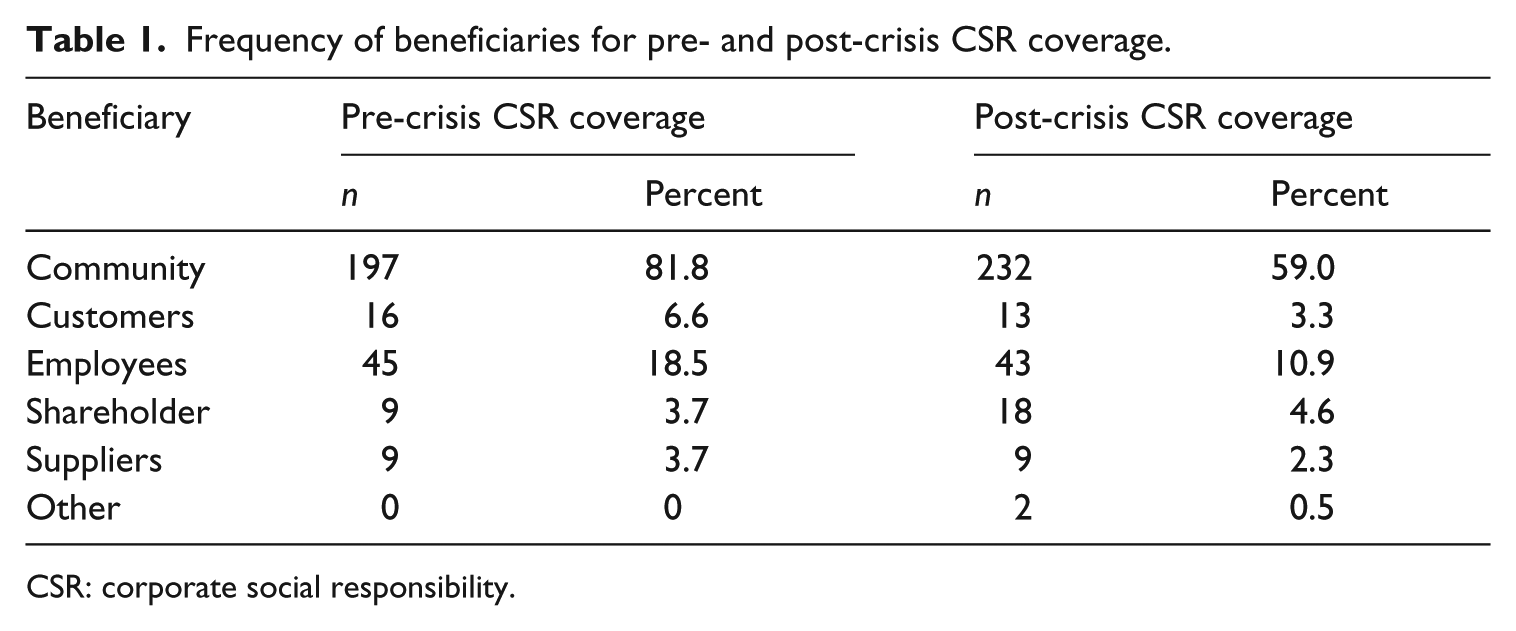
CSR: corporate social responsibility.
Frequency of beneficiaries for business-specific and general news publications.
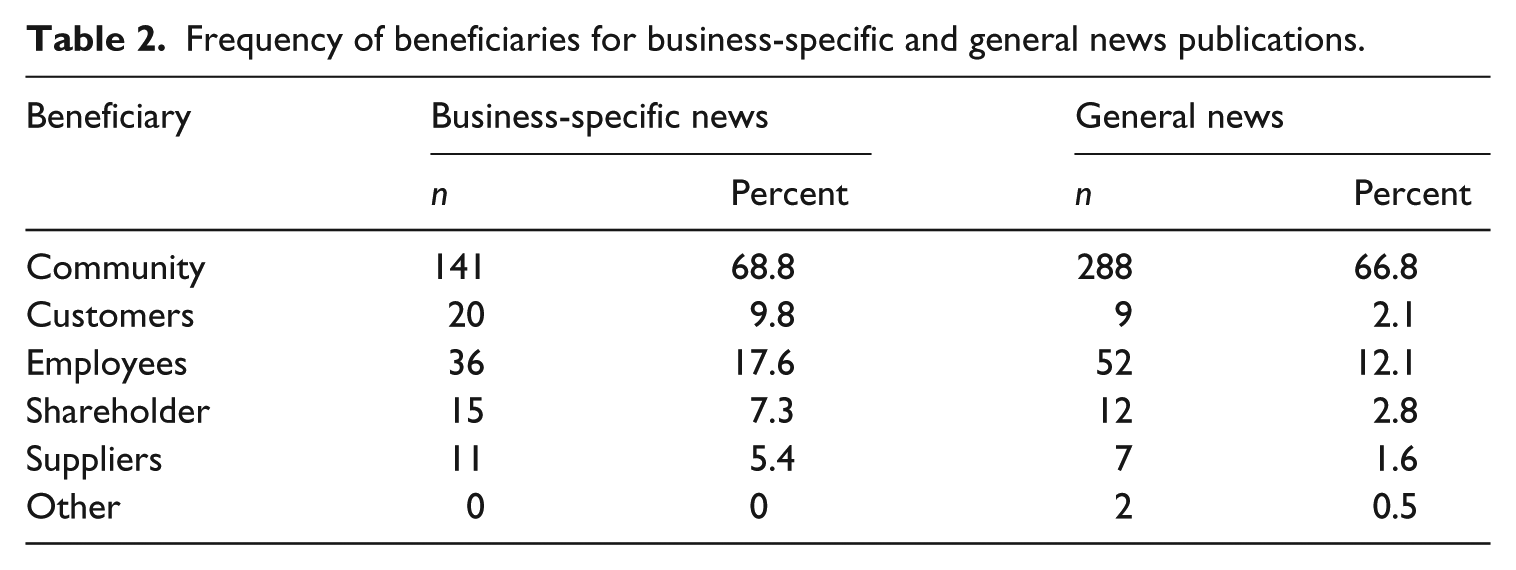
Following this, RQ1 asked what major themes of CSR were addressed in business news. Under community, the most common topic discussed was environmental conservation (n = 147, 23.1%), followed by development and poverty (n = 133, 20.9%), health and wellness (n = 78, 12.3%), arts and culture (n = 48, 7.5%), primary and secondary education (n = 46, 7.2%), higher education (n = 25, 3.9%), disaster relief (n = 14, 2.2%), and sponsoring sporting events (n = 1, 0.2%). In addition, 18 stories (2.8%) were classified as ‘other’ to include topics like equality and human rights, as well as the ethical treatment of animals. For the second largest beneficiary, employees, the primary topic mentioned was employee welfare (n = 50, 7.9%), then employee health and safety (n = 18, 2.8%), equal opportunity (n = 17, 2.7%), providing jobs (n = 15, 2.4%), and employees’ rights to participate in decision-making (n = 2, 0.3%). The major topics for customers were product quality (n = 16, 2.5%), then product safety (n = 10, 1.6%), and other (n = 3, 0.5%), which included improving friendliness/helpfulness toward customers and saving them money. And finally, 28 stories (4.4%) mentioned shareholder care, while 18 (2.8%) mentioned supplier care.
H4 posited that a majority of business media, across publication types, would adopt a positive tone in their coverage of CSR before the economic recession and a neutral/mixed tone afterward. A chi-squared test for independence found results consistent with this hypothesis because the majority of business news publications did adopt a positive tone in their pre-crisis coverage (n = 130, 53.5%) and a neutral-mixed tone in a majority of their post-crisis coverage (n = 256, 65.1%). These results were statistically significant (χ2(2) = 67.768, p < 0.001). Thus, H4 was supported.
Furthermore, RQ2 asked whether there would be a difference in tone used by business-specific news sources and the business sections of general newspapers in their coverage of CSR. Chi-squared results revealed that during their pre-crisis coverage, a majority of both business-specific news outlets (n = 42, 54.5%) and general news sources with business sections (n = 256, 65.1%) covered CSR positively (χ2(2) = .892, p > 0.05). In addition, business-specific news (n = 78, 60.9%) and general news (n = 178, 67.2%) stayed neutral/mixed in their CSR coverage after the recession (χ2(2) = 3.247, p > 0.05).
The last hypothesis, H5, anticipated that corporations would be the most prominent sources portrayed across business news coverage of CSR. Frequencies showed that corporations were the most-mentioned source, showing up a majority of the time before (n = 174, 71.6%) and after (n = 229, 58.3%) the economic crisis, as well as in both business-specific outlets (n = 133, 64.9%) and general news publications (n = 270, 62.6%). Therefore, H5 was supported. To see the frequency of the other sources (government, academics, nonprofits, media, industry memberships, and other) used across business news coverage of CSR, see Tables 3 and 4.
Frequency of sources for pre- and post-crisis CSR coverage.
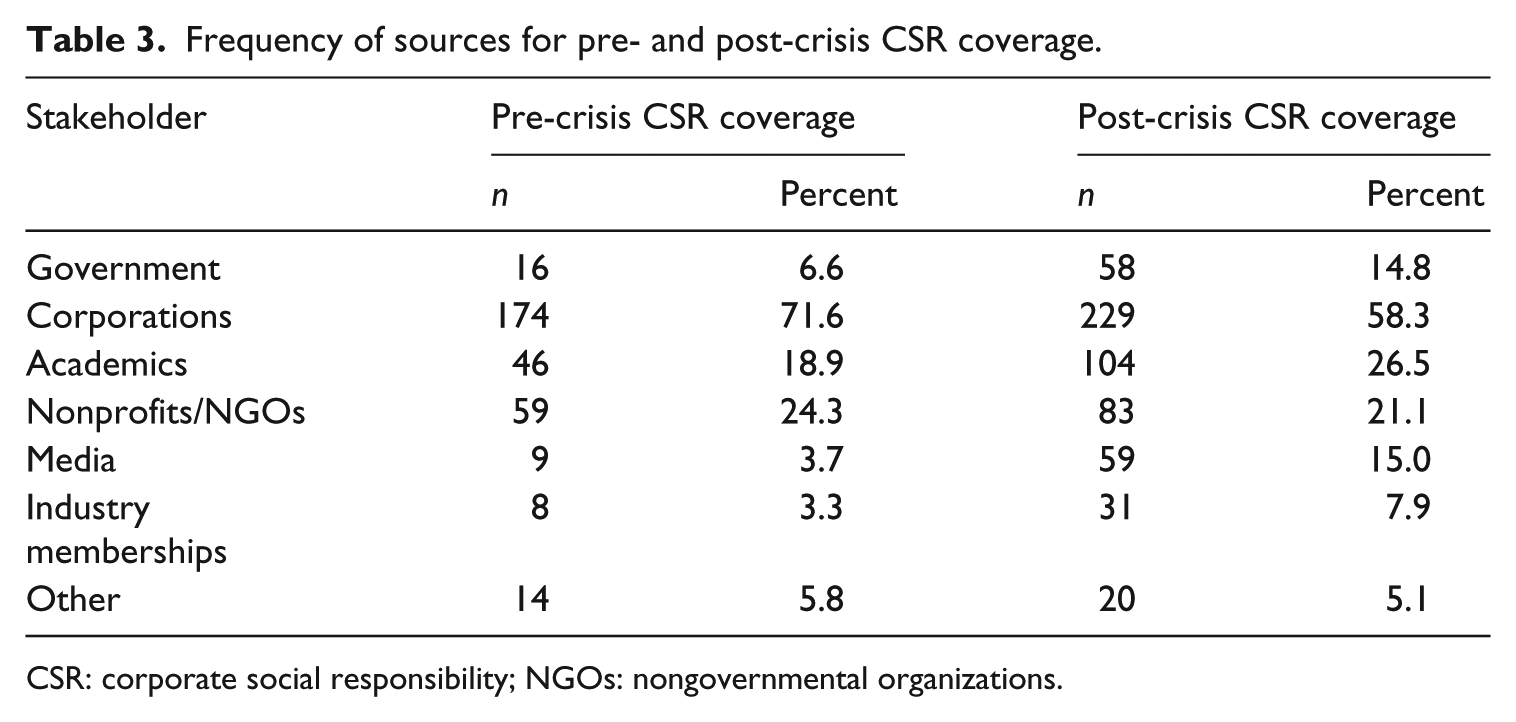
CSR: corporate social responsibility; NGOs: nongovernmental organizations.
Frequency of sources for business-specific and general news publications.
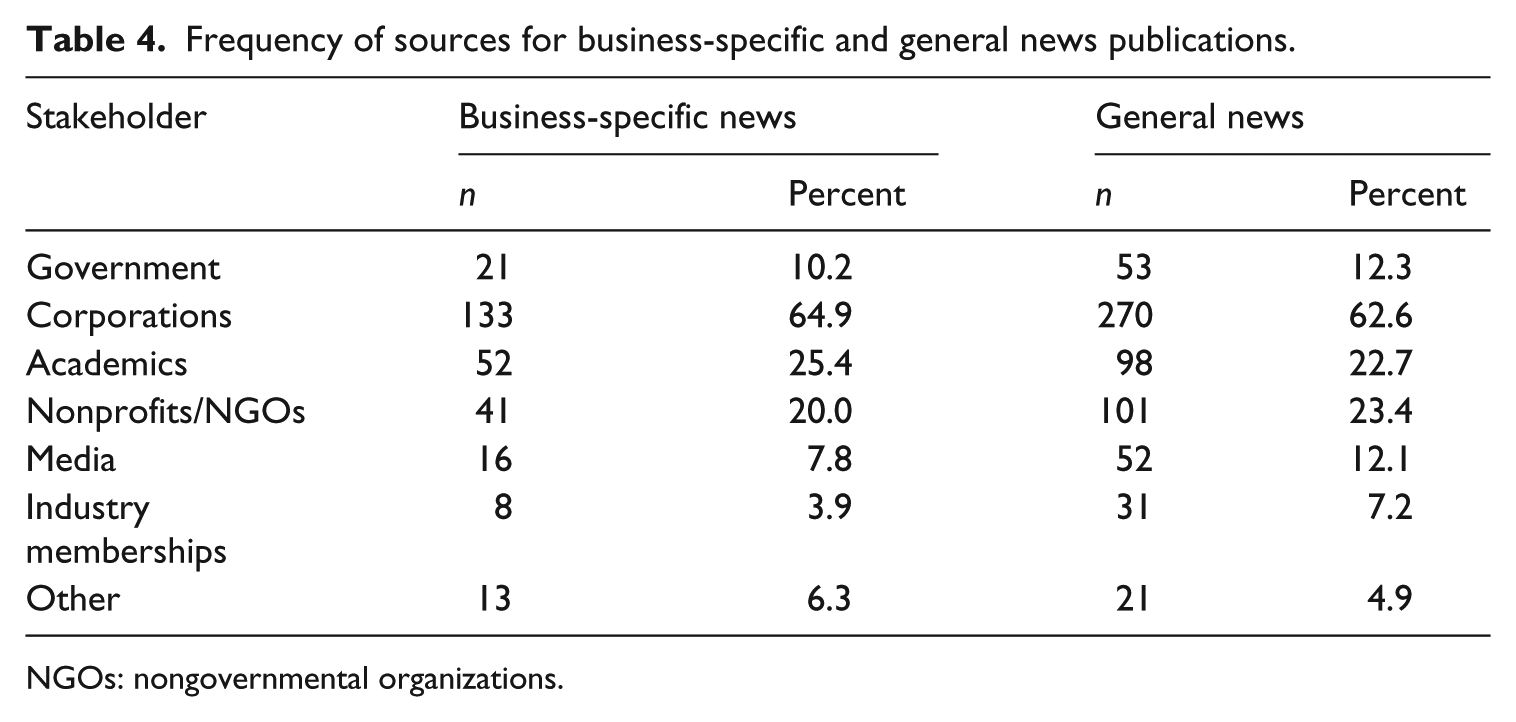
NGOs: nongovernmental organizations.
Finally, to assess RQ3, which asked whether the use of corporate sources was associated with an increased use of positive tone, two chi-squared tests were run. Findings for the first test were statistically significant (χ2(2) = 11.751, p < 0.01), revealing that before the financial crisis, using corporate sources was associated with a higher prevalence of a positive tone across all business media (n = 99, 56.9%). However, statistically significant results (χ2(2) = 12.703, p < 0.01) after the crisis found that corporate sources were most associated with a neutral/mixed tone (n = 147, 64.2%).
Discussion
The purpose of this study was to explore how business news have been covering CSR since the latest US financial crisis in order to (1) examine how business outlets depict CSR; (2) see whether CSR is being portrayed in a positive, neutral, or negative way; and (3) find out whether using corporate sources leads to an increased use of a positive tone in business news coverage of CSR. To accomplish these objectives, this study adopted Starkman’s (2014) list of business publications and compared CSR coverage both before and after the economic crisis. The ultimate goal was to find out whether financial journalists are taking a more skeptical approach after receiving criticism for not predicting the onset of the financial crisis (Starkman, 2014).
Findings and implications
At first, the findings for the first objective of this study (to see whether business media deemed CSR as an important agenda by to cover) seemed consistent with previous research from Tench et al. (2007), which stated that both general news and business journalists often think CSR coverage is irrelevant; therefore, they are unlikely to cover it. These results make sense considering the size of this study’s sample: only 636 business news stories were found to address CSR over a 10-year period. However, when results were analyzed to see whether business news was engaging in active discussion of CSR, business-specific news outlets engaged in more active discussion of CSR than general newspapers with business sections. These results likely occurred because, as Davis (2000) concluded, business media still feel a responsibility to make corporate sources happy because they support these media outlets with high levels of advertising.
According to McChesney (2003), a major problem with the business media environment is that powerful interests often do try to dominate how news is covered; however, it is also important to remember that media organizations themselves are commercial enterprises. Therefore, it makes sense that business-specific outlets would want to keep corporate sources happy by covering CSR as an agenda in order to keep the advertising dollars flowing (Bagdikian, 2004), but results in this study also revealed CSR is not discussed as often in post-crisis coverage. In order to hold onto their audience base, business news outlets may not want to be seen as bolstering corporate reputation by devoting a lot of coverage to CSR, especially after receiving public criticism for not being more watchful of corporations prior to the US economic downturn (Starkman, 2014).
Using second-level agenda setting as a guide, the next objective of this study was to explore how business news covers CSR by examining the major beneficiaries presented in business stories. The most prominent beneficiary mentioned in business news coverage of CSR across outlets both before and after the economic crisis was community, which is consistent with findings from previous research (Grafström and Windell, 2011; Tang, 2012; Tench et al., 2007). A possible reason for such phenomenon is that numerous leading companies incorporate community involvement into their strategic business plan and dramatically increase community contributions as corporate community involvement is considered as one of the most visible aspects of CSR (Uyan-Atay, 2013). Grafström and Windell (2011) also concluded that CSR is often associated with community relations because it provides a straightforward and uncomplicated way to understand a complex topic, like CSR. Community events are simple, isolated events that are easily accessible to journalists, which means they are easy for journalists to turn into articles.
For the topics pertaining to each beneficiary, the following results were found: for community, the most common topic discussed was environmental conservation, followed by development and poverty, health and wellness, arts and culture, primary and secondary education, higher education, disaster relief, and sponsoring sporting events. In addition, stories classified as ‘other’ included topics like equality and human rights, as well as the ethical treatment of animals. For employees, the primary topic mentioned was employee welfare, then employee health and safety, equal opportunity, providing jobs, and employees’ rights to participate in decision-making. The major topics for customers were product quality, then product safety, and other, which included improving friendliness/helpfulness toward customers and saving them money. These results also pertain to second-level agenda setting because which topics are mentioned could influence how audience members understand CSR.
Next, framing, which posits that mass media can influence people’s viewpoints of news topics, was used to examine the tone used in business news reporting of CSR (Kiousis and Wu, 2008). Consistent with the hypothesis formed in this study, it was found that business media adopted a positive tone most often in their CSR coverage before the economic crisis and a neutral/mixed tone a majority of the time afterward. The results prior to the recession are consistent with previous research (Buhr and Grafström, 2007; Tench et al., 2007; Zhang and Swanson, 2006), which found that a majority of journalists frame CSR in a positive way. This makes sense, given the relationship that often exists between business reporters and corporate sources (Davis, 2000; Grümberg and Pallas, 2013). However, the fact that business news stories adopted a neutral/mixed tone after the downturn, contradicting the results of these previous studies, suggests they are trying to distant themselves from negative associations developed during criticism of their pre-crisis financial news coverage.
The meaning of these results is further exemplified by the findings from RQ2, which asked whether there would be a difference in tone used by business-specific news outlets and the business sections of general newspapers in their coverage of CSR. Ultimately, it was found that, despite their corporate audience (Davis, 2000; Do, 2013; Hollified, 1997), business-specific news outlets maintained the neutral/mixed tone in their post-crisis coverage of CSR. Again, this is likely their response to public criticism for not being more watchful of corporations prior to the US economic downturn (Starkman, 2014). However, across publications, negative tone was the least evoked, as business journalists likely still wanted to maintain the status quo and not upset that relationship between business publications and their corporate sources (Bagdikian, 2004; Davis, 2000; Grümberg and Pallas, 2013; McChesney, 2003).
This leads to the final goal of this study, which used agenda building, to examine the major sources depicted in business news coverage and whether there was a correlation between the sources used and the tone portrayed. Corporations were the largest source represented across both business-specific news outlets and the business sections of national newspapers. Not only were these findings expected because of the results from Grafström and Windell (2011), which found corporations to be the leading sources used in CSR coverage, but also because research on business news has discovered that strong relationships exist between corporate sources and financial news publications (Davis, 2000; Grümberg and Pallas, 2013). These results could also indicate that the relationship between business news outlets and corporate sources is still intact, even though Starkman (2014) and critics have chastised financial journalists for not calling out the corporations believed to have sparked the economic downturn.
However, the findings from the final research question of this study suggest that corporate sources might not have as much influence over the direction of coverage since being criticized over pre-crisis reporting, as previous research has concluded (Davis, 2000; Grümberg and Pallas, 2013). More specifically, RQ3 asked whether there was a correlation between the use of corporate sources and an increased use of positive tone. The results were statistically significant, indicating that while using corporate sources was associated with an increased use of positive tone before the economic downturn, after the crisis, they were most associated with neutral/mixed tone instead. This suggests that corporate sources may not be having as much of an agenda-building effect on how CSR is portrayed in business news coverage.
Limitations and directions for future research
While this study builds upon agenda-setting, framing, and agenda-building theories and contributes to practical knowledge for understanding how business news is operating in these post-crisis times, there are limitations that should be noted. First, even though the sample was a consensus sample and covered a large time frame, the sample collected was still small. This could indicate that CSR is not just an important agenda in business news; however, more keywords in future study could be used to make the sample more exhaustive. Additionally, efforts should be taken to ensure the keywords bring back more stories pertaining to corporate social responsibility, not individual, government, or artists’ social responsibility and companies trying to relocate their citizenship.
While the list of publications was adopted from Starkman (2014) in order to show whether these publications were making alterations to coverage after receiving criticism for their pre-crisis work, because not all of the publications are entirely business-specific and some are published daily and some weekly, this could have had an impact on results. Yes, the results between the two types of publications were compared, but the list of publications under each category should be expanded in future research to get a bigger picture of how business-specific and national news publication are covering CSR. Additionally, future research should be conducted on business news publications in other countries affected by the global economic crisis, and a survey or experiments could shed light on the impacts of this coverage on business news consumers.
Conclusion
The purpose of this study was to explore how business news outlets have covered CSR in the United States, since coming under fire for not giving ample warning toward the onset of an economic depression (Starkman, 2014). Results indicated that business news journalists do not actively discuss CSR, and they are taking a more neutral approach to coverage since the US economic crisis, despite findings in previous research (Buhr and Grafström, 2007; Tench et al., 2007; Zhang and Swanson, 2006). Additionally, the use of corporate sources was not associated with a positive tone in business news coverage of CSR as it did before the crisis, even though research examining the relationship between business news and corporate sources has found that they often influence business coverage (Davis, 2000; Grümberg and Pallas, 2013).
While these findings do not necessarily indicate that business news publications are starting to bark again, they do suggest that business news sources are being less positive toward businesses in their coverage of CSR since receiving criticism for their US economic pre-crisis work. If business news outlets want to fully distant themselves from criticisms that they bolster corporate reputation, they should exhibit this trend consistently across coverage, not just in stories about CSR. Being too critical of businesses could upset interactions with corporate sources, which will always exist – because business journalists write for a corporate audience (Davis, 2000; Do, 2013). However, a more neutral approach would allow financial journalists to find balance between being a barking watchdog and maintaining those relationships with corporate sources.
Footnotes
Funding
The author(s) received no financial support for the research, authorship, and/or publication of this article.