




Abstract
Mainstream news media have been criticized for serving as marketing agents of establishment ideas and elite voices. In response, this article introduces an analytical framework of agonistic media pluralism that enables an evaluation of media discourse on whether it opens or closes the space for a democratic debate about and beyond established social structures and ways of life. Theoretically, this framework draws from post-foundational political thought, agonistic democratic theory, and post-politics. Methodologically, it consists of a critical discourse analysis that combines four levels of analysis: the ideological conflict underlying a social issue, the scope and form of media discourse, the ideological culture of a media outlet, and the level of agonistic pluralism in a media landscape. Special attention is paid to how particular discursive strategies either open (i.e. cultivate or politicize) or close (i.e. depoliticize) a debate. It concludes by sketching some future research avenues.
Keywords
Already in 1970, the singer-songwriter Rodriguez sang, ‘Opened the window to listen to the news, but all I heard was the establishment’s blues’. At this juncture in time, it is quite a common practice to express dissatisfaction with how issues and events are represented in and by media. Professional-commercialized news media, generally referred to as ‘the mainstream media’, are being criticized from both the Left and the Right. On the Left, a traditional concern has been the role of mainstream media discourse in the consolidation of the hegemony of the neoliberal project (e.g. Hall et al., 2013; Phelan, 2014). For example, in the context of the global financial–economic crisis, mainstream news media in Europe have been criticized for failing to put forward any other responses than austerity (e.g. Schifferes et al., 2017). More recently, on the Far Right, it has become custom among politicians such as Donald Trump (United States) or Marine Le Pen (France) to refer to mainstream news media as ‘fake news’ and as the ‘dishonest’ and ‘liberal’ media who are simply ‘mouthpieces of the establishment’. Similarly, the German Islamophobic movement Pegida has repopularized the term ‘Lügenpresse’ from the Nazi propaganda handbook.
In other words, mainstream news media have been characterized as echo chambers of establishment ideas and elite voices. Rather than contributing to a pluralistic public space that promotes and facilitates public scrutiny, discussion, and reflection about (alternatives to) established societal structures and ways of life, these examples illustrate how media are perceived to serve as marketing agents of the establishment instead. Thus, despite the professionalization of (Western) news media over the last decades, and the anchoring of journalistic norms and values such as objectivity, balance, and impartiality across newsrooms, there is a widespread feeling that only particular ideas and voices are (fairly) represented.
This context calls on media scholars to provide the tools for analyzing media discourse on the extent to which it indeed impedes or facilitates debate about the established social and political order. The aim of this article is to answer this call by putting forward an analytical framework of agonistic media pluralism. This framework combines an extensive engagement with contemporary debates in political philosophy and democratic theory – and more particularly agonistic democratic theory – with rigorous social–scientific research into media practices and products. Furthermore, it builds on our previous work in two ways.
First, in two recent conceptual papers, we argued that both liberal and deliberative notions of media pluralism (Raeijmaekers and Maeseele, 2015b), as well as the analytical ideal of ‘objectivity’ (in tandem with ‘balance’ and ‘impartiality’; Raeijmaekers and Maeseele, 2015a), fail to reveal the ways in which media discourse opens/closes a debate about and beyond established social structures and ways of life. Indeed, what this requires is an agonistic approach that premises, rather than overcomes or neutralizes, ideological contestation. Second, in a series of empirical case studies (e.g. Maeseele et al., 2017; Pepermans and Maeseele, 2014), we have found the analytical concepts of depoliticization and politicization to serve this objective well. The framework that has been developed on the basis of these previous studies will be laid out in this article, both in theoretical and methodological terms.
In the first part, we explain how the above account of the establishment blues ruling the airwaves relates to what in political philosophy has been interpreted as a post-political zeitgeist, that is, the idea that there is no alternative to the established social and political order. Subsequently, we rely on Mouffe’s concept of agonistic pluralism for understanding which discursive mechanisms are responsible for this process of depoliticization. In the second part of the article, we translate these discursive mechanisms into ready-made empirical tools for an analytical framework that allows us to evaluate media discourse on whether it opens or closes the space for a democratic debate on status quo ideological preferences, or put differently, for agonistic media pluralism. In the discussion, we conclude by sketching some future research avenues. More particularly, we discuss how this framework can be put to work in terms of establishing the extent of agonistic media pluralism in 21st-century media landscapes, both with regard to mainstream, professional-commercialized news media and potential alternative spaces, such as alternative/radical news platforms, news satire, or popular television culture in general.
From post-politics to agonistic pluralism
Post-politics and depoliticization
The idea that (mediated) public discourse in this current juncture is characterized first and foremost by the establishment blues, and that moreover, there is a lack of mainstream channels for challenging these status quo ideas and discourses, has been confirmed by a number of political philosophers who have identified the existence of a post-political zeitgeist (e.g. Mouffe, 2005; Rancière, 1995; Wilson and Swyngedouw, 2014; Žižek, 2002). This refers to how the existent stage in economico-political development has come to be perceived as the inevitable framework within which to manage all public affairs, that is, the common sense claim that there is no (ideological) alternative (to neoliberal globalization and the liberal–capitalist order). Put differently, how potential alternatives to the established societal structures and ways of life are generally put forward as beyond reasonable doubt. In that sense, the aim of democratic politics has come to be defined in terms of consensus and conciliation, and as a result, as overcoming conflict and contestation. Such a view is sustained by the belief in the potentiality of a universal rational consensus, with experts reconciling conflicting interests and values through technocratic management, ‘objective’ procedures and technical knowledge (Maeseele, 2015b; Mouffe, 2005; Wilson and Swyngedouw, 2014). It refers to how politicians from centre left to centre right have come to define their policies as a matter of ‘good governance’ rather than an expression of ideological preferences. This post-ideological imagery gained traction especially after the fall of the Berlin Wall and came to be known as third-way centrist politics, that is, the idea that ‘[t]he market and state should now work together […] in a new entrepreneurial spirit to guarantee better economic and social outcomes’ (Phelan, 2014: 51, emphasis in the original; see also Hall, 2011). The result, however, was that ‘[m]arket and state were “reconciled”, but in a fashion that privileged the former and neoliberalized the latter’ (Phelan, 2014: 53). In this regard, Phelan argues how today’s hegemonic ideological formation has taken the form of an ideologically and politically disinterested project, grounded as it were in a practical ethics and concerned only with economic efficiency and productivity, rather than with any political or ideological principles. In substance, however, the entrenchment of neoliberal political rationality has been ever growing. This ‘post-political condition’ has been demonstrated in case studies on social, economic, environmental, and journalistic matters (e.g. Goeminne, 2010; Gregory, 2006; Phelan, 2014; Pickering, 2001; Swyngedouw, 2010; Wodak, 2011).
These analyses have their origins in post-foundational political theory (Marchart, 2007; Wingenbach, 2011). Post-foundationalism argues that any established social order (i.e. ‘hegemony’) is always shaped by particular ideological conceptions that demarcate the possibilities and limits of everyday practice. These political foundations 1 can always be contested and transformed, because of their inherent contingent and historical nature. However, when their contingent and historical nature is concealed or misrecognized, and there is an attempt to establish a final foundation, then we speak of depoliticization. Depoliticization concerns not only the concealment of those particular politico-ideological values, perspectives and choices that underlie a social order and shape its politics, but also – and more importantly – the misrecognition of the fact that any social order is always the provisional product and expression of a particular configuration of power relations. Indeed, once society’s ideological nature has been made invisible, the established social order comes to be defined in terms of necessity and fate. In that sense, post-politics refers to a particular kind of depoliticization, one that applies to the current juncture in the West. A recent example in this regard has been the general delegitimization in mainstream media reporting of Jeremy Corbyn – from the conservative press over the public broadcaster BBC to the progressive The Guardian – who was elected as Leader of Britain’s Labour Party on a platform that explicitly defied neoliberalism (Cammaerts et al., 2016; Media Reform Coalition, 2016). Ultimately, the misrecognition of society’s political foundations and the construction of an ultimate consensus serve to conceal the possibility of a radically different society. The subsequent question is how exactly to operationalize this depoliticizing process of concealment and misrecognition? How can we recognize misrecognition and reveal concealment?
Agonistic pluralism
Political philosopher Mouffe (2000, 2005, 2013) provides an answer with her work on agonistic pluralism, and more particularly, her argument about how particular discursive mechanisms of depoliticization are responsible for the lack of agonistic pluralism today. She argues how agonistic pluralism can only be achieved when democratic debate meets the following two conditions. First, it should take place within a framework of what she calls a ‘conflictual consensus’ (Mouffe, 2013: 7): while consensus is needed on liberal democracy’s institutions, an agonistic struggle is needed on the meaning and implementation of the values of liberty and equality that underpin them. A struggle is agonistic when it concerns a discursive confrontation between adversaries (i.e. ‘us’ versus ‘them’) who, despite fighting each other’s interpretation of these values, accept each other’s legitimacy to fight for the victory of their interpretation. In other words, agonistic pluralism holds respectful contestation as a key value. Second, this adversarial us/them struggle needs to be defined in political terms. It implies that, in a context of agonistic pluralism, democratic debate entails a confrontation between clearly differentiated political positions based on opposing ideological projects between which a rational reconciliation is impossible (only defeat or victory). This relates to her ontological starting point that there is no rational solution to the ineradicable conflictual dimension of social relations, which, moreover, she puts forward as constitutive of democratic politics and agonistic pluralism.
In the depoliticizing context of post-politics, however, these conditions for agonistic pluralism are unfulfilled. Mouffe (2005) predominantly takes aim against how, in the discursive process of achieving consensus, the us/them discrimination is no longer defined in political terms, but in rationalist and/or moralist terms. This displaces the agonistic struggle between ‘left and right’ to a struggle between ‘right and wrong’, either in terms of ‘rational versus irrational’ or ‘good versus evil’. This is problematic, since it keeps political conflicts from taking an agonistic form. Instead, they take an antagonistic form, and adversaries become enemies, defined as traditionalists, blind radicals, fundamentalists, and so on. In doing so, a discourse is created which justifies the exclusion of particular demands from public debate on the basis of being ‘too extreme’, concealing the politico-ideological nature of every frontier drawn between ‘insiders’ and ‘outsiders’. In other words, these rationalistic and moralistic terms operate as discursive mechanisms of exclusion, shielding particular demands or a particular framework from contestation, and resultantly, closing democratic discussion. This can either pertain to a micro level, claiming that particular choices or policy strategies are beyond dispute, or to a macro level, claiming that there is no (ideological) alternative to the existent social and political order. This displacement from a political to a rationalist or moralist level is what Mouffe defines as depoliticization, that is a discursive logic that draws a political frontier while denying its political character and, in doing so, transforms the political from a matter of ideological contestation and political position to a matter of administration, dialogue, and expert knowledge, on the one hand, or moral condemnation and self-idealization, on the other.
To challenge this discursive logic of depoliticization, and (re)open debate, Mouffe argues for (re)defining the us/them discrimination in political terms. This requires (politicizing) discourses that reveal the mechanisms of exclusion at work in depoliticizing discourses, thereby opening up particular demands or a particular framework to political contestation and democratic discussion and, consequently, the space for transformative social change. In this process, a shift takes place from the post-politics of consensus to agonistic democratic debate. Today, this implies, for example, challenging neoliberal political rationality by making its influence in public discourse visible and by offering people alternative political rationalities, based on an agonistic struggle among adversaries.
Depoliticization and agonistic pluralism in media and communication studies
In media and communication studies, the concept of ‘depoliticization’ has been used only sporadically, and in those cases, it was approached either as a form of governmental (e.g. Bingham, 2013; Ekecrantz, 1988; Wei, 1996) or societal depoliticization (e.g. Djerf-Pierre et al., 2014; Koffman et al., 2015; Reifová, 2015), rather than as a discursive form (an exceptional case has been Ylönen et al., 2015). The concept of ‘agonistic pluralism’ has increasingly been put to work this last decade to understand and evaluate social interaction on the Internet (for a more theoretical elaboration, see Dahlberg, 2007), either with regard to social media platforms such as Facebook, Flickr, Twitter, or YouTube (e.g. McCosker, 2014; Svensson, 2015; van Zoonen et al., 2011) or blogs (e.g. Warner and Neville-Shepard, 2011). Karppinen (2007, 2013), on the other hand, has focused on how to integrate this notion into media policy research. Until today, there has been no attempt (to our knowledge) at developing a framework for systematically analyzing media discourse in such a way as to come to conclusions on the state of (agonistic) pluralism in particular media landscapes.
A framework of agonistic media pluralism
In this section, we explain how we have translated Mouffe’s arguments into a framework of agonistic media pluralism. This framework allows for a systematic and empirical analysis of the extent to which particular media discourses facilitate an agonistic democratic debate about (alternatives to) established societal structures and ways of life. Although it is applicable to mediated public discourse in general, we focus on news discourse in particular.
This framework evaluates mediated debates on three levels. Above all, the key aim is to draw conclusions on the extent of agonistic pluralism in a specific media landscape (during a specific moment in time and on a specific social issue). However, to be able to say something about a specific media landscape, we must first look at the relevant news media outlets and establish their ideological cultures (cf. infra). In order to identify the ideological culture of selected media outlets, a considerable number of media ‘texts’ are evaluated in terms of scope (with a particular focus on the present ideological preferences) and form (with a particular focus on discursive strategies that are used to de/politicize and close/open debate). So, chronologically, this framework evaluates (1) selected media discourses, of (2) relevant media outlets, in (3) a particular media landscape. However, when it comes to agonistic media pluralism, one must avoid a media-centric approach: media debates not only construct but also reflect a particular political/social/cultural context. Therefore, an in-depth understanding of the social issue at stake is vital. More specifically, it is indispensable to determine the politico-ideological conflict(s) underlying (debates about) a social issue. As a result, the framework we propose consists of four levels of analysis. 2
Social issue: Ideological fault lines
First, to make the underlying clashing positions and radically different ways of looking at an issue tangible, we introduce the concept of ‘fault lines’. Ideological fault lines represent a struggle between competing analyses about what constitutes progress with regard to particular politico-ideological categories, such as the economy or nature (see also Carvalho, 2007). For example, the ‘socio-economic fault line’ involves competing perspectives regarding economic progress, for instance, with regard to the intervention of private companies (‘the market’) or public institutions (‘the state’) in different aspects of society (e.g. Maeseele et al., 2017; Raeijmaekers and Maeseele, 2014). Or, the ‘techno-environmental fault line’ concerns competing interpretations of techno-environmental progress, for instance, with regard to the preferred role of science and technology in nature (e.g. Maeseele, 2015a; Pepermans, 2015). It is important to emphasize that a fault line should be seen as a continuum that represents different directions of travel (instead of end points), and on which the differences are matters of degree.
The subsequent question is how to identify the relevant fault lines – with the potential positions and preferences – of a selected social issue. This is a matter of both deductive and inductive practices. On one hand, a number of fault lines appear to play an important role in many social issues (e.g. the socio-economic fault line). A first identification and definition of the relevant fault lines thus comes from reading previous empirical studies or theoretical/historical reflections on the selected (or a related) social issue. On the other hand, the exact operation of each fault line is case specific (and time-sensitive) and only becomes clear during the analysis itself: the positions and preferences on each fault line are rearticulated in line with the specific social issue at stake. Moreover, during the analysis, new relevant fault lines might be distinguished, or it might become clear whether/how particular fault lines are related. Once the relevant ideological fault lines and preferences are identified, it is time to examine the scope and form of these preferences in media discourse.
Media discourse: Scope and form
Two analytical aspects are key to the level and nature of contestation in media debates, that is, the scope and form of discourse. 3 Regarding the ‘scope of media discourse’, we are concerned with whether different sides of (a debate on) a social issue are addressed. Regarding the ‘form of media discourse’, we are concerned about the way these different sides are portrayed. In other words, we look at not only what is present in the media coverage but also how it is presented.
For this ‘textual’ analysis of scope and form, qualitative content analytical methods are preferred over quantitative methods, since the latter generally aim at identifying the frequency of predefined thematic categorizations (often referred to as ‘frames’) or positive/negative evaluations of particular identities and concerns. First and foremost, such quantitative methods are less suitable for this framework as the analysis of media discourse would be limited to prior-identified preferences and constructions, causing a potential loss of valuable information for the identification of the case-specific and time-sensitive ideological culture of a particular media outlet. Furthermore, quantitative analyses generally fail to reveal processes of power and ideology in the construction of meaning (Jones, 2013). Of the many qualitative content analytical methods at our disposal, critical discourse analysis (CDA) has proven to be most efficient in establishing ideological cultures in previous research. 4 With its focus on the relationship between discourse and specific social/political/cultural contexts, it adequately serves the objective of revealing the role of discursive strategies in the creation and reproduction of relations of power (see also Jørgensen and Phillips, 2002).
This particular CDA approach to agonistic media pluralism addresses three textual elements related to the scope of media debates, and three elements related to the form (see also Carvalho, 2008: 167–171). First, with regard to scope, we look at the presence, prominence, and absence of particular objects (i.e. issues, topics, angles), social actors (i.e. who is the predominant subject, and who gets to define the terms of the debate, i.e. framing power), and viewpoints/preferences (i.e. issue-specific standpoints, and politico-ideological aspirations). The analysis of these three elements is not independent from each other, since the analysis of both objects and actors directly informs the determination of (ideological) preferences. For instance, the objects generally point toward the fault line that is being addressed (economy, nature, freedom of speech, etc.). Second, regarding form, we look at layout (page, pictures, size, position, etc.), linguistic strategies (rhetoric, terminology, etc.), and discursive strategies (i.e. construction of arguments, cf. infra). The analysis of discursive strategies is most essential (since these directly inform us about the ideological culture at hand), while layout and linguistic strategies play a secondary role and mainly serve to illustrate the former. 5 This is why we have excluded layout and linguistic strategies from Figure 1, which visualizes the textual analysis.

Textual analysis.
To put it in general terms first, media discourse 6 is found to close democratic debate when an issue or event is presented by relying on mechanisms of exclusion. In that case, the reporting privileges (established) actors and preferences, which are presented in a depoliticized way as the only rational, moral, or natural ones. Resultantly, one course of action is proposed as the only way to move forward. On the other hand, media discourse is found to open democratic debate when an issue is presented by relying on mechanisms of exposure and expansion. Exposure refers to recognizing the existing limitations in scope and form, by identifying particular actors and demands as privileged, and/or discursive strategies as depoliticizing. Expansion then refers to introducing alternative actors and demands. This can happen either in rational or moral terms (i.e. ‘cultivation’) or in politico-ideological terms (i.e. ‘politicization’). As a result, several courses of action are presented as alternative ways to move forward.
So, in more detail, a first step is to determine which actors and preferences media discourses promote and/or neglect. To be able to say something about the scope of media debates (e.g. limited or broad), researchers must distinguish whether media texts introduce the same (established) 7 or allow for alternative (marginal) actors and demands. Debates are found to be closed, when media texts privilege particular (established) actors and preferences. Hypothetically, in the case of austerity policy, it might appear – both from explorations outside media texts and comparisons between media texts – that the government, together with particular economists and European Union (EU) technocrats, has obtained a prominent position, while critique and counter-proposals by affected or protest groups figure only sporadically. However, debates are getting (re)opened when discourses either identify this privilege toward particular (established) voices and demands, or when alternative (marginal) actors and preferences are also presented.
Then, an additional step is to disclose how media texts discursively present these actors and preferences. To be able to say something about the form of media discourse (i.e. impeding or facilitating discussion), we distinguish between a depoliticizing use of discursive strategies, constructing the idea that there is no valid (political) contestation, and a cultivating or politicizing use of discursive strategies, (re)constructing the idea that there actually is valid (political) contestation. Regarding depoliticization, media discourses impede debate, by eliminating both the possibility of other legitimate claims and the role of ideological assumptions and preferences. In that case, discursive strategies are adopted in such a way that there seems to be ‘objective’ argumentation (e.g. rational and moral grounds) for shielding particular claims or actions from contestation. Exposing this depoliticizing discursive process is one possibility to (re)open debate. Another possibility is to expand the debate itself by arguing for/against particular preferences in a different way. In this regard, media can opt for either a cultivating discourse or a politicizing discourse. In the case of cultivation, media discourses facilitate debate by (re)introducing the possibility of other claims and actions, still relying on the same ‘objective’ criteria. In the case of politicization, however, (re)introducing the possibility of alternative preferences goes hand in hand with acknowledging the role of ideological assumptions and preferences. Discursive strategies are used in such a way that being in favor/against particular claims or actions clearly – and legitimately! – has to do with political beliefs, choices, and interests. One could argue that while cultivation just aims at ‘growing’ more debate by addressing societal contestation, politicization aims at fostering more ideological debate by addressing political contestation. In the end, to fulfill the conditions for agonistic pluralism, cultivating debate is a good first step (i.e. creating inclusive, respectful contestation), but politicization must be the aim (i.e. stimulating contestation between clearly differentiated ideological positions and projects).
So far, in our previous empirical case studies, we have been able to recognize three key discursive strategies: positioning, de/legitimization, and de/naturalization. All three contribute to closing (i.e. depoliticizing) or opening (i.e. cultivating/politicizing) debates, but do so at a different intensity, leaving more or less room for interpretation. Whereas strategies of positioning indirectly steer a debate, de/legitimizing strategies directly limit debate, and naturalizing strategies completely dismiss – or, in the case of denaturalization, preserve – debate.
First, strategies of positioning refer to a particular context, which must convince an audience that certain claims and actions are preferable (and others not). Such strategies of positioning steer the debate, encouraging certain demands (while discouraging others). In the case of depoliticization and cultivation, it concerns an ‘objective’ context: formal political/economic/social relationships, historical ‘facts’ and ‘proof’, geographical locations, and so on. These are used to suggest that there are better and worse options (i.e. depoliticization), or that some alternative options are also (or still) well worth considering (i.e. cultivation). For example, in case of a national issue, one might compare to other countries (e.g. comparing Belgium to Germany when it comes to economic policy) or point out an international relationship (e.g. EU agreements) to discourage a particular course of action. Or, a political leader (with a particular proposition) might be positioned against his/her divided followers to undermine his/her authority. Or, on the contrary, one might refer to a similar situation in history (e.g. a previous economic crisis) to encourage certain measures (that are currently widely discouraged). In the case of politicization, however, strategies of positioning refer to a politico-ideological context: dis/encouragement via references to historical ideological developments, relations between socio-political groups, and so on. For example, a particular economic measure is discouraged by the argument that a similar decision in the past has led to more competition instead of aspired solidarity, or by linking the proposal to the agenda of a specific political or economic lobby group.
Second, strategies of de/legitimization enforce particular boundaries, on the basis of which certain claims or actions are (un)justified to be part of the debate. In the case of depoliticization and cultivation, it concerns ‘foundational’ boundaries: the limits of the debate are expressed in terms of rationality, morality, and so on. Depoliticizing discourses introduce those rational or moral criteria to shield particular preferences from contestation (i.e. legitimize) and reject alternative suggestions as ‘invalid’ (i.e. delegitimize). For example, while preferred actions are promoted as rational (e.g. evidence based, authorized by expert institutions, financially profitable), alternative claims are rejected as irrational (e.g. emotional, ideological/partisan, financially and economically damaging). Or, while favored claims are put forward as morally right (e.g. compassionate, democratic, ethical), alternatives are excluded as morally wrong (e.g. discriminating, undemocratic, inhumane). For instance, regarding government budgets, austerity politics might be presented as wise and in the best interest of the most vulnerable, while government welfare programs are put forward as outdated and unfair toward the hardworking middle class. Cultivating discourses, however, refer to those rational and moral criteria above all to include (formerly excluded) alternative preferences. For example, the economic proposals of a small civil protest group are labeled as actually intelligent and achievable. Then, in the case of politicization, the inclusion and also exclusion of actors and demands happens on the basis of political boundaries. Although some preferences are delegitimized, it is clear that their rejection has to do with competing political values and interests. For example, a policy proposal, which will lead to more market competition, is explicitly rejected because of its negative effects on highly valued welfare programs.
Third, strategies of de/naturalization ultimately deal with the simple existence of debate on a specific issue: disagreement as such is either completely rejected (i.e. naturalization), or explicitly acknowledged (i.e. denaturalization). More specifically, naturalizing strategies are used to impose the idea of a substantial social ‘consensus’ on particular claims or actions (e.g. in terms of a natural evolution, inevitable measures, a universal desire, or ‘the truth’), emphasizing that there is simply no alternative. For example, cutting down government expenses is presented as inevitable, sustaining economic growth as normal, taking measures that generally benefit the middle class – instead of particularly supporting lower incomes – as neutral. Such naturalizing strategies are keys to the discursive process of depoliticization, since they clearly eliminate the possibility of or need for other (political) interpretations. Cultivation and politicization, however, aim at (re)opening debate. Therefore, strategies of denaturalization are adopted: claims and actions are problematized as selective and contested. In the case of cultivation, denaturalizing strategies are referring to (surmountable) social contestation. For example, a government’s economic program is covered in terms of considerable (but solvable) disagreement between individuals or social groups. Or a specific economic measure is linked to a(n) (yet) uncertain outcome. In the case of politicization, denaturalizing strategies refer to (unsurmountable) political contestation, that is, grounding particular claims or actions in terms of incompatible worldviews or ideological projects. For example, a particular economic policy proposal triggers a reflection about which kind of economic system we should aspire or avoid.
Media outlet: Ideological culture
After evaluating whether selected media discourses close/open debate, we are able to determine the ideological cultures of the media outlets that reproduce these discourses. The concept of ideological cultures has been defined by Carvalho (2007) as
communities of ideas, values and preferences inside media organizations and in their particular audiences. The term culture points to the socially constructed nature of ideologies. Values and norms are, to some extent, always shared. This does not mean that ideologies are internalized by [each journalist and audience member] in a fixed and uniform way. In the term culture there is room for some pluralism and diversity. (pp. 239–240)
As is clear from Carvalho’s definition, ideological cultures are not uniform systems of meaning, but are adopted in different ways by particular journalists, often transform over time, and are characterized by inconsistencies. Therefore, in order get a clear understanding of the ideological culture of a media outlet, one should focus on the recurrent de/politicization or cultivation of particular preferences. This concerns both a hypertextual (i.e. beyond or above a single media text) and comparative approach (i.e. across media outlets and across time). What matters is the identification of patterns regarding both the ideological preferences and discursive strategies in a specific media outlet.
Furthermore, our previous case studies have shown how the ideological culture of a media outlet influences key article types in different degrees. In descending order: editorials, news articles, interviews, and op-eds. This should be interpreted in two ways. First, the editorials and news articles provide the most direct input for discerning a media outlet’s ideological culture (with the articles written by the leading journalist on the respective social issue upfront). 8 Second, a certain degree of diversity and pluralism is provided by leaving room for alternative discursive constructions, primarily in the op-ed and interview sections, and more seldom in the news articles and editorials (this is most likely in the case the author is a different journalist than the leading one). For example, while a particular media outlet can consequently advocate government cuts and privatization in its editorials (often manifestly), and in most larger news articles (often latently), alternative ideological references (e.g. claims for government investments, critique on austerity measures) will likely figure in some (shorter) articles and interviews, and on the (remote) opinion pages. In doing so, newspapers (aim to) create a sense of pluralism and diversity at first sight.
Media landscape: Agonistic pluralism
Last, when we compare the ideological cultures of the different media outlets, we can make statements about the level of agonistic pluralism in a media landscape. In theory, there are four possibilities (Figure 2). When the ideological cultures of the selected media outlets are promoting the same (established) preferences and ideological projects, we speak of media uniformity or media conformism. Obviously, when all relevant outlets share similar viewpoints, the media landscape is incapable of encouraging (political) contestation and debate, even when the discourse is based on ideological terms (i.e. politicized). To the contrary, it (re)produces the current ideological hegemony, either latently and seemingly unwittingly (i.e. depoliticized, ‘There Is No Alternative’) or openly and deliberately (i.e. politicized). Furthermore, we speak of media diversity, when the relevant media outlets hold different preferences and viewpoints, but refrain from presenting them in terms of contestation and ideology (i.e. depoliticization). In that case, the media landscape succeeds in reflecting a social variety of preferences, but not in discursively connecting them as part of a larger and legitimate (political) conflict and democratic debate. 9 However, when the different outlets present their preferences using a cultivating discourse, the media landscape might contribute to public debate and contestation (but not in terms of insuperable political–ideological disagreements). Last, we can only speak of media pluralism, when the relevant media outlets hold different preferences and ideological positions, and also present them as such. Then, the media landscape is found to (re)produce agonistic contestation: it allows for and stimulates a respectful debate about ever-present political–ideological disagreements.
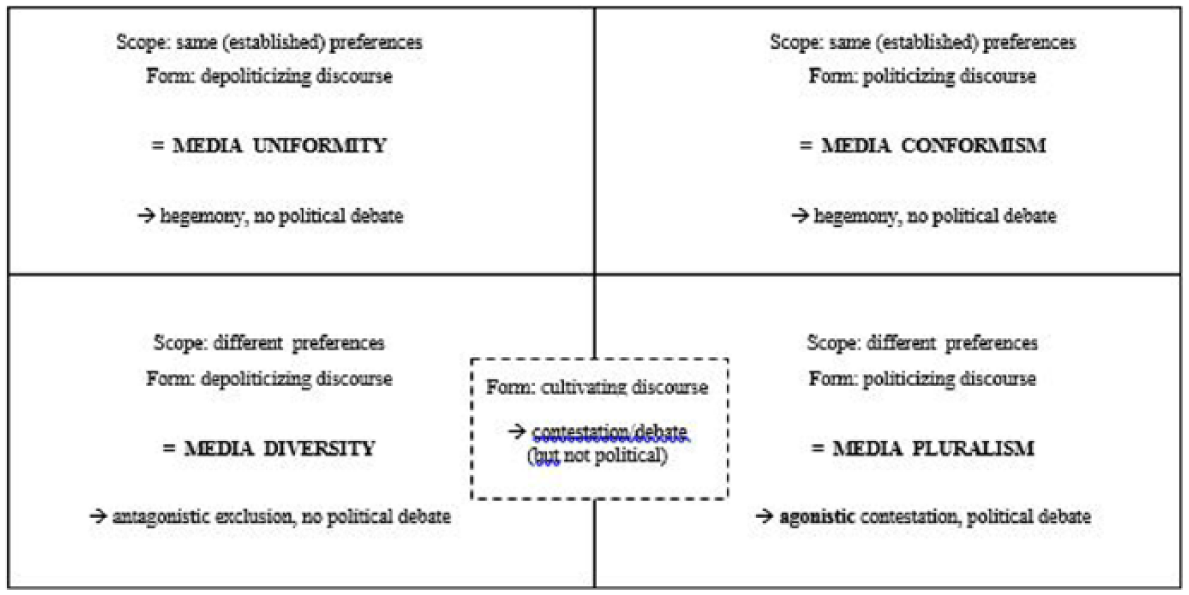
Media landscape.
In reality, however, the different ideological cultures never correspond to this ideal typical framework, since this would presume that each selected media outlet makes similar choices with regard to either scope or form. Until now, our previous case studies have revealed that there is always at least one ideological culture based on depoliticized neoliberal preferences. Depending on the selected media outlets, other ideological cultures are found to open the debate by either cultivating or politicizing more social–ecological values. In that case, we conclude that the media landscape is dependent on the latter ideological cultures to achieve a certain degree of media diversity or pluralism, respectively. However, if we focus only on professional-commercialized media (and leave aside alternative, non-profit media), such a (limited) degree of media pluralism has only been found either very recently (in the case of the 2015 elections in Greece and Spain, see Maeseele and Raeijmaekers, 2016) or more than two decades ago (see Raeijmaekers and Maeseele, 2016). In other words, it appears to be rather exceptional to find ideological cultures based on politicizing discourses in professional-commercialized media, which implies that the role and nature of neoliberal political rationality generally remains concealed or misrecognized, confirming at first sight that the establishment blues indeed rule the airwaves.
Discussion: Research agenda
On one hand, this framework holds great potential for establishing the extent of agonistic media pluralism in 21st-century professional-commercialized news media landscapes, while, on the other hand, identifying potential alternative spaces for contributing to agonistic media pluralism.
First, it could be put to work on a supranational level, to reveal and compare the extent of agonistic media pluralism within and between various regions and countries. In this way, ‘pluralism profiles’ could be created on similar issues in multiple countries. For example, by comparing the reporting in national newspapers on specific cases, such as climate change, migration, or the financial–economic crisis. In second instance, this can be broadened, by differentiating in terms of media types, including television or magazines. Eventually, the question then becomes: on which issues do we find what levels of agonistic media pluralism in and between which regions or nations? And do we only find this in the elite newspaper market or also with regard to other media types? Once there are data on any of these questions, then the really interesting questions arise, namely, how can we explain differences and shifts in pluralism? How is this related to characteristics of a specific media market (e.g. a strong public broadcaster), political system (two-party or multiparty system), or the relationship between media and state (state interventionism, censorship, etc.)? Do we find specific media mergers and acquisitions, processes of media concentration and convergence, influencing the level of pluralism between particular moments in time? What was the role of specific organizations or individuals in specific regions or nations in advocating specific ideological positions? Here one can think of examples as diverse as the organizations involved in the United Nations’ climate process (the Intergovernmental Panel on Climate Change or the United Nations Framework Convention on Climate Change), social movements such as Indignados or Occupy, politicians such as Thatcher, Clinton, Blair, Schröder, Trump, or Corbyn; political parties such as SYRIZA and Alternative für Deutschland; and so on. Finally, do we find differences according to models of media systems? For instance, the most well-known is Hallin and Mancini’s (2004) differentiation in liberal, democratic corporatist, and polarized-pluralist media systems (mainly according to media policy). Does this differentiation hold up with regard to the level of agonistic media pluralism, and if yes, how can these media systems then be characterized in terms of agonistic media pluralism?
Second, in addition to mainstream, professional-commercialized news media, it is increasingly called for to include potential alternative journalistic spaces, such as alternative/radical news platforms, news satire or even particular products of popular culture. These alternative spaces have in common that they reject the ideal of objectivity as an appropriate professional standard for journalism in today’s digital and postmodern era. This ideal is found to fail both in engaging a new generation of news users and in taking into account the unavoidable subjectivity in any search for truth (Baym, 2010; Harbers, 2017; Jones, 2010). In other words, in providing for transparency and reflection about the reporting practice. The (unintended?) consequence is often that these alternative journalistic spaces are characterized by cultivating/politicizing discourses, precisely because of their explicit aim to move beyond any objectivity ideal. With regard to alternative/radical news platforms, the Dutch-language area of Flanders and the Netherlands has been especially well served these last years, with initiatives such as DeWereldMorgen, De Correspondent, Mo Magazine, Apache, and so on. (Other more well-known examples are IndyMedia, Huffington Post from the United States or Mediapart from France.) In our empirical case studies, we have been including DeWereldMorgen systematically these last years, and time and time again, this news site has been found contributing to agonistic media pluralism by consistently politicizing the issues at stake. In other words, despite these news sites’ often low reach and influence, they are likely to play an indispensable role in facilitating democratic debate. The following questions to be asked then pertain to issues of production and reception. First, how do we find variable editorial practices, variable ways of organization, in terms of ownership, control, and funding, or alternative journalistic values and routines, contributing to these results? Second, how do users understand these ‘alternative media’ and which role do they play in their media repertoires (are they replacing or supplementing their professional-commercialized counterparts?).
However, we should not make the mistake to only focus on news media. This inevitably reproduces an elite focus, since many people simply do not consume news media, or at least not the ones scholars generally focus on. On the other hand, entertainment media (and popular television culture in general) are more inclusive, with fewer barriers to participate and engage. News satire is a case in point. In that respect, The Daily Show with Jon Stewart (and spin-offs such as Last Week Tonight with John Oliver) is widely believed to have set the global standard for this genre, receiving both critical acclaim and popular success. It has been found to serve as an alternative form of journalism (Jones, 2010) and, moreover, a form that has succeeded in reviving a journalism of critical inquiry, precisely by turning existing journalistic conventions on their head (Baym, 2010). Others have argued how popular culture products, such as The Wire, contribute to facilitating democratic debate on particular social issues, by encouraging the sociological imagination (Beer and Burrows, 2010) and by serving as a form of media literacy educator or public pedagogy (Peters, 2013). What would we learn when our framework is systematically applied to establish the extent of (de)politicizing discursive strategies used in series such as The Wire, The Newsroom, Game of Thrones, House of Cards, The Americans, Orange is the New Black, and so on. To what extent would we find these popular culture products contributing to agonistic media pluralism in the mediascapes of the 21st century? How about that, for fascinating future research projects?
Footnotes
Acknowledgements
As we consider this article the crowning achievement of a particular era, we would like to extend our deepest gratitude to two groups of people: first, the honorable members of the GOA-project – Jan Bouckaert, Tobias Klein, Andrea Masini, Peter Van Aelst, Hilde Van den Bulck, and Miriam van der Burg; and last but not least, the fantastic members of the Sample team – Ekaterine Basilaia, Karel Deneckere, Jiyan Faris, Yves Pepermans, Robin Reul, Laurens van der Steen, and Yeoh Pei Lee.
Funding
The author(s) disclosed receipt of the following financial support for the research, authorship, and/or publication of this article: This study has been conducted within a 4-year BOF-GOA project (nr. 28311) at the University of Antwerp, funded after a competitive, peer-reviewed process.