




Abstract
A growing series of news platforms such as live blogging, tweeting, and push notifications are struggling with the extreme pressure of immediate reporting. The current study explores which strategies of knowledge acquisition and knowledge presentation journalists who operate immediate channels are using to address the mounting pressures and enhanced risk of error. It focuses on online news flashes that at least in the Israeli case enable systematic comparison of four types of output: routine and crisis news flashes and routine and crisis final items that follow them. Findings show that news flash editors develop special practices to acquire and present knowledge – the most prominent being minimization of knowledge claims. However, significantly higher use of modality, evidentiality, and source responses (measures for minimizing journalists’ knowledge claims) was found only in crisis flashes. This may suggest that journalists find themselves outside their epistemic comfort zone only under the convergence of crisis and immediacy. According to ‘inductive error’ theory, the studied websites act as responsible epistemic actors, who are so concerned about ‘false-positive’ errors (untrue publications) that they do not hesitate to make ‘false-negative’ ones (delaying publication, minimizing knowledge claims, and sharing them with third parties).
Introduction
Modern journalism was always a field characterized by a sharp temporal dimension. Even its name stems from the French root ‘jour’, meaning day. Hence, no wonder that journalism studies devoted large space to temporal issues (e.g. Lewis and Cushion, 2009; Neiger and Tennenboim, 2016; Padley, 2012; Phillips, 2010; Reich and Godler, 2014; Schudson, 1986; Starkman, 2010). In recent years, however, the time dimension has become more and more dramatic, following the emergence of a series of ‘extreme’ channels, that enable almost real-time coverage, such as twitter, live blogging, breaking news, rolling news, push notifications, and news alerts (Hermida, 2010, 2015; Berkowitz and Zhengjia, 2016; Lasorsa et al., 2012; Poynter Institute, 2015; Thurman and Walters, 2013).
These channels are of great theoretical interest as they maximize the gap between the technological hare of immediate publication and the journalistic tortoise of verification and maintenance of accuracy (Craig, 2011; Fletcher, 2010; Lewis and Cushion, 2009). The gap between the two raises an epistemic challenge: how can one acquire and present knowledge under such extreme time pressures?
The epistemic challenge is growing substantially in hyper-quick channels such as live blogging and push notifications where immediate reporting is not an occasional occurrence rather an ongoing practice. It is becoming extremely dramatic during crisis events such as natural disasters, major accidents, and terror attacks, which are accompanied by torrents of uncertain, unverified information (Barnhurst and Mutz, 1997; Coombs, 2010; Craig, 2011; Livingston and Bennett, 2003; Molotch and Lester, 1974; Seeger et al., 1998; Tuchman, 1973) and a loss of control by official authorities and media organizations that rely on their information supply, during which voice is given to eyewitnesses, victims, and alternative and oppositional factors (Kampf and Liebes, 2013).
One of the rare places where immediacy and knowledge can be studied quite systematically is online news flash sections, that can be found on numerous news sites, under names like ‘tickers’, ‘news updates’, ‘breaking news’, ‘latest news’, ‘live news’ or ‘right now’. News flash sections were found in more 67 percent of US news sites (Webtech, 2008). Typically they appear as a box of fixed or running headlines 1 (Chu et al., 2009).
This article makes a systematic exploration of the production of news flashes under extreme time pressures compared with regular online news, focusing on knowledge acquisition and knowledge presentation, across routine and crisis events. The article uses multiple methods analyzing not only the news output but also its production practices, focusing on the two leading Israeli news sites, Ynet and Walla. 2
While sharing the pressures of time and uncertainty with other ‘hyper-quick’ channels, news flashes have several empirical advantages. First, unlike tweets of individual journalists, flashes represent an organizational voice, hence inviting organizational support to minimize risks of erroneous publications. And second – at least in the case studied here – news flashes are produced under a separate news assembly line that enables comparisons with regular online news. Unlike regular breaking news (Berkowitz and Zhengjia, 2016; Lewis and Cushion, 2009; Marriott, 2007), these flashes are edited by specialized editors who can develop their own practices and tools to address the challenges of immediacy.
The Israeli case is suitable for this study, since beyond the discernible assembly lines, both studied websites are engaged in original reporting of flashes and online news and employ their own reporting staff. Israeli news organizations are hyper-competitive, technologically up-to-date and as of the late 1970s, also highly experienced in real-time coverage of crisis events (Liebes and Kampf, 2007; Witzthum, 2004) and in reporting breaking news with the emergence of radio ‘hot line’ (Naor, 2014). Some of the Israeli organizations have been examined in previous studies on journalism and temporality (Neiger and Tennenboim, 2016; Neiger, 2007; Reich and Godler, 2016).
Literature review
The more immediacy and speed tighten their grip on personal and public lives; following a series of accelerations in the pace of production, consumption, transportation, and communication throughout recent centuries, sociologists and media scholars delineate the broadening gaps between the accelerated, short-lived, and shallow human experience afforded by new technologies, and their declining capacity to satisfy seriously physical, cognitive, emotional, and social needs (Bauman, 2000; Castells, 2010; Gitlin, 2002; Glick, 1999; Wajcman, 2008).
In the realm of journalism, the impact of time acceleration is momentous, raising fundamental questions regarding the capacity of the press to fulfill its role, as a supplier of news that audiences need in order to make decisions over private and public matters (Lewis and Cushion, 2009; McQuail, 2010; Phillips, 2011; Starkman, 2010). The public’s right to know is substituted by ‘[T]he public’s right to know everything, however fanciful and even erroneous, as fast as technology allows’ (Rosenberg and Feldman, 2008). Whenever a new communication technology is adopted by news industries, it serves to redefine both the news products that can be produced, distributed, and consumed within their news cycle, as well as the journalistic practices and routines that can – or cannot – be applied under their new time regimes (Phillips, 2011; Reich and Godler, 2016).
Although acceleration in journalism started long ago, with technologies such as telegraphy, telephony, live, and 24-hour news broadcast (Lewis and Cushion, 2009; Phillips, 2011), today they involve hyper-quick channels such as push notifications, Twitter, live blogging, and live streams of photos and video (Ingram, 2015) that enable almost real-time reporting. Furthermore, in current news environments, news organizations’ ability to withhold and verify information is limited as information is ‘already out there’ (Hermida, 2015). On the other hand, their errors are unprecedentedly visible (Kampf and Daskal, 2014), the more audiences are equipped to test their accuracy themselves (Berkowitz and Zhengjia, 2016).
Whether characterizing journalism as a ‘stopwatch culture’ (Schlesinger, 1978) or likening it to running on a ‘hamster wheel’ (Starkman, 2010), scholars tend to perceive the impact of immediacy on news as predominantly negative (Barnhurst, 2011; Boyer, 2010; Karlsson and Strömbäck, 2010; Lewis and Cushion, 2009; Phuvipadawat and Murata, 2010; Phillips, 2011; Starkman, 2010): a frenetic activity, speed for the sake of speed (Starkman, 2010) and subordination of journalism to the ‘constant now’ (Paulussen, 2013).
Under the extreme time pressures of immediacy, journalists feel expected to report news ‘almost before it has happened’ (Davies, 2008; Gumbel, 2000). And yet, journalism literature tends to emphasize the problem of verification and accuracy (e.g. Hermida, 2015; Karlsson, 2011; Lewis and Cushion, 2009; Neubig et al., 2011; Phillips, 2011; Phuvipadawat and Murata, 2010; Starkman, 2010) while ignoring the broader journalistic challenge: how can one acquire and present knowledge with enough confidence under these extreme pressures of immediacy?
Having a lot to lose from erroneous publication, news organizations are highly motivated to preserve their audiences’ willingness to continue to rely on their output. Hence, they will react with ‘epistemic caution’ (Stephen, 2015: 89, see also Berkowitz and Zhengjia, 2016; Marriott, 2007). This caution involves two interconnected types of practices, knowledge acquisition and knowledge presentation, that are described herewith.
Knowledge acquisition
Under extreme pressures of immediate reporting, the ordinary procedures of knowledge acquisition and gathering of evidence that are prerequisites of knowledge (Ettema and Glasser, 1987) can become virtually inapplicable. The greater the time pressure, the less journalists can spend time away from their desks, and the more they tend to rely on fewer human sources and use more second-hand brokers such as news agencies and public relations (PR; Phillips, 2010; Reich and Godler, 2016; Witschge and Nygren, 2009) as well as on sources traditionally considered dubious, such as ordinary citizens (Berkowitz and Zhengjia, 2016; Reich, 2015). Others suggest that immediate reporting means shallower and more fragmented news products that are too partial, immature, and deprived of context to make sense (Barnhurst, 2011; Boyer, 2010; Craig, 2011; Fletcher, 2010; Karlsson and Strömbäck, 2010; Lordan, 2007; Phillips, 2011). And yet, according to Craig (2011), journalists can aspire to thorough journalistic standards and even excel in reporting breaking news.
Witschge and Nygren (2009) suggest that journalists who publish immediate news can assess their accuracy mainly after the fact. Hence, they are publishing iterative updates and versions that their audiences have a hard time following (Craig, 2011; Dor, 2003; Glick, 1999), let alone deciding which of them is trustworthy (Karlsson and Strömbäck, 2010; Starkman, 2010).
Immediacy and epistemology
Our theoretical point of departure is that rather than compromising their editorial standards under the extreme pressures of time and uncertainty (Hermida, 2015; Marriott, 2007; Phillips, 2011; Starkman, 2010), news flash editors will try to act as responsible epistemic actors (Stephen, 2015). This means employing extra caution, using practices of knowledge acquisition and knowledge presentation. Beyond the journalistic raison d’être of publishing truthful information (Ekström, 2002; Hermida, 2015; Kampf and Daskal (2014), beyond the tendencies of cultural industries in general to minimize uncertainty and enhance production predictability (Hirsch, 1972), and beyond the tendency of responsible epistemic actors to encourage perpetual reliance on their truth claims (Stephen, 2015), news flash editors are hired, trained, equipped, and backed up by their organizations to develop proficiency in minimizing erroneous publication under extreme time pressures.
The push toward epistemic responsibility is illuminated theoretically through the perspective of ‘inductive errors’ theory (Stephen, 2015). According to this theory, news organizations are concerned about errors; however, not about all errors equally. They are less concerned about ‘false-negative’ errors as long as they allow them to minimize ‘false-positive’ ones. While false positive can mean erroneous publication of an event that did not occur, or occurred differently than their publication suggest, false negative means overlooking, delaying, playing down a true occurring event due to excessive caution. According to Stephen, this strategy is a rational choice for responsible epistemic agents who specialize in supplying information to heterogeneous audiences, whose epistemic standards are unpredictable.
A second reasoning for expecting extra-cautious editing of news flashes is called ‘pragmatic encroachment’ in epistemic theory, according to which responsible actors raise the threshold of proof when they expect greater practical risk to themselves (e.g. more likelihood for libel suit) or to the users of their information (Fantl and McGrath, 2009; Stanley, 2005).
Furthermore, the higher the standards of certainty an epistemic agent aspires to, the lower his or her chances for knowledge acquisition (Miller, 2014). This trade-off between levels of certainty and potential scope of knowledge is especially true under conditions of uncertainty, when the actual state of affairs is still ambiguous (Berkowitz and Zhengjia, 2016).
Finally, as any knowledge acquisition process, producing news flashes need time to test hypotheses or explore the state of affairs in the world. This is why time is knowledge, according to the philosopher and psychologist William James (1907). Hence, compression of time limits the amount of knowledge that can be acquired with sufficient certainty.
Knowledge presentation
Presentation of knowledge in situations of uncertainty is alluded to sporadically in journalism studies literature, as ‘ultra-cautious language’, ‘hedging’ of assertions, and ‘avoidance of categorical statements’ (Berkowitz and Zhengjia, 2016; Marriott, 2007). Others mention the use of ‘semiotic disclaimers’ (Hermida, 2015) such as quotations and attributions (see also Muñoz -Torres, 2007; Tuchman, 1972). A more elaborate system to address uncertainties is suggested by pragmatics, the scholarly branch of linguistics dealing with language in use and the contexts in which it is used. Inspired by this literature, we differentiate below between three main types of ‘disclaimers’.
Modality
Expressions that indicate a degree of doubt or reservation toward the information (Bonyadi, 2011) such as ‘probably’, ‘possibly’, or ‘it seems that’ (Livnat, 1999). In journalism, modality expressions may enable broad assertions on the state of affairs in the world based on relatively limited information while expressing reservations toward the sources and the truth value of their assertions using verbs such as ‘claim’, ‘declare’, and ‘expect that’ (Bonyadi, 2011).
Evidentiality
A linguistic category that indicates the source of information – ‘whether the narrator actually saw what is being described, or made inferences about it based on some evidence, or was told about it, etc’ (Aikhenvald, 2006: 320). Speakers who had unmediated access to the information bestow more validity to their witnessing, compared to information based on hearsay, inference, or unverified information (Aikhenvald, 2006; Papafragou et al., 2007). In the studied corpus of news texts, evidentiality included outsourcing the responsibility for the content to a third party using two mechanisms. The most prevalent mechanism was attribution of truth claims to news sources (e.g. according to Palestinian sources, Israel Defence Forces (IDF) fighter aircrafts attacked a Hamas outpost), while a minority of cases put these versions in quotation marks (e.g. Palestinian sources: ‘IDF fighter aircrafts attacked a Hamas outpost’). It is important to note that we included under evidentiality only quotations that apparently describe a state of affairs in the world, having according to Jacobson ‘referential function’ (Jacobson, 1960) or falling onto the category of ‘assertives’, that can be characterized as true or false (Searle, 1975). All other quotations are included in the next category.
Source reactions
Including any source quotation that plays a non-referential function, according to Jacobson (1960), using speech acts such as directives (orders and requests), commissives (promises), expressives (e.g. apologies, thanks, and condemnations), and declarations (Searle, 1975). These citations emerge in reaction to unfolding events, typically from elite and institutional sources. While these citations may fill different journalistic functions such as authenticate claims, enhance multi-vocalism, or confront speakers (Gibson and Zillmann, 1993; Hallin, 1992; Kuo, 2007), they still put third parties behind the quoted texts.
Obviously, modality, evidentiality, and source reactions may serve as ‘strategic rituals’ to prevent external criticism (Hermida, 2015; Tuchman, 1972). And yet, they can serve as authentic indicators or proxies, for limited or ‘circumscribed’ knowledge, since journalists generally wish to maximize their authority and minimize sharing knowledge with third parties (Frank, 1999). Hence ‘circumscribed knowledge’ is used here as an umbrella term for the three modes of limited journalists’ knowledge, while ‘minimized knowledge’ is used for the broader strategies such as message brevity, delayed publication or adherence to the little one knows with enough certainty, as described below.
Research questions
In order to explore how journalists address the extreme conditions of immediate publication, and whether they are employing special strategies for acquiring and presenting knowledge, the study examines three research questions (RQs). We will start with the questions on knowledge presentation (RQ1–RQ2) that supply an overview of knowledge work in news flashes and then move to the additional practices that cover knowledge acquisition (and presentation) (RQ3).
RQ1: To what extent are there differences in the ways in which news sites use all types of ‘circumscribed knowledge’ according to item type (news item or news flash) and according to situation (routine versus crisis)?
RQ2: To what extent are there differences between the ways in which news sites use specific types of ‘circumscribed knowledge’ (modality, evidentiality, and source reactions) according to item type and situation type?
RQ3: What other measures of knowledge acquisition and knowledge presentation do news flash editors use to protect their websites against erroneous publications?
Since crisis definitions depend on the perceptions of respective stakeholders, our working definition for crisis situations included not only ‘objective’ criteria but also marked by the unequivocal behavioral shift on the studied websites. Objective criteria include the involvement of an unpredictable event with potentially negative outcomes that may threaten lives, environments, and activities (Berkowitz and Zhengjia, 2016; Coombs, 2010; Molotch and Lester, 1974; Tuchman, 1973). During substantial crisis events, the studied websites shift from regular coverage of all types of news to dedicating virtually all news flashes to the single crisis over the course of several hours at least. Routine events, that are no less challenging to define, included all non-crisis events, comprising not only ‘routine’ and pre-scheduled events, but also unscheduled ones, that are part of ordinary news diets, such as accidents and scandals (Molotch and Lester, 1974).
Methodology
Table 1 summarizes the methods that were used to address these research questions, clarifying which method was used to address each question.
Summary of research methods.
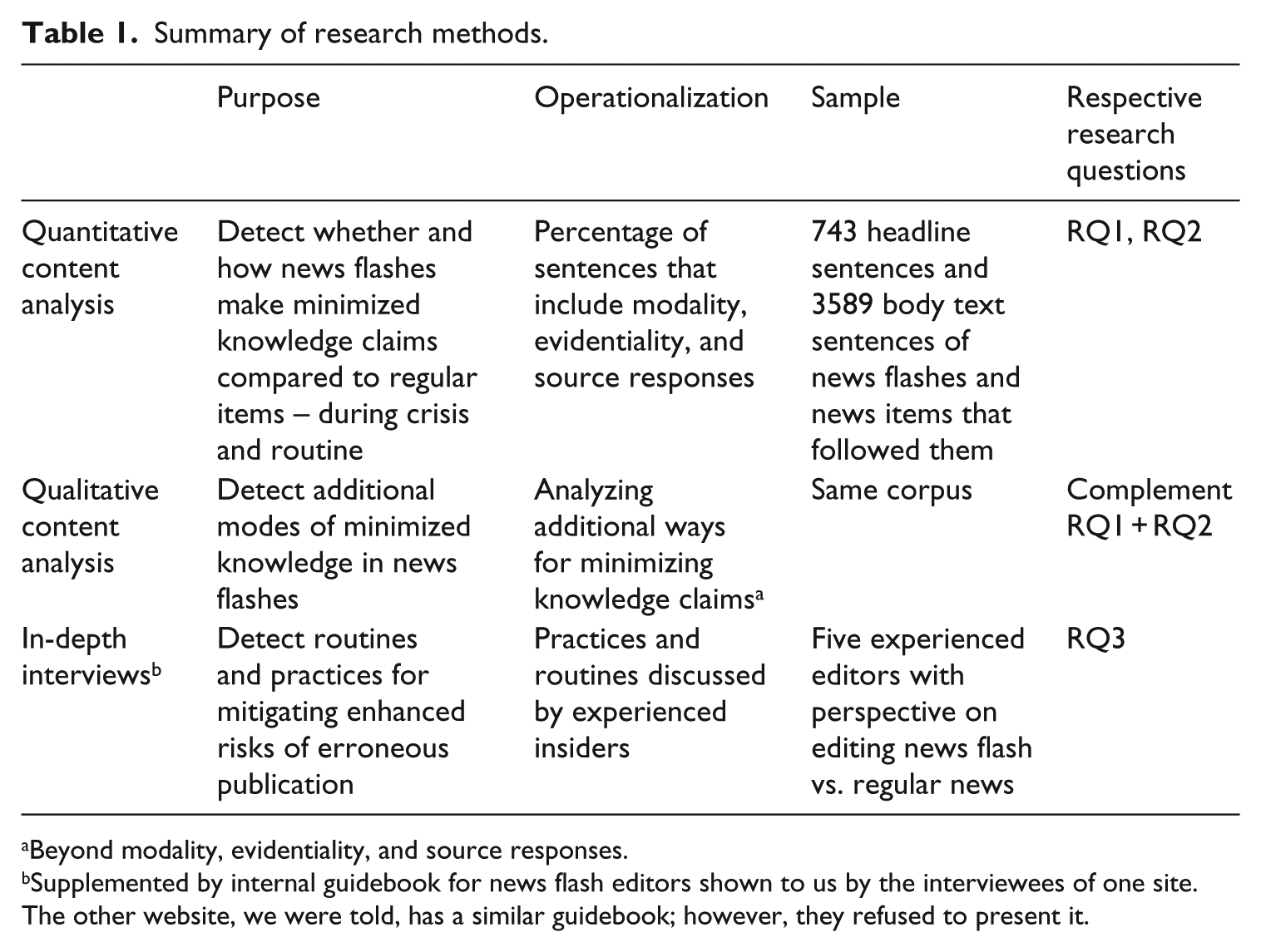
Beyond modality, evidentiality, and source responses.
Supplemented by internal guidebook for news flash editors shown to us by the interviewees of one site. The other website, we were told, has a similar guidebook; however, they refused to present it.
While the employment of minimized knowledge claims was addressed by quantitative and qualitative content analyses of flashes and news items that followed them in both websites, the practices of news flash production and presentation were addressed using in-depth interviews with specialized editors who had a perspective on editing news flashes and regular news. Furthermore, interviewees for one of the sites showed us their internal guidelines for news flash editing, while for the other site, we were told that they indeed had printed guidelines, but they refused to present them.
Finally, the discussion section tries to compare the proportion of errors in news flashes and final items in order to contextualize the findings and show whether, despite editors’ efforts, immediate publications like news flashes contain higher levels of errors, as common scholarly wisdom suggests (Boyer, 2010; Karlsson and Strömbäck, 2010; Lewis and Cushion, 2009; Phillips, 2011; Starkman, 2010).
Sampling
To enhance comparability, we included only flashes that were followed by a news item that covered the same event. Hence, out of thousands of flashes and hundreds of news items published during the 19 days of sampling, the final study is based on circa 700 items and flashes.
The sample included four types of content: routine flashes (N = 199), routine items (N = 95), crisis flashes (N = 412), and crisis items (N = 36). The sample included all crisis news flashes, since, as typical of crisis days, all flashes were dedicated to the crisis and followed by full-fledged news items, whereas during routine days only about 15 percent of the daily flash output was selected, as the rest were not followed by final news items.
Another measure to enhance comparability was the use of the single sentence as a unit of analysis since items were found 8–10 times longer than flashes. The analysis differentiated between headlines and body text, due to their different prominence, role, and composition.
Based on 6 weeks of close daily monitoring of both websites, some days on an hourly basis, we decided to sample materials manually and directly from both websites, using the following sampling procedure:
1. Copying the entire population of news flashes: In each of the sampled days, flash sections of both websites were visited daily, cutting and pasting all the flashes published during the 24-hour cycle (our preparatory monitoring showed, that news flash sections are reliable repositories with access to all flashes as originally published, and that they are removed 2–3 days after publication).
2. Locating the final items that followed them: To try and locate all the final items that followed these flashes in the studied websites, a combination of three tools was used: the website’s internal search engine, Google news search, and a manual search in the relevant sections and subsections. Searches included the reporter’s name and a series of story-specific keywords. To make sure that these were indeed final items, the three searches took place the day after. The entire process was labor intensive, lasting circa 4 hours per sampled day.
3. Clustering flashes and items: To enhance comparability, only clusters that comprised at least a single flash + a single item that reported the same event were included in the study. While flashes, as mentioned, could not be missed due to the inclusiveness of the flash sections, one cannot rule out that despite the thorough searches, we missed a news item here or there. However, the amount of potentially missed items could not be larger than this thanks to the hours spent daily on sampling and the use of no less than three search methods to locate the final publications. Furthermore, missing an item could not bias the picture substantially, since in that case the respective flashes were likely to be dismissed as well.
To avoid overemphasis of multi-version items, we included in the analysis only one version – the latter in the case of final items and the earlier in the case of news flashes (as happened in two flashes that involved a correction of error), in order to represent more polarized stages of knowledge acquisition. The potential effect of versions was marginal, since despite the updating nature of the Internet (McMillan, 2000) a vast majority of flashes and items were single shot publications.
To sample routine materials, we selected in advance 16 random days across the 4-month period between April and August 2014, while waiting for a crisis event that addresses our criteria. This occurred on 12 June 2014, when a Hamas group kidnapped three Israeli teenagers in Gush Etzion, an event followed by a wide search operation (that eventually deteriorated into a war with Gaza). Only 18 days after the kidnapping, when the bodies of the teenagers were found, it turned out that they had been murdered almost immediately. Our crisis sample included only the first 3 days of the event, after which the search for the kidnapped teenagers entered its routine phase, marked by the rising proportion of non-crisis flashes in the news flash sections.
To test intercoder reliability, a second coder was trained and asked to code 10 percent of the flashes and news items (Hayes and Krippendorff, 2007). Intercoder reliability was found high enough in all categories: 98.3 percent for modality, 89.8 percent for evidentiality, and 93.2 percent for source reactions with respective Krippendorff’s αs of 0.93, 0.71, and 0.85.
To complement the findings and illustrate the logic of minimized knowledge claims, we conducted a qualitative content analysis. The thematic analysis intended to identify recurring strategies for presentation and qualification of knowledge in news flashes, beyond the technical attributes of modality, evidentiality, and source responses and beyond the discursive manifestations of one strategy or another. While being fully open to find such strategies, we were also attentive to find in the text some footprints for the interviewees’ modus operandi (see in-depth interviews). The analysis included four steps: holistic reading of all flashes and marking potential strategies, three additional waves of iterative reading, identification of recurring themes, and comparative reading of the news items to make sure they rarely include these themes or do not include them at all.
In-depth interviews
Since news texts are often nontransparent regarding the practices of their production, we asked to interview news flash editors and observe their work, both of which were not allowed. However, we managed to conduct a series of five in-depth interviews with insider experts that have not only an intimate familiarity with news flash editing, but also a comparative perspective on editorial processes of news flashes versus regular online news. Four of them, interviewed face-to-face, were former news flash editors with 3–6 years of experience, promoted to the position of senior desk editors that maintain close relationships with current flash editors. The fifth, interviewed over the phone, was a chief news editor.
The thematic analysis of the transcribed interviews intended to identify patterned behavior of news flash editors. We were interested in finding themes that either might have footprints in the published text or may give essential context for understanding why news flashes look as they do. Special emphasis was put on news flash editors’ routines, practices, norms, and editorial strategies and their strategies for addressing uncertainties, fragmented information, competition, time pressure, and brevity, all these while comparing routine and crisis situations and news flashes versus regular items. The analysis included three steps: holistic reading of all the transcribed interviews and identification of potential theme, two additional waves of iterative reading, and identification of final themes.
Findings
The first research question addressed the differences in the total use of ‘circumscribed knowledge’ attributes (modality, evidentiality, and source reactions) in news flash and news item during routine and crisis events.
Findings in Table 2, based on the quantitative content analysis, show significant differences among the four types of content in the body text, where almost one-fifth (18%) of the sentences of news flashes in crisis situations involve at least one type of circumscribed knowledge (modality, evidentiality, or source reaction) – compared to 12 to 13 percent in other types of content. Though news flash headlines use overall more circumscribed knowledge attributes, differences between headlines were not significant, probably due to the limited N of headline sentences and their more careful editing.
Percentage of sentences with circumscribed knowledge claims in news flashes versus news items during routine and crisis situations.
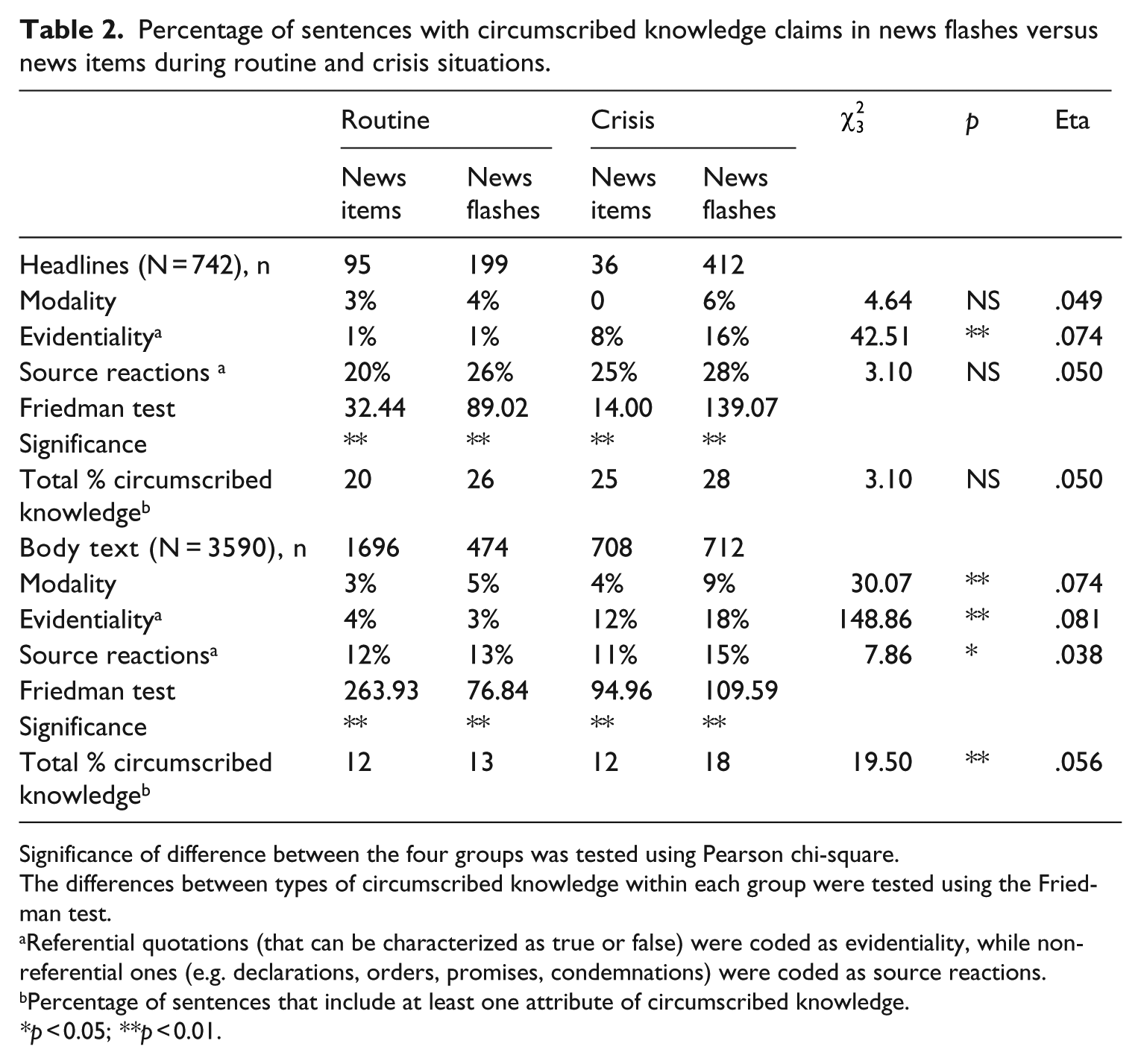
Significance of difference between the four groups was tested using Pearson chi-square.
The differences between types of circumscribed knowledge within each group were tested using the Friedman test.
Referential quotations (that can be characterized as true or false) were coded as evidentiality, while non-referential ones (e.g. declarations, orders, promises, condemnations) were coded as source reactions.
Percentage of sentences that include at least one attribute of circumscribed knowledge.
p < 0.05; **p < 0.01.
Further analysis of the data shows that the intensity of ‘circumscribed knowledge’ changes as well during crisis. While in routine situations, the typical pattern is using only one attribute of circumscribed knowledge (in 61% of the sentences that include circumscribed knowledge in routine flashes and 63% in routine items), in times of crisis the typical mode involves – two to three circumscribed knowledge attributes (in 83% of the sentences that include circumscribed knowledge attributes in crisis flashes and 94% in crisis items).
Different types of circumscribed knowledge
The second RQ focuses on the specific attributes of ‘circumscribed knowledge’, based again on the quantitative content analysis. As indicated in the lines of Friedman’s tests in Table 2, there is a significant difference between the types of circumscribed knowledge attributes used across all types of content. Examination of the percentages shows that the most prevalent measure by which journalists distance themselves from liability for published content are source reactions, which are most prominent in headline sentences (20%–28%). In the body text, they were used more than any other form of circumscribed knowledge in routine situations (12%–13%), both in news flashes and regular items. On the other hand, in crisis news flashes, modality is the least preferred measure (0%–6% in headlines and 4%–9% in body text sentences). Evidentiality is preferred only during crisis situations in body text, both in news items and news flashes.
However, coping with knowledge deficits often involves measures beyond modality, evidentiality, and source reactions. A further qualitative content analysis reveals three manifestations of minimized knowledge, seen almost exclusively in crisis flashes.
The first is openly admitting lack of knowledge. Contrary to regular news, where journalists try to obscure deficits of knowledge in order to establish an authoritative voice (Frank, 1999), here journalists admit straightforwardly their lack of knowledge. For example, ‘Representatives of the military wing of Hamas were absent from the press conference for reasons unknown’; ‘It is still unclear whether the event [the encirclement of the house in Hebron] is associated with the teenagers’ kidnapping’.
A second manifestation was making third parties accountable for information deficits. Unlike regular attributions, here the reporters indicate explicitly who was responsible for the deficit. For example, ‘Major General Mordechai [Israel’s coordinator of government activities in the territories], refused to say whether there is information that the kidnapped boys are being held in Hebron’. In other cases, journalists made do with a clarification that they should not be held accountable for the information deficit: ‘There was no way to confirm at the State Department that one of the kidnapped boys is a US citizen’.
A third manifestation of limited knowledge, that is indicative of the severity of the informative deficit and can hardly be found in regular news, was negating reports. This means flashes reporting what had not happened. For example, according to the senior source, ‘there is no indication whether they [the kidnapped teenagers] are alive or dead’. ‘A senior Egyptian official: Hamas hasn’t tried yet to contact Egypt’.
Other strategies
The third RQ addresses other strategies news flash editors developed, according to in-depth interviews, to protect their news organizations against erroneous publication. To understand the pressures that news flash editors encounter, one must take into account that during times of crisis, the number of flashes per hour tends to surge from – 4 to 5 to 10 to 15. Much more dramatic, according to all our interviewees, is the surge in the torrent of incoming information from numerous stakeholders outside and inside the newsroom they tried, often hopelessly, to keep up pace with. To address these and other pressures, news flash editors developed the following strategies of knowledge acquisition and knowledge presentation.
Adherence to the little that is known with enough certainty
The main strategy for publication of flashes under conditions of uncertainty was focus on the little you know confidently enough. The classic example, given by one of our interviewees, referred to the typical flash aired during times of tension between Israel and the Gaza strip: ‘A ‘red color’ siren [early warning for rocket attack] was heard across the Eshkol Regional Council’.
Brevity
For flash editors, brevity is not only a format constraint, rather a desired strategy for minimizing space for errors. ‘More words’, said one editor, ‘means greater opportunities for error’. Data show that brevity reflects the differences between news and flashes and between routine and crisis. If a routine flash involves 2.4 sentences on average (circa 45 words), a crisis flash comprised two sentences (circa 20 words), while a regular news item contains between 8 and 20 sentences (350–450 words).
Delayed publication
Whenever news flash editors have doubts regarding incoming information, or detect contradictory information, they are instructed by their websites to delay publication until they have a more coherent picture of the state of affairs. ‘Haste is of the Devil’, said one editor, ‘and the devil is us. We are constantly instructed: reliability and accuracy before speed. And it doesn’t change the fact that the entire system is speed-oriented’. Another interviewee: ‘Since we ascribe ourselves some responsibility, our foot on the brake is tighter than our foot on the gas. You do not go public with everyone that says something’.
Filtering information through the reporting system
Despite the constant updates flowing directly to their desks from official sources and first responders, news flash editors were instructed to run every news snippet through the network of the news site’s reporters prior to publication. Reporters, in turn, often ran the information through their network of news sources. As we learned from our interviewees, the insistence on reporters’ mediation, despite the painful time toll and the technical possibility of bypassing them, was that the studied websites saw their existing ‘news net’ (Tuchman, 1978) as the best antidote against erroneous publications. Both reporters and sources in this net have the knowledge, experience, prior acquaintance, and judgment to evaluate information (Manning, 2001). Furthermore, despite the tendency of western news organizations to perceive very short items as authorless (Reich, 2010), both websites byline almost every flash, probably due to the accountability function of credits, which enhances author responsibility for the published creation (Fisk, 2006).
Learning from past errors
To minimize errors, websites systematically draw lessons from erroneous publications using both written and unwritten procedures. For example, after a false report of an earthquake, based on a series of citizens’ alerts, one of the websites issued new guidelines according to which earthquakes can be reported only if approved by the head of the Geophysical Institute, providing news flash editors with his mobile number and permission to wake him up in the middle of the night. Similarly, procedures forbid writing flashes ahead of time. The constant lesson-learning was also manifest in the opening words of the guidebooks for flash editors: ‘the following pages include a collection of remarks, some of which were written in blood’.
Corrections on the go
When errors are discovered immediately after pressing ‘publish’, editors are expected to try and correct them ‘in the air’, eliminate the flash or turn it into an error page, assuming that technical errors are more tolerable by the public than factual ones.
All these strategies, however, do not suffice to prevent all errors. One editor said,
There is a procedure whereby if you made a serious mistake you can delete the flash so the user will see it as a bug […] a deleted flash […] has a life of its own in the web.
Discussion and conclusion
Out of four news products studied here – routine items, routine flashes, crisis items, and crisis flashes – only the latter contains a significantly higher proportion of sentences in which journalists limit their liability by using significantly higher levels of modality, evidentiality, and source responses. This may suggest that under the convergence of both constraints – crisis and immediacy – news flash editors find themselves furthest outside their epistemic comfort zone. Under these pressures, they are willing to make substantially wider use of measures that lower their own voice, distance themselves from full responsibility for the published content, and minimize their knowledge claims. This trend is in contrast with the dominant tendency of journalists (and occupations in general) to maximize their epistemic authority using knowledge performances (Reich and Godler, 2016).
The more cautious practices, especially in crisis situations, are congruent first with the ‘inductive errors’ approach (Stephen, 2015), according to which responsible epistemic agents are ready to tolerate ‘false-negative’ errors (e.g. overlooking, delaying, playing down a true occurring event or unnecessarily sharing the information about it with a third party) – in order to minimize ‘false-positive’ errors (erroneous publication).
A second perspective congruent with editors’ practices and their minimized knowledge claims in news flashes is ‘pragmatic encroachment’ theory, according to which responsible epistemic actors tend to raise the threshold of proof when facing higher risks of erroneous publication. This may suggest that minimizing knowledge claims reflect not only a strategic ritual, but also genuinely narrower levels of knowledge. First, aspiring for higher standards of certainty lowers the range of potential knowledge (Miller, 2014) especially in situation of uncertainty (Berkowitz and Zhengjia, 2016). Second, knowledge acquisition itself is a process that transpires over time, as the philosopher and psychologist William James had shown. Hence, having less time for knowledge acquisition means less knowledge.
If regular news has a ‘stroboscope’ effect (to use the metaphor suggested by both Ericson et al. (1989: 254) and Dayan Katz (1992: 22), slicing events and processes into thin fragments, news flashes have a hyper-stroboscope effect. Like a stroboscope in a dance club, the short-lived light beams of news flashes often capture dramatic, hesitant, and transient positions that seem awkward. Under the less abrupt beams of regular news these congeal and solidify into more stable positions that look more familiar and less awkward. This is manifested most clearly during events in which news flash editors are trapped between an unscheduled, dramatic event on the one hand, and an information deficit on the other hand. One of the examples for this catch was the flash: ‘IDF soldiers besieged a house in Hebron and probably launched a missile at the building’. Oddly enough, from the perspective of regular news, this item could have become more dramatic and newsworthy had the editor waited a few minutes until the results of this house siege become clear. However, the hyper-stroboscopic logic of flashes legitimizes such narrow slices of information.
The richness of the practices seen across this article, based on a triangulation of methods, suggests that unlike regular journalists, who handle ‘the most unexpected occurrences […] through the most predictable routines’ (Berkowitz and Zhengjia, 2016: 156; see also Hermida, 2015; Marriott, 2007; Tuchman, 1972), news flash editors develop a series of special strategies to address the perpetual uncertainties of their platform.
Finally, to contextualize the findings, we explored the extent to which news flashes contained more errors, despite the efforts to minimize them. Obviously, we could not conduct here a full-fledged accuracy study based on news sources evaluations (Maier, 2005; Meyer, 1988; Tillinghast, 1982); yet, it was systematic enough as an initial indication at least regarding obvious errors that can be detected by ordinary readers, such as typos, misspelling of names, and erroneous details. 3
Our findings indicate that the body text of news flashes contained significantly more errors especially during crisis (where 8% of the sentences contained at least one error, compared to 4% in routine flashes, and 1%–2% in news items) (
The limitations of knowledge under extreme time pressures exposed here are only the tip of an iceberg that may keep growing with the proliferation of hyper-quick news platforms. Further studies are encouraged to examine the effects of extreme time pressures on other platforms, and for news cultures and contents overlooked here such as flashes that were not followed by full-fledged items and events whose coverage was minimized, postponed, circumvented, or ended up in errors that could not be detected using our research design. Further studies should explore, for example, whether ‘false-positive’ errors are more tolerated on platforms such as Twitter, which represents reporters’ personal voice, and among epistemic agents outside mainstream media, such as independent journalists, citizen journalists, activists, and bloggers. They should also pay attention to push alerts, that might be more competitive, visible, and hence more detrimental to the reputation of the news site than regular new flashes in case of erroneous publication. Contrary to our manual sampling scheme, automated scraping could better guarantee the capture of every published version, and hence be more nuanced and sensitive to evolving knowledge.
Journalism scholars, educators, and ethicists should reexamine the common, pessimist wisdom concerning publication under extreme time pressures (Barnhurst, 2011; Boyer, 2010; Karlsson and Strömbäck, 2010; Phuvipadawat and Murata, 2010; Starkman, 2010). In postindustrial information societies, speed is not only here to stay (Bauman, 2000; Glick, 1999; Wajcman, 2008), but is also enabling individuals to react in real time to financial, political, and existential threats during which information can become a matter of life or death (Castells, 2010; Knorr-Cetina, and Preda, 2007; Le Cam and Domingo, 2015; Neubig et al., 2011; Padley, 2012; Phillips, 2011). According to philosopher Alvin Goldman (1992), the quicker truthful information reaches potential audiences, the more positive its epistemic consequence can be.
Footnotes
Acknowledgements
The authors thank Dr Zohar Kampf and Yigal Godler for their contributive remarks to earlier versions of this article.
Funding
The author(s) received no financial support for the research, authorship, and/or publication of this article.