



Abstract
This study aims to investigate the translation of attribution, one of the key journalistic conventions to ensure news credibility, in the context of South Korea. An examination on how attribution is translated can address one of the major challenges facing today’s news industry: the erosion of credibility. While the growth of new media threatens news credibility, the norms and process of news translation can aggravate this credibility. Based on the attribution principles for Korean and English news, this study compares 359 Korean-language articles and their English translations collected from the websites of South Korea’s three major newspapers to investigate whether and how the meanings and functions of attribution change in the process of translation and what impact the changes may have on news credibility. The findings show that the meanings and functions of attribution change in the process of translation, and the consequence is not insignificant because it can weaken credibility, which in turn calls for more scholarly and practical attention to the translation of attribution in this fast-changing media landscape.
Introduction
This study aims to investigate the translation of attribution, one of the key journalistic conventions to ensure news credibility, in the context of South Korea. In today’s media industry, attribution and translation are related to one of the biggest challenges from the growth of new media based on the Internet: the erosion of credibility. New media and the digital environment transform how news is produced, distributed, and accessed (Collis et al., 2009; Price, 2015). Members of the public act as publishers, authors, and increasingly the breakers of news stories, and the vast majority of stories on new media outlets originates from other media, online communities, and even an individual’s cell phone (Alterman, 2008; Collis et al., 2009: 9; Cushion and Lewis, 2010: 176; Price, 2015). In this production model, verification of news sources and checking the accuracy of stories before publishing rely on readership or community rather than professional reporters and editors (Alterman, 2008), and the Internet allows much faster and wider distribution and easier access to news. While these changes can provide the public with a democratizing influence and force against censorship (Price, 2015: 8), they can also obscure the boundary between facts and opinion or the reliability of information and accelerate the dissemination of false news, which can damage the credibility of news and the new media that produce it (see Alterman, 2008; Cushion and Lewis, 2010; Garrison, 2000; Morozov, 2009). For instance, during the Hurricane Katrina crisis, activist Randall Robinson’s post on the Huffington Post referred to reports from New Orleans about people ‘eating corpses to survive’, which later turned out to be ungrounded. Although founder Arianna Huffington promptly asked Robinson to post a retraction, it was not fast enough to prevent the false information from being repeated elsewhere (Alterman, 2008).
The credibility issue is not confined to new media; it can affect traditional news organizations which have already seen deteriorating public trust (Alterman, 2008; Bivens, 2008). As the convergence has become the norm in news production (Bivens, 2008) and trends on social media are increasingly seen as genuine news, traditional news organizations use materials published by such media or leverage social networks to attract younger audience or advertisers (Collis et al., 2009: 7; Price, 2015: 8). Since the facts are not always checked properly (Cushion and Lewis, 2010: 176), issues of credibility that plague new media often spill over into the realm of traditional media (Price, 2015: 8).
While weakened credibility requires media organizations, both new and traditional, to increase efforts to gain trust from readers, it can also point to an increasingly important role of traditional media in verifying sources and information. This means that the eroding credibility in today’s news industry can be a threat and an opportunity at the same time for traditional media, which highlights the need for a thorough investigation into journalistic practices of verifying sources to ensure news credibility. This study attempts to satisfy this need by examining the practice of attribution which is the act of identifying sources of information and one of the most important rhetorical devices in journalism to present articles as credible (see Harcup, 2014; Ingram and Henshall, 2008; Mencher, 1984; Park and Lee, 2007; Shoemaker and Reese, 1996; Song, 2005).
This study explores attribution in the context of translation since the norms and process of news translation can make a detailed presentation and verification of sources difficult. In news translation, drastic intervention is tolerated and even encouraged or required because priority is placed on meeting the expectations and demands of target readers – who are likely to view the translated versions as the original stories per se – and ensuring the prompt transmission of information (Bassnett, 2006; Bielsa, 2007; Chen, 2009; Valdeón, 2005a, 2005b; Van Doorslaer, 2010). While the translated articles are systematically disassembled and re-used as raw material for the construction of news stories, globalization and digitization accelerate the process to the extent that texts are selected not just by consistency of meaning but for their size and adaptability to a given frame (Orengo, 2005: 172–173). Such norms and process suggest that the need to clearly identify sources can be overlooked or ignored and the traces of sources can be missing in news translation, which will further aggravate the credibility problems. Despite this potential impact, attribution has been rarely discussed in an in-depth manner in journalistic translation research which grew exponentially in the 21st century covering translated texts, translation processes, and reception issues (Valdeón, 2015: 634). Vuorinen (1999) and Chen (2009) briefly address attribution in their research, but on the sidelines of their investigation on quotation, another rhetorical device to support news credibility (see Tuchman, 1972; Van Dijk, 1988). This lack of academic attention reinforces the need for this research which focuses on the translation of attribution.
This study examines Korean-to-English news translation provided by South Korea’s traditional newspapers since the practice in the country’s specific circumstances can further support the relevance of attribution in the context of translation. Given that translation mediates between two cultures, the journalistic conventions of which may be different, insufficient knowledge of the difference and failure to comply with the conventions of the target culture can confuse or alienate target readers. If the conventions are concerned with attribution, readers’ perception of news credibility will be significantly affected. In Korea, most Korean-to-English translations by newspapers are produced by translators rather than journalists whose main job is to write original Korean-language articles based on English-to-Korean translations or original English articles. While professional journalists are likely to have sufficient knowledge of journalistic conventions, translators often lack this knowledge due to little or no reporting experience or relevant education and training (Hong, 2014a, 2014b). Given that these news translators are employed as translators, not journalists, it may not only be infeasible but also undesirable to ask them to observe all journalistic conventions. Still, given that translators’ compliance with genre conventions specific to the texts they deal with affects the quality of translations and professional ethics, attribution – which governs how to present news sources in the text – may be one of the most essential journalistic conventions these news translators are expected to abide by. The Korean-to-English translation offered by the country’s traditional newspapers is also worth an investigation since it is one of their important strategies to overcome another challenge from new media: decreasing revenues. As many newspapers are going online and providing various types of content to drive their profitability (Alterman, 2008; Collis et al., 2009: 7; Price, 2015: 5, 8), South Korea, the world’s most wired country with the highest Internet penetration rate, is also witnessing its traditional newspapers quickly leveraging the Internet and aggressively offering various content. One of the most active service areas is the translation of their original Korean-language articles into foreign languages, particularly English. As of mid-December 2017, 7 of the country’s 10 most circulated newspapers provide English translation services. 1 These specific circumstances of Korea’s media industry require more focused research on how attribution is translated from Korean into English, which can provide implications for traditional media across the world seeking new revenue sources.
This study can also bridge the methodological gap between Translation Studies and journalism by adopting a data collection method widely used in journalism research for news content analysis. While the textual analysis in the journalistic translation research so far has drawn on methodology from various disciplinary areas ranging from cognitive linguistics, critical discourse analysis, descriptive translation studies to narrative theory, the interface between translation and communication studies is yet to be fully exploited (Valdeón, 2015: 647–648). The approach adopted by this study will help enhance the plausibility of the discussion and the validity of the methodology and draw useful implications for both disciplines.
In an attempt to explore the translation of attribution by the South Korean newspapers focusing on Korean-to-English translation, this article will seek answers to the following three research questions:
How are the expressions for attribution presented in the source text (ST), and what are their meanings and functions from the perspective of attribution principles for Korean news?
How are the expressions translated in the target text (TT), and do the translated expressions have similar meanings and functions to those in the ST from the perspective of attribution principles for English news?
What effects do the changes, if any, bring about in terms of credibility, and what may have brought about the changes?
News source, attribution, and credibility
Having addressed the relevance of credibility, news sources, and attribution in today’s media landscape, this section will introduce the definition and importance of news sources and the significance of attribution discussed in journalism to provide a more fundamental understanding of their functions to support news credibility.
News sources are defined as individuals, institutions, or documents that provide the information in a news story in a large volume of journalism literature. According to Mencher (1984: 709), a source refers to a person, record, document, or event that provides the information for the story. Gans (1979: 80) defines news sources as the actors whom journalists observe or interview. Lee and Jung (2007: 62) say that the subjects that reporters approach for news stories, such as individuals, organizations, or materials and documents, are referred to as sources. Sources have been viewed as playing an essential, fundamental, and critical role in news production as suggested in the metaphors used to describe them ranging from ‘starting point’ to ‘heart’, ‘bible’, and ‘lifeline’ (see Conley, 2002; Fedler et al., 2005; Franklin and Carlson, 2011; Gans, 1979; Keeble, 2006).
The significance of sources supports the importance of attribution, a journalistic convention which governs how to present them. Attribution refers to the act of identifying the sources of information in news (Harcup, 2014; Ingram and Henshall, 2008; Mencher, 1984) and is closely associated with objectivity and accuracy which are important measures of credibility in journalism (Gaziano and McGrath, 1986; Meyer, 1988). Shoemaker and Reese (1996: 108) stress that attributing statements to sources is a key element of the objective ritual as it protects against accusations that they have been manipulated. Attribution also serves as a device to attest the accuracy of news. Boeyink (1990: 235), citing Adler (1977), says that attribution is a significant truth-telling check on a reporter’s accuracy by helping others verify the reported information on their own. Nam (2001: 228–232) stresses that attribution provides an important standard to gauge news credibility. Given these discussions, accurate and transparent attribution can be arguably considered one of the most important responsibilities and professional ethical standards for those involved in news production who are expected to ensure news credibility.
Accurate and transparent attribution, however, requires sufficient knowledge of relevant principles since attribution is made in a variety of forms with different meanings and functions depending on the reported information’s degree of certainty and types of sources. It becomes more complicated for news translators who mediate between two cultures which may have different journalistic conventions. Since this study compares English translations of Korean-language articles, the following section will examine detailed attribution principles suggested by major journalism textbooks and media organizations’ guidelines for Korean and English news articles which helped construct a framework for the textual analysis of this study.
Attribution principles
In this section, attribution principles for Korean articles will be first addressed as a framework to identify the meanings and functions of attribution in STs. These principles are also likely to affect the corresponding TTs produced by the translators in this study since they work at Korean newspapers, possibly providing clues to the reasons behind their choices. Their counterparts for English news will then be investigated as a framework to examine whether the meanings and functions of attribution in STs change and TTs comply with the attribution principles widely accepted in the target culture.
Attribution principles for Korean-language news
Attribution principles suggested by most Korean journalism textbooks and media organizations call for the transparent and detailed disclosure as well as the accurate presentation of sources.
Among many textbooks, Nam (1997: 149) argues that disclosing not only who said what but also where, to whom, and under which circumstances the source spoke as well as how the reporter obtained the information should also be clearly stated. Nam (2001: 232) advises reporters to use specific expressions such as ‘a high-ranking source at the Foreign Ministry’ or ‘a high-ranking official in the Minjoo Party’ instead of vague wordings such as ‘diplomatic source(s)’ or ‘a source in the political circle’. Yoo (2002: 218) calls for reporters to exercise vigilance in quoting sources, from using correct spelling to presenting accurate numbers.
Korean media organizations also require their reporters to disclose sources in a transparent and detailed manner. 2 The Chosun Ilbo’s Rules for Reporters and Standards for Reporting Accident to Protect Human Rights, respectively, call for disclosing the names of sources in all stories except when the sources or related people can suffer a serious disadvantage due to the reports (Kim, 2004: 128–129; Lee, 1998: 88–90). The Hankyoreh’s (2007) Rule on News Gathering and Reporting suggests that every story attributes the sources of all information as specifically as possible and that the name and other identifying features be basically provided.
Hierarchy
Some Korean textbooks discuss hierarchy in the importance of sources in terms of credibility. Nam (2001: 228) stresses that an announcement on the same policy carries different credibility depending on who makes it, for example, the president, a minister, or a working-level official, reinforcing the importance of clear and specific attribution of sources to enhance news credibility.
Reporting by other media
Attribution principles for other media’s work are also stated since news organizations publish not only stories produced by their own reporters but also those reported by other organizations. The Dong-A Ilbo prohibits plagiarizing content reported by other media and JoongAng Ilbo requires its reporters to clearly give credit to the original source when quoting other media organizations or materials (Kim, 2004: 124–126, 130–136).
Attribution principles for English-language news
For English-language news, reporters are required to provide attribution except for obvious, well-known, or easily verified facts (Mayeux, 1996; Reuters, 2013; The Associated Press (AP), 2017). More specifically, attribution should be given when there is uncertainty about the source, an opinion is expressed, potentially inflammatory statements are made, or information may be controversial (Mayeux, 1996: 25). For industry-wide guidelines, the Statement of Principles by The American Society of Newspaper Editors (ASNE, 1975) stipulates in Article VI that ‘Unless there is clear and pressing need to maintain confidences, sources of information should be identified’.
Individual media organizations also suggest detailed attribution principles, all of which stress the following two rules: (1) transparent and specific disclosure of sources’ identity and (2) accurate presentation of sources’ identity.
The Washington Post’s (WP) (1999: 2) Standards and Ethics pledges to reveal the source of all information except when the newspaper agrees to protect the source’s identity, and in any case, some type of identification is almost always possible and should be reported. Reuters’ (2013: 3) Handbook of Journalism advises giving as much context and detail as possible about sources to authenticate the information they provide. The New York Times (NYT) (1999) states that if a scene directly witnessed makes a material difference, it should distinguish in print between personal interviews and telephone or email interviews, as well as written statements.
Along with the transparent and detailed description, the accurate presentation of sources is also highlighted. Reuters (2013: 564) asks reporters to never deliberately mislead when sourcing by, for example, providing an incorrect number of sources. Reporters should correct their stories when there is a misspelling, an erroneous name, or typos in proper names. Bloomberg News also requires a correction for misspelled names and words that change the meaning of a sentence, missing first references and incorrect attribution (Winkler, 2012: 83).
Hierarchy
English-language media organizations also categorize the hierarchy of sources depending on their closeness to the information and authority which reinforce their credibility. According to this ‘sourcing hierarchy’ (Keeble, 2006: 54) or ‘gradation of sources’ (Reuters, 2013: 561), specific principles for attribution are suggested.
Reuters (2013: 561–563) divides news sources into three categories depending on their importance. The best source is a Reuters journalist or camera which provides firsthand reports. The next best source is a named source, and the name and position should be identified whenever possible to allow readers to assess how close the source is to the information. The weakest sources are anonymous sources, and they are subdivided into authoritative sources (e.g. a foreign minister), official sources (e.g. a company spokesman), and designated sources (e.g. diplomatic sources) in order of strength. Keeble (2006: 53) stresses that inclusion of relevant details of sources, such as titles or descriptive phrases accompanying their names, immediately ‘hardens’ the story, while the presence of ‘ordinary people’ without any title or representative function ‘softens’ it. This means making a distinction in hierarchy between sources in attribution can help increase news credibility.
Reporting by other media
Stories based on reports from other media organizations also require transparent and clear attribution to avoid a possible accusation of plagiarism. Bloomberg warns its reporters against unattributed copying of other news organizations’ work, defining the act as plagiarism (Winkler, 2012: 77). NYT (1999) also attributes facts gathered by any other organizations, including newspapers, books, and broadcasts as well as news agencies such as AP. That means even if AP is a co-op and NYT is a member, NYT does not use AP’s reporting as its own.
Comparison of attribution principles between Korean and English news
As is readily apparent, attribution principles for Korean-language and English articles are essentially identical in valuing the transparent and accurate presentation of news sources. However, the guidelines for Korean news are not as detailed as their counterparts for English news, leaving the practice at the discretion of each news producer. Park and Lee (2007: 449) stress that Korean media organizations’ codes of ethics or stylebooks, if any, fail to offer detailed guidelines for attribution. Because no explicit education is given to cub or junior reporters, they must learn how to attribute sources from senior reporters’ revision or editing, raising the possibility of incorrect practices being repeated (p. 449). In addition, the guidelines for Korean news are inclined toward protecting news sources rather than disclosing them in a transparent and detailed manner, and this ‘relative passiveness in attribution’ can be explained by the country’s historical background (Nam, 1997: 49). For an industry-wide code of ethics, the Korea News Editors’ Association (KNEA) announced the Newspaper Code of Ethics and the more specific Practice Guidelines of Newspaper Code of Ethics on 7 April 1957. However, the first revision was made on 30 July 1961 when freedom of the press was severely suppressed after the 16 May military coup led by former President Park Chung-hee. Protecting news sources rather than disclosing them was deemed a more important principle in reporting news (Nam, 1997: 42–45). It was not until 8 April 1996 that the provision on attribution was included when the latest revisions were adopted by the KNEA, Korean Association of Newspapers, and Journalists’ Association of Korea (Kim, 2008: 15). As a result, devoting comparatively less attention to attribution has become ‘chronic’ in practice, and vague expressions such as ‘알려졌다’ [be known to] are frequently used instead of providing clear information on sources in South Korean journalistic culture (Nam, 1997: 45). In other words, such expressions can provide journalists with a practical means to attribute their news sources without putting the sources at risks.
These specific conditions suggest that Korean-to-English translators in Korean journalism may pay less attention to attribution when understanding Korean-language STs and producing English TTs for readers who are familiar with the journalistic conventions that place greater value on transparent and detailed attribution. It is this gap that supports the necessity of the present study’s attempt to investigate how sources are attributed in translations which are produced by translators in Korean journalistic culture but consumed by English-speaking readers accustomed to their relevant journalistic conventions.
Method
Since most Korean media provide their Korean-to-English translation services only via their homepages, data were collected from the websites of the country’s three most circulated daily newspapers based on the Korea Audit Bureau of Circulations (2006): The Chosun Ilbo, The Korea Economic Daily (KED), and The Hankyoreh. The Chosun Ilbo has the largest circulation and is one of Korea’s most conservative newspapers, while The Hankyoreh, the seventh most circulated daily, is considered most progressive in Korea. KED ranks fifth in circulation among dailies and second among business newspapers. In terms of the number of website visitors, The Chosun Ilbo ranks first and The Hankyoreh is seventh among dailies, while KED was the most visited business newspaper for the week through 11 July 2017, according to the latest available weekly data as of mid-July 2017 from Rankey.com (http://www.rankey.com), Korea’s Internet data analysis service provider. The inclusion of the highly ranked newspapers with diverse political views can help this study draw conclusions that represent and therefore readily apply to the country’s media industry as a whole.
A total of 177 English TTs and 182 Korean STs were selected from articles produced by these newspapers during a 1-year period from 20 January 2015 to 19 January 2016. 3 Instead of retrieving all news stories during the period, this study selected articles on six simple random days, which Wang and Riffe (2010) suggest as the most effective and efficient sampling method to represent the population of 1 year’s online news content. The sample dates were 21 January, 18 May, 23 July, 14 September and 18 November 2015, and 18 January 2016.
The expressions used to attribute sources in STs were examined to identify their meanings and functions based on attribution principles for Korean news. Then, the translated expressions in TTs were compared to explore whether they had similar meanings and functions to those in STs from the perspective of attribution principles for English news. Finally, the possible effects of and explanations for the changes, if any, were investigated.
The next section will focus on cases where the meanings and functions of attribution in STs are changed in the process of translation and therefore the reported information’s credibility or readers’ perception of it is affected. These cases can provide clues to the knowledge and awareness of attribution principles for Korean and English news among translators or other participants in Korean-to-English news translation within Korea’s media organizations. To help better understand the changes in each example, author’s English gloss translation of Korean STs will be provided in a square bracket and information added by author will be presented in parentheses when necessary.
Findings
Change in the meaning/function of Korean news–specific/implicit attribution
Confusion between facts and assertions about facts
As discussed earlier, in Korean journalistic culture, vague expressions without clear identity of sources, such as ‘알려졌다’ [be known to], are frequently used to protect sources (Nam, 1997: 45). Such expressions, which also include ‘전해졌다’ [be said to] and ‘파악됐다’ [be identified to], serve another function: to distinguish between facts and assertions about facts. These expressions, usually used for sensitive or contentious information, conceal specific identity of sources, on one hand, and clearly show that the reported information is not officially confirmed of announced although it was obtained from sources, on the other hand. In this case, an indication of sources’ identity, usually anonymous, is often provided in the preceding or/and following sentence or paragraph. Given that attribution principles for Korean and English articles require clear distinction between facts and assertions about facts (Mayeux, 1996: 25; KNEA, 1996b; The Hankyoreh, 2007), English translations of such expressions in Korean news should also indicate that the information is not confirmed or announced and provide any indication of sources. However, translators often fail to provide attribution in such cases, suggesting they are unaware of the meanings and functions of those expressions.
Example 1 addresses the translation of a sourced story about a sensitive and contentious issue, which is the North Korean purge directed at thousands of its own people. Due to limited access to the reclusive regime and the sensitivity or potential risks involved, stories on North Korea often use indicative expressions to suggest that the information is not officially confirmed or announced and cite anonymous sources, such as relevant government officials, defectors, or an intelligence agency, as shown in the ST. Although the reporter clearly uses direct quotes made by the source in the second paragraph, he uses the expression ‘전해졌다’ [is said to] in the first and fifth sentences to avoid presenting the information as a given or confirmed fact.
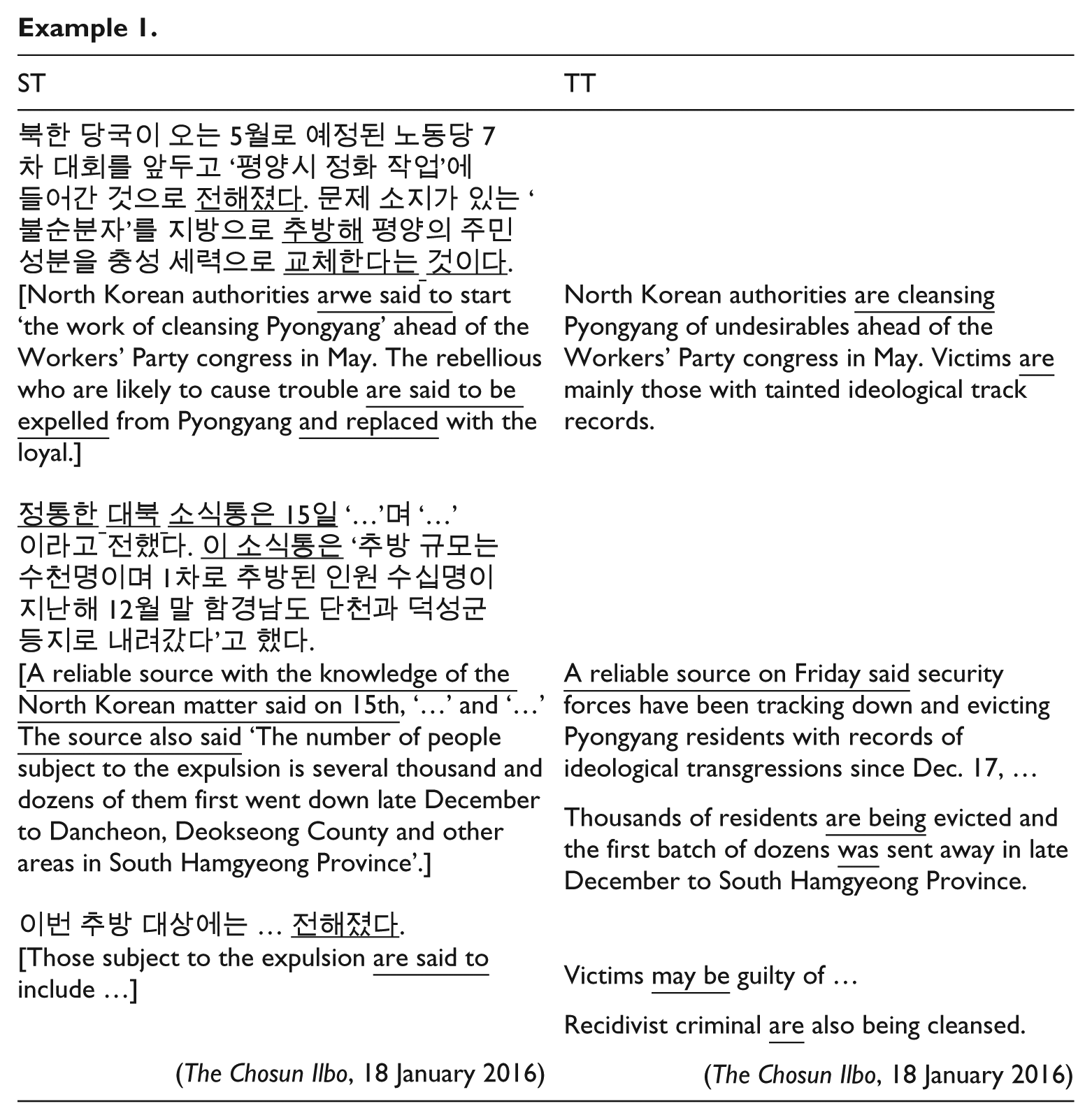
To provide the meanings and functions of this indicative expression in compliance with the attribution principles for English news, the source of the key information in the TT, that is, the North Korean purge against thousands of its people, is advised to be clearly presented in the first paragraph because the event is not a given fact and should be attributed whenever it appears since it is a sensitive issue. However, the TT drops most of the attribution, including the indicative expression, failing to show that the information is not a given fact or officially confirmed. In the first paragraph, the TT uses the present or present progressive tense, such as ‘North Korean authorities are cleansing […]’ and ‘Victims are mainly those with […]’ instead of presenting the source of the information or at least an indicative expression. Consequently, readers have to wait until the third sentence to discover that the information is an allegation from someone whom the article describes as a reliable source. In addition, only one out of the six translated sentences is attributed throughout the story. Specifically, the attribution to the second direct quote in the ST is removed in the process of being changed into an indirect quote. This cannot be considered sufficient from the perspective of the attribution principle for English news which requires reporters to present the sources of a contentious statement each time it appears. This is not just a matter of expression because it can ultimately confuse readers in terms of a given fact versus assertions about a fact in a highly sensitive story, which can, in turn, weaken the credibility of an article. Given the difficulty in distinguishing between facts and opinion in today’s news industry significantly threatens news credibility, Example 1 suggests that insufficient rendering of attribution in news translation can further blur the distinction and therefore damage the credibility.
Change in the meaning/function of implicit attribution
Failure to credit other media organizations’ work
As discussed earlier, attribution must be provided for other media’ reports, and this principle also applies to when using stories from other media based on a contract (NYT, 1999). South Korea’s media organizations often sign a contract with other news organizations to use all or part of their stories. However, TTs often fail to properly and clearly cite ST producers that are not from their organizations.
The ST in Example 2, from KED’s Korean-language homepage, is highly likely to have been published based on a contract with The Yonhap News Agency. The headline, structure, and expressions are exactly the same as the story produced by Yonhap and published on the agency’s homepage. Specifically, the byline and dateline, which provide information on the reporting location; company name, that is, The Yonhap News Agency; as well as the reporter’s name and email address remain intact on the KED homepage, hinting that the story was originally produced by Yonhap and therefore serving as a form of attribution to the news agency. The only difference from the version on the Yonhap homepage is the lower placement of the reporting location, company name, and reporter’s name, that is, the end of the story body on KED versus the beginning of the story body on Yonhap (see the underlined section in the ST).
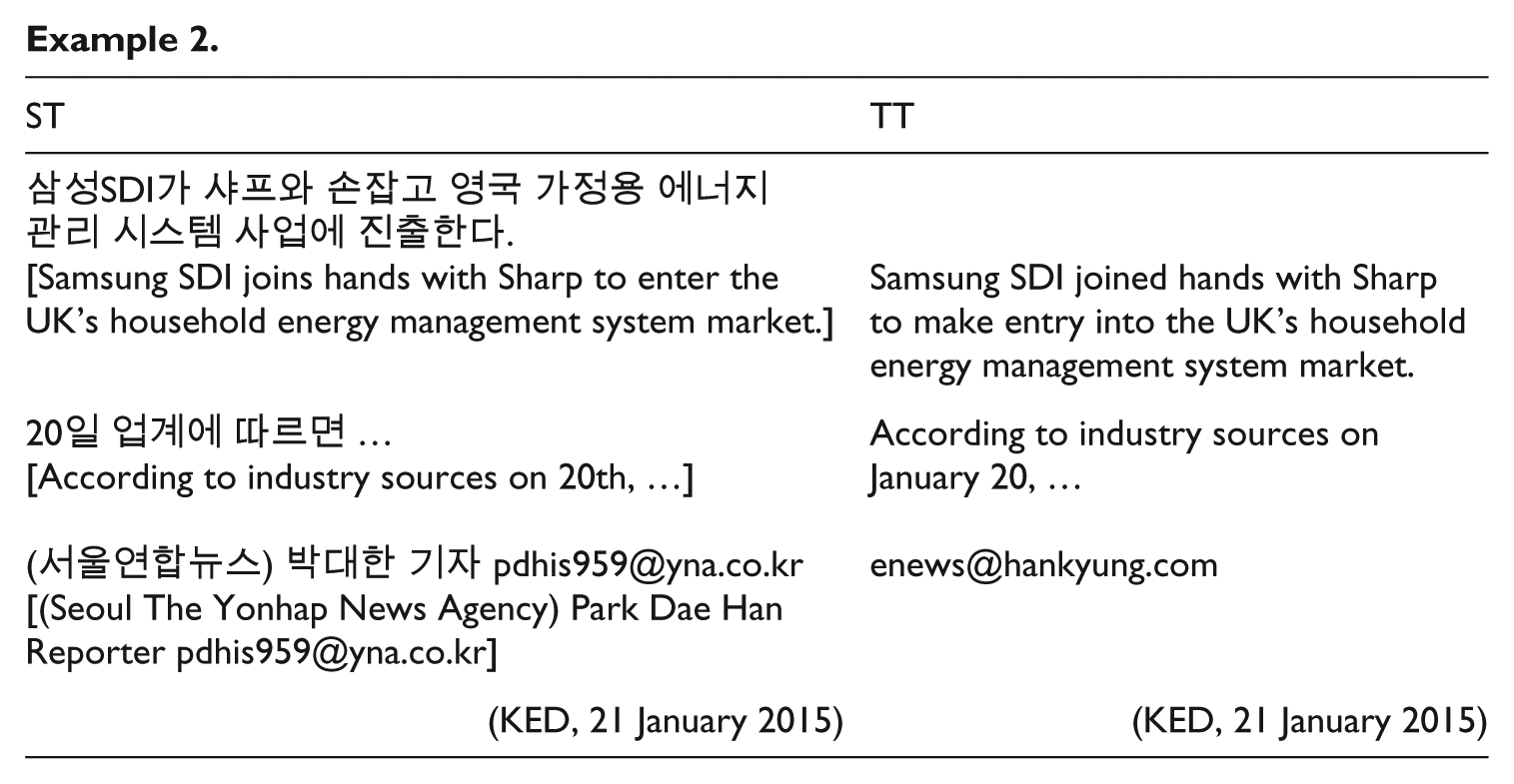
However, no attribution to Yonhap is given in the TT on KED’s English homepage although it is an obvious translation of the Yonhap story into English. Moreover, the email address at the end of the TT,
The result suggests that the translator is not aware of or does not pay much attention to the significance of attributing other media’s material, as opposed to those involved in posting the Yonhap story on KED’s Korean homepage. If the translator worked on an edited ST, the editor or whoever prepared the edited version may not have taken enough care in attribution. In any case, Example 2 shows how the principle of attribution to other media is not fully respected, particularly with regard to news translation, possibly due to the lack of detailed guidelines in Korean journalistic culture.
Change in the meaning/function of explicit attribution
Insufficient information on the setting
Attribution principles for Korean and English news commonly advise reporters to provide a detailed description of how the information was obtained and why the source is reliable to support news credibility (AP; Nam, 1997; Reuters, 2013; Winkler, 2012). In Example 3, the underlined phrase ‘본지 통화에서’ [in a phone interview with this newspaper (The Chosun Ilbo)] in the ST indicates the reporter took the initiative to make a phone call to obtain the comment and that the comment is exclusive to The Chosun Ilbo. According to the guidelines for Korean news, reporters are required to clearly distinguish various types of settings because the concreteness and transparency in describing the setting enhance the authenticity of the reported information and therefore its credibility. Moreover, the nuance of a statement can differ depending on whether it is made in an official press conference or in meetings, to a group of reporters or exclusively to one reporter, or to a source and then transmitted to a reporter (Nam, 1997: 149).
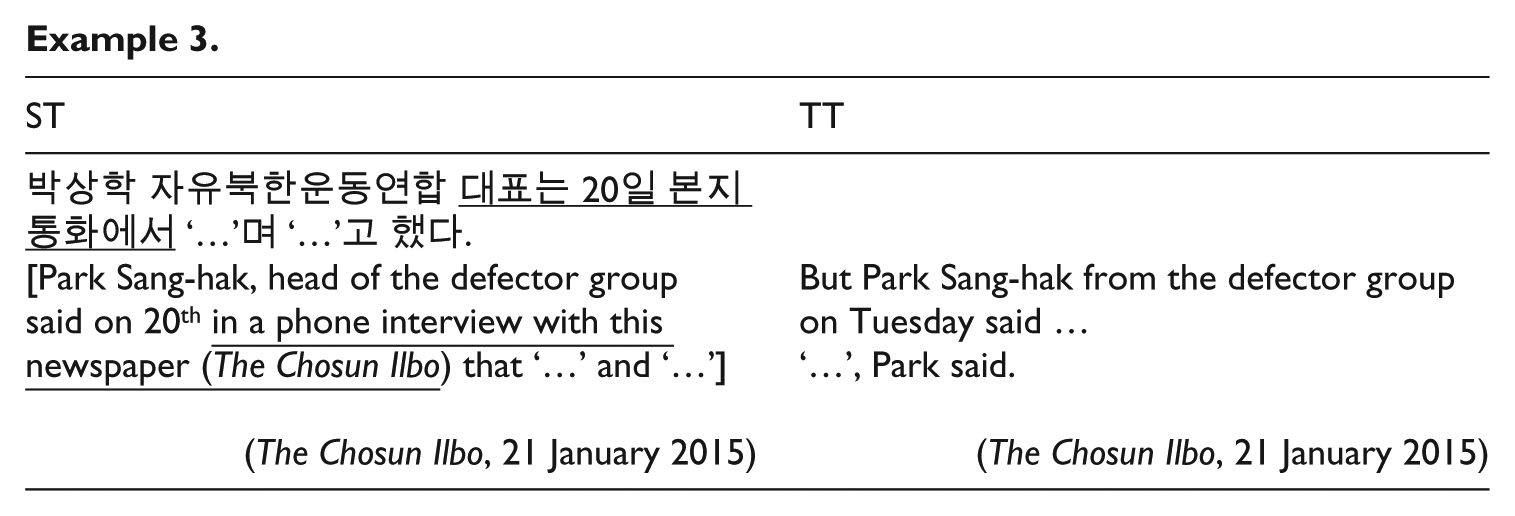
Given that attribution principles for English news also value reporters’ efforts such as initiative to make a call (e.g. NYT, 1999), describing the setting in an equally detailed manner can help the TT achieve the same meanings and functions of the attribution in the ST. However, the TT removed the phrase to render it simply into ‘said’, not only weakening the authenticity of the information but downgrading its newsworthiness by turning what required the reporter’s extra effort into information that any reporter could easily obtain. This does not help the newspaper promote itself as a more credible and exclusive source of this particular information in today’s increasingly competitive media landscape.
Change in sourcing hierarchy level
As discussed earlier, there is a hierarchy of sources depending on their closeness to the information and authority, and the higher a source is on the ladder, the more authoritative and reliable his or her information is considered (Reuters, 2013: 562).
However, English TTs often reduced or removed the information used to support the authority and reliability of sources. In Example 4, the source of the ST, ‘Kim Seok Kwon, head of Character, Physical and Arts Education Division at the Ministry of Education’, is considered strong and transparent since it is named. It is also one of the most authoritative and reliable sources because the division is a ministry unit directly in charge of the program, and it would be the unit’s head that has the most accurate information on relevant matters. However, the corresponding TT deleted his name, title, and department, turning a named source with authority into an anonymous one with no particular clout.
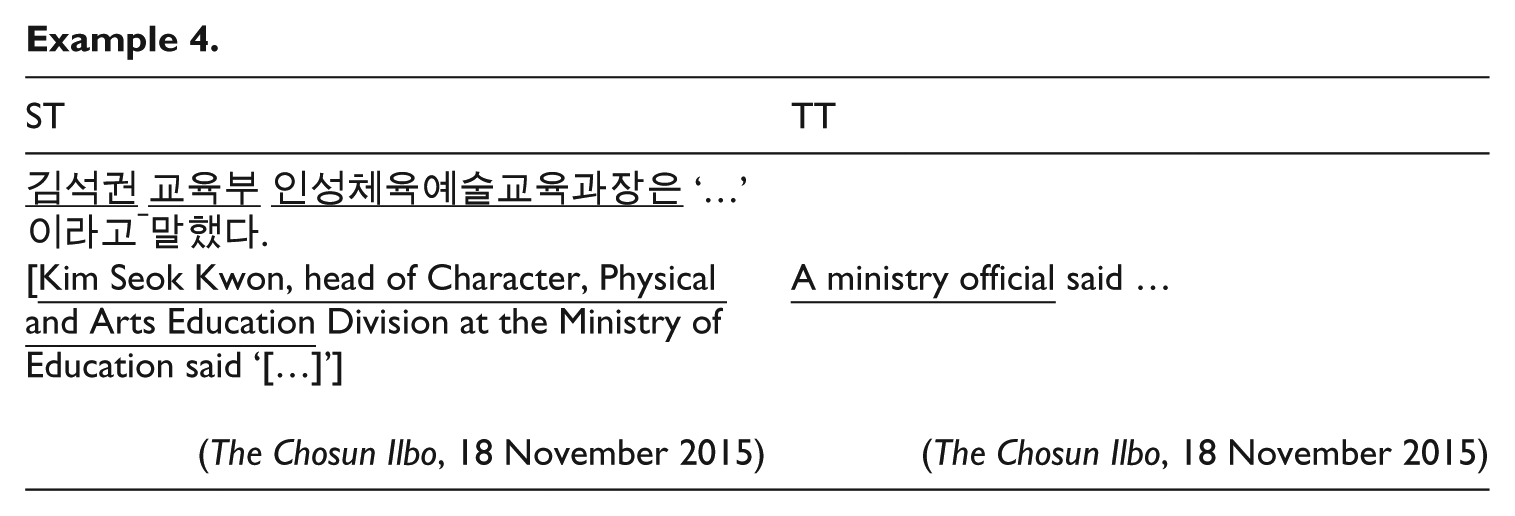
In similar examples, the titles of sources, such as the head of an organization, which indicate the strongest degree of authority to comment on relevant matters, were omitted, weakening the authority and reliability of the sources compared to those presented in the STs.
Inaccurate presentation of sources’ identity
Attribution principles for both Korean and English news require accuracy in terms of number and spelling. However, the TT in Example 5 presents a single source in the ST, that is, one official, as ‘officials’. The translator may have paid little attention to the ST or may have made a typographical error; whatever the case, the translator is likely to be unaware of the importance of relaying the accurate number of sources to readers. This can unwittingly exaggerate the number of sources, which will, in turn, affect the readers’ judgment on news credibility.
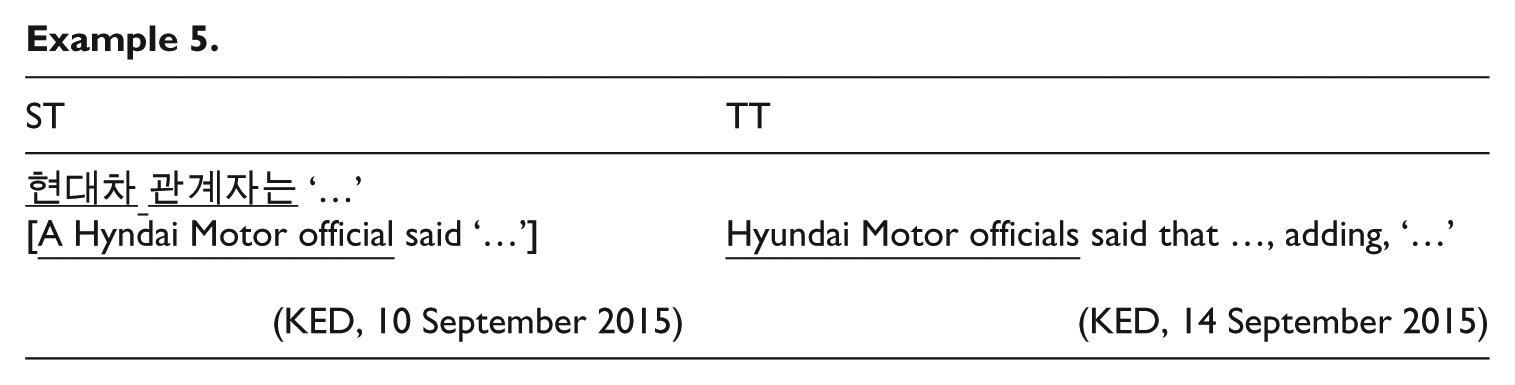
In other examples, an incorrect reference to sources’ names was also frequently found, indicating the translators’ carelessness. This inaccurate presentation can also affect the readers’ trust in other information in the article and therefore in the article as a whole, which will, in turn, damage the media’s reputation.
Discussion and conclusion
This study analyzed a total of 359 Korean STs and English TTs on the websites of Korea’s three major newspapers to investigate how the attribution in the STs is translated in the TTs.
The analysis identified the following four types of modification which resulted in major changes in the meanings and functions of attribution that can affect the credibility or credibility perception of the reported information. First, the implicit and indicative expressions for attribution specific to Korean news, such as ‘알려졌다’ [be known to], ‘전해졌다’ [be said to], and ‘파악됐다’ [be identified to], were often removed in TTs. This presents assertions in STs as facts or official announcement in TTs, which can cause misunderstandings about the factuality of news and therefore affect its credibility. Second, implicit expressions for attribution, which are not Korean news–specific, were also frequently omitted in TTs. For example, clear attribution of stories reported by other media was frequently deleted in TTs, which can also weaken news credibility. Third, explicit expressions for attribution, such as a detailed description of news gathering settings, were also not faithfully reproduced in TTs, weakening the authenticity of the reported information. Fourth, errors in the spelling or number were frequently discovered in TTs, which can hurt the credibility not only of the reported information but of the article as a whole.
Given that most of the modifications feature less detailed and transparent presentation of sources, the changes may be attributed to the specific journalistic culture of Korea. As discussed earlier, the country’s journalism tradition has focused more on protecting sources than disclosing them and the attribution guidelines for Korean-language news are less detailed compared to those for English news. This can result in an insufficient awareness of the importance of attribution or a lack of knowledge of attribution principles among those involved in news production. The cases where STs provided detailed and transparent attribution but TTs failed to faithfully reproduce it as seen in Examples 2, 3, and 4 suggest that such lack of awareness or knowledge may be more serious among translators and other participants in news translation. One explanation of this is that Korea’s journalistic culture has paid less attention to news translation compared to original reporting and that relevant education or training is rarely given, as is the case in many other countries (Bielsa and Bassnett, 2009; Tsai, 2005; Vuorinen, 1995, 1999). A significant change is required in that the translators produce texts that function as news per se for English-speaking readers who may be familiar with detailed and transparent attribution when Korea’s traditional newspapers are actively providing English translation services to survive in an increasingly competitive arena. This study shows that the meanings and functions of attribution change in the process of translation and the consequence is not insignificant because it can affect credibility whose significance is increasing in today’s fast-changing news industry, which, in turn, calls for more scholarly and practical attention to the translation of attribution.
Supplemental Material
Supplementary_Material – Supplemental material for Translation of attribution and news credibility
Supplemental material, Supplementary_Material for Translation of attribution and news credibility by Jungmin Hong in Journalism
Footnotes
Declaration of conflicting interests
The author(s) declared no potential conflicts of interest with respect to the research, authorship, and/or publication of this article.
Funding
The author(s) received no financial support for the research, authorship, and/or publication of this article.
Notes

Author biography
References
Supplementary Material
Please find the following supplemental material available below.
For Open Access articles published under a Creative Commons License, all supplemental material carries the same license as the article it is associated with.
For non-Open Access articles published, all supplemental material carries a non-exclusive license, and permission requests for re-use of supplemental material or any part of supplemental material shall be sent directly to the copyright owner as specified in the copyright notice associated with the article.
