




Abstract
Scholars have questioned the extent to which journalism’s public-service values can be reconciled with the financial responsibilities of running an online, entrepreneurial news site. This study explores that debate using content analysis and secondary survey data to examine the links between financial sustainability, technological innovation, and community-centric content at online local news sites in the United States. Results suggest that ownership, revenue, financing mechanisms, and mission relate to the extent to which online, local news sites fulfill the civic engagement criterion of community news. High-revenue and advertising-supported sites published less public-spirited content than lower-earning sites with alternative funding mechanisms. Non-profit and foundation/university/grant-financed sites incorporated more interactive features than the other sites. Ultimately, this study suggests that the sustainability of online community news sites, in terms of finances and community engagement mission, seems to be tied to new, alternative ways of thinking about funding and ownership.
Keywords
New technologies have shaken up the journalism industry, forcing new and re-conceptualized understandings of basic definitions of journalism and journalist. The Internet, Web 2.0, social media, and the ubiquity of smartphones with video capabilities have expanded not only journalists’ roles but also who can act as a journalist, leading to the industry’s need to rethink the entire news process (Usher, 2017). Just as journalists’ practices and values have changed because of technologies (Paterson and Domingo, 2008), so, too, have audience behaviors (Weber and Monge, 2014). The result is an industry struggling to find sustainable business models (Deuze, 2017) and balance the financial, market-oriented demands of serving digital audiences with the traditional public-service mission of journalism (Coddington, 2015; Siapera and Papadopoulou, 2016).
Within this context of technological disruption and an industry in upheaval, entrepreneurial, online, independent, local news sites have arisen that serve as important alternative and supplemental information sources (Friedland, 2014; Sutter, 2009). These sites fill the vacuum left by the rollback in coverage by traditional newspapers (Carr, 2014; Napoli et al., 2017). In fact, research points to the continued importance of local news (Michell and Barthel, 2015), especially for readers wanting civic-oriented news (Rosenstiel et al., 2011). Still, local sites face challenges of sustainability and identity, as digital technologies have changed our understanding of community and community journalism in particular.
Prior to this digital era, ‘community’ referred to a shared geographic area – physical closeness – and community journalism meant ‘reporters, editors and photographers’ were in fact ‘citizen-journalists, intimately involving themselves in the welfare of the place, in the civic life of their towns, participating as an active member of the very community they are covering’ (Lauterer, 2006: xiv). The Internet, however, has collapsed geographic boundaries so that communities now are virtual and global. As Franklin (2006) suggested, ‘In the new millennium, local newspapers are local in name only’. Still, as Robinson (2013) noted, ‘while the techniques and circumstances around traditionally local newspapers have morphed with globalization and digital technologies, community journalism’s fundamental emphasis on the citizen and on community remains intact’ (p. 114).
With this in mind, this study uses content analysis and secondary survey data of 15 online local news sites in the United States to examine the links between financial sustainability, technological innovation, and community-centric, or public-spirited, content aimed at fostering community engagement. Following the lead of Siapera and Papadopoulou (2016), this research questions whether online local news sites can reconcile entrepreneurial journalism’s business and profit values with community journalism’s public spirit and social values. Such a study is important to further our understanding of online community journalism and how community-focused journalism can be sustainable in this digital age.
Furthermore, considering the positive correlations between Internet use and civic and political participation (Gerbaudo, 2012; Gil de Zúñiga et al., 2010; Xenos et al., 2014), it becomes all the more urgent to understand online community news sites’ commitment to content that promotes community engagement. In addition, scholars have noted that more research should specifically consider how new business models are affecting online community news (Konieczna and Robinson, 2014; Robinson, 2013). Gilligan (2011) called for further studies into the digital evolution of community news, arguing that ‘expansions in online news audiences beyond the newspapers’ traditional geographic communities may enhance civic engagement, the exchange of ideas among the public, and community participation’ (p. 69). By exploring the links between revenue, innovation, and public-spirited content at online, local news sites, this study answers that call, taking a first step toward empirically analyzing how entrepreneurial factors like ownership and funding might impact online community news’ ‘civic engagement’ criterion (Metzgar et al., 2011).
Literature review
Community journalism
Community journalism privileges citizens and their relationship with each other and the local community (Lauterer, 2006). Robinson (2013) contended that community journalism should be understood as ‘nearness to people’. Community journalists are attached to the communities they serve and advocate on behalf of community members (Reader, 2006, 2012); the social responsibilities of journalism, such as providing the news of the day and serving as a forum for debate, or promoting participation, deliberation, and mobilization (Bartzen Culver, 2014), are particularly relevant to community journalism (Christians and Nordenstreng, 2004). Altschull (1996) saw community journalists as serving a mediator role, suggesting, ‘Why not be responsible to the community and for helping it solve its problems?’ (p. 172). Fulfilling these social responsibility roles is critical for giving community members the information they need to ‘fully participate in the civic and democratic lives of their communities’ (Friedland et al., 2012: iii). Unlike journalists at large, mainstream media outlets, community journalists are attached to their communities (Reader, 2006). For example, Hatcher and Haavik’s (2014) study of community journalists in Norway found that journalists’ membership and participation in the community was fundamental to their journalistic roles.
Criticizing much of the literature for reducing understandings of community journalism to size/scale or utopian concepts related to small-town journalism, Lowrey et al. (2008) proffered a theoretical construct and measurement scale for community journalism. Their review of community journalism scholarship found conceptions of community tied to location and shared meaning. Furthermore, many of the articles they examined linked community journalism with principles of civic or public journalism, such as serving, leading, and listening to the community. Ultimately, they saw community media as ‘fostering the process of community’ (p. 288). Similarly, Chadha’s (2016) interviews with journalists at online local news sites revealed that they saw themselves as community cheerleaders, reporting on and participating in the communities.
Scholars have used the terms ‘public service journalism’ (Ferrucci, 2017) or ‘citizen-centered journalism’ (Konieczna et al., 2018) to refer to local news that not only offers a space for community members to have a voice but also advocates on behalf of community members and encourages their participation in civic and political affairs. After accounting for all of the preceding definitions, for the purpose of this article, we conceptualize public-spirited content as community news that fosters engagement with, advocates for, and mobilizes members of those communities (Konieczna et al., 2018; Lowrey et al., 2008) through community cheerleading (Chadha, 2016), and/or publishing calls for action (Harlow, 2017).
Prioritizing community and its norms, often over professional journalistic norms, is a core tenet of community journalism, rather than that of large newspapers (Reader, 2012). Digital technologies and their use by journalists to engage audiences, however, have put community building first by both big and small news organizations. For example, in their study of health reporters at US newspapers, Molyneux and Holton (2015) found the journalists prioritized relationships with their audiences and cared about how the audiences perceived them and their actions. Similarly, Holton (2016) found that freelance journalists used digital tools in innovative ways to engage their audiences, thus transforming themselves into ‘intrapreneurial informants’ who informed traditional news organizations’ policies and norms through journalistic innovation (p. 918). Therefore, journalists can use online platforms and tools effectively to build and engage communities, so long as they make people feel ‘connected in some way to others’ (Robinson, 2013: 114).
Community journalism online
Originally, community journalism was understood in geographic terms (Lauterer, 2006). In the digital age, however, ‘place-based’ journalism has been replaced by communities of interest, whether cultural, social, political, or religious (Lowrey and Gade, 2011; Rosenberry, 2012). Hess (2012) offered the idea of ‘geo-social’ to refer to online news that is simultaneously geographically bound and limitless because of the reach of the Internet. Despite this alternate understanding of community, nearness to community remains key even to online community journalism, as human connections matter most (Robinson, 2014). Metzgar et al. (2011) termed such online community news sites as ‘hyper-local media organizations’ that are (1) ‘geographically-based’, (2) ‘community-oriented’, (3) ‘original-news-reporting organizations’, (4) ‘indigenous to the web’, (5) ‘intended to fill perceived gaps in coverage of an issue or region’, and (6) that ‘promote civic engagement’ (p. 774).
While this definition is a good starting point, scholars and practitioners alike have found it difficult to conceptualize the different kinds of local and hyperlocal startups that do not fit into any established category (Ewart, 2014; Hirschman, 2012). These startups vary in size, geographic boundaries, topic of coverage, and revenue models, and to accommodate these differences, Reynold’s Journalism Institute Fellow Michele McLellan began to categorize them into various groups back in 2010 with a primary focus on four types: (1) new traditional (different from community and micro local sites only in terms of size); (2) community; (3) micro local; and (4) niche news sites (McLellan, 2010). In recent years, McLellan said she made changes to the list to gain a better understanding of ‘the new local news landscape’ and ‘focus on sites that may be developing a formula that will create impact and sustainability in many communities’ (Michele’s List, 2018, paras 4–5).
Studies show online community news media often experiment with user-generated content and citizen journalism (Lewis et al., 2010; Singer, 2010), although some research indicates these sites use little multimedia and offer little possibility for interaction (Van Kerkhoven and Bakker, 2014). Interactivity is important because citizens involved in the news process can feel a greater sense of community (Robinson and DeShano, 2011). For example, a study focused on the failed AOL hyperlocal news project Patch indicated the site replicated traditional reporting practices of mainstream newspapers and did not encourage interactivity with audience members (St John et al., 2014). It is important to note, though, that interactivity alone does not lead to civic engagement (Metzgar et al., 2011). As Bruns’ (2010) study of a German participatory online news site found, most user-generated content was apolitical and focused on culture and community. In general, these sites’ news coverage focuses on crime, accident, and human-interest stories (Paulussen and D’heer, 2013).
Still, as St John et al. (2014) noted, ‘while the local-focused aspect of community journalism’s practice is well detailed, less is known about how community journalism is adjusting to the rise of online news’ (p. 199). One response has been the rise of non-profit online news startups to better serve citizens (Kennedy, 2013) by fostering democracy through stories that offer more context, provide solutions, and include a variety of sources (Ferrucci, 2015). Powers and Yaros (2013) noted such sites focus on ‘public interest journalism often missing from regional for-profit publications’ (p. 158), and Konieczna and Robinson (2014) suggested such sites’ emphasis on community building could help strengthen trust between the media and community. Even foundations increasingly support non-profit efforts to sustain community news as the former recognize the importance of local news in building community and fostering citizenship (Stearns, 2017).
To measure the value of non-profit and for-profit local digital news sites to their communities, Powers (2018) said journalists in part evaluated their impact according to their civic contribution, noting they wanted tools to help them better understand how their work contributed to changes in ‘public policy, public opinion/discourse, individual/community action, and awareness/understanding’ (p. 467). Similarly, Ferrucci (2017) noted digital-native non-profit news sites across the US practiced ‘public service journalism’ by offering solutions to community problems and actively promoting a sense of community. Likewise, Konieczna et al. (2018) proffered the existence of ‘citizen-centered journalism’ that ‘sees citizens as not just members of society, but also as players investing in maintaining the public good, contributing to, not simply consuming, information, and tackling social challenges’ (p. 5). Their idea of journalism goes beyond offering a space for participation; it advocates on behalf of the community and encourages agency. With these concepts in mind, this study likewise is interested in the civic contribution of local online news startups and the ‘civic engagement’ criterion of online community news sites (Metzgar et al., 2011). In addition, this research examines whether a commitment to social values, and what Pein (2014) referred to as ‘public-spirited mission of journalism’, can be upheld in the face of financial challenges of sustainability.
Entrepreneurial journalism and revenue
Prior conceptions of community journalism do not correspond with the business value orientation of many entrepreneurial online news startups. For instance, Altschull (1996) cautioned that ‘community journalism demands putting the public interest ahead of the maximization of profit’ (p. 171). Interestingly, Cass ([2005] 2006) noted that community journalism is removed ‘from the high-pressure, profit-margin-obsessed world of corporate journalism’ (p. 20). Profit margins, however, seem to be a major underlying characteristic of online news startups (Coddington, 2015; Cohen, 2015). While Vos and Singer (2016) showed how journalists talk about online journalistic ventures can vary according to purpose, norms, operations, and business structures, Siapera and Papadopoulou (2016) suggested these sites usually combine an emphasis on technological innovation with the business/profit side of news. Entrepreneurial sites are primarily focused on discovering multiple revenue streams, and finding innovative ways to make money, beyond advertising and subscriptions (Nee, 2013; Sirkkunen and Cook, 2012).
Digital news, however, is not a money-spinner; users think of it as an inferior product and as their income increases, their use of digital news decreases and vice versa (Chyi and Yang, 2009). The top revenue earners from digital platforms also are technology companies rather than news organizations (Mitchell and Holcomb, 2016). In this trying atmosphere, digital news startups struggle to find a sustainable business model that will make them profitable and ensure their longevity (Bruno and Nielsen, 2012). Local independent startups are possibly the hardest hit in this endeavor. These sites experiment with for-profit and not-for-profit business models and try to diversify their earnings by bringing in foundation grants, user subscriptions, and advertising (Nee, 2013; Pickard and Stearns, 2011). These attempts have not, however, translated into recurring sources of income that would make these sites sustainable.
Bruno and Nielsen (2012) indicated news startups that would most likely thrive would be lean, have diverse revenue streams, and focus on niche audiences not being served by mainstream media. Most local independent startups meet these criteria but struggle anyway. Reasons vary from lack of advertising and subscription support from their communities (Boraks, 2015), to the kind of content provided by the outlet. For example, Fico et al. (2013) found digital news sites provided information that complemented coverage provided by mainstream media rather than replace the coverage. St John et al. (2014) found AOL-run Patch relied on official sources rather than incorporating a significant number of community members’ voices in their stories, and the sites themselves lacked engagement with their audiences.
Although Nee’s (2013) qualitative study of non-profit online news sites in the United States suggested the founders used technologies to further journalism’s public-service mission and to engage with audiences, this could be attributed to the fact that she analyzed not-for-profit, rather than for-profit sites. Further indications of this are studies that raise concerns about a market-oriented approach to journalism (Hanitzsch, 2007; McManus, 1994) that treats audiences as clients rather than community members. Research by Napoli et al. (2017) showed that local, community-oriented news sites are heavily dependent on the economic prosperity of their target audience. Their analysis of the local news ecosystem across different communities revealed economically stable and/or growing communities can help sustain independent and public-service models of journalism versus those that may not have the financial means to support their local news sites.
Local independent news startup founders, thus, face the unenviable challenge of balancing their entrepreneurial responsibilities with their public-service mission of journalism; two concepts Pein (2014) contends are ‘irreconcilable’. Scholars have raised concerns over the eroding boundaries between the news and business sides of journalism (Coddington, 2015), and journalists themselves questioned whether news media entrepreneurs could maintain their independence and objectivity while fund raising (Vos and Singer, 2016). Community journalists, attached to and part of the communities they cover, do not necessarily adhere to the same norms of objectivity as mainstream, corporate media (Ferrucci, 2017), but have nonetheless expressed similar concerns. For example, Harte et al. (2016) study of entrepreneurial founders of hyperlocal news sites found a reluctance to fundraise, as the entrepreneurs did not want to risk their independence and their relationship with the communities they covered.
Thus, based on the preceding literature regarding (online) community journalism, civic responsibilities, and entrepreneurism, this study poses the following research questions:
RQ1. What is the relationship between a site’s revenue and the extent to which it focuses on public-spirited content?
RQ2. What is the relationship between a site’s ownership and the extent to which it focuses on public-spirited content?
RQ3. What is the relationship between a site’s mission and the extent to which it focuses on public-spirited content?
RQ4. What is the relationship between a site’s use of interactive features for engagement, and its revenue, financing mechanisms, ownership, and mission?
Methods
This study was conducted in two parts. First, secondary survey data analysis was conducted using Michele’s List 2015, an annual survey of US news startups conducted by public scholar Michele McLellan in collaboration with the Tow-Knight Center for Entrepreneurial Journalism at CUNY (Welsh, 2015). This survey included information on 94 news sites’ financial health, types of stories published, and employment data. For this study, the following survey questions were deemed most relevant: ownership (for-profit/limited liability company (LLC) or non-profit), income (high-income of US$500,000-plus; middle-revenue of US$51,000–US$499,999; and low-revenue of US$50,000 or less), financing mechanisms (advertising, foundation/university/grant funding, or city or state government funding), mission (cover local general/niche news, serve a specific demographic community, or investigative/watchdog), and use of interactive features (sites listed various features that ultimately were collapsed into eight categories: comments/discussion forums, ability to upload content or submit news tips, staff contact information, social network integration, polls or voting, newsletter, calls to action, and contests). As McLellan’s list focuses on independent, digital local sites that concentrate on communities – and this study primarily examines these digital forms of local and community news and whether they fulfill their role as community informers and builders – we decided to obtain our sample from this database.
From the total 94 news sites surveyed, a sample of five high-income (US$500,000 and higher) earning sites, five middle-revenue-earning sites (US$51,000–US$499,999), and five low-income (US$50,000 or less) sites was sampled. A conscious effort was made to select independent websites that did not have more than one site operating under its umbrella brand. For example, Technically Philly, an entrepreneurial venture that runs more than one site, was excluded for parity with other revenue-earning sites that only had one operational news platform. The researchers selected the top 5 and the bottom 5 sites based on their revenue rank; the five mid-level revenue-earning sites, however, were randomly selected given this category had the largest number of independent ventures.
Then, two constructed weeks of content (Riffe et al., 1993) from 2014 were collected for each of the 15 sampled sites. The stories were collected via searches of the sites’ archives as well as Google site-specific searches for the relevant dates, resulting in a total of 760 stories. After removing duplicates and stories with broken links, the final sample comprised 680 stories. From extant literature, the variables of advocacy, mobilizing information, calls to action, and community cheerleading (e.g. Chadha, 2016; Downing, 2001; Harlow, 2015; Nicodemus, 2004) were identified as essential elements of what we conceptualize as public-spirited content. Thereafter, a codebook was developed and two student coders were hired and trained to classify the content according to aspects of public-spirited content. Acceptable inter-coder reliability (ICR) rates (Hayes and Krippendorff, 2007) were achieved and the variables, with their ICR alphas, are listed below.
Advocacy
This variable was defined as any content overtly advocating for a cause or a group, whether related to cultural, social, or political issues. These are news stories in which a clear stand was taken. (Cohen’s Kappa: .65; 97.5% agreement)
Mobilizing information
This variable was identified as information included in a story that informed people about how, where, and at what time to attend a community meeting or event. For instance, the City Council meets at 7:00 p.m. every Wednesday at 100 Main Street. Sports schedules and movie listings were not considered mobilizing information (Cohen’s Kappa: .90; 95.6% agreement).
Calls to action
These stories included implicit or explicit calls to action to engage in civic or political activities, such as calling on readers to donate, volunteer, or attend a protest (Cohen’s Kappa: .88; 98.1% agreement)
Community cheerleading
This variable referred to positive stories about or showing support for a local community, community member, or business. These stories celebrate local successes, such as profiles of local community members or businesses. (Cohen’s Kappa: .727; 87.5% agreement).
Results
Overview
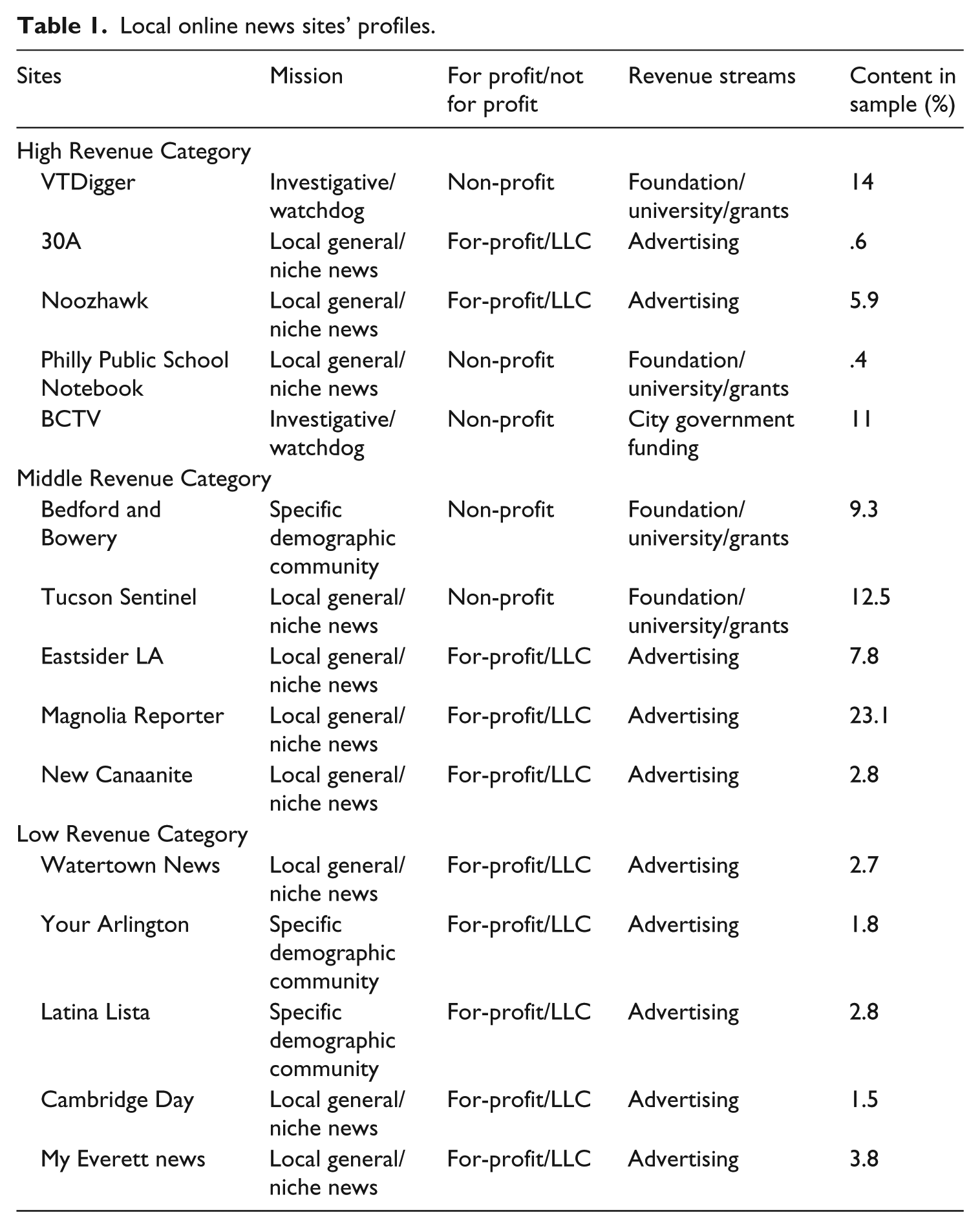
Overall, about 52.9 percent of content came from sites that said they were LLCs, and 47.1 percent from non-profits (see Table 1). Most content (55.4%) came from middle-income sites, followed by high- (32.1%) and low-income (12.5%) sites. Just over half (52.9%) of content was published on sites that said they were funded by advertising, followed by foundations/universities/grants (35.9%) and city government funding (11.2%). In terms of the sites’ missions, about 61 percent of content came from general news sites, 25 percent from sites that said they did investigative/watchdog journalism, and 14 percent from sites that covered a particular demographic community. When considering story content overall, only 2 percent of articles advocated for a cause. About 27 percent were characterized as including community-cheerleading content. About 35 percent included mobilizing information, and about 6 percent included a call to action. When considering eight different interactive features that the sites could offer, most sites (about 33%) named five interactive features; about 13 percent named all eight possible features. It is also worth noting that all the sites with investigative/watchdog missions were characterized as high-income earners, while all the sites serving a particular demographic community were low- (33%) and middle-income (67%) earners only. The sites with general news missions were mostly middle-income (76.2%) earners, followed by 13.1 percent low-income and 10.7 percent high-income sites. Non-profit sites were mostly high (54%) and middle-income (46%) earners, while the LLCs were mostly middle (64%), followed by low (23.7%) and high (12.3%). Most (64%) advertising-reliant sites were middle-income earners, as were those with foundation/university/grant financing (60.9%). Sites with city funding were all classified as high-income earners.
Local online news sites’ profiles.
Revenue and public-spirited content
RQ1 questioned the relationship between a site’s revenue and the extent to which content focused on public-spirited content. Results point to significant differences (x2 = 27.51, degrees of freedom (df) = 2, p < .001), as sites that rely mostly on advertising published fewer advocacy stories (1.4%) than sites that rely on government funding (10.5%) (see Table 2). Similarly, significantly more (x2 = 33.81, df = 2, p < .001) sites financed by government funding (55.3%) or foundation/university grants (24.7%) than advertising (23.2%) published community-cheerleading content. Government-funded sites (43.4%) also published significantly more (x2 = 15.79, df = 2, p < .001) mobilizing information than sites financed by advertising or foundation/university grants. Significantly more stories with calls to action (x2 = 18.71, df = 2, p < .001) were published in government-funded sites (14.5%) than in sites relying on advertising (7%) or foundation/government grants (1.6%). Whether the sites were classified as low-, middle-, or high-income earners also made a significant difference when it came to a story’s public-spirited content. Analysis indicated that significantly more advocacy stories (x2 = 15.643, df = 2, p < .001) were in low-income (5.9%) than in middle- (.3%) or high-income (4.1%) sites. Likewise, significantly more (x2 = 14.057, df = 2, p < .01) stories with calls to action also were in the low-income sites (12.9%), while significantly more (x2 = 20.809, df = 2, p < .001) community-cheerleading stories were in high-income sites (38.5%). Revenue did not make a significant difference when it came to stories with mobilizing information.
Cross-tabulation comparing primary financing mechanism and public-spirited content.

df: degrees of freedom.
(x2 = 27.51, df = 2, p < .001).
(x2 = 33.81, df = 2, p < .001).
(x2 = 15.79, df = 2, p < .001).
(x2 = 18.71, df = 2, p < .001).
Ownership and public-spirited content
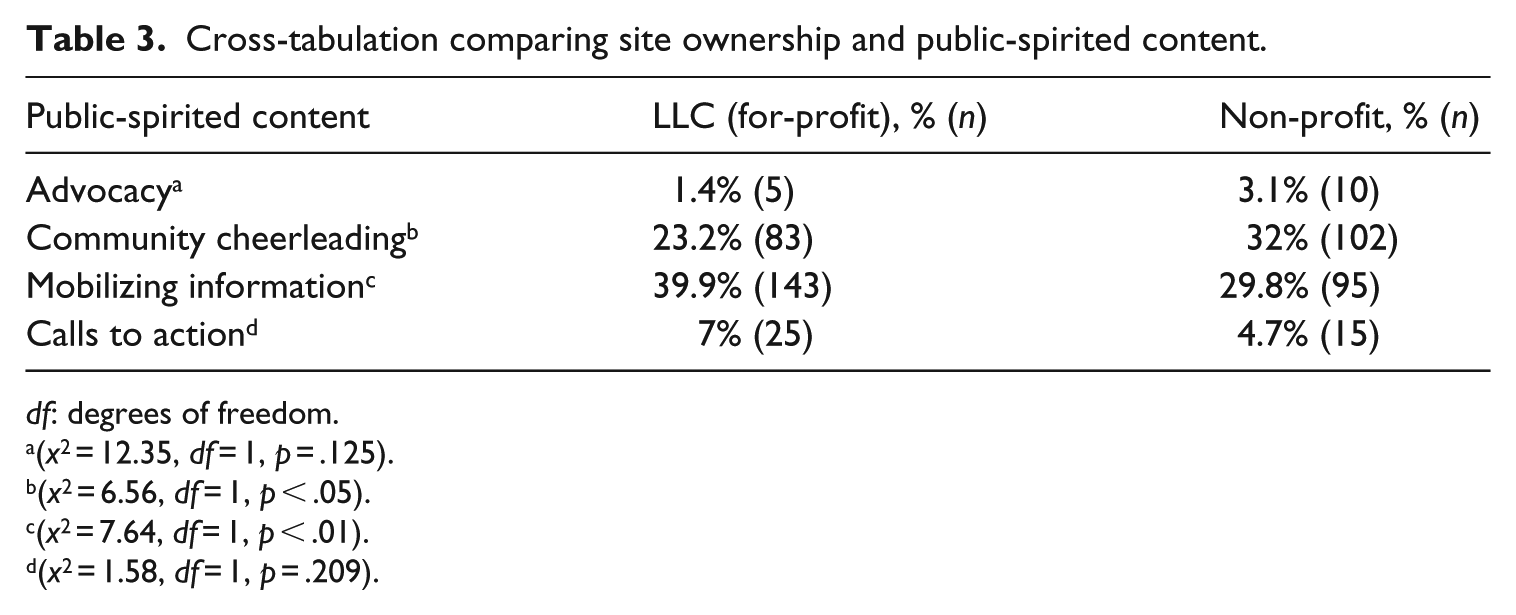
RQ2 explored the relationship between a site’s ownership and the extent to which content focused on public-spirited content. Analysis showed no significant differences when it came to ownership and content that advocated for a cause (x2 = 12.35, df = 1, p = .125) or that included a call to action (x2 = 1.58, df = 1, p = .209). However, there were significant differences when it came to community-cheerleading content (x2 = 6.56, df = 1, p < .05), as more non-profits (32%) than LLCs (23.2%) included such stories (see Table 3). However, mobilizing information was found significantly more (x2 = 7.64, df = 1, p < .01) in LLCs (39.9%) than in non-profits (29.8%).
Cross-tabulation comparing site ownership and public-spirited content.
df: degrees of freedom.
(x2 = 12.35, df = 1, p = .125).
(x2 = 6.56, df = 1, p < .05).
(x2 = 7.64, df = 1, p < .01).
(x2 = 1.58, df = 1, p = .209).
Mission and public-spirited content
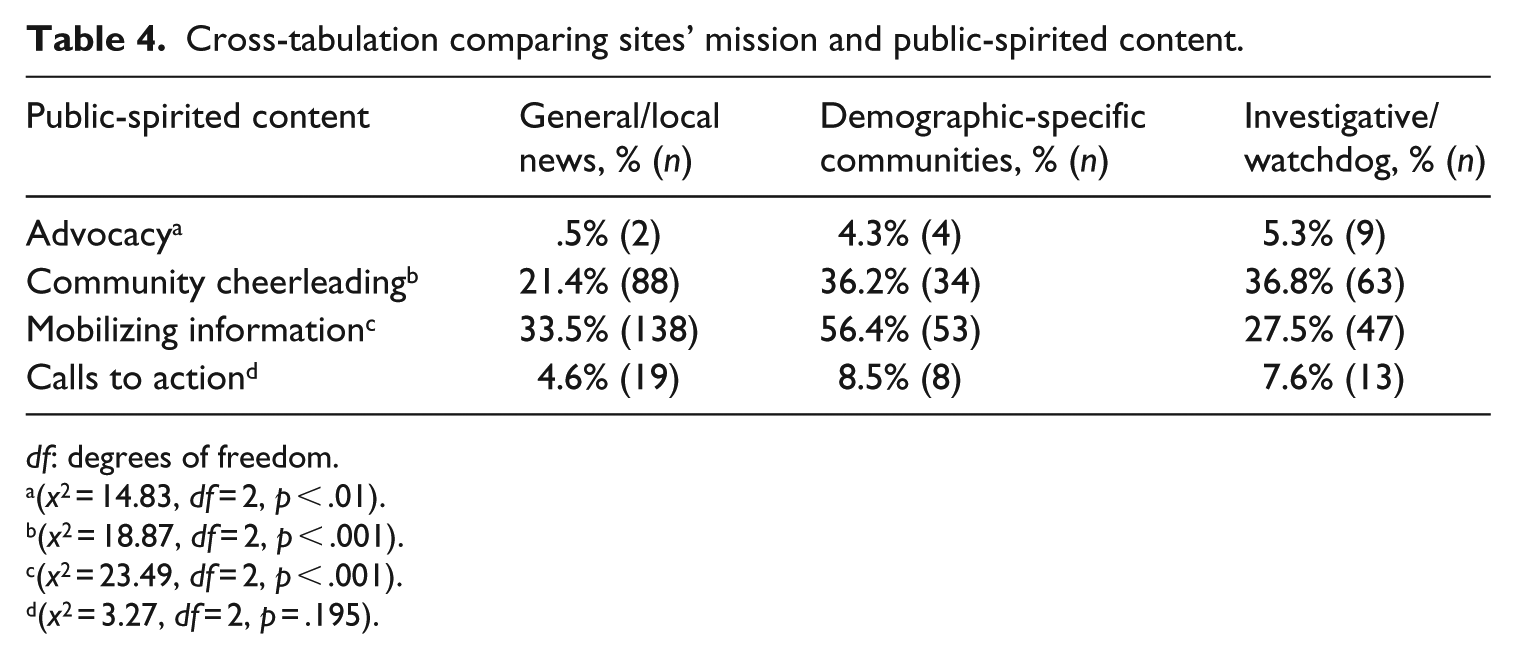
RQ3 examined the relationship between a site’s mission and the extent to which content focused on public-spirited content. Results revealed some significant differences (see Table 4). Advocacy content appeared significantly more (x2 = 14.83, df = 2, p < .01) in investigative/watchdog sites (5.3%) than those covering news more generally (.5%). Similarly, community-cheerleading content was significantly more prevalent (x2 = 18.87, df = 2, p < .001) in investigative/watchdog (36.8%) and demographic community-serving (36.2%) sites than general news sites (21.4%). Content with mobilizing information appeared significantly more (x2 = 23.49, df = 2, p < .001) in sites serving specific demographic communities (56.4%) than in general news (33.5%) or investigative/watchdog (27.5%) sites. No significant differences were found when it came to mission and stories that called for action (x2 = 3.27, df = 2, p = .195).
Cross-tabulation comparing sites’ mission and public-spirited content.
df: degrees of freedom.
(x2 = 14.83, df = 2, p < .01).
(x2 = 18.87, df = 2, p < .001).
(x2 = 23.49, df = 2, p < .001).
(x2 = 3.27, df = 2, p = .195).
Interactive features
Finally, RQ4 analyzed the relationship between a site’s use of interactive engagement features and its ownership, revenue, and financing mechanisms (see Table 5). Results of an independent samples T-test showed ownership was significantly related to inclusion of interactive features (F = 95.044, t = –15.44, p < .001): non-profit sites (M = 6.354, standard deviation (SD) = 1.482) incorporated more interactivity than did content in LLC-owned sites (M = 4.821, SD = 1.03). Likewise, an analysis of variance (ANOVA) revealed financing was significantly related to interactivity (F = 609.926, df = 2, p < .001). A post hoc Tukey’s honestly significant difference (HSD) test showed that advertising-reliant sites (M = 4.821, SD = 1.03) used more interactive features than government-funded sites (M = 4, SD = 0), but incorporated fewer features than sites with foundation/university/grant monies (M = 7.09, SD = .777). Another ANOVA test also showed a significant relationship between amount of revenue and use of interactivity (F = 145.176, df = 2, p < .001). A post hoc Tukey’s HSD test revealed that low-revenue sites incorporated significantly fewer interactive features (M = 3.412, SD = .979) than middle-income (M = 5.894, SD = 1.205) or high-income earning sites (M = 5.772, SD = 1.374). Mission was not significantly related to the use of interactive elements (F = .825, df = 2, p = .439).
Means and standard deviations of a site’s number of interactive features by its ownership, financing, revenue, and mission.

SD: standard deviation.
p < .001.
Discussion and conclusion
Local and community news not only inform people of important issues, resources, and help create public spheres and ‘spaces of cooperation’ (Ali, 2017; Dickens et al., 2015: 99), but also build community and create a communal sense of identity (Chen et al., 2017). Community and local news also are influenced by the community they report on, such as relationships with the members (Berkowitz, 2007) and the community’s financial prosperity (Napoli et al., 2017). Our study pursued this line of research and examined how community and local news sites’ mission, revenue stream, and ownership influenced the news they published – specifically public-spirited content that engages, mobilizes, and, subsequently, builds communities. Scholars and journalists alike have questioned the ability of such sites to maintain their journalistic independence and civic responsibilities when faced with the realities of fund-raising. To date, however, little research empirically explores this dilemma. This study fills gaps in the literature by showing how entrepreneurial factors like ownership and funding can impact the online community news’ ‘civic engagement’ criterion (Metzgar et al., 2011).
When looking at the sampled sites’ missions, nearly two-thirds of content came from sites that covered general news, rather than investigative sites or those that cover specific demographic communities. This could explain why general news-oriented sites also earned higher revenues; serving a wider and larger audience could be more appealing to advertisers. Source of funding is important because this study’s findings showed sites that relied on advertising published fewer stories that advocated for a cause, called for action, or included mobilizing information and community-cheerleading content than sites that received city government funding or financing from foundations/universities/grants. Advertising-reliant community news sites were not the ones publishing the most public-spirited content; sites with alternative funding mechanisms better fulfilled the civic engagement component of online, local news sites.
Thus, sites that adhered to traditional financing models seemed to follow traditional understandings of journalism norms and practices, such as objectivity, neutrality, and distance from the story – leading to distance from the community. This resonates with previous research that showed founders who start digital news startups are likely to transfer the norms and practices learned in traditional newspaper organizations to their digital platforms, where it may not be as effective or appropriate (Naldi and Picard, 2012). Sites with non-traditional funding, however, seemed to operationalize journalism and their responsibilities through more of an advocacy lens, pointing to a recognition that as local journalists they are not just covering a community but also are a part of it. This finding builds on extant community and alternative media scholarship, adding financing as a key factor in whether online local news sites will function more as a traditional, commercial site or as a community news outlet that prioritizes civic engagement.
Likewise, the amount of revenue sites earned was significantly related to the amount of public-spirited content. Sites earning less included more stories calling for action or advocating on behalf of a cause. This is in line with previous research that suggests more oppositional or alternative media outlets are smaller with fewer resources (i.e. Downing, 2001; Rodriguez, 2001), and that local news outlets are likely to promote stories that are in their communities’ best interests (Napoli and Yan, 2007). It also is worth noting that the high-income sites included more community-cheerleading content. Future research should attempt to establish causality, as perhaps the sites’ positive stories highlighting community members or events are attracting more readership and consequently, more revenue. It is also possible that funders are more attracted to sites with seemingly benign pro-community stories than those with potentially controversial content that call for some kind of social change. Such a finding also warrants caution for community journalism practitioners: they should beware of overlooking advocacy, calls-to-action, and mobilizing information aspects of public-spirited content in exchange for more revenue-friendly community-cheerleading content.
Interestingly, ownership was not as much of a factor as financing mechanisms or revenue when it came to public-spirited content. More community-cheerleading content was found in non-profit news sites than LLC-owned sites, but ownership showed no significant differences when it came to advocacy stories or those with calls to action. Furthermore, more mobilizing information was published in LLC-owned sites than non-profit ones. At first glance, this finding is confounding and indeed, future research should explore this further. However, these findings perhaps can be explained by our broad definition of mobilizing information, which included time, date, and place for community members to attend any event, whether it be a protest or the grand-opening of a business advertised in a public relations–oriented story. It follows that LLCs would be more likely to include stories advertising public relations–oriented events than would a non-profit.
The proclaimed mission of these sites also was found to be significantly related to the inclusion of public-spirited content. In general, investigative/watchdog sites and those serving a particular demographic community included significantly more public-spirited content, with the exception of stories that included calls to action, which were not significantly related to any particular mission. Such findings indicate that sites serving specific demographic communities, for example, would be more likely to include mobilizing information so that their community members could participate in events relevant to them – a key characteristic of community media. Likewise, it follows that demographic-specific sites and investigative/watchdog sites would care more than a generic news site about speaking up on behalf of a community (cheerleading content) or advocating for an issue. Still, even sites with a general news mission are community sites and their neglect of public-spirited content raises questions about whether these sites just happen to be publishing in a community rather than for and on behalf of that community. This finding has important implications for journalists’ practices, as being an online community site requires journalists’ commitment to that community, and their participation in and cheerleading for, and not merely their presence in, that community – potentially requiring a re-prioritization of traditional journalistic norms and practices.
Beyond looking at type of content, this study also examined interactivity levels, as participation is a crucial aspect of community-minded media (Rennie, 2006). Previous studies suggest that online versions of traditional, mainstream news media, as well as online community journalism sites, include little opportunity for interactivity between the user and the site or the user with news producers (St John et al., 2014; Van Kerkhoven and Bakker, 2014). This study adds weight to that research, finding that online local news sites mostly offered basic interactive features, such as enabling comments on their sites, integrating social media, offering staff contact information, or providing a way for readers to give news tips. Furthermore, this study adds to the literature by pointing to ownership and financing as being significantly related to the extent to which a news site offers interactive features. Non-profit sites included more interactive elements than did LLC-owned sites, and foundation/university/grant-financed sites incorporated more interactive features than did advertising-reliant sites. Such a finding is important as it begins to shed light on the relationship between funding, innovation, and engagement, and how this might influence journalistic practices. This study suggests sites not beholden to corporate owners or financing perhaps have more flexibility and freedom to experiment by adding interactivity to their sites. Journalists at these sites could also intentionally use interactive features to encourage users to visit their website and potentially donate to their journalistic endeavors. It also is possible they are less worried about opening the gates to user input, potentially losing control of their message, because they do not have to be concerned about offending corporate interests.
At the same time, it is important to note that philanthropic/foundation-based grants impose their own restrictions and obligations, often forcing non-profits to follow the agenda of the funding agency rather than their own (Benson, 2017). Thus, a qualitative study that explores the reasons behind the practices of independent non-profit news sites would not only build on entrepreneurial journalism and non-profit journalism scholarship but also shed light on the motives behind these sites’ news reporting and production routines. A potential implication of this finding is that entrepreneurial journalists interested in creating an innovative local news site should consider alternative and diverse financing structures that ensure their independence. Still, considering that low-income sites incorporated significantly fewer interactive features than middle- and high-income sites, it appears that innovation indeed is driven by dollars. It also is possible that the low-income sites, due to lack of funding, do not have the personnel, expertise, or time to offer more interactive features.
This study is limited in that it partly relied on secondary data analysis. As such, the variables studied were dependent on pre-existing survey questions, beyond the control of the researchers. In addition, the Cohen’s Kappa reliability of the advocacy variable (.65), while acceptable, was still low. However, the percent agreement was nearly perfect, at 95.83 percent. The discrepancy is due to the few instances of stories within the sample that could be coded as advocacy. Thus, the lack of advocacy stories in comparison with the other types of stories coded is a limitation of this study. Also, the content analysis relied on content collected online, which occasionally resulted in dead links or content that could not be accessed because it was behind a firewall. In these instances, content from those news sites could not be analyzed, limiting the sites that eventually were included in this study. Future studies should attempt to content analyze sites requiring subscriptions.
Ultimately, this study provides an important empirical analysis of the links between revenue, financing, ownership, innovation, and dedication to public-spirited content at online community news sites in the United States. Understanding these relationships is a first step toward elucidating the extent to which the dilemma of entrepreneurs as fund-raisers or journalists might compromise the community development and engagement mission of community news sites. The findings presented here have practical implications as they point to the potential importance of alternative means of financing (not advertising) and ownership (non-profit) for adhering to the community engagement criterion of online community news sites. Our study shows the issue of revenue is crucial to the manner in which these digital startups serve their communities and reaffirms that all forms of funding come with their own set of restrictions. It would behoove future scholars to examine whether diversity in revenue generation – and the extent of it – allows these sites to exercise a greater degree of independence.
Still, as this study noted, innovation requires resources. Thus, the sustainability of online community news sites, in terms of finances and commitment to the community engagement mission, is tied to new, alternative ways of thinking about financing and ownership. Future research could involve interviews with startup founders to examine how they identify themselves as entrepreneurs may further influence the innovation they display, the diversity they pursue in revenue generation, and the professional practices they adopt and/or discard in their entrepreneurial venture.
Our research shows economic pressures are discordant with community-oriented objectives of digital community news sites. In fact, higher revenues and a reliance on advertising seemed to hinder a site’s public-spirited mission, suggesting that community journalists’ news production practices, much like those at mainstream media outlets, are constrained by market demands. In other words, whether purposeful or not, focus on the community often gave way to financial considerations. This article thus points to underlying differences in journalist practices that are ultimately reflected in, and belie, the community-mindedness of these sites. A genuine commitment to public-spirited content and civic engagement thus might be incompatible with a for-profit or commercial model of journalism that prioritizes traditional journalistic practices. Further research is necessary to determine whether this means non-profit and other innovative/alternative business models are more suited to promote community building and public-spirited content.
Footnotes
Funding
The author(s) received no financial support for the research, authorship, and/or publication of this article.
