



Abstract
Drawing on interviews with a diverse group of adults living in the United States, this study examines news media literacy and how perceptions of personal bias and news bias affect news choices and interpretation in general and evaluation of two news stories specifically. Findings suggest that while people recognize that their worldviews shape their news choices in the abstract and believe that news bias occurs for a variety of complex reasons, when faced with analyzing stories, they point to political partisanship connected to specific news outlets as the root of bias in news with most relying on source cues to make their assessments.
When thinking about political and social issues, the vast majority of Americans think news organizations regularly promote one perspective over another. In 2017, the gap between Republicans and Democrats grew with 84 percent of Republicans and 53 percent of Democrats saying that news organizations tend to favor one side (Pew Research Center, 2017). These perceptions of news bias may color Americans’ news choices and perceptions (Garrett and Stroud, 2014; Gunther, 1992). The complicated role of bias in news – as both a part of news products and a perception of news consumers – suggests the need to explore how perceptions of bias inform interpretation of news and how individuals’ news media literacy (NML) contributes to their understanding of bias.
Developing NML skills tailored for contemporary media environments in which perceptions of news bias are endemic is increasingly important. NML emphasizes the need to critically analyze and engage with news to become more informed and capable of navigating complex media environments (Bulger and Davison, 2018; Craft et al., 2017). In addition, NML efforts prompt us to recognize that our perspectives also shape our news choices and interpretations (Klurfeld and Schneider, 2014). As such, NML educators and researchers approach bias from multiple perspectives.
In this study, we build on previous research (e.g. Craft et al., 2016; Edgerly, 2017) to explore how individuals’ perceptions of their personal worldviews and understandings of news bias affect news choices and interpretation. Drawing on interviews with adults in the United States, this study examines how participants’ worldviews and perceptions of news bias affect their news choices generally and news evaluations specifically. Participants’ attitudes about news and their political identity are of particular interest to this study, as both are shown to influence news choices and interpretations. Specifically, these preexisting attitudes may contribute to hostile media perceptions, which suggests that people with partisan viewpoints see news content as biased against their side even when it is deemed unbiased by neutral observers (Coe et al., 2008; Eveland and Shah, 2003; Gunther, 1988).
As such, this research engages with the following questions: (1) How do participants understand the effect of their own biases on news choice and interpretation? (2) How do participants evaluate and detect bias in news in general and in specific stories? Addressing these questions allows for a greater understanding of how bias operates as both an aspect of personal worldviews and as a perceived element of news. This research has implications for NML, selective exposure, and hostile media effects (HME) research.
Literature review
Perceptions of bias
While the public tends to value accuracy and objectivity in the news, they perceive considerable bias in journalism and often distrust news media (Pew Research Center, 2017). In fact, 75 percent of Americans think that news sources are biased and tend to promote one political position over another (Pew Research Center, 2017).
However, perceptions of bias may occur on the part of news consumers, rather than solely as a by-product of news content. The HME suggests that personal involvement in an issue can generate perceptions of bias for neutral news stories, such that the same content can be decried as biased by partisans on differing sides of an issue (Gunther, 1988; Vallone et al., 1985). HME has been observed on a wide range of issues, topics, and audiences (Gunther, 1992; Perloff, 2015; Vallone et al., 1985), meaning that journalists are often confronted with a public seeing bias where little or none may exist.
The contemporary political and media environment may exacerbate biased perceptions of news. Scholars have long recognized that people prefer and seek out content that supports their beliefs, likely because they see agreeable information as more credible than material that challenges their beliefs (Edwards and Smith, 1996; Frey, 1986; Lord et al., 1979). The current media environment facilitates this selective exposure to politically congruent news, which may not only contributes to increasing levels of political polarization but also encourages greater reliance on source cues as individuals seek out news from sources that match their political beliefs (Garrett, 2009; Iyengar and Hahn, 2009).
These media choices have important implications for HME research. Stronger social identification with a group and greater involvement with an issue both increase the strength of HME (Hansen and Kim, 2011; Perloff, 2015), so greater political polarization heightens the potential for HME to occur. Scholars have also uncovered a relative HME, such that partisans who encounter biased news are willing to forgive news that favors their side and see it as relatively unbiased but overcompensate in punishing news that favors the other side by rating it as even more biased (Feldman, 2011; Gunther et al., 2012; Metzger et al., 2015). Frequent exposure to and expectations of partisan news may not only heighten relative HME for incongruently biased news, but also predispose individuals to perceive bias where none exists – in other words, classic HME. In short, people have biased perceptions of what constitutes news bias. And this occurs both for issue partisanship (Feldman, 2011; Gunther et al., 2012) and for political partisanship (Metzger et al., 2015; Perloff, 2015).
With the rise in news outlets offering a political viewpoint (Coe et al., 2008; Iyengar and Hahn, 2009), news source cues may often be sufficient to create perceptions of bias as the outlets themselves are viewed as politically partisan (Groeling, 2008; Pew Research Center, 2009). Such reliance on source cues is not new – credibility assessments often rely on peripheral cues about the source, such as reputation, expertise, and likeability or consistency with predispositions (Chaiken, 1980; Metzger et al., 2010). But in a polarized environment, the partisan perceptions of content and its source may be increasingly relied upon in making assessments of the content (Metzger et al., 2015; Pew Research Center, 2014). As a result, understanding how people apply NML skills and values to their news consumption and interpretation becomes even more important as they are confronted with news at a rapid pace and may be faced with making decisions about quality based on source or other cues (Kahne and Bowyer, 2017).
News media literacy
When considering the knowledge and skills people need to understand news messages and the media environment, scholars frequently draw from media literacy efforts. NML is an important subset of the broader field of media literacy, which emphasizes the development of knowledge, skills, and a personal sense of control about media choices (Ashley et al., 2013; Maksl et al., 2015; Potter, 2018).
NML, then, focuses on the necessary abilities relevant to becoming a critical news consumer. Researchers and educators describe the relationship between journalists, news production, consumers, and democracy as fundamental to NML (e.g. Ashley et al., 2013; Maksl et al., 2015; Potter, 2018; Vraga and Tully, 2015). To fully engage with the multifaceted role of news in American society, NML efforts must grapple with news production and consumption issues that are sometimes in tension. For example, NML education urges news consumers to be skeptical of the role of advertising and constraints on journalists, such as deadlines and limited resources on newsmaking, while still encouraging thoughtful engagement with news to become informed citizens (Maksl et al., 2015; Potter, 2018; Vraga and Tully, 2015, 2016). This reflects a challenge for NML efforts: the need to foster skeptical news consumers, who understand the goals behind news production, without creating undue cynicism that may hinder trust in any or all news sources (Craft et al., 2016; Mihailidis, 2008).
Most NML education highlights the challenges journalists face by contrasting journalists’ duties to be accurate and inclusive in their reporting with the constraints and pressures that journalists encounter in their jobs, including commercial pressures and competition for audiences’ attention (Kovach and Rosenstiel, 2007; Potter, 2018). These pressures intersect with news production processes to influence how news is created and consumed (Postman and Powers, 1992; Potter, 2018). NML education is concerned with conveying the ability of media to shape the public’s perceptions of reality – often by selecting which stories to cover or which aspects of those stories to emphasize (Ashley et al., 2013; Jeong et al., 2012; Rosenbaum et al., 2008).
At the same time, NML education emphasizes that bias, which is often attributed to news outlets or journalists, frequently arises when consumers allow their own beliefs to color their selection and interpretation of news, echoing findings from HME and selective exposure research (Garrett and Stroud, 2014; Gunther, 1992; Perloff, 2015). As a result, personal bias is ‘perhaps one of the most intractable barriers for news consumers to overcome’ (Klurfeld and Schneider, 2014: 12). However, nascent research suggests that exposure to NML messages can reduce partisan selective exposure, particularly among Republicans (Vraga and Tully, 2017).
Working to simultaneously recognize actual bias in news and overcome personal biases to seek out diverse sources of news and to evaluate them fairly, but critically, is essential to becoming news media literate. Potter (2018) nicely summarizes how to think about the dual face of bias and the difficulty in discerning how it operates in news: Bias—like fabrication—is a willful distortion on the part of a journalist, but it is difficult for audiences to recognize when this is occurring. This highlights the distinction between actual bias (where a journalist willfully distorts a news story) and perceived bias (when audiences think that the story is slanted). (p. 193)
In addition, previous research has made the connection between NML and the HME. Research suggests that short- and long-term media literacy interventions can reduce hostile media perceptions for neutral news messages, among other positive outcomes, such as improving understanding of points of views in media messages (Hobbs and Frost, 2003; Jeong et al., 2012; Kamerer, 2013; Vraga and Tully, 2015).
With this in mind, this study explores news habits, perceptions of personal and news bias, and NML to elucidate how these areas intersect with news consumption and interpretation.
Methods
This study draws on 22 structured in-depth interviews about news choices, habits, and NML with adults in three geographically and demographically different locations to increase the diversity of the sample pool: a small city in a Midwestern state (N = 9), a large suburb in a South Atlantic state (N = 5), and Washington, D.C. (N = 8). Structured interviews allow for an in-depth examination of our core research questions, which ask how participants understand the effect of their own biases on news choice and interpretation and how they evaluate and detect bias in news. Much existing work on NML and on news consumption and interpretation, including selective exposure and HME research, relies on quantitative data from surveys and experiments (Hansen and Kim, 2011; Hart et al., 2009; Perloff, 2015). Although these data provide critical insights into the phenomenon and allow for important theorization, quantitative data does not capture nuance well, which is essential to addressing this study’s key questions.
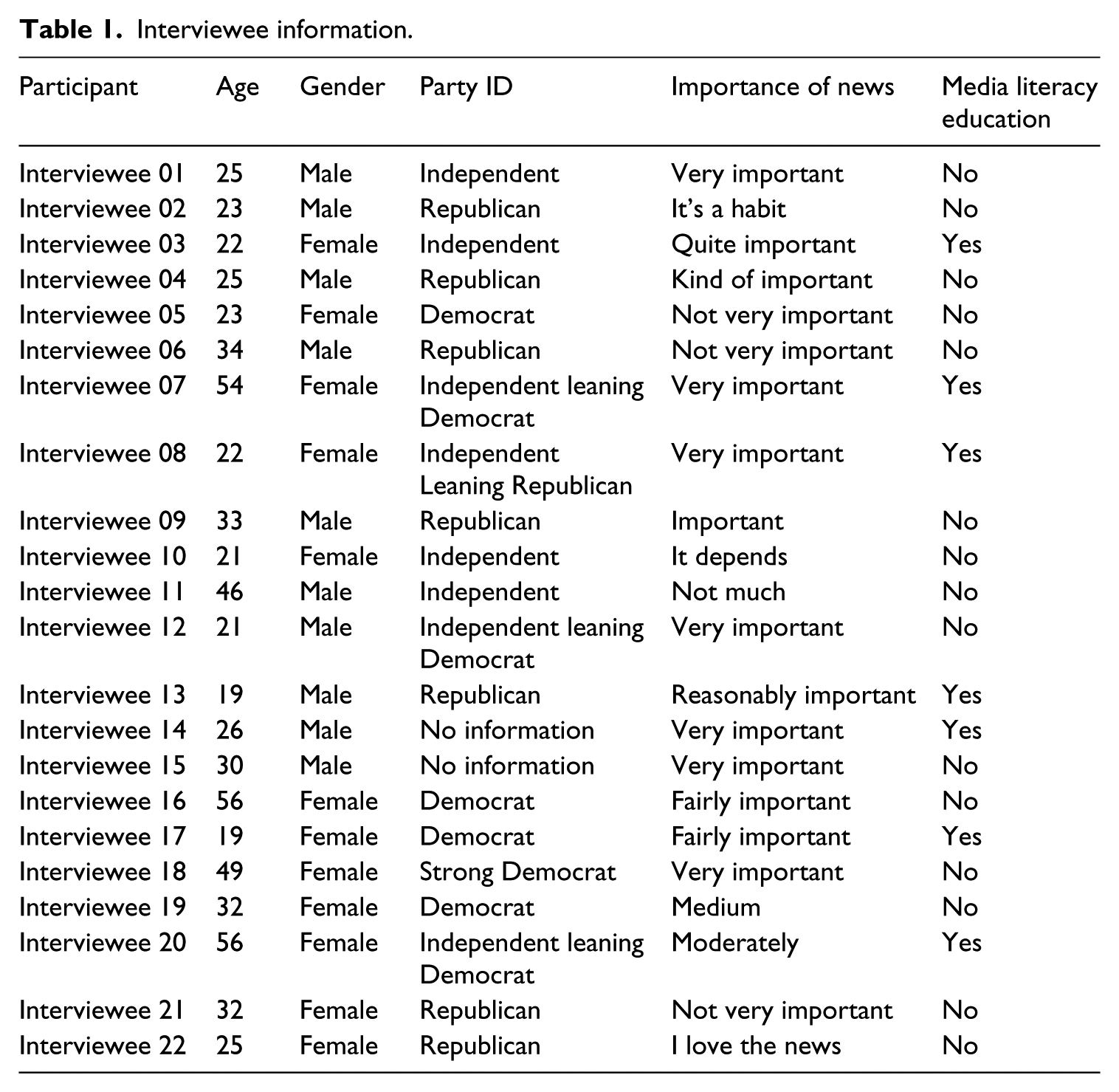
Interview subjects ranged in age from 19 to 56 years old (M = 31.5), included 10 men and 12 women, and 12 participants identified as ‘white’, and 10 interviewees indicated other races (e.g. Black, Asian, Indian) or mixed race. The sample was educated, with nine interviewees currently enrolled in college and 13 completing at least a 4-year degree. Of particular relevance to this study, interviewees represented the American political spectrum with eight self-reporting as politically independent (or Independent leaning Republican or Democrat), seven identifying as Republican, five identifying as Democrat, and two did not report party identification. Only four participants said news was not very important to them, and all thought news was at least somewhat important for informing people about political and social issues. Seven participants had prior media literacy training in high school or college (Table 1). This relatively diverse interview sample allowed researchers to achieve saturation, in which no new information was observed in the data (Guest et al., 2006). Interviews were conducted from September to November 2015.
Interviewee information.
Researchers conducted the interviews following a structured interview protocol to ensure that all topics were covered in every interview. 1 Subjects were recruited using fliers, which indicated that the study was about news use and media literacy, posted in public locations (e.g. libraries and coffee shops) and through referrals from other subjects. As such, participants self-selected into the study with some initial knowledge about the study aims. Interviews were conducted at a time and place of convenience for the subject and researcher. Interviews lasted approximately 30–60 minutes. Subjects received a US$20 incentive for their participation. 2 Interviews were audio recorded with permission of the participants and transcribed for analysis.
Interviews started with a discussion of interviewees’ media habits, especially their news use to better understand their consumption and exposure patterns. The protocol then asked about trust in news sources and information-seeking habits, areas related to both NML and biased processing, before discussing NML specifically.
The NML phase of the interview focused on definitions of the term ‘news media literacy’ and related concepts (e.g. bias) and self-perceptions of NML building on previous research (e.g. Craft et al., 2016; Vraga and Tully, 2016). Participants were asked about their NML and were given an NML definition to guide this part of the conversation. Participants were asked about their assessments of their NML, trust in news, bias in news stories, and personal worldviews. Participants also were asked about skills and behaviors that make them or others news media literate and then instructed to complete a news task to put these skills into practice (Question wording available upon request).
The task required participants to read, analyze, and discuss two news stories about the severe drought in California, a newsworthy issue at the time of the study. The two news stories were chosen from Fox News and The New York Times (NYT), recognizable news outlets that are often considered ‘conservative’ and ‘liberal’, respectively, to deliberately present different source cues and perspectives (Iyengar and Hahn, 2009; Pew Research Center, 2014).
One story, from the Associated Press (AP), and reprinted by Fox News, focused on personal aspects of the drought by highlighting individuals and families affected by the drought. The NYT story focused on larger social and environmental issues, particularly climate change. These stories were chosen for three reasons: (1) the drought was not happening in the locations in which interviews were conducted, thus limiting the potential influence of personal experience in their analysis; (2) they were printed in news outlets that are commonly perceived as conservative (Fox) or liberal (NYT) so we could examine how participants perceived and discussed source cues, but (3) neither story had a particularly partisan slant based on the researchers’ assessment, which is relevant for assessing perceptions of bias and the HME. Having participants analyze these stories allows for an evaluation of how source cues and actual content influence interpretations of bias, building on news bias and HME research. Throughout the results the stories will be referred to as the ‘Fox’ story or ‘NYT’ story for consistency.
Participants took approximately 10–15 minutes to read the stories and take notes. When they completed the stories, researchers asked a series of questions related to participants’ perceptions of the stories to gauge how participants used NML skills when reading the articles. The task was adapted from an exercise in a media literacy textbook (Potter, 2016: 213).
Having participants read, analyze, and discuss news stories allows for an examination of their critical abilities in a concrete fashion. In other words, the task represents their actual practice, rather than simply their perceptions of their practice, similar to when subjects respond to real-world scenarios (e.g. Craft et al., 2016; Edgerly, 2017; Hobbs, 2017). In doing so, we draw on performance-based measures of media literacy, which differ from self-assessments (e.g. Hobbs, 2017; Martens and Hobbs, 2015).
Including the news task as a part of an interview in which participants self-assess and engage in a skills-based task allows for a deeper examination of their perceptions and practices and is consistent with previous work that interrogates individuals’ media literacy (e.g. Craft et al., 2016; Freisem, 2017). The interview itself can be considered a form of NML intervention, in which participants are exposed to NML concepts and definitions and then asked to apply these ideas and skills to a related task similar to the exercises included in the NML focus groups conducted by Craft et al. (2016). As such, the discussion and exposure to NML concepts prior to the task should encourage application of those ideas to the task. The interview concluded by asking participants to share their views on the value and applicability of NML to their news habits.
To analyze the data, interview audio was transcribed and passages were coded as relevant to (1) perceptions of personal bias, (2) perceptions of news bias, and (3) perceptions of specific stories. Researchers read and reread the transcripts to uncover themes and the final themes were determined through an iterative process. Throughout the results, participants are identified by an interviewee number to maintain anonymity.
Results
Perceptions of personal bias
All participants in this study recognized that their worldviews or viewpoints influenced their interpretation of news stories. One Republican participant believed his personal views ‘heavily influence’ his understanding of news and went on to say, ‘I mean, when I feel like I am getting information that confirms my viewpoint then you know it probably makes me want to go back – it makes me trust that publication more and you know, go back to them in the future’ (Interviewee 09). He also noted that other people do the same thing by continuously returning to news sources that confirm their views: ‘there are people who read those [publications] who are confirmed in their viewpoint, and then you know they keep going back to those because you know they’re – the writers there are confirming their beliefs’ (Interviewee 09). His response resonates with an understanding of the confirmation bias that underlies much selective exposure (Garrett and Stroud, 2014).
Several participants recognized that their views drive their news selection. One participant noted, ‘I mean I’m probably going to focus on stuff that I want to hear about, learn about, read about and not focus on things that I don’t find interesting’ (Interviewee 19). Another participant articulated how her worldviews influence news selection and interpretation, ‘I only read stuff that’s like pertinent to me’, and went on to conclude ‘if it doesn’t agree with me then I stop reading it’ (Interviewee 05), providing further evidence of selective exposure and avoidance (Garrett, 2009; Garrett and Stroud, 2014; Stroud, 2008). One participant, who was exposed to media literacy education in her high-school social studies class, nicely captured how personal viewpoints operate, noting that her views influence her understanding of stories ‘100% unfortunately. And, I think that’s the bottom line that even though you think you’re outgoing and unbiased, your life and your perceptions color everything you do’ (Interviewee 20).
Perceptions of news bias
Although many participants recognized that their personal biases and worldviews influence news selection and interpretation, they did not believe that bias was purely in the eye of the beholder. Instead, many recognized the numerous ways that news bias operates and permeates news products (Potter, 2018).
Interview participants have complex views about news bias and who or what contributes to bias in stories. For some, bias was evidenced by word choice, tone, and terminology in the article (e.g. Interviewees 08, 09, 10, 13, 16, 18, and 19). Or, as one woman described it, a news story might ‘use weighted words with it, maybe more positive connotations for one side and more negative for the other’ (Interviewee 16). Others said they look for balance or telling all sides of the story (e.g. Interviewees 03, 06, 12, 17, and 21) to uncover bias. For example: Well I don’t think you can always tell if a news story is biased. Sometimes if it’s obviously biased it seems to only tell one side of the story or cast an individual or an organization in just one certain light. I mean, almost always, there’s two sides to every story. (Interviewee 21)
Reading stories closely or comparing news stories about the same topic were mechanisms that participants mentioned to detect bias and attempt to overcome it. Close reading revealed potential bias. As one participant, who was exposed to media literacy in a quantitative reasoning course in college, described, ‘A lot of times there’s a subtlety in the verbiage like with the migrant/refugee. Often different sources have been using migrant and some have been using refugee and there’s a huge difference between the two words’ (Interviewee 08).
Although some participants described engaging in purposeful behaviors like comparing stories to address the news bias they encounter, most participants said they stop reading, ignore the stories, or get angry, but do not actively seek out additional news or information (e.g. Interviewees 06, 03, and 18), counter to suggestions from media literacy educators (Potter, 2018). When asked what she does when she encounters bias in stories, one woman noted: ‘Get mad … I would want to, for the most part, look into other sources but if it’s not that important to me I probably wouldn’t pursue that’ (Interviewee 03).
Another group said they rely on cues about the news outlet or journalist to detect bias (e.g. Interviewees 02, 05, 11, 16, and 22). For example, a 46-year-old political Independent said that the news outlet and journalists contribute to bias in stories: Well, the source. Am I reading – am reading Fox – what am I reading first of all? Where is it coming from? I look at the writer of the article. If it’s an article about women and it’s a guy writing it, I’m going to be a little, I don’t know, I just, I look for little telltale signs like that. (Interviewee 11)
Another mentioned ‘considering the source’ as an important component in evaluating whether a news story is biased (Interviewee 16). Furthermore, a woman recognized that she is likely to approach articles with preconceived notions about the content based on the publication. When asked how she could tell if a news story was biased, she said, ‘depending on the outlet, I already know’ (Interviewee 22). Similarly, a Republican man said that when reading articles from MSNBC or Think Progress, he is ‘reading just to find out what a person on the very far left is saying about a topic. I don’t trust those sources as publications for unbiased reporting’ (Interviewee 09).
Fifteen participants mentioned journalists, editors, producers, news ownership, or organizations as responsible for bias in news. A woman who identified as a Democrat described news ownership and conglomeration as a reason for bias, while also describing how it is difficult to know who owns news organizations: Networks like Fox are extremely biased to the Republican agenda and you can tell by the experts they bring in. Certain brands, it’s sometimes harder unless you research the owning company, but I think most of the companies are owned by like Disney or something, like ABC, so I think they’re all – like all the networks are owned by like three or four companies. (Interviewee 05)
Other participants mentioned money or advertising as a source of bias (e.g. Interviewees 01, 11, 12, 16, and 18): Oh, follow the money. I think it’s very much how our media is funded, everything in this country right now, what we consider important, what we are given to consume in the media, our contemporary values are all fed to us by the big machine of money. (Interviewee 16)
Responses that mentioned structural and organizational constraints reflect an important understanding of media industries, which is essential to developing knowledge that contributes to NML (Craft et al., 2017; Kovach and Rosenstiel, 2007; Potter, 2018).
Although attracting audiences was implicit in some comments, only one person mentioned audience demands and news organization’s responses to audiences as the main cause of bias in news, noting that news organizations are ‘trying to cater to their audience and many people want the biased story. If you’re very conservative, you want to read a conservative newspaper – you want to feel like your news also agrees with you’ (Interviewee 08). Her interpretation of news bias reflects an understanding of our fragmented partisan news environment and audiences’ tendency to seek out content that matches their beliefs (Garrett, 2009; Garrett and Stroud, 2014).
Bias in stories
To better understand how perceptions of bias influence news interpretations and to see how participants apply NML skills in practice, participants read and responded to two news stories about a drought in California. Results suggest that participants saw bias in the news stories emerge in three ways. First, political bias in the form of liberal versus conservative bias was the most discussed type of bias and was often connected to the source cues of Fox or NYT (e.g. Interviewees 05, 06, 09, and 12). Second, participants described bias in relation to how climate change was discussed or ignored in relation to the drought (e.g. Interviewees 06 and 09). Third, they saw bias in the tone and intended purpose of the article, particularly regarding emotional appeal in the Fox story versus a scientific orientation in the NYT story (e.g. Interviewees 08, 10, 11, 13, and 19). Yet, few participants explicitly tied their evaluations of story bias to their own predispositions, despite reflecting on these biases previously.
Many participants used source cues as shortcuts for assessing political bias (Coe et al., 2008; Iyengar and Hahn, 2009). This political bias was sometimes connected to serving the news organizations’ audience who expect to see content that leans a certain way. One participant, a 34-year-old Republican man, who described Fox as dramatic earlier in the interview, described the stories as ‘pretty standard liberal versus conservative media’ and went on to say: I mean they were both completely biased. … The whole purpose was to provoke the insight and the almost the camaraderie of its viewership. You know, Fox knows that not too many Democrats are going to be reading their thing so they voice this subtle, humble propaganda, you know… Meanwhile, The New York Times, the Democratic source is citing that we are depleting, we are killing ourselves, and the government is here to help protect us and keep us from ultimate annihilation. (Interviewee 06)
His analysis suggests that he sees bias in these stories as purposeful and useful to the news organizations as it serves audience expectations, an important insight relevant to NML (Maksl et al., 2015; Potter, 2018).
Other participants had a similar assessment of partisan political bias serving organizational goals suggesting a broader understanding of news media industries, an important component of NML (Maksl et al., 2015). For example, an Independent leaning Democrat assessed the stories as ‘fairly biased’ and described Fox as a ‘very conservative outlet – who they interview you know, average citizens, because that’s who their target audience is you know – you’re the trusted news source. So, they go to a 40year-old disabled vet – that’s gonna appeal to conservatives’ (Interviewee 12). He described the NYT story as liberal and also noted that it had shortcomings in its sourcing, particularly not providing enough details about the scientific sources or evidence in the story (Interviewee 12).
For others, source cues colored their expectations of the stories with little critical evaluation beyond suggesting that each outlet has a partisan perspective. As one Republican participant noted, ‘because I knew the sources, I think it was pretty easy’ (Interviewee 06). Another Democrat participant described the Fox story as ‘ridiculous’ and went on to say, ‘Fox News was blatantly trying to play up the vet and family man thing from the farm and make it seem down to earth … just basically what you would expect from Fox News, I guess’ (Interviewee 05). Others made similar comments about the NYT article. As one Republican participant described it: Once I read The New York Times and then the first words said ‘global warming caused by human emissions,’ so I pretty much knew. I knew pretty quickly knew where this was headed based on those two things, based on what publication it was and you know the first 5-6 words in the piece. (Interviewee 09)
Despite the resonance of source cues in these interpretations, only two participants recognized that the ‘Fox’ story was a reprint from the AP. Notably, these participants (Interviewees 09 and 11) did not use the language of political partisanship to describe the Fox story, suggesting that seeing beyond the sources allowed them to engage in more critical analysis that is central to developing NML skills (Potter, 2018). One participant went so far as to say, ‘I’m going to call this other one the Associated Press piece because, although you have Foxnews.com at the top, this is actually an AP piece so you know there’s probably many other outlets in addition to Fox News that ran the story’ (Interviewee 09). His analysis shows an understanding of how wire services work and led him to analyze the story through a different lens describing the Fox story as a human interest story focused on portraying local families. The other participant had a similar assessment of the piece: ‘This felt like a human interest story – the Fox news – it read like a sob story’ (Interviewee 11). He later went on to call it an AP story and noted that Fox ‘just picked this up’. Neither participant had previous media literacy training, but both were able to discern the subtle ‘Associated Press’ byline and used this cue in their analysis. Both participants noted that although it wasn’t a story from Fox, it still fit their agenda and audience, again suggesting a deeper understanding of news structures (Maksl et al., 2015).
For some participants, lack of discussion of global warming in the Fox story was seen as purposefully avoiding the issue because it doesn’t align with conservative views. As one self-described ‘very liberal’ man noted: It’s an important issue but it was more human based.. … There wasn’t one scientist mentioned in here. Just a county worker. The Times was very heavy science based. I think they said global warming 20 times in there, and it wasn’t about the people at all. Almost, seemed like half of it was about global warming and the dangers of it and not just necessarily for California. (Interviewee 11)
He went on to describe the Fox story as, ‘it wasn’t misleading as much as it was not informing’. For him, the Fox story missed the more important story about climate change with its focus on daily life during the drought.
While some viewed the Fox story as avoiding the ‘real’ issue and implications of the drought, others thought that the Fox story did a better job than the NYT story because it showed how the drought affects people. For example, one participant, a 56-year-old woman who identified as an Independent leaning Democrat, believed that the Fox story did a better job presenting the story of the drought and noted how it aligned with her own predispositions: The Fox news probably did use the better sources because they’ve thrown in the human element of how this issue, water, affects everyday people. But, and so that really speaks to my own bias, because trying to help people and address human problems are the things I am most interested in. (Interviewee 20)
Although, she stated that she believes global warming is an important issue, in this case, she found the NYT focus to be too detached to give the full story. She was one of few participants to make a direct connection to her personal views as a guide for evaluating the stories, making an important connection between the two kinds of bias that influence news interpretations (Klurfeld and Schneider, 2014).
Beyond differing political biases, participants described the two stories as different in terms of tone and appeal. Many participants described the Fox story as a human interest story, designed to appeal to emotions, explaining why it lacked official sources or discussions of science. On the contrary, they perceived the NYT story to be more well-sourced and scientifically focused. When comparing the pieces, descriptions such as ‘emotional’ versus ‘analysis’ (Interviewee 10) or ‘human side’ of the story versus ‘more environmentally and politically oriented’ (Interviewee 13) emerged. A self-described politically independent woman from D.C. who previously said news was very important to her and that she reads the NYT daily, compared the articles noting that the ‘Fox news article is a lot more emotional and just trying to get you to connect with the people the drought is affecting whereas the NYT is more analytical about it’ (Interviewee 08).
Some participants said that comparing the stories made them realize the multiple ways the drought could be covered and that both stories had value because of their different approaches further supporting suggestions from media literacy educators to consume and compare diverse sources of news (Potter, 2018). The difference in how the stories addressed climate change was a major point of comparison that participants used to make sense of how they covered the drought. For example, as one woman from D.C. noted: … if had read either of these separately I would not have thought really much – I wouldn’t have thought oh this one’s biased or this one’s biased. I would have accepted it as the Fox News – oh it’s a sad story. Or this New York Times, oh this is a really serious problem. (Interviewee 21)
Her analysis highlights the value in reading more diverse sources to get a fuller understanding of an issue, even as most participants said that was not often something they regularly did as part of their own news habits.
Discussion
This study set out to examine how NML is understood and applied to news consumption using in-depth interviews. This study interrogated how participants evaluated news for bias and how they understand the role of their own biases in influencing news consumption and interpretation. The results suggest that participants recognize that their viewpoints shape the way they consume and interpret news and have some understanding of the myriad ways bias enters news during the news production, distribution, and consumption processes. When evaluating specific stories, participants applied some of these lessons to discuss issues of tone and purpose of the articles, suggesting some deeper understanding of news structures, a key component of NML. Overall, however, most participants relied heavily on news source cues (NYT or Fox) to make determinations about bias, which they viewed as liberal versus conservative partisan bias with less discussion about how or why news bias emerges.
Participants have internalized lessons about the need to scrutinize news to detect biases. Many interviewees pointed to news practices – like the choice of specific words or phrases – as ways in which news articles can be biased. Participants appear to recognize that news organizations choose particular aspects of an issue to highlight, and they consider the implications for their own and the public’s understanding of an issue. Others highlighted larger structural forces – including profit motives, ownership structures, and desires to match audience expectations – as reasons for bias in news content. This range of responses aligns with key arguments made in NML education and research (Maksl et al., 2015; Potter, 2018; Rosenbaum et al., 2008). However, few respondents named all these factors and even fewer made connections between them, suggesting an in-depth understanding of news industries is lacking.
But while it may be promising that respondents identified ways in which journalistic norms and practices can color news content, this is only one component of NML. Indeed, most NML education stresses that people also must recognize their own biases in interpreting news content, especially given selective exposure and HME research, which suggests that personal biases influence news choice and interpretation and can create unfair perceptions of media as hostile to their own viewpoints (Garrett and Stroud, 2014; Gunther, 1992). Although there was little evidence of hostile media perceptions coloring interpretation during the news tasks, most participants still viewed the stories through a liberal–conservative partisan lens, which did influence how they analyzed the coverage. In addition, while many participants recognized that their views affect the news and information they seek out, this self-awareness did not always result in more critical news choices. In fact, most were not troubled by their decisions. Many participants noted they prefer news that agrees with their worldviews and often dismiss news that disagrees with them, choosing to ‘walk away’ or ‘stop reading’ (Interviewee 08 and 21). Very few said they seek out additional sources or opposing views even though they know they could and sometimes should.
In addition, while all participants recognized that their personal viewpoints influenced their consumption choices, they rarely addressed their views when asked to analyze news stories. This, of course, could be attributed to the task design, which was focused primarily on the story. With different prompting, participants may have elaborated on the role of their worldviews in more nuanced ways. However, despite this limitation, most participants drew conclusions about partisan bias in the stories based on source cues and extrapolated to make assessments about the stories’ treatment of the drought, despite their acknowledgment earlier in the interview about the more nuanced reasons why and how bias manifests. In other words, in the abstract, participants articulated myriad ways that bias operates in news, but when faced with two stories with sources they recognized and had views about, they turned to these cues to make assessments (Chaiken, 1980; Metzger et al., 2015). Although previous research has found some success in mitigating biased perceptions of news by situating NML interventions directly preceding news consumption (Vraga and Tully, 2015), the current research reinforces the need for these reminders as it appears that beliefs about news sources influenced evaluations of specific stories even in the context of an interview about NML.
Although several participants specifically acknowledged the value of comparing two news stories about the drought in helping them better identify holes or biases in the coverage, most admitted to rarely venturing outside their comfortable bubble of agreeable news. There appears to be considerable disconnect between what people recognize as good news consumption practices – recognizing one’s own biases and consuming diverse news sources on a topic – and their actual behaviors. This may represent another opportunity for NML efforts to encourage more diverse news consumption habits. These interventions need to go beyond telling people to consume more diverse content to explain why this is important and how it can better equip them to navigate complex news environments. NML interventions should also provide strategies and skills for promoting better news habits – such as seeking out diverse news sources, recognizing layered sources (e.g. a friend sharing a news story on social media), and acknowledging the role of algorithms in promoting or devaluing certain content – as well as emphasizing the importance of media literacy for civic society (Kahne et al., 2012; Mihailidis and Viotty, 2017; Thorson and Wells, 2015). If news consumers believe that developing NML is important and relevant to their lives and feel they have the necessary skills, they may apply these skills more regularly and avoid the cynicism that can make these efforts appear pointless (Mihailidis, 2008; Tully and Vraga, 2018).
Study limitations and areas for continued research are important to note. First, as with all qualitative research, this sample is by no means representative and recruitment was limited to areas accessible to researchers. Although the participants are relatively diverse in terms of race, political party affiliation, and geographical location, their higher levels of education and value for news may mean they were more familiar with NML prior to the study. Future research should examine perceptions about NML and news bias with more diverse populations with a focus on education levels, a factor that has been shown to be important in both NML and news habits research (Edgerly, 2017; Maksl et al., 2015). In addition, more qualitative work is needed to examine the ambiguity and contradictions inherent in contemporary news consumption practices.
In addition, although researchers determined that the news stories used in the task did not have a clear political bias, the stories were not evaluated without source cues. As such, participants’ interpretations could differ if the cues were removed. Future work should explore how people engage with a range of news and news-like content (e.g. sponsored or branded content) with a specific focus on how people interpret this content to more fully understand how interventions could be developed to encourage critical media consumption (Bulger and Davison, 2018).
This study suggests that NML research and education efforts must take into account that simply educating consumers about news and personal biases might not be enough. Rather, scholars and practitioners must engage with the underlying reasons, including political predispositions and stances toward controversial issues that influence news choices and attempt to reconcile the disconnect between the normative ‘should do’ and actual news behaviors. Understanding attitudes, motivations, and decision-making processes could potentially bridge this disconnect. In addition, although some participants had previous media literacy training in school, most did not, and moreover, this training did not always result in more critical or nuanced approaches to news. This finding further validates the need for continued exposure to NML outside of formal educational settings (Tully and Vraga, 2017; Vraga and Tully, 2015). Finally, if NML education only gives people the tools to identify news biases in sources and stories without helping people reflect on their own biases, it could promote cynicism toward the news media or unfair assessment of news (Mihailidis, 2008), an outcome that has potentially serious negative implications for informing citizens in a democracy.
Footnotes
Authors’ Note
Anne-Bennett Smithson is now affiliated with University of Maryland, USA.
Funding
The author(s) received no financial support for the research, authorship, and/or publication of this article.
