



Abstract
There was significant media coverage of migrant flows in the summer of 2015 and public debate is ongoing. A central issue covered by the media regarded the risks associated with the entrance of refugees in the European Union, thus we decided to analyze the way in which online media covered the violence that involved refugees in the time frame of 1 June 2015–31 October 2016. The analysis highlighted that journalists were mostly interested in publishing cases of illegal border crossings and less interested in cases of severe interpersonal violence (such as murder, rape, and suicide). This time, journalists decided to publicize crimes which affected national security (therefore, they threatened the entire territory and population of a country) and focused less on crimes which involved hurting some categories of vulnerable people (women, children, or elderly people). The main changes that we identified were how refugees were framed regarding the place of the media and journalists as ‘secondary definers’ of crimes, and the positioning of the refugee in the role of victim.
Introduction
Starting with the summer of 2015, Europe was confronted with a relatively new phenomenon–a high number of refugees entered through the so-called ‘Balkan route’ from Greece toward the center and then the north and west of the European Union (EU). At the end of 2015, around 1,046,599 refugees entered Europe and another 387,739 refugees also arrived on the continent at the end of 2016 (International Organization for Migration, 2018: 1). Refugees from conflict areas (mostly from Syria, but also from Iraq and Afghanistan) were presented in different manners in the media. The media coverage regarding the masses of refugees was significant and debates are ongoing. Eight years before, in 2006–2007, important debates regarding migrants were also covered by the European media, labeled as another ‘wave of immigration’ – that of Romanian and Bulgarian citizens moving toward Western European countries. Romanian and Bulgarian immigrants were represented in the West European media, mainly as a burden for the welfare states or were frequently associated with phenomena of violence (Vicol and Allen, 2014). Surprisingly, the Romanian media also associated the image of Romanian emigrants with violence and the Romanian journalists using the distinction ‘offender-migrant vs. hero-migrant’ (Beciu, 2012: 65). In the meantime, although there were published articles that presented Romanian emigrants as victims of the residents’ violence, there were fewer in the period considered (Balica, 2016, 2017; Balica and Stöckl, 2016).
Romanian media has extensively debated the issue of European refugees’ crisis, even though the transit routes had avoided Romania and the number of the refugees that entered or transited this country was small. After August 2017, as a result of blocking the Balkan route used by refugees, Romania became a transit-country for the refugees coming from Turkey through Bulgaria and Romania on the Black Sea. Thus, between August and November 2017, more than 1000 refugees had entered Romania using this new route (International Organization for Migration, 2018: 1).
Romanian public opinion regarding the refugees who entered the EU had dramatically changed from accepting the refugees toward rejecting the refugees. This was under the influence of politicians’ discourse which promoted the anti-migration message through the media (Momoc, 2016).
At the same time, Romanian journalists’ discourse about the refugee crisis was an ‘accountable’ one, centered on identifying the actors responsible for the crisis and finding solutions (Corbu et al., 2017: 15)
Romania represents an interesting case because it was known as a post-Communist country which, after 1990, faced an increase in the number of Romanians migrating toward various regions of the world in search of a workplace. Thus, in 2017, Romania had a total diaspora of over 3.6 million people (United Nations, Department of Economic and Social Affairs, Population Division, 2017: 13) and an average annual growth rate of migration of 7.3 percent per annum. In the period 2000–2015, Romania was the second highest country in the world regarding the diaspora’s pace of growth (United Nations, Department of Economic and Social Affairs, Population Division, 2016: 19). All the above-mentioned happened under conditions in which there was no conflict in which Romania was involved and that the country is a member state of the EU since 2007.
Between 2015 and 2016, the Romanian media became interested in the issue of refugees. This was generated by the debates that took place within the EU regarding the way of allotment of the refugees which entered EU and the refugees’ quotas for each country. During those debates, Romania was near the countries from the Visegrad Group (Czech Republic, Poland, Hungary, and Slovakia) and opposed to mandatory quotas (Despina, 2015).
Framing the refugees
Building on how media reconstruct a series of subjects from the criminology area, Tuttle (2017) shows that there is still a tendency to assume that the media mislead the public toward a relationship between immigration and crime. It is argued that this is due to the manner in which they present the phenomenon of immigration. There are relatively few studies that analyze migration, crime, and media in the existing literature.
While the issue of media connection with crime was approached for a long time only through studies and analysis made from the perspective of separate academic fields (criminology, media studies, etc.), the deplacement which took place in the criminological studies toward what is called ‘cultural criminology’ (Brown, 2011; Garland, 2001; Greer, 2003; Mason, 2003; Rafter, 2006) invited researchers to reconsider the so-called ‘crime-media nexus’ (Brown, 2003a, 2003b, 2011; Greer, 2010). The first result of this connection is the creation of a new confluence in the relationship between the criminological subject and criminal representations (Yar, 2012). Although this development refers mainly to criminological studies (Ferrell et al., 2008), it entails also a reassessment of the role played by media in connection with crime, this deplacement being from ‘crime and media’ to ‘a new confluence of new relations between the criminological subject and criminal representations’ (Yar, 2012). To our knowledge, there are no studies recorded until now on the media-crime nexus regarding the 2015 refugee crisis in the EU.
Traditionally, the way the media covers issues of immigrants, asylum seekers, and refugees was often approached using the media framing theory (Cheng et al., 2011; Fryberg et al., 2012; Vliegenthart and Boomgaarden, 2007; Vliegenthart and Roggeband, 2007). In their analysis of the manner immigrants and refugees are presented in Irish media, Breen et al. (2006) identified five main negative frames ((1) murderers, (2) contaminants, (3) illegal strangers, (4) threat to integrity, and (5) economic burden for the host country) and three positive frames ((1) human interest, (2) Positive, and (3) supportive).
Research carried out within the so-called ‘media and crime’ approach (Yar, 2012) also indicates that refugees and asylum seekers have two main roles in news coverage: as intruders (or threat) on one hand and as innocent victim on the other hand (Benson, 2013; Eide and Ytterstad, 2011). The intruder type frame is related to crimes, lack of honesty, and threat to society. An intruder is an undesired person in the host society and is presented in the media as someone who induces the feeling of fear, anxiety, and insecurity (Parker, 2015). On the other hand, the victim frame presents them as a person who plays a ‘tragic’ role and needs the help of society’s other members (Parker, 2015).
May (2005) showed that a specific type of frame that is found in these media materials is the criminal frame, which highlights elements related to violent and criminal behavior. This type of frame is sustained in different manners. The frame is therefore built by associating crime with race and some different types of crimes and violent acts with various ethnic groups (Cecchi, 2011) or with some groups mainly originating in third-world countries (Heller, 2014).
Following the same general theoretical framework of media and crime, the role of sources in refugees’ media coverage was approached in various studies. Thus, as Ekström (2006) pointed out, the use of sources never leads to neutral presentations of facts and to neutral quotes of social actors. Instead this represents the reconfiguration of what a source declares in order to satisfy a series of intrinsic requests that the forms and genres of the articles and news have (Killenberg and Anderson, 1993).
According to Cook (2005), the media coverage of a theme or of an issue follows the lead of the governmental sources. The government, the police, and the law system therefore become important actors that define a certain situation, the ‘primary definers’ of it, as the theory of primary definers’ in media (Hall et al., 1978) has stressed. Following the new developments of Hall’s initial theory, one can speak also about ‘secondary definers’ (Greer and McLaughlin, 2011; McLaughlin, 2008). An emerging trend which has been examined in recent years was the rise of ordinary individuals as ‘primary definers’ of the situation (Kunelius and Renvall, 2010; Van Leuven et al., 2015), this movement pointing out the deplacement in journalistic practice toward what Gans (2011) had called ‘bottom-up news’.
After the events during the summer of 2015, when thousands of refugees entered the EU, an interesting distinction between the deserving and non-deserving refugees was developed by Holmes and Castaneda (2016). On the basis of the anthropological analysis of the representations of refugees in media and political discourse in Germany, the deserving refugees were seen as the real refugees. In other words, people who find themselves in this position because (due to political or geopolitical considerations) they are forced to leave their countries of origin. On the other hand, non-deserving refugees are often also called ‘immigrants’, which means people who choose to relocate for economic reasons, who voluntarily leave their country in search of a better life (Holmes and Castaneda, 2016). After 2015, as Holzberg et al. (2018) showed, the distinction between ‘deserving’ refugees and ‘un-deserving’ (economic) migrants emphasized the difference between the international (general) legal rights of a person and the moral or ethical (specific) qualities (‘worthiness’) of a person to became a member of a certain nation.
Although it has no direct connection to media-crime, the distinction between deserving and undeserving refugees is useful as an analytical tool. It allows us to connect the ‘Otherness’ of the refugees from 2015 with the ‘Otherness” of Romanian migrants in the EU after 2007.
In our approach, we started from the existing literature (Light and Young, 2009; Morosanu, 2007; Uccellini, 2010) and we were interested to see what happened with the media coverage of refugees and crime. Specifically, we looked at the country whose coverage often presented the ‘label’ of associating its own migrants within the EU with crime and violence.
For this reason we assessed that the Romanian media presentations of refugees’ crisis in connection to violence can offer clues for understanding the interplay of media and crime on a double level of ‘otherness’. It can be seen that the press from a country placed on a liminal space (‘the East of East’), when presenting the ‘other’, represent migrants as disrupting the social and political order existing at the level of the EU.
Methodology
The way the analysis of media frames is conducted is different in the specialized literature, as shown by Semetko and Valkenburg (2000). Therefore, the inductive analysis of the frames analyzes small article samples, building on some very general analysis directions, in order to extract possible frames of news coverage. On the other hand, the deductive approach of the frames uses large samples. It also defines particular frames and counts their appearances within articles. This is done in order to highlight the differences that exist among different types of mass media content.
In our study, we used an inductive approach for the frame analysis. The advantage of this perspective stands in its capacity to capture the diversity of frames which can be identified in the sample of the analyzed article. Following Strauss and Corbin (1998), we intend to develop a new explanation about the underlying structure of processes which were implicit in the media’s texts regarding the concept of refugees and crime.
We were interested, as such, in identifying the frames at a double level – both as prime definers of the situation and as the entire analyzed corpus (Ferree et al., 2002). The qualitative data was coded and categories were created for this aim (Elo and Kyngäs, 2008), in order to allow the research findings to emerge from the significant themes inherent in raw data, without the restraints imposed by the structured-deductive approach (Thomas, 2006). In our analysis the visibility of frames regarding refugees and crimes (regardless of the tonality used by journalists) were coded in the entire sample.
Our research questions were:
RQ1: If the Romanian mass media associate migration with crime, can one speak about the same association between the refugees and crime?
RQ2: How is the association of refugees with crime framed in the Romanian mass media?
The sample used in our study included all the articles identified in the online media which tackled the issue of refugees within the EU and which were published in the time frame 1 June 2015–31 October 2016. We chose to analyze this time frame because from June 2015 (55.625 new arrivals) until October 2016 (34. 280 new arrivals), the number of refugees that entered the EU had increased at a steady pace. Starting with November 2016, the number of refugees that entered the EU (19.671 new arrivals) recorded a significant decrease (International Organization for Migration, 2018:6). In addition, in September 2015, at the level of the Council of the EU had emerged a proposal to regulate the refugees’ quotas (Hosu and Stoica, 2017). In order to identify the articles, we used keywords which were introduced in Google Chrome. In the first stage we used the keyword: refugees. To have a general image about the way in which online media build the relation between refugees and crime, we have tried to identify all articles in which the refugees were associated with crime. For this reason we used the following keywords: ‘violence’ and ‘refugees’. There were analyzed articles identified within the first 10 pages of Google Chrome for each of the keywords used.
Finally, we selected 458 articles which tackled the general issue of the refugees (refugees were either associated or not with crimes within the articles) and made a sample of 162 articles in which refugees were directly associated with crimes. The articles were published in online newspapers, aggregator news websites, and television websites in Romania (see Appendix 1). We have chosen to select our articles in the online medium for a few reasons. First, previous data suggests that the Romanian audience’s habits of consuming and reading the news (60% of the Romanians read news on the Internet, irrespective of the type of media outlet newspapers, aggregate sites, or TV stations; Croitoru and Becuț, 2017). Second, we took into account the peculiarities of the Romanian media system after the 2007–2010 economic crisis – the preeminence of television stations among other media (Popescu et al., 2015), the atomization of media market in Romania during the past decade (Avadanei, 2017), and the fact that, due to difficulties related to selling printed copies, many newspapers and magazines went exclusively online (Florea, 2016).
This article presents the results of analyzing the articles which associate refugees with crimes (N = 162) and tries to highlight aspects regarding the manner in which the online media in Romania presented refugees associated with crimes (as victims or offenders).
Statistical analysis was carried out using the SPSS package and both descriptive and inferential statistics were used.
Data analysis
Approximately one-third (N = 162; 35.4%) of the articles published in the Romanian online media between 1 June 2015 and 31 October 2016 presented crimes in which refugees were involved (either as victims or as perpetrators).
In addition, it is shown that countries on the ‘Balkan route’ (those in the southeast of Europe – Greece, Bulgaria, Hungary), countries which were ‘arrival countries for refugees’ (members of the EU – Germany, Austria, France), and, namely, Romania and Turkey were the countries where most of the crimes covered by the media took place.
As the existing literature shows (Benett et al., 2013; Fleras, 2014), according to our data, there was a common usage of the family words ‘immigrant’, ‘asylum seeker’, and ‘refugee’ in the articles analyzed. Alongside ideas about belonging to a certain country and terms which designated criminal acts, these three categories represented the most used attributes in relation to refugees (see Table 1). In the case of the Romanian media coverage of the topic, the refugees were less associated with numbers, as opposed to the findings from other countries (Speers, 2001; Sulaiman-Hill et al., 2011). Furthermore, they were less characterized on a very general level (as ‘people’, ‘individuals’, and ‘citizens’).
Main attributes which accompanied the refugees.

Most of the articles (N = 103/64%) presented refugees as a group of people, while a small number of the articles (5.6%/N = 9) presented a unique refugee as a singular person involved in crimes. The crimes associated with refugees were ‘the illegal crossing of borders’ (N = 69/42.6% of articles), followed at a great distance by ‘human trafficking’ (N = 30/18.5%), then ‘fights between refugees and police officers’ (N = 24/14.8% of articles), ‘public vandalism acts’ (N = 22/13.6%), ‘terrorism acts’ (N = 21/13%), and ‘fights between groups of people’ (N = 19/11.7%).
Although half of the analyzed articles (N = 83/51.2%) presented the refugees as offenders, almost a third of the articles (N = 47/29.7%) presented them as victims (e.g. of human trafficking), while 17.7% (N = 28) of the analyzed articles presented the refugees in a double posture: both as a victim and as an offender at the same time.
Our models of logistic regression had shown that the ‘typical portraits’ of victims and offenders had been extremely different in the period of time we have analyzed. If the existing literature (Esses et al., 2013; Henry and Tator, 2002) had underlined the dehumanization and the absence of refugees’ voices from media coverage, our analysis pointed out some peculiarities. Thus, the offender was different from the victim in regard to the demographic variables which were used to characterize him or her, with ‘the ethnicity’ being the main element used in their presentation. The journalists had always presented the aggressor using a set of attributes (gender, age, religion) while the victim’s description was ‘ethnicised’ in the analyzed articles. Also, in cases where the refugee is the victim of the criminal act, ‘the period of time since she or he had migrated’ was an important predictor of his or her presentation in the Romanian media.
On the other hand, the terms used in the refugees’ description stressed their ethnicity (N = 67/40.8%) and were mostly words that gave them a religious profile (N = 57/34.6% of total items).
The image of the refugee was not presented within a context, meaning that there were no given indications to understand ‘why’ a person or a group got into this situation. When they tackled ‘the causes’ that led to the statute of being a refugee, most of the articles (N = 22/13.6%) mentioned ‘war’, followed by ‘political causes’ (N = 15/9.3%), ‘economic causes’ (N = 11/6.8%), and finally, ‘social causes’ (N = 4/2.5%).
The perspectives from which the refugees were tackled in the analyzed articles were extremely varied. Most of the articles (N = 111/68.5%) presented the refugee from the perspective of the acts of violence. One-third of the total number of articles (N = 54/33.3%) also used a geopolitical perspective, while 24.1 percent (N = 39) tackled refugees from a perspective which took into account the security and the terrorism issue. A similar percentage tackled them from the ethnic group point of view. The ‘humanitarian’ point of view (N = 13/8%), the ‘cultural’ one (N = 8/4.9%), the ‘human rights’ perspective (N = 9/5.6%), the ‘civic initiative’ (N = 6/3.7%), and the ‘health policies’ point of view (N = 5/3.1%) were underrepresented within the sample of analyzed articles.
Most of the articles (N = 67/41.4%) had articles or programs from other media as the main source, followed by articles which used information provided by Romanian press agencies (N = 64/39.5%) and police (N = 45/27.8%). Following this were articles which had local and central official sources from the country (where the act of violence occurred) (N = 43/26.5%) and then, the international news agencies (N = 34/21%).
Regarding ‘the primary definers’ that were used by journalists, there were two types: people and institutions (the last ones through citing documents issued by them included as fragments in the articles). In the case of articles which cover crimes, the ‘primary definers’ were representatives of police who were quoted in more than half (N = 87/53.7%) of the analyzed articles. With almost a quarter of the articles that quotes them, central authorities from Romania (N = 35/21.6%), on one hand, and journalists (N = 39/24.1%), on the other, were secondary definers in the media coverage of crimes which involved refugees. ‘The voices’ of the victims, the aggressors, and of the members of their family or group summed up only 11 percent (N = 17) of the total number of people who were quoted. As such, they were only ‘marginal definers’ by reference to these acts of violence.
The second category of ‘primary definers’ was represented by the quotation of the documents issued by institutions and organizations: police (N = 63/38.9%), media (N = 36/22.2%), ministries (N = 10/6.2%), and international organizations (N = 9/5.6%).
In line with the existing literature (Morin, 2016), our analysis pointed out that the delinquency frame and the terrorism-security frame were used in different ways by journalists. Thus, the logistic regression models for the delinquency frames mostly included – alongside the ‘primary definers of the situation’ (the citation of penal institution representatives and the citation from the police documents) – elements that had defined the identity of the refugee before he or she left his or her country (the economic and social situations prior to migration and the political life in his or her country before migration).
At the same time, in the case of the terrorism-security frame, the journalists had stressed a peculiar set of ‘primary definers of the situation’ – those which belong to national and international levels – experts, international organizations, ministries’ reports, central authorities, and religious leaders.
As such, we have a double image. On one hand, the delinquency frame was more personalized in relation with the refugees presented in the article, being, as such more the result of the previous socioeconomic history of the period prior to migration. On the other hand, the terrorism-security frame was more impersonal and general, being, as such, defined at a very general (national and international) level (Table 2).
Main predictors of the delinquency and terrorism-security frames – values of β.
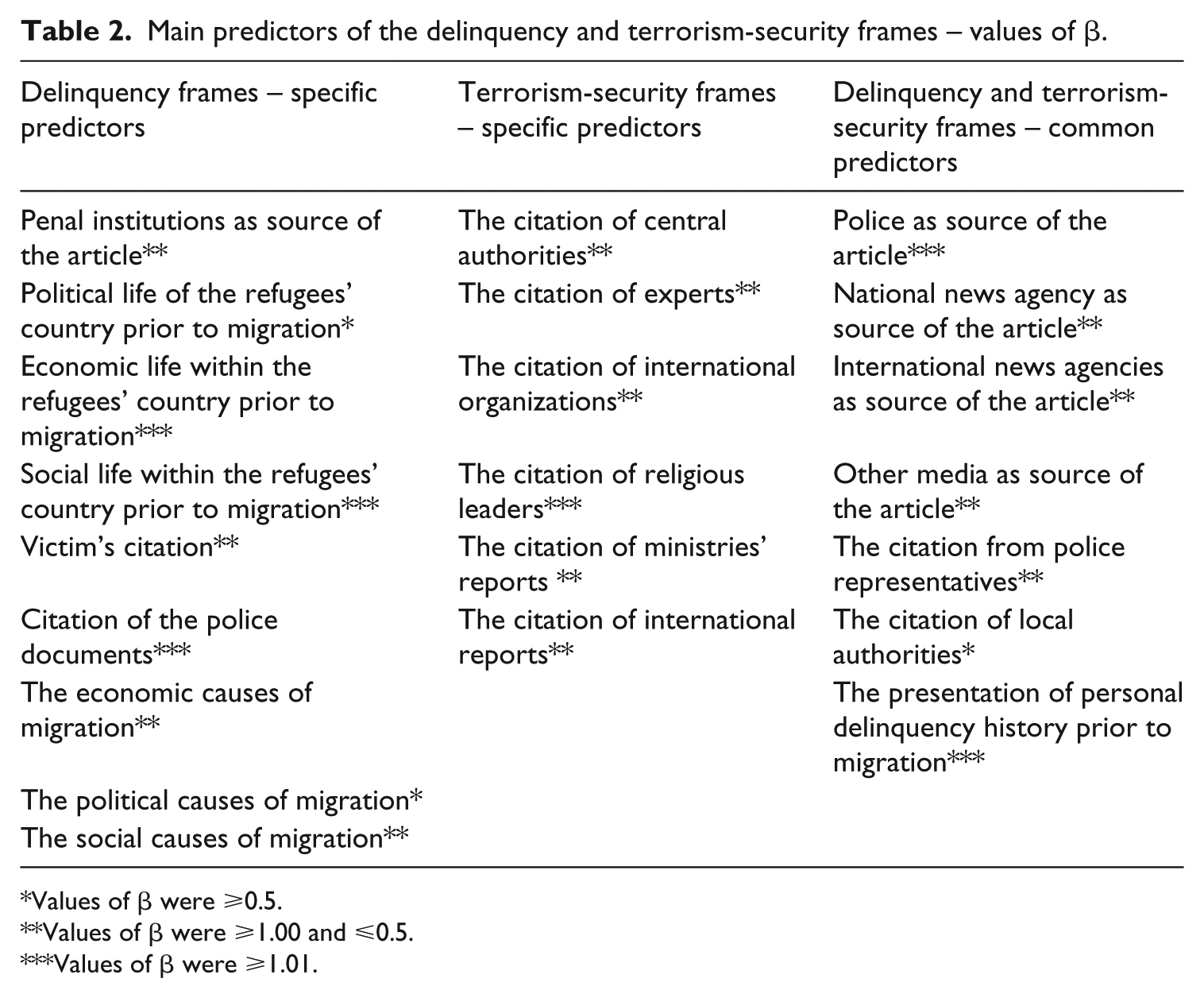
Values of β were ⩾0.5.
Values of β were ⩾1.00 and ⩽0.5.
Values of β were ⩾1.01.
Discussions
In accordance with Hier and Greenberg (2002), our analysis showed that media coverage of crimes in which refugees were involved tended to subsume the ‘episodic’ type of frames (Iyengar, 1990), a fact that can be explained especially by the nature of the event that was initially covered – arrival of a massive and relatively compact group of refugees in a short period of time in Europe.
In the case of the sample of analyzed articles from Romanian online media, the terms ‘refugees’, ‘immigrants’, ‘asylum seeker’, and ‘migrants’ were used as having similar meanings. Further to this, they were associated as attributes that the refugees had. If the wrong usage of the family words ‘immigrant’, ‘asylum seeker’, ‘refugee’ is a characteristic of the journalistic speech both in Europe and in Canada (Fleras, 2014), then the characterization of the refugee as a ‘migrant’, as an ‘asylum seeker’, or as an ‘immigrant’ went beyond simple wrong usage or interchangeability of those terms. Presenting the refugee as migrant or as an asylum seeker changes his or her position from a ‘deserving person’ to an ‘undeserving one’ in relation to the host population.
As shown by the specialized literature (Welch et al., 1997, 1998), the ‘primary definers’ for the articles which covered crimes which involved refugees were police representatives. In our analysis, it was found that quoting governmental sources (especially police representatives and documents issued by this institution) was also prevalent in the media coverage of crimes involving refugees. At the same time, the perspectives of the refugees and/or of civil organizations were almost absent (Greenberg and Hier, 2001). A new type of ‘definers’ which appeared for this research are represented by mass media and by journalists. As McLaughlin (2008) and Greer and McLaughlin (2011) showed, journalists are now the ‘secondary definers’ and this is also true when considering the media coverage of refugees and crime, as our data proved.
The fact that mass media can play a negative role in dehumanizing the refugees was admitted by Esses et al. (2013). They showed that the representation of refugees and immigrants as bogus, disguised terrorists, or carriers of contagious diseases not only dehumanizes them but also induces the feeling of public opinion that urgent measures against them must be taken (Esses et al., 2013). Yet, unlike other previous studies regarding the manner of representing the refugees in the media (Bradimore and Bauder, 2011; Huysmans, 2006), the terms used for describing the refugees were not only the ones related to events and natural processes or the ones associated with ‘objectification of refugees’. Instead, they were mainly words that place the refugee in a clear identity from a religious and ethnical point of view. At the same time, the usages of ethnic and religious determinants were not underpinned with the usage of other elements, which would induce empathy for the person placed in this position.
As shown in the specialized literature (Dowler et al., 2006; Jewkes, 2011; Peelo et al., 2004; Pizarro et al., 2007), the Romanian media tends to misrepresent the victims and the aggressors regarding a series of sociodemographic characteristics. Lack of definitory elements for the refugees involved in violent acts appears in contradiction with the results of Steimel’s (2010) analysis. By indicating the nonexistence of ‘proximity framing’, the readers are made to understand the core of a tragedy, even it is geographically far (Robins, 2003).
The analysis of the articles regarding the involvement of refugees in crimes highlighted the fact that journalists were mostly interested in publishing cases of illegal border passings and were less interested in cases of severe interpersonal violence (such as murder, rape, and suicide). This time, journalists decided to publicize crimes which affected national security (therefore, they threatened the entire territory and population of a country) and to a less extent, the coverage including crimes that involved hurting some categories of vulnerable people (women, children, or elderly people) which the public shows empathy for (Carrabine et al., 2004). It is worth noting that in the same time period, several terrorist attacks took place in major European cities (January 2015 Paris ‘Charlie Hebdo’, August 2015 train from Paris to Amsterdam, November 2015 Paris, December 2015 Londra, March 2016 Bruxell). It can be assessed that the reader/public – due to his or her affiliation to the territory and whose borders were invaded – became a victim of the crimes. The results confirm the journalists’ interest for ‘signal crimes’, meaning the cases which stand out and affect the entire society (Innes, 2003).
Nevertheless, the elements of novelty and difference regarding our study aim of how refugees are presented in the role of victim in violent acts. Previously, Chan (2013) showed immigrants appeared as aggressors in 95 percent of the total of Canadian news and articles analyzed, while only 2 percent of them presented the immigrants as victims of acts of violence. For the online media sample that we analyzed, the fact that almost a third of the articles presented the refugees as victims of crimes indicates an important change in the media coverage for this type of issues and problems.
Our analysis indicated the existence of some schematic ‘portraits’ which lacked not only the personalization of the refugees (by giving some specific details – name, family, education, occupation) but also the context of their life story. The lack of some of these elements – which arguably allow the reader to locate and to understand the refugee – was also identified by Hickerson and Dunsmore (2016). This ‘localized coverage’ ignores the international situation of the refugees and focuses exclusively on their present and future in the host country and is now being extended to acts of violence which involved refugees.
Conclusion
The coverage of refugees’ crime in particular is an important area of inquiry due to the stress put on fear of crime and moral panic in such media coverage. As a result, journalists’ pivotal role of setting the public agenda of such sensible topic is highlighted. Thus, as the existing literature on moral panic and fear of crime has stressed (Carrabine, 2014; Cohen, 2011; Garland, 2008), we can assess that the association of the refugee with crime leads to stigmatization of the refugees and to their rejection from the society in which they attempt to integrate. But, as the studies on violence against children and trafficking of persons showed (Rodríguez-López, 2018; Weatherred, 2015), the public debate of such topics leads to the increase of general knowledge of the population regarding the risks that refugees are facing and about violations of human rights in their cases.
One of the peculiarities of the Romanian media coverage of minorities and vulnerable groups is the use of ‘primary definers’ of the situation. These were mainly ordinary people and State institution representatives (Lazăr et al., 2018; Marinescu, 2006). The persons belonging to the minority groups and those who belong to vulnerable groups also have an invisible identity and their general description was extremely schematic (Marinescu, 2012). This was the case with the refugee, who was presented as the victim of the criminal act covered by media, as our analysis had shown, where ethnicity was the main demographic axis used by journalists. On the contrary, in the case where the refugee was seen as an aggressor, media coverage used more attributes, including gender, age, religion, and ethnicity. While these results can be related to the degree of journalists’professionalization in Romania (Lazăr et al., 2018), it could be also linked to the ways in which the media reinforce the dominant stereotypes about refugees (Esses et al., 2013).
In this respect, it is worth noting the fact that the Romanian attitude toward refugees changed during the period of time considered for analysis. Opinion polls showed important shifts in their opinions related to hosting the refugees in their country. Thus, in August 2015, 65 percent of Romanians agreed to host refugees in their country (Institutul Român pentru Evaluare și Strategie (IRES), 2015), while in September 2015, the percentage dropped dramatically and 56.2 percent of Romanians did not agree with hosting the refugees (INSCOP, 2015). When one analyzes the evolution during the time of the articles which associated refugees with crime, it can be noticed that 9.5 articles were published on average with a peak in August 2015 and September 2015 when 30 articles were published for each of them.
In an extended analysis of the relationship between frames and the information sources regarding immigrants, Hayes (2008) shows that governmental official sources were the most used in what he called ‘restrictive frames’ – all of these being negative frames. Positive frames or ‘welcomes frames’ were based on sources among immigrants or activists for human rights (Hayes 2008). In the case of our analysis, the main frames used by journalists were the delinquency frame, the geopolitical frame, and the terrorism-security frame – a fact that is directly linked to the use of the State’s institutions and central-national or international media as sources in media coverage of the criminal acts in which refugees were involved.
Our study confirms the thesis presented by Esses et al. (2013), which argues that, in recent years, the presentation of refugees and immigrants in several Western countries has become more and more negative, with media from these countries highlighting the threat they represented for the host societies. The type of vocabulary used also contributed to that, as well as the framing manner, which presented refugees as murderers and people with deviant behavior (Bradimore and Bauder, 2011; Greenberg and Hier, 2001; Leudar et al., 2008; Steimel, 2009). In the same vein, our analysis confirms the conclusions of Leudar et al. (2008) – the refugees were described in a negative manner and the main attributes which accompanied the refugees belonged to crime, terrorism, and religion plus the ethnicity was noted as being different from that of the EU countries.
Another result from our analysis demonstrates that ethnicity and religion were the main axes which made a difference between refugees (as victims and as aggressors) and the rest of the population from the host countries. Journalists who covered these crimes seem to pay tribute to some presentation models of the events that have an ethnical part, according to Van Dijk’s (2006) analysis. Moreover, although research indicates a humanitarian tendency within coverage of Syrian refugees in the time frame 2011–2013, this disappeared in 2015–2016. The negative representations of the refugees involved in acts of violence perpetuated a series of negative elements which already existed (Rettberg and Gajjala, 2016) and did not change them. Also, it is directly related to the predominance of the criminalization frame for the Romanian emigrant in the Romanian media (Beciu, 2012).
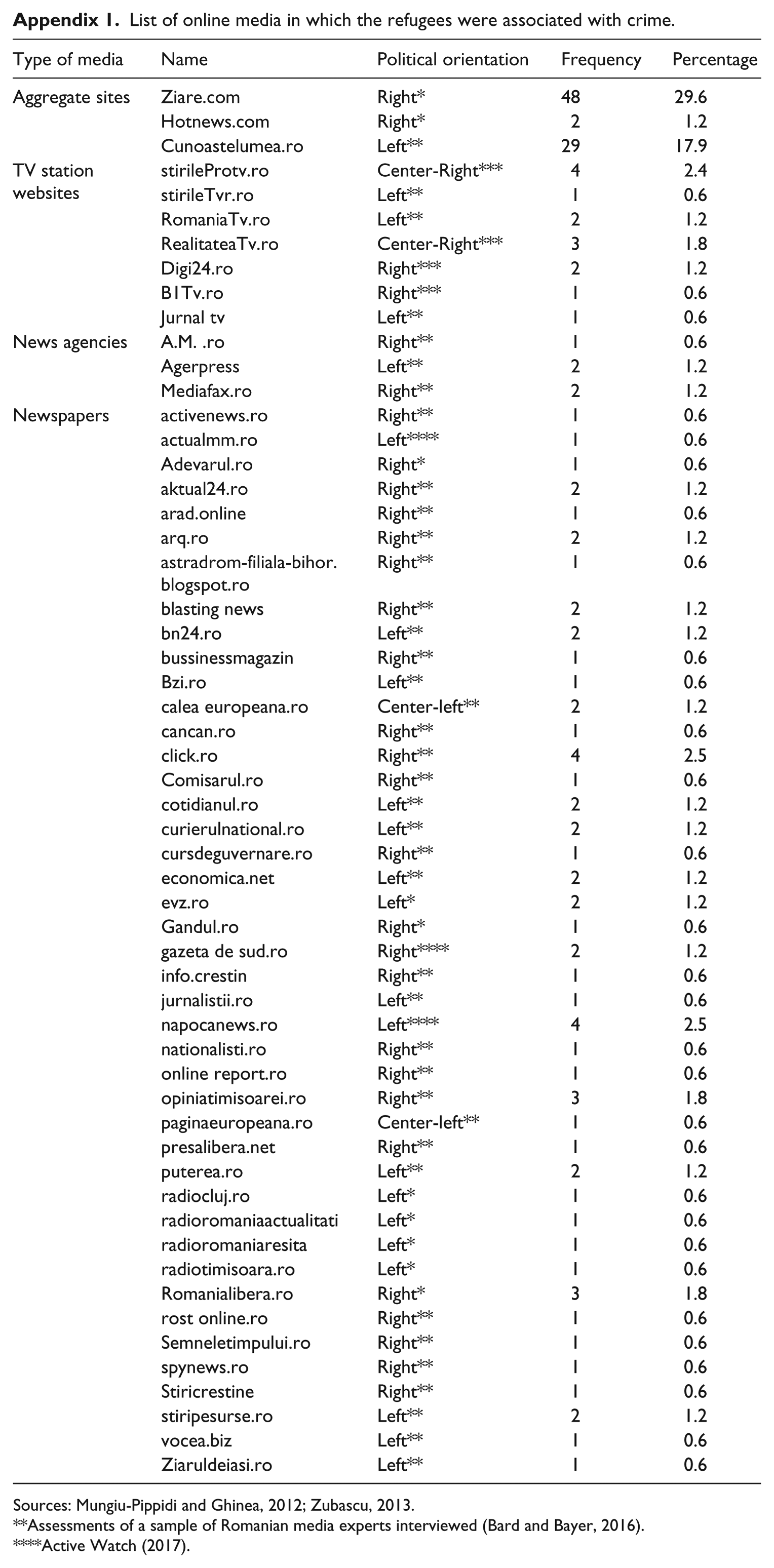
The main limitation of the study is the analysis focus on a sample of articles published exclusively in the online media from Romania. The analysis of media outlets’ political orientation (left vs right) enclosed in the sample (see Appendix 1) showed the difference between the number of articles which were published in the left-oriented media (40.9%) and the number of articles published in the right-oriented media (59.1%). In the meantime, even if 47.50 percent of the total sampled items were published on two websites (the ziare.com – a right-oriented aggregated site and cunoastelumea.ro – a left-oriented aggregated site) we assess, on one hand, that this result could reflect the separation between the left- and right-oriented media at the level of the entire sample and, on the other, it is a direct consequence of the character of this media outlets (which only aggregated the information from other sites of similar political orientation). Building from here, we can say that although the results refer to the entire European region, they cannot be generalized for a larger geographical and cultural zone. Also, the exclusively quantitative nature of the analysis does not allow us to identify narrative and rhetorical elements which formed the public speech regarding refugees in the analyzed time frame.
In spite of these limitations, the research provides some very interesting elements related to the actual changes in media and journalism. To be more precise, the main changes that we identified in framing the refugees involved in crimes – which are the media and the journalists’ transformation in ‘primary definers’ of these acts and, especially, the positioning of the refugee in the role of victim within a significant number of articles. This shows the admission of some movements in the way journalists covered the events in the time frame 2015–2016.
Footnotes
Appendix
List of online media in which the refugees were associated with crime.
| Type of media | Name | Political orientation | Frequency | Percentage |
|---|---|---|---|---|
| Aggregate sites | Ziare.com | Right* | 48 | 29.6 |
| Hotnews.com | Right* | 2 | 1.2 | |
| Cunoastelumea.ro | Left** | 29 | 17.9 | |
| TV station websites | stirileProtv.ro | Center-Right*** | 4 | 2.4 |
| stirileTvr.ro | Left** | 1 | 0.6 | |
| RomaniaTv.ro | Left** | 2 | 1.2 | |
| RealitateaTv.ro | Center-Right*** | 3 | 1.8 | |
| Digi24.ro | Right*** | 2 | 1.2 | |
| B1Tv.ro | Right*** | 1 | 0.6 | |
| Jurnal tv | Left** | 1 | 0.6 | |
| News agencies | A.M. .ro | Right** | 1 | 0.6 |
| Agerpress | Left** | 2 | 1.2 | |
| Mediafax.ro | Right** | 2 | 1.2 | |
| Newspapers | activenews.ro | Right** | 1 | 0.6 |
| actualmm.ro | Left**** | 1 | 0.6 | |
| Adevarul.ro | Right* | 1 | 0.6 | |
| aktual24.ro | Right** | 2 | 1.2 | |
| arad.online | Right** | 1 | 0.6 | |
| arq.ro | Right** | 2 | 1.2 | |
| astradrom-filiala-bihor.blogspot.ro | Right** | 1 | 0.6 | |
| blasting news | Right** | 2 | 1.2 | |
| bn24.ro | Left** | 2 | 1.2 | |
| bussinessmagazin | Right** | 1 | 0.6 | |
| Bzi.ro | Left** | 1 | 0.6 | |
| calea europeana.ro | Center-left** | 2 | 1.2 | |
| cancan.ro | Right** | 1 | 0.6 | |
| click.ro | Right** | 4 | 2.5 | |
| Comisarul.ro | Right** | 1 | 0.6 | |
| cotidianul.ro | Left** | 2 | 1.2 | |
| curierulnational.ro | Left** | 2 | 1.2 | |
| cursdeguvernare.ro | Right** | 1 | 0.6 | |
| economica.net | Left** | 2 | 1.2 | |
| evz.ro | Left* | 2 | 1.2 | |
| Gandul.ro | Right* | 1 | 0.6 | |
| gazeta de sud.ro | Right**** | 2 | 1.2 | |
| info.crestin | Right** | 1 | 0.6 | |
| jurnalistii.ro | Left** | 1 | 0.6 | |
| napocanews.ro | Left**** | 4 | 2.5 | |
| nationalisti.ro | Right** | 1 | 0.6 | |
| online report.ro | Right** | 1 | 0.6 | |
| opiniatimisoarei.ro | Right** | 3 | 1.8 | |
| paginaeuropeana.ro | Center-left** | 1 | 0.6 | |
| presalibera.net | Right** | 1 | 0.6 | |
| puterea.ro | Left** | 2 | 1.2 | |
| radiocluj.ro | Left* | 1 | 0.6 | |
| radioromaniaactualitati | Left* | 1 | 0.6 | |
| radioromaniaresita | Left* | 1 | 0.6 | |
| radiotimisoara.ro | Left* | 1 | 0.6 | |
| Romanialibera.ro | Right* | 3 | 1.8 | |
| rost online.ro | Right** | 1 | 0.6 | |
| Semneletimpului.ro | Right** | 1 | 0.6 | |
| spynews.ro | Right** | 1 | 0.6 | |
| Stiricrestine | Right** | 1 | 0.6 | |
| stiripesurse.ro | Left** | 2 | 1.2 | |
| vocea.biz | Left** | 1 | 0.6 | |
| Ziaruldeiasi.ro | Left** | 1 | 0.6 |
Sources: Mungiu-Pippidi and Ghinea, 2012; Zubascu, 2013.
Assessments of a sample of Romanian media experts interviewed (Bard and Bayer, 2016).
Funding
The author(s) received no financial support for the research, authorship, and/or publication of this article.
