




Abstract
This study explores how news authorship, exclusiveness, and media type affect readers’ paying intent for digital contents. A web-based experiment involving 602 Spanish adults reveals that authorship (prestigious journalist), exclusiveness, and media type (legacy media and new media over unknown media) increase readers’ economic value assessments of online news. In addition, our results show that the interaction between authorship and media type is affected by the level of news exclusiveness: when an online article is written by a prestigious journalist and is exclusive, readers’ heuristic assessments of its economic value are biased toward new media over legacy ones, and thus privilege the former and penalize the latter in their pecuniary evaluations. These results might point to a change in readers’ consumption patterns, favoring the brand values, and news production processes of new media over legacy ones.
Introduction
As a result of profound technological and industrial transformations, news organizations worldwide are experiencing a period of exploration and testing of new business models, organizational structures and multi-platform strategies, in order to adapt to the new digital environment while remaining profitable (Schlesinger and Doyle, 2015). According to recent literature on the newspaper crisis, many factors negatively impact the balance sheets of media organizations: drop in sales of advertising and print subscriptions (Sánchez-Tabernero, 2008), emergence of new digital and social media platforms for news consumption (Goyanes, 2014), changes in patterns of information access (Huang, 2009) and, above all, the failure of most online media in monetizing digital content (Myllylahti, 2014). In response to this challenge and in order to find a sustainable revenue model, many news outlets have implemented paid content strategies 1 (Sjøvaag, 2016). In this context, the exploration and exploitation of factors that can affect reader paying intent is a strategic challenge for the survival of the news industry.
Previous market research on the economics of news has shown the limited paying intent for digital content (KPMG, 2010; Newman et al., 2016; Newman and Levy, 2014) since only 3 percent of print circulation are digital subscribers, regardless of the price of the newspaper (American Press Institute and ITZBelden, 2009). According to KPMG (2010), the type of online content that consumers are most willing to pay for is the same as they normally pay offline, but only 2 percent would pay if their favorite newspaper implemented a paywall. In the United States, only 4 percent of readers pay for digital news (Rosenstiel and Mitchell, 2011). Even in the successful case of The New York Times, the million digital subscribers account for only 2 percent of its unique monthly users. In Spain, around 10 percent of Internet users pay for news, after a significant increase in 2015 (11%) compared with 2014 (8%). This percentage is slightly below the average of 13 percent in the 26 countries included in the Digital News Report 2016 (Newman et al., 2016) and very far from Norway (27%), Brazil (22%), Poland and Sweden (20%). Paying penetration is thus on the average, and a review of recent literature indicates that there are no available behavioral data regarding the number of people actually paying for news in this country.
In this turbulent environment, some scholars have suggested, ‘it is impossible to charge for general information’ (Thurman and Herbert, 2007: 15) that ‘information must be free unless it is specialized’ (Goyanes, 2014: 422) or that ‘it is signed by a prestigious journalist’ (Filloux, 2011). For years, these have been the assumptions held both academically and professionally. However, because of a lack of empirical testing on the potential effects of exclusiveness, authorship, and media type on readers’ news assessments, it is difficult to calibrate their validity. Therefore, the present study explored (1) how intrinsic values of digital news, specifically authorship and exclusiveness, and media type (legacy media/new media/unknown media), affect readers’ economic evaluations of news; (2) whether the potential effects of authorship/exclusiveness differ between different media types; and (3) whether the effects of the interaction between news authorship/media type and reader paying intent differ depending on whether the news article is exclusive or not. It can be assumed that both the intrinsic characteristics of digital content and media type serve as cues in readers’ heuristic judgments about the economic value of a news article, so that both might bias paying assessments. We therefore conducted an experiment that systematically varied the characteristics of news stories (in terms of author prestige and exclusiveness), as well as the media type to test predictions derived from these assumptions.
Theoretical framework
Predictors of paying intent for online news
As far as the literature on the economics of online news is concerned, there is a general consensus that the failure to monetize digital content through advertising support has led many media outlets to implement paid content strategies and charge readers for news access and consumption (Chyi and Lee, 2013; Goyanes, 2014; Kammer et al., 2015). Previous research addressing the industry ‘free to fee’ transition suggests that there is no perfect way to solve this industry transformation and therefore news organizations around the world should pursue their own business model innovations through trial-and-error tactics (Goyanes and Vara-Miguel, 2017). According to recent literature, two formulas are the most prominent: paywalls and micropayments. Paywalls suppose conditional access after paying a subscription to a full media outlet, while micropayments are made just for particular pieces of news or a very limited access (see Goyanes and Dürrenberg, 2014 for further clarification). News organizations such as The Financial Times, The Times, The New York Times, and The Wall Street Journal are arguably the most important representatives of these business model innovations, and as such, they usually serve as examples of successful business cases.
Despite the increase in digital revenues, the value of advertising space on the Web is significantly less than in print, and therefore, digital growth is not meaningful enough to offset the decline in print advertising (Rosenstiel et al., 2012). Academic research clearly shows that advertising alone cannot provide sustainable profits and charging for content will likely be an essential part of an effective business model in the future (Chyi and Lee, 2013). However, after years of open news services, readers have grown accustomed to getting news online for free, and as a result, they are highly reluctant to pay for digital content (Geidner and D’Arcy, 2015). In addition, in a context of generic, low-scarcity and commoditized free stories, the literature on the economics of online news assumes that, in order to trigger readers’ online payments, news stories should be worth the cost associated with the purchase. Therefore, high-scarcity news (such as exclusive reporting, prestigious journalists and unique local stories) is a crucial factor to increase the economic value assessments of readers of news (Graybeal and Hayes, 2011). In this regard, Sjøvaag (2016) shows that when news websites introduce paywalls, local content tends to remain accessible just for subscription, while wire, syndicated content, and immediacy news tend to remain open. That free access content generally generates more traffic, but restricted areas include within them the most elaborated journalistic products (Brandstetter and Schmalhofer, 2014). In the same vein, Myllylahti (2014) identified hard news and opinion pieces as the content mostly located inside newspapers’ paywalls.
Propelled by these industry challenges, a growing number of media scholars started to empirically investigate the factors that might influence reader paying intent. Previous research on this issue was fundamentally correlational and observational (Chyi and Lee, 2013; Kammer et al., 2015), focused on how different internal or external variables (such as demographics and media uses, previous print and digital payments, social media use, and purchase of digital products and platform preferences) might influence readers’ paying intent. Goyanes (2015) found that paying intent is related to predictor variables such as age, income, and purchase of most digital products and social media use. Fletcher and Nielsen (2016) suggest that those who already pay for print news are more likely to pay for online journalism in the future. They conclude that when reference price is above zero in an offline environment, the reference price is also above zero in online products. Chyi et al. (2015) found that people think others are generally more likely to pay for news platforms than oneself (third-person effect). In addition, that perception widens from print to web to news apps. Paying intent would also depend on other personal factors such as value perception, news interests, and consumption patterns.
Exclusiveness and authorship
Market research indicates that readers are generally reluctant to pay for digital content, especially, when certain conditions of news values and platform preferences are not met (Chyi, 2012; Geidner and D’Arcy, 2015). According to recent literature on the economics of online news, many factors might explain this reluctance. On one hand, some scholars have suggested that readers, after decades of open news consumption, are accustomed to freely consume news online and therefore, they assume a ‘free mentality’ orientation toward online content (Dou, 2004). Along the same lines, scholars have also suggested that readers’ reluctance may be related to the methods of payment, their availability or the delivery format and platform (Chyi, 2012).
On the contrary, the primary argument to explain readers’ reluctance to pay for digital content is due to news commoditization, lack of value and the low-scarcity nature of online content (Geidner and D’Arcy, 2015; Picard, 2009 Goyanes, 2014, 2017). Graybeal and Hayes (2011) showed how micropayments could be a successful revenue model if news organizations continue to offer generic stories for free, while attaching micropayments to unique and in-depth, original reporting. Geidner and D’Arcy (2015) have also demonstrated that individuals are willing to pay for news under certain conditions. In their experiment, a vast majority of people decided to buy at least one piece of news, as well as the number of stories selected by these people were not significantly fewer than those not paying for news. They conclude that the key aspect is discovering which stories are most appealing for audiences, so that they can feel motivated to purchase them.
Despite the lack of empirical testing on the effects of news values on reader paying intent, media scholars assume that news organizations fail in implementing paid content strategies if readers can easily get similar content on free media (Goyanes, 2015). As a result, reader payment may only be triggered if readers cannot find the same information on other free options, and therefore, if news are high-scarcity and valuable (Picard, 2009). In this regard, some scholars have suggested different approaches to enhance the value of news and therefore increase readers paying intent. Some examples include offering exclusive news (Graybeal and Hayes, 2011), or news that are signed by prestigious journalists (Filloux, 2011). In the first case, the economic value of news increases as the product of its exclusive and high-scarcity condition and thus the difficulty in finding the same or similar content for free. In the second case, authorship reflects the traditional dominance of ethnocentric perceptions of journalism that led to the rise of bylines mainly across the 20th century (Reich and Boudana, 2014). To this regard, the mere presence of a prestigious journalist has a measureable impact on readers’ perceptions regarding the meaning, authority, and credibility of texts (Das and Pavlíčková, 2014). If those assumptions were true, a reader, controlling for all extraneous variables, would be more likely to pay for exclusive content and for a news article written by a prestigious journalist than when the same story is non-exclusive and written by an unknown journalist. Formally, this is stated as the following hypothesis:
H1: Reader paying intent for online news increases when a news article is exclusive than when it is not exclusive.
H2: Reader paying intent for online news increases when a news article is written by a prestigious journalist than when it is written by an unknown (fictitious) journalist.
Legacy and new media
There is a general consensus that reader paying intent for online news depends on various factors and levels. Conceptually speaking, Arrese and Kaufmann (2016) identify legacy/traditional/offline media as synonyms, as well as native/digital/online media outlets. Kelly (2008) had been previously using the ‘legacy’ or even ‘mainstream’ label, but this distinction has been accepted and used extensively in other pieces of research. Beyond these conceptual clarifications, what this literature has demonstrated is that, contrary to conventional wisdom, legacy and new media are not obtaining substantially different audiences (Arrese and Kaufmann, 2016; Fortunati et al., 2014), and significant divergence (in terms of readership) mostly exists around journalistic factors (online journalism characteristics and the value of journalistic brand values) and not around marketing factors (payment for news and demographic audience profiles) (Arrese and Kaufmann, 2016). In addition, Pennycook and Rand (2018) have also introduced the central issue of familiarity with the media outlet: when readers are not familiar with a given news source that dramatically reduces the trustworthyness difference among mainstream media sources and hyper-partisan or fake news websites.
On the contrary, according to the literature on media brand management, media brands are strongly linked to professional journalistic values (Kim et al., 2010). Brand value in journalism is attached to factors like uniqueness, relevance, and preference for readers (Ots, 2008). In fact, that brand preference, when originally coming from the offline world, is commonly maintained in same-brand digital platforms (McDowell, 2011). Some authors argue that the types of content appealing to people are basically the same in offline and online media (Dutta-Bergman, 2004). Chyi (2012) proved that the type of online content that consumers are likely to pay for is the same as in offline outlets, though only 2 percent would pay for a website that they currently enjoy for free. But others specify that legacy media selection is mostly driven by brand appreciation and news impartiality, while digital media consumption is reinforced by factors like opinion-driven media, authors’ journalistic authority (Arrese and Kaufmann, 2016) and journalism innovation (Aitamurto and Lewis, 2013). Both legacy and new media are in a privileged position in the online environment and their readers’ degree of difference is very low (Arrese and Kaufmann, 2016), which suggest that reader paying intent will be very similar between them, but will increase (in both cases) in comparison to a third unknown media outlet. This is stated as the following hypothesis and research question:
H3: Reader paying intent for online news increases when a news article is published online by (a) a legacy media outlet and (b) a new media outlet in comparison to an unknown (fictitious) media outlet.
RQ1: Do readers have statistically significant differences in paying intent for online news depending on whether the news is published by a new media or legacy media?
In addition, we want to explore whether the potential effects of authorship/exclusiveness vary between different media types and whether the effects of the interaction between news authorship/media type and reader paying intent vary depending on whether the news article is exclusive or not. It can be assumed that both the intrinsic characteristics of digital content and news brands serve as cues in readers’ heuristic judgments about the economic value of a news article, so that both might bias paying assessments. We therefore explore the following research questions:
RQ2: How does news exclusiveness interact with the media type to affect reader paying intent?
RQ3: How does news exclusiveness interact with news authorship to affect reader paying intent?
RQ4: How does news authorship interact with media type to affect reader paying intent?
RQ5: Do the effects of the interaction between authorship/media type and reader paying intent vary depending on whether a news article is exclusive or not?
Methodology
Participants
All web-based experiments were carried out simultaneously between 20 November and 5 December 2017 in Spain through an online survey. Simulated screenshots of the article on the website were integrated into this Web questionnaire. An invitation to the survey in Spanish was distributed online (using Facebook posts, e-mail, Twitter, and posts to online discussion forums) by students of a master’s course on media management (Prochazka et al., 2018). In addition, a local news bulletin advertised the link. Gift certificates from Amazon served as incentives for participation. A convenience sample of 602 respondents completed the questionnaire (50 respondents for 10 of the conditions and 51 for 2 of them). The reported levels of education were as follows: 0.2 percent less than primary school, 10.1 percent primary school, 8.8 percent secondary school, 18.3 percent vocational training, 34.4 percent university studies, 24.4 percent master studies, and 3.8 percent PhD. The sample of 602 Spanish residents included slightly more women (50.1 per cent, n = 302) than men (49.9 per cent, n = 300) with an age range between 18 and 75 (M = 34.7, SD = 11.1). The median length of survey duration was around 5 minutes.
Several research reports have highlighted some of the current risks experienced by media systems, caused in part by the commercialization of the news production business. The results of the 2016 Media Pluralism Monitor – MPM2016, a comparative study carried out at the European level – reveal that commercial and owner influence over editorial content is a very significant risk for media pluralism. Twelve out of thirty countries had a high-risk score for this indicator, while the national context for our research, that of Spain, was included at the medium risk level. When it comes to media trust, recent data from the Digital News Report (Newman, et al., 2017) show a remarkable recovery in the news in general. If in 2015, Spain was one of the lowest positions in terms of trust in the media, possibly conditioned by the turbulent political and electoral situation, currently 51 percent of Internet users trust the news–four points more than in 2016 and 17 with respect to 2015. The percentage of news skeptics has gone from 33 to 24 percent in 2017. In general terms, the Spanish media ecosystem has evolved from small newspapers organizations to big multimedia groups, resulting in a fierce competition and an increasingly fragmented scenario. According to Llorens (2011), this absence has led to the creation of five or six multimedia groups, which have made structural pluralism possible at a national level.
Procedure
Upon accessing the study website, participants were first presented with questions concerning demographic information, level of news interest, news consumption, print newspaper subscription(s), and previous digital payments (see the ‘Measures’ section). They were then taken to the stimulus page to read a news article and were instructed to read it as they would usually read news online. Participants were randomly assigned to one of the conditions in a 2 (exclusive vs non-exclusive) × 2 (prestigious journalist vs fictitious journalist) × 3 (legacy media vs new media vs fictitious media) between-subjects experiment design. In the post-test questionnaire, participants were asked to report their paying intent and their general interest of the article. Finally, they were asked to list any thoughts that occurred to them while reading the news story (Figure 1).

Screenshot of the exclusive, prestigious journalist and legacy media condition.
Stimulus material
As stimuli, we used realistic screenshots of a news website containing a slightly modified version of an article that had been published by a major newspaper in Spain (El País) on the 30 March 2017. Entitled as ‘The Court of Auditors 2 denouncing improper payments of 133 million in the works of the AVE 3 ’, the original article revealed numerous irregularities in the high-speed rail route from Spain to France. To ensure that all respondents did not have knowledge about this particular corruption case prior to the experiment, they were first asked if they have read the original news article. Respondents who answer this question affirmatively (only one subject) were excluded from the survey and therefore were not part of the final sample.
We decided on the topic of corruption for the sake of external validity, because exclusivity and journalistic authorship on such a topic is plausible. This good-quality news article on a contemporary topic was manipulated in three ways. First, for the manipulation of the media type, the article was embedded into one legacy media, El País, one new media, El Confidencial, and one fictitious (unknown) media, which we named Diario La Tribuna. In the first two cases, the article and page layout were changed to resemble each of the publications, while in the fictitious media, an original layout was created. Participants were told that the article had actually appeared in these media within the past week. El País was chosen because it is the leading Spanish online and print newspaper, while El Confidencial was selected because it is one of the most important Spanish new media and also a well-known research-based online newspaper. El País and El Confidencial are prestigious media outlets that are associated with an image of quality journalism. We used these two news organizations to account for the variation in reader paying intent (legacy media vs new media) and thus for being able to strengthen our claims beyond just one media type.
Second, the prestigious journalist selected for the manipulation of authorship was Fernando Garea, a veteran newsworker with many years of experience in El País and quite respected by Spanish audiences due to his qualified coverage of national politics and his regular TV and radio appearances in political and corruption debates. In addition, this journalist was signed by El Confidencial a few weeks before the survey was launched, which has also served us to incorporate him in the analysis of this new media. As in the media type manipulation, the page layout resembles each of the publications and the name of the journalist appeared clearly and in the same position as in the original media layout. The same procedure applies for the fictitious journalist, who we named Luís González. We made sure this name does not exist journalistically.
Finally, the exclusiveness condition was manipulated to create a (1) high- and (2) low (or no) exclusive news version. The differences between both are the following: in the exclusive article, for example, it was made clear that the published news story was original information by alluding to its exclusive nature, first in the subtitle (e.g. ‘EL PAÍS exclusively reveals a new report that collects numerous irregularities in the high-speed route to France’) as well as throughout the text. In the most important boxouts (in bold and within a box, with bigger font size and layout outside the text) the exclusive nature of the article has been emphasized (i.e. ‘The report to which EL PAÍS has had exclusive access reveals inflated prices, payments of works not carried out, unfulfilled deadlines without justification and irregular assignment of minor contracts’). In addition, data not disclosed in the non-exclusive condition have been revealed in the exclusive one. The two different versions were written by the authors and reviewed by a professional journalist.
Measures and descriptives
To control the factors that might affect the paying intent for online news addressed by previous research (Goyanes, 2014; Chyi, 2012), participants were asked before reading the stimuli to indicate their gender, age, education, and previous online news payment (‘Have you paid for online news content, or accessed a paid for online news service in the last year?’, 0 = no (n = 537; 89.2%); 1 = yes (n = 65; 10.8%)), print subscriptions (‘Have you been subscribed to a printed newspaper in the last year?’, 0 = no (n = 521; 86.5%); 1 = yes (n = 81; 13.5%)). After reading the news article, participants were asked to evaluate their paying intent (‘How likely is that you personally would pay for the news article you just read?’ on a five-point Likert-type scale ranging from 1 = very unlikely to 5 = very likely (M = 1.84; SD = 0.94)). Paying intent was used as dependent variable above ‘willingness to pay’ (WTP) since it is a better measurement for the aim of this research, as far as ‘paying intent’ is oriented to predict behavior (in this case paying for online news), while WTP refers to the maximum amount of money one is willing to pay for a product, which is the inevitable outcome and ultimate measure of competition. More than two thirds of the sample answered either ‘very unlikely’ and ‘unlikely’, which suggests that readers are generally ‘intent not to pay’ rather than on ‘intent for paying’ for online news. Therefore, one of the main findings of this study is that most respondents would not be willing to pay for news. Finally, the participants indicated how interesting they thought the news article was on a five-point Likert-type scale ranging from 1 = not at all interesting to 5 = very interesting (M = 3.00; SD = 1.20).
Results
To ensure that there were no statistical differences between experimental groups with respect to different demographic variables (age, gender, and education), we conducted a one-way analyses of variance (ANOVAs) with the participants’ condition as the independent variable. These analyses did not reveal significant differences across conditions (p = .3). A 2 (exclusive vs non-exclusive) × 2 (prestigious journalist vs unknown (fictitious) journalist) × 3 (legacy media vs new media vs fictitious media) analysis of covariance (ANCOVA) was conducted to test the effects of exclusiveness, authorship, and media type on paying intent for online news, controlling for previous online newspaper payment, and news article interest, (Table 1).
Analysis of covariance. Dependent variable: paying intent for online news.
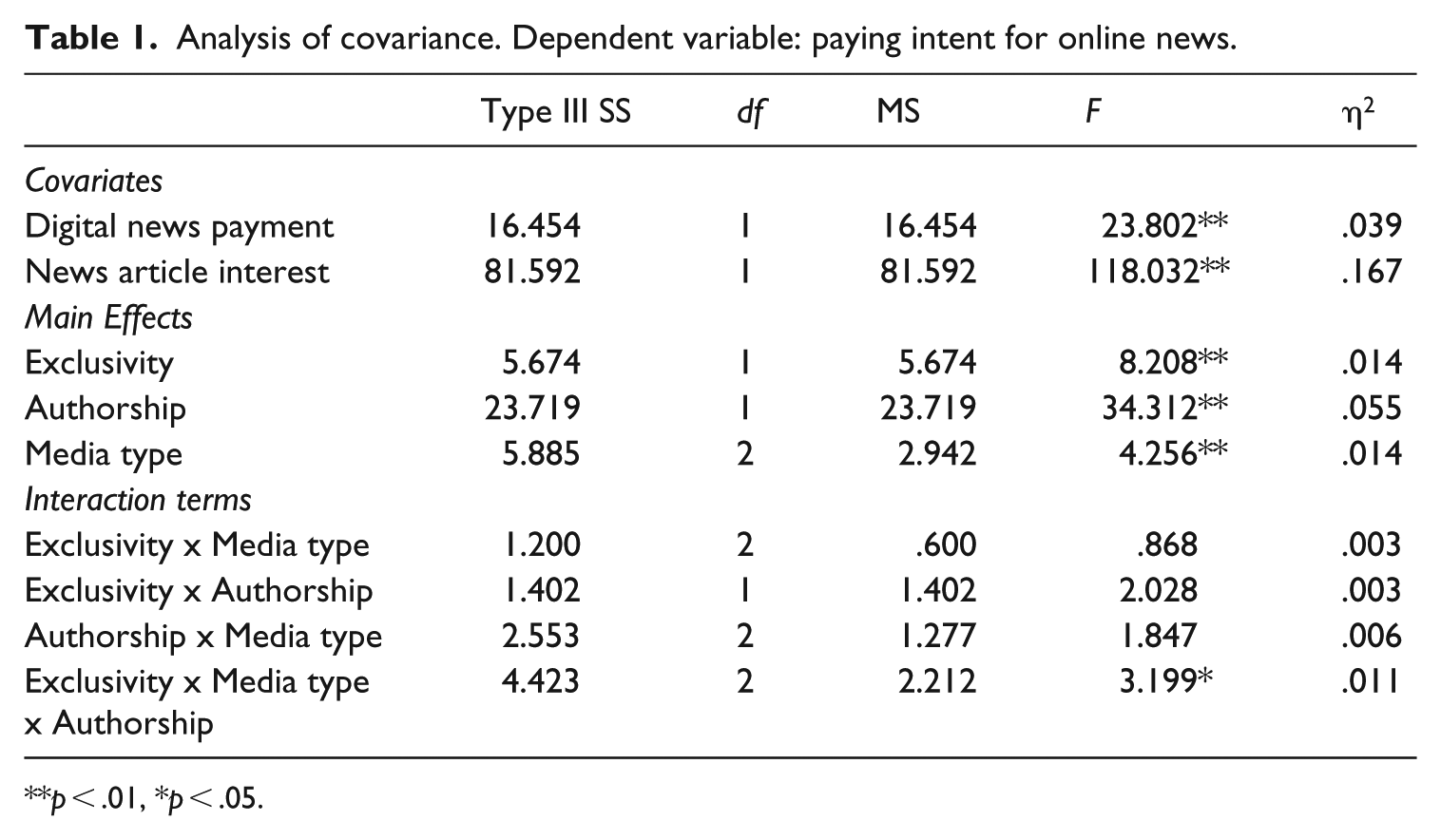
p < .01, *p < .05.
The ANCOVA analysis revealed a statistically significant effect of both covariates digital news payment, F(1, 588) = 23.803, p < .01, η2 = .039, and news article interest, F(1, 588) = 118.032, p < .01, η2 = .167, in reader paying intent for online news. Therefore, participants that have paid for online news content in the last year and that indicated a strong interest in the news article (stimuli) are more likely to pay for online news. H1 stated that reader paying intent for online news increases when a news article is exclusive than when it is not exclusive. The ANCOVA analysis revealed a main effect of exclusivity in paying intent, F(1, 588) = 8.802, p < .01, η2 = 0.14 (MExclusivity = 1.946, SD = 0.97; MNonExclusivity = 1.752, SD = 0.98). Overall, the paying intent for online news was higher when the article was exclusive, supporting H1. H2 stated that reader paying intent for online news increases when a news article is written by a prestigious journalist than when it is written by an unknown (fictitious) journalist. The ANCOVA analysis revealed a main effect of authorship, F(1, 588) = 34.312, p < .01, η2 = 0.55 (MPrestigious = 2.048, SD = 1.07; MUnknown = 1.650, SD = 0.84), fully supporting H2.
H3 stated that reader paying intent for online news increases when a news article is published online by (a) a legacy media and (b) a new media in comparison to an unknown (fictitious) media. The ANCOVA analysis revealed a main effect of media type, F(2, 588) = 4.256, p < .01, η2 = 0.14 (MLegacy = 1.915, SD = 1.04; MNewmedia = 1.923, SD = 0.95; MUnknown = 1.709, SD = 0.96). A planned contrast showed a statistically significant difference between the means of legacy and unknown media (0.317; p < .05), and new media and unknown media (0.212; p < .05), thus fully supporting H3a and H3b. RQ1 asked whether readers have statistical significant differences in paying intent for online news depending on whether the news is published by a new media or legacy media. The planned contrast revealed no statistical significant differences in readers’ paying intent depending on whether the news is published by a new media or legacy media (0.105; p = 0.283).
Testing for RQ2, RQ3 and RQ4, a two-way interaction terms between exclusiveness/media type, exclusiveness/authorship, and authorship/media type were created, showing no statistically significant effect in paying intent for online news. Finally, RQ5 examined a three-way interaction between authorship, media type, and exclusiveness. The analysis show a statistically significant three-way interaction, F(2, 588) = 3.199, p < .05, η2 = 0.11. Readers reported more intention to pay for online news in all three media types when, in the non-exclusive condition, the news article was written by a prestigious journalist. The effect of the non-exclusive nature of the news article was higher in the unknown media than in the legacy and new media when the article was written by a prestigious journalist. On the other hand, readers reported more intention to pay for online news in all three media types when, in the exclusive condition, the news article was written by a prestigious journalist. The effect of the exclusive nature of the news article was higher in the new media than in the legacy and unknown media, (Figure 2).
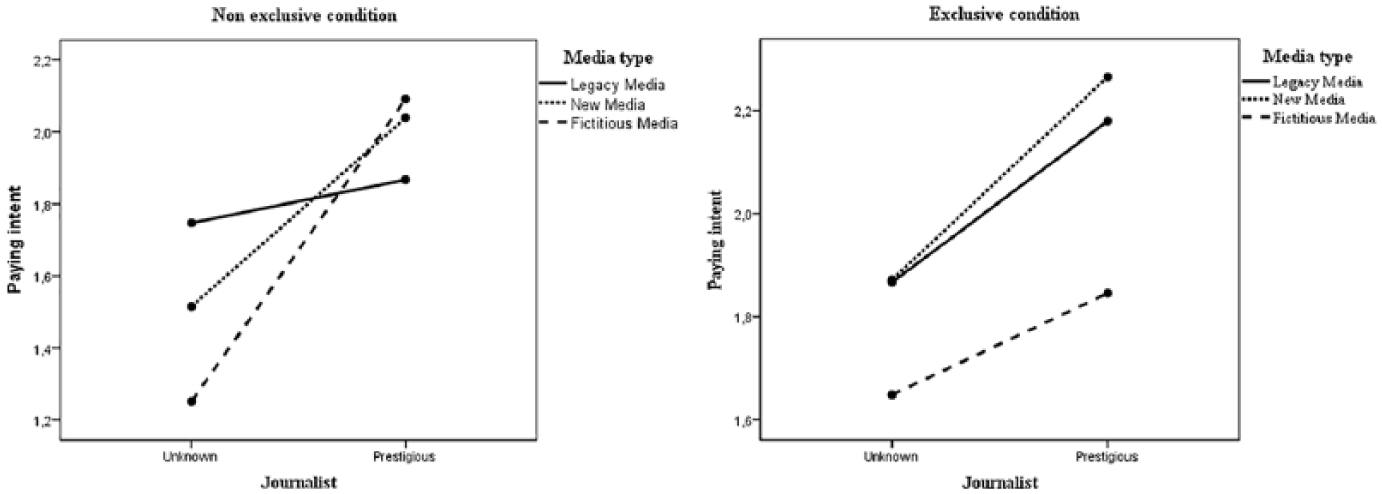
Three-way interaction between authorship, media type and exclusiveness.
General discussion
The aim of this study was to examine how news authorship, exclusiveness, and media type can influence readers’ economic evaluations of digital content. Our experimental design revealed that authorship (prestigious), exclusiveness, and media type (legacy and new media over unknown ones) have a significant main effect on reader paying intent for online news. In addition, our results show that the interaction between authorship and media type is affected by the levels of news exclusiveness (three-way interaction). However, further analysis revealed a non-significant two-way interaction between authorship/exclusiveness, and media type. These results make several important contributions, including (1) testing how intrinsic values of news (specifically, authorship, and exclusiveness) can affect readers paying intent for digital content, (2) providing the first experimental account that empirically measure readers’ economic assessments of online news under different conditions, (3) introducing the subtle role that media type can have on assessing the value of news, and (4) providing important implications for news organizations’ paid content strategies and business models (Evens and Damme, 2016).
Effects of news values and media type in reader paying intent
Despite the business failure in monetizing digital content (Graybeal and Hayes, 2011) and the effects on news quality that all the austerity measures news organizations have implemented to deal with significant declining revenues (Ekdale et al., 2015), our results show that reader paying intent for online news increases when certain conditions are met. On one hand, news values such as the exclusive and authorship nature of an article are significant factors to increase readers’ perception of online news economic value. Therefore, newsroom investments in qualified and experienced personnel seem a fundamental strategic measure for a long-term financial relationship with readers. If journalists’ working conditions continue to decline and, as a consequence, news organizations increasingly rely on commoditized news from news agencies (Deuze, 2007), this will definitely undermine readers’ assessment of the economic value of news.
On the contrary, our study demonstrates the significant impact of media type in convincing readers to pay for digital content. Reader paying intent for online news is higher in legacy and new media over unknown ones. In addition, the difference in means between both legacy and new media are not statistically significant, which suggests that online divergence exists mostly around journalistic factors and not around marketing factors (Arrese and Kaufmann, 2016). Our results suggest that the traditional privileged position of legacy media is being challenged by new media competence, taking full advantage of technological and newsroom innovations (Aitamurto and Lewis, 2013). In fact, under certain content conditions, legacy media are no longer dominant in triggering consumers’ payment. In this respect, if legacy media are unable to fully adapt their organizational structure and professional skills to the new digital marketplace, their print brand power and prestige might not be strong enough to convince readers to pay for their services over the technological and entrepreneurial orientation of new media.
The role of exclusiveness in the interaction between news values and media type
Our results show that the interaction between authorship of a news article and media type is influenced by the level of exclusiveness. In the non-exclusive condition, all three media types increase reader paying intent when the news article is written by a prestigious journalist, but this increase is higher in unknown media and new media than in legacy ones. Therefore, when a news article is written by a prestigious journalist, but the content itself is not exclusive, readers penalize legacy media over other digital options. On the contrary, in the exclusive condition, all three media types increase reader paying intent when the article is written by a prestigious journalist, but this increase is higher in new media than in legacy and fictitious ones. Therefore, in the online environment, when a news article is written by a prestigious journalist and is exclusive, readers’ heuristic assessments of its economic value are biased toward new media over legacy ones, and thus favor the first and penalize the former in their economic evaluations.
These results show how readers’ heuristic judgments about the economic value of a news article are affected by a three-way interaction, two representing news values, and one media type. In both the exclusive and non-exclusive condition, readers’ economic assessments of digital news are lower in legacy media than in other media types. Specifically, in the first case (non-exclusive condition), the paying intent increase is higher in both the new and fictitious media when the article is written by a prestigious journalist. This finding suggests that despite the prestigious condition of a journalist, if the news article does not provide valuable content, readers penalize legacy media and favor other digital alternatives, especially unknown media brands. The second case is even more surprising, since readers’ economic assessment of online news is higher in new media than in legacy ones when both news articles are exclusive and written by a prestigious journalist.
In conclusion, our results indicate that readers’ might assume that legacy media in digital operations are in a privileged position, but with limited exploitation of this potential dominance in the practical terms that readers expect. Therefore, readers might take for granted that legacy media must provide more valuable news services, and if their needs and wants are not met in the standards expected, they favor other digital options (even fictitious). Readers’ expectations of legacy media in digital operations might not be met and therefore readers’ positively bias their economic assessment toward new media competence.
Implications for practice
This study demonstrates that readers, under certain conditions, say they would be likely to pay for online news. However, this paying intent, at least in the Spanish context, is still very limited and restricted. Our results revealed that 76.1 percent of the survey respondents range between 1 (very unlikely) and 2 (unlikely) in their paying intent. Despite this limited intention, our study indicates that classic values of news (such as exclusiveness and news authorship) have a significant impact on readers’ news economic evaluations as so do media type. Therefore, some of the arguably most important core values of print operations play also a crucial role in the digital environment when it comes to predicting reader paying intent for digital content.
Our study suggests that despite the increased competition and the declining influence of legacy media brands online (Arrese and Kaufmann, 2016), their value in terms of uniqueness, relevance, prestige, and preference for readers (Ots, 2008) still partially hold in the digital environment (McDowell, 2011). In this regard, two classic dimensions of news values remain crucial when implementing paid content strategies: the exclusiveness and authorship of a news article. In addition, the media brand itself has a positive impact, which explains their higher paying intent in legacy and new media over unknown ones. As previously outlined, legacy media are benefited by their brand power (gained in print operations) and try to consolidate and transfer this valuable heritage into their digital services. Our results indicate that legacy media are in a privileged position to implement paid content strategies online, although according to readers’ expectations, they are not taking full advantage of this leverage. Therefore, their potential success in digital operations will not only be a consequence of their glorious past performance, but of their competence and dexterity in conceiving and exploiting fully adapted digital content and services that ‘have something to say’ in a market of increasing and fierce competition.
In this context of limited paying intent for digital news, it is still highly risky for both Spanish legacy and new media to venture into the implementation of revenue models that charge readers for news access and consumption. Unless there are strong reasons for paying for digital content (mainly in terms of the relative benefits attained), readers’ economic sacrifice is yet not strongly triggered by their news value assessments. However, as this study shows, readers clearly perceive the intrinsic value of news, and therefore, when certain conditions are met, their paying intent increases. In this context, we might suggest that, although there is a strong tendency of news organizations in the digital environment to commoditize news by increasingly resorting to institutional sources, news agencies, and the work of freelances (Deuze, 2007), traditional values associated with news quality are still crucial predictors of readers’ economic assessments of news. News organizations’ investments should therefore focus on making news more attractive by relying on classic values such as the exclusivity of a report or the interpretation of current affairs by prestigious journalists. Under these conditions (and many others yet to be empirically explored), and with some pedagogy about the democratic implications of establishing a trusted and professional media system (in an era of fake news and misinformation) the chimera of a natural implementation of revenue models that go beyond the advertising support, solving the financial instability of the industry, are increasingly feasible.
Limitations and future studies
Several limitations of the current analysis are noteworthy. First, it is possible that the lack of difference in means between legacy and new media (RQ1) was because the participants did not notice the source of the article. Previous research on source attribution has consistently found that the majority of readers fail to notice the source of the online news they read. For instance, the Media Insight Project (2017) reports that only 2 in 10 people were able to remember the source of a news article they read. This is consistent with other studies, such as Amazeen and Muddiman’s (2018) Saving Media or Trading on Trust? The aim of the RQ1 is to explore whether or not the brand values associated to new and legacy media differ when it comes to convince readers to pay for online news. Therefore, we do not implement any manipulation check to ensure that participants noticed the source of the article (media type), because this is explicitly what the study aims to measure. The same logic applies to news authorship and news exclusiveness. Although the other main effects (i.e. authorship and exclusiveness) were found statistically significant predictors of paying intent (what makes our position more firm), we cannot say definitively whether the lack of difference in paying intent between the legacy and new media conditions are because participants did not notice or did not care.
Second, because of the suggested limits on the number of factors allowed in experimental studies (Smith et al., 2002), the current analysis could not include in the design all the known demographic and media use factors that influence reader paying intent. These factors include age, gender, income, and interest in news and social media use (Goyanes, 2014, 2015). Related, because the topic of the stimulus article was political in nature (corruption), it might be the case that political ideology might have an influence on paying intent. Therefore, future research should examine as covariates different demographic, news use variables, and political ideology in experimental studies (that use corruption news articles as stimulus material) and as control variables in correlational research. Third, despite the balanced nature of the experimental design (aprox. 50 respondents per condition), the broad sample size (602 respondents) and the lack of statistical significant demographic differences across experimental conditions, the survey sample is not representative of the Spanish population. In addition, we chose the controversial topic of corruption for reasons of external validity, but we cannot determine whether our effects would have been the same using different topics. Further research should therefore attempt to replicate these effects using different topics and with a representative sample from the same or a different population.
Fourth, to measure the impact of media type (legacy, new media, and unknown media) on the paying intent for online news, we only looked at one media brand each (El País, El Confidencial, and Diario La Tribuna). Therefore, it remains unclear whether the present results can be generalized beyond the three media represented in the experimental design. Future research should thus explore the impact of media type on the paying intent for online news considering also more than one media brand in each category. Fifth, this study’s operationalization of exclusivity and authorship was quite specific, when both concepts might be multi-layered. Exclusiveness, for example, can also be defined in terms of the quality of the report itself, the presence of opposing perspectives in a story and the innovation and originality of the topic covered. In the same way, authorship, can be defined in terms of popularity. However, for the purpose of this study and for a more efficient experimental control, this research used specific operationalization for these concepts. Future studies should therefore address the exclusiveness and authorship dimensions further as well other news content values.
Footnotes
Acknowledgements
All authors have agreed to the submission, and the article is not currently being considered for publication by any other print and electronic journal.
Funding
The author(s) received no financial support for the research, authorship, and/or publication of this article.
