




Abstract
Existing studies have examined the significance of UK media coverage of the 7/7 London bombings. This article seeks to widen this analysis by exploring the coverage of 7/7 in the leading newspapers of the United Kingdom, the United States, and Poland comparatively using a new agenda-setting perspective that is grounded within network analysis. The study is devised to respond specifically to the contrasting arguments about the influence of media globalization versus religion and ethnicity on this reporting. It finds that the diverse approaches to religion within the countries of the analyzed newspapers appear to mitigate the reproduction of shared religious narratives in this reporting. Nevertheless, the analyzed coverage does carry common attributes and these, it argues, can be explained broadly by the influence of a US-dominated ‘lens on terror’.
Keywords
Introduction
Recent studies that apply agenda-setting theory (Guo and McCombs, 2016) express a return to Walter Lipmann’s idea that the media can construct a kind of a bridge between the images in our heads and the world outside (Lippmann, 1922). This notion takes on a new dimension when it is applied to the study of the media representations of conflict, such as terrorism. In an era of globalization and networking, news media outlets, for example, are observed to work collectively to circulate meanings and images of organized chaos, destruction, and a large number of victims (Couldry and Hepp, 2013) to various countries and regions around the world.
Set against this context, this article focuses on the presence of attributes in comparative reporting of the 7/7 London bombings. It reports on a transnational study of newspaper coverage that follows two intertwined aims: (1) to provide the basis for an analysis of the coverage of 7/7 in the United Kingdom, the United States, and Poland, especially with regard to the networked connections of religious and global political themes and (2) to show the usefulness of a new approach to intermedia agenda-setting.
In contrast to previous studies of coverage of the London bombings, this work emphasizes the connections between the attributes in newspaper coverage that give meaning to the whole event in the context of ethnic and religious differences within the studied countries and media globalization. In short, it examines the networked patterns of connections between religious attributes and political themes with the aim to understand the relationship between the media representation of acts of terrorism and various motifs. A similar, but narrower, interest exists in previous studies of terrorism and 7/7 to which we will now turn.
Studies on the London bombings
7/7 was a significant terrorist event in the United Kingdom. Common to its reporting at the time was the reproduction of the then UK Prime Minister Tony Blair’s views. One commonly reported speech that followed the incident began with the words, We all know what they are trying to do – they are trying to use the slaughter of innocent people to cow us and frighten us out of the things that we want to do, of trying to stop us going about our business as normal as we are entitled to do. (Blair, 2005)
The presence of the Prime Minister’s view in the media reports revealed the tendency of journalists to reproduce the prevailing discourse and beliefs in their work (see Carey, 1989) and to potentially shape the course of events and their essence (Cottle, 2004, 2016; Eskjær et al., 2015; Pantii, 2016). Moreover, media coverage is observed to habitually reproduce a perspective on terrorism and conflict events that reflects the news priorities of journalists and editors, rather than a substantive review of the facts (Barnett and Reynolds, 2009; Deprez and Raeymaeckers, 2010; Szostok et al., 2016). While frames used to report these events may also involve moments of transition for its main characters (Dayan and Katz, 1994), such frames, often in the case of terrorism events, are based around the threat from terrorism (Nacos, 2003, 2007) or evaluations made by those authorities who are handling the situation (Hayes and Guardino, 2010).
Past studies of the 7/7 bombings and the consequences of that event focus on three perspectives, for instance: (i) the dominance of the discourse of solidarity in the media content, (ii) commemorative aspects of the victims’ testimony in the context of the activation of participatory journalists, and (iii) the discourse of securitization around Muslim citizens in the United Kingdom. The intention of this article is to add to this literature a fourth perspective that relates to the analysis of religious and global political themes in the media representations of the event. This will be examined after first reviewing the three former approaches.
The first explanation of the reporting of terrorist attacks for 7/7 follows one offered to explain the reporting of 11 September 2001 in the United States. At this time, schematic descriptions were abandoned by news editors, and these were replaced by the use of representations of solidarity, which, untypically for American journalism, took for granted certain common values and assumptions (Schudson, 2002). Previously, Daniel Hallin (1986) when discussing the operation of US journalism introduced issues discussed as part of a ‘sphere of legitimate controversy’ underpinned by journalisms’ need for balance and objectivity. During 9/11 nonetheless a ‘sphere of consensus’ played a dominant role among journalists argues Michael Schudson (2002). In the case of 7/7, this kind of coherent representation of solidarity was retained, although two major trends should be added to this as is suggested by Julian Matthews (2016): It is in the aftermath period of incidents where coverage on condemnation and solidarity usurps critical analysis and explanation that we witness a reaffirmation and thus display of associations between the political elite, dominant discourses of the nation and UK newspapers. (p. 187)
Noticed here is how a discourse of solidarity was strengthened by the voices of important social actors and representatives from the elite sections of society (Matthews, 2016). Given the notable absence of cruelty, violence, injuries, and corpses in the coverage of terrorist attacks, which are more often revealed in war and conflict reporting (Fahmy and Daekyung, 2008; Katz and Liebes, 2007; Mogensen, 2008), stories of 7/7 focused largely on the testimonies of victims or material provided by participatory journalists.
Meanwhile, these testimonies changed over time and evolved as participatory journalists acquired and published materials, some of which breach general journalistic ethics. As noticed by Lorenzo-Dus and Bryan (2011) in the case of 7/7, The unexpected circumstances in which the attacks unfolded meant that broadcasters were not on the scene to obtain immediate footage of the blasts, and even following news of the explosions, the three underground crime scenes remained out of bounds. (p. 36)
Studying the influence of images of 7/7 on emotional and political responses to terrorism point to an indirect, but potentially significant, influence on the political views of citizens and their general support for the government’s counterterrorism policy, it has been argued (Iyer et al., 2014). Not surprising, then, is the fact that when professional journalists failed to deliver materials illustrating the full extent of the destruction on 7/7, publics sought detail from participatory journalists (Hoskins, 2011).
Finally, the reporting of 7/7 has been explored as representing the Muslim minority in the United Kingdom as a subject of betrayal and distrust. Reporting has highlighted the status of perpetrators of the attacks as UK citizens and in the process has sought to question the relationship between Muslims living in the country and notions of their ‘Britishness’ (McGhee, 2008). Studies show increased coverage of Islamist groups and extremist groups (Knott et al., 2013; Moore et al., 2008; Poole, 2011), while political actors discuss the ‘securitization’ of UK Muslims. As a result, this phenomenon, as confirmed by Hussain and Bagguley (2012), ‘has had clear effects through some non-Muslims’ views of Muslims’ (p. 731).
Agenda setting at the networked level
In contrast to the specific focus of the above work, this article uses an agenda-setting research approach to explore wider influences on the reporting of the 7/7 London bombings. This approach was first developed to examine the presidential elections of 1968 (McCombs and Shaw, 1972). Following this early empirical research involving agenda setting that took root in different parts of the world, there have been a number of analyzes that have, in addition, ‘provided a common umbrella for a number of research traditions and concepts in communications’ (McCombs and Shaw, 1993: 60). A tradition that is adopted in this article is called ‘intermedia agenda-setting’ and has evolved to explore the influence of media agendas on each other (Brandenburg, 2002; Lopez-Escobar et al., 1998; Vliegenthart and Walgrave, 2008).
Generally, the essence of agenda-setting theory refers to the transfer of salient issues from the media agenda to the public agenda through exposure to cumulative media messages (McCombs, 2004). The traditional approach is informed by two levels of analysis, including the rank order of the salience of issues in the media agenda and the prominence of these issues in the public agenda. When compared, these allow for a level of correlation to be established. It is assumed that the public takes note of these issues exhibited in the media, and consequently, the researcher will compare the salience of attributes in the media agenda with the salience of attributes in the public agenda (McCombs et al., 2000).
Recently, a model of the third level of media effect has sought to integrate the two levels of agenda-setting theory with the newly recognized digital reconfiguration of social space. Known as the network agenda-setting (NAS) model, this suggests that the connection between elements in the media agenda can be passed onto the public agenda (Guo, 2012, 2014, 2016; Vu et al., 2014) and thus demonstrate ‘networked media effects’. As noted by Lei Guo (2016), this allows for the identification of a much wider and stronger hypothesis: The salience of media networks of objects and attributes influences the salience of the networks of these elements among the public. (p. 5)
Thus, the NAS model assumes that news media messages are constructed not on the basis of the individual elements that travel from the media agenda to the public one, but rather on the semantic connections between elements. In practice, news consumers will construct meaning in their minds from the information networks that are transferred from the media agenda to the public agenda, which ultimately translates into the basic mechanism of control over information (Castells, 2012).
Furthermore, the NAS model described can be studied at a step ahead of the transfer from the media agenda to the public agenda and from the perspective of ‘intermedia agenda-setting’. This perspective notes that some outlets shape the agendas of other news outlets on certain issues at certain times. The process occurs often in the presence of obtrusive events by opinion-lead media that share close geographical proximity to the issue (see Vonbun et al., 2016: 3). Situating this process within the NAS model, we gain a sense of the networked intermedia agendas and an opportunity to explore the continuities between them. Doing so with the reporting of an event from different countries, however, requires thought given to arguments about global journalism and national characteristics.
Hypotheses and research question
Informed by the above approach, this article compares three selected newspapers coverage of the 7/7 London bombings in their first three editions after the attack. Addressed specifically is a basic interest in the main attributes of 7/7 that are found in the UK, US, and Polish newspapers as is reflected in its first research question:
RQ1: What are the core attributes of the London bombings in the newspaper coverage of the event presented in the editions from 8 to 11 July in the United Kingdom, the United States, and Poland?
Of course, relevant to this question are ideas about global journalism. To date, sociological and political perspectives and network approaches (Berglez, 2013; Cottle, 2014; Reese, 2010) have provided sweeping explanations of the operation and the content of global journalism. Nevertheless, it is comparative studies that offer the more convincing and detailed explanations of journalism and globalization (Esser et al., 2012; Shoemaker and Cohen, 2006; Wilke et al., 2012). Revealed in the findings from three large-scale projects based on a global approach (Hanitzsch et al., 2011; Weaver, 1998; Weaver and Willnat, 2012) are observations of the heterogenization and the homogenization of the news content. These sustain a tension between the explanations of globalization and localization. Hence, it is possible to find evidence for what Cottle (2009) claims as the world becoming ‘… radically interconnected interdependent and communicated in the complex formations of flows of news journalism’ (p. 309). Likewise, it is easy to find within foreign news a contrasting tendency to be domesticated (Cohen, 2013) or at least to report through the lens of national interests (Nossek and Kunelius, 2012).
To be able to recognize the similarities and the differences present within journalistic cultures, one must first construct a research hypothesis that can be used to explore any suggested homogeneity in global journalism (Reese, 2010). To study the newspaper coverage of 7/7, this article proposes the following hypothesis:
H1: The 7/7 networked attribute agendas in UK, US, and Polish newspapers correspond to a high degree.
At the same, it is vital to capture any potential differences between the countries that underpin journalistic cultures. In this case, the United Kingdom and the United States are characterized by a diversity of social structures within which many nationalities and ethnicities co-exist. Poland, by contrast, is homogeneous in terms of its ethnic structure (Barwinski, 2016) and demonstrates a religious dominance of Roman Catholicism (87.02%) among its observing population (Dmochowska, 2015). The United Kingdom and the United States, as a consequence of the Reformation, include a larger share of various Christian confessions, denominations, and other religions (British Social Attitudes Survey, 2016; Religious Landscape Study, 2014). Such variables must be taken into consideration and thus the comparative analysis of the newspapers will also include the following competing hypotheses:
H2a. A high degree of similarity among the networked attribute agendas of 7/7 is due to ethnicity context.
H2b: A high degree of similarity among the networked attribute agendas of 7/7 is connected to congruent religious context.
Materials and methods
The study on which this article is based explored the first edition of UK, US, and Polish newspapers following the event of the London bombings (from 8 to 11 July 2005). It selected three newspapers of a left-liberal orientation for comparative analysis: The Guardian from the United Kingdom, The New York Times from the United States, and The Electoral Gazette (Gazeta Wyborcza) from Poland. Each is selected due to its importance as a left-liberal orientation broadsheet newspaper within its respective country. For example, The Guardian is characterized by an extensive international department, while The New York Times has been repeatedly referenced in earlier agenda-setting studies (McCombs, 2004) and intermedia agenda-setting projects (Mathes and Pfetsch, 1991; Vonbun et al., 2016). The Electoral Gazette is the most prestigious and remains the most-read opinion-forming newspaper in Poland. Thus, these newspapers are comparable international titles in their respective press markets of the United Kingdom and the United States. Although the US media market is highly decentralized, The New York Times is nationwide in range and displays a left-liberal orientation. Likewise, although the press market in the United Kingdom has remained highly concentrated, with the highest circulation within conservative titles (The Times and The Daily Telegraph), The Guardian continues to be the major nationwide and left-liberal daily.
The web archives of each newspaper title were used to gather material for the analysis. Two search terms were employed to extract relevant media articles (‘London bombings’, ‘London 7/7’) from first days of the media coverage of 7/7. Focusing the analysis on the period from 8 to 11 July helped to capture the specific features of coverage including what Couldry and Hepp (2013) describe as the unexpected combination of events, the lack of a clear scenario, organizational chaos, and the enormity of victims and loss. A total of 318 examples of press materials were gathered and analyzed, including the following: 121 from The Guardian, 135 from The New York Times, and 62 from The Electoral Gazette. Although the last title produced a small number of articles, the amount of content and its volume was significant.
The reporting was analyzed using the method of content analysis (Krippendorff, 2013). Each article was selected as a unit of analysis and analyzed for 50 attributes of the 7/7 London bombings (see Appendix 1). A pilot study of sample of 15 articles (five for each title) was used to build the codebook. Following this, a binary coding approach was used to identify the coexistence of the examined attributes. For example, if the attribute appeared in the article, the coder assigned it a value of ‘1’; otherwise, it was assigned a value of ‘0’ (see Table 1). The author coded the material himself. The intra-coder reliability coefficient of Cohen’s kappa κ was 0.76.
Excerpt of the UK networks media agenda.

A: description of bombs; B: description of terrorist attacks; C: places of the bombing; D: reactions of Londoners; E: number of victims and injured; F: suffering from victims; G: corpse; H: destruction of property.
Thereafter, the obtained material was subject to a network analysis (Guo, 2012; Robins, 2015). This was used to explore the agenda of attributes regarding 7/7 in the studied coverage. The study devised a matrix of attributes to allow for the analysis of a media agenda network for each studied title (Guo, 2012) and to identify which attributes therein link to a greater extent than others. Composed were three symmetrical matrices of 50 rows and 50 columns that were based on the interrelationships observed between the elements in the media content. An example of the matrix from The Guardian appears below (see Table 1). Each cell shows the number of times when two attributes appeared in the same article. Thus, if cell D corresponding to C is 14, this means that these two attributes (reactions of Londoners × places of bombings) appeared together in 14 articles.
In order to test hypotheses H1, H2a, and H2b, the study used a quadratic assignment procedure. This statistical technique comparing the three matrices to register the correlations between their networks of attributes. The process also established the degree centrality through exploring the most important attributes in the research material. In sum, this provided a measure of the number of connections between an attribute and other attributes (i.e. the number of ties in a singular node). Finally, the study employed Johnson’s hierarchical clustering to detect patterns in each media network.
Results
An analysis of reporting was conducted from countries who have a clear political commonality and share democratic values: the United Kingdom and Poland were still partners in the European Union at the time of 7/7 and all of the analyzed countries were members of North Atlantic Treaty Organization (NATO). Hence, it is possible to explore globalization as driver in producing homogenized media content in these countries, despite their observed differences. In response, findings show that there is a high degree of correspondence between all of the news agendas. For example, the average correlation between the network attribute agendas of the United Kingdom and the United States, as presented in Table 2, is positive and high on the level of a maximum of +0.737.
Comparison of the attribute agendas among the United Kingdom, the United States, and Poland.
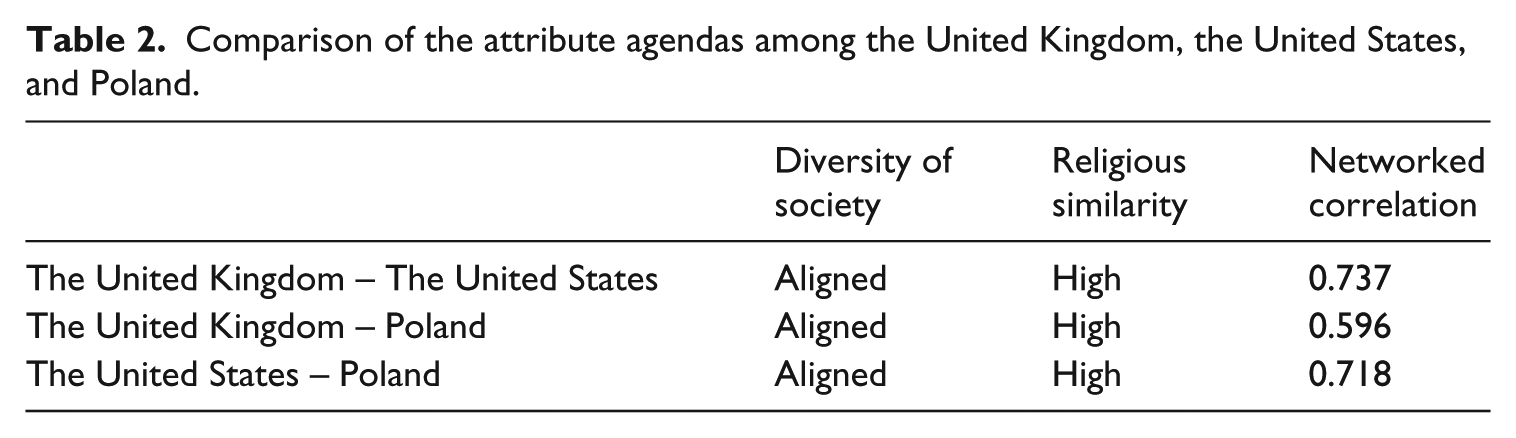
In addition, the study examines the religious context in the analyzed countries in a bid to identify the relations between the media representations of the 7/7 London bombings and the sphere of religion. When considering the differences between the assumed hypotheses H2a and H2b, the study finds statistically significant correlations between the considered agendas of the United Kingdom and the United States (0.737, p < 0.002). Likewise, statistically significant high correlations of the networked attribute agendas occur between the networked attribute agendas of the United Kingdom and Poland (+0.569, p < 0.002) and the United States and Poland (+0.718, p < 0.002). These, we can suggest, are associated with the political closeness of these three countries rather than their ethnic and religious differences.
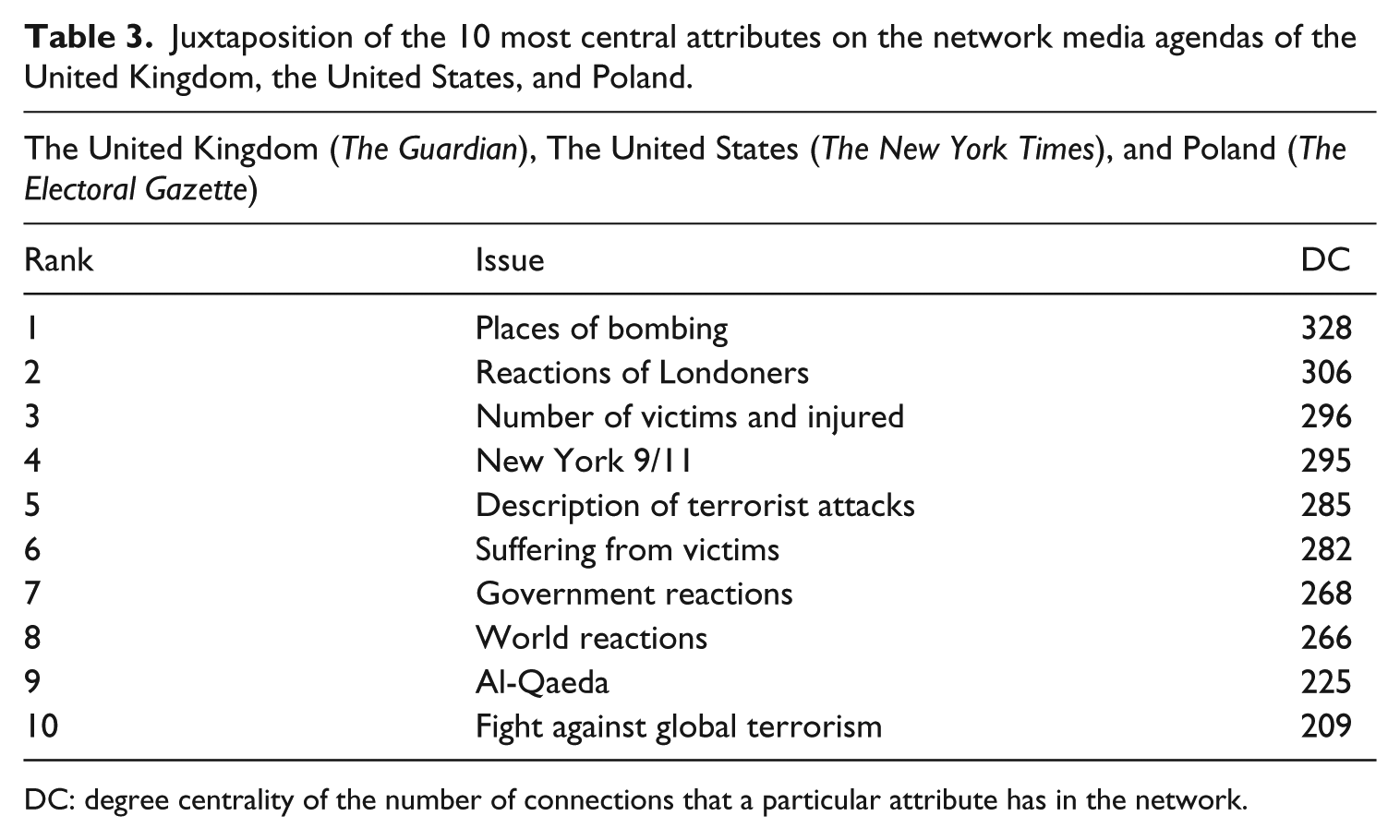
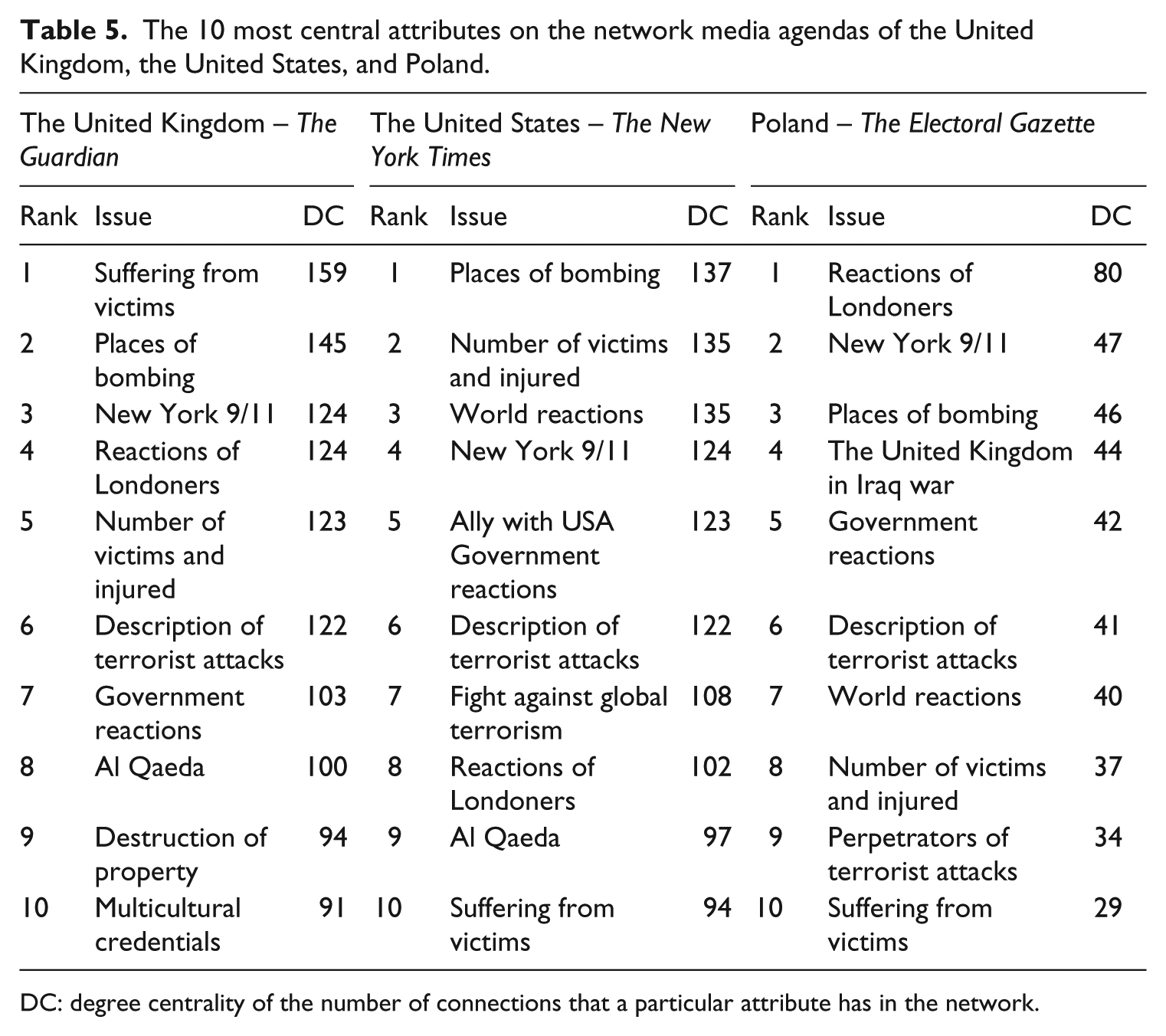
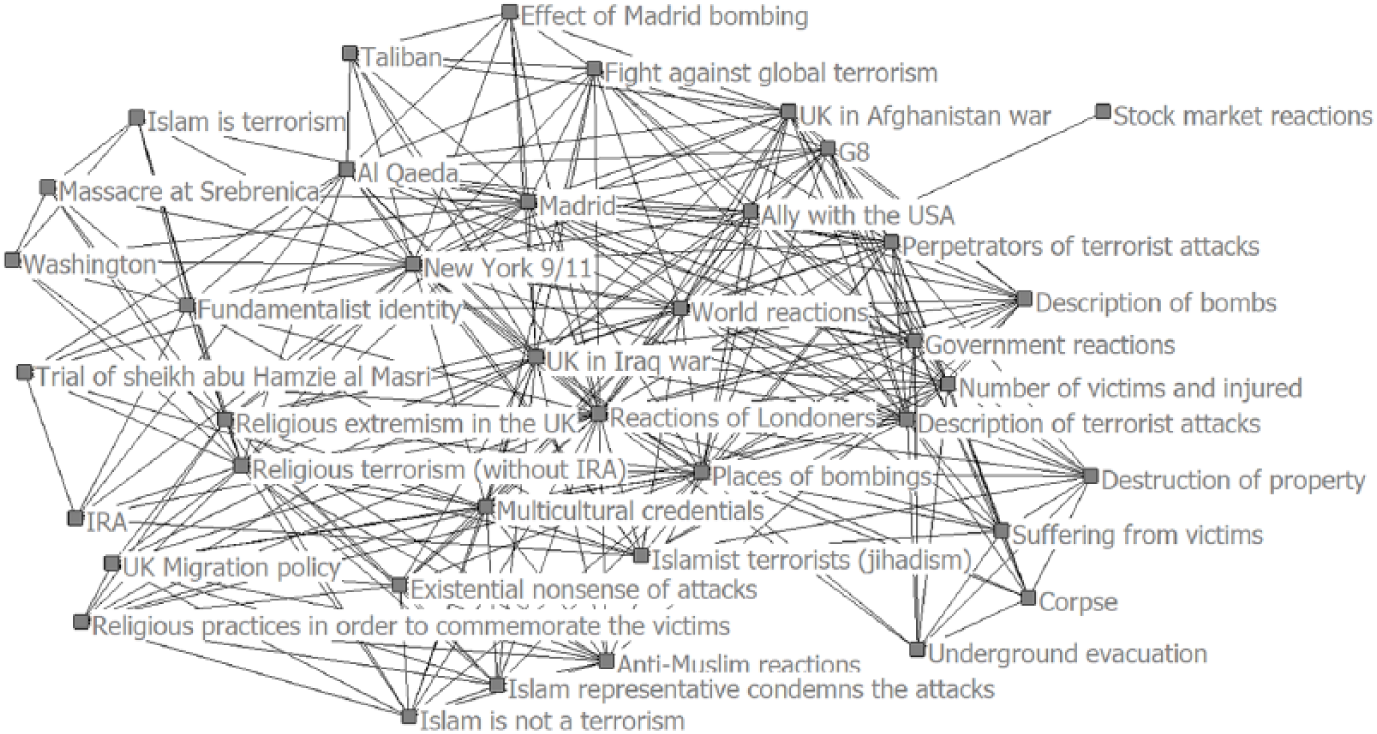
Furthermore, the study has looked at the connections between attributes or what is termed as the measure of the degree centrality. The results in Tables 3 to 5 were produced with the use of UCINET software and present here 10 attributes with the greatest number of connections. Later visualizations of the entire network (Figures 1 to 3) and religious themes (Figures 4 to 6) demonstrate which of these attributes were central and which were peripheral. These results were performed with the use of the network visualization software NetDraw.
Juxtaposition of the 10 most central attributes on the network media agendas of the United Kingdom, the United States, and Poland.
DC: degree centrality of the number of connections that a particular attribute has in the network.
Juxtaposition of religious attributes on the network media agendas of the United Kingdom, the United States, and Poland.

IRA: Irish Republican Army; DC: degree centrality of the number of connections that a particular attribute has in the network.
The 10 most central attributes on the network media agendas of the United Kingdom, the United States, and Poland.
DC: degree centrality of the number of connections that a particular attribute has in the network.

The research subject’s network in the UK.

The research subject’s network in the USA.
The research subject’s network in Poland.
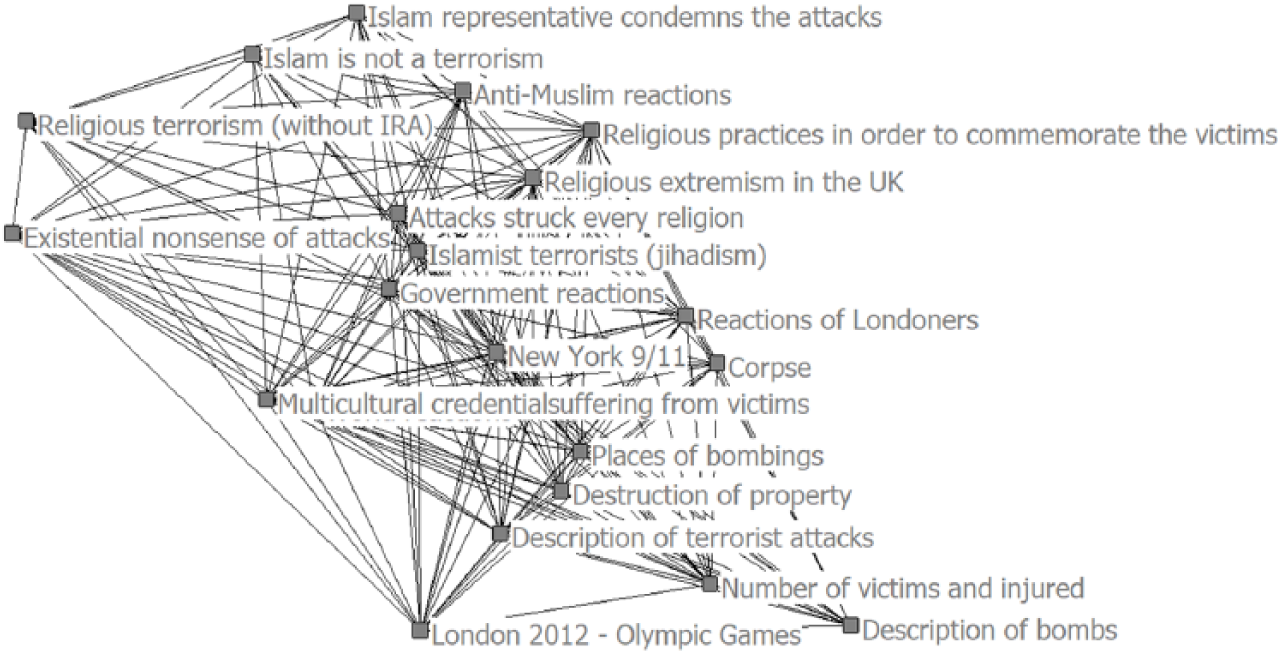
The research religious subject’s network in the UK.
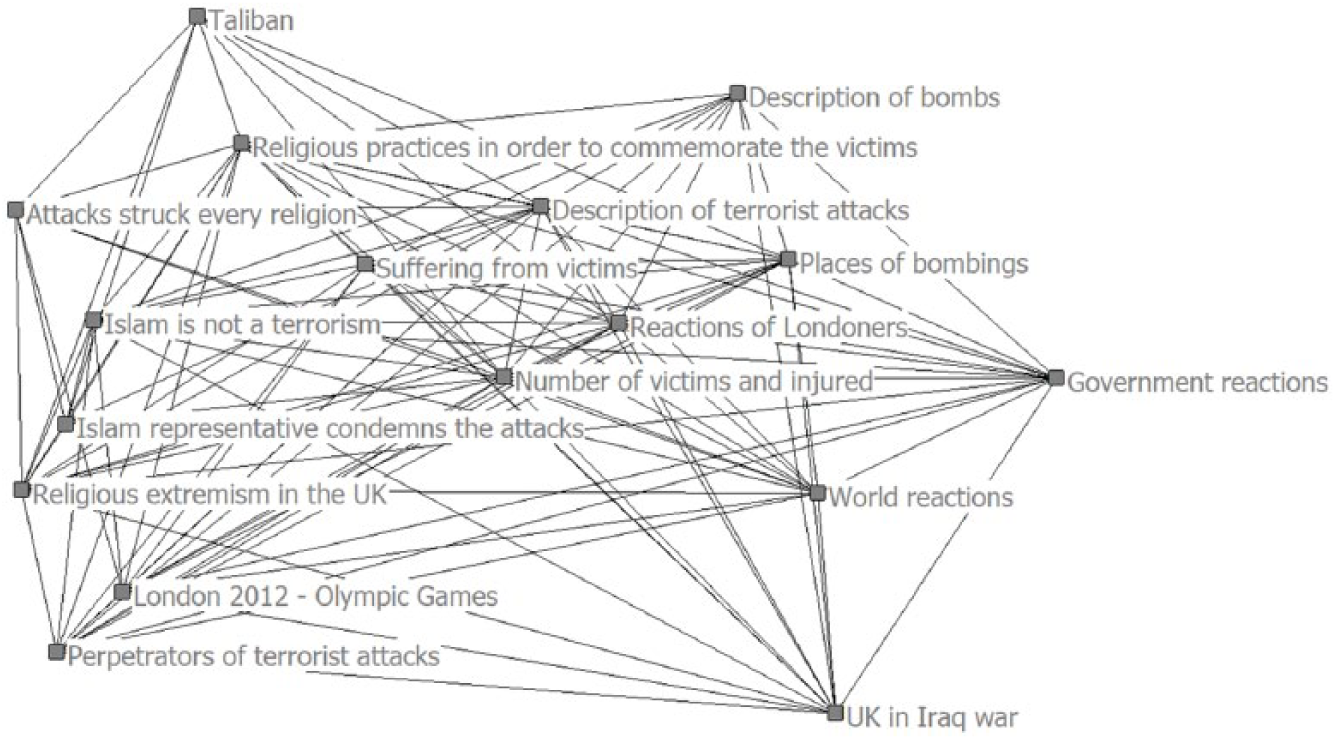
The research religious subject’s network in the USA.

The research religious subject’s network in Poland.
Hence, we learn that the first editions of newspapers after the attacks reported three attributes with the greatest frequency: ‘Places of bombing’, ‘Reactions of Londoners’, and ‘Number of victims and injured’ (see Table 3). As can be seen, the dynamics of the event constituted the core of media reporting. Furthermore, networked attribute agendas of the United Kingdom and of Poland prescribed the main role to the attributes of ‘Reactions of Londoners’ and ‘Suffering from victims’. Meanwhile, religious threads occupied much more elusive positions (Table 5). Although none of the included claims connect Islam to terrorism directly, these do reproduce ‘Islamist terrorists (jihadism)’ as the most cited religious aspect.
Media, terrorist attacks, and religion
This study has explored the coverage in the studied countries. Recognized is how the combined coverage has focused on the fight against global terror and the personification of terror in the form of Al Qaeda. The analysis of the editions after the London bombings is consistent with previous findings. This coverage describes of terrorist attacks and terrorism as the cause and not the symptom of the conflict (Schlesinger, 1987) and further marginalizes discussions of the context that motivates the actions of terrorists (Mcdonald and Lawrence, 2004).
More specifically, it has uncovered insights from the individual networked attribute agendas and threads that have been overlooked elsewhere. Results from analysis of the degree centrality of attributes in the United Kingdom’s networked agenda reveals that the category ‘multicultural credentials’ is important for example (see Figure 1). Previously, studies describe public discourses that either undermine the effectiveness of the policy of multiculturalism or those that link the rationale for the attacks with the country’s foreign policy when they involve representatives of Muslim communities in the United Kingdom (Hussain and Bagguley, 2012). In fact, these findings of media coverage appear to contradict the high degree of identification among the representatives of various ethnic groups in the United Kingdom (Heath and Demireva, 2014; Koopmans, 2010; Wright and Bloemraad, 2012).
Also, a basic pattern emerges when looking for between-cluster similarity using Johnson’s hierarchical clustering of networked attribute agendas. Connections between ‘New York 9/11’, the ‘reactions of Londoners’, and ‘number of victims and injured’ is established and these confirm the existence of a global frame in the coverage of 7/7 that can be traced back to 9/11.
Results of the networked attribute agenda of The New York Times (see Figure 2) discuss the first reports of 7/7 from the US perspective and account for the reactions of others around world. In this global view, the London bombings are introduced as reminiscent of the 9/11 attacks on New York and associated with the categories related to the ‘fight against global terrorism’. A journalist from The New York Times describes the emergency procedures or the testimonies of the injured with reference to 9/11, saying in on instance ‘just as people did on Sept. 11, 2001’ (Cowell, 2005). This indicates a clear link between H1 and the emphasis global journalism places on the reactions from the international community (Reese, 2010). In building a bridge between the coverage of the event and global processes and conditions (Berglez, 2013), we see this global coverage transforming its reaction from those of a national into a global citizen (Van Leuven and Berglez, 2016). Moreover, The New York Times provides hierarchical clustering of similar attributes including the following: ‘government reactions’ – ‘New York 9/11’ – ‘world reactions’. What this shows is that the global perspective offers an extended narrative rather than providing a combination of associations.
Switching attention to Poland, it is important to note there is an absence of academic work on the media coverage of the 7/7 London bombings. In its place are a few studies of the earlier event of 9/11 and these collectively accentuate the end of the reported myth of an invulnerable USA (Kloch, 2006). Looking at the data, we observe the degree centrality of the networked attribute agenda of The Electoral Gazette is different to that of The Guardian and The New York Times. Such a finding does not confirm the hypothesis concerning the homogenization of the content of global journalism (Reese, 2010) and the associations of global journalism with counter-Western ethical performance (Van Leuven and Berglez, 2016). However, a concentration of network attributes concerning the ‘reactions of Londoners’ are observed as dominant to the Polish reporting (Figure 3). Although strategies for covering traumatic events differ (see Hoskins, 2011), the Polish case emphasizes the strength of a traditional narrative of the event’s participants, reactions of public opinion, and possible causes of bombings. Coverage focuses more widely on the environment and reactions to the event and this analysis shows that it clusters three place-related attributes (‘government reactions’ – ‘description of terrorist attacks’ – ‘world reactions’). On this basis, it can be suggested that it was a broader correspondent’s point of view that determines the frame through which a Polish audience interpreted the events of 7/7.
Furthermore, an overview of the networks of connections between specific religious attributes (Figures 4 to 6) also emerges from this comparison of the newspaper coverage from the United Kingdom, the United States, and Poland. The attributes associated with religion focus on the concept of ‘religious practices in order to commemorate the victims’ and reflect the mediatized rituals of death characteristic of contemporary Western societies (Sumiala, 2013). In the case of the United Kingdom (see Figure 4), coverage is rather focused on the controversies surrounding religion as is observed in other studies of media portrayals of religion in the United Kingdom (Knott et al., 2013).
In the case of the United States, coverage focuses on religious rituals in the honor of the victims and these adopt an international character as is found in the included reactions of the world to the London bombings. In addition, the coverage highlights the victims as representative of different religions and faiths, including Muslims (see Figure 5). It also presents the terror attacks as reaffirming basic values of religious people and believers, among whom violence is definitely rare (Collins, 2008). Religion, therefore, is being presented as a social institution in contrast to that of religious extremism.
It is much more difficult to build a coherent narrative based on the observed religious attributes in The Electoral Gazette. Coverage focuses in part on the mediated ritual of death and commemoration (Sumiala, 2013) through its exploration of the reactions of Londoners to the attacks, religious extremism in the United Kingdom, and attitudes to Islam (see Figure 6). It also reflects anxiety associated with the reported attributes of ‘multicultural credentials’ and ‘existential nonsense of attacks’. As indicated earlier, reported concerns about the possible failure of multicultural policy in the United Kingdom turn out to be unfounded (Heath and Demireva, 2014). Nonetheless, the reporting of human solidarity in the face of the terror event appears to challenge this irrational view and to reflect the discourse of solidarity found clearly in the UK press (Matthews, 2016)
Conclusion
In conclusion, the approach adopted in this article has helped to provide a wider view on the reporting of the 7/7 bombings that includes insights into connections between its coverage and religion (Everton, 2016). It takes a place among the growing number of studies that have used the NAS model to analyze media and political issues (Guo and McCombs, 2016). The network perspective, as has been shown here, provides a fresh look at the network of relationships between the attribute agendas of The Guardian, The New York Times, and The Electoral Gazette following 7/7. We learn that there are significant associations between the media agendas of the United Kingdom, the United States, and Poland in terms of the London bombings. These findings suggest that political interests explain the strength of the correlations, as has been found elsewhere (Guo et al., 2015). Analyzing the reporting of the three countries concerned has showed that ‘places of bombing’ identified ‘reactions of Londoners’ to be among the central categories that defined the basis for thinking about the event. This, of course, connects with a US-dominated perspective that has its roots in the 9/11 attacks.
The effort to examine religious issues within the network of connections between the networked attribute agendas of the United Kingdom, the United States, and Poland, however, has not produced a coherent narrative. It can be suggested that focusing on religious extremism in the United Kingdom inhibits the reporting of the function of religion in connecting people to a common process of mourning for, and commemorating of, the victims. Elsewhere, the clear Polish accentuation of existential threads and shared experience disclosed a typical characteristic of Polish Catholicism. Relations within the United States additionally pointed to tension arising out of the fear of identifying with religious institutions associated with acts of terror. Placing these differences aside, we recognize that the features of the reporting reflected the application of a global journalistic frame to the events of 7/7 London bombings that remains important for the wider debate surrounding comparative research on media, politics, and terrorism.
Footnotes
Appendix
A total of fifty analyzed attributes with additional explanation.

| No. | Attribute | Additional explanation |
|---|---|---|
| 1 | Description of bombs | |
| 2 | Description of terrorist attacks | |
| 3 | Places of bombings | |
| 4 | Reactions of Londoners | |
| 5 | Number of victims and injured | |
| 6 | Suffering from victims | |
| 7 | Corpse | |
| 8 | Destruction of property | |
| 9 | Underground evacuation | |
| 10 | World reactions | |
| 11 | Government reactions | |
| 12 | Stock market reactions | |
| 13 | Business reactions (not stock exchange) | |
| 14 | Lack of anti-Muslim reactions | Information about lack of anti-Muslim reactions |
| 15 | Anti-Muslim reactions | Description of anti-Muslim reactions |
| 16 | War with Islam | |
| 17 | The holy War/threat of militant Islam | |
| 18 | Islam representative condemns the attacks | |
| 19 | 10th anniversary of the massacre of Muslims in Srebrenica | |
| 20 | Existential nonsense of attacks | |
| 21 | Bombings as a trial | |
| 22 | Bombings as slaughter | |
| 23 | Islamist terrorists (jihadism) | |
| 24 | Islam is terrorism | |
| 25 | Islam is not a terrorism | |
| 26 | Attacks struck every religion | |
| 27 | Religious extremism in the United Kingdom | |
| 28 | Religious practices in order to commemorate the victims | Gatherings, flowers, commemorations, religious services |
| 29 | Religious terrorism (without IRA) | |
| 30 | Ally with the United States | |
| 31 | Multicultural credentials | A faith in multicultural policy in the United Kingdom |
| 32 | Fight against global terrorism | |
| 33 | The United Kingdom in Iraq war | |
| 34 | The United Kingdom in Afghanistan war | |
| 35 | Freedom of movement in EU | |
| 36 | UK Migration policy | |
| 37 | Effect of Madrid bombing | |
| 38 | London 2012 – Olympic Games | |
| 39 | Fundamentalist identity | |
| 40 | Progress in armaments | |
| 41 | G8 | |
| 42 | Trial of sheikh abu Hamzie al Masri | |
| 43 | Taliban | |
| 44 | Al-Qaeda | |
| 45 | Perpetrators of terrorist attacks | |
| 46 | New York 9/11 | |
| 47 | Washington 9/11 | |
| 48 | Madrid 3/11 | |
| 49 | IRA | |
| 50 | Massacre at Srebrenica |
IRA: Irish Republican Army; EU: European Union.
Funding
The author(s) received no financial support for the research, authorship, and/or publication of this article.