




Abstract
This study examines antecedents of paying for news subscriptions. Taking the customer-perceived value approach, we investigate the impact of perceived quality and perceived journalistic and societal value of news. News habit strength, different motivations for news use, and entertainment spending were also examined for their value in predicting how much people report paying for news. Results of a national survey (N = 403) show that perceived quality of news, habit strength, motivation of social–cultural interactions, and entertainment spending are positively predictive of how much people pay, after demographic controls. These findings not only suggest practical implications for news organizations seeking to increase subscriber support but also raise critical questions about how Americans’ relationships with newspaper news is degrading.
Keywords
Introduction
The advent of Internet and digital technology has changed the news landscape into a more digitalized, mobile-prevalent environment. These changes have severely damaged advertising as a dependable source of revenues for newspaper companies, leaving a reliance on people paying for subscriptions.
According to Pew (Gottfried and Shearer, 2017), from early 2016 to August 2017, the number of American adults getting news via a digital platform increased to 43 percent – with twice as many getting news digitally as from print. Reuters Institute reports an 8 percent growth in mobile news use with more than 70 percent of the US sample getting news from websites and mobile applications (Reuters Institute for the Study of Journalism (RISJ), 2017). In another Pew report, among readers under 50 years old, 78 percent of them get news through social media platforms (Shearer and Gottfried, 2017).
Facing increased digital news competition, news organizations moved toward digitalization hoping it could help them retain readers and shore up financial earnings. Despite this endeavor, the accelerated loss of advertising revenue continues to disrupt news business. From 2003 to 2014, newspaper advertising revenue in digital platforms increased by US$2.3 billion, while print advertising sales declined by US$28.4 billion (Pew Research Center, 2015). Losing advertising revenue has forced news organizations to further explore pay models for boosting subscription revenue to sustain their business (Sehl et al., 2017).
However, American Press Institute (2017) notes that about 50 percent American adults do not pay for any kind of newspaper company products/services. Free alternative content and a lack of interest in news are the most common reasons that people give for not subscribing to news. Yet, other studies suggest people, regardless of age, are willing to subscribe to news they find useful and valuable (American Press Institute, 2018; Fletcher and Nielsen, 2017). Significant recent increases in subscriptions have recently been observed in Nordic countries (RISJ, 2018); while in the United States, both legacy media (e.g. The New York Times) and independent news organizations (e.g. ProPublica) reported an increase in subscription and donation revenue after Trump won the 2016 presidential election. Commentators speculate that people financially support news organizations because they are motivated to protect the freedom of press (Lichterman, 2016). As it is commonly accepted that an informative and independent press is essential for achieving democracy tasks (Gentzkow et al., 2006), survival of these organizations could be critical from a societal and democratic functioning point of view (Schultz, 1998: 51). Thus, it is crucial to explore ways to sustain news organizations.
Therefore, it is important for scholars to ask what makes audiences pay for news? In pursuit of this question, this study proceeds by reviewing key studies and raising new research questions and theoretical propositions about the role of news in people’s lives.
Literature review
Paying for online news
Recent studies have identified some important predictors of the intent to pay for news. Age is the first significant factor – younger people show higher paying intent for online news. Men also tend to have higher paying intent than women, and people who are more interested in news, and who use more online news are more likely to pay (Chyi, 2012; Chyi and Lee, 2013). Preference for online formats also leads to higher news paying intent (Chyi and Lee, 2013) and customers’ willingness to pay (Berger et al., 2015). Higher prices charged for news creates a negative impact on willingness to pay (Berger et al., 2015).
In addition, several studies have investigated different paywall models and their effectiveness. For example, Myllylahti (2014) examined paywall models in eight countries and found that paywalls were softening as newspapers struggled to attract digital subscribers. Pickard and Williams (2014) investigated three US paywall models and argued that revenues brought by paywalls were unable to cover the loss in advertising revenue. Ananny and Bighash (2016) reviewed difficulties of establishing a paywall and documented 69 newspapers that decided to drop their paywalls.
Despite these challenges, scholars also found factors that lead to online paywalls success for news outlets. Sjøvaag (2016) compared paywall strategies of three local newspapers in Norway and found that paywall effectiveness was differentially successful for different content categories. Kvalheim (2013) found that perceptions of exclusivity, proximity of location, and identification with local community contribute to the success of paywall for a regional newspaper in Norway. After setting up the paywall, this newspaper managed to achieve higher online subscription income.
While many previous studies primarily focus on audiences and explore paywalls as a corporate strategy, the attributes of news and their potential influence on paying for news remain largely unexplored. The question addressed here is ‘what perceptions of news are associated with people paying more for news?’.
Good journalism, good business
In the early 2000s, several scholars examined the connections between indicators of journalism excellence and business performance. This line of research provides strong arguments against short-term managerial strategies such as cutting newsroom expenditures and downsizing newsroom staff (Lacy et al., 2004). They argue that newsroom cuts damage news quality and lost quality leads to even more reduced revenues.
In his Financial Commitment Model, Lacy (2000) structures theory about why increased news content quality improves financial performance of news organizations. Several empirical studies utilized longitudinal data to illustrate that newsroom investment (used an indicator of news quality) is positively related to newspaper circulation and subscription revenue (Chen et al., 2005; Cho et al., 2004; Mantrala et al., 2007; Tang et al., 2011). These studies demonstrate that increasing expenditures in newsrooms has a direct impact on the content quality and thus creates competitive advantages that lead to improved financial performance.
Likewise, Kanuri et al. (2014) illustrated that circulation and subscription revenue would rise after adjusting content to match loyal readers’ preferences. Amount of news content is also important as Li and Thorson (2015) found it boosts newspaper circulation and advertising revenue.
In summary, previous studies have shown that once a newspaper enhances its content quality, it attracts subscribers. While current scholarship focuses on audience characteristics and uses newsroom investment as a proxy of quality, few studies have taken the value-creation approach, especially the notion of customer-perceived value.
Customer-perceived value and the duality of news
The most commonly employed definition of customer-perceived value was first articulated by Zeithaml (1988), who defined it as consumers’ comparisons between perceived benefits and perceived costs of a product or service. This comparison can be seen as an overall assessment of trade-off that precedes a business exchange (Zeithaml et al., 1990).
The marketing literature suggests that customer-perceived value is a preferable measure for predicting consumer behavior (Gale and Wood, 1994), and is crucial for companies to develop competitive advantages (Ulaga and Chacour, 2001). Customer-perceived value addresses two major points: (1) value has various aspects and therefore is a multi-dimensional construct and (2) perception of value involves one’s subjective judgments (Eggert and Ulaga, 2002).
To better examine customer-perceived value of news, we first need to understand the duality of news. Unlike other commercialized products, the specialness of news lies in its duality. This means that news is both a private commodity and a public good. It not only gratifies audiences’ personal needs but also benefits democratic society through informing the public (Doyle, 2013). Consequently, the news industry includes the operation of both economical capital and cultural capital (Bourdieu, 2005).
Given the duality of news, this study examines perceived value of news from two perspectives. The first aspect, perceived quality of news, emphasizes the product value of news that satisfies consumers’ utility. From a business perspective, this involves evaluating the functionality of news and its ability to fulfill consumers’ needs. As the functionality of news mainly lies in its content (Lacy and Rosenstiel, 2015), we investigate perceived quality of news based on the criteria of content characteristics.
The second aspect, perceived journalistic and societal value of news, derives from the concept of news as a public good. Evaluating news quality is hardly equivalent to assessing consistency and performance of a manufactured product even though they share the same conceptual definition (Picard, 2000). As a public good, news also plays a crucial role the society. Scholars argue that journalism benefits the public through its professionalism (Kovach and Rosenstiel, 2007, 2011) and its role as the fourth estate (Hunt, 1850). Hence, news also creates journalistic and societal value.
Among all discussions about journalistic value, scholars argue that it is the professionalism of journalism that differentiates news agencies from other organizations. Kovach and Rosenstiel (2007, 2011) propose several principles that contribute to good journalism. These principles include telling the truth, keeping the highlights relevant and interesting, ensuring comprehensive and proportional coverage, being loyal to citizens, and being independent from powerful authorities.
The societal value of news refers to the benefits that news conveys to the society. This approach focuses on functions the press serves in democracy, emphasizing the press’ role in representing the public and protecting the public’s rights and interests. Scholars argue that the press functions as a ‘watchdog’ that scrutinizes governmental activities and monitors other founts of power (Bennett and Serrin, 2005). Importantly, through providing news and information, news organizations also help build norms and practices of democracy, and thus may minimize potential societal conflicts (Curran, 2005). The press also contributes to democracy by informing the public, addressing crucial issues, enhancing citizens’ decision-making by the provision of information, and providing a public sphere for open discussion (Patterson and Seib, 2005; Picard, 2016). Meijer (2012) also suggests journalism encourages completion of the democracy tasks by encouraging public participation and representing the citizens. These arguments provide theoretical foundations and references for us to investigate perceived societal value of news.
Purchase intention, willingness to pay, customer-perceived value, and actual paying
This article aims to investigate people’s antecedents of paying for news by examining people’s perceptions of product and societal values of news. Previous news research has not investigated actual paying, but rather on paying intent and/or willingness to pay (e.g. Chyi, 2012). To clarify possible confusion of these two concepts, Chyi (2012) defines news paying intent as the purchase intention of news products/services and willingness to pay as the highest monetary amount audiences are willing to offer.
In marketing research, Eggert and Ulaga (2002) found that customer-perceived value directly influences purchase intention and is positively related to customer satisfaction. Homburg et al. (2005) found that customer satisfaction predicts willingness to pay. Inspired by the theory of reasoned action (Fishbein and Ajzen, 1975), we aim to test the relationship between customer-perceived value of news and their self-reported paying behavior. As theorized above, the concern is for perceived value in terms of personal product benefit and perceived social benefits of news.
Most fundamentally, we posit there is a positive relationship between customers’ perceived value of news, including both perceived quality and perceived value of journalism to society, and their paying for news. Therefore,
H1. Perceived quality of news is positively related to paying for news.
H2. Perceived journalistic and societal value of news is positively related to paying for news.
Particularly, for perceived journalistic and societal value of news, we posit the following:
H2a. The more people value the truthfulness of journalism, the more they pay for news.
H2b. The more people value the independence of journalism, the more they pay for news.
H2c. The more people value journalism’s role in representing the public, the more they pay for news.
Habit strength of news consumption
It is important to include habit strength because it plays a vital role in news consumption independently of peoples’ attitudes toward news. In contrast to the evaluation process of perceived value, habit strength represents the non-conscious aspect of media consumption behavior (LaRose, 2010). Once routines are established, habits become automatic and repetitive. Verplanken and Orbell (2003) argue that habit is uncontrollable; it occurs without awareness and requires no effort.
With regard to news habits, Shoemaker (1996) argues that people are hardwired for news because of the evolutionary advantages to surveille possibly dangerous occurrences in one’s environment. Diddi and LaRose (2006) report that habit strength is the most powerful predictor of news consumption among college students. Lee and Delli Carpini (2010) suggest that news habits are consistent across different platforms and that a person’s news use pattern in adulthood closely resembles that developed as youth.
Meanwhile, marketing research has provided strong evidence that habit is a crucial factor for predicting consumer purchase intention (Chiu et al., 2012). Marketers are encouraged to create and/or break old consumer habits in order to sell new products (Wood and Neal, 2009). Given these evidences, we argue if one has higher habit strength for news use, it is more likely for him or her to subscribe to news. Therefore, we posit the following:
H3. People who have higher habit strength of news use will pay more for news.
Motivations for news use
Scholarship that investigates motivations to use media is theorized as ‘uses and gratifications’ research (Katz et al., 1973). As media and audience groups vary, uses and gratification studies have an array of different categories. Dobos and Dimmick (1988) identify five core dimensions: general information seeking, decisional utility, entertainment, interpersonal utility, and parasocial interaction. However, dimensions found by Diddi and LaRose (2006) are entertainment, habit strength, surveillance, escapism, and to pass the time. This variation in defining motivations adds to the complexity for researchers trying to understand news use motivations.
The importance of understanding the motivations of news use also lies in its impact on how individuals process news. Eveland (2001, 2002) suggests that the surveillance motive leads to greater news attention and elaboration, which then directly influence learning from news. While Eveland focuses on the surveillance gratification, Lee and Chyi (2015) argue that there are four underlying psychological factors: information, entertainment, social, and opinion-shaping motivations.
This study, however, follows Lacy’s (2000) research on news motivations, as his work directly addresses utilities of newspapers and their circulation revenue. Lacy (2000) summarizes five fundamental types for news use motivations. These five types are surveillance, entertainment, social–cultural interaction, personal understanding, and decision-making. Social–cultural interaction implies using business, social, and other information to fit in certain social groups. Personal understanding provides information for individuals to promote self-insight. Decision-making provides information that helps people resolve problems.
Although it is more a framework of formative indicators than scale development, Lacy’s model is generated from his observations from several empirical studies and is well-aligned with theoretical perspectives (see Lacy and Simon, 1993) and arguments about utility and gratification (Dimmick, 2002). Moreover, the validity of formative indices has been discussed and accepted in the business literature (e.g. Diamantopoulos and Winklhofer, 2001). Hence, we argue this model to be a more appropriate taxonomy regarding motivations for news use.
Built on this, we follow Lacy’s (2000) taxonomy while designing dependent measures for motivation for news consumption. As people’s psychological needs drive them to use more media (Katz et al., 1973), we also posit that people who have higher psychological motivations for news would be more likely to purchase news. Thus, we hypothesize the following:
H4a. Higher motivation for surveillance will lead to more paying for news.
H4b. Higher motivation for entertainment will lead to more paying for news.
H4c. Higher motivation for social–cultural interaction will lead to more paying for news.
H4d. Higher motivation for personal understanding will lead to more paying for news.
H4e. Higher motivation for decision-making will lead to more paying for news.
Other than motivations for news use, the competition between news and entertainment also plays an important role in news consumption. Prior (2005) suggested that investing in entertainment reduces the time and resources that people invest in news. To test this conception, we enter money spent per month for entertainment media as a predictor as well. We expect that,
H5. More entertainment spending will lead to less paying for news.
Finally, we argue that other predictors of subscription revenue may not be the same across different platforms and also may differ in terms of national or local coverage. Research has found that younger people are more likely to pay for online news (Chyi and Lee, 2013; RISJ, 2018). From the market perspective, geographical boundaries also matter in that news consumption may differ between local and national settings. Hence, we ask the following:
RQ1. What is the difference between predicting paying for print/digital bundles and digital-only subscriptions?
RQ2. What is the difference between predicting paying for national and local newspaper subscriptions?
Method
Participants
Data for this study were collected through a Qualtrics national panel fielded between 28 June and 17 July 2018. The survey was distributed with stratified quota of education attainment to match with US Census, as Qualtrics tends to over-represent higher level education (Sue and Ritter, 2012). The final sample consists of 403 respondents, excluding those who failed either of two attention checks. The Institutional Review Board at the researchers’ university approved this study.
Measures
Independent variables
Perceived Quality of News was measured using 11 items. We asked participants to rate their general perception of journalism quality for content characteristics such as including diversified/important topics and providing well-written articles. Responses were on a 7-point scale from ‘Extremely bad’ (1) to ‘Extremely good’ (7).
Perceived Journalistic and Societal Value of News was measured in terms of three variables. Responses were made on a 7-point scale from ‘Strongly disagree’ (1) to ‘Strongly agree’ (7) for each item. Truthfulness was measured through two items: ‘It is important to me that journalism always tells the truth’ and ‘The essence of journalism is verifying facts’. Independence was measured via three items ‘Journalism must maintain an independence from their reporting subjects/government authority/financial power’. Representing the Public was measured through six items such as ‘Journalism must address the public’s concerns’ and ‘Journalism must provide a forum for public discussion’.
Habit Strength was measured through four items such as: ‘I have a pattern of news use that’s pretty consistent from day to day’. Participants were asked to choose from ‘Strongly disagree’ (1) to ‘Strongly agree’ (7).
Motivations for News Use were measured in terms of five variables. Responses were given on a 7-point scale from ‘Strongly disagree’ (1) to ‘Strongly agree’ (7). Surveillance was measured with three items such as: ‘I consume news to keep up with the government and society’. Entertainment was measured through two items such as: ‘I consume news because it is a form of entertainment’. Social–Cultural Interaction was measured through two items: ‘I consume news to define/promote my membership in subgroups I belong’. Personal Understanding was measured through two items: ‘I consume news because it helps me to learn more about myself/help me grow as a person’. Decision-Making was measured through two items: ‘I consume news because it provides information that helps me make decisions in everyday things/serious societal issues’.
Entertainment Spending was measured as the sum of monthly cost for five items: (1) basic cable television, (2) premium cable, (3) video streaming, (4) music streaming, and (5) satellite radio.
Dependent variables
Four items were used to measure for paying for news. We asked subjects to fill in their monthly payment for (1) national newspapers – digital-only subscriptions, (2) national newspaper – print and digital bundle, (3) local newspapers – digital-only subscription, and (4) local newspaper – print and digital bundle. Paying for Newspaper was measured by summing up all four items, Paying for Print and Digital Bundles was measured as the sum of items (2) and (4), Paying for Digital Subscription was measured as the sum of item (1) and (3), Paying for National Newspaper was measured by summing up (1) and (2), and Paying for Local Newspaper was measured as the sum of the following two items: (1) local newspaper – digital-only subscription and (2) local newspaper – print and digital bundle.
Control variables
We included demographic measures of age, gender, income, education, race, and partisanship as control variables. Partisanship was measured through a 7-point scale ranging from ‘Strong Democrat’ (1) to ‘Strong Republican’ (7).
Results
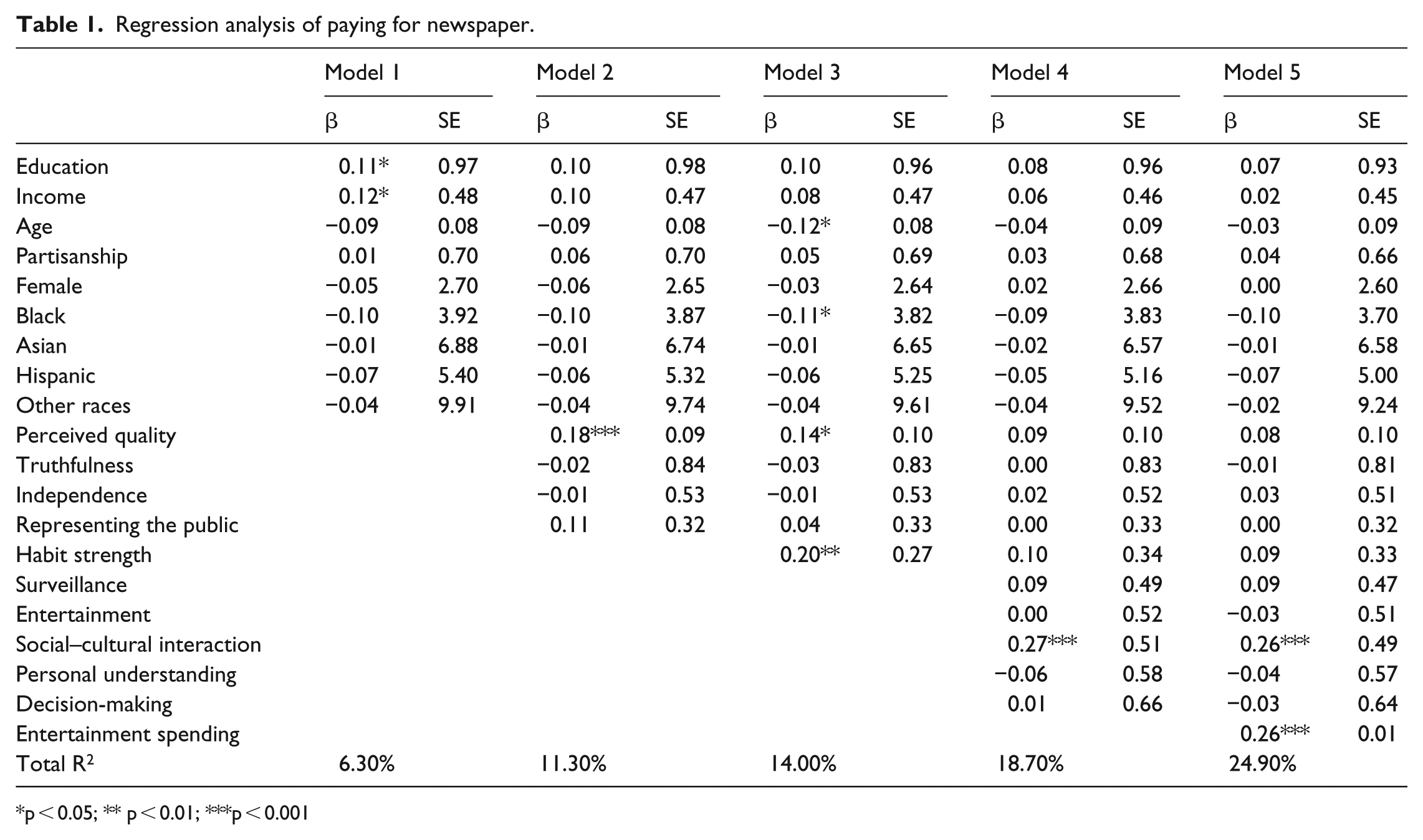
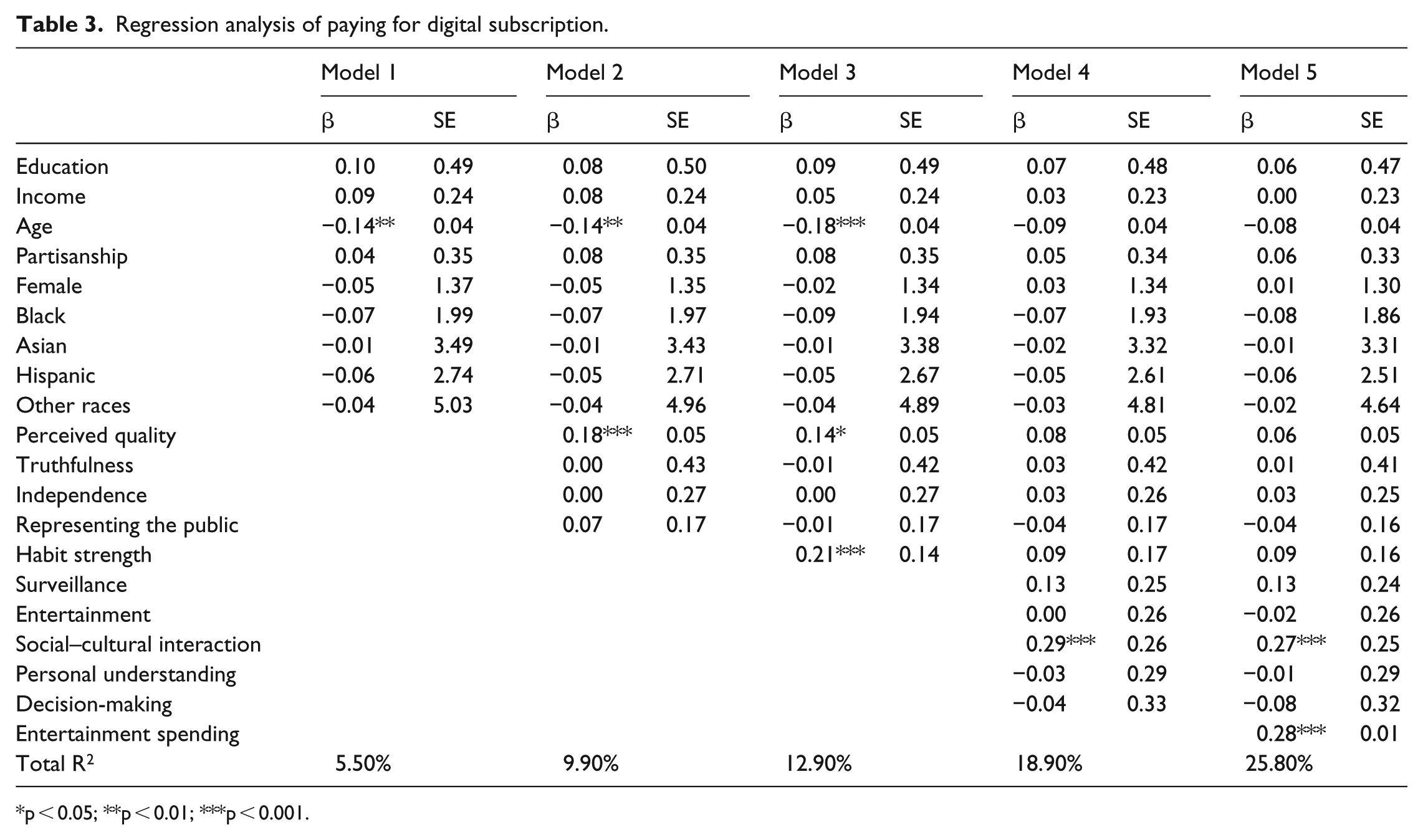
Tables 1 to 5 illustrate regression analysis of paying for newspaper (in total), paying for print and digital bundles, paying for digital subscriptions, paying for national newspapers, and paying for local newspapers. Models 1 to 5 in each table show the results of entering different blocks of predictors. Model 1 tests demographic variables, Model 2 adds perceived quality of news and perceived journalistic and societal value of news, Model 3 adds habit strength, Model 4 adds predictors of motivation to use news, and Model 5 adds entertainment spending.
Regression analysis of paying for newspaper.
p < 0.05; ** p < 0.01; ***p < 0.001
Regression analysis of paying for print and digital bundle.

p < 0.05; **p < 0.01; ***p < 0.001.
Regression analysis of paying for digital subscription.
p < 0.05; **p < 0.01; ***p < 0.001.
Regression analysis of paying for national newspaper.

p < 0.05; **p < 0.01; ***p < 0.001
Regression analysis of paying for local newspaper.

p < 0.05; **p < 0.01; ***p < 0.001
H1 suggests that there is a positive relationship between perceived quality of news and paying. Consistent results of significance were found in both Model 2 and Model 3 for paying for newspaper (Model 2: β = 0.18, p < 0.001; Model 3: β = 0.14, p < 0.05), paying for print and digital bundles (Model 2: β = 0.16, p < 0.01; Model 3: β = 0.12, p < 0.05), paying for digital-only subscriptions (Model 2: β = 0.18, p < 0.001; Model 2: β = 0.14, p < 0.05), and paying for national newspapers (Model 2: β = 0.19, p < 0.001; Model 3: β = 0.15, p < 0.01). Whereas for paying for local newspapers, perceived quality of news quality was only found in Model 2 (β = 0.11, p < 0.05), as the result became non-significant after we introduced habit strength into Model 3. H1 is thus partially supported.
H2 posits that the relationship between perceived journalistic and societal value of news is also positive. In particular, we aimed to investigate whether people’s perception of the truthfulness, independence of journalism and its function of representing the public would lead them pay more for news. The only significant result we found was representing the public in Model 2 that predicts paying for local newspaper (β = 0.17, p < 0.05). All other variables and models were found to be not significant. Therefore, H2a and H2b are not supported, and H2c is only supported in terms of predicting paying for local newspaper.
H3 suggests that people who have higher levels of news consumption would pay more for news. Significant results were found consistent in Model 3 for paying for newspaper (β = 0.20, p < 0.01), paying for print and digital bundles (β = 0.17, p < 0.05), paying for digital-only subscriptions (β = 0.21, p < 0.001), paying for national newspapers (β = 0.15, p < 0.01), and paying for local newspaper (β = 0.20, p < 0.001). Hence, H3 is supported.
H4a to H4e posit that people who show higher levels of motivations for using news will pay more for news. Specifically, we investigated whether this positive relationship holds true for five different motivations. In Model 4 of each table, we tested these hypotheses, and we also wanted to see if the effect of these predictors would last in Model 5. Surveillance, entertainment, personal understanding, and decision-making were found to be not significant for predicting people’s paying for news. H4a, H4b, H4d, and H4e are not supported. However, consistent significance for social–cultural interaction was found for paying for newspaper in total (Model 4: β = 0.27, p < 0.001; Model 5: β = 0.26, p < 0.001), paying for print and digital bundles (Model 4: β = 0.23, p < 0.001; Model 5: β = 0.23, p < 0.01), paying for digital-only subscriptions (Model 4: β = 0.29, p < 0.001; Model 5: β = 0.27, p < 0.001), paying for national newspapers (Model 4: β = 0.21, p < 0.01; Model 5: β = 0.19, p < 0.01), and paying for local newspapers (Model 4: β = 0.26, p < 0.001; Model 5: β = 0.26, p < 0.001). H4c is supported.
H5 suggests that people who spend more money on entertainment media will pay less for news. Contrary to expectations, positive relationships were found between people’s paying for entertainment and paying for news. Significance were found for all paying for news measures: paying for newspapers (Model 5: β = 0.26, p < 0.001), paying for print and digital bundles (Model 5: β = 0.21, p < 0.001), paying for digital-only subscriptions (Model 5: β = 0.28, p < 0.001), paying for national newspapers (Model 5: β = 0.22, p < 0.001), and paying for local newspapers (Model 5: β = 0.21, p < 0.001). H5 is not supported.
RQ1 asks about the difference in predicting paying for print and digital bundles and digital-only subscriptions. This study could not investigate the print-only subscription since news organizations in the United States are selling their print version newspaper along with digital access (e.g. The New York Times and The Kansas City Star). This type of bundling is listed as a premium and more expensive option for consumers to choose. As a result, we instead measured paying for print and digital bundle and compared it to paying for digital-only subscription.
In terms of paying for print and digital bundles, being African American was found consistently significant throughout Model 1 to Model 5 (Model 1 and Model 2: β = –0.11, p < 0.05; Model 3: β = –0.12, p < 0.05; Model 4: β = –0.10, p < 0.05; Model 5: β = –0.11, p < 0.05). Income was also found to have a positive impact in Model 1 (β = 0.13, p < 0.05) and Model 2 (β = 0.12, p < 0.05), while education was only significant in Model 1 (β = 0.11, p < 0.05). In comparison, age was found to be an important predictor of paying for digital-only subscription (Model 1 and Model 2: β = –0.14, p < 0.01; Model 3: β = –0.18, p < 0.001), with younger people paying more. The significance of age disappeared once we added all the motivation variables.
RQ2 investigates whether predictors of paying would show different patterns based on the coverage scope of the newspaper (national vs local). Table 4 shows that age has a significant, negative impact throughout Model 1 to Model 5 (Model 1 and 2: β = –0.17, p < 0.001; Model 3: β = –0.20, p < 0.001; Model 4: β = –0.13, p < 0.05; Model 5: β = –0.12 p < 0.05). Meanwhile, education (β = 0.11, p < 0.05) and income (β = 0.11, p < 0.05) were found to have a positive impact on paying for national newspapers in Model 1. African Americans were less likely to pay for local newspapers (Model 1 and 2: β = –0.12, p < 0.05; Model 3: β = –0.13, p < 0.05; Model 4: β = –0.11, p < 0.05; Model 5: β = –0.12, p < 0.05).
Based on the results for RQ1 and RQ2, we conclude that younger people are more likely to pay for digital-only subscriptions to national newspapers, whereas African Americans are less likely to pay for print and digital bundles as well as local newspapers. Yet, other variables such as perceived quality of news, habit strength, and social–cultural interaction show similar patterns of predicting paying for print/digital and national/local newspapers.
Discussion
As news organizations continue searching for strategies to increase the revenue derived directly from readers (Kiesow, 2018), this article adds knowledge to current scholarship in two ways. First, we measured actual monetary amounts (as self-reported) paid for various categories of news subscriptions. Prior to this, research scholars had not used payment self-report, but rather purchase intention and willingness to pay. We suspect that estimates of likelihood of future paying behavior are not as accurate as reporting on what one actually spent. Second, we reexamined paying for news from the perspective of its value as a business product and as a public good: asking which type of value is most associated with paying more for news.
There was a positive relationship between perceived quality of news and paying, which is consistent with previous research. People are willing to pay for news that they think is of value and good quality. Our quality measures consist of several content characteristics such as accurate information and clear writing. This again argues that a smart business approach for newspaper companies is to keep improving their content quality. Unfortunately, it is abundantly clear that this is not the case (Newspapers FactSheet, 2018), a fact that bodes negatively for the future of newspaper companies.
The finding that news quality positively impacts paying shows that people are willing to pay for news in a world where much ‘news’ can be acquired free. However, concerns may rise as President Trump constantly claim that mainstream media are ‘losers’, publish ‘fake news’, and are ‘the enemy of the people’ (e.g. Flynn, 2018). It seems that these attacks have increased the negative view of the press by many Americans (Schwartz, 2018). Our findings suggest that only those who view the press as doing a good job are likely to provide financial support, which is now more than ever needed by news organizations that have lost so much advertising support (Pew Research Center, 2015).
Meanwhile, the most important finding of this article is that people’s needs for social–cultural interaction are a significant predictor of paying for news. In other words, people pay for news because it helps maintain and promote their social status among peers. Moreover, the impact of social–cultural interaction is consistent and outweighs habit strength and perceived quality of news in all categories of paying. An interesting possibility that need further study is that the strength of this motivation is being fueled by the increased perception of the mainstream press, certainly newspapers, as being part of the social identity of liberals and Democrats, not of conservatives and Republicans. Unfortunately, a free and independent press dedicated to discerning the truth and reporting it should not be associated with partisanship. Instead, its value is that it keeps all Americans sufficiently well-informed to be able to participate effectively in their democracy. The results shown here suggest that this value is being lost.
One surprising finding is that perceived journalistic and societal value does not lead people to pay for news. Although there was claimed to be ‘Trump-bump’ for news subscriptions after the president was elected (RISJ, 2017), we did not find democracy-related values predict paying. This suggests ‘Trump-bump’ may not have been an actual scientifically supported trend, but was instead a story based on informal interview data, or else if it did occur, it had a fleeting effect. Moreover, the growth in subscriptions might be a positive market response to digitalized content and delivery methods, since media organizations have been experimenting with content forms that fit better in digital platforms (e.g. Pavlik, 2008: 105).
The lack of relationship between perceiving the press as an important component of a successfully functioning democracy and paying for news to keep that press going raises concerns for journalism. Although extensive studies have addressed the importance of the press and its role in democracy (e.g. Curran, 2005), there is a gap between how the public value the press and how we see it. If this gap continues to grow, our society may face calamitous consequences. The lack of relationship also suggests insufficient news literacy training for most Americans. Although there are efforts to increase such training (Center for News Literacy, 2016), there is no indication of impact of such programs in the national sample of adults represented here.
It was surprising that consumers’ entertainment spending is positively associated with their paying for newspaper subscriptions. We expected the opposite given the strong arguments that time spent with entertainment media reduce time spent with news (e.g. Prior, 2005). Of course, it is possible that people who want the conveniences that might be associated with paying for media content are simply buying both entertainment and news. We hope to see further research on how spending levels for all forms of entertainment content relate to spending on news. Another possibility is that as news and entertainment media provide different utilities, they are not perfect substitutes from an economics perspective. This indicates that entertainment media cannot satisfy one’s needs for news despite individuals’ attention, time, and financial resources are limited. Again, direct test of this possibility is needed.
In addition, this study is important for future studies since news consumers are price-sensitive. A recent report by American Press Institute (2017) suggests that promotions boost subscription, because low price is seen as an incentive. Our findings could also shed light on news organizations’ pricing strategies.
Thus, while the findings are important and possibly useful to news organizations as they try to figure out how to get more paying customers, what may be more important are insights about the changing relationships between American society and perceptions of the role of quality news in American democracy. As noted, perceiving newspaper news content as critical for democracy showed no impact on paying for that content. Second, the respondents in this study paid more for news content when they perceived that news helped them with their social identities. A free and unbiased press should not support particular social identities as much as it challenges attention and concern for all kinds of identities, whether in terms of race, partisanship, wealth and education, sexual preference, and all of the myriad of other ways that Americans differ from each other.
Caveats
Like all empirical studies, this one has limitations. Even though we aim to obtain a representative sample of the US general population, our final sample leans toward White and slightly more educated. Another limitation is that we only measured paying for newspaper, leaving magazines and online-only news organizations unexplored. Also, our measures of perceived quality of news might be a bit simplified compared to Lacy and Rosenstiel’s (2015) suggestion. This concept could also be further investigated as it contains several dimensions of content characteristics. Future research could explore more in these aspects, such as diversity of story length, storytelling styles, and news sources cited. Given the increasing importance of digital news platforms, interactivity between audiences and newsroom could also be included in news quality measures.
Footnotes
Acknowledgements
We are grateful for the two anonymous reviewers for their insightful comments. The first author (W.C.) also thanks Dr. Stephen Lacy for his suggestions at the early stage of this research.
Funding
The author(s) disclosed receipt of the following financial support for the research, authorship, and/or publication of this article: This work was supported by the 2017 CAS Summer Research Excellence Fellowship in College of Communication Arts and Sciences at Michigan State University. The authors thank the School of Journalism for their financial support.
