



Abstract
Different forms of communication have emerged throughout history and most of them have been linked to technological innovations. This fact has allowed the development, since the 1950s, of a powerful theoretical tradition specialized in the analysis of communication processes, which has resulted in the formulation of different communication theories. Recently, the emergence of Virtual Reality and 360-degree video has opened new analytical perspectives in relation to communication mediated by these technologies. Precisely, this article analyzes the narrative elements that are modified by the intervention of Virtual Reality and the peculiarities caused by the introduction of this technology in the communication process within a specific context such as journalism. This area of study has been selected because Virtual Reality and 360-degree video technologies are increasingly being used in the creation of journalistic content, which has resulted in the emergence of the so-called ‘immersive journalism’. Based on this analysis, the article proposes a new model for ‘immersive communication’ and a model for ‘the structure of immersive journalism’, which is totally novel in the journalistic context.
Keywords
Introduction
Traditional media have been deeply transformed by the advent of the Internet, which has led to the digitalization of such media and has, in turn, led to the emergence of new ones. Linked to this, social needs, requirements, and demands, on the one hand, and the professional, business, technological, and political challenges, on the other, have led to the increasing specialization and diversification of both communication and information (Antón, 2002). As a result of this context, the ways in which the journalistic message is produced and consumed have been substantially modified. That is why the study of communication in the 21st century required a profound theoretical and methodological renovation, which in this case is linked more than ever to technological aspects.
One of the latest transformations experienced by journalism is the incorporation of Virtual Reality (hereinafter, VR) and 360-degree video, which has led to the emergence of the so-called ‘immersive journalism’. These technologies have introduced important transformations that affect, not only the production and creation of news contents, but also their consumption. Based on these issues, it becomes necessary to address how VR technology transforms the classic communication models, a question that has not been explored in-depth by the scientific and academic communities, despite it being essential to be able to understand the scope and transcendence of this new way of doing journalism. With this objective in mind, and from a methodological point of view, this article offers a theoretical review of the history of communication and the basic theoretical models that have been proposed to explain how the communication phenomenon occurs, which will allow us to analyze the elements that are a part of communication mediated by VR and the peculiarities caused by the introduction of this technology in this process. This analysis will lead to the formulation of a proposal for an ‘immersive model of communication’ and an original and innovative ‘model of the structure of immersive news’, both within the immersive journalistic context, which allows us to think of the communicative process in 360-degree RV/video that implies both an individual and a social or collective experience.
State-of-the-art review
Given that the phenomenon of communication has evolved over the years until the arrival of VR, it is necessary to approach the concept and models of communication.
The concept of communication
Before continuing, it is necessary to introduce the concept of ‘communication’. It is a widely used and interpreted term that has given rise to multiple definitions (see Antón, 2002; Benito, 1982; Berelson and Steiner, 1964; Berlo, 1984; Cherry, 1957; Escarpit, 1977; Gerbner, 1956, 1967; Ortiz and Río, 1977; Osgood et al., 1957; Paoli, 1983; Romero, 1982; Shannon and Weaver, 1964; Theodorson and Theodorson, 1969; Thompson, 1998 and Wright, 1972; among others). To give an idea of the variety of existing definitions for the concept of communication, we can review some classical authors in this matter.
The definition offered by Osgood et al. (1957) focuses on the notion of influence as the goal of communication and proposes that communication exists whenever a ‘system, a source, influences the states or actions of another system, the destination or receiver, by selecting among the alternative signals that can be carried in the channel connecting them’ (p. 272).
Berelson and Steiner (1964), on the other hand, depart from the notion of transference, understanding communication as ‘the transmission of information, ideas, emotions, skills, etc. through the use of symbols, words, pictures, figures, graphs, etc., is the act or process of transmission that is usually called communication’ (in Beltrán, 2007: 40).
Gerbner (1967), in contrast, says that communication can be defined as ‘social interaction through messages’ (p. 43). In this case, the author understands that the communication process involves ‘relationships’ and ‘interaction’.
From the perspective of mathematical theory, for engineers Shannon and Weaver (1964), the term communication is understood in a broader sense ‘to include all the procedures by which one mind may affect another’ (p. 3). Meanwhile, Wright (1972) focuses his definition on the ‘transfer of meaning’, so that for him, communication is ‘the process by which meanings are transmitted from one person to another’ (p. 9). In this line, Paoli (1983) argues that communication is ‘an act of relationship between two or more actors, through which a meaning is commonly evoked’ (p. 11).
All these definitions show that communication is a process that involves different elements (sender, means, audiences . . .), each one of which has specific characteristics and performs a specific function within this process.
Communication models
The first theoretical models that tried to explain the communication phenomenon emerged after World War II. It was in the postwar period, when there was a growing interest in the formulation of models in the field of communication. Before presenting a brief review of some of the models that emerged in this period, it is necessary to clarify the concept of ‘model’. For Martín (1982), A model is the representation of some sort of organization of something. To represent any ‘thing’, it is necessary to take into account its components and the relationships that exist between such components. For example, a model that represents an integrated circuit will reflect all the parts that constitute it and the connections that link them. (p. 89)
According to McQuail and Windahl (1997), ‘a model seeks to show the main elements of any structure or process and the relationships that exist between these elements’ (p. 30). These authors, quoting Deutsch (1966), have identified three basic functions that models play in the field of social sciences: first of all an organizing function, as they order and relate systems to each other; second a heuristic function, insofar as they help researchers explain something and can lead them to the key points of a process of a system; and finally a predictive function, as they can foresee certain results or the course of events (McQuail and Windahl, 1997: 30–31). At the same time, they identify five large blocks of models according to their characteristics and functions: (1) basic models, (2) models of personal influence, diffusion, and effects of mass communication on individuals, (3) models of the effects of mass communication on culture and society, (4) audience-centered models, and (5) models of media organization, selection and production (McQuail and Windahl, 1997).
This article does not seek to assess all existing models to date, but it is necessary to mention those ones that are more significant when it comes to understanding how the transmission of communication works. These contributions will serve as a theoretical and methodological reference to subsequently analyze the communication process mediated by VR technology.
In this sense, we depart from the ‘basic’ models, starting with the one developed by Harold Lasswell (1948), which is one of the most accepted and reproduced paradigms. Lasswell’s model is based on the answer to the question, ‘Who (communicator) says what (message) in which channel (medium) to whom (recipient) with what effect (stimulus)?’ The influence of Aristotle in Lasswell’s paradigm is evident. In Rhetoric (translated version, 1990), the Greek philosopher had already differentiated the three basic elements that constitute any communication process: speaker, discourse, and audience. In this case, Lasswell starts with the ‘who’, ‘what’, and ‘whom’, which Aristotle had already identified, and adds ‘how’ (channel) and ‘what for’ (effect) to configure a one-way model: a communicator who wants to influence its receiver. We must take into account that this model, which would be subsequently expanded by Braddock (1958), was formulated at a time of political communication and propaganda (the end of World War II). This was precisely the problem of these early communication models: they did not take into account the possibility of feedback.
The same is true in the case of the mathematical model of Shannon and Weaver (1964: 7), which, once again, describes communication as a one-way process, identifying five phases or stages that start from the source of information that produces the message and end with the destination. Later, this model was perfected by DeFleur (1966), who introduced a two-way information flow: one from the sender to the receiver, produced by the mass media, and another one from the receiver to the sender, through ‘feedback instruments’.
Other models that tried to explain communication as a dynamic process also emerged in the 1950s and 1960s. This is the case of the circular model of Osgood and Schramm (Schramm, 1954), which breaks with the idea of linear communication, by proposing that the two parties involved in the communication process (sender and receiver) perform the same functions: coding, interpretation, and decoding; and Dance’s model (1967), which proposes a spiral model that delves into the (changing and evolving) nature of the communication process without paying too much attention to its elements. There were also more complex models that take into account the internal and external factors that can influence the communication process, such as those proposed by Gerbner (1956), Riley and Riley (in McQuail and Windahl, 1989: 79–83), and Maletzke (1963).
Elements of the communication process within the journalistic message
As it has been observed in the aforementioned models, the basic communication process involves a number of elements, such as a sender, a channel, a message, and a receiver. The sender initiates the communication process by creating a message with the intention of transmitting it to the receiver, who can give feedback to the sender (Figure 1).
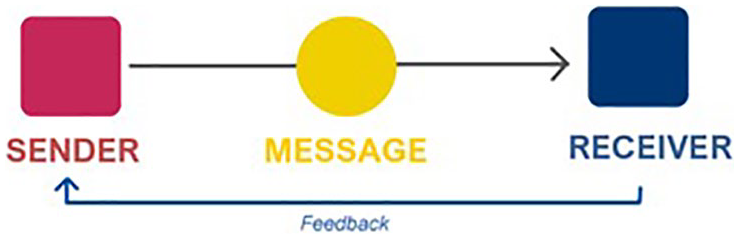
Representation of a basic model of communication.
In the case of mass communication, the figure of the sender is represented by the journalist or communicator, who is in charge of selecting the sources that will nurture and shape the message according to journalistic criteria.
The channel refers to the medium used by the sender to transfer the message to its destination. The channel can be natural-physiological (spoken language) or artificial-technical (cinema, radio, television, etc.). McLuhan (1996) differentiates between hot media, which provide information that leaves little room for the public’s imagination (e.g. photography, which provides visual information), and cool media, which offer little information and stimulate the public to participate and complete it (e.g. the telephone). Daft and Lengel (1986) establish a differentiation according to the richness of the channel, understanding it as the amount of information that can be transmitted in a communication episode and its understanding capacity in a given time interval. These authors consider that face-to-face communication is the richest form as it allows real-time feedback and offers multiple ways of communication (words, gestures, facial expressions, etc.), while written media are characterized by less richness but are more effective in transmitting large volumes of formal and standardized information (Daft et al., 1987; Daft and Lengel, 1986). In this way, the preference of one or another channel will depend on the characteristics of the message to be transmitted. Vivas et al. (2002: 23) link this issue to social influence, understanding that less rich media limit the social influence of the message.
As shown in the review of the ‘basic’ models of communication, some refer to two processes: encoding and decoding. Encoding has to do with transforming the message into a language that is understandable for the recipient; while decoding is the reverse process that the receiver performs to extract the meaning of the message (Hall, 1980). For McQuail and Windahl (1997), in a communication between two people, the coding is performed by means of speech while decoding is performed by hearing and sight. On the other hand, in mass communication, coding can refer ‘to the technical transformations necessary for the transmission of signals and also to the systematic selection of words, images and formats’ (McQuail and Windahl, 1997: 33).
VR in the face of the journalistic challenge
VR is the result of a set of technological advances and long decades of research that have resulted in a wide range of works that try to address this phenomenon from very diverse areas of knowledge. This proliferation has been observed in the last decades of the 20th century and especially in the 21st century. It is precisely in these years when the potential of VR applied to the field of communication begins to be analyzed, for example, by Biocca and Levy (1995), who explore how this incipient technology can become a new tool to present the news to the public. For these authors, As a mass medium, virtual reality could fulfill the oldest dream of the journalist, to conquer time and space. Virtual news environments would invest journalists with the ability to create a sense on the part of audiences of being present at distant, newsworthy locations and events. (Biocca and Levy, 1995: 137–138)
At first, its economic costs drove information companies away from this technology, but at present, the advances in 360-degree video and viewing devices, which are increasingly cheaper and faster to produce, have accelerated the incorporation of VR into the communication sector (Hardee, 2016). The combination of VR and journalism has led to the emergence of the so-called ‘immersive journalism’, defined by Nonny De la Peña as ‘the production of news in a form in which people can gain first-person experiences of the events or situations described in news stories’ (De la Peña et al., 2010: 291).
Immersive journalism generates a feeling of presence that transports users from their real location into a different scenario where they can get an eyewitness account of certain news events and can feel ‘truly there’ (Aronson-Rath et al., 2015; Biocca and Levy, 1995; De la Peña et al., 2010). This presence contributes to the different immersion or visualization systems available, whether they are VR headset or Head Mounted Display (HMD), or a system like CAVE (Cave Automatic Virtual Environment), which simultaneously projects moving images on different surfaces (walls, ceilings, and floors) creating a three-dimensional (3D) environment (Cruz-Neira et al., 1992).
For the creation of this type of projects, immersive journalism makes use of VR technology, either by creating virtual worlds, which would be called ‘three-dimensional recreations’, or 360-degree videos, which are the most frequent productions in the media sector (Pérez and Campos, 2017). These formulas enable consumption through ‘special’ headsets that help the user ‘achieve the maximum immersion’ and are what De la Peña et al. (2010) call high-level ‘immersive journalism’ and provoke what these authors call ‘response as if real’ (RAIR). This gives rise to an ‘incarnated’ journalism that immerses users into another reality (the news story), takes over their attention and makes them feel part of it, which leads them to react within that virtual environment as they would do in the physical world. This fact takes us back to the concept of presence that allows the amplification of the multisensory feedback with the user (Hardee, 2016; Zahoric and Jenison, 1998).
The first journalistic projects of this type began to appear timidly in 2014 (with the exception of previous experimental examples that will also be analyzed in this study), opening a series of possibilities in the journalistic profession as they took advantage of the new technology to offer the public the chance to get immersed in the narrative. Some examples of this type of journalism were developed by print and audiovisual news media companies from around the world, such as the Franco-German television network ARTE (https://bit.ly/2S2Tv2y), the British Broadcasting Corporation (BBC) (https://bbc.in/2KkkH5k), the Swiss newspaper Blick (https://bit.ly/2CGQ7AJ), the Argentinean newspaper Clarín (https://clar.in/2KRCPor), the Italian newspaper Corriere della Sera (https://bit.ly/2sFTK5o), the Pakistani Daily Jang (https://bit.ly/2FKOvd3), the Russian TV channel RT (https://bit.ly/2RMH37J), the Spanish Radio and Television Corporation RTVE (https://bit.ly/2FN7fc3), London’s The Economist newspaper (https://econ.st/2Rbxzhd), the American daily The New York Times (https://nyti.ms/1TX0wHS), the South Korean Yonhap News (https://ocul.us/2HwXEaV), the Austrian daily Wiener Zeitung (https://bit.ly/2S2WvvQ), and the German public television channel Zweites Deutsches Fernsehen (https://bit.ly/2KYcvYH), among others.
Another issue that is rising up due to the use of VR applied to the journalistic context has to do with the ethical challenges facing the profession (Benítez and Herrera, 2019; Pérez-Seijo and López-García, 2019). These issues mean that concepts such as fairness, accountability, and transparency (FAT), mentioned by Shin and Park (2019), are now starting to be dealt in the academic literature and it can also be applied to immersive journalism.
On the other hand, within this narrative context in which VR is used, there is a variable that stands out that it had not been taken into account until now in traditional formats (news, reports, and documentaries that are two-dimensional (2D)). This variable is the user experience (UX) related to those aspects of how the users ‘live or experience’ the journalistic stories made in VR. Regarding this aspect, several studies confirm the identification, both with the place of the events and with the characters or sources that participate in the journalistic piece (De la Peña et al., 2010; Kokkinara and Slater, 2014; Shin, 2018; Shin and Biocca, 2018). A similar behavior of identification has been identified between the gamer and its avatar when playing video games. In addition, UX delves into all those aspects that have to do with the cognitive and affective processes of human beings. Although this line of research has not been very developed yet (Reinhard and Dervin, 2012), some studies such as the authors Shin and Biocca (2018) begin to show the links between immersion, empathy, and incarnation. New lines of research in this field are oriented to answer how users feel when they consume a story via VR (Shin and Biocca, 2018), and it belongs to the psychology approach.
UX, therefore, plays a key role in the creation of VR content to the extent that it can positively influence the achievement of a greater degree of user immersion (Shin, 2019a). This opens up a new line of research, in this case from the communicative approach still to be explored, related to the evaluation of UX applied to VR and the extent to which this factor is determinant in the behavior of users who experience non-fiction content, in a specific context such as journalism.
Proposal for a communication model for immersive journalism
When we talk about VR, the main elements of the communication process are the same as the ones we mentioned above, although they have some peculiarities. Taking as a starting point the basic communication model used in the previous section, it can be said that a journalist (sender) publishes a news article (message) that reaches the public (receiver) through a channel, for example, television. This communication process takes place in the real world, for example, in the receiver’s living room. The main difference in the case of VR has to do, precisely, with the environment where the receiver gets the message (a VR piece/immersive content), since, in this case it is not going to happen in the real world but in a virtual one that is accessed through a VR system and may, or may not, follow the conventional rules of the real world, bearing in mind that technological development within this field is unstoppable (Figure 2). We have to remember that the haptic and visualization interfaces (HMD) isolate the user from the real world, so that it ‘disappears’ as the user enters into a new (virtual) environment that the receiver perceives as real (feeling of presence).

Reception of the message in a virtual environment.
The technological component in this case is fundamental, not only in the process of transmitting and receiving the message, but also in relation to the intrinsic characteristics of the message itself. The coding and decoding performed by the sender and the receiver are determined by the technology itself, since specific software and hardware are necessary for production and consumption and the receiver needs a display device (VR headset) to be able to decode the message.
On the other hand, with regard to feedback, it occurs both ways: toward the sender, on the one hand, which is the feedback shown in the basic models (e.g. by way of comments), and on the other, toward the message itself. The receiver will be able to interact with the content, by choosing the point of view he or she wants to take at any time. This feedback is motivated by a series of circumstances or factors that are inherent to the receiver (personality, knowledge, social and cultural environment, etc.) and will influence the way the content is consumed (Figure 3).
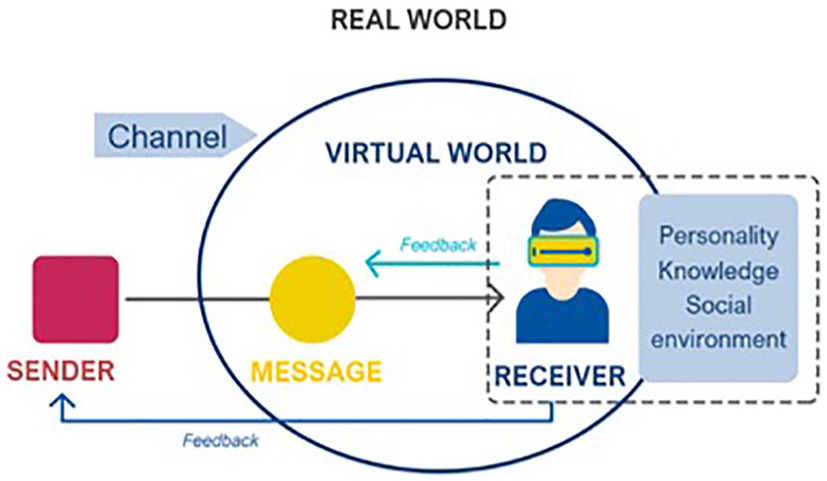
Immersive communication model.
It is important to remember that when we say message, in this case we refer to a VR content that enables the receiver’s immersion and allows the user to select and change point of view, anytime he or she wants, and to interact with the content. This aspect related to immersion is very important, precisely because of the novelty it introduces into the communicative process analyzed. As Shin (2019b) points out, ‘immersion can be a perception of being physically present in a non-physical world’ (p. 3); a combination of images, sounds, and other stimuli contributes to this sensation. However, the truth is that ‘what is implied by immersion and exactly what causes it’ (Shin, 2019b: 3) is still not clearly defined and most of the studies related to this question are linked to video games (entertainment) and not to non-fiction contents.
While recognizing the importance of the concept of immersion and interaction design (UX) linked to VR, research in these fields would require a multi- and interdisciplinary approach between areas such as psychology, neuroscience, or engineering which, along with the area of communication, they have also opened this line of study linked to VR. It is necessary to specify that this would contribute to a deeper discussion that has not been contemplated within the methodological approach of the research presented here and that it focuses its object of study specifically on the communicative-journalistic scope.
Returning to the immersive model of communication proposed in this research, in relation to the reception mode itself, which involves the isolation of the user with a visualization device, makes it an individual type of communication, so that although the message is the same, the interpretation of the user will be different in each case given that each receiver is motivated by a number of factors of his or her own.
In the case of multiuser VR, where several users can enter the same virtual environment (which is more frequent when it comes to ludic content with multiplayer VR games), each of the receivers/users is motivated by his or her own features (personality, environment, and knowledge), which will influence the way he or she moves through space and interacts with it, but also by the other users with whom he or she shares the experience (Figure 4). In this sense, in this shared modality, one can identify a third type of feedback: the one that occurs between the different receivers.
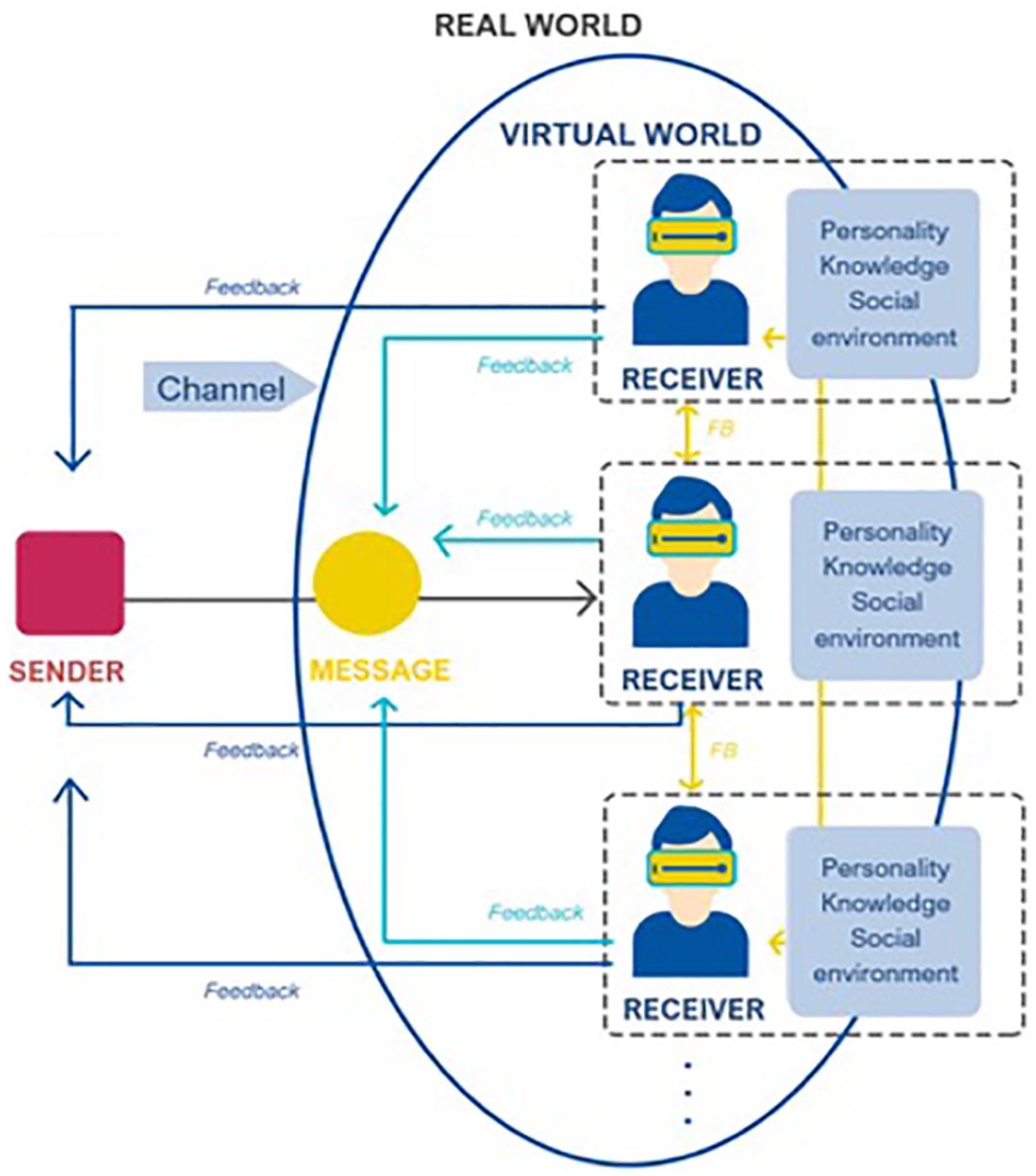
Multiuser immersive communication model.
However, in the case of immersive journalistic content, this type of multiuser model will not be frequent.
Toward a proposal for a model for VR journalistic information structure: A reconfiguration of the lying down pyramid
The structure of the written journalistic news story responds to the so-called inverted pyramid, which places the most newsworthy information at the beginning of it, and the rest of the material in the lower portion in order of diminishing importance (Figure 5). This structure seeks to make sure the reader receives all the fundamental information in the lead. This structure is completely opposed to the romantic narrative, which follows the following formula: setup (details), conflict (content of secondary interest), and resolution (climax), thus keeping the suspense up to the end (Armentia and Caminos, 2008; Warren, 1979).
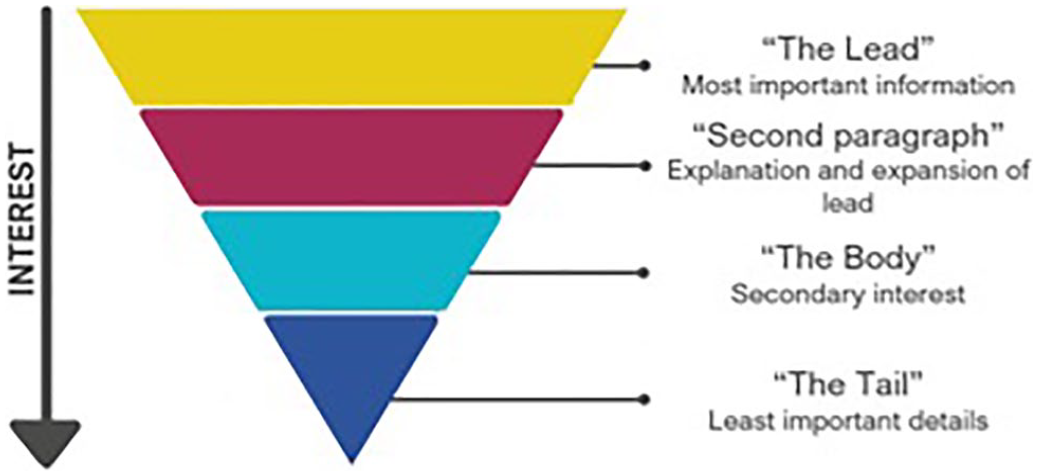
Inverted pyramid.
The inverted pyramid has been used throughout the world in the journalistic profession. In its beginnings, this editorial scheme constituted a solution to the restrictions of the use of the telegraph, which needed to find a way to write and send news reports that highlighted the most important events, as Fontcuberta (2011) points out: [. . .] The American Civil War substantially changed the structure of newspapers. [. . .] Telegraph operators devised a method for giving preference to all correspondents at the same time. The system consisted in making a round of informants in which each one could dictate a paragraph, the most important one of their news stories. At the end of the shift, the dictation of the second paragraph began, and so on until the end. This was the birth of the inverted pyramid of the news, a method that is still in use today. (p. 93)
This news structure gives priority to the most essential pieces of information and places them in the lead, which also serves to attract the attention of the reader. In this way, the lead must address the so-called ‘five W’s’, which derive from Lasswell’s paradigm: Who, What, When, Where, and Why. Authors such as Vivaldi (1964) and Tubau (in Gomis, 2008) add a sixth question: ‘How’.
Although the inverted pyramid format has been used in the journalistic routines of the press to face news events, this scheme is not suitable for all media. When it comes to digital media, Canavilhas (2007) proposes the concept of the lying down pyramid (Figure 6), which takes into account the hypertext, one of the essential elements of the new Web as a resource that for the first time allows readers to expand information as much as they want and delve into those aspects of the news story that are of interest to them. The information, therefore, develops horizontally, from less to more on each of the elements of the news story (five W’s), so that users can choose the reading path they prefer according to their interests (Canavilhas, 2007: 86).
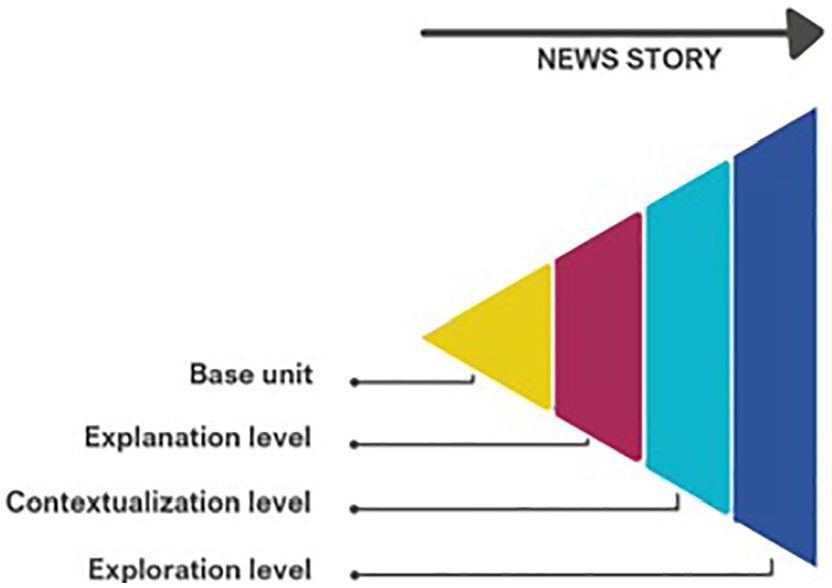
Lying down pyramid.
Trillo-Domínguez and Alberich-Pascual (2017) have made an innovative proposal for the organization of the information in the digital environment, especially for transmedia content. These authors propose a structure in the form of a deconstructed Rubik cube, which understands the news story in a 3D way, in which each layer corresponds to an information deepening level. In this way, in the digital environment, users can choose their own paths, and delve into those aspects that are of interest to them. These authors reclaim the inverted pyramid as a classic paradigm to structure news information and place the five W’s as a point of entry to the news story (first level of deepening), while the hyperlinks and multimedia elements of digital media constitute the second level. The third level would include the interaction or feedback of the user, leading up to the ‘climax’. ‘It is then when the story makes full sense, when the sender and receiver roles are exchanged, when they talk and share information, when they engage in that conversation that defines the new media’ (Trillo-Domínguez and Alberich-Pascual, 2017: 1096).
In relation to the immersive narrative, this study proposes a reformulation of what these authors have contributed (in this case, related to the transmedia news), and which in this case (RV news) proposes a structure represented by two 3D cubes. The first of the cubes represents the virtual environment and contains the user who accesses the content in VR mode. This constitutes, in turn, a first level of information, which contains the classic five W’s (who, what, when, where, and why) of the news story (plus the ‘how’ that constitutes the sixth face of the cube) that attracts the interest of the reader toward the story (Figure 7). It is important to remember that in ‘immersive journalism’ the user can get an eyewitness account of the events reported in the journalistic stories. Therefore, the ‘where’ of the news coincides with the 3D environment the user is watching, which in turn corresponds to the place where the reported news event occurs, and the ‘when’ (the moment in which the event occurs) is ‘now’, that is, the moment in which the user wears the viewing device and watches the VR content.
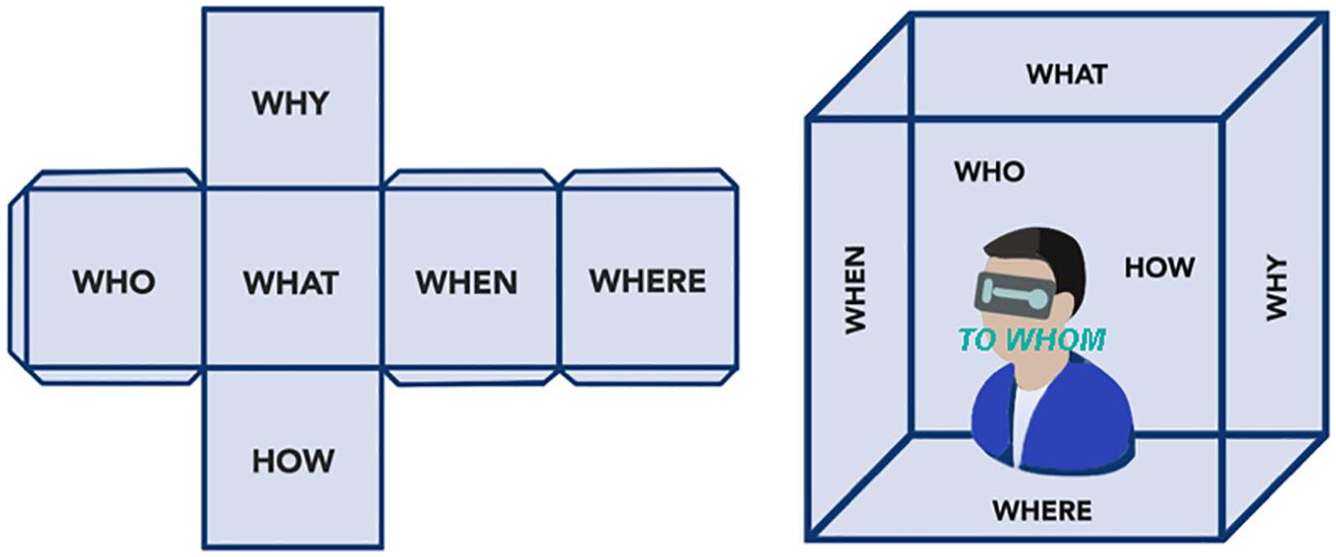
Structure of RV journalistic content: first level of deepening.
In short, the traditional communicative model that considers the 5 W, presents now a reformulation that concerns the ‘where and when’ to which the ‘to whom’ also joins, which in this case is not referred to the message or content but has to do with the spectator-user who consumes the immersive information, from the point of view of the psychology of the audience.
To illustrate this idea, we can use as an example the Hunger in Los Angeles project, developed by Nonny de la Peña in 2012. This VR project transports users to a street in the city of Los Angeles and recreates an eyewitness account of a man who goes into diabetic shock while waiting in line at a food bank as a result of prolonged starvation. The ‘where’ of the story is precisely that street in Los Angeles, where the user can go, while the ‘when’ of the event coincides with the moment in which the user puts the VR headset on. So, although the events that are narrated in the immersive piece occurred on a specific day in August 2012, the year when the piece was released, the user ‘lives it’ as if it were just happening every time he or she puts the VR headset on.
The second level of deepening is represented by a second 3D cube, which contains the secondary elements that increase the degree of knowledge of the story (text, photographs, and videos), as well as the new paths that the user can select, whenever they are available, to continue delving into the story (Figure 8).
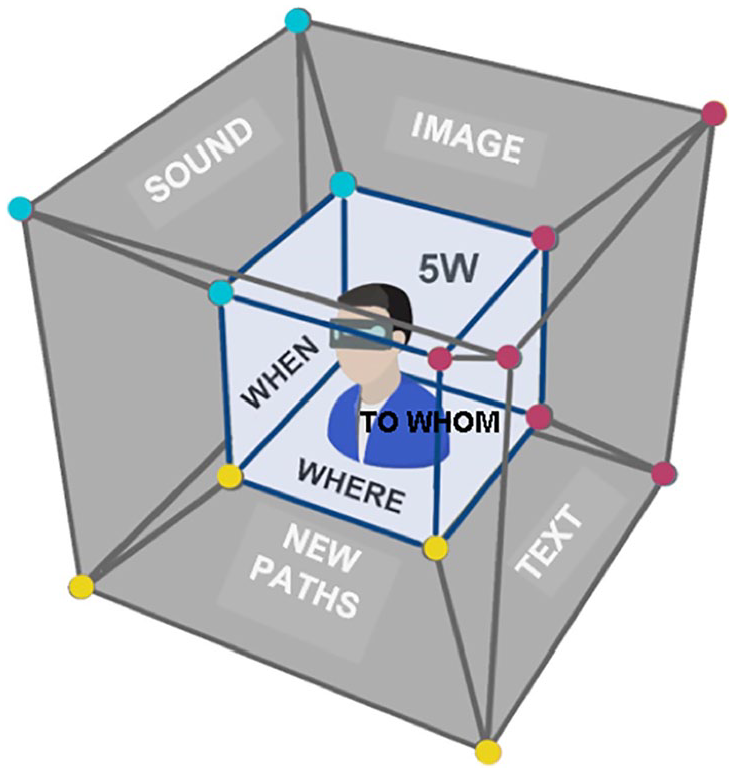
Structure of VR journalistic stories: second level of deepening.
In relation to these aspects known as ‘new paths’, it must be specified that they refer to intrinsic details of the production of the journalistic piece: the content is created by the journalist but the user decides whether to access these additional narrative elements and, therefore, accessing a deeper level of information, or just visualizing the main content (first level of deepening). This behavior would be similar to what happens with web journalism and the hyperlinks inserted in the news on the Internet. The user can only read the information in the news or go deeper and access a second level of information by following the links ‘paths’ inserted by the journalist to offer a deeper level of information.
Examples of new layers of information include WDR 360 VR, a piece on Cologne Cathedral (Germany) produced by the public radio and television corporation Westdeutscher Rundfunk, which introduces different chapters and additional contents in the form of text, audio, and video for the user to activate according to his or her interests. Harvest of Change, made by Des Moines Register in 2014, is another example that contains new layers of information, with the difference that in this case the user can also navigate the virtual space by means of haptic controllers.
All the aspects mentioned above open an interesting line of research that has to do with UX when it comes to consuming this type of content, and more specifically with the capacity to ‘feel’ new experiences made possible by VR technology. Possibly, this is one of the freshest perspectives related to the possibilities that VR opens within immersive journalism.
The Rubik’s cube of Trillo-Domínguez and Alberich-Pascual (2017) contains a third level of deepening that corresponds to the possibility of user interaction and participation. However, in the case of an immersive product, the dialog that can occur between sender and receiver takes place outside the 3D environment. It is important to remember that, as shown when approaching the structure of an immersive communication model, there is constant feedback toward the content (not toward the sender), from the moment the user accesses the piece. However, the piece does not give the user the possibility of ‘creating’ his or her own content or conversation, which can only be produced outside the immersive environment. In this sense, this interaction is generally going to be limited to sharing, commenting or rating the displayed content. In the case of those pieces that are stored within an app, as in the case of NYT VR (created by The New York Times) and ARTE 360 (produced by the Franco German network ARTE), feedback can be given from the application itself, which has a ‘share’ button.
Conclusion
The arrival of VR to journalism introduces a series of modifications that require a review of the traditional communication models and the elements involved in the communication process based on this technology. It is evident that the use of VR and 360-degree video can reduce the distance between the user and the news events, a question that has to do with the point of view of the user-receiver, who now can be in the place where the news event occurs and get an eyewitness account of what is being reported. These technologies imply a significant change in the traditional communication models. In this regard, we have proposed an ‘immersive communication model’. Specifically, we have formulated an individual communication model and a multiuser communication model, which serve to understand how information is received within a virtual environment. This model focuses on the environment in which the user receives the information, which in this case coincides with a virtual environment, generated by the VR headset.
Based on this model, we have also defined a new ‘model for immersive journalistic news structure’. Traditional models of the structure of journalistic news were adapted for immersive news stories, given that the ‘where’ and ‘when’ of traditional news stories are the ‘here’ and ‘now’ of the immersive news story. In other words, when a user consumes a project produced with VR or 360-degree video technology, he or she ‘abandons’ its real location and enters a completely different environment, which will correspond to the place where the action happens. In the same way, those actions will occur whenever the VR narrative is played, so that the user will feel that the story is unfolding in that very moment.
This study, in addition to allowing this reformulation of the communication process and the elements involved in it, has enabled the formulation of the aforementioned models, which in turn opens the way to future research related to the study of the innovations prompted by VR in the journalistic context.
Footnotes
Funding
The author(s) received no financial support for the research, authorship, and/or publication of this article.
