




Abstract
In this study, the researcher examines some of the key arguments in the scholarship on media–government relations by analyzing press reporting of four different events in the securitized context of Pakistan. For this purpose, framing analysis of one elite English newspaper Dawn and one popular Urdu newspaper daily Jang was conducted. Overall, the results are mixed. The tragic event of Salala check post did not result in critical coverage. On the other hand, policy uncertainty on participation in the Yemeni conflict produced critical coverage. In case of Kashmir conflict, the broader political consensus was responsible for supportive coverage. Similarly, the unpopular step of giving extension to army chief was mainly reported in neutral fashion with some procedural criticism.
Introduction
Analyzing media–government relations in the policymaking arena is of special interests to scholars of political communication. Since the influential study of Hallin (1986) on the US media reporting of Vietnamese invasion, scholarship in this academic area has exponentially grown. Numerous studies have been conducted on the media-policy nexus in the context of US military adventures in Latin America and Middle East (Aday, 2010; Althaus, 2003; Bennett, 2003; Herman and Chomsky, 1988; Mermin, 1999) as well as in UK, Israel and elsewhere (Robinson et al., 2009; Tumber and Webster, 2006; Vowe and Dohle, 2007; Wolfsfeld, 1997; Wolfsfeld et al., 2013; Weiss and Weiss, 2005).
In these important studies, the researchers have thoroughly analyzed the media’s role in the policymaking process by identifying the factors that characterize media–state relationship as well as those that enable the media to play a more independent role (Robinson, 2017). Barring a few studies, most of the existing scholarship on the topic at hand focuses on countries having consolidated democracies where executive power rests with the popularly elected representatives. In this study, however, I am attempting to shift the focus, within this particular area of inquiry, to the fragile democratic milieu of Pakistan where a strong military disallows civilian governments to function freely (Haqqani, 2010; Siddiqua, 2006). Despite being a constitutional democracy, the country has remained under direct military rule for almost half of its existence. Even during the so-called democratic eras, the military has enjoyed monopoly over the foreign and security policies and has, in the process, rendered the popularly elected rulers powerless (Siddiqua, 2006). However, despite these repeated military interventions over the decades, a democratic culture has also taken root in Pakistan. The dominant public opinion is in favor of parliamentary democracy. A public survey by the Pakistan Institute of Legislative Development found that 67% of the people favored parliamentary democracy and only 19% supported military rule (PILDAT REPORT, 2014). It is almost a norm for the military dictators, who usurp power, to establish their own political parties to give some semblance of democracy to their dictatorial regimes (Haqqani, 2010).
Keeping in view the peculiar context of Pakistan, I have focused on four different events in the recent history of the country to evaluate the key scholarly arguments in the domain of media–government relationship. The main objective is to examine whether and to what extent some of the main arguments in the existing literature are relevant in the context of Pakistan. To set the context for this examination, a brief note on the current state of the media in Pakistan is presented, which is followed by a review of the relevant literature.
Media in Pakistan
Pakistan inherited a vibrant media culture from the British Empire. In 1947, at the time of independence, there were dozens of newspapers and magazines enjoying considerable independence from the government (Pintak et al., 2018). In the coming decades, despite many odds, the media industry had been able to sustain itself. As of today, there are thousands of newspapers in circulation and about 90 TV channels and hundreds of radio stations operating countrywide (Ellis-Petersen and Baloch, 2019). The total annual size of the industry is around $600 million whose workforce runs into thousands (Latif, 2018).
Pakistan has a hybrid media system. Though a number of TV and radio channels are state-owned, it is the private media that has the larger share of the audience (Pintak et al., 2018). However, like in the case of Israel, as succinctly explained by Peri (2014), national security culture is the dominant force in the media system. In case of Pakistan, it is the powerful military that controls and dictates the media industry. Though Pakistan was envisioned as a democratic welfare state by its founding fathers, it has ended up as a security state (Ahmed, 2013). The Pakistani military has extended its influence to all the important spheres of the state (Haqqani, 2010). Alongside defense, the military is running big businesses in the sectors of real estate, manufacturing, education and health. Like in Israel, as outlined by Peri (2008), in Pakistan when it comes to issues involving the military, no media can afford to be critical, particularly on policies related to war and foreign policy (Kugelman, 2012; Hussain and Lynch, 2019).
Though Pakistan has been criticized by international watchdogs over the decades for media censorship, it is the present military-backed populist regime which is considered to be the worst regulator in the recent history of the country (Dawn, 2020; Ellis-Petersen and Baloch, 2019). The owner of Jang Group, the largest media group in Pakistan, is currently imprisoned and other independent media groups have been denied official advertisement, which has led to layoffs in the industry on a massive scale (Dawn, 2020). It is then no wonder that the country appears to perform poorly against the global press freedom indicators. Pakistan is ranked 145th globally on the World Press Freedom Index 2020, which is three points higher than the previous year with an overall score in negative (−0.31). Similarly, the Annual Press Freedom Report 2020, by Freedom Network, has reported over 90 cases of abuse and violence against media in Pakistan, over 1 year, including attacks on journalists. According to this report, seven journalists have been killed, two abducted, nine arrested, 10 assaulted and 23 media persons received life threats (FNAPF report, 2020). Journalists who cover security related issues and those who work for foreign media outlets are the frequent targets in such incidents. Keeping in view this controlled media system, it would be interesting to investigate how the Pakistani press report on important policy matters.
Literature review: Theories of media–government relations
Media–government relations have attracted significant academic attention and many researchers have theorized this relationship. The scholarship has evolved from a focus on the factors curtailing media independence to the identification of specific conditions, which allow media to become free from the control of the state and assume a more independent role (Robinson, 2017). The three major contributors of the original scholarship are Daniel Hallin (media spheres model-1986), Herman and Noam Chomsky (manufacturing consent model-1988) and Lance Bennett (indexing model-1990). Robinson (2017), conversely, while undertaking a systematic analysis of the relevant literature, describes these three models as elite-driven approach which emphasizes on elite’s powers to control media. Important modifications to this body of scholarship can be found in the works of Gadi Wolsfled (political contest model-1997), Pierce Robinson (media–policy interaction model-2001), Robert Entman (cascading activation model-2003) and Regina Lawrence (event-driven news model-2001).
Danial Hallin is often credited for being the first researcher to have systematically analyzed media–government relations in the policymaking arena. In his seminal work (1986) on the coverage of Vietnam invasion in the US media, he identified three spheres, viz. sphere of consensus, sphere of legitimate controversy and sphere of deviance to categorize conflict coverage. He found that the US media coverage was concentrated in the first sphere before and after the Tet Offensive. The second sphere received most of the coverage while only a small amount of coverage went to the third sphere. Hallin (1986) described the cold war ideology and professional ethos of objectivity responsible for these patterns in the coverage. Despite the generalized nature of these three spheres, Hallin’s work is still considered quite influential and a number of researchers have adopted his model with some modifications (Allen and Blender, 2018; Robinson et al., 2009).
In a related model, Herman and Chomsky (1988) identified an array of factors that made media subservient to the government. These included: commonality of interests between the media industries and corporate sector, media’s dependency on advertisement, reliance on official sources, flak in case of producing controversial information and ideology. These factors help policy elites and corporate sector in the US to promote their perspectives and discourage critical programming (Herman and Chomsky, 1988) In contrast to the Hallin model, the manufacturing consent model accorded an active role to the media and hence is better able to analyze the role of media in the policymaking process (Kennis, 2015; Zollman, 2015) This is despite the fact that this model has garnered relatively little interest in the scholarship surrounding communication (Herring and Robinson, 2014; Klaehn, 2002).
The influential elite indexing model by Bennett (1990) builds on the work of Hallin (1986) and Herman and Chomsky (1988) and argues that the viewpoints and perspectives in the US media are indexed to the elitist debates. Indexing explains the closeness of fit between media discourse and debate among political elites (Althaus, 2003). According to Bennett (1990), reliance on elite indexing occurs to (a) avoid disrupting the powerful political and economic interests (b) the transactional relationship between journalists and politicians and (c) a function of normal democratic expectations whereby journalists seek out information from democratically elected officials. This model can be usefully applied to milieus when governments attempt to convince public about foreign policies during wars and conflicts (Bennett, 2016; Robinson, 2017). Despite its US-centricity, researchers in other countries have found support for the indexing hypothesis (Vowe and Dohle, 2007; Weiss and Weiss, 2005). Critics, on the other hand, have criticized this approach for de-contextualizing the complex media–policy relationship (Althaus, 2003) and a need for including the influence of market forces and news production process (Kepplinger, 2007). Later, Bennett et al. (2008) suggested that three factors reduced reliance on indexing that include (1) unexpected and dramatic news events (2) skillful oppositional communications strategies and (3) investigative journalism.
The key argument in the elite-driven approach of media subservience to the governments is supported in many studies (Althaus, 2003; Kennis, 2015; Zollmann, 2015) especially in wars (Robinson et al., 2009; Wolsfeld, 2018). On the other hand, a number of researchers have found significant departures from the elite-driven approach. While analyzing the Japanese government decision to deploy forces abroad, a study found the Japanese media enjoyed remarkable freedom though it fell short of performing an all-out watchdog role (Otopalik and Schaefer, 2008). Similarly, Klein et al. (2009), Glazier and Boydstun (2012) and Speer (2017) found some evidence of media independence in the US during the Iraqi invasion.
The elite-driven thesis has been criticized on a number of grounds. According to Robinson (2017), it does not shed light on the relative power of the factors that shape media coverage. Questions relating to empirical accuracy like treating both procedural and substantive types of criticism as similar and methodological issues in analyzing media biasness are the other important points of critique on the elite orthodoxy (Robinson, 2017). Likewise, others have argued that elite-driven approach does not theorize exceptions to the rule where processes of elite domination break down (Entman, 2004; Robinson, 2001).
Beyond elite orthodoxy: Key modifications
Wolfsfeld’s (1997) political contest model offers a viable addition to the elite-driven approach. This model specifies that control over the political environment is a major determinant of media–policy nexus. Media dependence on officials increase if the governed is able to initiate and control events, control information and garner elite support. If on the other hand, governments lose control over the political environment, the media become critical (Wolfsfeld, 1997, 2018).
Event-driven news model (Lawrence, 2000), on the other hand suggests that dramatic and tragic events can result in critical news narratives that can influence policy. Media interpretations of such events provide opportunities to deliberate upon the problems related with these events (Lawrence, 2000). For example, The Columbine shooting was framed as the effects of widely available guns and a violent popular culture (Lawrence, 2001). Examples of the event-driven news model in foreign policy arena include the so-called CNN effect, in which the media purportedly use gripping events to draw policy makers into the foreign policy fray (Livingston, 2011).
Likewise, Robinson (2001) introduces the concept of policy uncertainty to the elite-driven approach for analyzing media role in the policymaking process. His policy–media interaction model posits that news media can become more influential on policy initiatives during policy uncertainty. Unable to find satisfactory answers, in such a scenario, media take side in a debate and become a participant that can significantly change the direction of government policy (2001).
Entman’s (2003) cascading activation model offers a more comprehensive account of media–government relations. While generally supporting the elite-driven approach, he argues that media can play a more independent role when (a) there is conflict in the official circles (b) mid-level sources help push counter-frames up (c) events that are framed are culturally ambiguous (Entman, 2003). Cascading activation model reconciles the divergent perspectives in the event-driven news and indexing hypothesis (Aday, 2010). Through this approach, media role can be better analyzed as a response to particular sets of event characteristics, cultural values, and political power relations in government (Aday, 2010; Bennett et al., 2006). If officials present a unified front, critical counter-frames may be curtailed; on the other hand, if serious official debate breaks out, particularly with policy-making implications, counter-frames may expand (Robinson, 2017).
Summary: What contributes to media independence?
Studies have shown journalists do independent and critical reporting when elites lose control on political environment (Wolfsfeld, 1997), during policy uncertainty phase (Robinson, 2001) when issues of culturally ambiguous nature emerge (Entman, 2003) and events that erupt suddenly and are of deadly nature (Lawrence, 2000, 2001). Others have found that these four factors do not have permanent influence and sooner than later are controlled by the officials with their news management skills and formats (Livingston and Bennett, 2003). This becomes more evident during war times where media play more of amplifier role as compared to the watchdog role due to nationalistic, structural and commercial inclinations of media industries (Herman and Chomsky, 1988; Lynch and Galtung, 2010). As neatly outlined in the rally round the flag concept, journalists produce uncritical, patriotic, and casualty-free war coverage particularly in the early phase of a conflict (Bennett et al., 2006; Groeling and Baum, 2008).
There are certain exceptions to this stream of scholarship, however. For examples, at least two studies have shown that despite the initial supportive coverage in the US and UK media to the Iraq war, media became more independent or even oppositional with the passage of time (Robinson et al, 2009; Bennett et al., 2007). Summarizing debate on the important work on theorization of media–government relations, Robinson (2017, 2014) argues the modifications to the elite-driven model do not reject the core arguments in the thesis rather supplements them. Since we do not have overwhelming evidence of media influencing the policymaking process, the elite-driven thesis is still relevant.
To analyze the key arguments listed above, for this study, four different events having relevance to these theoretical strands are selected. Below follows brief notes on each of these events.
Salala attack (2011)
Soon after the 9/11 attacks, Pakistan joined the global alliance and closely worked with Nato and US forces in the fight against Al-Qaeda and Taliban militants in Afghanistan (Haqqani, 2010; Musharraf, 2006). As part of its role to check infiltration of militants into Pakistani territory, it deployed thousands of soldiers alongside the Afghanistan border. On November 26, 2011, while the Pakistani soldiers were on routine duty, in an utter intelligence failure, US forces in Afghanistan attacked them and killed 28 troopers and injured many others (Dawn, 2011). This sudden but tragic incident put the Pakistani government in a difficult situation to continue supporting the US led coalition. In an effort to calm down public, the government halted Nato supply and asked the US to apologize for this incident (BBC, 2019; Dawn, 2012). The situation normalized when the US Secretary of State Hillary Clinton officially apologized for the incident after several months. In this study, the researcher investigates the state of media–government relationship during this tragic event.
Kashmir conflict (2019)
The state of Kashmir is a bone of contention between India and Pakistan since 1947 when the two states got independence. Though the United Nations consider the territory as a disputed region, both India and Pakistan occupy its parts and claim full ownership of the region (Aljazeera, 2019; BBC, 2019). Both parts of Kashmir enjoyed semi-autonomy within the Federations till the August 2019 decision by the Indian government to scrap the special status of Indian-controlled Kashmir. Pakistani government strongly protested against this action and asked the international community to intervene (Dawn, 2019). Joint parliament session was convened where the top military brass, diplomats and politicians deliberated on the impending situation (BBC, 2019). In a rare display of unity, all the stakeholders agreed to support the government policy of helping Kashmiris diplomatically and raise the issue in the international forums (Dawn, 2019). In this study, the researcher investigates the nature of media–government relationship during this politically controlled environment.
Military aid to Saudia in the Yemen conflict (2015)
Pakistan and Saudi-Arabia enjoy close economic and strategic relationship. While Saudia helps Pakistan financially due to its weak economic conditions, Pakistan being a nuclear country helps her militarily (Afzal, 2019). When the conflict in Yemen broke out, Saudia requested Pakistan to provide her military support against the Houti militants (The Guardian, 2015). This put the Pakistani government in a difficult situation because the defense agreements were only related to protection of holy sites and not the whole of Saudia. There was a clear division among the government and opposition political parties, religious groups and other important stakeholders for joining or not joining the Saudi-war (Afzal, 2019). Unable to devise a clear-cut policy, the government convened a joint session of Parliament where it was decided not to take part in this conflict. In this study, the researcher investigates the nature of media–government relationship during this policy uncertain event.
Extension to army chief (2019–2020)
The current civilian government (2018–2023) is often criticized for being the brainchild of Pakistan military as it is a weakly woven coalition of pro-military political parties (Aljazeera, 2020). To curry favor with military and strengthen his position, the Prime Minister Imran Khan extended the tenure of army chief General Qamar Javed Bajwa upon his retirement in November 2019. This unpopular decision infuriated the civil society, political dissenters, human rights activists and majority of common people because the army chief was accused of involving in political activities (Khattak, 2019). Human rights activists challenged this decision in the court, which ruled that the issue should be settled by the Parliament. Owing to its immense political clout, the military was able to get the support of all the political parties in the parliament. In this study, the researcher investigates the nature of media–government relationship during a culturally ambiguous event.
R.Q.1: Keeping in view the semi-democratic credentials of Pakistan, what is the distribution of key frames and slants in an event that is (a) sudden and tragic like Salala attack (b) policy-wise uncertain like participation in the Yemeni conflict (c) political controlled environment like the Kashmir conflict and (d) socially incongruent event like extending the tenure of army chief?
R.Q.2: Across the four-selected events in the study, which event is more independently reported as compared to rest of the events?
Research method
To investigate the role of press, content analysis of two major newspapers was conducted. Daily Jang—the largest Urdu (national language) newspaper in the country is popular among the common people and Dawn—the largest English newspaper is mostly read by the elite and educated population in the country. Both these newspapers are considered the agenda setters for rest of media in Pakistan and are owned by the biggest media companies that own TV channels, radio stations and magazines (Iqbal and Hussain, 2018).
Time duration for the four selected events spanned from the initiation of these events till the three next months. Census technique was adopted where all the relevant news stories were included appearing on front, back and national pages. The two newspapers were retrieved from the archives in the National Library of Pakistan. The researcher photocopied all the relevant news stories. Relevance of news stories was judged from reference to the event in the headline or first two paragraphs of a news story. The final sample included a total of 468 news stories in which 88 news stories were related to Salala attack, 93 news stories related to the expected decision to sending military aid to Saudia in the Yemen conflict, 182 stories were about the Kashmir conflict and 105 stories related to the debate on giving extension to army chief General Qamar Javed.
To analyze the role of press, both frames and slants were identified in the news stories. Frames are the “central organizing idea that provides meaning to an unfolding strip of events. The frame suggests what the controversy is about, the essence of the issue” (Gamson and Modigliani, 1989: 143). On the other hand, slant occurs in the absence of competing frames (Entman, 2007). In this way, according to Entman (2007: 165) slant is created when framing of events favors one side over the other in a current or potential dispute.’ In a nutshell, in this study we use frames as highlighting the key aspects of an event and slants as the overall impression generated in a news story about a particular event.
Following Carter et al. (2011), frames were identified by carefully reading all the news stories. At first stage, six discursive themes were identified for each of the four events. In the second stage, these themes were further analyzed and compared to uncover the finer frames that were more representative of the text and conveyed more precisely the discursive patterns of the issue at hand. List of the frames for the four selected events is given below.
A graduate student was trained in the coding scheme. 25 news stories were selected randomly from each of the four events and were coded separately by the coder and the author of this article. Krippendorff’s alpha was calculated for each of the twelve variables. Except for one variable—legality of extension for which the value was (α = 0.66), rest of the variables got higher α values than .80. Unit of analysis was a complete news story.
Alongside these twelve framing strategies, three types of slants in the coverage were identified that included supportive coverage of the government, oppositional coverage of the government and neutral coverage. News stories were treated as supportive if the government policies and actions were appreciated. News stories were treated as oppositional if the government role was criticized. News stories that simply narrated the event and did not show a particular slant were included in the neutral category.
Unit of analysis for the slant categories was a single paragraph to more rigorously capture the nature of media content. Keeping in view the three slants in mind, all the paragraphs in a story were counted and then based on greater number of paragraphs, a story was included in a particular paragraph. For example if two paragraphs were supportive and one paragraph was neutral, the whole story was included in the supportive category. In case of equal of paragraphs, the headline was consulted.
Another student having MS degree in Media Studies was trained in the coding scheme of slants. 20 news stories were randomly selected and coded separately by the coder and this researcher. Krippendorff’s alpha was calculated for each of the twelve variables. The first attempt yielded alpha values below .60 for three variables. On examination, it was found the coder had issues with the peculiar format of Jang newspaper. Urdu press in Pakistan follow a very different format—stories are split in 3 to 4 headings, followed by a brief intro and then the rest of information in provided on inner pages. The coder received some more training in the coding scheme specifically in the identification of paragraphs. Usually coders who are not well familiar with the format of Urdu press make mistakes in demarcating the introduction paragraph from the second paragraph (Hussain and Siraj, 2019). In the second attempt, all the variables got Krippendorff’s alpha higher than .70.
Findings
Salala attack-2011 (testing event-driven news model)
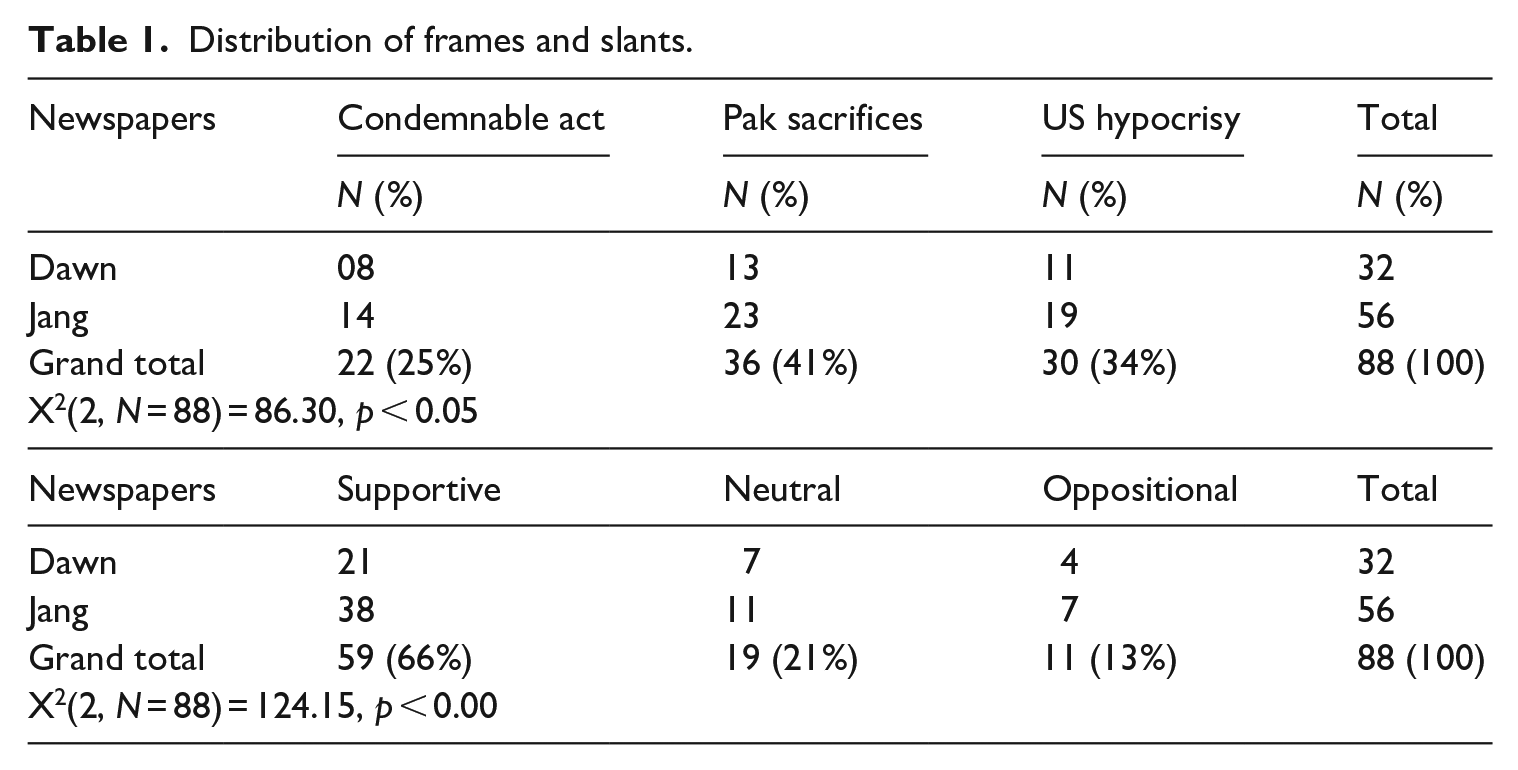
As shown in the Table 1, out of a total of 88 news stories on the Salala attack in the daily Jang and Dawn, 41% stories highlighted sacrifices by the Pakistan military as compared to 34% stories that focused on the dubious US role in the war on terrorism and 25% stories declared the incident as a condemnable act. Statistically, there is a significant difference in the distribution of three categories (X2 (2, N = 88) = 86.30, p < 0.05). The three framing strategies show that the incident is mainly reported through the government perspective. The Pakistani military had long maintained that it was fighting this war to defeat Al Qaeda and that it was the worst affected in the process (Hussain, 2020). The findings in the second part of the table further elaborate on this point. The coverage mainly approved the government stance with 66% stories in the support category, 21% stories in the neutral category and 13% stories in the opposition category. Statistically, the difference is significant (X2 (2, N = 88) = 124.15, p < 0.00). These findings challenge the event-driven news model that sudden and tragic events often result in anti-government coverage (Lawrence, 2000) despite its support in the scholarship (Aday, 2010). The limitation of this model most likely lies in the special context of Pakistan. Unlike the Western democracies, the country is tightly controlled by the military and on the conduct of war on terror; it enjoys an absolute monopoly (Hussain et al, 2019). Journalists were solely reliant on press releases issued by the Pakistan military and hence greater number of favorable coverage. However, there is some oppositional reporting (13%) where the government/military are criticized. This occurred mainly when the press covered the protests of religious groups and university students who demanded retaliation by the army and severing ties with the US. Overall, the study does not find support for the event-driven news model in the context of Pakistan.
Distribution of frames and slants.
Yemeni conflict-2015 (testing press–politics interaction model)
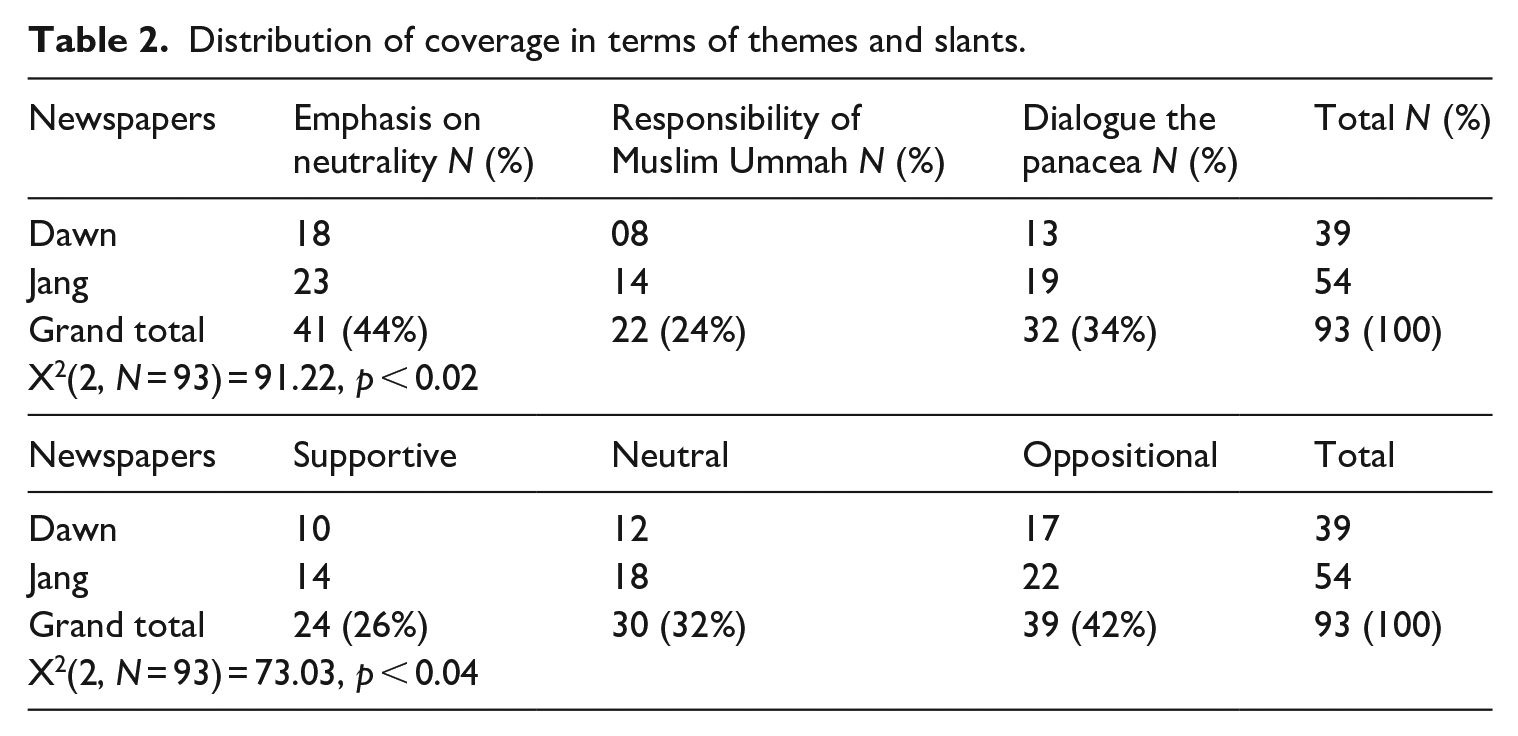
As shown in the Table 2, the selected newspapers mainly emphasized that Pakistan should remain neutral in the Yemen conflict (44%) and that dialogue was the only solution (34%) alongside putting the responsibility on Muslim countries to help resolve this conflict (24%). The statistical test shows significant difference in the distribution of three framing categories in the coverage (X2 (2, N = 93) = 91.22, p < 0.02). These three thematic strategies essentially go against the government’s initial policy that Saudia was a victim of Houti’s aggression. The second part of the Table 2 shows that 42% of the coverage was against the government, 32% coverage was neutral and 26% of the coverage supported the government policy. Statically, the differences among the three categories are significant, thus confirming a major oppositional role of media (X2 (2, N = 93) = 73.03, p < 0.01). These findings are in line with the work of Robinson (2001) who argued that political uncertainty lead to critical coverage that may exert some influence on the policymaking process (Robinson, 2017). In such circumstances, critical media reports provide further ammunition to those seeking a change in the policy. This probably happened in this case where the opposition political parties and other interest groups found a sympathetic media to highlight their perspectives and pressurized government to change its decision. Eventually the government had to succumb to the combined pressure and announced neutrality in the Yemeni conflict (Dawn, 2015). The press-politics interaction model is supported here.
Distribution of coverage in terms of themes and slants.
Kashmir conflict-2019 (testing political contest model)
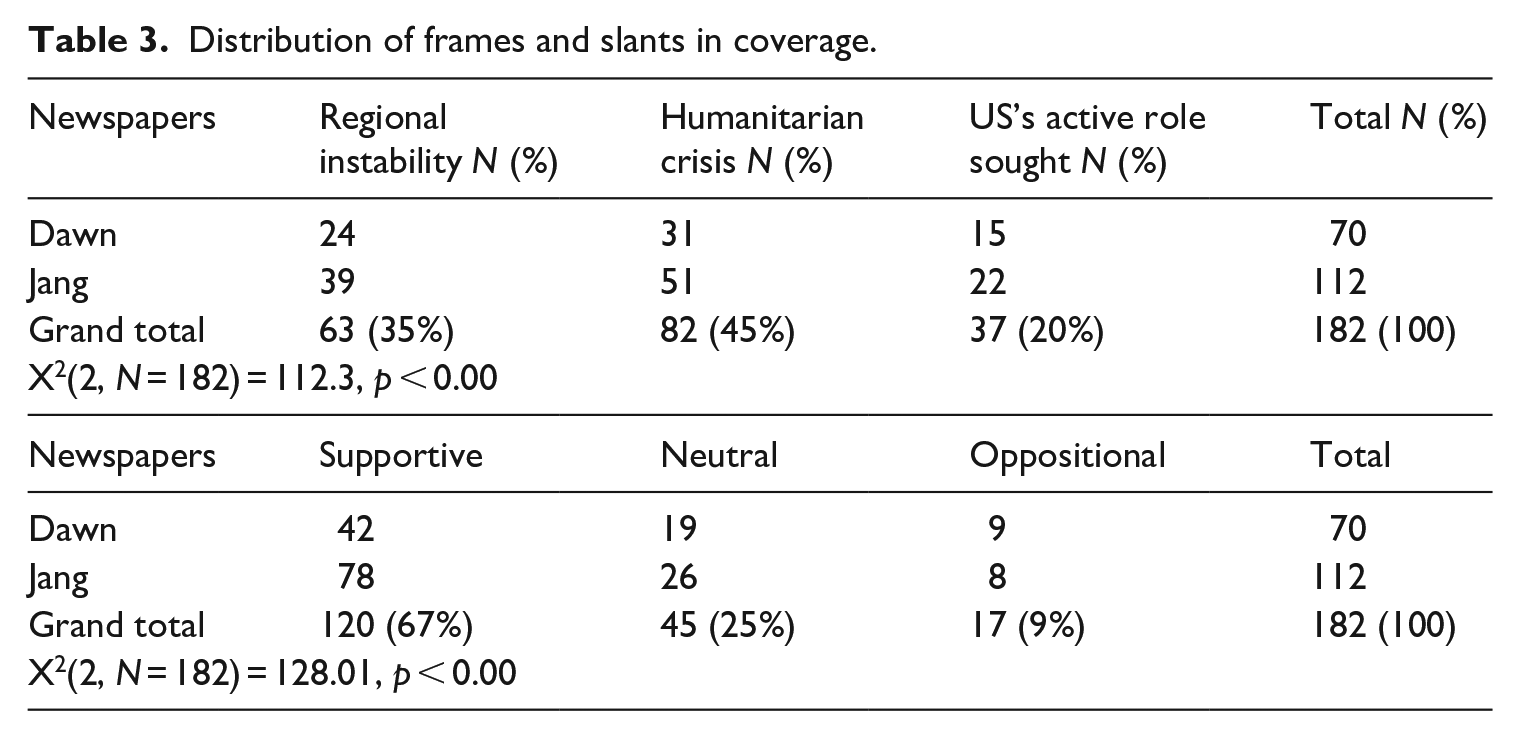
The above Table 3 suggests that the Kashmir conflict is mainly seen as a humanitarian crisis (45%), which has the potential to destabilize the South Asian region (35%) and hence there is a need that US should intervene (20%). This distribution among the three frames is statistically significant (X2(2, N = 182) = 112.3, p < 0.00). The framing strategies mainly reflected the government policy that Kashmir is a disputed region and that the people of valley should be given right of self-determination (Foreign Office Pakistan, 2019). This pro-government framing can be more vividly seen in the second part of the table which shows that 67% of the coverage is supportive, followed by 25% neutral coverage and just 9% oppositional coverage with significant differences (X2 (2, N = 182) = 128.01, p < 0.00). These findings are consistent with the work of Wolfsfeld (1997) who argued that pro-government narrative would dominant if the political environment is controlled. In case of Kashmir conflict, the government was able to get the support of almost all the stakeholders. There was some oppositional coverage (9%) where the press criticized government for not taking optimum measures to respond to the Indian government decision for abolishing the status of Kashmir. Again this falls within the procedural type of criticism and is not substantive in nature. So, overall there is support for the political contest model.
Distribution of frames and slants in coverage.
Extension to army chief, 2019 (testing cascading activation model)
As shown in the above Table 4, 47% of coverage focused on the legal aspects of giving extension to the army chief as compared to 31% coverage to its implication for democracy and just 12% of the coverage on the need for extension due to the prevailing security situation in the region. The difference among the three frames is statistically significant (X2 (2, N = 105) = 87.02, p < 0.04). The coverage is predominantly framed as a legal issue because the Supreme Court intervened in the army chief extension conflict, this making it the leading story for a whole month till the final decision. The second part of the table shows that in terms of slant, the coverage is mainly concentrated in the neutral category (45%) as compared to either supportive category (30%) or oppositional category (25%). Statistically, the neutral category is dominant as compared to rest of the categories (X2 (2, N = 105) = 72.34, p < 0.02). These findings suggest the press did not take a critical position though the extension in the tenure of army chief was largely disapproved by people and civil society for its potential to threaten democratic system (The New York Times, 2020). Cascading activation model predicts that culturally dissonant would lead to critical stance in media (Entman, 2004) but in this study, it did not happen.
Distribution of frames and slants in the coverage.

The inapplicability of this model in the Pakistani context can be explained in two ways. First, the powerful military wanted extension for its chief. Despite the dominant public opinion disapproval of the army chief for his alleged role in rigging elections and weakening democracy, the media could not muster courage to criticize him. During his tenure as army chief, General Javed Bajwa was accused of strangulated media through censorship, layoffs of critical journalists and killings and abductions of dissenting voices by the intelligence agencies (BBC, 2019). This zero tolerance for critical coverage dissuaded media from raising questions that are considered legitimate in consolidated democracies. Secondly, the Supreme Court was involved. The court proceedings had to be reported in neutral way. Though the social media was abuzz with rumors that the military had deliberately involved higher judiciary to get indefinite extension for the army chief (which it did), the press however only reported the proceedings of the hearings. This approach focused on the day today events like the enquiry into the rules regarding extension, the occasional mismanagement by the government and the final decision of granting extension. During the process, fair amount of critical coverage (25%) also occurred but this criticism was of procedural nature (Bennett et al., 2006) and did not confront the government or military for this hugely unpopular decision. Overall, the cascading activation model is not supported in this study.
As shown in the above Table 5, the decision to participate in the Yemeni conflict was mainly reported in critical stance (42%) and got least supportive coverage (10%) as compared to the rest of the three events {X2 (2, N = 469) = 70.67, p < 0.04}. This should be read in the context of Table 2 that shows the Pakistani newspapers stressed for remaining neutral in this conflict and criticized government for considering sending troops to fight against the Houti militias. Rest of the three events are reported in neutral or supportive stance towards the government. As discussed earlier, sending troops to Yemen to help Saudi Arab was hotly contested in the Parliament. Since the government and military were unclear about the modalities of sending troops like what exact would be their role, from where funds would come and how the neighboring countries specially Iran would react to it—all this created policy uncertainty (Robinson, 2017). Unable to find satisfactory answers from the government, the opposition voices including journalists were able to identify the risks in the decision and ultimately the parliament voted against sending troops to Saudia.
Event-wise treatment in the selected press.

However, this independence is compromised in the case of giving extension to the army chief. As shown in the Table 5, the issue got maximum neutral coverage. Being arbitrary and having implications for democracy, the media should have reported it critically. But due to military pressure and legal proceedings, the coverage was largely neutral. Some procedural criticism did occur but it did not substantially criticized military rather it was the ‘mishandling of the case’ by the government that angered the higher judiciary and was duly highlighted in media reports.
Finally, more supportive supportive was found in the case of Kashmir conflict and the Salala checkpost attack. The intractable Kashmir conflict between India and Pakistan has deeply influenced the collective consciousness (Iqbal and Hussain, 2018) and has strong unifying power in Pakistan and all segments of society ‘rally round the flag’ during tensions with India. Political communication researchers have found direct connection between supportive media coverage and euphoria in wartimes (Bennett, 1990; Hallin, 1986) and the Kashmir conflict is no exception to that. In the case of Salala checkpost attack, despite its abruptness and tragic nature, the press remained largely friendly. As discussed earlier, the pro-government coverage is due to pressure from military that disallows criticism to its policies in Pakistan. Pakistan is included in the list of deadly countries for journalists especially those reporting security issues and usually journalists take care not offend military establishment (Hussain and Lynch, 2019).
Discussion and conclusion
In this study, the researcher examined key arguments in the scholarship on media–government relations by analyzing media reporting of four events having policy implications. These included event-driven news (Lawrence, 2001), policy uncertainty (Robinson, 2001), control on political environment (Wolfsfeld, 1997) and culturally dissonant events (Entman, 2004). As outlined at the outset, the objective of this study was to replicate some of the key arguments in the existing literature in Pakistani context and analyze how and to what extent the findings are in line with the existing scholarship. Overall, the results are mixed. The Salala check post attack did not result in critical coverage. On the other hand, policy uncertainty on participation in the Yemeni conflict produced critical coverage. In the case of the Kashmir conflict, the broader political consensus was responsible for supportive coverage. Similarly, the unpopular step of giving extension to the army chief was mainly reported in a neutral tone with some procedural criticism (Livingston and Bennett, 2003).
This study signifies that the press in Pakistan exhibits independence when there is policy ambiguity and when the military is not involved. Further, media independence is related with the nature of military engagements. On security issues like the Salala attack, the press is solely reliant on army for information and is tightly monitored and hence critical coverage is exception than a norm. However, in the case of military intervention in the political issues having socio-cultural ambiguities like the army chief’s extension case, the press was not supportive thought it fell short of doing critical reporting of this event. On the other hand, due to the larger societal consensus, the Kashmir issue is mostly reported as per the government guidelines.
These findings suggest several important points. First, the scholarship developed in the context of US and Western Europe has replication limitations in semi-democratic setups like Pakistan. In consolidated democracies, executive powers rest with elected representatives who are accountable to the public. On the other hand, Pakistan has weak democratic institutions and the powerful military establishment enjoys considerable executive powers, particularly in the domains of security and foreign policy and is usually unaccountable for its actions. So while in the Western context, people are persuaded before any major action, in Pakistan, they can be easily coerced and hushed up. As the case studies show, the military was able to silence opposition to her policies in the aftermath of the Salala incident and during the whole extension saga. As such, the media did not object to the shortcomings in the existing policies but rather toed the military lines in both those events.
Secondly, the existing models of media–government relations supplement each other instead of being diametrically opposed to each other. For example, sudden tragic events spur critical reporting of existing policies (Lawrence, 2001) but the officials soon control these events (Livingston and Bennett, 2003). Since the government is better placed to control information (Wolfsfeld, 2004), opposing views disappear with the passage of time (Bennett et al., 2006). This most likely happened in the aftermath of the Salala attack where the military, through its information control strategies, was able to curtail critical reporting. Likewise, events having socio-cultural dissonance have the potential to break the official perspective (Entman, 2004). However, Entman (2004) concedes that government officials in influential positions better placed to frame events of their liking due to their control on information. In a seminal study, Bennett et al. (2006) found that during the Abu Ghraib prison scandal, despite clear evidence of large-scale institutional practice of prisoner abuse, the media followed the elitist perspective that the mistreatment of the prisoners was an individualistic affair. During the debate on the army chief’s extension case despite the popular resentment, the press focused on the legal aspects of the decision and largely maintained a neutral approach.
However, under certain conditions like policy uncertainty, media may become independent of government influence (Robinson, 2001, 2017). Media usually do not undertake policy issues by itself (Aday, 2010) rather they provide opportunity to the opposition voices due to the government failure to control the flow of information (Wolfsfeld, 1997). When the Saudi government requested Pakistan to send troops to Yemen to fight against the Houthi militias, the government was ambivalent. This indecision on policy matters created a lacuna that was duly exploited by the opposition. However, governments usually are well prepared to deal with important policy issues. Through policy certainty and clear-cut goals (Robinson et al, 2009), governments succeed in controlling the political environment (Wolfsfeld, 1997, 2018). In the case of the Kashmir conflict, the government was able to create elitist consensus as well as controlling the flow of information. This resulted in an overwhelming amount of pro-government coverage.
The above discussion highlights the theoretical consistency among the various models of media–government relationship. It shows linkages among the key arguments and argues against one-solution-to-all-problems approach. The empirical evidences suggest that media coverage is distributed across various perspectives despite favoring one particular approach. The four selected events received supportive, oppositional and neutral coverage. Other researchers have also found variations in the coverage much against the theoretically extreme positions taken by certain authors (Livingston and Bennett, 2003; Mulherin and Isakhan, 2019; Robinson et al., 2009).
This study is not without limitations. First, I selected just two newspapers. The number of newspapers could be increased for more comprehensive analysis. Electronic media could be studied due to its popularity in the country. Likewise, as compared to the frame and slant analysis, the method introduced by Robinson et al. (2009) could be adopted for more vigorous examination of the press-government relationship. Finally, a qualitative approach using textual analysis and interviews with stakeholders would be useful to investigate the effects of media in the policymaking process.
Footnotes
Funding
The author(s) received no financial support for the research, authorship, and/or publication of this article.
