




Abstract
This research examines the role of gender and class inequalities in the experience of reading print newspapers. We draw on data from two complementary sources: a survey of news, technology and entertainment consumption (n = 700) administered in the greater Buenos Aires area, and 158 semi-structured interviews conducted in the City of Buenos Aires and other towns in Argentina. Our findings indicate that although news consumption in general appears to be evenly distributed, with no significant gaps according to age, gender, education and socioeconomic status, print newspaper consumption seems to be the preserve of older, more affluent, mostly male audiences in ways that reinforce patriarchal family patterns – it is usually husbands and fathers who decide for the entire household which newspaper is purchased and when that takes place. In addition, newspaper reading is carried on by those at the top of the income-earning pyramid, and reinforces class status mainly due to the persistent associations between newspaper readership, civic duty, and professional prestige. We conclude by reflecting on the implications of these trends for print newspapers and their role in society.
Print newspapers have had a central role in the information ecosystem for centuries (Habermas 2015). They have been undergoing an economic crisis in the past decades due to severe loss of circulation and advertising revenues (Abernathy, 2018; Doyle, 2013; Kolo, 2016; Van der Burg and Van den Bulck, 2017). In Argentina, print consumption has fallen from 45% to 23% between 2017 and 2020 (Reuters, 2020). There are twenty-six newspapers nationwide but the circulation is primarily led by two of them, Clarín and La Nación, both published in Buenos Aires, which account for 40% of total circulation (IVC, June 2020). Paradoxically, the decay of print newspapers has been coupled with a mushrooming of studies about the economic, organisational, and professional dimensions of this process (Boczkowski et al., 2018). Scholarship has also tackled the broader societal implications of this decay, often underscoring negative implications such as decreased voter turnout and a less vibrant public sphere (Cornia, 2016; Hassid and Repnikova, 2016). Much less attention has been devoted to what this means to readership dynamics (Papathanassopoulos et al., 2013; Thurman, 2018; Thurman and Fletcher, 2019). The few existent studies on contemporary newspaper consumption converge in showing that readership practices are imbricated with broader everyday practices (Boczkowski et al., 2020; Fortunati et al., 2015; Kormelink and Meijer, 2019). We build upon these latter studies by inquiring into two social structural formations: gender and class. We ask: how do preexisting gender and class dynamics shape contemporary reading practices and, in turn, how do these practices affect these dynamics? What does this imbrication mean for the role of print newspapers play in society?
To answer these questions we analyze data from the socio-demographic profiles of print newspaper readers via an in-person survey (n = 700) in the Greater Buenos Aires Area in October 2016, and an account of issues of practice and interpretation that emerged from 158 semi-structured interviews conducted between March 2016 and October 2017. Our study shows that reading print newspapers is mostly undertaken by older, more affluent, mostly male audiences in ways that reinforce patriarchal family patterns – it is usually husbands and fathers who decide for the entire household which newspaper is purchased. In addition, newspaper reading is carried on by individuals of higher socioeconomic status and reinforces class differences mainly due to the persistent associations between newspaper readership, civic duty, and professional prestige. We build on these findings to reflect on what the decay in print newspaper readership might mean for gender and class inequalities.
Conceptual matters
We build on various streams of scholarship to examine issues at the core of this paper: studies on the sociodemographic factors and print readership, and accounts of the role of gender and class in media consumption.
The social demography of print newspaper readership
Scholarship over the years has focused on which sociodemographics indicators are associated with newspapers readership. Research has found that education (Burgoon and Burgoon, 1980; Poindexter and McCombs, 2001), age and cohort (Barnhurst and Wartella, 1991; Peiser, 2000; Salisbury, 1981) gender (Burgoon and Burgoon, 1980; Lain, 1986; Loges and Ball-Rokeach, 1993; Schoenbach et al., 1999), income (Malthouse and Calder, 2006) are linked print newspapers consumption.
Newspaper use has been consistently shown to be positively related to higher levels of social capital and political activity (Beaudoin and Thorson, 2004; Shehata and Strömbäck, 2011; Stamm et al., 1997). Schoenbach et al. (1999) have found that reading print newspapers in the United States ‘can be described to some extent as determined by one’s lifestyle: a higher income, a good education, being male and of an age indicating a state in life that may be called “established”’ (p. 237).
However, factors associated with print readership are not constant across generations. Age cohort studies have for some time predicted the death of print readership. Scholarly evidence shows that media habits are formed in early stages of people’s lives (Cobb, 1986; Lee and Delli Carpini, 2010; Stone and Wetherington, 1979). Peiser (2000) examined newspaper readership among generational cohorts in the United States and Germany, and concluded that if newspaper reading is declining in the population, more children will be raised by parents who do not read newspaper on a regular basis, thus failing to develop a strong newspaper reading habit. This might have negative consequences for the polity since reading news online rather than in print reduces exposure to public affairs stories (Althaus and Tewksbury, 2002; Dalrymple & Scheufele, 2007). While scholars have made important contributions to understanding the demographic factors that drive newspaper readership, most of the research is based on studies of Europe and the United States, and thus has not yet fully addressed how gender and class might shape newspaper readership in developing democracies.
Gender and media consumption
The role of the household in creating media habits tied to issues of patriarchal family structures, gender, and media use has been broadly analyzed (Gauntlett, 2003; Hobson, 1982; Lull, 1982). Some studies have illuminated the connection between gender and media in their relation with political participation (Benesch, 2012; Delli Carpini and Keeter, 2000; Norris et al., 1997). Scholars have also assessed how women appear in the media (Fowler, 1995; Lynch et al., 2016) and what they do with media (Brunsdon and Morley, 2005; Gray, 2006; Morley, 1999; Poindexter et al., 2008). Morley’s classic work on Nationwide (2005) sheds light on different roles in media consumption in daily life, explaining why, for instance, men typically appropriate the remote control when watching television.
Some researchers have suggested that there is a gender gap in free time, which is in turn related to media consumption habits (Bittman and Wajcman, 2000; Fraser, 1990). Bittman and Wacjman (2000) argued that it is not only a matter of quantity of free time but also of quality: men have more high-quality leisure than women since the latter experience a higher proportion of their leisure time encumbered by unpaid work (p. 151). Gray finds this pattern in VCR consumption: spare time was mostly used by males who ‘seemed able to claim their “own time” once at home’ (2006: 148). Studies have also found that the gender gap in leisure time has consequences for news consumption (Benesch, 2012; Fortunati et al., 2014; Toff and Palmer, 2019). Poindexter et al. (2008) argued that preferences and opportunity costs are associated with women consuming relatively less news than men. Benesch (2012) found that women spend on average about 10 minutes less than men per day accessing news. The gap increases among households with children (Benesch, 2012; Bittman and Wajcman 2000). In their study of female news avoidance, Toff and Palmer (2019) indicate that a possible explanation is the fact that women perceive that ‘news-is-for-men’ (p. 1566), an issue that has also been addressed by other scholars (Hobson 1982; Morley, 2005). These gender dynamics are also tied and reinforced by issues of class status.
Class and media consumption
Field theory has contended that the dominant class cannot prevail merely by appealing to its economic capital; it also obtains legitimation by imposing its cultural capital (Bourdieu, 1991; Wacquant, 2013). Thus, consumption, and cultural consumption in particular, constitute a privileged scenario to understand the mechanisms of reproduction and social differentiation (Bourdieu, 1993, 2013). Media consumption is neither an exclusively commercial phenomenon, nor a purely ideological process (Canclini, 1995), but rather ‘a cultural phenomenon through which people. . . live the constitution of the meaning of their life’ (Martín-Barbero, 2000: 183).
Contemporary research on the appropriation of media as cultural has looked into radio and television consumption practices (Bourdieu, 2001; Livingstone, 2013; Silverstone, 2003), and more recently into the use of new media (Couldry, 2013; Hine, 2015; Livingstone, 2009). Scholarship has found that socioeconomic status shapes how people incorporate the Internet into their daily lives (Hargittai, 2010), which suggests a strong link between technology use and class habitus (Lindell, 2015). In terms of news consumption, Lindell and Sartoretto (2018) argue that ‘class, or social position, matters at the extent to which young people “buy into” the normative order that regards news as inherently “good”, valuable and worthwhile’ (p. 2057).
Finally, gender and class differences could also be explained in relation to patriarchal dynamics in Western societies (Barret, 1980; Weber 1947). Walby (1990) argues that patriarchy is composed by six structures: patriarchal mode of production, relations in paid work, relations in the state, male violence, relations in sexuality, and patriarchal relations in cultural institutions. In Segato’s words (2016) The history of the public sphere is the history of Patriarchy (. . .). The natural subject of that public sphere, heir to the political community space of men, will be, by mark of origin and genealogy, 1) male; 2) son of the colonial process and, therefore, a) white or bleached; b) owner, c) literate; and d) paterfamilias (94, italics in the original).
The scholarship discussed in this section informs the formulation of two sets of hypotheses, and one research question. The hypotheses are meant to help illuminate sociodemographic patterns of gender and class, and the research question to inquire into their instantiation within broader everyday practices.
The first set addresses issues of gender and age:
H1a: Men will be more likely to read print newspapers than women.
H1b: Age will be positively correlated with print newspaper readership.
The second set deals with matters of class:
H2a: Socioeconomic status will be positively correlated with print newspaper readership.
H2b: Educational attainment will be positively correlated with print newspaper readership.
Finally, we pose the following research question:
RQ: How do gender and class dynamics shape the practices and interpretations associated with newspaper readership, and how are those practices and interpretations imbricated with the daily lives of the public?
Methodology
This study is based on two complementary streams of data: a survey of news, technology, and entertainment consumption conducted in the greater Buenos Aires area (N = 700), and 158 semi-structured interviews conducted face-to-face by a team of research assistants in Argentina between March 2016 and December 2017, which aimed to explore recent experiences with news, entertainment, and technology.
Argentina is a fruitful location to conduct research in print newspaper readership for several reasons. First of all, the country has a literacy rate of 99% (World Bank, 2019), and at the end of the twentieth century there were more than a dozen national newspapers, something notable for a country with a population of forty-five million. Finally, the country has been a democracy for the past 37 years (Polity IV), with relatively high levels of freedom of expression (RSF, 2018).
The survey was conducted face-to-face during October 2016 by a polling firm. 1 Households were selected according to a probabilistic multi-stage sample design (random selection of neighborhoods and blocks within the Greater Buenos Aires Area, systematic selection of households) and respondents within designated households were selected to complete age and gender quotas. Of the 700, 175 were 18- to 29-years-old, 175 were 30–44, 175 were 45–60, and 175 were 60 or older. Half of the sample was female and the mean age of all participants was forty years old. 2 Nonrespondent households were re-visited once, and the survey response rate was 19%.
Interviews were conducted from March 2016 to November 2017 by a team of research assistants and took place mostly in the greater Buenos Aires area, but some also took place in the provinces of Córdoba, Salta, Santa Fe, and San Juan – thus, representing regions in the East, West, and North of the country, but not in the South. The interviews lasted on average 33 minutes and were tape-recorded and fully transcribed for analysis. The recruitment process was conducted through snowball sampling technique (Heckathorn, 2011). The interviews held a wide range of occupations, such as students, factory and construction workers, attorneys, professors, cooks, teachers, housekeepers, psychoanalysts, designers, accountants, programmers, security guards, and retirees, and 56% were women. Regarding education, 35% had obtained a high-school degree or less; 22% were college students; 38% had an associate or bachelor college degree; and 5% had received a graduate degree.
The interviews were analyzed through two rounds of coding by the authors, and followed a grounded theory approach (Corbin and Strauss, 2008). Once we reached a theoretical saturation of the emergent analytical categories (Glaser and Strauss, 2017), we ended the analysis process. The quotes included in this paper were translated from Spanish into English by authors, who are bilingual; and pseudonyms are used to protect the privacy of participants.
Findings
We divide the presentation of the results into three parts. First, we address the sociodemographic profile of newspaper readers. Second, we delve into how these patterns are shaped by family dynamics in which men have a central role. Third, we explore the consolidation of readers’ prevailing class habitus through the enactment of civic and professional responsibility, two markers of class distinction.
Who reads print newspapers?
The survey indicates that 97% of the people consume news regardless of their age, gender, education, and socioeconomic status, but only 37% of the respondents choose print newspaper as a source of information for current news. 3 Moreover, men read print newspapers in a greater proportion: 42% male respondents answered that they read print news, compared to 33% of women. The difference is significant (χ2 = 5.8171, p. = 0.016). This confirms H1a.
The analysis also shows that newspaper consumption increases linearly and significantly with age: half of those 60 and older read the print newspaper, compared to 39% between 45 and 59 years-old, 36% between 30 and 44 years-old, and 24% of respondents between 18 and 29 (Figure 1). The difference is significant (χ2 = 5.5421, p. < 0.0005). This confirms H1b.
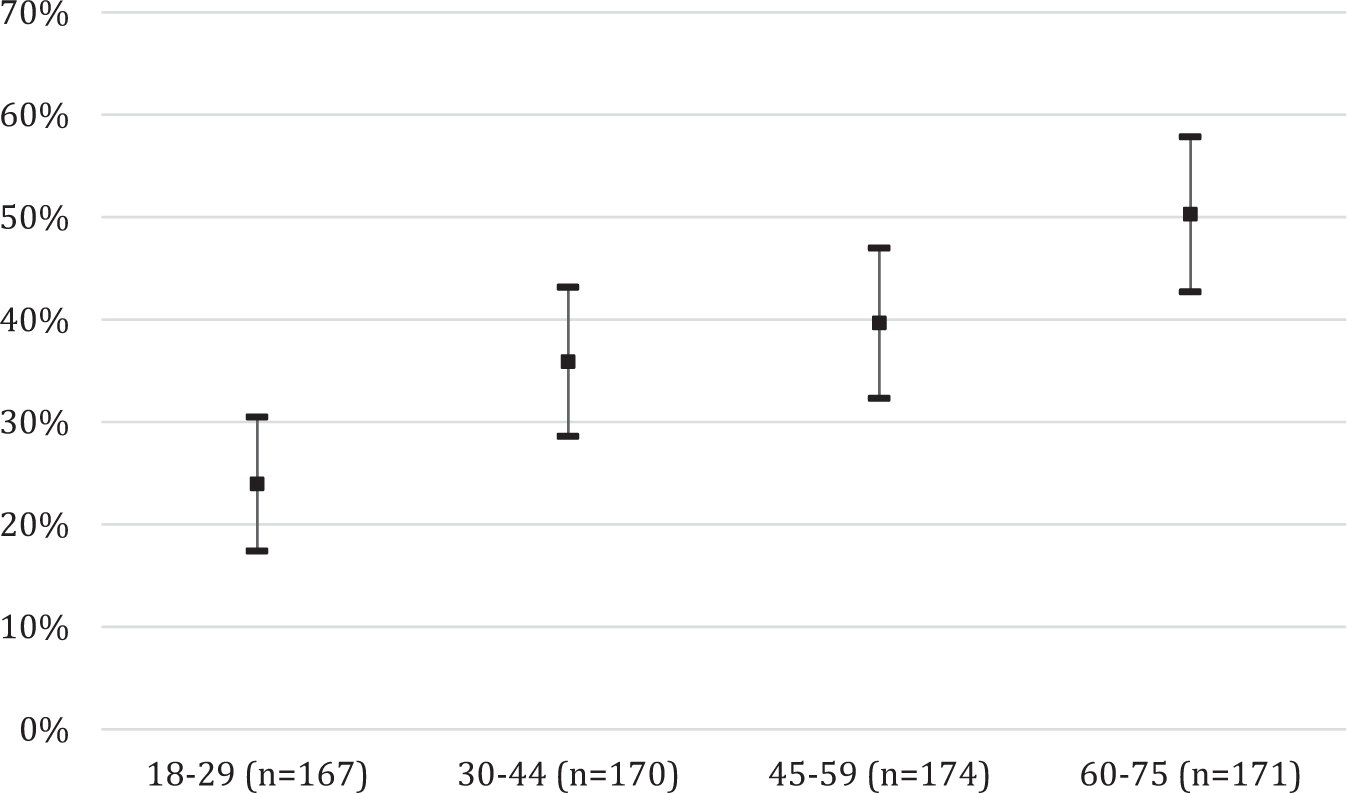
95% Confidence interval for percentage who use print newspapers as a source of news, by age.
Regarding the relationship between class and print readership, 52% of respondents of high socioeconomic status choose print outlets, compared to only 26% of people in the lowest socioeconomic stratum (χ2 = 11.4091, p. = 0.022) (Figure 2). 4 This confirms H2a. On a related note, half of college graduates read the news in print, compared to 32% of those who did not complete high school (χ2 = 10.8319, p. = 0.004) (Figure 3). This confirms H2b. These differences are statistically significant. 5

95% Confidence interval for percentage who use print newspapers as a source of news, by socioeconomic status.
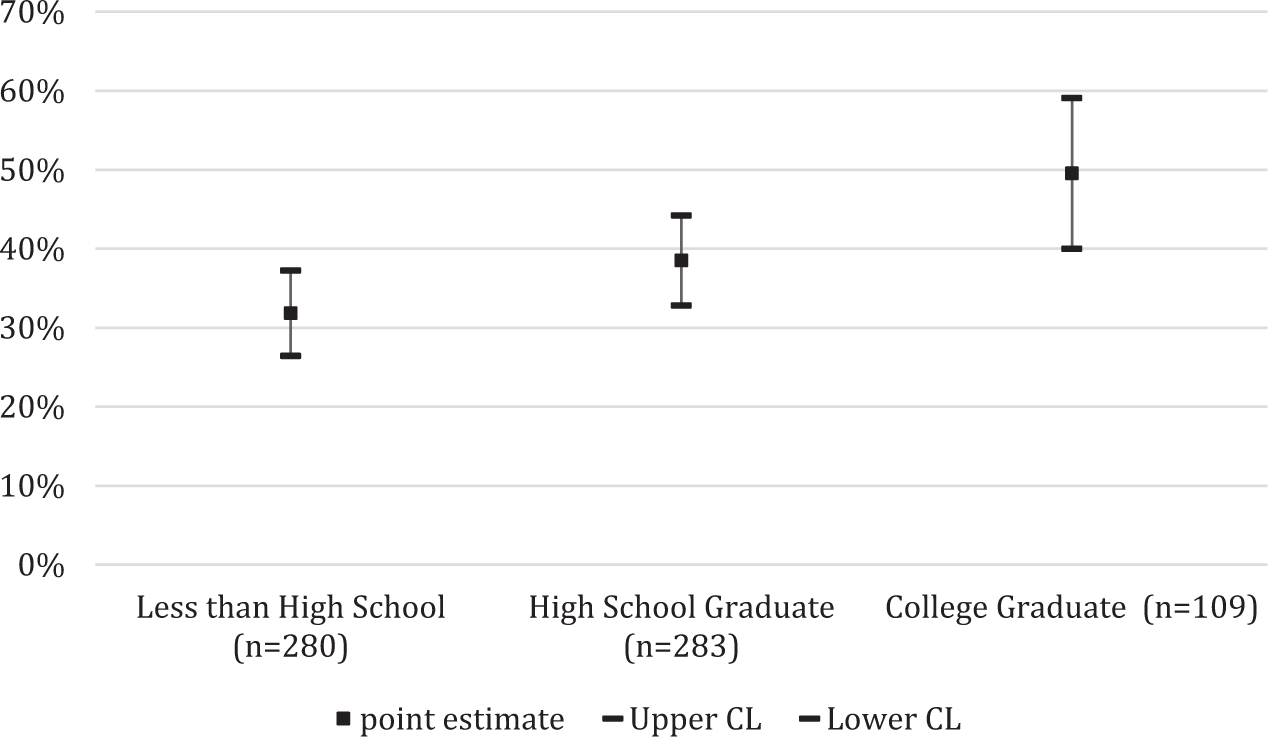
95% Confidence interval for percentage who use print newspapers as a source of news, by educational attainment.
A logistic regression examines the relationship between socio-demographic variables, media consumption habits, and choosing print newspapers as source of news. Age and gender are significant even when including other sociodemographic characteristics and media consumption habits, and explain around 4% points of the variance in the dependent variable. Each extra year of age increases the odds of selecting print as a source by 2%, and being a woman decreases the odds of reading the newspaper by 49% when compared to a man (Table 1, Model 4). Educational attainment and socioeconomic status explain an additional 3% points in print readership. Although socioeconomic status by itself is not significant, its interaction with gender indicates that for women moving one category up in socioeconomic status is related to a 33% increase in the odds of reading news in print. 6 Furthermore, respondents who have not finished high school have 28% lower odds of reading news in print than those who have finished college. Choosing print as a source of news is also positively correlated with other traditional media sources of information: reading magazines and listening to the radio increases the odds of using print newspapers. Trust in print newspapers and online news is also positively related to reading news in print. Overall, media habits and attitudes explain about 11 additional percentage points of the variance in print readership, but age and gender continue being significant predictors of newspaper consumption even when controlling for other factors.
Logistic regression of ‘uses print newspaper as a source of news’ on gender, age, lives in the city of Buenos Aires (compared to greater Buenos Aires), socioeconomic status, educational attainment, source of news and trust in media.

Significant at the p < 0.05 level.
Significant at the p < 0.1 level.
The enactment of patriarchy
The analysis of the interviews
7
reveals that reading print newspapers is shaped by the practice of power relations within heteronormative families in which men, as both husbands and fathers, often decide whether a newspaper is read within the household, and if so which one, all based on their personal preferences. Claudia, a 41-year-old psychologist said she prefers getting news on the Internet because it gives her more freedom and autonomy. However, when talking about print news she said: My husband subscribed to Clarín, and that stuck. He reads it on Sundays. I like La Nación more [she subscribes to the digital version], its format, the type of news it publishes. But we already get Clarín. We won’t subscribe to two newspapers, we don’t devote that much time to reading the news (10/1/2016).
Andrea, a 31-year-old photographer, said she ‘would love to get into the habit of reading a newspaper, I find it super poetic.’ However she narrated a similar situation to that of Claudia in terms of which newspaper is chosen: We get Clarín because a while ago [my husband] told me “I joined the readers’ club or whatever to get the 365 Clarín [loyalty] card.” I thought it was disastrous. Being subscribed to Clarín is disastrous, and being subscribed to get the 365 card is even worse (. . .) Because I don’t want to have anything to do with all those people (. . .) Clarín is part of the hegemonic media (6/1/2017).
The power relations that underlie family ties within households also extend to domestic labor. Marta, 61-year-old domestic employee, states: ‘Sometimes I grab some magazine, I read a little. The magazine that comes with Clarín or La Nación. (. . .) My mister [“el señor,” in Spanish] reads the newspaper’ (9/1/2017). The words of Jazmín, a 44-year-old teacher, summarise the way newspaper consumption is shaped and limited by household relations. She said that even though the newspaper is bought on Sunday she does not read it, but added My husband looks at it (. . .). I think the Popular, I don’t really know which one it is (. . .). I’m not interested. It’s something that doesn’t catch my attention (. . .). I learn about a lot of the news from him. He tells me, “Oh look what happened!” (8/2/2017)
Other female interviewees discussed how they accessed print newspapers outside their homes. Susana, a 76-year-old housewife commented that: ‘when I am at a place that has a newspaper, I grab it and read it. I like to read the news! But I don’t buy the newspaper’ (11/1/2016). Similarly, Sonia who is 58 years-old said: ‘I like newspapers. [I usually] go to bars and I always ask for the print newspaper. I read whichever newspaper is available’ (3/1/2017).
Although younger interviewees do not frequently read the newspaper, they describe it as an activity undertaken by their parents, particularly the fathers. Clara, who is 24 years of age, commented that because of her work as a financial analyst she needs to be informed constantly, mostly via digital news. This contrasts with the presence of a print newspaper in her household, but ‘dad reads it. They [her parents] discussed not buying it any longer, but, he loves the paper, old-style. None of us [“nosotras” in Spanish, the female first-person plural pronoun] reads it, we do everything on the iPad, the cell phone, or the computer’ (5/1/2016). Leila, a 19-year-old college student, noted that reading the newspaper ‘is a cultural habit more than anything else. My dad buys it some days, but it got very expensive’ (7/1/2016). Víctor, a 23-year-old student, concurs: ‘my dad must be the last person who reads the newspapers, I mean, there are not a lot of people reading the print newspaper, it is more convenient to read it online’ (8/1/2016). He reminisced about how his relationship with his father shaped his print newspaper reading practices during childhood: I was a sports fan from a young age, and I read the newspaper when I was a kid. I used to get up at 7 a.m. to go to school, and my dad would have left the newspaper open on the sports pages. So I got up and read just the sports page before leaving for school (8/1/2016).
However, newspaper readership is not solely shaped by patriarchal relationships within the family boundaries but also intertwined with class inequalities that reinforce and reproduce these dynamics.
Class inequalities
As some of the previous statements suggest, the analysis also reveals how newspaper reading is tied to the enactment of class inequalities. One way this emerges in the data is through the connection between newspapers and issues of civic and professional duty, often among highly educated and professional men. Juan, a 26-year-old graduate student, accesses print newspapers both by subscription and also by encountering newspaper at coffee shops. He explained that he reads them as a result of his college experience: ‘I acquired the habit during my undergrad years and I like it. . . Because I majored in political science, I liked to be informed (. . .) if we debated any topic, I knew what they were talking about’ (8/2/2016). Lucas, a 30-year-old lawyer who subscribes to a newspaper on Sunday and also buys monthly Le Monde Diplomatique, said that read print newspapers because of his professional activity: ‘I am a lawyer. I think it is a lawyer’s responsibility to have some general knowledge, and to be informed of what is happening in the country’ (10/2/2016).
Hector, a 47-year-old businessman said: ‘I am interested in political news, news that is related to the economy (. . .). Politics is a way of transforming reality (. . .). Also, it helps to open up my mind, think differently, to know more, to be more informed’ (11/1/2016). Carlos, a 58-year-old accountant who works in a notary’s office, described his news diet: In the morning when I wake up I turn on the radio a few minutes until I get up and have breakfast, and while I have breakfast I read the newspaper (. . .) I mostly listen to the morning shows about national news. Not only for a list of news, but also for commentary on the news, with interviews, comments, editorials (1/1/2017).
Our analysis indicates that both men and women face time constraints related to reading the print newspaper. Ricardo, a 19-year-old college student said: ‘The truth is that it doesn’t call my attention [to read the newspaper] (. . .) I don’t have so much time at home’ (7/1/2016). Lucas, the attorney, added that he reads on Sundays because: ‘I have more free time because on Saturday I do more social activity, on Sunday morning I am relaxed at home’ (10/2/2016). Solange, a 63-year-old teacher noted something similar: ‘I will usually look for [newspapers] (. . .) on weekends; because that is when I have more time to read them’ (4/1/2017). However, for women, time for newspaper reading is not only limited by their work schedules, but also constrained by household chores and care duties. Marcela, a 72-year-old administrative employee said that she buys the newspaper every day: Lately, now that I live alone, that my children are already out of my house, I keep myself more informed. Before, mothering activities did not allow me to [keep up with the news], because you have to take the kids to school, to a birthday, here and there. Now that I am alone I have much more free time for that and I get much more informed. And I love being informed (. . .) it’s like I participate more in social life (2/1/2017).
As the words of these participants showed, the connection between issues of civic and professional duty contribute to the development of a distinctive taste for the print press. Interviewees also highlighted that reading print newspapers was tied to a certain level of previous knowledge, which they sometimes associated with higher levels of educational attainment and socioeconomic status. Patricia, a 51-year-old high school teacher who subscribes to two daily newspapers, liked to read print news ‘because of the language and the genre of the writing, the newspaper includes articles written by journalists with a very good education’ (11/1/2016). Luciano, a 36-year-old accountant, who combines digital news during the work-week with two print outlets on Sundays – a national newspaper (Clarín) and a regional one (La Capital)– said: ‘I do not read anything about sports or gossip. I look at economics, international news, politics and the whole issue of the stock and financial market, because I like it and because I understand it’ (1/11/2017; emphasis added). Similarly, Santiago, a 41-year-old teacher and journalist, noted: I am lucky to be able to understand English (. . .). I read some culture sections from Huffington Post. I read The New York Times, The Guardian. [I read] online news during the week and during weekends there is nothing better than (. . .) print news (7/1/2017).
However, other interviewees associated the newspaper to other work-related practices. Araceli, a 56 years-old speech therapist recounted how she got the newspaper on Sundays, but did not read it ‘sometimes I can cut out some coloured figures that I am interested in for work, for rehabilitation (2/1/2017).
Finally, the price of newspapers appears to be a barrier for readership, further underscoring the relationship between socioeconomic status and print consumption. Susana, a 76-year-old retiree, shared ‘I liked the newspaper very much, due to economic circumstances I’ve let it go, but yes, the newspaper is fundamental’ (11/1/2016). Silvina, a 62-year-old who is also retired, rarely ever reads the newspaper, and added: ‘Yesterday, for example, I bought Le Monde Diplomatique (. . .) but I was amazed at how much it costs! 70 pesos a newspaper! It’s a lot! ’ (12/2/2016). Finally, Leila, the college student noted: ‘I read La Razón every day, but because it’s free, they give it to me and I read it’ (7/1/2016).
Discussion
This paper examines how gender and class formations are intertwined with news consumption habits in audiences’ daily lives. Our survey findings indicate that although news consumption in general appears to be evenly distributed in Argentina, with no significant gaps according to age, gender, education and socioeconomic status, print newspaper consumption appears to be the preserve of older, more affluent, males. This print divide resonates with findings from other countries (Barnhurst and Wartella, 1991; Malthouse and Calder, 2006; Peiser, 2000; Salisbury, 1981), in which there were age, gender, and status differences between print readers and non-readers. We add to this literature by showing how these structural formations are imbricated and maintained in everyday life by heteronormative and classist family patterns in which men have a central role, deciding which newspaper – if any – gets purchased in the household based on their preferences, thus perpetuating gender and class dynamics of a patriarchal nature. In other words, demography does not matter so much in itself, but as an expression of broader sociocultural dynamics that were underexamined in previous work. Furthermore, patriarchy and class are compounded in everyday practices: women are less likely to decide which newspaper to buy within heteronormative households, less likely to have the free time to read whichever newspapers their husbands decide to purchase, and – in light of societal-level income differences – less likely to have the means with which to purchase news in print. 8
Although women and young people in general might have access to a newspaper within their respective households, our findings suggest they often do not have a say about which newspaper is bought, which might be related to further estrangement from the medium. Significantly, differences in print newspaper readership between men and women disappear among high socioeconomic status respondents. If, in the words of Benedict Anderson, newspaper readers are part of an ‘imagined community’ (2006), that community in Argentina is patriarchal and classist: primarily affluent, college educated, older, and male.
This gender-based exclusion from print newspaper consumption mirrors marginalisation of women from the news itself. Research conducted in Argentina indicates that women are less likely to author news stories, and significantly less often cited as sources in news articles than men (Mitchelstein et al., 2019). This gender segregation in news production mirrors the patriarchal dynamics within and outside the household, and also likely reinforces it: men claim ownership of news sources in part probably because what they read reflects positively on them, and women likely feel alienated for the opposite reason. Needless to say, there is nothing in the essence of news as a cultural product that generates these dynamics: it is the social processes what undergirds its gendered construction and reception.
Consistent with Bourdieu’s (2013) association of social class with the structure of aesthetic preferences, our findings also suggest that the current consumption of print newspaper in Argentina could be understood as the consolidation of readers’ prevailing class habitus. Reading newspapers – especially among older and better educated consumers – bestows distinction, not because of the cost of the artifact, but mainly due to the persistent associations between readership, civic duty and professional prestige. Cultural consumption reifies power structures because, as Lindell and Sartoretto (2018) argue: ‘the world of news is yet another site where contemporary class antagonisms take place’ (p. 2058). Class privilege, as well as gender privilege, is reflected and reproduced through readership of print newspapers.
Nonetheless, between domination and resistance (Ortner, 2016) women agency is not entirely negated. Either by rejecting print newspapers or by actively preferring online news – as a space sometimes experienced as having greater freedom and autonomy – the interviewees reveal that power structures are not uniform but continuously negotiated (Brunsdon and Morley, 2005). Thus, our analysis elucidates the importance of looking at the broader patterns of everyday life (Radway, 1988) to making sense of an activity as highly routinised as reading the newspaper.
This research has two limitations. First, newspaper reception has been traditionally measured by quantifying a particular indicator of the reading activity: frequency, time spent, or subscriptions (Malthouse and Calder 2006). This study uses the indicator ‘uses newspaper for news’ as a binary variable. Future research should examine other ways of addressing differences in newspaper consumption across gender, age and social strata. Moreover, even though our interviews were conducted in several locations in Argentina, the survey took place in the Greater Buenos Aires, which does not preclude possible variations in print readership in other Argentine cities and towns. Despite these limitations, the combination of survey and interview data allows this research to probe not only the individual factors, but also reinforces the importance of situating uses of media in relation to a range of other social practices.
This account has industry implications. Our findings raise questions in terms of how newspapers are going to survive in a historical period marked by widespread technological innovation, and challenges to established gender norms – especially among younger generations. The fall in newspaper consumption could be understood both as a result of the recent economic crisis in Argentina (Sturzenegger, 2019) and the crisis in print news in particular. In the Argentine context, both threats appear to be reinforcing, with price as one of the barriers in access to print. However, accessibility is not the only condition for print readership: conversely to what previous research indicates (Chyi and Yang, 2009; Stone, 1988), qualitative evidence presented by this research signals that young people prefer other news sources even when they have physical copies available in their households and workplaces. Moreover, reasons for non-reading newspapers such as the inconvenience of access and unpleasant physical characteristics should be also considered.
This paper also sheds lights on potential implications for society. Print newspapers were once the material representation of the public sphere (Habermas, 2015) and a key vehicle for the construction of nationhood (Anderson, 2006). Neither the public sphere nor the nation-state were egalitarian in terms of age, gender, and socioeconomic status in their origins (Fraser, 1990). However, during the course of the twentieth century, women, young people, and low-status citizens were further included in decision making (Calhoun, 1992), and therefore allowed to ‘participate more in social life’ – as one of our interviewees put it. First print, then broadcast, and more recently digital media expanded participation in the public sphere. Yet, as print newspapers face a crucial crisis, they are experienced as the medium of older, male, and well-to-do citizens, while young people and women gravitate towards enacting social, familial, and work practices on social media.
Gabriel García Márquez began his career as a journalist and remained committed to journalism throughout his life. However, in the classic novel (1982) from which we borrowed the title of this paper, newspapers only appear once: Pablo and Pedro Vicario wrap in newspapers the knives they use to kill Santiago Nasar, who had deflowered their sister, Angela, prior to her wedding to another man. They meted out a patriarchal punishment for a crime against their sister’s honor. As male dominance is challenged across social structures, one of the preserves of male power, the print newspaper, is also retreating. As with the end of patriarchy, this study shows that the demise of the experience of reading print newspapers might not be altogether bad news.
Supplemental Material
sj-pdf-1-jou-10.1177_1464884920987683 – Supplemental material for Chronicle of a death foretold: The enactment of patriarchy and class in print newspaper readership
Supplemental material, sj-pdf-1-jou-10.1177_1464884920987683 for Chronicle of a death foretold: The enactment of patriarchy and class in print newspaper readership by Eugenia Mitchelstein, Pablo J Boczkowski and Facundo Suenzo in Journalism
Footnotes
Funding
The author(s) received no financial support for the research, authorship, and/or publication of this article.

Supplemental material
Supplemental material for this article is available online.
Notes
Author biographies
References
Supplementary Material
Please find the following supplemental material available below.
For Open Access articles published under a Creative Commons License, all supplemental material carries the same license as the article it is associated with.
For non-Open Access articles published, all supplemental material carries a non-exclusive license, and permission requests for re-use of supplemental material or any part of supplemental material shall be sent directly to the copyright owner as specified in the copyright notice associated with the article.
