



Abstract
When female journalists write about issues of gender equality, they often become the target of incivility and their work is devaluated. Research has investigated such devaluations based on journalists’ gender under the scope of byline biases, analysing if it matters to readers whether a news piece is authored by a male or female journalist. In this paper, we set out to study if gender byline biases occur when journalists write about gender equality. As gender attributions become particularly salient through the presentation of gendered emotion norms, we also inquire in how it matters for readers’ interest in reading such an article and the attributed credibility of the author when an article prescribes gender-specific emotions. We report findings from two consecutive experimental studies, manipulating gender bylines and emotion norm prescriptions and include reader gender as a quasi-experimental factor. Our findings show that gender byline biases against female authors are depending on content and context characteristics and only become activated when gender cues are clearly visible. At the same time, we found a tendency to judge female authors as more credible for topics on gender equality, which (partly) mitigated negative effects on reading intention for female authors. The prescription of emotion norms did not further strengthen biases against female authors. Our study opens the path for further investigations into the question when gender bylines are activated and underlines the challenges for female journalists’ visibility when they address controversial issues such as gender equality.
When female journalists write about issues of feminism, criticize traditional gender roles or address other topics of gender equality, their work is often devalued by (male) readers and they even become the target of sexist comments or other forms of (online) incivility (Chen et al., 2018; Searles et al., 2018).
This devaluation of female journalist’s work on gender equality echoes findings from journalism research on gender byline biases investigating the question, if the (attributed) gender of an author influences the perception of news articles (Flanagin and Metzger, 2003; White and Andsager, 1991). Even if studies in the 1990s have argued that the times of such biases against women journalists are over (Burkhart and Sigelman, 1990), findings on gender byline biases are still mixed and this stream of research has even gained some new relevance in the context of online communication and when journalists address seemingly controversial societal issues such as gender equality (Anisman-Razin et al., 2018). Female authors still are rebuked, when their writing does not adhere to traditional expectations of gender roles (Wilhelm and Joeckel, 2019).
Such gender role expectations become particularly apparent through socially shared expectations on emotion expressions of men and women (Thoits, 2004) such as men not being allowed to show certain emotions like shame and guilt, or women not being allowed to be angry. Media messages were found to contribute to the shaping of such gendered emotion norms (Piwoni, 2020).
Against this background, our study sets out to extent research on byline biases regarding two aspects. First, we examine in how far gender equality as a subject is prone to byline bias effects. Second, we further inquire in how far the prescription of emotion norms that violate traditional gender roles impacts the strength and direction of such gender byline biases. Empirically, we conducted two consecutive experimental studies. While the first, paper-pencil study provided a limited focus, we built on its findings for a more extended second study. Our findings provide not only insights into the question, if gender byline biases occur for articles on gender equality but also demonstrate some methodological implications for studying such biases.
Gender byline biases in news articles
What studies on the potential impact of content creators’ gender on audiences have in common is the notion that gender acts as a cue, a cognitive shortcut (Flanagin and Metzger, 2003) that impacts information processing and article evaluation. The use of such heuristics is often linked to schemas and stereotypes suggesting that individuals connect specific cues to categories that allow them to quickly determine attitudes or behaviours (Armstrong and Nelson, 2005). Here, men are generally more easily attributed to be experts (Paludi and Bauer, 1983). Even though theoretical explanations argue for gender as an important and readily accessible cue that is closely linked to often deep-rooted gender role expectations (Wood and Eagly, 2012) and stereotypes (Prentice and Carranza, 2002), empirical findings argue for as well as against gender byline biases in article evaluations. Research has focused on byline biases with respect to article selection (Armstrong and Nelson, 2005) as well as attributed author credibility (Armstrong and McAdams, 2009; Burkart and Sigelman, 1990; Searles et al., 2018; White and Andsager, 1991).
An initial study by Goldberg (1968) found that female authors of academic articles were evaluated worse than when the same article was written by a man, even in academic fields attributed more to women such as art history or education. Paludi and Bauer (1983) replicated this study and also found that men as authors were judged more positively than female authors. Pointing into the same direction, a recent study by Klaas and Boukes (2020) found that news articles written by male journalists were perceived as significantly more credible overall, but especially when the article covered a typical male topic (technology vs fashion). Ordman and Zillmann (1994) reported for the case of sports coverage, that female journalists were rated less competent by both male and female readers. This was further supported by a study on informational blogs (Armstrong and McAdams, 2009) suggesting that men journalists being attributed more credible compared to women journalists.
At the same time, studies found gender bylines to not impact negatively on women author’s evaluation and credibility for a broad range of different topics such as politics (Burkhart and Sigelman, 1990), personal webpages (Flanagin and Metzger, 2003) and product reviews (Craciun and Moore 2019).
The question remains, under which circumstances byline biases against female authors still exist.
The case of articles on gender equality
As previous research indicated, findings on gender byline biases are topic sensitive and differ regarding subjects and genres of news reporting. Studies as early as Goldberg (1968) or Paludi and Bauer (1983) have differentiated between academic disciplines normally attributed to men (law, city planning) and such more attributed to women (art history, education), articles on sports coverage (Kian et al., 2011; Ordman and Zillmann, 1994) usually considered a field of male expertise or technology versus fashion as typical male versus female topics of reporting (Klaas and Boukes, 2020). Less attention has been given towards studying authors’ critical positioning regarding the debated topic of gender equality.
Gender equality refers to the equal participation and treatment of men and women in different domains of life (Abendroth, 2014), ranging from economic aspects to education and social life. There is evidence that content dealing with gender equality has the potential to stir up debates and often result in increased incivility directed against female authors (Döring and Mohseni, 2018). According to Chen et al. (2018), women journalists were particularly experiencing harassment if their article dealt with topics predominantly related to men but also when articles addressed issues of feminism. Furthermore, research highlights that men judge women addressing gender equality more negatively in comparison to women addressing a neutral topic (Anisman-Razin et al., 2018) and men even may react negatively when confronted with issues of gender equality (Paryavi et al., 2019).
Emotion norm prescriptions targeting gender through news articles
One of the strongest gender-related stereotypes relates to differences in what types of emotions are considered appropriate for men and women (Brescoll, 2016). Debates on societal issues such as gender equality often involve individual and societal notions of how men and women should behave, but also of how they should or should not express their emotions (Brescoll, 2016). Sociological research provides us with the idea of socially shaped emotion norms suggesting that emotions are not biologically given but considered as social phenomena shaped by culture and developed in an emotional socialization process (Eid and Diener, 2001). Research has pointed to norms about gender-appropriate emotion expression in such that it is more socially acceptable for women to admit fear and men in general are more likely to be asked to control their emotions (Plant et al., 2000; Thoits, 2004). Differences in emotion expression were attributed to societal roles of men and women.
While the media is considered a source for moral evaluations of actors or events, it as well serves as a resource for negotiating emotion norms (Piwoni, 2020), for example, through confirming or challenging gender-related emotion norms. Exposure to non-gender stereotypical emotion norms might increase reader’s experience of dissonance and therefore perceived controversy of the news article.
Craciun and Moore (2019) are one of the few studies that outlined the relationship between gender bylines and the expression of emotion. They demonstrated that women in contrast to men as product reviewers are not judged negatively for negative emotion expression. This may be due to the fact that in Western countries, women are found to express emotions more freely while men are more likely to internalize their emotions, particularly negative emotions such as guilt, fear and sadness (Chaplin, 2015).
We extend research on byline biases by focusing on the prescription of gender norms in news articles dealing with issues of gender equality.
Study 1
To investigate the relationship of emotion norm prescription and gender byline biases for news articles dealing with gender equality, we conducted a first study on the case of journalists prescribing the emotion norm of men feeling shame for their sexist behaviour towards women. As our brief literature review outlined, findings on gender byline biases are ambivalent and we have arguments both for as well as against gender bylines. When women are perceived as experts in the field (Hetsroni and Lowenstein 2014) as it is expected for articles dealing with gender equality (Kunz and Prügl, 2019), this should lead to women authors being evaluated more positively and hence, the interest to continue reading such an article should increase. Still, the negative reactions towards female authors writing about gender equality (Chen et al., 2018; Döring and Mohseni, 2018) speak in favour of gender bylines against women, reducing the interest to continue reading the same article written by a woman. When two opposite-direction effects for byline biases for or against women are justified by literature, we cannot deduce a directed hypothesis and need to pose an undirected research question. Therefore, we asked what direction a proposed main effect of a gender byline will have in our case on gender equality:
RQ1: Will readers of an article dealing with gender equality be more or less likely to continue reading the same article written by a woman compared to a man?
While in this research question we inquire the direction of a main effect of gender bylines, we have some assumptions on a potential interaction effect between gender bylines and reader’s gender (Flanagin and Metzger, 2003; White and Andsager, 1991). As Anisman-Razin et al. (2018) as well as Paryavi et al. (2019) show, men as readers are particularly critical against women authors addressing issues of gender quality. One explanation could be that men are more likely to adopt a same-gender perspective than women as socialization and respective processes of gender development put more pressure on boys to show gender-typed behaviour and to learn from same-gender role models (Bussey and Bandura, 1999). Therefore, evidence and theoretical explanation for a direction of an effect is stronger and we argue for an interaction hypothesis as follows:
H1 (interaction effect): Readers’ own gender will moderate the evaluation of an article on gender equality so that men compared to women will be less likely to continue reading the article written by a female author.
Readers have different expectations how men and women express emotions (Craciun and Moore, 2019) and if readers are confronted with an emotion norm prescription of a gender non-appropriate emotion expression this potentially leads to a devaluation of the article and thus reduces the interest to continue reading this article. In our case, we focus on prescribing the emotion norm of shame for men – an emotion not expected to be expressed by them (Plant et al., 2000; Thoits, 2004). Thus, we pose a hypothesis:
H2: If an article on gender equality promotes a gender non-appropriate emotion norm such as men feeling shame, this reduces the interest to continue reading this article.
What now becomes relevant to investigate is the relationship between this hypothesis on emotion norm prescription and potential gender bylines. Simply put, does it make a difference if such an emotion norm is prescribed by a female or a male author and if this prescription is read by a man or a woman? As we do not have any theoretical backing nor any previous findings that point to a specific direction, we leave it open for empirical investigation:
RQ2: How does the interplay of author’s gender, reader’s gender and prescribed emotion norm affect reader’s interest to continue reading the article.
Method: Study 1
Participants
The study was conducted in Spring 2018 as a paper-pencil survey among German participants, using a quota sample with quota parameters for age (50% 18–35 years, 50% 35+ years), gender (50% women/men) and education (50% with at least a college degree). After eliminating incomplete data sets the final sample contained N = 493 participants (Mage = 38.33, SD = 17.28). A study overview is presented in Supplemental Appendix A1.
Procedure and stimulus material
The study employed a 2 (byline male/female) × 2 (emotion norm prescription yes/no) between-subjects-design with reader’s gender (byline male/female) as an additional quasi-experimental factor. After answering some questions on their general media use, participants were confronted with our stimulus, a news article headline plus an around 75 word-long article preview, as for instance can be found on online news websites. Supplemental Appendix A2 shows the study design and Supplemental Appendix A3 depicts the employed stimulus material. All materials were pre-tested in a sample of graduate students for suitability prior to initiating the study.
Author names were generic German last names and common male and female first names. We randomly distributed the four treatment versions among our participants.
The article dealt with women being sexually harassed at the workplace. In the emotion norm prescription condition, the news comment prescribed the emotion of shame, stating that ‘men should be ashamed of themselves’ for sexually harassing women. In the non-prescription condition, the article only stated that men are ashamed of such harassment happening. To not confound findings, we deliberately kept headline wording as similar as possible between the two conditions.
Measures
Dependent measures
Reading intention (RI)
We asked how likely participants were to continue reading the full article after they had read the preview (from 1 not all to 5 very likely).
Independent measures
We noted gender byline and emotion norm prescription for our experimental manipulation as well as reader’s gender based on self-report (male = 1; female = 2).
Controls and co-variates
Interest in topic
As interest in gender equality is likely to be a well-suited predictor for reading intention, we controlled for its influence by adding it as a co-variate. Therefore, we asked our participants, how much they were interested in a list of six current news topics, one of which was their interest in gender equality (i.e. equal opportunities and emancipation). This item ranged from 1 = not interested at all to 5 = very much.
Socio-demographics
As further control variables, we accounted for participants’ age in years and education measured on a seven-point rating scale ranging from 1 = no education to 7 = university degree, PhD or equivalent.
Results: Study 1
We tested our hypotheses and research questions in a 2 × 2 × 2 ANCOVA, with our two experimental factors byline gender and emotion norm prescription as well as reader’s gender as a quasi-experimental factor. Reading intention (RI) acted as dependent variable and reader’s age, education and interest in gender-related topics were controlled for. Figure 1 gives an overview on the means by experimental condition, including the 95% confidence intervals based on a N = 1000 bootstrap. Detailed means for all groups are presented in Supplemental Table A1.
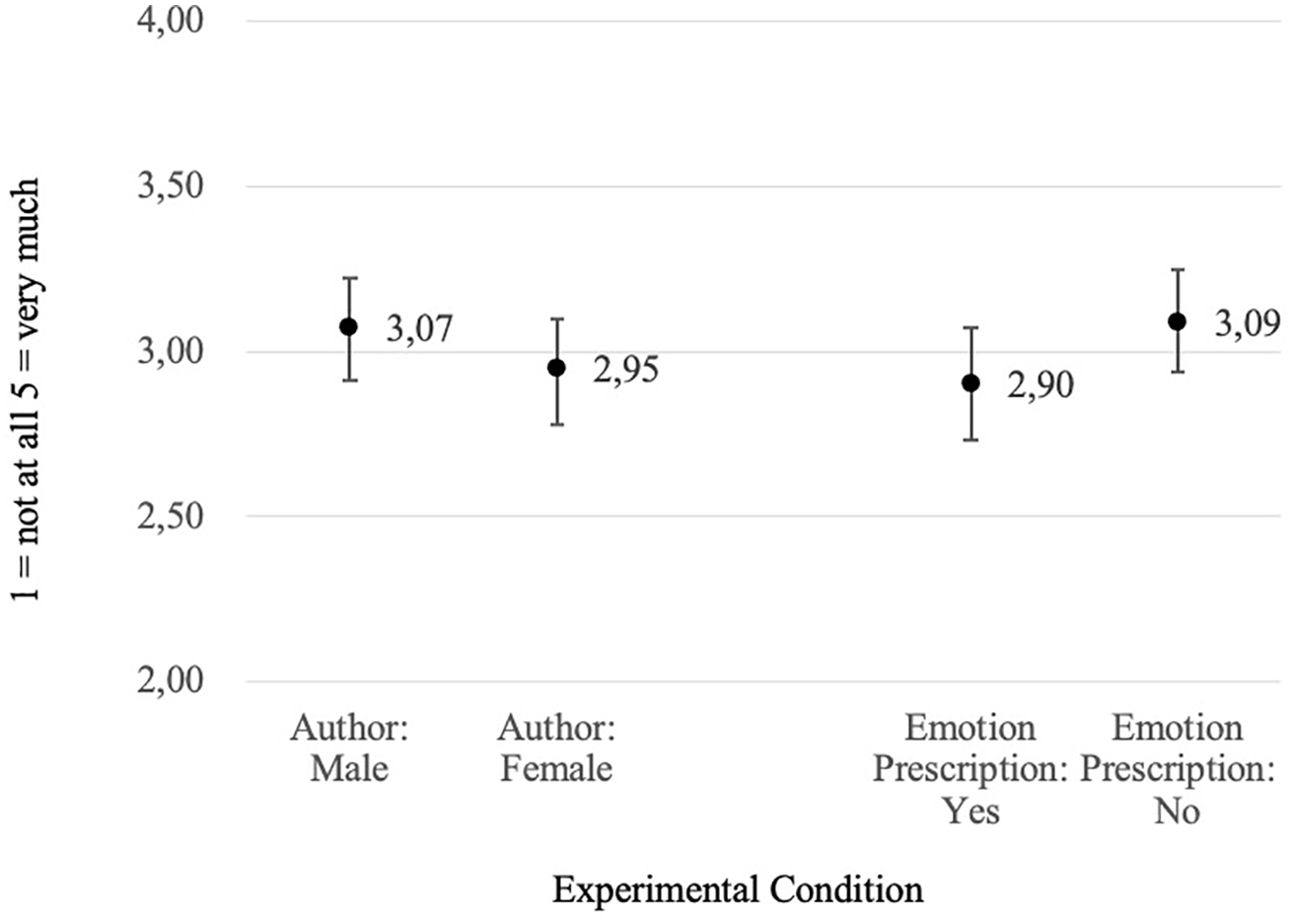
Means by experimental factor, study 1, DV = intention to read. Scale enlarged for better display of 95% confidence intervals.
Regarding RQ1, focusing on the effect of byline biases, we do not see a significant main effect of our byline manipulation on intention to read even though reading intention is higher for male authors (Figure 1; Table 1). Neither a negative nor a positive bias for women authors could be identified. We also did not find a significant interaction effect of author byline and reader’s gender on interest to continue reading the article (Table 1). H1 cannot be confirmed.
Results ANCOVA study 1, DV = reading intention.
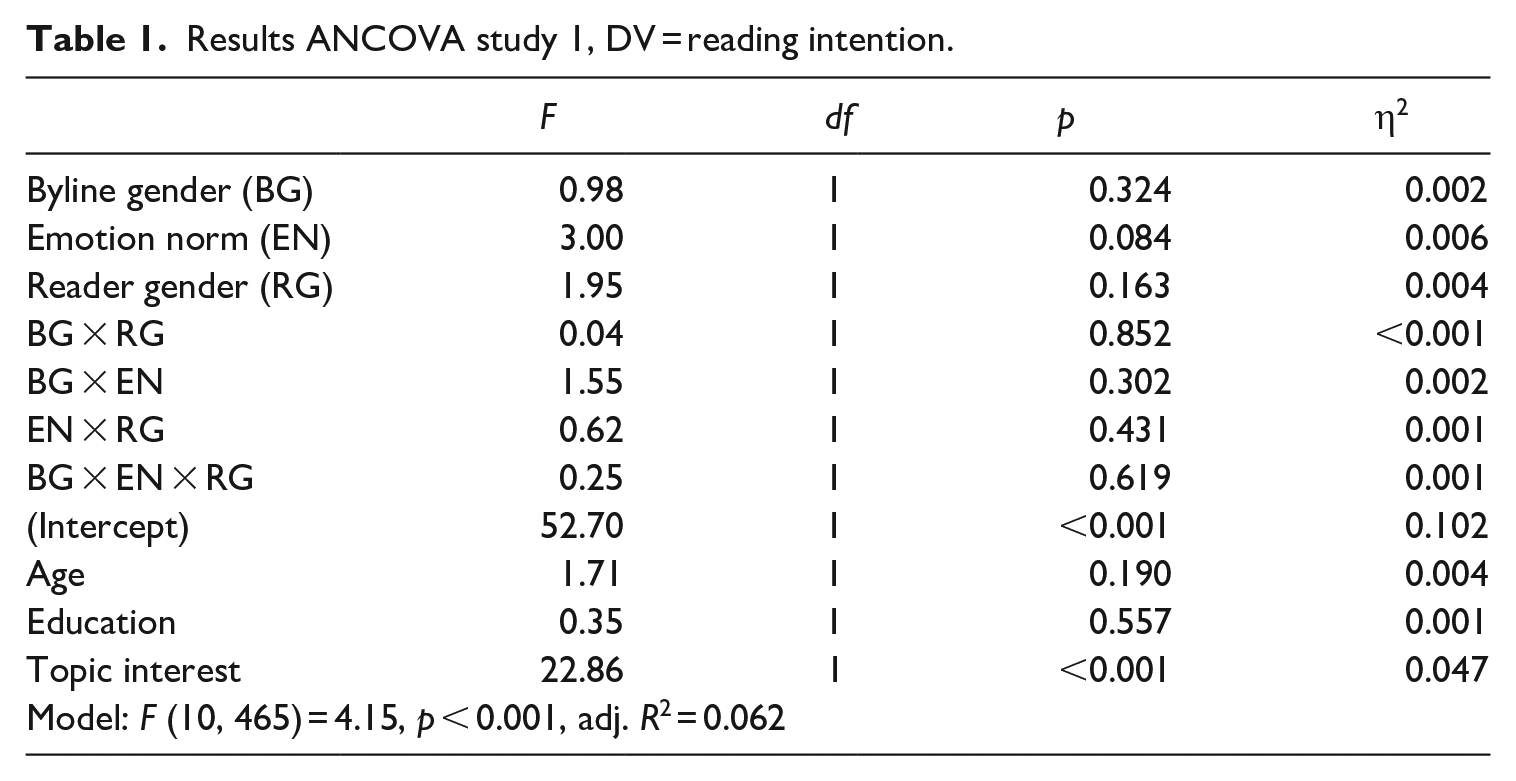
With respect to H2, effects run into the assumed direction, in so far that participants were less likely to continue reading an article including an emotion norm prescription (Figure 1), but this main effect is not significant, even though it is within the p < 0.1 level (Table 1). Still, we cannot confirm H2.
Analysing potential interactions between reader’s or author’s gender and emotion norm prescription on intention to read (RQ2), we do not see any significant interaction effects. The prescription of an emotion norm does not impact potential gender byline biases, regardless of the reader’s gender.
Discussion of study 1
We could neither find a significant main effect with respect to gender bylines (RQ1) nor significant interaction effects between byline and reader’s gender on the interest to continue reading a news article dealing with issues of gender equality (H1). We also did not find that the prescription of an emotion norm makes these byline biases more salient (H2) and we observed no interactions between reader’s gender, author’s gender and emotion norm prescription on interest to continue reading (RQ2).
We have to note that our study was bound due to several methodological limitations. (1) With regard to our stimulus material, we only looked at an example of journalists commenting on men’s behaviour. (2) As previous research has not yet inquired on the effects of emotion norm prescriptions through media, we had to come up with new material. Even though we had pretested and confirmed the suitability of our material (see Supplemental Appendix A3), the manipulation of emotion norms prescriptions compared to simple descriptions of emotions displayed was very nuanced with only few words changed between the two stimuli versions. (3) We manipulated author’s gender by generic first names (comparable to Armstrong and McAdams, 2009; Burkhart and Sigelman, 1990). This manipulation is however rather unobtrusive and could have been overlooked by our participants. (4) Due to the limited scope of the paper-pencil study, we only accounted for participants’ interest to continue reading the article and did not account for attributed author credibility.
As a consequence of these four limitations, we revised our experimental design and carried out a second study.
Study 2
Study 2 set out to overcome the four limitations identified for study 1. (1) To account for an effect of emotion norm prescriptions targeting men and women alike, we added a second stimulus targeting women. Here, we created a scenario of a female soccer coach expressing anger. Anger is typically associated with men (Kelly and Hutson-Comeaux, 1999) and public displays of anger as a signal of dominance are deemed more appropriate for men (Hess et al., 2005) while women are more likely to be expected to control this emotion (Plant et al., 2000). We selected this scenario as previous research studying leaders and emotion display found that female managers are more likely to be devaluated when they express anger compared to male leaders (Lewis, 2000). (2) We added attributed credibility as a further dependent variable. (3) We increased the obtrusiveness of our gender byline manipulation by including photos of a man and a woman accompanying the news comment (c.f. Boulter, 2017). (4) We revised the manipulation of the emotional norm prescription. We no longer relied on the mere description of an emotional norm versus a prescription of a non-stereotypical norm but now we either confirmed an existing gender-stereotypical norm in contrast to a violation of such a norm. We test the effects of violating gendered emotion norms for men (feeling shame) and for women (expressing anger) separately acknowledging the distinctiveness of these emotions and differential effects of gender norms for men and women (Bussey and Bandura, 1999).
Based on these changes, we adjusted our research questions from study 1 as follows:
RQ12 Will readers of an article on gender-equality (sexual harassment at the workplace/anger expression by a woman) . . . A: be more or less likely to continue reading the same article written by a woman compared to a man? B: attribute more credibility to a woman or a man author?
H12 (interaction effect): Readers’ own gender will moderate the evaluation of an article on gender equality so that men compared to women as readers . . . A: will be less likely to continue reading the article written by a female author. B: will attribute less credibility to a woman compared to a man author.
H22: If an article on gender equality violates a gender-related emotion norm prescription such as men feeling shame, this reduces. . . A: the interest to continue reading this article. B: the attributed credibility of the author.
H32: If an article on gender equality violates a gender-related emotion norm prescription such as women expressing anger, this reduces. . . A: the interest to continue reading this article. B: the attributed credibility of the author.
RQ22: How does the interplay of author’s gender, reader’s gender and violation of a gender-relation emotion norm affect. . . A: reader’s interest to continue reading the article B: attributed author credibility?
Lastly, the use of an online survey instead of a paper-pencil survey further allowed us to present our stimulus material in a more realistic setting, as teaser texts are common on online news platforms.
Method: Study 2
Participants
In October 2019, participants were recruited through a noncommercial German online-access panel which is based on voluntary participation. After eliminating incomplete data sets, N = 1216 participants took part in the study (Mage = 45.37, SD = 15.80 years, ranging from 16 to 94 years). About 46% (n = 553) self-identified as men, 54% (n = 651) as women. Our sample was biased towards highly educated participants (63% university degree or PhD).
Procedure and stimulus material
We again recurred on a 2 (byline male/female) × 2 (emotion norm violation/confirmation) between-subjects-design plus gender as a quasi-experimental factor. Yet, we repeated this procedure for two different stimuli that we treated as separate cases in the data analysis. Supplemental Appendix A4 gives an overview on the study’s design. The structure of the questionnaire was largely the same as in study 1.
For the prescription of shame targeting men (labeled as ‘Shame: Men’), in the condition prescribing a confirmation of emotion norms, it states that men take responsibility for sexual harassment at the workplace but do not need to feel ashamed because of it, while the condition prescribing a violation of emotion norms claimed that men need to feel ashamed.
For the prescription of anger targeting women (labeled as ‘Anger: Women’), in the emotion norm violation condition, the article states that it is ok for a (female) manager to show anger, while the emotion norm confirmation condition says that managers, in particular women, should control their anger. 1 Again, suitability of materials was pretested in a sample of graduate students. Detailed information on stimulus material and its creation is presented in Supplemental Appendix A5.
Measures
Dependent measures
Reading intention (RI)
We employed the same one-item measure as in study 1.
Author credibility (AC)
This was measured with four items each rated on a five-point rating scale anchored at 1 = not agree and 5 = fully agree. Participants had to indicate if the article’s author was considered (a) trustworthy, (b) reputable, (c) competent or (d) biased (reverse coded). Items were derived from related studies on newspaper and journalist credibility (Boulter, 2017; Burkhart and Sigelman, 1990; Searles et al., 2018). Internal consistency for the combined scale was acceptable for both stimuli (shame targeting men: α = 0.83; anger targeting women: α = 0.82).
Independent measures
We noted gender byline as well as emotion norm prescription as per our experimental manipulation as well as reader’s gender (male = 1; female = 2).
Controls and co-variates
Interest in topic
Again, we added interest in topic as a co-variate. For shame targeting men we accounted for topic interest in career and equal rights. For anger targeting women we accounted for interest in sports and equal rights. Interest in these topics was again measured ranging from 1 = not interested at all to 5 = very much interested.
Control variables
We included age, education and the order of stimulus presentation as control measures.
Results: Study 2
Analysis strategy
As participants were confronted with two stimuli in the same questionnaire – ‘Shame: Men’ and ‘Anger: Women’ – spill-over and/or learning effects between the independent stimuli presentation could have occurred. We took several measures to limit the potential for such effects: (1) We deliberately created scenarios that were distinct from each other, which should limit potential learning effects. (2) We randomized the order of stimuli presentation, so that learning effects from one case to the other could potentially cancel each other out. (3) We added the order, in which the stimuli were presented, as a control variable in our analysis. (4) Most important, we also replicated our data analysis for each of the two stimuli separately only with the cases who had seen either the ‘Shame: Men’ or the ‘Anger: Women’ stimuli first, thus cutting our sample in half. That is, for these participants no spill-over/learning effects could have occurred. In the data analysis we highlight, where this alternative data analysis differed from our combined approach. We opted for the combined approach as it provided us with substantially more statistical power. We had enough (95%) power to find effects as low as f = 0.15 and at least 80% power to find effects of f = 0.12.
As data analysis strategy, we employed a MANCOVA using reading intention and author credibility as dependent variables. Again, we included our two experimental manipulations as well as reader’s gender as quasi-experimental factor. We controlled for age, education, topic interest as well as order of stimulus presentation. First, we investigated multi-variate findings based on Pillai-Spur tests for effects on both DVs simultaneously. Multivariate findings are presented in Supplemental Table A2. We carried out our analysis separately for each stimuli condition. Means by condition for both stimuli are presented in Figures 2 and 3. Detailed means are available in Supplemental Tables A3 and A4.

Means by experimental factor, study 2 ‘shame: men’, DV = intention to read (IR) and author credibility (AC). Scale enlarged for better display of 95% confidence intervals for N = 1000 bootstrap samples.
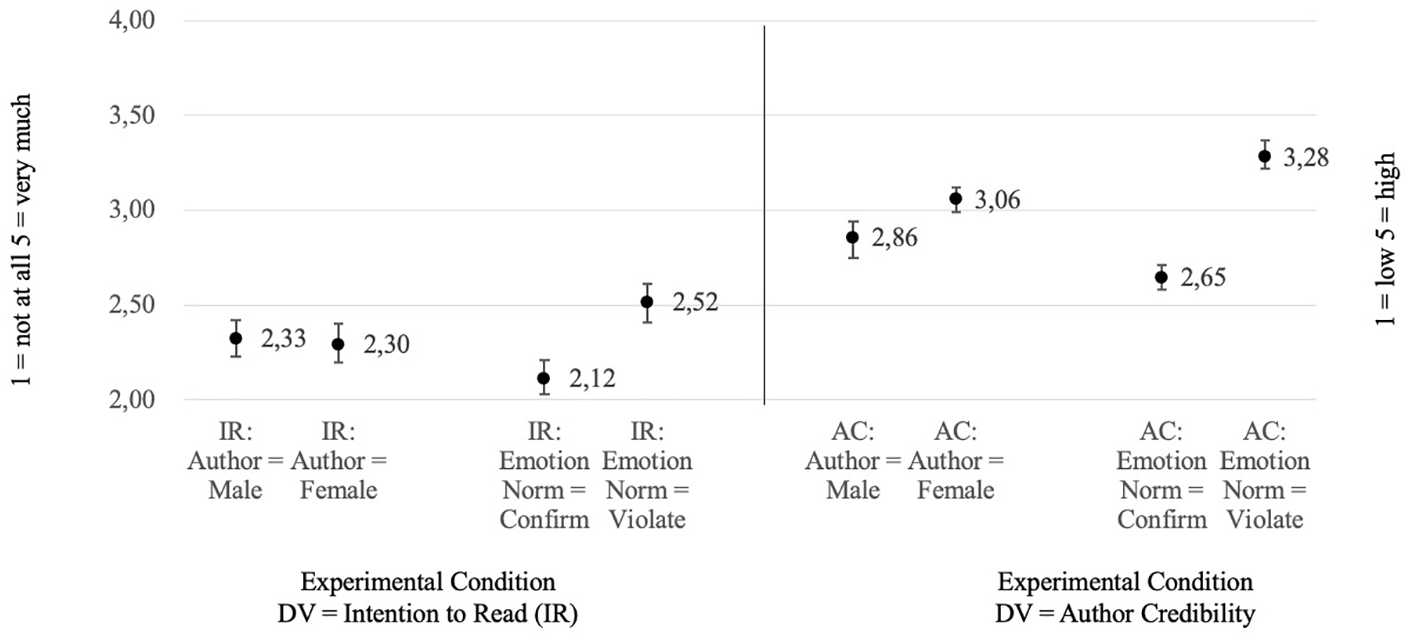
Means by experimental factor, study 2 ‘anger: women’, DV = intention to read (IR) and author credibility (AC). Scale enlarged for better display of 95% confidence intervals for N = 1000 bootstrap samples.
Effects on reading intention and author credibility
Answering RQ1
Between subject effects (MANCOVA), study 2 ‘shame: men’.

Between subject effects (MANCOVA), study 2 ‘anger: women’.

Please note: The significant order effect runs into the direction that those who saw the ‘anger: women’ stimulus first, significantly scored lower for intention to further read and credibility when rating the second ‘shame: men’ stimulus. Yet, effect size was rather low and including it as a co-variate partialled out this unintended order effect.
With respect to H12, focusing on interaction effects between reader’s gender and author’s gender, neither effects on reading intention (A) nor on credibility (B) were significant for any of the two cases (Tables 2 and 3).
The inconclusive findings on RQ12 opened the ground for some further examinations into the relationship between gender bylines, reading intention and credibility. It seems that positive and negative byline effects for women authors on credibility and reading intention are likely to cancel out each other, which may also explain the inconclusive nature of the state of research. Therefore, we supplement our analysis with a post-hoc analysis on the relationship between credibility and reading intention.
Post-hoc analysis: The interplay between reading intention and author credibility
Credibility and intention to read were strongly related: If readers consider an author to be credible, they were more likely to continue reading an article from that author. In our study, the correlation between our two dependent measures was r = 0.414 (p < 0.001, n = 1197) for the case of ‘Anger: Women’ and r = 0.445 (p < 0.001, n = 1182) for the case of ‘Shame: Men’. What we observe here is a suppression effect, emerged from the opposing effects of gender byline on reading intention and credibility: A female gender byline reduces the likelihood to continue reading the article due to a direct negative effect, but it also increases the likelihood to continue reading the article due to a positive indirect effect through increased credibility. And as both effects are rather small, this may lead to the fact that both effects cancel each other out in such a way that neither effect becomes significant. We tested this assumption of a potential mediation effect in a post hoc analysis.
We relied on a PLS-based path model, with gender byline as predictor (0 = woman, 1 = man as author), credibility as mediator and reading intention as dependent variable. Impact of topic interest on reading intention was controlled for. We tested for the direct effects in this model and the specific indirect effect of the byline manipulation on reading intention through credibility. Table 4 gives an overview of these effects.
Mediation analysis for reading intention.

Results based on consistent PLS-bootstrapping with N = 5000 samples, 95% confidence interval, standardized effects, controlled for topic interest. Byline: 0 = woman, 1 = man.
For both stimuli cases, we found gender byline biases as a weak, yet significant (positive) effect running into the direction that participants were more likely to continue reading articles by men authors. We also found a – stronger – (negative) effect of bylines on attributed credibility, so that female authors are judged as more credible than male authors in the case of ‘Anger: Women’. This supports findings in the MANCOVA based analysis. Yet in this case, we also found a significant (negative) indirect effect on reading intention through credibility, which implies that a female byline increased reading intention through its relationship with credibility. This may explain why, in the case of our MANCOVA-based analysis, we did not find a direct effect of byline on reading intention in the case of ‘Anger: Women’.
The effect of emotion norm prescription
In the case of ‘Shame: Men’ we found effects supporting H2
Answering RQ22, which looked at potential interaction effects between emotion norm prescription and bylines as well as reader’s gender on our DV measures, we found that the interaction between gender byline and emotion norm prescription had a significant effect on author credibility in the case ‘Shame: Men’, but narrowly misses significance (p = 0.053) for our stimulus ‘Anger: Women’ 3 (Tables 2 and 3). In the case of ‘Shame: Men’ credibility was lowest for a female author prescribing a confirmation of emotion norm (M = 3.16, SD = 0.82, n = 296) and highest for the female author prescribing a norm violation (M = 3.40, SD = 0.77, n = 284). We also observed a significant interaction effect of emotion norm prescription and reader’s gender: This effect was significant for reading intention in the case of ‘Shame; Men’. Here, reading intention was highest for women, confronted with the emotion norm confirmation (M = 3.57, SD = 1.12, n = 315) and lowest for men in the same condition (M = 2.97, SD = 1.21, n = 273). In contrast, in our case ‘Anger: Women’ this interaction effect was significant for author credibility. Here, author credibility was highest among women readers confronted with the emotion norm violation (M = 3.29, SD = 0.79, n = 332) and lowest also among women readers but for those being confronted with the emotion norm confirmation (M = 2.54, SD = 0.76, n = 309).
General discussion
We set out to answer the question, if it matters if a male or female journalist writes an article about an issue of gender equality and in how far the prescription of gendered emotion norms further impacts the evaluation of such articles. We conducted two experimental studies. While the first did neither find effects of gender byline nor effects of emotion norm prescription, the second found (weak) evidence for negative effects regarding participants’ intention to further read articles by female authors. At the same time, attributed credibility was slightly higher for female authors. Regarding the effects of emotion prescription findings of study 2 suggest that they are likely to be different with respected to the addressees (men vs women) and type of emotion, in our case shame versus anger. Altogether, we could expand the state of research by three main conclusions:
First, gendered byline biases still exist, but they are depending on content and context characteristics. Research has already outlined the topic sensitivity of gender bylines, and our study supports this notion within the domain of articles on gender equality. Female bylines alone did not trigger biases against female authors even when such an author criticized men for sexual harassment (study 1); however, when such an article was accompanied by a portrait picture (study 2) negative biases became more likely. According to the picture superiority effect (Whitehouse et al., 2006), visual stimuli affect users’ attitudes and behaviour more intensely and are easier to remember compared to textual information. Byline biases only seem to occur when gender cues are clearly visible. This finding critically interrogates issues of female visibility (Wilhelm and Joeckel, 2019) and poses new challenges for women journalists whose work still seems to be devalued when they become more visible. Regarding practical implications, we do not recommend making use of less obtrusive ways for mentioning the author of a news piece on gender equality but journalists writing on gender equality should be aware of the fact that visual representations may trigger or reinforce stereotypical attitudes of readers.
A second implications refers to the integration of reading intention and author credibility as dependent variables. Our post hoc analysis revealed that the relationship between the two variables is complicated for example, as demonstrated in the findings of the stimuli case depicting a female coach expressing anger. Here, female authorship increased credibility, particularly when the coach was allowed to express anger (violation of emotion norm). Yet, female authorship was still seen as a cue to engage less with the article, which, at first sight was not a significant effect but it became significant when the mediating effect of credibility attribution was controlled for. In the light of our findings, we recognize the ambivalent relationship of credibility and gender. In general, men are judged as being more credible than women attributed to gender-stereotyped perceptions of competence and expertise (Carli, 2001). However, the opposite is the case if the topic seemingly favours women’s expertise (Klaas and Boukes, 2020) – such as gender equality with women being perceived as more credible.
A third lesson learnt relates to the importance of gender equality issues and their relationship with the prescription of emotion norms. We found that prescribing an emotion norm in an article indeed impacts attributed credibility and reading intention. Yet, the direction of these effects can be different and is likely to be related to the particular emotion addressed. Prescribing an emotion norm violation such as shame targeting men in a case of sexual harassment had a, albeit weak detrimental effect on reader’s interest to continue reading, just as expected in our hypotheses. However, prescribing the non-gender-appropriate norm for a woman to express her anger, made the article more likely to be engaged with and, particularly, the articles’ author more credible. Interestingly this happened regardless of author’s gender. We can speculate that the emotion norm ‘allowing’ women to express anger is far more acceptable than men admitting shame. Moreover, we also see female readers approve emotion norm violations by women more than male readers.
This leads to a first limitation of our study as we did not control for, in how far readers agreed or disagreed with the emotion norm presented. Even though, anger is considered an emotion not appropriate for women (Brescoll, 2016; Hess et al., 2005), our sample had a bias towards higher educated participants, and those participants are likely to accept such non-stereotypical behaviour by women. Even though we carefully designed and pretested our stimulus material, a further potentially intervening factor in the evaluation of both emotion norm violations refers to the cases we presented in the news comments. Addressing men who should feel ashamed in light of their ‘peers’ often sexually harassing other women could have been interpreted as a stronger norm violation compared to the non-stereotypical display of a female manager. Future research is thus advised to inquire and (statistically control) how acceptable the addressed emotion norms are for an audience.
This leads to some further limitations. On a theoretical level, we need to acknowledge that gender bylines relate to evaluations based on in-group versus out-group distinctions. As such, women are likely to perceive a female author as a member of the same in-group, while men do the same for a male author. Yet, research including our own has not accounted for such in-group versus out-group effects and it seems plausible that gender alone might only be one trigger to perceive an author as a member of the same in-group, with other variables such as ethnicity or education also coming into play. Future research is well advised to account for this intersectional aspect of potential byline biases. On a methodological level and as outlined as a result of study 1, research on how media messages impact the shaping of gendered emotion norms is limited and we had to design suitable stimulus material from the scratch. While the cases created were developed based on existing emotion stereotypes, we did not empirically test to what extent the emotion norm violations depicted in the articles were actually considered this way by our participants. Also, only employed rather short text previews, so the potential for emotion prescriptions to become salient in these short texts is rather limited and we had to tradeoff between keeping as much of the texts within each case identical to not confound our findings with other aspects. In order to detect the impact of emotion prescription of media messages, future studies are advised to control for the actual norm among the public, for example, by inquiring the public opinion on the emotion norms used in the study.
Finally, it could be worthwhile to manipulate topic as a further experimental factor, potentially opening the ground for research based on text-vignettes or conjoint-based research that allows the simultaneous manipulation of more factors at the same time.
Even if empirical results in our two studies are far from homogenous, the combination of two studies allowed us to highlight the complex nature of gender bylines and emotion prescriptions on reading intention and attributed credibility.
Our findings demonstrate that when women write about gender equality to increase the visibility of all genders and to provide a platform for inclusion, solidarity and social change, they might still be seen as credible authors for such topics, more so than their male counterparts, but this might still not be enough to compensate biases against them, in terms of reading intention. This underlines the need for a better visibility of both female and male journalists with regard to reporting about gender equality to change these perceptions on the long run.
Supplemental Material
sj-pdf-1-jou-10.1177_14648849211012176 – Supplemental material for Are byline biases an issue of the past? The effect of author’s gender and emotion norm prescriptions on the evaluation of news articles on gender equality
Supplemental material, sj-pdf-1-jou-10.1177_14648849211012176 for Are byline biases an issue of the past? The effect of author’s gender and emotion norm prescriptions on the evaluation of news articles on gender equality by Leyla Dogruel, Sven Joeckel and Claudia Wilhelm in Journalism
Footnotes
Funding
The author(s) received no financial support for the research, authorship, and/or publication of this article.

Supplemental material
Supplemental material for this article is available online.
Notes
Author biographies
References
Supplementary Material
Please find the following supplemental material available below.
For Open Access articles published under a Creative Commons License, all supplemental material carries the same license as the article it is associated with.
For non-Open Access articles published, all supplemental material carries a non-exclusive license, and permission requests for re-use of supplemental material or any part of supplemental material shall be sent directly to the copyright owner as specified in the copyright notice associated with the article.
