



Abstract
Drawing upon the newsworthiness model that posits that media outlets rely on criteria (news values) to determine which stories are newsworthy and deserve prominence and the media coverage predicts audience attention to the event, this study examines the news values that lead social media users to like, comment on, and share mainstream news stories on Facebook. A content analysis of 2480 articles from three major news newspapers in South Korea (Chosun, Hankook and Hankyoreh) found that news stories of higher social significance are more common than news stories of higher deviance on the Facebook pages of the three news outlets. Although audiences comment on news stories of higher social significance more frequently than stories of higher deviance, they hit more ‘likes’ on news stories of higher deviance. The results are mixed for sharing – for the conservative Chosun’s Facebook page, stories of higher deviance were more often shared than stories of higher social significance, while the opposite pattern occurred with the moderate Hankook and liberal Hankyoreh.
In the past two decades, the proliferation of social media has dramatically changed news dissemination. Mainstream media outlets are integrating social media links into their stories to encourage readers to help spread the news (Singer, 2014; Tandoc and Vos, 2016). For example, TMZ’s exclusive reporting of musician Chester Bennington’s suicide gained over 7 million Facebook engagements, such as likes and sharing (Rayson, 2017). News stories posted on social media draw public attention, ultimately influencing the public agenda (García-Perdomo et al., 2018).
News values are the criteria journalists use to determine which events or issues are considered worthy of coverage (Al-Rawi, 2017; Eilders, 1997; Staab, 1990). The newsworthiness model assumes that events deemed by journalists as newsworthy are also accepted as such by news consumers (Lee, 2009; Shoemaker, 1996). In this model, traditional gatekeepers (reporters and editors) play a pivotal role. However, with the uptake of social media as a crucial news venue, social media users have unprecedented freedom to select the news they want to read, to engage with reporters and other news consumers, and to decide what news is worthy of sharing throughout a network (Park and Kaye, 2018; García-Perdomo et al., 2018), thus downplaying the gatekeeping role of editors and complicating traditional gatekeeping (Goode, 2009).
On social media, some stories attract more attention and get shared more widely than others. Much is at stake – stories that rise to the top of news feeds can shape public opinion and impact public policy. With social media as a central venue for consuming, disseminating and talking about news, it is important to understand what elements of a news story trigger readers to share it more widely than another story, even of the same topic.
This study, thus, examines the relationship between story dissemination on mainstream media Facebook pages and a story’s news values. This study is guided by the framework proposed by Shoemaker and Cohen (2006) of two broad categories of news values, deviance and social significance. Shoemaker (1996) suggests that all human beings are inevitably attracted to deviant or socially significant events because of their biological instincts and cultural learning processes. These two news values underlie traditional indicators of newsworthiness such as novelty, conflict, social impact, importance, consequence, and human interest, and they have been tested by other scholars (e.g. Al-Rawi, 2017; Eilders, 1997; Lee, 2009).
Although Shoemaker’s perspective suggests that individuals react to news stories in similar ways based on the common recognition of their social significance and deviance from cultural norms (Shoemaker, 1996), it is worthy to explore whether this relationship holds up in today’s interactive social media world where users read, like, comment on and share information. To better understand the relationship between news values and story dissemination, this study investigates the news values in 2480 stories posted on the Facebook pages of three major South Korean newspapers: Chosun (conservative), Hankook (moderate) and Hankyoreh (liberal). The stories were content analysed for news values to see if stories containing certain news values are liked, commented on, or shared most often. Facebook was chosen for this news investigation because it is one of the most important social media platforms for reading, commenting on and sharing news in the U.S. and in South Korea (Choi, 2018; Newman et al., 2019).
Prior studies have examined how a variety of news values predict either commenting (e.g. Tenenboim and Cohen, 2015) or sharing (e.g. Trilling et al., 2017). Unlike previous studies, the current study intends to illuminate the nuanced association between theory-based news values (deviance and social significance) and distinct news engagement behaviour on social media (liking, commenting and sharing), expanding Shoemaker’s newsworthiness model.
Literature review
Gatekeeping in the context of social media
Gatekeeping plays an essential role in fulfilling journalism’s normative tasks (Shoemaker and Vos, 2009). Gatekeeping theory posits that news editors filter huge quantities of information to settle on a carefully selected set of news reports (Shoemaker, 1991; Vos, 2015). But the original gatekeeping concept assumes an asymmetric and hierarchical relationship between journalists and the audience (Deuze, 2003). News organizations have traditionally had control over the flow of information as ‘they decide which messages to allow past the gates’ (Shoemaker and Vos, 2009: 21). In other words, journalists prefer to craft news content with the assumption that ‘what interested them would interest the audience’ (Gans, 2004: 229).
The traditional gatekeeping model does not adequately apply to digital media in general or to social media. For instance, bloggers often do not keep gates of their own, but instead create a curated hub for their audience, a practice coined as ‘gatewatching’ (Bruns, 2018). With the rising popularity of social media as a tool for news distribution, complex networks of interdependent gatekeepers are emerging (Goode, 2009; Marshall, 2020). As social media users become active participants and sometimes replacements for journalists in the gatekeeping process, an updated conceptualization of gatekeeping and even of gatewatching, is needed. One such model proposes ‘audience gatekeeping,’ wherein readers readily communicate their preferences to media professionals (Shoemaker et al., 2010), whereas another model defines social media users’ role in relation to news media as a form of ‘secondary gatekeeping’ (Singer, 2014).
News values
News values and gatekeeping are connected in that journalists and editors decide if an event or subject is newsworthy (Shoemaker, 1991). News shapes the environment ‘within which events and issues are viewed as important [and are] made available for public discussion’ (McNair, 1998: 49). At the centre of the news industry is newsworthiness – the idea that journalists decide what news events or issues are most important to write about (O’Neill and Harcup, 2009). News values such as sensationalism, proximity, relevance, unambiguity and facticity were first proposed by Lippmann (1946) as criteria that make an event worthy of journalistic coverage. Further, Galtung and Ruge’s (1965) seminal study of the flow of foreign news in Norway found that journalists relied on a set of 12 news values to determine the newsworthiness of an event.
Although news values are useful as guides to understanding news selection, they are challenged by social, cultural, economic, and technological changes (O’Neill and Harcup, 2009), and thus have evolved through the years. Since the Galtung and Ruge’s (1965) study, several researchers (e.g. Eilders, 1997; O’Neill and Harcup, 2009; Staab, 1990; Wendelin et al., 2017) have developed their own lists of news values, many of which overlap with each other. For example, unexpectedness/surprise is identified as an important news value by Eilders (1997), O’Neill and Harcup (2009), and Staab (1990), and impact/magnitude by Wendelin et al. (2017) and O’Neill and Harcup (2009).
These news values fit within Shoemaker and Cohen’s (2006) simplified and timeless newsworthiness framework of two broad categories of news values – deviance and social significance. Shoemaker (1996) suggests that all human beings are inevitably attracted to deviant or socially significant events because of their biological instincts and cultural learning processes. Examples of news values within the deviance dimension include novelty, oddity, conflict, controversy and sensationalism. Examples of news values within the social significance dimension include importance and impact (Shoemaker and Cohen, 2006; Shoemaker et al., 1991).
According to Shoemaker and Cohen (2006), deviance refers to news events that are unusual and occur infrequently. Although deviance can refer to positive behaviours or actions outside of the norm (Herington and van de Fliert, 2018), Shoemaker and Cohen (2006) do not assign any specific valence to deviance. Statistical deviance describes events that are empirically different from the average, or that are considered odd or unusual; normative deviance is associated with the breaking of a social system’s laws or norms; social change deviance describes events that have the potential to change the status quo in some way.
Social significance considers the extent to which an event has affected people and society and consists of four dimensions: political significance is related to legislative, executive and judicial systems of a country; economic significance is associated with economic aspects such as the financial system, taxes and tariffs, and imports and exports of a country; cultural significance is linked to religion, arts, language and ethnic groups; and, public significance describes events related to the public welfare, such as health and disease and public safety (Shoemaker and Cohen, 2006).
Deviance and social significance are separate predictors of attention to news: ‘People have been biologically influenced to attend to deviance and culturally influenced to attend to social significance’ (Shoemaker and Cohen, 2006: 9). Further, these two news values reduce complexity by directing readers’ attention to what is meaningful (social significance) and what is potentially dangerous or unusual in some way, whether positive or negative (deviance) (Eilders, 2006; Wendelin et al., 2017).
Shoemaker et al. (1991) newsworthiness model suggests that traditional media give prominent coverage to the most socially significant and deviant events. The effectiveness of the newsworthiness model was later confirmed through a content analysis of news media in 10 countries (Shoemaker and Cohen, 2006). When the model was applied to South Korean traditional media, the two categories (deviance and social significance) held up as comprehensive news values (Shim and Fredin, 2004).
News values and news seeding on Facebook
The rise of digital news has complicates the meaning of news values. The professional process by which news organizations post certain stories on their Facebook pages and Twitter accounts is referred to as seeding (Newman, 2011). Seeding often depends on editorial judgement of what constitutes appealing news and currently trending topics. Stories about the entertainment world are most often seeded on Facebook, whereas serious hard news is seeded on Twitter (Bastos, 2015; Newman, 2011). Political stories are seeded on both Facebook and Twitter, often to spur moral outrage and controversy (Anderson and Huntington, 2017).
Social media provide a distinct online environment in which different types of news values are more relevant than others. Media sociologists’ (e.g. Galtung and Ruge, 1965; Harcup and ONeill, 2001, 2017) contention that journalists determine what aspects of an event or an issue should be highlighted in writing and reporting, prompted scholars to examine the prominent news values in social media. For example, immediacy, interactivity, and participation are key values in the social media age (Usher, 2014), and speed and quality are considered the twin pillars of ‘good’ online journalism, with sociability suggested as another pillar (Phillips, 2012). For example, it is no longer enough to be ‘first with the news’ or to provide high quality information, sociability must also be included in the journalistic mix to make the news spread virally. Journalists who take advantage of social media get instant feedback about whether their news selection decisions coincide with a large number of readers, thus enabling a potential negotiation between journalists’ professional news values and the audience’s interests and demands (Karlsson and Clerwall, 2013). Some news outlets and journalists adjust their news selections in accordance with audiences’ demands and social trends (Al-Rawi, 2017; Harrison, 2010).
The two main news values – deviance and social significance – have repeatedly explained how journalists deem stories as newsworthy (Shoemaker and Cohen, 2006). But Shoemaker’s newsworthiness model has not been tested in the social media context of seeding, and it is still not clear what news values dominate news organizations’ social media pages. Considering the possible connection among the newsworthiness model, deviance and social significant news values, and seeding, this study first calls attention to the news values emphasized in stories posted on Facebook by mainstream news organizations, with the following research question:
RQ1: Do South Korean mainstream newspapers more frequently seed their Facebook pages with stories that are higher in deviance than in social significance?
News values and audience engagement with news on Facebook
The basic assumption of the newsworthiness model is that topics that are considered relevant or interesting from a journalistic point of view also garner attention from the audience (Shoemaker, 1996). Journalists present the most newsworthy elements prominently in their stories, with the expectation that readers will zero in on what is important and relevant (Bednarek and Caple, 2014; Eilders, 2006; Harcup and O’Neill, 2017; Lee, 2009). In the traditional media environment, news values of social significance pull in readers more strongly than deviant values (e.g. Eilders, 2006; Fretwurst, 2008; Lee, 2009).
News values of journalistic articles affect both participation and interactivity in the comments sections of news websites (Weber, 2014). For example, the news values most preferred by online readers are proximity and conflict, while the news values least preferred are timeliness and prominence (Schaudt and Carpenter, 2009). Moreover, Internet news site users have a strong preference for posting comments on news events characterized by social significance, such as changes in the local community, politics and welfare issues. In user rankings of the most commented stories, news values of social significance are more important than values of deviance (Ziegele and Quiring, 2013; Ziegele et al., 2014).
In the social media environment, however, timely and sensational news does better than serious news (Martin, 2018). Because content needs to be shareable and likeable on social media, news is subject to exaggeration or sensationalization. Social media’s interactive features broaden users’ engagement with content (Bruns and Burgess, 2012; Siapera and Veglis, 2012; Thurman, 2008) such that they can comment on and share news throughout their network (Almgren and Olsson, 2016; Park and Kaye, 2018). In the U.S., approximately seven-in-ten adult Twitter users (71%) get news from Twitter (Shearer and Matsa, 2018), and three out of 10 adults (32%) discuss issues in the news on Facebook (Guskin, 2013).
When social media users judge a story newsworthy, they interact with it in three main ways: selective reception (e.g. liking), selective multiplication (e.g. sharing news) and selective participation (e.g. commenting on news articles) (Wendelin et al., 2017). News values could very well influence these social media activities.
Liking
The dominant form of selective reception in social media is ‘liking’, or even ‘not liking’ (Gonzalez, 2015). The most easily recognized icon on Facebook is the ‘like’ thumb (Subsign, 2016), which is used to show agreement, enjoyment or support of the posted content. But other icons indicate disagreement or lack of support. Whether liking or not liking, the 10 most engaging news stories on Facebook in the U.K. and the 15 most engaging messages on Twitter reflect the deviant news values of entertainment, surprise and bad news (Harcup and O’Neill, 2017).
Although stories with higher social significance in traditional media outdraw users to stories of higher deviance, this study investigates whether such stories also gain more attention on newspaper Facebook pages, with the following research question:
RQ2: To what extent do news values of deviance and social significance induce ‘likes’ on South Korean newspapers’ Facebook pages?
Sharing
Sharing news via social media has also become central to the news experience (Hermida et al., 2012). Audience involvement with news via social media challenges the long-standing one-way communication from news outlets or journalists to news consumers (Hladík and Štětka, 2017), and changes the dynamic between journalists and their followers (Wendelin et al., 2017). Essentially, sharing makes every user who is exposed to content a potential gatekeeper.
News stories with a high level of ‘shareworthiness’ diffuse rapidly throughout a network (Trilling et al., 2017), and virus-like propagation of content through connected individuals explains how news can quickly reach many people – popularly known as ‘going viral’ (Klinger and Svensson, 2015). As the mechanism for contagion relies on user engagement with content, each individual in the network participates in the curation of information (Thorson and Wells, 2015).
Social media make it easy to share (selective multiplication) news stories to encourage discussion within a network of users and involvement in current events (Oeldorf-Hirsch and Sundar, 2015). Sharing news stories is thought as a safer user practice than commenting, which makes users vulnerable to trolls and critical attacks (Almgren and Olsson, 2016).
Several studies have examined what kinds of news stories tend to spread more quickly on social media. For example, news content that evokes high-arousal positive (awe) or negative (anger or anxiety) emotions is more viral online (Berger and Milkman, 2012). Stories of conflict and human interest are widely shared in the Netherlands (Trilling et al., 2017), whereas information that is considered novel is most commonly spread by Twitter users in the U.S., and novelty and entertainment go viral on Facebook (Rayson, 2017). Other news values that spread widely through Facebook are eliteness, unexpectedness and negativity (Bednarek, 2016). In addition, human interest, conflict and controversy are the key news values that influence Facebook and Twitter users to share news articles (García-Perdomo et al., 2018).
But further study is needed to learn if the newsworthiness model (Shoemaker and Cohen, 2006) is applicable to social media stories in regards to the level of deviance and social significance. Therefore, the next research question asks:
RQ3: To what extent do news values of deviance and social significance induce ‘sharing’ on South Korean newspapers’ Facebook pages?
Commenting
Beyond simply hitting ‘likes’ or sharing a news item, Facebook users often express their opinions by commenting on an article (Hille and Bakker, 2014). Commenting is different from sharing news in that users directly express their emotions and opinions to news stories and take part in the debate (Singer et al., 2011). Commenting on social media can reach a broad swath of users, and could thus lead to intense social conversation, but commenting is personally risker than merely liking or sharing a story (Almgren and Olsson, 2016) because people care about how other users will react (Berger, 2014).
Commenting puts the writer on public display (Gummerus et al., 2012). Some social media users may be hesitant to comment on news stories for fear of harming their reputation, social status, or social relationships, especially if the story is highly deviant. Further, political and social topics are also more likely to be commented on, while deviant, sensational items and curiosity-arousing stories are heavily clicked on but not necessarily commented on (Tenenboim and Cohen, 2015). Commenting on a highly deviant story could make a person seem radical, whereas commenting on a story of high social significance might be more socially acceptable. Thus, this study asks the following research question:
RQ4: To what extent do news values of deviance and social significance induce ‘commenting’ on South Korean newspapers’ Facebook pages?
Method
Research context – Mass media and social media in South Korea
South Korea is a media-rich country of approximately 50 million people, with 10 nationwide daily newspapers, over 100 local/regional daily newspapers, three national television networks, and over 60 cable channels. In a market of free economy and electoral democracy, South Korea’s mass media and its press fiercely compete among themselves while benefiting from a high degree of press freedom. However, the mainstream media, particularly, 7 of the 10 major newspapers have long been criticized for being slanted toward conservatism and unfair reporting (Park, 2015). Broadcasters remain neutral under liberal governments, but turn conservative under conservative governments.
South Koreans are avid users of new media technologies. The availability and adoption of the Internet in South Korea is on a par with the world’s most industrialized countries. As of the third quarter of 2020, 86% of the population were active social media users (Statista, 2020). South Korea is one of the countries where online news consumption (84%) surpasses television news (74%) (Kim, 2018). Among the social media platforms, YouTube (31%), KakaoTalk (39%), Facebook (25%) and Twitter (8%) serve as major channels through which news is shared and spread throughout the country.
Data collection and measurement
This analysis of news selection and news values was conducted on the Facebook pages of the three major newspapers’ in South Korea – Chosun, Hankook and Hankyoreh. Of the 10 nationwide newspapers in South Korea, Chosun is one of the most conservative, Hankyoreh is one of the most liberal, and Hankook is rated as middle-of-the-road in terms of political stance (Shim, 2013). By examining the Facebook pages of these three newspapers that politically differ from each other, the impact of political ideology on news selection is minimized.
The unit of analysis is the single news story on Facebook. The content analysis included story text as well as multimedia, such as photos, videos and infographics. Netvizz, a tool that extracts data from Facebook, retrieved all of the news articles published on the three newspapers’ Facebook pages, between January 10 and March 10, 2018. In total, 2530 news stories were obtained – 50 were used for practice coding, 2480 for study analysis.
Two graduate students majoring in mass communication carried out the coding. The coders attended three training workshops to learn about coding protocols and the operational definition of each variable. The coders were walked through practice exercises in which 50 Facebook posts (not included in the analysis) were coded, and they learned about intercoder consensus and were instructed on how to reach the desired agreement on the study variables. The goal was to achieve an intercoder reliability near or above .82 (Krippendorff’s alpha). The actual coding began only after the coders fully understood the coding protocols and the study variables. Each coder was assigned 1240 Facebook posts, which they coded independently.
Each of the three dimensions of deviance and four dimensions of social significance was rated on one of four intensity levels, which ranged from low intensity to very intensive. Although a Likert-scale is not commonly used in content analysis, for some studies, moving beyond simple counting achieves an in-depth and robust understanding of the phenomenon under investigation (Neuendorf, 2011), especially if strict rules of categorization are created to minimize the impact of subjective coding (Vogt et al., 2014).
Some scholars propose that variables be content analysed on a continuum rather than placed in one category or the other (Riffe et al., 2005). Shoemaker et al. (1987: 363) asserted, ‘Continuous measurements of newsworthiness would yield a more sensitive test of the hypothesis.’ Indeed, several studies have reliably measured subjective variables, such as ‘incivility’, using a Likert scale (e.g. Zhang et al., 2013; Ziegele et al., 2018). Coupled with rigorous operational definitions and in-depth training, quantitative content analysis that uses a continuum can identify underlying nuances of a variable (Neuendorf, 2011). Further, Neuendorf and Skalski (2009) argue that in content analysis studies a researcher should have the flexibility to devise measures based on theory.
Drawing on the above reasoning, this study adopted Shoemaker et al. (1987) and Shoemaker and Cohen (2006) 4-point intensity scale to measure deviance and social significance. The scale ranged from (1) no/little deviant/socially significant to (4) very deviant/socially significant:
Statistical deviance: (1) The deviant event is common; (2) The event is somewhat uncommon; (3) The event is uncommon; (4) The event is extremely uncommon and rarely takes place.
Normative deviance: (1) The event did not break any norms or laws of South Korea; (2) The event somewhat violated South Korean norms or laws; (3) The event violated existing South Korean norms or laws, but instances occur occasionally in the country; (4) The event definitely violated South Korean norms or laws, and such an event has never or almost never taken place in this country.
Social change deviance: (1) The event is not at all threatening to the status quo; (2) The event is somewhat threatening to the status quo, but change is unlikely in the near future; (3) The event will probably change the status quo in some way, although not necessarily in a very major way; (4) The event will almost certainly have a major impact on the status quo.
Political significance, economic significance, cultural significance, and public significance were measured using the following 4-point scale: (1) The event exerts no or little impact on politics/economy/culture/public well-being; (2) The event has some impact on politics/economy/culture/public well-being; (3) The event has substantial impact on politics/economy/culture/public well-being; (4) The event has an unusually huge impact on politics/economy/culture/public well-being. Detailed operational definitions of the variables are described in Table 1.
Operational definitions.

The operational definitions were created based on Shoemaker and Cohen (2006).
When a news story contained multiple events or actions, coding focused on the most dominant event or action. For example, if a news item mentioned two different events that were both high and low in social change deviance, coding was done based on the more dominant event in the story (Table 2).
Distribution of news items coded as deviant or socially significant.
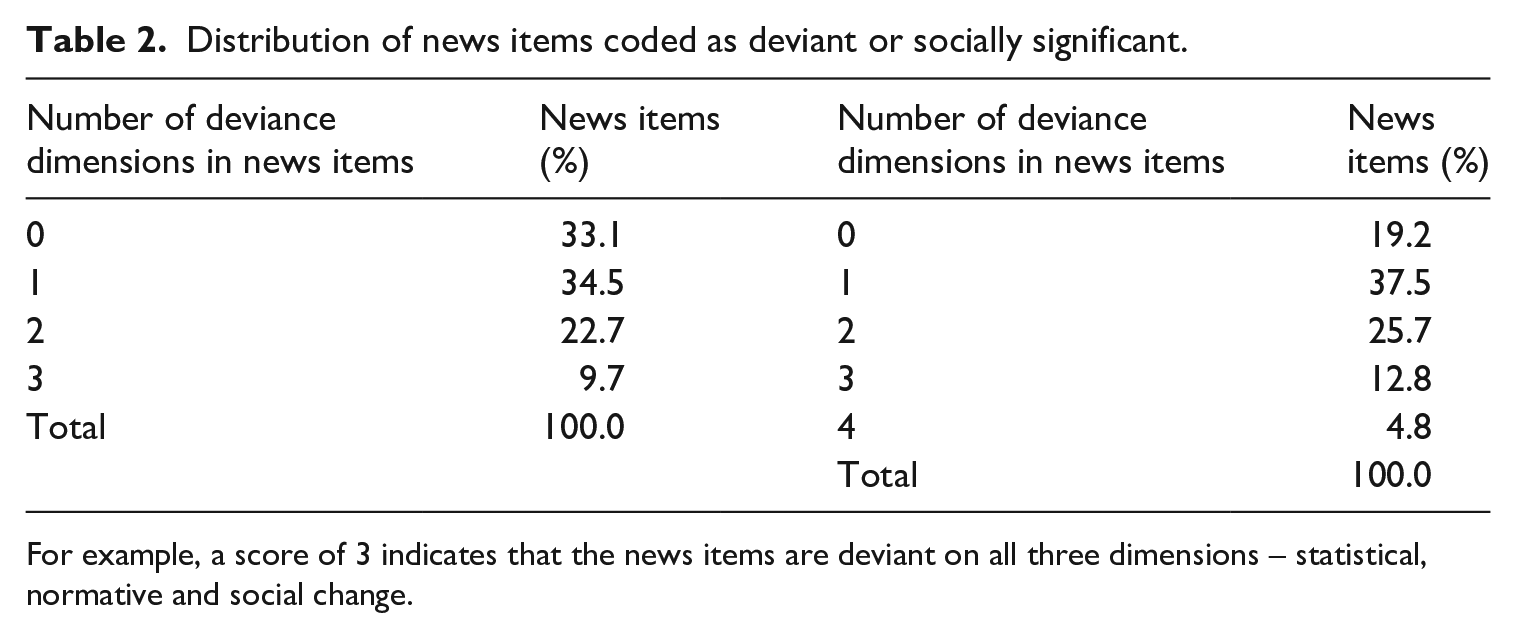
For example, a score of 3 indicates that the news items are deviant on all three dimensions – statistical, normative and social change.
Ten percent of the news stories were randomly selected to assess intercoder reliability. For the seven newsworthiness indicators, Krippendorff’s alphas ranged from 0.82 to 0.96 (statistical deviance .83; normative deviance .96; social change deviance .82; political significance .83; economic significance .84; cultural significance .82; public significance .82). A score above 0.90 is considered ideal, and a score above 0.80 is acceptable in most situations.
The sums of the three indicators representing deviance in each news item were combined and averaged. The sums of the four indicators of social significance were also added and averaged (Table 3). Further, the number of likes, shares and comments were counted for each news article posted on the Facebook pages.
Means and standard deviations for the seven news value indicators.
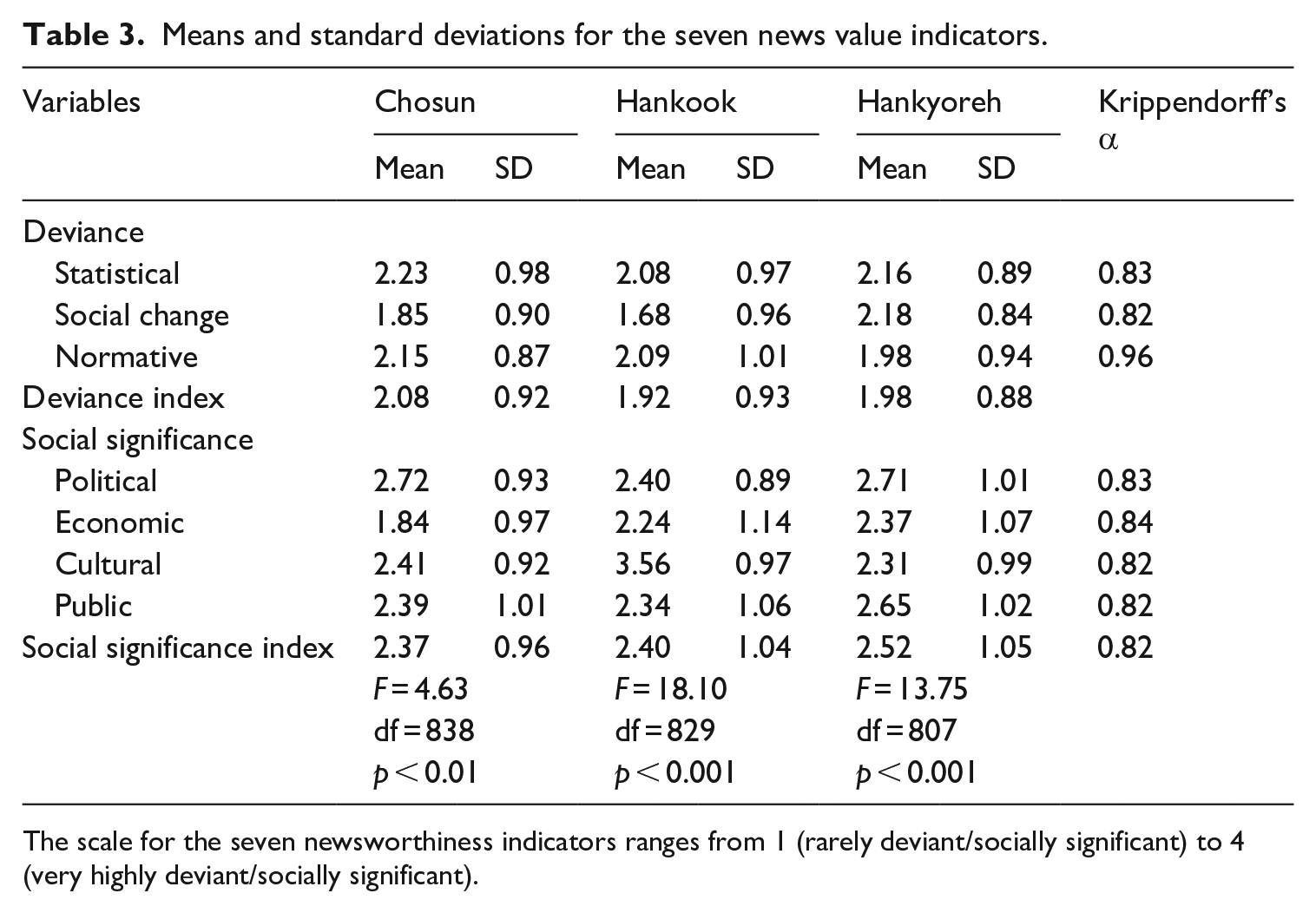
The scale for the seven newsworthiness indicators ranges from 1 (rarely deviant/socially significant) to 4 (very highly deviant/socially significant).
Data analysis
The dependent variables are discrete count data that follow a highly skewed Poisson distribution. In this case, it is not recommended to use OLS regression with its assumption of a normal distribution to test the proposed hypotheses (Agresti, 1996). Accordingly, this study conducted Poisson regression analysis, which uses maximum likelihood estimation. To compare the influences of deviance and social significance indicators on liking, commenting and sharing, all of the predictor variables were standardized.
Results
The first research question asks whether South Korean newspapers more commonly seed stories that are higher in social significance than in deviance. As shown in Table 3, for all three newspapers, stories of social significance were seeded significantly more frequently on their Facebook pages than stories of deviance: Chosun – social significance (M = 2.37), deviance (M = 2.08); Hankook – social significance (M = 2.40), deviance (M = 1.92); Hankyoreh – social significance (M = 2.52), deviance (M = 1.98).
The second research question investigated the extent to which news values induce more ‘likes’ on Facebook. As shown in Table 4, the coefficients of deviance are significantly higher than those of social significance for the three Facebook pages. For Chosun, though both social significance and deviance positively predict liking, the coefficient of deviance (β = .34, p < .001) was much higher than that of social significance (β = .16, p < .01). The same pattern occurs with both Hankook (deviance β = .27; social significance β = .13) and Hankyoreh (deviance β = .25; social significance β = .11). These findings imply that the newsworthiness model is partly effective in predicting which news values received more or less attention from Facebook users than others.
Comparison of parameter estimates of Poisson regression among Chosun, Hankook and Hankyoreh newspapers on liking.
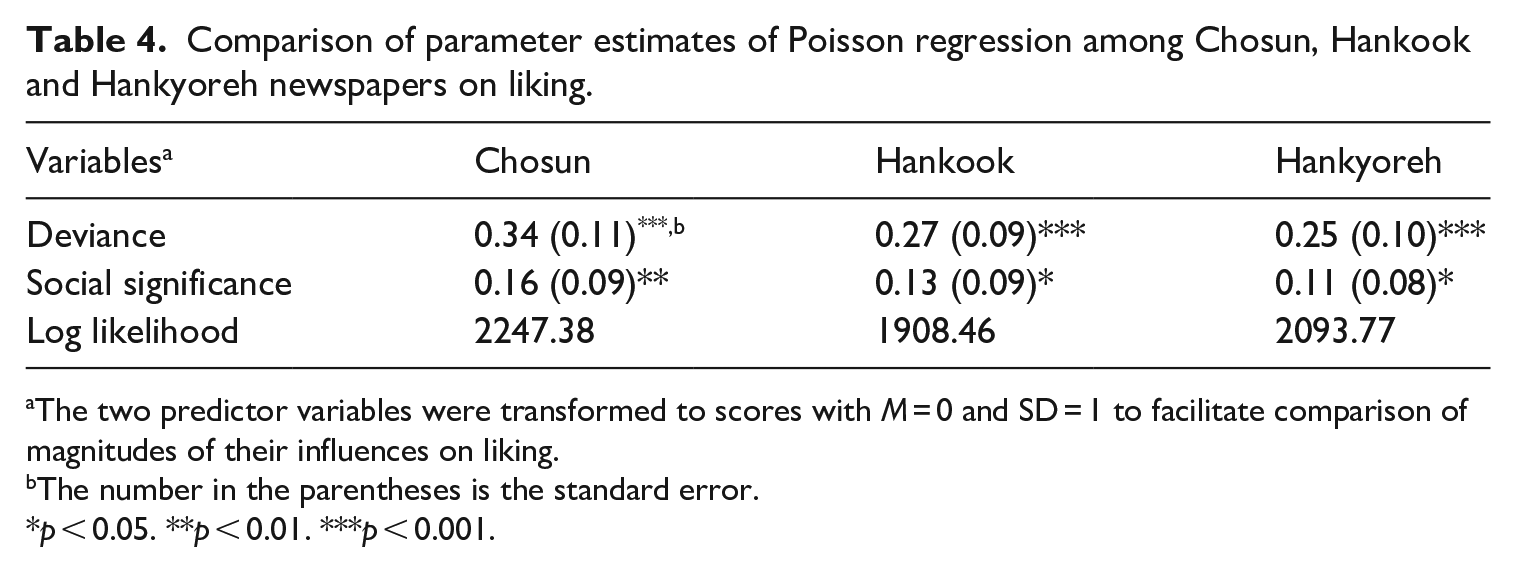
The two predictor variables were transformed to scores with M = 0 and SD = 1 to facilitate comparison of magnitudes of their influences on liking.
The number in the parentheses is the standard error.
p < 0.05. **p < 0.01. ***p < 0.001.
The sharing of socially significant and deviant stories is examined by RQ3. As seen in Table 5, for Chosun, the coefficient of deviance (β = .20, p < .01) is significantly higher than that of social significance (β = .09, p < .05), indicating that news stories with higher deviance are more likely to be shared by its Facebook users than stories with higher social significance. Conversely, readers of the moderate Hankook (deviance β = .07, not significant; social significance β = .12, p < .05) and the liberal Hankyoreh (deviance β = .07, not significant; social significance β = .21, p < .001) share stories with higher social significance more than stories with higher deviance.
Comparison of parameter estimates of Poisson regression among Chosun, Hankook and Hankyoreh newspapers on sharing.

The two predictor variables were transformed to scores with M = 0 and SD = 1 to facilitate comparison of magnitudes of their influences on liking.
The number in the parentheses is the standard error.
p < 0.05. **p < 0.01. ***p < 0.001.
Lastly, RQ4 concerns the likelihood of commenting on stories higher in social significance than in deviance. As seen in Table 6, the coefficients of social significance are all positive across the three news outlets (Chosun, β = .22, p < .001; Hankook, β = .17, p < .01; Hankyoreh, β = .24, p < .001), and they are all higher than the coefficients of deviance. These results show that stories with higher social significance are more likely to be commented on by South Korean newspaper Facebook users than stories with higher deviance.
Comparison of parameter estimates of Poisson regression among Chosun, Hankook and Hankyoreh newspapers on commenting.
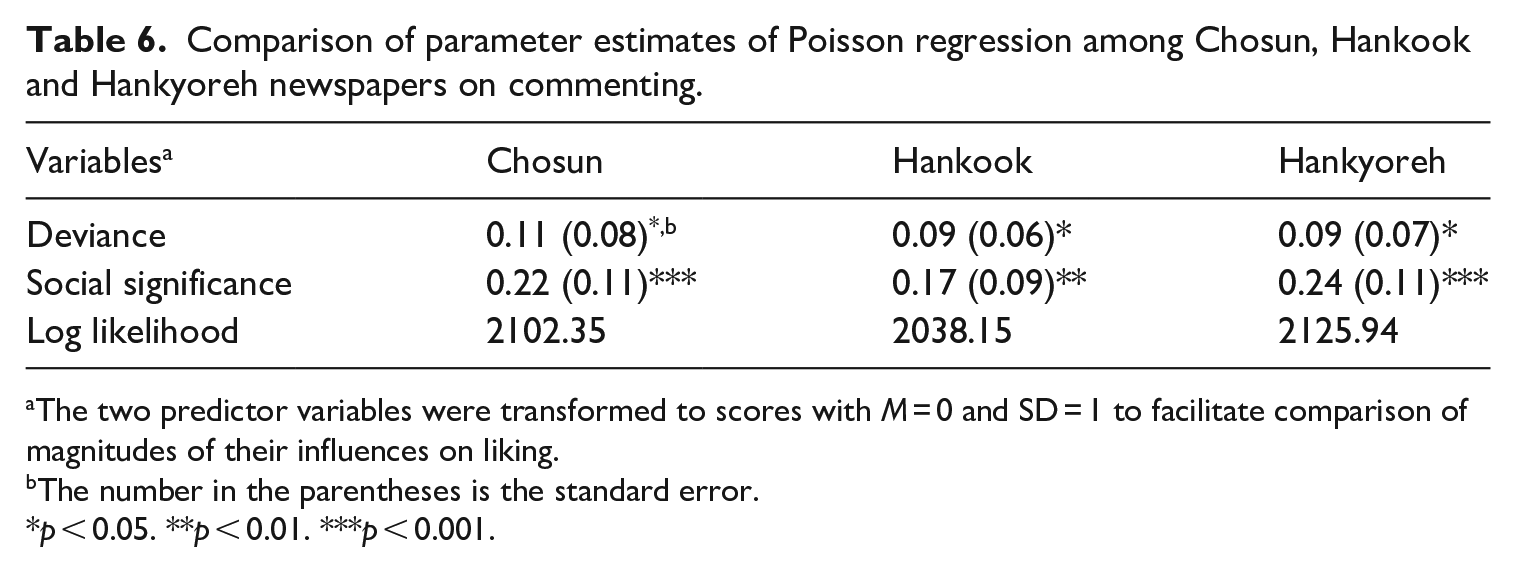
The two predictor variables were transformed to scores with M = 0 and SD = 1 to facilitate comparison of magnitudes of their influences on liking.
The number in the parentheses is the standard error.
p < 0.05. **p < 0.01. ***p < 0.001.
Discussion
News organizations across the world have been turning to social media in an effort to build their online audiences. For instance, The New York Times describes its social media marketing as one of the several essential strategies for disseminating news online and as a ‘brand enhancer’ (Emmett, 2009: 42). South Korean mainstream media also rely heavily on social media to attract audiences and promote their stories (Kim, 2018). As print subscriptions continue to dwindle, newspapers have discovered that by posting content on their own sites and social media pages, they are able to maintain their readers as they shift from print to online access and their profitability through digital advertising revenue (Lee, 2019; Shieber, 2019).
This paper examined whether seeding deviant or socially significant news stories on the Facebook pages of three Korean newspapers affect the frequency of ‘liking’, ‘sharing’ and ‘commenting’. In general, stories of social significance are seeded significantly more frequently on the newspapers’ Facebook pages than stories of deviance. For all three papers, both deviance and social significance positively predict ‘liking’ and ‘commenting’, though social significance is a stronger predictor of commenting while deviance is a stronger predictor of liking. Differences, however, emerged among the papers in regards to sharing. For the conservative Chosun, stories of deviance are more frequently shared than stories of social significance. Stories of social significance, however, are shared more frequently than stories of deviance on the Facebook pages of Hankook (moderate) and Hankyoreh (liberal).
Theoretical contributions
This study makes two theoretical contributions to the study of news values as criteria for newsworthiness. First, this study shows that seeding stories of deviance or social significance on Facebook influence the frequency that stories are disseminated by Facebook users, and thus illuminates how the newsworthiness model can be applied to social media. Second, this study connects news values to user engagement in terms of liking, sharing and commenting, thereby shifting Shoemaker and Cohen’s (2006) research on newsworthiness from journalists to audience members as disseminators of news. This study also has valuable practical implications for social media news dissemination.
The first theoretical contribution is that this study explicates what news values news media seed most prominently on Facebook. For the past several decades, the three Korean newspapers have played a crucial role in setting up national agendas, shaping public opinion and influencing governmental policies (Park, 2015). That the newspapers’ Facebook pages seeded stories of social significance more often than stories of deviance, indicates that these three newspapers apply their print editorial standards to their Facebook page, and that even on their Facebook pages the three South Korea newspapers are gatekeepers of social and/or political issues, which is not much different from their proclaimed role in the pre-Internet context (Lee and Choi, 2009). Although, seeding stories of social significance on Facebook draws in readers, these are not necessarily the types of stories that readers engage with most often. The findings suggest that the original newsworthiness model as applied to traditional media needs to be refined to match the needs of the social media audience’s interactive nature by seeding more stories of deviance, which are liked more frequently than stories of social significance.
The second theoretical contribution shows that the type of news value, deviance and social significance, influences the rate of user engagement in terms of liking, sharing and commenting. Although the Korean newspapers seed their Facebook pages more often with socially significant news values, stories with higher deviance get more ‘likes’ – a finding similar to Tenenboim and Cohen (2015), in which sensational or curiosity-arousing stories are frequently clicked. Going back to the days of yellow journalism, sensationalism, not the ordinary life events, is what sold papers (Kaplan, 2008). Socially significant news can often seem ho-hum, but stories of unusualness (statistical deviance), social norm breaking (normative deviance) and challenging the status quo (social change deviance) are interesting and attention-grabbing not only when reported in the mainstream press but also when seeded on Facebook. Human brains are wired to respond to deviance as a survival mechanism (Shoemaker, 1996). By surveying the deviant environment, humans can neutralize or diminish threats to the status quo (Newhagen and Reeves, 1992).
Readers are quick to ‘like’ deviant stories, maybe not so much because they like the event or behaviour, but as a way to draw attention to the deviance. A recent experiment shows that for most people, clicking the ‘like’ button is a fairly thoughtless action (Harvey-Jenner, 2017). For this reason, people tend to tap ‘likes’ intuitively when faced with deviant news. The finding that stories of higher deviance elicit more likes than socially significant stories could also suggest that ‘liking’ is closely connected to supporting activists who take on the established power structure (Herington and van de Fliert, 2018).
Different from merely clicking on the ‘like’ button, commenting requires thought and time. That Facebook followers of the three newspapers tend to comment more often on articles with higher social significance than on articles with higher deviance can be explained in terms of cultural socialization. Commenting on socially significant stories is less likely to attract trolls than expressing an opinion about deviance (Tierney, 2013). In general, Facebook users might deliberately avoid controversial topics due to fears of social disapproval (Villines, 2014). Further, the absence of anonymity makes Facebook commenters hesitant about posting comments that might seem sensational, rule-breaking or odd (Hille and Bakker, 2014).
Facebook users express their opinions, add information, correct inaccuracies and misinformation, and debate issues of social significance (Wang, 2016). Engaging through commenting requires substantial cognitive effort and social knowledge, which perhaps is why for this study, stories were commented on one-quarter as frequently than they were liked. This finding conforms with another study in which only 14% of news users have left comments on news stories (Wang, 2016). The current study then connects news values to high engagement by speculating that writing a comment requires motivation and strong investment in the issue at hand, and thus socially significant events are commented on more frequently than deviant ones.
The types of news values that are shared most often varied among the papers with readers of both Hankook (moderate) and Hankyoreh (liberal) Facebook pages sharing stories of higher social significance, which are also seeded more often than stories of higher deviance. The conservative Chosun Facebook page readers, on the other hand, are more likely to share stories of higher deviance. These results indicate that political orientation might explain the differences in news sharing via Facebook. Liberals and conservatives are different – in their personalities and their unconscious reactions to the world around them. Readers of the liberal Hankyoreh and the moderate Hankook might share stories of higher social significance than stories of higher deviance in part because they are interested in progressive social change in general (Laber-Warren, 2012).
The conservative Chosun Facebook page readers, on the other hand, are more likely to share stories of higher deviance. Normatively deviant behaviours (e.g. crime) do not conform with conservatives’ expectations, and conservatives are more sensitive to social change deviance (e.g. aggression toward structures of authority or gay marriage) than liberals (Okimoto and Gromet, 2016), suggesting that conservatives are more attuned to assessing potential threats than liberals (Silver and Silver, 2017). Thus, it is plausible that readers of the conservative Chosun share deviant information to alert others of a potential threat, creating a sort of warning mechanism about social threats to a community (Diakopoulos and Zubiaga, 2014).
In sum, the present study advances the newsworthiness model by illuminating the extent to which news values of deviance and social significance explain the salience of topics in today’s social media landscape, in which online users are the ones who decide to like, share or comment on a given item.
Practical implications
The findings about liking, sharing and commenting expands the newsworthiness model in the context of social media, particularly Facebook. That liking is associated more with deviance than with social significance, commenting more with social significance than with deviance, and sharing with both news values, depending on political ideology has practical implications for news organizations.
The ease with which information is published and shared challenges the long-established relationship among the media, the audience and journalists who play a crucial role as gatekeepers (Hladík and Štětka, 2017). In this context, news organizations need to seed their Facebook pages with stories that resonate with their audience to maximize the number of liking, sharing and commenting, all of which boost the news organizations’ brand and recognition. Today, audience engagement and outreach have become part of journalists’ digital gatekeeping roles (Scacco et al., 2015), and engagement is a novel aspect in news making (Craig and Yousuf, 2013).
Limitations and future research
This study of news values on South Korean media Facebook pages creates a path to future studies about audience engagement and story seeding. This study focused on the Facebook pages of three main newspapers of South Korea, but the use of Facebook by traditional media in other countries may differ because of legal, social, cultural and geographic constraints. Future research could expand this study’s research design to other countries and conduct comparative studies using other social media.
News values on social media is a nascent area of study that is open to a variety of studies. How traditional media journalists use other types of social media besides Facebook to promote their news stories and the role news values play in this process is also worthy of study. Other studies could also examine so-called ‘social media editors’ of news organizations in regards to how they choose stories to highlight and the subsequent effects of seeding on user engagement. From these types of studies perhaps a more generalizable pattern between news values and liking, sharing and commenting will emerge. Future studies also need to examine how deviance and social significance interplay and how journalists and social media news users perceive deviance and social significance differently.
Future research should take into consideration this study’s limitations. This study was limited to Facebook posts that were liked, commented on, or shared. Not accounted for are the number of Facebook users who actually read the selected news stories, but did not like, share, or comment. Nor did the present study explore how many of those who viewed and engaged with the stories on Facebook are regular followers of a traditional medium who thus might not be highly interactive online. Also, considering that content analysis cannot assume causality between variables, further study is needed to parse out the nuanced link between sharing of stories of higher deviance and political orientation.
Footnotes
Funding
The author(s) received no financial support for the research, authorship, and/or publication of this article.
