




Abstract
In Australia and beyond, journalism is reportedly an industry in crisis, a crisis exacerbated by COVID-19. However, the evidence revealing the crisis is often anecdotal or limited in scope. In this unprecedented longitudinal research, we draw on data from the Australian journalism jobs market from January 2012 until March 2020. Using Data Science and Machine Learning techniques, we analyse two distinct data sets: job advertisements (ads) data comprising 3698 journalist job ads from a corpus of over 8 million Australian job ads; and official employment data from the Australian Bureau of Statistics. Having matched and analysed both sources, we address both the demand for and supply of journalists in Australia over this critical period. The data show that the crisis is real, but there are also surprises. Counter-intuitively, the number of journalism job ads in Australia rose from 2012 until 2016, before falling into decline. Less surprisingly, for the entire period studied the figures reveal extreme volatility, characterised by large and erratic fluctuations. The data also clearly show that COVID-19 has significantly worsened the crisis. We then tease out more granular findings, including: that there are now more women than men journalists in Australia, but that gender inequity is worsening, with women journalists getting younger and worse-paid just as men journalists are, on average, getting older and better-paid; that, despite the crisis besetting the industry, the demand for journalism skills has increased; and that, perhaps concerningly, the skills sought by journalism job ads increasingly include ‘social media’ and ‘generalist communications’ skills.
Keywords
Introduction
Globally, the news about the news is not good. This was true before 2020, but COVID-19 has only made matters worse. Take Australia. In March 2020, newswire service the Australian Associated Press announced it would be shutting down its operations after 85 years (Samios, 2020). In June, a last-minute consortium of investors and philanthropists saved the day – but salvation was merely partial, with only 85 of the company’s 180 journalists, photographers and other staff retained (Wahlquist, 2020). Meanwhile, News Corp has been closing scores of regional titles (see below). In the US, the news about the news is just as bad, if not worse. In February, the country’s No. 2 newspaper chain (McClatchy) declared bankruptcy (Benton, 2020). Amid widespread pay cuts, furloughs and layoffs, US newsrooms reportedly shed more than 11,000 jobs in the first half of 2020 (Willens, 2020).
Even before COVID-19, digital technology upended journalism’s advertising-driven business model (ACCC, 2019). As the Nieman Lab notes: The Internet has brought forth an unprecedented flowering of news and information. But it has also destabilised the old business models that have supported quality journalism for decades. Good journalists across the country are losing their jobs or adjusting to a radically new news environment online (Nieman-Lab, 2020).
But is journalism in crisis? A wealth of research in Australia, the US and comparable countries suggests yes. Profits have been hard, if not impossible, to come by; many firms were struggling or collapsing and layoffs and redundancies were the norm (ACCC, 2019). As Fenton (2011) wrote in a paper centred on the UK, ‘News media are in crisis. The crisis is being managed by closing papers or shedding staff [and] these cuts are having a devastating effect on the quality of the news’. That was a decade ago. Subsequent research suggests the situation has worsened significantly. In Australia, the commonly cited figure based on research by the journalists’ union is that 3000 journalism positions have been lost since 2011 (Ricketson et al., 2020). For instance, it is estimated that in 2011 news publisher Fairfax Media employed about 1000 editorial staff across the Sydney Morning Herald, The Age, The Australian Financial Review, and its Sunday papers, The Sun Herald and The Sunday Age. By mid-2017, however, half of those jobs were gone (Zion et al., 2018) (including the job of one of this paper’s authors). And then the coronavirus wielded its scythe. Already, the reported impact of COVID-19 on journalism jobs has been devastating, with widespread closures and job losses, particularly in regional areas (Crerar, 2020).
This research assesses the extent of the claimed ‘journalism crisis’ in Australia by analysing labour market data from January 2012 to March 2020. To do this, we performed a quantitative analysis of two longitudinal data sets: job advertisements (ads) for journalism jobs and the official Australian employment statistics. This allowed us to measure longitudinally the demand for and supply of journalism jobs in Australia. Further, the breadth and detail of these data provided us with the opportunity to comprehensively assess the quality and characteristics of these journalism jobs. Not only did we examine how key features of journalism jobs have changed – such as salaries, location or years of experience – but also how journalism skills required in Australia have evolved. Additionally, the available data enabled us to measure the early effects of COVID-19 on journalism jobs.
Our findings confirm that there is a crisis in Australian journalism; a crisis that appears to have worsened during the early stages of the COVID-19 pandemic. However, the data also yields more granular findings, including three surprise findings. The first finding is that advertised journalism jobs only started to decline from 2016, not before. The second finding is that as the journalism jobs market became more volatile, gender inequity worsened: women journalists who remained were younger and worse paid than the men. And the third finding is that, according to our skill similarity calculations, generalist skills such as ‘Communications’, ‘Public Relations’ and ‘Social Media’ became more important to journalism, as opposed to traditionally specialist journalism skills such as ‘Reporting’, ‘Editing’ and ‘Investigative Journalism’. These findings, together with others, reveal that the crisis in journalism is not only real, but in some ways more complex than was previously understood.
By implementing a data-driven methodology, we provide a comprehensive and longitudinal assessment of journalism jobs in Australia from January 2012 to March 2020. We tease out granular and specific trends, including the early impacts of the COVID-19 pandemic, the contrasting effects on regional and urban journalism jobs and the gendered nature of ongoing impacts. And we analyse the underlying skills data to identify the skills sought in journalism jobs, and where people with journalism skills are likely finding alternate career paths.
Relevant literature and background
Journalism jobs in crisis
If there is a crisis, the simple explanation is the Internet. (Putting aside COVID-19, to which we will return.) While digital channels have given journalism bigger audiences, they have also strangled income. Once, advertising funded journalism, but now advertising has largely migrated online. As the Australian Competition and Consumer Commission (ACCC) found in 2019, in the Final Report of its Digital Platforms Inquiry, ‘The reduction in advertising revenue over the past 20 years, for reasons including the rise of online advertising, appears to have reduced the ability of some media businesses to fund Australian news and journalism’. The ACCC cited Census data showing that ‘from 2006 to 2016, the number of Australians in journalism-related occupations fell by 9% overall, and by 26% for traditional print journalists (including those journalists working for print/online news media businesses)’. Further, the ACCC cited data provided by leading media companies showing that the number of journalists in traditional print media businesses fell by 20% from 2014 to 2018 – a time of growth for Australia’s population and economy (ACCC, 2019).
However, the pressures on news media were not spread evenly. For instance, local news in particular bore the brunt. Between 2008 and 2018, 106 local and regional newspaper titles closed across Australia, representing a 15% decrease in the number of such publications. As a result, 21 local government areas previously served by a newspaper were now without coverage, including 16 local government areas in regional Australia (ACCC, 2019). These figures are mirrored in the US. In 2018, Abernathy (2018) from the Hussman School of Journalism and Media at UNC released a report, The Expanding News Desert, which found that the US had lost almost 1800 papers since 2004, with 7112 remaining (1283 dailies and 5829 weeklies). This meant that the US lost roughly 20% of its newspapers between 2004 and 2018. These closures included large dailies such as the Tampa Tribune and the Rocky Mountain News, but also many newspapers that had circulations of fewer than 5000 and served small, impoverished communities.
As the above research reveals, news media companies were under pressure, and journalism jobs were being cut. There was some hope in the shape of new players entering the market and hiring journalists, including digital natives such as Vice and Buzzfeed. However, in 2019 these two companies were among the many that announced significant staff layoffs (Goggin, 2019). Worse, in 2020 Vice cut a further 155 jobs and Buzzfeed furloughed many of its workers without pay (Izadi, 2020). Furthermore, as Australia’s ACCC notes, these publications ‘tend to employ relatively few journalists’ (ACCC, 2019). Even accounting for new arrivals, the number of journalism jobs in Australia continued to fall (our own analysis in Jobs data analysis and results also shows this trend), and as a result there were areas (including local government, local court, health and science issues) that journalism no longer covered adequately (ACCC, 2019).
Further research has also revealed a clearer profile of the typical journalist, and also the typical journalist who loses his/her job. Drawing on 2017 data, one study found that journalism jobs internationally were largely filled by a young, inexperienced and itinerant workforce (Josephi and Oller Alonso, 2018). Meanwhile, research suggests that it was journalists with extensive experience who were losing their jobs (at least in Australia) (Sherwood and O’Donnell, 2018). And those who lost their jobs faced decidedly uncertain futures. In longitudinal research tracking the post-journalism careers of Australian journalists who had been made redundant, many of those surveyed revealed they were experiencing job precarity (Zion et al., 2018). Further, a significant minority had moved into strategic communications or public relations (Zion et al., 2018). However, the flow of journalists into PR (and sometimes back again) is not new (Carey, 1965; Fisher, 2014; MacNamara, 2014, 2016) and our analysis also supports these previous results.
The nature of ‘journalism work’ has also changed. Increasingly, scholars have sought to theorise journalism in terms of boundaries and blurring (Carlson and Lewis, 2015; Loosen, 2015; O’Regan and Young, 2019; Maares and Hanusch, 2020). The idea of blurred boundaries is intended to capture the ways in which journalism is increasingly difficult to define, and how traditional notions of journalism have been upended in the digital age (Loosen, 2015). Empirical work suggests that journalism is a fluid concept that now means many things, and that the definition of journalism is changing over time (Bögenhold and Fachinger, 2013). For example, many contributors to social networks, including Instagrammers, can be considered to be creating work that is journalism (Maares and Hanusch, 2020). As such, there is now no such thing as a typical journalist; rather, journalism is marked by diversity and heterogeneity rather than any unifying concept (Bögenhold and Fachinger, 2013). The notion of blurred boundaries aligns with our findings regarding the way journalism jobs, and journalism skills, have been shifting. Indeed, Carlson (2016) argues that journalism is uncertain, which means that scholars and audiences need to work towards clarifying both the value of journalism, and its meaning. Our research has been data-driven, analysing journalism jobs data according to the Australian occupational classifications of journalists (see Supplemental Material) and based on their underlying skills in job ads data. Nonetheless, we suggest that our findings, coupled with previous research, have the potential to further inform how precisely journalism jobs in Australia have changed during this tumultuous period for the media industry.
The impacts of COVID-19
There is a growing body of research into the impacts of COVID-19 on news and its audiences. Unsurprisingly, the research reveals that the outbreak of the global pandemic was accompanied by a marked upswing in news consumption in Australia (Park et al., 2020), the US (Casero-Ripolle’s, 2020) and the UK (Kalogeropoulos et al., 2020). In Australia in 2019, 56% of Australians accessed news more than once a day; by April 2020, 3 months after the first local case of COVID-19 was confirmed, that figure had jumped to 70% (Park et al., 2020). Among other things, this increase involved audiences returning to television and legacy media in greater numbers (Kalogeropoulos et al., 2020; Park et al., 2020). Soon, however, many people started avoiding news – and especially news about coronavirus – because it made them anxious (Kalogeropoulos et al., 2020; Park et al., 2020). As Kalogeropoulos et al. (2020) wrote following a survey of UK audiences conducted in May, ‘After an initial surge in news use, there has been a significant increase in news avoidance’.
Ultimately, COVID-19 gave rise to a paradox. The above surveys show that, as audiences sought out information to stay safe, there was a dramatic surge in the consumption of news – at least initially. At the same time, however, news outlets found it even harder to make money, as advertising dried up even further (Doctor, 2020; Olsen et al., 2020; Radcliffe, 2020). With concerts cancelled and restaurants shuttered, promoters and restaurateurs had nothing to advertise, and the impacts on local and regional news were especially harsh (Doctor, 2020). On March 25, 2020, The Atlantic ran a story under the headline, ‘The coronavirus is killing local news’ (Waldman and Sennott, 2020). The author urged people to subscribe: ‘Among the important steps you should take during this crisis: Wash your hands. Don’t touch your face. And buy a subscription to your local newspaper’. As one US media expert noted in late March, ‘Advertising, which has been doing a slow disappearing act since 2008, has been cut in half in the space of two weeks’ (Doctor, 2020).
Even before COVID-19, the advertising crisis for journalism has been described not as a single black swan, but as a flock of black swans (Doctor, 2020). By one estimate, from 2006 to 2020, US newspapers lost more than 70% of their advertising dollars (Doctor, 2020). COVID-19 further cruelled advertising, compounding the strain on news media and the journalists they employ (Olsen et al., 2020).
In Australia, there were widespread closures and job losses before the pandemic, but COVID-19 compounded the problem. In late March, Rupert Murdoch’s publishing business News Corp warned of ‘inevitable’ job cuts and the closure of regional titles (Meade, 2020c). Soon afterwards, News Corp – Australia’s biggest publisher – suspended the print editions of 60 Australian newspapers, including the Manly Daily and Wentworth Courier in Sydney, the Brisbane News and the Mornington Peninsula Leader in Victoria (Meade, 2020c). In May, News Corp confirmed that more than 100 of its local and regional mastheads would either switch to digital only or disappear completely (Meade, 2020b). These cuts came in the wake of a dramatic drop in advertising from the entertainment, restaurant and real estate industries, the titles’ main revenue sources. The global pandemic is ongoing, and its lasting impact on journalism remains to be seen. Our findings, drawn from data that runs until March 2020, are early and indicative rather than definitive.
Job ads as a proxy for labour demand
Job ads provide ‘leading’ indicators of shifting labour demands as they occur, as opposed to the ‘lagging’ indicators from labour market surveys. Consequently, job ads are increasingly used as a data source for analysing labour market dynamics (Blake, 2019; Markow et al., 2017). For instance, job ads data have also been used to assess labour shortages. Dawson et al. (2019) defined a range of indicators to evaluate the presence and extent of shortages, such as posting frequency, salary levels, educational requirements and experience demands. They also built a metric based on the forecasting error from Machine Learning models trained to predict posting frequency. Intuitively, occupations experiencing high posting volatility are difficult to predict. Subsequent work showed these indicators to be predictive of labour shortages in the Australian Labour Market (Dawson et al., 2020a). In the present research, in Jobs data analysis and results, we use a similar set of indicators to analyse labour demand for journalists. Further details on job ads data are provided in the Supplemental Material.
Analysing journalism jobs
Journalism jobs have previously been analysed using job ads. Young and Carson (2018) collected and assessed how Australian media outlets defined journalism job positions when hiring journalists from November 2009 to November 2010. The authors used a content analysis methodology and manually labelled data fields, such as employer, educational qualifications, job responsibilities, experience requirements, location, work hours, media platform, skill demands, job title and any other miscellaneous information. The authors found that journalism was not a high priority during this period; instead employers advertised four times as many job ads for sales, marketing and advertising positions.
More recently, Guo and Volz (2019) conducted content analysis on 669 journalist job announcements from US media organisations from 1 July to 31 December 2017. The authors’ objective was to define, compare and analyse the journalists’ expertise requirements as expressed through job ads. To achieve this objective, the authors manually reviewed and codified job vacancies. This research found that ‘multi-skilled’ journalists are experiencing higher levels of demand. The authors also found that journalists’ ability to flexibly adapt to changing situations was a characteristic of growing importance. These studies, while significant, are relatively limited in scope. In this paper, we analyse a 9-year dataset of job ads which allows us to uncover longitudinal dynamics of journalism jobs.
Historic employment levels of journalists in Australia have also been analysed by O’Regan and Young (2019). The authors used 5-yearly census data and found that not only has the advent of digital platforms coincided with the decline of many types of journalists (e.g. ‘Print’, ‘Radio’, ‘Television’ and ‘Editors’), but employment has shifted into related professions, such as ‘Authors’ and ‘Public Relations’.
O’Regan and Young’s paper built on earlier research by Higgs and Cunningham (2007). Our research complements the findings of O’Regan and Young (2019), providing additional labour demand detail from job ads data while also matching it with labour supply data from employment statistics.
Limitations of job ads data
Job ads data are an incomplete representation of labour demand. Some employers use traditional forms of advertising for vacancies, such as newspaper classifieds, their own hiring platforms, or recruitment agency procurement. Furthermore, anecdotal evidence reveals that some vacancies are filled informally, using channels such as word of mouth, professional networks and social media. Job ads data also over-represent occupations with higher-skill requirements and higher wages, colloquially referred to as ‘white collar’ jobs (Carnevale et al., 2014). Finally, just because a job is advertised, does not mean that the position will be, or has been, filled. Despite these shortcomings, job ads provide extremely rich information for what employers are demanding in near real-time; including information that cannot be gathered from employment statistics. Given the sample size of journalism job ads available and the detailed skills extracted in the data set, we are confident that the journalism job ads used for this research provide a useful indication of journalism labour demand.
Employment statistics and occupational standards
Employment statistics provide data on populations employed in standardised occupational classes. Occupations in Australia correspond to their respective occupational classes according to the Australian and New Zealand Standard Classification of Occupations (ANZSCO) (Australian Bureau of Statistics, 2013).
There are significant shortcomings to analysing occupations within ANZSCO categories. Official occupational taxonomies (like ANZSCO) are often static and are rarely updated, therefore failing to capture emerging skills, which can misrepresent the true labour dynamics of particular jobs. For example, the occupational class of ‘Print Journalist’ has been a constant in Australian occupational statistics. Yet, the underlying skills of a ‘Print Journalist’ have changed dramatically in recent decades.
To overcome the above-stated limitations, in our data construction, we leveraged the Burning Glass Technologies (BGT – the job ads data source) occupational ontology together with the ANZSCO ontology. We also used the rich skill-level information from job ads that are missing from occupational employment statistics to build an encompassing journalism job ads dataset.
Data and methods
Data sources
This research used both labour demand and labour supply data to analyse journalism jobs. On the labour demand side, we used a detailed dataset of over 8 million Australian job ads, spanning from January 2012 to March 2020. These data were generously provided by Burning Glass Technologies (BGT). 1 For labour supply data, we leveraged official employment statistics (Australian Bureau of Statistics, 2019a) and salary levels (Australian Bureau of Statistics, 2019b) provided by the Australian Bureau of Statistics (ABS) over the same period. These data sources provide longitudinal employment and salary information that have been disaggregated by gender, location and types of employment (full-time and part-time). Further details of data sources and data construction are provided in the Supplemental Material. While there are nuances to ‘journalism work’ and the requirements of journalism jobs have evolved over time (Maares and Hanusch, 2020; MacNamara, 2016; O’Regan and Young, 2019), this research defines journalism jobs by the official ANZSCO standards (ABS, 2019).
Skill similarity
To analyse the underlying journalism skills within occupations, we implemented a skill similarity methodology adapted from Alabdulkareem et al. (2018) and then by Dawson et al. (2019) to calculate the pairwise similarities between skills from job ads.
Two skills are similar when the two are related and complementary, that is, the two skills in a skills-pair support each other. For example, ‘Journalism’ and ‘Editing’ have a high pairwise similarity score because together they enable higher productivity for a journalist; whereas ‘Journalism’ and ‘Oncology’ have a low similarity because they are seldom required together. We measured the similarity of skill-pairs based on their co-occurrence patterns in job ads, while accounting for skill ubiquity and specialisation. To capture how journalism skills have changed over time, we measured skill similarity during calendar years.
Formally, given J as the set of job ads posted during a specific calendar year, we measured the similarity between two skills s and s′ as:

where j and j′ are individuals jobs ads from the set J, and e(s, j)∈{0,1} measures the importance of skills s for job j using theory from Trade Economics (Hidalgo et al., 2007). Skills s and s′ are considered highly complementary if they commonly co-occur and are both ‘important’ for the same job ads. Finally, θ(s, s′)∈{0,1}, a larger value indicates that s and s′ are more similar, and it reaches the maximum value when s and s′ always co-occur (i.e. they never appear separately).
We build the top yearly lists of journalism skills by computing θ(Journalism, s) – that is, the similarity between the skill ‘Journalism’ and each unique skill that occurs for each year from 2014 to 2018. The yearly top 50 skills most similar to ‘Journalism’ are shown in the Supplemental Material together with the full details of the θ measure.
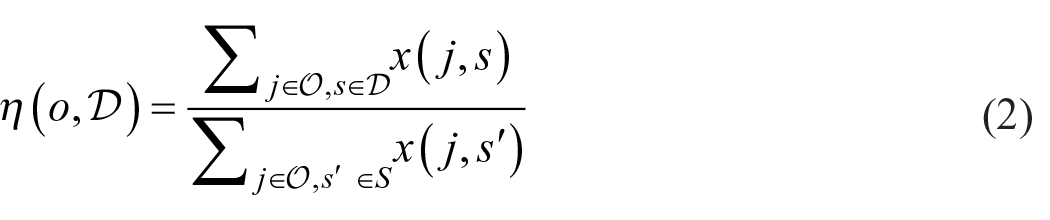
Finally, we determined the occupations with the highest levels of skill similarity to the top journalism skills uncovered from above. We propose η, the ‘Journalism Skill Intensity’, for each standardised BGT occupation, defined as percentage of journalism skills relative to the total skill count for the job ads related to an occupation o. Formally:
where
Jobs data analysis and results
In this section, we conducted a data-driven analysis of journalism jobs in Australia based on job ads data and official occupational statistics. First, we longitudinally examined key features of jobs data, such as employment levels, job ads posting frequency, salaries and posting frequency growth and predictability level. We also analysed how the underlying skills of journalists had changed over time, and which skills and occupations grew in similarity to journalism.
Posting frequency and employment levels
In Australian journalism, 2012 is considered a watershed year. An estimated 1500 journalists were made redundant, the majority of those from Australia’s two largest print companies, Fairfax Media (now Nine Entertainment) and News Limited (now News Corp Australia) (Zion et al., 2016). The severity of this industrial shock can be observed in Figure 1. Against the left y-axis, the blue line shows quarterly job ads posting frequency for journalism jobs. As the graph depicts, posting frequency for journalism job ads experienced extremely low levels in 2012 until 2013, when they began to increase. The volume of vacancies increased until mid-2014, before plummeting in late-2014 to the levels last seen in 2012. From 2015, journalism job ads experienced strong growth, reaching a peak in mid-2016. Since then, journalism job ads have trended downward until the first quarter of 2020 (end of available data for job ads), albeit with volatile peaks and troughs. In summary, the data shows that journalism job ads had not been in freefall since 2012. Rather, there was erratic growth in journalism job ads until a peak in 2016, followed by erratic decline.
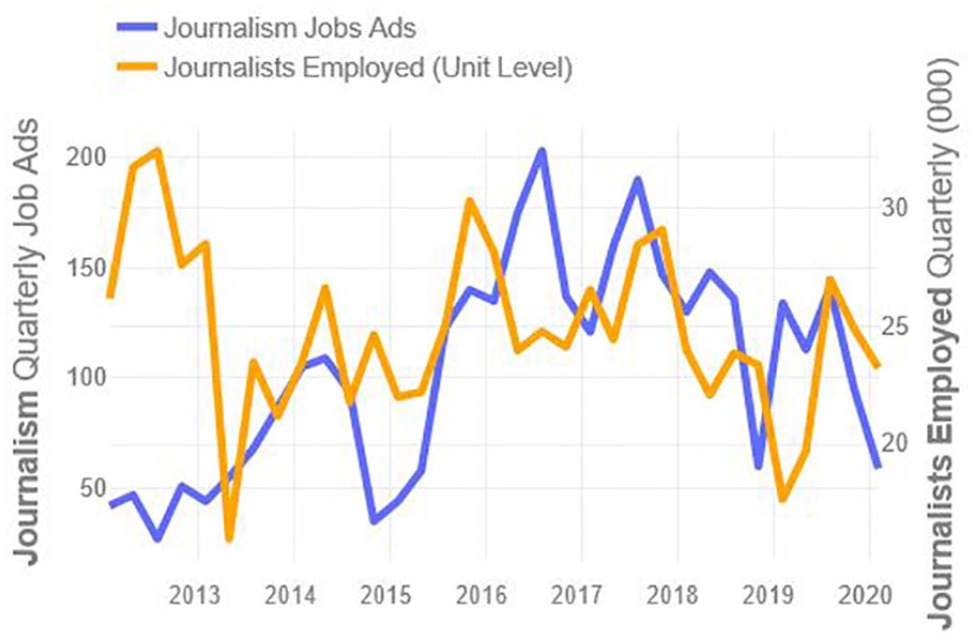
Quarterly posting frequency of journalism job ads (see Data and methods) and employment levels of ‘Journalists and Other Writers’ at the ANZSCO Unit level (000s) from Jan 2012 to Mar 2020.
Similarly, employment levels underwent immense volatility from 2012 to 2013. Against the right y-axis of Figure 1, the orange line shows the number of quarterly employed for ‘Journalists and Other Writers’ at the ANZSCO Unit level. Employment levels peaked in mid 2012, before dramatically dropping in early 2013. This is an effect of the mass journalist redundancies made in 2012, given that employment statistics are ‘lagging indicators’ and it takes time for labour markets to reflect changes in occupational statistics. Early 2013 marked the lowest point of journalist employment seen in this time-series. As also observed in job ads data, journalist employment levels grew until 2016–2017 and has since trended downwards, exhibiting volatile quarterly changes through to the first quarter of 2020.
COVID-19 and journalism jobs
The early effects of COVID-19 were apparent in the posting frequency of job ads in Australia. This was the case for most occupations, including journalists. Higher vacancy rates typically mean higher levels of labour demand by employers, which is a critical component of healthy labour markets. As Figure 2 highlights, vacancy volumes declined for both journalism jobs and at aggregate levels in Australia. Since mid-February 2020, weekly posting frequency had decreased across all Australia job ads, as seen in Figure 2a. Such a decline this early in the year is atypical. As Dawson and Rizoiu (2020) show, the frequency of job ad postings follow a yearly seasonal pattern, with late February and early March typically being a period of upward trend growth. However, late February and early March 2020 coincided with the international outbreak of COVID-19. During this period, the Australian government instituted widespread quarantine and social distancing measures, which significantly constrained economic activity (Boseley and Knaus, 2020). The impacts of these COVID-19 containment laws are starkly apparent in Figure 2b. Posting frequency for journalism jobs were down 63% when comparing March 2019 volumes to March 2020. This was significantly higher than the aggregate market of all Australian job ads, which was down 37% over the same period. Figure 2b shows that Melbourne appeared to be the city hardest hit, recording no journalism job ads in March 2020 and only three posts for the first quarter of 2020, even before the major lock-downs instituted for Melbourne in August 2020. Clearly the pandemic had an early and damaging effect on the journalism jobs market.
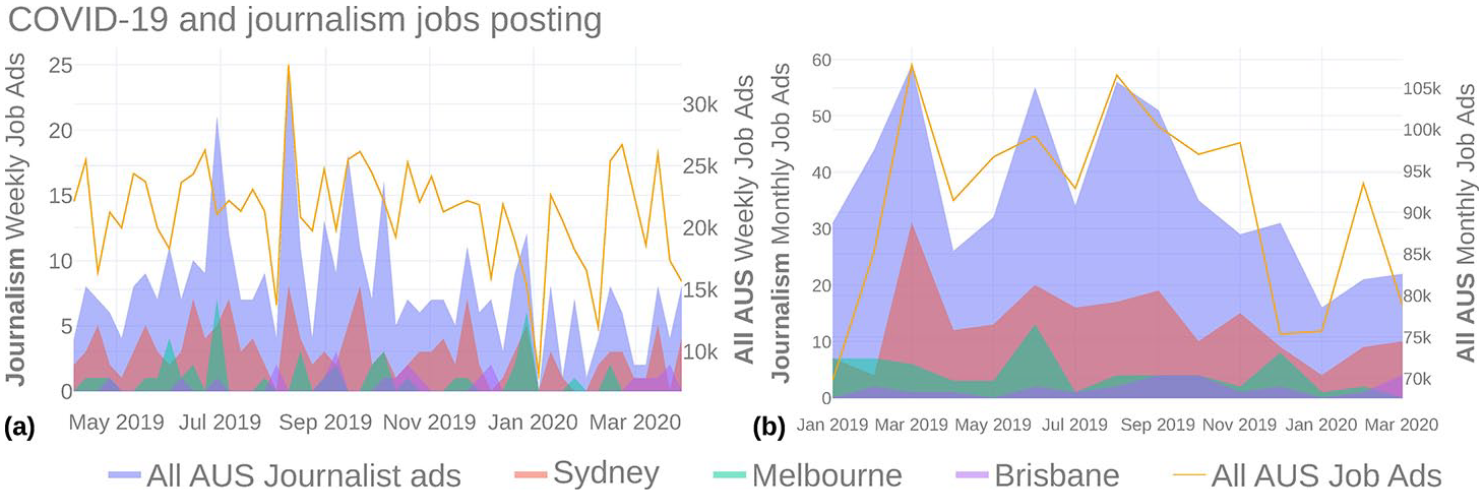
Posting frequency for journalism jobs during the early stages of the COVID-19 crisis in Australia and its major cities: (a) weekly posting frequency volumes for journalists and all Australian job ads between April 2019 and March 2020. Both decreased as the early stages of the COVID-19 crisis hit and (b) monthly posting frequency for journalists were down 63% when comparing March 2019 to March 2020. This was significantly higher than all Australian job vacancies, which was down 37% over the same period.
Salaries
We compared salaries extracted from job ads with ABS reported wage data for ‘Journalists and Other Writers’. 2 Figure 3 reveals two main findings regarding journalist salaries. First, according to job ads data, journalists attracted considerably lower annual wage levels (solid blue line) than the market average (dashed blue line). As of 2018, job ads indicated that journalists earned approximately AU$10,000 less than the market average. These findings, however, are somewhat contrary to the wage earnings data collected by the ABS (Australian Bureau of Statistics, 2019b), according to which ‘Journalists and Other Writers’ (solid orange line) had been earning a growing wage premium over the market average (dashed orange line) since 2014. This discrepancy can be explained by the fact that job ads data tend to over-represent occupations in the ‘Professional’ and ‘Manager’ classes (Carnevale et al., 2014), which typically attract higher wages. As a result, the average salary levels from job ads data (dashed blue line) were about AU$20,000 higher than average salary levels from ABS data (dashed orange line), from 2014 to 2018. However, the salary levels for journalists were very similar when comparing across the two data sources.
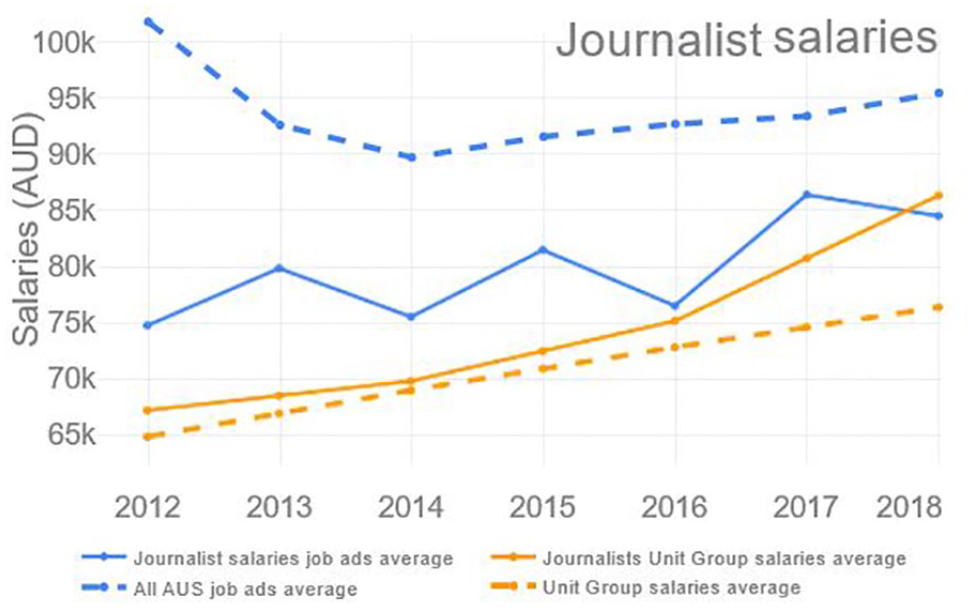
Journalist salaries (solid blue line) increased according to job ads data, but remained below market average levels (dashed blue line). However, according to ABS data, ‘Journalists and Other Writers’ (ANZSCO Unit level, solid orange line) earned a growing wage premium above the market average (dashed orange line).
Figure 3 yields a second observation: journalist salary levels increased in both absolute and relative terms compared to average market levels, between 2012 and 2018 in both data sources. More importantly, the relative salary growth of journalists exceeded the market averages, during the period studied.
Trend analysis and predictability
Posting trends
We constructed an auto-regressive Machine Learning model to predict posting frequency of journalism job ads in Australia (Taylor and Letham, 2018). The model accounts for long term trends, seasonality patterns and external events (see the Supplemental Material for technical details). We isolated the posting frequency trend component and, in Figure 4, plotted it comparatively for ‘Journalists’ against two occupations that have experienced high levels of labour demand, ‘Data Scientists’ and ‘Data Analysts’, as well as against the aggregated market trend. Visibly, journalism jobs experienced varying degrees of growth until mid 2016, at which point growth plateaued, and started to decline. From the end of 2017 until 2019, the trend for journalism job ads has heavily decreased, even when compared to the aggregate market, which also shows a more modest decrease during the same period. ‘Data Scientists’ and ‘Data Analysts’ consistently grew throughout the entire period.
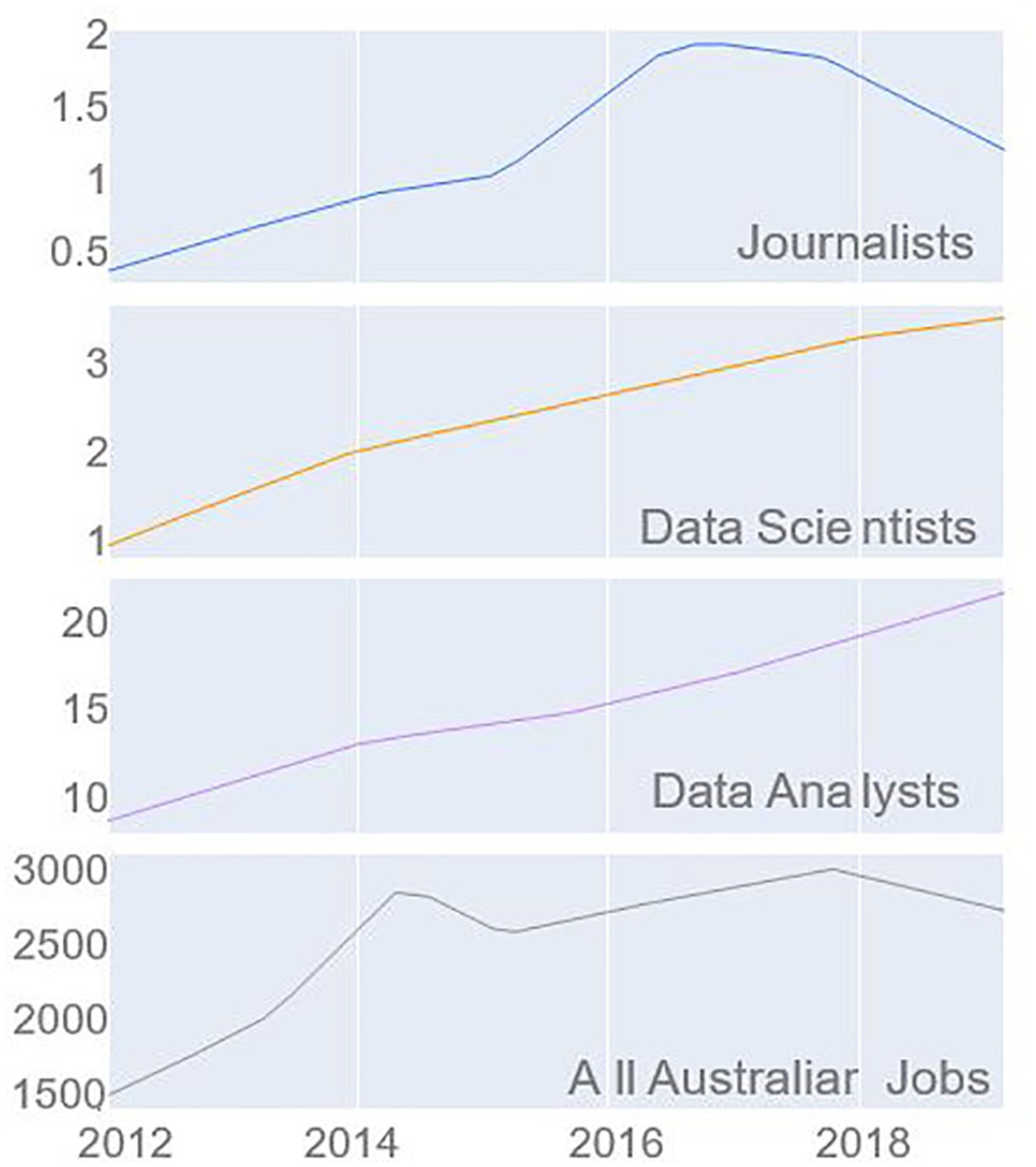
Trend lines of posting frequency for ‘Journalists’, ‘Data Scientists’, ‘Data Analysts’ and ‘All Australian job ads’. Posting frequency for ‘Journalists’ trended downwards since 2016.
Quantify labour demand volatility
When constructing Machine Learning models, it is standard procedure to use error metrics to evaluate the prediction accuracy. Volatility in posting volumes inherently lead to lowered prediction performance and higher error values. Here we use the prediction error measured using the ‘Symmetric Mean Absolute Percentage Error’ (Makridakis, 1993; Scott Armstrong, 1985) as a proxy for the volatility of labour demand for different occupations (see the technical section in the Supplemental Material for more details).
Figure 5 shows the prediction performance for three occupations (‘Journalists’, ‘Data Scientists’, ‘Data Analysts’) and for the volume of ‘All Australian job postings’. We used a sliding window approach to obtain multiple predictions (see the Supplemental Material) that we aggregated as boxplots. The higher the error score on the vertical axis, the lower the predictive abilities for that occupation. As Figure 5 reveals, predicting the daily posting frequency of journalism jobs was consistently more difficult than for the other occupations, and the market as whole. ‘Data Scientists’, an occupation undergoing strong relative growth, is also showing a high prediction error compared to the market as a whole, indicative of experiencing a degree of volatility. However, it was not nearly commensurate to the predictive difficulties, and volatility, of journalists. This was true from 2012 to 2019, and has become worse in 2020 with the spread of COVID-19.
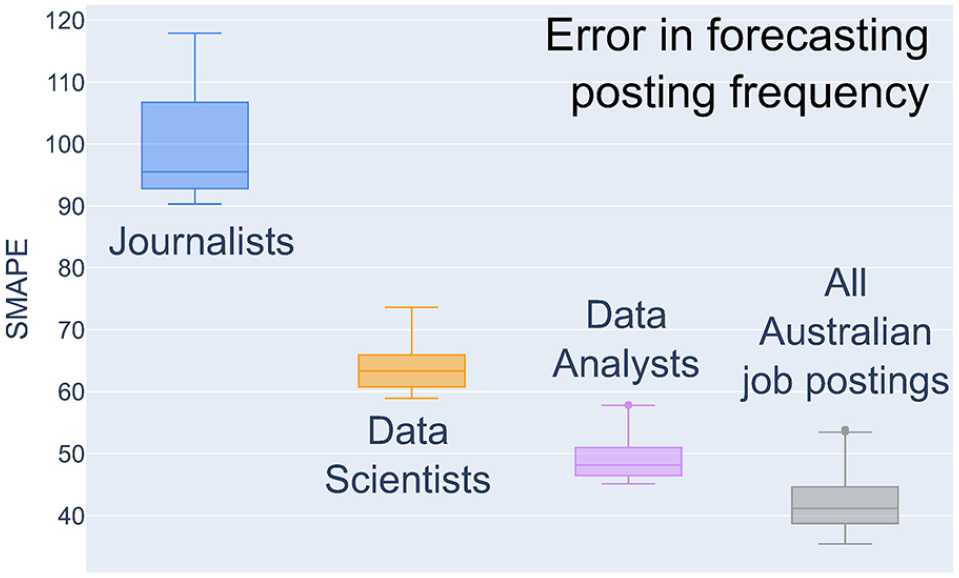
Predictability comparison of temporal posting frequency highlighting the difficulties of predicting journalism job ads and their volatility.
Gender
There have been growing gender differences of employed journalists in Australia (North, 2009, 2016) and across the world (Hanitzsch et al., 2019); the data presented in this research reinforces these previous findings. Figure 6a shows that the ratio of female employed journalists increased relative to male journalists (ANZSCO Unit Level) (Australian Bureau of Statistics, 2019a). In 2014, the female-to-male employment ratio was 0.7. In 2018, the proportion more than doubled, with almost 1.8 female journalists employed for every male journalist. It then declined in 2019 to 1.35, but this proportion was still almost double that of 2014.
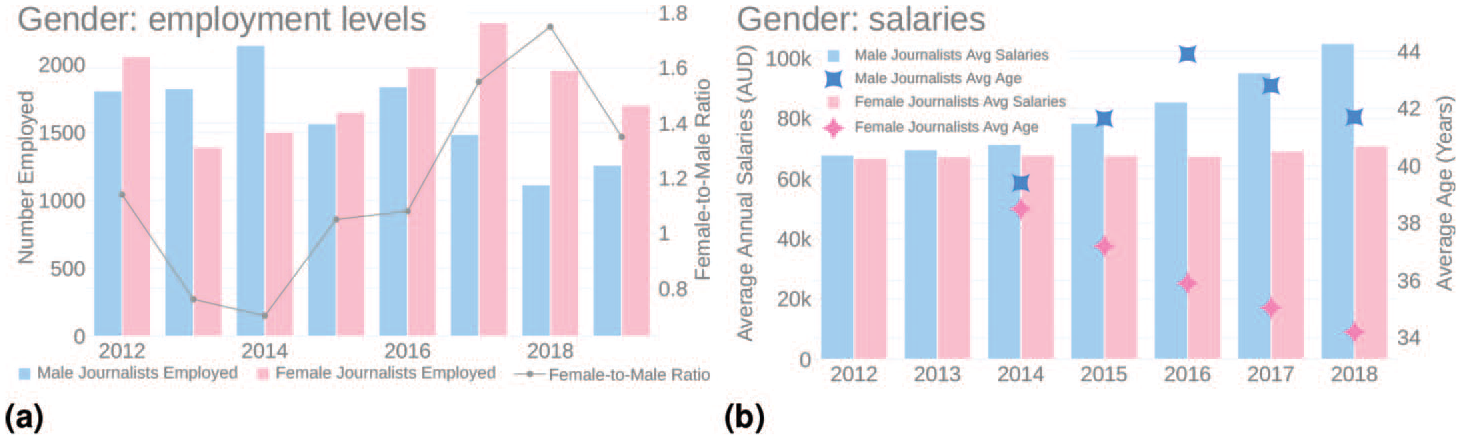
Journalist employment levels and salaries by Gender: (a) since 2015, the employment ratio of female-to-male journalists increased and (b) wage inequality increased between males and females in the ‘Journalists and Other Writers’ Unit group. This was at the same time that the average age of journalists decreased for females and increasing for males since 2014.
Figure 6b also shows that wage inequality between female and male journalists worsened from 2014 to 2018 (Australian Bureau of Statistics, 2019b). Since 2014, the annual salaries for female journalists increased by only AU$3000, whereas annual salaries for male journalists increased by more than AU$30,000. Male journalists thus experienced an average wage growth that was 10 times greater than female journalists from 2014 to 2018.
There were also changing age demographics of employed journalists during the studied period. The markers on Figure 6b highlight the average age of journalists by gender, per year. Male journalists were getting older, their average age increasing by 2 years from 2014 to 2018. Female journalists, however, were steadily getting younger. The average age for female journalists decreased by more than 4 years from 2014 to 2018.
Location
Figure 7 plots the location and volume of employed journalists in Australia. Figure 7a shows the absolute and relative number of job ads posted for each of the capital cities, and outside them, and Figure 7b shows the location of employed journalists per state. Unsurprisingly, Sydney and Melbourne, the respective capital cities of New South Wales (NSW) and Victoria (VIC), consistently had the highest job ad posting frequencies. However, the relative share of job ad posting frequency in Australian capital cities had shrunk in later years, with Figure 7a showing an increase outside of major cities, both in relative and absolute terms. This trend reached a peak in 2017, when less than 50% of all journalist job ads were for positions inside capital cities. A small rebound followed, and in 2019 Sydney commanded approximately one-third of all journalism job ads.

Location of journalists in Australia: (a) posting frequency for journalism jobs decreased in major Australian cities, in relative terms and (b) as of 2019, the majority of journalists in Australia were employed in New South Wales, Victoria and Queensland, respectively.
Education and experience
Figure 8a and b show respectively the number of years of formal education required for journalists, and the experience requirements (both per year, extracted from job ads data). The education requirements consistently remained at market average levels, with journalists required to possess a Bachelor-level degree (approximately 16 years of education).
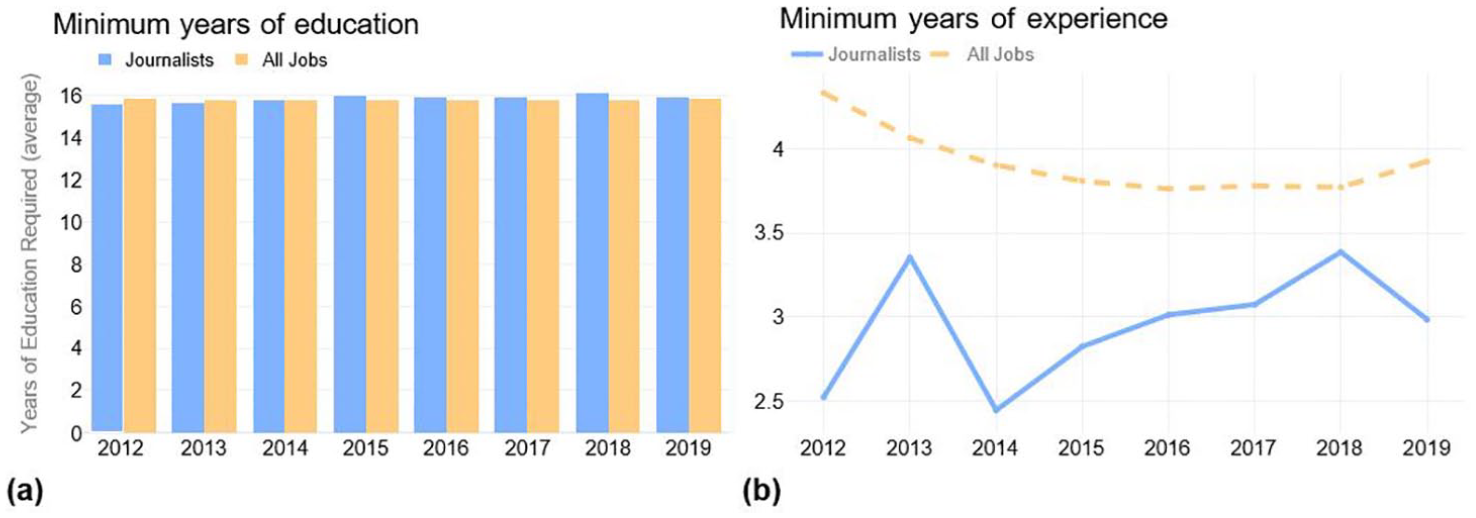
(a) Years of education demanded by employers from job ads were consistent with the market average and (b) years of experience required by employers consistently remained below the market average, according to job ads. However, this gap had closed since 2014.
By contrast, the experience requirements were more variable. Since 2012, employers required fewer years of experience from journalists than was required in the market generally. However, the gap narrowed. In 2019, employers demanded of journalists, on average, half of an additional year of experience compared to 2014. This countered the general market, where employers’ demands trended downward from 2012 to 2019.
Employment type
Casual and temporary work have become more commonplace in Australia (Gilfillan, 2018), and we studied if this is also the case for Australian journalism jobs. In Figure 9 we plot the number of permanent and temporary journalism jobs, per calendar year – in the job ads data, jobs are classified as either ‘Permanent’, ‘Temporary’ or not specified according to the content of the job descriptions. The number of ‘Temporary’ journalism jobs had increased in absolute terms since 2012, which made up the majority of all journalism ads in every year. It is noteworthy too that the share of ‘Permanent’ journalism vacancies had also increased since 2012. However, this trend should be interpreted with a degree of scepticism as only 50% of all journalism job ads specified whether the roles advertised were permanent or temporary.
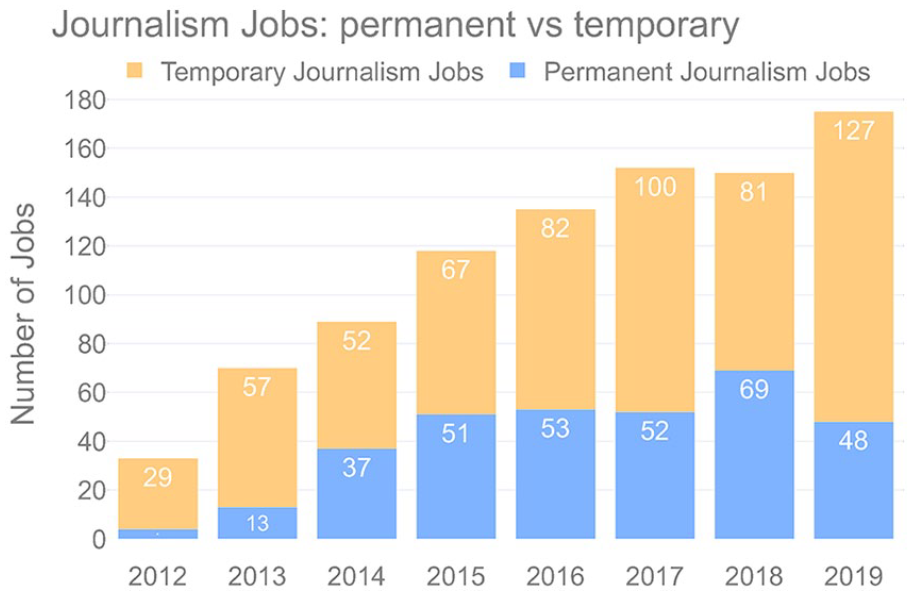
Temporary positions represented the majority of journalism job ads in Australia.
Journalism skills
Growing demand for journalism skills
Here, we analysed how the demand for some fundamental journalism skills changed over time. First, we selected three traditionally important skills to journalists that appear in job ads: (1) ‘Journalism’, (2) ‘Editing’ and (3) ‘Writing’. These skills were then counted across all job ads in Australia, regardless of their occupational class. While Figure 4 shows that labour demand for journalists has decreased since 2016, Figure 10a presents the more nuanced story, showing that the posting frequency for each of these core journalism skills increased from 2012 to 2019, with 2018 to 2019 being the first yearly decline.
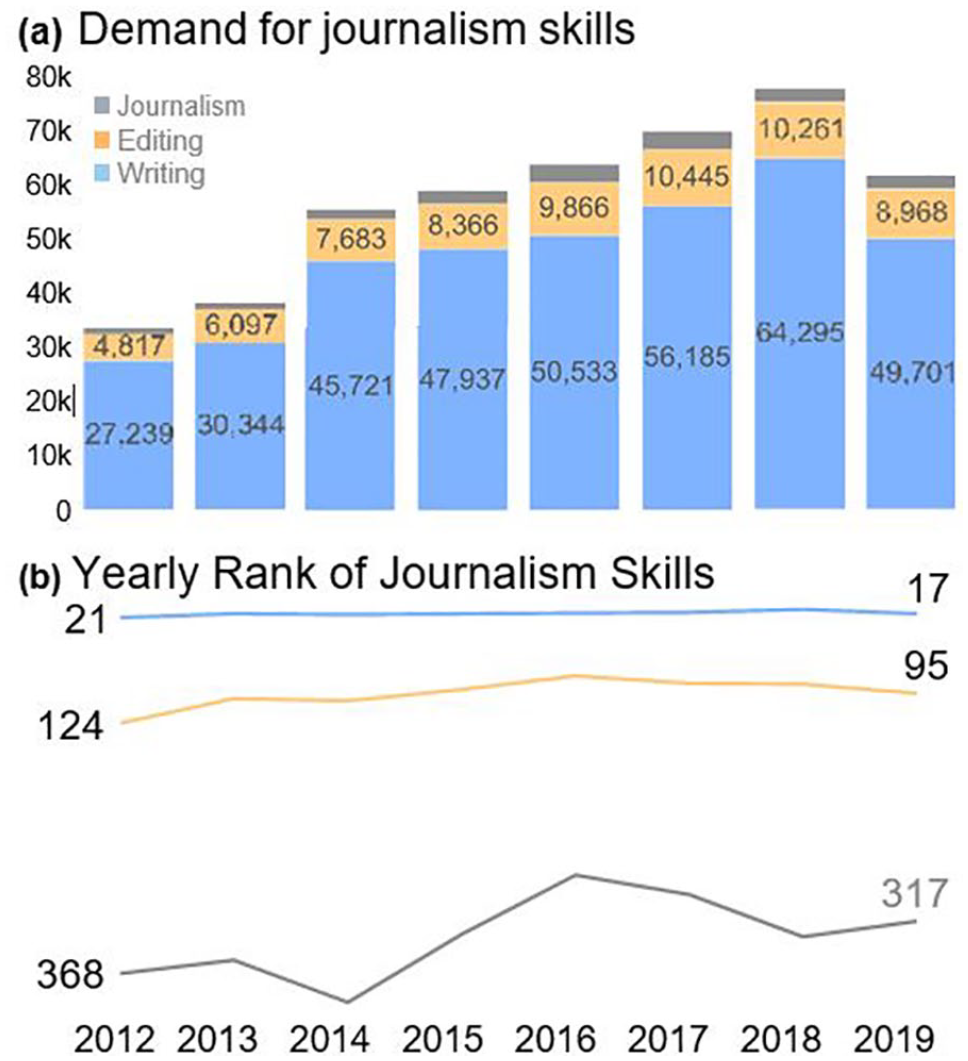
The absolute posting frequency (a) and relative yearly rank (b) of three major journalism skills increased between 2012 and 2019.
The relative rankings of these three skills also increased. For each year, we counted the posting frequency of each unique skill that appears in job ads. We then ranked these skills by posting frequency as a proxy for labour demand. Figure 10b shows that the rankings of all three of these fundamental journalism skills had improved from 2012 to 2019. In other words, not only did the posting frequency of these three journalism skills increase in job ads over these 8 years, but their importance relative to all other skills also increased.
Changing importance of journalism skills
We wanted to determine whether the relative importance of the Journalism skill changed over time, using a skill similarity approach. Given the dynamics of skill requirements in job ads, skills can become increasingly more (or less) similar over time. We used the similarity measures in equation (1) to identify the skills that are becoming more relevant to being a journalist (see Data and methods for details, and the Supplemental Material for the top 50 skills for each from 2014 to 2018). The higher the similarity score, the more likely the skills pair will complement and support each other in a given job. Figure 11a shows the changes in similarity scores between the skill ‘Journalism’ and each of the eight other top journalism skills (as per the top yearly journalism skills lists in the Supplemental Material). The greater the area covered in the radar chart, the greater the similarity score, with the blue area representing 2014 and the red area 2018. 3 Visibly in Figure 11a, ‘Social Media’ related skills became increasingly relevant for journalists, with the relative ratio of more traditional skills such as ‘Editing’ and ‘Copy Writing’ diminishing with respect to ‘Social Media’, from 2014 to 2018.
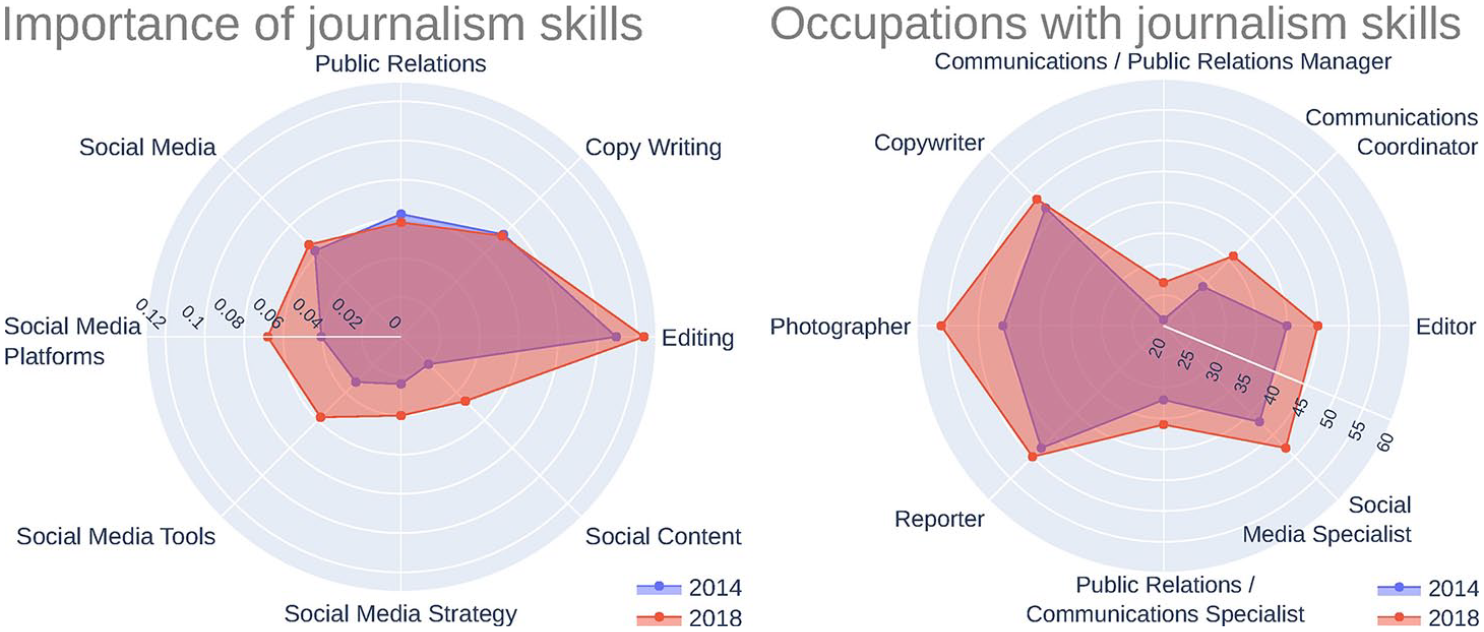
Skill and occupational similarity analyses: (a) the changing similarity (or relative importance) of specific skills compared to the skill ‘Journalism’ and (b) eight occupations that had the highest similarity to the ‘Top Yearly Journalism Skills’.
Occupations that require journalism skills
Here, we studied which occupations most required journalism skills, and their dynamics over time (according to the BGT occupational taxonomy). Given the yearly lists of top journalism skills (described in Skill Similarity), we used equation (2) to determine the occupations with the highest intensities of journalism skills, for each year from 2014 to 2018. Intuitively, this allows us adaptively to identify occupations that become more or less similar to ‘Journalism’, based on their underlying skill usage. It also provides a means to assess likely transitions between occupations, as workers are more likely to transition to occupations where the underlying skill requirements are similar (Bechichii et al., 2018). Higher similarity lowers the barriers to entry from one occupation to another.
Figure 11b highlights eight top occupations and their journalism skill intensity scores for 2014 and 2018. ‘Reporter’, ‘Editor’ and ‘Copywriter’ cover the highest percentage of journalism jobs in the dataset, respectively. While the journalism skill intensities of these occupations were relatively high in 2018, their growth since 2014 was relatively low. In comparison, ‘Photography’, ‘Communications’, ‘Social Media’ and ‘Public Relations’ experienced higher journalism skill intensity growth from 2014 to 2018. This provides insights as to where workers with journalism skills might have found employment outside of journalism.
Discussion
Volatility of journalism jobs
Drawn from job ads and employment statistics, our findings reveal the highly volatile nature of the journalism industry. Compared to other occupations and the aggregate labour market, journalism experiences dramatic fluctuations that are unpredictable and irregular (see Figure 5). The data also confirmed that journalism is an industry in crisis, worsened in the early stages of COVID-19. However, the data also reveals surprises, including that the number of journalism jobs ads and employment levels increased from 2012 until 2016. Since then, though, journalism jobs in Australia declined.
The volatility of journalism jobs in Australia was clearly apparent in Posting Frequency and Employment levels. Posting frequency of job ads ranged from near zero levels in 2012 and 2014 to more than 200 posts per quarter in 2016. These violent swings are also apparent in the quarterly employment statistics of ‘Journalists and Other Writers’. Following the mass redundancies of 2012, employment levels plummeted, reaching their lowest levels in 2013. They then increased before falling again into the beginning of the COVID-19 pandemic. However, the data confirms that volatility of employment has been a constant for journalism, and that this has worsened during COVID-19.
Figure 5 reveals this extreme volatility. The error metrics from the Machine Learning model used to predict daily posting frequencies of job ads (as detailed in Trend Analysis and Predictability) highlight the difficulties of making predictions about journalism employment. This lack of predictability is indicative of volatility. The higher the error scores for a given occupation, the higher the likelihood that the occupation is experiencing significant disruption. This becomes apparent when we compare journalism to other occupations. For example, the volatility of ‘Journalists’ dwarfs that of ‘Data Scientists’, an occupation experiencing significant demand and volatility in Australia (Dawson et al., 2019).
The volatility of journalism jobs was further revealed by a time series analysis of journalism compared to other occupations (Figure 4), a gender- based analysis (Figure 6), a geographical analysis (Figure 7) and an analysis of the temporary nature of journalism jobs (Figure 9).
What is indisputably clear is that the advertising market for news and journalism collapsed, and, at the time of writing, continues to collapse (ACCC, 2019; Doctor, 2020; Shirky, 2009). Meanwhile, consumers have tended to show an unwillingness to pay for digital journalistic content: in 2019, Australian news consumers admitted they would much would rather subscribe to a video streaming service such as Netflix (34%), than pay for online news (9%) (Fisher et al., 2019). Admittedly, during COVID-19 some subscription rates have risen (Edmonds, 2020). Clearly, however, the Internet has detonated the advertising model that once sustained journalism, and simultaneously re-adjusted consumer expectations on the monetary value of journalism content. The fact that journalism is struggling is confirmed in several ways by the data, including by the unpredictability of job ads posting frequency and the clear shifts in employment levels, as shown in Figure 1. To say that journalism has been disrupted is an understatement.
Volatility exacerbated by COVID-19
In a fragmenting news ecosystem, consumer demand for news and journalism is difficult to quantify. The Digital News Report: Australia 2019 has found that many consumers are disengaging, with the proportion of Australians avoiding news increasing from 57% in 2017 to 62% in 2019 (Fisher et al., 2019). Demand for ‘quality’ and ‘public interest’ journalism is even harder to quantify, given ongoing debates as to what exactly constitutes ‘quality’ and ‘public interest’ (Wilding et al., 2018). Nonetheless, demand for journalism has surged dramatically since the outbreak of COVID-19.
The irony of the coronavirus pandemic is that even as it has been killing off journalism jobs, it has also created a heightened demand for, and appreciation of, journalism among the general public. As news analyst Doctor (2020) wrote of the US situation in late March, ‘The amount of time Americans spend with journalists’ work and their willingness to pay for it have both spiked, higher than at any point since Election 2016, maybe before . . . [but] how many journalists will still have jobs once the initial virus panic subsides?’ In the UK in March, The Guardian received 2.17 billion page views, an increase of more than 750 million above its previous record, set in October 2019 (Bedingfield, 2020).
Since the outbreak of COVID-19, the volatility of the journalism jobs market has worsened dramatically. We noted above that in May News Corp ended the print run of more than 100 newspapers nationally. In April, Australian Community Newspapers, which publishes 170 community titles, said it was suspending publication of some of its non-daily newspapers; as a result, four printing presses were closed and an unspecified number of staff were stood down (Meade, 2020a). Also in April, the federal government announced a AU$50million package to support public interest journalism across TV, newspapers and radio in regional and remote Australia (Hayes and Rubbo, 2020). And on April 20, the Australian government announced that digital platforms including Google and Facebook would be forced to pay for content as the Internet advertising business would be overhauled to help local publishers survive the economic fallout of the coronavirus crisis (Crowe, 2020). The scheme, which would involve a mandatory code imposed on digital giants, would potentially set a global precedent. The combined and ongoing impact on journalism jobs of these sudden, cumulative developments are hard to predict, but will no doubt be profound.
Gender wage gap
At first glance, the data seems to suggest that gender equity is finally arriving in Australia for journalism – an industry that has traditionally been male-dominated – as more women than men are employed. As the data shows, in 2014 there were 0.7 female journalists employed for every male Journalist, but by 2018 the proportion of female-to-male employment more than doubled, with almost 1.8 female journalists employed for every male journalist. It then declined in 2019 to 1.35, a proportion still almost double that of 2014.
However, further detail reveals that equity remained elusive. Specifically, wage inequality worsened. Since 2014, annual salaries for female journalists increased by AU$3000, compared with an increase for male journalists of over AU$30,000 over the same period. From 2014 to 2018, average wage growth for Male journalists was more than 10 times greater than for female journalists. Meanwhile, the average male journalist was getting older, while the average female journalist was getting younger. In 2014, the average age for a journalist, whether male or female, was roughly the same: late 30s. By 2018, the average age for a male journalist was 42, whereas for a female journalist it was 34. These results support previous findings on changing demographic characteristics. In a survey of female journalists in Australia, North (2016) found gendered divisions of tasks associated with reporting, where the majority of female reporters were assigned ‘soft-news’ areas, such as arts, education and health. These gender and age inequities for journalists were also present in other countries (Hanitzsch et al., 2019). The wage and age discrepancies between female and male journalists observed in the employment statistics are consistent with the surveyed experiences of female journalists in Australia by North (2016).
The potential impacts of this worsening disparity are concerning. It is possible that senior positions responsible for major editorial decisions were increasingly being dominated by men, whereas junior roles were being filled by women who are younger and worse-paid.
Further research is needed into related issues of the industry’s composition, including, for instance, the ethnicity of journalists. A vast body of literature exists regarding the importance of diversity in news (Budarick and Han, 2017; Rodrigues and Paradies, 2018). Further work is needed into diversity (and its various sub-categories), and what effect diversity has, for instance, on the proportion of people who are actively avoiding the news.
Location
As discussed above, the sustained pressures on regional and local journalism have led to a worrying growth of ‘news deserts’ in countries including Australia and the US. This trend alarmingly accelerated in the early stages of COVID-19, leaving many areas without any regional or local news coverage. For instance, as at October 2020, the ‘Public Interest Journalism Initiative’ had documented a net decline of 124 newsrooms from January 2019 (PIJI, 2020). Hence, we might assume that journalism jobs in regional and local areas had been drying up, and that an ever-increasing proportion of journalism jobs were in urban centres.
The data, however, were not so clear until the end of 2019. As Figure 7a shows, in 2012 fewer than a quarter of Australia’s journalism job ads were for jobs outside Sydney, Melbourne, Brisbane, Canberra and the ACT or Perth. In every subsequent year, the proportion of job ads for journalism positions outside these urban centres was considerably higher. The peak came in 2017, when nearly half of all job ads were for positions outside the major cities. Does this suggest that in 2017 there were as many jobs for journalists in the regions as in the centres? Surely not. The explanation, we suggest, lies in various factors. These include that regional journalism jobs are hard to fill, perhaps because they offer relatively low salaries, and are hence re-advertised. It is also possible that there is a high turnover for some regional positions. In short, the job ads data may simply be an indication that the journalism industry is even more volatile in the regions than in major urban centres.
Research consistently and emphatically reveals that regional and local journalism have been suffering, with an increasingly bleak prognosis of cuts and closures (Abernathy, 2018; ACCC, 2019; Doctor, 2020). While the data shows a surprisingly high proportion of journalism job ads for positions outside the main metropolitan centres, this cannot be taken to suggest that journalism is holding steady in these areas.
Evolving journalism skills
Skills are the building blocks of jobs and standardised occupations. In this regard, occupations can be characterised as ‘sets of skills’. Intuitively, skills that are similar can be interpreted as complementary when they are paired together or relatively easy to acquire when one skill is already possessed.
This intuition provides insight into how journalism skills are evolving and where journalists might be finding alternate career paths. As Figure 1 shows, both the demand for and supply of journalists have been declining in Australia since 2016. Therefore, a growing number of former journalists, who presumably possess an assortment of journalism skills, needed to transition between occupations to find new work. There are, however, significant transition costs moving between jobs (Bechichii et al., 2018; Bessen, 2015). These costs can come in the form of education, training, physically moving for new employment and other barriers. To reduce the friction of these transition costs, workers tend to leverage their extant skills, in concert with acquiring new skills, to make career transitions.
As seen in Figure 11a, the skill ‘Journalism’ became more similar to ‘Social Media’ and more generalist ‘Communications’ skills. After applying the Skill Intensity formula from equation (2), we identified the top occupations with highest intensities of journalism skills from 2014 to 2018 – these normalised measures from equations (1) and (2) take into account newly emerging and redundant skills. The Figure 11b chart reinforces that top journalism skills were becoming more important to other occupations, such as ‘Photographers’, ‘Social Media Strategists’, ‘Public Relations Professionals’ and ‘Communications Specialists’. While it is certainly possible that journalism tasks were being performed in these different occupations, it nonetheless highlights the changing nature of journalism work and the occupations where journalism skills were of growing importance.
From the data, we suggest, three conclusions can be drawn, which supports previous research (O’Regan and Young, 2019; MacNamara 2014, 2016; Young and Carson, 2018). First, to be hired, journalists are required to have a wider array of skills, such as photography and social media aptitude. Second, jobs requiring journalism skills were increasingly occupations in social media, generalist communications and public relations rather than in reporting and editing. And third, we see hints as to where onetime journalists are finding alternate career paths. As employment conditions progressively worsen, journalists are seemingly pursuing new careers in the occupational areas seen in Figure 11b, such as photography or public relations.
At a time of great uncertainty, with employment prospects deteriorating, it is no wonder that journalists look beyond traditional journalism for their futures. For society, however, the implications are significant. In this time of economic instability and polarising politics, the people who possess the journalism skills required to keep the public informed and hold leaders to account are, in many cases, employing their talents elsewhere. This places enormous strain on the health and quality of journalism in Australia.
Conclusion
The data reveal a contradiction: demand for journalism skills increased at the same time that demand and employment for journalists declined. Indeed, this is one of several contradictions in a volatile industry. For an increasing number of news media organisations, a sustainable business model remains elusive.
Our findings give a clearer outline of the problem. Unfortunately, the solutions remain less clear. Quality journalism is expensive. Good reporting is often slow and laborious, fixed to the unfolding story. What is required of quality journalism is, therefore, at odds with the prevailing employment conditions. The declines in employment of traditional journalists could have serious implications if the media produce poorer quality content.
This paper highlights the stresses experienced by journalism in Australia by analysing jobs data. We observed the volatility and downward trajectory of the occupation both in job ads and employment statistics. These unfavourable employment conditions were worsened by the unfolding COVID-19 crisis. Our longitudinal analysis also yields important findings regarding gender inequity. While women represented a greater share of employed journalists, they earned less, and the wage gap grew.
Further, this paper also identified top journalism skills. Adopting a data-driven method, we described which skills are most similar to ‘Journalism’. We then used these yearly skill sets to adaptively select similar occupations. This enabled us to quantitatively show that the skill demands of journalists became increasingly similar to those of ‘Social Media Strategists’, ‘Public Relations Professionals’, ‘Communications Specialists’ and others. This suggests where people with journalism skills were likely finding alternate career paths, but also raises a related concern. On the face of it, the journalism jobs data we have analysed does not look so bad after all. On reflection, however, it suggests that the thinning ranks of ‘journalism’ are populated by fewer journalists, and more public relations specialists.
Future research could compare these results to other labour markets in different countries to assess and compare the validity of these findings. For example, the skill similarity methodology could be applied in other labour markets to compare the resulting top journalism skills in different locations. Additionally, labour demand analyses could be conducted on occupations most similar to journalists to better understand the incentives to transition to other vocations. This could provide insights into the boundaries of ‘journalism work’ and analyse the relative demand of different types of journalism. Further work could also examine the implications of changing journalism skill demands for journalism schools. This research demonstrated that not only have the skills demanded of journalists evolved, but the occupations that require journalism skills have broadened. The extent to which journalism schools are adequately preparing its students for the quickly changing labour demands of journalists is a rich area of inquiry.
The results from this research both reinforce the well-documented difficulties of journalism in Australia and provide granular details that isolate and reveal these challenges. The hope is that these analytical methods and insights can contribute to the health and well-being of the Fourth Estate, and hence to the health and well-being of society.
Supplemental Material
sj-pdf-1-jou-10.1177_1464884921996286 – Supplemental material for Layoffs, inequity and COVID-19: A longitudinal study of the journalism jobs crisis in Australia from 2012 to 2020
Supplemental material, sj-pdf-1-jou-10.1177_1464884921996286 for Layoffs, inequity and COVID-19: A longitudinal study of the journalism jobs crisis in Australia from 2012 to 2020 by Nikolas Dawson, Sacha Molitorisz, Marian-Andrei Rizoiu and Peter Fray in Journalism
Footnotes
Acknowledgements
We would like to thank Burning Glass Technologies for generously providing the job advertisements data that has enabled this research.
Conflicts of interests and funding sources
The authors report no conflicts of interests or funding sources in the development of this research.
Funding
The authors disclosed receipt of the following financial support for the research, authorship, and/or publication of this article: Marian-Andrei Rizoiu was partially supported by Facebook Research under the Content Policy Research Initiative grants and by the Commonwealth of Australia (represented by the Defence Science and Technology Group).
Supplemental material
Supplemental material for this article is available online.
Notes
Author biographies
 .
.
References
Supplementary Material
Please find the following supplemental material available below.
For Open Access articles published under a Creative Commons License, all supplemental material carries the same license as the article it is associated with.
For non-Open Access articles published, all supplemental material carries a non-exclusive license, and permission requests for re-use of supplemental material or any part of supplemental material shall be sent directly to the copyright owner as specified in the copyright notice associated with the article.
