



Abstract
We adopt the cultivation theory to identify the ways the increased exposures to (mis)information in social media and traditional media cultivate the perceptions of (1) informational mistrust and (2) ill-confidence in dealing with Covid-19 pandemic risk. Importantly, we expanded the theory and hypothesized about the roles of informal societal ties by investigating whether local community attachment and frequent friend-family interactions can mitigate the formation and consequence of mistrust arising from the exposure to misinformation. We found that the higher exposure to Covid-19 misinformation, as promulgated in both active and passive social media uses, was related to informational mistrust that was also linked to a lower level of confidence in telling the veracity of misinformation. Findings also show the significant relationships between two forms of informal social ties and misinformation confidence. We discuss how the abundance of information sources fuels misinformed citizenry as individuals are left alone to navigate increasingly confusing influx of unfounded misinformation abounded in social media.
The idea that the more dialogues people have, the better informed citizens become has been a cornerstone of democracy. Increased amount of information and the diversity of channels to exchange information in this context have been touted as the means to achieve this normative goal, as unequal informational access hinders the formation of informed citizenry by depriving equal opportunities. Social media such as Facebook, Instagram, or Twitter affords, however, created a new concern that the increased connectedness and volume of information might be not informatively positive but negative, as social media have now become the constant source of receiving and sending mis-, or dis-information. As Napoli (2018) argued, more speech is not necessarily the solution to a problem, but the problem in current digital informational ecosystems, generating mistrust and ill-confidence upon information exposure. In addressing above mentioned issues, the current study theorizes and tests a set of assumptions about the formation and consequence of informational mistrust at the exposure of misinformation. We problematize misinformation, or factual misperception, in the context of Covid-19 and argue that increased exposure to misinformation in social media would cultivate a broad range of mistrust over public information, of which the individual-level consequences include displaced confidences in dealing with the pandemic.
We are concerned that even after the ending of the Covid-19 crisis, there will be the continuous dissemination of misinformation (such as misguided cures, vaccine side effects, virus variants, or conspiracies of pandemic origins) and its impacts, collective breeding of misinformed citizenry. Thus, we adopt cultivation theory (Gerber et al., 1980) to understand misinformation exposure in social media (in place of local news consumption from the original cultivation framework) in its perceptional influence on Covid-19 risk readiness estimates (in place of crime risk estimates, often called “mean world syndrome”). This study regards social media as a conduit for cultivating mistrust, but further argues that individuals’ characteristics such as the patterns of (mis)information consumption work in concert with societal ties in filtering off, or mitigating cultivation impacts. This focus on societal contexts at the meso-level helps understand the non-media interactive dynamics that have been largely absent in media-deterministic viewpoints. By doing so, we answer the questions of (1) how mistrust is cultivated in Covid-19 related social media use and (2) how it affects ill-confidence, and (3) to what extent informal societal ties can reverse such influences.
As we argue below, central to our conceptualization is the question of under what conditions misinformation becomes salient features of social media consumption, bringing about negative perception. Thus, we delimit the scope of the current study to perceptional grounds, as the parameter for what constitutes cultivation is attentive to, not facts, but beliefs about facts.
Our contention that more informational connectedness may no longer produce positive social outcomes (as promised by digital and participatory democracy) but harbor mistrust is grounded in earlier misinformation studies. Still, surprisingly little work has been done to test this (Stecula et al., 2020; Tandoc, 2019). While we acknowledge that Silicon Valley-driven “fact-checking” initiatives can guide off the spread of misinformation and its ill consequences, we do not have the faith to self-policing rectitude of respective platforms (Lazer et al., 2018; Napoli, 2018; Tandoc et al., 2020). Instead, the current study is set to argue and offer evidence that correction might be also situated in societal contexts outside of social media, given that limits in individual cognition might not be positioned to sift through the constant influx of (mis)information.
Theorizing cultivation in social media misinformation
The contribution of cultivation theory to understanding misinformation in social media use seems evident, considering its conceptual clarities. The theory hypothesizes the influence of television watching on perceiving some versions of televised realities as “real” (Gerber et al., 1980). Nevertheless, the scope of original cultivation hypothesis was limited as it was specifically for local news coverage of violence in poor neighborhood and perceived crime realities. The theory was criticized for its overly generic proposition and tenuous empirical support based on potentially spurious correlations between media consumption and viewer perception (Shrum et al., 2011). Despite progresses made in later works, scholars also pointed that the conceptualization of viewing by Gerber et al. (1980) was based on the assumption that the world represented on television is essentially uniform across programs and subsequent exposures irrespective of individual circumstances produce invariant effects. The criticisms led us to consider possible differences in individual characteristics and societal locus in which the reception and digestion of (mis)information occur.
First, it is essential that the source of information is observed across different media channels —social media and traditional media. Information-news flows affect one another, with their confluence across different media channels triggering substantial public discussion. A study by Gupta et al. (2020) found that the yet unknown nature of Covid-19 led to a sudden barrage of non-expert reviewed information at the early stage of the pandemic, contributing to the overabundance of unfounded rumors traveling across different types of media. Second, the variation of misinformed content is important to be taken into account. A large number of Covid-19 misinformation has been known, ranging from unproven methods of cures, such as hydroxychloroquine, to baseless rumors about Coronavirus Wi-Fi transmission. In the U.S., a political chasm between the Republicans and the Democrats pummeled all kinds of misinformation even further, as then President Trump publicly contradicted expert opinions of his own scientific advisors (Boyd-Barrett, 2019). Granted that Covid-19 triggered similar themes and qualities in social media conversations (Singh et al., 2020), observing different misinformation contents will help address non-uniformity of cultivation potentially present in scale of misinformation exposure. Third, examining the reception of misinformation, homogeneous audience assumption is critical to dismantle. Social media might make individual variations possibly more salient than traditional media, because those with similar socio-political-cultural backgrounds often receive and send information within loosely knitted relationships—namely, Facebook friends, Twitter or Instagram followers, etc. Note that the cultivation thesis is built on the simplified S (stimulus)-R (response) premise. The criticisms in earlier works essentially speak about this over-simplification in that individuals’ cognitive process is reduced to a media-dictated deterministic mechanism. This is never to rule out the general utility of cultivation hypothesis being applied to social media (mis)information. In fact, in our conception, this S-R sequence parsimoniously summarizes cognitive process in which a person’s misbeliefs about facts, objects, or people can be cultivated via repeated (mis)information exposure.
But just like a television viewer’s mind is not cultivated in a-contextual, a-motivational vacuum, individual cognition is not a sponge unconditionally absorbing what is being transmitted. Here what we explicate is the conceptual need to recognize unspecified processes between S and R in its monolithic chain of media effect causation. On the other hand, studies (e.g., Weeks and Holbert, 2013; Wellman et al., 2003) also documented the role of even broader societal mechanism in which media reception gets elaborated, filtered, or rejected, in everyday interpersonal interactive dialogues. We treat this process as additional elaborative reasoning at a meso or community level, demonstrating a broad informal translation of cultivation occurring to an individual. This meso-level variable is not an explicit component of the original cultivation hypothesis. However, the earlier media effect studies have already shown repetitively that everyday societal interaction cannot be divorced from media and information consumption (Katz and Lazasfeld, 1955).
Earlier studies on Covid-19 misinformation revealed how individuals acquire information from social media, and yet demonstrated the connection between S (misinformation) and R (audience response). We are disappointed, not because the intuitive warnings in those viewpoints (e.g., Tasnim et al., 2020) were wrong, but because the majority of papers published at the hike of pandemic treated the exposure to misinformation and rumors as having unconditional and universal impacts on individuals. A study by Motta et al. (2020) is a notable exception, as they discovered a significant relationship between the right-leaning media (Fox News) consumption characteristics of individuals and the likelihood of trusting Covid-19 misinformation. Their study also found that people with more exposure to Covid-19 misinformation tended to disapprove official CDC guidelines, suggesting that one’s cognitive responses to misinformation can be politically amplified from the willful selection of information source.
Our study is also guided by the literature on misinformation concerning other general topics. Bode and Vraga (2015), for instance, proposed to understand the reception of misinformation, or objectively incorrect information, from the standpoint of a psychological principle. They linked a personal (mis)belief system to the premise of motivational reasoning and posited that a person’s belief or misbelief is primarily motivated by the cognitive desire to conform to preexisting attitudes, rather than factual accuracy, thus explaining specific patterns in which people’s exposure to misinformation become vulnerable. Jang and Kim (2018) offered a similar insight in that their study found evidence that cognitive bias instinctively helps people seek favorable information that does not hurt their mental wellbeing to the extent to which individuals are willing to disregard their own vulnerability to believing non-factual accounts of events—or simply, fake news.
Potential cultivation sequences within and across individuals
Here we theorize this study’s conjecture that misinformation functions as a cultivating frame that motivates individuals to reason in specific ways (see Figure 1). The theorized structure combines the two steps (S-R) by identifying sub-component variables within orientation in each of S and R. The first link nested within S specifies the cultivating sequence from social media to misinformation exposure. On the other hand, the second link within R details the other half of route with the individual-level outcome variables of (mis)information confidence and Covid-19 risk readiness estimate. The focal point in the proposed structure is the role of informational mistrust—individuals’ perceptional reasoning playing a cognitive linking pin that connects S to R, both as consequent of misinformation and as antecedent of displaced confidence. Specification of misinformation cultivation hypothesis.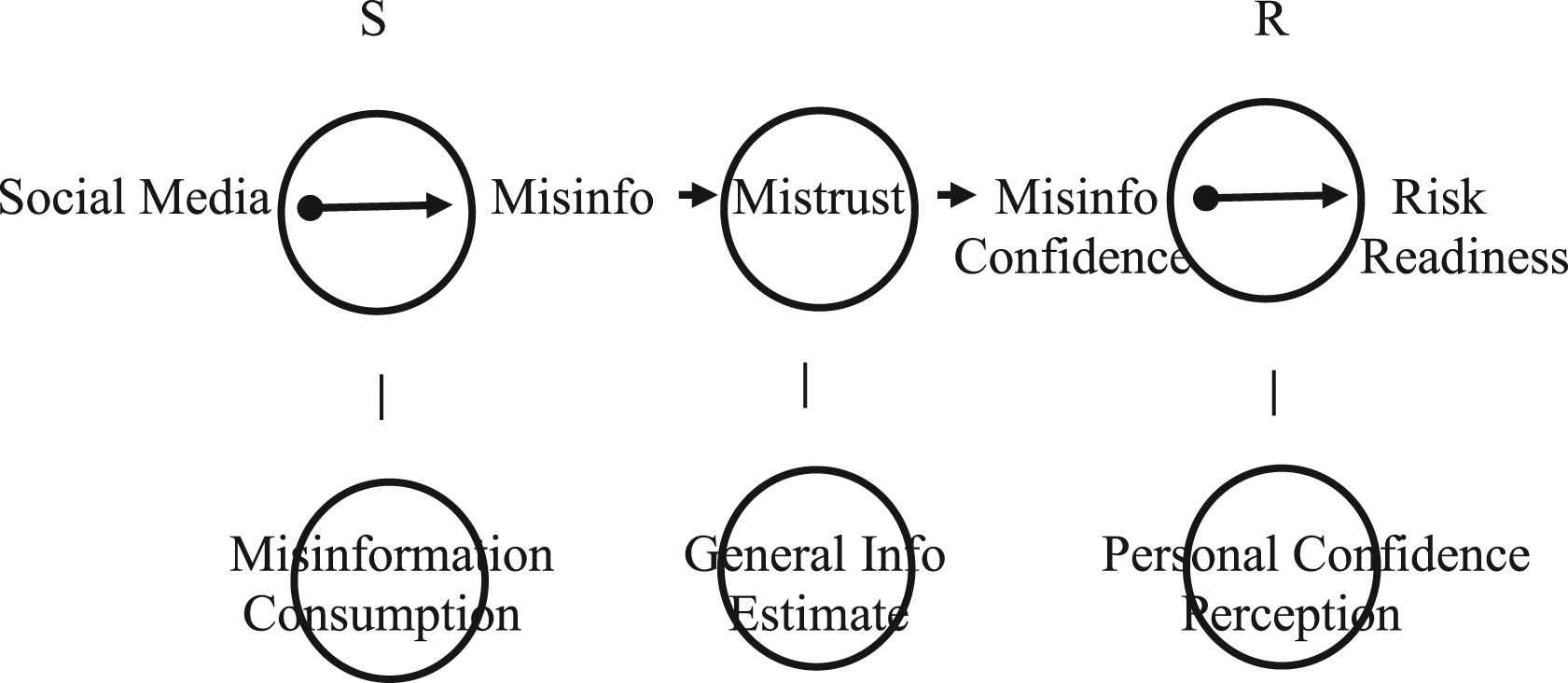
A complexity of social media and its cultivation effects that we explicate arises from the outlandish nature of misinformation concerning Covid-19—for instance, one is forced to ponder a wild possibility of 5G cell towers transmitting Wi-Fi coronavirus. Here we are agnostic about mis-informational content per se. Instead, we explore the influence from a shred of social media information that happens to share questionable veracity with no clear origin of genesis. This sets us apart from the dependent variable of original cultivation hypothesis that purported to measure a tight congruence between what is represented and what is perceived. In so far as misinformation is concerned, what is being cultivated, as we argue, is not what is in the literal level of information but what is in the meta-level of information. Scholars (Potters, 1994; Shrum et al., 2011) recognized this as the second-order cultivation—derivative risk estimate of “mean worlds,” rather than the first-order perception about the likely frequency of violent crime occurrence as depicted in local news outlets. Our conjecture derives from this as a similar step to the second-order cultivation, but analytically we place an emphasis on antecedent cognitive process and its consequence, as individuals may be conditioned to perceive “informational mean worlds” to be full of Covid-19 related risky, plainly false, or confusing information.
That is to say, a preponderance of misinformation and its subsequent exposure in social media use will create a representational view about one’s surrounding environment filled with mistrustful informational veracity (H1), and we expect that this informational mistrust will bring about negative perceptional consequences, as indicated by one’s diminished confidence in discerning misinformation (H2a), which will lower one’s perceived readiness for Covid-19 risk (H2b). It has been established that the absence of trust toward one’s social environment serves as an antecedent cause of dismantling individuals’ confidence in that environment (Lewis, 2019; Siegrist et al., 2005). Likewise, the mistrust over questionable informational veracity may be a catalyst for eroding individual confidence in telling difference between facts and non-facts specific to Covid-19. We also have empirical evidence that shows the significant association between trust and individual decisions related to risk estimate (Uslaner, 2013). From this, we can expect that the lack of (mis)information confidence, once triggered by informational mistrust, will be negatively associated with one’s self-risk estimate on perceptional level that precisely relates to handling the subject matter of that information—in this case, being ready against Covid-19.
Apart from the cognitive process of intra perceptional reasoning within individuals, we predict that the reception of (mis)information never precludes the external societal process in which those individuals interact with one another. In fact, evidence suggests that the presence of interactive societal ties might function as a corrective filtering mechanism that competes with the role of informational mistrust exerting its inhibiting influences on individual confidence. In the field of social psychology, for instance, Lee et al. (2018) discovered that the feeling of self-confidence often emerged from the presence of supportive relationships in community settings. A direct evidence was found in an experiment by Bode and Vraga (2015). Their study discovered that public misconception at the spread of Zika virus could be fixed or reduced, when participants in their Facebook uses were manipulated with a supply of corrective sources, and this suggests that the presence of societal ties, which supply alternative and competing information, can benefit individuals with exposure to diverse perspectives resulting from a width of interpersonal dialogues and a variety of information resources.
Our logic is close to a thesis by Wellman et al. (2003) in their NetLab community life study. They found that online modes of interaction, which emerged in the early 2000s, did not replace but rather transform communicative relationships by supplementing community functions. This supplementary function between online and offline, as we theorize, will also be the key in translating social media misinformation, as interactive ties have been the fundamental interpretative building block for individuals. Accordingly, we hypothesize about the function of such non-social media societal ties in filtering off misinformation cultivation in its antecedent and consequent process (H3). Granted the potentially effective intervention of a factual correction that is specific to respective pieces of misinformation, this general-level social inoculation might work, as individuals with interpersonal opportunities are more likely to encounter counter-viewpoints that discredit and contradict unfounded rumors or misconceptions.
Methods
Sociodemographic characteristics of sample (n = 9,751).

Note. Entire dataset is available for download (ATP, American Trends Panel, April, 2020) at https://www.pewresearch.org/internet/2020/04/30/covid-internet-methodology/
Following procedures were employed for empirical tests. First, we used Poisson’s regression (count data) to test theorized cultivation processes in H1 and logistic regression (binaries) for H2a/H2b, taking into consideration of measurement scales, as well as other news consumption variables, sociodemographics, and political leaning. For H3, hierarchical regressions were used, as the analysis allows us to roles of societal ties, while separating their explanatory power from prior observations. Thus, we are interested in detecting discrete patterns of each cultivation process. Variables below are organized by the two main processes: (1) antecedent and (2) consequent of informational mistrust, with additional variables of societal tie.
The first set of antecedent variables is social media use, measured as the two kinds of behavior (sending and receiving news-information about coronavirus on Facebook, Twitter, or Instagram), and misinformation exposure, as indicated by the number of Covid-19 rumors to which an individual was exposed. In counting the number of misinformation exposed, each respondent had the option to choose any of the followings: miracle breach cure, blood plasma transfusion, hydroxychloroquine treatment, vitamin C preventing coronavirus spread, virus disappearing in warm weather, and 5G mobile virus transmission (Min. = 0, Max. = 6; M = 1.37, SD = 1.28).2
The second set of consequent variables consists of the two confidence variables, measured on a binary scale as to whether (1) one feels confident in telling veracity of misinformation (misinformation confidence, M = 0.54, SD = 0.49, 1 = “easy” /0 = “difficult”) and (2) one estimates personal readiness in dealing with Covid-19 risk (Covid-19 risk readiness, M = 0.88, SD = 0.31, 1 = “Yes” /0 = “No”). Question for misinformation confidence was: “When you get news and information about the coronavirus outbreak, do you generally find it easy or difficult to determine what is true or what is not”; For Covid-19 risk readiness, the question was: “In general, do you feel like you have a handle on the issues and developments surrounding the coronavirus outbreak?” For informational mistrust, respondents were asked to estimate the degree, on a 4-point scale (“Not at all” to “A great deal”), to which they view any news-information about Coronavirus a) to be completely false and b) to be confusing to American public. We added these two items to make one scale (M = 6.14, SD = 1.26, inter-item r = 0.46, p <0.01).
Given our interest in counter cultivation by non-social media interaction (H3), we operationalized societal tie in the two dimensions: (1) close community tie (closeness) and (2) frequent interactive tie (frequency). This operationalization fits our focus on the societal locus of an individual, with their respective emphasis on closeness and frequency. Close community tie was assessed on a 4-point scale (“Not at all” to “Very much attached”) by the degree to which one feels closely attached to the local community to which she/he belongs (M = 2.97, SD = 0.77). Frequent interactive tie was measured on a 5-point scale (“Never” to “Almost all the time”) by the frequency with which a respondent engages herself/himself with others to discuss the coronavirus outbreak, whether online, in person or over the phone (M = 3.52, SD = 0.84). Our rationale is to capture variations of existing societal ties, positions, and associated resources that one might usually afford at the reception of misinformation. Thus, this also invites the consideration of sociodemographic and political backgrounds (M = 3.02, SD = 1.07, on a 5-scale of “Very conservative” to “Very liberal”), indicative of one’s relative socio-political stances, all of which variables were accounted in our analyses.
Zero-order correlations.

*p <.05, **p <.01.
Result of hypothesis testing
Predicting misinformation exposure and informational mistrust.

Note. Poisson’s regression was run for count data of misinformation exposure, with its coefficients and likelihood ratio. Chi-square reported for R2. Reported are coefficients for informational mistrust, with standard error in parenthesis.
* p <.05, ** p <.01, *** p <.001.
Predicting misinformation confidence and Covid-19 risk readiness estimate.

* p <.05, ** p <.01, *** p <.001.
Note. Reported is odds ratio, with standard error in parenthesis.
In regard to the final outcome variable of Covid-19 risk readiness estimate, misinformation confidence was a significant and sizeable predictor—the more confidence, the more likely to estimate one’s personal readiness against Covid-19 (odds ratio = 3.92, p <0.000). The absence of direct influence from informational mistrust suggests that its relationship to Covid-19 risk readiness exists only through misinformation confidence—or simply put, indirect. Had the influence from informational mistrust persisted in the model, there would have been both direct and indirect influences from informational mistrust. This indicates that misinformation confidence is a cognitively necessary step, that is, it must be present for mistrust (or the trust over information) to translate into Covid-19 risk readiness estimate. Interestingly, we found the significance for passive social media use being negatively related to Covid-19 risk readiness (odds ratio = 0.92, p < 0.05), indicating that the passive reception of Covid-19 information negatively affects one’s perceived readiness in coping with Covid-19 risks.
Accounting for the roles of societal ties.

* p <.05, ** p <.01, *** p <.001.
Note. Reported of misinformation confidence and Covid-19 risk readiness estimate are odds ratios; standardized coefficients are for informational mistrust.
Poisson’s regression was run for count data of misinformation exposure, with its coefficients and likelihood ratio.
Chi-square reported for R2. Parentheses are standard error.
We found the same opposite pattern of significance in predicting Covid-19 risk readiness estimate (odds ratio = 1.27, p <0.001 for close community tie; odds ratio = 0.85, p < 0.001 for frequent interactive tie). The opposite significance does not support H3, but oddly, it does lend its support to our premise that increased conversational volume alone does not necessarily produce positive outcomes—also pointing that what matters is not the frequency but the perceived quality of societal closeness, which helps build the confidence in telling informational veracity or in getting ready against Covid-19 risk. In predicting mistrust, none of societal tie dimensions were statistically significant, providing no support for either frequent or close societal tie reversing the antecedent process leading to informational mistrust. In predicting the level of misinformation exposure, we also found that close societal tie was not statistically significant but frequent tie was (β = 0.09, p <0.001), indicating that the higher frequency of interactive ties was related to the greater level of misinformation exposure, as frequent societal interaction in the context of misinformation did not necessarily produce positive outcomes.
Finally, though not hypothesized, the findings for political leaning and sociodemographic variables must be noted, given the exposure to misinformation does not happen in socio-political vacuum (see Table 1 and Table 2). We also draw attention to these variables, as misinformation exposure and confidence are the important reference points of our analysis. Younger people, for instance, were less likely to report the exposure to misinformation (β = 0.04, p <0.001), even though they were still weary and generally more likely to be mistrustful of Covid-19 information (β = −0.10, p <0.000). Notably, nonwhite minorities reported more exposure (β = −0.25, p <0.001), raising a concern that minority groups may be disproportionally exposed to misinformation about Covid-19. Those with politically conservative beliefs also reported more misinformation exposure (β = −0.03, p <0.001), while also being less confident than those with liberal beliefs about whether they were able to tell the veracity of Covid-19 information (odds ratio = 1.64, p < 0.001).
Discussion
Summary of findings
Our theoretical proposition is that the original premise of cultivation theory (Gerber et al., 1980) can be adopted in understanding social media use, exposure to misinformation, and its perceptional influences. We illustrate this through the application to Covid-19 related misinformation by examining the antecedent and consequential process of informational mistrust—namely, a belief that the world is full of confusing and misleading sets of information. This is interesting, because of the social prominence of the pandemic especially at its peak of informational uncertainties in April, 2020 when data were collected. Our specification of cultivation process is also to answer a call from Potter (1991, 1994) in his longstanding quest for precisely “why” and “how” cultivation is actually at work. We found supports for our hypothesized model in which the higher exposure to Covid-19 misinformation, as promulgated in both active and passive social media uses, were significantly related to informational mistrust, which were linked to a lower level of confidence in telling the veracity of misinformation, bringing about a negative consequence in how one estimates her/his own readiness in coping with Covid-19 risks. The results on the formation of mistrust and its influence on confidence as well as Covid-19 risk readiness estimate support the current study’s expectation that misinformation is likely to initiate specific sets of cognitive responses by cultivating negative perceptions. Importantly, these findings are in line with broader literature that discovered relationships between mistrust and low confidence (Williams, 2005), with (1) increased reliance on social media as one of (mis)informational sources cultivating our perceptions about the world and (2) trust over one’s environment turned out to be associated with (mis)informational exposure, swaying the likelihood of eroding individual confidence (Tsfati, 2010).
However, our result is at odd with media-deterministic perspective, illuminating the importance of examining underlying societal mechanism. In exploring potential roles of social ties in countering cultivation effects, we found that societal closeness (quality) is critical in supplementing individuals’ reasoning outside of social media, forging positive influences as found in misinformation confidence. Frequent conversational tie (quantity) alone, on the other hand, made matters worse, diminishing one’s confidence to telling veracity of Covid-19 information. To us, the findings on societal closeness have enormous theoretical potentials that are worth further research. They suggest that so far as to curtailing negative perceptional consequences of misinformation, effective solutions are to promote community or group-level buffers or cohesiveness, which can reside outside of social media. Social psychology literature suggests that interpersonal closeness might buffer impersonal experiences of exclusively computer-mediated interaction (Kalkhoff et al., 2020), possibly indicating that close circles invite individuals to be apart from social media information flow vacuumed of critical feedback or other corrective options.
Granted that such interpersonal interactions presume a certain level of closeness and trust among the users, it is intriguing to see the possibility within the social media platform, and our findings are broadly in line with prior studies that identified the societal conditions that encourage quality-interaction. In this vein, we do not have immediate answer, with our dataset, as to precisely how societal mechanism might function to reverse cultivation against misinformation. But we suspect that the general trust that is related to having close community attachment of societal ties, as well as personal-level connections, might be in potential mix, especially when interactive settings are egalitarian and thus afford opportunities to filter in and out diverse interpretations (Lee et al., 2018; Park and Chung, 2017; Park and Jones-Jang, 2022; Uslaner, 2012).
The findings on the negative relationship between frequent social communication (frequent interactive ties) and one’s confidence in telling misinformation necessitate more empirical research. For instance, future research can possibly observe and measure how diverse or fragmented individual-level contacts within community-level interactions bring out positive perceptions. From the conceptual point of view, our thesis is that exposure to misinformation in accumulation in itself can result in negative consequences such as mistrust, and ill-confidences. As the process of cultivation revolving misinformation on social media is collectively interlaced, our study provides insights to this cultivation process by explaining how an individual’s increased amount of social media use can lead to an increased exposure to misinformation, formation of informational mistrust, and ill-confidence in one’s ability to tell veracity of (mis)information and correctly assume the risk, while still offering a possibility of positive outlook through societal inoculation against misinformation. We summarize the current study’s theorization in Figure 2 to highlight media form (social media), substance (misinformation), and consequences (information confidence and Covid-19 risk readiness estimate), with extraneous factors of societal ties in their potential roles. Social media (Form), misinformation (Substance), and intervention outside platforms.
We anticipate the criticisms at the three fronts. First, conceptually, the dependent variables of our proposed cultivation, especially of mistrust, are not to observe a precise correspondence between what is represented in (mis)information and what is perceived of the content of that (mis)information, as in the original cultivation. Second, there is an alternative temporal-order possibility in which the cognitive variables are antecedents, rather than resultants. For example, unlike our model, misinformation confidence can precede informational mistrust. Although we reasoned our model based on prior studies, this temporal reversal deserves a consideration. Third, the use of secondary data posed limits in measurement: several measures with binary response options fell short of measuring cognitive variations. Such limits constrained us from testing alternative models, for instance, a single unified structural model with latent variables.
The best defense against the above criticisms would be to clarify this study’s conceptual contribution and its intended scope in the hope that future studies overcome our study’s shortcomings and test to replicate our findings. As for the first criticism, we do not see that it will be entirely fruitful to measure the fidelity of cognitive translation from the content of misinformed rumors to the misinformed mental state. A precise match between misinformation content and perceptions may be an interesting enterprise in itself. That said, we are not certain if in the context of misinformation, we will have all necessary factual reference points against which to measure the accuracy of a (mis)match between facts and perceptional variations (Pelzer and Raemy, 2020). Instead, we argue that misinformation does entail a shift in the focus of cultivation from the literal content of (mis)information to the (mis)informational environment that is bound to cultivate seemingly misleading, confusing, and misinformed rumors. Importantly, this environment-level cultivation is not at odds with broad perceptional activation postulated by prior cultivation studies. As earlier works (Potter, 1994) began to shift their focuses on television as the broad cultivating source of shared social images, later studies also recognized informational platforms as common symbolic environments within which viewers are socialized (Bonfadelli, 2010; cf. Park, 2021).
In regard to the second criticism, unless we have (1) a controlled experiment that manipulates one’s exposure to misinformation or (2) a time-series panel design that tracks over-time variations in the level of exposure, the cross-sectional nature of our analysis lends no certainty to the proposed sequence in our model. The justification, however, can be made conceptually. For example, it seems less plausible to project that a psychological state, such as one’s low confidence, will precede a decision to expose themselves to (mis)information. Evidence showed that low confidence results in low motivation to seek information, as efficacy in one’s abilities generally arises first to enhance self-serving informational pursuit (Bénabou and Tirole, 2002). Furthermore, considering that the exposure to misinformation is not particularly unique of one’s active or passive social media use, it is less likely that users have an intentional choice over whether their social media use exposes them to misinformation, to begin with. The same may be true of the relationship between the outcome variable of Covid-19 risk readiness estimate and the antecedent of social media use. Though not impossible, it is less likely that negative self-outlook concerning Covid-19 emerges as a pre-step to seeking social media engagement (Lin et al., 2016). In fact, the preceding roles of trust (or mistrust) to perceptional and attitudinal variables have been established in social psychology literature and more specifically, in studies that investigated positive outcomes of trust (Uslaner, 2013).
We will be defenseless, with our binary items, to the demand for a unified modeling. Discrete patterns of our interest, however, warrant microscopic views on each step of the proposed sequences. Such discrete inspection enabled us to discover the presence of indirect relationship between mistrust and Covid-19 risk readiness estimate via misinformation confidence—a possibility in which the consequence of mistrust is delicately contingent upon a mental calculus of how one estimates to be informationally able. If we restrict the scope of this discrete view only to the true substance of informational component (i.e., exposure, mistrust, and misinformation confidence), we see clearer respective cultivation patterns, within which (1) exposure makes a positive contribution to informational mistrust (r = 0.14, p < 0.00) and (2) mistrust makes a negative contribution to one’s misinformation confidence (r = −0.12, p < 0.00), as in upper and lower graphs in Figure 3. Surely, future studies should replicate our thesis in other contexts, using more sensitive scales. But beyond this obvious call for better scale development, binary items offer us a closer look to logistic distribution that can be efficiently parceled into, for instance, two discrete levels of confidence (Yes or No) for easier interpretation over the presence or absence of cultivation. This might be another defense against a general critique about the cultivation thesis masking quadratic-curvilinear relationship between media and perceptions (significance does not hold true for those at the low end of consumption, see Potter, 1991), with no concern over overall model fitness that is sensitive to sample size. Cultivation in discrete patterns.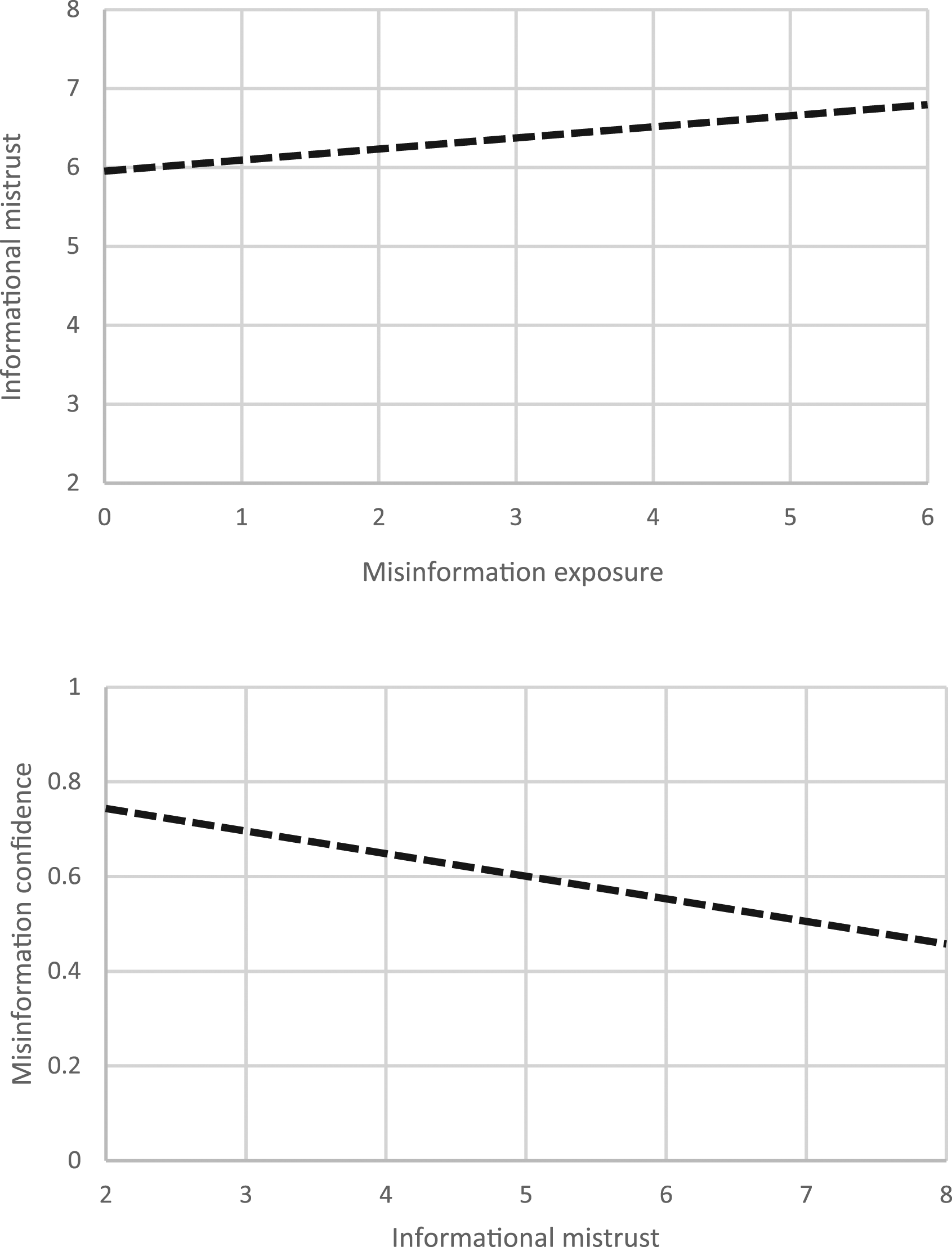
Nevertheless, we caution readers about the limitations of a cross-sectional survey. Future debates will benefit from panel studies, using specific platforms such as Facebook. If it is possible to track how the spread of Covid-19 misinformation at a prior point in time triggers a sequential process of instilling mistrust and the lack of confidence at a later point, we have an argument for causal directionalities—generating clarities on how cultivation in producing negative perceptional consequences, particularly mistrust, goes through interlinked steps in the context of unfounded rumors, misinformation, fake news, or alike.
Conclusion and implication
Misinformation often leaves cognitive imprint that can persist in memory, outlast a quick moment of exposure, and defy intentional corrective efforts. This is illuminating, considering the argument by Napoli (2018) who argued that social media ecosystems challenge a counter-speech doctrine which would assert that an insertion of more speech fixes and helps public reach the veracity of information. It is worth noting that we are not dismissive about a suggestion that functional features like crosschecking sources can be an effective corrective tool. Yet we are concerned that social media platforms with their institutional gatekeeping power exert exclusive controls over public information at their whim, setting the condition under which misinformation in its sharing and distribution remains “sticky.” As we documented in this work, misinformation, once it sets in motion, will be hard to reverse its influence without persistent institutional effort—for example, to improve algorithm designs that mitigate misinformed traffic (Tandoc et al., 2020; Park and Jones-Jang, 2022). Our finding that misinformation exposure was significantly related to Covid-19 news-following makes it also hard to be optimistic about good will of media institutions, whether increased access to news-information takes a form of social or traditional media consumption.
Our conceptual contribution is to shed a newer light on the cultivation thesis in understanding misinformation and its influence. Like local television watching tends to cultivate certain perceptional views about the mean world, misinformation in social media can cultivate informational mistrust, a view of the world full of misleading information. As our use of cultivation includes personal-level perceptional consequences, we argue that it is conceptually possible to specify the process between S and R, in which cognitive calculus can be translated into negative risk estimate, further raising the possibility of existing societal ties in countering such cultivation. On a more practical note, the current study provides (social) media industry with deeper understandings of how users might end up constructing pessimistic risk perceptions consequential of their products. Naturally, lessons for the industry should extend to their effort to design platforms with better algorithms that can mitigate misinformation dissemination. Because of a global scale of Covid-19 pandemic that affects virtually everyone, this directs to the industry’s realization that social media should not simply function to cater to the demands of advertisers, just because outlandish mis- and dis-information travels well and creates traffic in the same way local news media outlets (used to) sell violence to create attention.
On a final front, we speak to the complexity of cultivation hypothesis, on the one hand, as there can be a precisely interlinked sequence that is identifiable for misinformation to influence or shape informational mistrust. On the other hand, we also see the parsimony of cultivation for its predictive validity, whereby misinformation exposure in social media use eventually increases negative risk perceptions. The several decade-old media effect theory still offers tremendous room in advancing our understandings of new (mis)information problems.
Notes
1. We are limited by self-reported measures. It is possible that respondents had not even realized their own exposure to misinformation, but question wordings rather forced them to recall. The extent to which respondents were vulnerable to selective retention would have hindered our analysis from capturing valid exposure and its consequences. 2. Acknowledging that there was no clear definition of misinformation given to respondents, their perceptions or meanings taken out of respective exposures may have been different from what constitutes as “misinformation” or “fake news.” By counting the total number of misinformation exposed, however, our measure attempted to be true of the preponderance of exposure as in the original cultivation hypothesis.
Footnotes
Declaration of conflicting interests
The author(s) declared no potential conflicts of interest with respect to the research, authorship, and/or publication of this article.
Funding
The author(s) received no financial support for the research, authorship, and/or publication of this article.
