




Abstract
In times of increasingly precarious media work, being recognized for one’s performance has become more and more important for journalists’ sense of well-being and can even constitute a competitive advantage in the journalistic field. As material forms of recognition, journalism awards decisively contribute to accumulated journalistic capital and work as an instrument of cultural hierarchy within the field. However, despite the growth in journalistic prizes and the added importance of recognition in times of crisis, we still have an incomplete understanding of how journalists themselves assess the meaning of awards for their position in the field. In this study, we therefore focus on journalists’ evaluations of awards. Drawing on 40 semi-structured interviews with young awarded journalists we explore the meaning of prizes to better understand the relationship between recognition and capital. Our results indicate that from the perspective of awarded journalists receiving an award does not automatically contribute to prestige and hence the accumulation of journalistic capital. Instead, our study suggests that journalists consider prizes to be an ambiguous and ambivalent form of recognition. Whether an award is considered prestigious depends on aspects such as its scarcity, its sponsors, the composition of juries, the visibility of the award in the industry as well as the genre and category that is awarded.
Keywords
Introduction
At a time when journalists increasingly experience job insecurity, precarity, audience hostility and threats to their autonomy, positive experiences such as being recognized for good work are arguably more and more important for their sense of well-being. Such recognition – material or immaterial – can fulfil vital functions for journalists, even if they no longer guarantee job security (Örnebring et al., 2018). For example, recognition potentially enhances journalists’ job satisfaction and work motivation (Beam, 2006), adding to their desire to stay in the job despite the drawbacks they experience.
One of the material forms of such recognition are journalism awards (Willig, 2013: 380), which serve two key purposes: First, by identifying exemplary journalistic work and actors they display what (and who) belongs to the field and what (and who) does not (Lough, 2021). In that sense, awards are a means of journalistic boundary work (Carlson, 2015). Second, as an „emblem of recognition of journalistic excellence” (Volz and Lee, 2013b: 249), they are signs of quality (Swiatek, 2019) and separate the elite from the ordinary.
Previous research has studied the meaning of awards in general (e.g. English, 2002, 2005) and journalism awards in particular (e.g. Jenkins and Volz, 2018; Volz and Lee, 2013a, 2013b) from a Bourdieusian perspective. Journalistic prizes can thus be understood as indicators of journalistic capital and are conceptualized as conditions for and consequences of cultural, social, economic, and symbolic capital in the journalistic field (Hovden, 2008; Wahl-Jorgensen, 2013; Willig, 2013). Since competition for various forms of capital is the essence of social fields (Bourdieu, 1990a), prizes have a vital meaning as signaling field-specific resources. Not surprisingly, Shepard (2000: 22) observed a „pursuit of the prize” in American newsrooms, arguing that journalists are obsessed with awards.
However, awards also have downsides. In fact, English (2005: 22) refers to cultural awards in general as „a debased coin”. The sheer growth in journalism awards (Swiatek, 2019), the emergence of dubious sponsors from outside journalism (Jenkins and Volz, 2018), as well as the tendency to award well-known journalists while failing to recognize emerging forms and marginalized actors (Lanosga, 2015) may lead to ambivalence among journalists about awards (Heinich, 2009).
Despite the growth in journalistic prizes and the added importance of recognition in times of crisis, we still have an incomplete understanding of how journalists assess the meaning of awards and to what extent the pursuit of the prize influences journalistic practices. In this study, we therefore focus on journalists’ evaluations of awards, responding to Jenkins and Volz’s (2018) call for more nuanced analyses of how journalists view awards. Drawing on 40 semi-structured interviews with young awarded journalists we explore the significance and meaning of prizes, in an attempt to better understand the relationship between recognition and capital.
Literature review
(Peer) Recognition and job satisfaction in journalism
From a field theoretical perspective, agents in a social space such as the journalistic field struggle over meaning and recognition. The result of this struggle depends on actors’ position in the field, where some have greater relative power than others. Occupying such a position requires possession and accumulation of (im)material resources which are largely conceptualized as economic, cultural, social, and, most importantly, symbolic capital (Bourdieu, 1986). While economic, cultural, and social capital are resources that actors acquire through time-labor, 1 symbolic capital refers to the symbolic effects that some of these resources can have when they are perceived as more valuable than others (Bourdieu, 1990b). Journalistic capital, the specific symbolic capital in the journalistic field, encompasses the knowledge, perceptions and practices that are perceived as more valuable than others, for example investigative reporting or hard news beats (Schultz, 2007; Vera-Zambrano and Powers, 2019). It is thus also linked to renown, recognition and prestige and is often measured through journalistic awards (Hovden, 2008). Field-specific symbolic capital is therefore a key indicator of field membership.
On the one hand, recognition conveys belonging. To be approved by the field’s establishment is a basic requirement to compete for field-specific capital. Such recognition accords the symbolic resources of prestige and credibility, and can subsequently translate into material rewards (Carlson, 2015). Consequently, those claiming a place in the field seek recognition from the establishment to achieve legitimacy. Digital native news organizations like BuzzFeed and Vice, for example, initially tried to establish a place in the field by achieving legitimation through both peer and public recognition (Stringer, 2018). Studies also suggest that particularly journalists with lower professional reputation use social media to garner peer recognition (Maares et al., 2021; Powers and Vera-Zambrano, 2018).
Recognition is also about the appreciation of journalistic quality with praise from a colleague or appreciative remarks in the newsroom being signs of immaterial symbolic capital (Willig, 2013). Journalists who are recognized by their supervisors report higher job satisfaction (Beam, 2006), while those who lack peer appreciation are more likely to be pushed out of the profession (Viererbl and Koch, 2021). In times of increasingly precarious media work, such recognition takes on additional importance as the lack of material security through pay and employment threatens journalists’ job commitment (Davidson and Meyers, 2016; Gollmitzer, 2014) and negatively impacts their job satisfaction (Reinardy, 2011). Appreciation of their work may ease the pain of diminished material rewards and has the potential to result in more stable positions – though it is in no way “correlated with stable working conditions in a linear fashion” (Örnebring et al., 2018: 410). Since especially young journalists suffer from low levels of job satisfaction due to unstable working conditions (Reinardy, 2011), receiving recognition for their work may be particularly important for them.
The award culture in journalism
While feedback and appreciation from different stakeholders constitute immaterial forms of recognition, prizes can be considered material ones (Willig, 2013: 380). However, their benefits do not only relate to prize money and prospects for promotion but also to more symbolic dimensions such as prestige, merit, and self-confidence, providing a „rich-terrain for studying recognition” (Heinich, 2009: 86).
The journalistic field has witnessed enormous growth in awards over past decades (Jenkins and Volz, 2018; Swiatek, 2019), reflecting the heavy reliance on credentials as markers of achievement in contemporary societies (Swiatek, 2019) and indicating the need for material and symbolic recognition, particularly in precarious professions. As in other fields, awards in journalism are „most visible tokens of recognition” (Beam et al., 1986: 693) for individual (journalists) and collective (media organizations) actors. Awardees are deemed exemplars of what constitutes good journalism and hence represent “the field of journalism as it aspires to be” (Lanosga, 2015: 955).
In that sense, prizes can be considered tools of distinction in two ways: First, by providing or refusing recognition, they act as boundary markers that distinguish between journalism and non-journalism (Carlson, 2015). They may expand traditional boundaries by awarding emerging forms of journalism and peripheral actors, but can also protect the autonomy of traditional journalism by only awarding the core of journalistic practice and refusing to acknowledge other forms. Accordingly, research has referred to prizes when sampling journalistic actors and artefacts that the field itself acknowledges as (exemplary) journalism; e.g. when studying data journalism (Loosen et al., 2020). Second, journalism awards serve as emblems of “recognition of journalistic excellence” (Volz and Lee, 2013b: 249). Previous research has drawn on this self-selection by the journalistic field and analyzed award-winning stories to identify not only what counts as journalism but also what is considered outstanding in the field itself (Wahl-Jorgensen, 2013).
Prizes thus decisively contribute to accumulated journalistic capital (Örnebring et al., 2018) and work as an instrument of cultural hierarchy within the field (English, 2005: 54). Equipped with cultural capital, prize-winning journalists have better prospects to reach sources, to connect with colleagues, and to receive pay raises and promotions (Willig, 2013: 380). Hence, being awarded not only enhances prestige but is likely to result in higher social and economic capital. Although many journalism awards are endowed with prize money, their value is not primarily in cash (Lanosga, 2015), but in longer-term consequences for material security and access to resources. Due to their potentially great impact on all forms of capital, prizes are vital resources in the journalistic field.
(Shepard, 2000) vividly described how this promise of a competitive advantage initiates a “pursuit of the prize” in US news organizations. Their annual calendar is largely governed by submission deadlines for awards; they employ staff to deal exclusively with the preparation of such submissions, and they encourage journalists to cover stories that are perceived as particularly likely to win an award. An analysis of the Pulitzer Prizes’ entry and jury materials further suggests that the awarding of prizes represents an “exercise of real power” (Lanosga, 2015: 965). Accordingly, newspapers strategically plan their coverage and nominations to match criteria that are perceived as award-worthy. Hence, the pursuit of the prize appears to affect journalistic practice, with potentially serious consequences: Cases of individual journalists, such as former SPIEGEL journalist Claas Relotius, who fabricated stories to match perceived jury criteria, have had a detrimental effect on the credibility of journalism as a whole (Lünenborg and Medeiros, 2021).
The power to define excellent journalism has traditionally been exerted by fellow journalists, rather than the general public (Jenkins and Volz, 2018). With the growth and diversification of prizes, however, non-journalistic actors increasingly contribute to definitions of valuable journalism and can – through founding and sponsoring awards – engage in definitional struggles over what is journalism (Jenkins and Volz, 2018: 937).
Still, the more renowned prizes tend to be awarded to journalists and news organizations who are already prestigious, excluding marginalized and emerging actors (Volz and Lee, 2013a). The Pulitzers, for example, have been argued to serve the function of keeping „certain kinds of newspapers, journalists, and stories out of prominence rather than in it” (Lanosga, 2015: 963). In fact, gender, place of birth and education are aspects that affect the prospects of winning a Pulitzer for international reporting (Volz and Lee, 2013a.).
Theoretical synthesis and research questions
Despite the number of studies into journalism awards, we still know little about the perceived function of awards for those who compete for capital in the journalistic field, i.e. news organizations and journalists. The literature suggests that awards have the potential to build symbolic capital for journalists. In times of increasing job insecurity and with new entrants on the periphery of journalism, such capital seems particularly necessary to legitimize belonging to the field as well as to improve job prospects. However, while such considerations emphasize the benefits that come with an award, there is reason to believe that awards do not necessarily contribute to accumulating capital (Hovden, 2008; Willig, 2013) and may even jeopardize the position of awardees in the field. This points to the ambivalent nature of journalism awards, an aspect that has not yet been investigated from journalists’ perspective. We know little about how journalists assess the value of prizes for gaining a foothold in journalism, to what extent they engage in pursuing prizes and how this affects their journalistic practice. Of course, as members of a field of cultural production, in which aspiration for economic and symbolic reward is often disguised as disinterestedness (Bourdieu, 1996), journalists cannot always be expected to attach exceptional value to awards when asked to reflect their importance in self-reports. Still, given the lack of related research (Jenkins and Volz, 2018), we believe considering journalists’ perspectives is valuable. To address this research gap, we focus on young journalists, taking into account that they have been shown to be particularly affected by the symptoms of the journalism crisis and are therefore especially in need of recognition. From these considerations, we derived two research questions:
Method
To answer the research questions, we conducted semi-structured interviews with 40 young Austrian journalists who had all received the same award for their early-career achievements. The “Top 30 under 30” award is conferred by Austrian industry magazine Der Österreichische Journalist [The Austrian Journalist] and is given annually to the 30 best journalists below the age of 30. The award was chosen deliberately as a sampling criterion because it ensured a substantial number of potential respondents and allowed for better comparison given the award was the one thing all respondents had in common. Further, the award itself could be characterized as somewhat ‘awkward’. Winners are nominated by fellow journalists or superiors, usually their employer’s editorial board, for their body of work. However, as our respondents remarked, the procedure that ultimately leads to being included in the list remains rather obscure. Since the award’s inception in 2011, 180 young journalists in total had been listed at the time of sampling in 2018. 2 Awardees must be employed by Austrian media outlets or work as freelancers for Austrian media organizations.
The Austrian media system is characterized by a co-existence of public service and private broadcasters (Steinmaurer, 2009), and the market is largely dominated by two media organizations: public broadcaster ORF (Seethaler and Beaufort, 2021) and the tabloid newspaper Kronenzeitung (Media-Analyse, 2021). Austria’s media system suffers from many of the symptoms of the broader crisis in journalism (Grünangerl et al., 2021) and is characterized by a highly competitive job market for journalists (Hummel et al., 2012). Hence, receiving recognition can be considered particularly desirable. Not only is Austria’s media system similar to that of other Western democracies, the award culture can also be considered comparable. The website newsroom.at, which claims to provide the most extensive database on journalism awards, lists 411 different awards in 14 categories. These include highly-renowned prizes such as the Dr Karl Renner-Publizistikpreis, as well as highly specialized ones like Das Silberne Pferd [The silver horse], an award for the coverage of Equestrian sports in digital media, endowed with 6000 Euro.
For our study, we identified 40 respondents following a structured but randomized sampling process. We chose a roughly similar number of journalists from each of the six cohorts of awardees, and ensured an equal share of male and female journalists. Within cohort and gender criteria, sampling was random. When they were chosen in the “Top 30 under 30”, our respondents were aged between 20 and 29. Half worked (primarily) for print media, five for TV, and six for radio programs; eight were employed by online outlets and one by a news agency. At the time of interview, the youngest respondent was aged 24, the oldest 37, with all respondents still working as journalists. Most had remained at the news outlet they worked for when winning the award. Thirty were in stable employment.
Interviews were conducted by trained graduate students in December 2018 and January 2019; 30 were conducted face-to-face and 10 via telephone, using an interview guide with open-ended questions. From our theoretical considerations on the need for recognition, assessments of journalism awards and perceived influences of such awards on journalistic practices and careers, we developed more specific supplementary questions in order to ensure respondents addressed all relevant issues. Example questions included: “What did it mean to you to be chosen in the ‘Top 30 under 30’?”, “How has this award affected your work as a journalist?”, “What impact do you think this award will have on your career prospects in journalism?”, “How do you assess the significance of other Austrian journalism awards?”, “To what extent do you aspire to win more awards?”. Interviews lasted an average of 45 min, were transcribed by the students and thematically analyzed by the authors of this article, using MAXQDA software. From theoretical considerations and previous research we derived analytical categories such as “importance of material recognition”, “advantages and disadvantages of being awarded”, “engagement in the pursuit of the prize”, and “features of good/bad awards”. We combined this deductive approach with open coding which identified additional themes, such as “impact of awards on social capital”, “awards as a means of legitimation to friends and family”, and “importance of an award’s visibility in the industry”.
Findings and discussion
The meaning of being awarded
In answer to RQ1, we found that all our respondents were pleased to receive their award, arguing it was always better to be recognized than not. However, they assessed the actual value of the award very differently: A few merely referred to the short-term pleasure of being praised but otherwise attached no importance to being chosen, while most respondents did not only feel initial joy but attributed longer-term value to the award. They did not see the prize primarily as an emblem of outstanding excellence but rather as a first-time official recognition of belonging to the field and hence being considered a legitimate journalist. To be chosen for the award was the “first threshold to cross” (2016_m_3) and brought self-confidence as it “makes you feel that you are no longer completely unimportant” (2016_m_3). Respondents attached particular importance to the fact the “Top 30 under 30” awards recognize journalists for their (early) career achievements and not for single stories. Hence, the award was perceived as “certainly good for young journalists to appear on the map” (2013_f_4). Respondents agreed this confirmation of belonging is particularly important when starting out. Said one journalist: “Especially in the early stages of a career, when everyone is struggling for a certain standing, it was particularly nice for me to be able to say: ‘Yes, I belong.’” (2016_f_3) Respondents particularly appreciated the public announcement in the renowned industry magazine Der Österreichische Journalist. This public affirmation of belonging not only boosted self-confidence regarding their status in the newsroom but also signaled to the entire field they had been granted admission.
These findings reiterate arguments that recognition is especially important for beginners in the journalistic field when doubts about the quality of one’s work are greatest (Beam, 2006). The prize conveys a feeling of security and provides some form of social validation (Donsbach 2004). However, echoing Lough (2021), it appears the award primarily offers young journalists recognition of belonging to the field, rather than recognition of excellence.
Moreover, not all respondents aspired for social validation equally. While public confirmation of belonging was important for all, journalists who felt marginalized – for example because of socio-economic background or the beat they covered – ascribed particular importance to such recognition. While socio-economic marginalization differs drastically from working in a less-appreciated beat, as working class and ethnic minority journalists must invest much more effort to adapt to the middle-class habitus of journalists (Bourdieu, 1990b), respondents referred to similar struggles for acceptance and a lack of self-confidence. Being awarded was thus perceived as a decisive game changer; as a second-generation immigrant journalist put it: Many colleagues who didn’t take me so seriously before suddenly took me seriously. Some of them always avoided me before because they thought I was just doing this for fun. Especially when you’re young and not from Austria, it’s very difficult to be taken seriously. (2016_f_2)
Similarly, a science journalist believed the prize signaled to the field that his work was an essential part of it: “That’s a big accolade, of course, and that makes me very happy, and maybe the others will see that we’re not a fringe beat after all” (2017_m_3).
As these examples show, awards can push the boundaries of the journalistic field as they can incorporate more marginal or peripheral forms of journalism by recognizing them as legitimate (Carlson, 2015). They can also play an important role in promoting diversity. It appeared that ethnic minority journalists were particularly dependent on this external and visible recognition to be taken seriously by the dominant core of the field (Hultén, 2009). However, while previous research also points to gender disparities (Volz and Lee, 2013b), we could not find any such differences in our sample.
The prize provided the feeling of being taken seriously, increased self-confidence and eased the constant pressure on young (and, particularly, marginalized) journalists to prove themselves. Being awarded thus had a liberating effect. Some respondents reported this was not just a feeling of relief but had practical implications as it resulted in better access to resources, allowing journalists to continue covering topics which were previously treated as insignificant: I write a lot of stories about gender issues, and this topic didn’t go down well in the newsroom at the beginning. Then I received this award and since then these stories are simply no longer questioned in the same way. Basically, this legitimization from the outside makes it easier for me to write my stories. (2017_f_1)
While respondents valued the award primarily as a first proof of belonging to the field, most also perceived it as recognition for doing a proper job and employing the professional rigor expected from the field. A pre-requisite of the award is a nomination by more experienced journalists. Therefore, respondents perceived the prize as both proof of appreciation by some agents in the field and a trigger that may enhance future reputation inside and outside the newsroom. Accordingly, one respondent highlighted that “you should by no means underestimate how this [being awarded] helps you internally in the newsroom” (2016_w_1). Another respondent pointed out: “It’s kind of cool for your reputation in the industry because everyone notices” (2016_m_1).
Here, too, respondents particularly valued the public announcement in a magazine they considered a must-read in the industry. According to them, this ensured that the entire field not only knew they belonged, but they were doing good work. Taken together, the confirmation of belonging and the appreciation of quality were perceived to provide a leap of faith in one’s work. Again, this perception enhanced self-confidence and primarily reduced doubts among colleagues and superiors about the purpose and quality of the awardees’ work. That way, receiving the award increased respondents’ perceived professional autonomy in the newsroom (Sjøvaag, 2013).
For some respondents, the award not only served as internal legitimation, but also to the outside world – especially friends and family. One respondent stated: “For me personally, the prize was important because it was the first visible thing I could show my parents. So, where I can say quasi-objectively, I stood out.” (2011_m_1) This indicates the importance of the award as a material form of recognition, which is more presentable than immaterial praise and recognition (Willig, 2013).
Even though journalists drew self-assurance from the prize and used it as a visible token of appreciation, our respondents attached little value to the “Top 30 under 30” award as an indicator of outstanding excellence. Demonstrating the somewhat murky selection criteria and processes, the list of awardees is ill-suited to separate the best from the rest because far too many journalists are awarded in each round. As one respondent put it: “The junior staff at major newspapers is limited. That means you can’t really do so much wrong that you won’t end up in one of these rankings at some point.” (2013_f_2) From the respondents’ point of view, not appearing in the list is more a sign of failure. Hence, they attached little symbolic value to the award, and did not believe it would help them add to their economic capital. According to one respondent, being chosen “is a bit part of the career. It is assumed that one will have this award sooner or later anyway” (2018_f_1). Another journalist said that “any decent story you deliver is more relevant to your career than something like this [award]” (2011_m_2). Nevertheless, most respondents admitted they would mention the award when applying for a new job; albeit not to stand out at the top, but rather to not fall off at the bottom. Winning the prize was seen more as a necessary condition for gaining a foothold in journalism, rather than as an opportunity to overcome obstacles.
While rejecting any importance for cultural and economic capital, some respondents indeed appreciated that the prize supported them to establish networks with fellow journalists. Since the prize’s sponsor initiates regular meetings of all awardees, they can get in touch with each other. Such informal networks can provide them with information necessary for their careers, such as vacancies and other opportunities (Hummel et al., 2012). In this way, the award contributes to building social capital in journalism.
Young journalists’ assessments of journalistic prizes in general
While respondents attributed to the “Top 30 under 30” award the validation of belonging to professional journalism in Austria, they also considered it as low in prestige. In response to RQ2, our respondents were highly critical of the award culture in journalism and agreed to large extent with complaints found in other fields (Heinich, 2009), which emphasize the drawbacks of such awards. This does not mean, however, that respondents condemned all awards equally and that they would not take part in the pursuit of prizes.
Importantly, our interviewees distinguished clearly between different prizes, arguing that only two or three actually delivered on the promise of conferring prestige. Only these renowned awards – on which the journalists largely agreed 3 – supposedly really mattered for longer-term reputation. The vast majority of prizes – and hence, the award culture in Austrian journalism in general – was denied the power to identify journalistic excellence and to display what should be considered outstanding journalism. Consequently, journalists assigned no particular function to most prizes in the competition for field-specific capital. Respondents first and foremost explained this low impact with the Austrian award culture in general and the sheer number of journalism prizes in particular. As one journalist put it: “At some point, pretty much everyone gets awards or some kind of medal in this country. The importance is very, very low” (2013_f_2). In such situations, where recognition is no longer scarce, the impact of being awarded is devalued so that it no longer conveys outstanding prestige (Bourdieu, 1990c: 137). It hence fails to confer symbolic capital that would imply a competitive advantage within the field.
However, this does not mean journalists considered all prizes, except for the few prestigious ones, to be meaningless. While they acknowledged that receiving awards may not automatically enhance prestige, they still pointed at the prize money associated with most journalism prizes. Given many did not receive large salaries, they would gladly accept such prize money. Hence, while denying the potential of most prizes to contribute to symbolic capital, respondents recognized short-term benefits for their own economic capital. For our interviewees, contrary to assumptions by Lanosga (2015), the actual economic value of winning an award thus appeared to be in cash rather than in long-term consequences on material security. This points to ambiguous perspectives on economic capital that manifest primarily in the time perspective in which financial resources come into play (Erzikova and Lowrey, 2017; Hovden 2012). There are only a few prestigious prizes that are expected to improve long-term job perspectives and their economic value is thus largely unrelated to prize money. Beyond that, however, there are numerous prizes that are denied symbolic value but are appreciated because they come with prize money. This speaks to the little symbolic value that is given to economic capital in the journalistic field, much like other fields of cultural production and the importance of time for journalists to reach both recognition and financial stability (Bourdieu, 1996: 84). Thus, we must distinguish between short-term and long-term perspectives when conceptualizing economic capital in the journalistic field.
However, respondents expressed concerns about the double-edged nature of most awards that come with prize money. Referring to the fact that such awards are usually sponsored by companies and organizations outside journalism, respondents feared they were primarily intended to serve sponsors’ interests, potentially undermining journalistic norms. Hence, such recognition was not considered to build prestige, but rather came at the expense of journalistic reputation. Said one respondent: There are prizes that are awarded by lobby groups […] where the primary goal is not to award great journalistic work. These prizes are perhaps also vehicles to say: ‘Look, we like you and we’ll give you the prize and there’s a bit of money in it. And maybe you can write a nice story about the topic.’ (2011_m_1)
Respondents were well aware of this potential instrumentalization of prizes and most agreed they would not pursue such dubious awards. As one journalist put it: “I would have a problem with an award for business journalism donated by a bank.” (2011_m_6) Like Willig (2013) has argued, a commercial prize, which is misrecognized in the field, lacks symbolic value and does not contribute to building journalistic capital. In fact, it may even diminish journalistic capital through its negative reputation and resulting suspicion from colleagues. However, our findings also suggest that, in times of precarious employment, such sponsored prizes may still be appreciated by journalists as they provide them with economic capital and secure recognition by precisely those sponsors who might become potential future employers outside journalism (Viererbl and Koch, 2021). This again points to the ambivalent nature of journalism awards for journalists and the complex interplay of different factors when considering the actual value of awards in the journalistic field.
Respondents also confirmed Willig’s (2013: 380) assessment that prizes that are perceived as “unfair” lack symbolic value. In fact, they referred to a general lack of transparency and validity in the selection of award winners, expressing skepticism not only towards some individual awards, but rather to award culture in general. In particular, they criticized the usually non-transparent award criteria and unclear compositions of juries. According to our respondents, such lack of transparency makes it impossible to assess the true value of recognition associated with an award. With regard to the judgement of journalistic performance, interviewees ascribed far more legitimacy to their peers than to non-journalistic agents. Therefore, they did not call for more citizen judges who could give proxy recognition by the audience. Accordingly, the value of recognition depends largely on whether respondents considered judges capable of actually understanding journalistic work. And they attributed this ability particularly to their experienced peers.
But even prizes awarded by journalistic institutions such as trade unions enjoyed a dubious reputation among our respondents. They referred to such awards as a “rigged game” (2013_f_1) in which prizes are usually given to a small circle of already prestigious media organizations, a finding that resonates with research about the Pulitzer Prizes (Volz and Lee, 2013a). As for journalistic capital, it seems more likely that the possession of journalistic capital would increase the prospects of winning a prize than allowing less reputable actors to gain prestige. As such, the schemes of perception that drive distinction are reproduced and do not include new practices, norms or behaviors (Bourdieu, 1990b).
In summary, respondents were highly critical of the awards culture in journalism because, for a variety of reasons, they considered awards unsuitable for identifying and rewarding journalistic excellence. They only referred to a small number of awards which ultimately had the power to contribute to longer-term prestige. Only such exclusive awards thus contribute to the formation of journalistic capital, but even their contribution to career advancements is overestimated, according to our respondents. Strikingly, they still admitted they regularly entered the competition for journalism awards – even for those they actually oppose. Besides material rewards through prize money, they emphasized that such official, material recognition may somewhat compensate for missing feedback in the newsroom. Said one respondent: “There is often simply a lack of recognition and then somehow you want to have something official.” (2018_w_5) In that regard, respondents agreed peer recognition was critical to their job motivation. But disappointed by poor feedback culture in the newsroom, they longed for more formal confirmations of doing a good job – so they entered competitions for journalism.
Except for one respondent who admitted he “would like to now write stories which are somehow prize-worthy” (2013_m_1), journalists typically insisted that the pursuit of awards did not affect their practice. One journalist stated: “You must strive for the best story every day, aiming for some trophy is secondary.” (2011_m_1) Accordingly, stories were written without regard to a prize, but when an award submission deadline approached, respondents admitted considering which of their stories might fit the criteria. The awarding of prizes thus seems to represent an exercise of power (Lanosga, 2015: 966), as it encourages journalists to reflect on what they themselves consider to be good journalism and to select their submissions accordingly. While respondents denied direct impacts on journalistic practices and topic selection, they acknowledged indirect influences, as they anticipated the jury’s criteria when screening the body of their work for award-worthy pieces.
Conclusion
Our results indicate that material forms of recognition, such as receiving an award, do not automatically contribute to prestige and hence the accumulation of journalistic capital. Instead, they suggest that journalists tend to consider prizes to be an ambiguous and ambivalent form of recognition. In answering our first research question, we found that awards are perceived to be particularly important in the early stages of a career, but are also ambiguous. According to our respondents, the “Top 30 under 30” list is not a suitable indicator of outstanding excellence, but primarily conveys a sense of belonging. From this, young journalists draw self-confidence and the feeling they can work autonomously beyond the daily pressure to justify themselves to superiors. Even if its significance tends to be ridiculed, the award is important for establishing oneself in the profession and plays a decisive role in adopting journalistic doxa.
The importance of other awards was primarily discussed in terms of their relevance for journalistic prestige and hence their relation to forms of capital in the journalistic field. In answering our second research question, we found that comparatively young and already-awarded journalists differentiate between valuable prizes, prizes that are pleasant but do not add value, and prizes that can undermine prestige. This ambivalence not only applies to prizes, but immaterial forms of recognition as well. The interviews revealed that journalists compare prizes with other forms of feedback and here also distinguish between valuable, nice and unwanted recognition. They consider appreciation from those they intend to monitor, i.e. politicians and other social elites, and from companies, to be harmful. They find feedback from relatives and the general audience pleasant and gratifying, but not very meaningful. Lay people are denied the competence to judge actual journalistic quality, explaining why our interviewees did not want more prizes to be awarded by the audience – a finding in line with a long-held suspicion of the audience among journalists (Costera Meijer and Groot Kormelink, 2016). Respondents saw only the recognition of those who are experts in the field as truly legitimate. On the one hand, this concerns expert sources who appreciate when a complex issue is covered correctly. But above all, it is about colleagues and superiors who are trusted to really recognize outstanding quality. Consequently, a serendipitous finding is that recognition is not automatically evaluated positively and future research should consider the value of forms of recognition for journalists more broadly.
Crucially, our study found that the journalists interviewed value awards as compensation for the lack of direct feedback in newsrooms. Our findings therefore suggest there is a lack of leadership in journalism that focuses more on positive recognition of journalistic work. Strengthening the feedback culture in newsrooms would be an important practical implication of our study.
Interpreting interviewees’ assessments of journalism awards we can conclude that different forms of journalistic capital are in a complex relationship with each other, and prestige as symbolic capital in journalism arises through the interplay of different aspects. With regard to journalism awards as a material form of recognition, we were able to show that economic and symbolic capital are not mutually dependent, but can even be detrimental to each other. In that vein, economic capital has the potential to undermine journalistic capital. Figure 1 exemplifies how awards can contribute to journalists’ standing in the journalistic field by referring to prizes introduced earlier in this article. Journalists with high symbolic and economic capital occupy more dominant positions in the field (Bourdieu, 1996: 122). Accordingly, the “30 under 30” award is mapped here in the lower part of the space mounted by the two axes of symbolic and economic capital. However, as it offers a first form of official recognition, the award has at least some symbolic value. In contrast, an award like “Das Silberne Pferd”, which offers a high amount of immediate economic capital but has no symbolic value, may harm journalists’ position in the field. As an international reference, the “Pulitzer Prizes” are at the top because they uniquely combine high renown and high prize money. According to our respondents, the awarding of a “Dr Karl Renner Prize” enhances the prospects of a dominant position in the field, even though it does not come with prize money. While the “Prälat Leopold Unger Prize” is endowed with substantial prize money, it does not carry similar prestige and is therefore considered less significant for occupying a dominant position in the field. Spatial distribution of journalism prizes according to the symbolic and economic capital they provide.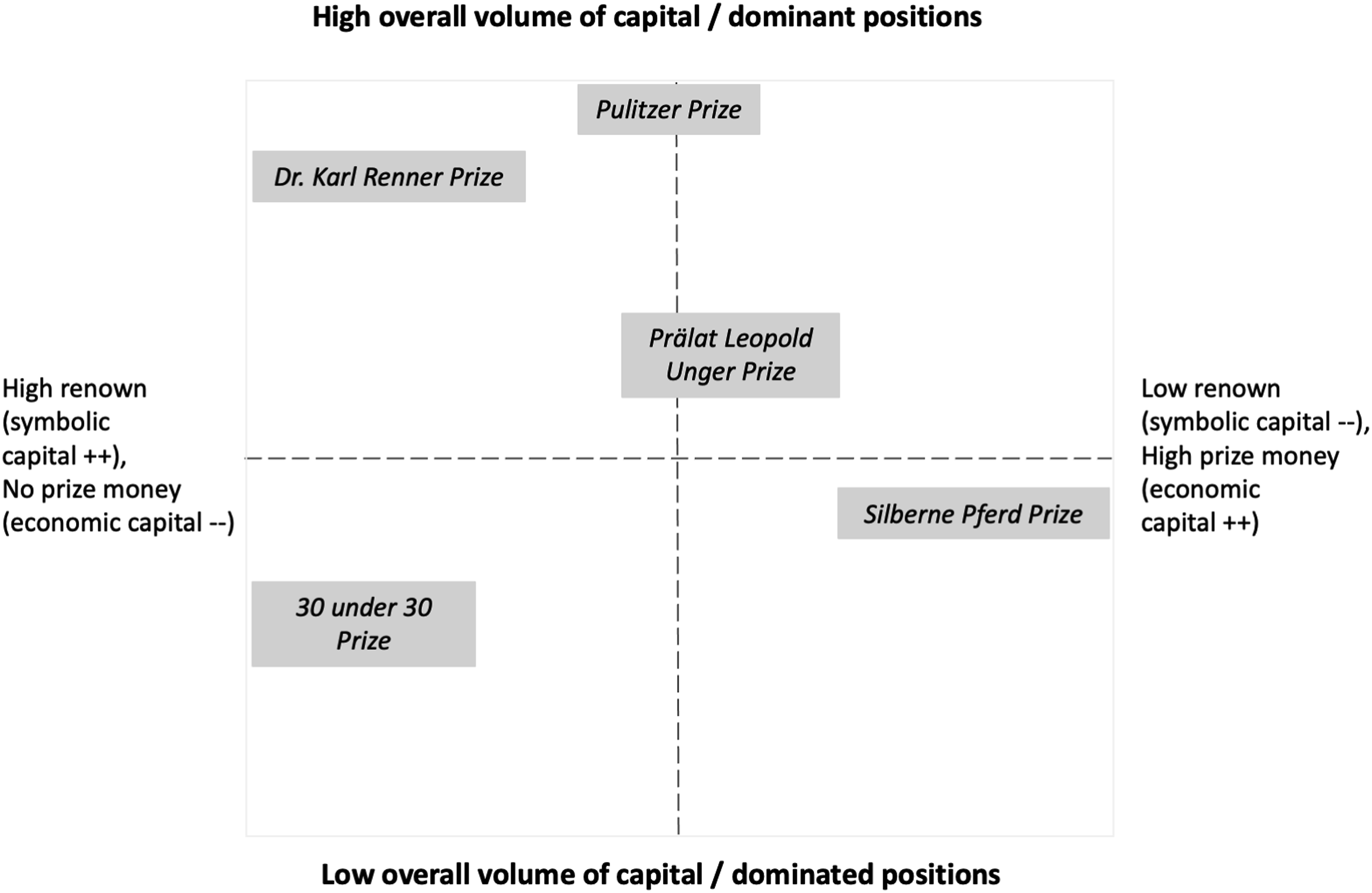
Nevertheless, in the face of precarious employment, it can be tempting for journalists to prefer the short-term benefit of prize-money to longer-term reputation. Our study also shows that winning an award or receiving immaterial recognition does not automatically lead to prestige. Through the qualitative approach, we were able to identify several aspects that are significant for journalists when assessing the value of journalism awards for building capital. These include the scarcity of an award, its sponsors, the composition of juries, the visibility of the award in the industry as well as the genre and category that is awarded. Accordingly, it makes a difference whether journalists are awarded for individual pieces or for their achievements in journalism. Future research should include these (and further) aspects in large-scale studies to understand how such factors interact and ultimately contribute to the building of journalistic capital.
Our study not only suggests that journalists attribute different values to different awards. It also shows there are conflicting views among journalists about the value of certain awards. For example, we found awards are more important for those who feel marginalized for different (socio-demographic or occupational) reasons to achieve a sense of belonging. It would be plausible that those who are precariously employed would be particularly eager for prize money associated with sponsored awards. However, particularly for those who are not yet (fully) established in the core of the field, it may jeopardize a future in journalism if they are violating journalistic doxa by accepting awards from external sponsors. Building on what we know about the socio-demographics of those who have greater prospects of receiving journalism awards (Volz and Lee, 2013a), it would also be valuable to compare journalists based on different criteria such as gender, place of birth, and education. Still, in our present study, assessments of awards did not seem to differ by gender. Moreover, while we deliberately focused on young journalists, it would be worthwhile to examine to what extent early career journalists have a different perspective on awards than their more established colleagues. Based on our findings, it would certainly be worthwhile to analyze which (socio-demographic and occupational) factors affect assessments of immaterial and material forms of recognition.
With regard to concrete awards, we took an open approach in our study and let the respondents themselves talk about which prizes they perceive as valuable or less valuable and why they do so. From this we developed our model which might serve as a starting point for future research in order to compare awards at opposite poles to trace the reasons for these assessments even more precisely.
Our study also calls for more thorough theoretical work on the relationship between different forms of capital and the interplay of different aspects in building prestige. Our finding that prestige does not automatically result from prizes and that different awards may lead to different forms of capital also seems applicable to other forms of recognition. Since recognition plays such an important role, especially in the face of precarious employment in the journalistic field, we believe it is an important endeavor for future research to investigate more closely the complex and multifaceted nature of material as well as immaterial forms of recognition in contemporary journalism.
Naturally, our study comes with limitations. We relied on journalists’ self-reports, and it would be interesting to triangulate these with more objective observations of the effects that awards can have on journalistic practice and careers. Further, our sampling decision to rely on winners of one particular award may have skewed the diversity of respondents, even if our key aim was to have an internally comparable sample. Future studies may thus want to include a broader diversity of socio-demographic profiles and awards.
Footnotes
Acknowlegements
We would like to thank the students of a University of Vienna research seminar on journalism awards for their help in collecting the data for this study; in alphabetical order: Susanna Banfi, Nina Bauböck, Viktoriia Diadia, Viktoria Herbst, Gilles Johann, Petra Susanne Kappl, Theodoros Karapanagiotidis, Magdalena Kranabitl, Nadine Kummer, Carmen Ludwig, Luise Mbaduko, Christoph Menezes, Julia Mörtl, Magdalena Pötsch, Andrea Stockinger, Larissa Schneider, Julia Täuber, Chiara Wachter, Valentina Witting, and Isabella Zak. Many thanks also to the editor and reviewers for insightful comments.
Declaration of conflicting interests
The author(s) declared no potential conflicts of interest with respect to the research, authorship, and/or publication of this article.
Funding
The author(s) received no financial support for the research, authorship, and/or publication of this article.
