



Abstract
In this article, we explore the relationship between increased media market concentration and its effects on the diversity of news content. We assemble a dataset of 1,419,479 print and online ‘hard news’ articles published between 2018 and 2021 by the four largest newspapers in Flanders (Belgium). These include two popular and two quality titles owned by two rival media companies, which only emerged in recent years after a string of mergers and takeovers which fundamentally changed ownership diversity in the small yet increasingly concentrated Flemish media market. In our analysis, we compare articles for their similarity between titles belonging to the same company using automated text comparisons. We find that content is growing increasingly similar and expand the existing body of research on the link between media concentration and news (content) diversity in Flanders as well as beyond.
Introduction
In this article, we assess the homogeneity of over 1 million news articles (n = 1,419,479) published between 2018 and 2021 in four newspapers of the small and highly concentrated media market of Flanders (Belgium). News content overlap between print and/or online news titles has been studied before by myriad scholars, with a host of vantage points, conceptual and theoretical frameworks, though progress on both fronts has been limited thus far (Hendrickx et al., 2020; Joris et al., 2020; Loecherbach et al., 2020). We position our content analysis within a broader conceptual framework on news diversity and contribute to scholarship by its innovative research approach. Rather than opting for a traditional manual coding of news articles, an interdisciplinary research collaboration between scholars in journalism studies and computational research culminated in an automated news content analysis. In doing so, we heed recent calls for expanding the scope of media and news diversity research (Just, 2009; Loecherbach et al., 2020; Van Damme, 2020) and propose a novel theoretical framework and approach for gauging news content homogeneity within a wider and more holistic news diversity perspective.
Conceptual framework
The link between media concentration and news (content) diversity
As early as in the 1930s, consolidation in the American media industry fostered claims that it could narrow public discourse and degrade civic information (Guardino and Snyder, 2012: 533). The seminal news content homogeneity study of Bigman (1948) revealed that news stories in newspapers were often verbatim copies from one another. These studies form part of the normative deliberative democracy perspective that is recurring and dominant within relevant scholarship and emphasises dialogue between various viewpoints and the active duty of news media and a free press as a key aspect of democratic systems (Helberger et al., 2018; Masini et al., 2018; Moe et al., 2021; Papandrea, 2006; Raeijmaekers and Maeseele, 2015). Seen as a stepping stone towards achieving pluralistic societies, the concept of diversity within media markets and news content is typically foregrounded in academic and regulatory discussions as a key prerequisite, in spite of its definition and operationalisation remaining much-discussed yet still opaque (Hendrickx et al., 2020; Karppinen, 2013; Loecherbach et al., 2020; Sjøvaag, 2016).
Following the deregulation of the audio-visual sector in the 1980s, the earlier mentioned American fears from political and academic perspectives seeped through across the European continent (Meier and Trappel, 2003), and they have remained and only exacerbated since. A host of scholars has expressed the fear that the diversity in opinions and viewpoints in news reporting would decrease as a result of increased media market concentration (Baker, 2007; Humprecht and Büchel, 2013; Iosifidis, 2010; Masini et al., 2018; Noam, 2016; Valcke et al., 2015). Scholarship, however, remains divided on the topic. Depending on the vantage point of researchers and the media market(s) they analysed, they either established a negative link (Badr, 2021; Baum and Zhukov, 2019; Blankenship and Vargo, 2021; Boczkowski and de Santos, 2007; Hendrickx and Ranaivoson, 2019; Hendrickx and Van Remoortere, 2021; Redden and Witschge, 2010; Vogler et al., 2020) or at least no outspoken negative link (Beckers et al., 2017; Sjøvaag, 2014; Skärlund, 2020) between heightened media concentration and news content diversity.
The concepts media and news diversity have been studied recently in structured literature reviews (Hendrickx et al., 2020; Joris et al., 2020; Loecherbach et al., 2020). This article follows a theoretical model for news diversity which was outlined in a previous publication by one of the Hendrickx et al. (2020). The term is conceptualised as comprising five dimensions (ownership, brand, production, content and consumption diversity), which are assumed to be interlinked, and visualised as metaphorical gears of a machine.
(As was the case in the first draft of this manuscript, the visualisation of Figure 1 has been purposefully omitted for anonymous peer-review purposes.) Model of news diversity (Hendrickx et al., 2020).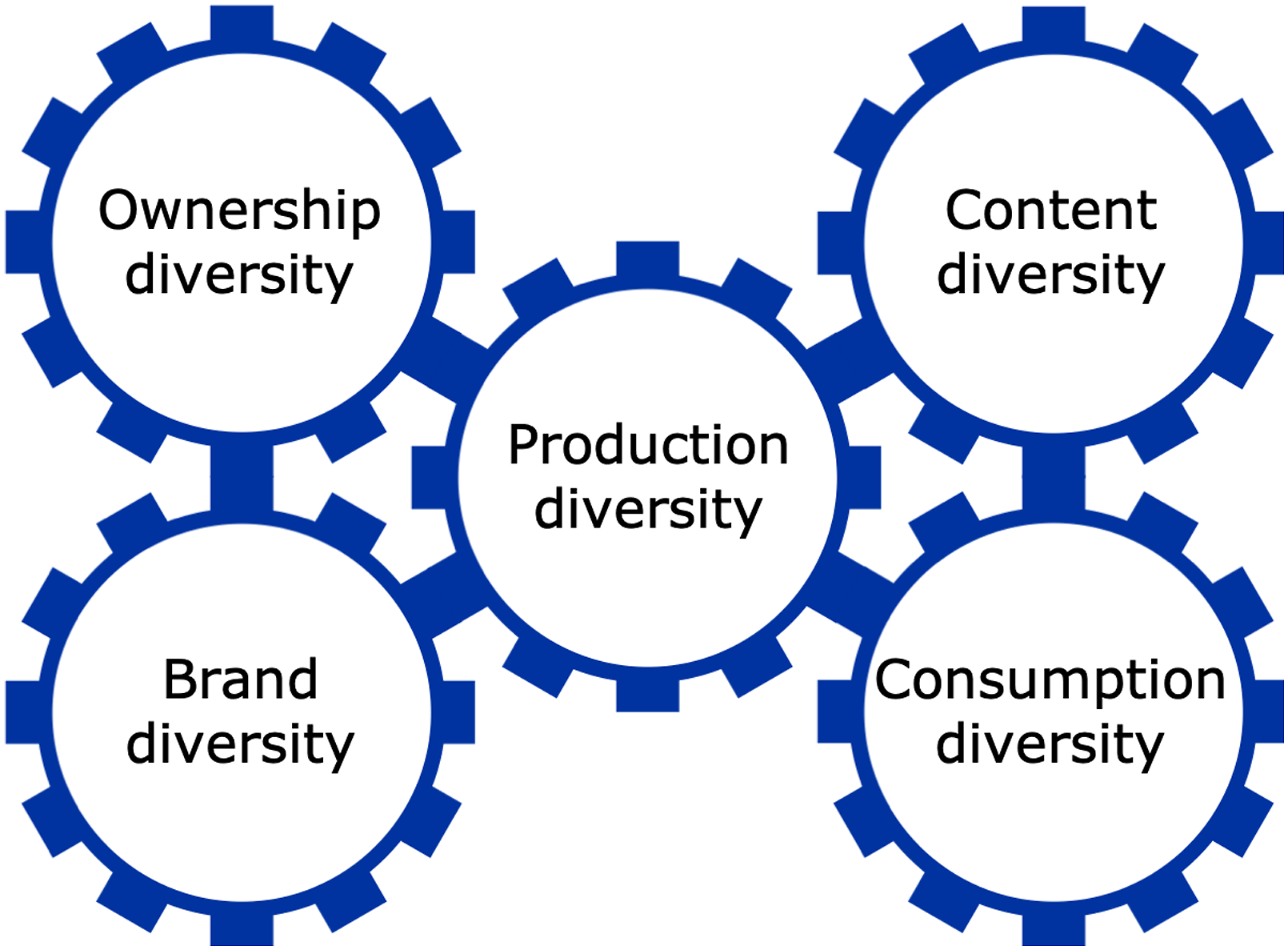
The dimensions or components of news diversity as a holistic concept fits within previous classifications of various diversity types. Philip Napoli’s (1999) differentiation between source, content and exposure diversity can be considered as the perfect storm for academic debate on media and news diversity. It incorporated previous taxonomies such as internal and external diversity (McQuail and Van Cuilenburg, 1983) as well as vertical and horizontal diversity (Entman and Wildman, 1992: 11), which both relate to “the variety of ideas within a single media outlet”, and “the variety of ideas available across the aggregate of different media”, respectively. Simultaneously, Napoli’s multi-layered perspective of diversity served as the precursor for later classifications such as Helle Sjøvaag’s (2016) organisational, production, output and reception diversity and the expansion of the notion of structural diversity as “media ownership and the number of different outlets” (Moe et al., 2021: 1). The key discrepancy with the multidimensional news diversity model operationalised in the paper at hand is that it actively makes the case that the various components have an associative relationship and organically affect and alter one another: changes in the diversity of how news is produced will ultimately lead to alterations in the diversity of its output (e.g. news content) and in turn how said content is (not) consumed. This means that specifically for our study, we build on previous research on Flemish and international news content diversity (e.g. Badr, 2021; Beckers et al., 2017; Hendrickx and Ranaivoson, 2019; Vogler et al., 2020) and its relationship with changes in media concentration to argue that changes in ownership diversity affect all other dimensions, and thus eventually too have direct (and sometimes potentially negative) ramifications for content diversity. By overtly centering the theoretical and methodological frameworks of our study around this link between various aspects of news diversity as a holistic term, we seek to clarify how it is affected in practice through an automated news content analysis of over one million news articles.
To this end, we adopt the deliberative democracy perspective and its underlying rationale that a decrease of actors and viewpoints in the news narrows the public’s access to information, with possibly negative effects for democracy and said public’s decision-making processes in free and fair elections (Helberger et al., 2018; Moe et al., 2021). This distinct perspective is a recurring, dominant one focusing on news diversity (Sax, 2022) and explicitly deals with the expectations of citizens in terms of receiving “information necessary to understand a particular issue, and [for them] to be able to link factual conditions, underlying moral values, and proposed solutions as to what consequences are likely” (Strömback, 2005: 337). We link this to the argument that enhanced media concentration following mergers and acquisitions between media firms can result in less diverse reporting and content (Badr, 2021; Beckers et al., 2017; Blankenship and Vargo, 2021; Hendrickx and Ranaivoson, 2019), indicating a systematic recycling of relevant actors and viewpoints in news reporting. Thus, the main contributions to scholarship of the paper at hand are the next phase in operationalising the concept of news diversity and a novel research approach using automated text analysis.
Media concentration and news content diversity in flanders
Since the 1970s, Belgium’s increasingly convoluted political and cultural structures and divides have facilitated the emergence of a distinguishable and designated Flemish media market (De Bens, 2007), spanning solely across the Dutch-language area of the country which boasts around 6.6 million inhabitants. Belgium and its media system(s) have been classified as democratic corporatist and later as Western liberal (Brüggemann et al., 2014; Hallin and Mancini, 2004). Hence, as there is no real ‘Belgian media market’, scholarship has long ago accepted the common use of the denomination ‘Flemish media market’, which this paper will expand upon.
Overview of the four newspapers and the number of articles analysed.
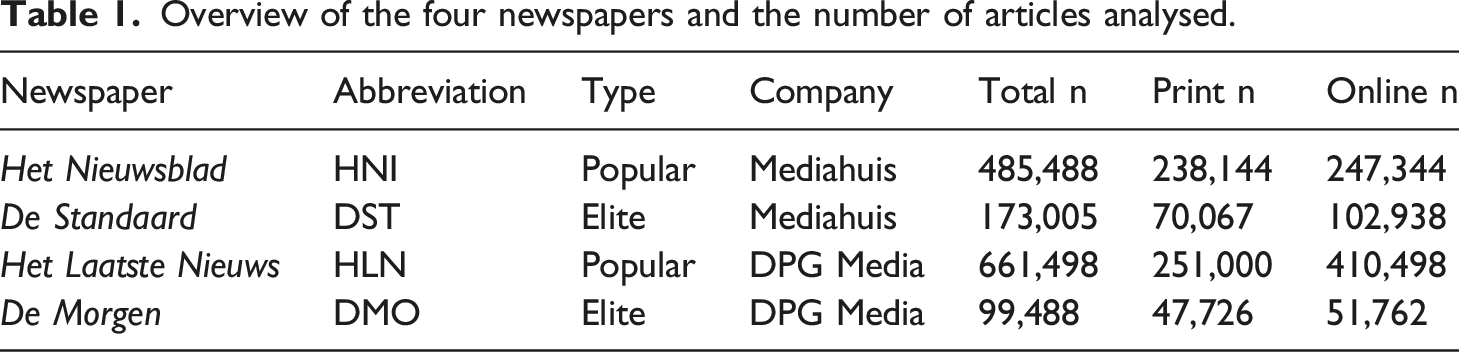
Understanding the differences in company structures and synergy methods is key to contextualise the media titles assessed belonging to either media firm. Both corporations have actively facilitated far-reaching synergies inside their newsrooms including the structural exchange of news content between titles belonging to the same media group, with DPG Media effectively having merged all of its Flemish newspaper, magazine and TV newsrooms in the same new Antwerp-based building (Hendrickx and Picone, 2022). At both firms, though, the quality or elite titles have been able to maintain more independence. As previous studies found that the latter news brands are less prone to homogenising their news content (Beckers et al., 2017; Hendrickx and Van Remoortere, 2021), we venture that this will hold too for the study at hand.
The diversity of Flemish news content and its evolution over time has been studied several times. Panis et al. (2015) assessed cross-ownership in the Flemish market and its effects on self-promotion in news reporting in the same four newspapers analysed in the ensuing study. Their results only partly indicated that newspapers reported more frequently on affiliated television stations belonging to the same media company, and highlighted that the different target groups of newspapers as well as the general newsworthiness of certain TV and media news events played a crucial role in contextualising and somewhat nuancing instances of self-promotion in news coverage. An extensive longitudinal, manual coding analysis of over 20,000 news articles of nine Flemish newspapers published between 1983 and 2013 (Beckers et al., 2017) yielded three notable findings. First, content became more diverse between 1983 and 2003 and only slightly less so between 2003 and 2013 in terms of news stories. Second, in line with Panis et al. (2015), newspapers with similar profiles (e.g. popular or elite target audiences) were found to overlap more with one another as opposed to titles with divergent profiles. Third, and most importantly, the researchers established a correlation of media ownership and concentration with news content diversity by concluding that newspapers belonging to the same media company had grown more similar in terms of published news content, regardless of their different profiles and target audiences (Beckers et al., 2017: 1677).
In a similar follow-up study, a content homogeneity analysis of 3101 articles published in the Mediahuis-owned newspapers in 2013 and 2018 found that the share of recycled content had increased from 36 to 51% over five years’ time. Notably Het Nieuwsblad, the biggest Mediahuis title and Flanders’ second largest newspaper, had seen a steep rise in its share of recycled content, increasing from 24 to 58% of all coded articles (Hendrickx and Ranaivoson, 2019). The study carried out for this paper focuses on news articles published between 2018 and 2021, and thus again serves as a continuation of the existing body of research, while also innovating it conceptually, as outlined before, and methodologically, as the next section will discuss.
Methodological framework
Research questions & hypotheses
Diversity in news content has been measured through measuring actors and opinions (Humprecht and Büchel, 2013; Masini et al., 2018) and manual coding processes which frequently only involved looking at titles and/or the first sentences of articles (Beckers et al., 2017; Hendrickx and Ranaivoson, 2019; Sjøvaag, 2014). While computational text analyses are increasingly becoming commonplace, existing studies have mainly focused as well on only small sections of articles (Welbers et al., 2018) or merely the content of print (Vogler et al., 2020) or online newspapers (Cage et al., 2015) as separate entities. With our study, we contribute a research design which facilitates assessing the overlap of full articles between titles belonging to the same media corporation, while also comparing print and online content published by the same news titles. We recap the four assessed Flemish newspapers and their most important characteristics underneath, with the classification between ‘elite’ and ‘popular’ titles established through previous research (Beckers et al., 2017; Panis et al., 2015).
The comprehensiveness of our dataset, in total boasting 1,419,479 articles, allows for comparisons to be made at three axes: first, two different and competing media firms; second, online and print news content; third, popular and elite newspapers. Based on this as well as on previous research on content homogeneity in Flanders and beyond, we present three research questions and hypotheses revolving around Flemish content diversity. The answers to these questions, compounded and contextualised with other relevant findings, will allow us to link changes in ownership diversity to content, production and brand diversity. In its turn, this will ultimately enable us to make statements about news diversity in Flanders.
Has news content grown more homogenous at Mediahuis and DPG Media?
Based on the longitudinal study of Beckers et al. (2017), we estimate an increase in recycled content between the two newspapers belonging to the same media company.
Has news content grown more homogenous across print and online articles?
We foresee that online content in particular is growing increasingly similar, as was the case in previous research (Hendrickx, 2020).
Has news content grown more homogenous in popular and elite newspapers?
Following earlier analyses (Hendrickx and Ranaivoson, 2019; Panis et al., 2015), we project that elite newspapers will diversify themselves (slightly) more than popular ones.
Scraping and comparing news articles
We assembled our dataset through scraping the official repository of Belgian print publishers, GoPress (www.gopress.be). The web-based automation library Selenium, which automates the manual act of opening a browser and selecting and downloading the articles as xml files, was applied to facilitate this. All news articles published in print and online between 1 January 2018 and 30 June 2021 were collected, resulting in a total dataset of 1,419,479 articles. We solely assessed ‘hard news’ articles, as the diversity of information in this type of news is expected to have the most direct implications for the democratic processes (Chan et al., 2020; Welbers and Opgenhaffen, 2019). Soft news articles (e.g. regional news, lifestyle, traffic reports, weather reports and sports) were not assessed as they are less linked with the deliberative democratic purpose of news media as previously argued by scholarship (Helberger et al., 2018; Masini et al., 2018; Moe et al., 2021; Papandrea, 2006; Raeijmaekers and Maeseele, 2015). Although regional news should not per se be considered soft news, in our case study it can be categorised as such. Belgium is a very small country and as a consequence regional news is very specific municipal news. Unlike in other, larger countries, regional news can rather be characterised by lighter news items about for example a resident of a certain village turning 100. The soft news articles were removed by manually labelling articles to train a random forest classification model using a tf-idf (term frequency and inverse document frequency) vector as features.
(News content) diversity from a communication science perspective is increasingly assessed through automated methods. Looking specifically at assessing content homogeneity Jaccard similarity based on n-grams (Vogler et al., 2020) have been used before. This paper’s approach is similar to that of Welbers et al. (2018), as it also relies on cosine similarity of tf-idf vectors. The homogeneity of the articles in our dataset was calculated using the following steps. First, an xml parser implemented by the python Elementtree library was used to extract all articles from the xml files, the format in which they were scraped. Second, we composed a bag-of-words for each article, which indicated the frequency of each word in the given article. Third, we offset word frequencies by the number of documents in the corpus which contain that word, whereby we consider that certain words appear more frequently than others in news articles. Words that appear very often in articles like “the”, “and”, “or”, etc. were given less weight compared to more unique words like “tax”, “alarm”, “agreement”, etc. More weight was thus attributed to rarer words which are more meaningful for computing document similarity. The resulting vectors, then, are tf-idf or thus ‘term frequency and inverse document frequency’ which reflect how important a word is to a specific article in a larger collection of articles. Similar articles are expected to display a similar tf-idf vector. Fourth, we calculated the actual similarity between articles with the cosine of the angle between their tf-idf vectors, which ranges from 0 (indicating no similarity at all) to 1 (indicating complete overlap). News articles were compared for the day of their print or online publication and for 1 day later. Ultimately, we considered articles with an overlap of 0.8 or more to be homogenous with one another. To ensure methodological soundness, we carried out a dry run where we manually verified and coded a randomised sample of coded articles from our dataset (n = 250). This test confirmed that our set threshold of 0.80 or 80% is able to accurately signal all articles which are (as good as) identical. We found that this manual check validated our approach as we only detected in a handful of occurrences false negatives or positives.
Having computed the degree of homogeneity between individual articles, we calculated the overall content similarity across the newspapers and platforms in percentages, as this renders the raw data more accessible. We thereby followed Vogler et al. (2020: 6) and their statement that media content concentration is ‘the share of media articles in a given media market, which is published in at least two different media outlets’. We calculate this as the sum of shared media articles divided by the sum of media articles published. We assess and compare various outlets with our study (various titles and their offline and online content) and hence additionally divided the sum of the shared articles by the sum of that specific outlet and/or platform and divide findings per month, with 42 assessed months in total between January 2018 and June 2021, to diversify our global results and better respond to the research questions and hypotheses as outlined before.
Research results
The findings of our automated news content homogeneity analysis will be presented in four parts. We start with a descriptive analysis of our total data set to further contextualise our case study. The three other parts of our results section all correspond directly to the three previously established research questions and their accompanying hypotheses. For the sake of clarity, results will be consistently expressed in weighted percentages which indicate the share of articles of a given company, title and/or platform quantified as being homogenous and published in highly similar or identical fashion elsewhere as well.
Descriptive findings
Our total data set consists of 1,419,479 articles. At the company level, we see that the two DPG Media titles account for a 53.6% share of the total n. However, when looking at the individual news brands, additional interesting features surface. Between 1 January 2018 and 30 June 2021, DPG Media’s popular title HLN alone has published slightly more hard news print and online articles than the two Mediahuis brands combined (661,498 vs 658,493) and accounts for 46.6% of the total data set. For DPG Media’s quality outlet DMO, this is a mere 7%, compared with 12.2% for Mediahuis’ elite title DST and 34.2% for its popular brand HNI. When looking at said percentages per year, we see that the share of articles for DMO did slightly increase. In 2018, the first year of our analysis, it accounted for 12.5% of DPG Media’s hard news article output. This rose progressively to 15.8% in the first half of 2021. An opposite scenario is visible for Mediahuis, where the share of the elite title was higher to begin with, but also declined more steeply over time, from 30.0% in 2018 to 20.7% in the first 6 months of 2021 for DST. The title did not publish fewer articles, but its growth paled in comparison to that of HNI, with 119,749 in 2018 and 81,141 in the first half of 2021 alone. At HLN, the growth of articles is much less outspoken, with more articles published in 2019 than in 2020 (205,442 vs 189,418).
When looking at the distinction between print and online articles, we denote how all four news brands throughout our time period have published more online than print articles. Whereas there was a nearly even split of print and online articles in 2018 (49 vs 51%), this has shifted to 39.8 versus 60.2% in 2020 before tailing off again in the first half of 2021 (43.1 vs 56.9%). The two popular titles published considerably more online than print articles, with the difference less pronounced among the elite outlets and DMO in 2019 actually publishing more print than online hard news articles (14,319 vs 12,204).
These descriptive findings confirm the prevalence of online reporting over print as the main diffusion gateway for news content of contemporary news corporations in Flanders and of course far beyond. They also confirm dominance of HLN, the brand that is routinely the most consumed both in print and online according to the Digital News Report and that features the biggest newsroom in Flanders, explaining the sheer size of its total output (Hendrickx and Van Remoortere, 2021). The rapid growth of articles published by HLN’s main Mediahuis-owned rival HNI confirms that both corporations increasingly focus on expanding both the newsroom size and the scope of their output in terms of articles predominantly for the quality titles, which can be hazardous for the independence and quality of the elite brands’ output, particularly as a previous study from the same Hendrickx & Van Remoortere, 2021 had already revealed that they are more prone to homogenising their content across platforms (Hendrickx and Van Remoortere, 2021) (Figure 2). Total overlap of Mediahuis and DPG Media.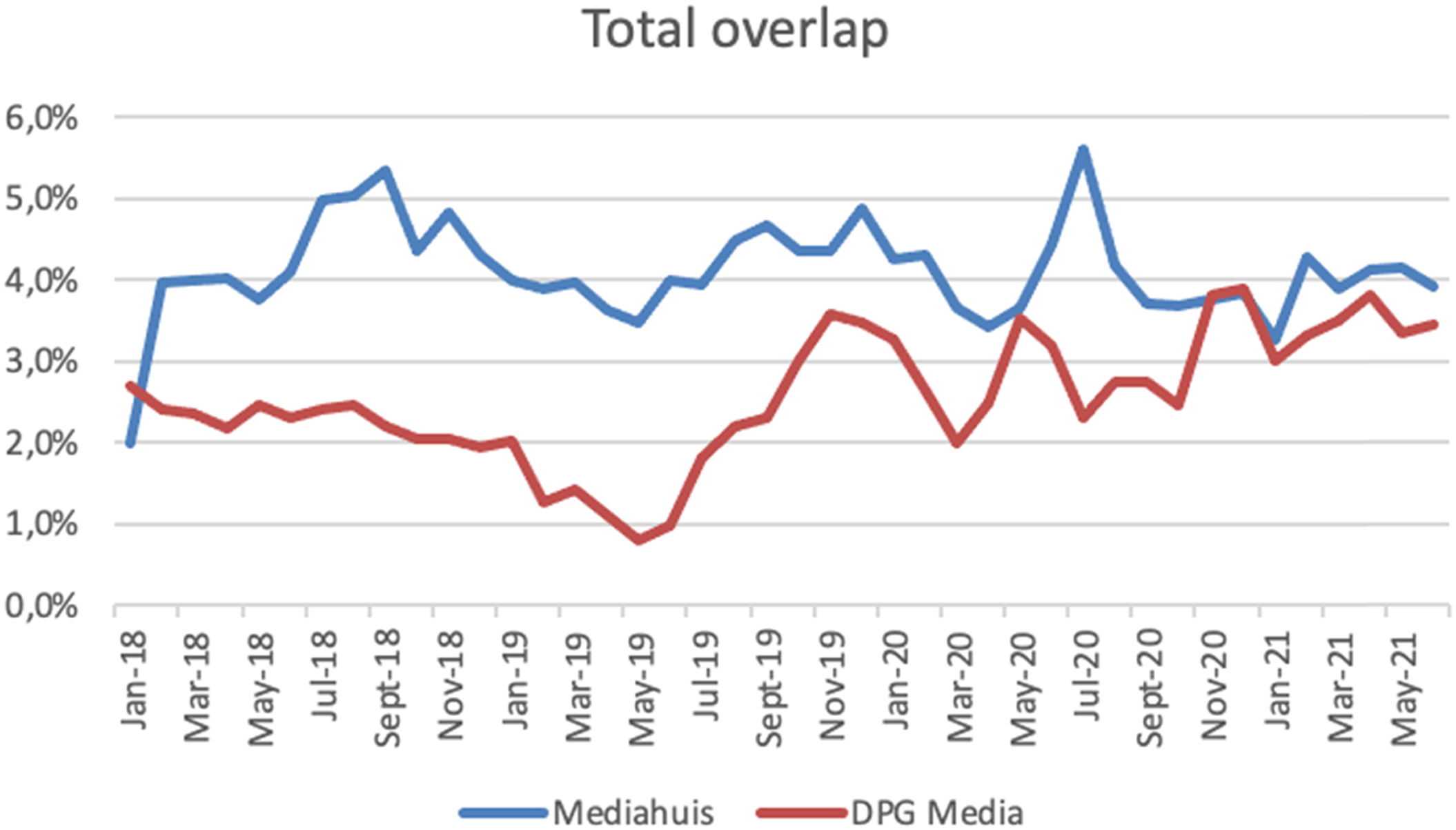
RQ1: Has news content grown more homogenous at Mediahuis and DPG Media?
Globally speaking, the two Mediahuis titles HNI and DST score higher in total overlap (4.1%) than HLN and DMO of DPG Media (2.6%). We do clearly denote a much more stable situation at the former than the latter corporation. For Mediahuis, the share of overlap, or the share of articles across both titles and platforms that were found to be (nearly) identically verbatim to one another, was actually at its lowest in the first half of 2021 (3.9%) and had peaked in 2018 (4.2%). We see the inverse situation occurring at rival company DPG Media, with the total overlap rising from 2.3 to 3.4% between 2018 and 2021. Mediahuis did not undergo structural changes in terms of its inner working and synergy operations, explaining the stagnation in the share of identical articles while also contextualising how it does remain as firmly ingrained in the company structure and said working. As said before, DPG Media started moving all of its newsrooms into the same Antwerp-based building from the second half of 2019, along with the launch of far-reaching new synergy processes to enhance company efficiency (Hendrickx and Picone, 2022). While we are unable to establish scientific correlation, we wish to draw attention nonetheless to the spike in shared articles at DPG Media from the last months of 2019 onwards and remaining higher since. Thus, to answer RQ1, we find that news content has grown more homogenous at DPG Media, but not as structurally at Mediahuis. H1 is thereby only partially confirmed.
The percentages of total overlap may confuse some readers who might have expected higher shares based on the problematisation of the study topic in the conceptual framework. However, it is of paramount relevance that the total percentages are immensely skewed by the prevalance of the popular news titles of either news company. The articles published by the two elite outlets, DPG Media’s DMO and Mediahuis’ DST, only account for 19.2% of the total n. As the discussion on the third and final research question will argue, however, they score much higher in terms of content overlap (Figure 3). Total online and print overlap of Mediahuis and DPG Media.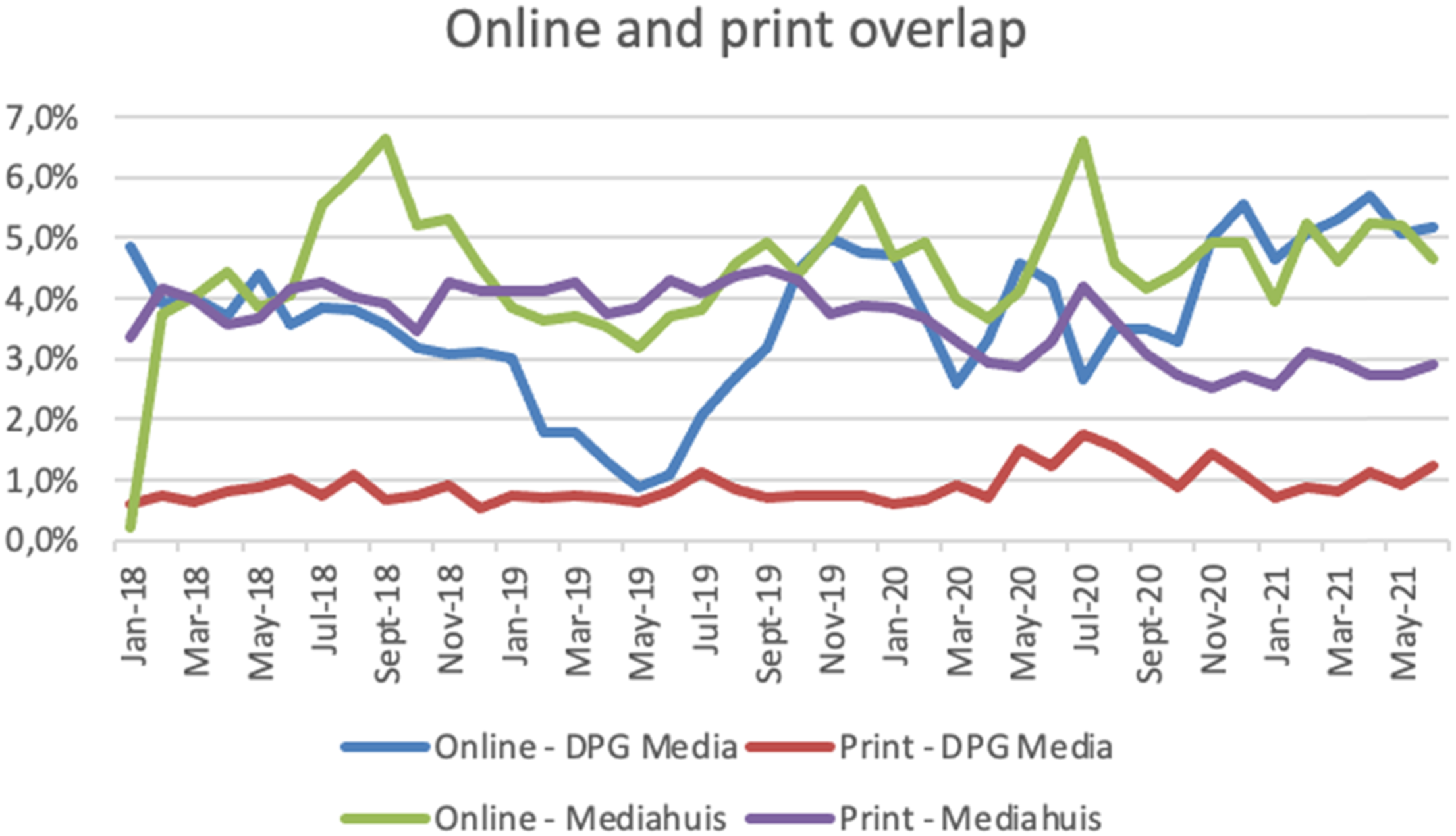
RQ2: Has news content grown more homogenous across print and online articles?
To answer our second research question, we differentiate the total overlap figures per platform. Only towards the end of our study period are we able to denote an outspoken distinction in overlap percentages between print and online news content overlap of hard news articles. For Mediahuis, the print overlap decreased from 3.9% on average in 2018 to 2.8% in the first 6 months of 2021. While fluctuating much more in the figure above, the annual average percentages for online overlap actually remained mostly stable, ranging from 4.2% in 2019 to 4.8% in 2021 as the lowest and highest shares. We are unable to explain the spikes in certain periods such as September 2018 and July 2020. When we look at DPG Media, the print overlap between DMO and HLN remained low and only peaked in the first half of 2020 at less than 2%. The online overlap, on the other hand, decreased between 2018 (3.8% on average) and 2019 (2.7%) before picking up in 2020 (3.9%) and soaring in the first 6 months of 2021 (5.2%). Particularly in these last months, the share of overlap of the two DPG Media-owned news websites surpassed that of the Mediahuis ones. We again link this to heightened attention for structural collaboration between newsrooms belonging to the same media group. This means that as print overlap decreased at Mediahuis and mostly remained stable at DPG Media while online overlap peaked in 2021 for the leading news brands of both corporations, we are able to confirm H2. We again stress that the relatively low percentages are skewed by the overrepresentation of the popular news titles in our total dataset.
RQ3: Has news content grown more homogenous in popular and elite newspapers?
As a part of our answer to the final research question, we differentiate our findings per title. This reveals that the popular titles assessed score much lower in terms of content homogeneity than the elite sources. To make this more clear: in June 2021, 20.8% of all hard news articles as posted at the website of DMO were also published (nearly) verbatim at the website of HLN, the popular DPG Media-owned title. However, the other way around, this was just 4.1%. In similar vein, the percentages for the two Mediahuis brands in the same month were 19.6% for DST and 4.9% for HNI. This yields very comparable patterns in how the two leading rival private media corporations in Flanders, that are also active in various other European countries, not only keep their elite newsrooms smaller in terms of numbers of articles published, but also smaller in terms of contributing to news diversity due to considerably higher shares of republished content.
When further breaking down the results in Figure 4 to annual averages to better pinpoint changes over time, we see that for both DMO and HLN separately the share of content overlap decreased in 2019 before rising later. DMO saw an increase of exactly five percentage points (from 16.6% to 21.6%) in 2 years’ time, with a steep rise for HLN (from 2.3% to 4.0%). Unlike DPG Media’s results, the findings for Mediahuis’ two leading news outlets are less clear-cut. While HNI actually saw a global decrease in its share of recycled content between 2018 and 2021 (from 6.0% to 5.0%), DST witnessed a vast increase (from 14.1 to 19.0%). We thus again find that predominantly the elite titles suffer from heightened news content homogeneity. Interestingly, this conclusion negates previous findings regarding the diversity of quality news outlets (Hendrickx and Ranaivoson, 2019) and rejects H3. Total overlap per title.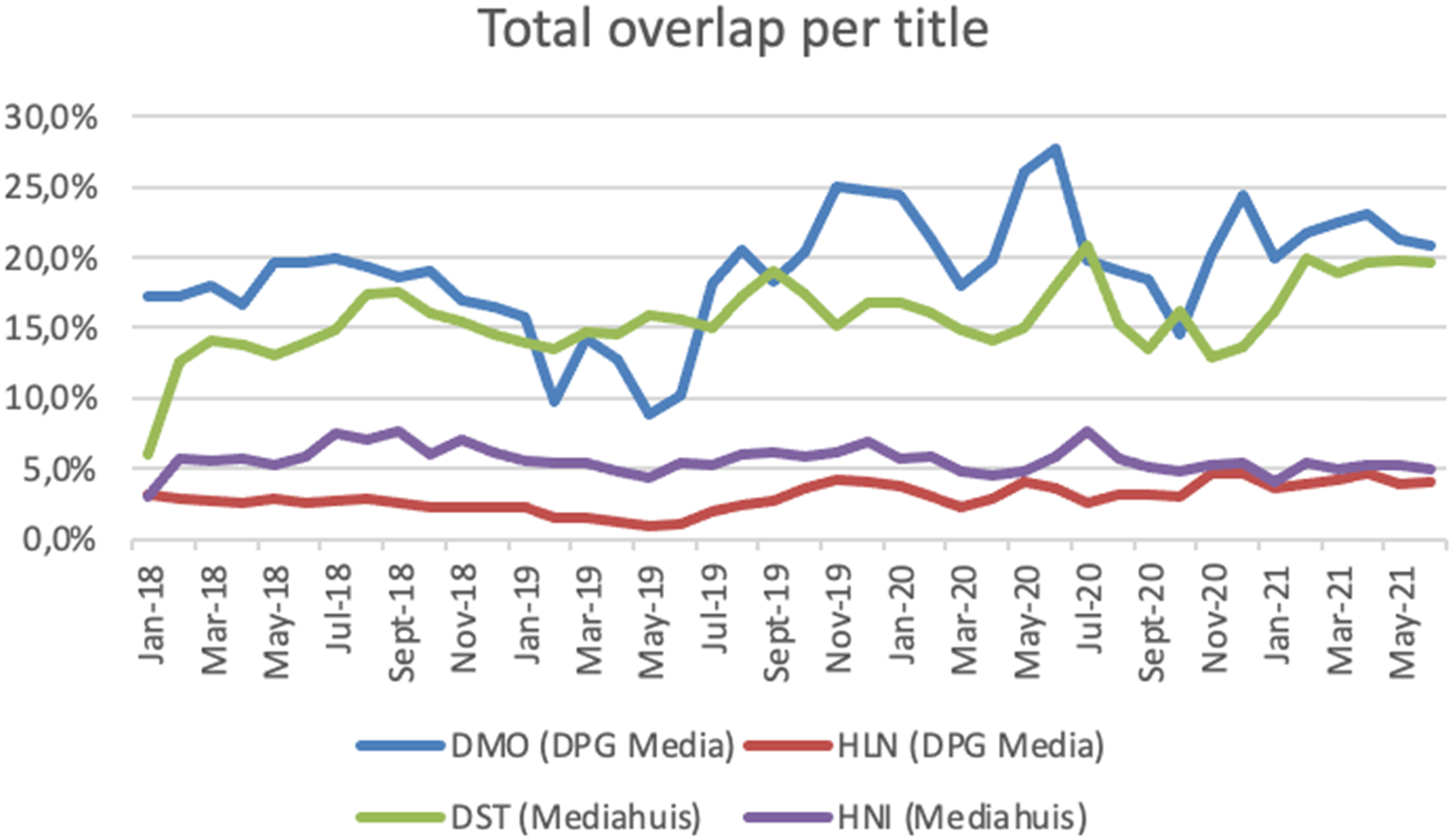
We are also able to further analyse our findings per news title and per platform. This allows us to shine further light on the findings of H2 and additionally aids in rejecting H3. At DPG Media, the print overlap for elite title DMO and popular outlet HLN remained mostly stable, with 5.6% and 1.1% shares respectively, again confirming that news content diversity is lower for elite outlets. When it comes to online overlap, we again denote high spikes for HLN (3.0% in 2019 yet 6.1% in 2021) while it peaked in 2020 for DMO (35.7%, with in June of that year 52.0% or over half of all hard news online articles at the website of DMO also being published (close to) identical at the website of HLN) before dropping slightly in 2021 (33.5%). On average, nearly one of every three online DMO articles was also published at HLN, in spite of the titles having very different target demographics and characteristics. We again denote different situations at Mediahuis, where print overlap decreased across the board. For DST the share dropped from 16.3% in 2018 to 14.9% in 2021; for HNI, this went from 5.2% to 3.5%. While the online overlap for Mediahuis’ popular title plateaued at 6.5% on average, it is noteworthy to see this share soaring for elite outlet DST during our data period, from 12.7% in 2018 to 21.9% in 2021, peaking at 23.8% in May of that year.
Thus far, we have made it abundantly clear that H3 is rejected as the two assessed elite titles recycle vast parts of their hard news content in comparison with their popular counterparts. There is, however, one more relevant element we can contribute to further back this point. Following previous work (Hendrickx and Van Remoortere, 2021), we also look at what we call the internal overlap of news titles, or the share of news content that is recycled (close to) identically between a brand’s own print newspaper and website (Figure 5). Internal overlap per title.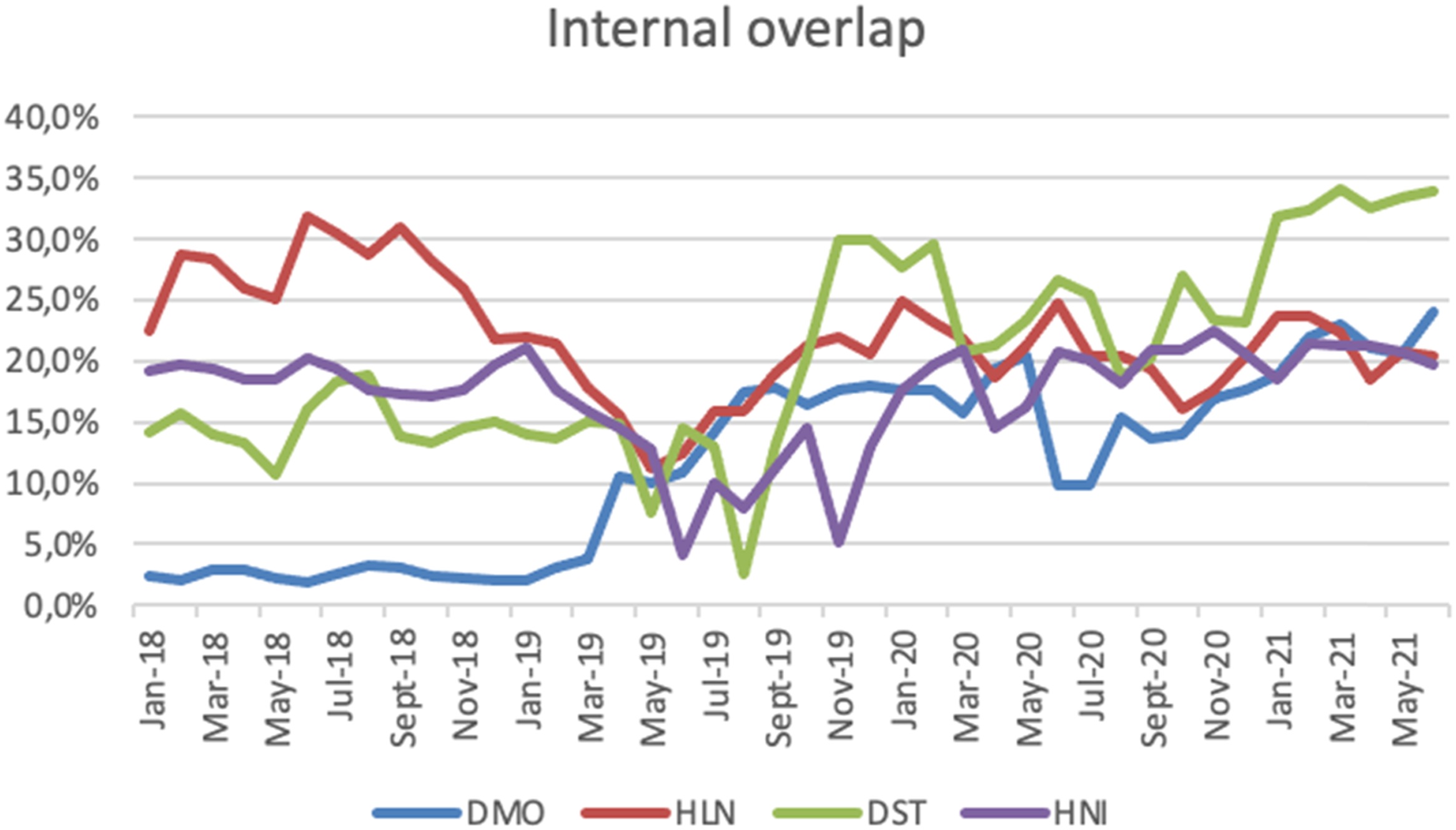
The percentages of internal overlap dramatically fluctuate over time, yet by looking at annual averages we are able to spot trends. HLN is the only news brand that became more diverse internally as its share of exchanged news content between its website and newspaper decreased from 27.4 to 21.5% between 2018 and 2021, meaning that it is still common practice to recycle content across platforms at Flanders’ leading news brands. When we look at DPG Media’s elite title DMO however, we see that this share remains very low before suddenly soaring from 2019 onwards - again not coincidentally the time frame where synergy operations at the newly founded corporation took effect. The annual average shares of internal overlap exploded, from just 2.5% in 2018 to 21.6% in the first half of 2021, signalling changed newsroom practices and a more unified, and thus less diverse, product for DMO readers. Shifting the focus to Mediahuis, we see that internal overlap at popular title HNI remained mostly stable except for a drop in 2019, averaging at 17.3%. For quality outlet DSI however, we also witness dramatic increases in the share of internally recycled content, rising from 14.8% in 2018 to 33.0% in 2021, or one third of all hard news articles published by DST recycled verbatim across its newspaper and website. It is telling that for both quality news titles, the internal overlap suddenly drastically increased in the first 6 months of 2021. Future research will have to gauge whether or not this signals a fixture or just a temporary trend.
Discussion & conclusions
In this article, we have assessed the homogeneity of news content of four leading Flemish newspapers which belong to the two main media groups active in Belgium’s Dutch-language region: popular title Het Laatste Nieuws (HLN) and elite title De Morgen (DMO) of DPG Media, and popular title Het Nieuwsblad (HNB) and elite title De Standaard (DST) of Mediahuis. Both companies were founded in the past decade after large-scale mergers and acquisitions which dramatically altered media ownership diversity in the small and increasingly concentrated Flemish market. We drew on previously executed content analyses in Flanders (e.g. Beckers et al., 2017; Hendrickx and Ranaivoson, 2019; Panis et al., 2015) and beyond (e.g. Baum and Zhukov, 2019; Sjøvaag, 2014; Vogler et al., 2020; Welbers et al., 2018), and assessed a dataset of 1,419,479 print and online news articles, all published between 1 January 2018 and 30 June 2021, on their overlap using automated text analysis. Our innovative research design enabled us to compare content homogeneity at the three distinct levels of companies, dissemination platforms (print vs online) and types of newspapers (popular vs elite). This facilitated us to not merely shine light on the similarity of news coverage in general, which arguably still can signify a wide range of diversity in terms of topic, actor and viewpoint diversity (Masini et al., 2018), but more specifically allowed us to gauge the degree of uniqueness and distinctiveness of news content, as all articles between news titles we found to be similar were, in fact, (nearly) identical verbatim copies of one another. Our manual coding check as discussed earlier confirmed that this includes repurposing the same actors and viewpoints across reporting, thus also negatively affecting these poignant types of content diversity.
Our hypotheses were only partly confirmed. Contrary to previous findings, we found that the overall content overlap at the level of Mediahuis and DPG Media remained stable for the former and only clearly increased at the latter (H1). With DST as the only exception, the three other assessed news titles had higher shares of recycled content online rather than in print. Notably, the two elite newspapers had much higher shares (H2). This already partly proved H3 wrong as our content analysis also revealed that the DST and DMO recycle news content across its own print and online platforms to considerably larger extents. While maintaining the lowest share of all four titles, DMO saw the steepest rise across the 3.5 year-period and Mediahuis’ elite title DST also saw increases. This rejected our hypothesis, drawn from previous research, that elite titles diversify themselves more than popular counterparts.
We contextualise our findings within the multi-layered news diversity framework as developed by Hendrickx and Picone (2022) inspired by previous scholars, notably Napoli (1999) and Sjøvaag (2016). We therefore draw on the findings of our automated quantitative content analysis as well as on qualitative ethnographic field studies across various Flemish newsrooms owned by DPG Media and Mediahuis (Hendrickx and Picone, 2022). The alterations to ownership diversity through the M&As in the Flemish media market also affected media ownership structures and brand diversity in other European nations due to the rapid expansion of both corporations abroad. While this has thus far not led to cutting legacy brands, we do note how far-reaching synergy operations introduced at both companies continue to structurally affect the production diversity, and in its turn content diversity. Journalists and editors now exchange news content and sources as integral parts of their daily routines, helped by sharing office space, content management systems and digital communication channels such as Slack and WhatsApp. All these measures were introduced to streamline the flow of organic collaborations between various newsrooms, establishing a direct link between ownership diversity to production and content diversity (and management). Thus, we hold the view that only studying news content diversity is not enough to make statements about changes in journalism practice or studies. Instead, considering other dimensions of overall news diversity as a holistic concept, such as changes in ownership, brand and production diversity, is a necessary prerequisite to better contextualise and juxtapose findings against one another. We invite scholars to further investigate this intricate relationship in close connection with the acknowledged dominance of news agencies and wire reporting (e.g., Welbers et al., 2018). While such an in-depth analysis went beyond the scope of our study, we hold the view based on existing scholarship that a sizeable amount of the overlap retrieved between the four assessed Flemish newspapers comes down to the repurposing of “ready-made” news content provided by the national press agency and hold the assumption that this will be a recurring trend in other media markets as well.
Additionally, we wish to position our study within the deliberative democracy framework and the role of journalism as the fourth estate (Helberger et al., 2018; Masini et al., 2018; Moe et al., 2021; Papandrea, 2006; Raeijmaekers and Maeseele, 2015). In our content analysis, we specifically focussed on hard news articles as they are more overtly linked to the fulfilment of journalism’s democratic function in society. As we have shown, the practices outlined above are increasingly leading to more recycled news content, notably at elite titles which are underrepresented in terms of newsroom sizes and raw article output and in recent years in Flanders have suffered considerably more from losses in circulation figures and news trust according to the Digital News Report. We stress again that we solely focused on hard news output. Based on previous research carried out at topic-based content homogeneity of Mediahuis-owned newspapers, we expect the shares of identical news content to be much higher when we would have included soft news content as well, even though we did not do so for reasons outlined before. It is telling that at both DPG Media and Mediahuis, the two competing media firms, very similar trends about fostering the growth and diversification of the leading popular titles went hand in hand with the continued erosion of the diversity and uniqueness of the content of their elite outlets. Here, we have no choice but to openly question the overtly normative, idealistic view of journalism as the fourth estate in the era of heightened ownership consolidation. The freedom of the press is rightfully considered as one of the pillars of any well-functioning society. However, press freedom also includes giving journalists and newsrooms the financial and practical resources to bring distinctive reporting. While we do not claim that our findings could signal the erosion of the democratic function of journalism in society, we wish to draw scholarly attention to further exploring this relationship and how it holds up in other (highly concentrated) media markets.
Our study is solely applicable to the Flemish media market, with its unique characteristics, contingencies and constraints, just as any other market. We therefore do not assume our results to be easily transferable to other regions and countries, in spite of DPG Media and Mediahuis’ acknowledged increased presence in other European markets. However, like similar studies carried out elsewhere, ours too assumes a negative relationship between increased media market concentration and news content diversity (Vogler et al., 2020; Welbers et al., 2018), even though there is no universal consensus on this (Sjøvaag, 2014; Skärlund, 2020). The strengths of this study, and their main contributions to scholarship, are its link with news diversity and democratic frameworks, as well as its research approach, using automated content analysis to properly measure homogeneity at vast bodies of articles at once. Finally, we acknowledge one main shortcoming, which is also a recommendation for future research. Our findings are admittedly rather descriptive, taking a macro perspective at assessing over one million articles. We are unable to deduce conclusions on topic or source diversity, which would have further enriched the study. While we still believe that our findings convincingly make the case for a heightened focus on news diversity in consolidated media markets, we warmly invite fellow scholars to take a more micro perspective in future research, to further enrich the on-going academic debate about the importance of news diversity in journalism and democratic society.
Footnotes
Declaration of conflicting interests
The author(s) declared no potential conflicts of interest with respect to the research, authorship, and/or publication of this article.
Funding
The author(s) received no financial support for the research, authorship, and/or publication of this article.
