



Abstract
Even though radio continues to be the most dominant media platform for black South Africans, the rise in indigenous language podcasts marks a significant milestone in the South African media landscape for speakers of these languages who have previously been afforded limited agency in the sector. The place of podcasts in South Africa must be understood from the rich 100 years of radio in a context where oral media serves as a central platform for developing linguistic and cultural identities. This qualitative study employs purposive sampling to consider the production practices of South African indigenous language podcasts using Epokothweni and iLukuluku as two case studies. In considering these two podcasts, the study highlights the content creators of Epokothweni and iLukuluku as a model of how South African indigenous language podcasters draw on radio as an established storytelling platform for South African indigenous language speakers that allow them to use their podcast platforms in socio-culturally relevant ways. The paper argues that these platforms allow black South Africans to tell stories that have been neglected and silenced, allowing them to articulate the world and their experiences involving economic and scientific issues. The view is that indigenous language podcasting is set to increase as content producers greatly appreciate engagement with black audiences, which are currently under-prioritised in a sector dominated by English-language outfits.
Introduction and background
The media consumption landscape in South Africa is undergoing a significant transformation with the rise of digital tools and improved internet access. Despite this, radio remains the dominant platform. This is evident in recent research that shows that 80% of South Africans listen to the radio weekly (Bosch, 2022). Globally, the number of people who listen to the radio is equally high. A 2019 study found over three billion people listened to the radio weekly (Stewart, 2019). However, the accessibility of smartphones and broader internet penetration has opened new avenues for media consumption, including podcasts, which are growing in popularity (Royston, 2021). Podcasts are digital programmes that can be downloaded or streamed online, expanding beyond their initial association with the Apple iPod MP3 player and broadcasting (Van der Merwe, 2021). McGregor (2022) characterises podcasts as digital texts that initially catered to an accessible medium for amateur creators, often biased towards the same demographic as tech culture, namely white men.
One distinguishing feature that distinguishes podcasts from radio is their enhanced parasocial intimacy. Unlike traditional radio, where listeners are exposed to whatever content is on-air during a specific time, podcasts require audiences to seek out and actively subscribe to chosen content. This opt-in orientation empowers listeners to choose what and when they consume podcasts, offering greater flexibility than scheduled radio consumption. Further, podcasts differ from radio because they are distributed over the internet, while radio broadcasts are primarily transmitted over airwaves. This means that podcasts can be accessed anywhere in the world with an internet connection, while radio broadcasts are only available in areas covered by a particular radio station’s signal, except for online radio. While this flexibility is a key advantage, there are generally accepted conventions within podcast production, such as regular episode releases and distinctive series formats (Bottomley, 2015). Notably, the adoption of podcasts in Africa is noteworthy, as technological access and affordability still pose limitations for creators and consumers (Africa Podcast, 2021). Nevertheless, podcasts excel at engaging communities by leveraging their characteristic parasocial intimacy, creating a sense of connection and familiarity between listeners and their favourite hosts (McGregor, 2022).
The emergence of podcasting in South Africa can be traced back to 2015 and 2016 (Van der Merwe, 2021). While precise figures on listenership are scarce, the advertising expenditures by companies indicate a growing interest in podcasts. According to the Africa Entertainment and Media Outlook 2022 report published by PwC in October 2022, podcast advertising has become a rapidly expanding sector, recording a 30.4% revenue growth in 2020 (PwC, 2022: 12). The report further identifies Spotify as the preferred platform among South African podcast consumers, closely followed by Apple Podcasts (PwC, 2022: 12). A cursory analysis of popular podcast charts, such as Chartable, which claim to rank podcasts based on their popularity, indicates that the most widely listened to podcasts in South Africa are not typically produced by South Africans. As of October 18, 2022, a link to the chart shows only three South African-based podcasts in the top 10 (Figure 1), all in English. These trends contrast the radio landscape, where indigenous language radio stations attract a wider audience (Broadcast Research Council of South Africa, 2023). https://chartable.com/charts/spotify/south-africa-top-podcasts [October 18, 2022].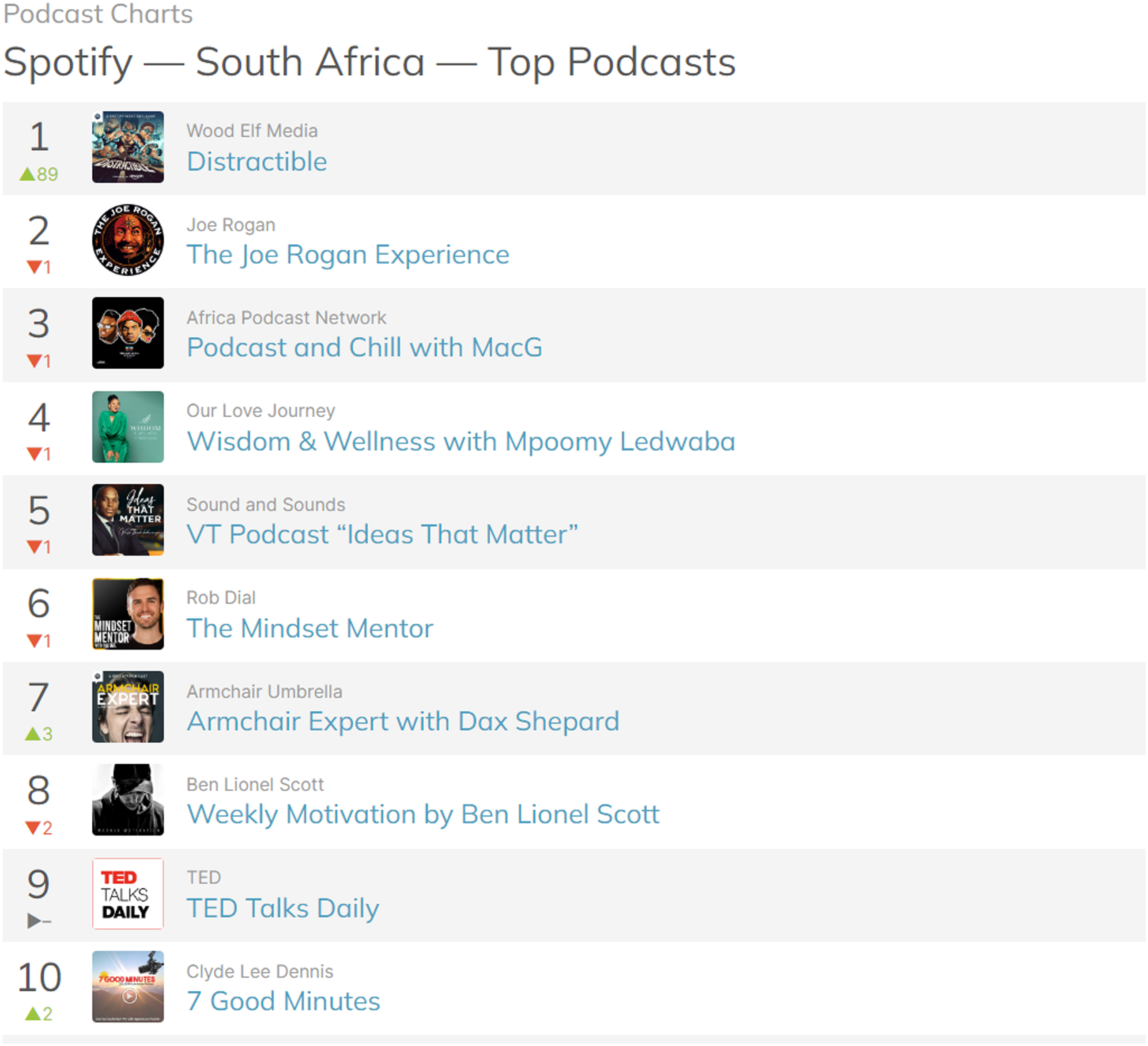
The main objective of this paper is to investigate the podcasting practices of Epokothweni and iLukuluku and explore how creators of these podcasts effectively utilise the attributes and functionalities associated with radio, a well-established platform for storytelling, to cater to South African indigenous language speakers. Specifically, this paper contends that these platforms provide an essential space for articulating marginalised voices, allowing indigenous language speakers to express their perspectives on economic and scientific matters in relevant socio-cultural ways.
Literature review
To comprehend the significance of podcasts in South Africa, we must consider the profound legacy of radio spanning over a century, as outlined in the literature. Radio has served as a pivotal platform for forming and expressing linguistic and cultural identities in this context (Lekgoathi, 2009; Onyenankeya and Salawu, 2019). In his work on the role of Radio Bantu, for example, Lekgoathi (2009: 583) argues, “The high regard in which the announcers were held by listeners was both a cause and effect of the station’s popularity overall and of the sense of the ambiguous North Sotho pride which accompanied it”. Onyenankeya and Salawu (2019: 42), meanwhile, find that in this context, indigenous language radio is a form of alternative media where speakers of these languages “not only air their views but also construct alternative images of themselves and others”. Initially, when radio was introduced in South Africa, it did not include broadcasts intended for indigenous language speakers. Only during the Second World War, with endeavours to garner support from the majority black population, did the notion of black people as a potential audience emerge. Mhlambi (2019: 213) explains it as follows: Initially these were three-minute broadcasts inserted into the existing English (Service A) and Afrikaans (Service B) programme, which was gradually extended to 30 minutes in length. Hugh Tracey, then head of the South African Broadcasting Corporation (SABC) in Durban, said he got the idea of broadcasting to African audiences in Natal when he discovered that a rumour was spreading among Africans that every Zulu speaker would earn 10 shillings a day when Hitler arrived.
Hence, from the beginning, black South Africans were never regarded as an audience meant to engage with the radio for entertainment and information (Lekgoathi, 2009). The power of radio was initially intended to shape their perspectives based on the agenda of the white South African authorities. However, when the medium eventually opened to indigenous language speakers – both as an audience and as content creators – with the first Zulu broadcast in Durban in 1941, they discovered a means to utilise its affordances to amplify their voices in a society that would otherwise continue to silence them. Gunner et al. (2011: 6) contend that despite being initially designed as a propaganda tool to serve colonial empires, radio possessed far more versatility and complexity than intended by the colonial powers. Language and radio’s ability to operate within the rich domain of cultural knowledge played a crucial role in its polysemic effectiveness and its capacity to cultivate new and occasionally rebellious publics.
Against this backdrop, the emergence of indigenous language podcasts represents a significant milestone in the South African media landscape for speakers of these languages who have historically been afforded limited agency within the sector. They have reached audiences not prioritised in an English-speaking market through digital platforms. Although precise statistics on podcast listenership in this context remain inconclusive, a report by Africa Podcast (2021: 17) suggests that podcast consumption in South Africa accounts for approximately 10% of the population. These productions, spanning various topics such as personal finance, science and technology, and arts, serve as more than just sources of entertainment and education (Africa Podcast, 2021). They also serve as repositories of African epistemology, drawing on folk laws, proverbs and idioms to articulate key messages. Furthermore, in the South African context, they offer insight from the perspective of black youths navigating their identities and those of their fellow citizens in a post-apartheid era.
Scholars of oral media posit that an essential characteristic of these media forms, including radio and podcast, is their reliance on storytelling as a powerful narrative form (Abel, 2015; McHugh, 2016). Through their presence online and on-air, these podcasts reaffirm the podcast format as one centred around storytelling, regardless of the medium of dissemination (Bottomley, 2015). The significance of orality in contemporary African society cannot be underestimated. Rather than being an indicator of pre-modernity or a developmental lag compared to the Digital North, Africa’s diverse practices of oral literature reflect dynamic and evolving communicative traditions, including storytelling and the exchange of cultural proverbs. (Royston, 2021: 3)
The Africa Podcast (2021: v) report aptly captures the significance of podcasting, explaining, “Podcasting has provided many Africans with the opportunity to share stories that have otherwise been neglected or marginalised, enabling them to express their worldview and experiences”. This affordance holds immense value for indigenous language communities in this context, who have long been censored or silenced, depriving them of the means to articulate themselves through audio and visual media. Fox et al. (2020: 3), discussing podcasts by African Americans, note that “Black podcasts...responded to political, cultural, and social discourses in ways made possible by new technological affordances that were previously less accessible to audiences”. Florini (2015: 210) introduces the concept of “audio enclaves”, emphasising how using Black American cultural references and the intimate qualities of radio-style audio allows podcasts to recreate a sense of being in black social spaces. While the digital realm hosting these platforms is often perceived as a more accessible and inclusive space (Häussler, 2021), the harsh realities of the digital divide in African contexts mean that citizens do not benefit equally from these affordances (Schelenz and Schopp, 2018).
This issue of access starkly contrasts with radio, the most widely accessed audio medium in Africa. Therefore, it is no surprise that podcasters targeting black audiences in South Africa also recognise the need to engage radio listeners. As discussed below, the podcasts of interest in this study have successfully bridged online audiences and on-air listeners through collaboration with traditional radio stations. Epokothweni, an “award-winning personal finance podcast in isiXhosa” (Nonkenge, 2022b), partnered with Vukani FM, a community radio station primarily broadcasting in Xhosa. Likewise, iLukuluku, a “science podcast entirely hosted in Zulu, sharing knowledge about the subject to engage and educate children” (Africa, 2022), featured inserts on Ukhozi FM, the largest public service radio broadcaster that operates in Zulu, as well as on Nongoma FM, a Zulu community station. These podcast series are of particular interest in this study because they navigate an online and on-air presence, effectively bridging the digital world of the elites and the terrestrial world of the general public.
The argument advanced in this paper is that the digital nature of these podcasts gives the producers of these texts leeway to create indigenous language communities online and on-air by drawing on discursive practices such as storytelling and conversations. Indeed, as a media genre, podcasts generally provide producers with the opportunity to create communities, but for producers of indigenous South African language podcasts, the significance of creating communities online and on-air is particularly pronounced. Due to the historical legacy of colonisation and apartheid, English and Afrikaans have dominated the South African media landscape, though they are not the majority languages in this context, creating a linguistic hierarchy that reinforces the notion that indigenous languages are inferior (Nkoala, 2020). Moreover, the commercial nature of the media has justified this marginalisation based on the view that the English and Afrikaans-speaking urban middle-class population is more financially lucrative due to its spending power, while indigenous language speakers, despite being in the majority, are regarded as a less profitable audience demographic (Salawu, 2015; Wasserman and Botma, 2008).
According to Giroux (2011: 21), an analysis of the affordance presented by digital media texts such as podcasts can help us examine how “we imagine the new media and its underlying communication systems as contributing to a distinctly different public sphere that offers the promise of recasting modes of agency and politics”. In this vein, Fox et al. (2020: 7) insist that podcasts produced for black audiences are “particularly representative of online media’s capacity to usher new voices into the conversation, forging alliances across national and ethnic boundaries, and protecting those public spheres where the formative culture necessary for creating educated and informed citizens can develop”. As such, the central questions explored in this paper are: What content production strategies are employed by selected indigenous South African language podcasts? How might these provide a model for understanding the affordances these productions present for indigenous language podcasters to use these platforms in socio-culturally relevant ways?
Theoretical framework
Affordance theory is rooted in a perspective advanced by James Gibson (1977: 127) in his book Perceiving, Acting, and Knowing: Toward an Ecological Psychology, where he posited that “affordances [are] ‘action possibilities’ that arise in the interaction between an animal and its environment. The affordances of the environment are what it offers the animal, what it provides or furnishes, either for good or ill”. The central idea of affordance theory is that the environment contains cues and information suggesting how objects can be used, or actions can be performed (Jones, 2018). Thus, the theory underscores the intimate connection between perception and action, asserting that when individuals perceive an affordance in their surroundings, it immediately triggers an appropriate action without necessitating conscious cognitive processes (Hutchby, 2001). Expounding on the applicability of this notion to digital media, Florini (2020: 154) argues that affordances “are not stable characteristics of technologies but arise in the interaction between users and technology…[they] are not just about physical and material characteristics but are also tied to perception”.
An example of the practical applicability of affordance is if one considers a social media platform’s “like” button. This digital interface element, often represented by a heart-shaped icon or a thumbs-up symbol, embodies the concept of affordance in the digital media context. The icon’s design serves as an affordance, suggesting to users that clicking it will express approval or “liking” a post. The “like” button’s visual representation directly implies its function, allowing users to engage with posts and content by indicating their approval or appreciation with a simple click. This immediate correspondence between the icon’s visual cue and the user’s intended action demonstrates how affordance theory informs the design of user interfaces in digital media, facilitating user interaction and engagement.
To this end, Nagy and Neff (2015: 1) introduce the notion of imagined affordances, which they suggest “emerge between users’ perceptions, attitudes, and expectations; between the materiality and functionality of technologies; and between the intentions and perceptions of designers”. They argue that the notion of imagined affordance helps us to “theorise the duality of materiality and communication technology: namely, that people shape their media environments, perceive them, and have agency within them because of imagined affordances” (Nagy and Neff 2015: 1). The perspective adopted in this paper aligns with the view advanced by Florini (2020: 154) that “While designers shape the materiality and functionality of a given technology, users may bring cultural practices and epistemologies that cause them to perceive the technology differently, thereby leading to the emergence of affordances”. Specifically, the paper’s focus on content production strategies and affordances arises because it allows one to delve into the specific methods and advantages that indigenous language podcasters employ to create culturally relevant and impactful content and, in so doing, assist in providing further insights into the role and significance of these podcasts in the South African media landscape.
Other than in instances where radio stations republish content that was previously broadcast on-air on their podcast platforms online, for the most part, the content shared by podcasters does not make its way onto on-air platforms, or vice-versa. By discussing how the content creators of these podcasts have imagined ways of bringing the on-air content broadcast on radio together with the online content published on their podcasts, I use content from Epokothweni and iLukuluku as a model of how South African podcasters draw on radio as an established storytelling platform for South African indigenous language speakers.
Methodology
This qualitative study utilises Epokothweni and iLukuluku as case studies to examine the phenomenon of indigenous language podcasts in South Africa. The selection of these two podcasts as case studies is justified by several key factors. Firstly, both podcasts are notable for producing content in indigenous South African languages, which is crucial for understanding the dynamics and implications of indigenous language podcasting, and both have garnered some acclaim in the South African media landscape (Nonkenge, 2022a; Scibraai, 2022). Secondly, the podcasters behind Epokothweni and iLukuluku have positioned themselves online and on-air to engage with indigenous language audiences, demonstrating a deliberate effort to connect with and serve these communities. Lastly, the chosen topics of economics and science addressed in the podcasts hold significant social relevance, making them important domains for exploring the potential impact of indigenous language podcasts on informing and empowering their target audiences. With this being a case study, it faces the same limitations that other studies employing this approach face: limited generalisability, selection bias and limited sample size (Fürsich, 2009).
Epokothweni is hosted and produced by financial expert Babalwa Nonkenge. The podcast was started in 2021 as a platform “to talk all things personal financial stewardship in my mother tongue isiXhosa” (Nonkenge, 2021). It was awarded a 2022 technology and business award by the Pan South African Language Board. The podcast has a presence on social media using the handle @epokothweni on Twitter and Instagram. It is also available on YouTube, Facebook and WhatsApp. The podcast is published on various platforms, including Spotify, Apple Podcasts and Google Podcasts (Nonkenge, 2022b).
iLukuluku, disseminated by Scibraai, is a Zulu podcast. The hosts, Sibusiso Biella and Ntokozolo Nomasiko Msomi, say they are motivated by a desire to ensure that Zulu-speaking children understand the world of science better. In an interview about the podcast, Msomi said they started the podcast for the Zulu child who failed to connect with science because of the language barrier they face (Africa, 2022). Part of the podcast’s tagline, “Let’s talk science in our language”, is linked to another online outfit called Scibraai, a platform that publishes “data-driven, multimedia, multi-platform science journalism and digital storytelling in English, isiZulu and Afrikaans” (Scibraai, 2022). Founded in 2013, the platform sees itself as a means of developing science journalism and communication in South Africa using indigenous languages that “are underserved when it comes to science journalism” (Scibraai, 2022). The Scibraai team is comprised of science communicators, journalists and writers. As with Epokothweni, it uses various social media platforms to disseminate its content. The big difference between the output of these two accounts is that over and above publishing in the audio podcast, Scibraai also has text-based online articles in different languages. In contrast, Epokothweni’s content is primarily audio.
The data collection and analysis approach employed was audio content analysis, focusing on the discourse and language in these texts. Audio content analysis is a research methodology systematically examining and interpreting audio data to extract meaningful insights, patterns and information (Kotsakis et al., 2012). It focuses on analysing the content within audio recordings, such as speech, music, sound effects or any other auditory elements present. In studying podcasts, audio content analysis involves listening to podcast episodes and analysing their content. Researchers may transcribe the spoken words, identify key themes or topics discussed, analyse the tone or emotions conveyed through voice, examine nonverbal cues, and explore the overall structure and organisation of the audio content (Wang and Ji, 2015). For this paper, the focus on discourse and language was deemed most appropriate as far as it would allow for a comprehensive exploration of the linguistic, cultural and discursive dimensions in the podcasts to facilitate a deeper understanding of the communication dynamics, cultural expressions and socio-cultural significance of language use within these texts. The researcher listened to all of the episodes from Epokothweni and iLukuluku that were available until January 2022. Specific examples were selectively sampled to streamline the analysis and pinpoint production practices conducive to socio-cultural relevance. This deliberate sampling strategy facilitated a more concentrated investigation into how these practices contribute to socio-cultural significance within the podcasts. The sampled portions were transcribed and analysed to consider the discourse and linguistic aspects and the multimodal features, storytelling techniques, cultural expressions and contextual nuances in the audio recordings.
Discussion
Engaging openings: Establishing familiarity and capturing attention
Epokothweni podcast has a standard opening, which starts with a guitar-based medium-tempo instrumental that plays for a few seconds, creating a warm, inviting atmosphere. The host, Babalwa Nonkenge’s voice, then comes on as she greets the listeners as “ziholobo zasepokothweni”, friends of Epokothweni, establishing a sense of intimacy and community. In a departure from the norm of podcasting, she encourages each listener, speaking directly in the singular, to prepare a warm beverage and have something to take notes with. This framing of this podcast experience as an engaging conversation over a hot beverage runs counter to the prevailing perspective of podcasts as a mobile medium that one consumes while on the go undertaking other tasks (Royston, 2021). It, instead, aligns with the enduring South African radio tradition of consuming content in a domestic context, where listeners can relax and pay careful attention (Chiumbu and Ligaga, 2013). By referencing the traditional radio format, Epokothweni draws on the affordance of radio as a medium that fosters a sense of connection and intimacy with the audience, transcending the boundaries of digital communication (Fisher, 2009). Further, the personalised greeting and direct addresses (Schulz, 1999), typically used in radio, allow the podcast to bridge the gap between the digital realm and listeners’ experiences.
Similarly, iLukuluku adopts a distinct approach in its podcast opening. Each episode begins with the host asking a thought-provoking question about the topic before they announce the subject matter. Then she says, ‘Sikhuluma isayensi ngolimi lwethu iLukuluku with Nomasiko and Sibusiso. A podcast by POC and SciBraai’, which is translated: “We are talking science in our tongue. iLukuluku with Nomasiko and Sibusiso. A podcast by POC and SciBraai”. Following this, a jingle of drums and other sound effects marks the official start of the podcast. This opening initially engages listeners, capturing their attention and setting the tone for scientific discussions. By deviating from the standard podcast opening conventions, iLukuluku allows podcast producers to connect with the audience dynamically and captivatingly. Sound effects and jingles enhance the podcast’s appeal and align with the producers’ aim of promoting scientific engagement in indigenous languages for young audiences (MacFarland, 2013). This creative and interactive approach demonstrates how the affordances of the podcast platform enable the producers to present science socio-culturally relevantly, making it accessible and enjoyable for a diverse audience.
The openings of Epokothweni and iLukuluku are examples of how these indigenous language podcasts draw on enduring South African radio traditions – of greeting in the case of Epokothweni and of a catchy musical jingle in the case of iLukuluku – to establish a sense of familiarity, capture the attention of their intended audiences, and create an immersive podcasting experience. These opening techniques allow the podcast producers to engage listeners immediately, set the tone for the forthcoming content, and create a socio-culturally relevant platform for community participation.
Meaningful connections: Creating familiarity and cultural resonance with listeners
As a medium that is often lauded for its ability to reach millions while maintaining a sense of intimacy through a sense of personal presence, one of radio’s enduring legacies in South Africa has been in how, despite being a mass medium, it can transfix the audience through references to the individual listener (Bosch, 2022). The ways in which South Africans consume radio as a type of background companion in their everyday activities has shaped production practices such as scheduling of content to align with what the producers imagine the public to be doing at a particular time (Bosch, 2022; Gunner et al., 2011). One would assume that such production practices would not translate into podcasting since this content is consumed using an on-demand approach not informed by audiences tuning in at a specific time or place. However, with Epokothweni, we hear traces of that in how, in her opening, the host encourages the listener to grab a beverage, a notebook, and something to write with as the podcast gets started. An example of this is in episode 30, where she says: Ndiyathembe uzakuthi zava. Thatha into yakho yokuphunga nje ngesiqhelo, uthathe nesibhilivana sakho apho apho ubhala khona ukwazi ukwenza ii-notes zakho [I trust you will relax. Grab a hot beverage as usual and grab your notebook that you write in so that you can take your notes].
This imagined context on the part of the producer of Epokothweni informs the rest of the approach in the podcast, which has a very relaxed conversational tone. If we consider the programming clock structure that has characterised radio in South Africa for decades – a morning breakfast show that typically airs from 06:00-09:00, a mid-morning show from 09:00-12:00, a lunchtime show from 12:00-15:00, followed by an afternoon drive time show 15:00-18:00 – we could describe the content of this podcast as falling into the mid-morning or lunchtime programming slots, or perhaps late from 20:00 onwards (Krüger, 2006; Setiowati, 2018). These are the slots most conducive to taking notes while drinking a beverage and listening to a podcast (Fombad and Jiyane, 2019). Also, the suggestion for the listeners to grab a notebook and make notes implies that the people listening are doing so in a context where they can give the content their undivided attention, so it is not someone listening while cooking or driving, for example. This is relevant in South Africa because the mid-morning, lunchtime and late evening slots are typically associated with this content.
Epokothweni’s incorporation of standard production practices from radio, such as scheduling content for specific time slots, reflects a deep understanding of South African listeners’ habits and preferences. While podcasting is typically characterised by its on-demand nature, detached from specific times or places, this podcast demonstrates how indigenous language podcasts can leverage the affordances of radio to create a socio-culturally relevant experience. This phenomenon can be understood through the concept of “cultural resonance,” defined by Rowling et al. (2011) as the feature of media texts that “are especially attuned to the cultural schemas habitually used by large numbers of citizens to process information and events”. Culturally resonant media refers to the alignment between media content and the cultural values, practices and habits of the target audience and tends to “elicit a common response among the citizenry—by appealing to broad cultural values and shared identity” (Rowling et al., 2011). The convergence of radio and podcasting in this context offers new insight into the socio-cultural affordances of these platforms through how they create “the social structures and patterns” for particular people to engage in a particular community (Willis et al., 2013). This concept of cultural resonance highlights the power of indigenous language podcasts in forging meaningful connections with their target audience.
With iLukuluku, there are no references in the actual podcast that relate to the imagined context and time of listening. The production adheres to approaches typical of on-demand listening, devoid of assumptions of where and when listening occurs (Royston, 2021). The only hint of this podcast’s imagined audience can be gleaned from the textual information explicitly mentioning that the content is aimed at children. Without this information, one could listen to the content and assume it is meant for anyone interested in scientific topics.
The speech format on iLukuluku is a dialogue between the hosts, driven by questions and answers. One of the hosts will ask questions, and the other will answer. Their engagement in this way is organic and sounds unscripted as they change roles, and the one who was asking can also play the part of the knower, answering the questions of their co-host. There is no direct address to listeners at the start or during the conversation. It is only right at the end that they speak directly to listeners to encourage them to send in questions and suggestions for topics of interest. This approach can be characterised as presenter-centric dialogical interaction, where the hosts engage in conversation without direct interaction with the listener, creating a sense that the listener is participating in the conversation as an eavesdropper listening in as two friends talk about a topic which interests them. It is a shift from the approach traditionally employed in presenter-driven radio formats in South Africa, where the presenter addresses the listener frequently and directly as a trusted friend. When hosts address their audience on iLukuluku, they intend to encourage them to engage with the podcast content by asking questions or posting comments on social media sites. In this regard, rather than being addressed as passive recipients of information, listeners are invited to become co-creators of content by submitting questions and suggestions for future episodes. This shift from a one-way communication model to a participatory framework demonstrates the affordance of interactivity, where the podcast becomes a space for ongoing engagement as the audience and host collaboratively decide on what scientific topics are of interest.
The content on Epokothweni, on the other hand, positions the podcast as engaging directly with listeners as friends throughout and regularly addresses them as “izihlobo zasEpokothweni” [friends of Epokothweni] and by encouraging listeners to contact the host through the platform’s other social media channels. Even when the host interviews a guest or several guests, references to the “friends of Epokothweni” position the engagements as a three-way conversation. Again, at the beginning of each episode, listeners are encouraged to grab a hot beverage and notebook to take notes. In this way, the podcast positions itself as a platform to educate. It also imagines an audience that consumes its content in the comfort of a space where such drinks are available. This also draws on a perspective of listeners that one observes in traditional radio in the South African context, particularly for programmes aired during the mid-morning slot, typically between 9:00 a.m. and 12:00 noon. These differences in audience interaction reflect distinct approaches in positioning the listener and shaping the podcast experience, with iLukuluku focusing on co-participation and interactivity and Epokothweni emphasising direct engagement and a sense of camaraderie. These approaches can be linked to the concept of audience relationship. By inviting their listeners to be active contributors and co-creators of content through social media platforms, iLukuluku fosters a sense of shared ownership and collaboration. On the other hand, Epokothweni emphasises a closer, friend-like relationship with the listeners through endearing terms. Both approaches seek to create meaningful relationships with the audience, but they do so with different strategies, highlighting the diverse ways in which indigenous language podcasts can engage and resonate with their listeners.
Embracing multilingualism: A language-conscious approach
Both podcasts, while primarily sharing content in Xhosa and Zulu, respectively, employ multilingual communication strategies such as code-switching, where bilingual or multilingual speakers use more than one language and usually involves a conscious and explicit shift from one language or code to another (Bullock and Toribio, 2009), and loanword use which is the practice of adopting and incorporating words or expressions from one language into another (Sheperd, 1996), under the broader approach of translanguaging, where different registers of an indigenous language are used, some formal and some informal, and translation, where terms in one language are expressed in another language.
Viewed against the backdrop of 100 years of radio broadcasting in South Africa, multilingualism in on-air content is relatively recent, having gained traction in the post-apartheid era. When audio broadcasts to black South Africans were initially introduced in the 1940s, the inclination was to stratify the audience according to ethnic and linguistic identity by way of stations that were intended to broadcast exclusively in specific languages; the apartheid government planned to use radio as an instrument to entrench further the ideology espoused by the system of separateness (Gunner et al. 2011). It was unheard of for Radio Xhosa presenters to feature content in English. However, as noted by Onyenankeya and Abiodun (2019: 34), “At the advent of democracy in 1994, the political leaders sought to foster an all-inclusive, multicultural, and unified society” an approach that translated into different realms including broadcasting where stations such as YFM embraced content in different languages and registers (Mhlambi, 2004). Thus, the multilingual approach of these podcasts builds on the multilingual broadcasting approaches that have become more acceptable in South African radio. The producers do not adopt a purist approach in their communication, such that only standardised Xhosa and Zulu are used to discuss technical subjects such as economics and natural science. Instead, we see them making the languages work for them and including English where needed. One way they do this is by using a technical Xhosa or Zulu word that is not commonly known, and then when they do this, they mention the English translation. In an episode on the topic of the moon, for example, aired on iLukuluku on June 28, 2022, one of the hosts said to the other. Yhini konje i-island ngesiZulu? [What is an island is Zulu?]
And the other host responds, isiqhingi [an island].
Here, we see an example of loanword use and how this podcast develops the scientific vocabulary of its Zulu-speaking audience by referencing a concept in English and then translating it into Zulu. Many would be familiar with the word ‘island’ but might not know the Zulu term. By asking for the translation, a form of code-switching, the host opens an opportunity for listeners who may not have known to be introduced to this. This example is a straightforward approach to the development of vocabulary through codeswitching. There are other less explicit examples, such as one from episode 46 of Epokothweni, where the host talks to a guest about different financial products, such as unit trusts. Namhlanje sizakuncokola ngalendawo ibonakalayo. Siye sayifanisa ne-container okanye isingxobo apho yenzeka khona yonke le-action [Today, we are going to talk about the aspect that is visible. We likened it to a container, or a container, where all of this action happens].
The host does not mention that she is sharing a translation of the word container when she says okanye isinxgobo. She just says the two words. Xhosa speakers will know from listening to the context that she is engaged in translating the English term into Xhosa, and this way, they will come to know a term they might not have previously known.
These loanword uses and translations provide a good example of how, in broadcasting content about science and finance in an indigenous language, there is value in avoiding a purist approach that would see the content produced exclusively in the indigenous language. Instead, mimicking the multilingual society for which the content is created and drawing on a multilingual approach that is increasingly employed on South African radio, the strategic use of code-switching, loanword use and translation in Epokothweni and iLukuluku goes beyond purist language approaches and recognise the multilingual nature of their audience, forging connections with their listeners to facilitate a more inclusive and accessible dissemination of scientific and financial knowledge. This language-conscious approach reflects a departure from the historical separatist language ideologies that have characterised broadcasting in this country and served the apartheid agenda of separating South Africans through various mechanisms, including language (Mhlambi, 2019; Van der Waal, 2008). The use of these translation techniques in this multilingual context is part of how South Africans communicate through code-switching: many will speak an indigenous language as their mother tongue but also know how to speak English as the language of business and scientific engagement in this country. This reveals the intentionality on the part of Epokothweni and iLukuluku to be responsive to who black South Africans are, namely multilingual people, through production practices that centre on multilingualism while still promoting the development of Xhosa and Zulu, respectively.
Conclusion
While podcasting is a relatively new media form in South Africa, platforms such as Epokothweni and iLukuluku demonstrate the ability of these new online forms of audio content to draw on traditional on-air production practices, simultaneously harnessing the new affordances presented through digital platforms. In this study, consideration was given to the content production strategies employed by these two indigenous South African language podcasts and how these might provide a model for understanding the affordances these productions present for indigenous language podcasters. The paper argues that Epokothweni and iLukuluku demonstrate how podcast openings, meaningful connections with listeners and a language-conscious approach contribute to them producing content in socio-culturally relevant ways. Affordance theory is the lens through which the paper has considered how these podcasts draw on established on-air production practices while exploiting the distinct affordances introduced by digital platforms.
The study finds that in terms of creating meaningful connections with their audiences, these podcasts employ different strategies, including valuing active collaboration in fostering a sense of closeness and friendship with audiences. Secondly, the study considered language, arguing that with indigenous languages (because at the centre of the production, both podcasts essentially share content in Xhosa and Zulu, respectively), both have a language-conscious approach that employs multilingual communication strategies such as code-switching. Considering how Zulu and Xhosa are used in these podcasts has demonstrated how their multilingual approach can be viewed as a means of responsiveness to who black South Africans are, namely multilingual people rather than the monolingual people content producers have historically imagined them to be. This finding must be read alongside issues concerning podcasting and the study of indigenous language media in South Africa and beyond, including concerns around the sustainability of indigenous language media, which are prone to the same funding challenges faced by mainstream media in indigenous languages (Africa Podcast, 2021; Salawu, 2015), and concerns that these platforms could further marginalise indigenous languages from mainstream media (Royston, 2021). Further, challenging this dominant narrative, indigenous language podcasts can counterbalance the marginalisation of indigenous languages and voices in the South African media landscape. By centring indigenous languages in storytelling and conversations, the podcasts reinforce the importance of these languages as carriers of cultural identity, fostering pride and a sense of community among speakers (Malungana, 1999; Aiseng, 2022).
Further research is needed to explore the effectiveness of linguistic and cultural adaptation strategies in indigenous language podcasts. This could mean investigating the impact of code-switching, translanguaging and multilingual communication strategies on audience engagement, comprehension and knowledge retention. Additionally, studying the preferences and perceptions of listeners regarding the use of formal and informal registers in indigenous language podcasts can provide valuable insight into language choices and their impact on audience reception. A comparative analysis between indigenous language podcasts and podcasts in other languages should also be undertaken to examine indigenous language content creators’ unique affordances and challenges. Such studies can provide insight into how indigenous language podcasts might leverage their distinct features to enhance audience experience and contribute to the broader podcasting landscape.
Footnotes
Declaration of conflicting interests
The author(s) declared no potential conflicts of interest with respect to the research, authorship, and/or publication of this article.
Funding
The author(s) received no financial support for the research, authorship, and/or publication of this article.
