



Abstract
Co-management of forest resources has gained acceptance among governments, development agencies and development practitioners as an alternative natural resources management strategy to the top-down or centralized government management approach. However, a significant methodological issue in the current literature on evaluation of co-management institutional arrangement is how to link these institutions with sustainable livelihood outcomes of the poor forest dependent communities. To address this limitation, there is need for linking co-management with the sustainability of the community, effectively for the sustainability of its livelihood. This article links two theoretical concepts—co-management and sustainable livelihood approach (SLA)—to formulate an evaluative framework for co-management of forest institutions and their associated livelihood outcomes.
Introduction
The World Bank (2000) identifies that one out of four of the world’s poor depend, directly or indirectly, on forests for their livelihood. The resources that the poor households depend on from the forests include: (a) subsistence goods such as fuelwood, medicines, wood for building, rope, bush meat, fodder, mushrooms, honey, edible leaves, roots and fruits; (b) goods for sale for example all of the above subsistence goods, plus arts and crafts, timber and other wood products; (c) income from employment, both in the formal and the informal sectors; and (d) indirect benefits such as land for other uses, social and spiritual values, environmental services, including watershed protection and biodiversity conservation (FAO/DFID, 2001). They also depend on capability benefits such as opportunities for social networking and skills development when user groups are formed and, through income generation, home improvement, improved trails, in-village drinking water sources, support to schools (e.g., salary, building materials, etc.), construction of community buildings, community roads and village electrification (Thoms, 2008).
A livelihood is defined by Scoones (1998) as comprising the capabilities, assets (including both material and social resources) and activities required for a means of living. Scoones (1998) explains that a livelihood is sustainable when it can cope with, and recover from, stresses and shocks, maintain or enhance its capabilities and assets, while not undermining the natural resources base. The concept of natural resources governance suggests that we look beyond the government towards public–private–civil society partnerships, as a way of dealing with the shortcomings of single agency, top-down management (Kooiman, 2003). Co-management, or the sharing of power and responsibility between the government and local resource users, is an arrangement whereby such partnerships can come about (Berkes, 2009). There is, however, no single universally accepted definition of co-management (Armitage et al., 2007; Berkes, 2009). Many times, the term co-management refers to a range of arrangements, with different degrees of power sharing, for joint decision-making by the state and communities (or user groups) about a set of resources or an area (Armitage et al., 2007; Berkes, 2009).
To understand if co-management approaches can improve the livelihoods outcomes of the poor forest-dependent communities, many studies have been conducted (see Be´ne’ and Neiland, 2004; Edmunds and Wollenberg, 2003; Jentoft, 2000; Jumbe and Angelsen, 2007; Sayer, 2005; Tole, 2010). However, the current literature shows that many natural resource management scholars have conceptually narrowly focused their research, informed either by the literature on institutional design and evaluation or by the literature on livelihood outcomes per se, without explicitly acknowledging and rigorously examining possible linkages between the two (see Tanvir et al., 2007a; Thoms, 2008). Thus, a major gap that exists in the current literature on the evaluation of co-management institutional arrangements is the linkages between co-management and sustainable livelihoods (Agrawal, 2002; Dahal and Capistrano, 2006; Dominique, 2015; Ming’ate et al., 2014; Morse and McNamara, 2013; Ribot, 2004; Ribot and Larson, 2012; Ribot et al., 2006; Roy, 2014; Tanvir et al., 2007a, 2007b). These linkages are established in this article by a review of current literature on: (a) the rationale for co-management of forests to identify the existing gaps in co-management of common-pool resources literature; (b) common-pool resources theories for designing robust institution arrangements for co-management approaches to identify the need for these linkages in the analysis of co-management approaches and their associated livelihood outcomes; and (c) a review of literature on the sustainable livelihood framework to enable the development of a framework for evaluation of forest co-management institutions and their associated livelihood outcomes. The article finally develops an evaluative framework that can be used to analyze the linkages between co-management and their associated livelihood outcomes in forest-dependent communities.
Methods of data collection and analysis
In this research, books, documents and online journals were used as a major source of data (Sapsford and Jupp, 1996). Content analysis was then used (see Ritchie and Lewis, 2003) for the analysis of all the documents that were used for this study. Bryman (2008) argues that documents should be examined in terms of, on the one hand, the context which they are produced, and, on the other hand, their implied readership. The documents were examined in terms of the content contained in them and what it implied for the writing of this article. The reason for doing this was to ensure that the information from the documents was relevant to the objective of this article.
The rationale and identification of gaps for co-management of forests
The application of co-management concepts to forests has been a significant theme promoted by scholars and donors in developing countries that have inherited centralized governance systems from colonial powers. The basic precept tends to be that the forests were community run before colonialism, but became central government assets under colonial jurisdictions. Whether this is generally true, there has been a move to encourage power sharing with communities whether under the aegis of devolution, decentralization, community-based resource management or stakeholder/shareholder participation in decision-making (Ribot and Larson, 2012). That co-management of forests is desirable seems almost to be a given in the latter half of the twentieth century, despite limited evidence that it has brought benefits (Arnold, 1999). For instance, it has been suggested that the livelihood contributions of forests often become more stable and reliable when forests are managed collectively and that this is beneficial to the community as a whole (Thoms, 2008).
Furthermore, there is evidence that community involvement in the management of a forest can substantially improve the quality and condition of the forest, over and above the levels at which governments are able to establish independently. Biodiversity may well be enriched, instead of diminished, by the activities of forest dwellers. Community involvement in forest management, where forests play important roles in rural livelihoods, is likely to lead to substantial changes in the ways forests are managed and ensure the safeguarding and/or diversification of their multiple benefits (Brown et al., 2007).
It is also believed that community-based forest management increases the resource flows to rural populations, leading to important positive effects on poverty alleviation and income distribution (Brown, 1999). For instance, some studies of participatory forest management have found that participatory approaches have the potential to increase social and natural capital, and reduce the vulnerability of forest dwellers, increase their awareness of forest protection and empower them to manage forests to earn income (Kassa et al., 2009; Tanvir et al., 2007b).
Likewise, Thoms (2008) found that community control of forests can open up new livelihood opportunities for local households. Involving communities and community institutions in forest management (a sector often noticeably lacking in ‘good governance’) may help to introduce discipline into the management of the sector and offer significant checks and balances on otherwise unregulated public services (Brown, 1999; Schumann, 2007) due to the participation of resource users in management decisions and utilization of data that is credible to them (Schumann, 2007).
Participation in co-management by stakeholders is also believed that it may enhance their efficiency and, perhaps the equity of the intertwined common-pool resource management and social systems (Castro and Nielsen, 2001). Co-management may also offer a pathway for resource users to obtain a proprietary share in the authority and decision-making powers that underwrite management (Castro and Nielsen, 2001) and may be developed for a number of reasons, including the recognized failure of centralized arrangements and/or because of economically driven reforms and constraints (Arthur, 2005). Co-management has also been instituted because of legitimacy reasons (Berkes, 2002). It is used to give legitimacy of management or create equitable regulations (Jentoft, 1989).
Ribot and Larson (2012) have demonstrated substantial economic and other livelihood benefits, such as increased income, greater human and social capital, natural resource conservation, decreased vulnerability, greater equity, democratization of power and empowerment results from community forestry. They further report that community forestry in Cameroon, Nepal and Senegal has also significantly increased income to forest villages.
Furthermore, Community Based Forest Management (CBFM) is framed as a decentralized approach to forest management in which local communities are usually given increased access to and control over forest resources through tenure reforms (Dominique, 2015).
Governments, donors, NGOs and theorists typically defend decentralization reforms on grounds of improved efficiency, equity and responsiveness of bureaucracies to citizen demands. The underlying logic is that local institutions have better knowledge of local needs, and, when endowed with powers, are more likely to respond to local aspirations. The belief in greater responsiveness is based on the assumption that local authorities have better access to information about their constituents, and are more easily held accountable by local populations. Transfer of significant powers and ‘downward accountability’ of local authorities are thus central to this formula (Ribot et al., 2006). They further argue that the decentralization advocates also believe that the greater efficiency and equity along with local people’s ‘ownership’ of local decisions and projects will result in more effective local investments and management and ultimately in more socially and environmentally sustainable development.
Emerging evidence from a number of countries indicates devolution of rights and resources produces more favourable forest management outcomes than centralized state control (Roy, 2014).
Conversely, the impact of participatory forest management on the human, physical and financial assets of residents has been found to be negligible (Tanvir et al., 2007b). Tanvir et al. (2007a) found, from their comparison of villages participating and not participating in community forestry projects in North–West Pakistan, that there were no considerable differences in the sources of income and livelihood strategies of the respondents of project vis-à-vis non-project villages. Furthermore, Tanvir et al. (2007a) similarly argues that, despite a much greater emphasis on community-based approaches to forest management, there are few instances where this has actually generated substantive economic benefits of a sufficient quality or quantity to compete on economic terms with the unsustainable use of forest land and resources.
Also, the decentralization of forest management authority from the central state to local communities typically does not occur in practice (Dahal and Capistrano, 2006; Dominique, 2015; Ribot, 2004, 2012). Instead of decentralization, deconcentration usually occurs in which the state defines both the conservation problems and their solutions and government agents at the local level retain authority, while the responsibility of carrying out forest management is devolved to local forest users (Dominique, 2015; Ribot, 2004).
Ribot and Larson (2012) caution that benefit from forests, property rights are not enough. Producers must also have access, in this case, to markets—which in turn require an ability to influence those who control market access—that is, forest service agents and powerful merchants. Furthermore, they report that the forest management laws give the communities rights over forests, but the forest service refuses to transfer the powers.
Case studies of decentralization reforms suggest that the necessary institutional arrangements for the desired outcomes are rarely observed (Ribot et al., 2006). In many instances, institutions are not seen as things that need legitimacy at all because of the way they have obtained their status. In other words, a criteria of legitimate institutions is that their legitimacy is rarely questioned (Jentoft, 2000). Most decentralization reforms are either flawed in their design, or encounter strong resistance from a variety of actors that erodes their effectiveness (Ribot et al., 2006).
From the review of the literature, there are few if any other comparative studies investigating participation in forestry and their associated livelihoods. Also, the Sustainable Livelihood Framework (SLF) does not specify particular methods and techniques that have to be applied to explore the capitals, institutions, vulnerability, etc. (Agrawal, 2002; Morse and McNamara, 2013). Most community-based reforms are defective in their design. These arguments explain the reason for the need to create a framework that can be used for the analysis of co-management designs and their associated livelihoods. The questions is does the devolved responsibility of carrying out forest management at the local level add any value to the communities? If then, how can this be analyzed? This article illustrates this observation by establishing a framework for linking the analysis for forestry co-management institutional arrangements with their associated livelihood outcomes.
Designing of robust co-management institutions for delivery of sustainable livelihood outcomes
Co-management theory and practice has been informed by common property resource theories (Bromley and Cernae, 1989; Carlsson and Berkes, 2005; Ostrom, 1990). The term common-pool resources refers to resources that (a) are used by multiple-users and/or multiple-user groups, (b) for which joint use involves sub-tractability, that is, use by one user will subtract benefits from another user’s enjoyment of the resource system and (c) from which it is difficult to exclude users (Steins and Edwards, 1999b). On account of these attributes, a major concern is the risk of unsustainable utilization of common-pool resources (referred to as the ‘tragedy of the commons’) (Dutta and Sundaram, 1993; Hardin, 1968). Several examples of common-pool resources provided by Ostrom (2001) include lakes, oceans, irrigation systems, forests or the atmosphere. Mappatoba (2004) argues that in natural resources, property rights play not only a central role in determining patterns of equality in access, they also have a far-reaching impact on the creation of incentives for the overall sustainable management and improvement. Bromley (1992) and Steins and Edwards (1999b) have classified common property rights as: (a) open access where no use rights are attached to a specific group, resulting in a ‘free for all’; (b) public property in which access for the public is held in trust by the Crown or state; (c) common property or ‘commons’ where use rights are attached to a specific user group and (d) private property where the tradable rights are owned by an individual, household or company. The common property owning groups vary in nature and size of internal structure across a broad spectrum, but they are social units, with definite membership and boundaries, with certain common interests, with at least some interaction among members with common cultural norms and their endogenous authority systems. Tribal groups, or sub-groups or sub-villages, neighbourhoods, small transhumant groups, kin systems or extended families are all possible examples of common-property regimes. These groupings hold customary ownership of natural resources such as land, grazing land and water grounds (Bromley and Cernae, 1989).
Institutional design principles for stable local common-pool resources management
A design principle is defined as a concept used, either consciously or unconsciously, by those constituting and reconstituting a continuing association of individuals about a general organizing principle (Ostrom, 1994). A large number of empirical studies of common property resource management have been informed by new institutionalist thinking (McCay and Acheson, 1987). This body of literature has been termed as common-property resource theory (Steins, 1999). This theory is used for understanding common-pool resources management, where the emphasis is on institutional arrangements or the rules of the game (Quinn et al., 2007). A common theme that can be distilled from the common-property resource theory literature is the concern with the design principles underlying successful collective resource management, though there is debate about what ‘successful’ and ‘not successful’ means, and whose perceptions of success count (Ostrom, 1990; Steins and Edwards, 1999a). The starting point and focus of much of the debate has been Ostrom’s (1990) design principles for stable local common-pool resources management. Eight design principles have been identified by Ostrom (1990: 102) that can be used to help design institutions for management of common-pool resources:
Applicability of these institutional design principles for stable local common-pool resources management
The applicability of existing design principles in more complex natural resource systems, such as forestry, has been questioned by some common-pool resources institutional analysts. To begin with, Ostrom has made some criticisms of her own common-pool resources design principles. For instance, she has identified a number of threats to establishing sustainable community governance of small-scale common-pool resources: (a) blueprint thinking in the use of her design principles; (b) over-reliance on simple voting rules as the primary decision mechanism for making all collective choices; (c) transmission failures from one generation to the next of the operational principles on which community governance is based; (d) turning to external sources of help too frequently; (e) international aid that does not take account of indigenous or local knowledge and institutions; (f) corruption and other forms of opportunistic behaviour; (g) lack of: large-scale institutional arrangements related to reliable information collection, aggregation and dissemination; fair and low-cost conflict-resolution mechanisms; educational and extension facilities; and facilities for helping when natural disasters or other major problems occur at a local level (Ostrom, 1999).
In addition, exogenous and endogenous factors have also been identified by Ostrom (2000) that challenge the long-term viability of self-organized resource-governance regimes. For instance, major migration (out of or into an area) may be a threat that may or may not be countered effectively. Although out-migration may reduce the likelihood of the carrying capacity of common-pool resources from being exceeded, it may also change the economic viability of a regime due to loss of those who contribute needed resources, knowledge or skills. In-migration may bring new participants who do not trust others or are not trusted (are ‘outsiders’) and who do not rapidly learn social norms that have been established over a long period of time. Nor do they essentially have the sense of ‘be-longing’ that some ascribe as a key feature in sustainable commons resource management. Ostrom (2000) thus concludes that since collective action is largely based on mutual trust, some self-organized resource regimes that are in areas of rapid settlement have disintegrated within relatively short time periods.
Additionally, Ostrom (2001) has also identified that some scholars have concluded that only very small groups can organize themselves effectively because they presume that size is related to the homogeneity of a group and that homogeneity is needed to initiate and sustain self-governance, while heterogeneity of groups is highly contested. She demonstrates that for instance, groups can differ along a diversity of dimensions including their cultural backgrounds, interests and endowments and each group may operate differently. But if groups coming from diverse cultural backgrounds share access to a common resource, the key question affecting the likelihood of self-organized solutions is whether the views of the several groups concerning the structure of the resource, authority, interpretation of rules, trust and reciprocity differ or remain the same. In other words, she is concerned whether these groups may share a common understanding of their situation.
These criticisms raised by Ostrom (1990) have not however addressed the fundamental criteria for designing common-pool resources. For instance, Ambika and Ganesh (2005) argue that studying organizations in terms of successes and failures is problematic because the definition of success differs among stakeholders. Agrawal (2001) argues that although Ostrom’s (1990) theory of stable local common resource design principles has been applied widely, there is no single widely accepted theory of sustainability of common-pool institutions. He argues that most of Ostrom’s (1990) principles focus on local institutions or on relationships with local contexts. Only two of the principles (about legal recognition of institutions by higher level authorities and nested institutions) can be seen to express the relationships of a given group with other groups or authorities.
Cox et al. (2010a) observe that some scholars argue that critical social variables (e.g., scale, village size, homogeneity or the ability to exclude outsiders) need to be included in Ostrom’s (1990) design principles for a full account of successful community-based natural resources management. However, they point out that, the glue that keeps an institution alive over time is the social mechanisms (e.g., trust, legitimacy and transparency).
Furthermore, Ambika and Ganesh (2005) have also identified that Ostrom’s (1990) design principles have given little consideration to the effects of external factors (markets, technology, states and population pressures) on common-pool resources. They further question whether the design principles can be applied to a wide range of cases beyond those that were used to develop them. Agrawal (2002) also reports that two main deficiencies exist in the studies of sustainable institutions around common-pool resources. First, many scholars of commons have focused narrowly on institutions around common-pool resources. A second deficiency of the existing studies of sustainable institutions around common-pool resources relates to methods and this he argues is more primary. Studies that connect the different variables in causal chain relationships or that propose plausible casual mechanisms are rare.
Despite the range of critiques of the applicability of existing design principles, there is, however, also growing evidence that successful collective management does occur, and a rising consensus that common property may be a viable institutional arrangement supportive of sustainable resource is in use (Kris and Kristen, 2004). For instance, Ashutosh and Tadao (2001) firmly argue that many case studies throughout the world reveal that common-pool resources users’ self-governance can protect common-pool resources from possible degradation. Ostrom (1990) and Ashutosh and Tadao (2001) have also argued that the eight design principles are sufficient to make common-pool resources institutions robust and long lasting.
Linking the design of common-pool resources institutions with sustainable livelihood outcome
The aim of this article was to address a significant methodological issue in the current literature on evaluation of co-management institutional arrangement of linking co-management and sustainable livelihood outcomes of the forest-dependent communities. The previous section has established a theoretical framework for the analysis of the design of robust institutional arrangements for co-management approaches. However, a case has been already made in this article that the sustainable development perspective is a weak theme in the common-pool resources and co-management literature in linking co-management and sustainable livelihood outcomes. An analytical framework that links co-management approaches and sustainable livelihoods therefore needs to draw on a wider body of literature on institutional analysis from a sustainable livelihood stance. Not surprisingly, the SLF, because of its specific focus on livelihoods, appeared most appropriate for the formulation of these linkages. Thus, the objectives of this section are twofold: to provide an overview of the SLF in terms of its key elements, its strengths and criticisms and to modify the sustainable livelihood framework as an analytical framework to evaluate co-management arrangements from a sustainable development perspective.
The sustainable livelihood framework
There are several varieties of SLF but the predominant one is that of the Department for International Development (DFID) and, as such, has proven useful in a variety of settings (Carney, 1999). It is the one that has been employed in this article. The review of literature on the sustainable livelihoods framework further demonstrates the conceptual utility of the SLF for framing an approach to an intervention. The development of a co-management approach to managing a common-pool resource like a forest is an institutional intervention—it involves transforming the transformational structures through which people pursue their livelihood strategies. Thus, this article has limited itself to two concepts despite several developments that have taken place there after the developments of the SLF. Furthermore, as some scholars who have used Ostrom’s (1990) design principles for the analysis of institutional arrangements argue, the implications of the design principles have been examined with regard to donor-initiated forestry projects in Peru, fisheries stakeholder organizations in New Zealand, irrigation Common Pool Resources (CPRs) in Japan and local forestry institutions in Nepal. All these studies have found the design principles useful for analyzing institutional robustness (Ming’ate et al., 2014; Quinn et al., 2007).
Furthermore, Ashutosh and Tadao (2001) point out that Ostrom’s (1990) design principles are basic, well configured and appropriate for governance of common-pool resources. Thus, the evaluative framework used in this article places Ostrom’s (1990) design principles as a tool to evaluate the nature of a particular institutional regime, instead of the transforming structure and processes in the DFID framework (Figure 2). This enables the study of the institutional design of a co-management regime on its effects and the sustainability of the livelihood of the poor forest-dependent communities.
Sustainable livelihood (SL) is a way of thinking about the objectives, scope and priorities for development, in order to enhance progress in poverty elimination (Farrington et al., 1999). It emerged in the 1990s in response to the failure of development interventions to appropriately conceptualize the cross-scale and complex economic, social, ecological and behavioural choices confronting predominantly rural, agricultural producers (Cox et al., 2010b). Livelihood analysis focuses on the identification of when, where and how individuals, families and communities can absorb the shocks and stresses that determine livelihood outcomes (Armitage et al., 2007). This SLA has since been adopted by a range of development actors (e.g., bilateral and multilateral banks and development agencies) and provides a reasonably coherent approach for evaluating linked economic–social outcomes associated with co-management. The SLA emphasizes on understanding the vulnerability context and the organizational and institutional environment within which poor people draw upon assets of different types in order to implement a livelihood strategy (Armitage et al., 2007; Meinzen-Dick and Adato, 2001). The SLA is operationalized through the SLF. Thus, the SLF seems appropriate for examining the potential for co-management to strengthen the livelihoods of poor forest-dependent communities.
The key components of the DFID’s SLF are a set of livelihood assets and the structures and processes that individuals and communities work through in order to transform those assets into the outcomes they seek, in accordance with particular chosen strategies; these assets, however, are always seen as vulnerable to a variety of threats and that vulnerability may be increased or decreased depending on the nature of the development activities or changes to the structures and processes through which the livelihood strategies are implemented (Figure 1) (Carney, 1999).
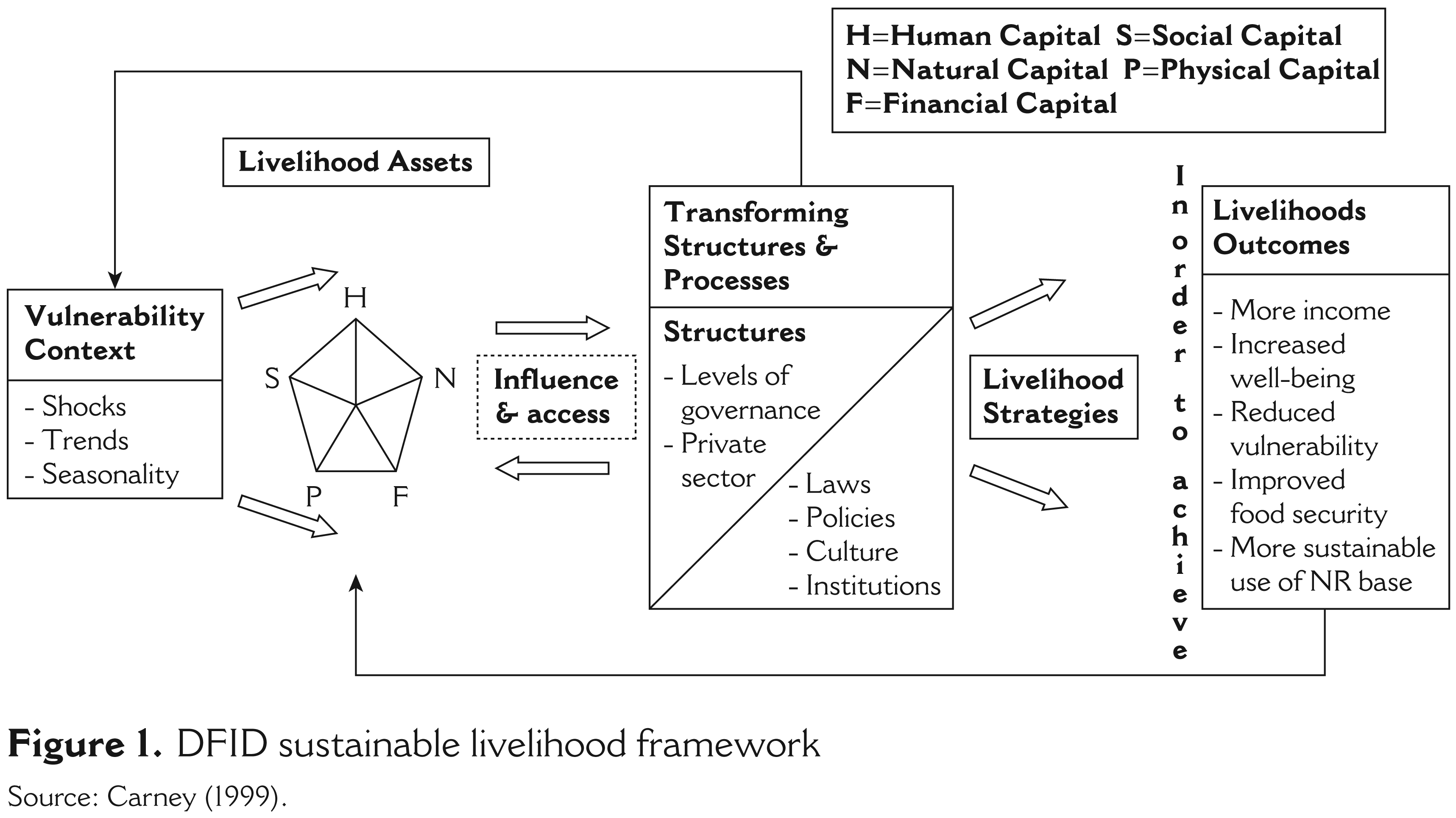
Source: Carney (1999).
The standard DFID framework identifies five types of capital assets which people can build up and/or draw upon: human, natural, financial, social and physical (DFID, 1999; Farrington et al., 1999). Human capital represents skills, knowledge, ability to labour and good health, that together, enable people to pursue different livelihood strategies and achieve their livelihood objectives (DFID, 1999). Natural capital is the term used for the natural resource stocks from which resources flow and services (e.g., nutrient cycling and erosion protection) useful for livelihoods are derived. There is a wide variation in the resources that make up natural capital, from intangible public goods, such as the atmosphere and biodiversity, to divisible assets used directly for production (e.g., trees, land and forests). Physical capital comprises the basic infrastructure and producer goods needed to support livelihoods. Infrastructure consists of changes to the physical environment that help people to meet their basic needs and to be more productive, whereas producer goods are the tools and equipment that people use to function more productively. The components of infrastructure include: affordable transport; secure shelter and buildings; adequate water supply and sanitation; clean, affordable energy; and access to information (communications). Financial capital denotes the financial resources that people use to achieve their livelihood objectives. There are two main sources of financial capital: (a) savings, which can be held in several forms such as cash, bank deposits or liquid assets like livestock and jewellery. Financial resources can also be obtained through credit-providing institutions and (b) regular inflows of money: the most common types of inflows are pensions, or other transfers from the state, and remittances (DFID, 1999).
Social capital is much debated about, notably what exactly is meant by the term ‘social capital’ (see Portes, 2000). In the context of the SLF as employed in this research, it is taken to mean the social resources (e.g., friendship) upon which people draw in pursuit of their livelihood objectives. These resources are developed through, and include, social networks and connectedness, membership of more formalized groups and relationships of trust, reciprocity and exchanges that facilitate cooperation, reduce transaction costs and may provide the basis for informal safety nets among the poor.
Cahn (2006) has also argued that culture should be regarded as a separate asset that should be sustained and enhanced. The livelihoods that people aspire to and the strategies they choose to achieve those outcomes are both influenced by culture. However, in this research, culture is treated within the social capital set.
Transforming structures and processes
Transforming structures and processes within the livelihoods framework are the institutions, organizations, policies and legislation that shape livelihoods. An understanding of structures and processes provides the link between the micro (individual, household and community) and the macro (regional, government and powerful private enterprise) (Cahn, 2003; DFID, 1999; Ellis, 2000; Scoones, 1998), as they effectively determine access, control and use of assets (Cahn, 2003; DFID, 1999). Understanding institutional processes also allows identification of restrictions/barriers and opportunities to sustainable livelihoods and shed light on the social processes which underlie livelihoods sustainability (Cahn, 2003; Scoones, 1998).
Livelihood outcomes
A focus on outcomes leads to a focus on achievements, indicators and progress (Cahn, 2003). Cahn (2003) and DFID (1999) argue that an understanding of livelihood outcomes is intended to provide, through a participatory enquiry, a range of outcomes that will improve well-being and reduce poverty. For instance, more income, reduced vulnerability, improved food security, more sustainable use of the natural resource base and recovered human dignity (Serrat, 2008).
Livelihood strategies
The livelihood approach seeks to promote choice, opportunity and diversity. Livelihood strategies is a term used to denote the range and combination of activities undertaken, and choices people make, in order to achieve their livelihood goals (including productive activities, investment strategies, reproductive choices, etc.) (DFID, 1999). Depending on the assets people have, the structures and processes that impact on them (Cahn, 2003) would add tradition, and the vulnerability context under which they operate; people theoretically choose livelihood strategies that are expected to best provide them with the sought after livelihood outcomes. Livelihood strategies change as the external environment (over which people have little control) changes. Sometimes unsustainable and unproductive livelihood strategies continue because of tradition, habits or other socio-psychological factors. At other times, livelihood activities are introduced as coping strategies in difficult times, rather than as strategies to achieve longer-term outcomes (Cahn, 2003).
Scoones (1998) has identified three types of rural livelihood strategies: agricultural intensification or extensification, livelihood diversification including both paid employment rural enterprises and migration (including income generation and remittances) and migration in search of opportunities (including income generation and remittances). Carney (1998) and Cahn (2003) have listed the categories of livelihood strategies as natural resource based, non-natural resource based and migration (but omitted remittances), whereas Cahn (2003) and Ellis (2000) have categorized livelihood strategies as natural resource based activities or non-natural resource based activities (including remittances and other transfers) but omitted migration in their rural livelihood strategies.
In order to understand the diverse and dynamic livelihood strategies, it is important that interventions are appropriate (Cahn, 2003). Also, a key issue in the analysis of livelihood strategies is the scale at which an assessment takes place, livelihood strategies, for example, can be described at an individual household and village level as well as at regional or national levels (Scoones, 1998).
Vulnerability context
The vulnerability context frames the external environment in which people exist. People’s livelihoods and the wider availability of assets are fundamentally affected by critical trends as well as by shocks and seasonality—over which they have limited or have no control (DFID, 1999). The vulnerability context is also about how people adapt to, and cope with, stresses and shocks (Cahn, 2003). For instance: (a) population trends, resource trends, (including conflict), national/international economic trends, trends in governance (including politics) and technological trends; (b) human health shocks (e.g., illness and injury), natural shocks, economic shocks, conflict and crop/livestock health shocks and (c) seasonality of prices, production, health and employment opportunities, have a direct impact upon people’s asset status and the options open to them in pursuit of beneficial livelihood outcomes (DFID, 1999). Culture (including gender) and household dynamics can also cause risk and vulnerability and can influence the way people perceive risks and vulnerability (Cahn, 2003, 2006). Cahn (2006) reports that risks are culturally defined and the perception of risks are influenced by socially entrenched values and beliefs of a particular culture.
Strengths of the sustainable livelihood approach
A number of authors have made claims about the strengths of the sustainable livelihoods approach, but these are mainly in the context of using the SLA as a tool to implement or guide the implementation of sustainable development. These claims include that SLA tries to reflect the complex range of assets and activities on which people depend for their livelihoods, and recognizes the importance to poor people of assets which they do not own. It provides a framework for addressing the whole range of policy issues relevant to the poor, not just access to health and education, but issues of access to finance, markets and personal security (Ashley and Carney, 1999). The approach facilitates an understanding of the underlying causes of poverty by focusing on a variety of factors, at different levels, that directly or indirectly determine or constrain poor people’s access to resources/assets of different kinds, and thus their livelihoods (Krantz, 2001). It also provides a systematic approach enabling a better understanding of cause and effect relationships, in general (Ashley and Carney, 1999). Krantz (2001) argues that the sustainable livelihoods concept provides a more realistic framework for assessing the direct and indirect effects on people’s living conditions than, for example, one dimensional productivity or income criteria. Several principles of the SLA are not new, but they are lessons that have been learnt in different sectors over recent decades. Some of the principles of the SLA are: it is people centred, dynamic, responsive and participatory (Ashley and Carney, 1999).
Critiques of the sustainable livelihood approach
Despite the wide use of the sustainable livelihoods approach, it has received some criticism. The major concern is that the SLA is too complex to apply in development processes. It is also considered by some that the approach is overambitious and offers insufficient practical guidance on the way forward (Cahn, 2003; Carney, 1999). Carney (1999) and Cahn (2003) further argue that most of the research on, and use of, the approach has been carried out in Asia and Africa. The nature of poverty in the Pacific is very different to those continents and the influence of culture and the traditional sector is much stronger. In the early DFID framework, culture is considered as part of the vulnerability context. Culture can also be regarded as a process, along with laws, policies and institutions. Cahn (2003) identifies rules, customs and land tenure as cultural institutional aspects that could modify access to resources in a way that is not highlighted by SLAs which see culture as part of the vulnerability context. However, this appears to be more a case of poor practice and overly narrow conceptualization of institutions rather than anything fundamentally wrong with the DFID framework. Notably, also none of the SLAs has discussed on how to identify the poor that is trying to assist (Krantz, 2001), but this again would be context and practitioner-dependent, rather than a fault with the framework itself. It has also been criticized that the transforming structures and processes in the SLA do not work to the benefit of the poor (DFID, 1999).
A proposed evaluative framework for co-management of forests institutions and livelihood outcomes
The purpose of this article was to develop an evaluative framework that can be used to link co-management approaches to the delivery of sustainable livelihood outcomes for poor forest-dependent communities. The review of literature on the sustainable livelihood framework has demonstrated its conceptual utility for framing an approach to an intervention. The development of a co-management approach to managing a common-pool resource like a forest is an institutional intervention—it involves transforming the transformational structures through which people pursue their livelihood strategies. The traditional DFID SLF approach to assessing changes to the transformational structures is to consider them in terms of their effect on: access (to various types of capital, livelihood strategies and decision-making bodies and sources of influence); the terms of exchange between different types of capital and returns (economic and otherwise) to any given livelihood strategy (DFID, 1999). One might also consider the effects of the institutional change on the vulnerability of the livelihood assets of the communities dependent on the forest for their livelihoods.
Ostrom’s (1990) design principles capture the details of common-pool resources institutions and, provide a strong indication of the likelihood of the institutions to deliver sustainable outcomes. For instance, the implications of the design principles have been examined with regard to donor-initiated forestry projects in Peru, fisheries stakeholder organizations in New Zealand, irrigation CPRs in Japan, and local forestry institutions in Nepal (Ming’ate et al., 2014; Quinn et al., 2007). All these studies have found the design principles useful for analyzing institutional robustness (Ming’ate et al., 2014). Furthermore, Ashutosh and Tadao (2001) point out that Ostroms’s design principles are basic, well configured and appropriate for governance of common-pool resources. Thus, the evaluative framework used in this article places Ostrom’s (1990) design principles as the tool to evaluate the nature of a particular institutional regime, the transforming structure, in the DFID framework (Figure 2) (Ming’ate et al., 2014).
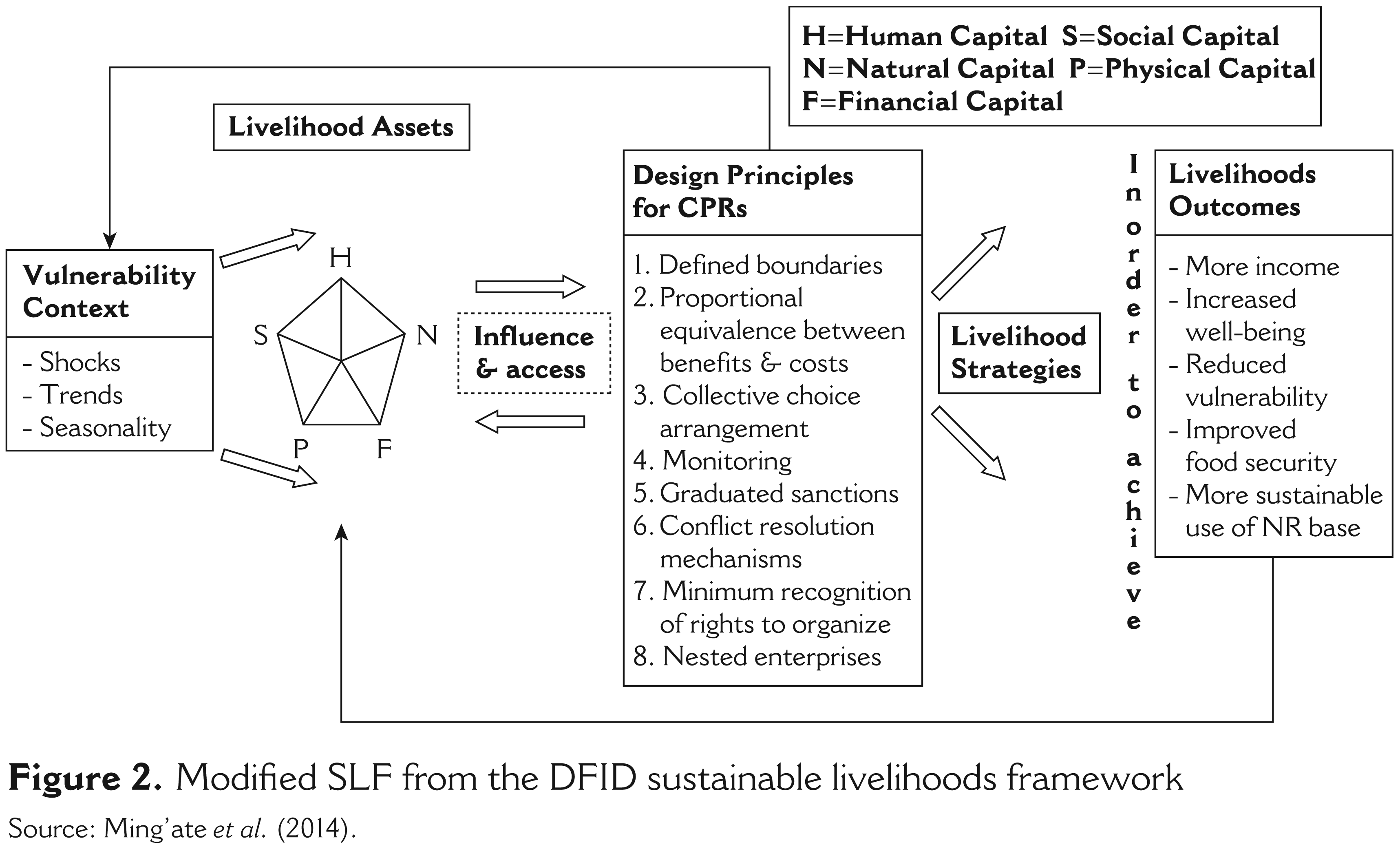
Source: Ming’ate et al. (2014).
Despite the critique of the SLF, it continues to be used in designing projects or programmes. The aim is to develop these projects or programmes around the central concept of poverty. Of greater significance to this modified sustainable livelihoods framework, however, is to help in designing a research aimed at the evaluation of co-management of forests and their associated livelihood outcomes for the monitoring and assessment or evaluation of projects. Project evaluation refers to a structured method for collecting, analyzing and using information to answer questions about projects, policies and programmes, particularly about their effectiveness and efficiency (Joy, 2002; Patton, 1997). While designing, research means the structure of any research work which gives direction and systematizes the research before data collection or analysis can begin (de Vaus, 2001). When monitoring, reviewing or evaluating programmes and designing research, the review directs attention towards the positive and negative livelihood (socio-economic) impacts associated with co-management efforts, and the identification of specific co-management interventions that significantly limit livelihood disturbance or minimize costs to livelihoods and how they can be modified to fit better. Such outcomes can be measured through an examination of the relationship between co-management interventions and the implications or changes for various livelihood assets or capital stocks held by individuals and households. It also looks at how and why co-management worked (or did not work) and why the poor in some instances found it difficult to participate in co-management. Measurements can also be achieved by linking qualitative and quantitative analyses of vulnerability of the key actors in the process (e.g., local natural resources users) with co-management interventions (Farrington et al., 1999). It can help to provide a holistic context for understanding the livelihood context of individual people or groups of people (e.g., households, geographical communities and interest groups) as a result of co-management or partnerships, for instance, in forests (Hocking, 2003).
The modified framework can also be used to assess co-management approaches by linking them to livelihood parameters (e.g., increased well-being, decreased poverty, increased income, decreased vulnerability context, increased food security and sustainable use of natural resources). This should be indicative of the extent to which they have been achieved through co-management.
When using the SLF for qualitative research, it does not seek to establish absolute values for the things that it investigates; its aim is to build up an accurate interpretation of what is being researched through triangulation of many different descriptive, sources whereas, in quantitative research, it seeks to place reasonably firm, absolute levels or values on the things that it investigates (DFID, 1999).
The key questions to explore and analyze include: (a) what change is occurring at the micro level? (b) How do livelihood strategies influence the degree of local participation? (c) How does the policy and institutional context influence livelihood impact or outcome? (DFID, 1999).
In a nutshell, as already identified in section III, there are few, if any, other comparative studies investigating participation in forestry and their associated livelihoods. This modified sustainable framework has thus created this linkage for designing a research and evaluation of co-management of forests and their livelihood outcomes. Therefore, the key parameters (and examples of secondary parameters) considered when designing research and evaluation of programmes livelihood outcomes associated with co-management are those set out in Table 1.
Strengths and weaknesses of the proposed framework
The strengths of the proposed evaluative framework include: first, its ability to relatively easily evaluate the institutional frameworks of stable common-pool resources in achieving sustainable livelihoods by poor forest dependent communities. Second, the above framework has managed to address one of the key problems in common-pool resources studies identified by (Agrawal, 2002; Morse and McNamara, 2013) a lack of a framework that connects different variables in a causal chain. Third, following the strengths described by Ashley and Carney (1999), the framework provides a people-centred approach and is able to respond to changing circumstances and can be used in multiple layers. For instance, it can be used at the national level or public/private partnerships and private sectors to evaluate institutional arrangements of co-management regimes, and the extent to which these institutions are able to deliver sustainable livelihood outcomes to the poor forest-dependent communities. Fourth, it can also be helpful in understanding how institutional arrangements can lead to poverty.
The framework has weaknesses, just like other frameworks. It may be difficult and complex to apply with certainty in a multilayered rich and intricate socio-political world. Also, when using the framework for monitoring, reviewing and evaluating programmes, the framework is broad and does not allow the many different factors of livelihoods to be put in context and balanced against each other (Twigg, 2001). For instance, Twigg (2001) argues that when an approach is so broad, problems are likely to arise in identifying the most important needs for analysis. In spite of these weaknesses, Twigg (2001) maintains that the SLF is a good model for reviewing all aspects of livelihoods. The framework has the ability to provide guidance in the exploration of institutions in a setting where there is both a reliable resource and a co-management agreement in order to ascertain whether there are any sustainable livelihoods outcomes, and, if so what is their nature or extent.
Livelihoods (economic and social) parameters for evaluation

Livelihoods (economic and social) parameters for evaluation
Source: Modified by the researcher after Carney (1999).
It can be helpful in understanding the interventions that can be included in co-management arrangements to significantly reduce livelihood disturbances of the forest-dependent communities. It can also be used to measure the livelihoods outcomes of the forest dependent communities involved in co-management institutions, examine the co-management interventions and their implications on the livelihood assets base of the forest-dependent communities and examine co-management interventions and local resource improvements.
This article has reviewed the literature on the SLA and its primary methodological contribution. There was a clear indication from the review of literature that since the SLF emerged in the 1990s, it has been adopted by a range of development actors and it provides a reasonably coherent framework for guiding implementation and evaluating linked economic–social outcomes associated with co-management. The literature has also identified that despite the significant benefits that are behind the establishment of co-management approaches (e.g., increased livelihoods, increased human, social and natural capital, decreased vulnerability, greater equity and democratization of power, there are also challenges facing co-management approaches, most governments refuse to relinquish power to the local communities involved in co-management approaches. The review also confirmed that comparative studies in the current SLF do not, specify the particular methods and techniques to apply to explore the capitals, institutions for co-management and vulnerability. Thus, a framework for evaluation and analysis of forest co-management institutions and livelihood outcomes for developing countries has been developed by replacing the transforming structures and process in Carney’s (1999) original SLF with Ostrom’s (1990) design principles to form a framework that can be used to explore real world commons. In this framework, the key features to consider when seeking data to explore the impact of co-management or designing institutional arrangement for co-management approaches therefore include; livelihood assets that people have built/or drawn upon as a result of the co-management arrangement (e.g., the human, natural, financial, social and physical capitals; livelihood outcomes; livelihood strategies and vulnerability context) and the Ostrom (1990) design principles. From the review of the literature, it was found that Ostrom’s (1990) design principles capture the details of common-pool resources institutions and are useful for analyzing the robustness of these institutional arrangements. The proposed framework for designing and analysis of co-management approaches and their associated livelihoods is therefore systemic, enabling considerations of explanations for linkages and probable cause and effect relationships. It also enables qualitative and quantitative data to be combined into one framework.
Footnotes
Acknowledgements
The author acknowledges and highly appreciates with gratitude the financial support from The World Academy of Sciences (TWAS) and German Research Foundation (DFG). Other acknowledgements go to Kenyatta University and the Universität Köln for signing an exchange programme agreement between the two universities that made it possible for the publisher to go to the Institut für Ethnologie, Universität Köln for the TWAS–DFG Cooperation Visits Programme for scientists from sub-Saharan Africa that made the writing of this article possible.