



Abstract
This article uses qualitative data from Niger to examine adolescent girls’ perceptions of their own agency in marriage decisions and contextual factors influencing these perceptions. We find that girls make marital decisions within a context that stresses parental consent and community approval, places a high value on obedience, and is constrained by limited opportunities, gendered distribution of labor, and dominant social norms promoting an early and narrow ‘window of opportunity’ for marriage. Findings demonstrate that interventions aiming to delay marriage in Niger must work to influence both community norms supporting child marriage and girls’ own motivations in martial decision-making.
Introduction
Child marriage, or marriage before age 18, is widely recognized as a human rights violation that increases the risk of intimate partner violence, reduces girls’ likelihood of being enrolled in school, and is associated with early childbearing and related risks (Hindin et al., 2008; Mensch et al., 1998; Murphy and Carr, 2007). Despite an increasing number of resolutions calling for an end to the practice—including the African Charter on the Rights and Welfare of the Child (ACRWC) (African Commission on Human and People’s Rights, 2018)—as well as an increasing number of national laws setting the legal marriage age at 18, the practice remains widespread (Maswikwa et al., 2015). While Niger signed onto the ACRWC in 1999, national laws continue to permit girls to be married from age 15, or earlier with parental consent. Presently, Niger has the highest prevalence of child marriage in the world, with 77.1 percent of women aged 20–49 reporting marriage by age 18 and 30.2 percent reporting marriage by age 15 (INS and ICF International, 2013).
Despite high rates of child marriage in Niger, there is limited research to date on what drives the practice in this context specifically. Existing research has suggested that in Niger, extreme poverty, absence of educational infrastructure, profound gender inequality, and powerful social norms supporting early marriage contribute to high rates of child marriage (Saul et al., 2017; WiLDAF, 2017). Islam undoubtedly has a strong influence on Nigerien culture and society (Muslims account for approximately 99 percent of the population [INS and ICF International, 2013]) and likely plays a role in shaping discourses and behaviors related to marriage; however, this influence is expected to vary across the country in relation to different interpretations of Islam.
In countries with limited educational and economic opportunities for girls—as in Niger, where approximately 70.2 percent of girls and 55.6 percent of boys ages 10–14 are not in school (Saul et al., 2017)—interventions aiming to delay marriage for girls have often focused their resources on girls’ ‘empowerment’ beyond formal education. Empowerment is highly contextual and is conceptualized and measured differently from one discipline to the next (Kabeer, 1999). In practice, child marriage interventions emphasizing girls’ empowerment as a strategy have typically included efforts to increase girls’ voices in marital decision-making, to increase the choices available to girls other than early marriage, or to give girls the tools they need to exercise individual agency and delay their marriages (Amin et al., 2018; Chae and Ngo, 2017; Lee-Rife et al., 2012). One such intervention is the More Than Brides Alliance (MTBA) ‘Marriage: No Child’s Play’ program, 1 which aims to ‘empower young people to decide if and when to get married and to make informed choices about their sexual and reproductive health and rights’. Programmatic theories of change (including that of the MTBA) often assume that increasing girls’ voice, choice and/or agency can catalyze change toward delayed marriage and improved health and well-being for adolescent girls.
Recent research on child marriage in West Africa, however, has illuminated an apparent incongruity related to girls’ voice, choice and agency in marital decision-making in Niger: while child marriage is highest in Niger, high proportions of Nigerien girls married before age 18 report that the decision to marry was their own personal choice (Plan, 2011; Saul et al., 2017; WiLDAF, 2017). A report from WiLDAF (2017) found that 84 percent of respondents in Niger believe that girls are allowed to refuse marriage before age 18, and 56.2 percent of girls married before age 18 report the decision to marry was their own. Surveys conducted as part of MTBA also reported surprisingly equitable attitudes on several indicators related to gender roles and girls’ agency. 2 Despite 27.1 percent of the sample reporting ever being married and a mean age at marriage of 14.5 years, more than half (55.7%) reported having chosen their husbands and a majority (56.7%) agreed that girls have a right to refuse an arranged marriage.
Theory and Definitions
Programs to delay marriage through girls’ empowerment strategies require an understanding both of girls’ intentions regarding marriage and of the social environment in which marital decisions are made. In international development practice, ‘empowerment’ may be best understood to mean ‘the expansion in people’s ability to make strategic life choices in a context where this ability was previously denied to them’ (Kabeer, 2001). As Kabeer (2001) explains, empowerment is fundamentally linked to: (a) the idea of process, or movement from a place of relative disempowerment to a place of relative empowerment and (b) the idea of human agency and choice, which must be considered within the context of available alternatives and costs that are not ‘punishingly high’. Kabeer (2001) describes ‘strategic life choices’ as those ‘that are critical for people to live the lives they want’. Child marriage for girls is associated with lower rates of educational attainment (Jain and Kurz, 2007), early childbearing and related health risks (Nour, 2009) and economic dependence and intergenerational poverty (Parsons et al., 2015). Child marriage is additionally associated with higher age gaps between spouses and a higher likelihood of being in polygamous unions, both of which are associated with reduced agency in decision-making within households (Mensch et al., 1998; NRC/IOM, 2005). Given the bearing of these consequences on a woman’s health and quality of life, decisions related to the timing of marriage are considered to be strategic life choices.
In this exploratory article, we draw from the theoretical framework proposed by the social psychological theory of planned behavior (TPB) (Ajzen, 1991) to examine how girls’ voice, choice and agency are understood in relation to marital decision-making in Niger. The TPB is composed of several key constructs: attitudes (which refer to an individual’s positive or negative response to something or someone), subjective norms (which refer to perceived social pressure favoring a certain behavior) and perceived behavioral control (which refers to the perceived difficulty or ease of conforming to a certain behavior). Together, these concepts help to explain what forms individuals’ behavioral intentions, which may be important predictors of actual behavior (Ajzen et al., 2013; Schoen et al., 1999; Webb et al., 2006). In this article, we borrow the TPB’s key constructs for the purpose of organizing findings about how girls evaluate the decision of when to marry. Our intentions are neither to test the TPB in Niger nor to comment on the theory’s adequacy for explaining marital decision-making behaviors. We acknowledge that this individualistic psychological model may not easily translate to rural Niger, where collective decision-making is more salient. Nevertheless, the TPB, together with Kabeer’s definition of empowerment, provides a useful structure through which to explore our findings and to examine how girls’ perceptions of their individual decisions are embedded within the normative context.
In this article, we consider how each of the constructs within the TPB may influence marital decision-making in Niger. First, we examine girls’ attitudes toward early marriage and the forces that shape those attitudes. We then consider the subjective norms that constrain viable options for girls and make certain choices appear more beneficial than others. Next, we look at how girls perceive their own control over these decisions. Finally, we consider the implications of these reflections for interventions aiming to delay marriage in Niger.
Methodology
Site Selection and Data Collection
Data were collected by an experienced research group, the Laboratoire d’Études et de Recherche sur les Dynamiques Sociales et le Développement Local, based in Niamey, Niger, in partnership with Population Council (MTBA research partner). Data collection took place in late 2018 and included 16 focus group discussions (FGDs), conducted in four rural villages: two in the region of Tillabéri and two in the region of Maradi. Villages were chosen to include a diversity of ethnic groups: Puular, Hausa, Zarma-Songhay and Gurmance communities were represented (see Table 1). Efforts to maximize the ethnic diversity of the sample were made not with the intention of comparing responses across ethnic groups, but rather to ensure a wide representation of views and to minimize the risk of bias. Given the small sample size, we avoid making inferences about similarities or differences in opinions expressed based on ethnicity. All four villages included in this study were among those participating in the MTBA impact evaluation study, three as MTBA intervention villages (Villages 1, 3 and 4) and one as a comparison village (Village 2). This qualitative study was conducted at the same time as the MTBA impact evaluation study. The results of both were used to stimulate discussion among MTBA program implementation partners about drivers of child marriage in Niger and appropriate programmatic strategies. Due to the small number of FGDs and to the fact that we did not ask whether FGD participants interacted directly with the MTBA program, we avoid making inferences that opinions expressed in the intervention villages are related to the intervention. All FGDs were conducted by experienced interviewers of the same sex as participants. FGDs were conducted in local languages, recorded, and later translated and transcribed in French. In one of the villages where the facilitator did not speak the local language (Village 4), focus groups were conducted with the assistance of an interpreter.
Ethnicities Represented in Qualitative Data Collection
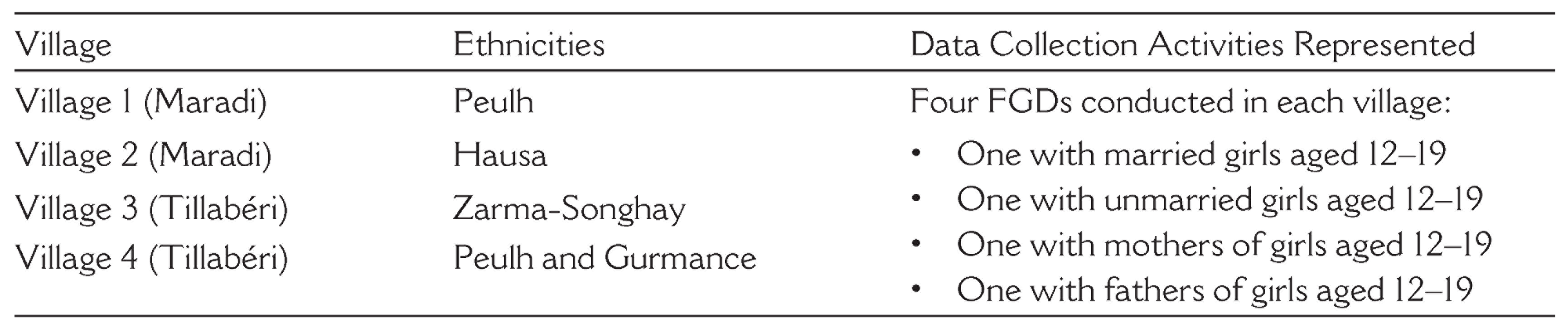
Ethnicities Represented in Qualitative Data Collection
In each of the four villages, separate FGDs were conducted with married girls aged 12–19, unmarried (including engaged) girls aged 12–19, mothers of girls aged 12–19 and fathers of girls aged 12–19. Discussions included an average of 12 participants per group. Criterion sampling (selected on marital status and ethnicity) was used to ensure adequate numbers of participants within each specified category.
Themes
Focus groups explored themes related to processes and expectations surrounding marriage in Niger, girls’ agency with respect to partner choice and marital timing, perceptions of social pressures and social supports surrounding marital decision-making, and other relevant topics including sexual security and gender roles. We examine whether girls’ voices are enough to challenge dominant norms and practices by exploring girls’ intentions concerning marriage, the contextual factors shaping the options available to them, and how girls evaluate what choices they have.
Ethics
Informed consent was obtained from all participants over age 18; for unmarried girls under age 18, parental permission was first obtained. Following parental permission, adolescents were approached and requested to give assent to participate. For married minors, it was in some cases necessary for FGD facilitators to obtain the permission of a girl’s husband before obtaining her assent to participate. In all cases, written consent/assent/permission was obtained prior to study participation. The study protocol was approved by the Population Council Institutional Review Board in New York City and by the Comité d’Ethique pour la Recherche en Santé in Niamey.
Data Analysis
Qualitative analysis of French transcripts followed a thematic approach (Clark and Braun, 2013; Ritchie and Lewis, 2013), based in part on themes predetermined by interview guides, but also allowing for additional themes to emerge (Strauss and Corbin, 2008). Researchers (Grace Saul and Aïssa Diarra) used Dedoose 8.1.8 software to identify overarching and repeated themes, and develop and refine a list of parent and child codes and code transcripts. Memos were used to identify interesting patterns or phenomena and to refine the code list. Codes related to marriage (decision-making, timing and alternatives) were coded separately, but axial coding revealed linking themes including voice and choice (Strauss and Corbin, 2008). This analysis focuses on the links between the decision-making process and the context in which marital decisions are made. Once pertinent quotes were selected, they were translated into English for inclusion in this article.
Results
Marriage as Livelihood Dependence (Attitudes)
We examined adolescent girls’ attitudes related to marriage in these communities, looking both at the forces shaping attitudes and at how these attitudes may contribute to Niger’s high prevalence of child marriage. Drawing on Ajzen’s (1991) notion of attitudes as being composed of both beliefs and of evaluations of behavioral outcomes, we seek to understand how adolescent girls and parents of adolescent girls in these communities view marriage.
To understand girls’ attitudes toward early marriage, it is useful to first consider the role that marriage plays more broadly in the Nigerien context. For women especially, marriage is nearly universal in Niger, with only 1 percent of women aged 25–49 reporting never having been married (INS and ICF International, 2013). In this context, marriage is considered essential for maintaining harmony within households, creating social cohesion, and fulfilling a religious obligation. As one married girl in Tillabéri put it, ‘They [girls] know that it is destiny, that marriage is like death [unavoidable]; that it has a definite moment’. This quote reflects the attitude that marriage is an inevitable life event for girls in this context: marital decision-making is not a question of whether a girl will marry but rather a matter of when she will marry. Participants described a narrow window of opportunity within which girls should be married and indicated that this window is determined by the timing of the marriages of other girls her age.
To understand how girls evaluate the question of when to marry, it is important to consider the economic and social factors that shape options available to adolescent girls in this context. In Niger, economic opportunities are extremely limited, and the distribution of labor is highly gendered, with 80 percent of men aged 15–49 employed for wages, compared to only 25 percent of women (INS and ICF International, 2013). As women’s work is typically unpaid domestic labor, women and girls are largely dependent on men for access to capital, while men are expected to provide for their families financially. This expectation that husbands financially support their wives and children was often the first cited when study participants discussed the characteristics of an ideal marriage.
Women’s involvement in economic activities, meanwhile, is seen as a means of earning supplemental income for one’s household when a husband is unable to support the needs of his family. One mother in Tillabéri explained, ‘If the men have the means, they invest [in their households]. If they don’t, it is us who will buy soap, salt, spice, and seasonings’. Another mother agreed, adding, ‘If the charge is a lot for the men, we come to their aid’. This discussion reflects an attitude that paid work is not considered a desired pathway for women, but rather a necessity if a husband is not able to provide.
For girls in Niger, marriage marks the transition from financial dependence on one’s father to financial dependence on one’s husband. Leaving one’s parents’ home is presented as synonymous with entering marriage; there exists little to no space for adolescent girls outside of their parental homes or marital homes. In this context, both married and unmarried girls indicated that financial dependence on husbands is preferable to financial dependence on parents. An unmarried girl in Tillabéri commented:
Her life [the life of a married girl] will be more beautiful because her husband will provide for all of her needs. Whereas to provide for their own needs, girls who are not married will have to either go do small business or ask of their parents or their friends, and certain people will try to take advantage of them. (Unmarried Girl, Village 4, Tillabéri)
Girls and parents alike described a girl’s marriage as a source of pride for the girl and her family. When asked what people would think or say if a girl were to be married before her peers, one mother in Maradi remarked, ‘They will say that Allah brought his choice quickly. Her mother is to be congratulated’. A girl’s marriage is considered a blessing and a positive reflection on the girl’s parents, especially her mother, who is seen as bearing a greater responsibility for socializing her children. Furthermore, it reflects that dominant attitudes favor being married earlier than one’s peers, which likely drives high rates of child marriage. When asked how the community would respond to a girl who marries first, one married girl in Maradi explained, ‘They will say that she is clever. She developed strategies to have a spouse very quickly. Everyone will speak well of her’.
Community Expectations and an Alignment of Voices (Subjective Norms)
These positive attitudes toward early marriage must also be considered within the broader context, which is characterized by powerful social norms surrounding the process of marriage formation. We adopt the TPB’s definition of subjective norms: ‘perceived social pressure that people feel to conduct a behavior’, understanding that these norms are composed of both beliefs about what others do and expect, and of motivation to comply with the normative behavior in question (Ajzen, 1991). We find that girls are socialized to be obedient and to consider multiple opinions in the community regarding decisions about their own marriages.
When discussing the ‘normal’ course of marriage formation, participants described a courtship process involving multiple steps and stakeholders. Some participants reported that the girl’s role in deciding the person and moment she will marry is most important. For example, one father in Maradi stated, ‘The [girl’s] role is overriding. They are the ones who decide what their marriage should be’. At the same time, participants explained that boys and men most commonly initiate the marriage formation process:
P: For me, I was at my home, he came, he saw me, and he told me he loved me, and me too, I said that I loved him, and we married. P: Our parents didn’t choose. It was him who saw and said he loved me, and the parents accepted. (Married Girls, Village 1, Maradi)
This quote demonstrates a common characterization of the marriage formation process offered during the FGDs: an alignment of consent, whereby a suitor presents himself to a girl and/or her family and asks for her hand in marriage, the girl accepts, her parents agree, and the marriage is organized, including the exchange of dowry and household goods. Explanations of this process demonstrated that while a girl’s acceptance of a marriage proposal is essential, it is embedded within a broader negotiation process involving household economics-related considerations and the voices of parents, in-laws and others in the community.
Numerous participants indicated however, that a girl’s parents ultimately have the final say regarding her marriage. One unmarried girl in Tillabéri explained, ‘Girls have the chance to choose the husband and the moment, but the parents usually have the last word’. The discordance demonstrated here is key for understanding marital decision-making in this context: while girls themselves may decide whether to marry, questions of marriage are fundamentally not decided at the individual level.
Married girls often stated both that their parents had chosen their husbands and that the decision to marry had been their own. During one discussion in Maradi, married girls explained how they were satisfied with the marital choices their parents had made for them. ‘All of us here, no one chose their spouse. It was our parents who chose, and we accepted it’, explained one girl. ‘We are proud of this choice’, added another. These explanations illustrate that girls in this context do not view these two responses as standing in contradiction to one another, but rather as complementary components of a harmonious marriage decision-making process.
Participants additionally made clear that other community members are often involved in the marriage formation process as well. One mother in Tillabéri stated, ‘If the others [in the community] are not in agreement, the marriage will not take place’. In this context, marriage does not appear to be solely a matter of girls exerting individual agency or even a negotiation that takes place within or between families, but rather a process involving many different voices in one’s community.
Results demonstrate that the normative context surrounding marriage in Niger also prescribes distinct expectations for parents, namely the expectation to secure one’s daughter’s marriage prior to her sexual initiation. Girls who become pregnant before marriage are subject not only to the short-term consequences of social shaming, but also to long-term economic consequences. As a girl reaches adolescence and her sexuality is increasingly viewed as a threat to her marriage prospects, social pressure mounts for her to be married so that her future is thereby secured. When considering the risks associated with premarital sex and pregnancy, an unmarried girl in Tillabéri noted:
Her life will be completely miserable. If she has a boyfriend who wanted to marry her, the marriage won’t take place because he will say that he was going to waste his money and his life for a bad girl, who is wild/loose [une traînée]. And he will be encouraged in this decision [not to marry her]. (Unmarried Girl, Village 4, Tillabéri)
Delaying marriage even a few years is linked to long-lasting economic consequences in this context: as girls pass the age considered ‘normal’ for marriage in their communities, they consequently become seen as less desirable wives and may have a harder time finding a husband, which could lead to social and financial insecurity in the future. One unmarried girl in Tillabéri explained:
Parents of the girl will call on God so that she will marry. Some adults will also call on [put pressure on] her. Others, on the other hand, will say that she is a bad girl; a fighter [une bagarreuse], wild/loose [une traînée]. That’s why all of the others got married and left her. There are some who will say these criticisms directly to the girl’s mother. Because of these prejudices, some mothers will forbid their sons to marry this kind of girl, even if they love each other. (Unmarried Girl, Village 4, Tillabéri)
We find that girls’ motivation to comply with expected behavior related to marriage is closely linked to the normative emphasis placed on obedience in Niger. FGD participants often spoke of the importance of obedience, portraying it as a sign of patience, discipline and reciprocal respect, and as essential for preserving harmony within families and communities. The importance of obedience was especially emphasized when participants discussed women’s roles in households and communities, what girls should learn before marriage, and to how girls and women should behave within marriage. As one unmarried girl in Maradi explained, ‘We are told to obey our husbands, step-by-step. You serve him, he serves you’. By accepting a marriage proposal that is supported by her community, a girl is not only demonstrating her obedience regarding the specific act of marriage but is also signaling more broadly that she is a well-socialized woman, that she will make a good wife and daughter-in-law, and that she is deserving of respect and admiration.
Considering that obedience and familial obligation are strongly valued in Niger, especially among female children (WiLDAF, 2017), it is difficult to discern a girls’ choice to accept a marriage proposal from her desire for parental and community approval when the interests of others in her community have aligned in support of her marriage. Girls who refuse a proposed marriage may be perceived by others as ill-mannered and disobedient. When asked whether girls have the right to refuse an arranged marriage, an unmarried girl in Maradi responded: ‘If she’s a docile and polite girl, she will accept her parents’ choice’.
Ability to Depart from the Norm (Perceived Behavioral Control)
Perceived behavioral control describes the extent to which an individual believes he or she is able to perform a behavior (Ajzen, 1991), or in this case, to depart from the norm by rejecting a marriage proposal. To better understand girls’ perceived behavioral control in marital decision-making in Niger, we examined both the obstacles and supports girls identified when considering the possibility of rejecting a marriage proposal.
When asked about what happens if a girl refuses to marry despite her parents’ wishes, FGD participants indicated that these circumstances are rare, but that her parents will not force her to marry against her will. At the same time, they also consistently articulated that such a girl will be judged and poorly treated for her refusal. ‘People will say that she is subversive. They’ll say bad things about her. They’ll make fun of her’, explained one unmarried girl in Maradi. ‘People will say that she doesn’t listen to her parents, that she doesn’t respect them, because a child who respects their parents would never refuse them something’, added another.
Girls known to have rejected suitors are judged harshly in their communities. As one unmarried girl in Tillabéri explained, ‘They insult her, saying that she had several suitors, but she rejected them all. Certain people will say that a spell was cast on her’. The pressure girls feel to accept marriage proposals is additionally linked to the desire to marry at the ‘right’ time in order to avoid judgement from others. One father in Maradi stated, ‘If your daughter passes 18 years without finding a husband, it is a catastrophe’.
While such social pressures likely dissuade girls from refusing a marriage proposal, some participants indicated that a girl or others in the community who object to a marriage can solicit the support of a friend or family member or of a village leader to convince the girl’s parents to call off the marriage. As one married girl in Tillabéri explained, ‘Girls have paternal uncles who they can turn to. If she reveals her problem, they will ask her reasons why she doesn’t want to marry, for example, if the suitor is a drunk, a thief, or [has] some other defect’. Another girl in this FGD added:
She can also resort to going to her maternal aunts, giving reasons such as the fact that the suitor is lazy and he won’t be able to take care of her [food, clothing needs, etc.] because of his irresponsibility. The aunt will meet with the parents and reveal the girl’s reasons and give some arguments to try to convince them. (Married Girl, Village 3, Tillabéri)
Such responses indicate that while girls perceive themselves as having some degree of behavioral control in rejecting an unwanted marriage proposal, this control remains contingent on her gaining the support of others in the community. Participants discussed what would and would not be considered legitimate grounds for a girl to refuse a marriage proposal. As an unmarried girl in Tillabéri stated, ‘If the arguments advanced are recognized by everyone, there won’t be any problem for this refusal’. Just as the approval of others is reportedly required in order for a marriage to proceed, results suggest that community acceptance of a girl’s reasoning for refusal is necessary for a proposed marriage not to take place.
Discussion
Our results call for a more critical examination of the starting point for girls’ ‘empowerment’ and of the concept of ‘choice’ in development practice by providing insights into how girls in Niger themselves view marriage, how time pressures and expectations to marry shape girls’ understanding of their options, and how girls view their negotiating power relative to marriage. As Kabeer (2001) notes, ‘empowerment’ can only be achieved where alternatives are available and the costs of adopting a new behavior are not ‘punishingly high’. Our results indicate that programs seeking to ‘empower’ girls to ‘choose’ who and when to marry must consider whether alternative pathways to marriage exist and are seen as acceptable for girls and must recognize that marital decision-making is largely a collective process in this context.
In Niger, we find that marriage is seen as an inevitable moment in a girl’s life which marks her transition to adulthood and independence from her parents, and as an economic necessity in a society characterized by women’s economic dependence on men. Few alternate pathways exist for unmarried women to provide for their basic needs, women’s involvement in economic activities is not seen as desirable, and marriage is considered the best way to protect a girl against the social and economic consequences of premarital sexual initiation. For these reasons, girls in Niger hold primarily positive attitudes toward early marriage. Our findings suggest that girls who accept early marriage in Niger consider themselves to be making a strategic life choice: they understand entering into marriage to be linked to relative independence and financial security as well as the respect and admiration of their peers and communities, while delaying marriage risks social shame and a closing window of opportunity for social acceptance and economic security.
While girls in Niger reportedly have a say in choosing when to marry, our findings suggest that this decision is not considered to be an independent or individual choice. Powerful social norms dictating an acceptable window of time for marriage and emphasizing obedience and familial obligation play a powerful role in shaping girls’ assessment of desirable options and of their own behavioral control in marital decision-making. We find that girls’ perceptions of their own agency are difficult to disentangle from their desire for parental and community approval. While girls reportedly have some ability to object to an unwanted marriage proposal by appealing to someone close to their parents or to a community leader, instances of girls following this course of action appear to be rare. Furthermore, we find that the community must judge a girl’s reasons for not wanting to marry to be legitimate in order for her to escape the negative consequences associated with departure from the norm. As these consequences include social rejection, reduced marital prospects, and related long-term financial insecurity, the costs of delaying marriage in this context can be considered to be ‘punishingly high’.
There are some limitations that influence our findings. We acknowledge that small sample sizes and the selection of villages (based on inclusion in the MTBA program evaluation) limit generalizability to Niger as a whole. Though there are likely significant differences in marriage norms and practices across Niger’s different ethnic groups, the small number of villages included in this study precludes comment on any such variation. Additionally, while it is unknown whether any FGD participants had direct interaction with the MTBA intervention, program presence in three of the four villages suggests some participants may have been exposed to child marriage messaging.
Additionally, use of the TPB for examining the context in which marital decisions occur reinforces certain critiques of the theory. Among the critiques of the TPB are Sniehotta et al. (2013), who note that the framework does not adequately address the influence that background factors may have on the TPB’s individual components. Our exploration of subjective norms included some examination of context with regard to early marriage; however, we are unable to fully examine community-level factors, including economic and political influences, which may play important roles in shaping marriage decisions. The TPB’s emphasis on factors influencing individual-level decision-making may limit the theory’s usefulness for analyzing behaviors that are the result of more communal decision-making processes, such as marriage formation appears to be in Niger.
Despite these limitations, this research helps shed light on the social expectations and norms at play in Nigerien communities and contributes to a wider understanding of the environment in which girls weigh the relative benefits and risks of their decisions in the country with the highest rates of child marriage in the world. We conclude that for girls, having a voice in marital decision-making is not sufficient for changing child marriage practices where alternative choices do not exist and powerful social norms continue to favor early marriage. A significant shift in social norms would be necessary to alter girls’ own attitudes toward early marriage and to render alternative pathways, such as engagement in economic activities, appealing or acceptable options for girls.
Conclusion
As past research has shown that girls in Niger report having a voice in the decision of when to marry, this study provides insights into how the perceived benefits and risks associated with early marriage influence girls’ acceptance of marriage proposals in this context. We find that although participants report that girls’ voices are considered in the marital decision-making process, delaying marriage is not seen as an individual decision, nor as a desirable option among girls themselves. Thus, it appears that girls’ revealed preference for early marriage in Niger is best explained by the internalization of socialization favoring obedience as a means of preserving harmony in the community and by the desire to secure one’s future in a context where women are financially dependent on men, there exists little to no space for young women to establish independence outside of their parental or marital homes, and norms prescribe a limited window of opportunity for girls to marry. Accordingly, girls accepting to marry within the ‘acceptable’ window of time perceive that they have agency with respect to their marriage. These findings suggest that programs working to address child marriage in Niger must focus efforts at both the girl- and community-level.
At the girl-level, empowerment programs should consider the following approaches that focus on building girls’ social, health and economic assets. Evidence from other settings has shown that such approaches have been effective in reducing adolescent girls’ dependence on others and in helping them to more effectively navigate the transition to adulthood (Austrian and Anderson, 2015). Asset-building programs that encourage girls to envision personal goals and provide them with the means of building skills needed to achieve those goals have potential for helping girls begin to imagine pathways for their lives other than early marriage, however constrained the setting. Weekly safe space groups for girls to develop both hard and soft skills have proven to have had positive effects on building girls’ self-efficacy (Austrian et al., 2017). In Niger, providing girls with a safe space to engage critically with the reasoning behind their marital decisions and to consider the influence of others’ expectations separate from their own personal motivations may help to change girls’ attitudes concerning the strategic life choice of marriage.
Involvement of mentors within programs is an additional strategy, which can serve not only to inspire young women to imagine personal goals unrelated to early marriage but also to help challenge collective norms and pressures which obscure and limit alternative possibilities for girls. As evidence from child marriage interventions in other contexts has shown that the involvement of mentors in programming can have a significant impact on delaying child marriage (Amin et al., 2018), child marriage interventions in Niger may consider focusing increased attention on identifying women in the community who can help to demonstrate to girls that marrying well is a more strategic goal than marrying soon. Future research is necessary to better understand positive deviance in this context and to uncover what conditions or mechanisms might give rise to success for women who choose to delay marriage beyond the conventionally accepted window of time.
This research makes clear that attitudes held by family members and others in the community influence the outcome of a marriage proposal both indirectly (via normative influence on a girl’s attitudes toward marriage) and directly (as parental and community approval is reportedly necessary for a marriage to take place or to be called off). Findings thus suggest the importance of interventions that focus on shifting social norms toward acceptance of an expanded window of time for girls to marry and toward the valuation of adolescent girls’ and women’s contributions beyond early marriage and childbearing.
Footnotes
Acknowledgements
We would like to thank our colleagues at the Laboratoire d’Études et de Recherche sur les Dynamiques Sociales et le Développement Local (LASDEL), who oversaw data collection and transcription in Niger, and without whom this research would not have been possible—namely, Issaley Nana Aichato, Ali Bako, Siddou Moumouni, and Chaibou Saadou. We would additionally like to thank the program staff of Oxfam and Save the Children Niger for their thoughtful review of the discussion guides used for this research.
Declaration of Conflicting Interests
The authors declared no potential conflicts of interest with respect to the research, authorship and/or publication of this article.
Funding
The authors received no financial support for the research, authorship and/or publication of this article.