



Abstract
The emergence of Sino-African megaprojects has become a major topic of discussion in recent years. Developments such as the Addis Ababa-Djibouti Railway, Merowe Dam and Nova Cidade de Kilamba are among the most visible linkages between China and Africa and have substantive effects on both bilateral relations and host-country economies. Although Sino-African megaprojects are heterogeneous in terms of framing, objectives and outcomes, certain threads (e.g., drivers, imperatives and policy mechanisms) bind them together within the constellation of overseas Chinese-backed projects. This research systematically examines the diversity of Chinese-backed megaprojects that has sprung up on the continent over the last several decades to construct a framework that categorizes and connects them. In doing so, the article attempts to add form to the growing literature on Sino-African megaprojects.
Introduction
The proliferation of Sino-African megaprojects has become a major topic in both academic and popular circles over the last several decades with the construction of projects such as Nigeria’s Lagos-Ibadan Railway, Ethiopia’s Eastern Industrial Zone (EIZ) and Ghana’s Bui Dam. These projects, and others like them throughout the continent, have substantive effects on host country economies and state-society relations. Moreover, given their size, cost and visibility, project outcomes can have significant implications for countries’ development pathways.
While some decry the emergence of Sino-African megaprojects as a sinister, state-directed ‘debt trap’; in reality, the projects are the result of dynamic, transnational processes and are generally driven by complementarities, or the convergence of needs, interests and proficiencies between Chinese and African actors (Alves, 2013). Though these vary largely by sector; as a whole, the projects function as complex sites that articulate multi-scalar flows of capital, ideology, expertise and technology. As such, their study provides significant insight into both the modalities of engagement and expansion of Chinese state and firm actors and the strategies used by African elites to leverage the wide-ranging processes of Chinese internationalization.
Although a small but increasing number of studies have begun analysing the effects of such projects (Kanai and Schindler, 2019; Lee, 2018; Wissenbach and Wang, 2017), most of these either focus on the construction process and subsequent local-level results (Benazeraf and Alves, 2014; Giannecchini and Taylor, 2018; HRW, 2020; Kanai and Kutz, 2011; Murray, 2015), or limit their scope to a single sector (Ballard and Rubin, 2017; Harrison and Todes, 2017; van Noorloos and Leung, 2018). Additionally, few consider the broad geopolitical or geoeconomic dimensions that Chinese-backed megaprojects share—an area that warrants greater attention in light of shifting geographies of trade, influence and power.
This article, based on a review of the academic and professional literature, as well as fieldwork undertaken in South Africa between August 2017 and March 2018, will construct a framework that categorizes and connects China’s African megaprojects. In essence, the article will create a typology of Sino-African projects and then systematically analyse the principal drivers, imperatives and characteristics behind each of the categories. Likewise, it will interrogate the broader patterns that emerge.
The article will proceed as follows. The first section will briefly delve into the megaproject literature and illustrate what differentiates these projects from their smaller counterparts. Moreover, it will contextualize the use of such projects as politico-economic instruments throughout Africa’s recent history. Section two will then detail the historical-geographical particularities of China’s use of megaprojects within its economic statecraft and examine each of the specific types of Chinese-backed project on the continent.
Understanding Megaprojects
Megaprojects are a global phenomenon and are used to deliver goods and services across a range of sectors, including manufacturing, energy and information and communications technology (ICT). Historically, projects have been used by state actors in pursuit of a variety of goals, including the reshaping of socio-economic structures and the reinforcement of national, ideological or modernist discourses. In this manner, megaproject construction must be understood as being entangled with the interests of domestic elites and (often) transnational capital. Yet the term itself has become something of a definitional morass, with characterizations ranging from ‘large scale projects which transform landscapes rapidly, intentionally, and profoundly in very visible ways’ (Gellert and Lynch, 2003, p. 15), to projects measured in ‘billions of dollars’ (Flyvbjerg, 2014, p. 6) or projects of substantial complexity and uncertainty (Salet et al., 2013). In fact, there is no formal definition for the term and as Ballard et al. (2017) note, it is often applied flexibly to a variety of projects and schemes. However, a common thread throughout the literature is that megaprojects are shaped by a far larger variety of actors (e.g., political, institutional, economic and regulatory) than ‘ordinary scale’ or ‘micro’ projects. Additionally, megaprojects are ‘trait-making’ as opposed to ‘trait-taking’, that is, projects are designed to ambitiously transform the structure of society as opposed to existing within established frameworks (Hirschman, quoted in Flyvbjerg, 2014, p. 6). African projects such as South Africa’s Gautrain, Egypt’s New Cairo City and Kenya’s Lamu Port all exemplify this transformative quality and have had (or will have in the event of successful construction) profound effects on multi-scalar politico-economic structures.
This research will utilize a modified version of Fiori and Kovaka’s (2005) holistic definition that highlights five key characteristics of megaprojects: cost, risk, complexity, visibility and ideals. A megaproject will therefore be defined as: ‘A construction project, or aggregate of projects, characterized by: magnified cost, extreme complexity, increased risk, lofty ideals, and high visibility, in a combination that represents a significant challenge to the stakeholders, and has a significant impact on the community’.
This analytically minded definition allows for a conceptualization of megaprojects which considers contextual factors and fosters comparison and examination in a way that focusing on simple figures does not. As Flyvbjerg (2004, p. 3) notes, ‘you cannot define a megaproject independent of the context in which the specific project is being planned or built’.
The research also builds on Gellert and Lynch’s (2003) typology and disaggregates megaprojects into five distinct types (Table 1). Though the categories may at times occur in combination, for example, mine (extractive) output transported via rail network (infrastructure) to manufacturing facilities (productive) and then to ports (infrastructure) for export; differentiating them allows for in-depth assessment of the varied drivers, ideologies, imperatives and policy mechanisms that produce project development. Moreover, foregrounding intra-category similarities offers a means to recognize and theorize the combination of structural and conjunctural factors involved in project development and thus allows for more accurate understandings of the higher-level processes at play.
Megaproject Typology

Megaproject Typology
Contextualizing Africa’s Megaprojects
During Africa’s colonial era, megaprojects such as railways, ports and mines were largely built to service the extractive and military needs of the ruling power. Colonial infrastructure, therefore, created networks with extensive rather than intensive linkages (i.e., connecting strategic points as opposed to providing networked coverage within a territory) (Arewa, 2016; Jedwab and Storeygard, 2017). 2 As core-periphery trade was emphasized over continent-wide trade, cross-border linkages were underfunded, ultimately contributing to today’s weak regional integration and the sharp infrastructural disparities among African countries.
The end of colonialism led to a megaproject boom across the continent as the governments of newly independent states turned to large-scale developments as instruments to engender growth and establish legitimacy. Then, as now, a variety of factors and opportunity/incentive structures came together to create the elite-level support necessary for project development. Politically, megaprojects were attractive to elites as their monumentality left lasting legacies for those involved; in addition, projects served to reinforce chosen national or modernist discourses (van der Westhuizen, 2007). Economically, projects were presented as tools to generate and sustain employment and create multiplier effects for growth. The capital city relocation programmes in Malawi, Tanzania, Nigeria, and Botswana, among others, (Abubakar and Doan, 2017) are indicative of this early phase of post-colonial megaproject construction—though many of the aforementioned factors that make projects appealing to elites remain the same to this day.
As top-down initiatives, the capital city relocation programmes were driven by state elites and conceptualized as symbols of national pride, modernity and development. Indelibly tied to discourses of state- and nation-building, 3 new capitals would not only serve administrative functions but were also meant to spur development, provide housing and basic services for millions, and wipe away the imprint of colonialism (Abubakar and Doan, 2017; Kironde, 1993; Mosha, 1996; Potts, 1985). Despite corresponding with the developmental theories of the time, specifically the idea of ‘growth poles’ as nodes of development (Cain, 2014, p. 562), these programmes largely failed to bring about their promised benefits and did little to change African countries’ dependence on the export of primary commodities. New cities were often overwhelmed (in terms of service provision) by rapid, informal urbanization, which exacerbated existing social divisions. Furthermore, the programmes burdened governments with debt and diverted investment from economic and social projects.
A sizeable number of post-colonial era megaprojects were also explicitly tied to Cold War geopolitics. Sneddon (2015, p. 139) documents how the United States used large projects to curry favour with newly independent countries and ‘demonstrate the benefits of capitalist ideologies’ as part of its effort to contain the spread of communism. Meanwhile, the Soviet Union used megaprojects to replicate its industrial development in allied countries. Indeed, China’s first steps towards what would become South-South cooperation, as well as its self-described role as the ‘leader of the developing world’, began with ideologically motivated projects such as the Tanzania-Zambia (TAZARA) railway (Taylor, 2010, p. 20). However, by the late 1990s a combination of factors including megaproject’s inherent precariousness, high debt levels across the continent, and the end of Cold War geopolitics, led to a shift among Western donors away from infrastructure-based aid and toward capacity building—social services, poverty alleviation and education (Lee, 2014; Yeh and Wharton, 2016). As Glennie (2010, quoted from Corkin, 2011) notes, by 2004, infrastructure aid from OECD countries had dropped from 53% of the total in the early 1990s to 31%.
Beyond changing developmental narratives and practices, the dynamic processes associated with global capitalism have also had substantial effects on trends in megaproject construction. Neoliberalizing practices, the development of new sites of accumulation, the expansion of global value chains/transnational corporate geographies and commodity price fluctuations have all influenced the reasons why megaprojects are built as well as the availability of capital for projects.
Developments such as Waterfall City in Johannesburg, Eko Atlantic in Nigeria and Konza Technopolis in Kenya are partly a result of these structural changes to capitalism. These projects are largely driven by urban neoliberal reform, articulated in a policy and planning sense as entrepreneurial urbanism, which sees cities compete for investment opportunities from transnational actors (Adama, 2018; Das, 2015; Graham and Marvin, 2001). As Swyngedouw et al. (2002, p. 546) explain, megaprojects are among ‘the most visible and ubiquitous urban revitalization strategies’ initiated by elites. However, these developments can result in what has been termed splintering urbanism, a process whereby assemblages are connected both physically and symbolically to international centres of accumulation and power but delinked from their immediate surroundings (Graham and Marvin, 2001). Capital then coalesces at these sites of engagement while devaluing the territories ‘in between’. Thus, notwithstanding visions of megaprojects as instruments to ‘suture the disconnect between the first and second economy’ (Desai, 2015, p. 28) or induce accumulation via integration into global systems (see Kanai and Schindler, 2018), their elite-led style of planning often exacerbates and crystallizes extant inequalities while relegating marginalized populations to informal livelihood practices (Grant, 2015).
Megaprojects have long functioned as important politico-economic instruments for the Chinese state, with their use mirroring China’s own developmental experiences, as well as the country’s broader geopolitical strategies and aspirations. Beginning in the 1950s and stretching until roughly the mid-1990s, ceremonial projects such as government offices, conference halls, institutional headquarters, stadia, national theatres, schools and hospitals were presented to ideologically comparable states in exchange for political or diplomatic support (Ding and Xue, 2015). However, as Figure 1 shows, the current phase of Chinese-backed overseas megaproject construction began with the ‘Go Out’ initiative of the mid-1990s.
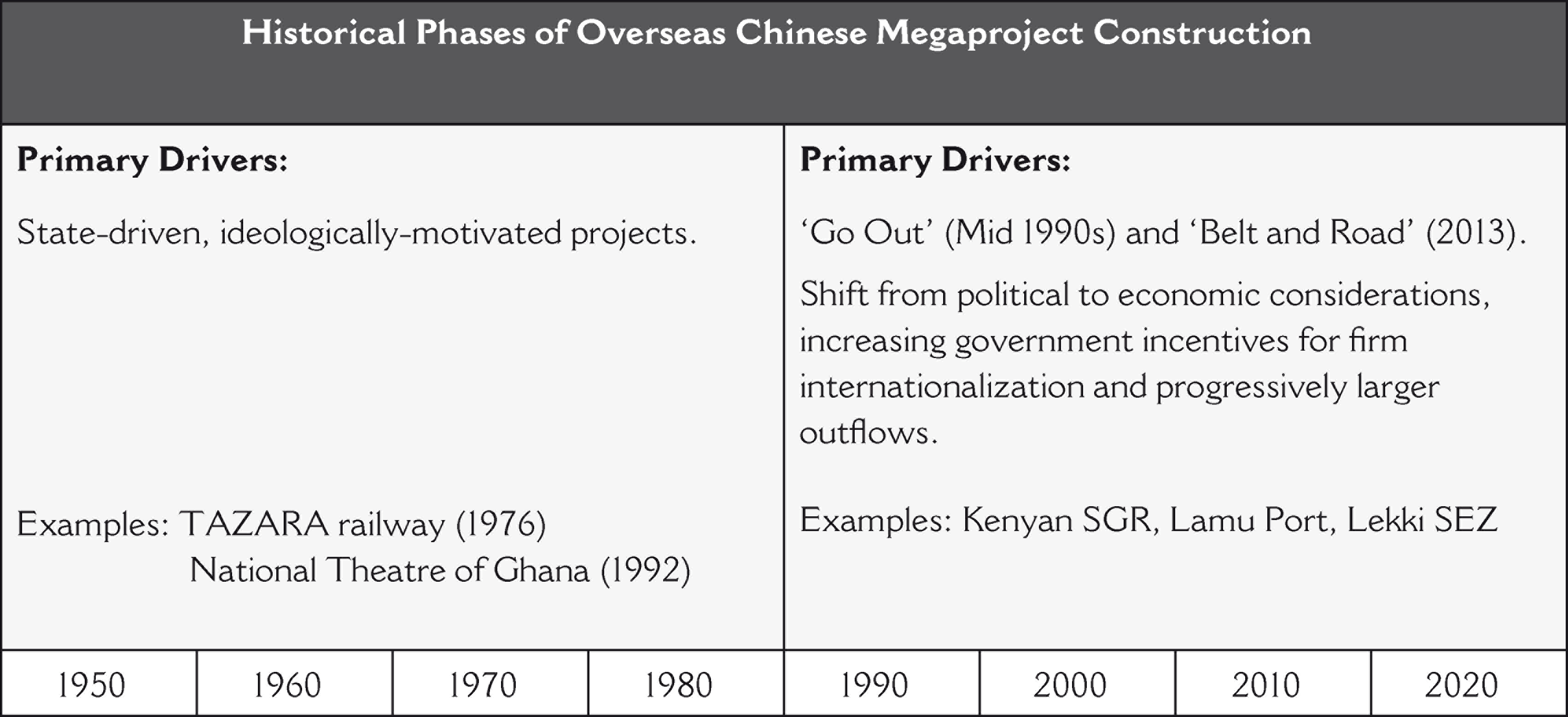
‘Go Out’ was instituted as a response to changes in China’s domestic economy, namely, conditions of overaccumulation, and was initially designed to incentivize the internationalization of major state-owned firms (Ding and Xue, 2015). ‘Go Out’ incentives were divided into two categories: fiscal incentives and financial inducements. The former category included tax and tariff exceptions, while the latter involved access to low interest (subsidized) credit and the extension of service-tied preferential loans to developing countries (Alves, 2013). As Zhang (2017) explains, while ‘Go Out’ is typically portrayed in terms of resource extraction, at its core it was a joint effort between the Chinese state and Chinese-based capital (generally in the form of large State-Owned Enterprises [SOEs], though this is not always the case) to further capital accumulation.
Given these imperatives, the current phase exhibits a markedly different set of logics and rationales than the previous. The focus in Africa has shifted towards extractive, production and infrastructure projects, as these allow for the creation of a ‘spatial fix’ for Chinese capital and material as well as the integration of continental economies into Sino-centric accumulation structures.
The Chinese state’s approaches to the use/structuring of megaprojects as modalities of engagement have been largely shaped by their own developmental experiences. One example is the adoption of commodity-backed loans to fund projects. This practice mirrors China’s experiences during the 1970s, when Japanese firms negotiated agreements to transfer high-tech equipment for oil and coal extraction, with repayment secured through the export of the commodities themselves. In the African context, this barter-like system has been used to fund projects such as the Bui Dam (partially paid for through the export of cocoa beans) and a variety of projects secured through oil concessions (Brautigam et al., 2015; Brautigam and Hwang, 2016). These schemes have also provided lending security for a substantial percentage of the credit lines extended to African states. The purpose of the system is not to acquire total ownership of the commodities themselves, but to reduce the risk to the lender, permitting for projects to be financed at more reasonable rates and allowing for investments in unstable countries (Johnston, 2017).
These sorts of pragmatic agreements, presented in the official discourse as ‘win-win’, are pervasive throughout Sino-African economic engagement and are reinforced by over 40 years of largely unchanged political discourse. Unlike Western aid and assistance; Chinese aid, trade and investment, and the megaprojects that go along with these, are explicitly linked in the discourse and framed as parts of broader economic partnership and development agreements (Johnston and Rudyak, 2016, quoted from Johnston, 2017). This functions to differentiate China from the West and plays into the domestic developmental initiatives and discourses put forth by elites in numerous African countries, thus creating opportunities for Chinese firms seeking to expand overseas.
Investment Versus Financing Versus Service Provision
A crucial point in understanding the involvement of Chinese actors in Africa’s megaprojects is the disaggregation of firm activities into three separate categories: service provision, financing and investment (Pairault, 2018a). These types of engagement are often conflated in both popular discourses and scholarly articles, leading to a monolithic or confused understanding of China’s involvement in African megaprojects. Chinese actors have roles in many projects throughout the continent, yet the roles they play can vary significantly and often diverge on the sectoral basis. For instance, Chinese actors generally do not invest in infrastructure in Africa, rather they build and/or finance these projects.
Chinese construction projects abroad fall under the umbrella term ‘Chinese overseas contracted projects’ (COPs) and can be financed either by policy bank loans, 4 international organizations or local governments (Wolf, 2016, p. 258). As per Yi-Chong’s (2014) study, nearly half of all projects undertaken by Chinese SOEs in Africa were underwritten by multilateral or non-Chinese donors, with approximately 40% financed through loans, export credits or other Chinese government-run schemes.
Scrutinizing the specificities of the Bui Dam in Ghana provides a useful example. The project was financed by a Chinese policy bank and built by Sinohydro, a Chinese SOE. However, the dam itself is owned by the Bui Power Authority (BPA), a Ghanaian company. In contrast, investment specifically involves the acquisition or creation of assets as a way to generate future income. While Chinese actors do sometimes invest in megaprojects in Africa (e.g., the Beijing Automotive Industry Holding Co. [BAIC] assembly plant in South Africa), this activity has thus far been confined largely to ventures in the manufacturing or extractive sectors and does not account for a large percentage of Chinese economic activity on the continent.
As Figure 2 highlights, on the whole, China is primarily a service provider rather than an investor, and African countries are largely consumers as opposed to partners (Pairault, 2018b). For example, in 2013, COPs accounted for $40 billion worth of projects in sub-Saharan Africa (SSA) compared to just $3.1 billion in FDI flows (Wolf, 2016). Moreover, Africa’s share of Chinese FDI has been falling since 2011. In 2016, China’s FDI into the whole of Africa was equal to 14.1% of what it invests in the United States and broadly equivalent to what it invests in Germany (Pairault, 2018b). South Africa, the African country with the highest investment totals and FDI stock, received approximately 0.4% of total Chinese FDI (MOFCOM, 2016). To better unpack these trends, the article will now turn to the specific categories of megaproject found on the continent.

Infrastructure Projects
Given the rapid, state-led nature of its industrialization and infrastructural development, China has one of the world’s most developed and dynamic construction sectors, with a specialization in civil works and large projects (Foster et al., 2009). As per Roskam (2015), 7 of the world’s 25 largest construction companies are Chinese, including 4 of the top 6. The international competitiveness of the sector can be seen in the fact that between 2007 and 2015, Chinese firms won approximately 30% of World Bank infrastructural projects in Africa, the highest winning percentage of any single country. Nearly 75% of these contracts were won by seven central government-owned SOEs (China Geo-engineering Corporation, CHICO, CCCC, China International Water and Electric Corporation, CICO, China Jiangxi Corporation for International Economic and Technical Development), though four of the companies were eventually debarred by the World Bank due to procurement irregularities and misconduct (Farrell, 2016).
On the other hand, African countries currently face an infrastructure deficit of approximately $130 billion a year, with a financing gap of between $68 and $108 billion (African Development Bank, 2018). 5 This shortfall extends from sanitation systems to all manner of transportation infrastructures (road, rail, port and air networks), telecommunications and energy. As Brautigam and Hwang (2016) note, 56% of Chinese loans to African governments between 2000 and 2014 went to infrastructure development.
Africa’s deficit is rooted in the historical role of the continent as a primary resource exporter during the colonial period, which led not only to extractivist patterns of development but also significant gaps in institutional structures and a lack of knowledge and technology transfer. The latter two deeply affected infrastructural development, maintenance and servicing after independence. The deficit was then further exacerbated by neoliberal reforms and structural adjustment programmes, which imposed strict controls on government spending.
Kanai and Schindler (2018) describe the contemporary proliferation of state-led infrastructure megaproject construction as an infrastructure scramble in which elites seek to create points of connectivity with the global economy that will eventually attract further economic activity. However, the scramble approach can lead multi-scalar contestation, for instance, the prioritization of the global over the local 6 as expressed through the rolling out of plans by central state entities in collaboration primarily with transnational capital and supranational or multi-lateral agencies. This in turn can marginalize local actors and decision-makers and have deleterious effects on economic conditions and livelihood strategies. In one recent example, the construction of the 450 MW Soupati Dam in Guinea led to the displacement of 16,000 people from 101 villages and hamlets. Efforts to mitigate the destructive effects of dam construction on local livelihoods have been ineffective thus far (HRW, 2020). Accordingly, while the infrastructure deficit must be addressed, using megaprojects as the preferred modality for this can be fraught with risk (though risk is unevenly distributed both socially and geographically).
Unpacking Africa’s Infrastructure Deficit
One of the more pressing aspects of the deficit facing the continent is that of integrated transport infrastructure. Beyond South Africa and Egypt, a few countries have adequate logistical networks with which to move goods and people (The Economist, 2015). In SSA, road densities are less than a third of that of South Asia, and only a quarter of all roads are paved. This results in travel times along key corridors in SSA that are approximately 2–3 times longer than comparable corridors in Asia, and road freight which costs between 2 and 4 times as much per kilometre as in the United States (Foster et al., 2009). As per Jedwab and Storeygard (2017), there are only 3,700 km of fully paved highways in SSA, compared to 111,900 km in China and 24,000 km in India. Additionally, while there are 55,000 km of rail line throughout SSA, the vast majority of it dates from the colonial era (Jedwab and Storeygard, 2017). For instance, Kenya’s SGR was the country’s largest project since independence and its first new rail line in nearly 100 years. However, the SGR was not without controversy, and as Wissenbach and Wang (2017) note, its economic viability, contracting practices and financing arrangements have all been heavily criticized.
Aside from Kenya’s SGR, Chinese actors are also involved in the financing and construction of rail projects in Mali, Nigeria, Uganda, Ivory Coast, Angola, Ethiopia and Djibouti. Chinese construction firms have also built airports in Kenya, Mali, Republic of the Congo and Mozambique as part of the China–Africa Regional Aviation Cooperation (CARAC) plan (China Daily, 2015) and are currently involved in the construction of major ports in Kenya, Tanzania and Nigeria. While these projects will undoubtedly add to the continent’s debt obligations, the hope among policymakers is that they will boost continent-wide market integration when paired with policies such as the African Continental Free Trade Agreement (AfCFTA) for example.
Yet Africa’s largest deficit is in the power sector, which is plagued by a lack of grid interconnectivity and frequent outages. Generational capacity in Africa is approximately half of that in Southeast Asia, and per the International Energy Agency (IEA), 50% of the population of 24 countries in SSA lacks access to grid-based energy (The Economist, 2015). This sector has attracted large amounts of Chinese financing and service provision, with much of it concentrated on 16 separate hydropower schemes in 12 countries. Hydropower projects are typically built through engineering—procurement—construction (EPC) agreements, 7 which necessitate that the host government provide 10% of the cost upfront, and require EXIM bank appraisal and approval (Brautigam et al., 2015). Foster et al. (2009) estimate that of the $5 billion spent on these schemes until 2009, $3.3 billion was financed by Chinese policy banks. It is important to note that China’s focus on hydroelectric projects extends beyond Africa. Indeed, numerous studies have explored similar developments in regions such as south/southeast Asia and Latin America (Biba, 2012; Kirchherr et al., 2017; Kirchherr and Matthews, 2018). This speaks to the proficiency of Chinese firms in building such projects, the appeal of hydropower schemes among elites and the high-level bilateral relations that underpin Chinese-backed megaprojects.
Extractive Projects
Although Chinese demand for African raw materials played a major part in the latest commodity supercycle (2003–2011), Chinese actors did not commence wide-spread investment in continental extractive projects until the mid-2000s, well after the incentivization strategies of the ‘Go Out’ initiative began (Garnaut, 2006). As such, large-scale Chinese projects in Africa’s extractive industries are a relatively recent phenomenon and remain small in number, especially when compared to Chinese extractive investment in other regions (e.g., South America, Oceania). However, investment has grown rapidly and between 2005 and 2016 approximately one-third of all outbound funds for Chinese extractive projects went to SSA (Kuo, 2017).
Principally driven by the need to acquire natural resources for national development in the face of rapid domestic depletion, China’s extractive megaprojects are part of what Fessehaie and Morris (2013, p. 539) term ‘inward-oriented outward investment’, or investment geared towards achieving domestic state goals. Institutionally, state-owned Chinese mining conglomerates operate with flexible, pragmatic approaches (including the acquisition of human assets from the international market and a willingness to undertake joint ventures to develop organizational capacity), which allow them to embed themselves within various host country institutions. This approach mirrors the Chinese government’s broader geostrategic ‘flexigemony’ (Carmody and Taylor, 2010), and suggests a concerted level of direction among the larger extractive firms from the Chinese government (Cooke et al., 2015). As such, extractive investments often adhere to what Lee (2017, p. 10) has coined ‘encompassing accumulation’ logics which prioritize political returns, as well as profits, and can operate on longer time frames than those of western corporations.
Given the conditions of entry for Chinese firms, they have been largely limited to acquiring existing mines and hard-to-reach deposits. Recent purchases include the Chambishi mine in Zambia, which now includes a special economic zone (SEZ) and functions as a hub for Chinese investment in the country (Kragelund, 2009), the Husab project in Namibia, which contains one of the world’s largest uranium deposits, the Kamoa Copper deposit in the Democratic Republic of the Congo (DRC), and a series of smaller mines throughout South Africa, including the Bakubung platinum mine and SAIL mining group’s Black Chrome mine (Interview, Mining Executive, October 2017, Johannesburg). Additionally, Chinese SOEs have invested large amounts of capital into foundries and processing plants throughout the continent, including a recent $700 million investment in an iron ore processing plant in Sierra Leone (Corcoran, 2017). 8
Reflecting the need to secure strategic assets, as well as the global competition among multi-national corporations (the combination of which gives African elites a certain amount of what Carmody and Kragelund [2016] term ‘bargaining power’), extractive megaprojects have at times formed the basis of multi-project package deals, in which large-scale capital is mobilized by the Chinese state to accomplish politico-economic goals. Two recent examples are indicative of this trend. The first is a $2 billion barter deal between the government of Ghana and Synohydro, a state-owned hydropower, engineering and construction firm. In return for refined bauxite (mined from the Atiwa forest in southern Ghana), Synohydro will build infrastructure throughout the country. Johnston (2017) details a similar agreement between Chinalco, Rio Tinto, the Government of Guinea and the International Finance Corporation (IFC) to extract iron ore from Guinea’s Simandou region. Simandou is home to an estimated 2.4 billion tons of iron ore—whose extraction would make Guinea the world’s 3rd largest exporter. However, political volatility and government instability have made mining in Simandou an incredibly high-risk venture. Under the most recent agreement, extraction is conditional on the construction of an infrastructure package consisting of 35 bridges, 24 km of tunnels, a new port, and 650 km of heavy-haul rail lines. The package forms the core of Guinea’s national redevelopment plan, and nearly $20 billion will need to be spent if the entire project is to be successful.
African leaders looking to foster and leverage novel connections with transnational capital have largely welcomed Chinese interest in the extractive sector. However, though such projects may inject much-needed capital into the continent, in terms of industrialization trajectories, extractive investments often simply reinforce the continent’s dependence on natural resource exports. As Taylor (2016) notes, of the 49 countries in SSA, 11 rely on a single commodity for 50% of export earnings, while more than 30 rely on at least 3 commodities for 50% or more of export earnings. Structural transformation, as expressed through the sophistication of exports or the creation of high labour productivity sectors simply has not happened on a large scale throughout SSA. Research into the topic, (Fessehai and Morris, 2013; Kragelund, 2009; Lee, 2014, 2017) has shown that due to cost factors and difficulties in input procurement in parts of SSA, Chinese mining firms typically import most inputs from abroad. This procurement strategy can marginalize the role of local suppliers in the mining value chain, minimize opportunities for technology transfer and create vertically integrated enclave developments. As per Lopes (2019), to achieve more sustainable development pathways, African governments will need to leverage extractive investments to induce value addition, technology transfer and the introduction of new services.
Consumption Projects
Africa’s consumption megaprojects are the product of a wide range of processes. The continent is facing the prospect of large-scale urban growth, and as entrepreneurial modes of governance have replaced managerial approaches (largely due to the neoliberalization of urban governance), policymakers throughout Africa have relied on megaprojects to attain developmental goals (Adama, 2018; Hannan and Sutherland, 2015; Kanai and Kutz, 2011; McCann and Ward 2011; Murray, 2015).
Concomitant with the spread of policy ideas (also termed ‘policy mobilities’ by McCann and Ward, 2011, p. 102) through the internationalization of development practices, African municipalities have begun looking at Asian cities as possible models to base their growth upon (Reboredo and Brill, 2019). Yet the creation of the Asian-inspired satellite cities and exclusive commercial enclaves that generally make up Africa’s consumption megaprojects does not address the problems facing a large segment of the continent’s urban population, which lives with minimal access to urban services.
Africa’s contemporary consumption megaprojects, specifically ‘New’ or ‘Smart City’ initiatives, are elite-driven projects that are disconnected from the needs of most urban residents and instead serve to entrench extant spatial and social inequalities (Watson, 2014). Draped in narratives of modernity, sustainability and ‘world-class’ development, Africa’s consumption megaprojects promise to turn cities into transnationally connected gateways for investors, while simultaneously providing them with ‘iconic’ modernist monuments—a process Carmody and Owusu (2016) describe as combating deepening informalization through the cultivation of connections with the global economy. Developments such as ‘Eko-Atlantic’ in Nigeria, ‘Tatu City’ and ‘Kenzo Techno’ city in Kenya, ‘Kigali new city’ in Rwanda, ‘Hope City’ in Ghana, ‘Kigamboni’ in Tanzania and ‘Cite le Fleuve’ in DRC are symptomatic of neoliberal urban reform, interurban competition and speculative urbanism (Cain, 2014; van Noorloos and Kloosterboer, 2018; Watson, 2014). While ostensibly similar to the capital relocation programmes of the 1960s, which also sought to create large-scale utopian urban centres with little regard for public involvement, the ‘New city’ or ‘Smart city’ projects are tied to a separate set of logics and developmental mechanisms.
Coined ‘City Doubles’ as they are mirror opposites of existing urban environments, these developments epitomize the ‘logic of capsularization’, or the formation of spatial enclosures that provide shelter from the perceived dangers of the outside world (Lieven de Cauter, 2001, in Murray, 2015). The projects are largely led by the private sector under public-private partnership (PPP) frameworks, though the state plays an active role via land acquisition and infrastructure/service requirements. As per Adama (2018), PPPs are characterized by the privatization and outsourcing of services and the restructuring of state agencies. African governments view PPPs as viable ways of attracting funding, expertise and innovation from the private sector to address policy problems. However, scholars have noted that using the PPP framework for megaprojects serves to exclude those who cannot pay for services as the projects are built on a for-profit basis (Fainstein, 2008; Shatkin, 2011).
Chinese firms have built or financed these types of megaprojects everywhere from eastern and southern Asia to parts of Europe (Shepard, 2017). In Africa, they have played a role in developments such as Kilamba in Angola, ‘New Cairo’ in Egypt, the Kigali New City in Rwanda, and the now defunct Modderfontein New City in South Africa. These megaprojects complement smaller developments, including apartment complexes and shopping centres throughout the continent (see Dittgen, 2017). However, unlike smaller projects, which are driven by purely economic logics, elite-level political linkages and relationships are highly visible in the new city developments.
The Kilamba Kiaxi New City is indicative of the logics, networks and mechanisms behind Sino-African consumption megaproject construction. The development, located outside of Luanda, was part of Angolan President Jose Dos Santos’ pledge to build more than a million new homes to deal with the country’s chronic housing shortage. The project was financed by the Industrial and Commercial Bank of China (ICBC) through oil-backed concessional loans and built by the China International Trust and Investment Corporation (CITIC) (Brautigam, 2018). The government of Angola provided land, forcibly removed any previous occupants, and led marketing operations through a branch of Sonangol, Angola’s state-owned oil company. Unlike other elite-led developments, Kilamba was marketed as a ‘social project’ and a ‘progress project’, yet despite the rhetoric, the government of Angola had to subsidize a rent-to-purchase scheme for residents, as the apartments were initially out of the price range of all but the wealthiest Angolans (Cain, 2014). While the initiative has ensured habitation, the new city remains accessible only to Luanda’s middle class (Buire, 2017; van Noorloos and Kloosterboer, 2018).
A visit by Xi Jinping in 2010 attests to the political symbolism of the project, which is painted in the official discourse as a ‘Sino-Angolan project across the board’ and has served to strengthen relations between the two governments (Brautigam, 2018). Yet Kilamba’s peripheral position and lack of integration into Luanda’s urban fabric limits opportunities for residents without consistent access to transportation and brings its overall sustainability into question. Moreover, the new city has a dedicated power substation to avoid load-shedding/brownouts and operates its own water and sewage systems. As such, state spending will likely skew towards the development, to the detriment of the rest of the city. Finally, any large-scale retreat of elites into the new development will also take away tax revenue from existing municipalities, exacerbating urban decline and degradation (Watson, 2014).
Production Projects
China’s financing of, and investment in, production megaprojects throughout Africa is intimately tied to the restructuring of the country’s economy from a low-value export-based model to one focused on domestic consumption, outward investment and the geographic expansion of Chinese production networks. As noted, contemporary China is undergoing a massive economic reform programme as its old development model has begun to show acute signs of stagnation, overcapacity in traditional industries, 9 and cyclical decline 10 (Kenderdine and Ling, 2018; Zhang, 2017).
China’s experience with production megaprojects goes back to the country-wide industrialization initiatives launched by Mao Zedong in the aftermath of the Chinese Communist Party’s (CCP) rise to power, yet it is the country’s strategic use of SEZs as part of its reform-era integration into the global economy that has caught the attention of policymakers throughout the Global South. As per Giannecchini and Taylor (2018), the term ‘special economic zone’ is a sort of blanket phrase that can describe a variety of economic initiatives including free-trade zones (FTZs), export-processing zones (EPZs) and free ports, among others. The crux of these initiatives is that they are spatially delineated areas designed to attract foreign investment through fiscal, customs and legal incentives (Pairault, 2019). Generally regarded as long-term projects, most zones place strong emphasis on technology transfer, the creation of backward linkages (i.e., linkages to domestic producers) and eventually encourage domestic private investment (Giannecchini and Taylor, 2018).
SEZs are increasingly being put forth as solutions to Africa’s industrialization problem and are being built throughout the continent. As per UNCTAD (2019), Africa currently has 237 SEZs (51 of which are under construction), with 53 additional zones currently in the planning stages. The hope in African policy circles is that, beyond attracting investment from the Global North, the zones will be able to absorb the labour-intensive, export-based, manufacturing that China and other middle-income countries (MICs) are attempting to shed (to move up the value chain), thus igniting local industrialization (Wolf, 2016). However, in the study of African economic zones, distinctions must be made between independent SEZ programmes (which may host Chinese companies or even partner with Chinese provinces, for instance Nigeria’s Ogun-Guangdong Free Trade Zone) and the Chinese central government’s ‘Overseas Economic and Commercial Cooperation Zones’ (OECCZs).
China’s Overseas Economic and Commercial Cooperation Zones in Africa
Although OECCZs are in essence industrial parks that incentivize the fixing of foreign capital, these zones in fact operate as enclaves designed to create ‘a haven in another country’s territory to accommodate Chinese companies and therefore boost Chinese economic development’ (Pairault, 2019, p. 4). This differentiates them from other SEZs on the continent, which generally make no distinction between the investment’s country of origin. Li Chunding (quoted from Pairault, 2019, p. 6) explains the specific objectives of the OECCZs:
OECCZs are a strategy for Chinese companies to ‘go out’, they are conducive to the formation of industrial clusters and alleviate the implementation of subsidy policies. […They allow] Chinese companies to group together and pool to invest abroad; when such areas are created and after an audit has been carried out, the [Chinese] government may grant public aid of 40 million dollars [per company] and long-term loans of up to 350 million dollars [per company].
The OECCZs importance thus lies in their ability to entice Chinese companies to move abroad, as well as their strategic use as accumulation points within larger networks of production. The Chinese government offers incentives for manufacturers to move their production to Africa through programmes granting tariff-free entry on a variety of products (Brautigam and Tang, 2014). Giannecchini and Taylor (2018) detail how Chinese investors have flocked to the Eastern Industrial Zone (EIZ), located just outside of Addis Ababa, to exploit low wage labour. As with other OECCZs in Africa, EIZ was funded by Chinese policy banks and built entirely by Chinese firms working under the Qiyuan group, which now holds the operator license. Table 2 details the different OECCZs in Africa.
Official OECCZs in Africa
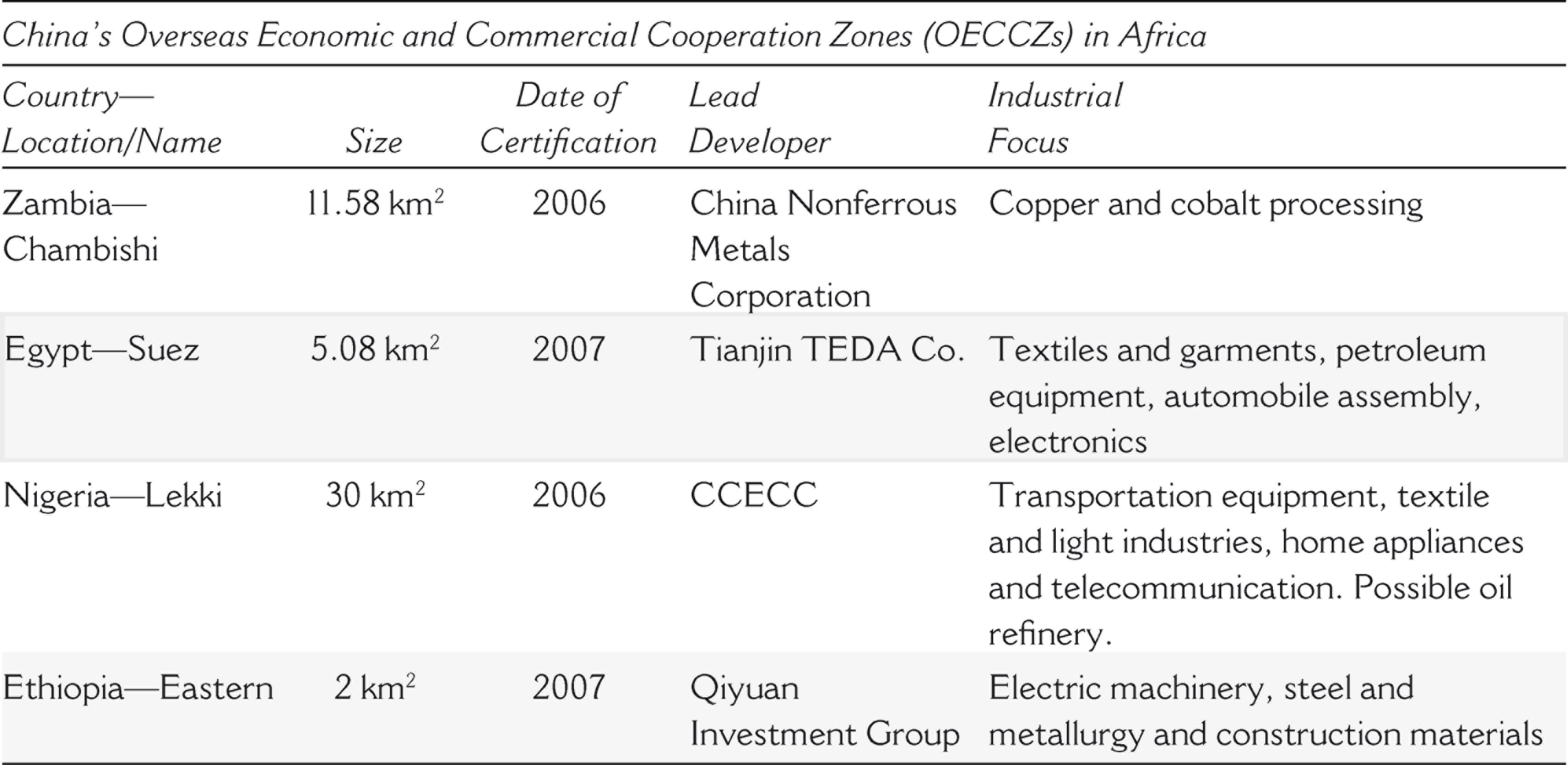
The specificities of OECCZ funding are varied. Some zones are backed by the central government while some are joint ventures (JV). For certain zones, Chinese developers have been allowed to seek grants from EXIM bank. The Zambian SEZ (Zambia-China Economic and Trade Cooperation Zone—ZCCZ), for example, was issued a $208 million concessional loan to build its on-site processing facility. Given their varied characteristics, these zones exemplify the highly fragmented and often ambiguous politico-economic frameworks of China’s state-business relationships (Gu et al., 2016).
Independent SEZ Programmes
As previously noted, country-specific SEZ programmes as well as non-Chinese owned/operated zones are also increasing throughout the continent. China’s domestic SEZs such as Shenzhen and Pudong have grown in the global governmental imaginary, and research (Breslin, 2005; Cartier, 2002) has documented how both their built environments and the structural transformation they produced in their local regions (transforming them from peripheral agricultural areas to global financial hubs) have become something to copy or aspire to. Such narratives are also disseminated and legitimized at high-level events like the Forum on China Africa Cooperation (FOCAC) and the BRICS meetings.
With SEZs, the success or failure of a specific zone is contingent on host country policy, and whether or not they are part of coordinated, government-wide programmes. The failure of South Africa’s Industrial Development Zone (IDZ) programme underscores the narrow view habitually taken by national and local administrators in Africa with regards to these sorts of projects. As Nel and Rogerson (2014) describe, despite a broad ambition to decentralize industrial development and reintegrate historically marginalized areas into the economy, South Africa’s IDZs lacked clear policy guidance, comprehensive frameworks or strategic planning. They relied exclusively on government ownership and management and did not feature prominent private sector involvement. Moreover, there were a few special incentives for zone investors, reducing their attractiveness. Unlike China’s SEZs, which were a small part of a multi-scalar, comprehensive plan to create growth multipliers and attract export-led investment, South Africa’s IDZs were essentially one-off attempts to bring in investment and were ‘caught between market-driven and Keynesian redistributive logics’ (McCallum, 2011, p. 15 quoted in Nel and Rogerson, 2014). The new SEZ programme, launched in 2014, hopes to reverse the failure of the IDZs. The SEZs have so far succeeded in attracting two megaproject-size investments from enterprising Chinese firms and conglomerates. However, their ability to maximize the transformative effects of these projects remains uncertain given structural issues (e.g., skills shortages) and difficult market conditions (Interview, LEDA, November 2017, Johannesburg; Interview, Analyst, February 2018, Johannesburg).
While large SEZs with well-managed linkages can foster innovation and promote technology/skills transfer to local populations, their developmental outcomes are tied to the specific policies put forward by host governments. Some, including Zambia’s and Egypt’s, consider their zones as pivotal parts of their macro-economic strategy, while others lack the policy mechanisms to optimize growth via zone development (António and Ma, 2015). Both OECCZs and independent SEZs can also face significant challenges in terms of political instability, a lack of suitable infrastructure, and deficient industrial frameworks (Pairault, 2019). Given the current set of conditions and economic structures, the bulk of the continent’s SEZ workforce will likely remain low-skilled and low-paid, with few opportunities for upgrading (Brautigam and Tang, 2014; Giannecchini and Taylor, 2018).
Ceremonial Projects
During the first three decades or so of contemporary Sino-African relations (comprising the late Mao era to the 1990s), ceremonial megaprojects were at the core of China’s foreign policy in Africa. After the end of the High Cultural Revolution (1966–1969), China’s foreign policy shifted from emphasis on far-left militancy with the specific goal of an armed workers revolution to a pragmatic approach focused on mutual development (Song, 2017). Despite widespread rural poverty, in the 1960s, China’s population (the largest in the world at the time) and abundance of resources made it the 6th largest economy in the world by Gross Domestic Product (GDP). However, per capita, China’s GDP was approximately the same as Nigeria and Benin, two newly independent countries. As Roskam (2015) describes, this statistical dissonance allowed China to play a two-level rhetorical game; at once claiming that it was a poor, developing country, while concomitantly touting its industrial prowess and the transformative properties of its state-led developmental model. This dual discourse is used to this day.
Brautigam (2009) describes how Mao-era aid programmes served overt ideological and political strategies, essentially becoming articulations of the ‘three worlds’ perspective, which categorized states as being in either the first, second and third world. 11 Under this model, China sought to position itself and project power within the third world sphere, as well as participate in the internationally recognized ‘non-aligned movement’. Ceremonial megaprojects became a central medium through which China could establish and promote its ideological agenda within these policy spaces (Roskam, 2015). On the other side, African elites often leveraged these projects to both strengthen relations with China and legitimize their rule.
Ceremonial projects such as the Palace of the People in Comoros, Friendship Hall in Sudan and the National Assembly of Guinea were designed to exude symbolic/aesthetic significance and support the place-oriented strategies of national governments. However, beyond supporting visions of ‘modernity’ in recipient countries, the projects were also utilized to foster trade, expand Chinese cultural influences and ensure the domestic and international legitimacy of the CCP (Ding and Xue, 2015). Additionally, these projects were part of a concerted effort by the Chinese state to promote (via associated industrial exhibitions) its manufactured goods around the world (in places such as Havana, Damascus, Khartoum and Yangon) to ease the domestic economic turmoil caused by the Great Leap Forward (1958–1961) (Roskam, 2015).
China’s post-Mao economic restructuring throughout the early 1980s meant that African ceremonial megaprojects were largely discontinued, and renewed engagement only began after Tiananmen Square. After the massacre, Chinese leaders, feeling ostracized by the West, once again turned to anti-imperialist rhetoric, and sought to position the country as the ‘leader of the developing world’ (Taylor, 2010, p. 20). The CCP’s attempts to carve out this international policy space were bolstered by projects such as Ghana’s National Theatre and Bamako’s National Conference Building.
China’s use of ceremonial projects has continued into the current phase of Sino-African engagement. Projects often remain politically motivated, as opposed to profit-seeking in nature, and serve to both strengthen bonds between governments and promote public diplomacy—what Ding and Xue (2015, p. 145) term a ‘charm offensive’ to enhance China’s soft power. Additionally, they advance the win-win and developmental partnership narratives put forth by the Chinese state. Contemporary examples of government-built projects include the aforementioned African Union building in Addis Ababa, Ethiopia’s national football stadium, the presidential palaces of Mozambique and Sudan, and the Grand Theatre in Dakar.
Perhaps the most visible example of contemporary Chinese-led ceremonial megaproject construction is the country’s ‘stadium diplomacy’, an ambitious campaign stretching over 25 years which has led to the construction of 140 stadiums in 61 countries. Ninety of these have been built in Africa, with most having been either donated to their host countries or paid for via concessional loans (Vondracek, 2015).
Though government-sponsored ceremonial megaprojects have somewhat fallen out of favour, Chinese construction companies are winning bids and contracts to build similar projects throughout the continent (one example being the $2 billion Djamaa El Djazair in Algeria—the largest mosque in Africa). This fact stresses not only the shift from political to economic considerations but also the enduring appeal of ceremonial megaprojects among elites.
Conclusion
This article has sought to categorize and connect the constellation of Chinese-backed megaprojects being built throughout Africa. It has shown how convergence between the needs, interests, proficiencies and capabilities of African and Chinese actors has led to engagement practices which are often articulated on the ground in the form of five separate categories of megaproject (infrastructure, extractive, consumption, production and ceremonial). An analysis of the categories has illustrated how elite-level African actors have leveraged China’s politico-economic internationalization and utilized megaprojects to both put forth a vision of elite-led development (which entails everything from industrialization initiatives or infrastructural development to ultra-modern cityscapes) and create novel linkages to broader accumulative processes. Likewise, elites often conceptualize megaprojects as being the most effective ways to boost their constituency’s material well-being, give tangible examples of governance, and advance discourses of modernity. For Chinese firm and state actors, on the other hand, projects serve as ‘spatial fixes’ for capital and material and help integrate African economies into Sino-centric accumulation structures. Similarly, they are held up as examples of ‘win-win’ cooperation, thus furthering China’s elite-level political and economic influence.
Each of the separate categories presents unique opportunities for a range of Chinese and African actors, which can include central SOEs, regional SOEs, private investors, policy banks, governmental departments, MNCs, economic migrants, small-to-medium enterprises (SMEs) and international agencies. Megaprojects thus serve to bring together a variety of noteworthy players and act as some of the main assemblages of Chinese influence and developmental cooperation. Yet the reasons why engagement is so often articulated in the form of megaprojects are varied and complex. Additionally, as has been noted throughout, megaproject-led development is articulated in distinct ways as a result of context-specific factors including regulatory environments, political opportunity structures and local capacities, among others.
Through its analysis of the broad drivers, imperatives and policy mechanisms behind the projects, the article has sought to emphasize both the heterogeneous character of extant megaproject construction and the threads (e.g., policy mechanisms, drivers, imperatives) which bind them together. In doing so, this article has attempted to add form to the growing and necessary literature on Sino-African megaprojects.
Footnotes
Acknowledgements
The author would like to thank Padraig Carmody for his comments on an earlier draft of this article. Special thanks to the anonymous referees for their suggestions and comments. All inaccuracies are the author’s responsibility. An earlier version of this article is available in the authors’ doctoral dissertation (Reboredo, 2020).
Declaration of Conflicting Interests
The author declared no potential conflicts of interest with respect to the research, authorship and/or publication of this article.
Funding
The author received no financial support for the research, authorship and/or publication of this article.