



Abstract
This study explores factors that shape parents’ decisions as to whether or not to arrange an early marriage of a girl child in the context of urban informal settlements in Bangladesh. The article draws on data from a larger mixed methods study conducted in two informal urban settlements of Bangladesh, and the analysis was guided by the theory of social exchange. The study found the following factors leading to early marriage: endemic poverty, high dowry costs for older girls, parents’ lack of wider social networks, adolescents dropping out of school, crime and insecurity, love affairs between adolescents and community pressure. Collaboration between government and non-government programmes to improve education, implementation of supportive laws, and greater formal economic opportunities for residents, including adolescents, in urban informal settlements, are critical to prevent early marriage in these environments.
Keywords
Introduction
Early marriage, defined as that which occurs before one or both spouses are 18 years old, is widely seen as a violation of children’s rights (UNICEF, 2018a; United Nations, 2015; United Nations, 1948). The Sustainable Development Goals (SDGs) confirm and strengthen this international consensus: The elimination of all harmful practices, such as child, early and forced marriage constituting one of the key targets of SDG5 on gender equality and empowerment of women and girls (United Nations, 2015). Within international development circles and in countries like Bangladesh, early marriage is thus high on the agenda (UNFPA, 2012; UNICEF, 2018b). According to UNICEF (2018a), 650 million women and girls alive in 2017 were married as children, and 12 million girls were getting married in their childhood every year. Although early marriage was five times more common among girls than boys in 2017, around 4% of boys globally were also married before the age of 18 years (UNICEF, 2018a).
In 2011 in South Asia, 30% girls were married by the age of 18 years in comparison to 5% of boys of the same age (Malhotra et al., 2011; Verma et al., 2013). Bangladesh had the fourth highest rate of early marriage in the world in 2017, where 59% of girls were married by age of 18 years, and 22% were married by age of 15 years (UNICEF, 2017, 2018a). However, the median age at marriage among women aged 20–49 years increased over time from 15.3 years in 2007 to 16.3 years in 2017. While the Bangladesh demographic health survey showed that 19% of girls aged 20–24 years were married by the age of 15 years in 2017, this represented a decline from 22% in 2014 (NIPORT, 2014; NIPORT & ICF, 2019; UNICEF, 2017, 2018a).
In Bangladesh, early marriage is defined as a marriage in which either one or both of the contracting parties have not completed minimum age; the minimum age being 21 years for males and 18 years for females. However, Bangladesh Child Marriage Restraint Act, 2017 sets a provision that marriage can be arranged before this age in any ‘special circumstances’ for the best interests of the minor, at the directions of the court and with consent of the legal guardian of the minor (Ministry of Women and Children Affairs, 2017). Moreover, personal laws largely regulate marriages in Bangladesh which allow marriage before 18 (Center for Reproductive Rights, 2018; Hossain, 2014). This creates a legal loophole, with opportunities for parents or guardians to arrange early marriage of their children, especially daughters.
Previous studies conducted in rural Bangladesh have identified the following causes of early marriage: poverty, rigid social norms, lack of education and earning opportunities, high dowry for older girls and parental fear regarding sexual violence (Chowdhury, 2004; Mahmud & Amin, 2006; Verma et al., 2013). Studies conducted in peri-urban areas, which are those immediately adjacent to a city, reveal additional factors shaping parental decisions to marry their children before the minimum age, including the availability of a suitable groom, community pressure and ‘love relationships’ (NIPORT, 2014; Yount et al., 2016).
Urban informal settlements are a result of industrialization and rapid, unplanned urbanization in developing countries (Banks, 2012; Ooi & Phua, 2007). Urban informal settlements are defined as clusters of compact settlements of five or more households, which generally grow very unsystematically on government or private vacant land, and therefore are under constant threats of eviction (BBS, 2014). Bangladesh is experiencing a rapid urbanization, which results the growth of urban informal settlements. Bangladesh census of slum areas and floating population 2014 shows that population in urban informal settlements comprises 6.33% of the urban population and 1.48% of the total population of the country and annual population growth is about 2.70%. This census also shows that a high number of families live in the informal settlements of Dhaka and Chittagong City Corporation, which are around 30% and 21% respectively (BBS, 2014).
Living conditions in urban informal settlements are deplorable; the majority of residents are poor with little education; jobs are scarce and precarious; and structural violence and pervasive crimes further heighten personal and social insecurity (Banks, 2012; Rashid, 2006; Wood, 1998). Evidence from global literatures indicates that in such contexts as mentioned above, early marriage is a common practice (Greene et al., 2015; Raj et al., 2014; UNFPA, 2012; Vaitla et al., 2017). Girls living in such environments have been found to be twice as likely to get married before the age of 18 compared to girls living in better off households (UNFPA, 2012). These urban informal settlements, therefore, are high risk contexts for early marriage.
The majority of literature, as referenced above, describes the proximal drivers of early marriage in rural and peri urban settings. However, in urban informal settlements, broader contexts of lack of governance and focused urban policies are responsible for perpetuating a lack of infrastructure, endemic poverty and deprive, lack of social cohesion and structural violence. These in turn influence early marriage decisions. These contextual factors and their consequences are unique to such settlements, and understanding how decisions of early marriage are made here, by whom and why, needs in-depth exploration of the different factors and their complex interactions. The causal factors cannot be assumed on the basis of findings gathered from research in rural or peri urban areas. Developing effective interventions and policies to prevent early marriage in urban informal settlements requires attention to the interaction of influencing factors, their origins, and how they influence early marriage decisions made by parents and adolescents. In the current literature, there is a huge gap in this regard since very few studies have aimed to understand the broader contexts and consequent drivers of early marriage in urban informal settlements. This study attempts to address this critical knowledge gap and aims to generate relevant recommendations for policy and programmes in these urban spaces.
The article builds on data derived from a larger mixed methods research study undertaken by the BRAC James P. Grant School of Public Health, BRAC University, with funding from IDRC, Canada. The article first outlines the theories and concepts guiding the analysis, the methodology adopted for the study and then presents the findings with relevant discussion. We conclude with a reflection on our key findings and recommendations.
Theoretical Framework and Concepts
This article draws on the ‘theory of social exchange’, a sociological-psychological theory, to analyse and explain how decisions for early marriage are taken, with particular attention to the interaction of influencing factors that motivate actors to take these decisions. The theory was first developed by sociologist George Homans in 1958 (Homans, 1958). Later, John Thibaut, Harold Kelley, Peter Blau and Richard M. Emerson contributed greatly to it (Emerson, 1976).
The theory views social changes as a process of interactive exchange between members of the society. This interaction is motivated by ‘cost’ and ‘reward’. The formula for predicting the behaviour of any individual in any situation is:
Behavior = Rewards of interaction – Costs of interaction.
Basically, the theory of social exchange proposes that individuals in a society will make decisions based on pragmatic assessment of outcomes. Individuals regard outcomes or rewards that generate social approval or social recognition as ‘positive’ and in striving to achieve such positive outcomes they conform to social expectations. His theory assumes that human exchange operates within sociocultural norms and that individuals prefer social credit over social indebtedness. Outcomes that are socially undesirable generate punishment through social disapproval or exclusion and are understood to be ‘negative’ outcomes. Social exchange theory explains why individual behaviour will generally tend to conform to social expectations and indicates that individuals whose behaviour does not conform will experience social costs.
The theory of rational behaviour, which states individuals behave rationally based on their perceived cost and benefit regardless of social norms (Coleman, 2017), can be presented as a critique of this social exchange theory. However, rational choice theorists such as Scott (2000) and Satz and Ferejohn (1994) advocate that complex social phenomena can be explained in terms of individual actions and they see social interaction as a process of social exchange, which involves the exchange of social approval and other valued behaviours (Satz & Ferejohn, 1994; Scott, 2000).
We employ social exchange theory to argue that individual choices and decisions for particular actions, such as early marriage decisions made by parents, are inextricably linked to the perceptions of social benefit versus social discredit. Pragmatic decisions are made, sometimes by the individuals or sometimes by their parents, where community approval or disapproval and existing sociocultural norms play an influential role over their lives.
Previous research on early marriage has shown that poverty, lack of education, dowry demand and other commonly recognized factors are drivers of early marriage in poor urban settlements. However, in urban spaces, education and income opportunities for families, especially for female adolescents/young women, are much higher than compared to rural or peri urban settings; these opportunities are considered to be factors that can prevent early marriage. Nevertheless, the rates of early marriage in informal urban settlements are very high. Why? Moreover, although urban informal settlements have poor infrastructure and higher incidents of poverty, they are heterogeneous in regard to characteristics such as wealth, social standing, occupation and type of household. This heterogeneity raises the question of whether all inhabitants in these spaces experience the drivers of early marriage in the same way?
While opportunities for work and education are greater than in rural and peri urban areas, the cost of living and education is very high in urban informal settlements. While work opportunities for young and/or adolescent women are on the rise, there are fewer opportunities for young and/or adolescent men. Increased mobility outside home also means that girls and women in such spaces may be exposed to sexual harassment and abuse in areas in which crime is already prevalent and law enforcement is weak. Young and/or adolescent men who have fewer job opportunities possibly will look for alternatives to gain money or power, which in such settlements often leads to involvement in illegal activities contributing to, again, the unsafe environment for girls and women where sexual harassment is common. Therefore, on one hand there exists factors that can potentially reduce early marriage in urban informal settlements as compared to rural-peri urban areas, but on the other, there are also emerging factors that are not so prevalent in rural-peri urban areas, that can motivate parents to marry off their daughters comparatively earlier. For a very poor family where the parents and siblings are dependent on the income of a young or adolescent woman, the beneficial choice would appear to be to let her continue earning instead of getting married early. However, where the parents live in fear that their daughter may be sexually abused, the beneficial choice could be to get her married to a suitor as soon as possible. Although the parents will lose the income from her earnings, they will reduce the number of mouths to be fed in their household, while assuring her marriage. For a family which is well to do, for example, who are landlords, and have power/local influence, it is beneficial to allow their daughter to continue education beyond secondary level, even to complete college level, because education is considered a hallmark of good social standing in an urban context and is likely to ensure they can arrange for her to marry a more economically established husband. Unlike the family whose daughter has to work, a family which is well-to-do and/or has local influence, can afford to keep her in education. This is because of two reasons: One, they are able to ensure that she is chaperoned traveling to/from school or college, and two, they may be able to influence local politics and law enforcement. So, consequently, she is less exposed to the perceived risks of sexual harassment and their serious implications for her marriage prospects. Therefore, it can be said even when the driver is poverty, decision-making is always complex and involves multiple factors in urban informal settings, and furthermore, that the complexity of that decision varies greatly based on individual family characteristics in the same urban informal context.
Consequently, it is important to understand the different contextual factors that are precipitating early marriage and how they interact in poor informal urban settings in order to understand decisions of early marriage. Social exchange theory can help decipher why different families with different backgrounds and circumstances in the same context choose differently when it comes to early marriage. In so doing, an improved understanding about what is driving early marriage in these settings reveals how parents and daughters are weighing-up their options to choose the best possible outcomes in this complex context. Crucially, this understanding takes us beyond assuming that those who decide on early marriage in informal urban settlements do so out of ignorance or slavish adherence to discriminatory gender norms or outdated cultural practices.
Methods
The article draws on data from a larger mixed methods study, conducted in two informal settlements: ‘Bhashantek’ of Dhaka and ‘Shantinagar’ of Chattogram in Bangladesh, which consisted of a survey and qualitative interviews. Data were gathered between March 2016 and January 2018. The two study sites were chosen purposively by the research team as they are two of the largest informal settlements in the country. Following a complete household listing of potential married–unmarried female respondents aged 13–24 years in each study site, we listed 2,076 eligible households in Bhashantek settlement and 2,826 households in Shantinagar settlement. All female respondents in those households who agreed to participate in the survey were interviewed. In Bhashantek settlement, we interviewed 1,009 respondents whereas in Shantinagar settlement, we interviewed 1,127 respondents which makes a total of 2,136 female adolescents and young women interviewed in the survey. Out of 2,136 respondents, 1,129 were married and 1,007 unmarried. Survey data were collected using a structured questionnaire. Information on socio-demographic characteristics, reasons and consequences of early marriage were gathered. Adolescent boys or young men were not surveyed because exploring their perceptions was not an objective of the larger study. This article utilizes data from the wider study collected from married female adolescents and young women and complements it with a small qualitative study on male perceptions. A larger representative survey of male perceptions was not possible due to time and resource constraints.
Survey data were analysed using Stata version 13; both descriptive and multivariable analyses (logistic regression) were performed. Descriptive analyses results are presented in tables and graphs showing frequencies and percentages. The survey asked all married respondents the reason for their early marriage and they had the option to choose multiple answers. A purposeful selection of covariates was made (Bursac et al., 2008) and logistic regression analysis was performed. At first, several unadjusted logistic regression models were performed to examine the association between different independent variables and the outcome variable—‘early child marriage’. Later, a multivariable logistic regression model was developed which included all the independent variables found to be significantly associated with the outcome variable in bivariate analyses as well as those that were deemed to be important confounding variables. Dowry, one of the variables, is the payment usually given by the bride’s family and expected by the groom’s family during marriage. This is illegal in Bangladesh under the Anti-Dowry Prohibition Act, 1980; however, the practice still continues mostly in the rural areas and in urban informal settlements (Chowdhury, 2010). Although dowry is illegal, data on dowry practices was collected from multiple sources (girls, boys, community representatives, parents and teachers) and cross-checked during analysis; therefore, we believe the collected data on dowry is not biased.
The survey data was supplemented with qualitative data collected through 98 in-depth interviews (IDIs) and 13 focus group discussions (FGDs) with unmarried adolescent girls and boys, married young women and men, and parents of adolescents. The respondents for qualitative interviews were selected purposively. In addition, 11 key informant interviews (KIIs) were conducted with community leaders and teachers (Table 3). After building rapport through multiple informal visits, including with parents, adolescents were approached for interviews. After identifying a number of parents of adolescents, we used snowballing to recruit more parents. Separate IDI, FGD and KII guidelines consisting of open-ended questions were used for interviews. IDI guidelines explored experiences, reasons, decision-making and consequences of early marriage. FGD and KII guidelines explored reasons and consequences of early marriage. After gaining trust through repeated visits, topics such as marital and love relationships, crime and sexual violence, and so on were introduced during interviews. Qualitative data were coded using Atlas Ti and thematic analysis was done.
The inhabitants in these two large informal settlements came from adjoining districts and were under constant threats of eviction. Fragmented neighbourhoods and lack of social cohesion in some sections of the settlements have resulted in mistrust of outsiders within the community. The researchers gained access to the two settlements through BRAC (local NGO) staff who have established services at these sites, which assisted in gaining entry and building rapport with the community and its leaders. Written informed consent was obtained from respondents aged 18+ years and from young men and women who were married. For unmarried adolescents, consent was given by an appropriate guardian (such as an older brother, mother, or older sister). Confidentiality and anonymity of all respondents was strictly assured. All names used in the findings section of the article are pseudonyms. All the interviews were conducted at locations, where the respondents felt comfortable and their privacy was maintained. Ethical approval for the study was obtained from the Institutional Review Board, an independent committee established in 2006, at the BRAC James P. Grant School of Public Health, BRAC University.
Findings and Discussion
The research findings are organized and discussed in the following sections. We begin by summarizing the socio-demographic characteristics of our respondents and the prevalence of early marriage in Bhashantek and Shantinagar informal settlements. We then move on to examine the factors leading to early marriage addressing, in turn, the influence of sociocultural and economic factors; fragmented households; crime, violence and social insecurities; love relationships; and community rumours. We conclude the findings by examining decision-making around early marriage.
Socio-demographic Characteristics of Respondents and the Prevalence of Early Marriage
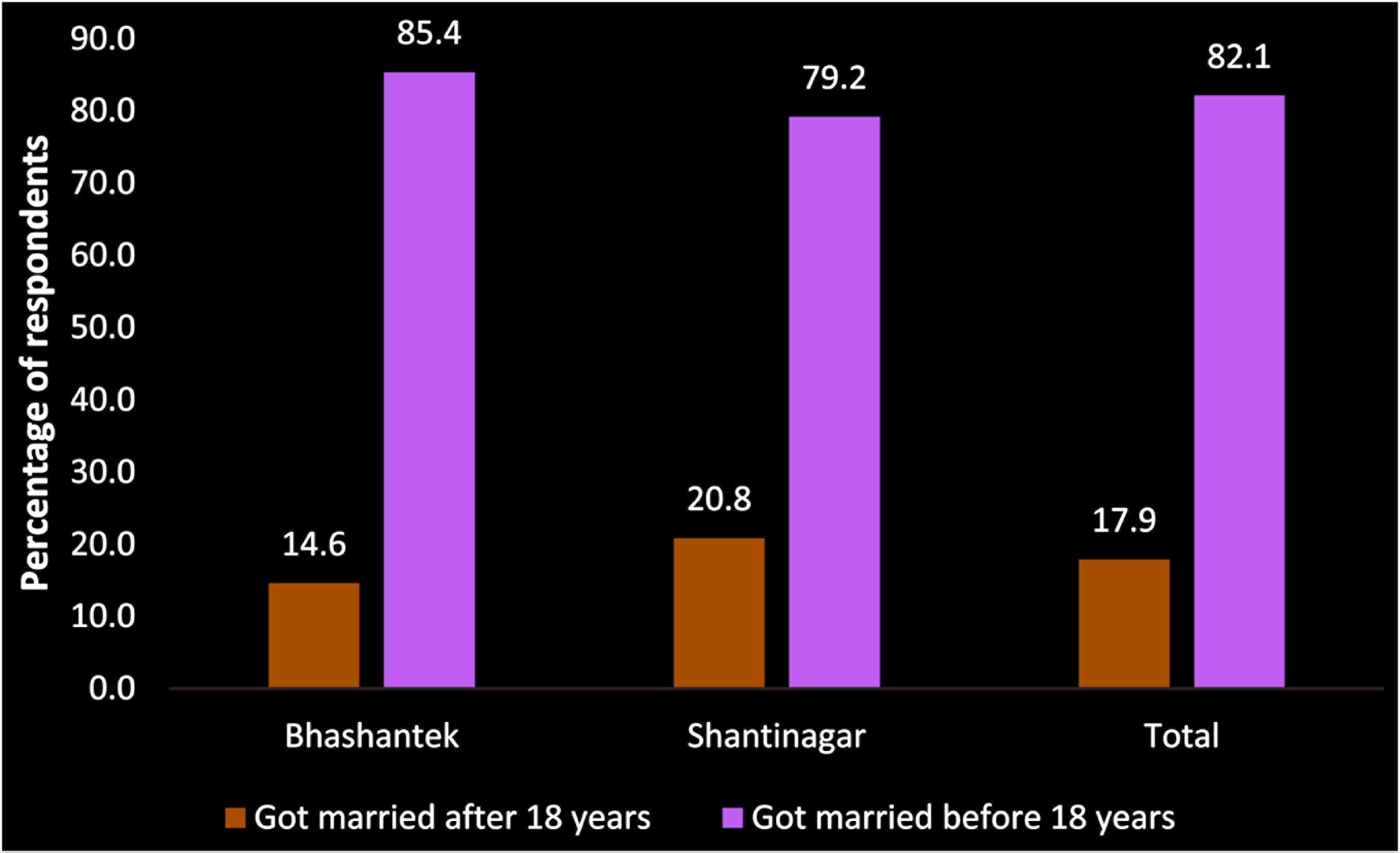
Table 1 presents the prevalence of early marriage (married before the age of 18) according to the socio-demographic characteristics of the married respondents. Among the 1,129 ever married women interviewed in the survey, 82% got married before the age of 18 years. Prevalence of early marriage was found to be higher among the respondents who reported living in the informal settlements for 5–10 years (88.5%) as compared to those who reported living there for only 1–2 years (77.2%). Early marriage was more common among the illiterate respondents (85.3%) as compared to those who had completed secondary education or above (68.5%). In addition, the prevalence of early marriage was found to be higher among those whose family income was less than BDT 5,000 per month (91.2%) as compared to those whose monthly family income was more than BDT 20,000 (75.5%) (Table 1).
Socio-demographic Characteristics of the Respondents


Socio-demographic Characteristics of the Respondents
In Bhashantek, the prevalence of early marriage among our respondents was 85.4%, whereas in Shantinagar it was 79.2% (Figure 1). Figure 2 shows the distribution of age at marriage among the study respondents. The minimum age of marriage was 13 years and the maximum age was 24 years. The average age at marriage among the respondents was 15.9 years (95% CI: 15.7, 16.0) and the median and modal age at marriage was 16 years.


In the following sections, we discuss in detail the socio-economic-cultural and other contextual factors which contributed to this high prevalence of early marriage in these settlements. Our analysis of the survey data from adolescent girls and young women found that education of adolescent girls and young women, father’s occupation, family income and husband’s income at the time of marriage were significantly associated (p-value < .05) with early marriage (Table 2). These findings are consistent with qualitative findings and are discussed in the following sections.
Factors Associated with Early Marriage of Adolescent Girls and Young Women in Bhashantek and Shantinagar Informal Settlements


Data Collection Methods, Respondents Profile and Number of Respondents for Qualitative Interviews

Logistic regression analysis revealed that girls from families with income less than BDT 5,000 (<$59) per month were 2.8 times more likely to get married early compared to girls from families with income more than BDT 20,000 (>$237.2) per month (Table 2). Girls whose fathers had erratic and poorly paid jobs, such as transport workers (the majority of whom were rickshaw pullers, with smaller numbers driving vans or buses), were 2.5 times more likely to get married early compared to girls whose fathers had a steady, secure income (such as Government/private service holders) (Table 2). These findings were corroborated by our qualitative findings.
Qualitative data also found that many of the poorer parents viewed daughters who did not contribute to family income as economic burdens, and as a result they saw arranging daughter’s marriage early as a pragmatic decision to reduce financial pressure on the family. A father from Bhashantek, 37 years old, said,
As long as she (his daughter) remains unmarried, it is a big worry for me. I need to save up money for her dowry so that I can marry her off.… In the meantime I have three other mouths to feed along with her. She will be taken care of by her husband after marriage, so I would not have to worry about her afterwards. (IDI, Parents)
IDIs and FGDs with parents and adolescents revealed that poverty often motivated poorer parents to act opportunistically by readily accepting ‘good proposals’. In these cases, good proposals were understood to be those in which the groom could provide financial security for their daughters. There were two cases where very poor parents encouraged daughters to continue love relationships with boys from comparatively better off families, hoping it may culminate into marriage. This behaviour was not only risky, given the social disapproval of premarital relationships, but also strategic, given the potential to secure a match with a comparatively better-off family.
Adolescents and parents in FGDs and IDIs reported that many poor parents married off daughters early to avoid higher dowry costs. Dowry costs increase substantially for girls older than 16 years of age.
A 15-year-old unmarried girl, Shirin, from Shantinagar said,
People here say ‘Kurite Buri’ (old at the age of 20). If you get older, no one brings a good proposal for you. Also, you need to pay dowry to a groom, if you want a good groom anyways. If the girl is older, there is demand for even higher amount, they want gold, motorcycles, whatever they wish. Everyone knows that. (FGD, Unmarried adolescent girls
Survey findings corroborated qualitative findings and revealed that the average amount of dowry was BDT 50,000 ($592) for girls aged between 15 and 16 years, whereas, for girls aged 18 or older, it was BDT 70,000 ($829) often with additional demands for gold jewellery, a television or a motorcycle, costing over BDT 100,000–150,000 (approximately $1,800) (data not shown). Findings from the FGDs with parents and adolescents also revealed that inability to pay the full dowry at the time of marriage led to repeated demands, and often to abuse and domestic violence for brides at the hands of husbands and in laws. One case from Bhashantek was reported by respondents where the girl was beaten to death. Therefore, most parents were willing to pay the demanded dowry, and it was a rational decision to arrange the marriage early, while the amount was relatively more affordable.
Poverty was identified as the main cause of adolescents dropping out of school by parents, adolescents and key informants. Poor parents were often compelled to prioritize covering the high costs of food and rent in urban settlements over education costs. In some of these cases, parents were found to prioritize a son’s education over a daughter’s, because they recognized the son as a future wage earner for the family whereas they expected daughters to be taken care of by their future husbands. Survey findings too found girls’ education to be significantly associated with early marriage. Girls with no education are almost four times more likely to get married early as compared to girls with secondary complete or higher education, and girls with primary education and secondary incomplete education are three times more likely to get married early as compared to girls with secondary complete or higher education (Table 2).
Adolescent boys who dropped out of school were expected to earn by taking on one of the laborious jobs typically available in the informal settlements (such as becoming a day labourer, rickshaw puller, driver, kitchen assistant in a hotel, shop assistant, or mechanic). They had greater mobility than young women who had dropped out of school and did not fear sexual harassment. Whereas for adolescent girls, the work available was mainly low-level garment work or domestic service; emerging jobs such as tailoring or work in beauty parlours was difficult to get without the requisite technical skills. Adolescent girls were also at a greater risk of sexual harassment and violence as long as they remained unmarried, and her future dowry costs rose the longer she delayed marriage.
Nasima, a 17-year-old girl from Bhashantek, who was married at 16, had to drop-out from school due to poverty when her father fell ill and could not work anymore. She said,
My parents and relatives believed that my only option for a good future in the city after I left school, was to find a husband who earns well. (IDI, Early married girl)
Unlike girls, adolescent boys who dropped out were not considered eligible for marriage until they were capable of earning a steady income. Few young men living in these settlements earned a higher income due to limited formal job options, and those who did not have any income or earned less than BDT 5,000 were considered unable to provide for a family, hence were less likely to be married. While the prevailing gendered economics of work and marriage meant that financial incentives protected adolescent boys from marrying as early as adolescent girls, young men with lower earnings are more likely to marry ‘underage’ girls than young men with higher earnings. Survey findings revealed that a young man who was earning BDT 5,000 ($59) per month at the time of his marriage was four times more likely to have married a girl who is under 18 years old, as compared to a young man earning BDT 15,001 ($178) per month (See Table 2).
The reported findings on poverty, dropping out of school, and fear of higher dowries for older girls as reasons for early marriage, are consistent with findings in studies across South Asia and lower middle income countries including Bangladesh (Ali et al., 2014; Chowdhury, 2004; Greene et al., 2015; Koster et al., 2017; Naveed & Butt, 2015; UNICEF, 2018a; Vaitla et al., 2017; Verma et al., 2013; Yarrow et al., 2015; Yount et al., 2016). Addressing some of the underlying causes of poverty is critical to prevent early marriage in informal urban settlements. Poverty is perpetuated in these spaces for various reasons, as most of the informal settlements are set up on empty government land and are considered to be illegal, leading to the constant threat of eviction. Residents there usually have poor income opportunities and basic formal services (i.e., health, education, legal support from government) remain limited (Banks, 2012; Wood, 1998). Many who have migrated here were pushed to leave rural areas after losing land, money, and arrive with almost no skills and little to no education (Wood, 1998). Our research has found, similar to other studies on urban informal settlements, that a majority of the residents were unskilled, some with weak networks, and engaged in labour intensive informal jobs, where income was on a day-to-day basis, making livelihoods very uncertain (Banks, 2012; Rashid, 2011). In addition, the high cost of daily commodities and pressure to pay rent to landowners, continues to reproduce a cycle of debt, deprivation and hardship for many of the households. Lack of social cohesion in informal settlements, unlike rural communities, along with the scarcity of secure jobs, and the prevalence of gambling, drugs, gang related activities among young men, meant that finding a good proposal from a ‘decent man’ was difficult. Moreover, poorer families in these informal urban settlements are less able to protect themselves from the endemic crime and violence than wealthier or more influential families. Considering their limited options, poor parents often chose early marriage, as its benefits outweighed the cost they would have to pay if their daughter were left unmarried for longer. This behaviour is consistent with the social exchange theory framework.
Fragmented Households and Choice of Early Marriage
Qualitative IDIs with adolescent girls suggested that girls from fragmented households may be particularly likely to be married early. Among the 30 IDIs we conducted with early married girls, 4 were from households where there was only one parent as a result of divorce/separation, and where one or both parents have died. These girls explained that they chose early marriage. Orphaned young girls who did not have income and were living with stepparents or relatives had little agency and sometimes faced abuse. For these girls, early marriage was a way out of a difficult situation. Our research found that single mothers and their daughters were often stigmatized by the community and these households were more vulnerable to poverty and insecurity. Smriti, an orphan who left her sister’s abusive in-law’s home to get married at the age of 15, said,
It felt I was dispensable to everybody and had nothing I could call my own … at least after marriage I will have a home of my own and respect from people. (IDI, Early married girl)
Rapid urbanization has led to more garment factories and job opportunities for females; however, fragmented households with single working mothers supporting their families are also on the rise (Banks, 2012). Daughters in these households lived in poverty, were exposed to day-to-day hardships, lacked good education opportunities and social protection. This left them even more vulnerable to sexual harassment/abuse and social stigma. While they cannot obtain social standing and economic stability on their own, they are able to secure these rewards by marrying early, and this again is consistent with the cost/benefit equation of social exchange theory.
Crime, Violence and Social Insecurities Leading to Early Marriage
FGDs with parents, adolescents and key informants revealed that gang related activities, pervasive crime and sexual violence was rife in the informal settlements. These gangs were protected and promoted by local leaders as part of the political power play and the situation was worsened by rampant corruption in the law enforcement agencies, including police taking bribes to ignore gang-related incidences. Parents, especially poorer parents with pretty daughters, often chose to marry off daughters early in order to protect them from sexual harassment and violence. This decision was seen as a practical step, partly informed by the perception that a husband can protect her from such incidents but also informed by the calculation that an unmarried girl who experiences sexual violence will find it difficult to make a good marriage because her reputation will be regarded as tarnished. In the survey, although only 7% of the early married respondents reported fear of sexual harassment and violence as a cause of early marriage (Figure 2), this was often reported in the qualitative interviews. Rehana, a mother from Bhashantek, 35 years old, with an unmarried daughter of 15 years, said,
Just couple months ago a teenage girl in this neighbourhood was raped and tortured by a local gang of boys.… These boys are associated with many crimes, no one reported against them and the police took their bribe and didn’t arrest them.… We do not want our daughter to be married now, but then again, when I think of what that girl and her family is going through, I feel helpless. (IDI, Parent)
Surprisingly, in spite of these fears, FGDs and IDIs with parents and boys revealed that poverty and lack of options resulted in some young men looking up to the gang leaders as role models, as they wielded money and power in the community. Some boys joined gangs and took part in crimes, gambling and drug abuse. In few of these cases, parents quickly married off their sons, believing that a wife would make them stop engaging in these activities and help them become more responsible.
Similar findings of early marriage caused by fear of sexual violence and harassment, were reported in studies done in rural and peri-urban contexts of Bangladesh, and India, Pakistan and sub-Saharan Africa (Greene et al., 2015; Koster et al., 2017; Naveed & Butt, 2015; Rashid, 2006; Vaitla et al., 2017; Verma et al., 2013; Yarrow et al., 2015). There is no official national policy for informal settlements, and being illegal they fall outside the boundaries of the existing urban authorities; therefore, these spaces do not have any formal governance (Wood, 1998). As a result, law enforcement is little to non-existent: These spaces are ruled by local leaders who remain protected by close contacts with national political parties and engage in political power plays. This perpetuates an informal economy of gang membership, drug trades and violence (Banks, 2012; Rashid, 2006). An article in a national newspaper (Mahmud & Hasan, 2017), reported 60 teenage gangs in the informal settlements of Dhaka city alone; four gangs were from Bhashantek area where we conducted the research.
As long as poverty, inadequate education, lack of income opportunities and lack of governance persist in such informal settlements, this situation of structural violence, political power play and criminal activities will persist. While this situation is constant, there will always be a risk of sexual violence and resultant shame associated with having an unmarried daughter in the family. Only families who have political hold or influence due to their wealth in the settlement may be able to remain safe and continue the education of their daughters. For the majority poor families, who have no influence or social support, they are easy targets who are unlikely to get justice or protection from local leaders. Consequently, they fear both that their daughters may become targets of sexual harassment and sexual violence and that failure to marry their daughters early will bring social stigma and damage the family’s honour. The decision of poor families to arrange an early marriage for their daughter can be considered as pragmatic, rather than keeping her in school or sending her to work in a risky environment. Social exchange theory helps to make sense of the cost-benefit calculations that are made by parents in this context and provides a useful theoretical framework that can provide insights into the decision-making around early marriage by parents and brides-to-be.
Love Relationships and Early Marriage
A major reason for early marriage in the informal settlements, as reported by all the respondents, was romantic relationships among adolescents. In the survey, 38% of early married adolescent girls reported it as the cause of their marriage (Figure 2); data from qualitative interviews and FGDs are consistent with these survey findings.
Survey findings indicate that 61% of the early married respondents had personal mobile phones, 9% used (local Bangla) Facebook, and 8% regularly used the internet. Parents, community representatives and some of the boys alleged in interviews that many boys regularly view pornography on the internet using smart phones. These respondents interpreted increasing use of pornography as creating stronger desires for sex, leading more boys to engage in romantic relationships and even marriage. Sadek, a young male from Shantinagar, who married at the age of 20 said,
Outside of marriage, I will not always get to fulfil my sexual desires. What if people come to know? So many boys think it is better off to marry a girl instead. Then no one will say anything. (IDI, Early married boy)
Qualitative interviews with adolescents revealed that some eloped with their romantic partners and others threatened to do so to compel the couple’s marriage as soon as possible. Tellingly, these circumstances were reported by 10 out of the 30 married adolescents in the IDIs. Although in such cases, the parents disapproved of the relationship and marriage, they reluctantly gave in, to prevent shame for their daughter and social stigma on the family. Sonia, 18-year-old, from Bhashantek, who eloped and got married at 16, said,
My parents were reluctant to marry us because he did not have a job, so we decided to elope together … everyone was gossiping about how I have spent the night with him, so my parents had no choice but to marry us off. (IDI, Early married girl)
Some of the girls who married early shared in the IDIs that they were coerced and emotionally blackmailed by their boyfriends into agreeing to an early marriage despite not being ready. Two girls reported that boys blackmailed them by threatening to spread rumours of physical intimacy, and eight girls said that their boyfriends (presently husbands) threatened suicide unless they agreed to the early marriage.
Our finding that love affairs can be a cause of early marriage is consistent with findings from other studies in Bangladesh, India, Nepal and Sub-Saharan Africa (Greene et al., 2015; Koster et al., 2017; Vaitla et al., 2017; Verma et al., 2013; Yarrow et al., 2015). With rapid urbanization, there are more garment factories and job opportunities for young women, and as a result they are more mobile in urban spaces than in the past or as compared to rural areas. At the same time where poverty drives both parents to work, there is a lack of supervision and surveillance of adolescents (Banks, 2012), which leads to greater interaction between young men and women. Easy accessibility to modern technology, as a result of rapid development, provides adolescents with exposure to a more sexualized global culture through social media and the internet. These factors along with the relative anonymity of young people in settlements encourage and facilitate romantic relationships among adolescents. Nevertheless, early marriage results in many denied opportunities for these young adolescents who may drop out of school and have children early, impacting adversely on their physical, emotional and mental health and well-being in the longer term.
Community Rumours Leading to Early Marriage
Adolescent girls and parents reported in their interviews that girls who were rumoured to be in love relationships were socially stigmatized and called names, such as ‘bad girl’, ‘noshto meye’ (spoiled girl), ‘going down a wrong path’, ‘characterless’, ‘shameless’, ‘shovab kharap’ (morally loose), by community members. They reported that it was rare for the gossip to implicate the boys. Unchecked rumours of physical relationships, elopements and cases of sexual violence sometimes led to a ‘Shalish’, a local arbitration facilitated by local leaders and attended by key community members, where the verdict was usually to marry the boy and girl to preserve family honour and appease the community. When challenged as to why Shalish favoured early marriage in cases of elopement, a 65-year-old local leader responded,
I know I am supposed to prevent early marriage, but when such cases of elopements are caught and brought before me, the parents want a verdict which is respectable for them, otherwise they will not be able to show face in the society, no other man or his family will also want to marry such a girl, then what can I do? I have to think of the girl’s future, her family’ respect and consider what the community will think of as a good verdict. (KII, Community leader)
The parents, however, reported in their interviews that better off and well-connected households were usually exempted from the Shalish, and even if it took place, the community leaders usually gave a verdict that would appease the affluent family. The verdict in such cases sometimes led to early marriage of the accused boy and girl if the affluent parents agreed; whereas, sometimes, it led to defamation or disproval of the complaint of the poorer party in order to protect the comparatively influential party.
A small number of similar cases (3) were found where boys fell victim to gossip about premarital sex: Their parents decided to quickly arrange the marriage of the young couple to preserve family honour regardless of the boy’s consent.
Parents, who are afraid of losing social respect, prefer to arrange their daughter’s marriage early in order to prevent her from getting involved in love relationships and premarital sex. Similar findings of early marriages arranged to preserve family honour are reported in Bangladesh, Pakistan and Sub-Saharan Africa in studies by Vaitla et al. (2017), Koster et al. (2017) and Greene et al. (2015). The reason girls (and not boys) are stigmatized for premarital relationships are due to patriarchal views that regard girl’s sexuality as something that should be controlled by a male guardian (father/husband), and these views are associated with the valuing of a girl’s chastity as a commodity in some South Asian and Sub-Saharan societies (Greene et al., 2015; Vaitla et al., 2017). Engaging in a physical relationship outside marriage is seen as breaking social norms and reflects shamefully on parents and guardians, making it a matter of family honour (Vaitla et al., 2017). When families who are poor and without social influence decide on an early marriage, they are attempting to avert the risk of social humiliation by conforming to the conservative gender norms of the community before any incident for moral policing can arise. In these contexts, the reward of social conformity and the respect it brings far outweighs the social seclusion and shaming that would arise from the rumours or occurrence of a premarital relationship. Analysing these decisions using social exchange theory generates insights into the complex interactions of different drivers of early marriage in informal urban settlements.
The following section describes some of the main actors and their roles in making decisions for early marriage in urban informal settlements.
Decision-making on Early Marriage
According to the qualitative findings, it was mostly parents who took the decision to arrange an early marriage for their child. In most cases, mothers acted as influencers while the fathers were the final decision-makers. However, in households which were single female headed or where the father did not have any income, the final decision was made by the mother or by both parents.
From the IDIs of early married girls and young women, it was found that a majority of them lacked agency and control over their marriage decisions, except where they had their own income or chose to elope. In contrast, the early married boys and young men had more agency and could exert more control over marriage decisions. Shila, an 18-year-old girl from Bhashantek, was forced to marry when she was 15, as her parents having received a proposal from a rich family. She said,
I didn’t want to get married, but my mother would not listen. She persuaded my father to agree to the proposal. She said I should get married to [this man], otherwise I would not have a place in the house. (IDI, Early married girl)
The majority of early married young men were found to have married early for love (7 out of 13 IDIs of early married boys). Some of the working boys reported meeting older married peers at their workplaces who had shared accounts of love, physical intimacy and other narratives which reportedly influenced them to also want sexual relationships and marriage. However, as mentioned above, in a few cases, participants in IDIs spoke of rumours about boys being physically intimate with their romantic partners, in which cases the parents subsequently forced their sons to get married to save themselves community censure. Findings of peer influence and rumours of physical intimacy as reasons of early marriage among boys are similar to the findings reported by Koster et al. (2017).
The study findings on decision-making by parents are similar to those reported in studies from Bangladesh, Pakistan and sub-Saharan Africa (Greene et al., 2015; Vaitla et al., 2017; Verma et al., 2013). Parents considered girls to be dependent on them and perceived the need to protect girls’ and family’s reputation from the shame and social disapproval that would arise from girls engaging in romantic and/or physical relationships. Therefore, arranging a daughter’s marriage was seen as a moral obligation for responsible parents: Doing it early, before she could get involved in a relationship, which was quite common in these spaces, was a rational decision by parents to safeguard their social position.
The greater decision-making space afforded to boys may be due to boys being considered more independent and sexually less vulnerable than girls and is strengthened by the fact that they are not facing a cultural expectation to marry early. Compelled by poverty, many of the young men taking part in the study contributed to family income, and as such were considered by the community to be adults with agency.
Conclusion
This study has identified multiple social, political and economic drivers of early marriage in urban informal settlements in Bangladesh. Moreover, the study has shown that the interaction of these contextual drivers is powerful in influencing individual and family decisions in favour of an early marriage. Although decisions of early marriage were pragmatic, it was also obvious from the analysis that individual/family decisions were motivated as much by avoiding potential risk/cost as opposed to being primarily motivated by the rewards/benefits arising from the existing sociocultural context. In this way, decisions for early marriage are consistent with the basic assumptions of ‘Social Exchange Theory’.
Analysing the findings using the Social Exchange Theory framework makes clear that early marriage decisions in urban informal settings are the results of interactions between multiple contextual factors and that decisions are taken after weighing pros and cons and the options available for the individual families. In a majority cases, the options are pretty constrained and the perceived risks associated with delaying marriage are worse for poorer families and female adolescents/young women as compared to wealthier families and male adolescents/young men, respectively.
While early marriage is still considered a product of social norms and culturally prescribed behaviours, and while behavioural change is a target of many interventions, it is also clear from the accounts of participants in this study that choosing to delay girls’ marriages is not so straightforward. The context is shifting and there is an increased awareness regarding the negative consequences of early marriage among parents; many would like to continue education of their daughters. However, at the end of the day, decision-making in favour of early marriage in such spaces seems to hinge more on averting risks and gaining or maintaining social capital than it does on following the normative behaviour. The context of high risks with limited opportunities means that early marriage is the more pragmatic choice still, and therefore, for the majority of the poor, vulnerable inhabitants of urban informal settlements of Bangladesh, it remains the common practice, although not so much for the more influential families.
With severely limited options and without any structural and social and economic incentives, it is difficult to blame parents who arrange early marriages for their daughters. To prevent early marriage in such urban spaces, the government and non-government sectors need to collaborate in order to comprehensively target the contextual drivers of early marriage with multi-pronged interventions. These need to include secure housing, free schooling, basic services and improved livelihood opportunities. The government also needs to develop inclusive national policies for informal urban settlements bringing them within the preserve of planned urbanization, ensuring good governance and supportive legal structures, so that extortion and exploitation of the most vulnerable can be addressed. The programme planners and policymakers need to recognize the complexities that lead parents, communities and young girls to choose early marriage, often as a practical and protective decision in the absence of viable alternatives. It is also evident from the respondents’ accounts that there is a slow but progressive shift in gender normative beliefs. Girls are taking up the role of providing for the family and themselves more and more, and this is due to the increasing opportunities available for female workers in these circumstances. If we want positive social change to prevent early marriage by shifting perceptions of gender roles in the community, we need to leverage the desire for better livelihoods and improved social standing held by these communities. This could be by creating more opportunities for education and income for girls and women and creating an enabling environment where families can afford to actually pursue these goals.
Interventions and messages targeted towards changing behaviours and shifting gender norms need to be accompanied by interventions to create enabling social, educational and economic policies and to reduce contextual risk factors. Without these, we run the risk of placing the blame on parents and of failing to change their decisions around early marriage. Crucially, this also requires critical reflection on the government’s lack of a comprehensive official urban policy for settlements and their currently siloed approach to health interventions, both of which prevent them from effectively addressing some of the complex structural and social factors underlying the perpetuation of the cycle of early marriage.
Footnotes
Declaration of Conflicting Interests
The authors declared no potential conflicts of interest with respect to the research, authorship and/or publication of this article.
Funding
This work was carried out with the aid of a grant from the International Development Research Centre, Ottawa, Canada [Grant no: 108110–001; Date: 29.10.15]. The views expressed herein do not necessarily represent those of IDRC or its Board of Governors.