



Abstract
This study examines local government officials’ perspectives on framing the Sustainable Development Goals (SDGs) in the Ghanaian context. The emerging themes suggest a dualistic framing of the SDGs by local actors, with the SDGs framed, on the one hand, as part of ongoing development programming and, on the other hand, as a framework that facilitates local development and provides a standard for local development. Framing the SDGs as ‘new wine’ in the ‘old wineskins’ of existing local development programming risks watering down the SDGs’ ambition through localization. However, framing the SDGs as local development facilitators enables innovations embedded in the SDGs’ ‘new wine’, to enhance the ‘old wineskins’ of existing development.
I. Introduction
The United Nations Sustainable Development Goals (SDGs) outline 17 interconnected goals that provide a comprehensive approach to development, and underscore the importance of social, economic and environmental aspects of development (United Nations, 2020). Since the SDGs are universal, the localization processes that national and sub-national actors employ to translate the global development agenda into tangible results are worth examining. This is because the nascent literature on localization indicates varied approaches adopted in different contexts to localize the SDGs. For example, localization strategies employed at the national level in Tanzania (Jönsson and Bexell, 2021) differ from the approaches adopted in the city of Bulawayo, Zimbabwe (Ndlovu et al., 2020). Empirical evidence from cities across Europe and the United Kingdom, including Gothenburg, Sweden; Copenhagen, Denmark; Utrecht, The Netherlands and Greater London in the UK, also highlights different SDG implementation strategies (Jones and Comfort, 2020; Valencia et al., 2019). A case study on Ecuador also highlights different strategies used by national and local governments to localize SDG 11 (Horn and Grugel, 2018): whereas the national government emphasized the right-to-the-city approach, city authorities in Quito adopted a private sector-oriented approach. These examples underscore the context-specific nature of localization and, hence, the importance of empirical research to analyze the factors that influence localization.
Emerging scholarly works on SDG implementation highlight different interactions between local contextual factors and the SDGs in various locations (Jones and Comfort, 2020; Masuda et al., 2021; Mejía-Dugand and Pizano-Castillo, 2020; Ndlovu et al., 2020; Valencia et al., 2019). Some studies also examine the impact of SDGs on the local context (Belda-Miquel et al., 2019; Bexell and Jönsson, 2020; Ndlovu et al., 2020) as well as local factors that impede or facilitate the localization process (Bexell and Jönsson, 2019; Croese et al., 2021). Empirical evidence on the nuances of sub-national SDG localization, particularly in Africa, however, remains limited. In line with the increasing emphasis on the local dimensions of SDG implementation, this article presents empirical evidence on SDG localization in Ghana’s local government context. Ghana is a relevant case study because of its long-standing local governance system, which is considered among the most successful examples of decentralization in Africa (Resnick, 2017). Moreover, the Government of Ghana recognizes and emphasizes the relevance of local govern-ments in implementing international policies like the SDGs and the Africa Union Agenda 2063 (Republic of Ghana, 2019). This study’s findings will therefore offer insights that will have relevance to SDG implementation in similar decentralized developing country contexts.
Existing studies on SDG localization in Ghana focus on the national level, including an analysis of the factors that constitute an enabling environment for the SDGs in Ghana (Tandoh-Offin, 2019) and the role of parliament in the national adaptation of the SDGs (Bexell and Jönsson, 2020). The present article goes beyond the national context to analyze SDG localization at the local government level. It addresses the principal question: How are SDGs represented in the local government context in Ghana? The article analyses empirical evidence on the framing of the SDGs in sub-national contexts in Ghana and draws lessons to inform SDG implementation for the remaining timeline. The analysis is relevant because the framing of the SDGs in a particular context influences the local strategies developed to advance the global objectives. Framing organizes the knowledge and experiences of actors in a context to define an issue. The framing of an issue also determines the strategies and approaches adopted to resolve it (Boas and McNeill, 2004). Though subtle, framing is an important avenue local actors utilize to emphasize their agency (Acharya, 2004; van Hulst and Yanow, 2016). Analysis of framing is therefore important to understand SDG localization.
This article proceeds as follows: the conceptual basis of framing and localization is presented together with an overview of decentralization in Ghana. The research design, data sources and analysis are then outlined. Next, the major research findings are presented, followed by the discussion section that situates the findings from the Ghanaian case in the broader SDGs localization literature. The conclusions summarize the research contributions and their implications for policy.
II. Theoretical and Conceptual Considerations
Following the negotiation of international norms on a global platform, local actors utilize several complex processes to translate the policies into tangible action at the local level. The processes and tools local governments employ to define, implement and monitor the translation of global SDG targets into tangible results at the local level constitute localization (United Nations Development Group, 2015). Localization also recognizes the role local governments play in facilitating globally set targets (Guha and Chakrabarti, 2019; Horn and Grugel, 2018; Slack, 2014). Local governments are relevant to SDG implementation because many of the services necessary to achieve the SDGs are delivered at the local level. Consequently, localization research remains topical, and the literature on SDG localization continues to expand (see Croese et al., 2021; Guha and Chakrabarti, 2019; Jones and Comfort, 2020; Jönsson and Bexell, 2021; Masuda et al., 2021; Mejía-Dugand and Pizano-Castillo, 2020; Ndlovu et al., 2020; Reddy, 2016; Slack, 2014; Valencia et al., 2019).
Acharya’s localization theory (2004, 2010) proposes a conceptual framework that brings together the processes local actors employ to link global and local norms. These adaptive processes, including discourse, framing, grafting and cultural selection, also emphasize the agency of local actors (Acharya, 2010: 14). The present article focuses on the process of framing and investigates how framing is utilized in SDG localization in the local government context in Ghana. Framing is the product of situated sociopolitical processes that make global policies appear local (van Hulst and Yanow, 2016). Local actors use framing to establish a link between global and local norms (Acharya, 2010). Through framing, local actors choose the aspects of the global norm to highlight, either through the choice of language or the interpretation to emphasize. Thus, framing reflects communication strategies actors use to construct a connection between existing local norms and global norms (Anderl, 2017; Druckman, 2004). For example, evidence from Ecuador indicates that in translating SDG commitment 10.2 on the elimination of all forms of exclusion (by age, sex, disability, ethnicity or religion), national actors emphasized disability-related exclusion more than ethnicity-related discrimination (Horn and Grugel, 2018). Hence, though other forms of exclusion existed in the context, local actors privileged disability over discrimination. This example illustrates that through framing, local actors emphasize a subset of relevant considerations, and discard competing ideas that are unfavourable to them (Boas and McNeill, 2004; Druckman, 2004).
Moreover, framing is often used to reinforce an existing local practice by linking it to an international norm (Anderl, 2017). This framing approach is typically employed by local actors to demonstrate alignment between local and international development policies. For example, in the Ecuadorian case study, Horn and Grugel (2018) reveal that 11,000 new houses, together with housing subsidies, were provided for the disabled under a domestic priority that was in place before the adoption of the SDGs. However, given the alignment between the existing local policy and the SDG target 10.2, the latter was used to reinforce the domestic policy. Additionally, linking local policy to international policy demonstrated the country’s commitment to addressing inequality. The country’s profile was also elevated, and it was acclaimed as an international model for SDG 10. Though there were other forms of inequality in Ecuador, the aspects of the local norm that were consistent with the SDGs were emphasized by local actors to highlight the country’s alignment with international policy. Following this example, the analysis of how a global norm is framed in a local context is important because it reveals the local factors that reinforce or obstruct the integration of the global norm into the local setting.
Additionally, through framing, local actors build on cognitive priors, that is, existing knowledge and experience, to emphasize alignment between global and local norms (Acharya, 2010). Thus, local actors use framing to situate a global norm in an acceptable context for local stakeholders. Framing is also employed to justify the significance of a global norm in a local context (Acharya, 2010). For instance, evidence presented by Ndlovu et al. (2020) on SDG localization in the city of Bulawayo, Zimbabwe, indicates that local actors used investments in the informal sector to address SDG 1, ‘no poverty’. Several residents in Bulawayo were engaged in the informal sector; thus, local actors built on residents’ experience with the informal sector to implement the global ‘no poverty’ commitment. Given the various ways framing can be employed by local actors, this article interrogates the use of framing in SDG localization at the local government level in Ghana.
Decentralized SDG Implementation in Ghana
Ghana has practiced a decentralized unitary governance system since 1988 and is regarded as a successful example of decentralization and local governance in Africa (Ahwoi, 2017; Awortwi, 2016; Resnick, 2017). The primary objectives of Ghana’s decentralization include facilitating community participation in national development and enhancing communication between the national government and local communities (Inkoom, 2011). The decentralized governance system designates local assemblies, namely metropolitan, municipal and district assemblies (MMDAs), as the coordinating units for local development planning and implementation (Ahwoi, 2017). The three types of local assemblies differ by the size of the population within their jurisdiction. Metropolitan assemblies cover a population of over 250,000; municipal assemblies cover a population of over 95,000; and district assemblies preside over a population of 75,000 and over (Koranteng, 2011). Currently, there are 260 local assemblies, and efforts are ongoing to strengthen local-level planning, monitoring and implementation (Republic of Ghana, 2019). This article uses local government interchangeably with MMDAs to refer to local assemblies in the decentralized system.
Per their designation as local development planning authorities in their respective areas, district assemblies are responsible for the political, administrative and economic development of their localities. Specific functions of the local assemblies include the preparation of the district’s development plans and budgets and the mobilization of resources. Additionally, local assemblies promote productive activity in their respective assemblies and initiate basic infrastructure development and other municipal works (Koranteng, 2011; Ofei-Aboagye, 2011). Other functions of the local assembly include providing services such as education, public health, sanitation and the maintenance of public safety in collaboration with local security agencies (Koranteng, 2011). These responsibilities position local assemblies as essential agencies for local economic development. Consequently, the medium-term development plans developed by MMDAs are the primary instruments that guide local development efforts. Local plans are aligned with the national development strategy using guidelines provided by the National Development Planning Commission (NDPC) (Ofei-Aboagye, 2011). Regional Coordinating Councils (RCCs) coordinate the activities of district assemblies in their respective regions, and the assembly sub-structures, including the zonal, town and area councils, mobilize the citizenry for self-help initiatives and other development projects (Forkuor and Wusu Adjei, 2016).
The Government of Ghana demonstrates its commitment to the SDGs through a ‘whole of government’ and ‘whole of society’ approach, which includes the integration of the global framework into development plans and budgets at the national and local level (Republic of Ghana, 2022). The country used a three-step localization approach to integrate the global development agenda into national development strategies. First, the SDGs were aligned with national and sub-national medium-term development plans. Second, the SDG goals and targets were adapted to the national development context and the necessary amendments made. Third, the SDG targets and indicators consistent with national aspirations were adopted without modifications (Republic of Ghana, 2019: p. 7). Consequently, SDG implementation efforts are coordinated via the decentralized development planning system, alongside SDG-specific structures, to ensure sustainability and consistency (Figure 1). The decentralized planning system assigns the NDPC the responsibility to coordinate plan formulation supported by RCCs, while MMDAs formulate and implement medium-term development plans to promote development in their respective districts. Ministries, departments and agencies are also assigned planning functions at the national level (Republic of Ghana, 2019).
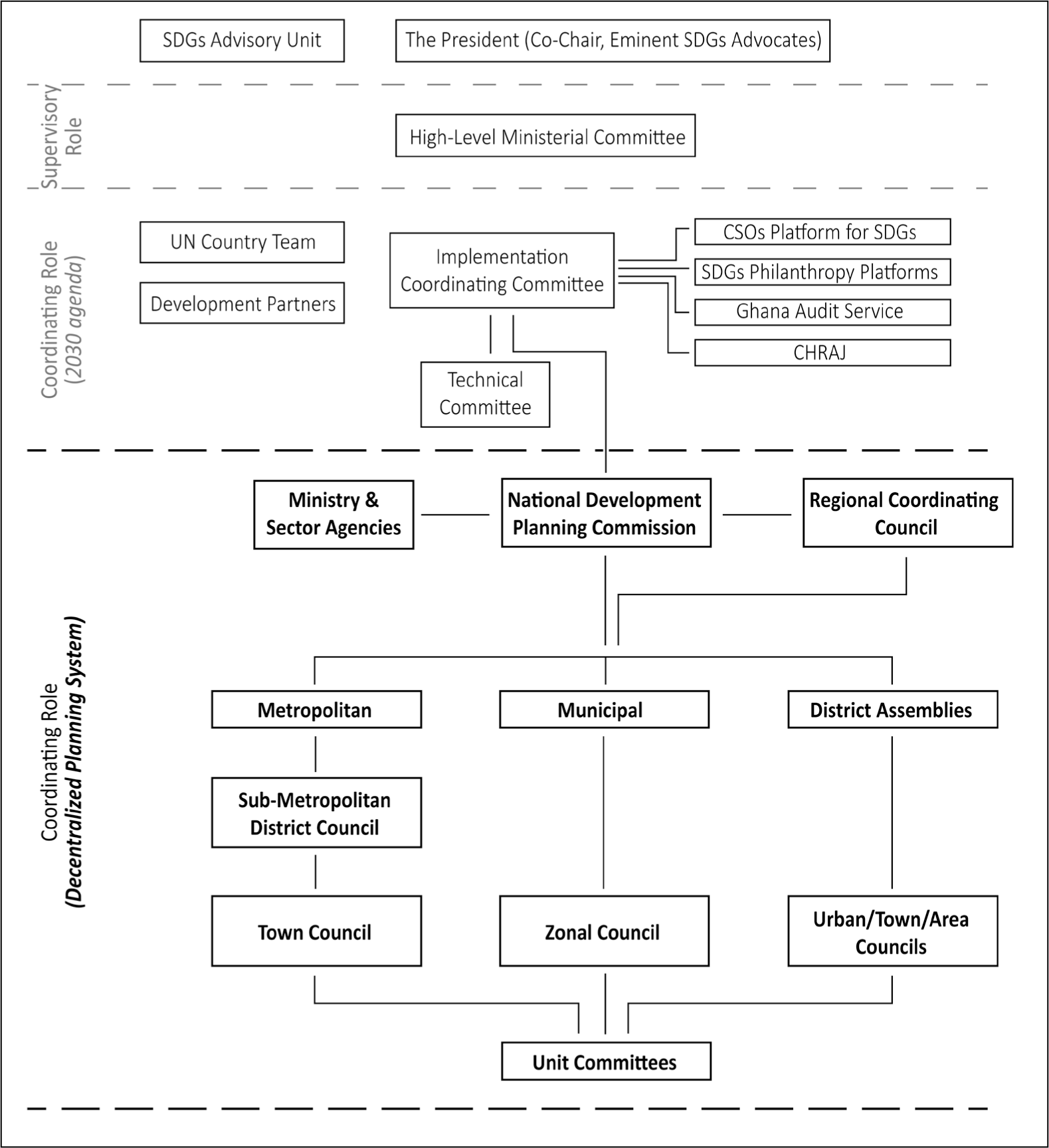
Following the integration of the global SDGs into Ghana’s policy context, SDG indicators that can be tracked with regular administrative data have been included in the results framework of national and local medium-term development plans to facilitate monitoring and reporting. Ghana’s SDG implementation arrangements underscore the country’s commitment to decentralization and emphasize the relevance of local governments to national and international development efforts. The significant role MMDAs play in SDG implementation in Ghana makes it an interesting context to analyse the local government framing of the SDGs. Moreover, the 2019 voluntary national review report on SDG implementation in Ghana highlights that, though the SDGs have been mainstreamed into district medium-term development plans, the commensurate capacity for implementation, monitoring and evaluation remains relatively low (Republic of Ghana, 2019). The need to build local government capacity to implement and monitor the SDGs is therefore flagged among the five priorities required to accelerate the SDGs (Republic of Ghana, 2019). This article’s analysis is relevant because, to propose relevant strategies to strengthen local capacity, it is essential to first understand how local actors conceptualize the SDGs, and what the SDGs mean to them. Analysis of the framing of the SDGs helps to uncover the meaning actors assign to the global framework, indicates the approach actors adopt towards the SDGs and the strategies they employ to implement them (van Hulst and Yanow, 2016). Hence, the analysis of framing presented in this article undertakes a diagnosis of what SDGs are represented to be at the MMDA level in Ghana and offers suggestions to advance SDG implementation. The data sources and analysis used to explore the study objectives are presented in the next section.
III. Data Sources and Analysis
As noted earlier, the purpose of this article was to understand the framing of SDGs in the local government context in Ghana. To achieve this purpose, a qualitative research approach was adopted using in-depth interviews (IDIs) to facilitate an understanding of the experiences, opinions and perceptions of participants. Study participants were development planning officers at the local government level. This group of practitioners was selected because of their pivotal role in local assembly development programming, including SDG implementation. Participants were identified via the researchers’ contacts, after which reverse snowballing was employed to share the project information with interested individuals. Recruitment was limited to local government officials (LGOs) with a minimum of 5 years of experience in the local government service, as they were better placed to share insights on SDGs localization from its adoption in 2015 to date. A total of 18 MMDA planning officers were interviewed in 10 out of the 16 administrative regions in Ghana (Figure 2). Participants were drawn from a mix of local assemblies: MMDAs. The study design ensured representation from the southern, middle and northern zones of Ghana (Figure 2). The recruitment of study participants was guided by the concept of theoretical saturation (Baxter and Eyles, 1997), stopping at the point where themes become repetitive and the addition of new participants does not add new information.

Data collection was between May and August 2022. Due to public health protocols and travel restrictions in place at the time, all interviews were conducted virtually via Zoom and telephone. Each semi-structured interview lasted between 35 and 45 minutes and was approached as a unique social interaction to enable participants to express their thoughts on issues they deemed important (Longhurst, 2003; Samuels, 2020). The interviews focused on how participants understood the SDGs, and examples of questions investigated included: What do the SDGs mean to you? How do the SDGs relate to your work? If the SDGs were not in place, how different do you think development planning/programming at the local assembly would be? Interview guides were used to ensure consistency across interviews, and probes were incorporated to uncover the framing of the SDGs in the local government context in Ghana (Edwards and Holland, 2013). All interviews were recorded with the participants’ consent and later transcribed. Data analysis followed a systematic and iterative process that included data familiarization and hand-coding techniques to assign ideas to texts and sentences (Clarke and Braun, 2017; Crang, 2005). The coding process continued until all relevant ideas had been included in the coding scheme. Emerging themes were identified through an iterative process to analyse, compare and combine similar ideas. The insights within each theme were identified and organized to form a cohesive narrative. Data extracts that illustrate key insights into themes were then selected to provide context for the broader narrative of the article (Braun and Clarke, 2019). The broad themes that emerged from the data gathered are discussed in the next section.
The research followed ethical protocols. For instance, consent was received from all participants before their participation in the study. Key participant identifiers were also removed from the results.
Due to the limitations of time and resources, this study presents the perspectives of district planning officers in 18 MMDAs out of the 260 MMDAs in Ghana. Thus, though the findings provide useful indications of the linkage between framing by local officials and SDG implementation strategies, they cannot be generalized to all districts in Ghana. Future studies can, therefore, examine SDGs framing by LGOs in other MMDAs in Ghana to explore parallels and differences with the present study.
IV. Findings
The following section presents a summary of the views shared by development planning officers at the MMDA level in Ghana on the framing of the SDGs. The dominant themes that emerged from the analysis suggest that participants variously framed the SDGs: first, as a replica of existing development programming; second, as a facilitator of local development, and third, as a universal standard for development. The ensuing discussion examines the implications of these framings for SDG implementation and localization.
SDGs: A Replica of Existing Development Programming
A major theme that emerged from the interviews involves the framing of SDGs as overlapping with the existing decentralized development programming. Most of the participants perceived the SDGs objectives and commitments as being the same as their ongoing local development programming. They described the SDGs variously as ‘same’, ‘not different’, ‘something we were doing initially’ and a ‘replica’ of development programming that was already ongoing in their respective MMDAs. Consistent with the suggestions by many LGOs, participant LGO 8 noted: ‘For me, I have not seen anything different between what assemblies were doing before and the SDGs…’. Another participant LGO 3 also remarked, ‘It is not something new that has been introduced to us’. Participants explained that they considered the SDGs to be the same as existing local development programming because similar actions were required to facilitate local development and achieve some SDG targets, such as SDG 4, quality education and SDG 6, water and sanitation. Participant LGO14 illustrated the linkage as follows:
you know at the assembly [MMDA] level, we provide certain services to communities within our jurisdiction, and these services are related to the SDGs…because looking at the 17 goals…most of them have a relationship with the services that we provide at the assembly level…for example, SDG 4, quality education…. SDG 3, health…SDG 6, water and sanitation….
Most of the participants indicated that they were pursuing various elements of the SDGs before they were characterized as part of the ‘new’ development agenda. Comparing their activities pre- and post-2015 when the SDGs were adopted, the majority of the LGOs interviewed insisted that ‘in principle, there is no difference’. A participant even described the SDGs as just a ‘nomenclature’ signalling that the SDGs were simply a new label for local development activities. Based on this premise, the LGOs interviewed framed the SDGs as part of their routine development programming.
Several research participants also indicated that because the SDGs reflected their regular development activities, they did not require additional effort to implement them. Consequently, most practitioners interviewed framed their approach to SDG implementation as business as usual. For instance, participant LGO 5 remarked:
The way the SDGs are carved out, whatever development activity you undertake in your corner, without even targeting a specific goal, you will certainly be doing something to contribute to at least one of the SDGs…any of the SDGs, from Goal 1 up to Goal 17.
The practitioners noted that because of the broad scope of the SDGs, several local service delivery activities could be linked to one SDG or the other. For example, LGO 17 asserted, ‘The 17 goals are so broad that almost every development agenda that you touch in my locality falls within any of these goals’. Thus, several LGOs suggested that because of the broad scope of the SDGs, they were able to implement their regular development programmes and link them to specific SDGs objectives for reporting purposes. Moreover, local practitioners explained that they did not have additional human and financial resources solely for SDG implementation; hence, framing SDG implementation as business as usual and associating the SDGs with routine local development programming enabled them simultaneously to pursue local development activities while also addressing SDGs commitments. Overall, the views expressed by participants demonstrated their perception that the SDGs reflect existing local development programming, albeit with some modifications.
SDGs: A Facilitator of Local Development
Another notable theme that emerged from the interviews was the framing of the SDGs as a ‘facilitator of local development’. Several participants noted that the ambitious targets and broad scope of issues covered by the SDGs had a positive impact on local development. The practitioners emphasized that the ambitious SDGs challenged them to ‘intensify’ local development efforts; thus, they framed the SDGs as ‘invigorating’ and ‘giving a new impetus to the local development agenda’. Furthermore, the participants depicted the positive impact of the SDGs with descriptions such as ‘eye-opener’, ‘holistic approach’ and ‘coherent programme’. The SDGs contribution to holistic local development was a prominent theme that several practitioners highlighted as the basis for framing the SDGs as a facilitator of local development. Many practitioners commented that ‘the SDGs encompass all areas of development’ and participants like LGO 4 cited specific SDGs’ commitments, like the pledge to ‘leave no one behind’ (LNOB), as motivating inclusive local development. LGO 4 remarked:
Providing classroom blocks is a regular service the assembly provides, however with the SDGs, we have to pay attention to gender equality by providing sanitary facilities for girls and address other vulnerabilities such as providing accessibility ramps for the disabled.
Participant LGO 15 also illustrated how the SDGs encourage local governments to pull together various elements of development:
There were issues that prior to the SDGs we were not paying much attention to…like issues of migration…we often ignored it…we did not integrate them into our plans…however with the SDGs, all the goals are outlined, so we can cater for all those categories in our implementation.
Another participant represented the comprehensive SDGs with ‘five Ps’, namely ‘people, planet, partnership, prosperity and progress’, to underscore the SDGs emphasis on social, economic and environmental dimensions of development. The importance of partnership, SDG 17, to the success of the SDGs agenda was stressed by several participants. LGO 7 described partnership as ‘that essential element that pulls people and all elements of development together’. Several participants indicated that implementing the comprehensive SDGs agenda obliged them to adopt intersectoral approaches and collaborate with other stakeholders in their locality. For instance, a participant cited increased partnership between the local assembly and the local police agency to promote peace and security (SDG 16), while another mentioned collaborating with traditional authorities to uphold local bylaws on deforestation to advance SDG 13, Climate Action.
Several participants indicated that they framed the SDGs as a facilitator of local development because of the sustainability considerations embedded in the global agenda. For instance, participant LGO 6 reminisced on development planning practices before the SDGs and concluded that the sustainability dimension of the SDGs augmented local development and made it more effective:
…The SDGs have opened the eyes of development practitioners that some things are very important as far as development is concerned…for instance the issue of sustainable development…that we should be developing, but we should not develop and destroy the environment so the generation yet unborn, can come and benefit from whatever we are doing. So now if you want to extract gold, get your gold but do not destroy our water body. Or if you destroy the water bodies find an alternative for us to get water to drink… But those days [pre-SDGs], they will just mine their gold and go.
Consistent with the suggestions of many practitioners, LGO 14 noted that working with sustainable development principles helped local development actors to ensure that the development initiatives yield long-lasting benefits. Participant LGO 14 remarked:
…the introduction of the SDGs, has made us very conscious about making sure that whatever activity that we do, we do not only look at the present, we should consider the future…for instance if we want to commence a project today, what will be the outcome for the future? That means we should not look at only the present so that at the end of the day our actions will not affect the future negatively.
Study participants also suggested that because the SDGs were timebound, they had to work to achieve objectives within a specific timeframe, which enhanced local development. For example, LGO 3 remarked that pursuing local development without the SDGs allowed local practitioners to procrastinate and work towards some objectives at their own pace. However, with the SDGs in place, they had to strive to meet certain targets by 2030, and this motivated them to invest more effort. Participant LGO 3 noted:
…without the SDGs we would still have development plans, but maybe there would not be that keen interest because you own it, so, you will think ‘Oh, if I am not able to do this, maybe next year I will be able to get it done’
Along the same line, several participants described the SDGs as ‘keeping local governments on their toes’ and ‘serving as a check on local governments’. Other practitioners, like LGO 15, noted that having specific targets and indicators helped clarify the planning process and streamline development efforts. Participant LGO 15 observed:
These plans [the SDGs] have come to make things clearer. As in you have a target to achieve, you know that you are supposed to have universal basic education and under it you know the indicators you are looking at… you know the various things you are targeting to be able to achieve that goal. So, it kind of streamlines it for us…and it makes working easier…
Consistent with the suggestions by many participants, LGO 9 mentioned that the ambitious targets set by the SDGs necessitated more effort from local governments and opined, ‘the SDGs make us do more’. Some practitioners, like LGO 13, however, indicated that the ambitious targets set by the SDGs stretched the limited resources available for local development; however, the impact was not significant. LGO 13 noted ‘the SDGs…put additional strain on local government resources…but it is not too significant…its manageable’. The practitioners, however, noted that because the overall impact of the SDGs was positive and the targets contributed to enhanced development, the investment was worthwhile.
In framing the SDGs as a facilitator of local development, local practitioners highlighted various ways in which the SDGs bring new energy to local development planning and programming. The views expressed indicated several ways through which the SDGs give a new push to local development planning and programming. This includes how the comprehensive SDG framework encourages local governments to form partnerships with other local stakeholders to undertake holistic development. Moreover, the target-based SDGs motivate local governments towards definite, time-bound outcomes that are also sustainable. Based on the added value of the SDGs for local development, all participants concluded that the SDGs enhanced local development with descriptions like ‘It is helping us to move forward’ and ‘it complements what we do’. Overall, research participants were of the view that the SDGs did not interfere with local development programming, hence the framing of the SDGs as a facilitator of local development.
SDGs: A Universal Standard for Development
A notable finding that emerged from the interviews was the framing of the SDGs by local practitioners as a ‘universal standard and guide for local development efforts’. Local practitioners stressed the ‘universal’ framing of the SDGs with various descriptors such as ‘globally set goals’, ‘global indicators’, ‘global commitment’, ‘framework for the whole world’ and ‘internationally set goals to guide the development of every nation’. Furthermore, participants framed the SDGs as the ultimate standard for local development efforts, describing them as the ‘yardstick’, ‘benchmark’ and ‘highest standard for development’. Participants emphasized the relevance of the SDGs in guiding various stages of development, from planning through implementation to the monitoring stage. Several practitioners indicated that the SDGs facilitated the local planning process because they used the SDG targets as a benchmark to identify shortfalls in their respective localities. Typical comments by participants included, ‘the SDGs help countries to take stock of where they are lacking in terms of development’. Participants explained that the local issues that had baseline indicators significantly lower than the global targets were then prioritized in local development plans. The quote below by LGO 1 illustrated this view:
The SDGs indicators are the benchmark by which you analyse your development situation as a local government and look for any gaps in your programming, so you work towards it. So, wherever there are gaps between the SDGs indicators and your current situation, that means there is the opportunity for you to initiate some activities to meet the shortfall.
Thus, in the development planning process, the SDGs serve as a benchmark that prompts action in areas where a locality falls short.
Most participants stressed that because their respective localities belonged to an international community, it was important to assess their progress relative to similar contexts. For instance, Participant LGO 4 noted: ‘the SDGs helps to compare your district’s development against others, so you know where you are lacking, and that becomes the focus of your planning process’. Similarly, participant LGO 8 stressed, ‘it is very good that we are working towards international standards because countries do not exist in a vacuum, so we should all work towards the same standards’. Several practitioners agreed that though individual countries had their priorities, because the SDGs had been agreed collectively, they served as a guide for global development. Additionally, local practitioners also indicated that since the SDGs were universal and applied to both developing and developed countries, they provided a good scale to evaluate development progress globally.
Local development practitioners framing of the SDGs as a global standard for development also enabled them to emphasize their contribution towards international commitments. Given that the SDGs were universal, linking local development programming to the SDGs helped local practitioners to highlight the relevance of their local development efforts to achieving international standards. A comment by participant LGO 3 reflects the perspective expressed by several participants:
…we [local practitioners] can now tell that this particular activity we are implementing, at the end of the day, this is what it will lead to globally…and this helps to take the activity seriously because we are contributing to the achievement of a certain goal at the global level.
The majority of the practitioners interviewed identified a positive linkage between the international SDGs and local development. Nonetheless, some participants also expressed concern about the impact that pursuing global frameworks would have on sustaining local development efforts. For instance, some participants observed that, almost halfway through the timeline of the SDGs, the initial enthusiasm associated with the SDGs was waning. Participants also expressed concern that since the global framework was likely to be replaced by a new international agenda after the 2030 endline, the momentum gained on the SDGs could be lost in the transition, and this would have a negative impact on local development. Typical comments from the practitioners included a quote by participant LGO 13:
Over here in Africa as we all know it is difficult keeping things on track. For instance, you start something, at the very beginning it is hyped, and everybody is on board, but as time goes on you realize that things tend to lag and we go back to where we started. Then another intervention comes in and we all get into it. So, we never get to a point, or we never arrive at the destination that we should be. That is the only negative thing that I tend to have with the SDGs…
Overall, local practitioners interviewed framed the SDGs as a universal standard for development because they applied to both developed and developing countries and offered a uniform scale to measure global development. They also perceived that the SDGs provided challenging targets for developing countries, like Ghana, to aspire towards. Their framing of the SDGs as a universal standard to aspire to was a positive for local practitioners that contributed to the ways in which they perceived the SDGs as facilitating local development. Nonetheless, some practitioners were aware that the specific timeframe of the SDGs might have a negative impact on development as the momentum gained in pursuing certain targets would be lost if the targets were revised or replaced by a new international agenda.
V. Discussions and Conclusions
This article interrogates how the SDGs are represented in the local government context in Ghana. The findings indicate that the SDGs are framed dually by local actors, on the one hand, as part of routine development programming and, on the other hand, as a framework that facilitates local development and provides a standard to assess local development in comparison to other contexts. The following section discusses the implications of the themes for SDG implementation and local development more broadly.
The findings suggest that the LGOs interviewed in Ghana have framed the global SDGs framework to make them appear local (Acharya, 2010). The connections established between the SDGs and existing local development programming have resulted in the framing of the global SDGs as a replica of existing local development planning. The framing of the SDGs as local can be attributed to the integration of the SDGs into Ghana’s decentralized planning system, with the SDG commitments cascading from national development plans to local development planning (Figure 1). The integration of the global agenda into national development strategies enables local practitioners to identify a close association between local development planning and the SDGs. The framing of the SDGs as a replica of local development programming has the merit of enabling local actors to easily construct a connection between the global norm and the local norms in any particular context (Anderl, 2017; Druckman, 2004). This framing facilitates ownership of the SDGs at the local level because participants can easily identify elements of the SDGs that align with elements in their development plans. The findings also highlight the interconnectivity between international, regional and local dimensions of development (UNDG, 2015). Given that the integration of the SDGs into the local development system in Ghana was initiated at the national level (Republic of Ghana, 2019), the national leadership created a conducive environment for local governments to follow suite. This observation resonates with the empirical evidence on SDG localization, including a case study in Kisumu, Kenya, by Croese et al. (2021). The study notes that multi-level government coordination is necessary to enable cities and local governments to address all aspects of the comprehensive SDG agenda. Related studies like Jones and Comfort (2020), Raffer et al. (2022) and Valencia et al. (2019) also suggest that inadequate national government leadership in SDG localization impacts the localization efforts of local governments.
The framing of the SDGs by local governments as a replica of existing local development also reveals some potential challenges with SDG localization in Ghana. Since framing enables local actors to emphasize a subset of relevant considerations and discard competing ideas that are unfavourable to them (Boas and McNeill, 2004; Druckman, 2004), the framing of SDG implementation by local governments as business as usual suggests an emphasis on the SDGs that align with existing local development programming. Thus, more challenging SDG indicators and targets that require more effort to implement are likely to be ignored. Moreover, the assertion by LGOs that every development intervention implemented at the local level relates to an aspect of the SDGs signals a risk. This is because local SDG reporting could focus on the targets that are within easy reach for local practitioners to implement. Local practitioners framing the ‘new wine’ of the SDGs in the ‘old wineskin’ of existing local development programming suggest there is a risk of watering down the ambition of the SDGs through the localization process. This ‘old wine in new wineskin’ scenario is akin to ‘SDG washing’, which connotes a superficial engagement with the SDGs (Heras-Saizarbitoria et al., 2022). Thus, the risk remains that local governments’ claims to be committed to the SDGs are only a re-labelling of routine local development programming as SDG implementation. Though framing the SDGs as a replica of local development presents an opportunity for local actors to foster local development alongside advancing the SDG agenda, the apparent risk of the most transformative SDG targets, such as inequality, being neglected in the implementation phase cannot be overlooked (Esquivel and Sweetman, 2016; Fukuda-Parr, 2016).
Local development practitioners’ framing of the SDGs as a facilitator of local development suggests there is an opportunity for SDG implementation to enhance local development. This finding highlights the use of framing to reinforce existing local norms, in this case, local development (Anderl, 2017). LGOs associate the SDGs with the cognitive prior of existing local development programming to create a societal need for the SDGs. Framing the SDGs as a facilitator of local development places the global norm in an acceptable context for its integration into the local setting (Acharya, 2010). For example, this framing of the SDGs supports the establishment of local partnerships to promote holistic development. Framing the SDGs as a facilitator of local development implies ‘new wine in old wineskins’, where the innovations embedded in the SDGs, the ‘new wine’, are applied to existing systems of development, the ‘old wineskins’. Evidence on localization in other contexts highlights similar trends of SDG implementation that are harnessed to emphasize existing development tenets, including partnerships (Masuda et al., 2021), inclusivity (Horn and Grugel, 2018) and sustainable local governance (Raffer et al., 2022). The framing aligns with the rationale for the SDGs, which includes harnessing the unique contributions of various countries and development contexts to enhance global development. Hence, framing the SDGs as an enabler of local development emphasizes the transformative ambition of the SDGs to propel global development and transform our world by 2030.
Local development practitioners’ framing of the SDGs as an international standard for development illustrates the use of framing to further the interests of local actors through the selection of a subset of considerations (Acharya, 2004; Boas and McNeill, 2004). By framing the SDGs as a universal standard, LGOs in Ghana emphasize the relevance of local development programming to universal development outcomes. Framing the SDGs as a standard also enhances the significance of local development efforts and underscores the relevance of local development actors. As the pivotal institution for local development, framing the SDGs as a universal standard serves the interests of local actors because it accentuates the relevance of their role. Nonetheless, framing the SDGs as a standard has the potential to ignite disillusionment. As flagged by some participants, global policies can represent a moving target that developing countries constantly strive to achieve. Since many African countries commenced the SDGs with a low baseline on many indicators (see Nicolai et al., 2015), significant gaps remain despite the gains made since 2015. Moreover, the global economic crisis following the COVID-19 pandemic, as well as the impacts of climate change, threaten to erase the marginal gains recorded (United Nations, 2022). Therefore, SDG objectives, such as LNOB, remain aspirational for many developing countries. While aspiration has the benefit of motivating political elites to strive for a better world, it also presents the risk of aspiration fatigue (see Finnemore and Jurkovich, 2020). Aspiration fatigue, especially related to time-bound targets, could result in false impressions of success or repressed information about a lack of progress (Finnemore and Jurkovich, 2020). For instance, political elites, including LGOs, risk substituting aspirational talk for action where commitment to global targets continues to be stressed without a tangible roadmap for action. The findings of the present research indicate that local practitioners acknowledge the globally set targets and positively frame the SDGs as a universal standard of development. However, beyond recognizing the targets, local actors need to identify a clear pathway to reach the desired outcome.
VI. Conclusions
This study examined how the SDGs are represented in the local government context in Ghana. The perspectives of LGOs were examined given their agency in the translation of global goals to the local context. The themes that emerged from the findings suggest a dualistic framing of the SDGs by LGO. On the one hand, the SDGs are framed as part of ongoing development programming and, on the other hand, as a framework that facilitates local development and provides a standard to assess local development in other contexts. Local practitioners framing the ‘new wine’ of the SDGs in the ‘old wineskin’ of existing local development programming present a risk of the localization process contributing to the watering down of the ambition of the SDGs. In contrast, framing the SDGs as a facilitator of local development implies ‘new wine in old wineskins’, where the innovations embedded in the SDGs, new wine, are applied to existing systems of development. This framing of the SDGs as an enabler of local development emphasizes the transformative ambition of the SDGs to propel development and transform our world by 2030. Framing the SDGs as a universal standard of development also emphasizes the relevance of local development programming to universal development outcomes. However, claiming commitment to global targets without feasible milestones presents the risk of igniting aspiration fatigue and/or creating false impressions of success.
The analysis of framing presented in this article uncovers the meaning local development practitioners assign to the global SDGs framework. It also indicates the approach actors adopt towards the SDGs. Given that localization is progressive (Acharya, 2010) and framing is dynamic, this article’s findings are important for facilitating a transition from what is currently being done to what ought to be done to advance the SDGs. The study’s findings have implications for development policy and research in Ghana and similar developing contexts.
First, local governments need to identify a set of localized targets accompanied by feasible milestones to inspire a sense of accomplishment and guard against aspiration fatigue. Localized target setting and monitoring are essential because the 2030 SDG timeline is fast approaching while the ongoing global economic and climate change crisis threaten to derail the SDGs. Thus, locally owned, ambitious but achievable (‘ambitiously achievable’) targets are important to sustain momentum towards the SDGs. In the absence of monitoring mechanisms to track the ‘extra’ effort that the SDGs encourage, romanticizing comments like ‘the SDGs make us do more’ risk remaining aspirational without accompanying actions and results. The present study does not investigate the extent to which the global targets remain aspirational in the Ghanaian local context. There is therefore a need to build on the work of Finnemore and Jurkovich (2020) to explore the implications of aspirational politics on SDG implementation in Ghana and similar developing contexts.
Second, as pivots for local development, local governments need to enhance accountability through collaboration with local development stakeholders, including civil society, traditional leaders and academia, to jointly monitor SDG implementation. Such multi-stakeholder platforms will help manage the risk of local adaptation processes diluting the ambition of the SDGs (Esquivel and Sweetman, 2016). Further, strengthening local partnerships is important because the holistic development the SDGs promote cannot be achieved in silos. Existing scholarship on SDG implementation underscores the importance of strong multi-stakeholder coordination to accelerate the SDGs (see Annan-Aggrey et al., 2022; Croese et al., 2021; Masuda et al., 2021). Hence, to facilitate SDG implementation and local development, local governments need to harness the skills and resources of other stakeholders through horizontal and vertical alliances.
Third, given the central role local governments play in local development and SDG implementation, international and national development actors need to deliberately invest in their capacity to effectively lead local development and bottom-up SDG implementation. For instance, voluntary local reviews (VLRs) should be strengthened at the local government level as an important monitoring tool to support the local implementation of the SDGs. Guidelines recently developed by United Cities and Local Governments and UN-Habitat (2020) provide a good starting point for local governments to learn from peers in territories who have successfully gone through the VLR process. Similar capacity-building tools and resources to enhance SDG localization by local governments and cities are encouraged.
Footnotes
Acknowledgements
The authors express their sincere thanks to all Metropolitan, Municipal and District Assembly (MMDA) development planning officers who participated in this research. The first author also appreciates the financial support provided by the Ontario Graduate Scholarship (OGS) and the A. E. Robinson Scholarship at the University of Western Ontario. The second author is grateful for financial support from the Social Sciences and Humanities Research Council (SSHRC). We are grateful to the editor, Catherine Locke, and the anonymous reviewers for their insightful feedback and comments that helped to improve the manuscript. We are also grateful to Bipasha Baruah, Belinda Dodson and Isaac Luginaah for their support in the entire project.
Declaration of Conflicting Interests
The authors declared no potential conflicts of interest with respect to the research, authorship and/or publication of this article.
Funding
The authors received no financial support for the research, authorship and/or publication of this article.