



Abstract
This article examines the effect of political knowledge on support for the euro and voting on the euro issue in the 2001 and 2005 UK general elections. Political knowledge increased support for the euro in 2001 but had no effect in 2005 and it conditioned the effect of the euro issue on vote choice in both elections. The effect of the euro issue on voting was stronger among knowledgeable voters, who were more likely to vote correctly on the issue by choosing a party closest to their own views on the euro. These findings demonstrate heterogeneity in voting on the euro issue in these elections and should motivate further inquiry into the role that political knowledge plays in conditioning voting behavior on European issues.
Introduction
Students of comparative politics have given increasing attention in recent years to the effects of European integration on national electoral politics. As the institutional powers of the European Union (EU) have grown, the consequences of EU policies for citizens and domestic interest groups have become more important. At the same time, there is a growing elite–mass gap in EU support (Hooghe, 2003; Mattila and Raunio, 2006) and increasing party conflict over the EU (Marks et al., 2006). Recent research has shown that European integration influences voting behavior in national elections, a result termed EU issue voting (De Vries, 2007; Gabel, 2000; Tillman, 2004). These studies suggest that an electoral connection on European questions may be emerging as parties, voters, and the media give more attention to European issues.
Although these recent studies have made important contributions, there is still much that we do not know about the effects of the EU on national elections. One important limitation is how we conceive of the European issue. Most previous studies of EU issue voting have operationalized the independent variable as a general level of support for EU membership. Although these studies have been valuable in advancing our knowledge on this topic, they may be limited by the use of this general measure. In many cases, EU membership itself is not the issue. Instead, contentious debates over the EU often center on specific EU initiatives or debates, such as an expansion of EU powers or an enlargement of the EU, which creates the possibility of new patterns of conflict that may not overlap with general attitudes towards EU membership.
A second limitation concerns how and when EU issue voting occurs within a particular electorate. Prior studies have found that the nature of party conflict on the European issue and the political context affect the degree of EU issue voting (De Vries, 2007; De Vries and Tillman, 2011; De Vries et al., 2011a), demonstrating that contextual factors condition the emergence of European issues in national elections. We know less about differences among voters in how they respond to European issues in national elections. Prior research has generated little insight into potential voter heterogeneity on European questions, leaving the question of who votes on European issues (and how) in national elections unanswered. Issue voting is not uniform among an electorate, especially when the issue is new or complex, or when levels of citizen knowledge about the issue are relatively low. It is important to understand the sources of voter heterogeneity in EU issue voting to identify which voters are motivated to vote on Europe, for which parties they vote, and for what reasons.
This study seeks to address these gaps through an analysis of citizen attitudes towards the adoption of the single European currency (the euro) and their effect on voting behavior in the 2001 and 2005 UK general elections. The role of the euro issue in these UK elections is interesting in its own right: two of the three major parties (Labour and the Liberal Democrats) supported the goal of the UK adopting the common currency despite the fact that UK public opinion was broadly opposed. 1 Labour won both elections, and the Liberal Democrats increased their share of the vote despite being on the unpopular side of the issue. Why did the parties not suffer electorally for being on the ‘wrong’ side of the issue? One answer to this question is that the euro did not matter to UK voters. However, the importance of European issues in UK politics (Clements and Bartle, 2009; Evans, 1998, 1999, 2002) and the public debate over potential UK adoption of the euro during the periods leading up to and after the 2001 general election suggest that this may not be the case.
This article demonstrates that the euro issue mattered in both elections. However, political knowledge conditioned attitudes towards the euro and voting on the euro issue. The analyses produce two sets of findings. First, there was a significant knowledge gap at the time of the 2001 election that led knowledgeable voters to be more supportive of the euro, though this gap in attitudes is no longer apparent in the 2005 election study data. Second, knowledgeable voters were more likely to vote for a party with a similar position to their own on the euro issue. Ill-informed voters showed little ability to connect their attitudes on the euro to their vote choice. Taken together, these findings suggest that the conditioning effect of political knowledge benefited pro-euro parties, particularly in 2001, because knowledgeable citizens were both more likely to support the adoption of the euro and to vote on this issue position. I discuss the implications of these findings for our understanding of the role of European issues in UK politics and for our understanding of EU issue voting generally in the concluding section.
European integration and national elections
Since the ratification of the Maastricht Treaty, research on citizen attitudes towards the EU and their consequences for European politics has generated three broad sets of findings. First, a number of studies have examined the sources of citizen attitudes towards the EU. Although disagreement remains about the degree to which attitudes are rooted in utilitarian (Gabel, 1998), domestic political (Anderson, 1998; Rohrschneider, 2002), or sociocultural (Carey, 2002; McLaren, 2002) concerns, many European citizens appear to hold structured attitudes on the EU. A similar set of findings has emerged about citizen support for the euro (Banducci et al., 2003; Gabel and Hix, 2005; Kaltenthaler and Anderson, 2001). Second, political parties are at least minimally responsive to citizen attitudes on EU issues (Carrubba, 2001; Steenbergen et al., 2007), though political elites tend to support the EU more than publics (Hooghe, 2003; Mattila and Raunio, 2006). One result of this increasing responsiveness has been the emergence of patterns of party contestation on European questions within national party systems (Marks et al., 2006). Finally, the previous two sets of results have generated research into whether national electoral politics have become an outlet for contesting European issues. The work in this area examines whether the EU has evolved into an electoral issue in national politics, leading to the development of the EU issue voting hypothesis (De Vries, 2007; Gabel, 2000; Tillman, 2004).
The EU issue voting hypothesis states that citizen preferences over European integration influence their vote choice in national elections. Citizens are expected to vote for the party closest to their own position on the question of European integration. Several studies have found evidence consistent with this hypothesis (De Vries, 2007; Gabel, 2000; Tillman, 2004) across different countries and elections. These studies have largely established the point that (in recent years) evidence of EU issue voting can be found across Western and Eastern Europe in many different political contexts. The UK has also received particular attention from scholars owing to the relatively long-standing contentiousness of debates over the EU. Several studies of recent elections have found evidence that the EU is an important issue in UK politics (Clements and Bartle, 2009; Evans, 1998, 1999, 2002).
Recent work has examined variation in the extent of EU issue voting. Several important findings have emerged from this research. High levels of party conflict facilitate the emergence of EU issue voting, so EU issue voting is stronger in East-Central Europe (De Vries and Tillman, 2011), where the nature of ideological debate facilitates party conflict on the EU issue (Marks et al., 2006), and in West European states such as Denmark and the UK where party conflict on Europe is higher (De Vries, 2007). In addition, national political-institutional contexts condition the strength of EU issue voting by altering the clarity of responsibility for European policies (De Vries et al., 2011a).
Two issues remain largely unresolved in the literature. First, it is unclear whether specific European issues function similarly to general EU attitudes. Most prior studies have measured the distance between a party and citizens in terms of a scale on which one pole indicates opposition to European integration (or EU membership) and the other support. 2 However, EU membership is not necessarily controversial in many member states. Instead, public debates often focus on specific European issues and initiatives. For example, Turkey’s candidacy for EU membership shaped voting behavior in the 2005 German election (Schoen, 2008). Similarly, the proposed European Constitution was defeated in referenda in France and the Netherlands, two countries normally thought of as pro-European (Hobolt and Brouard, 2011). Thus, specific EU questions may matter as much as general orientations towards the EU in national elections. Furthermore, specific European issues may lead to patterns of elite and mass conflict that cross-cut general support for EU membership, so that French or German voters who normally support EU membership may oppose the Constitutional Treaty or Turkish membership, respectively.
A second question that remains unclear is who votes on EU issues. Past studies of EU issue voting have largely ignored potential voter heterogeneity in search of a general effect. However, it is likely that European integration, being a relatively new and complex issue, will not have a uniform effect across all voters. Prior research on issue voting suggests that knowledgeable voters are more likely than less informed citizens to vote on a relatively new issue (Zaller, 1990). Research on the EU has generated mixed evidence of a knowledge gap. Whereas some studies find that knowledgeable citizens are more likely to judge the EU on relevant considerations (that is, assessments of the EU) rather than on evaluations of national government performance (Karp et al., 2003) and to vote on European issues (De Vries et al., 2011b; Hobolt and Wittrock, 2011), other studies find little evidence that knowledge conditions EU attitudes (Semetko et al., 2003), and Schoen (2008) finds that less educated citizens are more likely to vote on the question of Turkish EU membership. Thus, the conditioning effect of political knowledge on EU issue voting remains unclear.
Existing research on political knowledge and issue voting has generated two related sets of findings. First, political knowledge conditions citizen attitudes. Though the direction of the conditioning effect may vary (that is, knowledge may lead to increased support for some policies but decreased support for others), knowledgeable citizens’ political attitudes frequently differ from those of their less informed counterparts. Knowledgeable voters are more likely to form stable opinions on issues, to link these issue positions in logical ways to other relevant values and material interests, and to form accurate perceptions of the positions of rival parties or candidates on these issues (Althaus, 2003; Converse, 1964; Delli Carpini and Keeter, 1996; Zaller, 1990). A fully informed electorate would have different collective preferences (Althaus, 2003) and occasionally vote differently than the actual electorate (Bartels, 1996). One question that remains less clear is whether high levels of policy debate reduce or exacerbate information effects. Prior research in the United States and Europe has provided mixed evidence. One perspective suggests that sustained elite or media debate reduces information gaps by providing ill-informed citizens with access to the information they need in order to form meaningful opinions so that they become increasingly similar to knowledgeable citizens in their attitude structures (Althaus, 2003; Zaller, 1990). Other studies suggest that high-salience debates exacerbate information effects, given that ‘it takes information to get information’ (Converse, 2000: 334). Lacking the requisite background knowledge, ill-informed citizens fail to process new information resulting from policy debates, while knowledgeable citizens improve their understanding of the issue (Claassen and Highton, 2006). According to this latter perspective, knowledge gaps increase when the salience of an issue is high and decrease when it is low.
The debate over the potential adoption of the euro provides a context in which information effects are likely to exist. Higher levels of political knowledge should correlate positively with greater support for the adoption of the euro. There are several reasons for this. First, the euro question is a hard issue (Carmines and Stimson, 1989) in that it is relatively new, it is complex, and it concerns questions of economic and foreign policy that are remote to most citizens. Second, the adoption of the euro has important political and distributive effects. Skilled workers such as professionals and those with higher educational attainment are more likely to support economic integration because they stand to benefit from it more than do manual laborers or those with lower levels of education (Gabel, 1998). This effect has been observed in attitudes towards the euro (Banducci et al., 2003; Jupille and Leblang, 2007; Kaltenthaler and Anderson, 2001). The adoption of the common currency would be a major step towards closer integration with Europe, and the loss of national control over monetary policy accompanied by restrictions upon fiscal policy would also generate distributive effects. Given these complexities, it is likely that only more knowledgeable citizens will understand these effects, so political information should generate preferences that align more closely with group interests. The highly educated and professionals should be those most likely to perceive benefits from the adoption of the euro; they in turn are more likely to have higher levels of political information. As a result, higher levels of political knowledge should produce increased support for the euro (Gabel and Hix, 2005). However, it is unclear whether this knowledge effect would be greater in 2001, when elite debate over the euro was relatively high, or in 2005, when debate had decreased.
In addition to influencing attitudes, political knowledge should condition the likelihood of voting on the euro issue. Knowledgeable citizens are more likely to be informed about the issue (knowing the positions of different parties on the euro), to be capable of sophisticated thinking about politics (being able to relate beliefs on the euro issue to other issue positions or a broader value system), and to be able to translate those issue positions into political action (voting in a way that is consistent with that belief). Prior research has found that knowledgeable citizens are more likely than ill-informed individuals to vote ‘correctly’ (Lau and Redlawsk, 2006) or consistently with ‘enlightened preferences’ (Bartels, 1996; Delli Carpini and Keeter, 1996). Given the complexity and newness of the euro issue in UK politics and that citizen knowledge about European issues is typically low (Anderson, 1998), it is likely that such knowledge gaps in voting would be substantial. Thus, the second prediction that is tested in the subsequent analysis is that knowledgeable citizens are more likely to vote on the euro issue.
The euro and the 2001 & 2005 UK elections
The UK is an interesting case for examining EU issue voting because of the long-standing public debate over its relationship with Europe. European issues have received significant attention in UK election campaigns, with five elections seeing over 10 percent of party manifestos devoted to the issue (Clements and Bartle, 2009: 385). Moreover, the major parties have taken divergent stances on Europe, and the UK public remains divided over Europe. Although 44 percent of the respondents in the 2001 British Election Study (BES) described EU membership as ‘a good thing’, a smaller proportion indicated support for the adoption of the euro. Finally, attitudes towards the euro did not directly reflect evaluations of EU membership; support for the euro was mixed even among those who evaluated EU membership positively.
The high levels of public division and party conflict have led scholars to examine the effects of the European issue in UK electoral politics. Several studies have found evidence of EU issue voting in UK politics (Clements and Bartle, 2009; Evans, 2002), with Evans (1999) suggesting that the European issue had the potential to form a new electoral cleavage in UK politics as the rightward shift of the Labour Party under Tony Blair reduced the traditional left–right division over economic policy. A study of the 2001 UK election presented evidence of the electoral importance of the European issue (Evans, 2002), which became more salient owing to the decreasing conflict over economic policy and the hardening of the Conservative Party’s Euroskeptic position.
By the time of the 2001 election, the position of the three major UK parties on the euro was clear. Although all three parties endorsed continued EU membership, there was party conflict over the euro. The Tories came out in clear opposition to adopting the euro during the 2001 election and maintained this position through 2005, emphasizing a pledge to keep the UK on the pound. The Labour Party under Tony Blair took a pro-euro stance but sought to moderate its position prior to the 2001 election by introducing a series of economic tests that would need to be satisfied before holding a referendum on the issue. Ultimately, these economic tests were never satisfied, and the Labour government did not call a referendum on the euro. Similarly, the Liberal Democrats supported the adoption of the euro pending a successful referendum outcome. In short, Labour and the Liberal Democrats staked out positions in support of the euro whereas the Tories stood firmly against it, and UK voters perceived this party conflict over the euro. 3 However, the salience of the issue varied between the 2001 and 2005 campaigns. The issue played a fairly major role during the 2001 campaign and was an important part of the Tories’ campaign to ‘save the Pound’ (Bartle, 2003). All three major parties de-emphasized the issue during the 2005 campaign (Fisher, 2006; McKay, 2006). Voters appear to have responded to this party emphasis. Whereas polling prior to the 2001 election put ‘Europe’ among the five issues most frequently named by respondents that would determine their vote, it was only the 12th most frequently named issue in 2005 (McKay, 2006: 86). 4
Figures 1 and 2 provide illustrations of mass opinion towards the euro drawn from the 2001 and 2005 BES (Sanders et al., 2001, 2005). Figure 1 shows the percentage of respondents choosing each of three possible answers to a question asking whether the UK should keep the pound or adopt the euro. Respondents could choose to rule out adopting the euro on principle, to stay out of the eurozone for at least four to five years, to adopt the euro when economic conditions were right, or to adopt the euro as soon as possible. In practice, very few respondents chose the last option; only 6.3 percent wanted to adopt the euro immediately in 2001 and 8.9 percent in 2005. To ease presentation and analysis, I combine the responses to the final two choices into one category, which indicates respondents willing to adopt the euro in the short to medium term (in contrast to either other option, which call for ruling out the euro for the near future or permanently). Figure 1 demonstrates two points. First, public opinion over the euro was strongly divided. Roughly 45 percent of respondents were willing to consider adopting the euro ‘when conditions were right,’
5
whereas more than 25 percent of respondents ruled out adopting the euro at any point. Second, the level of mass support for the euro remained relatively stable across the two election periods. Although aggregate numbers can obscure changes of equal magnitude between groups, it does not appear that there was a major shift in public support towards or away from the euro between the 2001 and 2005 general elections.
Mean respondent support for the euro in 2001 and 2005. Note: The bars show the percentage of respondents choosing each option in the 2001 and 2005 British Election Study surveys. Mean support for the euro by political knowledge in 2001 and 2005. Note: The bars show the percentage of respondents indicating that the UK should adopt the euro as soon as possible or ‘when economic conditions are right’ for each level of political knowledge in 2001 and 2005.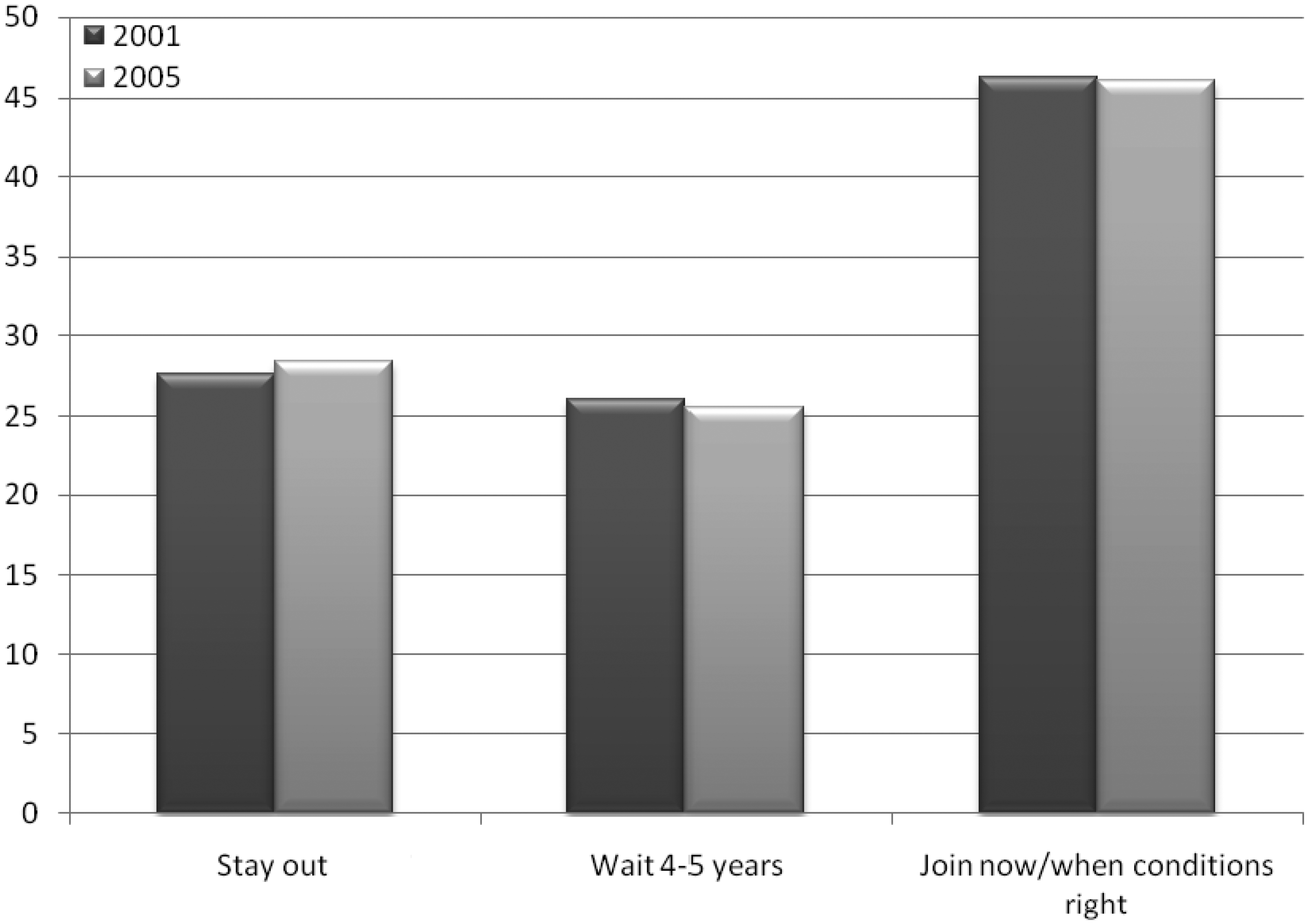
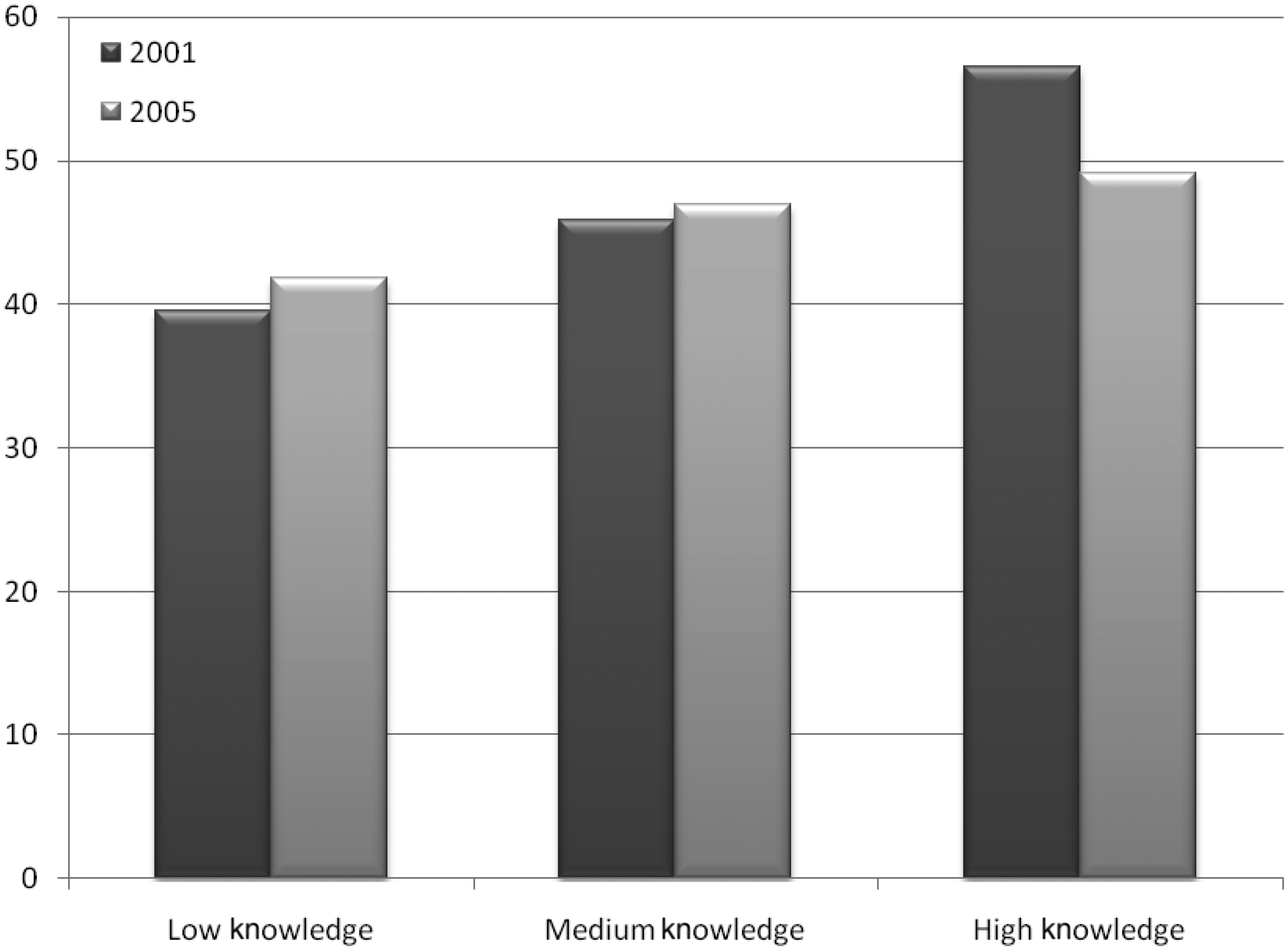
Figure 2 shows the percentages of those indicating support for the euro by the respondent’s level of political knowledge. Respondents are divided into groups of low, medium, and high knowledge, depending on the percentage of objective questions about UK politics that they were able to answer correctly. Two main patterns are evident in Figure 2. First, support for the euro was positively related to political knowledge. Those at the highest level of political knowledge were at least modestly more likely than those at lower levels of political knowledge to support the adoption of the euro. Second, this relationship was stronger in 2001 than in 2005. Whereas there was a gap in support of roughly 15 percentage points between low and high knowledge respondents in 2001, that gap was only about 7 percentage points in 2005.
In short, this review of UK politics and the descriptive statistics presented in Figures 1 and 2 suggest that the potential for voting on the euro issue existed and for political knowledge to condition this effect. First, there was evident party conflict on the issue, with the Tories opposed to the euro and Labour and the Liberal Democrats in favor. Second, there was a sufficient level of public division on the issue. In addition, the issue achieved moderate salience among voters, particularly in 2001. Finally, aggregate data suggest a knowledge gap in support for the euro. The next sections present analyses that will test three predictions. First, political knowledge should condition attitudes towards the euro, with knowledgeable respondents being more likely to support the euro. Second, knowledge should condition voting on the euro issue, with knowledgeable voters being more likely to vote on the issue. Finally, it is less clear whether knowledge effects should be increased or weakened between 2001 and 2005 as a result of the changing elite debate over the euro.
Data and variables
Given the level of party conflict and mass disagreement over the euro, the UK elections of 2001 and 2005 are promising cases for observing these relationships. I examine data from the 2001 and 2005 BES (Sanders et al., 2001, 2005) because each survey includes appropriate questions for measuring voting behavior, political knowledge, and attitudes towards the adoption of the euro.
There are three central variables in these analyses. The first, Euro Support, is the dependent variable in the first set of analyses and an independent variable in the second set of analyses. It is measured using a question asking respondents which of four statements is closest to their view: ‘(1) rule out joining [the euro] on principle; (2) stay out for at least the next four or five years; (3) join if and when the economic conditions are right; (4) definitely join as soon as possible.’ As noted in the previous section, the last two answers are combined owing to the fact that both express support for the adoption of the euro but an insufficiently small number of respondents chose the final option, complicating model estimation. Thus, Euro Support has three possible values, with higher values representing greater support for the common currency. 6 The dependent variable in the second analysis is the reported voting behavior in the post-election survey. The variable has three values, representing each of the three major parties included in the analysis: the incumbent Labour Party, the main opposition Conservative Party (Tories), and the Liberal Democrats (LD). Other parties are dropped from the analysis because they are too small to make estimation feasible. Finally, I include a measure of the respondent’s political knowledge in both analyses. Knowledge measures the proportion of objective political knowledge questions included in the BES that the respondent answered correctly. Past research has found that such questions effectively measure a citizen’s political knowledge and sophistication (Althaus, 2003; Delli Carpini and Keeter, 1996). This variable is scaled to range between 0 (indicating that the respondent could not answer any of the questions correctly) and 1 (indicating all correct answers). 7 Additionally, I generate an interaction term between Knowledge and Euro.
It is necessary to include a number of control variables in each analysis to minimize the possibility of spurious findings. First, I include respondent self-placements on three additional issue scales. The first variable is based on a question asking respondents to place themselves on a traditional 11-point left–right ideological scale. This variable is entitled Ideology, and it ranges from 0 (far left) to 10 (far right). Left-wing respondents should be more likely to vote Labour or Liberal Democrat (producing negative coefficients), whereas the coefficients for the Conservatives should be positive. A second scale asks respondents to place themselves on a scale where 0 indicates that ‘reducing crime is more important’ and 10 indicates that ‘protecting the rights of the accused’ is more important. This variable is used to create Crime, an important domestic political issue. Respondents placing themselves closer to 0 should be more likely to vote Tory and those closer to 10 more likely to vote Liberal Democrat. A final variable, Tax Spend, measures respondents’ self-placement on a scale where 0 indicates a preference for reduced taxation at the expense of decreased social spending and 10 indicates a preference for more social spending financed by higher taxation. Those favoring increased spending should be more likely to vote Labour or Liberal Democrat; those favoring lower taxes should vote Tory. Including these three policy variables helps to capture important domestic political concerns that likely influenced the choices of UK voters in both elections. Evaluations of the national economy are important in shaping voting behavior (Lewis-Beck and Stegmaier, 2007). I measure economic judgments using a standard retrospective sociotropic question. Retrospective Economy is coded using a question asking respondents to evaluate how the ‘general economic situation’ in the UK had changed over the past 12 months on a five-point scale. Values range from −2 (a lot worse) to +2 (a lot better). I expect Retrospective Economy to be negative and significant for the Conservatives and Liberal Democrats relative to the Labour Party (indicating that negative judgments of the economy reduce the likelihood of voting for the incumbent Labour Party in favor of the other two parties). Finally, I control for general preferences over European integration by including the variable EU Membership, which asks respondents a standard question about whether they approve of the UK’s EU membership, with responses ranging from 1 (strong disapproval) to 5 (strong approval). Including this variable ensures that results from the euro variable are not capturing general EU approval.
I include a number of variables capturing respondent characteristics likely to affect voting behavior. The first is party identification. I include three dummy variables to measure self-reported party identification: Tory Identifier, Labour Identifier, and Liberal Identifier. Each variable is scored 1 if the respondents claim to identify with that party and 0 otherwise. Non-partisans and partisans of minor parties serve as the excluded reference category. 8 Partisanship should strongly increase the likelihood of voting for the partisan’s preferred party and against the other two parties. I also include variables measuring the respondent’s self-reported occupational status. Each is a dummy variable taking a value of 1 if the respondent reports being a member of the group and 0 otherwise. These variables are Professional, Manager, Small Business (owner), Skilled Worker, Unskilled Worker, Student, Retired, and Unemployed. In general, members of high-status occupations (for example, professional, manager, small business owner) should be more likely to vote Tory whereas lower-status occupations (for example, skilled and unskilled workers) should be more likely to vote Labour. Class is a dummy variable coded 1 if the respondent self-identifies as a member of the working class and 0 otherwise. Working-class respondents should be more likely to vote Labour. Gender is coded 1 if the respondent is male, 0 if female. Respondents living in an owner-occupied home are coded 1 in Homeowner, and respondents who do not are coded 0. In general, homeowners should be less likely to vote Labour. Union is coded 1 for those respondents who report being members of union households, 0 otherwise. Voters from union households should be more likely to support Labour. Education is measured as the age at which the respondent finished full-time schooling, with values along a four-point scale from 1 (15 and under) to 4 (19 or older). Higher educational attainment should correlate with support for the Tories. Age measures the respondent’s age bracket on a five-point scale.
Analyses and results
The analysis proceeds in two stages. First, I estimate models of support for the euro in the 2001 and 2005 elections. These analyses allow for a test of whether political knowledge affects attitudes towards the euro. The second section presents models of voting behavior in the same two elections to test the hypothesis that political knowledge conditions the effects of euro support on the vote.
Political knowledge and support for the euro
Political knowledge and support for the euro

Note: Cell entries show ordered logit coefficients (with standard errors in parentheses); the dependent variable is the respondent’s level of support for the euro; see text for description and measurement of variables.
p < .05, one-tailed test.
The analysis here suggests that the knowledge gap decreased between 2001 and 2005. This decreasing knowledge gap is likely the result of the declining salience of the issue between 2001 and 2005. There are competing claims about whether increased policy debate reduces or strengthens knowledge effects (Althaus, 2003; Claassen and Highton, 2006; Converse, 2000; Zaller, 1990). The results presented here are consistent with the claim that elite policy debate increases the effect of knowledge because only more knowledgeable citizens are able to process and incorporate information (Converse, 2000: 334; Claassen and Highton, 2006). The relatively intense debate of 2001 allowed more informed citizens to form stronger opinions on the euro by relating arguments about the euro to other issue positions and values, whereas ill-informed citizens would lack the background understanding to do so. The fact that knowledge about the EU is low even in comparison to domestic political knowledge (Anderson, 1998) adds strength to this interpretation, because many ill-informed citizens (measured using questions about UK politics) may have such limited understanding of EU affairs as to be unable to form a structured opinion on the euro. Additionally, increased elite debate over the euro in 2001 may have resulted in a greater volume of positive messages about the euro for informed voters to receive, given the generally negative portrayals of ‘Europe’ and the euro in the UK media over time (Gavin, 2007). Thus, this analysis suggests that knowledge has an effect on euro attitudes in 2001 when salience was high but not in 2005 when salience diminished.
Does political knowledge moderate euro issue voting?
Support for the euro, political knowledge, and voting behaviour in 2001
Note: Cell entries show multinomial logit coefficients (with standard errors in parentheses); the dependent variable is the reported vote choice of the respondent.
p < .05, one-tailed test.
Support for the euro, political knowledge, and voting behaviour in 2005
Note: Cell entries show multinomial logit coefficients (with standard errors in parentheses); the dependent variable is the reported vote choice of the respondent.
p < .05, one-tailed test.
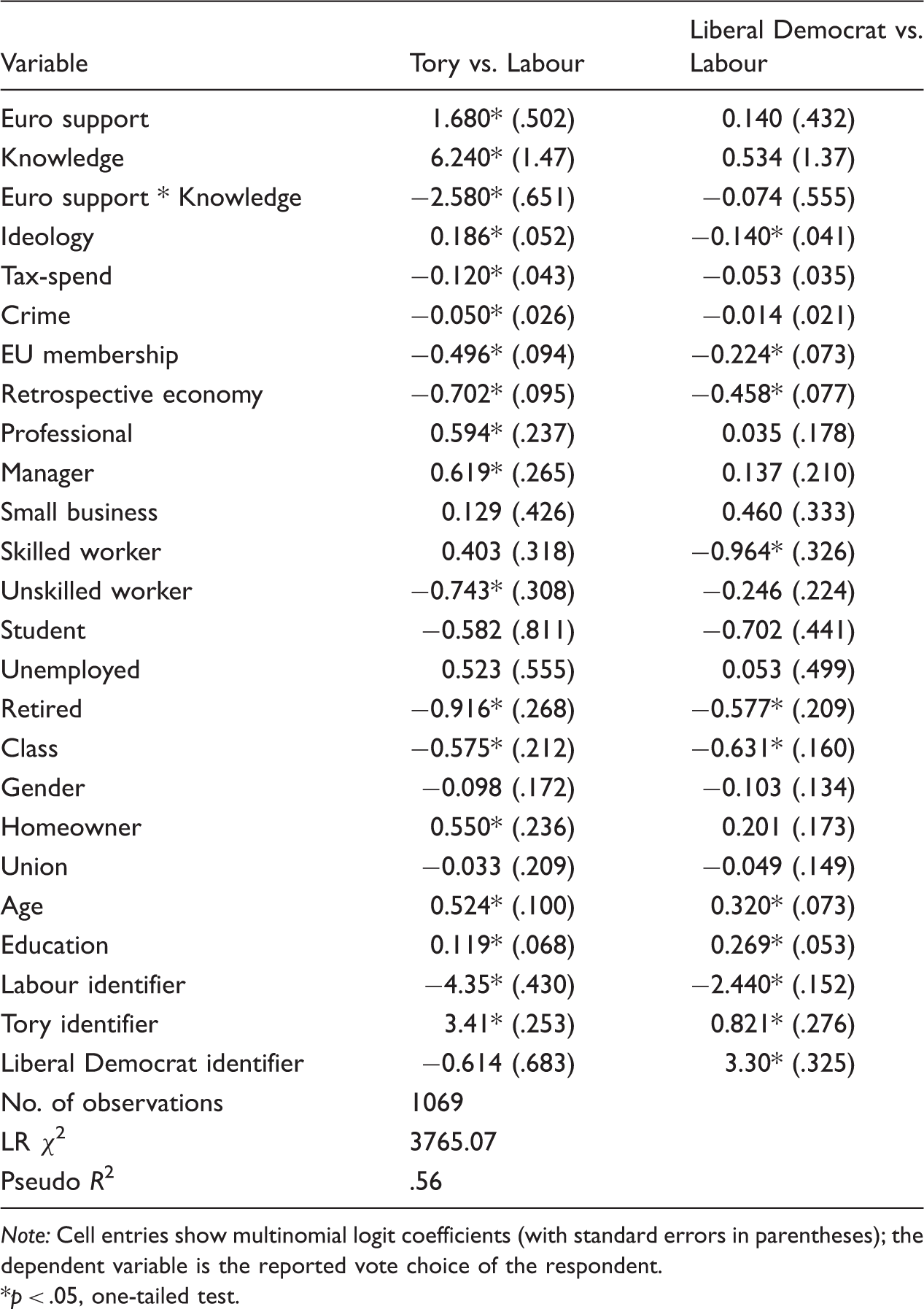
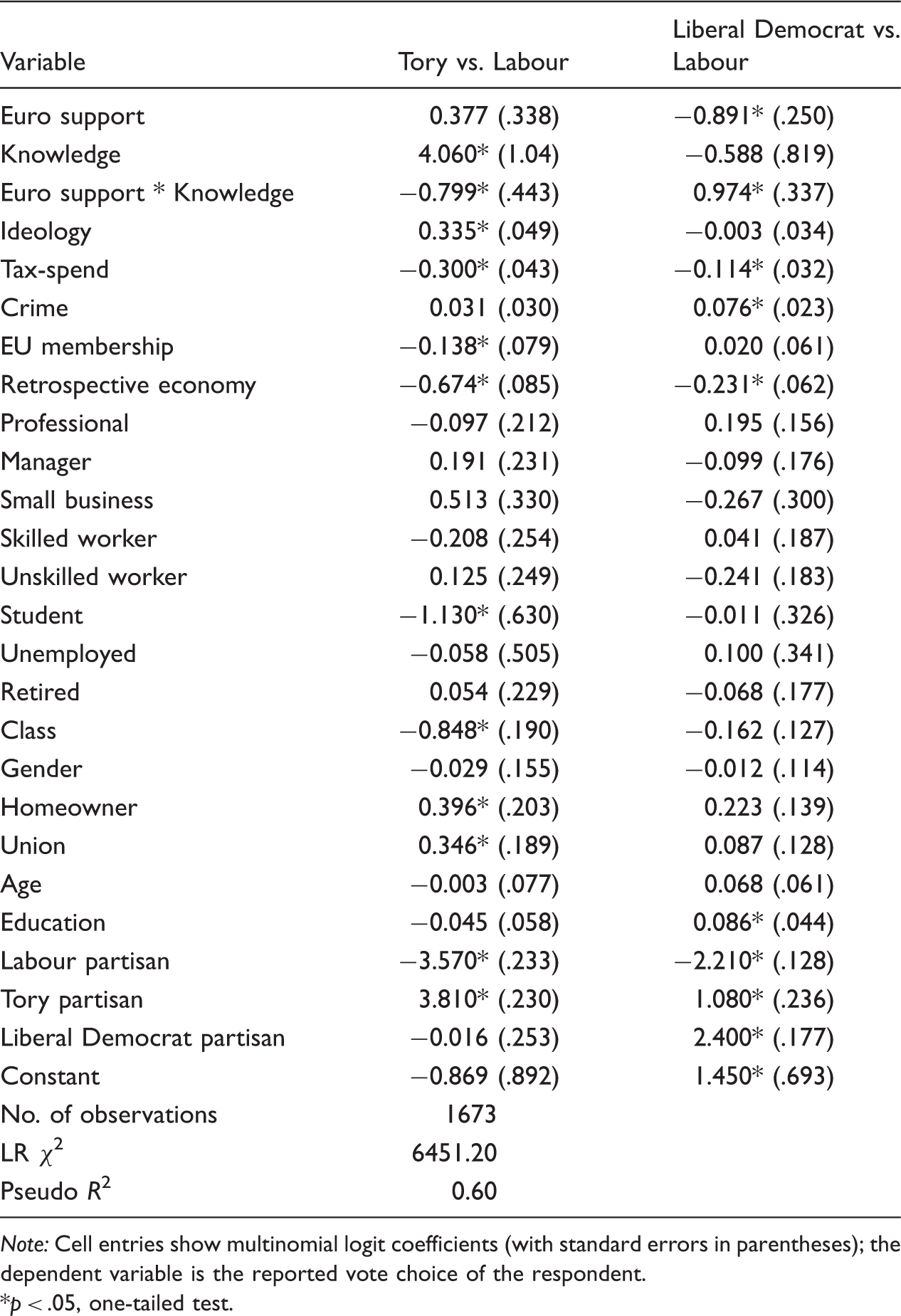
The key independent variables are Euro, Knowledge, and in particular the interaction term between the two variables. I expect that support for the euro should decrease the likelihood of voting Tory relative to Labour or Liberal Democrat and should have a neutral or positive effect on voting Liberal Democrat versus Labour, since both parties support the euro. Because political knowledge should increase the strength of euro issue voting, the coefficient for the interaction term should be negative for the Tory vs. Labour and Tory vs. Liberal Democrat combination. It is less clear whether knowledge should have any effect on the decision to vote Labour versus Liberal Democrat.
Table 2 shows the results of the analysis of the 2001 general election, and Table 3 shows the results of the 2005 general election. Note that the control variables generally have the expected effect. For example, voters who are further to the right on the ideological scale, who prefer reduced taxes over increased spending, and who believe the national economy has worsened are more likely to vote Conservative over Labour in both elections. The strength of the control variables increases confidence that the findings regarding the euro issue are not spurious. Additionally, EU Membership has a strong effect in the expected direction, suggesting that findings regarding the euro do not simply reflect general preferences over Europe.
Predicted change in vote probability by euro support and knowledge

Note: Cell entries show predicted changes (first differences) in vote probability for each party by a hypothetical respondent as she is moved from opposition to support of the euro at a low and high level of knowledge while the values of all other variables are held constant.
I start with the 2001 election. Consider first the low-knowledge respondent. Moving the individual from opposition to support of the euro has the unexpected effect of increasing support for the Tories. In other words, the ill-informed respondent becomes more likely to support the party that opposes the euro as she becomes more in favor of the euro, acting in opposition to her preferences over the common currency. By contrast, the simulated behavior of the knowledgeable respondent is in the expected direction: she becomes less likely to vote Conservative and more likely to vote Labour or especially Liberal Democrat as she moves from opposition to support of the euro. In addition, the magnitude of the effect on the Tory vote is larger as well (−0.37 versus 0.22). Thus, political knowledge has the effect of increasing the correspondence between the citizen’s attitude and vote by increasing the magnitude of the effect and by moving it towards the ‘correct’ direction.
A similar set of results holds in 2005. The ill-informed respondent decreases support for the Liberal Democrats and increases support for the Labour Party as she becomes in favor of the euro. Although the euro issue seems to have a modestly sizeable effect on the vote of the ill-informed citizen, its effect is muddled in that it leads to increased support for a pro-euro party (Labour) and decreased support for another pro-euro party (Liberal Democrats). By contrast, the knowledgeable respondent increases support for the Liberal Democrats and decreases support for the Tories as she becomes pro-euro, which is consistent with the goal of supporting a party that is closest to one’s own position on an issue. Interestingly, the knowledgeable respondent does not alter her likelihood of voting Labour. This may reflect a perception that the Blair government backtracked on holding a referendum on the euro during the 2001–5 term and de-emphasized the euro during the 2005 campaign, leading knowledgeable pro-euro voters to move towards the Liberal Democrats, who maintained a more consistently pro-euro stance throughout the entire period.
In sum, the results point to the importance of political knowledge on euro issue voting in two ways. First, knowledge increases the magnitude of the euro issue vote in the 2001 election. Second, and perhaps more importantly, it changes the direction of the effect of the euro issue on the vote. Knowledgeable respondents are more likely to vote correctly (Lau and Redlawsk, 2006) in the sense of choosing a party that most closely represents their own position on the euro. By contrast, ill-informed voters increase support for parties that hold positions on the euro opposite to their own simulated preferences. Finally, these effects are sizeable. The results of the 2001 simulations suggest that the hypothetical knowledgeable voter would be 37 percentage points less likely to vote Tory if she supported the euro than if she opposed it. That difference is 20 percentage points in 2005. 10 For an unattached voter, an effect of this magnitude is strong enough to shift the predicted vote away from the Tories. Given that Labour and the Liberal Democrats were both in favor of the euro, it is not surprising that the effect is smaller for both parties because it is divided between them. Thus, political knowledge conditioned the effects of attitudes towards the euro on voting behavior in both elections even though its effect upon support for the euro had disappeared by 2005.
Discussion
This article has examined the effects of political knowledge on support for the euro and the interactive effect of these variables on voting behavior in the 2001 and 2005 UK general elections. The results of the analysis generate two central findings. First, individual political knowledge had a positive effect on support for the euro at the time of the 2001 election, though this effect was no longer apparent in 2005. In 2001, knowledgeable respondents were significantly more likely to support the adoption of the euro. Second, attitudes towards the adoption of the euro affected voting behavior at both the 2001 and 2005 elections conditional upon the respondent’s level of political knowledge. Knowledgeable respondents were more likely than their ill-informed counterparts to select a party closer to their own position on the euro. Simulation results suggest these effects were not trivial; a fully informed individual who supported the adoption of the euro was 37 percentage points less likely to vote Tory in 2001 (20 percentage points less in 2005) than if she opposed adopting the euro. Taken together, these findings shed light on the puzzle of why Labour and the Liberal Democrats did not suffer electoral punishment for being on the wrong side of public opinion on the euro issue. The results suggest that those voters who were more likely to oppose the adoption of the euro (especially in 2001) were also less likely to vote on the issue.
The findings reported in this article contribute to the evidence in support of the EU issue voting hypothesis (De Vries, 2007; Gabel, 2000; Tillman, 2004), particularly in the UK (Clements and Bartle, 2009; Evans, 1998, 1999, 2002). More importantly, this article moves the study of EU issue voting beyond a general pro/anti-EU dimension to consider the effects of major European initiatives on voting behavior, demonstrating that the effect of the euro issue is independent of general attitudes towards EU membership. The results of the referenda on the Constitutional Treaty in France and the Netherlands (Hobolt and Brouard, 2011) and the influence of the debate over Turkish membership in recent German federal elections (Schoen, 2008) demonstrate that even broadly pro-European electorates can be motivated to vote against a specific European initiative to deepen integration or enlarge the EU, suggesting that the potential exists for greater electoral contestation over European issues even in member states where there is little party conflict about EU membership itself. Accordingly, this article should motivate further research into the effects of specific European issues on national elections. It will be important to examine how European issues influence attitudes and the vote within various countries, even when EU membership is not in question. EU issue voting could prove to be more prevalent than previously thought, because European issues can prove contentious even when European integration generally does not. The debate starting in 2010 within member states such as Germany over the response to the eurozone financial crisis may prove particularly interesting in this regard as national elections are held in different countries.
This piece also contributes to our understanding of the effects of political knowledge on citizen behavior. The finding that there was a knowledge gap in euro attitudes in 2001 but not in 2005 is consistent with the view that increased policy debate exacerbates knowledge gaps in public opinion (Claassen and Highton, 2006). Thus, greater levels of elite debate do not mitigate low and uneven levels of political knowledge; they widen the gap between informed and uninformed citizens. This argument would suggest that – at least in the short run – a more intense debate over Europe (or more media coverage of these debates) would not help bring the attitudes of less informed Europeans closer to achieving ‘enlightened preferences’ on European integration. Instead, more debate over European integration may allow knowledgeable citizens to form structured opinions about the EU and to vote correctly on those attitudes whereas ill-informed Europeans will largely fail to do so. Given that citizen knowledge about the EU tends to be low even in comparison with typical national political issues (Anderson, 1998), future research in this area should consider how the complexity or newness of the issue affects the conditioning role of knowledge on attitudes. This article’s findings also demonstrate a knowledge gap in euro issue voting, suggesting that informed citizens are more likely to vote for a party that holds a similar position on the issue. Taken together, these findings suggest that knowledgeable voters may have a disproportionately large effect when voting on European issues. To the extent that informed citizens are more (or less) likely to support European initiatives (Clark and Hellwig, 2012), this knowledge gap could play a role in the future of European integration by helping to determine the makeup of national parliaments and governments. However, this article creates a puzzle when viewed in light of earlier results that less knowledgeable respondents were more likely to vote on the question of Turkish EU membership in a recent German election (Schoen, 2008). This may be due to the relatively ‘easy’ (Carmines and Stimson, 1989) nature of the Turkish issue compared with other EU policy matters or that its cultural and economic affects would be most threatening to Germans with lower educational and occupational status. Future work should test this claim and seek to identify under what conditions knowledge may have a positive or negative effect on EU issue voting. Thus, there is a need for continuing research to understand how conditions such as the nature of the issue or elite conflict over the issue interact to influence the development of knowledge effects in attitudes and voting behavior.
There are reasons for treating these findings with caution. The most obvious limitation is that the analysis examines only two elections in one country, raising questions about generalizability to other countries and elections. Of course, the UK is unusual compared with the rest of the EU in having experienced contentious public debates over Europe for several decades (Clements and Bartle, 2009). Thus, results from the UK might not generalize to other EU member states where there is little party conflict over European integration. However, recent years have seen increased conflict over European integration even in the ‘original six’ member states such as Germany (Schoen, 2008) or the Netherlands (De Vries, 2007) in which the EU has generally been uncontroversial. If this trend continues, then the UK may no longer be so unusual in this regard.
Footnotes
Notes
References
Supplementary Material
Please find the following supplemental material available below.
For Open Access articles published under a Creative Commons License, all supplemental material carries the same license as the article it is associated with.
For non-Open Access articles published, all supplemental material carries a non-exclusive license, and permission requests for re-use of supplemental material or any part of supplemental material shall be sent directly to the copyright owner as specified in the copyright notice associated with the article.
