



Abstract
What determines how ‘European’ a party’s manifesto is? This article examines the salience of European issues in national parties’ Euromanifestos during the 1979–2004 period. I argue that domestic politics, including voter, party, and party system factors, influence the European content of a party’s Euromanifesto. Using data from the Euromanifestos Project for 14 member states, I find that the differential emphasis on European issues in the national party system, intra-party dissent on European integration, voter ambivalence on membership of the European Union, and party type all influence the salience of European issues in a party’s manifesto. These findings have important implications for understanding both how parties use manifestos to manipulate the political agenda and the dimensions of contestation in elections to the European Parliament.
Introduction
Since the first direct elections to the European Parliament (EP) in 1979, national parties have written specific manifestos for the EP elections. Similar to manifestos for national elections, Euromanifestos highlight the parties’ policy positions and goals on a range of issues, although they often emphasize issues related to the European Union (EU). For example, the manifesto of the Green Party of England and Wales for the 2009 EP elections focuses on a green New Deal that will ‘create new jobs, beat the recession and create a new environmentally sustainable economy’ (Green Party of England and Wales 2009: 9). The manifesto outlines how this will be achieved by actions at both the national and European levels. Through their manifestos, parties signal which issues are important to them in a given election. The issues a party emphasizes can be based on the preferences of the party’s activists and leaders, the party’s voters, or the electorate more generally, or can serve as a way for the party to differentiate itself from other parties in the system. Parties can, moreover, use their manifestos strategically because they are ‘the only authoritative policy statement approved by an official convention or congress’ (Klingemann et al., 2006: xvi).
Similar to manifestos for national elections, several factors influence the content of Euromanifestos. These may include the preferences of voters, party activists, or other parties in the party system, and the state of the economy. To date, however, there has been limited research on the manifestos that parties produce for EP elections. Examining the Euromanifestos offered by four European party groups (Socialists, Christian Democrats/Conservatives, Liberals, and Greens) between 1979 and 1999, Gabel and Hix (2002), for example, find that the parties distinguish themselves on both the left–right and the European integration dimensions. In his study of the Europarties’ 1999 manifestos, Pennings (2002) demonstrates that the European policy space is made up of 20 different issue dimensions, only one of which focuses on European integration. He also shows that the European party federations vary in their policy positions. Klüver and Casarramona (2011), moreover, find that the policy positions of the European party groups are largely influenced by the preferences of the national parties with higher vote shares.
Previous work has concentrated on the transnational party groups’ manifestos. We know less about the content of the manifestos which the individual national parties produce for the EP elections. I argue that Euromanifestos are equally important to examine because voters vote for their national parties, and not transnational party groups or federations, when they go to the polls in EP elections. Just like manifestos for national elections, these European manifestos include the parties’ positions on a wide range of issues at both the national and European levels, similar to the UK Greens’ manifesto discussed above. However, a significant proportion of the manifesto is devoted to European issues. Over the 1979–2004 period, an average of 21.7 percent of parties’ Euromanifestos focused on Europe-specific issues. There is, however, variation in the salience of European issues across parties and over time.
In this article, I seek to understand what determines how much of a party’s manifesto focuses on European issues – in other words, how salient Europe is. 1 I use pooled cross-sectional data from the Euromanifestos Project (EMP) from 14 of the EU15 member states between 1979 and 2004 (Luxembourg is omitted because of data limitations). I argue that domestic politics, namely the politicization of European issues among voters and parties, affect a party’s focus on the EU in its Euromanifesto. These findings elucidate the dimensions of party competition at the European level and show the interplay between national and European politics.
The article proceeds as follows. In the next section, I discuss the literature on the Europeanization of voters and parties, the politicization of issues, and niche parties and develop my hypotheses on the voter, party, and party system variables that affect the salience of Europe in a party’s Euromanifesto. I then test these propositions on the parties’ Euromanifestos. I find that differential emphasis on European issues in the national party system, intra-party dissent on European integration, national electorate ambivalence on EU membership, and party type influence the content of a party’s manifesto. The final section discusses the implications of these findings.
Does Europe matter?
Among scholars of voting behavior in the EP, there continues to be a debate about whether voters think about European issues when they go to the polls or if their vote is based solely on domestic concerns, following the expectations of the second-order election literature (Reif, 1984; Reif and Schmitt, 1980). Recent work at both the individual and aggregate levels has suggested that voters do consider their parties’ position on European issues (Clark and Rohrschneider, 2009; De Vries et al., 2011; Hix and Marsh, 2007, 2011; Hobolt et al., 2009). Hobolt et al. (2009), for example, demonstrate that voters are more likely to defect from the party they voted for in the national election if they have more Euroskeptic views than the party. Similarly, De Vries et al. (2011) have shown that attitudes towards Europe are an important factor deciding individual-level vote choice in the 2009 EP elections, especially among those who are more politically sophisticated and when media attention is greater. In a systematic comparison of the ‘second-order’ and the ‘Europe matters’ theses, Hix and Marsh (2007), using aggregate-level data from six EP elections, show that large parties tend to lose votes in EP elections regardless of their position on European integration. However, they also find some electoral gains for anti-EU parties and parties that emphasize the European issue (see also Hix and Marsh, 2011).
EUSUM by party family by year

Notes: Each cell is the average percentage of the Euromanifestos (grouped by party and year) that focuses on European issues (EUSUM). The number in parentheses is the number of parties in the party family in a given year. A blank cell indicates that no manifestos from this party family were included in the dataset for that year (Schmitt et al., 2005).
Politicizing Europe
Recent work on political behavior in Europe has argued that the issue of European integration is becoming increasingly politicized as we are witnessing public contention over European matters in referendums, party competition, and media reporting (De Vreese, 2003, 2007; Hobolt, 2009; Hooghe and Marks, 2009; Kriesi et al., 2008; Tillman, 2004). According to Schmitter (1969: 166), EU politicization refers to the increasing contentiousness of decision-making in the process of European integration. Hooghe and Marks, moreover, posit that this politicization has changed both the content and the process of decision-making (2009: 8). Importantly, however, the level of politicization of European issues varies considerably across countries and specific electoral contests. We know from studies of vote choice in referendums and elections, for example, that ‘EU issue voting’ is more pronounced when the European issue is politicized in the domestic sphere (De Vries, 2007; Hobolt, 2009; Hobolt and Spoon, 2012; Tillman, 2004). In discussing the Irish referendum on the Nice Treaty, Hobolt (2009), for example, finds that the more defined the alternatives were, and especially the consequences of a ‘no’ vote, the more likely voters were to vote ‘yes’.
Likewise, we would expect that, in member states where the issue of European integration is politicized in the period leading up to the EP election, parties would be more likely to focus on the issue in their Euromanifesto. Three indicators of the level of politicization are differential issue emphasis in the party system, intra-party polarization on the issue, and polarization within the electorate.
Party system polarization is a central determinant of the politicization of political issues. When parties are divided on an issue, their positions become clearer and voters are able to make real choices on the issue (Carmines and Stimson, 1989). Greater party polarization on the European issue not only offers voters greater choice on that dimension but also increases the salience of European issues to voters and thus makes it more likely that they will vote on this basis in EP elections (De Vries, 2007; Hobolt, 2009; Van der Eijk and Franklin, 2004). Whereas polarization addresses the position on an issue, I use this same logic to approach the emphasis on the issue. When there is differential emphasis on a given issue among parties, we can also think of the issue being politicized. The salience of an issue for one party, moreover, is influenced by the salience of the issue for the entire party system (Netjes and Binnema, 2007). Thus, when a party system is divided on the salience of an issue, parties will be more likely to focus on the issue in subsequent election campaigns and thus give voters a real choice among parties that have (or have not) emphasized a given issue, which leads to my first hypothesis.
Party type
Although most mainstream political parties in Europe are generally Europhile (the British Conservative Party is the most notable exception), niche parties arguably focus more on European-level politics than their mainstream competitors, though the reasons for this are not the same for all niche parties. For Meguid (2005: 347–8), niche parties do not adhere to the traditional class-based orientation of politics, concentrate on issues that do not follow the existing lines of political division, and limit their party manifestos to emphasize a narrow set of policies. She includes green, radical right, and ethnoterritorial (or regional) parties in her niche party grouping. 2
Green parties tend to be Europhile because they view the EP as a venue to gain credibility and de-radicalize their agenda (Bomberg, 1998, 2002; Bomberg and Carter, 2006). However, they are less supportive of the increasing powers of the EU because of their focus on decentralization and grassroots democracy (Bomberg, 1998; Shull, 1999). Green parties have shown mixed support for recent treaties that have sought to centralize power within the EU. Whereas the British Greens opposed the referendum on the European Constitutional Treaty (although the vote was cancelled), the Irish Greens called for a ‘yes’ vote on the subsequent Lisbon Treaty and Green members of parliament in Portugal voted against it.
Like the green parties, regional parties are also Europhile because they see the potential for regional independence within Europe and the eventual evolution of a ‘Europe of the Regions’ (De Winter, 1998; Jolly, 2007; Lynch, 2007; Newell, 1998). However, they are also opposed to increasing centralization (Keating, 1995, 1998; Lynch, 2007). In their study of niche party voting behavior in the EP, Jensen and Spoon (2010) found that regional party members of the European Parliament (MEPs) voted in an anti-EU manner during the third and fourth parliamentary periods, which coincided with increasing centralization in the EP under both the Single European Act (1987) and the Maastricht Treaty (1993). These two treaties increased the EP’s influence as well as the EU’s regulatory authority (Eichner, 1997; Raworth, 1995; Tsebelis, 1994; Tsebelis and Kalandrakis, 1999). Regional party MEPs have also not supported legislation that sought to centralize power within the EP, as Jolly (2007) found in his study of the Scottish National Party.
Similarly, radical right parties’ Euroskepticism also comes from their opposition to increasing centralization. However, the justification is different. These parties have long supported national sovereignty over ceding more power to the EU. Thus, they are concerned about the shifting of power away from the nation-state (Taggart, 1998).
Importantly, smaller, electorally less successful niche parties may have a different policy focus than their larger, more successful counterparts. Studies of green parties, for example, have demonstrated their evolution from policy- to more vote- or office-seeking parties (for example Burchell, 2002; Frankland et al., 2008). A larger niche party, for example, may place greater emphasis on vote maximization (Downs, 1957; Strøm, 1990), and thus may endeavor to produce manifestos that are more similar in scope to those of the mainstream parties. Based on the effect of electoral success, I argue the following:
Data and methods
To determine what makes European issues more salient in a party’s European manifesto, I use data from the Euromanifestos Project dataset (Schmitt et al., 2005). Parties typically produce Euromanifestos that are separate from their manifestos for national elections, except when the elections are held concurrently (Wüst and Schmitt, 2007: 92). Similar to the Comparative Manifestos Project (Klingemann et al., 2006), the EMP codes quasi-sentences of manifestos into a set of policy categories. In addition, the EMP identifies to which political level the quasi-sentence refers. These are (1) national; (2) EC/EU government; and (3) world government or unspecific. This dataset comprises coded European manifestos from national parties from 1979 to 2004. The national parties included are those that are considered relevant, defined as ‘parties that have been represented in the EP at least once’ (Braun et al., 2004: 40). The starting point for coding a Euromanifesto for any party is the election to the EP in which it first won representation.
Because I am interested in how the party, party system, and electorate at time t − 1 influence the European content of the manifesto at time t, I use lagged variables. Thus, the manifestos under study are those from 1984–2004. In addition, I include only those parties that appear in the dataset at least twice. For this reason, my analysis comprises parties in the 14 member states, because those in the 10 expansion countries would have been in the dataset only once (in 2004). 3 Based on these two criteria, there are 292 party manifestos in the analysis. The number of observations per country varies from 4 (Austria) to 37 (Denmark).
The dependent variable is the percentage of a party’s manifesto that focuses on EU issues, denoted as EUSUM (Braun et al., 2004). It is not a directional variable because it does not measure the percentage of the manifesto that is pro- or anti-European integration, but rather it combines both pro- and anti-statements into one measure of European saliency. I choose to focus on saliency because I am interested in understanding what explains how important the issue of European integration is for a party and not what leads to a manifesto that is more, or less, favorable to European integration. The EUSUM measure includes items such as favorable mentions of the EC/EU, competences of various European institutions, and mentions of a European way of life. See the Web Appendix for the dimensions included in this measure. The maximum potential value is 100, which would signify that 100 percent of the manifesto is devoted to European issues as defined by this measure. The mean value for the dependent variable is 21.67, the minimum value is 0, and the maximum value is 91.67. In its 1994 manifesto, the Spanish Euskal Herritarrok (‘We, the Basque citizens’) had an EUSUM score of 2.89. The far-right Belgian Front National (National Front) had an EUSUM value of 91.67 in 1999. 4
To assess the politicization of European issues, I include party system, party, and voter measures. First, to account for differential issue emphases in the national party system, I use the lagged range of the parties’ EUSUM values for all parties that ever won seats in the national legislature. I use this measure because it reflects the parties that are relevant in the party system and those that may influence other parties’ positions. A higher range indicates that the issue is more polarized in that system. I consider Belgium to have two distinct party systems (Wallonia and Flanders); thus, there are 15 party systems included in the analysis. The mean value of the differential issue emphasis variable is 24.04. The minimum value is 5.23 (Greece in 1999) and the maximum is 69.58 (Belgium-Wallonia in 2004). 5
Next, I follow the operationalization used by Steenbergen and Scott (2004) and Netjes and Binnema (2007) to determine intra-party dissent. I utilize a question from the Ray (1999) and Chapel Hill expert surveys (Steenbergen and Marks, 2007; Hooghe et al., 2010) which measures the degree of dissent within a party on European integration. I use the five-point coding of the variable from the 1984, 1988, 1992, and 1999 surveys (1 = complete unity; 2 = minor dissent; 3 = significant dissent; 4 = party evenly split on issue; 5 = leadership is opposed by a majority of party activists). I utilize the expert survey closest to the EP election, except for the 2004 election, for which I employ the 1999 data. Where there were missing data, I used the dissent values from either the preceding or the following dataset depending on availability. 6 As I expect the relationship between intra-party dissent and the salience of European issues to be curvilinear, I also include the squared term.
In operationalizing politicization of the European issue among voters, I assume that parties are vote maximizers (Downs, 1957) and thus will take into consideration the preference of as many voters as possible. I use a question from the corresponding European Election Study (EES) that asks respondents if they think their country’s membership in the EU is good, bad, or neither (Rabier and Inglehart, 1981; Rabier et al., 1986; Schmitt et al., 2001; Schmitt et al., 2004; Van der Eijk et al., 1994; Van der Eijk et al., 2002). 7 I then take the lagged percentages of voters who responded ‘neither’ as a measure of a national electorate’s ambivalence or indifference towards the EU. Thus, the more ambivalent the electorate as a whole is towards the EU, the less salient the issue of Europe will be for the parties and the lower the percentage of the manifesto that will focus on European issues. The mean of ‘neither’ responses is 20.21 percent, with a range of 2.8 percent (Italy in 1984) to 34.5 percent (UK in 1984).
To measure the effect of vote share on niche parties, I use Braun et al.’s (2004) classification of a party’s party family. I interact a dichotomous variable for niche party with the national vote share to explore the effect of vote share on all niche parties, regardless of party type. In a second model, I include interaction terms for each niche party type (green, regional, and far right) with the party’s vote share in the national election preceding the European election to measure the effect of niche party size on the salience of Europe in the Euromanifesto. 8
I also include two control variables. First, I use a variable to account for the party’s EUSUM score in the previous manifesto. I utilize the lagged value of the party’s EUSUM score in time t − 1. I include this variable because some parties may have stronger tendencies to emphasize EU issues in their manifestos, which may not be captured by other variables in the model. This predisposition may be due to the policy priorities of elites or activists, for example. I also expect that the content of a party’s manifesto to be affected considerably by its previous manifesto for the above reason. 9 Second, I use a dichotomous variable for whether the party was part of the national government at the time of the EP election, following Marks and Wilson’s (2000) finding that support for European integration is found primarily among governing parties. These data were collected from Döring and Manow (2011). Approximately 30 percent of the parties in the dataset are coded as governing parties.
Finally, I run the models with and without fixed effects for the EP parliamentary election. I use the first parliamentary election as the reference category. The EP’s influence increased following the entry into force of such treaties as the Single European Act (1987) and the Maastricht Treaty (1993) (Tsebelis, 1994; Tsebelis and Kalandrakis, 1999; Tsebelis et al., 2001), and influenced party behavior by leading generally pro-EU niche parties to vote against legislation that did not provide for provisions to protect local or regional autonomy (Jensen and Spoon, 2010). Thus, I would expect parties to devote more of their manifestos to European issues as the EP became a more influential institution. See the Web Appendix for the descriptive statistics of all variables included in the analysis.
To determine what affects the European content of a party’s manifesto, I use ordinary least squares (OLS) for the pooled sample and cluster the standard errors by party because parties’ manifestos are not independent of each other. To correct for potential autocorrelation, I include the lagged dependent variable as an independent variable, as discussed above (Beck and Katz, 1995, 1996).
Results
My results show that both voter- and party-level variables influence the content of a party’s manifesto. These findings lend support to my argument that parties consider domestic politics when crafting their manifestos for elections to the EP, thus further demonstrating the interplay of national and European politics.
H1 stated that, the more politicized the national party system is on European issues, the party will devote a higher percentage of the manifesto to European issues. As shown in Table 2, my findings confirm this hypothesis. The larger the differential emphasis on the issue of Europe in the national party system in the previous election cycle, the higher the European content of a manifesto of a given party in the system in the next election. Thus, in 1994, when the lagged party system differential emphasis in the United Kingdom was 14.94 (almost one standard deviation below the mean), the EUSUM value for the Conservative Party was 24.78. By 1999, when the lagged party system differential emphasis increased to 21.49 in the UK, the party’s EUSUM score had also increased, to 35.78. Holding all variables at their means, the value of EUSUM is 21.26 for both Models 1 and 3. Figure 1 illustrates the relationship between differential emphasis and EUSUM for Model 1. As differential emphasis in the national party system at time t − 1 increases, so does the value of EUSUM at time t. These findings highlight how the politicization of European issues in the national party system increases their saliency in subsequent elections.
EUSUM and party system differential issue emphasis. Determining the EU content of manifestos Note: ***p < .01; **p < .05; *p < .10.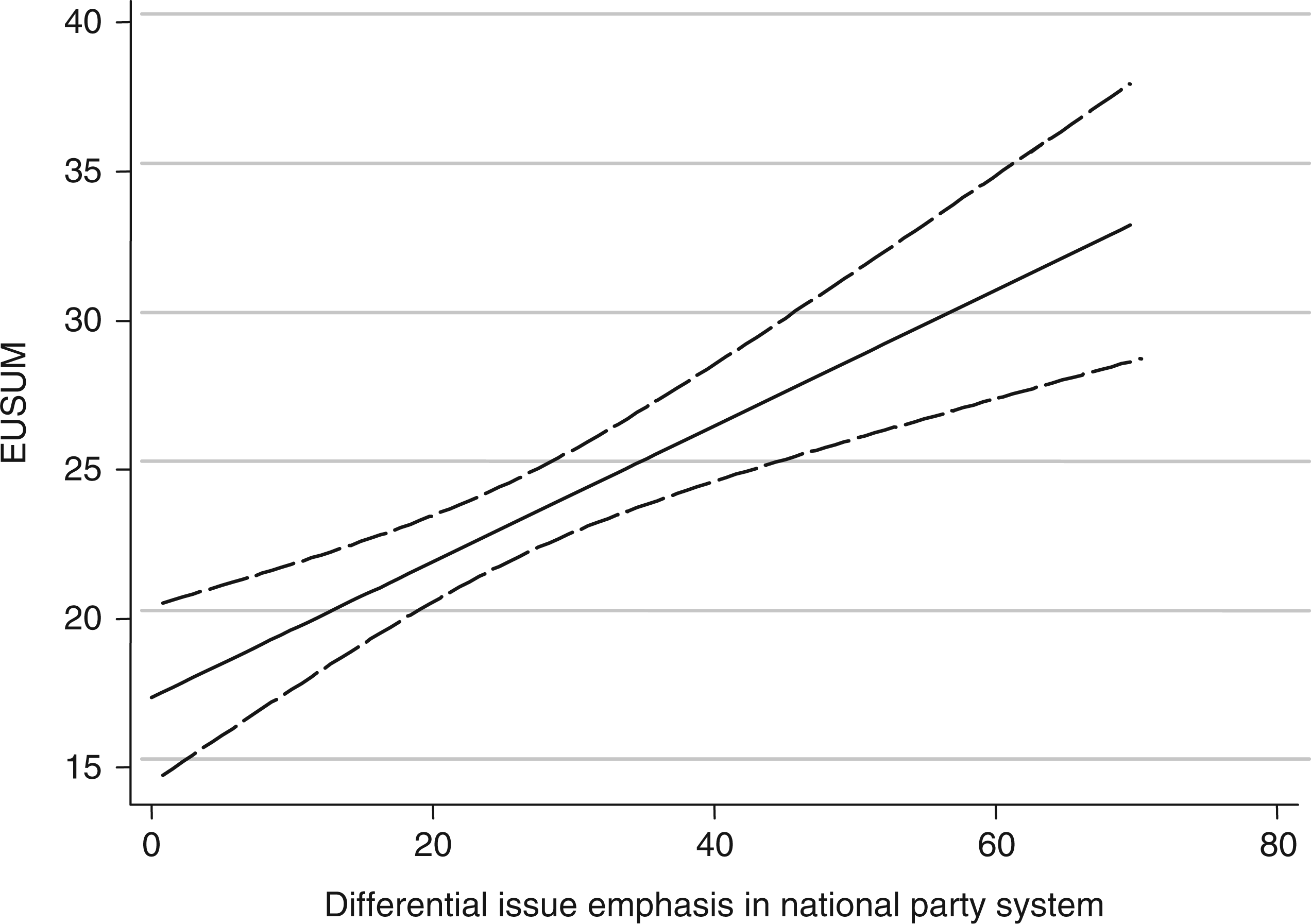

My second hypothesis – that there is a curvilinear relationship between intra-party dissent and the focus that a party gives to EU issues – is also confirmed. In Model 1, the coefficient for intra-party dissent is negative, whereas the coefficient for the squared term is positive. These results show that, at low levels of dissent, parties will devote a lower percentage of their manifesto to European issues. However, as dissent increases, so does the politicization over European issues, which increases the salience of European issues in the parties’ manifestos. Figure 2 presents this relationship graphically. From the plot, we see that the relationship between intra-party dissent and EU salience is much stronger at lower levels of dissent. Although there is an increase in the focus on EU issues when dissent is over 3 (significant dissent within the party), the confidence interval also widens. In Model 3, there is a similar relationship between high levels of intra-party dissent and EUSUM. Overall, these results offer further evidence that, the more politicized an issue, the more salient it will be for the party and the more the party will focus on it in its manifesto.
EUSUM and intra-party dissent.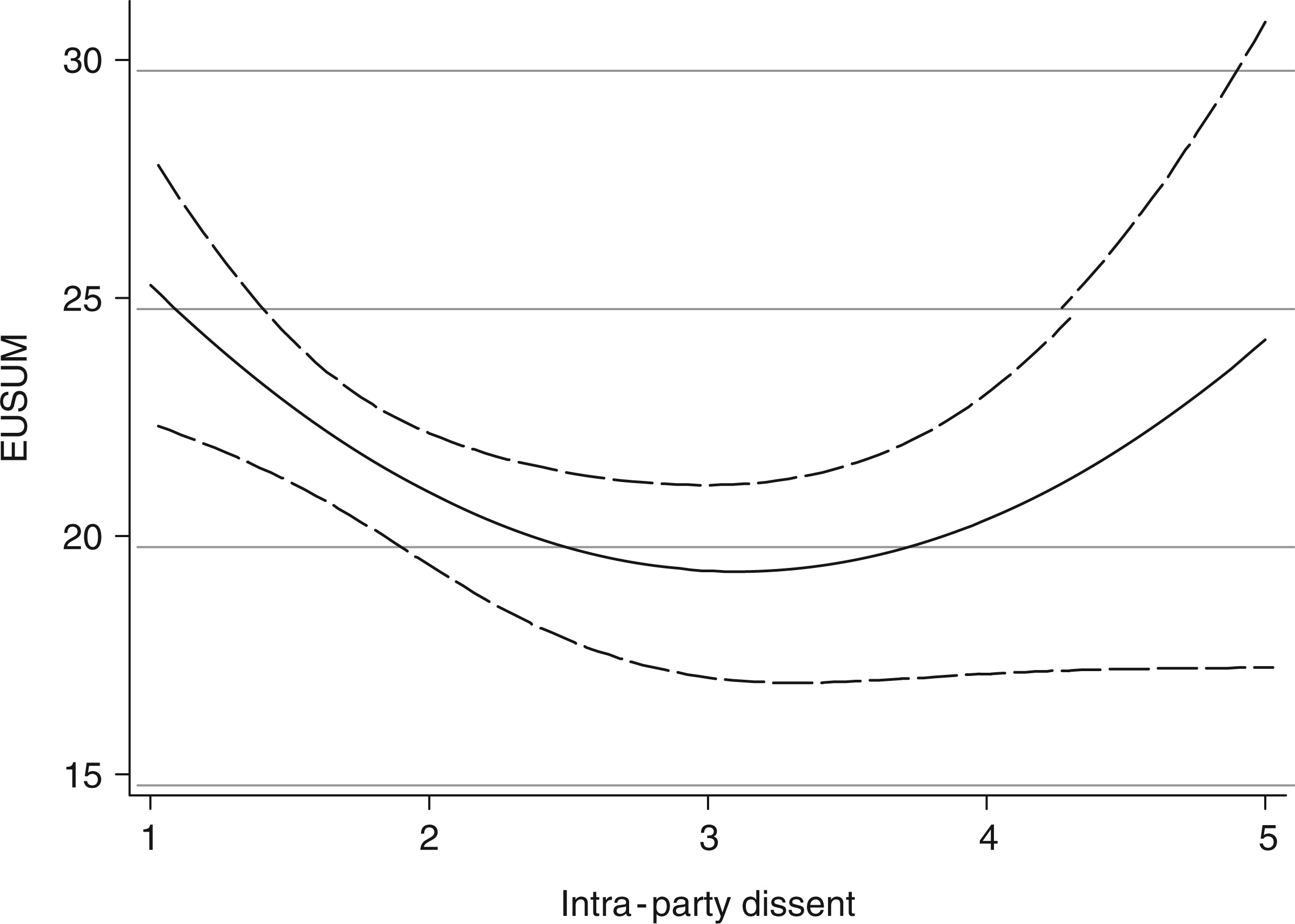
Conversely, H3 – that polarization on the issue of Europe among the electorate will also increase the saliency of the issue to the parties – did not hold. 10 Unlike the expected relationship – that electorate ambivalence would decrease saliency – the coefficient on this variable is positive and significant in all models. Thus, as ambivalence on EU membership among the electorate increases, so does a party’s focus on EU issues in its manifesto. This finding is the opposite of the polarization argument. It can be interpreted in two ways. First, it may be evidence of parties not taking their cues from voters, which counters some of the extant findings in the literature about party responsiveness to voters (see, for example, Adams et al., 2004, 2009; Steenbergen et al., 2007). However, other recent research on party responsiveness to citizen preferences has shown that in certain contexts parties are less responsive. Ezrow and Hellwig (2011), for example, demonstrate that, as parties become further integrated into world markets, they become less responsive to the electorate. These findings also concur with Wüst and Schmitt’s (2007) analysis of Euromanifestos from the 1999 EP elections. They find that voters and parties are concerned with different issues. Whereas the issue voters care most about is employment, parties are focused on the EU in their Euromanifestos. Thus, ‘parties and voters talk a great deal past one another, and the political messages of the parties are only in part received on the voters’ side’ (Wüst and Schmitt, 2007: 91). If the voters are not taking cues from the parties, then the parties may also not be taking their cues from the voters when writing their manifestos, as my findings illustrate. As the salience of EU issues has not varied a great deal over time, whereas voter ambivalence has, this is further evidence that parties are not necessarily responding to voters. Should this explain the result, then it may be additional evidence of the democratic deficit of the EU.
A second interpretation of these results yields the opposite conclusion – that parties are taking their cues from voters – and thus that Europe matters to both voters and parties. One could argue that, if a national electorate is truly ambivalent on the issue of EU membership, then perhaps parties would seek to differentiate themselves on the issue of Europe. If this is the case, then I would expect that as more of the electorate is ambivalent towards its country’s EU membership, the focus the parties place on European issues would increase, which is what I find. To test this alternative hypothesis, I examine the relationship between the range of the difference between pro-EU and anti-EU statements for each party in a given party system from the Euromanifestos data and the lagged public opinion variable. Running a simple bivariate regression shows that electorates that have a larger percentage of ambivalent respondents also have divergent party systems (p = .95). Thus, as the percentage of the electorate responding ‘neither’ increased in France from 5.6 percent in 1984 to 24 percent in 1989, for example, the parties’ positions on Europe diverged. In 1989, the range of the parties’ pro- versus anti-statements was 33.15, whereas it increased to 62.32 in 1994. To highlight this increased divergence among parties, we can look at the two largest parties – the Parti Socialiste (Socialist Party) and the center-right Rassemblement pour la République (Rally for the Republic). In 1989, the difference between the parties’ pro- and anti-statements was 5.22; by 1994 it had increased to 16.76. The French example demonstrates that following an increase in ambivalence among the electorate, the parties responded by differentiating their positions. The logic underlying this alternative explanation supports the expectation that parties respond to voters (Adams et al., 2004, 2009; Steenbergen et al., 2007) and that they care about winning, which is demonstrated by parties distinguishing themselves on the European issue.
Importantly, the two explanations of the results assume slightly different interpretations of what a ‘neither’ response means to voters. In the first, I interpret a ‘neither’ response as indifference on the part of the voter. Voters do not necessarily have concern for, or an opinion about, their countries’ membership and thus neither should the parties. In the second, ‘neither’ is more of an undecided or ambivalent position. For example, some voters, when asked about their opinion on EU membership, might think, ‘it depends on the situation’. Thus, parties respond by offering voters clear differences in their manifestos through which voters can distinguish them. It is this interpretation of ‘neither’ that underlies the alternative explanation of the results. However, since it is not possible to know the underlying motivation for voters’ ‘neither’ responses and because it may be a combination of ambivalence and indifference, either explanation is plausible.
In my fourth hypothesis, I argued that, as a niche party’s vote share increases, so should the percentage of its manifesto devoted to European issues. I find confirmation for this hypothesis when considering both all niche parties together (Model 1) and regional parties only (Model 3). These findings demonstrate that it is regional parties that are driving the significance of the niche variable. Research on regional parties’ in the EP (Jensen and Spoon, 2010) has shown that as the EP’s influence expanded, the voting behavior of regional party MEPs began to look more Euroskeptic as their concerns grew about the EU becoming too centralized. Moreover, as the parties’ vote share increased, they focused more on their cautious view of the centralizing tendency of European institutions, the focus of the EU saliency measure, in their manifestos. As the regional parties concentrated their efforts on maximizing their votes, they increased the saliency of European issues in their manifestos, to mirror the larger, mainstream parties. The results of the analysis demonstrate that, when the vote share of regional parties such as the British Plaid Cymru (Party of Wales) or the Spanish Esquerra Republicana de Catalunya (Republican Left of Catalonia) increases from its mean of 3.98 percent to the maximum of 14.9 percent, EUSUM increases by nearly 10 percent, to 33.40 percent. Thus, when the Flemish Vlaams Belang’s (Flemish Interest) national vote share increased from 7.8 percent in 1995 to 11.6 percent in 2003, the percentage of the corresponding Euromanifestos’ EUSUM values increased from 17.5 percent to 31.82 percent. Interestingly, when vote share is 0, the green party variable is negative and significant. This demonstrates that electoral size does not influence the saliency of European issues in green party manifestos.
In sum, these results support the hypothesis that, as niche parties in general, and regional parties in particular, get larger, they focus more on European issues. Overall, these results are further evidence that as niche parties increase in size they become more vote-seeking (Downs, 1957; Strøm, 1990). As regional parties evolve into more viable electoral contenders, their manifestos become more like those of the larger parties in terms of their emphasis on Europe. This finding illustrates how regional parties are becoming more like their larger competitors.
The control variables show mixed results. The lag of the dependent variable has a positive and significant effect on the European content of the manifesto in all models. Conversely, the dummy variable for government party is not significant in any of the models. Thus, being in government does not increase the saliency of European issues for a party.
Models 2 and 4 include fixed effects for European elections. Only EP4 in Model 4 is significant. This suggests that the 1994 election increased the saliency of Europe in a party’s manifesto. This is evidence that, as the EP became a more powerful institution following the entry into force of both the Single European Act and the Maastricht Treaty, the parties responded by focusing more on European issues in their manifestos for the 1994 elections.
Conclusion
In my analysis of what determines the salience of European issues in Euromanifestos, I find mixed results. First, the finding that increased politicization of the European issue at the national level affects a party’s subsequent EP manifesto may be evidence that Europe is becoming a domestic issue. If this is indeed the case, then this demonstrates that European issues may no longer be second order. Just as scholars have found that voters may be thinking more about Europe when they go to the polls (Hix and Marsh, 2007; Hobolt et al., 2009), so do parties when they craft their Euromanifestos. Second, similar to Steenbergen and Scott (2004) and Netjes and Binnema (2007), I find that at lower levels of intra-party dissent, the salience of European issues decreases, but as dissent increases, there is a slight increase in the focus on European issues. Third, depending on the interpretation of ‘neither’ by EES respondents, we may also find a relationship between non-politicization among the electorate and how the parties then politicize the issue. By politicizing European issues, parties are providing voters with information to differentiate among them on election day. Through this, they are showing that their emphasis on the issue differs and thus that the issue of Europe matters to them. Fourth, the result that regional parties’ emphasis on Europe increases with their size demonstrates evidence of a possible convergence of the salience of Europe among parties, regardless of party type. Together, these findings illustrate that parties are strategic in the writing of their Euromanifestos. They use their manifestos to signal their policy preferences to voters and to other parties their policy preferences. By emphasizing some issues (and de-emphasizing others), parties can manipulate the political agenda and the contested issue space.
As one of the first cross-national longitudinal analyses of national parties’ Euromanifestos, these findings demonstrate that, when contesting elections at the European level, parties are responsive to domestic politics. They offer further evidence that national and European politics are interrelated. Domestic politics affect the salience of Europe for parties in their European election manifestos and European issues influence the polarization of the domestic party system. Thus, this analysis has shown that, to understand the dimensions of competition in European elections, one must examine both domestic- and European-level variables. In sum, just as ‘Europe’ matters to European voters when they go to the polls (De Vries et al., 2011; Hix and Marsh, 2007; Hobolt et al., 2009), so too does it matter for parties.
Finally, more research is needed to elucidate some of the unanswered questions in this article. First, further analysis will expand our understanding of how parties prioritize their policies and how this relates to questions of party strategy, representation, and responsiveness to citizen preferences. To explore politicization in the national political system further, it would be useful to examine how the tone of the campaign coverage on Europe-related issues in previous national or European elections affects the content of subsequent Euromanifestos. Following from the extant research (see, for example, Druckman and Parkin, 2005; Hobolt et al., 2009; Norris et al., 1999; Wattenberg and Brians, 1999), I would expect that more overtly positive or negative campaign coverage would politicize the issue and subsequently affect the salience of Europe in parties’ Euromanifestos.
A second avenue for future research would be to delve further into the relationship between citizen preferences and party response. Using a survey question that more directly measures polarization would help to clarify this interaction. In the more recent EES, for example, there are questions that measure the electorate’s polarization on European integration more directly. Thus, we could further examine whether increased polarization among the electorate leads to increased (or decreased) saliency in parties’ manifestos.
Finally, additional research should explore what influences the substantive content of Euromanifestos on the issue of European integration. Do the same factors determine substance – a more or less pro-European manifesto–as salience? It would be a fruitful research agenda to examine how the substantive content of the parties’ national manifestos, voter preferences, and intra-party dissent shape their Euromanifestos.
Footnotes
Acknowledgements
I thank Catherine De Vries, Jane Green, Sara Hobolt, Christian Jensen, Heike Klüver, and the anonymous EUP reviewers for their comments and suggestions. All errors remain my own.
Notes
References
Supplementary Material
Please find the following supplemental material available below.
For Open Access articles published under a Creative Commons License, all supplemental material carries the same license as the article it is associated with.
For non-Open Access articles published, all supplemental material carries a non-exclusive license, and permission requests for re-use of supplemental material or any part of supplemental material shall be sent directly to the copyright owner as specified in the copyright notice associated with the article.
