



Abstract
This article answers the question of which EU-level characteristics of the Open Method of Coordination (OMC) are most likely to result in pressure on national governments to reconsider their policies as a result of OMC-related parliamentary activities and media coverage. On the basis of interviews with European Commission officials and an analysis of parliamentary debates in committee meetings and newspaper coverage on six OMCs in the United Kingdom and the Netherlands in the period 1996–2009, three characteristics are selected and their empirical relevance assessed. The findings indicate that, when an OMC is adopted in a policy field without any other type of EU-level activity already present, or does not include indicators/benchmarks or peer learning activities, the OMC will not increase the pressure on a national government.
Keywords
Introduction
Scholarly attention to the Open Method of Coordination (OMC) has fluctuated considerably in the last 10 years, with peaks in the first years of the new millennium, a subsequent phase of OMC fatigue, and a slight re-emergence of attention after more than a decade of experience. With the passing of time, possibilities opened up for analysing longitudinal data with quantitative research techniques. This article makes use of these possibilities to answer the question of which EU-level characteristics of OMCs are most likely to result in pressure on national governments to reconsider their policies caused by OMC-related parliamentary activities and media coverage. From this research question it is obvious that this study does not adopt the classical administrative perspective on OMCs. Many studies have focused on how country-specific information from OMC reports on employment and how social inclusion policies are used by public officials of national ministries for agenda-setting and policy formulation at the domestic level (see, for overviews of this literature, Heidenreich and Zeitlin, 2009; Kröger, 2009). In contrast, I am interested in topics that have received far less attention from scholars, that is, OMC-related parliamentary activities and media coverage consisting of, respectively, the use of information from OMCs by members of parliament (MPs) from opposition parties to criticize the policies of the incumbent government, and journalists using information from OMCs to report on the underperformance of national policies.
With the interest in OMC-related parliamentary activities and media coverage I aim to contribute to discussions on the democratic legitimacy of New Modes of Governance (NMGs), of which the OMC is a prominent example. In these discussions, three features central to democratic accountability in multi-level governance settings are identified: (i) control by elected, party-based, democratically accountable representatives over governing functions, (ii) a functional mode of representation of stakeholders in the decision-making process, and (iii) the media-based critical public debate of the operation and outcomes of the NMGs (Héritier and Lehmkuhl, 2011). Borrás and Ejrnæs (2011) addressed the second element of democratic accountability in the context of OMCs with a mix of qualitative and quantitative research techniques. This article aims to shed light on the first and third features.
In the next section I describe the origin and functioning of OMCs and review the literature on parliamentary involvement and media coverage with regard to EU affairs. Subsequently, three EU-level characteristics of OMCs, which are most likely to result in parliamentary activity and media coverage, are identified on the basis of semi-structured interviews with Commission officials. The empirical relevance of these characteristics is assessed through a quantitative study of parliamentary debates in committee meetings and newspaper coverage on six OMCs in the United Kingdom (UK) and the Netherlands in the period 1996/1999–2009. This analysis sheds light on which EU-level characteristics of an OMC result in pressure on national governments to reconsider their national policies. The empirical findings indicate that MPs use information from OMCs only when these OMCs include indicators/benchmarks and peer learning activities at the EU level and are adopted in policy fields in which previous EU-level activity took place in the form of directives, regulations or Community programmes. The operation and outcomes of the OMC were not subject to a critical debate in the media. The concluding section discusses the findings in light of the democratic accountability of NMGs.
The Open Method of Coordination: Parliamentary involvement and media coverage
The heads of state and government of the EU member states codified the OMC by including four elements in the presidency conclusions of the Lisbon Council, together forming the institutional infrastructure of an OMC (Council of the European Union, 2000).
1
This infrastructure consists of:
fixing guidelines for the Union combined with specific timetables; establishing quantitative and qualitative indicators and benchmarks as a means of comparing best practices; translating these European guidelines into national and regional policies by setting specific targets and adopting measures; periodic monitoring and peer review organized as mutual learning processes (Council of the European Union, 2000).
In subsequent years these four elements came to function as a template for implementing the OMCs on education, R&D, e-Europe/i2010 (Internet), social inclusion, and pensions. National governments play the central role in all OMCs. They approve by qualified majority in the Council the guidelines or objectives, indicators and benchmarks on which the different national policies are scored, and they formulate National Action Plans (NAPs) in which it is specified how they plan to improve their policies. The respective European Commission Directorates-General (DGs) and experts of national ministries identify the factors that cause a national policy to perform best and review the NAPs and policies of the member states in peer learning groups. The Commission and the Council draw up joint reports in which a summary is given of the progress made in each member state towards the objectives. Scholars have shown that, although OMCs are non-binding for member states, public officials in national ministries use information from OMC reports to adjust their policies in line with the OMC recommendations or to legitimize the continuation of a policy when it is labelled a ‘best practice’ (Buchs, 2008; López-Santana, 2006; Tsakatika, 2007: 550).
To ensure the input legitimacy of OMCs, openness was made one of the defining elements of OMCs, resulting in a promise to involve stakeholders and national parliaments (Smismans, 2008). Without the use by MPs of information from OMCs to assess the performance of national policies, there are no actors that can formally hold the executive accountable at the domestic level for the underperformance of national policies in OMCs (De Ruiter, 2010). When this is accompanied by little media coverage, it is unlikely that a national government is held publicly accountable at all (Héritier and Lehmkuhl, 2011; Weale, 2011). In this context it is claimed that the OMC leads only to ‘peer accountability’, with public officials of national ministries meeting up in Brussels to exchange best practices, at the expense of ‘accountability at home’ through the electoral circuit of representative democracy (Papadopoulos, 2010) and media coverage.
Whether this shift towards ‘peer accountability’ takes place in practice is an empirical question that has remained largely unaddressed by scholars. The literature on media coverage of EU affairs has shown that news reporting peaks around elections for the EP, the installation of a new Commission, Council summits, referendums on the EU and the signing of EU treaties, but there are also long periods of little news (Boomgaarden et al., 2010; Semetko et al., 2000; Trenz, 2004; Van Noije, 2010). Other scholars have shown how national parliaments have lost out owing to the transfer of policy-making competences to the EU level and have reported on the development of EU scrutiny instruments (Auel and Benz, 2005; Raunio, 2009).
Until now, only Meyer (2005: 141) has looked specifically at media reporting on NMGs and found lower coverage for the OMC in employment compared with EU fiscal policy coordination. This finding led Meyer to propose a reduction of objectives for the OMC in employment in order to trigger media attention. In 2005 this focused approach was introduced for the OMCs on employment, social inclusion and pensions with the national reform programmes. Scholars have not yet assessed to what extent this reform has had an effect on media coverage of the OMC in employment (Tholoniat, 2010: 109). Moreover, it is unclear whether other OMCs in the period 1999–2009 are more extensively covered in the media than the OMC in employment. There are indications that in other OMCs different media dynamics occur. Owing to poor results by German pupils in the OECD PISA-study – data that is also used for benchmarking in the OMC in education – a debate started in the German media on reform of the educational system (Livingston, 2003: 596). As a result, new concepts concerning teaching capacities, organization of schools and the content of the syllabus gained prominence on the agenda of the German Ministry of Education (Martens and Balzer, 2004).
Scholars have also paid attention to the (lack of) involvement of MPs in OMCs. It is claimed that MPs are not interested in following OMCs because they judge their impact on the national policy-making process to be marginal (Duina and Raunio, 2007: 298–299). Secondly, unlike normal EU legislation, the OMC does not have a clear beginning or end, or rules guiding the behaviour of actors. This makes the OMC hard to follow for MPs when they are not yet used to the method (Raunio, 2006). Thirdly, because representatives of national governments are involved in drawing up NAPs and joint reports of the Commission and Council, information on the performance of policies in the OMC policy comparisons becomes concentrated in the executive branch, outside the control of the legislature and media (Benz, 2007; Raunio, 2006; Tsakatika, 2007).
In sum, scholars have assessed the involvement of MPs and journalists in OMCs rather negatively, leading some to define it as ‘a principle’ that decision-making under NMGs escapes democratic control (Weale, 2011), without full disclosure at the national level of the information on the performance of national policies from OMC reports (Benz, 2007; Tholoniat, 2010). However, such claims are often based on theoretical accounts of NMGs or on data on one or two OMCs for restricted time periods (for example, De Ruiter, 2010; Meyer, 2005). At the same time, there is some evidence that the use of information from OMCs by journalists is not the same for all policy fields and may have changed during the last decade. Hence, there is a need for an empirical comparative study of a wider range of OMCs over a longer time period in order to assess the use by MPs and journalists of this type of NMG and the resulting pressure created on national governments to reconsider their policies.
A disclosure effect of OMCs
I selected two dependent variables to measure the degree of pressure on national governments to reconsider changing their policies in line with the recommendations and best practices included in OMC reports. The first dependent variable is the use of country-specific information from OMCs by MPs of opposition parties to criticize the performance of policies of the incumbent government in parliamentary debates.
2
The second dependent variable is the media coverage by newspaper journalists on the country-specific information on the performance of national policies from OMCs. The reason for studying the pressure resulting from OMC-related parliamentary activities and media coverage on national governments to reconsider their policies instead of the policy impact of these activities and coverage is that the policy impact of OMCs is hard to measure owing to the problem of isolating the influence of third variables. Scholars researching the link between policy change and the country-specific information published in the context of OMCs often identify a correlation between these variables because policymakers act in line with OMC recommendations and best practices. However, it is unclear to what extent they act because of this OMC output (Kröger, 2009). This problem of determining causality is circumvented in this study by focusing on the OMC influence that can be grasped (Hartlapp, 2009), that is, the pressure on national governments to reconsider their policies at the domestic level caused by OMC-related parliamentary activities and media coverage. I assume that, when country-specific information from OMCs on the bad performance of national policies gains presence in parliament and media reports, the pressure on a national government to respond to the identified underperformance increases (see Figure 1).
OMC-related parliamentary activities, media coverage and pressure on national governments to reconsider policies.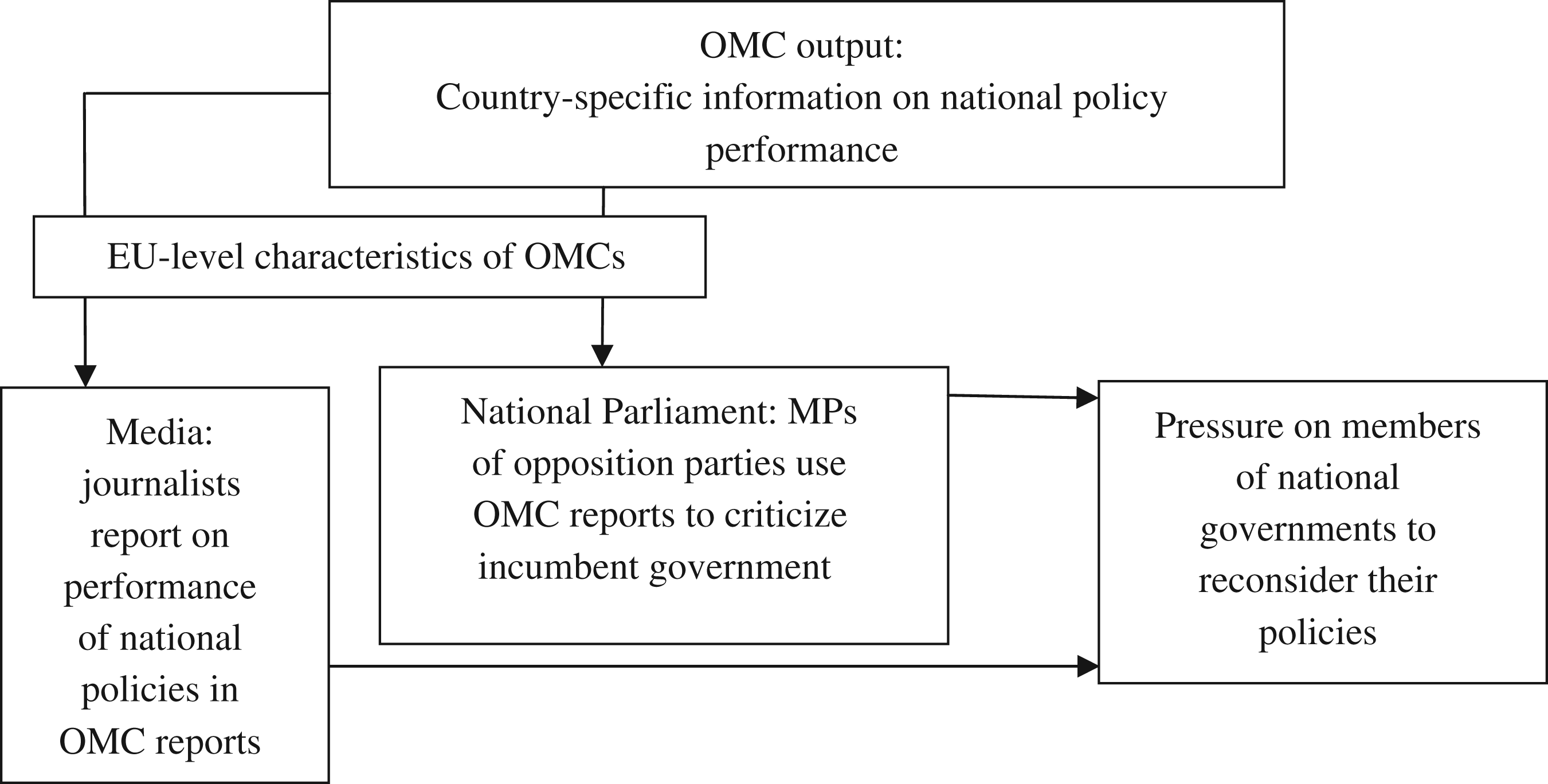
I am interested in the question of which EU-level characteristics of OMCs are most likely to result in pressure on national governments to reconsider their policies as a result of OMC-related parliamentary activities and media coverage. Three characteristics of OMCs were identified on the basis of semi-structured interviews with Commission officials on the development and functioning of OMCs at the EU leve1. 3 Subsequently, I assessed the empirical relevance of these characteristics through a quantitative study of parliamentary debates and newspaper coverage on six OMCs in the UK and the Netherlands in the period 1996/1999–2009.
The first characteristic identified on the basis of the interview data is related to the infrastructure of OMCs. Heads of state and government of the EU member states included in the presidency conclusions of the Lisbon Council four elements that together form an infrastructural template for OMCs. The presence of the elements from this template in a policy field enables the exchange of information on best and worst policy practices between EU member states. First, guidelines or objectives are needed to determine on which topics information needs to be exchanged with regard to best and worst national policy practices. Secondly, indicators and benchmarks measure the performance of national policies related to the topics made explicit in the guidelines or objectives. Thirdly, national governments report in NAPs which of their current and future national policies are related to the guidelines or objectives, indicators and benchmarks. The Commission and the Council publish joint reports in which the performance of national policies related to the guidelines or objectives is summarized. Fourthly, meetings of peer learning working groups are organized at the EU level – between public officials from national ministries, the European Commission and experts – to exchange information on best and worst policy practices. These constitutive elements of the OMC took a couple of years to develop in most OMCs (Interviews III, IV, VI; Tholoniat, 2010).
The presence in OMCs of these four elements allows MPs and journalists at the domestic level to acquire information from OMCs on the relative performance of national policies (Interviews I, II, V; Benz, 2007: 518; Duina and Oliver, 2005: 498). However, not all of the four elements are expected to create opportunities to the same degree for MPs and journalists to obtain information from OMCs on the performance of national policies. The joint reports published by the Commission and the Council are likely to be most valuable for MPs and journalists because they provide an overview of the information, which can be used to criticize the performance of policies of the incumbent government.
The second EU-level characteristic of OMCs is related to the EU-level activity in a policy field before an OMC was adopted. Several OMCs are adopted in policy fields in which there was already activity at the EU level before the launch of the OMC. Examples of such previous EU-level activity are the Framework Programmes in the R&D field, the Erasmus programme in education, provisions with regard to working conditions in employment policy-making, and the liberalization of the European telecommunication sector in the e-Europe domain (Interviews I, II, III, V, VI). I expect that when an OMC is adopted in a policy field in which there was already another kind of EU-level activity – in the form of Community programmes or regulations/directives – MPs and journalists make more use of information from this OMC than from an OMC adopted in a policy field without previous EU-level activity. The causal mechanism underlying this expectation is related to standard operating procedures adopted by MPs and journalists in order to decide which EU-level activities they should focus their attention on with limited time available. An example of a standard operating procedure is to focus on new EU-level developments – such as OMCs – only when those are occurring in policy fields with which MPs and journalists already have experience in an EU context. Within such policy fields, MPs and journalists can save time by building on their existing knowledge and experience with regard to EU affairs, when compared with policy fields in which no previous EU-level activity existed and, hence, which were never scrutinized by MPs or reported on by journalists with reference to an EU context. In short, it can be expected that when EU-level activities exist in a policy field prior to the adoption of an OMC, this is likely to have an increasing effect on the subsequent use of information from OMCs in parliamentary shaming strategies and reporting by journalists.
A third EU-level characteristic identified on the basis of semi-structured interviews with Commission officials involved in the development and functioning of OMCs is related to the presence of a treaty base for OMCs. Of the OMCs selected in this article, only the OMC in employment is explicitly referred to in the treaty. All the other OMCs are very loosely based on the non-binding presidency conclusions of the Lisbon Council of 2000. This difference between OMCs in the form and degree of codification is expected to have an impact on the attention paid to OMCs in the media and parliaments. The reasoning underlying this expectation is based, first, on interviews with Commission officials, who suggested that an OMC with an explicit reference in one of the EU treaties receives more attention from actors at the national level than OMCs that are not mentioned in the treaties (Interviews I, IV, V). Secondly, scholars have shown that the treaties are often a point of reference for politicians and journalists at the national level to find out what the allocation of tasks is between the EU and member states (Boomgaarden et al., 2010; De Vries, 2009; Van Noije, 2010). On the basis of these two points I expect that the increased attention to EU treaties results in more attention for OMCs with a treaty base, and more use of information from an OMC with a treaty base by MPs and journalists than from OMCs without a treaty base.
Data collection and analysis
The OMCs studied in this article are explicitly labelled as OMCs by the European Commission and the Council. The OMCs in the following policy fields were selected in this article: employment, social inclusion, pensions, education, R&D and e-Europe. The period under study for the OMC in employment runs from 1996 to 2009. The other five OMCs are studied from 1999 to 2009 because of the later starting date of these OMCs. The end date of December 2009 is chosen because of the EU2020 strategy launched at the beginning of 2010, which led to a considerable restructuring of OMCs.
To assess the empirical relevance of the three EU-level characteristics of OMCs, the Netherlands and the UK are chosen as country studies because they differ from each other on three aspects relevant for this analysis. First, the UK is a majoritarian democracy with a liberal media system, whereas the Netherlands is a consensus democracy with a democratic corporatist media system (Hallin and Mancini, 2000). Secondly, the Netherlands and the UK differ with regard to the type of EU correspondents active in Brussels. British journalists in Brussels are of the investigative kind, with a critical attitude towards the EU (Van Noije, 2010: 261). Dutch EU correspondents are closer to the institutionalist type, characterized by a more positive stance vis-à-vis the EU (Van Noije, 2010: 261). Thirdly, the Dutch parliament is seen in the literature as having more extensive scrutiny rights with regard to EU affairs than its British counterpart (Raunio, 2005).
I measured the use of information from OMCs by MPs of opposition parties through coding official parliamentary documents. 4 These documents were selected, in a first step, through the use of search strings (see, for similar approaches, Riffe et al., 2005; Roggeband and Vliegenthart, 2007). The search strings consisted of references to the European Union (and equivalent words such as Brussels and Europe – see note 3), the policy field in which the OMC is adopted and the constitutive elements of OMCs. This encompassing method of data collection reduces the risk of omitting parliamentary documents in which a reference is made to OMCs, but it does run the risk of resulting in a comparison of parliamentary documents that differ from each other with regard to the role played in the decision-making process. For example, opinions presented at early stages of the decision-making process in committee meetings do not have the same impact as plenary debates. In order to neutralize this risk, I categorized the data in a second step of the data collection as ‘plenary debates’, ‘written questions and answers’ and ‘interventions in committee meetings’. The bulk of the data consisted of interventions by MPs in committee meetings, with very few hits for the ‘plenary debates’ and ‘written questions and answers’ categories. Because MPs in practice did not use information from OMCs in venues other than parliamentary committee meetings, I decided not to analyse further the few data obtained on plenary debates and written questions. This resulted in comparable data – that is, only parliamentary documents on committee meetings were coded – on all substantial parliamentary activities related to OMCs.
Summary statistics on the first dependent variable: Number of documents on parliamentary Committee meetings in which shaming takes place, per six months
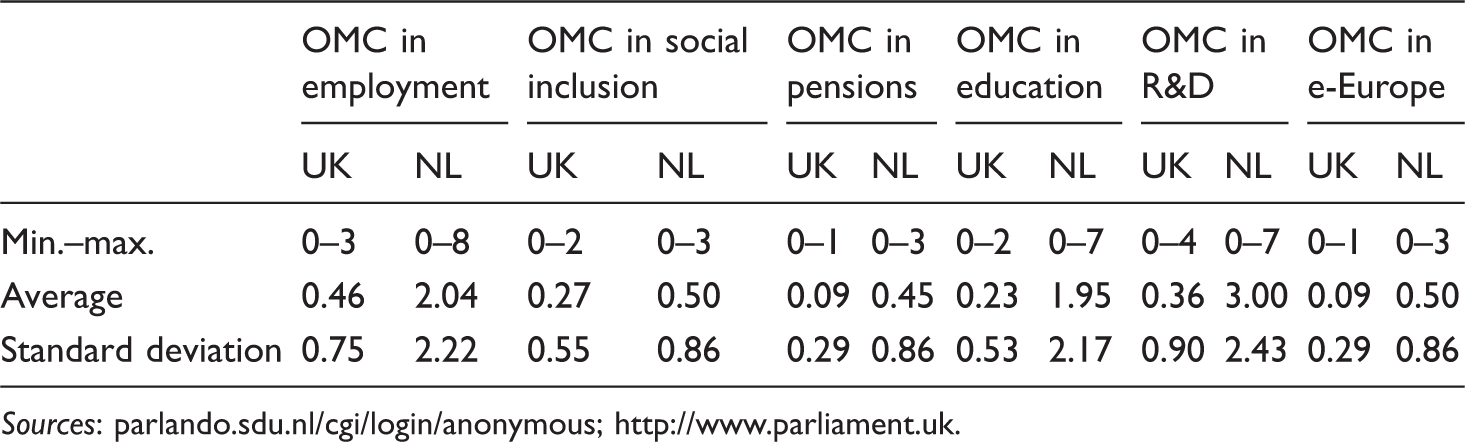
Sources: parlando.sdu.nl/cgi/login/anonymous; http://www.parliament.uk.
The media coverage of OMCs is measured with an in-depth content analysis of national newspapers included in the Lexis-Nexis database. For the Netherlands this resulted in a study of articles occurring in the following newspapers: Algemeen Dagblad, NRC Handelsblad, de Volkskrant, Trouw, Het Parool. For the UK the following newspapers were studied: The Independent, The Times/Sunday Times, the Guardian, the Sun, the Daily Mirror/Sunday Mirror. I collected the articles with the same search strings as used for collecting the parliamentary data, that is, a reference to a policy field in which an OMC is adopted and the European Union. Subsequently, the newspaper articles collected were sifted for relevance, studied in detail and coded. Because of the limited and uniform coverage of OMCs within the newspaper articles, the media coverage was coded by article and not by text fragment. In Web Appendix V an overview is provided of the aggregate coding results. See the results section for an explanation of the coding results for the newspaper coverage of OMCs.
Through the study of Commission documents insights are obtained on the differences between OMCs with regard to the three EU-level characteristics during the time period 1996–2009 (see note 3). The development of the infrastructure of OMCs is measured by dummy variables, with a value of 1 per half year from the moment an OMC infrastructural element is present at the EU level (Hypotheses 1a/1b). This resulted in four dummy variables measuring the presence or absence at the EU level of (i) guidelines/objectives; (ii) indicators/benchmarks; (iii) reporting through National Action Plans/joint reports; (iv) and peer learning activities. Since I hypothesized that the joint reports in particular are relevant for MPs and journalists, a separate dummy variable is constructed measuring the publication of a new joint report in an OMC (1) or no publication (0). The first time a joint report is published is measured not by this ‘renewal’ variable but by one of the four dummy variables related to the infrastructural development of OMCs.
Dummy variables are created to measure the presence (1) or absence (0) of a treaty base for an OMC (Hypotheses 3a/3b), and previous EU level activity on a policy field (hypotheses 2a/2b). Web Appendix VI gives an overview of the six OMCs and the extent to which they possess the three EU-level characteristics.
A range of control variables are constructed in order to determine to what extent the three EU-level characteristics of OMCs matter for the pressure created on national governments through the use of information from OMCs by MPs and journalists (see note 3). First, the political orientation of the minister responsible for the policy field in which an OMC is adopted – 0 = left (NL: PVDA; UK: Labour); 1 = centre (NL: CDA, D’66; UK: Liberal Democrats); 2 = right (NL: VVD; UK: Conservatives) – is included as a variable in the analysis. This variable controls for the possibility that a minister of an ‘issue-owning’ political party is in office. It can be expected that a right-wing opposition party is generally more critical towards a (centre) left-wing minister responsible for social policies – a so-called issue owner – than a (centre) right-wing minister responsible for social policies. Because such a dynamic is not related to the three EU-level characteristics of OMCs, this party political factor needs to be controlled for. A second control variable measures change of government in a six-month period (0 = no change; 1 = change). 6 When changes in government take place, it is likely that the use of information from OMCs by MPs and journalists is affected, possibly leading to a decrease in OMC-related parliamentary documents or newspaper articles. Hence, it is necessary to control for the influence of changes in government after elections or government crises in order to assess what the influence is of the EU-level characteristics of OMCs. Thirdly, other period effects are controlled for by including the total number of parliamentary documents 7 and newspaper articles related to policy fields in which an OMC is adopted. This variable controls for fluctuations in newspaper articles and parliamentary documents that cannot be attributed to the use of OMCs, but are related to a change in the general attention to a policy field. Fourthly, the dependent variable with a time-lag of half a year controls for the influence of the past series. Fifthly, it can be expected that MPs and journalists are likely to be more interested in following the performance of national policies in OMCs that touch upon the main concerns of citizens at the domestic level. Eurobarometer data (59–67) on the most important issues in the eyes of the public are used to measure this saliency of policy fields. Issues that are mentioned by Dutch and British respondents as important are assigned a 1 (that is, employment, social policies, education), other issues a 0. Sixthly, a country dummy is included in the analysis in order to control for fluctuations in shaming and media coverage owing to country effects (the Netherlands = 1; the UK = 2). Finally, it is claimed in the literature that information on the functioning of OMCs becomes concentrated in the executive branch because of the involvement of government representatives in drawing up NAPs and joint reports and their participation in peer learning groups at the EU level. When MPs do get information on how OMCs function – either through parliamentary hearings/questions or through information provision by the government – this has an increasing effect on the shaming of government policies by MPs from opposition parties (De Ruiter, 2010). To control for this effect, I include in the analysis a variable measuring the number of documents explaining the functioning of OMCs in parliamentary committee meetings.
The results were used to construct a dataset with the OMCs as the units and time periods of six months. The choice of time intervals of six months ensures that the presence of each infrastructural element can be coded separately, that is, there are no six-month periods in which two infrastructural elements in an OMC were developed at the same time. Moreover, the division of the year into two six-month periods takes into account the rhythm of the parliamentary year – before and after the summer break – and the times when OMC reports are published, that is, in March and November.
OMC-related parliamentary activities
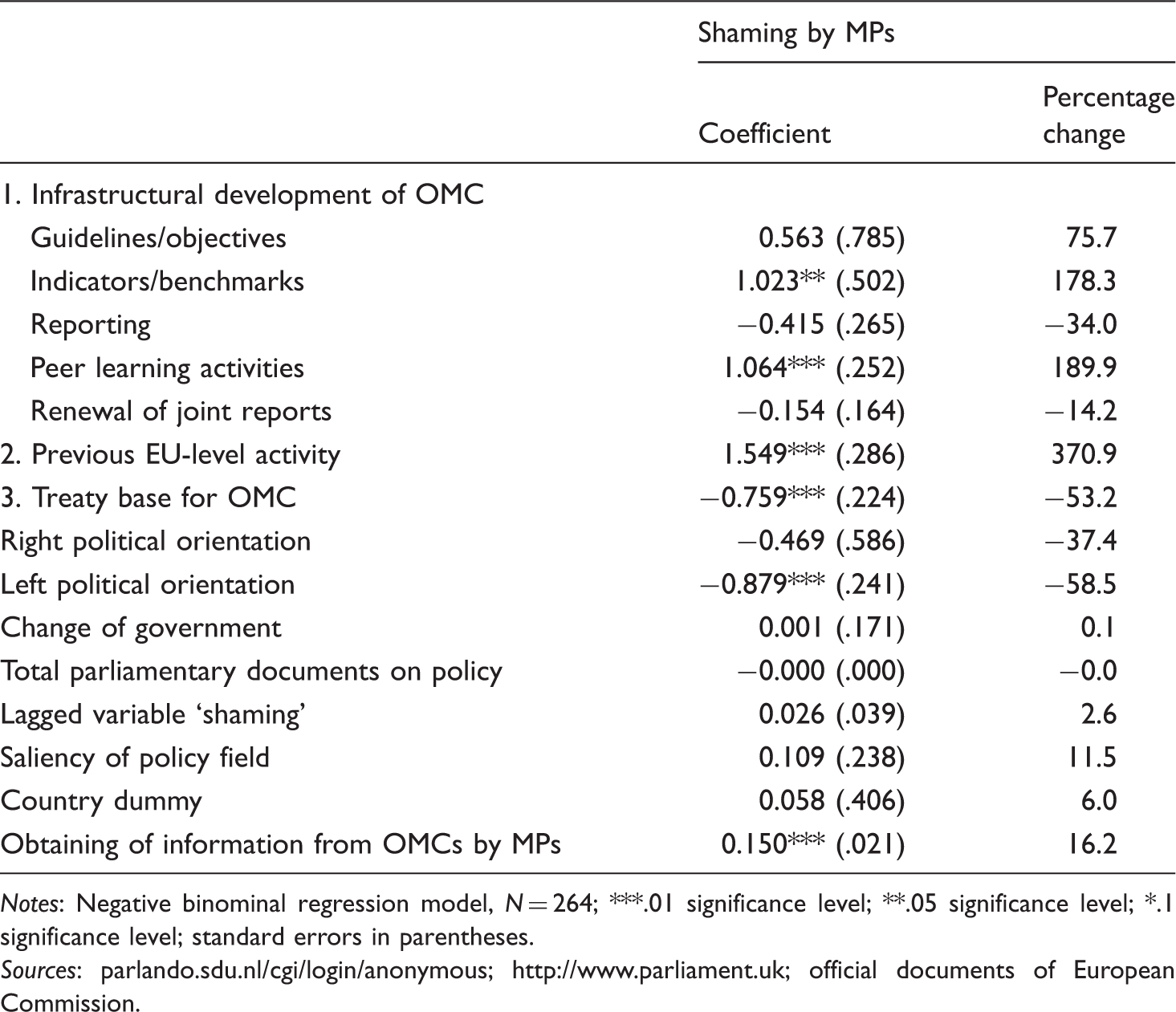
Notes: Negative binominal regression model, N = 264; ***.01 significance level; **.05 significance level; *.1 significance level; standard errors in parentheses.
Sources: parlando.sdu.nl/cgi/login/anonymous; http://www.parliament.uk; official documents of European Commission.
Results
Shaming by MPs in parliamentary committee meetings
The publicly available OMC reports contain abundant information on the performance of Dutch and British policies (see Web Appendix VII for more information). Hence, it can be assessed whether the three EU-level characteristics of OMCs influence the extent to which this information is used in committee meetings by MPs of opposition parties to shame the incumbent government.
The regression analyses indicate that (parts of) the three EU-level characteristics of OMCs reach significance, although not all in the expected direction (see Table 2). First, the presence of peer learning activities in an OMC has a positive effect on the use of information from OMCs by MPs (see Hypothesis 1a). From the moment peer learning activities become part of the infrastructure of an OMC, MPs of opposition parties on average make around 190 percent more shaming statements every half-year in committee meetings. Other elements from the OMC template that reach significance are the introduction of indicators and benchmarks. From the moment indicators/benchmarks are introduced in an OMC, MPs of opposition parties on average make around 178 percent more shaming statements every half-year in committee meetings.
Secondly, MPs of opposition parties use less information from OMCs with a treaty base than from OMCs without a treaty base. This goes against Hypothesis 3a, which stated that MPs of opposition parties are likely to use more information from OMCs on the performance of national policies to criticize the incumbent government in parliamentary debates when OMCs have an EU treaty base. The empirical findings indicate, however, that MPs make on average about 53 percent fewer shaming statements every half-year in committee meetings with the use of information from an OMC with a treaty base (that is, the OMC in employment) compared with OMCs without a treaty base.
This unexpected result warrants an explanation. Clearly, the presence in OMCs of a treaty base is not a sufficient condition for the use of information from OMCs by MPs. A possible additional condition could be that the topic on which the OMC touches needs to be on the political agenda. Scholars have shown that focusing events can lead to punctuated equilibriums, resulting in a situation in which MPs ascribe a higher importance to an issue on the political agenda than before the focusing events (Baumgartner and Jones, 1993; Jäger et al., 2009; Kingdon, 1995). On this basis it can be expected, in the context of my analysis, that without a peak in the policy attention cycle of MPs in a policy field, the treaty base of a related OMC is structurally ignored. This could be an explanation for the negative significant coefficient in Table 2.
Thirdly, the EU-level activity in a policy field prior to the adoption of an OMC has a positive effect on the number of documents in which MPs shame the incumbent government in parliamentary committee meetings. The estimated regression models indicate that MPs of opposition parties make on average around 371 percent more shaming statements every half-year in committee meetings with the use of information from OMCs adopted in policy fields in which there was already policy activity at the EU level, compared with other OMCs (see Hypothesis 2a). The OMCs in R&D, education, employment and e-Europe have been adopted in the policy fields of previous EU-level activities (see Web Appendix VI). A closer look at the data shows that MPs of opposition parties used the most information from the OMCs in R&D, education and employment. Dutch governments were criticized by MPs from (centre) left-wing opposition parties (PvdA, SP, Groen Links), with the use of information from the OMC in employment on the low labour market participation, inefficient back to work schemes and differences in earning power between men and women. MPs of opposition parties – from left to right – also criticized the Dutch executive with regard to the high number of early school leavers and the lack of students in technical studies. The lower private investments in R&D in the Netherlands vis-à-vis other EU member states were criticized with the help of information from the OMC in R&D. The shaming statements in the case of the UK are highest for the OMC in R&D, touching upon the low investment in innovation.
Newspaper coverage and OMCs
To test Hypotheses 1b, 2b and 3b it is necessary to determine whether EU-level characteristics of OMCs influence the extent to which information from OMCs is used by newspaper journalists to critically reflect on the policy choices made by the incumbent government. However, I did not find newspaper articles in which information from OMC reports was used to criticize the policy choices of the incumbent government. In other words, there was no variation in the dependent variable of the hypotheses on media attention, and, hence, the three independent variables do not have the expected effect. This leads to the rejection of Hypotheses 1b, 2b and 3b.
As already indicated in a previous section of this article, there were several reasons for hypothesizing that journalists do use information from OMC reports to criticize the incumbent government. Clearly, the data collected in the context of this analysis do not support these reasons. First, in contrast to what Meyer predicted in 2005, the reduction in OMC objectives – which took place in 2005 – did not spur media attention to OMCs, contributing to structural lows in the policy attention cycle. Secondly, the use by German newspaper journalists of OECD PISA-data – on which several benchmarks of the OMC in education are based – seems to be the odd one out when compared with the UK and the Netherlands.
Subjects of neutral media coverage (number of articles)
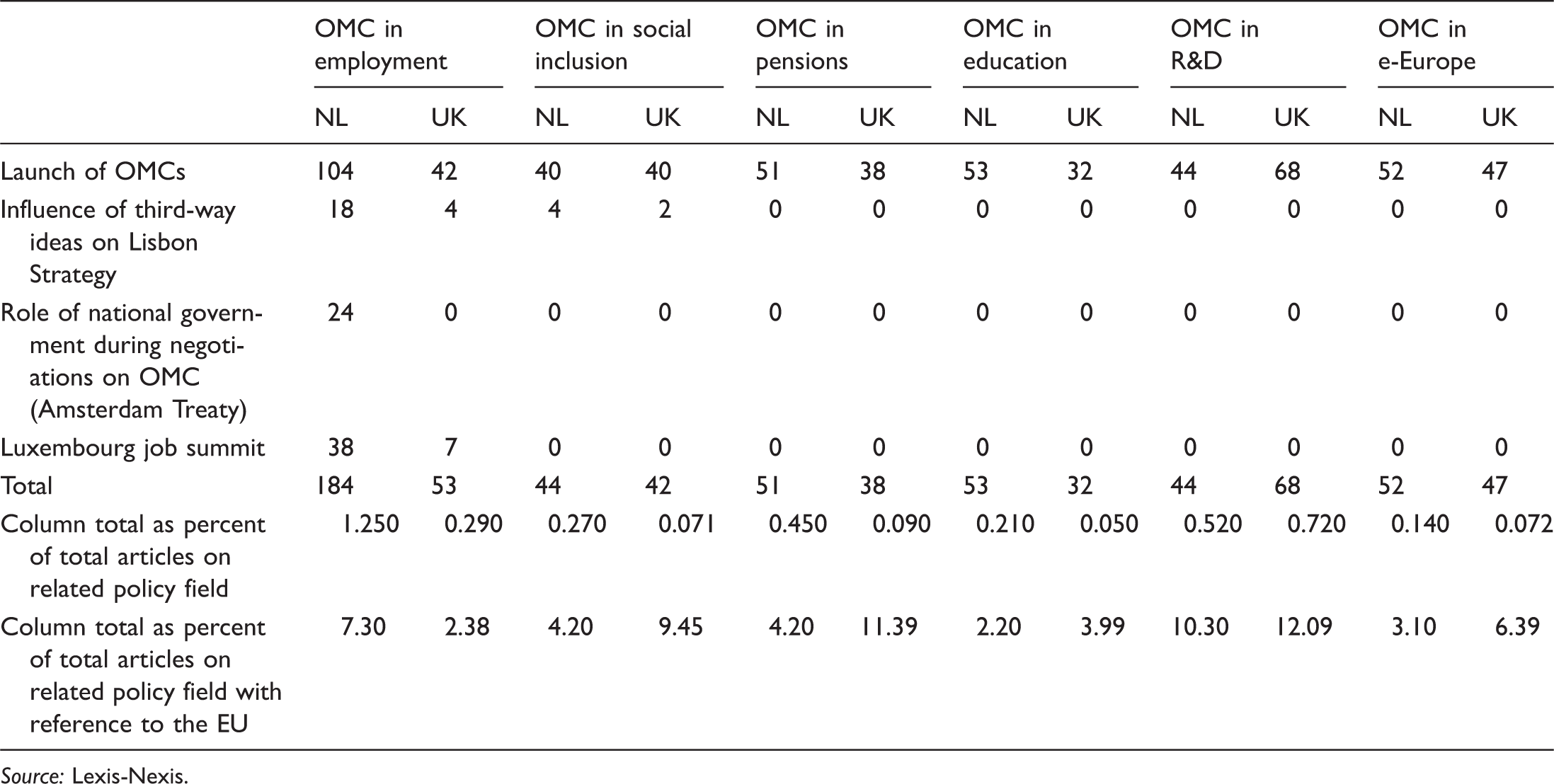
Source: Lexis-Nexis.
Journalists did not follow up on this coverage in subsequent years. After the Treaty Article for the OMC in employment was adopted and implemented and guidelines were introduced in OMCs initiated by the Lisbon Strategy, journalists lost interest in OMCs. In sum, on the basis of the findings for the Netherlands and the UK, it can be hypothesized that the neutral media coverage on OMCs in EU member states has a cyclical nature, with peaks around Council meetings in which OMCs are launched and subsequent periods of little news. During the latter periods, OMCs produced country-specific information on the performance of national policies, which was not used by Dutch and British journalists to reflect critically on the performance of the policies of the incumbent government.
OMC-related parliamentary committee activities, media coverage and pressure on national governments
This article is interested in the question of which EU-level characteristics of OMCs are most likely to result in pressure on national governments to reconsider their national policies as the result of OMC-related parliamentary activities in committee meetings and newspaper coverage. With regard to newspaper coverage, the analysis showed that British and Dutch journalists did not use OMCs as an information source to criticize the policies of the incumbent government. Hence, owing to the lack of newspaper reporting on the content of OMC reports, journalists did not create pressure on national governments to reconsider their national policies.
In contrast, OMC-related parliamentary activities can create pressure on national governments to reconsider their policies. From the regression analyses it follows that the infrastructure of an OMC needs first to reach an advanced level of development – by having indicators/benchmarks and peer learning activities in place at the EU level – before MPs are triggered to use information from OMCs on the performance of national policies (Hypothesis 1a). Moreover, MPs use more information from OMCs to criticize the performance of the policies of the incumbent government when an OMC is adopted in a policy field in which there is already policy activity (Hypothesis 2a). The OMCs that are in line with this characteristic have been adopted within the R&D, education and employment fields.
It is difficult to determine whether the pressure created by MPs is ‘substantial’ or not. On the one hand, the presence of indicators, benchmarks, peer learning and previous EU-level activity each independently increases OMC-related shaming by MPs with only a couple of statements per half-year (see Tables 1 and 2). On the other hand, however, one should note that even one statement in parliament can matter for the outcome of decision-making processes.
Conclusion
By analysing a range of OMCs and adopting a comparative and empirical focus, I have come to a less negative assessment of the involvement of MPs than other scholars in previous studies. Through the detailed analysis of OMC reports it became clear that MPs and journalists can easily obtain information from OMCs that can be used to criticize the incumbent government. Hence, in contrast to what several scholars have claimed (Benz, 2007; Papadopoulos, 2010; Raunio, 2006; Tsakatika, 2007), I have shown that not all information from OMCs remains concentrated in the executive branch but large chunks are publicly available, of a critical nature, and are used by MPs of opposition parties to shame the incumbent government. However, the finding that OMC-related parliamentary activity in the Netherlands and the UK takes place in parliamentary committee meetings and not in plenary debates limits the visibility of the OMC-related shaming by MPs and, hence, its contribution to increasing the democratic accountability of OMCs.
I have also shown that OMCs vary with regard to the pressure on national governments to reconsider their policies as the result of OMC-related parliamentary activities in committee meetings, and newspaper coverage of OMCs does not create such pressure at all. This is only in part good news for the legitimacy of OMCs. In this article, two features central to democratic legitimacy in multi-level governance settings have been discussed: (i) control by elected, party-based, democratically accountable representatives over governing functions, and (ii) the media-based critical public debate over the operation and outcomes of the NMGs. With regard to the first feature, the empirical findings indicate that MPs use information from OMCs only when these OMCs include indicators/benchmarks and peer learning activities at the EU level and are adopted in policy fields in which previous EU-level activity had taken place in the form of directives, regulations or Community programmes. Only in the case of OMCs (adopted in policy fields) with these characteristics, conventional mechanisms of representative democracy are not completely bypassed by OMCs and pressure is created on the government to reassess its policy choices. This finding counters the claim by Papadopoulos (2010) that NMGs increase ‘peer accountability’ at the EU level at the expense of ‘accountability at home’ through the electoral circuit of representative democracy. It also hints at the importance of hybrid modes of EU governance for the democratic legitimacy of multi-level governance systems (Börzel, 2010; Héritier and Lehmkuhl, 2011). My analysis indicates that a governance patchwork in which directives, regulations, programmes and OMCs function in sequence and in parallel to the same policy field is a necessary condition for information from OMC reports to be used by MPs from opposition parties in committee meetings and, as a result, for creating pressure on the incumbent government to reconsider its policies.
With regard to the second feature central to democratic legitimacy in multi-level governance settings discussed in this article, I have shown that the operation and outcomes of the OMC were not subject to a critical debate in the media. In sum, the newspaper coverage of OMCs does not add to the democratic legitimacy of NMGs. Scholars critical of OMCs (for example, Hatzopoulos, 2007) could interpret the findings as resulting from the lack of coercive means in OMCs, leading to a loss of interest by journalists after the OMC infrastructure was set in place at the EU level, and the use of OMC information by MPs in sub-arenas of the parliament (that is, committee meetings) that are less visible to the public at large. However, the finding that MPs of opposition parties do use information from OMCs in parliamentary committee meetings to criticize the incumbent government supports claims by OMC enthusiasts (for example, Duina and Oliver, 2005) that the OMC can contribute to a policy-seeking strategy by opposition parties at the domestic level. Regardless of which of the two groups of scholars one belongs to, my article has made it clear that the OMC is more than just a tool in the hands of public officials in national ministries of EU member states. At the same time, because of the marginal media coverage, the OMC does not provide full disclosure on the performance of national policies vis-à-vis other EU member states.
Footnotes
Notes
References
Supplementary Material
Please find the following supplemental material available below.
For Open Access articles published under a Creative Commons License, all supplemental material carries the same license as the article it is associated with.
For non-Open Access articles published, all supplemental material carries a non-exclusive license, and permission requests for re-use of supplemental material or any part of supplemental material shall be sent directly to the copyright owner as specified in the copyright notice associated with the article.
