



Abstract
Congruence in the European Parliament has been analyzed in terms of agreement between voters and national candidates/parties. The question whether voters and Europarties are congruent on major dimensions of contestation (left-right and European Union) remains unanswered. Acknowledging the ‘split-level’ structure of preference aggregation in the European Parliament, we theorize the interrelationships between these levels. Our model incorporates a typically neglected factor: the interplay between national parties and Europarties. We establish that voter–Europarty congruence is different from, and determined by, voter–national party congruence; moreover, national party–Europarty congruence moderates this relationship. Our findings shed new light on the quality of representation in the European Parliament and have key implications for understanding transnational democracy in the European Union.
Keywords
Introduction
Policy congruence between the represented and their representatives is fundamental to democratic representation (Mansbridge, 2009). The lack of congruence weakens the chances for ex post ‘substantive representation’: if the voters’ and their representatives’ policy positions a priori diverge, it is doubtful that the latter can ‘make’ the former ‘present’ in policy making so the outcomes reflect voters’ wishes (Pitkin, 1967). Normatively, this is critical as policy outputs influence public trust in democratic institutions, while policy congruence between citizens and elites affects satisfaction with democracy more broadly (e.g. Ezrow and Xezonakis, 2011; Grönlund and Setälä, 2011). Given the current public distrust of European Union (EU) institutions (Standard Eurobarometer, 2011), knowledge on congruence between voters and their European Parliament (EP) representatives is necessary.
In this article, we argue and empirically demonstrate that to fully understand citizens’ representation in the EP, we need to pay attention to its ‘split-level’ structure (Lord, 2004; Schmidt, 2006, 2009): policy inputs and outputs occur at different levels of government. According to the Treaty, which makes no reference to national parties, Europarties contribute to citizens’ European awareness and express their political will (Article 10.4 TEU). Despite Europarties' importance for citizen representation and transnational democracy in the EU polity, electoral competition for the European chamber is (still) nationally organized. Hence, national political parties are defacto and Europarties 1 legislating are dejure delegated the task of embodying the ‘channelment’ between citizens and elites in the EU. Yet, is the congruence achieved at the moment of selection preserved when the elected national parties from different member states join forces at the EU level?
To date, policy congruence between voters and Europarties per se has not been systematically analyzed. Previous studies examine either the linkage between voters and national parties (Mattila and Raunio, 2012; McEvoy, 2012) or between voters and the (national) party candidates for EP membership (Thomassen and Schmitt, 1997). This research has greatly enriched our understanding of EU politics by revealing gaps between citizens and elites (e.g. on issues of European unification) and variation in degrees of policy congruence across national parties contesting EP elections. Nonetheless, the bond between voters and national parties/candidates or even Members of the EP (MEPs) can only inform us partly about the linkage between citizens and those legislating on their behalf. This is because national parties can achieve little by acting unilaterally: to affect policy outcomes they need to join forces with similar parties from other countries. After the EP election, the nationally recruited MEPs therefore join Europarties and, when voting on legislation, tend to align with them (e.g. Hix et al., 2009; Mühlböck, 2012). But thus far, empirical accounts of representation and policy congruence in the EP neglect the interaction between national parties and Europarties (McElroy and Benoit, 2007, 2010, 2012); the consequences of varied degrees of policy congruence at different levels of preference aggregation remain uncharted territory.
Seeking to address these lacunae, we analyze the linkage between voters and Europarties, extending the standard accounts of EP representation by acknowledging the hierarchical relationships involved in the representational process at both theoretical and methodological levels. Our analysis, which integrates individual voters, national parties and Europarties in a single research design for the first time, covers the 2009 EP election in 27 member states, and relies on the 2009 European Election Study (EES) (van Egmond et al., 2011), the 2009 EU Profiler (Trechsel, 2009) and the 2010 expert survey on EP Political Groups (McElroy and Benoit, 2012). Based on these datasets we map voters, national parties and Europarties on the left-right (LR) and the pro/anti-EU policy space, construct measures for capturing the interrelationships between them and analyze voter–Europarty congruence by employing the concordant correlation coefficient and multilevel regression techniques.
Our key findings are: firstly, congruence between voters and Europarties does not correspond to congruence between voters and their preferred national parties. Hence, the linkage between voters and national parties is not enough for understanding the quality of EP representation. Secondly, policy congruence (a) between voters and their preferred national parties and (b) between national parties and Europarties jointly determine the alignment between EU voters and their Europarties. EP representation is a multilevel phenomenon: congruence between national parties and Europarties has a conditional and conditioning effect on voter representation at the EU level.
Theorizing policy congruence in a ‘split-level’ parliament
Approaching the representational relationship from a principal–agent perspective, voters are the principals choosing their agents among various candidates. In the selection model of representation 2 (Mansbridge, 2009), the alignment between principals and agents is crucial because it enhances the chance that the agent’s actions will conform to the principal’s policy views. Therefore, this model focuses on the selecting and sorting mechanisms in place to ensure this alignment. To facilitate selection based on policy congruence, agents sort themselves into organizations (parties) promoting specific policy proposals. The organizational label (party name) provides cues to voters about these proposals. If voters ‘correctly’ choose the party that best represents their views on major dimensions of contestation (Rosema and de Vries, 2011), then parties function as ‘the central intermediate and intermediary structure’ enabling ‘channelment’, ‘expression’ and ‘communication’ between society and government (Sartori, 1976: xxi). With these basic concepts in mind, and building on previous EP-focused research, we theorize citizen representation via parties in the EP and derive testable hypotheses to be empirically assessed.
Firstly, EP elections are organized at the national level: every five years citizens of national constituencies go to the polls to select among candidates for EP membership that are sorted in national parties (it is impossible to vote for a party in another EU member state, see Bright et al. 2013). Do citizens support national parties located close to them ideologically when casting a ballot? Of relevance here are the micro-level assumptions of the ‘second-order’ literature about citizens’ electoral behavior and the extent to which their party choice is based on policy congruence (see Marsh and Michaylov, 2010, for a discussion). The basic rationale is that as there is no government formation resulting from EP elections, voters can behave ‘differently’ compared to national elections. For this reason, they can ignore strategic considerations and support parties irrespective of their governing potential without feeling that they are ‘wasting’ their vote. Citizens may thus vote sincerely (‘with the heart’) for ideologically congruent parties. Alternatively, citizens may use the EP ballot as a ‘referendum’ to punish government parties for their policy performance and may even vote ‘with the boot’ for an ideologically distant party (Van der Eijk and Franklin, 1996). Weber (2007) shows, however, that voters’ different behavior results from government parties’ poor performance in presenting clear positions and mobilizing voters at the midterm. In sum, not all EP voters seek to voice their policy views and this should result in varied degrees of national–voter party congruence across supporters of the same party. In this study, we will show how this variation affects congruence between citizens and Europarties.
Secondly, citizens’ alignment with those representing them in EP policy-making is not ‘business as usual’ because the EU is a ‘split-level democracy’, where legitimizing mechanisms are split between levels of government (Schmidt, 2006, 2009). The architecture of the EP representation channel results in a ‘split-level’ party system seeking to balance territorial and partisan competition (Lord, 2004: 116). Although elections are nationally organized, the EP is organized along European party lines; and, acknowledged as the ‘indispensable means of expression’ for the ‘democratic peoples of Europe’ by the Single European Act, citizens’ ‘expression' is entrusted to political parties at the European level. After the election, the MEPs of each national party re-sort themselves into Europarties so as to make policy and (co-) decide on legislation that affects the EU citizenry. Thus, although studies of EP representation cannot disregard the national character of elections, the analysis of policy congruence between voters and their representatives cannot limit itself to voter–national party congruence. This would ignore whether the agreement achieved at the moment of selection (national ballot) is preserved when the selected party joins a Europarty.
Do national parties join Europarties that are located close to them on major dimensions of political conflict? On the one hand, compared to other federal polities, there is incongruence between party systems at the national and EU levels (Thorlakson, 2005). Moreover, Europarties are not fully integrated parties but conglomerates of national-level parties competing in separate party systems and selected by different electorates based on heterogeneous campaigns (e.g. Kreppel, 2002; Thorlakson, 2005). The eastern enlargement brought more diversity into this picture. For instance, it enhanced the Europarties’ heterogeneity, especially that of the European People’s Party (EPP) (Hix et al., 2009). A source of incongruence between the Europarty’s position and the position of some of its constituent members is the movement in policy positioning at the national level (McElroy and Benoit, 2010, 2012). This causes divergence among constituent members (McElroy and Benoit, 2007; Schmitt and Pütz, 2009). The policy congruence between a voter and her selected party could thus be distorted once this party joins a Europarty.
On the other hand, recent research convincingly shows that national party affiliation is driven by policy congruence (McElroy and Benoit, 2012). Although national parties join Europarties only after the election and Europarty membership is not stable (see McElroy, 2009), Europarties try to maintain policy coherence among their members to enable intra-Europarty decision-making, for example by requiring new members to adopt the ideological acquis of the Europarty, via party whips (McElroy and Benoit, 2010, 2012). Importantly, Europarties’ policy positions generally reflect the central tendencies of their constituent members (McElroy and Benoit, 2007). The policy location of Europarties on the two most important dimensions (LR and EU) tends to be ‘nearly indistinguishable from the position of the (weighted) median national party’ (McElroy and Benoit, 2010: 384). These findings paint a more positive picture of integration among Europarties' members. Given that degrees of congruence with their Europarty may vary across individual national parties, we examine how this variation affects the alignment between voters and Europarties.
Assuming that policy locations of national parties and their Europarties are close but not identical, a fundamental hypothesis in this study is H1: Policy congruence between voters and their preferred national party does not equate to policy congruence between voters and the Europarty their national party joins.
Hence, policy representation in the EP necessitates that: (a) EU citizens vote sincerely for the national party closest to them on major dimensions of political conflict and (b) national parties join Europarties that are ideologically congruent with them on the same dimensions. We model the alignment between elector X and Europarty χ as dependent upon policy congruence (a) between voter Χ and national party x and (b) between national party x and Europarty χ (with which x affiliates). In sum, our model suggests both voter–national party congruence and national party–Europarty congruence may affect the linkage between voters and Europarties that legislate on their behalf. H2a: The smaller the policy distance between a voter and the national party she supports, the higher the congruence between this voter and the Europarty that the preferred national party joins. H2b: The smaller the policy distance between a voter’s preferred national party and the Europarty that her national party joins, the higher the congruence between this voter and the corresponding Europarty. H3a: As the national party–Europarty policy distance grows, the effect of voter–national party distance on voter–Europarty congruence weakens (conditioning effect). H3b: For supporters of national parties, which are congruent with their Europarties, voter–national party congruence should have a positive effect on voter–Europarty congruence; for supporters of national parties, which are incongruent with their Europarties, voter–national party congruence should have a negative effect on voter–Europarty congruence (conditional effect).
Methodology and data sources
Studies of the EU political space commonly speak of the LR and EU ‘dimensions’, which reduce the differences in party positions across many issues to differences on those broad dimensions (Gabel and Hix, 2002). The LR heuristic has functioned as the major principle for the organization of West European politics and the foundation of contemporary patterns of policy competition. Previous EP representation studies portray this dimension as dominant at the national level and easily aggregated to the EU level (Thomassen and Schmitt, 1999: 206). EU orientations are studied using several measures (e.g. EU membership is good/bad; unification should be pushed further/has gone too far; preferences regarding expanding/reducing EU policy areas), all of which are proxies of a latent dimension (Marks et al., 2007). Assuming that voters’ and Europarties’ policy spaces coincide, as suggested by studies on how their LR and EU orientations are structured (Gabel and Anderson, 2002; Gabel and Hix, 2002), we embark on the analysis of: (a) policy congruence between citizens and Europarties, which we theorize to be affected by (b) policy congruence between citizens and the national-level parties they support and (c) policy congruence between Europarties and their party members.
Data sources
Our puzzle requires data on voters’, national parties’ and Europarties’ positions on the two policy dimensions of interest and thus follows previous works in combining different data sources. 3 We use three sources 4 that specifically inquire about the dimensions of interest for the 2009 EP elections: the Voter Survey of 2009 PIREDEU/EES (van Egmond et al., 2011); the 2009 EU Profiler data (Trechsel, 2009) 5 ; and the 2010 Expert Survey on EP Political Groups (McElroy and Benoit, 2012). 6 Combining these sources enables us to evaluate policy congruence in the EU27 by analyzing seven Europarties formed after the 2009 election, their member parties and their supporters. Given that the scales used in the aforementioned surveys are different, we rescaled them to make them comparable. 7 The outcome scale ranges from 0 to 1.
Our study covers (voters and party members of): the Alliance of Liberals and Democrats for Europe (ALDE), the European Conservatives and Reformists (ECR), the Europe of Freedom and Democracy (EFD), the EPP, the European Greens, the European United Left/Nordic Green Left (GUE/NGL), and the Party of European Socialists (PES).
Concepts and measurement
We conceive congruence as a ‘many-to-one’ and as a ‘one-to-one’ dyadic relationship (Golder and Stramski, 2010). There is a ‘many-to-one’ relationship between a single national party and its supporters (many voters–one national party) as well as a single Europarty and the supporters of each one of its member parties (many voters–one party). The ‘one-to-one’ dyadic relationship exists between the policy position of each Europarty and each of its member parties (one party–one party).
We map voters and national parties in relation to the policy position of their Europarty. We plot: (a) each national party’s distance from the position of their corresponding Europarty and (b) the mean distance of each national party’s supporters from their corresponding Europarty in a uni-dimensional space (LR or EU). The scale in the resulting graphs represents distances of the standardized position of actors and empirically varies from −0.5 to +0.7.
To test our hypotheses, we disaggregate the aforementioned dyads by using the ‘one-to-one’ concept – the ‘building block’ for all other conceptualizations (Golder and Stramski, 2010: 92). This concept captures the representational relationships: (a) between a single voter X and her preferred party x (b) between X and EU Party χ and (c) between party x and Europarty χ. To evaluate (a) and (b) we measure ‘individual citizen congruence’ (ICC); the absolute ideological distance between an individual and a party (see also ‘absolute citizen congruence’, Golder and Stramski, 2010: 96). In detail:
We calculate the absolute distance between voter X and the national party x she supported (voter–national party congruence) based on the formula: We calculate the absolute distance between voter X and the Europarty χ that national party x joined, based on the formula: We construct the measure ‘individual party congruence’ (IPC) to capture the absolute distance between a national party x and the Europarty χ it joined. We use the following formula:



In all above formulae, the value zero stands for perfect congruence; the lower the congruence scores therefore, the better the ideological match between voters and national parties or Europarties, or between national parties and Europarties, respectively (see Table A1 in the Web Appendix for a description of variables).
Concordant correlation coefficient
Our research design is based on the assumption that individual national parties are not ideologically identical with the Europarties they join. Were they indistinguishable, null Hypothesis would hold and the congruence between voters and the national parties they support should equate to the congruence between the same voters and the Europarty that their party joins. We test our first hypothesis based on the concordance correlation coefficient, which has been used in research on the evaluation of party positions’ estimation (Gemenis, 2013: 7–8) and electoral congruence over time and across space (Wittenberg, 2011). The concordance correlation coefficient (ρc) shows how different these two congruence values actually are (Lin, 1989): ρc is the product of Pearson’s r (measuring precision) and the bias correction factor Cb (measuring accuracy), and is used to identify agreement across sets of different measurements of the same concept. High concordance values (ρc > 0.9) indicate no difference between a voter’s congruence with a national party and her congruence with the corresponding Europarty. On the contrary, low concordance values would manifest congruence differences between levels of representation.
Multilevel regression
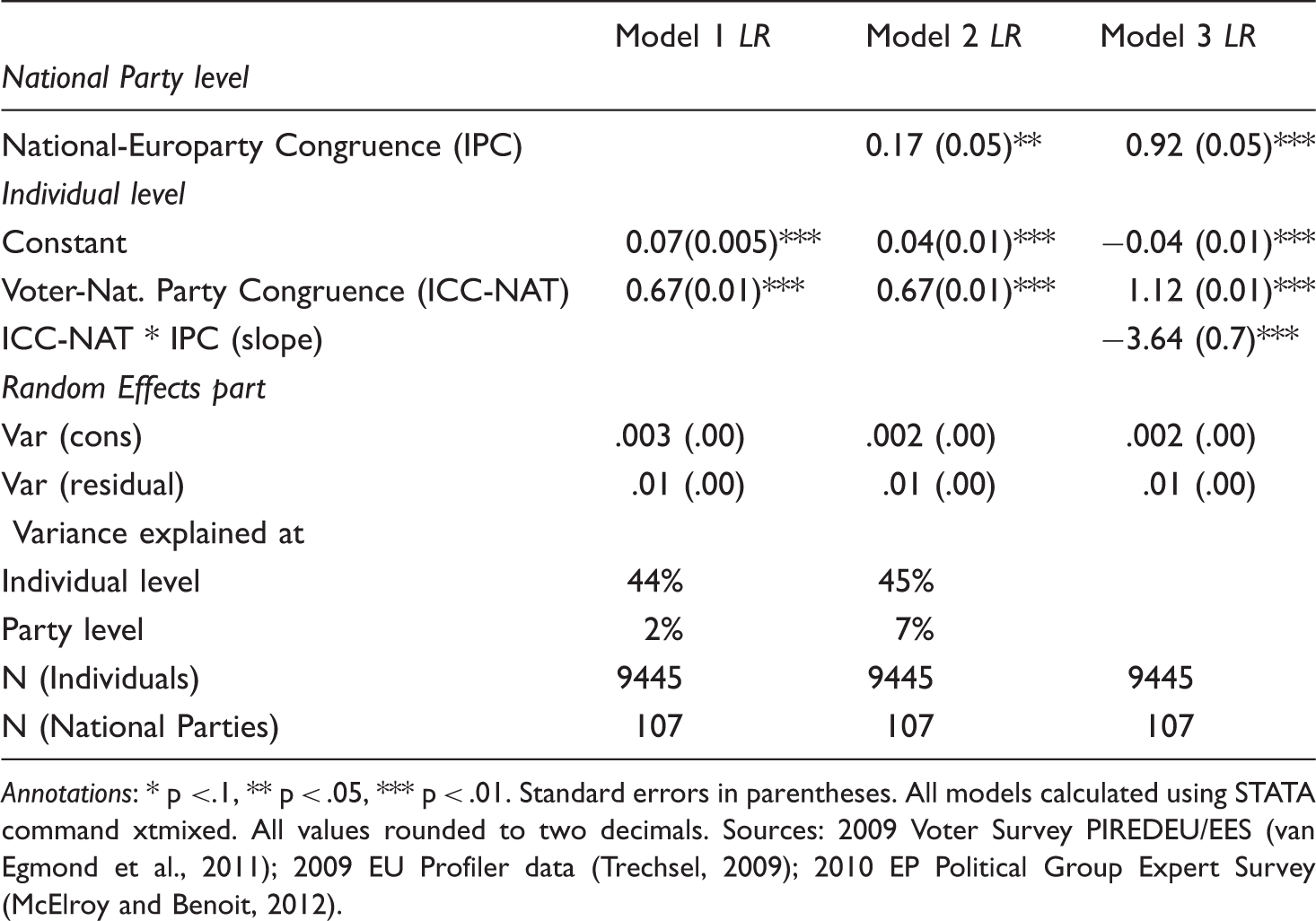
We estimate whether and to what extent the congruence achieved between the individual voter and the Europarty (ICC-EU) is affected by voter–national party congruence (ICC-NAT) and national party–Europarty congruence (IPC). As individual voters are nested in different national parties, 8 we build a multilevel model with individual and national party variables and estimate their effects, as well as the effect of their interaction. Our main explanatory variables are (1) ICC-NAT: measured at the individual level and (2) IPC: measured at the national party level. We build our models step by step: Model 1 estimates the effect of ICC-NAT on ICC-EU; Model 2 also includes IPC and Model 3 includes an interaction effect between ICC-NAT and IPC and a random effects component allowing the slope to vary for each national party.
Findings
To illustrate policy distances between Europarties, national parties and their voters on the LR and EU dimensions, we use the example of the EPP, the largest Europarty (for all others, see Web Appendix). In Figures 1a and 1b, the value 0 represents the EPP position, while the bars display (a) the distances of each member–party (light gray) and (b) the mean distances of each member–party’s supporters (dark gray) from the EPP’s position. For the LR dimension, negative values represent national parties’/voters’ positions that are on the left of their Europarty, while positive values demonstrate positions on their right. For the EU dimension, negative values represent positions that are more pro-EU than that of the Europarty and positive values indicate positions that are more anti-EU.
Distances to EPP position on the Left-Right Dimension. Distances to EPP position on the EU Dimension.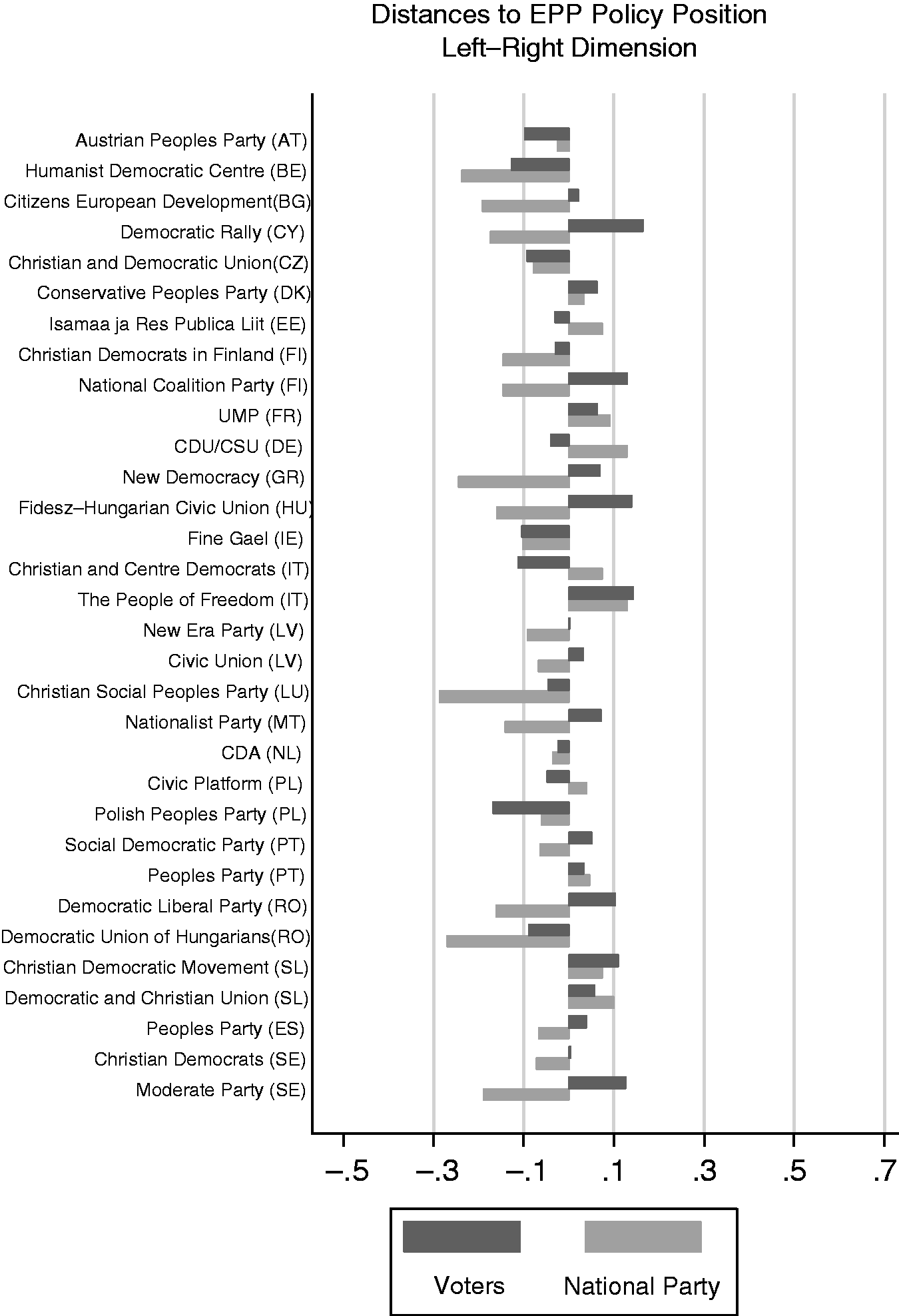
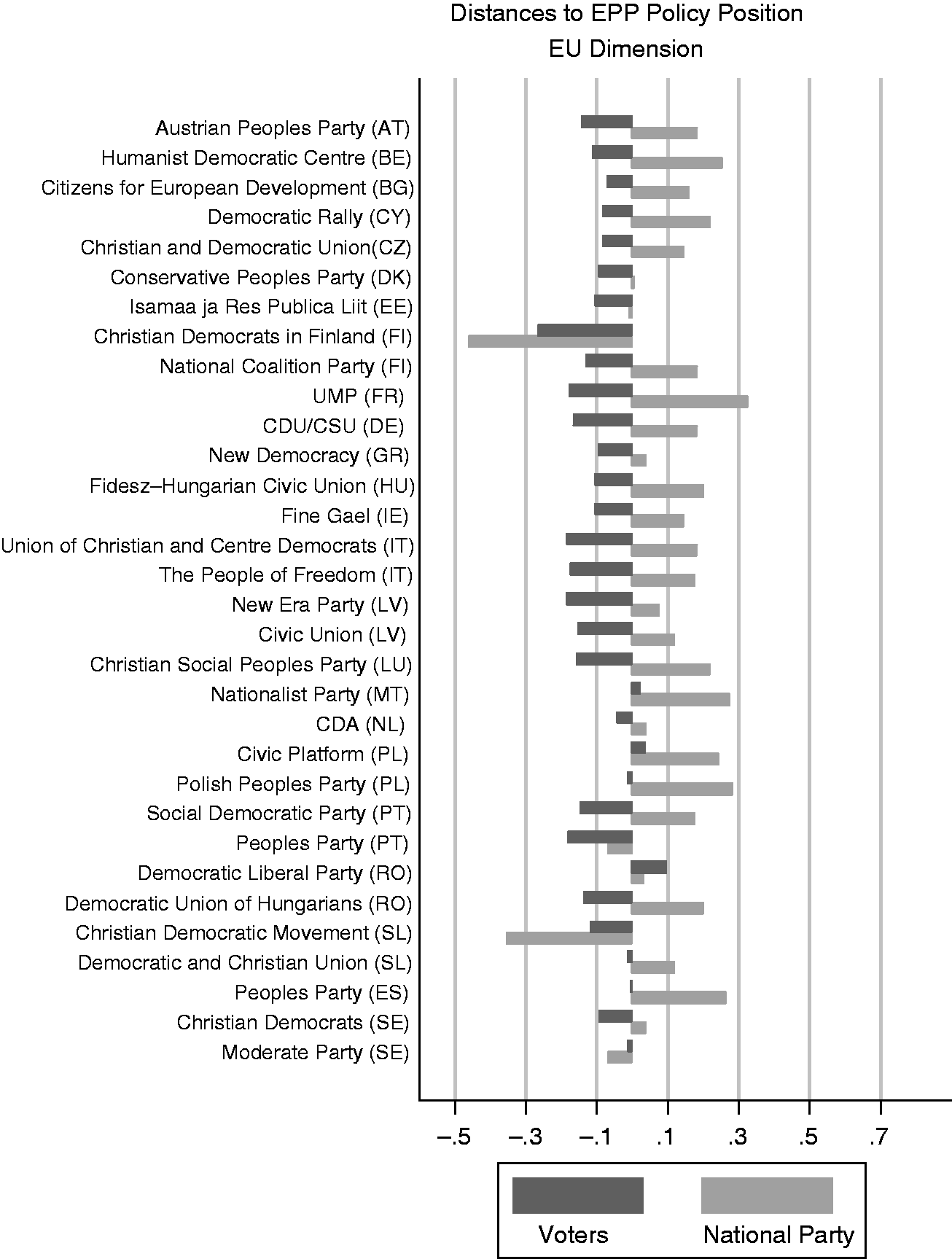
Figure 1a shows that the positions of the EPP, its party members and their supporters on the LR dimension do not coincide; the distances between them vary but are generally small. There is no clear pattern for whether the EPP is on the left/right of its members and their voters. The same holds for PES, ALDE and GUE/NGL; however, ECR and EFD are more ‘right’ than their members and their voters, while the Greens are generally on the left of their members’ supporters.
Figure 1b illustrates that distances on the EU dimension also vary but are slightly larger than on the LR dimension. Some members (e.g. the Danish Conservatives and Estonian Res Publica) appear congruent with the EPP while others do not (e.g. the French UMP and Finnish Christian Democrats). Generally, the EPP is more EU-supportive than its member parties, and the same holds for ALDE, Greens, GUE/NGL and PES; the opposite is true for EFD and ECR. Our results thus corroborate research that finds MEPs to be slightly more pro-EU than MNPs (national parliamentarians) (Thomassen and Schmitt, 1999). Unsurprisingly, Europarties tend to be more EU-supportive than national parties as they share a long-term ‘preference of increasing the power of the EP and the legitimacy of the EU system as a whole’ (Kreppel and Hix, 2003: 93). However, we also see in Figure 1b that the EPP seems more Eurosceptic than many of its members’ voters. ALDE, ECR, EFD, Greens and PES behave similarly. Interestingly, in all cases except for GUE/NGL (more pro-EU than its member parties and their supporters), Europarties stand in-between national parties and their supporters (see Web Appendix). When we consider the Europarty, the representation gap observed between national parties and their supporters on the EU dimension (Mattila and Raunio, 2006, 2012) is bridged.
A key difference between our study and previous works concerns the data used for estimating national party positions. For instance, Matilla and Raunio (2006, 2012) use voters’ perceptions of national party locations. This is not optimal given voters’ limited knowledge of national parties’ and (even more limited) knowledge of Europarties’ positions on European unification. Indeed, Kritzinger and McElroy (2012), who study voters’ perceptual agreement regarding party positions on the LR dimension and especially the EU dimension based on 2009 PIREDEU-EES voter survey data, suggest two notes of caution: (a) there are cases where the data can be misleading, a point illustrated convincingly based on specific cases, and (b) there is a large amount of ‘don’t knows’ in this survey, indicating voters have difficulties locating parties on the LR and even greater difficulties on the EU dimension. In sum, if perceptions of positions are incorrect, then congruence may in reality often be better than what is perceived.
Additional analyses (not shown here), where our estimates of national party positions were based on EP candidates’ perceptions of their national party position (Giebler and Weßels, 2010), resulted in some EPP member parties appearing somewhat less Eurosceptic than what the present study depicts. Reasons for this divergence are: first, that the EU profiler is an independent source of national party positions evaluating parties as unitary actors, whereas the Candidate Study relies on perceptions of ‘agents with two principals’ (Hix, 2002); that is, members of both national and Europarties. The way these agents place their national party may therefore minimize its distance with the Europarty, thus resulting in more pro-EU positions of national parties. Second, the Candidate Study achieved low response rates, with some party averages based on fewer than five candidates. 9
Finally, it should be underlined that the Europarty position reported here also comes from an independent source (expert survey on EP Political Groups), thus we can safely assume that it is more accurate than if we had inferred it from the central tendency of its constituent national party measures (see McElroy and Benoit, 2007).
Next, we examine congruence between voters and national parties and between voters and Europarties (H1) and the congruence patterns across dimensions (H4) using the concordance correlation coefficient (Figure 2 and Table 1).
Comparing National and Europarty Congruence (LR and EU dimensions). Comparing Voter-National Party and Voter-Europarty Congruence using Concordance correlation coefficient. Note: The figures compare congruence measures based on national parties and Europarties using standardized measures; ρc : concordance correlation coefficient; Confidence Interval of 95%; r: product–moment correlation coefficient; and Cb bias correction factor.
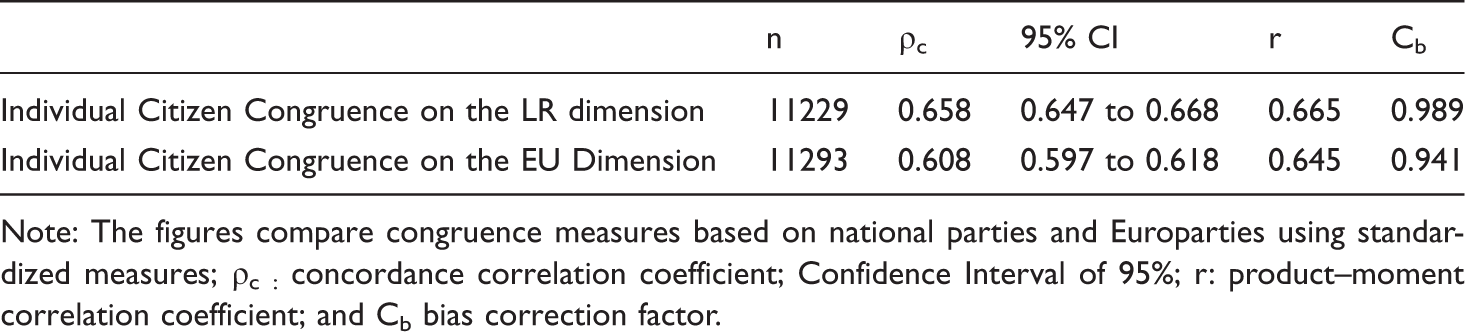
Figure 2 is composed of two graphs displaying concordance of the ICC-NAT and ICC-EU measures for the LR dimension (lower graph) and the EU dimension (upper graph).
Our two congruence measures (voter–national party and voter–Europarty) cannot be considered as equivalent given that agreement between them is not perfect (ρc > 0.9). 10
The concordance correlation coefficient for both dimensions (LR 0.665 and EU 0.645, respectively) is low enough to ensure the existence of clear differences of congruence between national and EU levels (H1). Low voter–national party congruence (i.e. higher values, close to 1) corresponds to higher degrees of voter–Europarty congruence (i.e. lower values) than what would be expected if concordance between the two measures were perfect. Voters are closer to their Europarties than they should have been, had the two measures been in concordance – a phenomenon that becomes more prominent as the distance between voter and national party increases. This finding indicates a potential moderating influence of national party–Europarty congruence on the linkage between voters and Europarties (H3a). Differences between the LR and EU dimensions are evident not only in the level of concordance but also in the slopes and the distribution. This implies that our model may perform differently across dimensions of political conflict.
Having established that ICC is different when we consider national parties and Europarties separately, we move on to analyzing the indirect relationship between voters and their Europarties (ICC-EU). We run hierarchical models using ‘National Party’ as the higher level in order to test hypotheses 2a, 2b, 3a and 3b. Models 1 and 2 show the direct effects of our two explanatory variables. To recall, low values indicate high congruence (small policy distance). Interpreting these models, we see there are significant positive relationships between voter–national party congruence (ICC-NAT), and national party-Europarty congruence (IPC) and our dependent variable (ICC-EU). Thus, as the distance between a voter and her preferred national party drops, the values of ICC-EU also become lower (H2a). Also, as the distance between the national party and its Europarty becomes smaller, the values of ICC-EU also become lower (H2b). This is true for both dimensions of conflict.
However, these findings need to be interpreted through the prism of the interaction effect (Aiken and West, 1991). Model 3 (in both Tables 2 and 3) reveals a significant interaction effect. Due to the difficulty of interpreting interaction effects solely based on coefficients (Brambor et al., 2006), we show graphically how the national party–Europarty congruence (higher level predictor) moderates the relationship between a voter and her party at the national level (lower level predictor) and this voter’s congruence with the Europarty (outcome). Figure 3 depicts the LR dimension and Figure 4 the EU dimension.
LR Dimension: Marginal Effect of Voter-National Party Congruence as National Party-Europarty Congruence Changes. EU dimension: Marginal Effect of Voter-National Party Congruence as National Party-Europarty Congruence Changes. Models explaining Voter-Europarty congruence for the LR dimension. Annotations: * p <.1, ** p < .05, *** p < .01. Standard errors in parentheses. All models calculated using STATA command xtmixed. All values rounded to two decimals. Sources: 2009 Voter Survey PIREDEU/EES (van Egmond et al., 2011); 2009 EU Profiler data (Trechsel, 2009); 2010 EP Political Group Expert Survey (McElroy and Benoit, 2012). Models explaining Voter-Europarty Congruence for the EU dimension. Annotations and Sources: see Table 2.
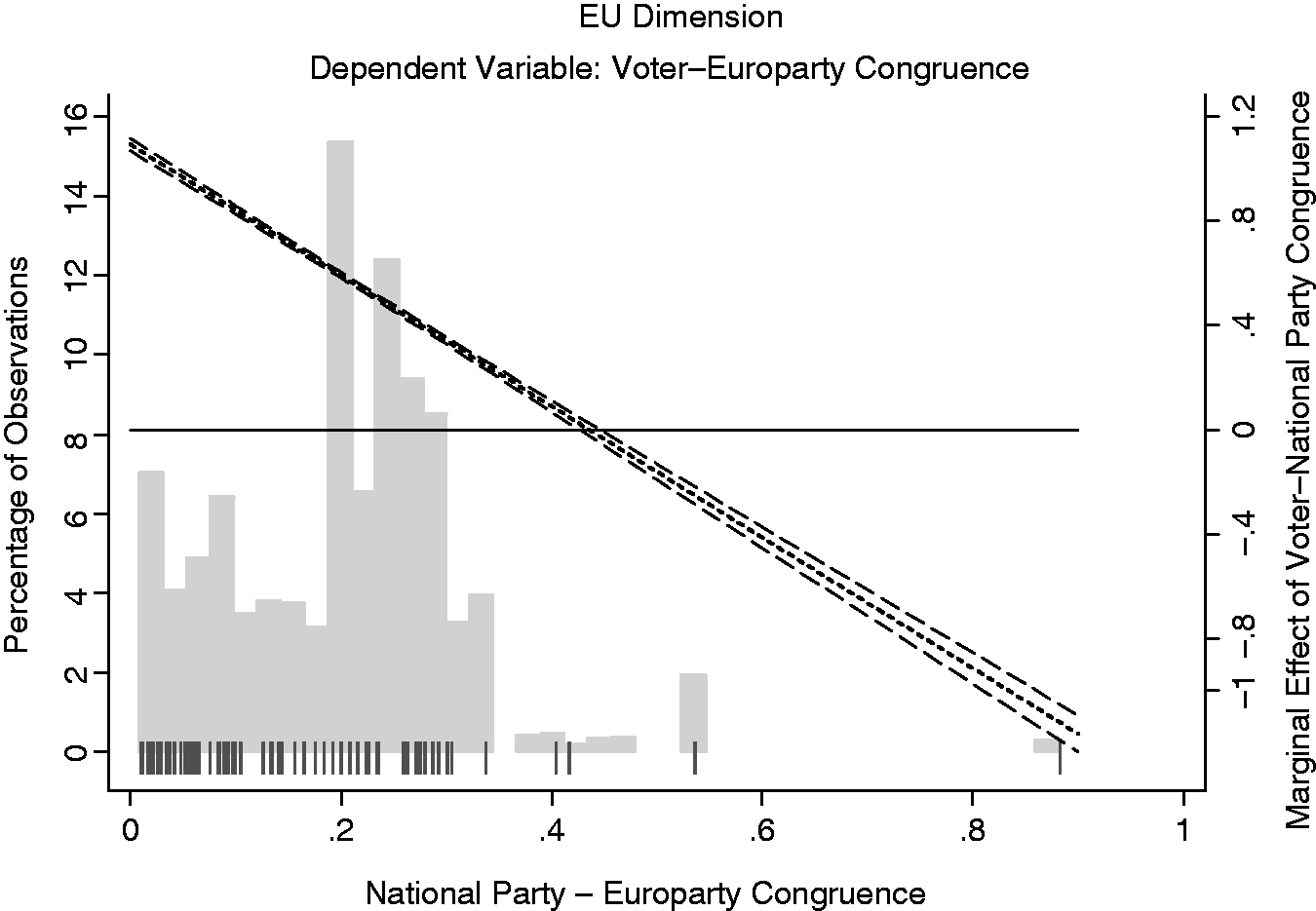

These figures display the conditions under which the lower level predictor (voter–national party congruence) has a significant effect on the outcome (voter–Europarty congruence) by considering the two-tailed 95% confidence intervals (dashed lines) shown. More specifically, they show how the marginal effect of voter–national party congruence on voter–Europarty congruence (vertical axis) changes as the distance between the voter’s preferred national party and its Europarty grows (horizontal axis). The effect of voter–national party congruence is significant whenever the upper and lower bounds of the confidence intervals are both either above or below the 0 line (see Clark and Golder, 2006). The figures also display the frequency distribution of the variable national party–Europarty congruence (in percentage points). This additional information allows for assessment of the conditional effect in relation to the density of observations of the variable posing the condition (Berry et al., 2012: 9).
Figure 3 shows that as the distance between the national party and the Europarty increases (i.e. values on the horizontal axis approach 0.3), the effect of voter–national party congruence on voter–Europarty congruence decreases. This confirms our expectation about the conditioning effect of national party–Europarty congruence (H3a).
Furthermore, Figure 3 supports our expectations regarding the conditional effects (H3b) of national party–Europarty congruence. We see that when national parties join Europarties close to them on the LR dimension, policy congruence between a voter and her selected party has a positive effect on her congruence with her Europarty. Under this condition, the more congruent a voter is with her selected national party, the more congruent she is with the corresponding Europarty (H3b). As the superimposed frequency distribution shows, this condition concerns the vast majority of observations.
However, when national parties join Europarties distant to them on the LR dimension, policy congruence between a voter and her selected party has a negative effect on her congruence with her Europarty. Under this condition, the more congruent a voter is with her selected national party, the less congruent she is with the corresponding Europarty. However, the frequency distribution shows that this condition concerns only a small percentage of observations, namely the Peoples’ Movement Against the EU (DK – GUE/NGL) and EFD Members: Slovak National Party (SL), True Finns (FI), Popular Orthodox Rally (GR), Danish Peoples Party (DK –), Order and Justice (LI). In conclusion, the more distant a national party is from its EP affiliation, the less voters’ choices at the national level matter for their representation in the EP (H3a and H3b).
On the EU dimension (Figure 4), the general structure of the conditioning and conditional effects of national party–Europarty congruence is similar to the LR dimension. Comparing the two figures, we see the slope in Figure 3 is slightly steeper than in Figure 4. On the LR dimension, the marginal effect of voter–national party congruence on voter–Europarty congruence changes direction (i.e. from positive to negative, H3b) when the distance between national and Europarty is around 0.3. On the EU dimension, this change occurs at a larger distance between a national party and its EP affiliation, namely around 0.43. The maximum distance between the national party and Europarty is 0.43 on the LR dimension but 0.88 on the EU dimension. Negative effects on the EU dimension concern the following parties: Christian Democrats (FI – EPP), Christian Union (NL – ECR), Law and Justice (PT – ECR), Green Party (SW – Greens), and Order and Justice (LI – EFD). Comparing the conditions under which negative effects occur (i.e. the more congruent a voter is with her selected national party, the less congruent she is with the corresponding Europarty), we see that the distance between national party and Europarty is smaller on the LR than on the EU dimension. Therefore, voters’ choice of national parties and national parties’ choice of Europarties depends upon their LR rather than their EU positions.
Conclusion
Drawing from Mansbridge’s ‘Selection Model of Representation’ (2009), we focused on the selection and sorting mechanisms that seek to match citizens with Europarties. We argue that because the EP representation channel operates with national parties and Europarties, the congruence between EU citizens and EP policy-makers depends upon congruence between voters and their preferred national parties and between national parties and the Europarties they join. Our results have implications for future studies of EP representation and the debate on the EU’s ‘democratic deficit’ more broadly: congruence between citizens and the national parties they support in EP elections is important but not the sole determinant of the quality of their representation in the EP. How parties from different countries join forces in the EP matters for citizens’ representation. Whether individual voters select national parties based on policy congruence matters for their EP representation but only to the extent that national political parties join a Europarty also based on policy congruence. Hence, policy representation in the EP should be analyzed as a multilevel phenomenon.
Importantly, our multilevel model performs well across dimensions of conflict, albeit better for the LR dimension. This latter result corroborates previous findings about a weaker linkage on the EU dimension than on the LR dimension. Based on independent data sources of national and Europarty positions, we shed new light on this picture: on the EU dimension, Europarties stand in-between their members and their supporters. Thus, our study of congruence between voters and parties in the EP exposes the representational linkage on the EU dimension as better than previously thought. This is important given that previous research on congruence had never integrated voters, national parties and Europarties in a single research design.
Although EU voters cannot locate their national parties accurately on the EU dimension (Kritzinger and McElroy, 2012), and their ‘correct’ voting concerns mainly the LR dimension (Rosema and de Vries, 2011), they are being represented by Europarties with EU positions relatively close to their own. This is positive for citizens’ representation given that MEPs tend to follow the Europarty line along the EU dimension more than on the LR dimension (Hix, 2002). For national parties that are distant from their Europarty on the LR dimension, voter–national party congruence affects voter–Europarty congruence negatively. This mainly concerns EFD members who coalesce on the basis of the EU dimension (anti-EU).
Overall, our findings imply fertile ground for the development of transnational party democracy: when citizens use elections to express their policy views, political organizations largely succeed in aggregating these views through a multilevel channel. Parties within the EU polity seem able to channel policy inputs from one level to the other on the LR dimension and less successfully on the EU dimension. Despite the absence of a direct electoral connection between citizens and Europarties, the latter function as effective instruments for the representation of the former. More broadly, our study of this transnational multilevel parliament contributes to knowledge of the extent to which citizens and political organizations adapt to processes of regional integration. However, the EU’s intense politicization during the current EU crisis and the voters’ increasing Euroscepticism are expected to play an important role in forcing parties to consider the EU dimension more in the 2014 EP election; this may impact the presented patterns of congruence between voters, national parties and Europarties.
Footnotes
Notes
Acknowledgments
We thank the anonymous reviewers for comments, Holger Döring, Kostas Gemenis and Roula Nezi for their valuable advice and Whitney Kathryn Isaacs for editorial assistance. All errors remain our own.
Funding
This project received support from the Austrian Science Fund (I150-G14), the GESIS-Leibniz Institute for the Social Sciences, the European University Institute and the Institute for European Integration Research, University of Vienna.
References
Supplementary Material
Please find the following supplemental material available below.
For Open Access articles published under a Creative Commons License, all supplemental material carries the same license as the article it is associated with.
For non-Open Access articles published, all supplemental material carries a non-exclusive license, and permission requests for re-use of supplemental material or any part of supplemental material shall be sent directly to the copyright owner as specified in the copyright notice associated with the article.
