



Abstract
Many academics and commentators argue that Europe is suffering from a democratic deficit. An interesting proposal that has been put forward to address this problem is to elect some members of the European parliament in a pan-European district. In this article, we evaluate this proposal using an online experiment, in which thousands of Europeans voted on a pan-European ballot we created. We find that the voting behaviour of European citizens would be strongly affected by the presence or absence of candidates from their own country on the lists. If a pan-European district is created, our findings provide an argument in favour of using a closed-list ballot and establishing a maximum number of candidates from each country on the lists.
Keywords
Introduction
There is a vivid debate in the literature about the (lack of) democratic legitimacy of the European Union (EU) (Kohler-Koch and Rittberger, 2007). Some argue that the democratic deficit is limited because EU decision makers are elected in well-functioning national democracies and interact in an institutional framework characterized by strong checks and balances (Majone, 1998; Moravcsik, 2002). Others contend that the democratic deficit is severe because there is a growing discontent among European citizens regarding the EU in general and its legislative decision-making process in particular (Hix, 2008; Hooghe and Marx, 2009; Karp et al., 2003; Rohrschneider, 2002).
Among those who accept that the perception of a democratic deficit is an important phenomenon (regardless of whether it is justified), it is often argued that the way European elections are organized does not help to reduce it. Although the European parliament (EP) is elected during a massive election where hundreds of millions of voters elect their representatives, national considerations usually dominate vote choice. European citizens are not interested in European elections, they often abstain, and they tend to use their vote as a way to protest against, or to reward, national governments, depending on the national electoral cycle (Hix and Marsh, 2007; Hobolt and Wittrock, 2011; Marsh, 1998; Reif and Schmitt, 1980). Furthermore, parties use national instead of European labels to compete in EP elections, even if they form European political groups in the legislature after the election.
An interesting proposal that has been put forward to address the EU’s democratic deficit is to change the districting system of the European election, and to elect, in addition to the current national districts, a fixed number of members of the EP (MEPs) in a pan-European district. Similar to national districts, the pan-European district would use some sort of proportional representation (PR) and each European citizen would be invited to cast a vote for a European party on a one-person-one-vote basis, regardless of her country. 1 Since candidates from different countries would be competing against each other, it would help develop a genuine European political space, where ideas and arguments would be debated transnationally. In turn, this development, often referred to as the politicisation of the EU, is likely to increase citizens’ support for European integration (De Wilde, 2011; Habermas, 2012). A recent study shows that Europeans are willing and able to engage in such a transnational political space (Fiskin et al., 2014).
In this article, we evaluate the pan-European district proposal. To do so, we rely on a unique online experiment that we conducted during the 2014 EP election. We invited thousands of European citizens to report how they would vote on a pan-European ballot. On this ballot, we randomised the nationality of candidates appearing on the various party lists. We are thus able to assess whether vote choice is affected by the presence of candidates from the subjects’ own country on the lists. Although the sample is not representative of the European electorate (see below), we believe that the effect we observe in our experiment is very likely to be found in the population of interest, especially since our sample is skewed towards pro-EU citizens that should be less inclined to have a strong national preference.
At the end of our experiment, we asked participants whether they like the idea of transnational party lists competing in European elections. Of the 1116 people that fully completed our experiment (see the description of the sample below), 59% responded that they liked it and 23% that they did not. However, even if the proposal is approved by a majority of Europeans, it is important to evaluate how voters would react to fully understand the implication of the change. If their vote is strongly affected by national considerations, there are good reasons to think that the effectiveness of the pan-European district as a way to address Europe’s democratic deficit will be threatened.
Creating an experimental pan-European ballot
In the three weeks preceding the 2014 EP election, we conducted an online experiment (for a discussion of the details of this experiment, see Laslier et al., 2015). We created a multi-lingual website, open to all, where users were invited to learn more about European elections in general and the rules used to elect MEPs, and to participate in an online voting experiment. To recruit experimental subjects, we collaborated with local academic colleagues from almost every one of the 28 European countries. These colleagues were in charge of publicizing the website through national media. This operation was more successful in some countries than in others. In some of them, very few subjects completed the online experiment. To make sure that our results are not driven by very specific samples, we focus in this article on the three countries for which we have the required data for more than 200 subjects: France, Germany, and Sweden.
In the experimental part of the website, we invited subjects in seven pre-selected European countries (Belgium, France, Germany, Hungary, the Netherlands, the United Kingdom, and Sweden) to indicate their vote preference in the upcoming EP election using the party lists utilized in their district. We use this information to weight our sample and as controls in our regressions (see below). We also asked all subjects, regardless of their country, to indicate how they would vote if 10 additional MEPs were to be elected in a pan-European district. This latter part of the study is the focus of the analysis in this article. Finally, we invited subjects to respond to a short questionnaire about their socio-demographic profile and political attitudes.
We simulated a pan-European ballot by creating party lists based on the existing political groups in the EP. In the 2009–2014 EP legislature, there were seven political groups: the European People’s Party (EPP, centre-right), the Progressive Alliance of Socialists and Democrats (S&D, centre-left), the European Conservatives and Reformists (ECR, conservative-Eurosceptic), the Alliance of Liberals and Democrats for Europe (ALDE, liberal-centrist), the European United Left-Nordic Green Left (GUE-NGL, radical left), the Greens–European Free Alliance (Greens-EFA, green), and the Europe of Freedom and Direct Democracy (EFD, right-wing populist). We used these seven political groups to create seven lists on the pan-European ballot. It is reasonable to think that if there had been a pan-European district at the time of the 2014 election, each of these groups would have formed a party list to compete against the others.
As mentioned above, we decided to set the number of MEPs elected in the pan-European district to 10. 2 We thus had to present to the subjects 10 candidates per list. To do so, we randomly picked, for each subject, 10 incumbent MEPs from each political group. It is worth noting that although not all these MEPs were candidates for re-election, selecting actual European politicians has the advantage of making our experiment more realistic.
On the pan-European ballot we presented to the subjects the seven pan-European lists, with the label and logo of the corresponding political group. The order of these lists varied randomly from user to user. We also disclosed the names of the 10 MEPs we randomly selected, their official MEP pictures, and their country of origin. Figures A1 and A2 in the online appendix show a screenshot of our pan-European ballot under closed- and open-list PR, respectively (see below for a description of these two electoral systems). Subjects were able to click on the name of a candidate to access her webpage on the official EP website.
The way we built the pan-European ballots has the advantage of following clear and ‘neutral’ rules. However, it is worth noting that it excludes independent MEPs, as they were not part of any political group.
Since the first election in 1979, the European law stipulates that the MEPs need to be elected through PR. However, each country can decide upon which variant of PR to use. In the 2014 EP election, 89% of all European countries used either a closed-list PR system, where voters have to cast a vote for a list, or an open-list PR system, where voters have to cast a vote for a list and for individual candidates within the list. 3 In both instances, the seats are first allocated among parties in proportion to the number of party votes received. However, the two electoral systems differ in how they allocate seats to individual candidates within parties. Under closed-list PR, the seats are allocated to individual candidates according to the order of the list, while in open-list PR the allocation also depends on the number of individual votes received by each candidate. In our experiment, the ordering of the candidates on the list was random. In reality, this ordering is decided by the party, possibly under some constraint (for instance, alternating gender as in France).
Several variants of open-list PR were used during the 2014 EP election. In Sweden, voters had to choose a single individual candidate on the party list they voted for. In Belgium, they could choose as many individual candidates as they wanted on their chosen party list. In our experiment, we invited users to vote under the variant used in Latvia where voters had to give a ‘+2’, a ‘+1’ or a ‘0’ to each of the individual candidates on the list they voted for (the ‘+1’ is the default category). 4 This system is actually similar to the one used in Belgium except there voters have to choose between giving a ‘+1’ or a ‘0’ to each of the individual candidates of the list they vote for.
In our online experiment, we asked all participants to cast hypothetical votes under three electoral systems: closed-list PR (used in France and Germany), open-list PR (used in Latvia, as described above), and panachage with cumulation (used in Luxembourg). We used these three electoral systems for both ballots in the experiment, i.e. the actual national ballot of the subject’s district in the seven pre-selected European countries mentioned above and the pan-European ballot. This articles focuses on the pan-European ballot and the closed- and open-list PR systems. As mentioned above, these two electoral systems are the ones most commonly used in EP elections.
Theoretical expectations
Vote choice can be seen as a function of two vectors of preferences: preferences over parties and preferences over individual candidates. Voters evaluate the various parties and candidates, and decide to cast their vote considering these two vectors. The literature has long focused on the determinants of preferences over parties, as these preferences are crucial to explain vote choice. The classic studies mention, for example, a voter’s socio-economic status (Lazarsfeld et al., 1948), ideology (Downs, 1957), partisan identification (Campbell et al., 1960), attitudes towards specific issues (Nie et al., 1999), and the overall reputation of parties (Stokes, 1963).
But there is evidence that voters also take individual candidates into consideration (Canache et al., 2000; Cutler, 2002). This tendency is probably even more frequent nowadays given the recent trend towards the personalisation of elections and politics in established democracies (Colomer, 2011; Karvonen, 2012). Recent research has investigated various determinants of preferences over candidates such as the candidate’s gender (Dolan, 2014), appearance (Lawson et al., 2010), non-verbal attributes (Dumitrescu et al., 2015), activity on Twitter (Spierings and Jacobs, 2014), whether they introduce Private Members’ bills in parliament (Loewen et al., 2014), whether they systematically follow the party line in parliamentary votes (Vivyan and Wagner, 2012), and how frequently they visit their constituency (Crisp and Desposato, 2004).
The degree to which the characteristics of candidates affect vote choice is also influenced by the electoral system. As claimed by Carey and Shugart (1995), as the number of candidates elected in the district increases, the extent to which the election is candidate oriented decreases. In large districts, individual candidates rely less on their own reputation, and more on the party, to be elected. However, open-list PR systems function differently: district magnitude tends to have the opposite effect on the amount of focus on the candidates in the election, and candidate characteristics have a substantive impact on individual candidate votes (André et al., 2015; Shugart et al., 2005).
In this strand of research, a special focus has been put on how local ties or local roots affect preferences over candidates. Several studies show that local candidates, i.e. those who are from the district in which they compete or have a special connection with the district, are more successful. Garand (1988) and Lewis-Beck and Rice (1983) show, for example, that presidential candidates in the United States benefit from a substantial home state advantage. Local roots also have an impact on the success of candidates in parliamentary democracies where elections are held under plurality rules. Blais et al. (2003) demonstrate moreover that in Canada vote choice is affected by voters’ preferences over local candidates. In the United Kingdom, Arzheimer and Evans (2012) find that the smaller the geographic distance between a voter and a candidate in her district, the higher the probability of voting for her. Recent experimental studies even demonstrate that local roots are one of the most important candidate characteristics for voters (Campbell and Cowley, 2014; Roy and Alcantara, 2014). However, all of these studies also acknowledge that the party to which the candidate belongs remains the most important predictor of vote choice.
Local roots are also important in PR systems. Marsh (2007) shows that under single transferable vote rules, voters tend to give a higher rank to candidates with local roots, as long as they are affiliated with their preferred party. Shugart et al. (2005) find that parties tend to nominate candidates who have held political positions locally under both closed-list and open-list PR, and that this tendency increases with the competitiveness of the district. André et al. (2014) complete this argument by adding that local roots are less important for candidate’s nomination in large districts. Using a similar indicator of localness, Tavits (2010) demonstrates that in open-list PR systems local candidates are more successful than others, and Riera (2011) finds that, even under closed-list PR, party lists that are led by a candidate born and raised in the district tend to obtain slightly more votes. However, these studies again show that the effect of local roots on vote choice is marginal, compared to party preference.
In our experiment, we expect co-nationality between candidates and subjects to affect voting behaviour in the pan-European ballot, just as co-locality does in national elections. However, we expect the effect to be even stronger than in national elections given that Europeans from different countries show high levels of distrust for each other (Bornhorst et al., 2010; Klingemann and Weldon, 2012), and that national identity is a key factor in explaining pro-EU attitudes (Hooghe and Marx, 2009).
Our first hypothesis concerns the open-list PR system. We expect co-nationality to affect preferential votes. Under this electoral system, subjects could choose to give a positive (+2), negative (0), or neutral vote (+1) to each candidate on the list they chose. We expect experimental subjects to give more positive, and fewer negative, points to their co-nationals. The hypothesis is thus: H1: The probability of a subject casting a positive (negative) individual candidate vote is higher when the candidate is (is not) a national of her country. H2: The probability of a subject voting for a pan-European party list, under both closed- and open-list PR, is higher when candidates from her country are on the list.
The findings
List voting in the pan-European ballot.

Note: ALDE: Alliance of Liberals and Democrats for Europe; ECR: European Conservatives and Reformists; EFD: Europe of Freedom and Direct Democracy; EPP: European People’s Party; Greens-EFA: Greens–European Free Alliance; GUE-NGL: European United Left-Nordic Green Left; S&D: Progressive Alliance of Socialists and Democrats.
The second observation is that there are few differences between closed- and open-list PR systems. In the aggregate, the largest difference in votes concerns the Greens-EFA, but it is only eight votes (so, not even 1% of the 1116 votes cast).
As noted in Laslier et al. (2015), left-leaning voters are over-represented in our sample. Only a bit more than 30% of the 1116 subjects voted for a right wing or centre-right pan-European list (i.e. the ALDE, EPP, EFD, or ECR). In the actual 2014 EP election, these parties obtained just over 50% of the seats.
To correct this bias, we weight subjects using the actual results of the 2014 EP election. To do so, we employ the experimental vote cast in the national ballot (regardless of the pan-European vote) under the given national electoral system in their country (open-list PR in Sweden and closed-list PR in France and Germany). Then, we apply this weight to the pan-European results. In the weighted sample, we also ensure that the difference in size of the country sub-samples does not alter the results by making the sum of the weights equal to a standard 1000 units in each country. 5 Also, given the nature of our recruitment process, it is reasonable to think that highly educated people interested in politics and citizens favourable to the EU are over-represented in our sample. However, we lack pertinent information to correct for these biases. We discuss the potential problem these biases could create in the conclusion.
Table 1 also shows the vote in the pan-European ballot when we use the weighted sample. The online appendix reports the weighted and non-weighted vote in each country in the pan-European ballot, under both electoral systems (see Table A1). All the analyses presented in this article are based on the weighted sample. However, we always report the initial, before weighting, number of observations.
To test our first hypothesis, we run a multinomial logit model predicting the probability of each subject giving a positive, negative, or neutral vote to each individual candidate on the list she voted for under open-list PR. Each subject had to give ‘+1’ (the default option), ‘0’, or ‘+2’ to each of the 10 individual candidates on the list, so there are 10 times 1116 observations. On average, 7% of the votes were negative, 21% positive, and 72% neutral.
The main independent variable is the nationality of the candidate (‘1’ if she is a co-national of the subject, ‘0’ otherwise). We also include several controls. Some of them are located at the subject level and others at the candidate level. At the subject level, we include the country of origin of the subject (France, Germany, or Sweden), the pan-European list she voted for under open-list PR (to control for party bias), and the number of points she gave to candidates in total. At the candidate level, we include a dummy variable for whether the candidate is female or male, and her age.
Predicting preference voting.

Note: ALDE: Alliance of Liberals and Democrats for Europe; ECR: European Conservatives and Reformists; EFD: Europe of Freedom and Direct Democracy; EPP: European People’s Party; Greens-EFA: Greens–European Free Alliance; GUE-NGL: European United Left-Nordic Green Left; S&D: Progressive Alliance of Socialists and Democrats. Entries are coefficients (Coef.) and relative risk ratios (RRR) estimated through multinomial logit predicting preference voting for individual candidates (neutral vote as reference). Standard errors are in parentheses. * p < 0.05, ** p < 0.01 (two-tailed).
Similarly, the chances of giving a negative vote to a co-national candidate are 32% lower. However, this effect is not statistically significant. This might be due to the rather low number of negative votes given in total (only 7%). The empirical evidence thus supports our first hypothesis at least partially: subjects give more positive votes to candidates of their country.
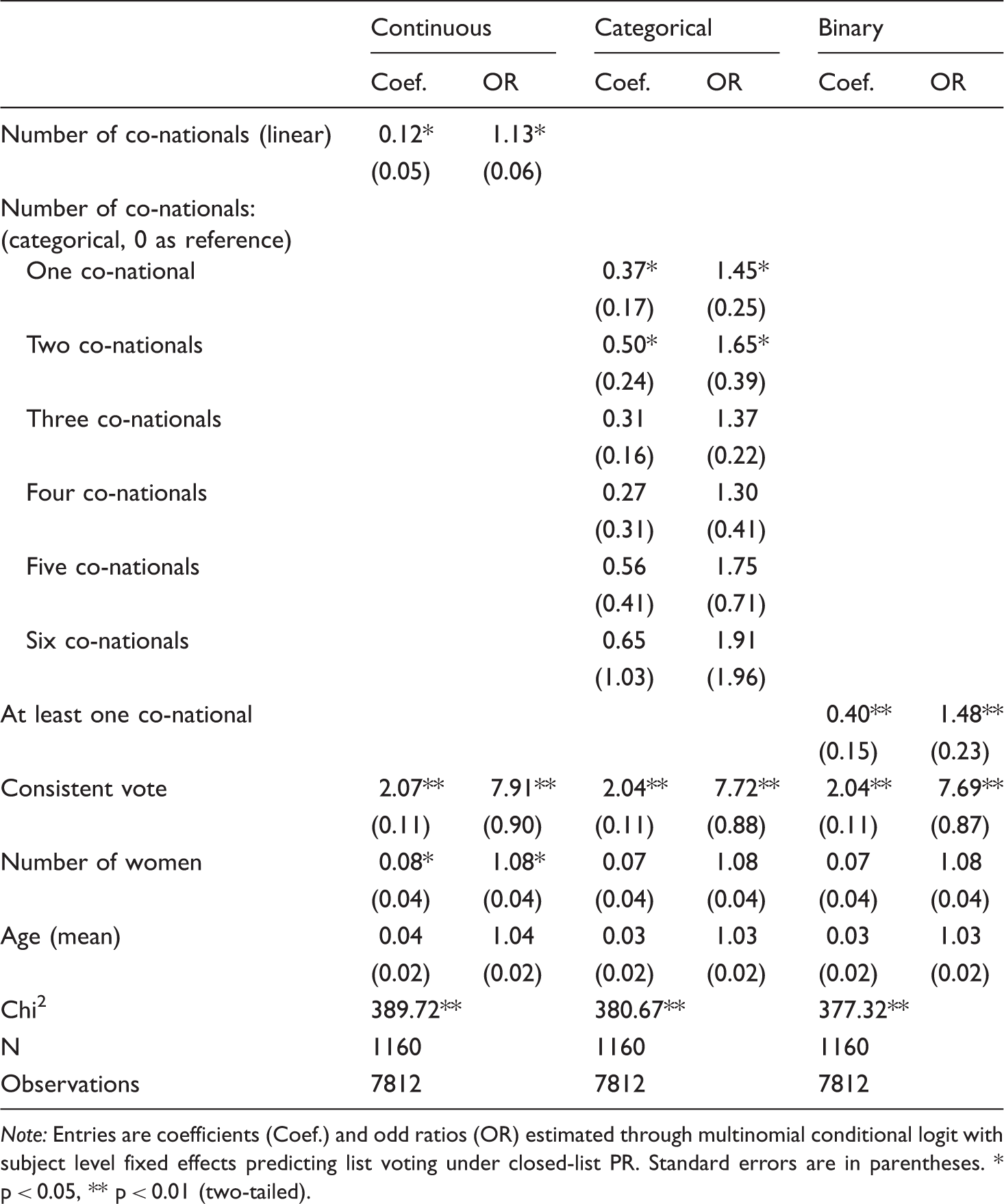
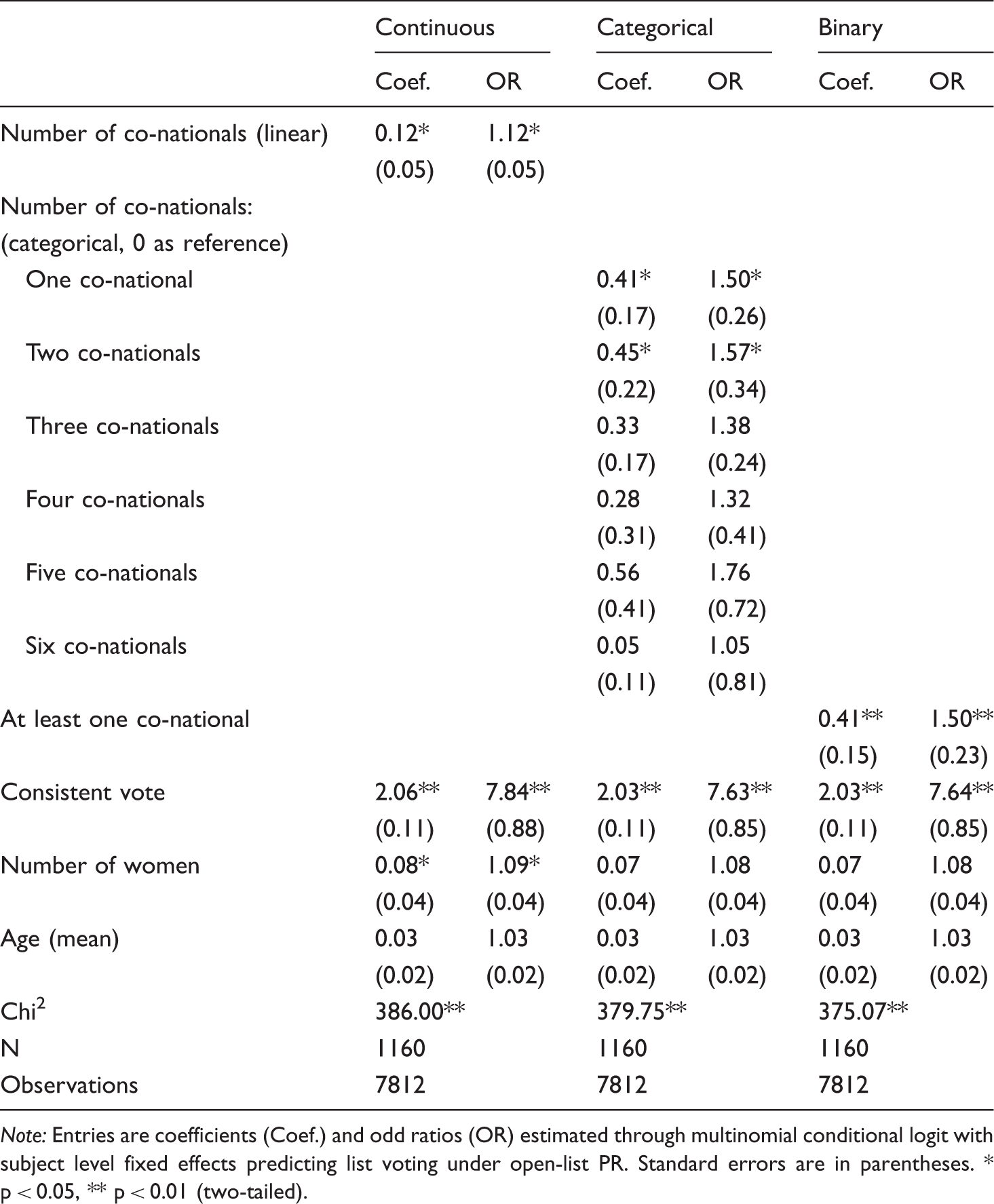
To test our second hypothesis, we run conditional logit models predicting the probability of voting for each list under both closed- and open-list PR systems. Each subject had the opportunity to vote for seven lists, so there are seven times 1116 observations. We measure the co-nationality of the candidates on the list in three different ways. First, we use a continuous measure counting the number of co-nationals in each list. In our dataset, this number goes from zero to six with more than 90% of the lists having zero, one, or two national candidates. Second, we use a categorical measure of the number of co-nationals to evaluate whether the effect is linear or not, suspecting that the effect of one extra co-national on the list diminishes as the number of co-nationals increases. Finally, following the same intuition, we use a binary variable measuring whether there is a least one co-national on the list or none. In our dataset, 54% of the lists that appeared on the subject’s screen did not include any co-national.
In this analysis, we again include controls at the subject and list level. At the subject level, we use fixed effects to account for the wide range of factors affecting the probability of voting for a given party list. At the level of the list, we include a dummy variable for whether the pan-European list vote is consistent with the vote cast by the subject on the national ballot (same party group), the number of female candidates on the list, and the average age of the candidates.
Predicting list voting (closed-list PR).
Note: Entries are coefficients (Coef.) and odd ratios (OR) estimated through multinomial conditional logit with subject level fixed effects predicting list voting under closed-list PR. Standard errors are in parentheses. * p < 0.05, ** p < 0.01 (two-tailed).
Predicting list voting (open-list PR).
Note: Entries are coefficients (Coef.) and odd ratios (OR) estimated through multinomial conditional logit with subject level fixed effects predicting list voting under open-list PR. Standard errors are in parentheses. * p < 0.05, ** p < 0.01 (two-tailed).
The last columns of Tables 3 and 4 show that the presence of at least one co-national increases the probability of voting for a list by 48% under closed-list PR and 50% under open-list PR. These effects are strong and statistically significant at p < 0.01. Tables 3 and 4 show that in all specifications and even after controlling for the effect of consistent voting, which is a powerful predictor, the positive effect of co-nationality on list choice is strong. This finding lends support for the second hypothesis.
Tables 3 and 4 also reveal that the effect of the presence of co-national candidates on the probability of voting for a list is equally strong under both closed- and open-list PR (e.g. the coefficients associated with the presence of at least one co-national on the list are 0.4 and 0.41, respectively). 6
Further tests
To evaluate the robustness of our findings and to further investigate the effect of co-nationality on vote choice, we conducted some additional analyses. We use the same variables as in Tables 2 to 4. In the models predicting list voting, we use the binary measure of co-nationality (presence or absence of a least one co-national on the list).
First, one of the main concerns in the literature on attitudes towards the EU is that citizens of some countries are more favourable to European integration than others (Hooghe and Marx, 2009). We thus conduct the same analyses as above in each of the three countries separately.
The online appendix shows the odd ratios associated with the effects of co-nationality on preferential and list voting, for French, German, and Swedish subjects (see Figures A3 and A4). It appears that co-national candidates are as likely to receive a positive vote under open-list PR in each of the three countries. The absence of a clear effect of co-nationality on the probability of giving a negative vote is also confirmed.
Similarly, we observe that the effect of the presence of at least one co-national on the probability of voting for a list under both closed-list and open-list PR is positive among French and German subjects. Swedish subjects do not seem to be affected by the presence of co-nationals on a party list. This result might be due to the fact that Swedish citizens, just as those of other Nordic countries, show exceptionally high levels of social trust towards foreigners (Delhey and Newton, 2005). This suggests that in this country partisan preferences trump the effect of co-nationality. However, future research is needed to validate this claim.
Second, when modelling vote choice, it is important to evaluate whether the odds of selecting a given party or list depend on the presence or absence of other alternatives. We re-estimated the models in Tables 3 and 4, excluding each of the seven lists one at the time. The online appendix exhibits the odds ratios associated with the effect of co-nationality on the probability of voting for a list under closed-list and open-list PR (see Figure A5). For the most part, the effect of co-nationality is not affected. It is only when we exclude the EFD, the ECR, and the GUE-NGL that the effect diminishes, but only slightly. This is rather logical given that very few co-nationals appeared on these lists in our experiment and that these lists did not obtain a large portion of the votes.
Third, under closed-list and some variants of open-list PR, the order of candidates on the list matters for determining who is ultimately elected. The better placed a candidate is on a list, the higher her chances of being elected. Subjects may thus be more affected by the nationality of the candidates at the top of the list. To test this intuition, we estimated the same models as in Tables 3 and 4, first considering the number of nationals among the first nine candidates appearing on the list, then another model in which we considered the first eight candidates appearing on the list, and so on, until we considered just the first candidate appearing on the list. The online appendix reports the odds ratios associated with each of these variables (see Figure A5). We observe that the effect of co-nationality on the probability of voting for a party list does not vary according to the position of the candidates. This result suggests that the subjects were affected by the nationality of the candidates regardless of their position on the party list. 7 However, it is worth noting that subjects were aware that the ordering of the candidates on the lists was random. In reality, parties decide upon this ordering and voters can use this information when making their choice (e.g. candidates at the top of the list might be more competent than those at the bottom).
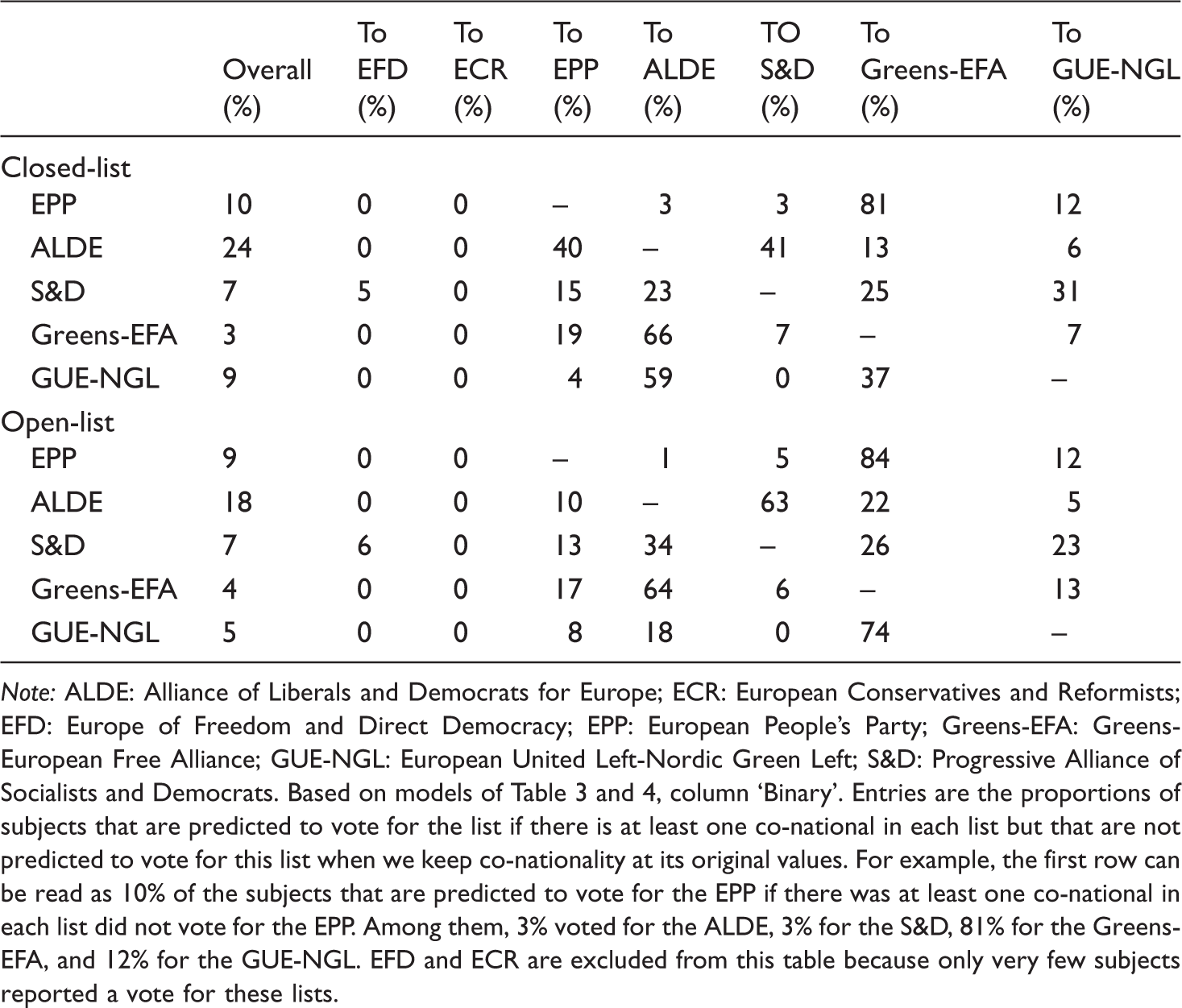
Proportion of switchers, compared to the situation in which there is at least one co-national in each list.
Note: ALDE: Alliance of Liberals and Democrats for Europe; ECR: European Conservatives and Reformists; EFD: Europe of Freedom and Direct Democracy; EPP: European People's Party; Greens-EFA: Greens-European Free Alliance; GUE-NGL: European United Left-Nordic Green Left; S&D: Progressive Alliance of Socialists and Democrats. Based on models of Table 3 and 4, column ‘Binary'. Entries are the proportions of subjects that are predicted to vote for the list if there is at least one co-national in each list but that are not predicted to vote for this list when we keep co-nationality at its original values. For example, the first row can be read as 10% of the subjects that are predicted to vote for the EPP if there was at least one co-national in each list did not vote for the EPP. Among them, 3% voted for the ALDE, 3% for the S&D, 81% for the Greens-EFA, and 12% for the GUE-NGL. EFD and ECR are excluded from this table because only very few subjects reported a vote for these lists.
From Table 5, we see that most subjects did not switch their vote. When they do switch, however, they do not seem to follow any clear ideological pattern. More precisely, for five of the seven lists (EED, EPP, S&D, Greens, and GUE-NGL) the list that gets the most switchers is not the most proximate. For example, we observe that 10% of EPP supporters voted for another list. Among them, 81% switched in favour of the Greens. Thus, subjects who are willing to change their vote because of nationality considerations seem to be ready to support ideologically distant lists. Note that EFD and the ECR are absent in Table 5. As very few subjects are predicted to vote for them (less than 1%), we cannot interpret the results for these two lists.
Conclusion
The EU is at a critical moment in its development. Many citizens express a negative attitude towards European integration and do not trust European decision makers. A proposal that has been put forward to mitigate this problem, and to help European representatives gain the confidence of the population, is to create a pan-European district in which a small number of MEPs would be elected. In this article, we evaluated this proposal via a unique online experiment where we invited thousands of Europeans to report how they would vote in a pan-European ballot, and where we randomised the nationality of the candidates appearing on the lists. We find that vote choice in a pan-European district would be substantially affected by the presence of national candidates on the lists. Europeans would give more positive votes to candidates of their country under open-list PR. They would also tend to vote for pan-European party lists that included co-nationals.
We conclude by discussing three aspects of our online experiment that could potentially affect our results. First, on the website we presented a hypothetical pan-European ballot, but there was no pan-European election at the time of our experiment. If there had been one, it is reasonable to assume that pan-European parties would have engaged in pan-European campaigns. These campaigns would have increased the parties’ visibility in the European public. If the citizen subjects had been more informed about the pan-European parties, it is possible that they might have been less affected by the presence of national candidates on the lists. Also, in the long run, a pan-European election might increase the politicisation of the EU and reduce the effect of the nationality of the candidates on vote choice. Still, the effect of national identity is likely to be substantial at least during the first pan-European elections.
Second, in the pan-European ballot, we primed the subjects to think in terms of nationality by providing them with the country of origin of all the candidates appearing on the lists. This priming might have led to an overestimation of the effect of the presence of national candidates on the party lists on vote choice.
Finally, the sample we rely on for our analyses is not fully representative of the European population. In particular, given the nature of our recruitment process, highly educated citizens and citizens interested in politics who know the EU and the EP political groups are certainly over-represented (the website was presented as a website on EP elections). We do not have the information necessary to correct for this bias, or to test for a moderating effect, and it could have led to an underestimation of the effect of the presence of national candidates on party lists on vote choice. It is reasonable to think that citizens who are less educated and knowledgeable about the EU would be even more affected by the presence of co-nationals on party lists.
However, we can derive two concrete recommendations for EU decision makers from our findings. First, if a pan-European district is created, we recommend establishing a maximum number of candidates from each EU country on the lists. Given that there are currently 28 EU member states and that the original proposal is that 20 seats be created, this might mean a maximum of one candidate per country on each of the lists. 8 If this number is not fixed, pan-European parties, anticipating the effect of the nationality of candidates appearing on the list on vote choice, as elucidated in this article, would be likely to nominate candidates from large countries. 9
Another strategy for pan-European parties would be to nominate candidates with multiple nationalities, such as the former president of the Green-EFA political group, who is German and French. Some studies show that the overall population of this type of ‘transnationally active’ citizen within Europe is growing (Kuhn, 2015). However, this would also weaken the transnational character of the pan-European election, as most candidates would come from the United Kingdom, Germany, and France. In turn, it would not help European citizens from small countries to feel represented in the EU decision-making process.
Second, if a pan-European district is created, the argument developed in this article lends support to the implementation of a closed-list PR system, instead of an open-list PR system. 10 Since we find that Europeans would give more positive votes to national candidates, the open-list PR system would also lead to the domination of the pan-European seats by large countries. Under this electoral system, which candidates are ultimately elected (partially) depends on the number of individual candidate votes. Again, this would not help citizens from small countries feel represented in the EU legislative process. All in all, although we see the great potential of creating a pan-European district to reduce the EU democratic deficit, we recommend being cautious in setting the precise rules for this election. This is particularly relevant for EU legislators to think about now, as the rules might be difficult to modify after their enforcement.
Footnotes
Funding
The author(s) disclosed receipt of the following financial support for the research, authorship, and/or publication of this article: This experiment was part of the Making Electoral Democracy Work Project ( ). The Making Electoral Democracy Work project is funded by the Social Sciences and Humanities Research Coucil of the Canadian Government.
Notes
References
Supplementary Material
Please find the following supplemental material available below.
For Open Access articles published under a Creative Commons License, all supplemental material carries the same license as the article it is associated with.
For non-Open Access articles published, all supplemental material carries a non-exclusive license, and permission requests for re-use of supplemental material or any part of supplemental material shall be sent directly to the copyright owner as specified in the copyright notice associated with the article.
