




Abstract
How do emotions affect public opinion on the European Union? This article advances existing literature that focuses on cue-taking, utilitarianism and identity by arguing that emotional reactions are important to understanding citizen attitudes towards the European Union. This is because discrete emotions such as fear, anger and enthusiasm affect how individuals deal with threats and how they seek out, process and use information. We hypothesise that, compared to anxious citizens, those angry with the European Union are more likely to wish to leave the European Union, less receptive to cost–benefit considerations, and less nuanced in their opinions about integration. Our analyses, carried out using a survey conducted in the UK in April 2015, support our hypotheses. These results help us predict the effectiveness of political strategies, e.g. in referendum campaigns.
Introduction
What explains public preferences towards European integration? A review article of public opinion in the European Union (EU) identifies three prominent approaches: cue taking, utilitarianism and identity (Hobolt and De Vries, 2016). The first approach postulates that citizens evaluate the EU through proxies, such as national institutions (e.g. Anderson, 1998; Armingeon and Ceka, 2014) or party cues (Steenbergen et al., 2007). The utilitarian approach posits that support for integration is a function of economic utility related to either the individual’s cost–benefit analysis of European integration or the country’s economy (e.g. Anderson and Reichert, 1995; Gabel and Whitten, 1997; Gomez, 2015). The identity approach suggests that European identity may act as a buffer against hostility towards the EU. In contrast, exclusive conceptions of national identity and perceptions of threat posed by other cultures are associated with opposition to the EU (e.g. Carey, 2002; Hooghe and Marks, 2009; McLaren, 2002; on anti-immigrant attitudes see also Kentmen-Cin and Erişen, 2017).
This article advances the literature by taking into account individuals’ emotional reactions to the EU. Individuals’ discrete emotions such as anger, fear and enthusiasm affect how they deal with threats, how they form preferences, and how they seek out, process and use information. Anger activates a different mental system from fear (Cacioppo et al., 1999; MacKuen et al., 2010; Marcus and MacKuen, 1993; Weber, 2012). Anger activates the approach/disposition system, lowers risk estimates, and leads individuals to try to remove perceived threats while relying on instinctive routines. In contrast, fear is related to the avoidance/surveillance system, makes individuals more risk-averse and cautious, and leads to an increased search for information (Brader et al., 2008; Carver and Harmon-Jones, 2009; Druckman and McDermott, 2008; Lerner and Keltner, 2000, 2001; Smith et al., 2008; Valentino et al., 2009, 2011). Enthusiasm is different from anger and fear due to its positive valence. In terms of its behavioural consequences, enthusiasm is associated with positive goal-oriented behaviour, but tends to be more similar to anger than to fear in that it tends to reinforce people’s habitual behaviours and existing political choices (e.g. partisanship), minimises perceived risks and reduces reliance on information (Isbell et al., 2006; Lerner and Keltner, 2001; Marcus et al., 2000; Valentino et al., 2008; see also Ladd and Lenz, 2008).
Despite the fact that emotions are a key topic in the literature on political behaviour, only one published study has examined their role in understanding EU attitudes, specifically in the context of vote choice in the Irish referendum on the fiscal compact treaty (Garry, 2014). The study finds that emotional reactions tend to condition the extent to which voting is driven by attitudes towards domestic politics. Risky framing matters for vote choice: because voting against the treaty was successfully painted as the riskier option, fearful citizens were more likely to vote yes, with angry voters more likely to choose no. Garry’s analysis shows that instrumental, issue-based considerations such as the perceived economic consequences of the vote mattered more to fearful voters, while angry voters decided more on the basis of ‘second-order’ concerns, such as partisanship or government performance.
Our argument builds directly on Garry (2014) and extends his argument by considering the direct and moderating impact of emotional reactions on preferences towards European integration. We expect emotions and affect to be ‘both a motivational component underlying information processing strategies and a direct source of information that individuals consult in making social judgments’ (Erişen, 2013: 117). Emotions concerning the EU are likely to be influential at three stages of opinion formation: as a direct source of opinions, as a moderator of cognitive considerations, and as a moderator of information-seeking strategies. First, emotional reactions exert a distinct direct influence on support for integration because different emotional reactions influence how individuals deal with perceived threats (Druckman and McDermott, 2008). We argue that those who experience anger should be the most likely to want to leave the EU. In contrast, fearful voters should be those who most want to renegotiate their country’s relationship with the EU. Enthusiastic citizens should unsurprisingly be least in favour of either option since continued membership on current terms will be attractive. Second, emotional reactions affect how individuals use other considerations to form opinions on EU integration (e.g. Garry, 2014; Valentino et al., 2011). We posit that instrumental considerations are more directly related to support for EU membership for fearful citizens, while underlying affect towards the EU is more important for those experiencing anger. Finally, emotional reactions also influence how individuals seek out and process information (e.g. Brader et al., 2008; Merolla and Zechmeister, 2009; Valentino et al., 2008). Because angry voters tend to be less active in finding and considering information, we suggest that they will have less varied and nuanced opinions regarding European integration than fearful voters.
Using evidence from an online survey conducted in the UK in April 2015 (n = 3000), our study has a three-fold contribution. First, we put forward an overall theoretical model of how emotional reactions affect public preferences on the EU, showing that emotions are important to understanding three distinct stages of opinion formation. In proposing this model, we offer an entirely new perspective by considering how emotional reactions affect the extent to which opinions on EU integration are varied and nuanced. Second, we examine general preferences concerning a member state’s relationship with the EU rather than voting decisions in a referendum. By incorporating emotionality into our empirical analysis we demonstrate that discrete emotional reactions have divergent effects on people’s preferences towards European integration. Finally, we also examine the distinct effects of enthusiasm, showing that its impact is more similar to that of anger than to that of fear. Our findings are robust because our data allow us to incorporate and control for the major explanations in the literature. In sum, we provide an important complement to existing work explaining support for EU integration (Hobolt and De Vries, 2016), and contend that future work explaining preferences over EU integration should integrate emotional reactions.
Emotional reactions and opinions about European integration
Early research into emotional reactions either used one simple positive–negative dimension or a two-dimensional valence model (Marcus, 2003; Marcus et al., 2000). More recently, researchers have argued that distinct emotions may characterise individuals’ reactions (e.g. Huddy et al., 2007; Larsen and McGraw, 2011; Petersen, 2010; Smith et al., 2008; Valentino et al., 2008, 2011; Weber, 2012; see also Conover and Feldman, 1986). Appraisal theories of emotions suggest that various distinct emotions arise due to individuals’ cognitive interpretation of the situation they experience (e.g. Roseman, 1991; Smith and Ellsworth, 1985; for a review, see Brader and Marcus, 2013). Neuroscientific theories based on the neural processes that generate emotional responses have also increasingly turned towards a three-dimensional model of emotions that distinguishes between fear, anger and enthusiasm (Brader and Marcus, 2013; Lerner and Keltner, 2001). Research in political psychology building on both appraisal and neural process theories has therefore focused in particular on the causes and consequences of anger, fear 1 and enthusiasm as distinct emotions (Carver and Harmon-Jones, 2009; Conover and Feldman, 1986; Huddy et al., 2005, 2007; Lerner and Keltner, 2000, 2001; Petersen, 2010; Smith and Ellsworth, 1985; Valentino et al., 2011).
Applied to political phenomena, distinct emotions cause different types of actions and attitudes: fear leads to caution and openness, and anger to more confident and aggressive responses (Druckman and McDermott, 2008; MacKuen et al., 2010). For instance, whereas fear and anger both tend to increase intolerance and threat perceptions (e.g. Erişen and Kentmen-Cin, 2017), they lead to distinct ways of reacting to terrorist threats (Lerner et al., 2003). Fearful citizens are more wary of the increased risk and turn to isolationism, while angry citizens are less risk-averse and tend to favour pro-active intervention (Huddy et al., 2007). Anxious citizens are also more likely to seek out new information and process this carefully (Brader et al., 2008; Marcus et al., 2000; Merolla and Zechmeister, 2009; Valentino et al., 2008). Finally, enthusiasm increases the willingness to participate in politics, but like anger it also increases less careful forms of information-processing (Brader, 2006; Marcus et al., 2000).
The process of European integration is likely to elicit distinct emotional responses from citizens. The EU is a complex institutional framework that has expanded its jurisdictional authority over a number of key policy areas. In terms of the negative emotions elicited by the EU, we might consider aspects such as beliefs about the negative impact of European integration, perceptions of one’s influence over political decisions, and assumptions about the motivations of EU actors. For some citizens, transposing sovereignty to the EU may therefore be perceived as a threat to domestic economic stability, cultural homogeneity, and national identity and sovereignty. For other individuals, the EU may inspire enthusiasm by appealing to common identities, solidarity and belonging as well as projects associated with economic prosperity. Those who view the EU with enthusiasm may associate it with positive past experiences as well as a feeling of future positive impact, coupled with perceptions of influence and control over those circumstances.
We suggest that these emotional reactions can subsequently influence support for European integration at three stages of the opinion formation process. First, emotional reactions can have a direct influence on attitudes towards EU membership; second, emotional reactions can affect the impact of other evaluations of the EU on opinions and attitudes about integration; and finally, emotional reactions can influence how individuals seek out and process information about the EU (Figure 1).
Emotional reactions and opinion formation on EU integration.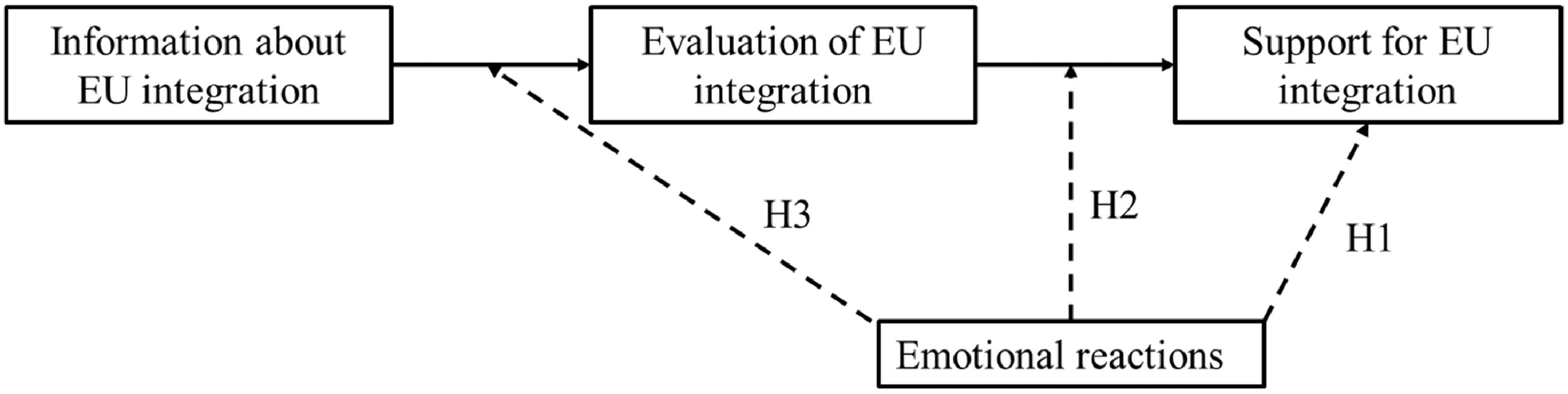
Our first set of hypotheses concerns how emotional reactions directly affect support for EU integration, so whether and how individuals want to re-order their country’s relationship with the EU.
2
Angry citizens should be more in favour of cutting ties with the EU. This is because angry individuals are more confrontational and less risk-averse. Anger leads to more confident and aggressive responses to a given threat that are meant to remove it completely (Druckman and McDermott, 2008). In contrast, anxious citizens are more open to compromise than angry individuals (Huddy et al., 2005; MacKuen et al., 2010). Anxious citizens also tend to perceive higher levels of risk, coupled with a greater sense of uncertainty and lack of control (Huddy et al., 2005). Hence, they are also generally more risk-averse, preferring caution over radicalism. Anxious citizens should therefore be more likely to support re-negotiation of their country’s relationship with the EU. Finally, while enthusiasm is generally linked to political interest and mobilisation (Marcus et al., 2000), its status as a positive emotion means that these citizens should not want to leave the EU or renegotiate the terms of membership. Our first three hypotheses are thus: H1: Anxious citizens are more likely to favour renegotiation than angry citizens (1a), and angry citizens are more likely to favour leaving the EU than anxious citizens (1b), while enthusiastic citizens are less likely to favour renegotiation or leaving the EU than anxious or angry citizens (1c).
If different emotions lead to different kinds of information-seeking and information-processing on European issues, then the resulting EU attitudes should also vary in their relationship with utilitarian concerns and affective evaluations. The EU stances of fearful citizens should be more strongly linked to cost–benefit analyses of the EU. We know that utilitarianism in the form of perceived costs and benefits of European integration provides a robust explanation of people’s EU attitudes, with those who perceive that integration benefits themselves and/or their country more likely to support the EU (e.g. Gabel, 1998; Gabel and Whitten, 1997). In contrast, angry and enthusiastic citizens may base their stance less on their perceptions of the costs and benefits of the EU. Such citizens should base their overall opinions more on affect-based evaluations of the EU (Garry, 2014; MacKuen et al., 2010). When asked about their opinion regarding political matters, angry and enthusiastic individuals tend to rely on heuristics based on their overall views (Brader and Marcus, 2013: 185). H2: The attitudes of angry and enthusiastic citizens towards the EU are less conditional on utilitarian considerations concerning EU integration than those of anxious citizens (2a), and the attitudes of angry and enthusiastic citizens towards the EU are more conditional on affect-based considerations concerning EU integration than those of anxious citizens (2b).
We do not test directly how emotions moderate information-seeking and information-processing. Instead, we take advantage of the empirical consequences that should be observable if emotions moderate citizens’ cognitive behaviour. We argue that the impact of emotions on information-seeking influences how nuanced and differentiated citizen opinions are. The EU is a complex institutional arrangement that covers a wide array of different policy areas. It is reasonable to support EU integration in some areas more than in others. However, emotions will affect the extent to which individuals want, look for and process information about the EU. If anger or enthusiasm leads to less information-seeking relevant to integration, citizens associating the EU with those emotions will have more uniform opinions about EU integration across policy areas. In contrast, anxiety is likely to lead individuals to seek out more information, which should also lead fearful individuals to be less uniform in their support or opposition across policy areas. Of course, some anxious voters will still develop uniform views on the EU, but their tendency to seek out more information should on average counteract these tendencies, at least compared to angry and enthusiastic voters. H3: Angry and enthusiastic citizens’ opinion on European integration is likely to be more uniform across policy areas than that of anxious citizens.
Data and methods
We rely on data collected from a large-N cross-sectional Online survey (n = 3000) conducted in the UK in April 2015, about 14 months before the Brexit referendum. The UK provides an ideal environment to test the effect of emotional reactions on public preferences towards European integration as the debate in light of the Brexit referendum increased the politicisation of the EU, defined as ‘higher levels of salience, polarisation of opinion and the expansion of actors and audiences involved in EU issues’ (De Wilde et al., 2016: 3). ResearchNow recruited our participants using online panels of approximately 500,000 respondents from a wide variety of Internet sites to avoid the bias associated with limited source recruitment. Our survey is representative of the British population in terms of gender, age and region (see Online appendix). Online surveys tend not to be fully representative of populations in terms of education and income; however, in-person and Online survey data tend to yield similar results both in terms of estimating parameters and the overall explanatory power of competing models (e.g. Sanders et al., 2007), so we consider this to be a limited problem for our analysis. We control for education and income in our models, also accounting for the fact that the less-educated and less well-off citizens voted in favour of Brexit (Hobolt, 2016).
Measures of EU support
Our analyses use two questions that measure different aspects of opinion about the EU. First, we capture an individual’s willingness to renegotiate EU membership based on answers to the agree–disagree statement ‘The UK should renegotiate the terms of its EU membership’. Second, we examine an individual’s opinion on whether the UK should leave the EU based on the agree–disagree statement ‘Irrespective of renegotiation, the UK should leave the EU’. Answers to both questions were measured on a seven-point Likert scale ranging from 1 (‘strongly disagree’) to 7 (‘strongly agree’). The points in between were labelled: ‘disagree’, ‘slightly disagree’, ‘neither agree nor disagree’, ‘slightly agree’ and ‘agree’. While the majority of respondents wish to renegotiate the terms of the UK’s EU membership, opinion is much more varied when it comes to leaving the EU (Figure 2).
Attitudes towards renegotiation of the terms of the UK’s EU membership.
To measure the degree of attitude uniformity across EU policies, we asked respondents a series of questions to capture how much authority they think the EU should have in 19 policy areas. Specifically, we asked ‘To what extent do you agree or disagree that the EU should have more authority over the EU Member States in the following policy areas’. 3 Agreement was again measured on seven-point scales. To assess attitude uniformity, we calculated the standard deviation of each individual’s responses across these 19 policy areas.
Measures of emotional reactions
Our survey asked: ‘Which, if any, of the following words describe your feelings about Britain’s membership of the EU (choose up to four words).’ As in the British Election Study (e.g. Whiteley et al., 2010), respondents could choose a maximum of four emotions from a list of nine: angry, disgusted, uneasy, afraid, happy, hopeful, confident, proud, and indifferent. The most prominent reaction to Britain’s membership of the EU is ‘uneasy’ at 49.3% followed by ‘hopeful’ at 25.3%. The least chosen emotion is ‘proud’, at 7.4% (Figure 3). About a quarter of respondents say that they feel ‘indifferent’ about Britain’s EU membership.
Emotional reactions to Britain’s membership of the EU, raw and recoded.
We combine these emotions into four groups (Figure 3). 4 We categorised individuals as afraid if they ticked either uneasy or afraid or both (Wagner, 2014) and as angry if they ticked either angry or disgusted or both. 5 Individuals are categorised as enthusiastic if they choose ‘happy’, ‘hopeful’, ‘confident’ or ‘proud’ (Marcus and MacKuen, 1993). While these terms may seem to tap into different emotions, they tend to be very similar in terms of their consequences (Brader and Marcus, 2013: 175). We measure indifference as those people who ticked that box; most people who are indifferent chose no other emotions.
The design of the survey question means that respondents can state that they have different feelings at the same time, e.g. anger and fear. This is implied by and consistent with current approaches to studying emotions (Carver and Harmon-Jones, 2009: 197; Tellegen et al., 1999). In our survey, 36% reported feeling fear and not anger, 6% reported feeling anger but not fear, and 16% reported anger and fear. 6
In addition to examining the direct impact of these emotions (H1a–H1c), we also aim to test whether the presence of certain emotions moderates the impact of other attitudes on preferences concerning European integration. First, we hypothesised that the effect of cost–benefit considerations varies by emotional reaction (H2a). To test this, we interact our emotion indicators with a variable measuring the perceived costs and benefits of membership. This is assessed using answers to the agree–disagree statement ‘Britain has greatly benefited from being a member of the EU’; higher levels of this seven-point variable indicate lower perceived benefits. 7
Second, we suggested that the effect of the general underlying stance towards the EU also differs by emotional state (H2b). To test this, we interact our emotion indicators with a variable measuring overall support for the EU; this is measured by extracting the first component of a principal components analysis of three items: first, how much integration the respondent would like to see, measured on a 0–10 scale where 0 means ‘the integration of Europe has already gone too far’ and 10 that ‘European integration should be pushed further’; second, trust in EU institutions, measured on a 0–10 scale where 0 means ‘do not trust at all’ and 10 means ‘trust completely’; and, third, satisfaction with democracy in the EU, measured on a 0–10 scale where 0 means ‘completely dissatisfied’ and 10 means ‘completely satisfied’. This variable captures a respondent’s overall positive or negative evaluation of the EU.
Control variables
To assess the effects of emotions, our models have to include important confounders. Emotional reactions towards the EU may be caused by characteristics and attitudes that also predict attitudes towards the EU. For instance, an individual who opposes immigration may be more likely to be both angry at Britain’s EU membership and more likely to support Britain leaving the EU, without anger having a direct effect on the outcome variable at all.
First, partisanship and party cues are pivotal in structuring people’s EU attitudes (e.g. Steenbergen et al., 2007), but also influence emotions (Ladd and Lenz, 2008). We include variables for party sympathy for Conservatives, UKIP, Labour, Liberal Democrats, Greens and any other party. Respondents were asked to assess, on a scale of 0–10: ‘How likely is it that you would ever vote for this party?’. This is known as the propensity-to-vote question; results do not differ if we use a standard party identification question instead.
Another potential concern is that our emotion measures are proxies for attitudes concerning EU integration. Therefore, we include those attitudes in our models to account for these confounders. We control for the items that make up our EU opinion scale used to test H2, i.e. how much integration the respondent would like to see, trust in national and EU institutions (e.g. see Anderson, 1998; Armingeon and Ceka, 2014); and a respondent’s satisfaction with democracy in the EU. We also include a measure of European identity in our models, with higher values indicating strong feelings of European identity (e.g. Carey, 2002; McLaren, 2002).
Our controls also comprise variables related to the utilitarian approach to European integration (e.g. Gabel, 1998; Gabel and Whitten, 1997; Gomez, 2015). These include questions that capture an individual’s personal economic evaluation and her assessment of the country’s economic situation. These are measured from 1 to 5, with lower values indicating improvement compared to 12 months ago. We control for the respondent’s attribution of responsibility to the EU for her country’s economic situation, measured on a scale from 0 to 10, with higher values indicating full attribution of responsibility to the EU. Next, we know that cognitive mobilisation influences an individual’s view of European integration (Inglehart, 1970), so we control for education levels. This variable is measured on a four-point scale with 1 indicating ‘less than secondary school exams’, 2 ‘secondary school exams (e.g. GCSEs or equivalent)’, 3 ‘college exams (e.g. A-Levels, NVQ or equivalent)’ and 4 ‘university (e.g. Degree, Professional qualifications)’.
We also add controls that relate to ideology (Hooghe and Marks, 2009), including an individual’s self-placement on the left–right dimension; attitudes on state intervention and redistribution, with higher values indicating leftist attitudes; attitudes on immigration, with larger values denoting right-wing attitudes; and attitudes towards addressing climate change, with higher values indicating a positive stance. Finally, other individual-level controls include gender, age, income and the frequency of following current affairs on TV, the internet and in the newspapers. 8
Results
Direct effects on support for EU membership
The impact of emotional reactions on attitudes towards renegotiation and preferences for the UK’s constitutional relationship with the EU.

Note: Standard errors in parentheses.
p < 0.05, **p < 0.01, ***p < 0.001.
Model 1 provides evidence that fearful and anxious citizens wish to renegotiate the terms and conditions of the country’s EU membership, with enthusiastic citizens less likely to do so. Note that the variables for each emotional reaction can change independently from each other, as different emotions can co-occur. The effect for anger is not statistically significant; it is, however, statistically significantly different from the effect of anxiety (p < 0.001). The effects of emotions on preferences over renegotiation are shown in Figure 4, which shows the predicted level of support for renegotiating EU membership on a 1–7 scale. The figure shows that anxious respondents most strongly support renegotiation, followed by angry and enthusiastic citizens. Perhaps angry and enthusiastic voters are more likely to have already made their mind up with regard to the UK’s EU membership, so that renegotiation no longer matters for their decision. Indifferent voters are similar to angry and enthusiastic voters.
Direct effect of emotional reactions on support for EU integration.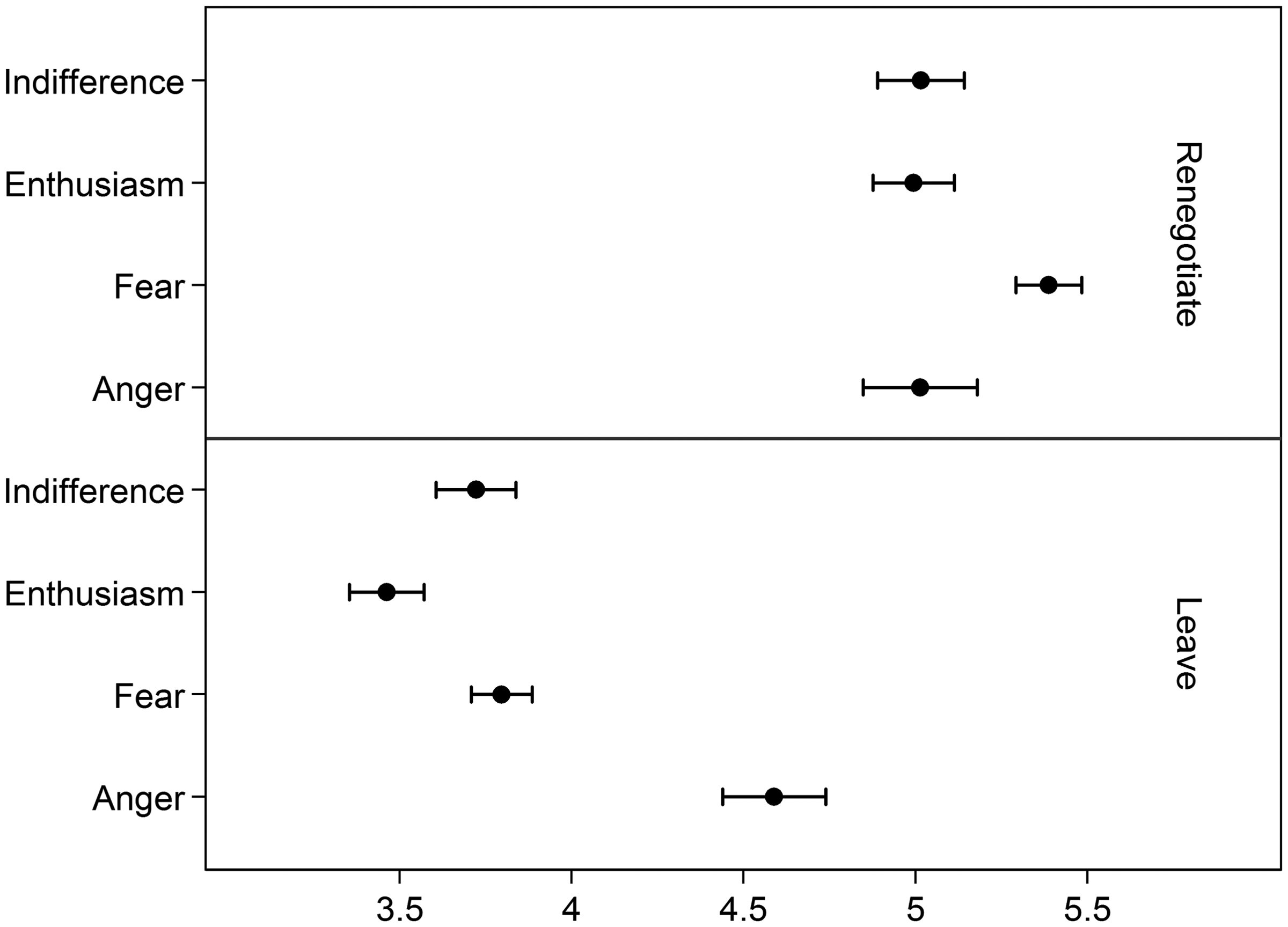
This resonates well with our findings in Model 2, where we test H1b, i.e. that angry citizens are more likely to favour leaving the EU than anxious citizens. In Model 2, we see a strong relationship between anger and the wish to fundamentally change the UK’s constitutional relationship with the EU. Enthusiastic citizens are less likely to want to leave the EU. Fear has a small but statistically significant positive effect on wanting to leave the EU compared to enthusiasm; moreover, anxious citizens are statistically significantly less likely to support leaving than angry citizens. Indifferent voters are similar to anxious voters.
Our findings related to the relationship between emotions on the one hand and willingness to renegotiate and preference for leaving the EU on the other are robust. Our models include a number of variables controlling for the main confounders of the relationship between emotional reactions and attitudes towards the EU. Party sympathy does not seem to have a strong effect across the models, with two exceptions: those who support the openly Eurosceptic United Kingdom Independent Party (UKIP) are more likely to wish to leave the EU; and those who support the Conservatives are more likely to support renegotiation. The variables relating to the EU also have a mixed impact. For example, lower perceived benefits decrease the willingness to renegotiate and increase support for leaving the EU. The attribution of responsibility variable is positive and significant across models, i.e. the more an individual attributes responsibility to the EU for the UK’s economic situation, the more likely they are to support both renegotiation and withdrawal. Higher EU trust, satisfaction with EU democracy and support for deeper integration decrease the desire for renegotiation, but these variables have a far weaker effect on wanting to the leave the EU. Finally, we find that there is a relationship between willingness to renegotiate and leaving the EU, i.e. individuals who want to renegotiate are more likely to wish to leave the EU and vice versa.
Our results show that higher levels of education mean a voter is more likely to wish to renegotiate the UK’s EU membership but less likely to wish to leave (see Hobolt, 2016). Among educated voters, a preference for renegotiation does not necessarily lead to a desire for withdrawal. Subjective perceptions of one’s personal economic situation compared to last year are associated with a wish to leave the EU, but there is no effect on willingness to renegotiate. Negative perceptions of the country’s economic situation are related with less support for renegotiation, but have only a weak positive effect on wish for withdrawal. Ideological dimensions relating to the economy and immigration are also important, and we note that the immigration scales in general have a larger impact than the economic scales. Finally, higher levels of trust in the UK government increase the desire both to renegotiate and to leave the EU.
Emotions as moderators of cost–benefit and affective considerations
Our second set of hypotheses concerned how emotions moderate the impact of general EU attitudes and cost–benefit perceptions. To test these hypotheses, we interact cost–benefit perceptions and overall EU attitudes with our emotion indicators. Figure 5 shows the marginal effect of each attitude for angry, fearful, enthusiastic and indifferent voters, respectively.
9
The dependent variable is willingness to leave the EU. The top half of the figure shows the marginal effect of general EU attitudes depending on emotional reactions, while the bottom half shows the marginal effect of cost–benefit perceptions. In order to read Figure 5 correctly, note that, unlike in Figure 4, the x-axis is the predicted marginal effect of cost–benefit perceptions and general attitudes; in Figure 4, the x-axis is the predicted level of the dependant variable.
Emotions as a moderator of other considerations.
Turning first to cost–benefit perceptions (bottom half of Figure 5), we can see that the marginal effect of this variable is clearly larger for anxious than for angry or enthusiastic voters. While cost–benefit perceptions are important for voters with all emotional reactions, the effect is about twice as large for anxious than for angry or enthusiastic individuals. Indifferent voters are between anxious voters on the one hand and angry or enthusiastic voters on the other. Overall, H2a is confirmed.
The top half of Figure 5 shows that the effect of general EU evaluations is negative for angry individuals, who are the only group for whom the marginal effect is statistically significantly smaller than 0. Enthusiasm appears to increase the positive effect of general EU attitudes. The moderating effect of enthusiasm also statistically differs from that of anxiety (F = 6.09, p = 0.01), which itself is only slightly positive and far from statistical significance. Finally, there is no clear moderating effect of indifference. We can confirm H2b: overall, it seems that angry and enthusiastic individuals are indeed more likely to rely on heuristic decision-making and therefore on general EU opinions, while anxious citizens base their decisions more on cost–benefit considerations.
Effects on information-seeking
The effect of emotional reactions on opinion uniformity across policy areas.

Note: Standard errors in parentheses.
p < 0.05, **p < 0.01, ***p < 0.001.
However, we also partly disconfirm H3 in that we find that enthusiasm is associated with increased variation in opinion, and its impact is in fact similar to that of fear. Hence, while angry citizens have by far the most uniform views, enthusiasm and fear are both associated with less heterogeneous opinions. Perhaps the increased interest in and affect towards the EU implied by enthusiasm are just as important for information-seeking as enthusiasm’s tendency to limit careful information-processing. Overall, it seems that anger most clearly leads to a lack of careful information-seeking and more uniform opinion across different EU policy areas.
Discussion
In this article, we have put forward and tested a theoretical framework of how emotional reactions affect public preferences on the EU at three stages of opinion formation. First, fear increases citizens’ desire to renegotiate their country’s constitutional relationship with the EU, while anger increases their willingness to leave the EU. Second, the attitudes of angry and enthusiastic citizens towards the EU are less conditional on the perceived benefits of EU integration than those of anxious citizens. Moreover, angry voters’ stances on EU membership are related more to underlying attitudes towards the EU than among fearful and enthusiastic voters. Finally, indicative evidence shows that angry citizens tend to express less nuanced and varied views on specific polices related to the EU; we suggested that this is due to differences in information-seeking and information-processing.
Our findings are significant as the EU is currently highly contested across EU member states. The continued inability of the EU to resolve the economic and refugee crises may have contributed to feelings of anger and fear among EU citizens, and these feelings have also been strategically exploited by populist politicians. In order to explain support or opposition to the EU, we need to consider how these emotional considerations may affect public opinion and behaviour. Doing so may help us go some way towards understanding the increasing success of Eurosceptic parties in the 2014 European Parliament elections as well as the UK’s decision to leave the EU.
This research also has implications for the persuasiveness and effectiveness of EU-related campaigns. Campaigns that elicit anger are more likely to solidify existing Eurosceptic attitudes, whereas pro-EU groups that create enthusiasm will mobilise citizens in favour of European integration. However, when discussions about the EU elicit anxiety, citizens are more likely to have nuanced positions on specific EU policies and base their EU opinion on cost–benefit considerations. A campaign that encourages fear and anxiety may mean that voters pay closer attention to the debate and decide more cautiously, so both sides will have to marshal good and convincing evidence for their position.
Our analysis also sheds light on the Brexit referendum. The two official campaigns ‘Britain Stronger In Europe’ and ‘Vote Leave’ set the agenda by transforming the debate into a battle between two issues: economy versus immigration (Hobolt, 2016). Whereas the rhetoric was negative in both camps, being referred to as ‘Project Fear’ and ‘Project Hate’ respectively by the other side, they each elicited different negative emotions. On the one hand, Britain Stronger In framed its campaign in terms of risk and risk avoidance. Its posters included phrases such as ‘Leave Europe and we will lose our seat at the table’, ‘Leave and there is no going back’ and ‘Leaving Europe would be a leap in the dark’. On the other hand, Vote Leave messages such as ‘Turkey (population 76 million) is joining the EU’ and ‘Let’s give our NHS the £350 billon the EU takes every week’ elicited anger, driven by a sense of collective threat. Anger was further aroused through the portrayal of the EU as an illegitimate source of this threat. Therefore, by evoking feelings of anxiety, the Remain camp sought to persuade voters to maintain the status quo (as the less risky option), whereas by eliciting anger, the Vote Leave camp enabled more risk-taking behaviours. Interestingly, neither campaign tried hard to evoke positive emotions.
A factor relevant for future research is the effect of these emotions on turnout. Fear and anxiety tend to be associated with avoidance strategies in order to minimise the experienced threat whereas anger may transform a stimulus into a reaction (Halperin and Pilskin, 2015). Enthusiasm tends to be linked to political interest and mobilisation (Brader and Marcus, 2013). It is plausible that anxiety is not a good motivator to turn out, whereas anger and enthusiasm may induce citizens to vote (Brader, 2006; Valentino et al., 2011). Future research should therefore examine whether citizens who expressed fear about EU membership were less likely to go to the ballot box as opposed to angry or enthusiastic citizens. If this is empirically verified, then the Vote Leave campaign not only persuaded citizens in terms of its argument but also might have encouraged people to participate in the vote. Put differently, if the Remain campaign had managed to create more enthusiasm about the EU, it might have more strongly mobilised UK citizens.
Future research should also take a comparative perspective. Our theoretical predictions apply to the UK, and similar arguments have been tested in Ireland (Garry, 2014). In both cases, the EU issue is relatively salient due to the success of UKIP (Britain) and frequent referendums (Ireland). However, we still do not know whether emotions affect public opinion on the EU where Euroscepticism is low, e.g. in Spain and Portugal, or in newer member states such as in Central and Eastern Europe. Overall, research that takes into account individuals’ emotions on the EU promises to improve our understanding of how and when people support and oppose European integration.
Footnotes
Acknowledgements
We are grateful to the journal’s referees for comments.
Funding
The author(s) disclosed receipt of the following financial support for the research, authorship, and/or publication of this article: This article draws upon research funded by an ESRC Future Leaders grant, ES/N001826/1.
Notes
References
Supplementary Material
Please find the following supplemental material available below.
For Open Access articles published under a Creative Commons License, all supplemental material carries the same license as the article it is associated with.
For non-Open Access articles published, all supplemental material carries a non-exclusive license, and permission requests for re-use of supplemental material or any part of supplemental material shall be sent directly to the copyright owner as specified in the copyright notice associated with the article.
