



Abstract
Why has the Transatlantic Trade and Investment Partisanship met with strong public resistance among some Europeans and in some European Union member states, but not in others? This article argues that one important perspective to explain the pattern of support for TTIP is the role of heuristic opinion formation and issue attention. Analysing multiple waves of Eurobarometer data, I find that views of the two treaty partners, the US and the European Union, shape attitudes towards TTIP and that the largely post-materialist concerns over TTIP resonated specifically in those European countries whose citizens’ attention was less focused on economic issues. In showing how opinions towards concrete real-world trade policy proposals are shaped by the political context, these findings complement previous research on citizens’ general stances towards trade.
Keywords
Introduction
Since July 2013 and until the inauguration of Donald Trump in January 2017 brought the negotiations to a halt, the European Union (EU) and the United States of America (USA) had been negotiating over a preferential trade agreement, the Transatlantic Trade and Investment Partnership (TTIP). With tariffs between the USA and the EU already down to a low level, the focus of the proposed TTIP lies in the reduction of non-tariff barriers to international trade and investment. The intended broad reduction of market access restrictions and regulatory hurdles to trade and investment amounts to a deep form of economic integration between two regions whose economies together amount to almost half of worldwide GDP. As compared to the usually low public salience of trade policies in the EU, TTIP has gained a remarkable amount of public attention in some EU member states. Advocates have pointed to the economic potentials and the opportunity to set beneficial international standards. Critics have pointed to the low transparency of the negotiations as well as the limited involvement of national parliaments and the broader public. Regarding the treaty’s substance, they have raised worries that TTIP would limit the room-to-manoeuvre for national democratic decision-making and endanger standards regarding worker, consumer and environment protection.
This debate has resulted in very heterogeneous levels of support for TTIP across the EU. Figure 1 below shows citizens’ attitudes on a dichotomous measure of support for ‘a free trade and investment agreement the EU and the USA’ according to Eurobarometer data from May 2016. At one extreme, only 22% of those Austrians who expressed an opinion were in favour of the agreement. At the other extreme, about 90% of Lithuanians supported TTIP. Strikingly, opposition to TTIP is high in some countries that are considered to benefit from globalization, such as Luxembourg and Germany.
Support for TTIP across EU member states. Note: Based on post-stratification weighted Eurobarometer data from May 2016. Note: TTIP: Transatlantic Trade and Investment Partnership; EU: European Union.
What divides supporters and opponents of TTIP? Why is support for TTIP so much lower in some of the EU member states? This article argues that to answer these questions we should take findings of how individuals arrive at decisions under limited information into account. It emphasizes the role of heuristic information processing and considers that opinions are often shaped by how much attention is paid to different considerations. In doing so, I build on research on trade policy preferences that starts from the observation that trade policy is a complex and unfamiliar issue for most citizens (Díez Medrano and Braun, 2012; Rho and Tomz, 2017). Citizens therefore use heuristics such as elite-cues to form opinions (Hicks et al., 2014; Naoi and Urata, 2013; Urbatsch, 2013) and are affected by how trade policy issues are framed (Hiscox, 2006; Jensen and Shin, 2014; Naoi and Kume, 2015; Rho and Tomz, 2017).
I add to this literature in two related ways. First, I propose that party endorsements are not the only relevant heuristic shortcut individuals rely on to form opinions on trade policy. Specifically, I argue that – given the complexities involved in the discussion over TTIP – individuals rely on a ‘treaty partner heuristic’: Individual views of the two treaty partners, the EU and the US, serve as cues to inform attitudes towards TTIP. Second, I suggest that societal levels of attention for different issue areas can affect opinions on trade because they influence whether certain frames resonate with publics or not. Consider that TTIP proponents and opponents tend to highlight different aspects: Economic benefits, on the one hand, vs ‘post-materialist’ worries over consumer protection, the environment and national democratic self-determination, on the other. I argue that how much attention is spent on economic (vs non-economic) issues in a society shapes the debate over TTIP and specifically whether the post-materialist critique gained attention or not. TTIP support should therefore be lower in countries with lower attention to economic issues.
Analysing four waves of Eurobarometer surveys conducted between November 2014 and May 2016, I find strong empirical support for the treaty partner heuristic and the issue attention effect. In contrast, explanations grounded in economic self-interest – while playing a leading role in research on trade attitudes in general – turn out to be of limited explanatory power in the case of TTIP.
The economic approach
Much research on attitudes towards trade studies how economic self-interest shapes preferences. Accordingly, my considerations start from this approach as well. Before turning to my argument about the role of heuristics and issue attention in the next section, this section will point out that explanations grounded in economic self-interest are likely to give us little leverage in the case of TTIP.
The basic idea of the economic approach is that those who are likely to gain, in material terms, from economic openness should be in favour of more integration, while those who are likely to lose should oppose integration. Winners and losers are either defined along sectors (the specific factors or Ricardo-Viner model) or factors of production (the factor endowment or Heckscher-Ohlin model and the ‘new new’ trade theory in the tradition of Melitz, 2003). In the specific factors model, workers and/or capital-owners in comparatively advantaged sectors gain from and support liberalization. In the factor endowment model and according to the Stolper-Samuelson theorem, skilled-labour (or capital) profits from international economic integration in skill-abundant (or capital-abundant) countries. In the high-income countries, high-skilled workers are expected to profit and should support economic openness. The ‘new new’ (or heterogeneous firms) trade theory states that highly productive firms – that draw heavily on input from high-skilled labour – will profit from increased export opportunities. This implies a skill-gap in support for trade that is not contingent on the abundance of skilled-labour (Ardanaz et al., 2013).
The economic self-interest argument has received mixed empirical support. Most studies have focused on divisions between skilled and unskilled labour. 1 In line with the prediction of the specific factors model (and the ‘new new’ trade theory), studies consistently find that in high-income countries educational attainment is positively related to support for free trade (Hays et al., 2005; Mayda and Rodrik, 2005; O’Rourke and Sinnott, 2001; Scheve and Slaughter, 2001). Yet, researchers have doubted that this pattern reflects economic self-interest: Hainmueller and Hiscox (2006) argue that it reflects different exposure to the idea that free trade is generally beneficial; others argue that it reflects differences in symbolic socio-cultural attitudes towards international openness, such as xenophobia and nationalism (Mansfield and Mutz, 2009; Margalit, 2012). In a recent contribution, Rho and Tomz (2017) point out that most individuals do not understand the distributional consequences of trade. When informed about distributional effects, citizens’ preferences become more in line with their self-interests, however. Rho and Tomz conclude that citizens’ preference can be driven by self-interest, but that this is contingent on individuals’ causal beliefs.
Empirical tests of the economic approach have almost exclusively focused on differences between individuals, yet it is conceivable that expected economic gains at the country level shape attitudes as well: Support should be higher, the more a country is expected to gain from trade. Relatedly, Mansfield and Mutz (2009) show that, at the individual level, perceived effects of trade on the US economy are strongly correlated with support for free trade.
At first sight, the economic approach seems to hold potential to explain differences in support for TTIP – both at the individual and country level. Following Rho and Tomz (2017), potential self-interest effects are probably contingent on individuals’ causal beliefs: They are likely when the distributional consequences are clear and pronounced from an economic point of view, unambiguously communicated to the public and perceived by individuals. Upon closer inspection, even the first condition is not well met in the case of TTIP, neither at the individual nor country level.
At the individual level, the distributional effects of a TTIP along skill levels are not as clear as with regard to trade in general. Given the similar structure of factor endowments across the USA and the EU, ‘Stolper-Samuelson type effects’ are likely limited (Felbermayr et al., 2015: 529). The ‘new new’ trade theory, however, would expect relatively larger gains for higher skilled individuals. Economic estimates on the potential impacts of TTIP in the EU across different skill levels point to largely similar gains (Egger et al., 2015; Francois et al., 2013). Overall, economic self-interest along skill level divides cannot be ruled out a priori, but seem to hold limited potential in explaining support for TTIP. 2
What about aggregate gains? Estimates on the country-level effects of TTIP on real income are rare, but available from Aichele et al. (2014) and Felbermayr et al. (2015). Both studies fit structural trade models to observed data, estimate effects of past trade agreements and simulate the effects of TTIP on this basis. While Aichele et al. (2014) include detailed sectoral data, Felbermayr et al. (2015) focus on aggregate trade flows. These different methodologies arrive at vastly different distributions of relative gains: The Pearson correlation between the two measures is 0.03 (n = 28). Apparently, even the experts were uncertain about the pattern of gains across countries – arguably for good reason given that the exact parameters of a final agreement have always been unclear. It is therefore doubtful that ordinary citizens had any sense of whether their country would especially profit or not. Perhaps, economic fundamentals are related to support for TTIP in a less demanding way: Support could be higher in countries with higher degrees of economic openness as these tend to be more dependent on and accustomed to economic globalization. In a similar vein, economic ties to the US specifically could matter. Yet, recall that Figure 1 showed low support for TTIP in one of the most open countries with strong foreign direct investment (FDI) ties to the US: Luxembourg.
Overall, economic interests along skill levels or economic characteristics of countries seem to not go far in explaining support for TTIP – given the absence of clear expectations on the distributional effects in combination with evidence on citizens’ limited understanding of the distributional effects of trade. The empirical part will test whether economic self-interest indeed does not matter much. The seemingly limited potential of the economic approach invites the question what else explains attitudes toward TTIP. The literature identifies several other determinants of trade attitudes that might play a role: These are symbolic predispositions towards international openness and foreigners, such as national identity and xenophobia (Mansfield and Mutz, 2009; Margalit, 2012), other ideational factors, such as inequity aversion (Lü et al., 2012) or environmental concerns (Bechtel et al., 2012), psychological characteristics, such as risk orientations (Ehrlich and Maestas, 2010; Johnston, 2013; Mayda et al., 2007), and the role of heuristic cues and framing effects (Díez Medrano and Braun, 2012; Hicks et al., 2014). In this contribution, I focus on the latter approach as it holds large potential to illuminate why some individuals and countries opposed TTIP.
The treaty partner heuristic, disaffection with national politics and issue attention
In developing my argument, I build on research on trade policy preferences that starts from the observation that trade policy is a complex and unfamiliar issue for most citizens. In a Spanish survey, for example, Díez Medrano and Braun find that most (82.1%) citizens admit to know little or nothing about the consequences of trade. Similarly, 61.6% indicated that they have never heard a comment from either family, friends or work colleagues on the import of foreign products. Such low levels of information are echoed in Rho and Tomz’ (2017) findings on citizens’ limited knowledge of trade’s distributional effects. That citizens’ opinions on trade shift dramatically in response to how questions are framed (Hiscox, 2006; Jensen and Shin, 2014; Naoi and Kume, 2015; Rho and Tomz, 2017) is a further indication that they do not hold fixed positions on trade that stand on a strong informational basis. Against this background, scholars have argued that citizens rely on heuristic information processing, that they are responsive to which positions political elites endorse and to how they frame questions of trade policy.
As to the use of heuristics in general, psychological research shows that humans use mental shortcuts, so-called heuristics, intuitively to answer complex and difficult questions, effectively substituting the difficult question with a simple one to which an answer is readily available (Kahneman, 2011). The power of such heuristic processing in the formation of political attitudes has been shown in a wide range of settings, especially when it comes to complex policy questions on which citizens hold limited information (Bullock, 2011). Research on support for European integration, for example, emphasizes that citizens rely on heuristic cues: They either transfer attitudes from the national to the EU level (Anderson, 1998; Armingeon and Ceka, 2014) or follow cues from political elites, especially parties (Hooghe and Marks, 2005; Steenbergen et al., 2007). Party attachments seem to also inform citizens’ positions on other complex questions of international economic policy such as whether to bail out other countries (Bechtel et al., 2014) or whether or not to default on sovereign debt (Curtis et al., 2014). Going beyond party attachments, research on voting behaviour in EU referenda has identified satisfaction with and trust in the national government as an important heuristic cue (de Vreese and Boomgaarden, 2005; Hobolt and de Vries, 2016).
Recent studies have applied the idea that citizens use heuristic cues to form opinions on complex issues to trade policy attitudes (Hicks et al., 2014; Naoi and Urata, 2013; Spilker et al., 2016a; Urbatsch, 2013). Hicks et al.’s (2014: 106) study on Costa Rica’s referendum on the Central American-Dominican Republic Free Trade Agreement (CAFTA-DR), for example, considers that citizens ‘can be swayed by political elites who, because of their public position, resources, and information, have the capacity to influence public opinion’. They find, similarly to Urbatsch (2013), that ‘the political cueing and framing done by the leading party, the PLN’ (Hicks et al., 2014: 115) tilted the balance in favour of CAFTA-DR.
Heuristic processing seems likely in the case of TTIP as well. While TTIP attracted remarkable public attention in some member states, the issues at stake were certainly complex: Proponents and opponents tended to talk past each other by emphasizing different facets of the agreement and the discussion involved difficult technical questions unfamiliar to most citizens. Add to that the uncertainty originating from the fact that no one could know how a final agreement would exactly look like. Such a setting makes it likely that individuals formed their opinions on TTIP in part by relying on heuristic cues. Drawing on the case of TTIP, I add to previous research on heuristic processing in the formation or trade policy attitudes by arguing that party endorsements are not the only relevant heuristic shortcut individuals rely on to form opinions on questions of trade policy.
A likely powerful heuristic is what I call the ‘treaty partner heuristic’: Individuals draw on their general orientations towards the treaty partner as a heuristic when forming attitudes on preferential trade agreements. Regarding foreign security policy, so-called ‘enemy images’ have been suggested as heuristics that shape attitudes some time ago by Hurwitz and Peffley (also see Peffley and Hurwitz, 1992). They ask ‘How do citizens organize, and make sense of, a complex policy domain such as foreign policy?’ and argue that ‘Americans base their policy choices on fundamental assumptions concerning the nature of the main U.S. postwar adversary – the Soviet Union’ (Hurwitz and Peffley, 1990: 3). I maintain that this logic extends from international security to international trade. Recent conjoint experiments by Spilker et al. (2016a) show that citizens prefer hypothetical partners for preferential trade agreements that are culturally similar, democratic and maintain high labour and environmental standards. Moving from characteristics of hypothetical to real countries, Jensen and Lindstädt (2013) show that American and British respondents view FDI much more friendly if the source country is Germany rather than Saudi-Arabia. They attribute this result to a country-of-origin heuristic. In line with this related evidence, I expect attitudes towards the US to affect orientations towards TTIP.
As to the specific mechanism, the treaty partner heuristic might reflect bounded rationality or an affective reaction. On the one hand, those with negative views of the US might be critical of the US government’s intentions and therefore fear an agreement that is disadvantageous for the European side. On the other hand, negative opinions of the US might matter through an ‘affect heuristic’ (Slovic et al., 2002) as the object ‘US’ triggers a negative emotional that leads to a rejection of TTIP. While I cannot discriminate between the different types of heuristics, the present study tests whether views of the US role in world politics are predictive of support for TTIP at the country level. H1: The more positive individuals’ views of the US are in a society, the higher is support for TTIP. H2: The higher their support for the EU, the more likely individuals are in favour of TTIP. H3: The higher their support for the political system at the national level, the more likely individuals are in favour of TTIP.
The argument starts from the observation that TTIP proponents and opponents tend to highlight different aspects of the agreement, framing the discussion over TTIP in very different ways. Whereas the pro-arguments centre on the potential economic benefits, the critique is mostly concerned with labour, consumer and environment regulation and national sovereignty. No matter whether the different viewpoints reflect real trade-offs or merely different framing strategies, they are likely to affect citizens’ orientations towards TTIP. In a working paper, Dür (2016; also see Spilker et al., 2016b) shows via survey experiments that these frames indeed matter: Support for TTIP tends to be higher if embedded in positive economic frames and lower if embedded in negative frames relating to the investor-state dispute settlement (ISDS) procedure. In line with this experimental evidence, it is likely that attitudes towards TTIP are shaped by whether individuals prioritize materialist values or ‘post-materialist’ issues, e.g. national democratic self-determination or protection of the environment, in the first place. That concern for the environment can shape views on trade has been shown by Bechtel et al. (2012). Given the worries about chlorinated chicken, genetically modified food and the like, this is likely to hold in the case of TTIP as well.
Importantly, I argue that – over and above the effects of value-cleavages at the individual level – how much attention is spent on different issues in a society overall shapes the debate on TTIP and thereby individual attitudes. I focus on the salience of economic vs non-economic issues. I expect that where citizens consider the most important political issues to be economic ones, the negative post-materialist frames have a harder time to resonate with the public. Consider that it were especially Europe’s ‘crises countries’ in which citizens’ were preoccupied with economic issues: When asked about the two most important issues facing the country and according to the Eurobarometer survey data introduced below, at one extreme, people in Cyprus in November 2014 named on average 1.7 issues that can be classified as economic (see below). This focus on economic problems is likely to have prevented worries related to TTIP’s consequences for consumer protection, the environment and national democracy from gaining steam in the public debate. At the other extreme, the average German respondent in May of 2016 named 0.3 economic issues. Under these circumstances, the post-materialist concerns have been likely met with higher awareness, gained more attention in the public debate and this lead to lower aggregate support for TTIP.
3
H4: The more attention individuals in a society devote to economic issues, the higher is the support for TTIP.
Data and estimation
To test these expectations on what divides supporters and opponents of TTIP, I utilize data from the Standard Eurobarometer surveys from November 2014, May 2015, November 2015 and May 2016 on the 28 EU member states. The four waves contain the dichotomous measure on support for ‘a free trade and investment agreement between the EU and the USA’ used in Figure 1 above. The Online appendix shows that while there is some change in support for TTIP over time within countries, these changes are small relative to the variation across countries. To these survey data, I add covariates measured at the macro level, either at the country or, if possible, country-year level. I first describe how I operationalized the independent variables specified by the four hypotheses; I then turn to control variables and finally discuss the models used to analyse these data.
To capture the effect of attitudes towards the US, I extract information from a previous wave of the Eurobarometer as orientations towards the US were not included in the relevant waves. This allows me to consider the effects of attitudes towards the US at the country level only. Relying on aggregate information is not only a disadvantage, however. Measuring both attitudes at the individual level could introduce endogeneity concerns: It is possible that opinions on TTIP shaped opinions on the US, especially in countries in which TTIP was a salient issue and in which the US negotiation strategy was criticized. I extract attitudes towards the US from Eurobarometer 66.3 conducted in autumn 2006. The considerable time lag is likely to result in some measurement error. On the other hand, as I rely on data from 2006 when TTIP was nowhere on the political agenda, this measure is clearly exogenous to how individuals or societies viewed TTIP and therefore allows for a conservative test. The measure is based on assessments of the US’ role regarding five domains: world peace, the fight against terrorism, the fight against world poverty, protecting the world environment and the growth of the world economy. A principal component factor analysis shows that the five items load strongly on a single factor (see the Online appendix). I computed the factor scores from this solution and took its (post-stratification weighted) mean across individuals as a country’s stance towards the US.
Information on EU support is available from the four Eurobarometer waves. To minimize measurement error, I use a measure composed from items that asks for trust in the European Parliament, the European Commission and the EU overall as well as for the ‘image’ of the EU. These also load strongly on a common factor (see the Online appendix) and the resulting factor score forms my measure of EU support. Support for the national political system was constructed using a similar approach. The measure was built from a factor analysis using items for trust in the national parliament, the national government, political parties and satisfaction with the way democracy works (see the Online appendix).
To capture how much attention is devoted to economic issues in a society, I relied on a question on ‘the two most important issues facing’ the respective country. Respondents could choose maximally two items out of twelve categories. In a first step, I constructed measures of individual issue attention. Attention for the economic situation is high (=1) if respondents chose two of the issues dealing with the economic situation, i.e. ‘economic situation’, ‘rising prices/inflation/cost of living’, ‘taxation’, ‘unemployment’ and ‘government debt’, moderate (=0.5) if they selected only one, and coded 0 if none of those. Problem attention directed at the environment is measured via a dummy variable marking respondents who chose ‘the environment, climate and energy issues’. At the individual level, I expected those who prioritize economic issues to be more supportive of TTIP, whereas those who prioritize environmental issues should be less supportive. Recall, however, that H4 expects an effect of issue attention that operates at the aggregate level: Over and above the effects of which problems individuals prioritize, it should matter how much a society’s attention is focused on economic issues. To test this, I aggregated the information on attention to economic issues to the level of societies, i.e. I calculated the mean of attention to economic issues for each country-survey wave combination.
In addition, I consider a host of control variables. Most of these are related to the economic approach. At the individual level, I proxy for a respondent’s skill level via educational attainment and current occupation. Educational attainment is measured through the age at which respondents finished full-time education (or current age for those still in education). 4 As to current occupation, I rely on the scheme by the Eurobarometer (see the Online appendix) in the main models though I consider alternatives in several robustness checks. This scheme distinguishes between different non-active categories (house persons, student, unemployed, retired) and employed categories (self-employed, managers, other white collars, manual workers). I modified this scheme in one respect: The self-employed were split into a high-skill (professional, business proprietors) and a low-skill category (farmer, fishermen, shop owner, craftsmen). I use manual workers as the reference category as this is the group usually assumed to lose out from trade. As additional demographic controls, gender and age are included.
As economic interests might also operate at the country level, I consider a long list of covariates that might proxy for such effects. These variables are listed along the sources they were obtained from and some further details in the Online appendix. I draw on the estimates on the country-level effects of TTIP on real income from Aichele et al. (2014) and Felbermayr et al. (2015), several measures of a country’s general economic openness and economic ties specifically to the US. Variables related to economic performance, i.e. GDP growth, the unemployment rate and the Gini index, are also considered, as one might think that poor performance leads to lower support for further trade integration – an expectation that contrasts with my argument that attention to economic issues is associated with less opposition to TTIP. Moreover, as larger countries might have more negotiating power and as this might lead to higher support for TTIP, I also take a country’s population size into account.
Finally, I added further individual attitudes that might affect support for TTIP. Perhaps, an individual’s stance towards TTIP just reflects her general views on whether economic globalization is beneficial or not, and little more. I include agreement with the statement that ‘globalization is an opportunity for economic growth’ to consider whether this is the case. My argument implies that this should not be the case. While it is to be expected that views on TTIP are informed by general predispositions on globalization, my argument implies that effects of heuristics and issue attention that are specific to the political controversy over TTIP should have a strong effect even once we control for general attitudes towards globalization. I also employ two proxies that are related to the idea that general symbolic socio-cultural attitudes towards internationalization inform attitudes toward trade issues: First, this is a dichotomous item measuring whether the EU means a ‘loss of our cultural identity’; second, I consider a dummy variable for trust in the United Nations (UN), as an aspect of internationalization on the political dimension. Finally, I add self-reported positions on the left-right scale (1 to 10) that are recoded in two dummy variables separating those on the left (positions 1 to 3) and those in the centre (4 to 7) from those on the right (8 to 10). To allow for an easier interpretation of coefficient sizes, I rescaled all covariates, micro and macro, to range from zero to one.
The resulting dataset contains 111,158 individuals (level 1), which are nested in 112 country-survey/time combinations (level 2), which are, in turn, nested in 28 countries (level 3). I estimate three-level hierarchical models with random-intercepts at the country-time and country level to take the multilevel structure of this data properly into account. Given the binary response variable, I estimate binary logistic multilevel models.
Results
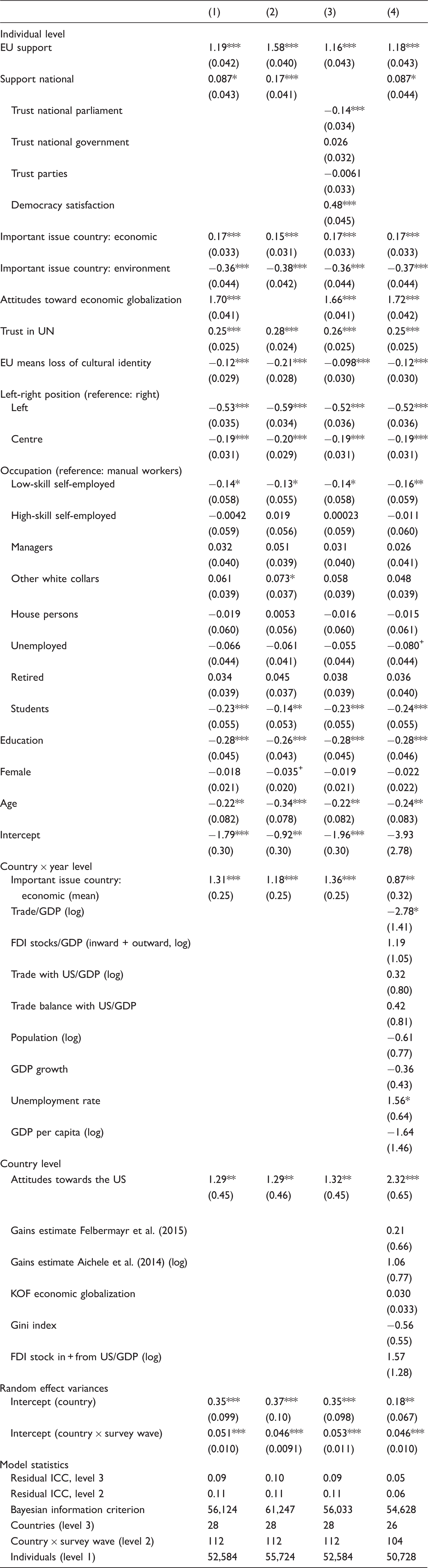
Multilevel binary logistic regression models for support for TTIP.
Note: Results from random-intercept models; standard errors are given in parentheses; +p < 0.10, *p < 0.05, **p < 0.01, ***p < 0.001.
TTIP: Transatlantic Trade and Investment Partnership; FDI: foreign direct investment; ICC: intraclass correlation.
To better grasp the substance of the effect sizes, I plot average marginal effects (AME) from this baseline model in Figure 2. The plotted estimates show how the probability of approving TTIP shifts with a one-unit increase of the covariate on average over the observed data. Note that the effects correspond to shifting each covariate from its minimum to its maximum as these have been rescaled to range from zero to one.
Average marginal effects on the probability of supporting TTIP. Note: These estimates are based on model 1 in Table 1. TTIP: Transatlantic Trade and Investment Partnership.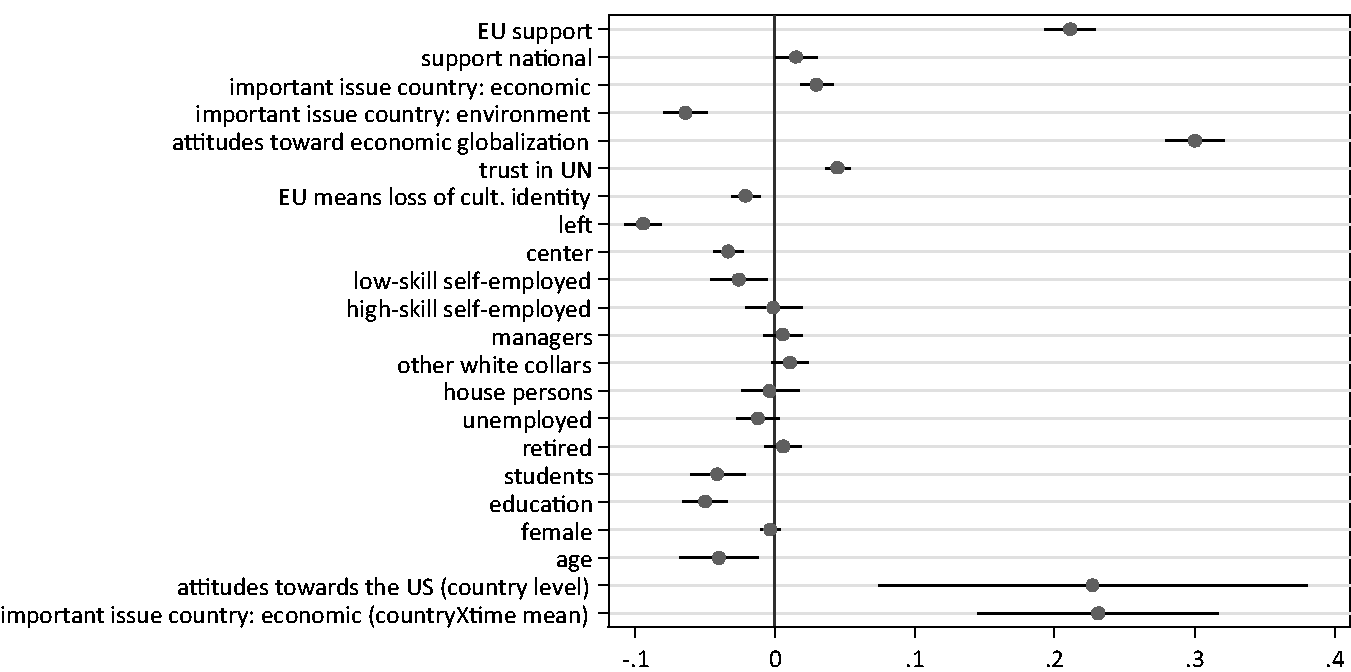
Perhaps not surprisingly, support for TTIP is most strongly related to attitudes on the economic benefits of globalization: A change from its minimum (0) to its maximum value (1) shifts the probability of supporting TTIP by about 30 percentage points. Even when controlling for these general views on globalization, EU support exhibits a strong effect, shifting the probability of being in favour rather than against TTIP by about 21 percentage points. With a potential shift of 1.5 percentage points, the effect of national support is miniscule compared to that. The effects of the macro-level predictors are pronounced as well: Attitudes towards the US and attention to economic issues both shift the probability by about 23 percentage points. That perceptions of what are the most important issues matter is mirrored at the individual level: Those who think of an environmental problem as being most pressing on the country’s agenda are, on average, less supportive (AME of −6 percentage points); while those who think of issues relating to the country’s economic situation are more likely to be in favour of TTIP (AME of 3 percentage points). This cross-validates the effect of issue attention at the aggregate level.
As to the control variables, the economic predictors show small and inconsistent effects. Regarding education, we observe a negative coefficient showing that those with more years of education tend to be less likely to approve of TTIP. There are little differences between the occupational groups. Perhaps most strikingly, managers and white-collar employees do not hold more positive opinions as compared to manual workers. Only the low-skill self-employed and the students stand out by holding somewhat more negative attitudes. Older people are a little less positive about TTIP. This could be interpreted in an economic way by pointing to younger people’s higher mobility increasing their chances to gain from economic openness or it could reflect cohort differences in world views. As to the other controls, the results for left-right position show that support is highest among the right, somewhat lower in the centre and smallest on the left. Trust in the UN is positively related with support for TTIP while those for whom the EU represents a threat to cultural identity tend to be somewhat more opposed. Despite the two measures not being perfect, these findings still confirm that general dispositions towards internationalization in non-economic dimensions matter.
In addition to this baseline model, Table 1 displays the results of three other specifications. Model 2 drops attitudes towards globalization as this measure might be considered endogenous to some of the individual-level predictors. The findings for all other covariates remain similar in this specification, though the coefficient for the dummy for white-collar employees becomes a little larger and turns statistically significant, indicating a small difference to the manual workers. Yet, there is no significant effect for managers and education continues to be negatively signed.
As overall national support shows a very small effect in model 1, model 3 disaggregates national support in its four components. This shows that those who are satisfied with democracy have a substantially higher tendency to approve of TTIP, as expected by H3. However, trust in the national parliament is associated with a somewhat lower probability of supporting TTIP, controlling for EU support. A potential explanation is that the missing involvement of national parliaments in the negotiations leads those who trust the national parliament to view TTIP more critically. Overall, H3 receives only mixed support.
Model 4 introduces control variables at the macro level. The model includes all covariates mentioned above at once. While the model might be considered over-specified, it exemplifies the robustness of the effects of attitudes towards the US and attention to economic issues as these two predictors remain statistically and substantially significant even in this specification. The only other predictors with a statistically significant effect are the trade ratio (negative coefficient) and the unemployment rate (positive coefficient). In the Online appendix, I present findings from models that enter the macro-level controls individually. In all models, H1 and H4 are vindicated. Only few of the other predictors turn out statistically significant. While there is a statistically significant positive effect of country-level gains as estimated by Felbermayr et al. (2015), the coefficient is essentially zero when using the estimates from Aichele et al. (2014) instead. Overall, the results show that support for TTIP is not consistently related to economic fundamentals in a way that would suggest cross-country variation in support for TTIP to be driven by material interests.
The only other significant macro control is the unemployment rate, indicating that support for TTIP is higher where the situation on the labour market is worse. An interpretation in line with H4 is that high unemployment leads public attention to focus on economic issues, which leads to lower opposition to TTIP. This interpretation is supported by the finding that the effect of the unemployment rate increases once we exclude aggregate attention to economic issues. Moreover, using attention to economic issues as the dependent variable, I find that this attention increases with the unemployment rate as well as the share of post-materialists in a society as measured by Eurobarometer data from 2008 (see the Online appendix).
The argument underlying H4 is further supported by cross-country variation in search activity for TTIP on Google: Publics with overall lower attention to economic issues searched more often for ‘TTIP’ according to data from Google Trends (r = −0.45). Much of this increased attention was likely critical and related to post-materialist worries. Google search activity for ‘TTIP’, in turn, shows a strong negative correlation with mean levels of support for TTIP at the country level (r = −0.66). 6 This supports my reasoning that the post-materialist concerns gained more attention in countries with a lower salience of economic issues and that this in turn lead to lower aggregate support for TTIP.
I subjected my findings to further scrutiny in several additional robustness checks (shown in the Online appendix). First, I estimated a series of random-intercept models for each of the four waves separately and logistic regression models by country. The former shows that we obtain support for H1 and H4 even when not pooling all four Eurobarometer waves over time, though attention to economic issues is not statistically significant in all four waves. The latter shows, regarding H2, that EU support is significantly positively related to support for TTIP in 25 of the 28 countries. Third, I estimated multinomial logit models that considered ‘don’t knows’ as a third response option. The findings show that those who didn’t express an opinion effectively fall between supporters and opponents where the variables of interest are concerned: EU support, attitudes towards the US and aggregate attention to economic issues show the expected opposite effects in discriminating between don’t know and the other two response options. Fourth, I checked that the results regarding H4 remain similar when I use different categorizations of which most important problems are economic ones.
Finally, I performed several additional checks for economic self-interests effects at the individual level (see the Online appendix). I used the original fine-grained information on current occupation. This shows that only the farmers stand out in being strongly opposed to TTIP – which might well reflect economic self-interest that operates at the sectoral level. 2 I go on to show that there are little differences related to individuals’ perception of their social classes. Following Schaffer and Spilker (2015), I also computed a globalization winner dummy combining information from current occupation and education. This measure is not significantly associated with support for TTIP in a range of different specifications, though being positively associated with general views on globalization. I also tested for interactions between this globalization winner dummy and political knowledge using EU related quiz question, on the one hand, and age, on the other. The results show a small interaction effect for age: Only among old people are globalization winners somewhat more positive towards TTIP. This is difficult to square with an economic logic that would rather suggest a strong gap especially between young globalization winners and losers who have most of their working life still ahead of them. Overall, these findings show that economic factors contribute only marginally to explaining individual differences in attitudes towards TTIP. 7
Discussion and conclusion
This article has studied what determines preferences towards the controversial TTIP. I have argued that – given the complexity and uncertainty involved in the public debate about TTIP – individual opinion is likely to be shaped by heuristic cues and by which issue areas individuals and societies devote attention to. The statistical analysis of Eurobarometer data has provided strong support for two types of treaty partner heuristics: Individuals seem to from their opinions on TTIP by relying on their general opinions towards the US and the EU. Whereas the strong effect of EU support could be shown on the individual level, attitudes towards the US at the country level measured before TTIP appeared on the agenda were shown to predict attitudes towards TTIP. While it has drawbacks that attitudes towards the US could not be measured on the individual level and not contemporaneously, the credible exogeneity of the measure suggest an effect that is indeed causal. Reassuringly, two parallel papers using survey data from Germany complement this finding by documenting strong associations between attitudes towards the US and support for TTIP on the individual level (Jedinger and Schoen, 2017; Jungherr et al., 2018). The findings further show that TTIP opposition is higher where the public’s attention is less focused on economic issues. I have argued that this reflects differences in the amount of attention spent on the largely post-materialist concerns over TTIP. The presented evidence is in line with this proposed mechanism.
Taken together, these findings enhance our understanding of why we observe strong public opposition to TTIP in only some of the EU member states. Consider Lithuania, the country in which support for TTIP is highest: Lithuania combines the highest mean level of EU support with very positive views on the US (in second place of all member states), fairly positive views on globalization (eighth place) and high public salience of economic issues (fifth place). In contrast, Austria, where opposition to TTIP is strongest, shows negative views on European integration (22th) and globalization (23nd), mediocre dispositions towards the US (16th) and relatively low public salience of economic issues (21st). While this structural explanation proposed here ignores the agency perspective associated with interest group campaign activities, which likely also affect attitudes towards TTIP, differences in public opinion related to the treaty partner heuristic and issue attention amount to a more or less fertile breeding ground for interest groups that aim to mobilize opposition against TTIP.
In contrast, this study found it difficult to account for difference in support for TTIP via economic self-interest. This is not to say that economic self-interest in general does not matter in the formation of trade policy preferences. It likely reflects that the redistributive effects seemed limited and uncertain in this case. That the data show lower support for farmers, i.e. among workers in a sector that was expected to potentially lose from TTIP, seems to support the notion that economic self-interest can matter, but only when distributional effects are clear and individuals are aware of them (Rho and Tomz, 2017).
On a broader note, this article illustrates, as other recent studies (Hicks et al., 2014; Naoi and Urata, 2013; Urbatsch, 2013), that studying real-world cases of salient trade policy proposals forms a useful complement to existing research on trade policy attitudes that mostly draws on abstract questions on increasing trade or general import barriers in contexts where trade policy is often of low salience in the public mind. It is an open question whether such survey expressions are anchored in well-developed opinions or whether they are prone to problems associated with ‘non-attitudes’ (Converse, 1964). In their recent review article, Kuo and Naoi (2015: 102) criticize that these survey instruments ‘might allow scholars to solicit citizens’ gut-based, general reactions to trade, [but] often diverge from the day-to-day context in which citizens think about trade policy’. These studies thus allow us to examine how economic characteristics, such as individual skill levels, and symbolic predispositions, such as national identity and xenophobia, are related to citizens’ general stances towards trade. Yet, studying real-world controversies over trade policy allows us to uncover how, in addition, heuristic cues, such as attitudes towards the treaty partners, and issue salience shape opinions. While the deep integration envisaged by TTIP might have brought specific dividing lines according to which values and issues individuals and societies prioritize and pay attention to, the effects of the treaty partner heuristic demonstrated here appear more universal and are likely to apply to preferential trade agreements in general. Future research might pay more attention to the specific mechanisms behind these heuristics using experimental designs.
Footnotes
Funding
The author(s) received no financial support for the research, authorship, and/or publication of this article.
Supplementary material
Supplementary material is available for this article online.
Notes
References
Supplementary Material
Please find the following supplemental material available below.
For Open Access articles published under a Creative Commons License, all supplemental material carries the same license as the article it is associated with.
For non-Open Access articles published, all supplemental material carries a non-exclusive license, and permission requests for re-use of supplemental material or any part of supplemental material shall be sent directly to the copyright owner as specified in the copyright notice associated with the article.
