



Abstract
The negotiations on the reforms of the Economic and Monetary Union were highly conflictual. This article analyses the dimensions of conflict that structured these negotiations. Using several dimension-reduction methods, we conduct an in-depth analysis of the ‘EMU Positions’ dataset, which codes the positions of all EU member states over a broad range of fiscal, financial, economic, and institutional integration proposals. The empirical findings show that the political contestation in the reform of the Eurozone is one-dimensional between advocates of fiscal transfer and discipline. On this one-dimensional scale, we identify three broader coalitions, while Germany and France lead the two opposing groups. This conflict structure provides a setting conducive to the constant (re-)negotiation of compromises. We conclude the analysis with a discussion of several implications.
Introduction
The political and social consequences of the Eurozone crisis were detrimental for the European Union (EU) and the Economic and Monetary Union (EMU) (Foster and Frieden, 2017; Hernandéz and Kriesi, 2016; Kriesi, 2018). The crisis made clear that the institutional and policy framework of the EMU was insufficient, which led to the broad consensus that the EMU had to be reformed. The views, however, on how the framework of the EMU should be changed differed strongly, from calls of better enforced fiscal discipline to models of permanent fiscal transfers. Against this backdrop, the fierce negotiations among member states during the Eurozone crisis have shown how challenging it is to overcome the deep political conflict, even when there is a broad agreement that reforms are needed. In this article, we provide an in-depth investigation of the political contestation among member states in the recent negotiations of EMU reforms.
This article contributes to the literature on EU and EMU politics by analysing the underlying conflict structure(s) in the reform of the EMU with new data. The theoretical part discusses several dimensions of conflict that potentially structure the political contestation among member states. The classic dimensions of conflict in EU politics are between more vs. less integration and the left vs. right of the political spectrum (Hix, 1999; Hooghe and Marks, 2001; Steenbergen and Marks, 2004). The political economy literature on the Eurozone crisis further adds the divide between advocates of fiscal transfer and fiscal discipline as a key dimension of conflict (Armingeon and Cranmer, 2017; Beramendi and Stegmueller, 2017; Frieden and Walter, 2017). We may expect that each of these conflict dimensions structures the politics of EMU reform in a one-dimensional conflict space—or, alternatively, that different combinations of these underlying conflicts span over a two-dimensional space.
We empirically investigate the dimensionality of the political conflict during the Eurozone crisis with dimension-reduction methods using the ‘EMU Positions’ dataset introduced in this special issue (Wasserfallen et al., 2019). The ‘EMU Positions’ dataset includes data on the positions of all EU member states and six EU institutions for 47 contested issues, covering a broad range of economic, fiscal, financial, and institutional integration proposals that were discussed between 2010 and 2015 (including policy proposals of the Six-Pack, Two-Pack, Fiscal Compact, European Financial Stability Facility (EFSF), European Stability Mechanism (ESM), assistance to Greece and the Banking Union). The first important finding of our empirical analysis is that we can only identify one single systematic dimension of conflict, namely the conflict between supporters of fiscal transfer vs. fiscal discipline. This conflict structure explains the contestation in most of the 47 contested issues coded in the ‘EMU Positions’ dataset. A complementary qualitative analysis of quantitatively selected cases shows that different, quite idiosyncratic, reasons explain why some contested issues deviate from the identified dominant conflict dimension.
The empirical analyses use different methods, such as Bayesian Ordinal Item Response Theory, W-Nominate, and Basic Space Scaling, to estimate the ideal points for each EU member state and the six EU institutions. Besides showing the aggregated positioning of each member state, the spatial analysis of the ideal points also highlights which coalitions of countries oppose one another. We identify three broader coalitions. The Southern countries and Belgium support fiscal transfers, whereas the fiscal discipline group includes Northern, Central, and East European countries with the Netherlands and Finland as the most extreme countries. A smaller group of countries and the EU institutions are located in-between these two opposing camps. On both extremes of the one-dimensional scale, Germany and France lead the fiscal discipline and the fiscal transfer coalitions.
Our findings contribute to the broader literature on EU politics by showing that classic conflict dimensions between supporters of more vs. less integration or between left vs. right governments are not relevant for understanding the politics of EMU reforms (Hix, 1999; Hooghe and Marks, 1999). Also, the enlargements of the EU to Central and Eastern Europe have not fundamentally changed the basic conflict structure between supporters of fiscal discipline vs. transfer, which is deeply rooted in the politics of the EMU, dating back to the negotiation of the Maastricht Treaty in 1991. Overall, the enlargements of the EU shifted the power balance a little bit in favour of the fiscal discipline group.
Finally, we discuss the broader implications of the one-dimensional conflict between supporters of fiscal transfer vs. discipline, which is historically stable and spans over a broad range of economic, fiscal, financial and institutional integration policies. Building on Riker (1986), we argue that this conflict structure provides a setting that is conducive to decision making in the information-rich and highly institutionalised environment of EMU politics. According to Riker’s (1986) model of decision making, one-dimensional conflict structures allow for the (re-)negotiation of compromises that are stable equilibriums, when the basic positions of all actors are well-known and the negotiations are not complicated by multiple dimensions. We conclude the article with the discussion of several practical implications derived from our findings, emphasising, for example, the key role of Franco-German leadership for the reform of the EMU.
Conflict dimensions in the politics of EMU reform
The decision making on EMU reforms requires agreements and compromises among EU and EMU member states, which raises a series of important integration questions, among others, on preference formation, institutional design and negotiation dynamics (see e.g. Bernhard and Leblang, 2016; Jones et al., 2016; Schimmelfennig, 2015; Wasserfallen, 2014). We analyse which substantive dimensions of conflict explain the negotiations during the Eurozone crisis. To that end, we derive from the literature on EU and EMU politics several possible conflict dimensions (for an excellent overview on political conflict dimensions and European integration, see Steenbergen and Marks, 2004)).
The most basic division in EU politics is the conflict between advocates of more vs. less integration. This political divide has been a central element of international relation models of European integration, dating back to Haas (1958). In this model, the conflict between supporters and critics of further integration is about national sovereignty vs. supranational governance. As such, this fundamental conflict is unrelated to the specific content of a policy. Typically, the six founding member states of the European Community are portrayed as pro-integration countries, whereas the United Kingdom and Denmark are examples of more integration-sceptical member states. This model of conflict predicts that a single dimension explains contestation among member states across a diverse range of policy areas. 1 The straightforward expectation of this model is that member states systematically advocate either more or less integration (no matter whether the policy issue is about the banking union, institutional reform, fiscal discipline, or fiscal transfers).
Building on the comparative research about West European party structures, Hix and Lord (1997) add the conflict between left vs. right governments as additional dimension of conflict. In applications and extensions of their model, the two dimensions of less vs. more integration and left vs. right are orthogonal, as they mobilise cross-cutting coalitions (Hix, 1999). Tsebelis and Garrett (2000), in contrast, argue that the two dimensions are interrelated because political actors on the left would support further regulation on the European level, whereas parties and governments on the right would favour less integration. Somewhere in-between these two opposing views, Hooghe and Marks (1999, 2001) claim that some aspects of the debate on more vs. less integration are absorbed by the left-right dimension, but not all.
Beyond these general and classic dimensions of EU conflict, the political economy literature suggests that a very profound divide between advocates of fiscal transfer and discipline structures the negotiations among member states on EMU reforms (Armingeon and Cranmer, 2017; Johnston et al., 2014). Advocates of fiscal discipline argue that the violations of debt rules destabilise the monetary union. Accordingly, they call for the strengthening of fiscal oversight with strict deficit and debt rules (De Grauwe, 2013; White, 2015). The basic assumption of this view is that fiscal discipline is the key to stabilise the Eurozone. Supporters of fiscal transfers, however, identify economic imbalances within the monetary union as the underlying cause of the crisis, calling for permanent and comprehensive fiscal equalisation within the monetary union in the form of a fiscal transfer system, a common budget with its own taxes, or a common unemployment scheme (Brunnermeier et al., 2016; Pisani-Ferry, 2012). 2 They argue that economically stronger countries have to financially support the weaker member states, which lost in the monetary union the option of devaluation as an instrument to regain economic competitiveness.
Conceptually, this follows the work of Thomson et al. (2004) and Zimmer et al. (2005), who have identified the north–south division as the main conflict dimension in the politics of the Council. Zimmer et al. (2005) explain the distributional underpinning of this conflict with reference to the EU budget, whereas southern countries are net-receivers and northern countries net-contributors. In EMU politics, this distributional dimension of conflict has a different structural and economic rationale. As far as Eurozone reforms are concerned, competitive countries with a high share of exports support fiscal discipline measures, whereas importing countries argue for fiscal transfers. This divide further intensifies as differences in competitiveness and balance-of-payments increase and accumulate (Copelovitch et al., 2016; Frieden and Walter, 2017). Figure 1 illustrates the one-dimensional conflict between advocates of fiscal transfers and of fiscal discipline.

Fiscal transfer vs. fiscal discipline as a one-dimensional conflict.
In a more complex two-dimensional model, we can think of the two dimensions of fiscal transfer and discipline as somewhat related, yet distinct dimensions of conflict, when the positions of member states on fiscal transfer measures are systematically different compared to proposals enforcing fiscal discipline. Figure 2 plots the political conflict over fiscal transfer and fiscal discipline as two distinct dimensions of conflict. The top left and bottom right corners reflect the positions that prioritise one of the approaches over the other. Member states in the top left corner support fiscal transfers and are against (or for only soft) fiscal rules. In direct opposition, representatives of countries in the bottom right corner argue that more strictly enforced fiscal discipline would stabilise the EMU. The diagonal from the top left corner to the bottom right is equivalent to the one-dimensional conflict between advocates of fiscal transfers and discipline (as illustrated in Figure 1).
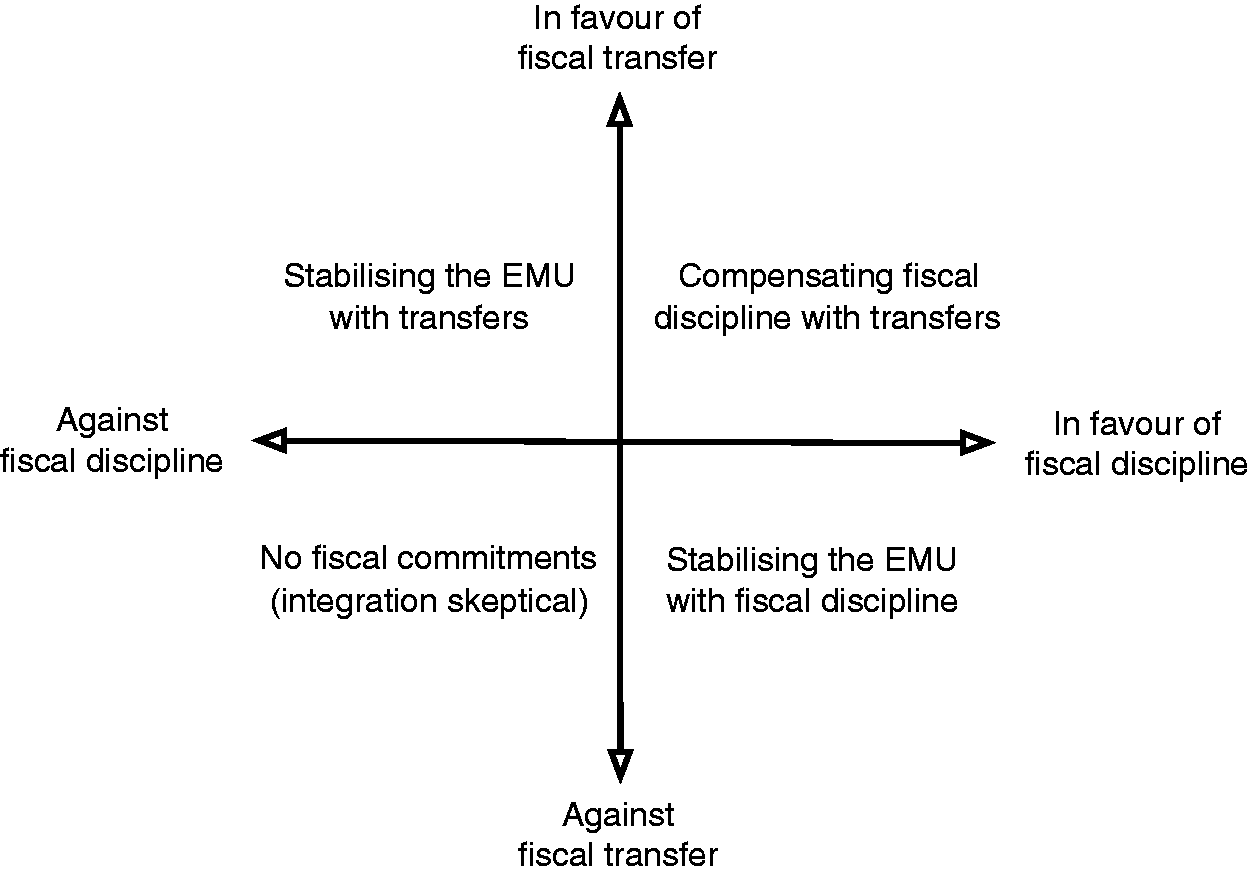
Fiscal transfer and fiscal discipline as two distinct dimensions of conflict.
The countries in the top right corner support reforms for more fiscal austerity and for more transfers (that is, they support more integration, no matter the substance of the proposals). Put differently, these countries advocate that fiscal transfers should compensate for stricter fiscal discipline measures. The countries in the bottom left, however, are integration-sceptical and oppose both fiscal transfers and fiscal discipline rules.
Building on the political economy scholarship on EMU politics and the literature on
European integration, we derive expectations on three dimensions of conflicts (more vs. less
integration, left vs. right, and fiscal transfer vs. discipline). We may empirically observe
that either one of these conflicts or a combination of two dimensions dominate the politics
on EMU reforms. As far as the political economy account is concerned, we hypothesised that
the conflict on fiscal transfer vs. discipline may be one or two dimensional (see Figures 1 and 2). Based on this theoretical discussion, we study the
following questions in the empirical part of this article: Are the politics of EMU reform during the Eurozone crisis structured by one
single underlying dimension of conflict or two separate dimensions that are distinct
from one another? Which conflict dimension(s) explain(s) the identified underlying conflict
structure (more vs. less integration, left vs. right, fiscal transfer vs. discipline)?
What are the most extreme countries on the identified conflict dimension(s)? And which
coalitions do we observe? For which policies do we observe deviant conflict structures? And why are
the politics in these cases distinct compared to the dominant conflict
structure(s)?
After having identified whether the conflict space is one- or two-dimensional, we
empirically analyse the positions of all EU member states and six EU institutions by
answering the following questions:
Finally, we investigate the variance that is not explained by the dominant conflict
dimension(s) and study the following questions:
Data and methods
The ‘EMU Positions’ dataset introduced and analysed in this special issue includes the positions of all EU member states and six EU institutions on 47 contested issues that were discussed during the Eurozone crisis from 2010 to 2015. For more information on the ‘EMU Positions’ dataset and the data collection process, please consult the introductory article of this special issue (Wasserfallen et al., 2019). For the purpose of this article, we briefly provide an overview of the contested issues of the ‘EMU Positions’ dataset by categorising the proposals into four groups, and we discuss various scaling methods for the empirical analysis.
An important advantage of the ‘EMU Positions’ dataset is its broad coverage of economic,
fiscal, financial and institutional integration proposals. This wide policy range is
necessary for an analysis that investigates the dimensionality of political conflict. If the
overall policy space of a dataset only covers a narrow policy area, the explanatory power of
a dimensionality reduction analysis is limited. For example, if we would only analyse the
positions of EU member states in regard to the Fiscal Compact, which reinforces fiscal
rules, we would expect that only the conflict dimension of fiscal discipline is powerful in
explaining the variation of positions across member states. With the broader policy
coverage, we have the potential to identify several conflict dimensions. Substantively, the
47 contested issues of the ‘EMU Positions’ dataset can be categorised in the following four
groups: Temporary and permanent fiscal transfer measures: EFSF, ESM and the
assistance programs for Greece. Fiscal discipline rules: Six-Pack, Two-Pack, and Fiscal Compact (i.e. the
Treaty on Stability, Coordination and Governance in the EMU). Common financial regulation (i.e. Banking Union): Single Rulebook, Single
Supervisory Mechanism (SSM), Single Resolution Fund (SRF) and Single Resolution
Mechanism (SRM). Proposals that were intensively discussed from 2010 to 2015, but did not
translate into legislation, such as the introduction of Eurobonds, the financial
transaction tax, and the proposals of the five presidents’ report for a fiscal
union.
3
The fiscal discipline measures of the Six-Pack, Two-Pack and the Fiscal Compact form the largest group in the ‘EMU Positions’ dataset with 17 out of the 47 contested issues. The dataset codes 15 contested policy issues for the fiscal transfer programmes of the ESM, EFSF, and the assistance to Greece. Following the theoretical discussion of the previous section, we either expect that the positions of EU member states in these two policy groups align on one conflict dimension (i.e. fiscal transfer vs. discipline), or two distinct dimensions of conflict. If they align on one single dimension, member states that aim to stabilise the EMU with fiscal transfers through the ESM, EFSF, and the Greece Assistant Programmes are, at the same time, sceptical about the fiscal rules of the Six-Pack, Two-Pack, and Fiscal Compact (and vice versa).
Of the 47 contested policy issues, 26 are coded as binary variables, where member states’ governments advocate one of two negotiation options. The remaining 21 policy issues include three or more alternative positions that are ordered on a scale between 0 and 100. The extreme positions are coded as 0 and 100 and all in-between proposals positioned with regard to their relative distance to the extreme positions. Overall, the dataset includes binary and ordinal data, which complicates the selection of an appropriate dimension reduction method. Bayesian Ordinal Item Respond Theory (IRT) and Basic Space Scaling are methods of choice for data with ordered variables, whereas the analysis of binary variables builds on parametric or non-parametric unfolding methods, like W-Nominate (Armstrong et al., 2014; Martin et al., 2011; Poole, 1998; Treier and Jackman, 2009). Also, the different scaling methods offer multiple analytical diagnostics. For a robust and comprehensive empirical analysis, we thus apply all of these three scaling methods and select the appropriate method for each part of the analysis.
The previous section introduced the framework for the empirical analysis in three subsequent steps. First, we aim to identify how many dimensions of conflict are underlying the data. Second, we derive estimates of the ideal points for each EU member states and the six EU institutions on the identified one- or two-dimensional conflict space. Third, we investigate which of the 47 contested issues are well explained by the identified conflict dimension(s). For Steps 1 and 3, we rely on W-Nominate because the scree plot and the estimation of cutting angles provide informative estimates for the analysis of the overall conflict dimensionality. For Step 2 of the empirical analysis (i.e. the estimation of ideal points), we apply all three scaling techniques mentioned above (Bayesian Ordinal IRT, Basic Space Scaling and W-Nominate). In the main analysis, we present and discuss the ideal point estimates of the Ordinal IRT model because of the ordered coding of the variables. The findings of the other two scaling methods are discussed in the article and presented in the Online appendix.
W-Nominate, the preferred method for Steps 1 and 3, is an unfolding method for binary parliamentary roll call data (Poole and Rosenthal, 1985). This scaling method builds on the spatial theory of voting, assuming that each member of a parliament has an ideal point on a latent dimension. For each vote, a member of a parliament has two options, namely to vote yes or no. The starting values for an ideal point are calculated based on the agreement score matrix, which includes the voting of all members of a parliament. Nominate uses an alternating likelihood function to estimate the ideal points in an iterative estimation process (Armstrong et al., 2014). Particularly for the analysis of the dimensionality of the data (Steps 1 and 3 of our analysis), W-Nominate provides very useful estimates with the eigenvalues and the cutting angles. 4
However, as discussed above, not all issues of the ‘EMU Positions’ dataset are binary. For the W-Nominate estimations, we recode the 21 ordinal variables as binary variables (setting all values below 50 to 0 and all others to 100). Because several variables are ordinal, we rely on Bayesian Ordinal IRT for the main analysis of the ideal point estimates (Step 2 of our empirical analysis). Bayesian Ordinal IRT is the standard scaling method for ordered data (Martin et al., 2011; Poole, 1998). 5 The Online appendix also presents, as robustness checks, the ideal point estimates derived with Basic Space Scaling and W-Nominate. The main results are the same, but we also find interesting nuances in the comparison of the model estimates.
Empirical findings
We start the empirical analysis with the question on the dimensionality of the political conflict. As discussed in the theoretical section, the contestation among member states in the 47 policy issues of the ‘EMU Positions’ dataset may align on only one or two underlying dimensions of conflict. For analysing the dimensionality, we discuss the findings of a scree plot estimated with W-Nominate. The scree plot shown in Figure 3 displays the eigenvalues of a correlation matrix associated for each additional dimension (the higher the eigenvalue is, the more explanatory power has a latent dimension). According to the estimates reported in Figure 3, only the first dimension has an eigenvalue over 1. The eigenvalues of the second and all other dimensions drop significantly, compared to the first dimension (and they are all clearly below 1). This shows that adding a second or third dimension to the conflict space does not add much explanatory power to the model. In short, only the first dimension accounts for a substantial part of the variation in the data.

Scree plot showing the explanatory power of multiple dimensions.
Although the eigenvalues drop significantly after the first dimension, they stay at a medium level until the fourth dimension. Whereas the first dimension is by far the most important one, the dimensions two to four seem to have some limited explanatory power. This again shows that there is substantial variation in the positioning of member states that is not explained by the first dimension. However, we cannot identify a two-dimensional conflict space, given that the variance that is left over by the first dimension does not converge on a strong second, but on several additional dimensions. Overall, the findings reported in Figure 3 thus suggest that we have a strong first dimension and that the (quite substantial) variance in the data that is not explained by the first dimension is idiosyncratic and multidimensional. 6
Figure 3 shows that we can identify only one strong dimension in the politics of EMU reform. What, then, is this conflict dimension? To answer this question, we rely on a one-dimensional Bayesian Ordinal IRT model (Martin et al., 2011). Figure 4 reports the ideal point estimates for each EU member state and the six EU institutions. 7 The distribution of ideal points is as expected by the political economy account of a one-dimensional divide between advocates of fiscal transfer vs. discipline. According to the estimates reported in Figure 4, France advocated the most extreme positions on the fiscal transfer side, followed by Greece, and supported by the other Southern member states and Belgium. The positions in the fiscal transfer coalition are not very homogeneous. However, the estimates of the Basic Space Scaling and W-Nominate models, presented in the Online appendix, suggest a greater cohesiveness in this coalition.

Ideal points of member states and EU institutions on the one-dimensional space estimated with Bayesian Ordinal IRT. AUT: Austria; BEL: Belgium; BGR Bulgaria; CYP: Cyprus; CZE: Czech Republic; DEU: Germany; DNK: Denmark; ESP: Spain; EST: Estonia; FIN: Finland; FRA: France; GBR: United Kingdom; GRC: Greece; HRV: Croatia; HUN: Hungary; IRL: Ireland; ITA: Italy; LTU: Lithuania; LUX: Luxemburg; LVA: Latvia; MLT: Malta; NLD: Netherlands; POL: Poland; PRT: Portugal; ROU: Romania; SVK: Slovakia; SVN: Slovenia; and SWE: Sweden; COM: European Commission; COU: European Council; ECB: European Central Bank; EFN: Economic and Financial Affairs Council; EP: European Parliament; and EUG: Euro Group.
On the other side of the spectrum, the Netherlands and Finland are the most pronounced advocates of fiscal discipline, followed by Germany. Also on the fiscal discipline side, yet closer to the middle, is a large group of Northern, Central, and Eastern European member states, including countries such as Slovakia, Croatia, the Czech Republic, Austria, Latvia, Estonia, Hungary, Sweden, Denmark, Romania, Great Britain and Bulgaria. A first striking result from this analysis is that we have two distinct coalitions on both ends of the one-dimensional spatial scale that are in strong opposition to one another. France and Germany are, as opinion leaders of these two opposing camps, positioned at both ends of the scale.
The fiscal transfer and discipline coalitions seek the support of the third group of actors that are positioned in the middle. Here, we find most EU institutions, namely, the Eurogroup, Council, European Parliament, European Commission, and European Central Bank, whereas the Economic and Financial Affairs Council is located closer to the fiscal discipline side. Ireland, Cyprus, Luxembourg and Slovenia are centrist member states that switch positions between both sides. The basic structure of three broader coalitions (fiscal transfer, centre and fiscal discipline) as well as the composition of these three groups are, by and large, corroborated by the Basic Space Scaling and W-Nominate model estimates (see the Online appendix).
Clearly, the fiscal discipline coalition is larger than the group of fiscal transfer advocates. This power advantage is also reflected in the analysis of the outcome of the negotiations (which is also coded in the ‘EMU Positions’ dataset). We did not include the outcome in the main analysis presented above because the outcome is not a position of an actor. However, it is interesting to analyse the outcome on the spatial scale. To that end, we re-run the Ordinal IRT model, including the outcome. The findings show that the negotiation outcomes are close to the positions of the EU institutions, and they are located on the fiscal discipline side of the scale (see the Online appendix). This result is consistent with the analysis on bargaining success by Lundgren et al. (2019), which shows that member states holding centrist positions were the most successful in terms of achieving outcomes. Lundgren et al. (2019) emphasise that the overall bargaining results reflect reciprocity and compromise in the conflict between the two extreme groups. This conflict is moderated by the countries and institutions in the centre. The analysis of ideal point estimates supports this interpretation.
For the final step of the empirical analysis, we turn to the question of which of the 47 contested issues are well captured by the above-discussed underlying conflict dimension between advocates of fiscal transfer vs. discipline. As discussed in the previous section, the ‘EMU Positions’ dataset includes contested issues covering a broad range of economic, fiscal, financial and institutional integration proposals. Table 1 lists all the 47 issues categorised in four groups: fiscal transfer measures (EFSF, ESM and assistance to Greece), fiscal discipline rules (Six-Pack, Two-Pack and Fiscal Compact), financial regulation (Banking Union) and ongoing and forward-looking proposals. In addition, Table 1 reports cutting angles, as measures of how congruent the variations in member states’ positions of a specific contested issue are with the ideal points of the dominant first dimension.
Congruence of policy issues with the first dimension estimated with cutting angles.

EBA: European Banking Authority; ECB: European Central Bank; COM: European Commission; CJEU: Court of Justice of the European Union; EFSF: European Financial Stability Facility; ESM: European Stability Mechanism; IMF: International Monetary Fund; SGP: Stability and Growth Pact; SRF: Single Resolution Fund; SRM: Single Resolution Mechanism; SSM: Single Supervisory Mechanism.
We estimate the cutting angles based on a two-dimensional W-Nominate model (see the Online appendix). Cutting angles are similar to factor loads of a factor analysis, indicating how well the positioning of member states on a single issue correspond with the conflict structure of the first and second dimension. Cutting lines with an angle of 90° match perfectly with the conflict structure of the first dimension, while angles of 0° align on the second dimension (which we do not identify as being systematic in our case). An angle of 45° suggests that an issue is structured by both dimensions to the same extent. For our purpose, the interpretation of the cutting angles is straightforward: the closer the angle is to 90°, the more consistent is the political contestation of the issue with the political conflict structure of the first dimension (and the closer the cutting angle is to 0°, the more it deviates from the conflict structure of the first dimension).
The most important finding reported in Table 1 is that several issues of the categories of fiscal transfer measures (EFSF, ESM and assistance to Greece), fiscal discipline rules (Six-Pack, Two-Pack and Fiscal Compact) and financial regulation (Banking Union) have political conflict structures that are consistent with the contestation structure on the first dimension (that is, the cutting angles are 90° or close to 90°). Thus, no matter whether the discussions during the Eurozone crisis were about fiscal transfers, fiscal discipline, or common financial regulation, the political conflict was structured by the dominant conflict dimension discussed above. This conflict constellation is not driven by disagreements on a single reform or a specific set of reforms. Rather, the spatial pattern reflects an underlying conflict that structures, quite broadly, the politics of EMU reform. Only the positions of countries in the category of ongoing and forward-looking proposals are quite different. This may not be surprising, given that the positions on forward-looking issues are prospective and not binding, and thus less sincere, compared to ‘real’ negotiation positions.
The estimates of the cutting angles reported in Table 1 allow us to identify issues that deviate from the structural pattern of the first dimension. This is of particular interest because the dimensionality analysis has shown that there is quite some variance in the dataset that is not explained by the first dimension. This left-over variance is due to idiosyncratic explanations, rather than systematic patterns. What, then, are these issue-specific explanations for deviations from the main structure of conflict? 8
In the category of fiscal transfer measures, for example, the question of whether the EU treaties should be changed to establish the ESM does not correspond at all with the first dimension (the cutting angle is at 6°). This is because we find in this issue a coalition of the ECB, EP, and Germany, who all supported an EU treaty change for the ESM. Germany was alone with this position in the Council. Most member states opted for a pragmatic solution because they feared that a revision of the treaty, if possible at all, would take too much time. Thus, we observe a divide between a more pragmatic and more fundamental approach to the reform of the legal basis for the ESM.
A further interesting case is the conflict over the private sector involvement in the ESM. The conflict structure on this issue deviates to some extent from the contestation of the first dimension. The cutting angle is with 64° between 45° and 90°, which suggests that most member states had positions that are consistent with the conflict on the first dimension, while several countries took a different stance than usual. As expected, the fiscal discipline advocates, Germany, Austria, Finland and the Netherlands, supported the involvement of the private sector, while the Southern member states opposed this measure because it would have increased the interest rates on their sovereign bonds. This is all consistent with the conflict on the first dimension. What makes this a deviating case is that the Central and Eastern European countries aligned with the Southern (not Northern) member states because they also feared higher interest rates on their sovereign bonds. Usually, the Central and Eastern European member states side with the Northern countries opposing fiscal transfers.
Two further examples of deviating cases in the fiscal compact are the role of the European Commission and the legal form of the debt break. As far as the former is concerned, Italy and the Czech Republic took an unexpected position because of the specific government composition at that time. The technocratic Italian government headed by Mario Monti sided with the advocates of fiscal discipline, and the newly established Czech government changed the position because it had not enough time to engage with the substance of the fiscal compact. 9 In the case of the legal form of the debt break, member states positioned themselves according to their legal tradition and their ability to meet the criteria for a constitutional change. This resulted in coalitions that are very different than the main conflict dimension discussed above. To further illustrate the use of cutting angles, the Online appendix shows the positions, ideal point estimates and the cutting angles for this issue.
This short discussion of deviating issues is by no means complete, but the cases illustrate why some contested policy issues are distinct in their conflict structures compared to the main dimension. The variation in the explanations highlights that there are different, quite idiosyncratic, reasons that explain why some policy issues are not well captured by the conflict constellation of the first dimension. The case analyses point to the following explanations. First, positions on forward-looking issues are prospective and thus less sincere. Second, some countries deviate from their usual positioning because of specific economic interests. Third, technocratic governments may take different stances. Finally, legal traditions are important for some issues.
Discussion of findings and conclusion
The theoretical part of this article presents several dimensions of conflict that potentially structure the politics of EMU reforms from 2010 to 2015 (Frieden and Walter, 2017; Hooghe and Marks, 2001; Steenbergen and Marks, 2004). The conflict dimensions include more vs. less integration, left vs. right and fiscal transfer vs. discipline, whereas different combinations of these conflicts may result in a two-dimensional conflict space. The theoretical section also discusses the possibility that one single dimension structures the politics of EMU reform. In line with this expectation, the empirical findings clearly show that we can only identify one single dimension of contestation in EMU politics, namely the conflict between advocates of fiscal transfer vs. discipline.
On this one-dimensional conflict scale, we can empirically distinguish between three broader coalitions (one on either extremes and one in the centre). The findings of this article are consistent with studies highlighting the divide between creditor and debtor countries and the differences across countries in export-orientation and competitiveness (Armingeon and Cranmer, 2017; Copelovitch et al., 2016; Johnston et al., 2014). However, our results also suggest that there is, besides the economic explanation, an additional ideational determinant of member states’ positions in EMU politics (Brunnermeier et al., 2016). For example, the result that France is the country with the most extreme positions on the fiscal transfer side cannot be explained with its economic conditions.
Importantly, the identified one-dimensional conflict structure is not restricted to a specific set of EMU reform policies. Rather, this conflict spans, very broadly, over the politics of EMU reforms, including economic, fiscal, financial and institutional reforms. However, the quantitative analysis also shows that there is a large variance in the positioning of EU member states that is not explained by this dominant one-dimensional pattern of conflict. According to the statistical analysis, there is no additional systematic pattern underlying the positioning of EU member states. The additional qualitative analysis shows that there are different, quite idiosyncratic, reasons that explain why some policy issues deviate from the dominant conflict dimension.
The main contribution of this analysis to the literature on EU politics is the finding of the one-dimensional structure in EMU politics. We find no evidence for classic conflicts between supporters of more vs. less integration or between left vs. right governments (Hix, 1999; Hooghe and Marks, 1999). Rather, the empirics show that member states support policies for the EMU which fit their economic profile and their ideational approach to reforming the EMU. Northern member states prefer fiscal discipline measures, whereas Southern countries propose fiscal transfer mechanisms. This is not only relevant for EMU politics but adds to the broader finding that the distributional conflict between Northern and Southern countries structures to a large extent the politics in the Council (Thomson et al., 2004; Zimmer et al., 2005).
A further contribution of this study is the finding that the enlargement of the EU to Central and Eastern Europe has strengthened the fiscal discipline coalition. Overall, the enlargements have shifted the power balance a little bit, but the fundamental political conflict has not changed. This result stands in contrast to the analysis of Mattila (2009), who argues that the enlargement of the EU has enriched the political conflict space, whereas older and new member states oppose one another on a systematic second dimension of conflict (which we can observe in immigration policy).
Our finding on the one-dimensionality of the conflict is also essential for the analysis of the overall negotiation dynamics. Lijphart (1969) forcefully argues that multiple conflict dimensions with cross-cutting coalitions provide a structure conducive to decision making in systems that are built on consensual decision making, like the EU. Applied to EU politics, the mechanism of consociational decision making is that a member state works side-by-side with another member state on one specific set of policy issues, while the same two member states then oppose one another on a different conflict dimension. These cross-cutting coalitions in a two-dimensional space moderate conflicts, facilitate package deals and increase power sharing. Thomson (2009), who also finds a two-dimensional conflict structure in EU politics, interprets his finding along these lines by stating that multi-dimensional conflict structures with cross-cutting coalitions are conducive to the consensus-oriented decision making of the EU. Should we, then, conclude that the one-dimensional structure of the politics of EMU reform leads to a highly polarised conflict and bargaining gridlock because the two opposing sides are not reconcilable?
Not necessarily. The advantage of a one-dimensional conflict structure is that it provides a straightforward negotiation space with the median position as compromise between the two opposing coalitions (Black, 1948). According to Riker (1986), a one-dimensional conflict space is even more conducive to the negotiation of bargaining compromises than a two-dimensional. In the case of multiple conflict dimensions, the content of the final decisions is a function of how skilfully political actors structure the process of decision making to their advantage with ‘agenda setting, strategic voting and manipulations of dimensions’ (Riker, 1986: 147). Riker (1986) calls this skill of managing and manipulating decision making ‘heresthetic’. Of course, a skilful political actor may successfully navigate the decision making in a two-dimensional conflict; but equally, if not more, likely is gridlock because the other actors find ways to block the decision-making process that the skilful actor tries to manipulate to her or his advantage.
Particularly in the case of the information-rich and highly institutionalised environment of EMU politics, member states are well informed about the sincere positions of the other member states, which makes strategic voting and manipulations of dimensions difficult. There may be some agenda-setting power exercised by France and Germany, as Degner and Leuffen (2019) argue. However, in the politics of EMU reform, clearly stated preferences that align on a one-dimensional conflict are conducive to the negotiation of compromises and the trading of concessions, particularly when multiple policy reforms are negotiated that include fiscal transfer, fiscal discipline, and regulatory measures. What we then observe is the trading of concessions across legislation (ideally within a larger reform package), rather than within one single policy reform (Aksoy, 2012).
This one-dimensional conflict structure (over several policy areas) is also stable over time. The broader political conflict constellations identified in this article date back to the negotiations of the Maastricht Treaty in 1991 and the Stability and Growth Pact (Heipertz and Verdun, 2010; Laursen and Vanhoonacker, 1992; Woolley, 1994). Lundgren et al. (2019) provide further evidence for this account of EMU decision making. Also, the analysis reported in the Online appendix shows that the negotiation outcome is a compromise, situated close to the middle. All of this suggests that the politics of EMU reform follow the Riker (1986) model of decision making, according to which the one-dimensional structure provides a straightforward setting for the (re-)negotiation of a constantly updated compromise between the two opposing coalitions.
The finding of this very profound and historically rooted one-dimensional divide between advocates of fiscal transfers and discipline not only contributes to the literature on EU and EMU decision making, we can also derive implications from this analysis that are relevant for policy makers. The spatial distribution of the ideal points has interesting implications, for example, in respect to the role of the Central and Eastern European member states and the Franco-German integration axis. First, many of the Central and Eastern European countries are situated close to the middle. Whether they side with the Southern coalition or with the fiscal discipline group shifts the power balance decisively. In EMU politics, they could make much more use of their pivotal position in-between the two opposing coalitions with a more active role as compromise facilitators.
Also, France and Germany can together exercise strong leadership in this one-dimensional structure. Both are situated at the opposing ends of the conflict space, whereas Germany is pressured by Finland and the Netherlands, which have more extreme positions. Given their power in EU decision making, they are the de facto leaders of the two opposing coalitions. This provides an ideal setting for joint German–French proposals, which should, in this broader conflict structure, gain political support among all EU member states. The question, however, is whether the governments of France and Germany are willing to take the political risk of a bold compromise, or whether they prefer the exchange of small concessions. The overall political conflict structure is favourable to both of these strategies – but for the long-term sustainability of the EMU, small concessions may not be enough.
Supplemental Material
Supplemental Material1 - Supplemental material for Political conflict in the reform of the Eurozone
Supplemental material, Supplemental Material1 for Political conflict in the reform of the Eurozone by Thomas Lehner, Fabio Wasserfallen, Fabio Wasserfallen in European Union Politics
Supplemental Material
Supplemental Material2 - Supplemental material for Political conflict in the reform of the Eurozone
Supplemental material, Supplemental Material2 for Political conflict in the reform of the Eurozone by Thomas Lehner, Fabio Wasserfallen, Fabio Wasserfallen in European Union Politics
Footnotes
Acknowledgements
We would like to thank Klaus Armingeon, Stefanie Bailer, Lisa Dellmuth, Jeff Frieden, David Howarth, Lucas Leemann, Dirk Leuffen, Magnus Lundgren, Martin Lodge, Frank Schimmelfennig, Gabi Spilker, Stefanie Walter, two anonymous reviewers, and the EUP editor, Gerald Schneider, for insightful comments.
Funding
The author(s) disclosed receipt of the following financial support for the research, authorship, and/or publication of this article: This research is part of the project ‘EMU Choices’ funded by the European Union’s Horizon 2020 research and innovation programme under grant agreement no. 649532.
Supplemental material
Supplemental material for this article is available online.
Notes
References
Supplementary Material
Please find the following supplemental material available below.
For Open Access articles published under a Creative Commons License, all supplemental material carries the same license as the article it is associated with.
For non-Open Access articles published, all supplemental material carries a non-exclusive license, and permission requests for re-use of supplemental material or any part of supplemental material shall be sent directly to the copyright owner as specified in the copyright notice associated with the article.
