



Abstract
The 2014 European elections were characterized in many countries by growing support for Eurosceptic parties. This growth was not uniform and not clearly associated with the economic performance of these member states. In this article, we investigate the role played in the 2014 European Parliament elections by a country-specific factor – the composition of government coalitions – different from economic performance. In particular, we argue that in those countries where moderately Eurosceptic parties were more involved in the government, citizens with negative attitudes toward the European Union were more likely to vote for highly Eurosceptic parties. This was especially the case when the governments also included strongly pro-EU parties. The empirical analysis, which is based upon the 2014 European Election Voter Study, the Chapel Hill Expert Survey, and the Parliaments and Governments database, confirms our hypotheses.
Keywords
Introduction
The 2014 European elections were characterized by a huge increase of votes for anti-establishment parties that were also very critical of European institutions and European policies (Treib, 2014). 1 At first glance, this phenomenon does not seem very surprising; indeed, the recent economic and financial crisis has severely affected a considerable part of the European population. The European institutions and many national governments have seemed unable to counter unemployment and loss of income. Against this background, large sectors of the electorate may have punished the traditional pro-Europe parties that were also the government parties during the crisis years and just before the European Parliament (EP) elections because of their poor economic performance (Hernández and Kriesi, 2016; Hobolt and De Vries, 2016). Nevertheless, further analyses have shown that the success of Eurosceptic parties in the 2014 EP elections, although undeniable, cannot be explained by the economy alone. At the individual level, for example, also policy attitudes have been found to contribute significantly to the explanation of voting for Eurosceptic parties (Hobolt and Tilley, 2016). At the country level, it has been found that these parties performed very well also in countries achieving a relatively good economic performance (for instance, Denmark and the Netherlands). By contrast, in those countries put under the tutelage of the European institutions and the International Monetary Fund due to their financial and economic conditions (for instance, Portugal and Spain), such parties were less successful or proved to be an almost marginal phenomenon (De Sio et al., 2014; Emanuele et al., 2016; Halikipoulou and Vasilopoulou, 2014).
To summarize, on the one hand, the great variance of Eurosceptic vote shares among European countries suggests the importance of national contexts in explaining the success of Eurosceptic parties; on the other hand, national economic conditions do not seem to be a particularly promising explanatory factor.
In this article, we investigate the role played by a country-specific factor different from economic performance: the composition of national government coalitions. This approach draws upon previous studies already focusing on the explanatory importance of coalition outcomes for voting decisions (Blais et al., 2006; Cox, 1997; Duch et al., 2010; Indridason, 2011). In particular, consistent with previous articles arguing that high levels of policy stability induce extremist voting (Kedar, 2005, 2009), we hypothesize that in countries where moderately anti-European Union (EU) parties share governmental power with highly pro-EU parties, citizens are generally more likely to vote for opposition Eurosceptic alternatives. We expect that, in the dimension that they consider salient, voters evaluate comparatively the opposition platforms and the government performance in order to choose the party for which to vote. In particular, when the status quo on a particular policy issue cannot be changed (or can be only marginally changed) because it is confined within the range of the relevant veto players, we assume that voters favorable to a policy change will be more likely to vote for opposition parties promising a radical shift in their desired direction. In our view, party competition on EU-related issues – and particularly on EU integration – furnishes a vivid example of this phenomenon. In this case, indeed, national governments cannot significantly and unilaterally change the status quo unless they undertake a formal exit from the EU. Moreover, when they are coalition governments, they almost always include at least one influential pro-EU party, presumably imposing a veto on such a decision. Within this scenario, both moderately and extremely Eurosceptic voters would be more likely to converge on fully oppositional Eurosceptic parties as objects of their electoral choice. The reasons for this choice may be different. On the one hand, voters may want to show strategic support for the policies espoused by an opposition party in the hope that moderately EU-critical parties in the government will fight more convincingly to get a light version of them adopted (Franklin et al., 1994; Rosenstone et al., 1996; Rüdig et al., 1996). On the other hand, they may sincerely value the programmatic platform of the opposition party as their most preferred one, especially in light of the poor outcome of the moderately EU-critical forces in charge.
In this article, we will not explicitly distinguish these two subjective mechanisms. Rather, for the sake of simplicity, we will assume that both patterns underlie a more general disagreement with the current government’s performance on the EU dimension, and that the expression of such disagreement will be more likely to coincide with voting for opposition Eurosceptic parties in countries where moderately anti-EU options are compromised in government coalitions together with pro-EU actors.
In order to test our hypotheses rigorously, we take advantage of the Chapel Hill Expert Survey (CHES), the Parliaments and Governments (ParlGov) database and the 2014 European Election Voter Study (EES). This last data source is an EU-wide survey that makes it possible to control at the individual level for a number of variables already ascertained in the literature as explanatory factors of Eurosceptic voting. The empirical analysis confirms that in those countries where moderately Eurosceptic parties were more involved in the government, citizens with negative attitudes toward the EU were more likely to vote for Eurosceptic opposition parties, in particular when the governments included also strongly pro-EU parties.
A theoretical account of voting behavior in EP elections
We suppose that the level of desired European integration is the salient dimension along which some voters choose their party. Of course, this is an extreme simplification, since it is well known that many other considerations enter the individual calculus of voting in this type of competition where national-level political concerns are notoriously prominent (Reif, 1984; Reif and Schmitt, 1980). Yet, alongside the mainstream explanation of European elections as second-order national elections, studies investigating the consistency of EU-issue voting have found increasing empirical support over time (Bellucci et al., 2012; De Vries et al., 2011; Hix and Marsh, 2007; Hobolt et al., 2009; van der Eijk and Franklin, 1996). In particular, with regard to the 2014 EP elections, recent analyses have found concrete evidence of a stronger politicization of Europe generated by EU policies trying to address the economic and financial crisis in Europe (Trechsel et al., 2014).
The utility of the voters is defined as a function of the Euclidean distance that separates them from the perceived party positions on the EU integration dimension. While as regards opposition parties, voters are assumed to evaluate only parties’ electoral platforms as in classic proximity voting (Davis et al., 1970; Enelow and Hinich, 1984), in the case of government party positions, voters consider also the government outcome, i.e. the position of the status quo before the elections. Also, this evaluation is assumed to be performed with respect to the level of desired European integration. This difference between government parties and opposition parties was first drawn by Downs, who considered the party differential, i.e. the difference between the utility that the voter actually received from the government parties and the one that the voter would have received if the opposition had been in power during the same period (Downs, 1957: 40). Similarly, we consider the perception of the government party positions as at least partially affected by the government’s performance.
More formally, the utility of voter i (i = 1, …, n) for opposition party o (o = 1, …, m), is inversely related to the ideological distance between i and o. In one dimension

The utility of voter i (= 1, …., n) for government party g (= m + 1, …, n) is inversely related to a weighted average of the ideological distance between i and g and the distance between i and the status quo policy before European elections at time t1, sqt1. In one dimension

Suppose that a political system of an EU country has four parties (Figure 1) ranging from a strong pro-Europe party g1 on the right (high values) to a fully Eurosceptic opposition party o on the left (low values). Every government party is presumed to be a veto player and to decide in conditions of complete information. At time t0, a new government is formed. At time t1, the parties that are government members will change (or preserve) the status quo sqt0 left by the previous government. At time t2, the voters vote for the EP elections by considering the party platforms po, pg and sqt1.

Spatial model with government and opposition parties’ positions on the EU integration dimension and Eurosceptic voting.
For the purposes of clarity, assume that:
α = 0 (the perceived government party positions coincide with sqt1); the voters are uniformly distributed along the European integration dimension; sqt1 = pg1 (the status quo is located on the pro-Europe side of the ideological spectrum and coincides with the electoral platform of g1, a very pro-European integration party);
2
sqt1 = sqt0 (the status quo is very stable);
In all EU countries, the level of European integration cannot be unilaterally changed, and it is similar everywhere given the common country membership of the EU and the policies and regulatory framework shared at the European level. Moreover, in almost all EU countries before the 2014 EP elections, the government included at least one pro-European integration party that could veto a decrease in the country’s level of European integration.
Each cut point cpn in Figure 1 is equally distant from the two closest perceived party positions on the left and right. Since we assume that the voters are uniformly distributed, cut points help to identify the support that each party enjoys.
Within this framework, we can envisage different scenarios (Figure 1). In scenario a, at time t1, g1 forms a single-party government. In scenario b, g1 and g2 form a two-party government quite homogenous along the European integration dimension. In scenario c, on the contrary, the government is heterogeneous because g3, a moderately Eurosceptic party, is a government member.
In scenario a, because pg1 is equal to sqt1 and g1 is the only government party, voters’ decisions are the same decisions that would be made according to the canonical proximity model. All voters on the left of cp will vote for g2.
In scenario b, the government is composed of g2 and g1. The perceived position of g2 will not be pg2. As the government outcome is sqt1, sqt1 will consequently be the perceived position of g2 on the EU integration dimension. The cut point cp1 shifts to the right compared to scenario a. Voters that in scenario a would have voted for g2 will vote for g3 if pg3 is closer to their ideal points than sqt1. Nevertheless, in this scenario b, we do not expect any increase of consensus for the very Eurosceptic party o.
In scenario c, when the government is somewhat heterogeneous on the European integration dimension, the cut point cp2 shifts to the right, and additional voters on the left of g3 are willing to vote for o because for them sqt1 is farther than po. Therefore, if we compare scenario a or b with scenario c, we find that voters with the same policy preferences will vote differently and in scenario c for the extremist party o.
Because policy inertia on the EU integration dimension reduces the credibility of those government forces supporting a moderate change in that respect, it increases the propensity to vote for more extremist parties without necessarily any change in the voters’ preferences distribution.
We can plausibly relax the assumption (4) of full inertia and allow for a limited policy change. In scenario d (Figure 1), we hypothesize that sqt1 ≠ sqt0 and that sqt0 > pg1. In other words, g1, the most pro-European government party, is now to the left of sqt0, and it wants to implement a decrease in the current level of the country’s European integration. In this case, we can envisage a change of sqt0 towards pg1. The level of European integration of sqt1 will be lower than in the previous scenarios. Such a change thwarts the voters’ radicalization because it reduces the distance between the Eurosceptic voters and the perceived position of the most Eurosceptic government party, g3, namely sqt1.
The implications of this simple model are quite straightforward and can be summarized in the following three hypotheses: H1: An increase in negative attitudes toward EU integration is more likely to generate a vote for Eurosceptic opposition parties when the level of a government's Euroscepticism is high, i.e. when moderately Eurosceptic parties form a government coalition with pro-EU parties. H2: An increase in the level of the government’s Euroscepticism, i.e. an increase in the level of Euroscepticism of the most Eurosceptic government party, is more likely to increase the propensity to vote for a very Eurosceptic party in the opposition when voters have negative attitudes toward EU integration. H3: The role played by the government’s Euroscepticism in increasing the propensity to vote for a very Eurosceptic opposition party is greatly weakened when the most pro-EU government party in the national government coalition wants a considerable decrease in the level of European integration.
Data
In order to test the hypotheses outlined above, we drew on the most recent post-electoral study at the European level, the 2014 EES (Schmitt et al., 2016). This choice suited the purposes of our analysis for two main reasons. First, this survey gathers information about electoral behavior at the 2014 EP election in all the 28 member states, which is a condition necessary to test our cross-country hypotheses. Moreover, it was carried out a few weeks after the EP election at issue, which is a guarantee of response accuracy of the key question about EP vote recall (see next paragraph for a detailed description) (van der Meer et al., 2012). Furthermore, this data set is reliable also because it has been constructed according to a stratified random sampling procedure, providing approximately 1100 respondents per country, with the exceptions of Malta and Luxembourg, with about 500. As argued by Marsh (2002), taking account of the huge variation in country size in the EU, such a balanced distribution of respondents across countries clearly entails disproportionality. Nevertheless, this can be considered as the best strategy in order to take effective account of national-level differences in voting behavior in one’s estimates, especially if compared to a random sample of the European electorate. In the latter case, we ‘would have far too few individuals to assess the extent to which voters in Ireland, or Denmark, or Sweden fitted the European model as well as those in France, The Netherlands or Finland’ (Marsh, 2002: 12).
Against this background, the original matrix was integrated with political and economic variables at the country level and at the level of the party voted for. In particular, macroeconomic conditions were inferred from Eurostat data regarding employment rate and median net income for the time span 2009–2013, while the level of Euroscepticism of government coalitions was calculated on the basis of party policy positions derived from the 2014 CHES data set. Finally, information about government party compositions was derived from the ParlGov data set. 3
The dependent variable
Similarly to some recent studies (Auel and Raunio, 2014; Tronconi and Valbruzzi, 2014), in order to identify the Eurosceptic parties, we referred to the mean of the CHES responses about overall orientation of national party leaderships toward European integration in 2014 (Polk et al., 2017). By default, this data source characterizes European parties according to increasing degrees of support for EU integration. However, since our hypotheses focus on levels of Euroscepticism, both in government coalitions and in the contents of individual vote choice, for the sake of a clearer understanding, we reversed the values of the original variable. This basically entailed that, on a readapted scale ranging from 0 (strongly in favor of EU integration) to 6 (strongly opposed to EU integration), we categorized as Eurosceptic those parties with a mean experts’ score higher than or equal to 4. 4 The resulting dependent variable is thus equal to 1, when the respondent declared that she had voted for an Eurosceptic party in the 2014 EP elections and 0 when she declared to have voted for another type of party. The causal mechanism we propose is based on the disrepute that affects the ruling parties unable to keep their promises of change for the benefit of opposition Eurosceptic parties. Thus, when the respondents reported having voted for a strongly Eurosceptic party that was part of the government during the period under consideration, the variable on Eurosceptic voting was equal to 0. However, only a few cases fall into that category according to our data source. A complete list of categorized opposition Eurosceptic parties, also including those in charge during the time span considered, is provided in the Online appendix.
Main independent variables
According to the theoretical model, an increase in the level of Euroscepticism of government parties enhances the propensity to vote for an opposition Eurosceptic party, the more the voter is located on the Eurosceptic extreme of the ideological spectrum. Conversely, an increase in the voter’s Euroscepticism is more likely to be translated into a vote for a strong Eurosceptic opposition party, the more Eurosceptic the parties in government are. Therefore, our main independent variable is an interaction term between the position of the most Eurosceptic party in the government coalition and the voter’s attitude toward EU integration.
In tune with the theoretical model, our measure of Euroscepticism of government parties is ‘spatial’. We explicitly focused on the scores of those parties which had been part of a government coalition between (September) 2008 and (April) 2014 in their country, i.e. between the official beginning of the financial and economic crisis and the EP elections. Importantly, such scores are the same as those of the readapted scale of Euroscepticism that we used to construct our dependent variable, i.e. vote choice for Eurosceptic parties, ranging from 0 (strongly in favor of EU integration) to 6 (strongly opposed to EU integration). Within this framework, in order to construct our government-level index, we took the values of the government party with the highest score (less EU integration) in each government of the period under analysis. Therefore, for each country, we considered as many government parties as the governments that were in office during the period selected. We calculated the weight in days of each government and, on the basis of the values of the most Eurosceptic government parties, an average score of government Euroscepticism for each country. In the case of a caretaker cabinet (e.g. the Monti Government in Italy), we considered each party in the national parliament, that supported the government’s investiture, to be a coalition government party. This is in line with the information included in the ParlGov data base. 5 The variable, which is key for the testing of hypotheses 1 and 2, is called Euroscepticism of Government Coalitions. On the other hand, in order to test hypothesis 3, the same procedure described above was applied to the most Europhile party in each national government under investigation, so as to obtain their weighted average per country over the period considered. Afterwards, for the sake of simplicity, we transformed this variable into a dichotomous one contrasting those countries where the Eurosceptic score of these parties was equal to or higher than the European mean to those where it was lower. Its name is Euroscepticism of Most Pro-EU Government Parties. 6
We now consider the position of the voter along the EU integration dimension. In this case, we alternatively referred to two different variables that capture the so-called ‘utilitarian’ and ‘strengthening’ dimensions of EU integration (Lubbers and Scheepers, 2005, 2010; van Spanje and de Vreese, 2011). Both were inferred from the answers to two questions included in the 2014 ESS. In the first question, the respondents were asked: ‘Generally speaking, do you think that our country’s membership of the EU is a good thing, a bad thing or neither a good thing nor a bad thing?’ The variable Perceived Utility of Country’s EU Membership is equal to 1 when the respondent answered that her country’s membership was a bad thing, while it assumed a value of 0 in all other cases. The second variable, Attitude toward EU Integration, concerned the level of agreement with the EU integration process in general. It was inferred from the answers to the following question: ‘Some say European unification should be pushed further. Others say it already has gone too far. What is your opinion?’ The respondents were asked to indicate their view using a scale from 0 to 10. The value 0 means it ‘should be pushed further’, while 10 means it ‘has already gone too far’. 7
Control variables
Citizens who had voted for a Eurosceptic party in the past were a priori very likely to confirm this choice also in the 2014 EP elections. Therefore, in order to insulate the effect of the government party composition on voting for Eurosceptic parties, we included in our models vote recall for Eurosceptic parties at the last national parliamentary elections as a control variable (Previous Eurosceptic Voting). 8 The effect of this latter on 2014 EP vote choice, however, is in turn presumably affected by the time difference between the 2014 EP elections and the previous national election in a country. In particular, we can suppose that the closer the previous national election is to the EP election at issue, the higher the probability that the previous electoral behavior will be confirmed in its substance (i.e. previous Eurosceptic voters will continue to vote for Eurosceptic parties). Accordingly, we introduced into our models also an interaction between Previous Eurosceptic Voting and the time distance measured in months between EP and previous national elections in each country (Time Span from previous National Elections).
The remaining variables that, according to previous studies, usually have an explanatory role can be divided into contextual (or country) variables, socio-economic variables and political individual ones. Regarding the first type, we included, first of all, two measures of country economic performance: the Percentage Change of the National Rate of Employment and the Percentage Change of the National Median Equivalized Net Income, both from 2009 to 2013. The latter, in particular, indicates the median income of a household after taxes and considering the household composition (in terms of household members’ age). Both these measures summarize countries’ economic performances – which are generally assumed to affect Eurosceptic voting in a negative way – and are politically sensitive indicators. Another country-level variable that we included is a dummy contrasting post-communist countries to all the others, which is equal to 1 when the country had been a communist country in the past (Post-Communist Country). We took this information into account because post-communist countries have often been associated with limited electoral experiences and low participation (Schmitt, 2005). In particular, since non-voting could be interpreted as an alternative way to signal Euroscepticism (Hobolt et al., 2009, see below), we expect that in these countries, the probability of voting for Eurosceptic parties would be low because the same distaste toward the EU is often communicated by abstention.
Moving to individual-level variables, a first set of predictors concerns economic considerations. The rationale for this choice was to take account in our analyses of those European studies arguing that negative economic evaluations, related either to national economic performance (sociotropic evaluations) or to personal conditions (egotropic evaluations), favor voting for opposition and/or Eurosceptic parties (Hobolt and Tilley, 2016; Lewis-Beck et al., 2008; Nadeau et al., 2013; van der Brug et al., 2007). As sociotropic evaluations, we considered predictors concerning retrospective and prospective assessments of the economy in a country (Retrospective Economic Evaluation, Prospective Economic Evaluation). Concerning egotropic evaluations, on the other hand, we relied on individual self-perception on the social staircase. This variable, which we call ‘Perceived Social Status’, consists of a scale ranging from 1 (the lowest level in society) to 10 (the highest level in society).
Furthermore, several studies have also argued that higher levels of information and interest in politics decrease the probability of voting for Eurosceptic parties (Hobolt, 2009), while at the same time, they increase the likelihood of EU issue voting at EP elections (De Vries et al., 2011). For these reasons, our analyses also took account of a series of cognitive variables. The first of them, Political Information, is a dummy measure equal to 1 when the respondent followed the news at least once a week (on the Internet, on television or in a newspaper). The second, Education, is equal to 1 when the respondent had continued studying after the age of 15. The third, Political Interest, is equal to 1 when the respondent was at least moderately interested in politics.
EP elections are often considered second-order national elections where vote choice is prevalently driven by national concerns (Hix and Marsh, 2007; Marsh, 1998; Schmitt, 2005; van der Brug et al., 2007; van der Eijk and Franklin, 1996). To take account of this further aspect, we introduced another control variable: (dis)approval of the government’s record. Specifically, Government Disapproval was a dummy variable equal to 1 when the respondent disapproved of the current government’s record. This information was very important, as it would make it possible to exclude that our findings were simply due to a generic disappointment of the voter in the government’s performance in general.
Finally, as additional controls, we considered also Ideological Self-Placement on a scale from 0 (extreme left) to 10 (extreme right), Age (centered to the sample mean), Gender, Location and Occupational Condition. This last was a dummy variable equal to 1 when the respondent was unemployed, a manual worker or a housekeeper, while the place of residence (Location) was classified according to the following trichotomy: living in a rural area or village, in a small- or middle-sized town, or in a large town. For further details, see the descriptive statistics in the Online appendix.
Empirical analysis
The nature of the data that we analyze implies that individual observations are not completely independent from each other because they are nested in a superior level, the respondent’s country of origin. This inclusion could generate residuals that are not independent within the same country. Therefore, if we used ordinary regressions, the standard errors and the significance of coefficients would be, respectively, under- and over-estimated (Steenbergen and Jones, 2002). In order to make our analyses reliable, we applied multilevel logistic regression analysis to EES data (Snijders and Bosker, 1999). 9
Specifically, we ran three classes of regression models – two for each of our three hypotheses – in which our key country-level predictors were combined with two different operationalizations of individual attitudes toward the EU (perceived utility of EU membership or individual agreement with EU integration) and with two types of contextual economic variables. In this regard, we show here only the models with the percent change of national rate of employment over time. For the sake of simplicity, we provide, in Figure 2a, graphical representation of the coefficients related to the first two models. Readers may refer to the Online appendix for a complete regression table, as well as for the analysis (with very similar results) when the percent change of the national median equivalized net income is the contextual economic variable.
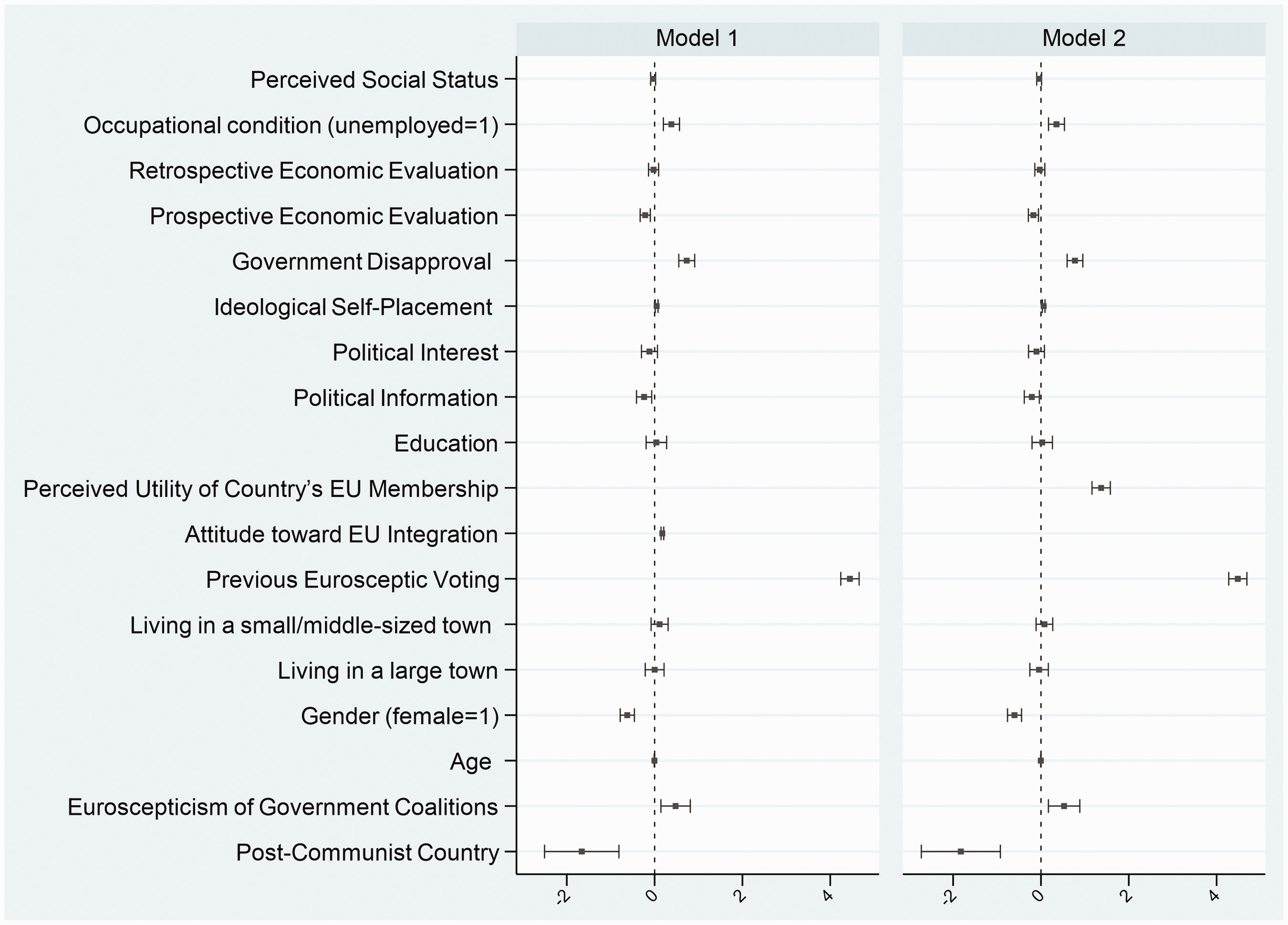
Predictors of Eurosceptic voting. Regression coefficients plot (Models 1 and 2).
Models without interaction terms
The first two models, which include alternative aspects of attitudes toward the EU, show that once one controls for vote recall at the last national elections and for other well-known predictors, Euroscepticism of Government Coalitions has a significant effect on the probability of voting for an opposition Eurosceptic party in the 2014 EP elections. Indeed, an extension of the government coalition of one unit toward the Eurosceptic extreme of the EU integration dimension implies, ceteris paribus, an average increase of around 60% in the probability of voting for a very Eurosceptic (opposition) party. This satisfies the first general expectation of this study. Against this background, the control variables that behave as expected are Prospective Economic Evaluation, Government Disapproval, Ideological Self-Placement, Occupational Condition, Post-Communist Country. In other words, Eurosceptic voters in 2014 EP elections were pessimistic about economic prospects; they were mainly manual workers or unemployed; they disapproved of the government’s record; they were prevalently rightist and they more frequently belonged to Western European countries. On the other hand, the variable Percentage Change of the National Rate of Employment (2009–2013), did not play any role. Almost the same applies to individual cognitive’ variables, because both Political Interest and Education are never significant, while Political Information seems to exert only a slight effect in Models 1 and 3 (p < 0.10). Lastly, opposition Eurosceptic voting seems to be predominantly a male ‘affair’. Being a woman, indeed, decreases the probability of voting for an anti-EU party by approximately 50%.
Models with interaction terms
In addition to the general expectation that the greater the Euroscepticism of government coalitions, the greater the propensity to vote for opposition Eurosceptic parties, our theoretical account predicts that this should apply in particular to voters who have an anti-EU attitude. On the other hand, we also expect that having a negative attitude toward EU integration is more likely to be translated into Eurosceptic voting (for an opposition party), the higher the degree of Euroscepticism of the government coalition. In other words, the theory led us to consider the effect of government coalitions’ Euroscepticism as mediated by individual attitudes toward the EU and the reverse. In order to test these hypotheses, we introduced in Models 3 and 4 the interaction between Euroscepticism of Government Coalitions and each of our two measures of attitudes toward the EU in turn (Perceived Utility of Country’s EU Membership, Attitude Toward EU Integration). As anticipated, we also included an additional interaction term: Previous Eurosceptic Voting with Time Span from Previous National Election.
If we consider the individual level of disagreement with the unification process, scaled from 0 to 10 (Negative Attitude toward EU Integration), an increase of Euroscepticism of Government Coalitions has a positive and significant impact on the probability of voting for an opposition Eurosceptic party, but only when voters already have a relatively pronounced negative attitude toward EU unification. In fact, the marginal effect loses its significance below score 5, which still identifies moderately Eurosceptic voters according to the criterion set out at previous note 7 and increases with the strength of this attitude (see upper-left graph in Figure 3). For voters who have the highest score (10), an increase of one unit in Euroscepticism of Government Coalitions implies on average an increase of around 4% in the probability of voting for a Eurosceptic party. If we consider as attitude toward the EU the dichotomous evaluation of one’s country membership of the EU, namely Perceived Utility of Country’s EU Membership, the dynamic is similar. Indeed, among respondents who considered their country’s EU membership to be a bad thing, the same increase of Euroscepticism of Government Coalitions implied an increase of approximately 5% in the probability of voting for an opposition Eurosceptic party.
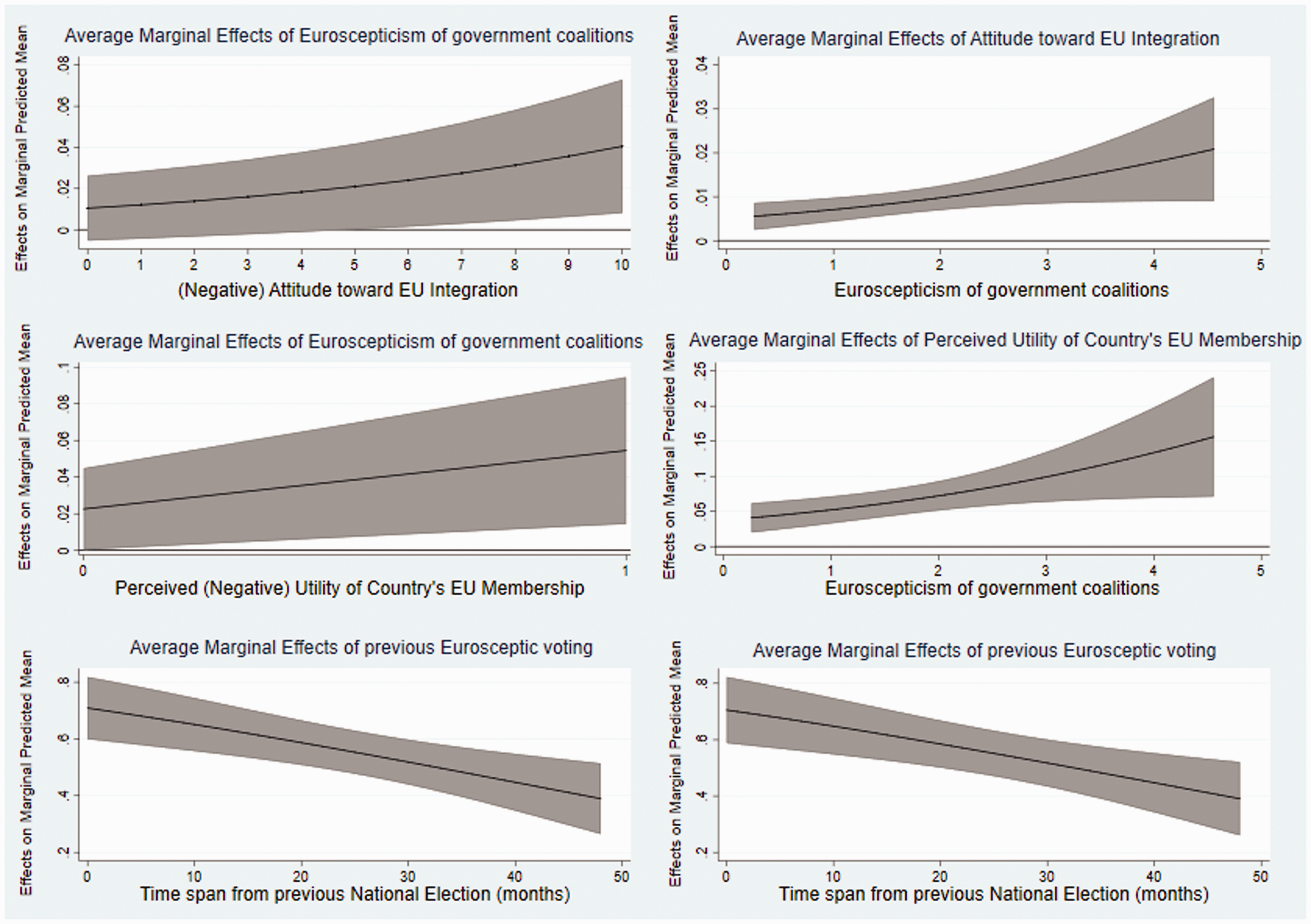
Average marginal effects (Models 3–4).
The reverse relationship, i.e. the effect of an increase in the anti-EU attitude (both versions of the attitudinal variable) according to different degrees of government parties’ Euroscepticism is confirmed as well. In the case of the scalar index, however, the impact seems very small. A unitary increase in a person’s anti-EU integration attitude, indeed, implies an around 2% increase in the probability of voting for a Eurosceptic party when a government party has a Eurosceptic score of 4.5 on our 7-point scale. On the contrary, when we consider the utilitarian dimension of EU attitudes (i.e. the dichotomous index that we called Perceived Utility of Country’s EU Membership), the effect of the radicalization of negative attitudes toward the EU is much stronger. In particular, when the level of Euroscepticism of a government is 0.25, shifting from a non-negative to a negative opinion about one’s own country membership of the EU implies an increase in the probability of a Eurosceptic vote of almost 5%. However, when the Euroscepticism of Government Coalitions is around 4.5, then such an increase reaches almost 17%. Ultimately, even if a direct comparison between the explanatory power of our variables on EU attitudes is not possible, because they are different in nature, what really matters for the voters seems to be not a general evaluation of the EU project, but the relationship between their country and the EU within the framework of the integration process.
As said, when the most pro-EU party in the government prefers a significant decrease in European integration, we predict that at least a marginal and symbolic change in such a direction takes place by altering the effects predicted by the two previous hypotheses (hypothesis 3). This expectation is fully confirmed by the results from Models 5 and 6. In these models, we introduced a third dichotomous term, Euroscepticism of Most Pro-EU Government Parties, to the interaction between Euroscepticism of Government Coalitions and the measures of individual attitudes toward European integration. Considering in particular the marginal effects shown in Figure 4, it is clear that when Euroscepticism of Most Pro-EU Government Parties is equal to one, i.e. when the most pro-EU party of the coalition is in fact more Eurosceptic than the mean of the most pro-European integration government parties in Europe, then the effect of the interaction between the voter’s attitude toward EU integration and governments’ Euroscepticism on Eurosceptic voting becomes weak or non-existent. 10 In other words, when the governments are not perceived as completely ineffective or non-credible in relation to Eurosceptic citizens’ desired policy outcomes on the European integration dimension, these voters’ electoral radicalization (i.e. their tendency to vote for opposition Eurosceptic parties) does not take place or is much smaller.

Average marginal effects (Models 5–6).
On the contrary, when the most pro-EU party is close to the extreme values of the European integration dimension (i.e. when Euroscepticism of Most Pro-EU Government Parties is equal to zero), the effects of the interaction are stronger than in the previous analysis (Figure 3). In particular, for extremely anti-EU voters, i.e. those who have the highest score (10) in Attitude toward EU Integration, an increase of one unit in Euroscepticism of Government Coalitions implies on average a growth of around 8% in the probability of voting for an opposition Eurosceptic party, which becomes approximately 12% when we consider the voters with a negative value of Perceived Utility of Country’s EU Membership. A unitary increase in a person’s anti-EU integration attitude, indeed, implies an around 5% increment in the probability of voting for a Eurosceptic party when a government party has a Eurosceptic score of 4.5 on our 7-point scale. Such increment stands at around 43% if we consider a change from a neutral or positive to a negative value of Perceived Utility of Country’s EU Membership.
That said, we conclude by commenting on the effect of another interaction of interest, that between past voting and the time distance between the 2014 EP elections and previous General Election (Figure 3). As to be expected, this time element moderates the impact of previous Eurosceptic voting on a Eurosceptic choice within a second-order framework. In particular, the closer the position of the EP election to the beginning of the national election cycle, the higher the reiterative character of a Eurosceptic vote.
Conclusions
An increasing number of studies insists on the importance of political and institutional constraints in explaining the different aspects of electoral behavior (Adams et al., 2005; Carlin and Love, 2013; Fiorina, 1996; Grofman, 1985; Hahm, 2016; Kedar, 2005, 2009). The policy inertia would feed polarization in the electoral choice because the voters ‘predicting their vote to be watered down along the path, prefer parties to hold positions more extreme than their own opinions’ (Kedar, 2005: 186). All of these approaches deal with first-order elections and more or less explicitly assume that voting is strategic and prospective. In other words, they assume that what would really matter for the voter are the future policies and how features of the political systems (namely the decision-making capacity) affect them.
In this article, we have taken a slightly different path. We have investigated the 2014 EP elections. This type of election is usually considered a second-order national election (Hix and Høyland, 2013; Hobolt and Wittrock, 2011). Indeed, its electoral campaign and actors belong to a national level of political competition. Nevertheless, their electoral stakes are not the composition of future national parliaments and governments. In such a context, any explanation of voting behavior based on purely strategic considerations would be completely out of place. According to our theoretical account, voters choose retrospectively and ‘correct’ the official positions of the government parties by looking at the real achievements of the government. In other words, by voting they express their level of agreement with the current policies, both those in place and those that are promised by the opposition parties. The aim could be either to reward their best-preferred option or to signal dissatisfaction with the performance of parties in the government. Within this general framework, we focused on Euroscepticism as the specific content of vote choice. Consistently with this research interest and a veto player theoretical framework (Tsebelis, 2002), we assumed that the status quo on the EU integration dimension is very stable. National governments cannot usually change unilaterally the level of EU integration, and when they are coalition governments, they almost always include at least one pro-EU party. Therefore, we suppose that some voters prefer very Eurosceptic opposition parties, because moderately Eurosceptic government parties are ineffective, although the latter propose electoral platforms that are the closest to their ideal points. More precisely, we hypothesized that (1) an increase of Euroscepticism in voters' attitudes is more easily translated into a very Eurosceptic voting when governments include moderately Eurosceptic parties and (2) an increase in the level of the Euroscepticism of the most Eurosceptic government party is more likely to increase the propensity to vote for a very Eurosceptic opposition party when voters have negative attitudes toward EU integration. When we relax the assumption that the status quo on European integration cannot be changed, we expect that a partial, maybe mostly symbolic, change toward a lower level of European integration can, ceteris paribus, decrease the propensity to vote for very Eurosceptic opposition parties. The most Eurosceptic government members are now considered less ineffective. In accordance with veto players theory, we hypothesized that such a change takes place in countries where the most pro-European government party wants a significant decrease in the level of European integration.
Empirical analysis has largely fulfilled all our expectations. An open research question concerns the possibility of extending the casual mechanism behind our hypotheses from voting behavior in the last European elections to voting behavior in the national elections. One might argue that, in general, when the status quo cannot be changed on a specific policy dimension, an increase in the level of government polarization (heterogeneity) on that dimension will fuel further radicalization in the voting behavior in favor of opposition parties without there necessarily being any further radicalization in the original preferences of the voters. Conversely, increasing extremism of policy preferences on a specific issue is more likely to be translated into a more extreme vote where government coalitions are more polarized – and thus ineffective – on that dimension. Nevertheless, the different stakes and the existence of incentives for strategic voting, when it comes to national elections, advise caution. Only future research will furnish a reliable answer.
Supplemental Material
Supplemental material for Government coalitions and Eurosceptic voting in the 2014 European Parliament elections
Supplemental Material for Government coalitions and Eurosceptic voting in the 2014 European Parliament elections by Stefano Camatarri Centre de Science Politique et de Politique Comparée (CESPOL), Université Catholique de Louvain, Louvain, Belgium Francesco Zucchini Department of Social and Political Sciences, University of Milan, Milan, Italy in European Union Politics
Footnotes
Funding
The author(s) received no financial support for the research, authorship, and/or publication of this article.
Supplemental Material
Supplemental Material for this article is available online.
Notes
References
Supplementary Material
Please find the following supplemental material available below.
For Open Access articles published under a Creative Commons License, all supplemental material carries the same license as the article it is associated with.
For non-Open Access articles published, all supplemental material carries a non-exclusive license, and permission requests for re-use of supplemental material or any part of supplemental material shall be sent directly to the copyright owner as specified in the copyright notice associated with the article.
