



Abstract
Who gains legislative influence in early agreement negotiations (trilogues) between the European Parliament and the Council of the European Union? Practitioners from both institutions suspect that it is the other side. Meanwhile, critics point at trilogues’ lack of transparency. This article proposes that legislative power and institutional transparency are inversely related: Opacity makes an actor more influential in political negotiations. The argument is tested on a matched sample of legislative files from the 1999–2009 period. The findings suggest that the European Parliament became more influential in early agreement negotiations – where it became opaque vis-à-vis the Council. In such negotiations, the relative influence of the European Parliament substantially increased; by contrast, the European Parliament did not gain influence in negotiations where it remained transparent.
Tripartite meetings (trilogues) are informal negotiations between the European Parliament (EP) and the Council of the European Union (Council), and they involve the Commission as an interlocutor. While trilogues have become a standard mode of European Union (EU) lawmaking, practitioners and scholars disagree on whether and how the institutional balance of power is affected. 1 Did the Council – traditionally considered to be the more powerful of the two chambers – become more influential or did the EP gain influence? According to Council representatives, the location of trilogues alone makes a difference: Negotiations take place on the EP’s premises where in some rooms ‘[…] Parliament’s key negotiators often sit on a podium looking down on the rest’ (Dionigi and Koop, 2017: 55). Furthermore, the EP can better handle negotiations because the legislative workload is more evenly spread out among its members (Häge and Keading, 2007). Representatives from the EP, on the other hand, see the Council’s negotiating hand strengthened because the preparation of the EP mandate has recently become public, whereas the Council’s secretive working methods allow it to bargain more effectively (European Parliament, 2014). Even though both chambers see themselves at a disadvantage in trilogues, both accept the practice as such (Dionigi and Koop, 2017). Meanwhile, the European news media (Cooper, 2016; Fox, 2014) and the scholarly literature (Farrell and Héritier, 2003, 2004; Shackleton and Raunio, 2003) have criticised trilogues for their lack of transparency.
In this article, I systematically analyse EU inter-institutional power in the light of informal lawmaking. Is the balance of power affected and if so, under what condition does the EP gain or lose influence relative to the Council? The central argument in this paper is that reduced transparency – opacity – makes an actor more influential in political negotiations.
The relationship between transparency and bargaining success has important implications for the inter-institutional balance of power in the EU. The article contributes to the literature on institutional influence in the EU (e.g. Costello and Thomson, 2013; Häge and Keading, 2007; König and Junge, 2009; Thomson, 2011) and the literature on the consequences of informal lawmaking (e.g. Farrell and Héritier, 2003, 2004; Rasmussen and Reh, 2013; Shackleton and Raunio, 2003). The former has missed the effect of varying degrees of institutional transparency on power dynamics. The latter has disregarded the effect of informal lawmaking on inter-institutional influence.
Empirically, the EP’s relative influence is analysed based on salient pieces of legislation in the 1999–2009 period. The paper draws on data from the ‘Decision Making in the European Union II’ (DEUII) data set (Thomson et al., 2012) and the ‘Dataset on The Informal Politics of Codecision’ (Bressanelli et al., 2014; Reh et al., 2013). Influence is measured in a spatial framework as the degree of preference attainment. The measure of relative influence, used in this article, builds on the extant literature (e.g. Aksoy, 2010; Bailer, 2004; Bailer and Schneider, 2006; Dür, 2008; Dür et al., 2015) and enhances interpretability and versatility for two reasons. First, it is a relative measure of influence, and second, by separating expected from realised outcome, it can easily include multiple theoretically motivated determinants of expected outcomes such as salience and status quo constraints.
Theoretically, the argument draws on bargaining theory. Under incomplete information, two actors involved in negotiations may be uncertain about the other’s true preference. Both must then decide which policy change they are willing to accept before ending negotiations (Huber and McCarty, 2001). To extract policy concessions from the other, each actor has incentives to understate the concessions that she can make (Schelling, 1980). The degree of institutional transparency affects the distribution of information and thereby a chamber’s ability to conceal information.
The central finding is that the EP became substantially more powerful when it was opaque. While the Council is always opaque, the EP is usually transparent. However, in early agreements – trilogues that are concluded at first reading – the EP became more opaque and reduced the informational asymmetry between the two chambers. It gained influence relative to the Council because of the more even distribution of information. The attribution of a causal effect of opacity on influence is corroborated by the finding that the EP did not gain influence in trilogues where it remained transparent, namely trilogues that were concluded at second reading. Finally, and in line with previous research (Costello and Thomson, 2013), the Council is the more influential institution overall, even when the EP was opaque.
Explaining inter-institutional influence
Transparency
Transparency is defined narrowly and in the context of bicameral negotiations. Inter-institutional negotiations are preceded by an intra-institutional formation of a negotiation position. I consider a legislative chamber transparent if the process of the formation of the negotiation position – the mandate – is known to the opposing chamber. In contrast, a legislative chamber is considered to be opaque if the opposing chamber faces uncertainty about the mandate and must infer it from claims made during the inter-institutional negotiations or by relying on back-channels.
Research on legislative transparency focuses on the effects of making lawmakers’ records public. The literature points to a trade-off: it increases accountability but also the risk of bargaining failure because representatives might be less willing to compromise (Stasavage, 2004). Hagemann and Franchino (2016) contest this trade-off, arguing that public records reduce problems of incomplete information and hence, reduce the risk of negotiation failure.
In line with Hagemann and Franchino (2016), I argue that transparency reduces information asymmetry which does not only reduce the risk of negotiation failure but also puts the legislators on a more level playing field. In contrast to previous research, my argument focuses on inter-institutional transparency and hence does not involve the public.
Influence in trilogues
Trilogues are informal negotiations between the Council and the EU and they involve the Commission in an advisory role. Delegations from the Council and the EP negotiate behind closed doors and come up with a compromise that is subsequently rubber-stamped in the parent chambers. By contrast, in formal negotiations, bills shuttle back and forth between both chambers in a maximum of three reading stages.
This article investigates who gains inter-institutional influence in trilogues and for what reason? This question has received scant attention in the scholarly literature, considering that it is still disputed among practitioners (Dionigi and Koop, 2017). One notable exception is Häge and Keading (2007), who show that the EP’s rate of successful amendments increases in trilogues. They argue that there is no inherent difference between informal (trilogues) and formal negotiations, but that the Council copes less well with an ever-increasing workload and is thus more willing to make concessions in return for speedy lawmaking in trilogues. Recent interviews with Council representatives support this view. The interviewees suggested that the workload in the EP is more evenly spread out, whereas, in the Council, one Presidency handles all informal negotiations (Dionigi and Koop, 2017: 55).
In line with Häge and Keading (2007), this article does not assume that there is a general difference between formal and informal negotiations but focuses on variation in the level of transparency.
Transparency and influence in trilogues
The approach in this article follows a spatial framework of politics where actors are rational and have single-peaked and symmetric preferences in a unidimensional policy space (Riker and Ordeshook, 1973). The spatial approach is commonly applied to EU politics (see e.g. Thomson et al., 2006; Thomson, 2011).
Both the EP and the Council are veto players in the lawmaking process and treated as unitary in the following. Policy change is to be expected only if the EP and the Council prefer a compromise to the status quo (Tsebelis, 2002). Negotiations between the EP and the Council serve to find such a deal. If both had complete information about the preferences of the other, this would be a formality (Cameron and McCarty, 2004). Procedural bargaining models of EU decision-making have well established that the outcome between both actors should be the midpoint between them (Crombez and Vangerven, 2014) because the EP and the Council are on an equal footing according to the rules of the ordinary legislative procedure (Tsebelis and Garrett, 2000).
In the case of incomplete information – where the chambers are uncertain about the other’s preferences – both actors must decide which policy change they are willing to accept rather than ending the negotiations (Huber and McCarty, 2001). Both chambers have incentives to exaggerate the policy that they are willing to accept to obtain the largest possible policy concession from the other (Huber and McCarty, 2001: 349). When information is distributed asymmetrically such that chamber A’s preferences are known but chamber B’s preferences are private, only chamber B can exaggerate its reservation point (‘walk-away point’) and extract policy concessions from A. When information asymmetry is reduced – suppose that under some circumstances, chamber A becomes more opaque – A gains influence on average, relative to extreme asymmetry, where B’s preferences are private, and A’s preferences are public.
In the context of inter-institutional EU negotiations, the Council and the EP differ in terms of transparency in the following way. Intracameral negotiations in the Council are closed to members of the EP (MEPs), no matter whether a compromise is negotiated in trilogues or not (Häge and Keading, 2007). The Council is always opaque to the EP, independent of informality. In the EP, legislative files are prepared by the responsible standing committee. Committee sessions are public, and a Council representative is usually present (Corbett et al., 2016). Therefore, the EP is transparent in the formal procedure. However, the EP could become opaque through an interaction of informality and timing.
Trilogues that start during the first reading stage are concluded either at first or at second reading. The difference between file conclusion at first or second reading determines whether the EP is transparent or opaque. If the negotiations were concluded at first reading, the EP became opaque because its delegation did not have a clear mandate (Corbett et al., 2016). Furthermore, the delegation did not have to report back to the EP and inform committee members in a public session on the state of the negotiations (Roederer-Rynning and Greenwood, 2015). However, if the informal negotiations were concluded at second reading, the EP remained transparent. The reason is that the first reading for the EP ends with a formal vote even if trilogues take place. The formal vote constitutes the mandate in subsequent trilogues and it is common knowledge. Therefore, opacity depends on the interaction of informality and timing. I henceforth distinguish between an opaque and a transparent EP.
Overall, in the EU context, the Council is always opaque. The EP, on the other hand, is transparent except in informal first reading agreements. If the EP becomes opaque, the information asymmetry between the Council and the EP is reduced. Therefore, in informal first reading agreements, both institutions can conceal information from the other. In contrast, in all other negotiations, only the Council can conceal information from the EP. H1: The EP gains influence, relative to the Council, in informal first reading agreements.
Research design
Conceptualising relative influence
In this article, influence is measured as the EP’s relative degree of preference attainment and it draws on previous research on measuring influence (e.g. Aksoy, 2010; Bailer, 2004; Bailer and Schneider, 2006; Dür, 2008; Dür et al., 2015; Schneider and Baltz, 2003, 2005). In its simplest form, preference attainment would be the distance between an actor’s preference and the outcome (Dür, 2008). Schneider and Baltz (2003, 2005) constructed a measure of relative influence by taking the difference between two absolute differences. The first is the distance between two actors. The second is the distance between the actor of interest and the outcome. This measure has been widely applied (e.g. Bailer, 2004; Lundgren et al., 2019). While straightforward, measuring influence in this way disregards the position of the status quo.
Bailer and Schneider (2006) take into account domestic and international constraints in their measure of influence that relies on the elegant Nash Bargaining Solution. Aksoy (2010) and Dür et al. (2015) both define influence in relation to the status quo/reversion point, i.e. the outcome that ensues if negotiations break down. Their measures include information on the status quo measured as distances to the status quo. I extend the approach by Dür et al. (2015) in a way that aligns more closely with veto player theory. 2
According to veto player theory, the expected outcome between two equally influential negotiators is conditional on the location of the status quo. The status quo determines the reservation point (‘walk-away point’) of an institution, which is the maximum policy concession a side is willing to make before ending negotiations. The expected outcome depends on the positions of the actors, the status quo and the reservation point of the more conservative institution. In the following, three policy environments are outlined that account for all possible scenarios with two actors. The policy environments are referred to as ‘constrained’ if the status quo affects the expected outcome, i.e. the midpoint is not the expectation. If the midpoint is the expected outcome, the environments are referred to as ‘unconstrained’.
In the first environment, both actors prefer the midpoint between them to the status quo. Therefore, the midpoint is the expected outcome and the environment is unconstrained.
In the second environment, the status quo is located between both institutions. Both want policy change but in opposite directions. Every alternative to the status quo leaves one institution worse off and because both can veto, no policy change is expected. In contrast to the first environment, the expectation is the status quo and the environment is constrained.
In the third policy environment, the reservation point of the more conservative institution is nearer to the institution than the midpoint. Figure 1 depicts such an environment. The Council prefers the status quo to the midpoint and both institutions prefer all points within the win set to the status quo. The reservation point sets the Council indifferent between status quo and policy change and this is the expected outcome. The environment is constrained.

Status quo constraint on the conservative institution. The midpoint between the Council and the EP is not included in the win set because the Council would rather end negotiations than accept the midpoint. Veto player theory predicts that the outcome is the reservation point of the Council. SQ: status quo; RP: reservation point of the Council; EP: European Parliament.
To measure relative influence in a way that is consistent with theory requires five steps. First, the reservation point of the more conservative institution is identified. Second, a constant is set to 0.5 reflecting equal influence; 0.5 would be the result if reservation point and outcome coincide. Third, the actual gain/loss of the relevant institution is set in relation to the maximum it could have gained. Fourth, that proportion is multiplied by 0.5 because the negotiations involve two actors. Fifth, the product and the equal influence constant are summed. Figure 2 illustrates the procedure.

Relative influence. RP is the reservation point and the expectation of the outcome. Out is the actual outcome. The positions are in brackets. RP: reservation point of the Council; EP: European Parliament.
In the example, the EP won because the outcome was closer to it than the reservation point (the theory-driven expectation). The maximum it could have gained is 45 and it got 31. Its relative influence is 1. Determine the reservation point of the more conservative institution (RP). 2. Was the outcome closer to the EP than the expectation (actual)? ○ Calculate as 3. What is the maximum the EP could have gained (max gain EP)? ○ Calculate as 4. Calculate relative influence as
This algorithm enhances existing measures to more accurately reflect veto player theory, and it can be extended by other factors such as the salience an actor attaches to an outcome.
Data
The DEUII data set (Thomson et al., 2012) is merged with the ‘Dataset on The Informal Politics of Codecision’ (Bressanelli et al., 2014; Reh et al., 2013). The former relies on expert opinion to measure the following variables on a 0–100 scale: policy outcomes, actor preferences, actor-level issue salience and the status quo for 331 controversial issues raised by 125 legislative proposals. The latter is used chiefly to determine whether the EP was opaque or not.
The relevant actors in this article are the EP, the Council, and for control purposes, the Commission. The preferences of the EP and the Commission are included in the DEUII data set directly but instead of a Council position, DEUII includes preferences of each member state. The member states’ positions are most often aggregated to a Council position using the ‘compromise model’ (Van den Bos, 1991). It is the average over the member states’ positions weighted by salience and either the Banzhaf power index (Banzhaf, 1965) or the Shapley–Shubik power index (Shapley and Shubik, 1954). The compromise model approximates a Nash bargaining solution (Achen, 2006). In this article, the compromise model is used to estimate the Council position employing the Banzhaf index (results using the Shapley–Shubik index are included in the Online appendix).
The unit of observation in the DEUII data set and in this article are controversial issues nested in legislative files. The following analyses assume a unidimensional policy space. This assumption is appropriate because the EU uses strict germaneness rules, i.e. a compromise to a budgetary issue cannot be overturned by an amendment on employment rights (Crombez and Hix, 2015). Strict germaneness implies that any dimension can be analysed in isolation (Krehbiel, 1988).
The DEUII data contains missing values on several variables. In line with previous research, these missing values have been imputed (König et al., 2005; Slapin, 2014). To account for the imputation uncertainty, 1000 data sets are imputed and each of the following analyses is run on all data sets. The imputation model and robustness checks are discussed in the Online appendix.
Case selection
The DEUII data contains issues nested in legislative files. These legislative files were either subject to the ordinary legislative procedure (codecision) or to consultation. For the purpose of this article, only codecision issues are included in the sample because the EP and the Council are both veto players in codecision but not in consultation.
Furthermore, the sample is reduced to files that were introduced after the Amsterdam Treaty entered into force because informal early agreements were not possible prior to the treaty changes. The voting rule in the Council can either be unanimity or qualified majority voting. In the reduced sample, the rule was always qualified majority voting.
Identification strategy: Addressing selection effects
The variable EP Position Opaque is the binary ‘treatment’ (the independent variable of interest) and approximates opacity. It indicates that an agreement, that was based on a compromise reached in trilogues, was concluded at first reading (1 = yes; 0 = no).
At the outset of the legislative process, the EP and the Council jointly decide whether to conduct formal or informal negotiations. It is therefore plausible that legislative files that are negotiated in the formal arena differ in important aspects from files that are negotiated in trilogues, leading to selection bias. To isolate the effect of opacity (EP Position Opaque) from such background covariates, I employ propensity score matching.
Generally, the propensity score is the probability of treatment assignment; in this study, it is the probability that an informal early first reading agreement was struck. Matching on the propensity score is sufficient to reduce bias due to observed covariates (Rosenbaum and Rubin, 1983). The matched samples are similar in terms of background covariates, thereby isolating treatment effects from background characteristics (Rubin, 2007). Matching also reduces the importance of functional form and model assumptions by excluding observations that lack common support, i.e. control cases that are far removed from treated cases (Ho et al., 2010; King and Zeng, 2006). Furthermore, given a set of valid observed covariates, balance (similarity) on unobserved covariates that are related to observed covariates increases as well (Stuart, 2010).
Matching variables
I use nine variables to estimate the propensity score. The choice of these nine variables is motivated by their potential to cause selection bias and informed by the literature on inter-institutional influence in the EU. The effects of those variables on the outcome – relative influence – are not of substantial interest here. The matching variables are only relevant insofar as they could cause selection bias. Furthermore, the matching design allows for a more credible estimate of the effect of opacity, but it neutralises the effects of observed background covariates. Therefore, the design cannot speak to the effects of variables that are used in matching. In the following, the nine predictors are discussed with respect to selection bias.
Salience is the relevance of a given issue to an actor and it is related to the effort spent in negotiations (Bueno de Mesquita and Stokman, 1994). The extant literature suggests that EU member states are more influential in the Council when an issue is more salient to them (Arregui and Thomson, 2009). Salience was also found to decrease voting cohesion in the EP (Bressanelli et al., 2016) and employed as a predictor, albeit insignificant, of informal and early negotiations (Reh et al., 2013). Furthermore, when member states attach greater salience to an issue, they may lobby EP representatives from their countries to vote along national lines (Costello and Thomson, 2016). The variable Relative Salience measures how important an issue is for the EP relative to the Council and is defined as:
The variable Commission Supports EP indicates whether the Commission was closer to the EP position than to the Council position (1 = yes; 0 = no) and is coded using DEUII data on member states’, EP and Commission positions. Commission representatives attend Council meetings (Corbett et al., 2016). It is, therefore, possible that the Commission acts as an information broker by informing the EP about the Council position whenever it prefers the EP’s text to the Council position. This variable was found to influence power (Costello and Thomson, 2013). Commission Supports EP would cause selection bias if the Council is less willing to enter informal negotiations when the Commission sides with the EP against the Council – the effect of opacity would be biased downwards. However, assuming that the Council always wants to enter informal negotiations and the EP prefers informal negotiations if the Commission is on its side, the effect of opacity would be biased upwards.
The variable 2nd Principal indicates whether the lead EP negotiator, the rapporteur and the Council Presidency shared the same nationality and whether the rapporteur’s national party was in government (1 = yes; 0 = no). I identify the national party affiliation of the rapporteur using the ‘Dataset on The Informal Politics of Codecision’ (Bressanelli et al., 2014). The data on the Council presidencies were collected by myself, and the ‘Parliaments and governments database’ (Döring and Manow, 2016) was used to determine whether the rapporteur’s national party was in government. The Presidency and the rapporteur are the lead negotiators for their respective institutions and hence, will be in contact. Rasmussen (2011) argues that rapporteurs who are from a party that is in the same national coalition as the Council Presidency may be loyal to their national government instead of the EP because they depend on the national party for re-election (see also Hix et al., 2007). The variable 2nd Principal would lead to selection bias if informal negotiations take place more often when such ties exist. Assuming that this weakens the EP’s hand, the effect of opacity would be biased downwards.
The variable File Complexity is included because the extant literature suggests that it is a prime suspect for causing selection bias. Farrell and Héritier (2003) argue that the ‘informal arena’ was introduced to increase legislative efficiency. Consequently, treatment assignment would be more likely, the more complex a file. Reh et al. (2013) find evidence for this relationship. Furthermore, Rasmussen and Reh (2013) show that the Council gains influence, the more complex a file. I gauge complexity using the following three variables. The variable Committees Asked is a count of how many committees were asked for an opinion. Length of Proposal is a word count of the Commission proposal and Recitals is a count of the number of recitals in the Commission proposal. All three covariates are included in the ‘Dataset on The Informal Politics of Codecision’ (Bressanelli et al., 2014). The number of recitals, committees asked for an opinion, length of the proposal and duration in months are count variables that are skewed and have outliers. Therefore, these variables have been log-transformed if they did not include zeros, otherwise, the square root transformation was used.
The variable Time Trend needs to be included in matching because disregarding the general increase of informal and early negotiations (treatment assignment) and the upward trajectory of the EP’s importance would likely lead to selection bias. Informal negotiations became more common over time (Reh et al., 2013). At the same time, the EP has become more influential as well (Hix and Høyland, 2013). Therefore, disregarding time would likely bias the estimate of opacity upwards. The variable Time Trend is a daily ticker, counting time passed since the Amsterdam Treaty.
The binary variable Enlargement is included in the matching procedure (1 = post enlargement; 0 = pre enlargement). In 2004, 10 new member states acceded to the Union. Informal and early negotiations may have become more common to offset the increased size of the Council and the EP, i.e. to make the legislative procedure more efficient (Farrell and Héritier, 2003). Selection bias would ensue if the 2004 enlargement also affected the institutional balance of power.
Finally, the variable Directive (1 = directive; 0 = regulation) is included in matching because selection into treatment could be related to the type of legislation. Directives have more distributive consequences and may be more salient to member states than the EP (Costello and Thomson, 2013). If directives are less (more) often negotiated early and informally, the estimate of opacity would be biased upwards (downwards) – assuming that the Council is more influential when negotiating directives.
The proposed mechanisms between the matching variables and relative influence may not be the ‘true’ mechanisms. It is key that these variables are related to treatment assignment and that they may affect relative influence. The fact that other causal mechanisms could be at play, further emphasises the strength of the matching design. By creating balance between observed background covariates in the treatment and control groups, their effects are neutralised.
Matching results: Balance of treatment and control groups
Pairs (to match on) were identified using the Matching package for R (Sekhon, 2011). I used 1:1 matching with replacement. A matching observation was found for each of the 46 treated units (where the EP position was opaque). None of the control observations was used more than twice to ensure that the analysis does not depend on too few control units. Table 1 shows sample balance before and after matching.
Balance summary statistics and tests: Propensity score of opaque EP position.

Note: Balance of the propensity score in the treatment and control groups before and after matching. Averaged over the 1000 imputation data sets. Original number of observations: 140; original number of treated observations: 46; matched number of treated observations: 46.
The matched sample is clearly more balanced on all statistics. The means of the propensity scores are quite close in the treatment and control groups after matching, i.e. treatment assignment is equally probable for treated and untreated units. The difference is no longer significant according to a difference in means test. Equally, the Kolmogorov–Smirnov test, which tests for the difference across the entire distribution (Sekhon, 2011), detects a significant difference before but not after matching. The sample size is reduced from 140 to 92 observations.
The balance statistics show that propensity score matching was successful. Therefore, selection effects of observed background covariates are successfully neutralised.
Addressing differences across policy areas
Inter-institutional negotiations involve different Council configurations and different EP committees depending on policy area. The extant literature provides evidence that variation between committees exists in terms of how frequently they negotiate informally, how they handled informal negotiations, and in terms of their bargaining styles vis-à-vis the Council (Reh et al., 2013; Roederer-Rynning and Greenwood, 2015, 2017). The Committee on Economic and Monetary Affairs (ECON) is described as exceptionally successful (Roederer-Rynning and Greenwood, 2017). ECON and the Committee on Civil Liberties, Justice and Home Affairs (LIBE) employ informal negotiations frequently, while the Committee on Industry, Research and Energy (ITRE) as well as the Committee on Transport and Tourism (TRAN) do not (Reh et al., 2013).
The strategy to address such differences is to estimate committee-fixed-effects models. Through the matching design and by controlling for differences between the committees and, hence, the policy areas, I reduce the potential for bias substantially.
Estimation
Data overview
I have emphasised the importance of comparing manifestations of bargaining power to theory-driven expectations of the outcome that are conditional on the location of the status quo. The expectations are dependent on the existence of spatial constraints in the policy environments, summarised in Table 2. Recall that an actor is constrained if the reservation point is closer than the midpoint.
Frequency of policy environments in the data.
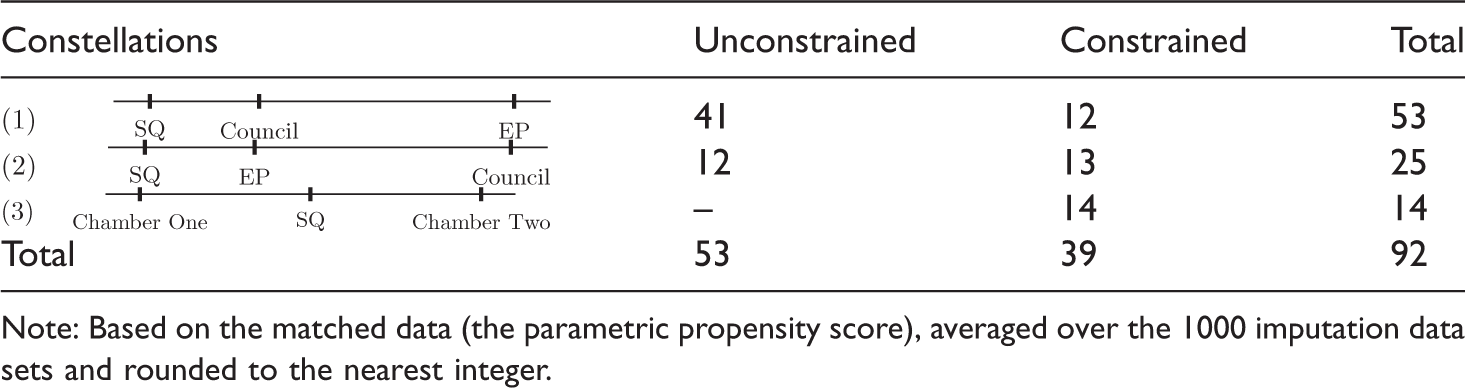
Note: Based on the matched data (the parametric propensity score), averaged over the 1000 imputation data sets and rounded to the nearest integer.
Firstly, 42% of the time, negotiators were in a constrained policy environment. In these cases, the midpoint is not the expected outcome. Furthermore, the Council is the more conservative institution, being closer to the status quo 53 out of 78 times, compared to the EP’s 25 out of 78. However, being more conservative is not automatically advantageous, i.e. merely being more conservative does not mean that the policy environment is constrained. The Council was constrained 23% of the time. The EP, on the other hand, was constrained 52% of the time.
König and Junge (2009) argue that the Commission will sometimes propose legislation when the status quo lies between both chambers, either due to mistakes (imperfect foresight) or due to shifted majorities. In line with their argument, this occurred 14 times (15%).
The relative influence of the EP over all issues is 39%. The matched sample includes 46 (50%) treated cases (where the EP position was opaque). For these cases, the EP’s relative influence is 49% and 29% otherwise.
Inter-institutional influence
The dependent variable is a ratio ranging from zero to one. Therefore, fractional logit models are estimated (Papke and Wooldridge, 1993). The data structure is such that issues are nested in legislative files. Standard errors were, thus, clustered by file.
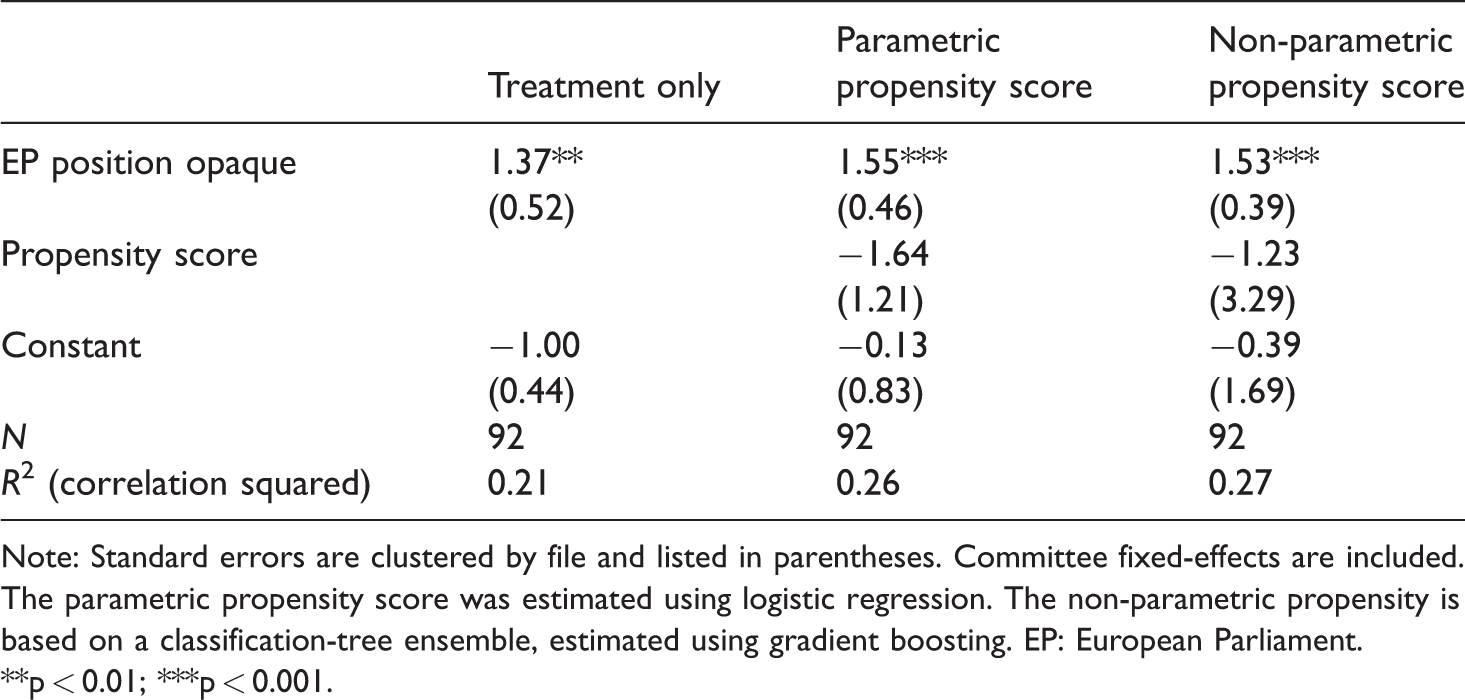
A model was fitted to each of the 1000 imputation data sets. From each model, I ran 10,000 simulations. The combined 10 million rows matrix was used to extract point estimates and uncertainty. The results are illustrated in Table 3.
Treatment effect of opaque EP position: Fractional logistic regression.
Note: Standard errors are clustered by file and listed in parentheses. Committee fixed-effects are included. The parametric propensity score was estimated using logistic regression. The non-parametric propensity is based on a classification-tree ensemble, estimated using gradient boosting. EP: European Parliament.
**p < 0.01; ***p < 0.001.
The first model in Table 3 excludes the propensity score and is thus akin to a difference in means test on the matched samples. The second and third models control for the propensity score – and thereby the observed background covariates – because matching did not yield an exactly balanced sample on all covariates (Ho et al., 2010). In the second model, the propensity score was estimated using logistic regression. In the third model, a non-parametric, data-driven approach was used to estimate the propensity score. It involves using an ensemble of classification trees, which avoids making functional form assumptions when estimating the propensity score, allows for the exclusion of bad predictors and interactions among the matching variables. 3
Across all three models, the EP gains relative influence when its position was opaque. The effective increase in power is quite substantial. Becoming more opaque increases the power of the EP between 16 and 53 percentage points (36 on average). 4
Placebo test: A transparent EP in trilogues
In this article, opacity is approximated by early first reading agreements rather than all informal agreements. The EP is only opaque in trilogues when the informal compromise was reached before the EP formed its formal first reading opinion. The EP position is common knowledge when trilogues take place after the EP voted in plenary on the formal first reading opinion. Therefore, the EP should not become more influential in informal early second reading agreements.
Informal early second reading agreements are similar to informal first reading agreements in most aspects. In both cases, triolgues commenced during the first reading stage. The difference is that in informal early second reading agreements, the compromise was reached after the EP had published its formal first reading opinion. The formal opinion makes the position of the EP common knowledge and thereby robs the EP of the ability to strategically conceal information.
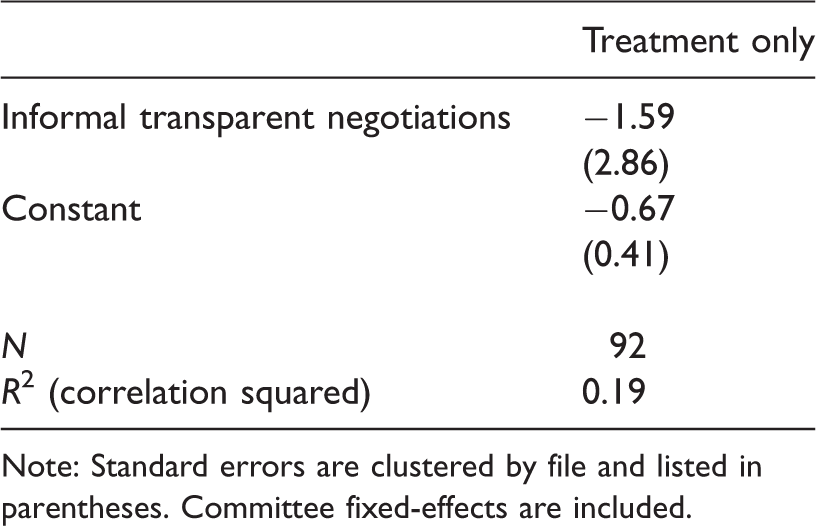
Table 4 illustrates the effect when the approximation for opacity (informal first reading agreements) is replaced with informal but transparent negotiations (informal early second reading agreements). In line with the expectation, the EP did not gain influence in such trilogues. While this test does not rule out all alternative explanations, it corroborates the claim that the EP becomes more influential due to opacity.
Placebo test: Effect of informal but transparent negotiations.
Note: Standard errors are clustered by file and listed in parentheses. Committee fixed-effects are included.
Overall, the effect of opacity is strong and robust (refer to the Online appendix for a series of robustness checks involving combinations of different conceptual choices). The evidence presented here points towards a substantive link between transparency and power in political negotiations. Many legislatures around the world are bicameral and many legislative chambers may choose rules regarding their legislative organisation themselves. Efforts that affect transparency are likely to also affect the institutional balance of power. The results also imply that a balance of power between institutional actors, such as the envisioned equal formal influence of the EP and the Council in the EU, requires a balance of transparency as well.
Conclusion
While informal inter-institutional negotiations (trilogues) have become ever more prominent in the EU, practitioners from both the EP and the Council suspect that the other side has an advantage in such negotiations (Dionigi and Koop, 2017). In this article, I ask the question whether the balance of power is affected and if so, what causes the EP to gain or lose influence relative to the Council.
The central argument is that the EP gains power when its position becomes opaque to the Council. 5 This happened during the 1999–2009 period in trilogues that were concluded early – before the EP issued its formal first reading opinion. The following summarises the mechanism linking transparency to power. While the Council is always opaque, the EP can become opaque but only in early informal negotiations. In such negotiations, the informational asymmetry between the EP and the Council is reduced providing both institutions with a more equal ability to extract policy concessions from the other. Institutions can exploit the other’s uncertainty by understating the maximum policy concession that they are willing to make before ending negotiations.
The core finding is that the EP did indeed gain substantial influence in trilogues that were concluded at first reading. The EP did not gain influence in trilogues where it remained transparent, namely trilogues that were concluded at second reading where the EP mandate was common knowledge. 6 In line with previous research, the Council was found to be the more influential institution overall (Costello and Thomson, 2013). However, in informal and early agreements, the EP’s relative influence was close to parity: 49%.
Trilogues have been criticised in the European media (Cooper, 2016; Fox, 2014), by scholars and practitioners (European Parliament, 2009; Farrell and Héritier, 2003, 2004; Shackleton and Raunio, 2003). In response, the EP has reformed its Rules of Procedure in 2009, 2012 and 2016 regulating the practice of informal negotiations (refer to the Online appendix for a detailed discussion of the reforms). Nowadays, the lead committee adopts a report that is voted on in plenary before the EP enters into informal negotiations. The plenary vote provides the mandate for the delegation. The position of the EP is, therefore, known to the Council. The EP has become transparent in all inter-institutional negotiations while the Council remains always opaque. In the sample that was analysed in this article, the EP’s relative influence was 29% when it was transparent while the Council was opaque.
The ordinary legislative procedure (codecision) affords equal power distribution between the EP and the Council (European Parliament, 2014). However, the secretive methods of decision-making in the Council tilt the balance of power in the Council’s favour. Recently, the European Ombudsman (2016), Emily O’Reilly, concluded in her investigation into trilogues that the Council should make its position public before entering into informal negotiations with the EP. Such a change would eliminate the informational asymmetry between the Council and the EP and thereby reduce the power imbalance between the institutions. While the EP has chosen to become more transparent, the Council has thus far not reciprocated.
In this article, I have argued that transparency affects influence in political negotiations in the EU and provided evidence for that link. Transparency may be linked to power in other contexts. In many bicameral systems, legislative organisation is determined by the chambers themselves. These lawmaking institutions face incentives to sacrifice transparency in order to gain influence. Recognising that link may enhance our understanding of how political institutions work and inform institutional design. 7
Supplemental Material
Supplemental material for Power and transparency in political negotiations
Supplemental Material for Power and transparency in political negotiations by Philipp Broniecki in European Union Politics
Footnotes
Acknowledgements
The author would like to thank Lucy Barnes, Gijs Jan Brandsma, Thomas Bräuninger, Frank Häge, Tim Hicks, Christel Koop, Thomas König, Amie Kreppel, Lucas Leemann, Nils Metternich, Abdul Noury, Lukas Obholzer, Christine Reh, Philipp Schröder, Hannah Smidt, Tatjana Stankovic, Nikoleta Yordanova, three anonymous reviewers and the editor.
Funding
The author(s) received no financial support for the research, authorship, and/or publication of this article.
Supplemental Material
Supplemental Material for this article is available online.
Notes
References
Supplementary Material
Please find the following supplemental material available below.
For Open Access articles published under a Creative Commons License, all supplemental material carries the same license as the article it is associated with.
For non-Open Access articles published, all supplemental material carries a non-exclusive license, and permission requests for re-use of supplemental material or any part of supplemental material shall be sent directly to the copyright owner as specified in the copyright notice associated with the article.
