



Abstract
Committee coordinators face a classic delegation problem when assigning reports to their committee members. Although a few theoretical developments have focused on the effects of expertise on delegation, empirical studies have commonly assumed monotonic effects. Based on existing informational models, we argue that a more loyal committee member, everything else being equal, is more likely to be appointed as a rapporteur and that more expertise, holding preference divergence constant, has a non-monotonic effect because of informational credibility. Employing accumulated committee service as an expertise measure, these theoretical expectations are tested on all committee report delegations in the European Parliament from 1979 to 2014. Our empirical analysis with non-parametric and parametric hierarchical conditional logit models renders strong support for these expectations. The results hold across member states, political groups, procedures, committees and over time.
Introduction
The European Parliament (EP) is a committee-based legislature dominated by political groups (Whitaker, 2001). How to identify, prioritize and allocate legislative proposals to rank-and-file members who negotiate on their behalf, becomes an essential task for the group’s committee leadership. We argue that within-party delegation of legislative tasks follows an informational rationale. The political group needs information about the possible implications of policy proposals that some of its (expert) members can provide. It consequently favors members who have acquired expertise through specialization. However, this does not imply that the members with the most expertise are the most preferred. This is due to informational credibility concerns.
To develop our argument, we first review the literature on committee organization and report allocation in the EP. While there is some consensus regarding the broad empirical patterns, the theories employed for accounting for these patterns apply somewhat inconsistent logics. Building upon extant game-theoretic models developed by Crawford and Sobel (1982) and Fischer and Stocken (2001), we present an informational account of report delegation within political group committee delegations. We highlight the nuanced effects of loyalty and expertise on the probability that a committee member is appointed as a rapporteur; that is, a committee member assigned with the task of drafting a report on behalf of the committee. While existing political science studies have conventionally asserted that the principal is monotonically more likely to appoint an agent with more expertise to pursue policy on the former’s behalf, Fischer and Stocken (2001) theoretically demonstrate that this expectation falls short of a theoretical foundation.
Another contribution of this article is the granularity of our data. While existing research tests allocations at an aggregated level – for example, the number of reports per term (e.g. Yoshinaka et al., 2010) – we consider only the alternatives that the committee coordinator can realistically choose between. At each allocation, the coordinator can only select amongst committee members from the same political group. We call this his ‘choice-set’. We then calculate the variables to reflect the information available to the coordinator at the time of the decision. For example, our loyalty score relies only on votes cast up to the time of the decision, rather than averaging over whole time periods. Similarly, committee-specific policy expertise is not measured in terms of binary categories such as incumbent or freshman, but as days spent on the committee until the day of the report delegation.
Across non-parametric and parametric conditional logit models, we find a linear effect of loyalty and a non-monotonic effect of committee-specific policy expertise on the probability of being delegated a report. While the coordinator initially prefers expertise, growing expertise may not generate strictly positive returns. This nuanced effect is consistent across member states, committees, political groups, procedures and over time.
Rapporteurs in the EP
The rapporteur collects information and negotiates a consensus within the committee. Later, she defends the committee compromise during the plenary reading, and continues to follow the dossier during inter-institutional bargaining. On the one hand, the rapporteur must identify a suitable coalition within Parliament. The rapporteur must decide if a super-majority is needed to promote Parliament’s institutional interests or if party-political contestation is called for (Hagemann and Høyland, 2010; Hix et al., 2003, 2005; Kreppel, 2000). On the other hand, the legislative outcome depends on agreement with the Council and support from the Commission. The rapporteur must therefore identify interests represented in the other institutions particularly on her or his committee’s policy areas and form proposals that the majority in those institutions is willing to accept (Costello and Thomson, 2010). Roger and Winzen (2015), building upon Ringe (2010), emphasize the importance of coalition-building within committees as well selective involvement of the political groups more broadly (see also Benedetto, 2005). In matters pertaining to particular proposals, the rapporteur is therefore the most influential Member of the European Parliament (MEP), and the proposal's success depends on her political skills.
The rapporteur is centre-stage in Parliament’s committee system. Bowler and Farrell (1995) discuss to what extent standard legislative theories can shed light on organization in the EP (for an overview of these theories, see Martin, 2014). Their study informs subsequent work on committee assignments in the EP (Chiru, 2020; Mamadouh and Raunio, 2003; McElroy, 2006; Whitaker, 2001, 2011; Yordanova, 2009, 2011a). The same framework has often been used to understand individual assignments such as rapporteurships (Benedetto, 2005; Daniel, 2013; Hermansen, 2018; Hurka and Kaeding, 2012; Kaeding, 2004; Yordanova, 2011b; Yoshinaka et al., 2010) and shadow rapporteurships (Hurka et al., 2015) as well as the group leaders themselves (Daniel and Thierse, 2018). Many of these studies find that participation, voting loyalty and relevant extra-parliamentary experience as well as time on a committee are important predictors of an appointment (see also Ringe, 2010). Moreover, partisan and informational theories are considered to provide the better fit as loyalty and expertise consistently increase the probability of delegation (Daniel, 2013; Kaeding, 2004; Whitaker, 2001; Yoshinaka et al., 2010). Of particular relevance here is the work on the selection of party group coordinators. Daniel and Thierse (2018) find that MEPs who are appointed committee coordinators possess policy expertise in the form of committee incumbency and relevant professional background. Moreover, Obholzer et al. (2019) show that these coordinators tend to select rapporteurs that are closely aligned with their own policy positions.
However, frameworks developed to understand collective committee assignments can neither accurately describe individual report allocations nor provide theoretical foundation for what shapes them. Gilligan and Krehbiel (1987) develop their informational approach based on the presumption that the floor can induce committees to share information by pre-committing to closed rules for amendments. While Gilligan and Krehbiel (1987) focus on the floor’s ability to monitor and sanction committees, we argue that report allocation is essentially a question of selection within political groups that act as gate-keepers with few means of monitoring and that seek a reliable and capable agent. In short, the transmission of information from rapporteurs to the political group should be thought of separately, and differently, from what is conceived in the traditional literature on committee assignments. As is the case for the partisan approach, we consider within-group cooperation. However, our explanation for the enforcement of loyalty is grounded in an informational argument.
An informational account of report allocation within political groups
In the partisan approach, leaders sanction unruly members by removing them from, or not promoting them to, salient positions. Members accept the discipline for a series of reasons that are not present in the EP. In contrast, we argue that – because of their relatively weak position – groups select policy-makers that, by and large, pursue preferences shared by a majority of their members. This also reduces the need for disciplinary measures later in the process.
Our approach generates new empirical implications that have not yet been tested. We consider selection as a function of the rapporteur’s incentives for policy drift (i.e. preferences) and his capacity to induce such a drift (i.e. specialization).
The committee coordinator is the principal. The rapporteur is the agent whose role is to provide information. A coordinator acts on the rapporteur’s initiatives. Proposals are discussed and voting instructions are issued in group meetings before the plenary deliberation. The report can also be amended on the coordinator’s initiative both in the committee and in the plenary. When acting, the coordinator must rely on information transmitted from the rapporteur. Whether the rapporteur is willing to truthfully transmit as much information as possible becomes a crucial factor in the appointment decisions.
The cheap-talk game of Crawford and Sobel (1982) corresponds well to the strategic interaction between political group leaders and their appointed rapporteurs. The game they develop has two players with different preferences. The agent (typically called a ‘sender’) will submit a report to the principal (called a ‘receiver’) containing a certain amount of information, followed by the receiver’s move to make a final policy. Crawford and Sobel argue that, as long as preference divergence is not too large, the sender with preferences more in line with the receiver’s reveals more information, since this leads the principal to take actions close to what the agent would like. Based on their theoretical results, we expect leaders to select rapporteurs with similar political preferences to the group majority. They learn about these preferences by observing members’ voting loyalty. H1: A coordinator is more likely to appoint a member with higher voting loyalty.
Another critical component in informational theory is specialization. The importance of expertise in the EP has generally been justified by reasoning that a more specialized agent can transmit more information. Authors often cite Krehbiel (1991) as the source for this intuition. Krehbiel hypothesizes that a more specialized committee is more likely to receive a restrictive rule for amendments and that. A more specialized congressman is therefore also more likely to be appointed as a conference committee member pursuing policy outcomes on behalf of her or his chamber. However, in the models, the sender is assumed to be either specialized or non-specialized. Understanding the effects of expertise on informational transmission requires us to model expertise as a continuous variable. This has not yet been explored in political science, as far as we know.
Taking preference divergence for granted, Fischer and Stocken (2001) theoretically examine the relationship between the sender’s quality of information and the information she reveals. When the sender does not have any information about the policy uncertainty of the receiver, the sender’s signal contains no useful information and both of the players suffer from policy uncertainties. However, once the sender starts to specialize, information is weakly preferred to be transmitted to the receiver because better information can help the latter sort out uncertainties and adopt a final policy beneficial to both of them. This implies that the receiver may initially prefer a more specialized sender.
However, Fischer and Stocken (2001) find that, as the sender acquires more expertise, everything else being equal, the two players may run into conflict, undermining information transmission. With preference divergence fixed, increasing expertise has direct and indirect effects on the quality of the information transmitted. The direct effect is that the sender has more information and is therefore capable of revealing more information to the receiver. The indirect effect is that increasing expertise would eventually undercut the credibility of the signal. Suppose that the sender prefers the receiver to take a higher action than would be taken if both had the same information. Increasing from no private information to coarse information, the direct effect would dominate the indirect one, because it is Pareto optimal for the sender to reveal coarse information so that the receiver would take different levels of action conditioning upon the signal. With more and more specialization, the receiver would be concerned about whether the sender, who now has more leverage to choose signals, may send misleading signals to trick the former to take a higher action. This means that the indirect effect may dominate the direct one when the sender is very specialized. If information collection is the most critical factor in coordinators’ rapporteur appointments, the consequence is that expertise has non-monotonic effects, holding preference divergence constant. H2: A coordinator is more likely to appoint a member with a higher level of expertise, but the effect is non-monotonic.
Note that Fischer and Stocken’s (2001) model only implies that the effect of expertise is non-monotonic. It does not suggest that the effect would have a particular non-monotonic pattern, such as an inverted U-shaped relationship. Furthermore, their results suggest neither whether nor how the effect of expertise depends on the extent of misaligned incentives. We speculate that it should depend on the utility functions of the sender and the receiver as well as the nature of the sender’s private information system. To empirically examine the interactive effect, we will include the interaction term between loyalty and expertise.
Our theoretical approach goes beyond what has been proposed or discussed in the literature. In line with previous research, we expect that loyalty and expertise are important criteria when parties select their policy-makers. However, by focusing on the rapporteur as a provider of information, we outline a coherent theoretical framework for these two hypotheses and make predictions about when these criteria apply and why.
Data, measurement and statistical models
We have collected data on all reports allocated to individual committee members from the beginning of the first directly elected EP in 1979 until the last meeting of the seventh EP in 2014. The data were gathered from the Official Journal of the European Union and the EP webpages. Reports without rapporteur and reports where the group had only one member on the committee at the time are excluded, as no meaningful delegation is possible. This has left us with 11,075 delegation decisions.
For each report, we identified the rapporteur, the main committee and the political group responsible. We generated the relevant membership of the political group delegation to the committee using data from Høyland et al. (2009). These sets of political group committee members form the basis for the group leadership’s choice of rapporteur. We label them ‘choice-sets’. A choice-set consists of all full committee member's belonging to a particular political group. It is from within this set that the group coordinator can pick the rapporteur. To create these choice-sets, we used the date of the adoption of the report in the plenary. Here, we rely on the assumption that the coordinator would not seriously consider members who were planning to leave the committee prior to the presentation of the report to the plenary. The substantive results are the same. These choice-sets vary in size across committees, political groups and over time.
Our focus is on the relative effects of loyalty and expertise on the likelihood of being selected as rapporteur conditional on being a member of the choice-set. In other words, conditional upon being in charge of a report, we model to whom amongst its committee members the political group coordinator grants the task of writing the report.
Voting loyalty
We need a measure that approximates the information available to the coordinator at the time of allocating the report. Newcomers and coordinators have little to no knowledge of each other prior to their entry to the Parliament since they usually do not share national party affiliation. We therefore assume that coordinators learn about members’ preferences through their parliamentary activities, notably their voting behavior. Observing higher levels of voting loyalty suggests to the committee leadership that the MEP has more similar preferences than members with lower scores. Although observed roll-call votes or loyalty scores likely reflect preferences induced by party pressure, they can nevertheless reveal the MEP’s loyalty relative to other MEPs.
Our calculation of loyalty is as follows. For each vote, we identify the majority position of the group. Then, for each MEP, we code as 1 if the vote is cast with the majority, and 0 if it is against. We sum this across all votes up until the date of the allocation. We then divide this number (+ 1) by the total number of votes (+ 1) in which the MEP has participated up until the decision date. This score is calculated for each MEP at each choice-set. 1
One concern regarding this operationalization is the informative value of roll-call votes as a measure of loyalty. Individual votes are not consistently recorded in the EP. Indeed, roll-call requests vary between groups, across topics and by procedures (Carrubba et al., 2006). A key concern is that behavior during these votes may be different from behavior in other (non-recorded) votes, potentially biasing statistical inference about true preferences. There is a lively, and unresolved, debate regarding the extent of this bias (Hix et al., 2018; Hug, 2016; Yordanova and Mühlböck, 2015), as well as the empirical pattern of roll-call requests (Finke, 2015; Thierse, 2016). However, our assumption is that the group leadership faces the same bias in the recording of roll-call votes as researchers do, and simply rely on what is available to them.
Expertise
Expertise is central in any informational account of report allocation, but the concept is contested and elusive. The literature has considered several different measures of expertise. To some, expertise is about what you bring in to the Parliament, in particular in the form of work experience (Yordanova, 2011b; Yoshinaka et al., 2010) or from national policy-making (Hermansen, 2018). To others, the key aspect is more broadly captured by members’ level of education (Daniel, 2013). These approaches allow expertise to be highly policy-specific. A farmer brings with him expertise that may be relevant to policy-making in the Agriculture committee, but not to the Foreign Affairs committee. In contrast, a lawyer might have relevant expertise not only on the Legal Affairs committee, but on all regulatory committees. However, this is also a relatively crude classification, as their educational and professional background may have provided them with a set of skills that differ substantively from the skills that are necessary for policy-makers on a committee. Furthermore, common to these approaches is their focus on what MEPs brought with them when entering office. As a result, it is a static and often binary measure of expertise. It is binary in the sense that an MEP either has expertise or does not. 2 It is static in the sense that an MEP lacking expertise when entering the EP will not develop it during her time in office. This is particularly problematic for the number of career politicians who make their debuts at the European level. This is not to say that MEPs’ background is not useful during delegation decisions. In the model, we therefore capture such effects with individual committee-specific intercepts, as detailed below.
As an alternative to policy-relevant expertise, we rely on committee seniority. It is defined as the number of years a legislator has served on a committee across terms and has been widely adopted in the literature on legislative studies (Buchanan et al., 1970; Clapp, 1963; Huckshorn, 1965; Krehbiel, 1991; Luce, 1922; McConachie, 1898; Schneier, 1970; Tobin, 1986). A legislator staying on a given committee longer is more likely to frequently join committee meetings and develop more policy expertise for this committee. While having higher education or related professional work experience can be helpful in boosting learning, it is also a broad and possibly unspecific approximation for knowledge about a committee’s policy jurisdiction. By contrast, staying on the same committee is a more direct approach to specialization in relevant policy areas. As Krehbiel (1991: 171) pointed out, there is ‘a huge literature on state and national legislatures that provides strong empirical support for the relationship between committee service and policy expertise’. His seminal work on informational theories employed this measure of expertise in examining competing theories of legislative organization in United States Congress and testing the effects of expertise on the probability of being appointed as a member for conference committees where the two chambers negotiate for a bill. While Krehbiel relies on the length of a legislator’s consecutive service, our definition of committee seniority is more inclusive, as we summate over any previous committee service for a given committee. There are two reasons why this approach makes more sense when studying the EP. First, it is not uncommon for an MEP to switch committees. Second, some MEPs left the EP for some time (e.g. taking up a seat in the national parliament for a while) and returned to the same committee later on.
Following Krehbiel (1991), we use committee seniority to measure committee-specific expertise and count the years of being on a committee up to the day of this committee’s rapporteur appointment. This measure has also been used in the EP context. Daniel and Thierse (2018) rely on a similar measure of committee experience when studying selection of group coordinators. In explaining report assignments, Yoshinaka et al. (2010) included a linear control for the length of an MEP’s committee service within a term. The variable captures a shorter period of time and was included not to capture expertise. Instead, they opt to employ previous careers and EP seniority as their two alternative measures of expertise. Obholzer et al. (2019: 250) use count of half-terms to measure committee experience. In line with our logic, they see it as a measure of ‘specialization (that) could be rewarded by more reports’. A unique feature of our operationalization is the granularity of our measure. The updating process accounts for an MEP’s developing expertise within a term. This allows us to distinguish between different levels of expertise among MEPs who joined with a similar background. It also allows us to distinguish committee seniority from EP seniority as we account for committee switching.
Control variables
As a measure of general parliamentary experience, we use chamber seniority which counts the number of years serving in Parliament up to the time of report allocation. As Krehbiel (1991) argued, this measure captures legislative experience independent of the committee’s jurisdiction and is not suitable for capturing committee-specific expertise. Committee and EP seniority are certainly highly correlated. An MEP staying longer on a given EP committee has higher EP seniority, but not necessarily the other way around. For our theoretical interests, committee-specific expertise is more relevant and precise than general experience. However, chamber seniority controls for the policy-irrelevant ‘learning on the job’ which could confound the effects of committee-specific expertise. In the remainder of the article, we use expertise to denote committee seniority and employ seniority to denote EP seniority. We rely on Høyland et al. (2009) for the data of these variables.
A central control variable in the literature on the EP has been legislative participation (e.g. Hurka and Kaeding, 2012; Yoshinaka et al., 2010). The consensus is that a more active MEP is more likely to be appointed as rapporteur, either as a reward for past service or as a self-selection into legislative tasks (e.g. Benedetto, 2005). Participation is calculated, just as loyalty is, on the basis of data from roll-call votes, dividing the number of votes participated in by the number of total votes that have been cast in a given term until the decision date. 3
The non-monotonic effects of expertise may be driven by members who reduce their activity towards the end of their career. This may be because of age (Bailer and Ohmura, 2018; Meserve et al., 2009) or a de facto early retirement (Daniel and Metzger, 2018). Career-oriented members also frequently shift focus to other relevant arenas for the next stage in their career (Høyland et al., 2019). The models therefore control for age and its squared term as well as an indicator for reports allocated during the MEP’s final year.
Many MEPs switch party or political group affiliations (Hix and Noury, 2018). To account for the possibility that political group switchers were rewarded by their new groups through report allocation, we include a dummy-variable for party switchers. Like previous studies, we also control for leadership roles in the national delegation and the group. We flag as leadership positions all trusted positions, leaving only rank-and-file members as non-leaders. Committee chairs and vice-chairs are, for their part, coded as committee leadership. Last, we account for MEPs with leadership roles in the Parliament. The Online appendix provides the descriptive statistics for our variables.
Statistical model
Existing literature has relied upon logit and count models to capture factors that determine whether an MEP writes at least one report during a specific time frame, or alternately how many reports an MEP drafts during a specific time frame. As we are interested in the decision of who is appointed as a rapporteur conditional upon the political group obtaining the responsibility for a report, our statistical approach is different. Thus, we use conditional logit models to realistically describe aspects of the group’s committee members that may affect the coordinator’s choice. We therefore do not estimate the probability of the outcome of interest given the values on the covariates, but rather how covariates affect the relative probability of one member in the choice-set being selected over the other alternatives. Within each choice-set the sum of the probabilities across units is one, so there is no baseline intercept in these models.
Our theoretical focus is on within-group allocation of reports and the conditional model explicitly describes that dynamic. However, this also means that choice-set level control variables that describe how selection criteria vary between groups can only be included as interaction effects in a mixed conditional logit. We have not theorized these effects and therefore drop previously included controls aiming at explaining such differences in the main models. However, to ensure that our findings are not driven by idiosyncrasies, we nevertheless explore if elements such as political groups, committees, procedures, time periods and nationality condition the findings. These elements are included primarily as random intercepts but we also explore their conditional effects through random slopes. Our choice is detailed below. Since most of the existing literature has looked at the determinants of the number of reports drafted by each MEP – including contextual variables – conflicting results may arise from the difference in design.
We rely on hierarchical modelling because individuals are observed several times. As members may serve on multiple committees simultaneously or over time, we use committee-specific MEP intercepts. A couple of members have furthermore been elected from different member states in different periods. For these MEPs, we include one set of such intercepts per country that they have represented. This allows us to capture individual aspects that affect their probability of being selected. Existing literature has highlighted several such factors, including work experience, education and ties with interest groups (Daniel, 2013; Yoshinaka et al., 2010). MEPs may have other, unforeseen characteristics that affect their suitability as rapporteur. However, as the MEP intercepts are committee specific, they allow for the importance of these factors to vary across committees. Mamadouh and Raunio (2003) argue that country-specific cultural factors influence report allocation. Moreover, some national party delegations may need time to learn how the EP operates and properly adjust (Lindstädt et al., 2012). Hence, we nest the MEP-committee specific intercepts within countries. This allows us to account for time-invariant policy-specific expertise of MEPs as well as country specific differences.
These effects are estimated using Bayesian hierarchical conditional logit models (Gelman et al., 2014) provided by the rstanarm library (Stan, 2016) in R-351 C (2018). To ensure that results are not driven by outliers, we use t-distributions with seven degrees of freedom (Gelman et al., 2014). Starting values were generated using frequentist conditional logit models without random MEP intercepts. We then added random noise to these by drawing from normal distributions with the frequentist estimate as mean and a standard deviation of .1. We assign default prior on the covariance. 4
In subsequent models, we first allow the slope to vary by country. Then, we allow the slope to vary by political group, committee, procedure or over time. As these latter groupings do not vary within each choice-set, we only vary the slopes of the variables by grouping levels. These slopes will capture to what extent the variables of theoretical interests differ by grouping level. This approach provides direct tests of differences in the selection criteria across political groups, committees, procedures and over time.
We begin with a preliminary exploration of the data. In a parametric setting, model results may be driven by the choice of priors or of the exact specification of the functional form of the relationship or the inclusion or exclusion of interactions. To guard against such concerns we first employed a new machine-learning approach called ‘boosting conditional logit model’ (Shi and Yin, 2018). The approach implements component-wise smoothing spline to estimate covariate effects non-parametrically. The boosting procedure has been shown not to be prone to overfitting and has the ability to capture potential nonlinear effects. Any nonlinear effect captured by this estimation procedure cannot be explained away by the researchers’ particular choice of functional form as the approach is non-parametric. In the results section, we first present these non-parametric results to establish the functional form of the relationship, before estimating the parametric models.
Results
Figure 1 presents the marginal results from the boosting conditional logit model. These results show that there is a positive marginal effect of loyalty on the chance of being selected as rapporteur. As such, a high level of loyalty is almost a prerequisite for being considered seriously as rapporteur. There is no strong evidence for an inverted U-shaped relationship between loyalty and the probability of being selected.
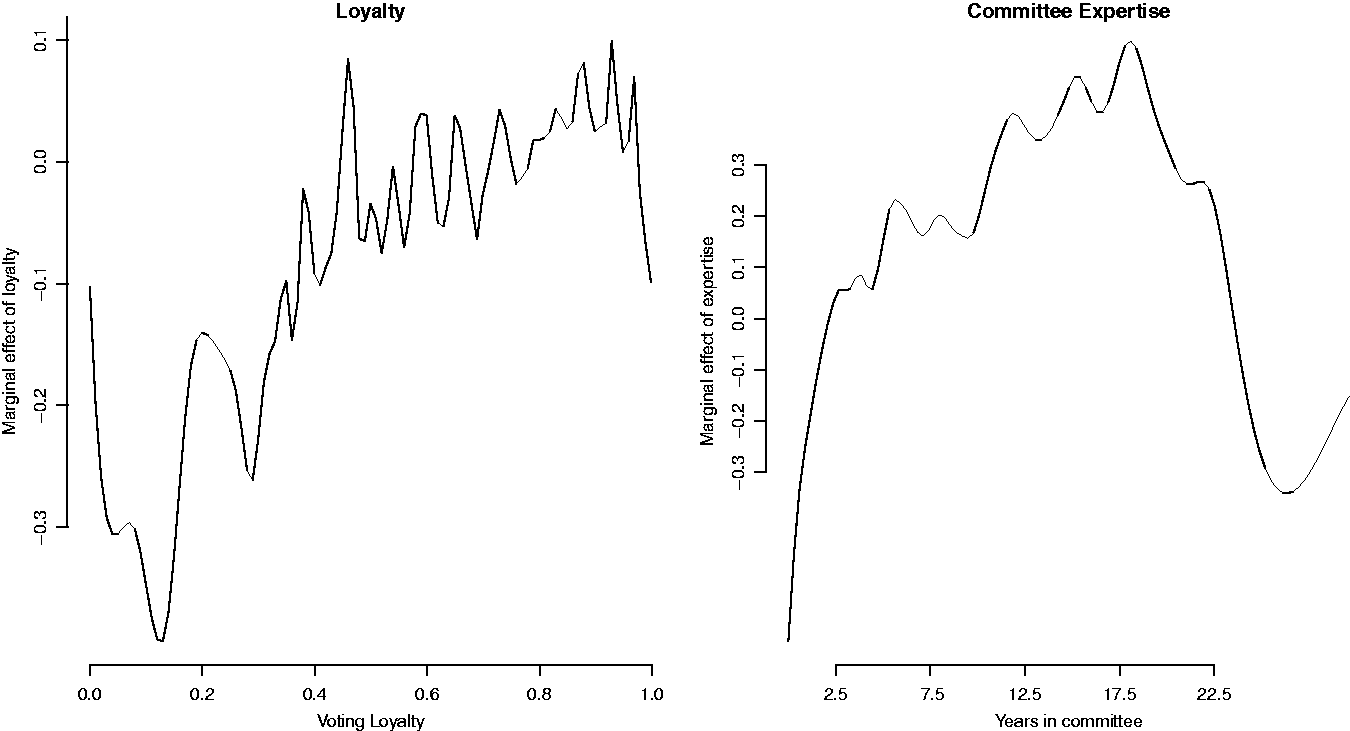
Boosting conditional logit models. These figures show the marginal effects of loyalty (left) and expertise (right).
For expertise, in contrast, the relationship is non-monotonic. MEPs in their first term are at a disadvantage. With more than one term’s worth of relevant committee experience, the marginal effect is generally positive but it increases at a decreasing rate until it reaches its maximum after 17.5 years. Additional committee expertise is a liability rather than an advantage. MEPs with more than 22.5 years on the same committee are less likely to be selected than MEPs with 5 years’ worth of committee expertise. In other words, the effect of committee expertise is clearly non-monotonic. Additional expertise is a clear advantage for the vast majority of members as their stint on the same committee lasts less than 17.5 years. However, those MEPs who stay longer than that on one committee are at an increasing disadvantage when reports are allocated. While we have established that the relationship is non-monotonic, the magnitude of the effect and the exact turning-point should be taken with a grain of salt as this model does not take MEP-specific effects into account. Moreover, this non-parametric model does not provide reliable uncertainty estimates. Hence, we move on to parametric models.
Table 1 presents the main results from the hierarchical conditional logit models. Model 1a includes only the variables of theoretical interest: loyalty, expertise, expertise squared and the interaction between these. The control variables are then added in Model 1b. Both models include random committee-specific MEP intercepts nested in countries. These intercepts take personal characteristics into account. The MEP-specific intercepts have country-specific means, modelled as county-specific intercepts drawn from a normal distribution with a mean of zero. This allows us to measure and account for unobserved country-specific differences in the probability of being selected to write a report.
Hierarchical conditional logit models.

Note: Committee-specific MEP intercepts nested in countries. Bayesian standard errors in parentheses.
SD: standard deviation; N: number of observations.
The key message from Table 1 is that the results are in line with our theoretical expectations. Moreover, the results are not sensitive to the inclusion of the control variables. The coefficients of loyalty and expertise are positive and of substantial magnitude. An MEP with a loyalty score of .95 is 67% more likely to be selected as a rapporteur than one with a score of .5. 5 The coefficients of expertise and expertise squared are positive and negative, respectively. Moreover, both are statistically significant. This indicates an inverse U-shaped effect of expertise. The coefficient for the interaction term between loyalty and expertise is negative and statistically significant, but this result does not hold under different operationalizations of loyalty, as detailed in our Online appendix. Furthermore, while the coefficient of the interaction between loyalty and expertise squared is positive, the magnitude is not substantively larger than the standard error.
Based on Model 1a, we illustrate the effects of expertise. 6 Figure 2 demonstrates the effects of expertise on the estimated probability conditioning on different levels of loyalty. For MEPs at the start of their career, there is a substantive positive relationship between expertise and probability of being allocated reports. The inverted U-shaped curve furthermore persists under different levels of loyalty. Comparing the height of the estimated effect on the far left of each of the subplots, we see that the curve starts higher up on the y-axis and has a less steep slope as we move to subplots conditioned on higher levels of voting loyalty. This means that an MEP with lower loyalty scores can improve the probability of being selected as a rapporteur more substantially from no expertise to 10 years of committee expertise, but this is not the case for the next 10 years. Among very loyal MEPs, the probability is generally higher and the curvature of the effect slightly less pronounced. 7
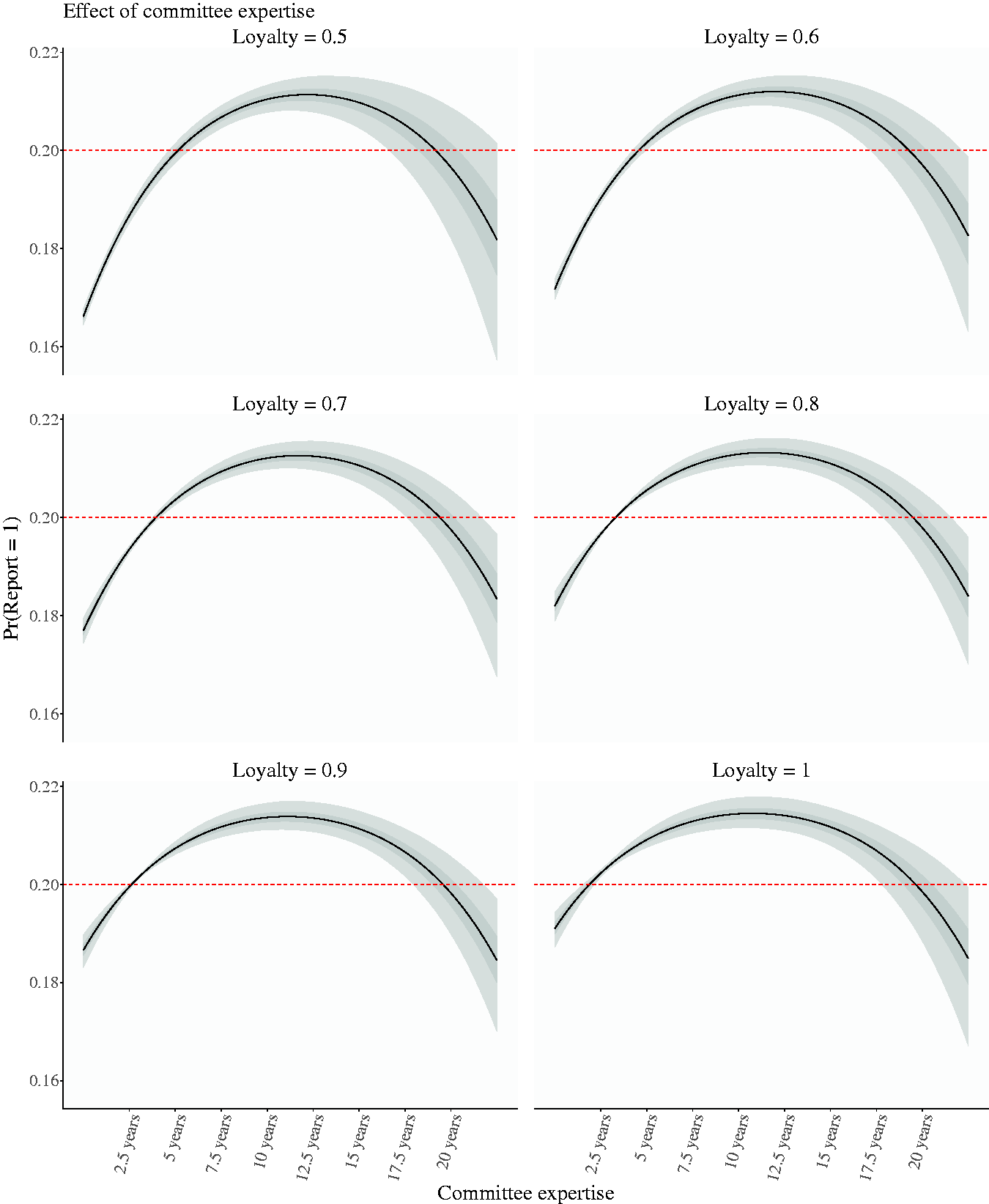
Substantive effect of committee expertise given loyalty.
The effects of the control variables are displayed in Table 1. While EP seniority is negative, the magnitude of the effect is tiny compared to the effect of committee expertise. The coefficient of the squared term of EP seniority is small compared to its standard error. In other words, committee expertise matters a lot more than EP seniority. Age has a positive effect, with a decreasing impact. Furthermore, MEPs in the political group leadership are about 11% more likely to be selected as rapporteurs than ordinary members. This difference is small in comparison to the difference between committee leaders and ordinary members, however. Committee leaders are more than twice as likely to be selected to draft reports, most likely because they are the fallback option in case no other member of the delegation can be convinced to take on the task. In contrast, there is no discernible difference in the probability of writing reports between MEPs in EP leadership roles and ordinary committee members. Nor do we find any clear effect of political group switching. However, we do find that MEPs in their final year are about 21% less likely to be delegated reports.
Varying coefficients by groups
In this subsection, we test to what extent the key findings hold across different categories of MEPs. As our models are hierarchical, we do this in a principled manner by letting all of the variables of theoretical interest vary across different subgroups. We consider five different grouping levels: member states, political groups, committees, procedures and time periods.
First, in Model 1c, shown in the Online appendix, we let the coefficients vary by member states. Mamadouh and Raunio (2003) found differences in allocation pattern across member states and attributed these to differences in language skills and culture. This model is a straightforward extension of Model 1a, only with varying slopes as well as intercepts at the country level.
As shown in the Online appendix, our main results hold across all member states. They are not driven by any particular member state, with only minor differences across nationalities. In line with Mamadouh and Raunio (2003), we find, for example, that MEPs from the Netherlands are more likely to be selected than loyalty and committee expertise alone can account for. In the case of the Czech Republic, we cannot definitely say that loyalty is positive. For Belgium, France, Germany, Italy, Malta, the Netherlands, Slovenia, Spain and the United Kingdom we can conclusively state that the interaction between committee expertise and loyalty is negative. However, while there is a clear positive tendency in the interaction between committee expertise squared and loyalty, the effect is not statistically different from zero for any particular country. The overall picture is that the results hold across member states and that the country differences are minor.
Second, Model 1d, illustrated in the Online appendix, allows coefficients to vary across political groups. Given that each choice-set only considers committee members from the same political group, we do not estimate group-specific intercepts, but the slopes of the coefficients from Model 1a vary for each political groups. To control for idiosyncrasies, the model further includes committee-member and national-specific intercepts. The key finding here is that there is little variation in the coordinators’ selection criteria across groups. In other words, the results are neither driven by a handful of political groups, nor is it the case that some groups are exempt from the logic.
Third, Model 1e allows the coefficients to vary by committees. Again the pattern is stable, but the effect of loyalty is somewhat stronger in the Budgetary Control committee (CONT) than elsewhere. We also see some heterogeneity in the squared term of expertise. While the effect is always negative, it is stronger in the Foreign Affairs (AFET) and Budgetary Control (CONT) committees, and smaller in the Budget (BUDG), Economic (ECON), and Industry, Research and Energy (ITRE) committees. These findings suggest that the second-order effect of expertise is most pronounced in CONT.
Fourth, Model 1f allows the coefficients to vary by procedure. The procedure-specific estimates are summarized in the Online appendix. We see that the findings are consistent across all procedures. In other words, there is nothing to suggest that our theoretical logic only applies to a subset of Parliament’s major legislative procedures.
Fifth and finally, Model 1g lets the coefficients vary over time. Again, the main pattern is stable across terms. However, the coefficient estimates vary somewhat over time. Loyalty is trending upwards. Low voting loyalty is increasingly a liability for MEPs seeking rapporteurships. This should be seen against the gradual increase in voting loyalty over time observed at the aggregate level (Hix et al., 2007). While the overall level of loyalty is higher today than previously, coordinators nevertheless continue to select the most loyal members. This speaks to the increasing importance of party dynamics in the EP.
On the other hand, the effect of committee experience is decreasing over time. This should be seen against the gradual increase in the number of MEPs with substantive committee expertise. Coordinators, therefore, can choose between more expert members today than before so that expertise is a less discriminating factor for the coordinator. It is also clear that the effect of experience is curvilinear across all terms. Estimates for expertise and its squared term remain clearly different from zero, with expertise squared in EP 7 being the only exception. To illustrate the effects, Figure 3 shows the effect of committee expertise for MEPs with a loyalty score of .9, in a committee delegation of five.
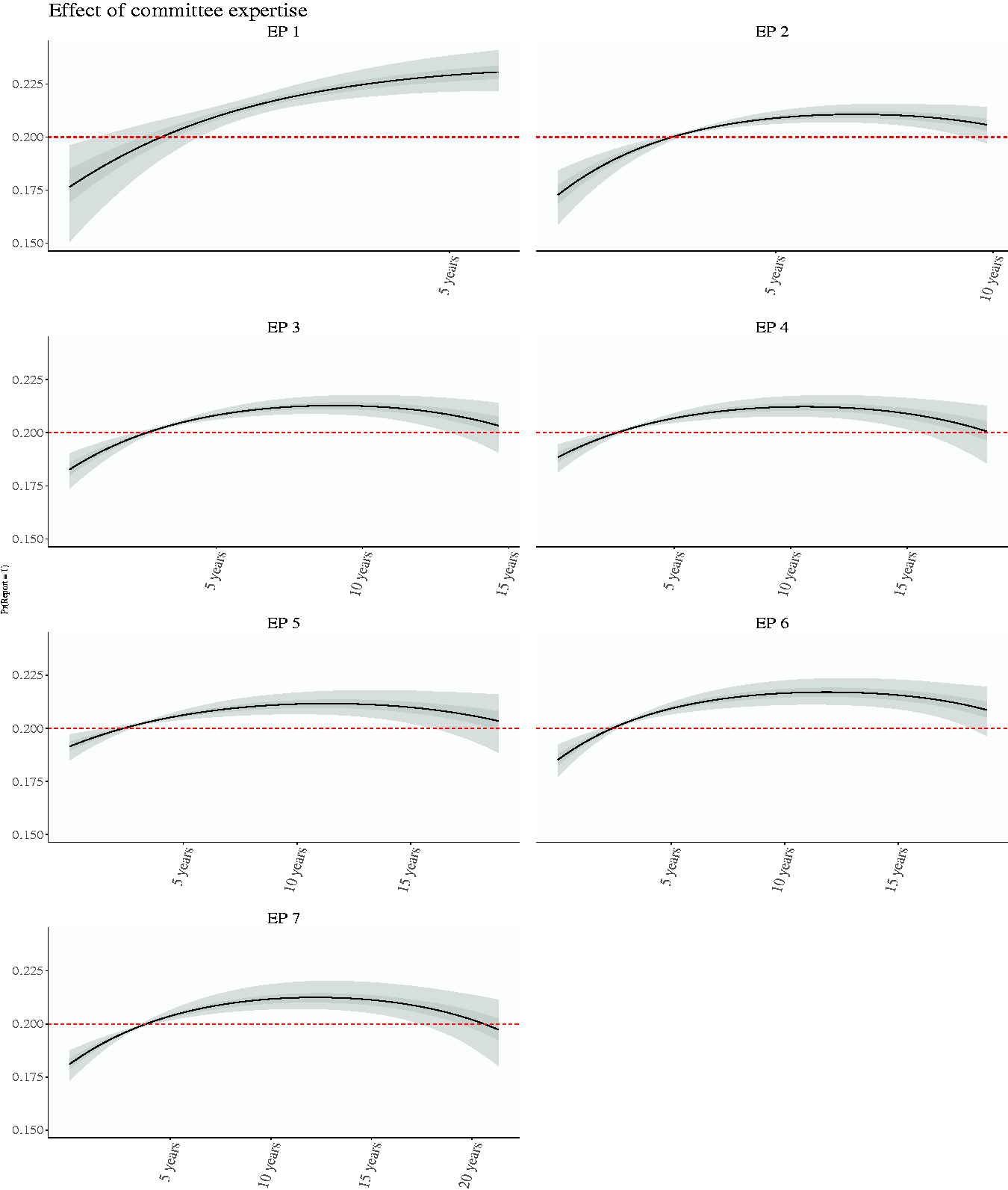
Substantive effect of committee expertise given loyalty across time periods.
Overall, we find that the results are not overly heterogeneous. By and large the main pattern holds across member states, political groups, committees, procedures and over time. Similar conclusions, also shown in the Online appendix, are found when we check to what extent the results are robust to different operationalizations of loyalty and replacing committee expertise with the number of previous reports for the committee, as well as changing the date for constructing the relevant choice-sets that the committee coordinators had to choose from.
Conclusion
We have shown that committee expertise matters for delegation of committee proposals within European party groups. Drawing on informational models, we hypothesize that loyalty and committee expertise should have a positive and non-monotonic effect, respectively. These hypotheses are tested on report delegation within committee group delegations in the EP, for the 1979–2014 period. Through a range of different model specifications, we demonstrate that newcomers are initially disadvantaged. The coordinator is more likely to select a safe pair of hands, somebody with experience on the committee. However, this relationship is not monotonic. According to our estimate, additional expertise is clearly beneficial in a member’s first and second term. Beyond that, there is no real gain from additional committee expertise. In fact, after two terms, it may become a liability rather than an asset.
The main implication of this finding is that there is a tension between expertise and policy drift within party groups. Members interested in policy-making should strive to be assigned early to the committee that covers the policy area they seek to influence. Early- and mid-career members may thus find it costly to switch committee because of reduced probability of receiving legislative drafts. From the perspective of legislative organization, the non-monotonic effect of expertise implies that members are discouraged from staying on the same committee for more than a decade, unless other benefits are offered to offset the decline.
Supplemental Material
EUP894059 Supplemental Material1 - Supplemental material for Delegation of committee reports in the European Parliament
Supplemental material, EUP894059 Supplemental Material1 for Delegation of committee reports in the European Parliament by Fang-Yi Chiou, Silje SL Hermansen and Bjørn Høyland in European Union Politics
Supplemental Material
EUP894059 Supplemental Material2 - Supplemental material for Delegation of committee reports in the European Parliament
Supplemental material, EUP894059 Supplemental Material2 for Delegation of committee reports in the European Parliament by Fang-Yi Chiou, Silje SL Hermansen and Bjørn Høyland in European Union Politics
Footnotes
Acknowledgements
We would like to thank Shaun Bowler, Christophe Crombez, Zoltan Fazekas, Fabio Franchino, Sara B. Hobolt, Gail McElroy, Sven-Oliver Proksch, Christian Rauh, Jonathan Slapin and Gerald Schneider, as well as the anonymous reviewers for useful comments. An earlier draft of the article has been presented at various European Political Science Association (EPSA) meetings. We thank the audience for constructive comments.
Funding
The author(s) disclosed receipt of the following financial support for the research, authorship, and/or publication of this article: While carrying out this research, Høyland and Hermansen have been associated with the project European Strains at ESOP – Centre for the study of Equality, Social Organization, and Performance at the Department of Economics, University of Oslo. European Strains is funded by the Research Council of Norway through its Europe in Transition funding scheme, project number 227072/F10. Hermansen has furthermore received funding from the Norwegian Research Council (grant number 223274). Chiou obtained funding support from a research grant (grant number MOST 102-2628-H-001-004-MY3) from Taiwan’s Ministry of Sciences and Technology. We are also grateful for access to high-performance computing facilities from UNINETT Sigma2, project NN9541K.

Supplemental Material
Supplemental material is available for this article online.
Notes
References
Supplementary Material
Please find the following supplemental material available below.
For Open Access articles published under a Creative Commons License, all supplemental material carries the same license as the article it is associated with.
For non-Open Access articles published, all supplemental material carries a non-exclusive license, and permission requests for re-use of supplemental material or any part of supplemental material shall be sent directly to the copyright owner as specified in the copyright notice associated with the article.
