



Abstract
Based on a new dataset, this article explains a turn towards Euroscepticism by regionalist parties from the early 2000s. Our findings point to the effects of cross-dimensional ideological linkages – positions adopted on the centre-periphery and left–right dimensions – and of an increasing formal regional involvement in European Union affairs without actual influence, which leaves regionalist (and especially secessionist) parties frustrated with the European Union multi-level system. Our findings substantiate the argument that regionalist parties are strongly supportive of economic integration but less supportive of political integration. They are also in line with the fall of the ‘Europe of the Regions’ thesis.
Introduction
As the European Union (EU) is moving from crisis to crisis, struggling to turn them into opportunities for relaunching the ‘European project’, it becomes crucial to understand which political forces are oriented towards sustaining or opposing such a project. While the positions of major party families have been extensively studied, other party families have attracted less attention and, when they have, the findings have not always been convergent and conclusive. In this article, we analyze the regionalist party family’s stances on European integration. In particular, we concentrate on analyzing and explaining a marked change in the level of support for European integration amongst regionalist parties in the last two decades.
Our study is relevant for two main reasons. First, regionalist parties have established themselves as important actors in several European democracies (Elias and Tronconi, 2011; Mazzoleni and Müller, 2017), at a time in which support for European integration has started to shrink. In some EU member-states, their relevance in national politics1 and their prolonged dominance in some regions makes these parties increasingly relevant actors, including for the prospects of further European integration. Indeed, the main steps towards an ever more integrated Europe are made through the negotiation and then ratification of treaties, which in turn allow EU institutions to produce further integration through ordinary European legislation. Given the important role of political parties in these processes and given the increasing difficulties for the pro-integration forces to prevail, even the positions adopted by regionalist parties can be relevant for the final outcome, especially at the stage of domestic approval. In addition, regionalist parties’ attitudes towards European integration and the EU are also relevant for EU policy making. Indeed, these parties are increasingly active in the EU multilevel system of governance (Massetti and Schakel, 2020), having some control on policy implementation through their role in regional governments, as well as trying to affect policy decisions in Brussels, either directly (Callanan and Tatham, 2014) or via their member-state (Bolleyer et al., 2014).
Secondly, the extant literature on regionalist parties’ positioning on European integration presents us with an unclear answer. On the one hand, quantitative studies have concluded that regionalist parties have always been consistent and convinced supporters of European integration (Jolly, 2007). On the other hand, qualitative studies have highlighted both an instrumental approach to European integration, which leads regionalist parties to remarkable longitudinal changes in their stances (Elias, 2009; Hepburn, 2010; Lynch, 1996), and the presence of considerable variation within the regionalist party family (De Winter and Gomez-Reino, 2002). In addition, some scholars have advanced the thesis that support for European integration has considerably decreased amongst regionalist parties in the 2000s (Elias, 2008). However, more recent quantitative studies have found mild or inconclusive evidence on this putative turn towards Euroscepticism (Bakker et al., 2015: 145; Jolly, 2015: 97–99; Szöcsik, 2013). As a result, ‘over the past few years, perspectives are divided amongst those who maintain the party family still proposes clear Europhile positions, and those who stress that attitudes towards European integration have evolved toward Euroscepticism’ (Gomez-Reino, 2018: 38).
Using new empirical data on 67 regionalist parties in seven Western European states in the period from 1970 until 2019, we find that the level of Europhilia has considerably increased up to the early 1990s and it has since gone down, with an evident fall in the early 2000s and a more gradual decrease in the last decade. We maintain that this trajectory is in line with theoretically grounded expectations that regionalist parties strongly support economic integration, while being more cautious of political integration (Marks et al., 2002: 587). In order to provide a deeper and more comprehensive investigation of the causal mechanisms, we propose two sets of hypotheses. First, we investigate the role of ideological linkages, whereby positions on the European integration dimension depend on positioning on the centre-periphery dimension and on positioning on the left–right dimension. Second, we propose an institutional set of hypotheses, based on the general expectation that regionalist parties (and especially secessionist parties) operating in regions with more involvement in EU affairs tend to be more Eurosceptic because they realize that their actual capacity to influence EU policy is extremely limited, especially in comparison with small member-states. The two sets of hypotheses are substantiated by our empirical analysis and they explain the marked decrease of support for European integration by regionalist parties in the new millennium.
Regionalist parties and European integration: The turn towards Euroscepticism
Drawing on De Winter (1998), we define regionalist parties as political organizations whose core mission is to achieve, protect or enhance some kind of territorially based self-government for the region (De Winter, 1998: 204). Being in the business of polity restructuring, regionalist parties have a natural interest in European integration. Their engagement with the European integration process is testified by the creation of a pan-European regionalist party federation – called European Free Alliance (EFA) – whose origins trace back to the establishment of an elected European Parliament (EP) in 1979 (Lynch, 1998). More importantly, their interest is also testified by the fact that many regionalist parties – besides developing a position on the kind of self-government they want to achieve and on the left–right dimension of party competition (Massetti and Schakel, 2015, 2016) – also express a stance on European integration (De Winter and Gomez-Reino, 2002).
In the 1980s and 1990s, there was a general consensus in presenting regionalism and European integration as harmonious and mutually reinforcing processes (Hooghe, 1996; Hooghe and Marks, 1996; Keating, 1995), whereby an emerging federal Europe – a ‘Europe of the Regions’ – would diminish the role of member-states and enhance the role of regions (Loughlin, 1996). Quantitative studies referring to that period found strong empirical evidence in support of a general Europhilia amongst regionalist parties (Hix, 1999; Hix and Lord, 1997; Jolly, 2007; Marks and Wilson, 2000; Marks et al., 2002). However, in the new millennium a clear division has appeared in the literature (Gomez-Reino, 2018: 38). On the one side, some qualitative studies pointed to a general disillusionment with the vision of a ‘Europe of the Regions’ (Hepburn, 2008; Keating, 2008; Lynch and De Winter, 2008), and an ensuing turn towards Eurosceptic positions by regionalist parties (Elias, 2008). On the other side, quantitative studies revealed only a marginal decrease in overall support for European integration (Bakker et al., 2015; Jolly, 2015).2 The present study engages with this ongoing debate, bridging the qualitative and quantitative literature, and shedding some light on the most recent developments.
We start by reporting, in Figure 1, the percentage of Europhile regionalist parties between 1970 and 2019. We traced the positions of 67 regionalist parties on European integration, i.e. whether they are Europhile (=1) or Eurosceptic (=0). The Online appendix details and validates our coding.
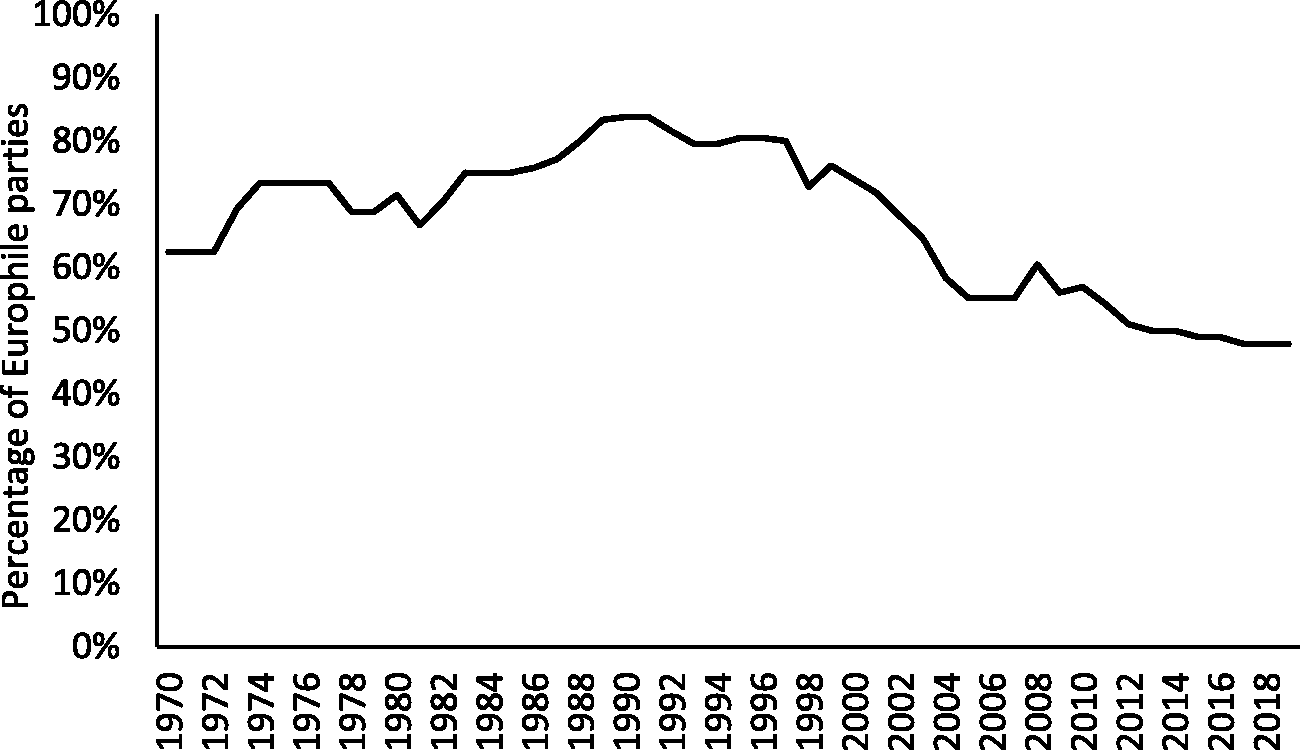
Percentage of Europhile regionalist parties between 1970 and 2019.
Figure 1 clearly confirms that the regionalist party family has been, overall, Europhile (Jolly, 2007, 2015).3 The percentage of Europhile parties has been 50% or above for the whole period until 2014. However, Figure 1 also highlights that an upward trend from 1970 (63%) to 1991 (84%), corresponding to the golden age of the ‘Europe of the Regions’, has been followed by a declining trend, roughly starting with the Maastricht Treaty. The most evident fall in support for European integration occurs during the early 2000s – the percentage of Europhile parties drops from 77% in 1999 to 55% in 2005. This evident ‘cooling down’ in support for European integration can be definitely considered a substantive turn towards Euroscepticism. From 2014 onwards, the percentage of Europhile parties has gone slightly below 50% (48% in 2019).
Considering the changing nature of European integration in different periods, the whole trajectory represented in Figure 1 is in line with the theoretical literature, which stipulates that regionalist parties should be expected to strongly support economic European integration, because it lowers the costs of secession (Alesina and Spolaore, 1997), while less enthusiastically supporting political European integration (Marks et al., 2002: 587). Qualitative studies have already pointed out how the turn towards Euroscepticism in the early 2000s can be linked to the disappointing negotiation process within the Convention on the Future of the European Union, when it became evident to regionalist parties that a ‘Europe of the Regions’ would not materialize (Hepburn, 2008); and that the possibility of ‘internal enlargement’ (i.e. a region that obtains independence from a member-state becomes automatically a new member-state) would not be included in the Treaties (MacCormick, 2004).
The ‘constitutional phase’ – roughly from 2001 (Nice Treaty) to 2008 (Lisbon Treaty) – clearly marks a sea-change in the orientation of important regionalist parties that had been supportive of European integration in the previous period. In particular, the consultative referendum on the EU Constitutional Treaty, held in Spain in 2005, obliged Spanish regionalist parties to take a stance (Aparicio-Romero, 2006), revealing a picture rather different from that of the ‘Europhile fringe’ (Jolly, 2007), even in a strongly Europhile context such as the Spanish one. The regionalist parties that eventually chose to back the Treaty, such as Convergencia i Unio (CiU) and the Partido Nacionalista Vasco (PNV), went through deep internal divisions and, eventually, staged a rather timid campaign (Barbera and Barrio, 2006; Madorran, 2005; Perez-Nievas, 2006: 53). In addition, other important regionalist parties, such as Esquerra Republicana de Catalunya (ERC), the Bloque Nacionalista Gallego (BNG), Eusko Alkartasuna (EA) and the Chunta Aragonesista (CHA), vocally opposed the Treaty (Acha, 2006: 81; Aparicio-Romero, 2006; Gomez-Reino, 2006: 184–185; Madorran, 2005).
Disillusionment with and/or resistance to the constitutional process of the EU was, by no means, limited to the regionalist parties of Spain. Leaving aside the criticism of traditionally Eurosceptic parties – such as the Northern League (LN) in Italy, Sinn Fein (SF) in the United Kingdom (UK), and the Vlaams Belang (VB) in Belgium – important regionalist parties that had manifested clear Europhile orientations (at least) in the previous decade adopted a contrary, ambiguous or critical position on both the Constitutional and the Lisbon Treaty. These include the Scottish National Party (SNP) and Plaid Cymru (PC) in the UK (Elias, 2009; Hepburn, 2010; Plaid Cymru manifestos, 2005; SNP manifestos, 2005: 37, 2007: 73, 2009: 5), as well as the Südtiroler Volkspartei (SVP) in Italy (Di Sotto, 2004), which expressed concerns for the risk that EU powers could expand at the expenses of regional powers.
In addition, a series of recent important crises (Euro-crisis and austerity, refugee crisis and Brexit) appear to have influenced the attitudes of some regionalist parties. In particular, some regionalist parties in Spain (e.g., Alternativa Nacionalista Canaria, ANOVA, EH-Bildu, Aralar and the Candidatura d’Unitat Popular) have clearly targeted the EU’s neo-liberal reaction to the Euro-crisis.4 Similarly, regionalist parties of Northern England (Yorkshire Party (YP) and North East Party (NEP)), in an attempt to realign with the prevalent preferences in their regions, have clearly adopted Eurosceptic positions after the Brexit referendum (NEP manifesto, 2019; YP manifesto, 2019).
Explaining the turn towards Euroscepticism among regionalist parties: Ideological linkages and regional authority
In this section we develop two sets of hypotheses that can explain regionalist parties’ positioning vis-à-vis European integration, including the turn towards Euroscepticism of the last two decades. Our hypotheses are grounded in the expectation that regionalist parties respond differently to economic and political integration. The first set of hypotheses looks at the coherence between positions on the centre-periphery and left–right dimension, on the one hand, and positions on the EU integration dimension, on the other hand. Our second set of hypotheses relates to the authority of the regions in which regionalist parties contest elections, and considers the levels of regional self-rule and shared rule as well as the set of institutions that enable regional influence in EU affairs.
Ideological linkages
As the original cleavage plays a key role in orienting parties vis-à-vis European integration (Marks and Wilson, 2000), regionalist parties can be expected to evaluate European integration ‘through the lenses of the centre-periphery cleavage’ (Elias, 2009: 30). This approach leads to a general expectation that regionalist parties are in favour of European integration (Marks and Wilson, 2000: 438–439; Jolly, 2007: 111). However, Marks et al. (2002: 587) make an important distinction, when they foresee that regionalist parties strongly support economic integration, while being less in favour of political integration. We argue that the reasons behind this distinction (i.e. between economic and political integration) are linked to regionalist parties’ positions in the centre-periphery dimension, that is to the distinction between autonomist and secessionist parties.
Indeed, parties that aim to create a new independent state might be in favour of economic European integration, as it provides access to a customs union and common market, but they can also be expected to be eager to use a hypothetically (re-)acquired sovereignty in an inter-governmental European context, rather than in a European federal state. As a consequence, the deepening of European political integration might render secession a less meaningful objective and more difficult to achieve. Indeed, recent attempts to achieve independence by Scotland and Catalonia have been met with clear hostility by EU institutions (Massetti, 2020), in spite of the fact that both instances had been presented as attempts to achieve ‘Independence in Europe’ (Cetrà and Linera, 2018). In contrast, autonomist regionalist parties, which see the future of their region within the ‘hosting state’, would not feel threatened by the moving of the European project towards a European federal state. Rather, the project of a federal Europe envisages that the EU incrementally expands its competences in ‘high politics’ areas and away from ‘low politics’ areas (Burgess, 2000), where competition with regional administrations can arise.
Centre-periphery positioning can also explain longitudinal variation. The constitutional process of the EU – from Nice to Lisbon – has alienated some sympathies amongst regionalist parties because some of them, particularly secessionist parties, did not like the institutional structure that the treaties provided; and they did not like the fact that no formal procedure was envisaged for ‘internal enlargement’ (MacCormick, 2004). H1: Autonomist regionalist parties adopt more pro-European integration positions than secessionist regionalist parties.
Left–right radicalism can also explain longitudinal change in the level of support/opposition towards European integration. The nature of European integration changes over time and it is, therefore, subject to different evaluations from the same ideological perspective at different times (van Elsas and van der Brug, 2015). In particular, while radical-right parties, which profess a traditionalist/authoritarian/nationalist (TAN) ideology (Hooghe et al., 2002), have always attracted Eurosceptic voters (Werts et al., 2013); radical-left parties have increasingly appealed to Eurosceptic voters after the Euro-crisis and the ensuing austerity policies (Santana and Rama, 2018). H2: Regionalist parties that are radical on the left–right dimension tend to adopt Eurosceptic positions, while regionalist parties that are mainstream or centrists on the left–right dimension tend to adopt a Europhile position.
Regional authority
Interpreting European integration through the lenses of the centre-periphery cleavage also implies to dynamically examine the compatibility between the state of the art of the regionalist project, i.e. how much regional authority has been achieved, and of the European project, i.e. how much authority has been transferred to the EU level (Lynch, 1996). In this respect, it is important to distinguish between self-rule (the power to run the affairs of the region) and shared rule (the power to contribute to decision making at the state level). Since increases in the levels of self-rule allow regions to act and feel comfortable within the EU multi-level governance system, we expect that regional empowerment in self-rule reinforces Europhile orientations. There can be competition over specific competences between the regional and the EU level but, for this very reason, the more powers a region has managed to obtain (in the face of both state and EU competition) the more the respective regionalist party can be satisfied with the resulting EU multi-level system. In contrast, shared rule concerns the decisional power regarding state-wide policy which is exercised together with the central government and other regions. Since the power of the member-states has been more directly and constantly in competition with the EU powers (Jeffery, 2007), we expect that increases in regional shared rule produce a lower level of support for European integration. It is important to note that the expected negative correlation between shared rule and support for European integration is likely to extend to the relation between regional authority regarding EU affairs and support for European integration. Indeed, regional institutions’ direct involvement in EU policy making, when this is allowed or prescribed, tends to remain symbolic (Tilindyte, 2016), especially outside formal federal states (i.e. Austria, Belgium, and Germany). Consequently, involvement in EU affairs tends to manifest itself primarily through the domestic level (i.e. by shared rule). However, this channel of engagement leads regionalist parties to accumulate frustrating experiences, as the role of regional assemblies is de facto very limited (Abels, 2017; Raunio, 2015), and intergovernmental committees on EU affairs are mostly populated by state-wide parties’ representatives of other regions and/or are often dominated by the national government (Börzel, 2002; Greenwood, 2003; Högenauer, 2014). Therefore, participation in these institutional processes often leads to a high awareness of the regionalist party’s actual inability to protect the regional interests in EU policy making (Hepburn, 2008). As a result, these regionalist parties will tend to adopt less favourable positions towards European integration. H3a: Regionalist parties acting in regions with high levels of self-rule support European integration more than regionalist parties acting in regions with low levels of self-rule. H3b: Regionalist parties acting in regions with high levels of shared rule support European integration less than regionalist parties acting in regions with low levels of shared rule. H4: Increases in regional authority regarding EU affairs result in a decrease of levels of support for EU integration amongst regionalist parties. H5: Increases in regional authority regarding EU affairs result in a decrease of levels of support for EU integration especially amongst secessionist parties.
Data and method
Our main dependent variable is a dummy variable indicating whether a regionalist party is Europhile (=1) or Eurosceptic (=0). We also applied a more fine-grained coding with scores ranging from 1 (rejectionist) to 6 (federalist). In this article, we focus on the binary dependent variable and, in the Online appendix, we present the results for the ordinal dependent variable. The binary coding may be more robust than the ordinal coding because a simple dichotomy can better ‘travel’ across time and space and may decrease the level of contestation in the coding of the individual cases.
Positioning on the centre-periphery is measured by a dummy variable that indicates whether a party is autonomist (=0) or secessionist (=1). On the left–right dimension we code regionalist parties as radical left (score = 1), mainstream left (score = 2), centrist and left-leaning (score = 3), centrist and right-leaning (score = 4), mainstream right (score = 5), and radical right (score = 6). We include squared left–right position scores in the models below to assess whether the linkage between left–right and EU integration positions can be described by an inverted U-curve. The Online appendix displays average position scores on the EU integration, centre-periphery, and left–right dimensions for all 67 parties included in the analysis. The Online appendix also provides more detail on the coding schemes and the primary and secondary sources used to assess ideological positions. In addition, in the Online appendix, we validate our ideology scores against the Chapel Hill (CHES) and Ethnonationalism in Party Competition (EPAC) expert surveys.
To assess the impact of regional authority we use the Regional Authority Index (RAI) dataset (Hooghe et al., 2016). This measurement distinguishes between self-rule – the autonomy exercised by the regional government over the people residing in the region – and shared rule – the authority exercised by the regional government in the country as a whole. Both self-rule and shared rule consist of five sub-indicators and regional scores can vary from 0 to 18 for self-rule and from 0 to 12 for shared rule. Self-rule is measured by institutional depth (0–3), policy scope (0–4), fiscal autonomy (0–4), borrowing autonomy (0–3), and representation (0–4). Shared rule is measured by law making (0–2), executive control (0–2), fiscal control (0–2), borrowing control (0–2), and constitutional reform (0–4). We include both self-rule and shared rule region scores in the models below.
To assess the extent to which regional governments are involved in the EU legislative process we rely on Tatham (2011), who provides a measurement of ‘regional involvement in the domestic EU policy-shaping process’ that consists of eight dimensions. Five dimensions tap into the pre-legislative phase and three dimensions concern the post-legislative phase of the (domestic) EU policy making process, with total scores varying between 0 and 8. More detail on the Regional Authority Index and Tatham’s (2011) measurement are provided in the Online appendix.
We include two control variables in the models below. The first control variable is a dummy variable that indicates whether a regionalist party was in regional government when it adopted a particular ideological position. We are agnostic on the direction of the effect because we see two possible and opposite dynamics at work. Parties in regional government might be less Europhile than opposition regionalist parties because the former can more closely observe how the EU encroaches upon regional competences. On the contrary, parties in regional government may be more Europhile because they are directly involved and socialized in the EU multi-level system of governance.
Vote shares won in regional elections constitute our second control variable. We take regional vote shares won in national elections when regional elections were not held (e.g. Belgium and the UK until the mid/late 1990s). These control variables are strongly linked to left–right ideological positioning, in the sense that mainstream and centrist parties often win (much) larger vote shares and are more likely to be in regional office than radical left and radical right parties. Therefore, including regional office and regional vote shares into the models enables us to discern the neat relationship between left–right and EU integration positions. Descriptive statistics of all dependent and independent variables are provided in the Online appendix.
We employ multi-level logit models whereby EU ideology scores are clustered by 67 parties. The unit of analysis is a regionalist party that obtains an EU position score for a particular regional (or national) election year. Many regionalist parties compete in elections of different regions and in order to avoid double counting regionalist parties’ ideology scores we only include the region and vote shares won in the region that can be considered to be at the ‘core’ of the autonomy demands voiced by a regionalist party.5 In total, the models include 451 EU position scores for 67 parties located in 35 regions and in seven Western European countries (see the Online appendix). Several parties compete in the same region and standard errors are corrected for 35 region clusters. A rho coefficient provides an estimate on the dependency among EU ideology scores within a party. Below we also present differences (Δ) between predicted probabilities and these are derived by running a margins command in Stata (Delta method) after a model estimation and using the specification of the values on the independent variables as detailed in the notes to the tables.
Results: Linkages between ideological positions and regional authority
Table 1 presents the results of two logit models. The second model includes an interaction effect between the secessionist dummy and EU involvement scores to test hypothesis 5. A comparison across the models reveals two important insights.6 First, ideological linkages between left–right and EU integration positions appear to be very strong and statistically significant across all models. Second, ideological linkage between the secessionist dummy and EU integration positions also appears to be very strong and statistically significant. Third, while self-rule is positively associated with Europhile positions, EU involvement is negatively correlated with support for European integration. The interaction effect between EU involvement and the secessionist dummy does not reach statistical significance. To gain further insight into ideological linkages we calculated predicted probabilities of adopting a Europhile position (score = 1) depending on whether parties are autonomist (= 0) or secessionist (= 1) and on the various left–right positions (Figure 2).
Logit model predicting whether a regionalist party is Europhile.
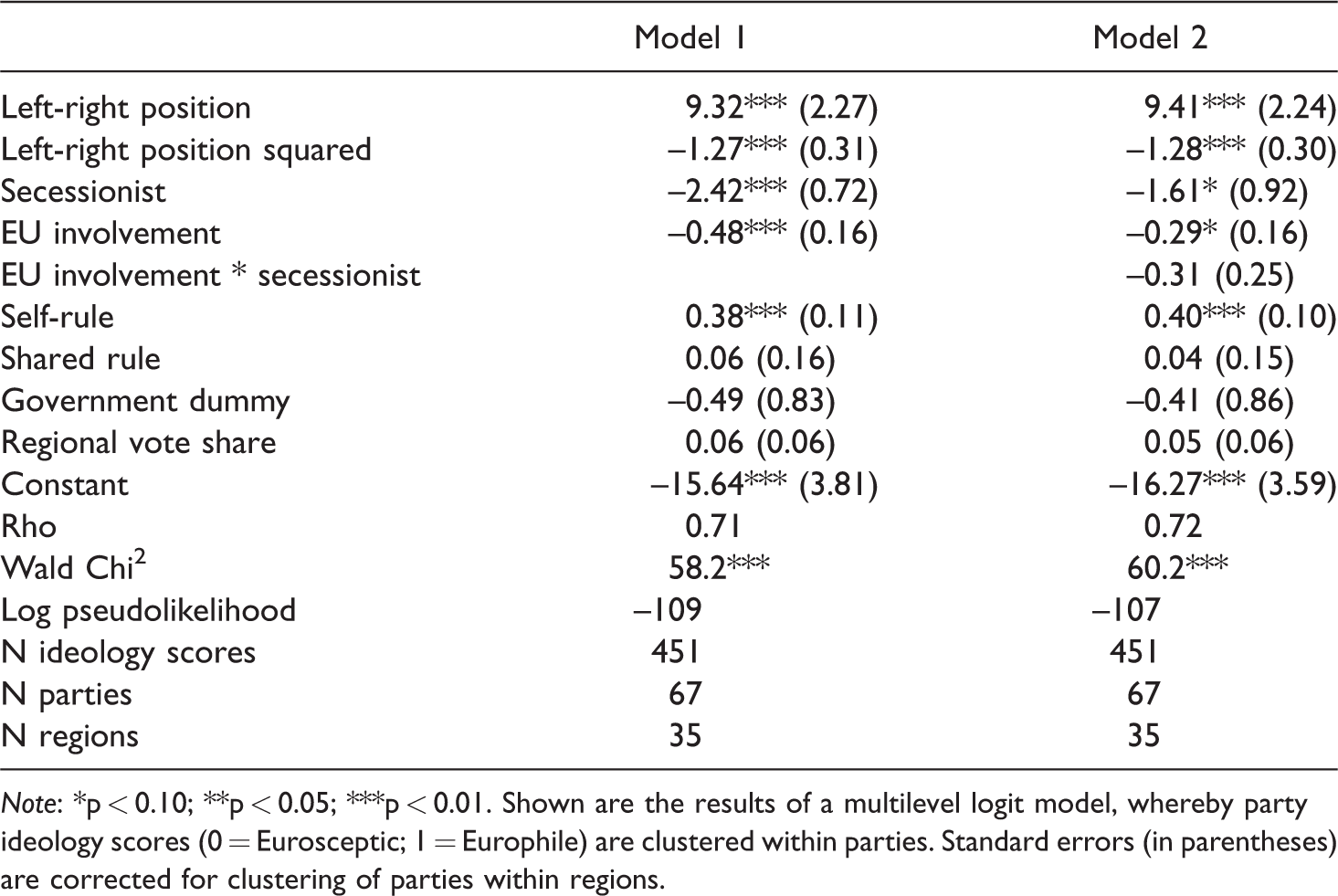
Note: *p < 0.10; **p < 0.05; ***p < 0.01. Shown are the results of a multilevel logit model, whereby party ideology scores (0 = Eurosceptic; 1 = Europhile) are clustered within parties. Standard errors (in parentheses) are corrected for clustering of parties within regions.

Probability to adopt a Europhile position.
Figure 2 clearly highlights that regionalist parties ‘behave’ similar to parties from other party families and the linkage between left–right and EU integration positions takes the form of an inverted U-curve. Radical left and radical right parties are very likely to be Eurosceptic and they have less than a 40% probability to be Europhile. Centrist parties, both left-leaning and right-leaning have a probability of 80% or more to be Europhile. Mainstream left and mainstream right parties fall in between and have a 47% to 86% probability to be Europhile.
Table 2 reveals that the difference in the probability to be Europhile between autonomist and secessionist parties is statistically significant for all positions on the left–right dimensions except for radical left parties. The difference in the probability to adopt a Europhile position is 12% (centre right parties) to 27% (left mainstream parties) lower for secessionist parties. These results clearly confirm hypothesis 1 that autonomist regionalist parties tend to adopt more pro-European integration positions than secessionist regionalist parties.
Probability to adopt a Europhile position.

Note: *p < 0.10, **p < 0.05, ***p < 0.01. Shown are the predicted probabilities for regionalist parties to adopt a Europhile position and their differences between autonomist and secessionist parties. Estimates are obtained by running a margins Stata command after running Model 1 displayed in Table 1. Interval variables are kept at their mean, ordinal variables at their median, and nominal variables at their mode (see the Online appendix).
Table 3 presents the differences in predicted probabilities between the various left–right positions for autonomist and secessionist parties. The predicted probabilities for the radical parties, on the one hand, and mainstream and centrist parties, on the other hand, are statistically significant (at the 95% confidence level) except for the comparison between right radical and left mainstream parties. There are no statistically significant differences in predicted probabilities between radical left and radical right parties. The predicted probabilities for the mainstream left and the mainstream right are significantly different (at the 95% confidence level) from those for centrist parties – left-leaning and right-leaning – with the exception of the comparison between centrist-left and mainstream right parties. Statistically, the predicted probabilities are not significantly different if we compare mainstream left and mainstream right parties; or left-leaning and right-leaning centrist parties. These results clearly support hypothesis 2: regionalist radical left–right parties tend to adopt Eurosceptic positions while regionalist mainstream/centrist parties are likely to adopt Europhile positions.7
Differences in predicted probabilities to adopt a Europhile position.
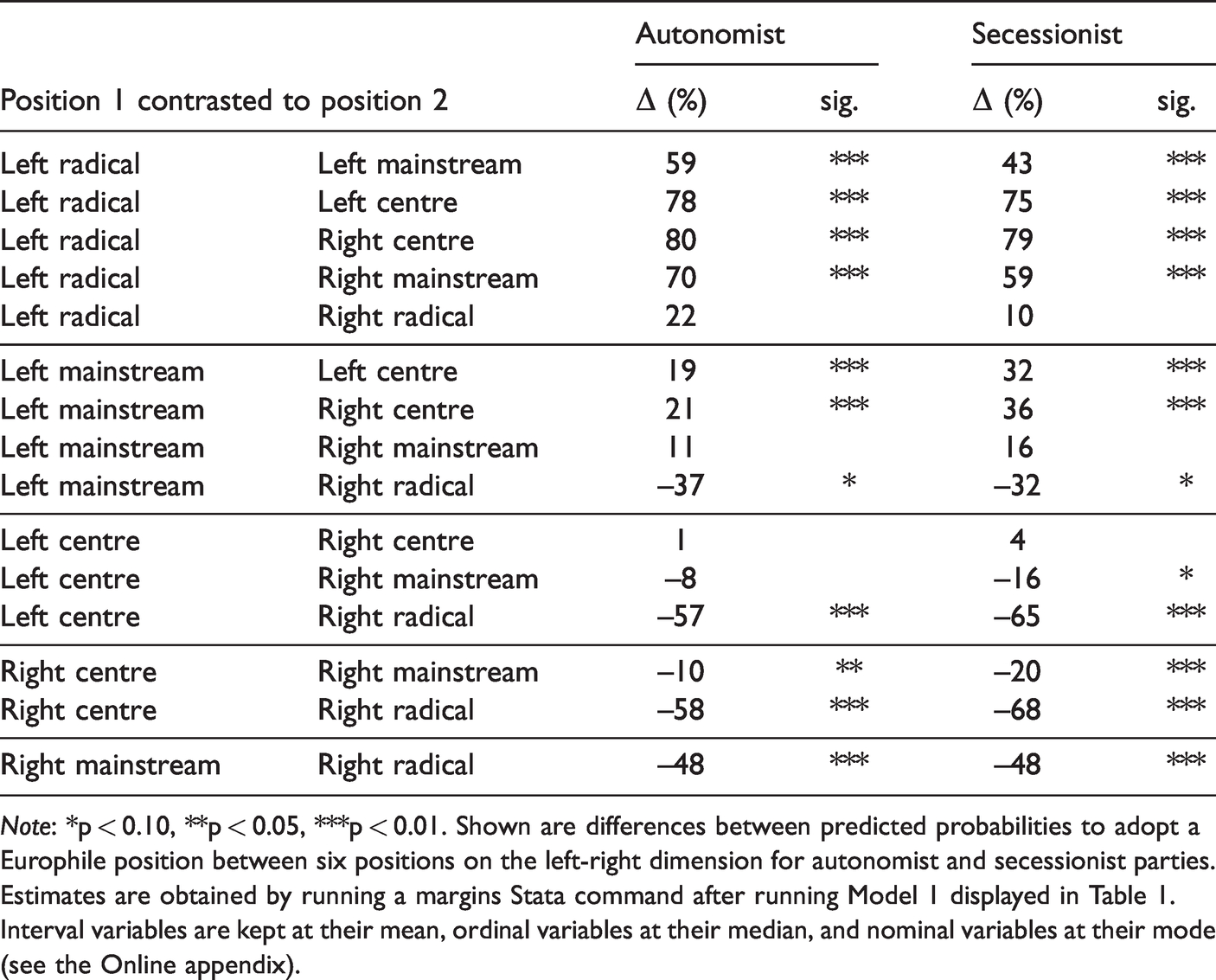
Note: *p < 0.10, **p < 0.05, ***p < 0.01. Shown are differences between predicted probabilities to adopt a Europhile position between six positions on the left-right dimension for autonomist and secessionist parties. Estimates are obtained by running a margins Stata command after running Model 1 displayed in Table 1. Interval variables are kept at their mean, ordinal variables at their median, and nominal variables at their mode (see the Online appendix).
A third important observation derived from Table 1 concerns regional authority. Self-rule appears to have a clear positive impact whereas EU involvement has a clear negative impact (Table 1). Self-rule, shared rule, and EU involvement correlate8 and they moved in tandem over time (i.e. increased for almost all regions). Therefore, we calculated predicted probabilities for seven different sets of self-rule, shared rule, and EU involvement scores (see Table 4). The seven different sets of scores are taken from the countries and (type of) regions in our dataset where the most and the strongest regionalist parties can be found, i.e. régions in France, Wales and Scotland in the UK, regioni a statuto speciale in Italy, comunidades autónomas in Spain, regions/communities in Belgium, and Länder in Germany. These regions also provide an effective ‘summary’ of the combinations of self-rule, shared rule, and EU involvement scores that can be found in our dataset. To adequately pick up on the over-time differences we calculate predicted probabilities on the basis of scores for 1990–1995 and 2010–2015 except for the UK, where devolution occurred in 1999. Overall, we compare a period when regionalist parties strongly supported the idea of a ‘Europe of the Regions’ to a period when disillusionment among regionalist parties became evident (Figure 1). In Table 5, we display predicted probabilities to adopt a Europhile position.
Self-rule, shared rule and EU involvement scores for 1990–1995 and 2010–2015.
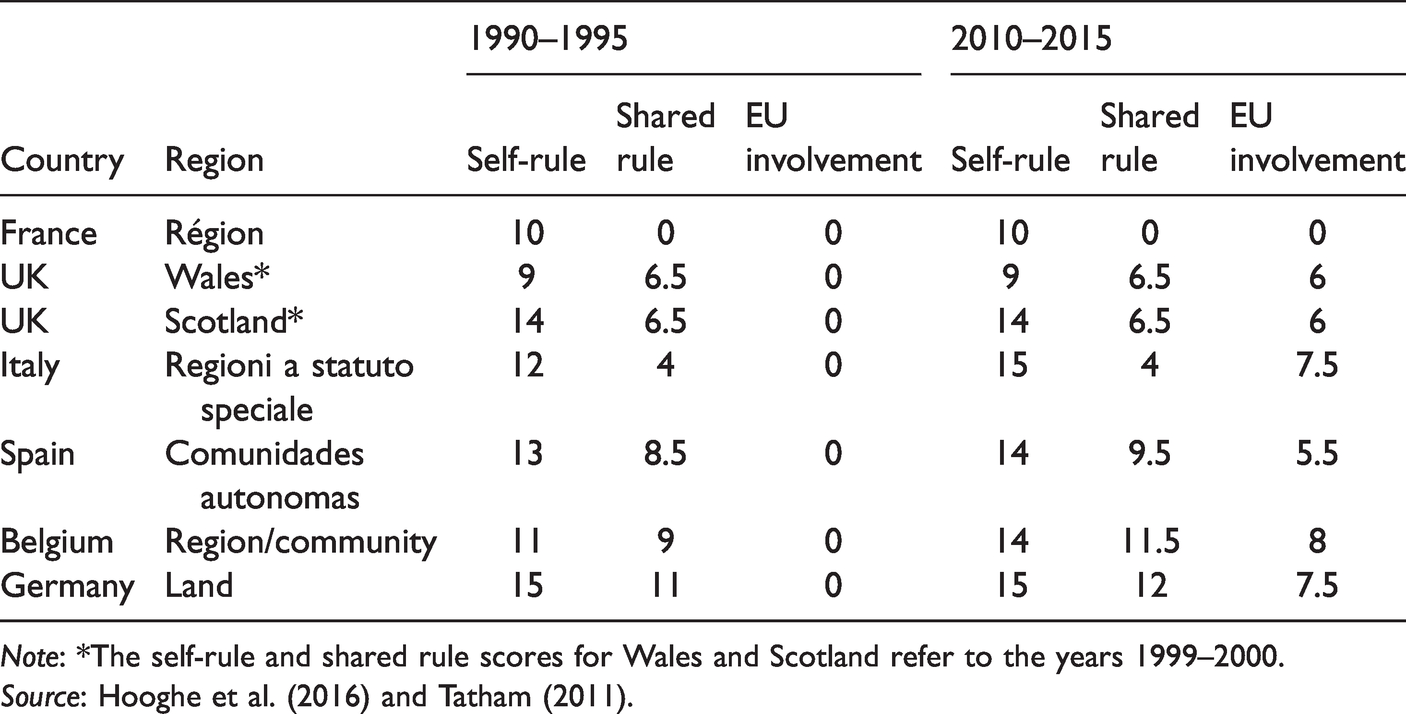
Note: *The self-rule and shared rule scores for Wales and Scotland refer to the years 1999–2000.
Source: Hooghe et al. (2016) and Tatham (2011).
Probability to adopt a Europhile position.

Note: *p < 0.10; **p < 0.05; ***p < 0.01. Shown are estimated probabilities to adopt a Europhile position. Estimates are based on Model 1 displayed in Table 1 whereby self-rule, shared rule, and EU involvement scores follow those as displayed in Table 4. The probabilities are calculated for autonomist and mainstream left parties (i.e. a centre-periphery score of zero and a left-right position score of two and a left-right position squared score of four). In the Online appendix, we provide predicted probabilities for secessionist parties and for the other left-right positions. Interval variables are kept at their mean, ordinal variables at their median, and nominal variables at their mode (see the Online appendix).
Table 5 reveals that regionalist parties have become more Eurosceptic in all countries and regions except for France for which the self-rule, shared rule, and EU involvement scores are not different between the two time periods (Table 4). The probability to adopt a Europhile position declines with 17% (Spain) to 32% (Wales) and all displayed changes in probabilities are statistically significant at the 95% confidence level except for Italy. We find strong empirical evidence for hypotheses 3a and 4. Regional authority increases and EU involvement decreases Europhilia among regionalist parties but their combined impact (also including shared rule) appears to have increased Euroscepticism among regionalist parties in all countries except France.
In a final step we explore the interaction effect between EU involvement and secessionism (Table 6) and calculated predicted probabilities to adopt a Europhile position when there is high ( = 8), medium ( = 4) or no ( = 0) EU-influence for a region (Table 4). The results reveal that the probability to adopt a Europhile position sharply declines for both autonomist and secessionist parties for higher EU involvement scores. However, the changes in predicted probabilities are not statistically significant at the 95% confidence level for autonomist parties whereas they are for secessionist parties. In addition, the differences in predicted probabilities between autonomist and secessionist parties are statistically significant at the 95% confidence level for EU involvement scores of four (70% versus 37%) and eight (57% versus 15%) which provides further evidence for hypothesis 1.9
Probability to adopt a Europhile position.

Note: *p < 0.10; **p < 0.05; ***p < 0.01. Shown are estimated probabilities to adopt a Europhile position. Estimates are based on Model 2 displayed in Table 1. The probabilities are calculated for mainstream left parties (i.e. a left-right position score of two and a left-right position squared score of four). In the Online appendix, we provide predicted probabilities for the other left-right positions. Interval variables are kept at their mean, ordinal variables at their median, and nominal variables at their mode (see the Online appendix).
Conclusion and discussion
This article directly addresses an open controversy in the literature, recently re-presented by Margarita Gomez-Reino (2018), concerning the question whether regionalist parties have remained strongly Europhile or have moved towards Eurosceptic positions. Our data show that regionalist parties’ Europhilia has grown until the early 1990s and has remained very high until the late 1990s. In contrast, it has undergone a marked fall in the early 2000s and a more gradual decline in the last decade. We contend that the overall trajectory and, in particular, the marked decrease in support during the ‘constitutional juncture’ (2001–2008) is grounded on ex ante theoretical considerations, which predicted strong support for economic integration and milder support for political integration (Marks et al., 2002). In addition, it is also grounded in previous works that have documented how the constitutional treaties have largely ignored requests coming from regionalist parties (MacCormick, 2004).
We found overwhelming evidence supporting the hypotheses that regionalist parties’ positioning on European integration depends on their left–right positioning – following an inverted U-curve that applies to political parties more in general – and on their centre-periphery positioning. Indeed, we find that secessionist parties are far more likely to be Eurosceptic then autonomist parties. When one considers positioning on both the centre-periphery and left–right dimensions, it appears that especially autonomist mainstream left and mainstream right parties are far more likely to be Europhile (above 74%) compared to secessionist mainstream left and mainstream right parties (below 64%). Over time, regionalist parties have moved away from the center on the left–right dimension and towards the secessionist pole on the centre-periphery dimension (Massetti and Schakel, 2015, 2017). Therefore, linkages between positions on various dimensions may also account for the decreasing Europhilia among regionalist parties.
We also find strong empirical evidence that regional authority affects positioning on the EU dimension. More precisely, increases in regional self-rule powers in the face of state and, increasingly, EU competition, are associated with higher levels of Europhilia. However, a decentralization trend during the 2000s strengthened shared rule and EU involvement of many regions. This process has interacted with the EU ‘constitutional juncture’, which has been rather deluding for regionalist parties. As a consequence, regionalist parties have tended to adopt a more Eurosceptic position. Thus, increases in regional involvement at the domestic level, coupled by insignificant gains for the role of regions guaranteed by EU treaties, have also contributed to the turn towards Euroscepticism among regionalist parties.
This means that transfers of powers from the member-states downwards to the regions and upwards to the EU have a complex and changing effect on regionalist parties’ stances on European integration. On the one hand, increases in regional self-rule powers appear to foster pro-integration attitudes. However, we also know from the literature that increases in regional authority push regionalist parties towards more secessionist positions (Massetti and Schakel, 2016); and that European political integration – in the way it has been implemented – pushes regionalist parties towards more secessionist positions (Laible, 2008). This study reveals that secessionist positions, in the face of unfavourable political integration and frustrating experiences of regional involvement in EU affairs, tend to produce increasingly Eurosceptic attitudes amongst regionalist parties.
The relationship between regionalist parties and European integration has substantively changed because regionalist parties have changed (in number and ideological heterogeneity); because the powers of their institutions of reference (i.e. the regions) have changed; and because European integration has changed, moving from the economic to the political/constitutional dimension, without taking the shape that many regionalist parties were hoping for. The ambiguous position that the party family, as a whole, has adopted in the last two decades appears to reflect a qualitative change in strength and ambition by several regionalist parties. On the one hand, they are confident enough to explicitly challenge not only their respective state but also the EU political system, insofar as it provides neither an enhanced substantive role for the regions nor institutionalized channels for allowing some regions to become new member-states. On the other hand, regionalist parties recognize that their increase in power and ambitions has been made possible also thanks to past European (especially economic) integration and that they must continue to pragmatically interact with EU institutions if they want to continue challenging their respective state (Lennon, 2020).
Supplemental Material
sj-pdf-1-eup-10.1177_14651165211001508 - Supplemental material for From staunch supporters to critical observers: Explaining the turn towards Euroscepticism among regionalist parties
Supplemental material, sj-pdf-1-eup-10.1177_14651165211001508 for From staunch supporters to critical observers: Explaining the turn towards Euroscepticism among regionalist parties by Emanuele Massetti and Arjan H Schakel in European Union Politics
Supplemental Material
sj-xlsx-2-eup-10.1177_14651165211001508 - Supplemental material for From staunch supporters to critical observers: Explaining the turn towards Euroscepticism among regionalist parties
Supplemental material, sj-xlsx-2-eup-10.1177_14651165211001508 for From staunch supporters to critical observers: Explaining the turn towards Euroscepticism among regionalist parties by Emanuele Massetti and Arjan H Schakel in European Union Politics
Supplemental Material
sj-zip-3-eup-10.1177_14651165211001508 - Supplemental material for From staunch supporters to critical observers: Explaining the turn towards Euroscepticism among regionalist parties
Supplemental material, sj-zip-3-eup-10.1177_14651165211001508 for From staunch supporters to critical observers: Explaining the turn towards Euroscepticism among regionalist parties by Emanuele Massetti and Arjan H Schakel in European Union Politics
Footnotes
Acknowledgements
Rebekka Svartebekk Myhrer provided excellent help with building the dataset. We are very grateful for the excellent comments received from four anonymous reviewers and the editor.
Funding
The author(s) disclosed receipt of the following financial support for the research, authorship, and/or publication of this article: Emanuele Massetti would like to thank the Italian Ministry of Education and Research (MIUR) which supported this research through the ‘Rita Levi Montalcini’ program 2015. Arjan H. Schakel would like to thank the Trond Mohn Foundation (grant number TMS2019REK01) and the University of Bergen (grant number 812468) who supported this research.
Supplemental material
Supplemental material for this article is available online.
Notes
References
Supplementary Material
Please find the following supplemental material available below.
For Open Access articles published under a Creative Commons License, all supplemental material carries the same license as the article it is associated with.
For non-Open Access articles published, all supplemental material carries a non-exclusive license, and permission requests for re-use of supplemental material or any part of supplemental material shall be sent directly to the copyright owner as specified in the copyright notice associated with the article.
