



Abstract
Under what conditions will international compliance-monitoring institutions pursue violations of international law? The European Commission’s infringement procedure is a multi-step process that culminates at the Court of Justice of the European Union when a member state has allegedly violated European Union law. The Commission, however, does not have meaningful enforcement powers, and may potentially spend valuable time and resources on a case only for a member state to not comply with European Union law. To manage this opportunity cost of pursuing other violations of European Union law, I argue that the Commission will strategically delay advancing a case through the infringement procedure when it anticipates that the political conditions will be more favorable for compliance in the future. I provide evidence that the Commission delays infringement proceedings when it expects the election of a new government that will be more likely to comply than the incumbent government.
Introduction and theory
Under what conditions will international compliance-monitoring institutions pursue violations of international law? Answering this question requires a framework to understand why states would create an international agreement in the first place, and why they would create a monitoring institution to oversee compliance with the agreement. A common explanation is that states form international agreements to solve collective action problems (e.g. Carrubba and Gabel, 2015). Put simply, two or more governments wish to cooperate on policies that would make each government better off, however, each government has an incentive to deviate. The governments, as a result, require a means to maintain cooperation. Creating an international agreement provides such an opportunity by allowing governments to codify and create shared expectations over appropriate behavior in maintaining the agreement. The agreement alone, nonetheless, does not tend be sufficient to sustain cooperation, as it is costly for each state individually to detect and sanction noncompliance with the agreement. Therefore, member states will often create a compliance-monitoring institution that facilitates the process of investigating and punishing noncompliance with an agreement to support a more durable cooperation (e.g. Keohane, 1982).
A monitoring institution’s presence alone cannot ensure an agreement’s efficacy. Since a member state’s cost of compliance with an agreement may vary over time, a member state in the current moment may have a higher cost of complying with the agreement than when it initially signed on to the agreement. If a member state’s cost of compliance is sufficiently high, any sanction from the monitoring institution is unlikely to be severe enough to compel the member state to comply. Such a situation may lead to other signatories retaliating against the noncomplying member state and, ultimately, the failure of the agreement.
Monitoring institutions - serving a similar function to international courts - can help an international agreement withstand such a scenario through the counterintuitive mechanism of establishing which instances of noncompliance are acceptable. As Carrubba and Gabel (2017: 60) state, international courts “prevent destructive retaliation by allowing an exception to the regime’s rules when the costs of compliance are simply too high to sustain cooperation in any case.” For example, Rosendorff (2005), following an extensive scholarship on the cooperation-sustaining role of escape clauses in international agreements (e.g. Koremenos et al., 2001; Rosendorff and Milner, 2001), explains that signatories designed the World Trade Organization (WTO) Dispute Settlement Procedure to allow a state to suspend its obligations when it faces domestic political pressure to protect industries and argues that this feature reduces the likelihood that the regime breaks down entirely.
Building upon these explanations, I argue that a monitoring institution’s ability to decide which instances of noncompliance to pursue is a distinguishing feature compared to international courts. While a monitoring institution serves a similar function to a court in maintaining cooperation with an international agreement, an international court often requires other parties to bring cases to it. Many such courts, however, lack control over their docket and the ability to refuse to hear cases. Furthermore, a member state’s current compliance cost may compel an international court to rule in its favor and allow it to break international law to sustain an agreement. If, in the future, the member state’s compliance cost substantially decreases, a court may be reluctant to overturn a previous decision, as it may value legal consistency (e.g. Garrett et al., 1998; Hansford and Spriggs, 2006; Larsson et al., 2017), and member states may lose out on an additional area of mutually beneficial cooperation.
Alternatively, a monitoring institution has full control over whether to pursue instances of noncompliance with an agreement. When noncompliance occurs, a monitoring institution can decide to bring a member state to an international court (assuming the agreement allows institutions outside of member states to have standing), reach a pre-trial settlement with a member state, or decide to do nothing about the member state’s noncompliance. If a member state’s costs of compliance are sufficiently high, a monitoring institution may decide not to bring an action against the member state because it does not believe it can bring the member state to comply. By not taking any action in the current moment, the monitoring institution is implicitly allowing a member state to break the rules of the agreement and serving a similar function to an international court. Unlike an international court, however, if the member state’s costs of compliance decrease in the future and make compliance with the agreement likely, the monitoring institution can then bring an action against the member state without the cost of reversing a previous decision. Strategically leveraging this power of selective prosecution, a monitoring institution can permit a member state’s noncompliance in the immediate term, while acting against a member state when the political conditions are more favorable toward the member state’s compliance. This discretion the monitoring institution exercises may be a critical factor in sustaining cooperation with an international agreement over the long term by empowering it to manage the opportunity cost of using its resources to pursue other violations in which it is more likely to obtain compliance from a member state.
A mechanism through which a member state’s costs of compliance with an agreement may change is through elections and political turnover. Scholars researching the WTO find that countries strategically initiate disputes around elections and that leadership turnover can affect the resolution of a dispute (e.g. Chaudoin, 2014; Rosendorff and Smith, 2018). Bobick and Smith (2013) provide the example of WTO Dispute 90 (1999) in which the Indian government refused to comply with a WTO Dispute Settlement Body ruling requiring them to remove tariffs. After the conservative Bharatiya Janata Party won the 1999 Indian elections, the Indian government complied with the ruling, as the turnover in leadership reduced the government’s cost of compliance.
To test my theory, I analyze the European Union’s (EU) central monitoring system. Analyzing the EU provides a number of substantive and empirical advantages. Substantively, the EU has a central bureaucracy in the European Commission (Commission) that monitors the implementation of EU law in the member states and can launch infringement proceedings against member states that are not complying with EU law. The Commission can ultimately decide to bring a case to the Court of Justice of the European Union (CJEU). Empirically, following the logic of Fjelstul and Carrubba (2018), I can make inferences about the Commission’s decision-making by leveraging the formalized steps of the Commission’s infringement procedure. All infringement proceedings must go through two separate stages before they are brought to the CJEU. As a result, I avoid selection bias problems by analyzing whether potential changes in the cost of compliance affect the timing of the Commission’s decision to advance an infringement proceeding further in the procedure.
To assess whether the Commission strategically times its infringement proceedings to reduce the probability of member state noncompliance, I analyze whether an infringement proceeding overlaps an election. The potential for a government’s election with a lower cost of compliance incentivizes the Commission to wait until after an election to decide whether to advance a proceeding through the infringement procedure. I find having an opposition party that is more pro-EU or more left-wing than an incumbent government in a member state to increase the probability that the Commission waits until after an election to decide whether to advance a proceeding through the infringement procedure. This evidence supports my theory that a monitoring institution will act strategically to mitigate the threat of noncompliance to sustain cooperation with an international agreement.
Noncompliance and the EU infringement procedure
The Commission’s responsibility to monitor the implementation of EU law is arguably its most important duty. Within the EU, member states have the task of transposing EU law into national law and must ensure EU law’s implementation. Oftentimes, the Council of the European Union (Council) and the European Parliament (Parliament) adopt laws that are broad frameworks about their desired policy outcomes without detailing how exactly member state governments must implement the policy. The Council and the Parliament, thus, delegate authority to the Commission to specify and detail more specific rules to the member states through issuing directives and regulations. EU directives provide a timetable in which the member states must transpose the directive into national law.
Member states, however, are sometimes imprecise in the transposition process (e.g. Hille and Knill, 2006; Haverland, 2000; Mastenbroek, 2003; Mbaye, 2001) or do not transpose directives at all (e.g. Falkner et al., 2005; Jensen, 2007; Luetgert and Dannwolf, 2009; Steunenberg, 2006; Thomson, 2007; Zhelyazkova, 2012). In the canonical conceptualization of McCubbins and Schwartz (1984), the Commission detects noncompliance through both “police-patrol”—by conducting its own investigations of member states—and “fire alarm”—by providing resources for citizens and organizations to report incidents of noncompliance—oversight. Once noncompliance is detected, the EU treaties provide the Commission the power to initiate infringement proceedings against member states that can ultimately be referred to the CJEU. The Commission can launch two types of infringement proceedings with regard to directives. 1 The first type, noncommunication, is launched when a member state does not transpose a directive in a timely fashion. The second type, nonconformity, is launched when a member state incorrectly transposed a directive or refused to transpose a directive altogether. The Commission begins infringement proceedings by sending the member state a letter of formal notice (LFN) and requesting a comment. If the member state’s response is not satisfactory, the Commission can further explain the member state’s noncompliance through a reasoned opinion (RO). As Börzel (2021:39) explains, “The reasoned opinion gives a detailed account of how the Commission thinks EU law has been infringed by a member state and states a time limit within […] which it expects the matter to be rectified.” If the member state still does not sufficiently address its alleged noncompliance to the Commission, the Commission can bring a case against the member state to the CJEU. The CJEU cannot refuse a case that the Commission requests it to hear. Figure 1 illustrates the stages of the infringement procedure.

Stages of the infringement procedure. Note: This figure illustrates the three stages of the Commission infringement procedure. The Commission starts proceedings with a letter of formal notice and ultimately may bring a case against a member state to the Court of Justice of the European Union (CJEU).
Starting an infringement proceeding is completely at the discretion of the Commission. Given its limited resources, the Commission cannot bring cases to the RO stage or the CJEU for all instances of noncompliance (e.g. Börzel, 2021; Conant, 2002; Carrubba and Gabel, 2015). Descriptively, existing evidence suggests the Commission is strategic with relation to the cases it moves past the LFN stage. According to Fjelstul and Carrubba (2018), out of the 13,616 LFNs sent between 2003 and 2013, 4,065 (29.8%) reached the RO stage. The Commission, even with this selective advancement of infringement proceedings, historically has dealt with a large backlog of infringement proceedings in which it has issued an LFN. To help alleviate the burden and to make the infringement procedure more efficient, the Commission has launched programs such as EU Pilot to some success, shortening the amount of time it takes for it to either end a proceeding at the LFN stage or decide to advance it to the RO stage (e.g. Cheruvu and Fjelstul, 2021). Moving an infringement proceeding forward to the RO stage, nonetheless, is a resource-intensive process requiring negotiations with a member state in an effort to reach a solution and avoid the time-consuming task of preparing legal arguments in front of the CJEU.
Given its resource constraints, the Commission faces a substantial opportunity cost when it decides to pursue one instance of noncompliance over another. The Commission could decide to prosecute an instance of noncompliance in which the member state’s cost of compliance is high, making it unlikely that the member state will comply if a case is brought to the RO stage and not increasing mutually beneficial compliance within the EU. While some scholars argue that compliance is likely if the CJEU rules against a member state (e.g. Siegel, 2011), this finding is subject to substantial selection bias. The CJEU, for one, takes into account member state’s costs of compliance when deciding whether to rule against it in an infringement case (e.g. Carrubba et al., 2008). Given an international court’s role in deciding permissible violations with an international agreement (e.g. Carrubba, 2005; Rosendorff and Milner, 2001), the CJEU will be reluctant to rule against a member state unlikely to comply with its ruling.
Alternatively, the Commission can pursue an instance of noncompliance in which a member state’s cost of compliance is not too high and in which it expects the member state to eventually comply if it were to bring the case to the RO stage. The Commission, not wanting to spend costly resources on a case only to lose at the CJEU, has incentive to bring cases to the CJEU that it expects to win (e.g. Fjelstul and Carrubba, 2018). Indeed, the Commission wins the vast majority (90%) of cases it brings to the CJEU (Castro-Montero et al., 2018). Additionally, by losing a case at the CJEU, the Commission may be sacrificing its ability to win a similar case at the Court in the future when the member state is more likely to comply with the directive in question. Since the CJEU cares about maintaining a consistent case law (e.g. Garrett et al., 1998; Hartley, 2007; Larsson et al., 2017), even if the member state were likely to comply with EU law following a ruling in a similar case in the future, the CJEU faces its own reputational cost for overruling its previous decision in which it did not find a violation. For the Commission, thus, it is advantageous to wait to move forward infringement proceedings until a member state is more likely to comply with a CJEU ruling finding it in violation of EU law. This strategy ultimately increases mutually beneficial compliance within the EU, given that the noncomplying member state will most likely change its behavior once the Commission pressures it through the infringement procedure, or the CJEU rules against it.
Providing evidence of such strategic behavior, Kelemen and Pavone (2022) argue that the Commission engages in a politics of supernational forbearance, in which it makes a deliberate political choice to not enforce the law. Their qualitative interviews with EU officials detail that the Commission made a deliberate shift in enforcement starting with José Manuel Barrosso’s presidency in 2004 to rekindle intergovernmental support for the Commission’s policy agenda. Kelemen and Pavone (2022:17–18) explain, “Commissioners were concerned about rising Euroscepticism among voters and a correlate decline in support from national governments […] [G]overnments were ‘pushing the Commission to be less involved…the degree of Euroscepticism and pushback against the Commission [meant] that the Commission felt […] battered and under siege for a lot of that time.’” Additionally, political officials would directly confront the Commission for infringements they viewed as unjust: several former Commission officials recall “there was really an ever-increasing caseload both in complaints and infringements. And […] a rather contentious, or not always a good relationship with the member states […] [C]entral governments would see a press release saying, The Commission has launched ten infringements’ […] central government would [confront Barroso and] say, ‘What’s going on? Why didn’t we know about this?’” (Kelemen and Pavone, 2022: 18–19). Their interviews further provide evidence that the Commission continued this strategic enforcement through the Juncker presidency as it “wanted to enhance the Presidency’s political discretion to wield forbearance more selectively” (Kelemen and Pavone, 2022: 28). Kelemen and Pavone (2022) conclude that the Commission is sacrificing its role as the “guardian of the treaties” to enhance its role as “an engine of integration”—in other words, it is using its prosecutorial discretion to allow member states to not comply with EU law in the short term to increase mutually beneficial cooperation in the long term.
When the Commission does not decide to pursue an instance of noncompliance in which a member state’s cost of compliance is high in the current moment, it may strategically wait until the member state’s cost of compliance decreases. If the Commission is acting strategically in deciding whether to advance a case through the infringement procedure, as I mentioned previously, the observable data are by definition subject to selection bias. Indeed, many scholars have noted this selection problem (e.g. Börzel, 2003; Hartlapp and Falkner, 2009; Siegel, 2011; Steunenberg and Rhinard, 2010; Thomson, 2007). Fjelstul and Carrubba (2018) formally theorize over this problem and argue inferences can be made about a member state’s compliance behavior by analyzing an infringement proceeding’s conditional probability of reaching each step in the procedure. For example, the probability the Commission decides to issue a RO to a member state—one step away in the procedure from bringing a case to the CJEU—after having already sent the member state an LFN to initiate the infringement proceeding, is in part conditional on its expectation that it can negotiate a pre-trial settlement with the member state in the RO stage. In other words, when the Commission does not expect it can negotiate a pre-trial settlement (i.e. when a member state’s cost of compliance is high), it may more likely decide to end a proceeding than advance it to the RO stage.
One means of gaining empirical leverage over how member states’ costs of compliance affect the Commission’s decisions over advancing proceedings through the infringement procedure is to analyze situations in which member states’ costs of compliance may change during infringement proceedings. Specifically, I require situations in which member states’ costs of compliance changed from the time the Commission decided to launch proceedings with an LFN to the time the Commission decided whether to advance the proceedings to the RO stage. A mechanism through which a member state’s cost of compliance may change is with a new government’s election during an infringement proceeding. Scholars provide evidence elections affect the transposition of EU directives in member states (e.g. Kaeding, 2008; König, 2007; Luetgert and Dannwolf, 2009; Steunenberg, 2006; Steunenberg and Rhinard, 2010).
For example, Falkner et al. (2004) describe the UK Conservative government’s opposition to the European Council’s 1994 Young Workers directive. 2 The Conservative government opposed the directive at the European Council and refused to implement the directive in its entirety after passage, only transposing politically acceptable provisions. The Commission launched infringement proceedings against the UK for nonconformity by sending an LFN in early 1997. In the May 1997 elections, a new Labour government assumed power and made manifesto commitments to implement EU regulations protecting workers. Following the Labour government’s election, the Commission issued a RO for non-transposition of the directive, the Labour government implemented the remaining provisions of the directive, and the Commission ended the proceeding. The Commission issued this LFN against the UK despite the Conservative government’s commitment to noncompliance. Following the Labour government’s election and given the government’s lower cost of compliance relative to the Conservative government, the Commission issued an RO because it expected it could negotiate a pre-trial settlement.
Given the length of infringement proceedings, a proceeding overlapping an election is a common occurrence. Between 2003 and 2016, 20% of Commission infringement proceedings overlapped an election in the LFN stage.
H1: When the Commission expects an election to decrease a government’s cost of compliance, it will wait until after an election to (not) advance an infringement proceeding to the RO stage.
Empirically identifying the theoretical mechanism
An important feature of the Commission’s infringement procedure is its distinction between noncommunication and nonconformity infringement proceedings. Noncommunication and nonconformity proceedings go through the same three stages of the infringement procedure. The Commission launches a noncommunication proceeding when a member state does not transpose a directive in time. In its 2010 report on monitoring the application of EU law, the Commission claims, “Very frequently, a large number of Member States miss the transposition deadline for a given directive. Once the Commission opens the infringement proceedings, notification of national measures increases sharply, which allows the proceedings to be closed” (European Commission, 2010). Launching a noncommunication proceeding is more or less automatic by the Commission, and most member states quickly comply following an LFN. The Commission will launch noncommunication proceedings against multiple member states together if they fail to transpose a directive on time. Furthermore, in 2008, the Commission launched a program called EU Pilot to create a structured dialogue between member states and the Commission before an infringement proceeding’s launching. In the same 2010 report, the Commission stated, “noncommunication cases…are clear-cut cases for which the use of EU Pilot would not provide added value” (European Commission, 2010). Since noncommunication proceedings are “clear-cut” by the Commission’s own admission, I do not expect member states’ costs of compliance to sufficiently vary in noncommunication proceedings. Although there are instances in which noncommunication cases constitute intentional noncompliance, the vast majority of these cases are resolved relatively quickly after domestic legislative actors communicate a directive’s transposition to the Commission.

Noncommunication and nonconformity examples. Note: This figure shows two examples of Commission press releases regarding an infringement proceeding. The top press release is an example of a noncommunication proceeding against Luxembourg for not communicating whether it transposed a directive. The bottom press release is an excerpt from a nonconformity proceeding against Czechia, Poland, and Slovenia for incorrectly transposing a directive.
The Commission is more likely to take into account a member state’s cost of compliance when deciding whether to launch and advance a nonconformity proceeding. In a nonconformity proceeding, the Commission informs a member state why it incorrectly transposed a directive and provides the member state an opportunity to respond to the noncompliance allegation. Figure 2 provides examples of Commission press releases 3 from a noncommunication proceeding and a nonconformity proceeding. While the noncommunication proceeding simply states that Luxembourg has yet to communicate to the Commission whether it has implemented the directive, the nonconformity proceeding details that Czechia, Poland, and Slovenia incorrectly transposed the directive into national legislation and had dozens of incidences of nonconformity with the rules. The nonconformity proceeding requires Czechia, Poland, and Slovenia to amend legislation and change the behavior of industries violating the directive. The Commission rarely publishes press releases regarding the sending of an LFN in a noncommunication proceeding. In contrast, the Commission often publishes a press release when it is sending an LFN in a nonconformity proceeding. Therefore, relative to noncommunication proceedings, I expect a nonconformity proceeding is more likely to overlap an election when a potential new government’s cost of compliance is less than the incumbent government’s cost of compliance.
Data and measurement
To estimate the hypothesized relationship, I need data on election dates, government costs of compliance, and Commission infringement proceedings’ progression through the infringement procedure. The ideal measure for a member state government’s costs of compliance would be proceeding-specific. Among the publicly available information, the only proceeding-specific indicator available is the Directorate-General launching the proceeding, which provides information on the policy area. Although a member state’s cost of compliance with a Commission directive may be determined by domestic interest groups and lobbies within specific policy areas (e.g. Siegel, 2011), data limitations prevent me from estimating these costs at this level of analysis. To take policy-area specific costs of compliance into account, Directorate-General fixed effects are present in some of my model specifications.
Due to a proceeding-specific information deficit, an aggregate measure for the change in a member state’s costs of compliance is necessary. I use ParlGov’s data on elections, and use their variables on EU ideology (named eu anti pro in their dataset) and left-right ideology (named left-right in their dataset). These data include all parliamentary elections from every EU member state except Luxembourg. I use these data to create a continuous variable that is defined as the difference in ideology between the prime minister’s—or chancellor’s—party at the time of the election and the largest opposition party in parliament. Higher values of the eu ideology variable indicate that the largest opposition party is more pro-EU than the prime minister’s party and higher values of the right ideology variable indicate the largest opposition party is more right-leaning than the prime minister’s party. As Kelemen and Pavone (2022, 17) detail, the Commission’s strategy of forbearance was adopted in part because “Austria’s far-right Euroskeptic Freedom Party joined the governing coalition in 2000 […] [and] the anti-EU United Kingdom Independence Party (UKIP) came in 3rd in the 2004 European parliament election.” Although these measures do not perfectly map on to a member state’s cost of compliance, I argue that on average more pro-EU political parties and more left-wing political parties will have lower costs of compliance with EU directives than their anti-EU and right-wing counterparts. In particular, such political parties are more likely to bear the transposition costs and motivate such costs to their voters.
Commission infringement proceedings data
I expand on Fjelstul and Carrubba (2018) and create a dataset of 15,209 Commission infringement proceedings completed between 1 January 2003 and 31 December 2016, starting from the earliest publicly available infringements data on the Commission’s website. 4 These data include every proceeding in which I can observe the proceeding’s LFN and closing dates. Utilizing the full publicly available information on each proceeding, I include the member state involved, the Commission Directorate-General that managed the proceeding (a policy-area indicator), a dummy variable indicating whether a proceeding is a noncommunication proceeding or a nonconformity proceeding, and each action’s (LFN, RO, referral to CJEU, closing) date in the infringement procedure. Within these data, 4291 infringement proceedings made it to the RO stage (28%) and 816 made it to the CJEU (6%). I combine the infringements data with the elections data by the closest election date in the defendant member state after the Commission launches a proceeding. Within these data, 3021 (20%) infringement proceedings overlapped an election in the LFN stage with 124 of those 3021 overlappings more than one election. The unit of analysis of these data, thus, is the infringement proceeding-election. The final dataset, as a result, has 15,333 observations, which are all included in the baseline model with right ideology as the primary independent variable. Since ParlGov does not have data on the EU ideology of political parties in Luxembourg, Malta, and Cyprus it reduces the number of infringement proceedings in the models with eu ideology as the primary independent variable to 13,527, with 2778 (20%) proceedings overlapping one election and 123 out of the 2778 overlapping more than one election. The baseline regression in this model, thus, contains 13,650 observations.
While other studies use data before 2003, the full progression of each infringement proceeding from the LFN stage to the CJEU is not available. For example, Börzel (2021) uses data from 1979 to 2019 on 13,367 infringement proceedings but only includes those that reached the RO stage and excludes LFNs. These differences in data collection represent a fundamental difference in the conceptualization of noncompliance: While Börzel (2021) views infringement proceedings that reach the RO stage as actual instances of noncompliance, I argue that ROs represent instances of noncompliance in which the Commission is strategically deciding to pursue.
Empirical strategy
I conduct analyses on two independent variables to test my theoretical predictions. The first analysis uses eu ideology to proxy for a member state’s cost of compliance. I expect to find a positive and statistically significant relationship, meaning that as the largest opposition party in a parliament becomes increasingly Pro-EU (a decrease in the cost of compliance) the Commission should be more likely to wait until after an election to decide whether to advance a nonconformity proceeding to the RO stage or not relative to a noncommunication proceeding. The second analysis uses right ideology. I expect to find a negative and statistically significant relationship, meaning that as the largest opposition party in a parliament becomes increasingly right-wing (an increase in the cost of compliance) the Commission should be less likely to wait until after an election to decide whether to advance a nonconformity proceeding to the RO stage or not relative to a noncommunication proceeding.
To properly estimate the effect, I must disentangle accidental noncompliance from intentional noncompliance and control for the Commission’s benefit from bringing a member state into compliance. Infringement proceedings may be longer and subsequently more likely to overlap an election for the simple reason that some member states do not have the administrative capacity to comply in a timely manner. Management school scholars explain member state noncompliance by theorizing extensively about the relationship between administrative capacity and EU directive implementation in the member states. Administrative capacity is necessary to provide information regarding transposition and to facilitate coordination within the bureaucracy (e.g. Borghetto et al. 2006; Falkner et al. 2005; Hille and Knill 2006; Mbaye 2001; König and Mäder 2013; Steunenberg 2006). To measure administrative capacity, I use the World Bank “government effectiveness” index (effectiveness), aggregating national bureaucracies’ performance quality measures with higher numbers indicating higher administrative capacity (Kaufmann et al. 2009). I also demonstrate my results’ robustness to alternative measures such as bureaucratic quality as Börzel (2021) uses, sourcing from the International Country Risk Guide of the PRS group. Additionally, I control for the total member state expenditures per capita (expenditures) to proxy for administrative capacity. As Fjelstul and Carrubba (2018, 437) note, “government expenditures strengthen capacity directly. In addition, expenditures are a lagging indicator of administrative capacity; to support large expenditures in public goods, a government needs to develop and support the type of bureaucratic institutions that are also capable of avoiding accidental noncompliance.” Furthermore, to control for another aspect of a member state’s cost of compliance, I collect data on public opinion of the EU in each member state (support) from Eurobarometer. 5 As Carrubba (2001) demonstrates, public opinion for EU policy affects member states’ positions with regard to integration. In sum, as support for EU integration decreases, compliance with EU law on average should be more costly for member states.
To control for the Commission’s benefit from member state compliance, I use each member state’s qualified majority voting (QMV) weight in the Council (influence). Scholars use QMV as a measure of member state influence in the EU’s decision-making process (e.g. Moravcsik 1993). The Commission’s benefit from compliance is greater when more powerful member states comply, as the largest economies and the most politically important actors in the EU are properly applying the rules in accordance with the Commission (e.g. Fjelstul and Carrubba, 2018). I also control for member states accession to EU Pilot (pilot) with a binary indicator for whether the Commission launched a case after the member state joined EU Pilot. As I previously mentioned, the Commission created EU Pilot to resolve noncompliance earlier in the infringement procedure (Cheruvu and Fjelstul, 2021). I further create a variable workload that is the number of open infringement proceedings the Commission has against the member state at the time it issues an LFN against the member state for the given observation in the dataset. As workload increases and the Commission hits more resource constraints, the Commission will have higher costs for moving an infringement proceeding from the LFN stage to the RO stage. I also control for aspects of the specific directive prompting the Commission to launch a proceeding against a member state. I use a series of variables from Fjelstul and Carrubba (2018) including length (log word count of the directive to measure complexity), commission (indicating whether the directive was enacted by the Commission instead of the Council), Addressee (a dummy variable indicating whether a directive was addressed to all member states or just specific member states), and scope (a variable counting how many previous directives the directive in question amends). Including these controls reduces the number of observations in my data to 8105 because, as Fjelstul and Carrubba (2018) explain, the directive is only known for 69.15% of infringement proceedings in their data. Lastly, I create a variable for the number of days before an election date in a member state that the Commission issued an LFN (daysbeforeED). This control is critical to my analyses, as the probability that an infringement proceeding overlaps an election is likely strongly correlated with how far in advance of the election the Commission issued the LFN. I standardize all continuous control variables to have a mean of 0 and a standard deviation of 1 for ease of interpretation.
I estimate this relationship using a linear probability model with standard errors clustered by the number of days before an election the Commission sent an LFN and whether the proceeding is nonconformity or noncommunication. As I demonstrate in the Online appendix, the residuals of my model sort by proceeding type and the amount of time before an election, as opposed to member state. As a result, clustering by member state is not appropriate for these models. I further demonstrate the robustness of my results to a logit specification. The baseline model takes the following form with i indexing the infringement proceeding-election:

Results
Table 1 presents the results for the eu ideology models. Models 1 to 3 display the ordinary least squares (OLS) specifications and Models 4 to 6 provide logit specifications. As expected the coefficient for eu ideology

Predicted probability European Union (EU) ideology. Note: This figure is based on Table 1, model 3. This figure compares the probability a noncommunication as opposed to a nonconformity proceeding overlaps an election across the values of eu ideology in the dataset with the solid lines indicating the predicted probability and the dashed lines indicating 95% confidence intervals clustered by the number of days before an election the Commission launched a case and whether the case is a noncommunication or nonconformity case.
Models with EU Ideology.
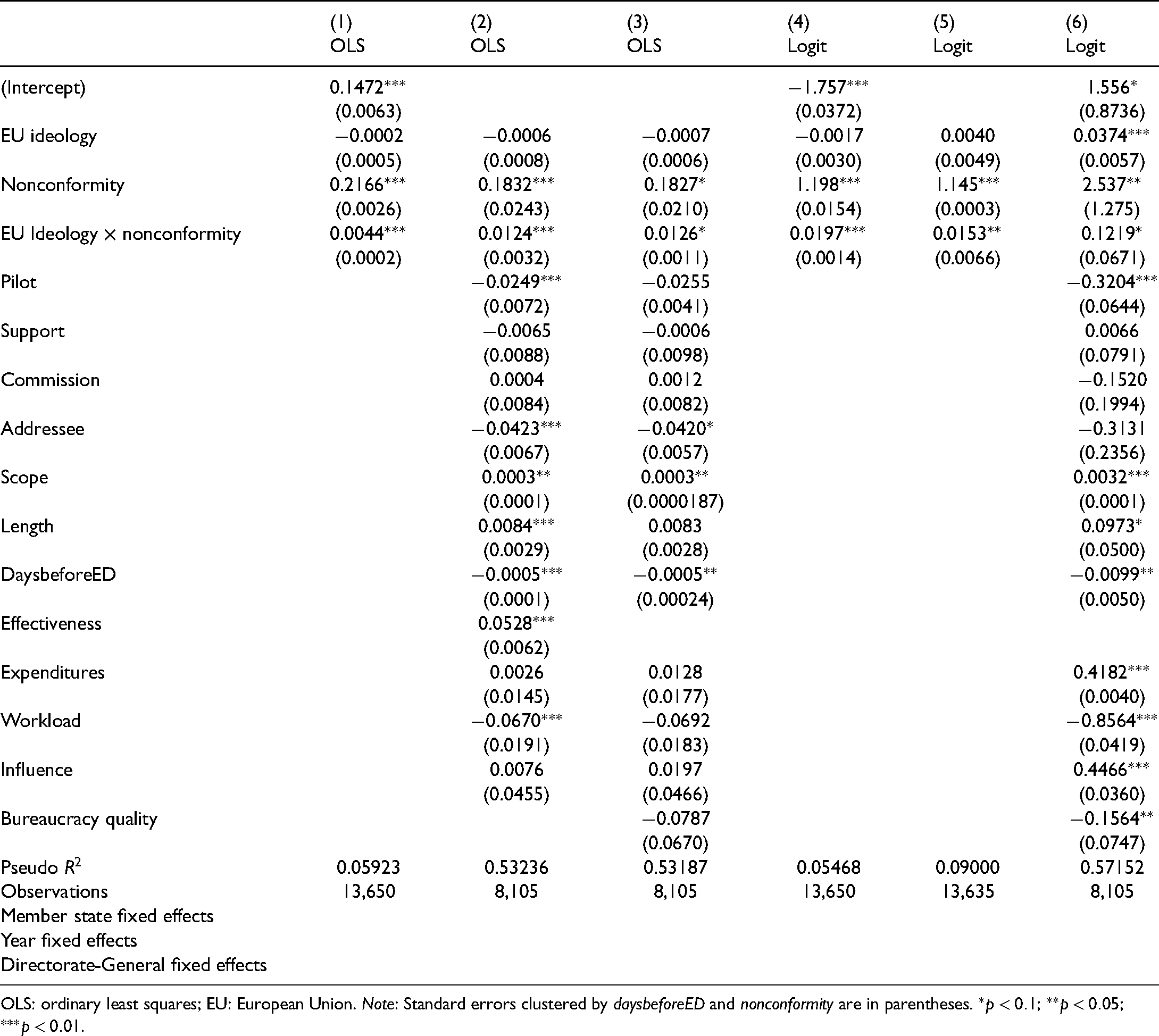
OLS: ordinary least squares; EU: European Union. Note: Standard errors clustered by daysbeforeED and nonconformity are in parentheses.
Table 2 presents the results for the right ideology models. Models 1 to 3 display the OLS specifications and models 4 to 6 provide logit specifications. As expected the coefficient for right ideology
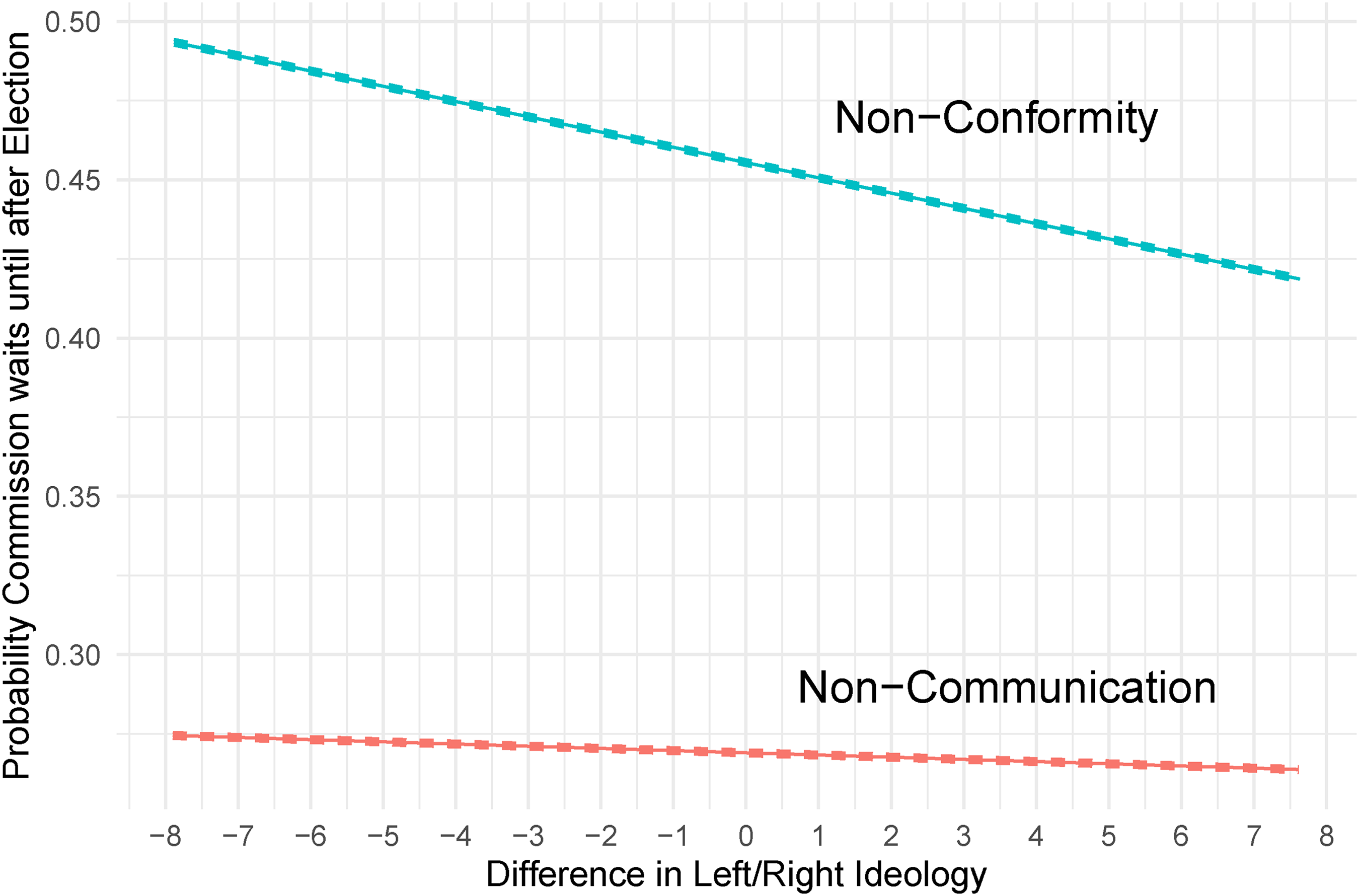
Predicted probability right ideology. Note: This figure is based on Table 2, model 3. This figure compares the probability a noncommunication as opposed to a nonconformity proceeding overlaps an election across the values of right ideology in the dataset with the solid lines indicating the predicted probability and the dashed lines indicating 95% confidence intervals clustered by the number of days before an election the Commission launched a case and whether the case is a noncommunication or nonconformity case.
Models with right ideology.
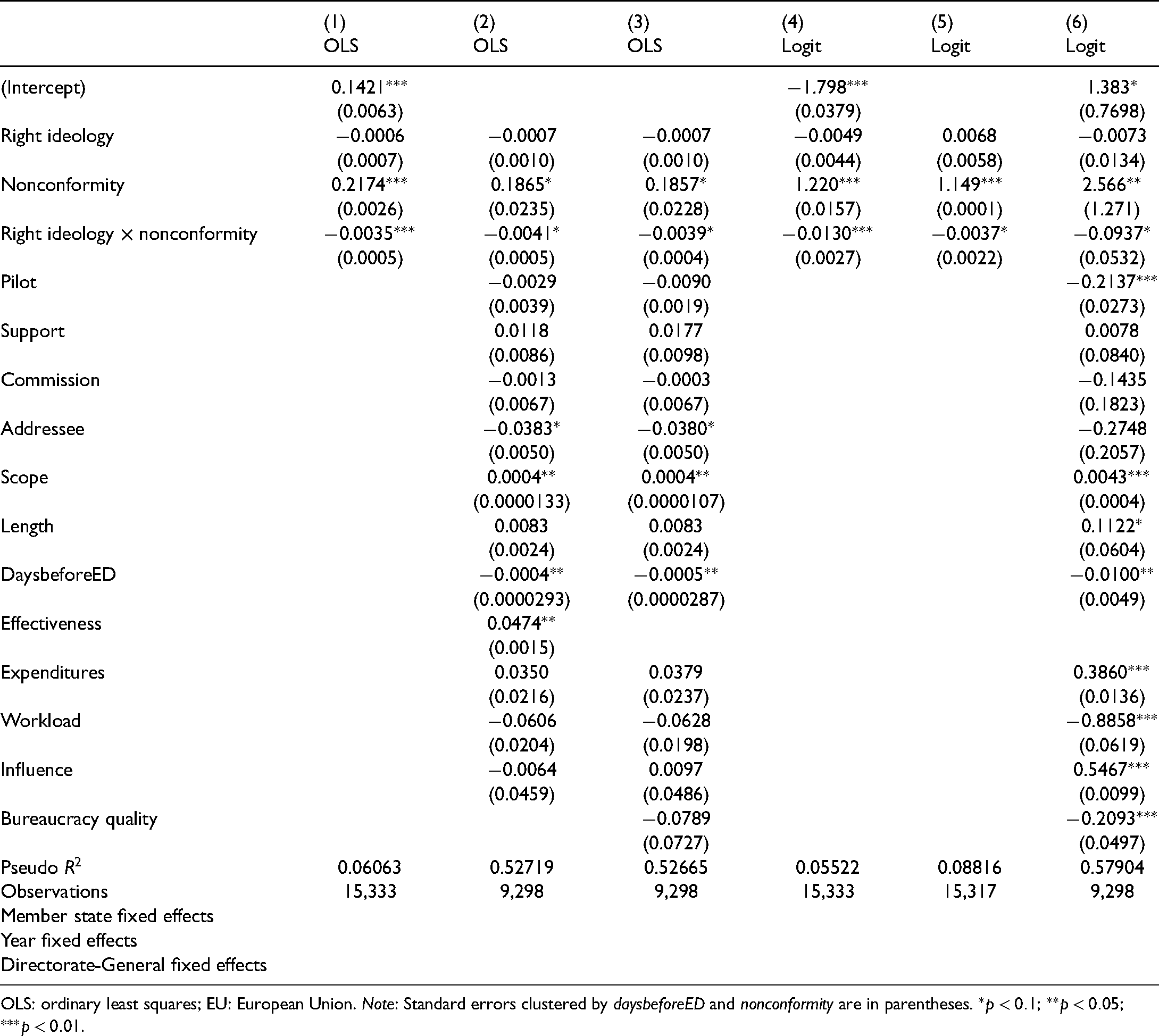
OLS: ordinary least squares; EU: European Union. Note: Standard errors clustered by daysbeforeED and nonconformity are in parentheses.
As mentioned earlier, utilizing these ideology metrics is a very noisy measure of government costs of compliance. The interests of domestic groups and lobbies are most likely not fully captured in this proxy. Nonetheless, the measures for eu ideology and right ideology both comport with the theoretical predictions that the Commission will leverage its ability to strategically delay infringements around election time when it expects a government with a lower cost of compliance to win the election. More specifically, the results demonstrate that we should only observe these dynamics in infringement proceedings in which the cost of compliance of a member state on average sufficiently varies (nonconformity) versus those in which it does not (noncommunication).
Conclusion
How can compliance-monitoring institutions mitigate the threat of noncompliance? In this article, I provide evidence that the Commission is responsive to changes in member states’ costs of compliance and acts strategically to advance an infringement proceeding to the RO stage when it expects a member state’s cost of compliance to be lower. When the Commission expects a more pro-EU (right-wing) government’s election, it is more (less) likely to wait until after an election to decide whether to advance an infringement proceeding to the next stage. These results show that even after launching an infringement proceeding that the Commission believes is valid on its merits—a process with strong selection effects as many studies show (e.g. Börzel 2001; Hartlapp and Falkner 2009; Mbaye 2001; Tallberg 2002; Thomson 2007)—the Commission strategically delays advancing proceedings if it may be more likely to obtain compliance after a new government’s election.
My argument generalizes to international and domestic regimes in which the institutions charged with monitoring and adjudicating the legality of executives’ actions are reliant on the same executives for enforcement. Heeding the call of Staton and Moore (2011), my findings provide fruitful avenues for future research. It includes studying the effectiveness of international institutions—facing noncompliance from sovereign governments—and domestic institutions—facing noncompliance threats from the executive branch. Monitoring institutions both in international and domestic contexts are strongly disincentivized to pursue costly litigation against an executive and may use similar strategies as courts to reduce the probability of noncompliance. For example, in the domestic (e.g. Gauri et al., 2015; Krehbiel, 2016; Staton, 2010; Vanberg, 2005) and international (e.g. Staton and Romero, 2019) contexts, publicizing noncompliance is used as a strategy by courts to pressure governments to comply. Strategically publicizing noncompliance to maximize executives’ audience costs seems like a sensible strategy for monitoring institutions. Future studies should explore how monitoring institutions can leverage public pressure for compliance to their advantage.
Inevitably, despite adopting strategies to help reduce the probability of noncompliance, monitoring institutions have to expend costly resources to bring some noncompliance cases to court. Citizens charge these monitors to make informed choices over which cases to pursue. Put simply, if monitors expend resources pursuing some incidents of noncompliance over others, citizens expect the monitors to win these cases in court. As a result, monitors face strong incentives to only bring cases to court in which they can win to both conserve resources and shield themselves from potential public backlash. This logic implies a more informed decision-making process in which monitors also weigh the probability of a favorable court ruling. Further research can explore this more complex dynamic and evaluate how the probability of a favorable court ruling affects monitors’ calculus over whether to pursue formal litigation against an executive.
Supplemental Material
sj-pdf-1-eup-10.1177_14651165221087635 - Supplemental material for When does the European Commission Pursue Noncompliance?
Supplemental material, sj-pdf-1-eup-10.1177_14651165221087635 for When does the European Commission Pursue Noncompliance? by Sivaram Cheruvu in European Union Politics
Supplemental Material
sj-R-2-eup-10.1177_14651165221087635 - Supplemental material for When does the European Commission Pursue Noncompliance?
Supplemental material, sj-R-2-eup-10.1177_14651165221087635 for When does the European Commission Pursue Noncompliance? by Sivaram Cheruvu in European Union Politics
Supplemental Material
sj-csv-3-eup-10.1177_14651165221087635 - Supplemental material for When does the European Commission Pursue Noncompliance?
Supplemental material, sj-csv-3-eup-10.1177_14651165221087635 for When does the European Commission Pursue Noncompliance? by Sivaram Cheruvu in European Union Politics
Footnotes
Acknowledgements
I thank Cliff Carrubba, Jeff Staton, Zac Peskowitz, Josh Fjelstul, Daniel Naurin, Tom Clark, Jay Krehbiel, Vanessa Baird, Josh McCrain, Brady Dauzat, Aniket Kesari, Sabrina Arias, Jiwon Kim, Cynthia Guo, Christina Sheng, Miriam Kilimo, the Emory law and politics discussion group, four anonymous reviewers, editor Gerald Schnieder, and participants at the University of Texas Graduate Conference on Public Law, Southern Political Science Association Conference, and Midwest Political Science Association Conference for their helpful feedback on this project.
Declaration of conflicting interests
The author declared no potential conflicts of interest with respect to the research, authorship, and/or publication of this article.
Funding
The author received no financial support for the research, authorship, and/or publication of this article

Supplemental material
Supplemental material for this article is available online.
Notes
References
Supplementary Material
Please find the following supplemental material available below.
For Open Access articles published under a Creative Commons License, all supplemental material carries the same license as the article it is associated with.
For non-Open Access articles published, all supplemental material carries a non-exclusive license, and permission requests for re-use of supplemental material or any part of supplemental material shall be sent directly to the copyright owner as specified in the copyright notice associated with the article.
