




Abstract
Does differentiated integration undermine the motivation of parliamentarians from less integrated member states to become involved in European Union affairs? Focusing on the European Union's new interparliamentary conferences in economic governance, and justice and home affairs, this study examines whether voluntary and involuntary as well as comprehensive and partial differentiation influence parliamentary involvement, measured as participation in interparliamentary conferences. Based on new data and Coarsened Exact Matching, the results indicate that the effect of differentiation depends on its political origins and design. Only voluntary and comprehensive differentiation depress parliamentary involvement. The results can be seen as favourable regarding the legitimacy of differentiation and compatible with the European Union's ambition to limit the institutional implications of differentiation. They also indicate a targeted parliamentary response to differentiated integration.
Introduction
National parliamentary involvement has long been considered important for the European Union (EU). It has been argued that the more national parliamentarians are involved in the EU, the more they could communicate EU affairs to the public, encourage informed public debate, and perhaps even enhance popular support (Auel et al., 2018; Auel and Raunio, 2014; Rauh and De Wilde, 2018). Parliamentary involvement might, however, be weakened by the differentiated integration (hereinafter referred to as DI or differentiation) of the EU, defined as the exemption and exclusion of member states from selected policy domains (Holzinger and Schimmelfennig, 2012; Schimmelfennig et al., 2015). Differentiation has often been considered positive for European integration as it helps overcome cross-national ideological and capacity differences (de Neve, 2007; Kölliker, 2006; Schimmelfennig and Winzen, 2020; Stubb, 1996), but does it undermine the motivation of parliamentarians from less integrated member states to become involved in EU affairs?
I examine this question with a focus on the participation of members of national parliaments (hereinafter referred to as MPs or parliamentarians) in the EU's interparliamentary conferences (IPCs). The EU has created IPCs in economic governance, justice and home affairs, and foreign and security policy. These biannual, formal meetings allow MPs to interact with each other and EU actors (Cooper, 2017b; Herranz-Surrallés, 2022; Jančić, 2016; Kreilinger, 2013, 2018; Schade and Stavridis, 2021). IPCs are not crucial for decision making but enable parliamentarians to gain information. Analytically, they are an opportunity to understand the incentives of MPs in the context of DI. While IPCs exist in domains that feature differentiation in various forms and for different countries, their membership is not differentiated. We can thus assess the relationship between differentiation and parliamentary participation.
I argue that the effect of differentiation on IPC participation depends on whether differentiation preserves incentives to participate. This in turn hinges on the political origins and institutional design of differentiation. I start from the premise that IPCs primarily serve as an informational function for national parliaments (e.g. Kreilinger, 2018; Lipps, 2020; Miklin, 2013), but also acknowledge that they might have an additional social purpose in the EU's ‘inter-parliamentary field’ (Crum and Fossum, 2009). I expect that parliamentarians, whose countries are exempted from EU policies and who, therefore, face weaker information needs and social expectations, participate less in IPCs. However, this effect is only likely in countries with voluntary and comprehensive differentiations, such as the British (before leaving the EU), Danish, and Swedish Euro Area opt-outs. It might also prove stronger for parliamentarians than parliamentary bureaucracies who participate in IPCs as well. In contrast, if differentiation is involuntary or covers the remits of IPCs only partly, the incentives to participate remain largely unaffected.
Empirically, the analysis relies on new participation data on the Interparliamentary Conference on Stability, Economic Coordination and Governance in the European Union (SECG IPC) and the Joint Parliamentary Scrutiny Group on Europol (JPSG). The EU's third IPC on foreign and security policy is not included. There is only one opt-out in its domain, Denmark, which participates the least compared to all member states (Schade and Stavridis, 2021), leaving little further variation of interest. Based on pre-processing of the data via Coarsened Exact Matching (CEM) (Blackwell et al., 2009; Iacus et al., 2012) as well as count and multilevel models, the analysis yields evidence in line with the hypothesis that voluntary and comprehensive differentiation reduces IPC participation, whereas involuntary and partial differentiation does not. There is no clear difference between parliamentarians and parliamentary officials, however.
The findings have favourable implications for the legitimacy of DI (see Schimmelfennig et al., 2023). The (normatively) most contested form of differentiation – involuntary exclusion – does not seem to undermine MPs’ willingness to use participation opportunities in EU affairs. The results further indicate that the institutional effects of differentiation might be limited. Even in IPCs, in which it would be easy for parliamentarians to disengage, involuntary and partial opt-outs do not reduce participation. Finally, in line with studies of parliamentary oversight and differentiation at the national level (Genovese and Schneider, 2020; Hallerberg et al., 2018; but see Rasmussen, 2018), this study suggests a targeted parliamentary response to differentiation.
The informational and social functions of interparliamentary conferences
I examine the effect of differentiation in IPC participation against the backdrop of the broader functions that IPCs perform for parliamentarians. Most literature suggest that they serve an informational function primarily. Some studies also indicate that they might have an additional social function in the EU's inter-parliamentary field (Crum and Fossum, 2009).
Generally, scholars have considered surprising that parliaments participate in international arenas given their low salience, weak authority and distance from domestic elections (Raunio, 2014; Šabič, 2008). Yet, some suggestions for what motivates participation have emerged. Some of these focus on the goals of parliamentarians. For instance, IPCs might constitute a profile-building opportunity for parliamentarians from internationally oriented constituencies (Malang, 2019). The most common argument, however, holds that IPCs help parliaments acquire information about policy. Based on interviews in the Austrian parliament, Miklin (2013: 32) for example finds that obtaining ‘a fast overview regarding current discussions at the EU level’ is often a key motivation for parliamentary involvement. Lipps (2020: 506), albeit outside of the EU context, suggests that participation in international parliamentary arenas means ‘minimising the information gap with the executive’ and ‘being able to scrutinise foreign policy’. This is not to deny that the opposition might want information to challenge the government, while government supporters might monitor EU policies in their role as party policy specialists (e.g. Auel, 2007; Miklin, 2013). Yet, for government and opposition alike, IPCs seem to fulfil an information function.
The institutional design of the SECG and JPSG IPCs also suggests this conclusion. Both adopt what Kreilinger (2018: 162) labels the ‘COSAC model’. Similar to Area the Conference of European Union Affairs Committees (COSAC) they help parliaments obtain information ‘for their own scrutiny activities’. The SECG IPC and JPSG are recurring meetings of parliamentarians regulated in EU law and rules of procedure. The SECG IPC originates in the Fiscal Compact and has met biannually since October 2013. The JPSG is defined in the EU treaties and the Europol regulation, which envisage the involvement of national parliaments in the monitoring of Europol. It has met biannually since October 2017. At their meetings, parliamentarians can exchange information on EU policy with each other and with EU-level actors who can be invited and who attend regularly. However, the SECG IPC and JPSG do not have a formal decision-making role and can only adopt consensual, non-binding meeting summaries and conclusions (Cooper, 2017b; Kreilinger, 2013; Lupo and Griglio, 2018). The JPSG has some formal information rights and delegates an observer to the Europol board, which strengthens its ability to scrutinise Europol and yield information for the participating parliamentarians (Cooper, 2018), but also lacks formal decision-making authority.
Some studies focus on the rules and practice of participation in the SECG and JPSG IPCs. These studies are in line with the assumption that IPCs serve an informational function. Participation is regulated by formal rules but varies cross-nationally in practice (Kreilinger, 2018: 176–177). According to the rules, the SECG IPC consists of delegations of flexible size with no upper limit and no obligation to participate. In the JPSG, participation is voluntary, but delegations are limited to four members for each national parliament. In addition, parliaments can send an unspecified number of parliamentary officials to support their delegations. Most importantly, according to the rules of procedure, participants must come from relevant committees (SECG) or have relevant expertise (JPSG). The JPSG rules also encourage national parliaments to ensure continuity in participation. In practice, nearly all participants indeed are active in pertinent sectoral committees and, less frequently, in European Affairs Committees (Kreilinger, 2018: 177–179).
Beyond the observation that specialists compose delegations, formal rules suggest that party proportionality is the norm. The formal delegation selection rules of many parliaments prescribe proportional party representation and, in some cases, explicitly prohibit one-party delegations (see Table 1 for a sample of countries and the Online appendix for all countries). Where party proportionality is not mentioned, the plenary election of delegations is the rule, which renders it likely that similar practices as in the composition of committees will be applied. In general, the co-occurrence of party proportionality and composition by policy specialists mentioned above is in line with the standard operation of parliamentary specialisation and committee structures in Europe (Strøm, 1998), and compatible with an informational perspective on IPCs. The overall size of IPC delegations is not formally regulated, however.
Examples of selection mechanisms for IPC delegations.

Note: ROP: rules of procedure; PR: proportional representation of party groups. For a sample of countries, the table shows the rules, as formally specified in parliamentary ROPs, for the selection of delegations to IPCs and other international bodies and assemblies. For the rules of all member state parliaments, see the Online appendix.
In addition to an informational function, IPCs might have a social function. There is little research developing this view. Yet, IPCs have been considered arenas of the EU's ‘inter-parliamentary field’ – a social space constituted by actors that see themselves as parliamentarians, by institutions (parliaments) that serve the purpose of representation, and by the formal and informal interactions of these actors and institutions (Crum and Fossum, 2009). As any field, the inter-parliamentary field entails social expectations of what actors (parliaments and parliamentarians) have to do to be seen as proper field members. It is also characterised by differences in status and power. The implications for IPCs have not been formulated explicitly, but it may be the case that IPC participation is in part a social activity through which parliaments claim their field membership (by doing what other parliaments in the field do), fulfil their commitments as field members (by staffing the IPCs that they have set up), and seek status in the field (by building contacts, experience and contributions such as hosting events).
While the literature conveys a sense of the functions of IPCs, the link to differentiation remains unclear. Some starting points can be found, however. Schade and Stavridis (2021) study participation in the EU's IPC on foreign and security policy, which is very similar to the cases studied here (Cooper, 2017b; Fromage, 2018). They find that Denmark, the only country with an opt-out in this area, sends the fewest parliamentarians. Yet, in explanatory terms, the authors focus on resource constraints arising from small parliamentary size and bureaucracies. Analogous to their study and based on official attendance records, Figure 1 shows cross-national variation in political and administrative attendance at the SECG and JPSG IPCs. It suggests that differentiation might be important in the limited British and Danish SECG attendance, yet the picture for the JPSG is not clear-cut.

Interparliamentary conference participation by country.
Further indirect evidence comes from studies of the role of countries with differentiations in the negotiations on the design and rules of IPCs. These studies indicate that the link between differentiation and participation might not be straight-forward. For example, Cooper (2016: 203) highlights that parliaments from countries with involuntary Euro Area opt-outs explicitly demanded full participation rights in the SECG IPC because they anticipated future Euro Area accession. In the JPSG, the ‘Danish question’ caused lasting controversy (Cooper, 2018: 199). Given Denmark's indirect, intergovernmental association to Europol (see further information below), the EP wanted to exclude it from participation, but Denmark insisted on full participation rights. As a temporary compromise, Danish parliamentarians were given the right to participate, but were officially designated ‘observers’. Since 2019, an addendum to the rules of procedure specifies that the Danish delegation is a full member but does not host meetings or vote (its position on votes is ‘recorded’). Whereas the previous paragraph indicated tentatively that differentiation might reduce participation, these two examples suggest that this need not be the case in all circumstances. This makes sense given that differentiation takes various institutional and political forms. Yet, existing literature does not currently specify and test the relevant arguments systematically.
Differentiation and variation in IPC participation
Following the literature, which emphasises the informational function of IPCs, I examine the effect of differentiation primarily from an informational perspective as well as arguments related to the social function of IPCs. If we understand IPCs as information mechanisms, DI should generally be expected to reduce parliamentary participation. Differentiation reduces the relevance of an IPC, and the information it provides to parliamentarians, by exempting a country from all or parts of a policy domain. This should reduce the perceived importance of monitoring this policy domain and, accordingly, parliamentary motivation to participate in IPCs created for the purpose of monitoring. In addition, considering the social function of IPCs, while parliaments from undifferentiated countries are normal IPC members, this is less clear for parliaments from differentiated countries, as the debates cited in the previous section indicate. For these parliaments, the social expectation to participate is thus weaker.
H1: Parliamentary participation in IPCs from countries with differentiation in the policy domain in question will be lower than from countries without differentiation.
Yet, this hypothesis should be refined to account for the political origins and design of DI. Regarding the origins of differentiation, some member states opt out of EU policies voluntarily and expect to remain outside for the foreseeable future. Other countries are excluded against their will and aspire to join in the future (Schneider, 2009). The respective domains of the SECG and JPSG IPCs contain some of the best-known instances of voluntary and involuntary differentiation in the EU. The SECG IPC lies in the economic governance domain with a focus on the Euro Area from which the United Kingdom (UK), Denmark and Sweden have voluntarily opted out and from which several countries that joined after 2004 remain excluded. The JPSG falls within the EU's Area of Freedom, Security and Justice (AFSJ). The UK, Denmark and Ireland have opted out of legislation in this domain (albeit with an option for the UK and Ireland to opt into legislation selectively). Moreover, several countries remain outside of, or excluded from, the Schengen Area.
In relation to participation in the SECG and JPSG IPCs, voluntary opt-outs should have a stronger effect than involuntary ones. Parliamentarians from involuntarily excluded countries have incentives to monitor progress towards ending differentiation. In addition, involuntary differentiation in the EU is temporary – the affected countries thus have incentives to monitor EU decisions that will apply to them in the future.
1
Yet, while informational incentives suggest some difference in the effect of voluntary and involuntary differentiation, it is less clear whether they justify expecting a large effect. After all, many existing cases in the Euro Area and AFSJ are commonly predicted to persist for the near future, thus reducing the relevance of parliamentary monitoring even under involuntary differentiation. It is thus important to note that social factors might reinforce the distinction between voluntary and involuntary differentiation. Parliamentarians might see involuntary differentiation as a threat to their social status in the parliamentary field. They might fear being seen as second-class IPC participants. Early proposals to give them observer status suggest some basis for such concerns (Cooper, 2016: 203). Parliamentarians might thus adopt compensatory, status-enhancing strategies such as participating in IPCs at least as actively as Euro Area member parliaments. Similar observations have been made about the conduct of certain governments in the Council (Adler-Nissen, 2008, 2009).
H2: Voluntary differentiation reduces parliamentary involvement more than involuntary differentiation.
In addition, the design of differentiation varies. We can distinguish between comprehensive differentiation, in which countries are exempted from entire policy domains, and partial differentiation that covers policy domains only partly or flexibly. Comprehensive differentiation is likely to depress IPC participation more than partial differentiation. In practice, the conceptual distinction between comprehensive and partial differentiation of course depends on how policy domains are demarcated. Yet, if we take the formal organisation of the EU treaties into separate policy chapters as the basis (Schimmelfennig and Winzen, 2020), then Euro Area opt-outs cover the entire monetary policy chapter and are, in this sense, comprehensive. As a result, the affected countries largely fall outside of the scope of the issues monitored by the SECG IPC. This is the case despite the fact that the SECG IPC has a broad mandate involving contributions to ‘democratic accountability in the area of economic governance and budgetary policy in the EU’ (Interparliamentary Conference on SECG, 2015: Art. 2.1). There are exceptions as the SECG might touch on the European Semester, in which all member states participate, but even the European Semester exempts Euro Area outsiders from enforcement processes – which constrains domestic parliamentary adaptation (Hallerberg et al., 2018) and should also limit IPC participation.
In contrast, AFSJ opt-outs are partial. The result is a highly complex relationship between the opt-out countries and the JPSG's focus on Europol. First, Denmark has opted out of the Europol regulation but has signed a ‘clunky’ (Mortera-Martínez et al., 2021: 9) intergovernmental agreement with the EU that involves it in Europol, albeit in a complicated way with various special procedures and restrictions. Second, despite the AFSJ opt-outs, Ireland and the UK have chosen to participate in Europol, reducing the relevance of differentiation. Nevertheless, as Schengen outsiders, they (as well as several post-2004 member states) are less directly affected than other member states by some of Europol's most important activities in the area of borders and migration (Mortera-Martínez et al., 2021), so that their AFSJ opt-outs are not irrelevant. Denmark, on the other hand, is part of the Schengen Area.
What this complicated set of relations suggests is that partial AFSJ differentiation, in contrast to comprehensive Euro Area differentiation, is less likely to affect IPC participation – many of the issues covered by the JPSG will be relevant for countries with opt-outs, even if only partly or through more complex (intergovernmental) mechanisms. The formal complexity and ambiguity created by the AFSJ opt-outs could also be interpreted as creating uncertainty about the social status and entitlement to participate of opt-out countries (Adler-Nissen, 2009) – and thus as motivating parliamentary efforts to affirm their social status in the inter-parliamentary field through IPC participation. The Danish case, in particular, should be a strong test for the expectation that comprehensive differentiation depresses participation more than partial differentiation, considering that its special status in the JPSG (as explained in the previous section) might render participation less attractive than for other countries. If Danish parliamentarians nonetheless participated as much as parliaments without differentiation, this would strongly suggest that partial differentiation does not depress IPC participation.
H3: Comprehensive differentiation reduces parliamentary involvement more than partial differentiation.
Finally, we can explore whether differentiation affects the participation of MPs and officials from the parliamentary administration differently. Existing literature underlines the strong bureaucratic dimension of parliamentary involvement in EU affairs (Christiansen et al., 2014; Högenauer and Neuhold, 2015; Neuhold and Högenauer, 2016). Across Europe, European affairs bureaucracies have emerged and shoulder a significant part of the practical workload of monitoring the EU. They are particularly important for monitoring the less salient areas of EU policymaking (Neuhold and Högenauer, 2016). Recent studies, therefore, expect that the relative weakness of some parliaments’ bureaucracies depresses IPC involvement (Schade and Stavridis, 2021). Yet, when it comes to the differentiation, it in turn seems likely that differentiation depresses involvement by MPs more than by officials. This is due to the mandate of officials to monitor EU policymaking also in less salient areas and the tendency of bureaucracies to follow institutional routines and commitments – such as IPC attendance – to a greater extent than politicians. Whereas MPs face competing obligations, parliaments have designated bureaucracies, including Brussels-based representatives (Neuhold and Högenauer, 2016), whose primary task is monitoring EU affairs.
H4: Differentiation reduces parliamentary involvement by parliamentarians more than by parliamentary officials.
Data and operationalisation
I test these hypotheses based on new data on the attendance of MPs and parliamentary officials from each member state at all biannual SECG IPC (first meeting in September 2013) and JPSG (first meeting in October 2017) meetings until the end of 2019. This means that the analysis encompasses all current IPCs, except COSAC – which is not policy specific and thus not linked to individual instances of differentiation – and the CFSP IPC, as explained in the introduction. The information was obtained from attendance lists that are publicly available (IPEX, 2022). Unavailable attendance lists were obtained from the host parliaments of an IPC meeting. Systematising this information is largely straight-forward. 2 The focus is on lower houses of parliament. Participation from upper houses or, in Belgium, sub-national parliaments is limited overall. However, given the argument that bicameralism might depress lower house participation (Schade and Stavridis, 2021), I test that the results hold when controlling for bicameralism (see below). For parliamentary officials, it is often difficult to distinguish affiliations to the lower or upper parliamentary chamber. This reflects imprecise information on attendance lists and the fact that many officials work for ‘the parliament’ (both chambers). Therefore, the analysis can only examine overall participation by parliamentary officials.
The independent variable of interest is DI. Table 2 summarises all relevant instances during the analysis period. Except for the Latvian and Lithuanian Euro Area opt-outs that ended soon after the first SECG IPC meeting in September 2013, all differentiations were in force throughout the study period. Differentiations that were initially demanded by rather than imposed on member states are classified as voluntary. While this approach enables a clear classification, it raises issues for the Czech Republic, Hungary, and Poland, where initially involuntary Euro Area opt-outs have gained domestic support (Dandashly and Verdun, 2018). Yet, when a shift from voluntary to involuntary opt-outs might have taken place, if at all, and whether it is more than a transitory reflection of the European sovereign debt crisis, is difficult to say. It would also not change the fact that these countries have legally and politically more complicated links to the Euro Area, and thus stronger incentives to seek information than member states with unambiguous opt-outs. Nevertheless, the implications of changing the classification of these countries will be examined. Note also that the current coding, even if it was mistaken, would make it harder to find support for the expectation that voluntary differentiation influences IPC participation more than involuntary differentiation (because the ‘involuntary’ and ‘voluntary’ groups would in fact be more similar). Finally, AFSJ differentiations are considered partial compared to the more comprehensive Euro Area opt-outs.
Differentiation across countries and policies.
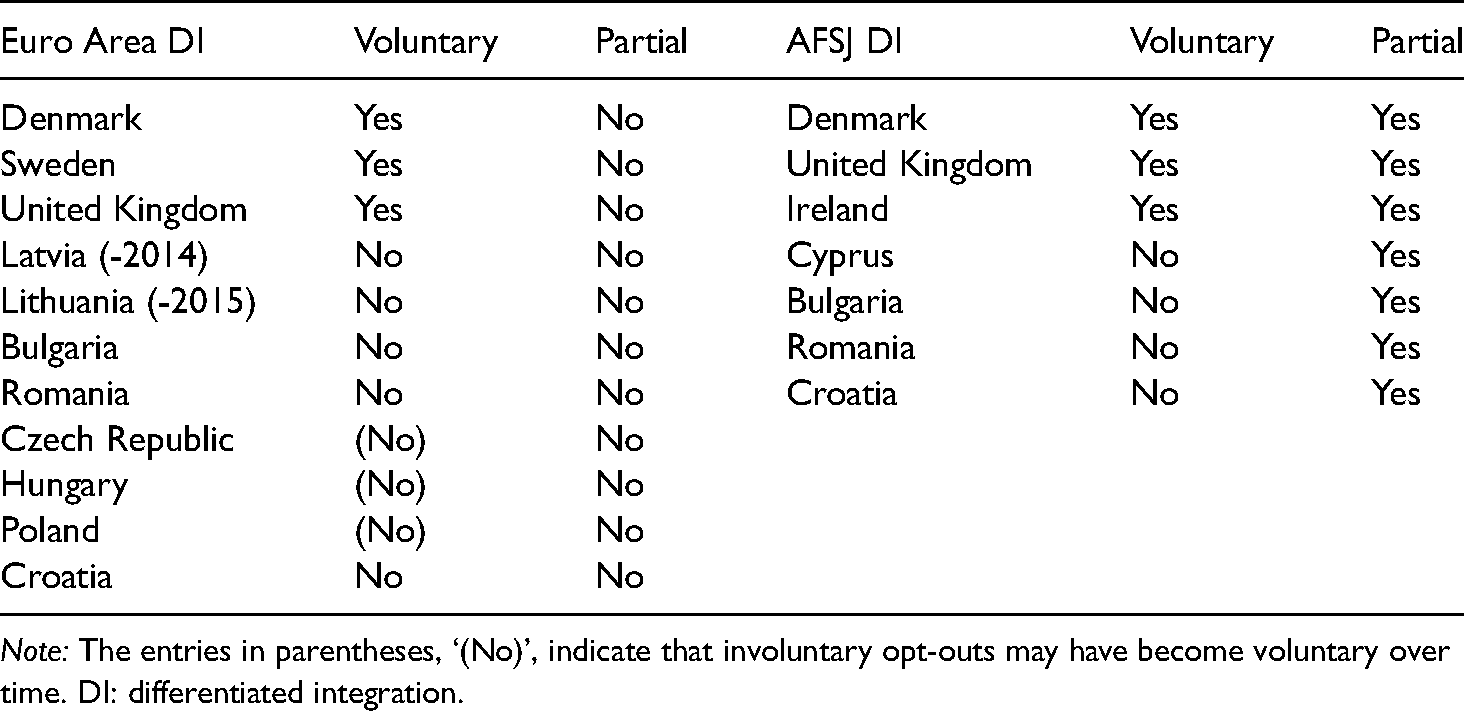
Note: The entries in parentheses, ‘(No)’, indicate that involuntary opt-outs may have become voluntary over time. DI: differentiated integration.
Several further variables will be employed (see the Online appendix for more details on the operationalisation). These include the accession cohort of a member state, the host country of an IPC, the proximity of the next election (measured in days and re-scaled by dividing by 365) (Schade and Stavridis, 2021), and the effective number of parliamentary parties. Additionally, parliamentary EU support will be measured as the seat-weighted average party support for European integration of all parliamentary parties, based on data from the Chapel Hill Expert Surveys (Bakker et al., 2020; Polk et al., 2017). The compositions of all parliaments were obtained from Parlgov (Döring and Manow, 2011). More Eurosceptic parliaments might include more deputies that want to avoid involvement in EU-level arenas. Furthermore, data on the strength of EU-related parliamentary oversight institutions at the domestic level come from Winzen (2021). Domestic opportunities to monitor EU affairs might render EU-level participation unnecessary or, alternatively, might motivate the involved parliamentarians to employ further information-gathering mechanisms (Lipps, 2020). Finally, given arguments by Schade and Stavridis (2021), I obtained information on the staff of national parliaments from the Inter-Parliamentary Union (2022). As a few parliaments have a very large staff, the log of this variable will be used. I do not measure total parliamentary seats since seats and staff correlate closely (r = 0.88).
Analysis
Figure 2 shows a comparison of IPC participation across countries with and without differentiation in the Euro Area and the AFSJ. It appears that MPs and officials from voluntarily differentiated countries might participate somewhat less on average in the SECG IPC. In the JPSG, MPs (but not officials) from countries with voluntary opt-outs also seem slightly less involved. In relation to the expectation that differentiation reduces parliamentary involvement, but less so for officials than MPs, these patterns are broadly supportive. Turning to countries with involuntary differentiation, this first assessment suggests that MPs and officials participate as much or more than their counterparts from uniformly integrated member states. Yet, a comparison across all countries could be misleading since countries with differentiation differ systematically from other member states and might thus not be comparable (Schimmelfennig et al., 2015; Schimmelfennig and Winzen, 2020).
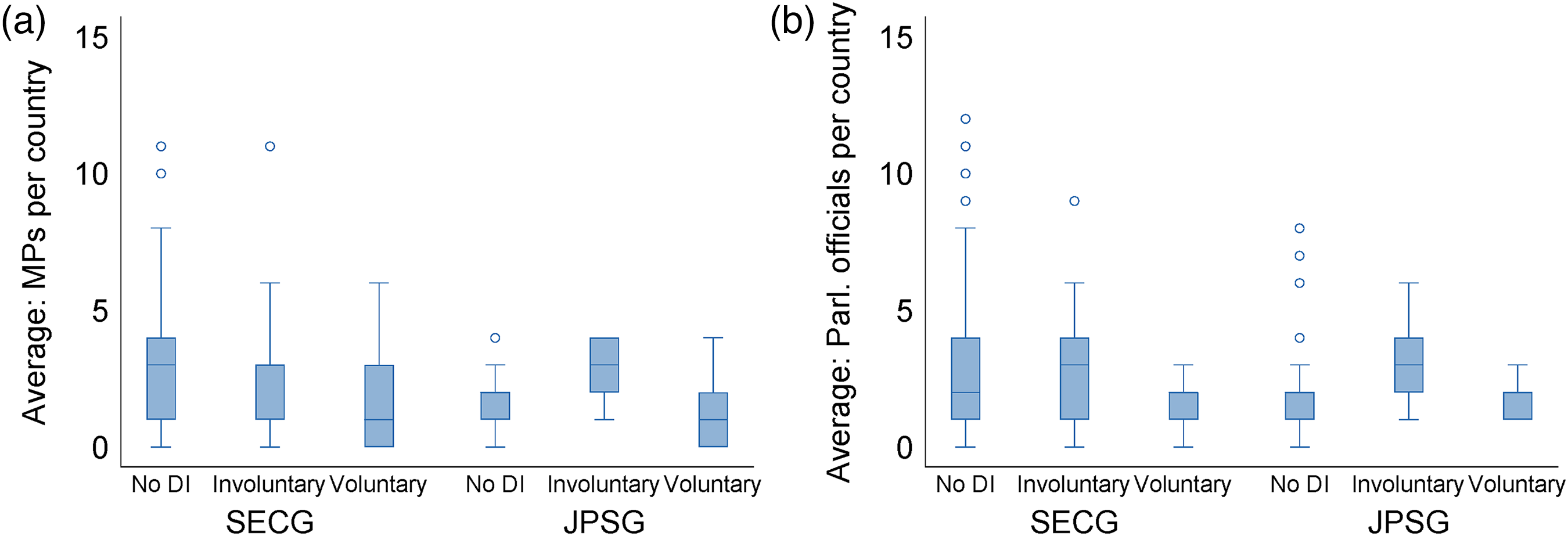
Interparliamentary conference (IPC) participation and differentiation.
To systematise this intuition, I rely on CEM (Blackwell et al., 2009; Iacus et al., 2012). The challenge is that the domain of common empirical support in the data is smaller than what the number of all country's IPC-semester observation suggests. The implication is that results from a multivariate model would depend on extrapolating relationships found in the area of common support to empirically unobserved configurations of variables – that is, they would be model-dependent (Iacus et al., 2012). CEM helps to reduce model dependence (Blackwell et al., 2009; Iacus et al., 2012). The ‘treated’ (i.e. differentiated) observations in the data are first exact-matched to similar untreated observations based on key variables. Continuous variables can be separated coarsely into categories to include them in the matching, which would not be possible in exact matching. Subsequently, unmatched observations are discarded, and an appropriate model can be estimated with the matched observations – including the matching variables and additional variables to further enhance balance in the data. The result, provided all treated observations have been matched, can be interpreted as an estimate of the average treatment effect on the treated cases – that is, how differentiation affects IPC participation in the differentiated countries.
The results in Tables 3 and 4 reflect this strategy. I first matched each treated observation to one or several untreated observations at the country-semester level. Each observation was grouped based on: (a) being either high or moderate-low in parliamentary EU support (4.5 was the cutoff on the 0–6 scale); (b) falling in the lower, middle or upper third of the measure of parliamentary oversight institutions; and (c) belonging either to the wealthier and less contested or poorer and more contested accession cohorts, as described in the previous section. Note that it is only possible to match based on one treatment at a time. Hence, the tables show separate analysis for voluntary and involuntary differentiation.
The relationship between differentiation and SECG IPC participation.
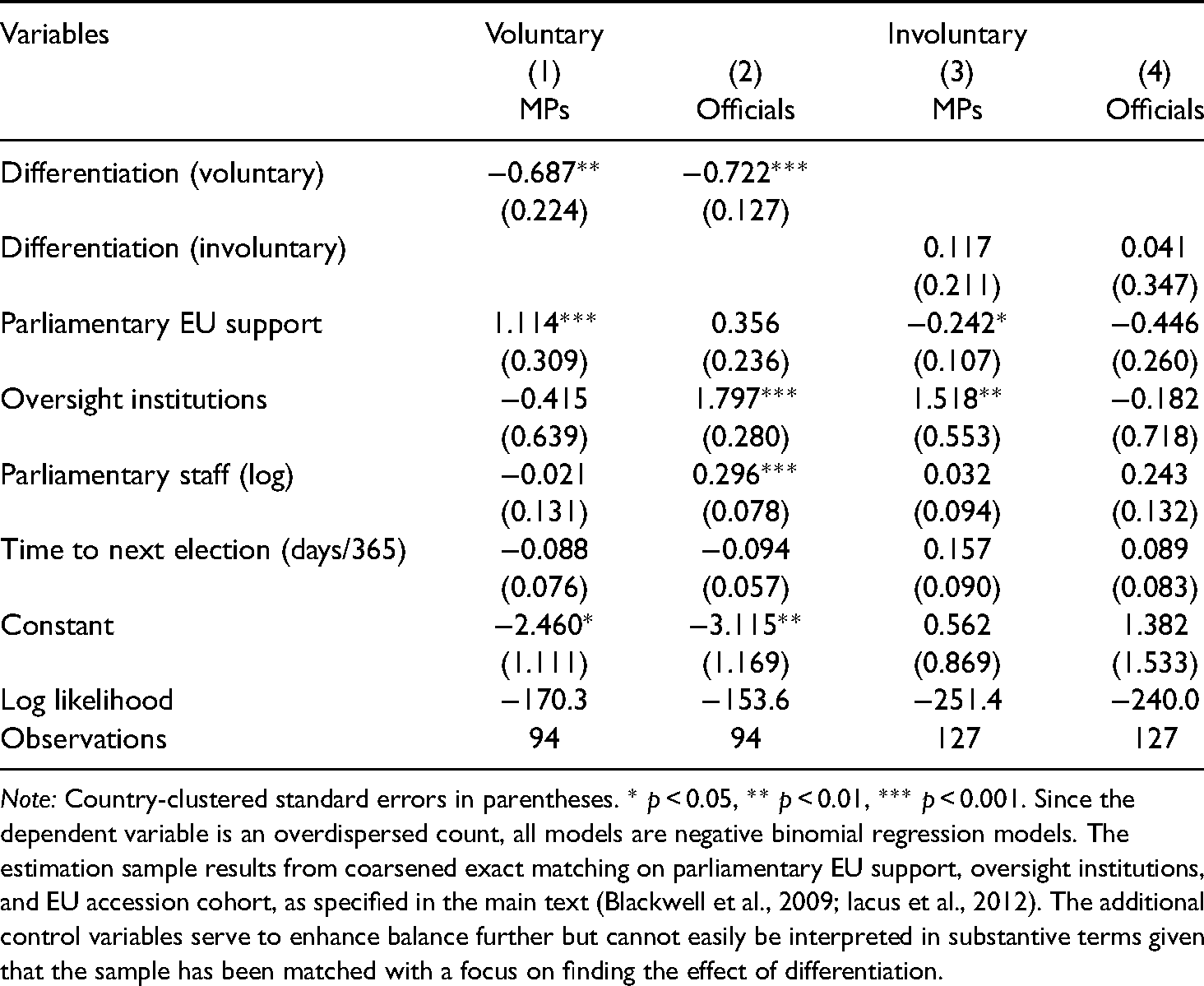
Note: Country-clustered standard errors in parentheses. * p < 0.05, ** p < 0.01, *** p < 0.001. Since the dependent variable is an overdispersed count, all models are negative binomial regression models. The estimation sample results from coarsened exact matching on parliamentary EU support, oversight institutions, and EU accession cohort, as specified in the main text (Blackwell et al., 2009; Iacus et al., 2012). The additional control variables serve to enhance balance further but cannot easily be interpreted in substantive terms given that the sample has been matched with a focus on finding the effect of differentiation.
The relationship between differentiation and JPSG participation.

Note: Country-clustered standard errors in parentheses. *p < 0.05, **p < 0.01, ***p < 0.001. In line with the different distributions of the dependent variable, model (1) is a Poisson model, model (2) is a negative binomial model and models (3) and (4) are generalised Poisson models for underdispersed count data (Harris et al., 2012).
Subsequently, I estimated count models in line with the characteristics of the dependent variable, which is a count of participation. As recommended in the literature (Blackwell et al., 2009; Iacus et al., 2012), the models include the (continuous rather than coarsened) matching variables to enhance balance further. I also included the log of parliamentary staff and the time to the next elections as these are two variables emphasised in existing work. 3 The Online appendix provides a more detailed discussion of the coarsening of the variables and risks of post-treatment bias with respect to parliamentary EU support and oversight institutions and also shows the full set of matched cases.
Turning to the results, Table 3 focuses on participation in the SECG IPC. In line with what the previous section suggested, we find a significant, negative effect of voluntary differentiation on IPC participation by MPs and officials. Translated into number of participants, voluntary differentiation reduces MPs’ participation by about 1.7 (95% CI [−2.5, −0.8]) and officials’ participation by about 1.4 (95% CI [−1.8, −1]). Compared to the average participation levels in the estimation sample (2.8 for MPs and 2.6 for officials), both effects are sizeable, implying a 60% (MPs) and 54% (officials) reduction in participation. While the small difference between the effects on officials’ and MPs’ participation is as hypothesised (see H4), it is not particularly meaningful in substantive terms. In contrast, involuntary differentiation does not appear to influence participation in the SECG IPC by MPs or officials.
Table 4 shows comparable analyses but with a focus on the JPSG. Recall that DI in this case can also be divided into voluntary and involuntary but is more partial in contrast to comprehensive Euro Area differentiation. In line with H3 that differentiation would have a weaker effect, I find that voluntary differentiation has a negative, but substantively weak and statistically insignificant, effect on participation. Involuntary differentiation in fact appears to increase rather than decrease participation by officials by ca. 1.2 (95% CI [0.4, 2]).
Following these initial analyses, I conducted several additional ones to address various concerns. One concern is that the models do not include host status. While host parliaments have more participants, the issue is of limited practical relevance because, in the SECG, only four (for models 1 and 2 in Table 3) and six (models 3 and 4) observations of conference hosts are included in the matched data. In the analysis of the JPSG, two (models 1 and 2 in Table 4) and three (models 3 and 4) host observations are included. Nevertheless, the Online appendix shows results controlling for host status. The results remain substantially unchanged, except that the negative effect of voluntary differentiation on SECG IPC participation becomes about 0.3 participants smaller. 4
I also examined the results after re-coding the involuntary Euro Area opt-outs of the Czech Republic, Hungary, and Poland to voluntary opt-outs (see the Online appendix). Involuntary differentiation still does not affect participation. Voluntary differentiation still reduces political participation by about 1 participant – that is, slightly less than in the main analysis – whereas it does not reduce officials’ participation. Overall, IPC participation of these three countries seems to differ from the other voluntarily differentiated countries. Therefore, adding them dilutes the effects. As noted, this is not a surprise: Given their ambiguous relationship with the Euro Area, Czech, Hungarian and Polish parliamentarians, even if considered to have a voluntary opt-out, have stronger incentives to seek information than countries with clear voluntary opt-outs.
Finally, alternatives to the matching approach could be considered. While more model-dependent, these would allow including all observations and a wider range of control variables (and be more easily interpretable). Table 5 presents results from multilevel regression models with country-level random effects. The results regarding the association between differentiation and IPC participation are in line with the matching approach. Significant relationships are found for voluntary differentiation in the SECG IPC only. The relationships are very similar in magnitude (−1.8 MPs and −1.3 officials). However, the effect of voluntary differentiation on participation by officials is more uncertain (p = 0.053). The positive effect of involuntary differentiation on JPSG participation by officials is not reproduced. Regarding the remaining variables, it is plausible to see that more officials (but not necessarily more MPs) participate from parliaments with more staff. Moreover, participation is higher for host parliaments and when IPCs take place in Brussels, co-hosted by the European Parliament. Upcoming elections coincide with more rather than less SECG IPC participation by parliamentarians (cf. Schade and Stavridis, 2021) – possibly, due to incentives such as showing involvement in international affairs (Malang, 2019). Further significant relationships are not found.
Multilevel models of IPC participation.

Note: *p < 0.05, **p < 0.01, ***p < 0.001. The models are multilevel, varying-intercept models with observations nested in countries. Models 1 and 2 are multilevel negative binomial models, models 3 and 4 multilevel Poisson models.
The multilevel models also enable us to compare all configurations of partial/comprehensive and voluntary/involuntary differentiation in a single model. 5 By separating the SECG and JPSG, the partial and comprehensive alternatives have so far only been compared indirectly. The results of the analyses with all configurations are in line with the findings presented so far (see the Online appendix). Compared to MPs from uniformly integrated countries, MPs from countries with partial, involuntary DI even seem to participate significantly more, whereas MPs from countries with comprehensive, voluntary DI participate less. The two other configurations – partial/voluntary and comprehensive/involuntary – do not relate significantly to IPC participation. As a last test, I included the effective number of parliamentary parties in the models. Due to the proportional allocation rules in many parliaments, more parties might require more delegation seats – empirically, no relationship is found, however (see the Online appendix for results and further discussion of this finding).
Summing up, in relation to the baseline hypothesis that differentiation reduces IPC participation (H1), the evidence rather suggests that the effect of differentiation is not unconditional and not necessarily negative. Largely in line with H2 and H3, I find that voluntary and comprehensive differentiation in the Euro Area reduces participation of MPs and parliamentary officials in the SECG IPC to very low levels. In contrast, involuntary differentiation does not seem to have a negative effect on participation. On the contrary, I found a positive effect on participation in the JPSG in the main analysis, but not in the alternative, multilevel model. Finally, regarding H4, voluntary Euro Area differentiation seems to reduce MP participation in the SECG IPC somewhat more than involvement by parliamentary officials. Yet, substantively, the difference is small.
Conclusion
DI has been considered necessary and helpful for European integration in light of cross-national capacity and ideological differences. Yet, it could have the problematic side-effect of weakening the motivation of national parliamentarians to participate in EU affairs – something often deemed important for the EU's legitimacy and proximity to citizens (Auel et al., 2018; Auel and Raunio, 2014; Rauh and De Wilde, 2018). 6 Treating the EU's IPCs as an opportunity to study parliamentary incentives in the context of DI systematically, this study yields a mixed picture. An analysis, based on CEM and new data on participation by MPs and officials in the SECG and JPSG IPC, shows that voluntary differentiation, such as the Euro Area opt-outs of the UK, Denmark and Sweden, depresses participation by national parliamentarians and parliamentary officials to very low levels. However, if differentiation is partial or involuntary and thus preserves incentives for IPC participation, it does not seem to reduce parliamentary involvement. The overall lesson is that the effects of differentiation depend on its political origins and institutional design and, specifically, on whether it preserves incentives for political actors to participate in EU arenas.
Several broader conclusions can be highlighted. First, regarding the legitimacy of DI, the results are to some extent favourable. Involuntary differentiation has been discussed critically as a possible case of illegitimate dominance of the EU over countries with weaker economies and administrations and weaker bargaining power (Eriksen, 2018). I do not evaluate this argument as such here or assess whether MPs share it. Yet, the results suggest that involuntary differentiation, which has been deemed necessary for progress in integration – specifically, enlargement (e.g. Schneider, 2009) – does not undermine parliamentarians’ views of the EU so much that they would forgo opportunities for involvement in EU arenas. Voluntary differentiation does, however, depress participation. In this respect, we do not see similar ‘reintegration’ as Genschel et al. (2023) observe in the analysis of policies and intergovernmental relations.
Second, the results suggest a nuanced assessment of the EU's ability to confine the implications of differentiation narrowly to the policies directly affected and avoid effects on political actors’ involvement in institutions. The EU has been eager to preserve shared institutions for all member states – most importantly, the European Commission, Council, Court and Parliament (Schimmelfennig et al., 2015: 3–4). Shared institutions maintain the exchange of ideas and information between all member states (Adler-Nissen, 2009; Cooper, 2017a; Heermann and Leuffen, 2020; Naurin and Lindahl, 2010; Schimmelfennig et al., 2015). Beyond the main institutions, the results presented here are largely compatible with the EU's ambition. IPCs have low authority, rely on voluntary participation and assume low priority relative to busy domestic agendas. Compared with arenas such as the Council of the European Union (Adler-Nissen, 2009), it should be easy for parliamentarians from differentiated countries to reduce participation. Yet, they seem to do so only under voluntary and comprehensive differentiation.
Third, in relation to the literature on national parliaments in the EU, the results indicate a targeted parliamentary response to DI. In the case of voluntary and comprehensive opt-outs, they react to the weakened policy relevance of the EU and to weaker social expectations in the inter-parliamentary field with reduced participation. However, they maintain participation if differentiation leaves incentives to participate in place, as in the case of partial differentiation in justice and home affairs, and involuntary differentiation. This interpretation is compatible with other studies that, albeit without the distinction between voluntary and involuntary differentiation, find weak domestic parliamentary reform efforts and debate during the crisis and reform of EU economic governance in countries outside of the Euro Area (Genovese and Schneider, 2020; Hallerberg et al., 2018).
Supplemental Material
sj-docx-1-eup-10.1177_14651165221104907 - Supplemental material for Does differentiated integration weaken parliamentary involvement? Evidence from the European Union's interparliamentary conferences
Supplemental material, sj-docx-1-eup-10.1177_14651165221104907 for Does differentiated integration weaken parliamentary involvement? Evidence from the European Union's interparliamentary conferences by Thomas Winzen in European Union Politics
Supplemental Material
sj-do-2-eup-10.1177_14651165221104907 - Supplemental material for Does differentiated integration weaken parliamentary involvement? Evidence from the European Union's interparliamentary conferences
Supplemental material, sj-do-2-eup-10.1177_14651165221104907 for Does differentiated integration weaken parliamentary involvement? Evidence from the European Union's interparliamentary conferences by Thomas Winzen in European Union Politics
Supplemental Material
sj-dta-3-eup-10.1177_14651165221104907 - Supplemental material for Does differentiated integration weaken parliamentary involvement? Evidence from the European Union's interparliamentary conferences
Supplemental material, sj-dta-3-eup-10.1177_14651165221104907 for Does differentiated integration weaken parliamentary involvement? Evidence from the European Union's interparliamentary conferences by Thomas Winzen in European Union Politics
Supplemental Material
sj-dta-4-eup-10.1177_14651165221104907 - Supplemental material for Does differentiated integration weaken parliamentary involvement? Evidence from the European Union's interparliamentary conferences
Supplemental material, sj-dta-4-eup-10.1177_14651165221104907 for Does differentiated integration weaken parliamentary involvement? Evidence from the European Union's interparliamentary conferences by Thomas Winzen in European Union Politics
Footnotes
Acknowledgements
For comments, I thank Dirk Leuffen, Frank Schimmelfennig and participants at the 2021 ECPR General Conference panel ‘DI and Core State Powers’ (30 August to 3 September 2021, University of Innsbruck) as well as two anonymous reviewers and the editors of EUP.
Funding
The authors received no financial support for the research, authorship and/or publication of this article.

Supplemental material
Supplemental material for this article is available online.
Notes
References
Supplementary Material
Please find the following supplemental material available below.
For Open Access articles published under a Creative Commons License, all supplemental material carries the same license as the article it is associated with.
For non-Open Access articles published, all supplemental material carries a non-exclusive license, and permission requests for re-use of supplemental material or any part of supplemental material shall be sent directly to the copyright owner as specified in the copyright notice associated with the article.
