



Abstract
Noncompliance and differentiated integration are two strategies to cope with heterogeneity between European Union member states. This article explores the relationship between the two strategies of coping with heterogeneity. We start from the observation that research has linked cross-country variation in differentiated integration and noncompliance to similar root causes—diverging preferences and differential capacity. Addressing the same issues of heterogeneity, we hypothesize that differentiated integration is likely to reduce member states’ noncompliance. In order to test this hypothesis, we combine novel data on differentiated integration and noncompliance. We find that differentiation increases rather than reduces the likelihood of noncompliance. We conclude by discussing why differentiated integration does not serve as a strategy to prevent noncompliance.
Introduction
The European Union's (EU) acquis communautaire has become ever more diverse in level and scope. Amidst the growing heterogeneity of member states, differentiated integration has served as an important tool to avoid deadlock in the integration process (Winzen, 2016). The literature has identified two main rationales underlying differentiated integration in EU law: effectiveness and efficiency. At the decision-making stage, differentiated integration allows to escape stalemate avoiding the veto of member states with diverging preferences against further integration. During the national implementation of a legal act, differentiated integration helps prevent noncompliance by alleviating the costs of adaptation or granting member states with weak capacities additional time to cope with the costs (Holzinger and Schimmelfennig, 2012; Leruth, 2015).
Preference-, power-, and capacity-based approaches in EU compliance research also tackle effectiveness and efficiency focusing on heterogeneity as a major source of noncompliance. Member states differ in their preferences for EU law, their ability to shape EU law according to these preferences, and their capacities to comply with EU law (König and Luetgert, 2009; Raustiala and Slaughter, 2002; Simmons, 1998; Tallberg, 2002; Weiss and Jacobson, 2000). Despite the shared focus on heterogeneity, effectiveness, and efficiency, the literature has hardly explored the link between differentiated integration and (non)compliance. Zhelyazkova (2014: 728) published a pioneering study on the relation between differentiated integration and “substantive conformity with EU legislative outputs”. By taking violations of EU law as our dependent variable, we exclude member states that chose to avoid the costs of adapting their domestic laws to the requirements of EU law by completely opting out rather than evading the costs by noncompliance. Moreover, by matching two major datasets, we provide the first large-N study on differentiated integration and noncompliance. The number of cases (21,673), which cover 892 directives in 10 different policy areas, ensure a sufficient level of generalization of our findings, on the one hand, and allow exploring variation across both member states and policies, on the other. This is particularly important as the literature has found that policy differences matter in explaining the demand for differentiation (Duttle et al., 2017; Winzen, 2016).
This article starts by defining our understanding of differentiated integration and identifying different causes of heterogeneity that influences the granting of deviations to member states. Then, we show how compliance theories conceptualize heterogeneity to explain member state violations of EU law linking it to preferences and capacity. Based on existing theoretical work, we hypothesize that receiving a temporary full, or a permanent or temporary partial opt-out for a given legal act should lead to a lower probability of noncompliance.
We test our hypothesis by combining the Differentiated Integration in EU Legislation (EUDIFF2) data on differentiated integration in secondary law and the Berlin Infringement Database (BID) on noncompliance with EU law. Contrary to our hypothesis, differentiation does significantly increase member states noncompliance. This finding, however, is only robust for some member states. Likewise, the positive effect of differentiation on noncompliance is driven by policy areas that are predominantly regulatory. Based on our results, we conclude that differentiation is most likely not responsible for the decreasing levels of noncompliance in the EU in recent decades.
Heterogeneity and differentiation
Differentiation is a mechanism to enable further integration amid the increasing heterogeneity among EU member states (Duttle et al., 2017; Schimmelfennig and Winzen, 2020; Stubb, 1996). In line with Schimmelfennig et al. (2023), we speak of differentiation or opt-outs when a legal act or parts of it do not apply to one or several member states (see also Winzen, 2016). In contrast to general flexibility mechanisms like flexible implementation (Zbiral et al., 2023), differentiation exempts individual countries from implementing (parts of) a legal act (temporarily) (Winzen, 2016: 102). Therefore, differentiation and flexible implementation instruments are used in very different situations (Zbiral et al., 2023).
Permanent, complete opt-outs constitute the most extreme form of differentiation. Noncompliance becomes obsolete since member states are not required to introduce any domestic changes. Legal acts that grant a temporary full opt-out or a temporary and permanent partial opt-out exert pressure on the member state to adapt its national law. 1 For example, being granted only a partial differentiation, albeit in primary law, motivates states to participate in interparliamentary conferences because it does not solve the heterogeneity between member states completely (Winzen, 2023).
The literature has identified two major sources of heterogeneity: (decision-making) efficiency and (implementation) effectiveness (cf. Leuffen et al., 2022). First, the expansion of EU tasks and competencies has rendered it more difficult for member states to agree on policies that move beyond creating the Single Market and have perceived benefits for all. Member state preferences for more integration are particularly likely to diverge in areas that lie at what they perceive as the core of their national sovereignty and national identity, including foreign and defense policy, the maintenance of law and order, public finance, and social security (cf. Genschel and Jachtenfuchs, 2014). The UK, Denmark, Poland, and Hungary appear to be more sensitive to sovereignty costs than Germany, France, Italy, and the Baltics (cf. Duttle et al., 2017; Winzen, 2016). With the rise of nationalist populism, however, sovereignty costs and identity concerns have also become politicized in traditionally EU-supportive member states, such as the Netherlands, Italy, and Greece. For example, Eurosceptic publics are increasingly supporting differentiation, challenging the demand for uniform integration (De Blok and De Vries, 2023).
Second, the enlargement of the EU has not only increased resistance against further integration in areas related to core state powers. Given their lower economic wealth and administrative capacities, Greece, Portugal, Romania, or Bulgaria often lack the capacity to meet the requirements of further integration. While these countries benefit from redistributive EU policies, such as cohesion funds, European regulatory (market) policies tend to incur economic and social costs for them. Stricter technical, environmental, and social standards undermine the competitiveness of these poorer countries in the Single Market. Moreover, their bureaucracies are often too weak to implement far-reaching EU regulations.
Differentiated integration addresses both member states’ diverging willingness and capacity to broaden and deepen European integration. On the one hand, differentiation has accommodated member states, such as the UK and Denmark, which have strong concerns about protecting their national sovereignty and identity (Winzen, 2016: 103). They have been seeking to opt-outs in areas of core state powers, such as Justice and Home affairs but also monetary and fiscal policy (Genschel and Jachtenfuchs, 2016; Winzen, 2016). As rich member states can afford to only partly participate in EU policies, differentiation-seeking behavior is connected to wealth (Winzen, 2016). When favoring the status quo, they have more bargaining power at the decision-making stage than those member states preferring to move forward (Thomson et al., 2006; Tsebelis, 2011). At the implementation stage, rich member states have the power to oppose EU policies “through the back door” (Thomson, 2010). They are able to resist compliance with costly EU law because they can afford EU sanctions or deter EU enforcement authorities to impose sanctions, in the first place. Opt-outs promote efficiency by counteracting the risk of powerful member states running the EU into deadlock and undermining the legal integrity of the aquis communautaire, respectively. Disgruntled member states do not block the adoption of EU law that is not in line with their preferences (Schimmelfennig et al., 2015); nor do they resort to noncompliance where they have failed to do so in the implementation of EU policies (Holzinger and Schimmelfennig, 2012; Leruth, 2015).
On the other hand, differentiation addresses problems of diverging state capacity. Poor member states and member states with weak and corrupt bureaucracies often need more time to transpose EU directives into national law and to build the administrative capacity to apply and enforce them. An ineffective implementation may result in market distortion and undermine the coherence of the EU's aquis communautaire (Schimmelfennig and Winzen, 2020; Winzen, 2016). Therefore, other member states are in many cases willing to grant temporary opt-outs. Member states may also impose (temporary) derogations on others. The Central and East European countries that joined the EU in 2004 and 2007 were initially excluded from the free movement of workers (Schimmelfennig and Winzen, 2014). At the same time, the newcomers themselves had asked for temporary exemptions from high regulatory standards to build up the necessary capacities and give domestic actors incurring compliance costs time to adapt (Holzinger and Knoepfel, 2000).
To sum up, differentiation deals with diverging preferences and capacities among member states. However, only a complete opt-out reduces both sources of heterogeneity completely. Partial or temporary opt-outs still require member states to implement at least parts of a legal act. Differentiation, hence, usually involves some compliance costs that particularly powerful member states will seek to avoid. Member states with limited capacities might run into compliance problems after the derogation is phased out. In our data, only about 5.5% of directives with a differentiation are full and permanent opt-outs, which mostly originate with treaty-based differential integration. This raises the following question: To what extent does differentiated integration mitigate the pressure for adaptation that uniform EU laws impose on member states with diverging preferences, power, and capacity?
Noncompliance—Coping with heterogeneity through the backdoor
The coherence and integrity of EU law require compliance of all member states. At the same time, noncompliance provides the flexibility to make one-size-fits-all legislation in an increasingly heterogeneous EU work (Iankova and Katzenstein, 2003). In other words, “differentiation at the legislative stage and lack of implementation at the later stage are two sides of the same coin” (Dimitrova and Steunenberg, 2000: 203). Unlike differentiated integration, however, noncompliance provides a non-institutionalized, illegal, and unilateral strategy of coping with heterogeneity. Having been unable to shape EU law according to their preferences, member states delay the transposition of EU directives into national law, transpose them incompletely or incorrectly, or do not (correctly) apply and enforce EU directives, regulations, and treaty provisions.
There is empirical evidence that persisting heterogeneity between member states at the European level affects the risk of noncompliance at the domestic level (Thomson et al., 2007; Zhelyazkova and Torenvlied, 2009). As outlined above, differentiated integration is also meant to address noncompliance problems caused by diverging preferences, power, and capacities of member states. Thus, there appears to be a connection between heterogeneity in the European and domestic domains. The question is whether the occurrence of noncompliance is caused by the same sources of heterogeneity as the granting of differentiated integration.
The literature has focused on three different sets of factors to explain state noncompliance with international norms and rules: the preferences of states as well as their power and capacity to act upon these preferences (König and Luetgert, 2009; Raustiala and Slaughter, 2002; Simmons, 1998; Tallberg, 2002; Weiss and Jacobson, 2000). On a theoretical level, preference-, power-, and capacity-based arguments tend to be treated as competing or alternative explanations of noncompliance (Abram and Handler, 1993; Checkel, 2001; Downs et al., 1996). Yet, empirically, a growing number of studies find that all three sets of variables are relevant (Börzel et al., 2010; Linos, 2007; Mbaye, 2001). Noncompliance only becomes an issue in case states are not willing or not capable to cope with the costs that arise when compliance with EU law requires institutional and behavioral changes at the domestic level. States seek to reduce such costs in the adoption of EU law.
Preference-based approaches focus on the misfit between the legal, administrative, and political status quo in the member states and the changes to it required by EU law (Duina, 1997; Duina and Blithe, 1999; Knill, 1998; König and Mäder, 2013). However, this approach has been criticized for being too static. More dynamic, actor-centered approaches have focused on the fit between the preferences of specific veto players—for example, government parties—and the legal requirements of an EU directive. The greater the misfit, the more likely the transposition of the EU directive is to be delayed, incomplete, or incorrect (Falkner et al., 2004; Thomson et al., 2020; Treib, 2003). Like differentiations, preferences of domestic actors are a prominent source of heterogeneity and ensuing noncompliance.
Member states do not only have diverging preferences: They also differ in their power to shape EU law according to their preferences. Power refers to the ability of states to pursue their preferences against resistance at the EU and the domestic level. Considering the highly legalized framework in which states cooperate in the EU and their democratic systems, state power is largely institutional. In the EU, their votes in the Council of the EU (henceforth, Council) and their contributions to the EU budget enable member states to reduce compliance costs by shaping EU laws according to their policy preferences (Giuliani, 2003; Jensen, 2007; Mbaye, 2001; Perkins and Neumayer, 2007; Sverdrup, 2004; Thomson, 2007; Thomson et al., 2007). Moreover, if they fail to do so, they can resist the costs because they can afford EU sanctions or deter EU enforcement authorities to impose sanctions in the first place (see above).
Capacity-based approaches conceptualize noncompliance as an unintended consequence of insufficient state capacity rather than a deliberate decision based on cost–benefit calculations. Capacity relates to the resources, member states are endowed with the efficiency of their bureaucracies to use these resources (staff, money, and expertise) to shape EU law, on the one hand, and to change legal and administrative institutions as well as the behavior of domestic actors targeted by EU law, on the other. Inefficient bureaucracy proves to be more relevant than resource endowment to explain noncompliance. Member states that lack an efficient bureaucracy miss implementation deadlines, incorrectly transpose directives into national law, and do not (correctly) apply directives and regulations (Angelova et al., 2012; Falkner et al., 2004; Mbaye, 2001; Sverdrup, 2004; Toshkov, 2008).
Differentiated integration meets noncompliance
We argue that the heterogeneity of preferences, power, and capacity equally affects differentiated integration and noncompliance and that differentiated integration and noncompliance both seek to cope with these sources of heterogeneity. The main difference between the two strategies is that differentiation is sanctioned by EU law, while noncompliance is a violation of EU law. Moreover, non-compliant member states cope with heterogeneity without making this transparent and without consulting other member states. In contrast, differentiated integration is decided at an earlier stage of the legislative process, with all member states involved in the decision. Although differentiated integration and noncompliance are both driven by the same sources of heterogeneity, the venue of decision-making, their legal status and their potential to impact the integrity of EU law are different.
This then raises two questions: To what extent does differentiated integration set off the heterogeneity of preferences, power, and capacity to avert noncompliance or, at least, to render it less likely? Is there a positive relation between efficiency and effectiveness in EU policy-making? Differentiations should consider member state's deviating preferences and their diverging power to realize them in EU decision-making. Member states are either granted an exemption from (parts of the) legislation they oppose or are given more time to build up the capacities necessary for effective implementation. This should also address the main causes for delayed and incorrect transposition of EU directives and their non-application and enforcement.
H1: A member state is more likely to comply with a directive with a differentiation than without one.
Our hypothesis rests on the assumption that, overall, member states prefer uniform integration and want to preserve the legal integrity of the EU (Zhelyazkova, 2014: 727). The Single Market requires a level playing field, yet the uneven application of EU law leads to market distortions. Moreover, we expect member states that are unwilling or unable to implement EU legislation because of the material or sovereignty costs ignore the law rather than seek opt-outs. Accordingly, noncompliance should increase with the growing expansion of EU tasks, competencies, and members. However, the opposite is the case: Violations of EU law have decreased since the mid-1990s, despite a growing number of member states with increasingly heterogeneous preferences, powers, and capacities (Börzel, 2021).
Data and method
To test our hypothesis, we focus on internal differentiation in secondary law (legislative differentiation, cf. Duttle et al., 2017). Most of the literature deals with treaty-based differential integration arguing that “legislative differentiation generally follows the logic of treaty-based differentiation” (Leuffen et al., 2022: 20; cf. Schimmelfennig and Winzen, 2020). As our theoretical argument focuses on the question of whether differentiation reduces adjustment pressure on member states and thus decreases the likelihood of noncompliance, the unit of analysis is the nexus between the member state and the respective legal act. Therefore, we explicitly focus on whether a member state is more likely to comply with a directive if it has received a differentiation for a given legal act compared to cases in which the member state has not received such differentiation for a legal act. Our analysis does not consider the year level: the focus is on whether differentiated integration reduces noncompliance and not how long it takes to combat noncompliance. We exclude cases where member states receive a permanent and full-opt out from a legal act. We investigate the effect of temporary full as well as permanent and temporary partial opt-outs for a member state from a given act on its compliant implementation of the given legal act (see the Online appendix).
Our dependent variable is whether the EU has sent a member state a reasoned opinion, i.e. a formal request to comply with EU law, for not implementing a directive in a timely and correct manner. Rather than a count variable (number of infringement procedures per directive), we use a dichotomous measurement, which ranges from zero (compliance) to one (noncompliance). Researchers have criticized the measurement of noncompliance by reasoned opinions (Hartlapp and Falkner, 2009; König and Luetgert, 2009; König and Mäder, 2014) because they may only cover the “tip of the iceberg” of noncompliance in the EU (Hartlapp and Falkner, 2009) without knowing the size of the iceberg. Unlike alternative measures of noncompliance, infringement proceedings are less prone to bias and cover all possible types of violations of EU law, not only the transposition of directives into national law. Although the BID does not allow measuring the size of the iceberg, it covers all those cases that lie at its core, i.e. that are central to the functioning of the EU. Of course, this measure might be biased as the European Commission might not pursue every noncompliance case equally and not every form of noncompliance is likely to be detected (Fjelstul and Carrubba, 2018; Hartlapp and Falkner, 2009; Zhelyazkova et al., 2017). However, we do not expect that these problems of identifying the actual level of noncompliance affect countries systematically differently. Moving from aggregate data at the level of EU policies to the level of individual legal acts allows us to better analyze the relationship between differentiation and noncompliance as coping strategies with heterogeneity among member states.
We combine the dataset on differentiated integration in secondary law (EUDIFF2) with the dataset on noncompliance with EU law (BID). The EUDIFF2 dataset contains all newly adopted legal acts between 1952 and 2018. Its unit of observation is the legal act per year. Amending legislation is only included if it changes the differentiation in the main legal act. Therefore, we can only trace the impact of differentiations on noncompliance with new legal acts and have to discard violations of amending legal acts. This is in line with our assumption that differences in member state preferences, power, and capacity are particularly pronounced for new legal acts. They incur higher costs than amending legislation, which requires the adjustment of existing domestic laws rather than the enactment and implementation of new regulations.
The BID data contain all official infringements of directives adopted between 1979 and 2012. Accordingly, our dataset includes every new directive adopted between 1979 and 2012. For control variables on the legal act level, we merged our data with data on directives (Legislative Production in the EU, 1967–2009 2 ). This allows us to include important indicators and proxies of heterogeneity during the legislative process, including how many countries have voiced their dissent in the Council vote and the length of negotiation for a directive. For other control variables on the member state level, we used publicly available data.
We added a variable to the EUDIFF2 dataset, indicating whether a country has an opt-out for the entire legal act. This allowed us to rule out cases in which a member state does not show noncompliance because the member state was generally exempted to implement a directive during the period of observation. For example, a lot of differentiations in the area of Justice and Home affairs grant the UK, Denmark, and Ireland a full opt-out from directives due to their primary law opt-out in that policy area. With this new variable in the EUDIFF2 dataset, we were able to rule out cases in which member states do not face any compliance pressure. Overall, on the member state/directive level we have 20,159 cases in the fully specified model and 21,673 in the bivariate model.
To control for various additional factors that explain noncompliance, we added several variables in the model for the year following the adoption of the act. Therefore, our aim is to hold constant other alternative explanations for noncompliance. These other factors, such as economic power or state capacity, should become most important during the phase when member states transpose the act into national law. Therefore, we follow other studies and chose to include the state-level controls one year after the act was adopted at the EU level (Börzel, 2021). We do this to compare the effect of differentiation on noncompliance, holding the different sources of heterogeneity between member states constant. By controlling for these confounding variables, we can reduce the problem that differentiated acts could show higher levels of heterogeneity than non-differentiated acts. However, we cannot directly control for the exact level of heterogeneity of preferences on the directive level. In the Online appendix, we also test our claim with the nearest neighbor matching as a robustness check. Following the compliance literature, we include GDP as an indicator for economic power and the Shapley–Shubik Index (SSI) for voting power (König and Luetgert, 2009). The Shapley–Shubik index measures the member states’ impact on forming a winning coalition to accept a legal act in the Council. To include the member states’ capacity into our model, we use the International Country Risk Guide (ICRG) bureaucratic quality data, measuring the bureaucratic competencies of a country on a four-point scale (Perkins and Neumayer, 2007). We include domestic veto players (captured by the POLCON index) and the degree of federalization (captured by the regional authority index) in our analysis to control for additional sources of noncompliance. Another confounding factor is Euroscepticism as it shapes sovereignty demands. We measure Euroscepticism by the percentage of the population sample who considers EU membership negatively (Winzen, 2016).
We also included control variables on the legislative act level. To measure heterogeneity between member states, we employ the share of member states that did not vote for the adoption of the legal act in the Council. As can be seen in the Online appendix, differentiated acts have a lower degree of dissent vote compared to non-differentiated acts, which indicates that differentiation is in fact a mechanism to overcome deadlock. Another control variable for heterogeneity during the negotiations is the length of the negotiation in days. On average, differentiated acts need 298 more days to be negotiated than non-differentiated acts.
As our focus is on cross-country variation, we used year-fixed effects. Finally, we computed separate models across countries and policies to investigate whether differentiation has a heterogeneous effect on noncompliance.
We cannot assume that differentiations are granted at every occurrence of diverging preferences, power, and capacity among member states. Thus, to fully understand the effect of differentiation on noncompliance, we should compare directives with the same level of heterogeneity between member states for which differentiations were only granted in some cases. Due to missing data, we cannot run the counterfactual of equally heterogeneous preferences, power, and capacities not resulting in a differentiated legal act (König, 2007). We have to employ controls as proxies (see below). Finally, noncompliance with costly EU laws in the past might fuel the demand for differentiated integration in the future (Héritier, 2018). To reduce this problem of reversed causality, we include the sum of a member state's reasoned opinions during the act's year of adoption as a control in the analysis.
Analysis
Table 1 shows whether differentiation has a negative effect on noncompliance by comparing the (non)compliance rate of differentiated vs. non-differentiated legal acts; 80% of newly adopted legal acts without a differentiation are implemented timely, completely, and correctly by every member state. For differentiated acts, the percentage is slightly lower at 68%. Contrary to our hypothesis, differentiation is associated with more rather than less noncompliance.
Compliance rate of differentiated and non-differentiated acts per member state (pooled).

Note: N = 21,673, absolute number in braces, Kendall’s thau of 0.046 with a p-value of <0.001.
To account for the nested data structure, as all observations are nested within countries, we use a directive-country level observation logistic regression model with year-fixed effects included (see Table 2). As mentioned earlier, the problem with the empirical test of our theoretical mechanism is that the heterogeneity before differentiation is granted can only be assumed but not quantified. We use logistic regression models to adjust for different sources of how individual member states can deviate in terms of power and capacity. Controlling for relevant variables, we do find that differentiation is in fact positively associated with noncompliance. This finding further questions the theoretical claim expressed in the literature that differentiation decreases non-compliant behavior. However, we still face the problem of reversed noncompliance, meaning that the EU grants specific member states differentiations out of concern that these countries will be non-compliant in the future. To account for the reversed causality explanation, we ensure that countries’ overall diverging compliance behavior is considered by controlling for the number of reasoned opinions from the year before the legal act was adopted.
Logistic regression models on the impact of differentiation on noncompliance for all new legal acts, covering the period between 1979 and 2012 with year fixed-effects.

Note: ***p < 0.01; **p < 0.05; *p < 0.1.
Another issue is that we cannot observe the negotiation process as such. In case the EU uses differentiation to overcome especially long-lasting and intense gridlock, the legal acts have a much higher baseline heterogeneity for which regression models cannot account. To control for heterogeneity between member states during the negotiation of legal acts, for which differentiation could be a solution, we included dissent vote and the length of negotiation in our model. In the Online appendix, we check the robustness of our findings by applying nearest neighbor propensity score matching. Even when applying these matching methods, our results hold. Matching cannot completely account for heterogeneity. We still cannot rule out the possibility that specifically for the given act, member states anticipate that they cannot comply—i.e. for the lack of state capacity—and therefore negotiate and succeed in receiving a differentiation. If this is the case, we might not see an effect because a member state’s probability of noncompliance has dropped to the “normal” probability and the coefficient will be insignificant. This is a limitation of our study.
Even when controlling for the most important predictors of noncompliance, namely voting power, bureaucratic efficiency, and EU support, differentiation does not reduce a member state's noncompliance (see Table 2). Corroborating the descriptive findings, differentiation correlates with more rather than less noncompliance, as indicated by the positive coefficient. Models 2 and 4 (Table 2) focus on the alternative explanations of noncompliance, namely legitimacy, power, and Euroscepticism, with varying samples. Model 2 (Table 2) only covers the old member states of the EU-15. This allows us to see whether the positive relationship between differentiation and noncompliance is a relic of the 2004 and 2007 accession period or whether it holds for the other member states as well. In both models, the positive coefficient is still positive; yet in the EU-28 model, the coefficient size is larger, indicating that at least in the period after accession, the new member states had a higher probability to show noncompliance with differentiated acts.
Models 3 and 6 (Table 2) focus on the alternative explanations for noncompliance. They also consider heterogeneity, which produces conflict among member states during negotiations, by including the length of negotiation, dissent vote, and number of reasoned opinions in the regression model. Even when accounting for conflict and gridlock between the member states during the negotiations, which is theorized to be higher for differentiated acts than for non-differentiated acts, the positive and significant association between differentiation and noncompliance holds, for both the EU-15 and the EU-28. Thus, our hypothesis that differentiation reduces the chances of noncompliance is not supported, we even find a reversed effect.
Our finding that differentiation does significantly increase noncompliance might overlook important heterogeneity between member states. We, therefore, estimated a model for each country separately, including the confounders on the directive and the member state level. By doing so, we examine whether we miss specific patterns when pooling all member states into a regression. For example, some member states might comply with a directive after receiving a differentiation while others could continue to show (or show even higher levels of) noncompliance. This also allows us to investigate the mechanisms driving noncompliance in the context of differentiated integration. We had to exclude the new member states, as the number of observations for differentiated acts was too low. We also dropped time fixed effects, as they are entirely collinear with every confounder. However, we do not find a systematic pattern of country heterogeneity, which is consistent with alternative explanations for noncompliance (see the Online appendix). In fact, the only country whose compliance significantly improves by differentiation is Belgium.
Another reason why differentiated integration boosts rather than decreases noncompliance may be related to variation across policy fields (Figure 1). For transport, environment and energy, health and consumer protection, and market, differentiated acts have a significant positive effect on the risk of noncompliance. What distinguishes these policy areas from agriculture and justice and interior, where differentiation and noncompliance are negatively related, as well as social policy, where we do not see a clear tendency, is that they are regulatory in nature. The costs of policy formulation and decision-making are relatively low at the EU level, but often significant—in material and political terms—when it comes to the implementation of EU laws at the domestic level (Majone, 1993, 1997). In other words, regulatory policy produces higher compliance costs than non-regulatory policy and is therefore more prone to noncompliance (Börzel, 2021). This might explain the puzzling effect of differentiated integration on noncompliance: As differentiated integration is either only temporary and/or only partial, it may delay or mitigate adjustment costs but ultimately does not address the problem that implementing authorities and societal actors might be neither willing nor able to bear them. Moreover, the EU allows between 18 and 36 months for the transposition of directives into national law. Once domestic actors become aware of the costs, it is too late to negotiate for opt-outs. Distributive (or redistributive) policies, in contrast, require direct public expenditures; the member states need to deal with these costs at the stage of decision-making. Once they have agreed to the amount to allocate, costs are no longer an issue because those who will not benefit from them or have to pay for them are not involved in the implementation. It seems that non-complete differentiation helps to cope with member state heterogeneity in decision-making rather than implementation.
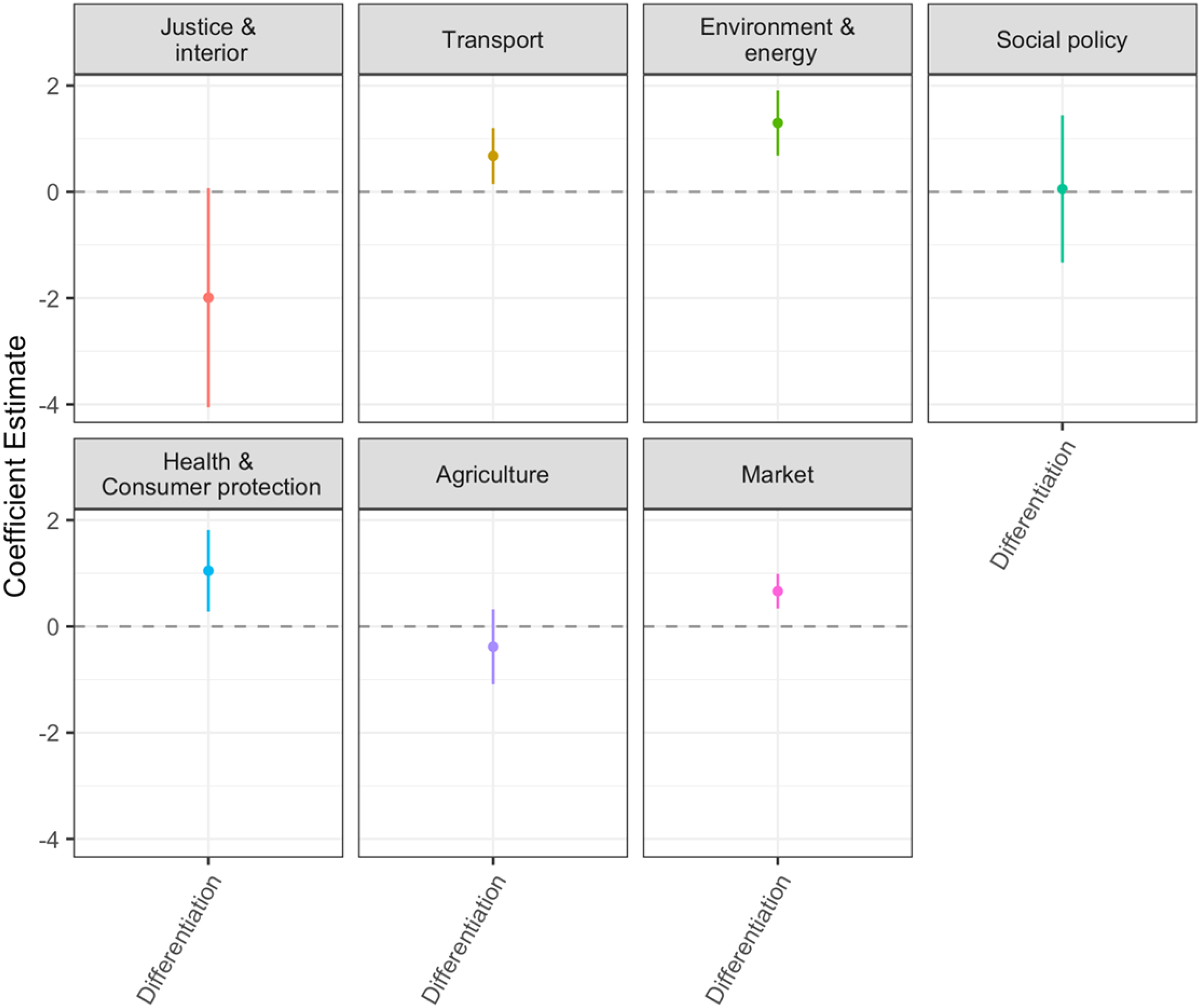
Coefficient plots for policy field models.
Discussion and conclusion
This article presents one of the first studies on the relation between differentiated integration and noncompliance. We conceptualize differentiation and noncompliance as two different strategies to cope with heterogeneity among member states. Both strategies aim at reducing the same sources of heterogeneity. Based on the similarity of the phenomena in aim and source, we assumed that differentiated integration and noncompliance are compensatory in their relationship: Differentiated integration should render member state’s noncompliance less likely. Testing this hypothesis on the relation between decision-making efficiency and implementation effectiveness is challenging, as legal acts with differentiation may contain a higher level of heterogeneity than legal acts without differentiation. In addition, differentiated integration and noncompliance are connected causally only indirectly by their shared causes.
Our analyses do not confirm our hypothesis that differentiation and noncompliance are negatively related. In fact, the opposite seems to be the case: Differentiated integration is associated with higher levels of noncompliance. We tested the effect of differentiation on noncompliance in different descriptive specifications: in a regression on the aggregate level, in a regression on the member state level and finally in a regression on the policy area level. Although the connection between differentiation and an increased probability of noncompliance is robust, it misses important heterogeneity, particularly on the policy-area level. Differentiation is associated more with noncompliance in regulatory policy areas where costs are shifted to the implementation level. Unlike complete opt-outs, temporary and partial differentiation only delays or mitigates the problem of member states being unwilling or unable to deal with adjustment costs.
There are at least three implications of our findings that deserve further investigation. First, if differentiation is to cope with heterogeneity among member states, differentiated legal acts should entail higher levels of heterogeneity. Differentiations in secondary law are rare. They might constitute extreme cases of heterogeneity. Even if legislative differentiation takes care of some of the heterogeneity, it may not be enough to reduce the risk of noncompliance, particularly if opt-outs are only partial or temporary.
Second, differentiation and noncompliance are two coping strategies addressing the same causes of heterogeneity among member states. Yet, they apply at different stages of EU policy-making. This is particularly relevant for regulatory policy, which forms the core of the acquis communautaire. (Re)distributive policy (e.g. agriculture and regional policy) requires direct public expenditures; member states need to deal with these costs at the stage of decision-making. Regulatory policy (market, competition, environment, and consumer protection), in contrast, shifts the costs to the implementation at the domestic level. The temporal decoupling of differentiation and noncompliance adds venue for national veto players to voice their preferences on the legal act.
Third, differentiation may be an effective instrument to reduce noncompliance by exempting member states that are likely to become non-compliers. However, member states only use full opt-outs at selective occasions (e.g. enlargement and far-reaching regulations). A systematic deployment would undermine the uniformity of integration and weaken the legitimacy of EU law by creating different classes of member-states. Some member states are more likely to ask and obtain opt-outs than others. Reserving differentiation to increase decision-making efficiency makes all the more sense as the EU has developed alternative mechanisms to foster implementation effectiveness (Checkel, 2001; Tallberg, 2002). Even tolerating noncompliance temporarily appears to be a more effective and legitimate way to cope with heterogeneity than exempting particular member states. Given the trade-offs and policy implications, differentiation, and noncompliance, after all, may not be two sides of the same coin. Differentiated integration is an instrument to escape deadlock rather than to avoid opposition through the backdoor.
Finally, we need to highlight some limitations of our study. Firstly, we compare differentiated acts and non-differentiated acts, which are most likely dissimilar. We cannot identify those cases of non-differentiated acts, for which member states would have liked to get an opt-out but did not obtain it. As argued theoretically, differentiated and non-differentiated acts are already subject to distinct pre-treatment. However, our analysis shows that being granted a differentiation does not lead to a convergence of the probability of compliance between differentiated and non-differentiated acts, as our coefficient is still positive and significant. Therefore, these acts do not become more similar due to differentiation. Another important limitation is that member states might anticipate their own incapability to comply with a directive during its negotiation, already asking for a differentiation. This is a serious concern because it could mean that differentiation would already be effective by reducing the compliance probability to a “normal” level. Yet, we show that differentiation alone does not reduce noncompliance. Due to the missing counterfactual—member states not obtaining a differentiation for a similar act under the same circumstances—we cannot rule out that differentiation might be effective in decreasing noncompliance in general. We need further research to address the question of causality.
Supplemental Material
sj-docx-1-eup-10.1177_14651165221130601 - Supplemental material for Two sides of the same coin? The effect of differentiation on noncompliance with European Union law
Supplemental material, sj-docx-1-eup-10.1177_14651165221130601 for Two sides of the same coin? The effect of differentiation on noncompliance with European Union law by Ronja Sczepanski and Tanja A Börzel in European Union Politics
Supplemental Material
sj-r-2-eup-10.1177_14651165221130601 - Supplemental material for Two sides of the same coin? The effect of differentiation on noncompliance with European Union law
Supplemental material, sj-r-2-eup-10.1177_14651165221130601 for Two sides of the same coin? The effect of differentiation on noncompliance with European Union law by Ronja Sczepanski and Tanja A Börzel in European Union Politics
Supplemental Material
sj-rdata-3-eup-10.1177_14651165221130601 - Supplemental material for Two sides of the same coin? The effect of differentiation on noncompliance with European Union law
Supplemental material, sj-rdata-3-eup-10.1177_14651165221130601 for Two sides of the same coin? The effect of differentiation on noncompliance with European Union law by Ronja Sczepanski and Tanja A Börzel in European Union Politics
Footnotes
Acknowledgements
The authors thank Stephan Lutzenberger, Massimo Troncone, and Yaron Weissberg for their work on the data collection. The authors also thank Markus Jachtenfuchs and Frank Schimmelfennig for their helpful comments on previous versions of the paper.
Funding
We acknowledge generous support for this article by the European Union's Horizon 2020 Research and Innovation Programme under Grant Agreements 822304.

Notes
Supplemental Material
Supplemental material for this article is available online.
References
Supplementary Material
Please find the following supplemental material available below.
For Open Access articles published under a Creative Commons License, all supplemental material carries the same license as the article it is associated with.
For non-Open Access articles published, all supplemental material carries a non-exclusive license, and permission requests for re-use of supplemental material or any part of supplemental material shall be sent directly to the copyright owner as specified in the copyright notice associated with the article.
