



Abstract
With nearly one-third of the UK’s total consumption of energy devoted to the domestic household sector, sustainable housing developments have an important part to play in reducing greenhouse gas emissions in order to combat climate change. This study analyses a sustainable housing development in the city of Nottingham in the United Kingdom that takes the form not merely of a sustainable housing project, but rather an experiment in developing sustainable communities. In terms of green or eco-innovation, it incorporates innovations in housing design geared to curbing the demand for energy; technological innovations in energy supply centred on a novel community energy system; and innovations in the governance models employed. The scheme is notable for the novel public–private partnership carrying out the development, which specializes in developments characterized by an emphasis on quality urban design and a strong commitment to environmental sustainability.
Keywords
Introduction
There is an urgent drive to promote environmentally sustainable urban communities to address climate change and other environmental and social issues. Two of the key elements in achieving sustainable communities are reducing domestic energy use, principally space 1 and water heating, which is a major source of greenhouse gas (GHG) emissions (DBEIS, 2016; Killip et al., 2018), and developing more sustainable approaches to personal mobility, which has the potential to reduce GHG emissions and to achieve other environmental and social goals such as improving local air quality, reducing associated health risks and increasing accessibility (Nykvist and Whitmarsh, 2006; van Wee and Handy, 2016). Studies agree that the potential for reducing GHG emissions from the domestic sector is great using currently available and near-market-ready technology, both in building design and in energy systems (Boardman et al., 2005; Johnston, 2003; Killip, 2013). Similarly, the application of new technologies in the transportation sector is capable of delivering significantly cleaner, quieter and more efficient vehicles and low carbon product service systems, such as car sharing and ‘smart’ city bike schemes (Cook, 2018; Nieuwenhuis et al., 2006; Nieuwenhuis, 2018).
Green innovations associated with both domestic energy consumption and personal mobility potentially have much to offer as part of the development of sustainable communities. Yet by failing to address environmental issues on new housing developments in a holistic way, planners and developers all too often repeat the pattern of the recent past. For example, they provide essential services on demand, rather than aiming to manage energy demand and energy supply in a coordinated manner. At the same time, the design and location of new urban settlements often facilitates private car use, and intentionally or unintentionally, dis-enfranchises non-car users.
Similarly, there is increasing recognition that while developments in automotive design can help in reducing GHG emissions, technology alone may well not be enough and that for genuinely sustainable mobility, more radical solutions affecting many aspects of society may be needed (Bohnsack et al, 2014; Nieuwenhuis et al., 2006; Sanne, 2002).
This study analyses a sustainable housing project being developed as part of a major urban regeneration programme in Nottingham, the waterside regeneration zone. Located beside the river Trent in a part of the city that featured in DH Lawrence’s semi-autobiographical novel ‘Sons and Lovers’ being described as ‘on the naked edge of the town’ (Lawrence, 1913 [1992]), the development is on a disused and run-down industrial site that symbolizes the city’s former role as an inland port. The Trent Basin project is a residential development of 500 homes comprising houses and apartments that will make a significant contribution to regenerating what has for many years been a run-down commercial area.
The project is led by a public–private partnership that has developed a strong reputation for combining high-quality design with sustainability. The project itself embraces a range of green technologies such as solar photovoltaic (PV) panels in the first phase, and the planned use in later phases of ground source heat pumps. A novel feature of the development is an energy storage system that incorporates an innovative community battery. The approach being taken to energy use is a holistic one that seeks to manage energy demand and energy supply on a coordinated basis. It achieves this by breaking new ground integrating energy efficient design and construction to manage demand, with a community energy system designed to promote community engagement in energy use.
The case study analyses the manner in which a number of different types of green innovation have been combined in order to effect behavioural change. These include not only innovations in design aimed at enhancing the sustainability of housing provision, but also technological innovations associated with energy storage and supply together with innovations in models of service delivery. Crucially, this case highlights the importance of innovations in governance (see Figure 1) if the potential of these largely technical and service model innovations is to be realized in pursuit of behavioural change consistent with enhanced environmental sustainability.
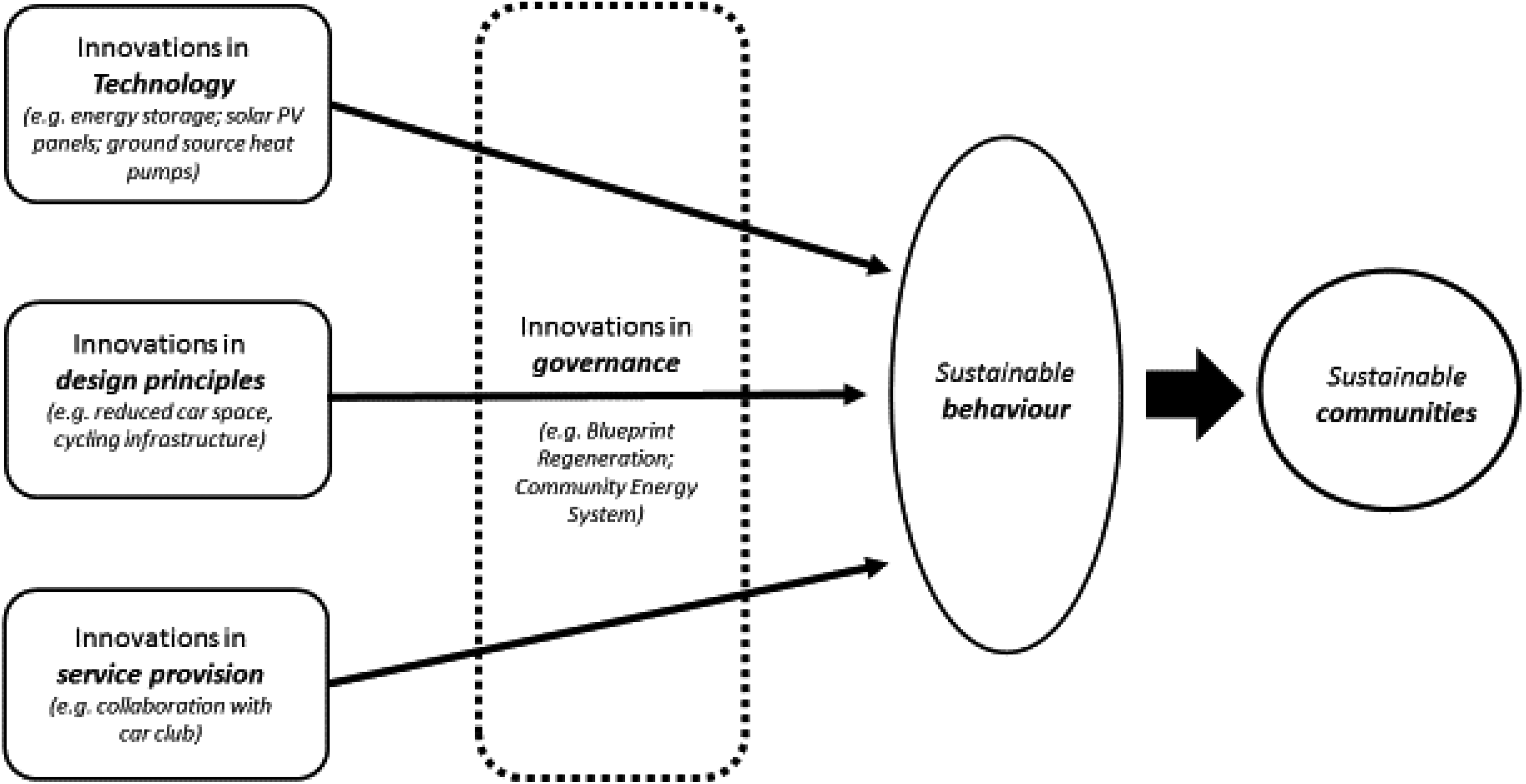
Types of green innovation utilized in the Trent Basin development.
Literature review
Several authors (Crabtree, 2005; Lovell, 2008; Seyfang, 2010) have pointed out that the concept of sustainable housing has its origins in the 1970s. Then, it emerged primarily as a response to the oil crisis and the corresponding threat to oil supplies that was a feature of that decade, though also influential and not to be underestimated was the impact of a small number of highly influential books. Chief among these were, Silent Spring (Carson, 1962), The Limits to Growth (Meadows et al., 1972) and Small is Beautiful (Schumacher, 1974) which for the first time began to question many of the dominant assumptions that had been a feature of the post-war era. Examples of early sustainable housing developments from this period include the Centre for Alternative Technology in Wales and the Findhorn Ecovillage in Scotland (Lovell, 2008). Latterly Seyfang (2010) notes how with the advent of concerns about climate change in the early 1990s, interest in the concept of sustainable communities was renewed.
Despite considerable enthusiasm for sustainable housing today, a number of researchers have observed that the concept is problematic. Winston (2009: 319) for example describes sustainable housing as, ‘lacking a shared vision’ and she goes on to point out that inadequate attention has been given to conceptualizing sustainable housing. This she attributes to a general neglect of the topic. Similarly, Priemus (2005: 5) describes sustainable housing as ‘badly defined’ not only in the academic literature but in policy documentation as well. In part, the problem is that too often the concept is used very loosely by academics and practitioners alike to include a broad range of characteristics ranging from environmental to social and economic.
Wide differences in the nature of sustainable housing developments led Barton and Kleiner (2000) to attempt to categorize such schemes by means of a typology of sustainable housing developments, which they termed ‘eco-neighbourhood’ schemes. They divided such projects into six types designated as: rural ecovillages, tele-villages, urban demonstration projects, urban eco-communities, ‘new urbanism’ developments and ecological townships.
Of these six categories, the one that most closely approximates to the Trent Basin development in Nottingham is ‘new urbanism’. New urbanism is a design principle for urban development that emerged in the United States in the 1980s (Trudeau and Kaplan, 2016), chiefly in response to post World War Two suburban sprawl (Trudeau, 2013) and the need to revitalize cities suffering the effects of deindustrialization (Brain, 2005). Advocates of new urbanism argued that many cities’ problems resulted from design mistakes made in the past. Echoing Jacobs’ (1961) critique of the sterile car-oriented landscapes created by much mid-20th-century architecture and urban renewal outlined in The Death and Life of Great American Cities, they highlighted problems that stemmed from urban development programmes of the 1950s and 1960s that attempted to make cities more amenable to the car (Rodriguez, 2014).
As a philosophy, new urbanism places great emphasis on design and represents a significant break from car-oriented landscapes (Trudeau, 2016). New urbanism developments typically comprise compact, high density, mixed-use designs located on brownfield sites, together with walkable pedestrian friendly streets, open spaces and public gathering spaces. These design attributes are intended to promote cohesiveness and a sense of community (Lund, 2003). Instead of car-oriented development, access to public transport (Ellis, 2002), termed transit-oriented design, has been a feature of many North American developments (Grant, 2005; Sharifi, 2016). Latterly, new urbanism has come to embrace environmental aspects of sustainability (Trudeau, 2013). Indeed post 2000 promoting environmental sustainability became a central feature of late new urbanism, to the point where it has been argued (Trudeau, 2013) that an interest in environmental sustainability has come to overshadow the social sustainability and cohesion concerns that originally inspired the movement.
New urbanism developments have not been without their critics (Trudeau, 2016), indeed Ellis (2002: 261) notes that, ‘over the past two decades, new urbanism has emerged as a controversial alternative to conventional patterns of urban development’. There are those who question whether it is possible to achieve either community cohesion or the regeneration of declining areas through design. Others have argued that new urbanism developments are pricey and favour middle-class residents (Rodriguez, 2014), while some challenge the environmental claims for compact development (Ellis, 2002; Ivanic and Grant, 2011).
Originating in North America, the concept of new urbanism has been taken up in a number of European countries. Grant (2005) identifies notable new urbanism developments in Europe as Karow Nord in Berlin, Borneo-Sporenburg in Amsterdam and Greenwich Millennium Village in London. The last of these reflected the endorsement of new urbanism by the New Labour administration of Tony Blair that came to power in 1997. Indeed the UK government made a significant commitment to the principles of new urbanism, following Deputy Prime Minister John Prescott’s visit to a number of new urbanism developments in the United States (Grant, 2005).
The Greenwich Millennium Village is a compact high-density development on a large former industrial site on the south bank of the River Thames. It comprises a mix of apartment buildings and townhouses accompanied by a network of streets, shared courtyards and community buildings together with landscaping and expansive views of the river. The development aims to create a community where the pedestrian has priority over the car (Foletta and Field, 2011). As part of a strategy to reduce car dependency, parking spaces are restricted and limited to 80% of the units. They are located away from individual properties. In line with the transit-oriented developments common to many new urbanism schemes in North America, Greenwich Millennium Village is well linked to the public transport network with frequent bus services and a new tube station, North Greenwich on the Jubilee Line, opened as part of the development (Foletta and Field, 2011).
Against this background, we present a case study of an eco-neighbourhood development which possesses many of the features of recent new urbanism developments. Hence, sustainability features characteristic of the Greenwich Millennium Village, such as a brownfield location, pedestrian-friendly streets and good access to public transport are present. However, the Trent Basin development is innovative in taking a holistic approach to energy use and supply through the provision of a community energy system based on battery storage. It is also innovative in terms of the manner in which the development in general and the community energy system in particular is being implemented.
Research methods
The basis of this article is a single case study of one eco-neighbourhood development. Following Leonard-Barton (1990), a ‘dual methodology’ was used to collect data for the case study covering archival materials and in-depth interviews. The latter took the form of a small number of key informant interviews (John and Reve, 1982) with practitioners who were or had been closely involved in the activities of the organization behind the development which forms the basis of the case study. As experienced practitioners in senior roles, the respondents were well qualified to provide data about the development and also to comment on industry trends and practices.
Data gathered in this way were augmented by a range of archival materials drawn from a variety of documentary sources. These ranged from published historical accounts of industrial and transport developments (Edwards, 1966; Foulds, 2006; Patterson, 2016), to individual cases studies (Dale et al., 2014; Foletta and Field, 2011), press reports (Ashe, 2017; Davies, 2016; Macalister, 2015), and reports and plans produced by local authorities, government departments and research institutes (Boardman et al., 2005; DBEIS, 2016; HM Treasury, 2007; Nottingham City Council, 2017). Evidence was also drawn from a number of previous studies and associated fieldwork, exploring aspects of Nottingham’s economy (e.g. Rossiter and Smith, 2017; Totterdill, 2000) and historical development (EMEPC, 1966; Wells, 1966).
Visits by the authors to the site of the Trent Basin development provided an opportunity for non-participant observation. Similarly, insights from one of the authors’ direct experience of working as a practitioner in one of the founding partners in the case study organization informed the interpretation of both documentary and interview data. 2 This direct experience of practice in economic development also informed our understanding of the regional and national policy context in which Blueprint was established and has operated since 2005.
Case study: The Trent Basin development
The developer: Blueprint Regeneration
The developer behind the Trent Basin development is Blueprint Regeneration, a public–private partnership involving an innovative form of governance. Established in 2005, the partners (see Table 1) initially comprised the East Midlands Development Agency (EMDA) and English Partnerships 3 (each of whom had a 25% stake), and the Igloo Regeneration Fund, which is itself a specialist fund managed by Aviva Investors, an asset management company that is part of the Aviva Group. Changes to the governance arrangements were to prove a feature of the new partnership. After just 3 years, English Partnerships’ stake was transferred, following the Review of Sub-National Economic Development and Regeneration (HMT, BERR and C&LG, 2007), to the Homes and Communities Agency (HCA). The Regional Development Agency (RDA) involvement gave Blueprint a strong regional focus, but this was lost when the incoming Coalition Government abolished the RDAs in 2011 and 2012. EMDA’s stake then passed to the HCA. In due course, the HCA elected to divest itself of its stake in Blueprint. This followed a 10-year review of its investments in Blueprint in 2014 when the agency opted to end its involvement in the partnership. At this point, the HCA’s stake in the partnership was acquired by Nottingham City Council (see Table 1).
Blueprint Regeneration: Changes in ownership structure.

EMDA: East Midlands Development Agency.
The Council was keen to diversify its income streams in the face of major cuts to income from central government introduced as part of the UK government’s austerity measures. Additionally, the Council sought to exercise its place leadership role (Sotarauta, 2015) by developing local regeneration and infrastructure projects that can contribute to the sustainable development and regeneration of the City. A good example of this is Nottingham’s successful and much used tram network, Nottingham Express Transit, which has contributed significantly to sustainability through reduced congestion and reduced NO x emissions, while also meeting regeneration goals by improving transport links to disadvantaged neighbourhoods. Hence, it is not unreasonable to see the City Council’s acquisition of a stake in Blueprint as the latest in a long line of acts of public entrepreneurship that have shaped the development of Nottingham over the long term (Rossiter and Smith, 2017). That Blueprint has proved able to weather the economic and policy turbulence of recent years, continuing to develop significant schemes with a strong emphasis on sustainability and regeneration is in no small part due to its Board’s agility in repositioning the organization as the policy and economic context has evolved.
Blueprint’s earlier projects included the Phoenix Square development in Leicester and a science park adjoining Nottingham University’s University Park Campus. The former is a mixed-use complex located in the city’s St George’s Cultural Quarter that combines contemporary living spaces with an independent arts cinema, media workshops and café. It utilizes ground source heat pumps. The latter in contrast is a 4.9 ha development that features various energy efficient innovations including solar PV panels and biomass boilers.
One of Blueprint’s more recent projects was the Green Street housing development located in the Meadows area of Nottingham not far from the Trent Basin. This was an £8 million development on the site of a former school, comprising 38 low-energy eco-houses. Among a number of energy-saving innovations, these utilized super-high levels of insulation, whole house heat recovery and industry leading standards of air tightness. With a proportion of their energy requirements met from roof-mounted solar PV panels, they aimed to make the maximum use of natural light while minimizing the use of energy. Completed in 2012, they proved popular with buyers selling entirely off plan. The Green Street development built on Blueprint’s core values of design quality and sustainability while also contributing to urban regeneration through the re-vitalization of a disadvantaged neighbourhood.
The location: The Trent Lane Depot
The location of the Trent Basin development is both unusual and symbolic. Located on the River Trent, historically the river traffic known as ‘the Hull Trade’ (Patterson, 2016) had played an important role in the development of Nottingham’s economy since medieval times (Foulds, 2006). This was evident in the 1920s when Nottingham Corporation in an ambitious attempt to develop trade with the North Sea ports, invested large sums of public money (£450,000 over 4 years from 1922) on major public works projects to improve the navigability of the river. These made the river accessible to large barges with a capacity of up to 200 tons carrying mainly coal, petroleum, local gravel and similar bulk loads (EMEPC, 1966), thereby enhancing the city’s role as an inland port. The final phase of this process came with the construction of the Trent Lane Depot by Nottingham Corporation in the 1930s (see Figure 2). This comprised an inland dock or basin, together with transit sheds for short period storage (Edwards, 1966) and two large, purpose-built warehouses (Patterson, 2016). During the 1950s and 1960s, in excess of a million tonnes of freight were transported annually on the river through Nottingham, with large barges moving bulk cargos such as grain, coal and oil a common sight. However, improvements to the road network and the changing nature of rail-freight in the 1960s saw the river trade decline dramatically in the 1970s. British Waterways closed the Trent Lane Depot in the late 1980s. The disused and derelict facility came to symbolize the changes in the local economy of the city resulting from rapid deindustrialization and the loss of large numbers of manufacturing-related jobs in the last decade of the 20th century (Rossiter and Smith, 2017).
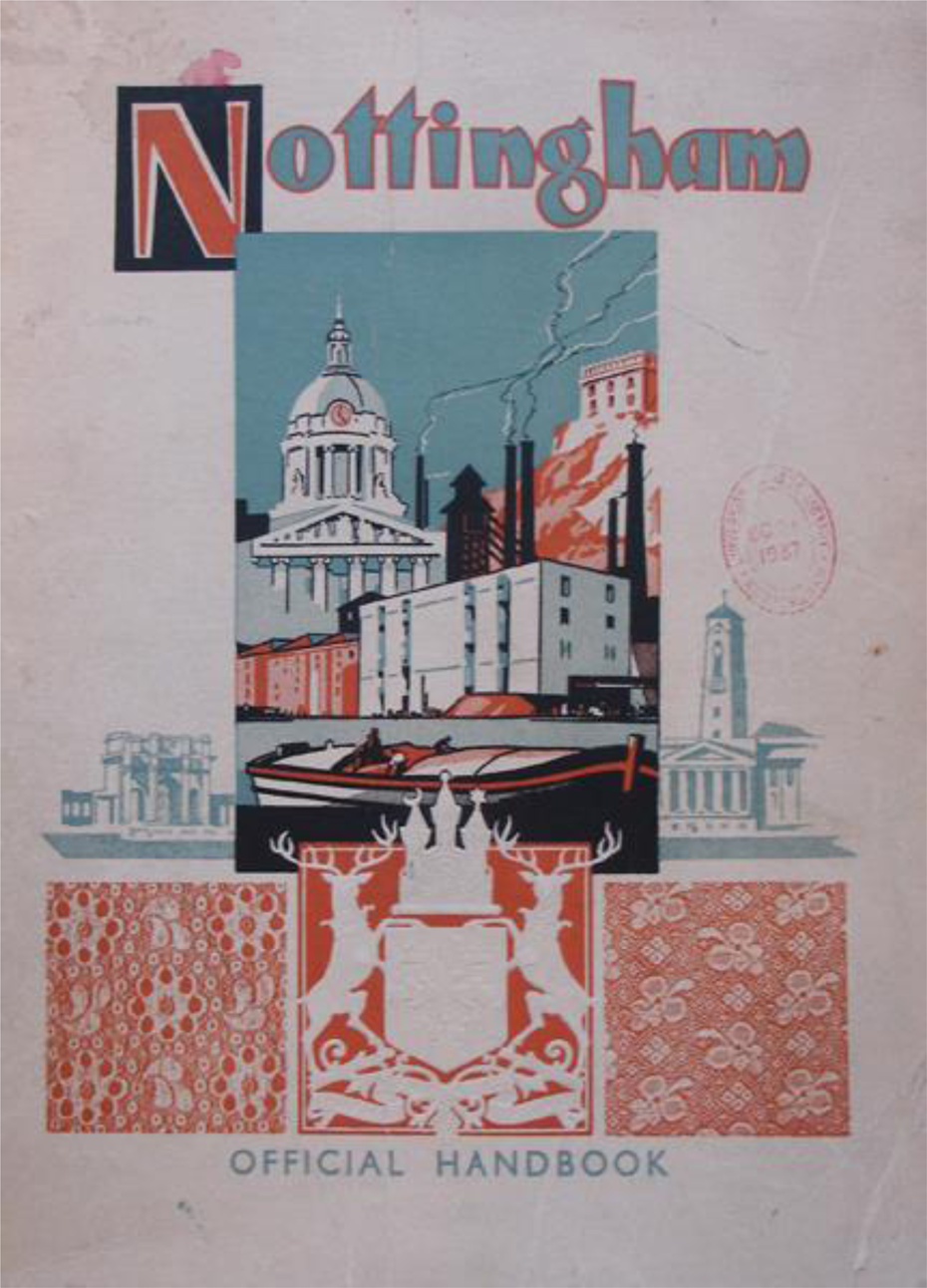
Nottingham corporation handbook 1937 with the Trent Depot in the centre. Source: Nottinghamshire County Archive.
The Trent Basin development
The Trent Basin development is a £100 million project (Ashe, 2017) located in the waterside regeneration zone, one of three major regeneration areas in the city that aim to link deprived inner city communities back to the prosperous city centre (Heath, 2010). The waterside regeneration zone also aims to reunite the city with the river. The development itself is central to the city council’s £250 million regeneration programme for this area. Located on the north bank of the River Trent on the site of the former Trent Lane Depot, Trent Basin has a long frontage both to the river itself and to the dock that was once part of the inland harbour complex (see Figures 3 and 4).

Proposed Trent Basin Development. Source: Blueprint Regeneration.
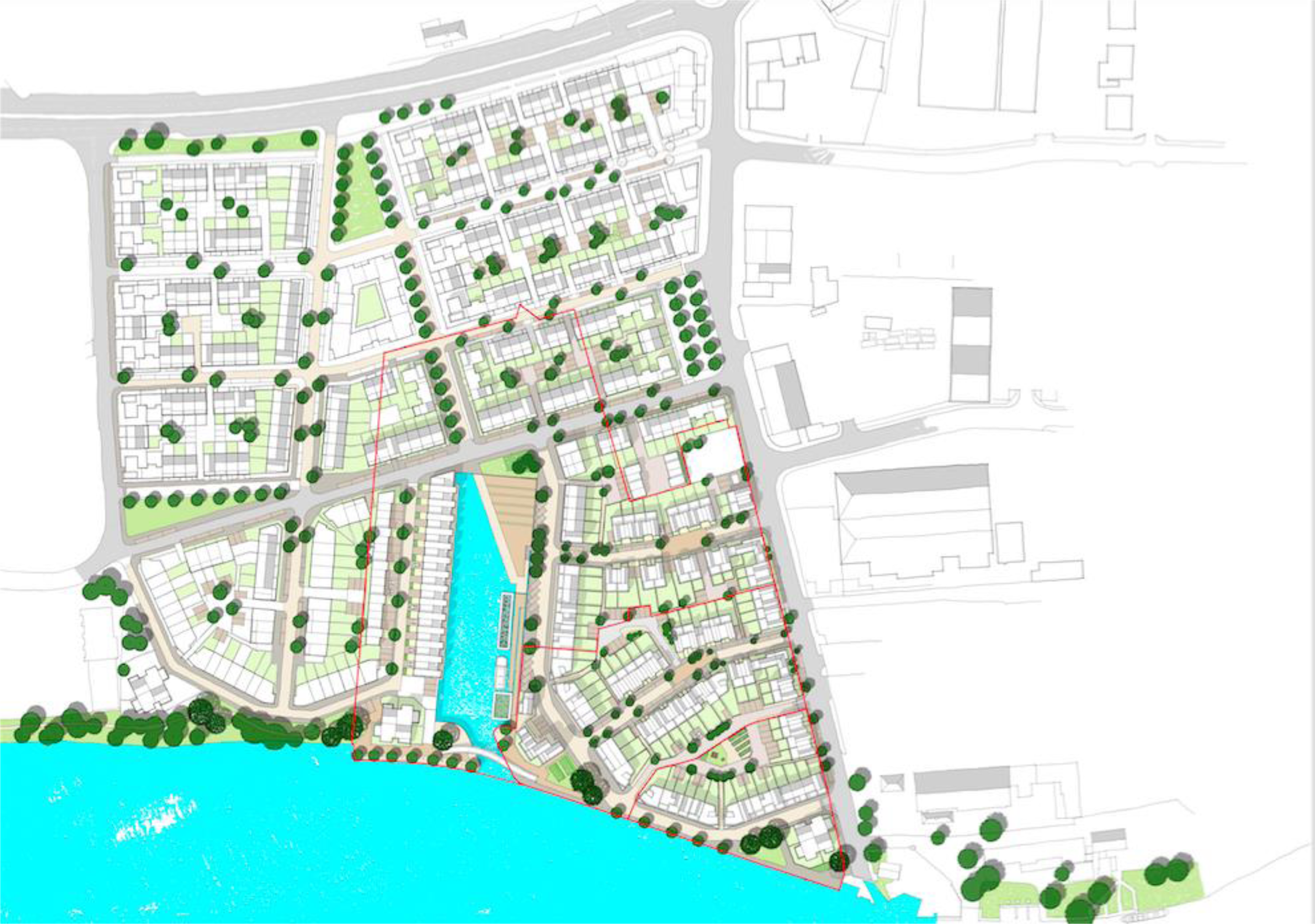
Master plan of Trent Basin development. Source: Blueprint Regeneration.
The site covers 3.64 ha and development is scheduled to take place in five phases over a number of years. Phase one was completed early in 2017 with phase two due to begin early in 2018. The development will eventually comprise some 500 homes including a mix of houses and apartments. The Blueprint vision for Trent Basin is of a sustainable neighbourhood. Properties are generally tall and thin three-storey designs, drawing inspiration from Dutch canal houses. Houses feature large terraces and small gardens resulting in a relatively small footprint, compared to the conventional homes offered by commercial developers. This results in a compact layout and a relatively high density for the development overall, in line with the ideas of new urbanism. The houses front pedestrian-friendly streets, which prioritize people over cars, together with open spaces providing views over the inland dock, the river and parkland beyond.
Consistent with the social objectives of new urbanism stressing social sustainability and a sense of community, the developers have sought to promote community cohesion in a variety of ways. The recently completed phase one development includes a community space designated as the ‘community hub’ for use by the 42 households now resident on site. This fully furnished facility includes a kitchen and a meeting room equipped with extensive audio–visual facilities including a floor to ceiling height video wall display. The community hub is designed to provide a space where residents can meet and socialize. It is envisaged that the facility will be used for social/community activities including yoga classes and potentially a film club. In addition, the developers have taken active steps to facilitate the creation of a residents group for phase one of the development. These moves mirror similar steps taken to foster the engagement of residents in the governance of the community energy system.
In terms of energy efficiency, the aim is for the fabric of homes and apartments to minimize energy use for space heating and power. Each home at Trent Basin is designed to meet the 2016 Fabric Energy Efficiency Standard 4 for space heating of 39 kWh/m2/year for apartments and mid terraces and 46 kWh/m2/year for end terraces. A mix of double- and triple-glazed windows and doors are used in order to minimize thermal bridging and these combined with high levels of insulation make individual units energy efficient. Thermal modelling was integral to the design process and has informed both the choice of construction materials utilized and the siting of triple-glazing units within the development. The decision was taken not to attempt to achieve the Passivhaus 5 standard, because the cost of reaching this standard was hard to justify and could have priced many first-time buyers out of the development and hence been incompatible with new urbanism objectives relating to fostering economic and social diversity. Furthermore, Blueprint had encountered problems with mechanical ventilation systems on previous projects. Low energy lighting is employed throughout and class ‘A’ energy efficient appliances are specified. Overall, the fabric of the buildings at Trent Basin perform 20–30% better than the Building Regulations currently stipulate, and are claimed to reduce carbon emissions by some 15%. 6
The development concept is that once the demand for energy is reduced through designing energy efficient buildings and promoting behavioural change, the next logical step is to meet the demand with energy supplied in the most sustainable fashion possible – including that from on-site microgeneration.
Sustainable mobility
Providing access to alternatives to the car is seen by the developers as crucial in achieving a modal shift to forms of sustainable mobility. From a design/planning perspective, it means, as a member of the development team pointed out, that it is possible to avoid, ‘sacrificing too much land to the car’, which can have, ‘a big impact on the built environment enabling high-density development’.
In order to deter car use, especially the use of a second car, properties are limited to just a single parking space. As well as deterring car use this also provides more space for a pedestrian-friendly layout. Thus, to encourage walking and resident interaction, open spaces and walkways are a feature of the development. These modest steps towards sustainable mobility have been supplemented through the actions of a network of local actors. Nottingham City Council, one of the partners that owns the developer Blueprint, has revamped the Sneinton Greenway, a well-laid-out and well-used footpath established some years ago utilizing a disused railway track, and now providing Trent Basin residents with pedestrian access to the city centre. Passing close to the Trent Basin site, the Sneinton Greenway facilitates a walking time into the city centre of less than 30 min. Currently, the city council has plans for another footpath that will benefit Trent Basin residents. This is the proposed Riverside Walk that will provide an 8–10 m wide walkway, running through the development and linking Colwick Park to Trent Bridge. This will enable Trent Basin residents to walk to Trent Bridge and a range of local leisure facilities, including a number of the City’s major sporting venues, in as little as 10 min.
The Trent Basin development is also well served when it comes to other forms of sustainable mobility, in particular cycling and public transport. Chief among these is the new Eco Expressway (Nottingham City Council, 2017). Developed by Nottingham City Council with the aid of a £6.1 million grant from the D2N2 Local Enterprise Partnership, this passes close to the Trent Basin site, and is designed to promote sustainable travel along an east–west corridor in and out of the city. It comprises a purpose-built cycle way and a bus lane. The latter is a high capacity, high frequency bus corridor for use by ultra-low-emission vehicles. It is served by Nottingham City Transport 7 using its new fleet of 58 fully electric buses built by the Chinese manufacturer BVD, and funded through the Department of Transport’s Green Bus scheme and Nottingham City Council’s workplace parking levy. 8 Termed the ‘Ecolink’ service, the electric buses run from Colwick Park on the eastern fringe of the city through to the city centre. With buses every 15–20 minutes and bus stops close to the Trent Basin site, the city centre is a 15 minute bus ride away. The recent introduction of the Eco Expressway gives electric buses and cycles a priority route to the city centre.
Finally, as part of efforts to deter car use, especially second cars, the developers have actively engaged with the Enterprise Car Club based in the city. This provides members with access to hourly vehicle rental on a self-service basis. Cars can be reserved on line or by phone. There are currently vehicle stations in the city centre where car club vehicles are located, and plans are being prepared to provide a dedicated vehicle station at the Trent Basin site. Trent Basin residents have free membership of the car club for the first year and preferential hourly/daily rates giving convenient access to a car for both short and long journeys.
Community energy
Arguably, the signature characteristic of the Trent Basin project since its inception has been the adoption of a holistic approach to energy use and supply, rather than simply seeking energy efficiency in pursuit of reducing carbon emissions. As part of efforts to bring about behaviour change, Blueprint is seeking to encourage residents to interface with energy in a different way. Hitherto the interface between energy users and suppliers has been limited, with little choice for users given highly centralized energy provision. While recent market reforms have promoted greater choice of suppliers, the manner in which consumers interact with suppliers has typically gone no further than playing-off different suppliers in order to secure the ‘best deal’. 9 In contrast, green innovation in the form of a community energy system offers the potential to create a radically different relationship between residents and their energy suppliers, one that in many respects offers a return to something akin to the localized municipal provision that existed in Britain in the late 19th century.
Recent advances in technology mean that the provision of a community energy system at Trent Basin is a feasible proposition. This led the developers to consider a community energy system with local storage capacity in the form of a very large community battery. Coupled with on-site power generation, this could potentially reduce dependence on the National Grid and enable residents to store the energy that their homes had generated making it available as and when required.
Such an ambitious and innovative scheme raised the problem of how it could be funded. This was solved when Innovate UK, drawing on two related energy research programmes, agreed to meet the cost of setting up a community energy system. Utilizing funding from the Energy Research Accelerator and Sustainable Community Energy Network, this aspect of the development is being delivered by a consortium, including Blueprint, the University of Nottingham, A T Kearney, Smartklub, URBED, Slam Jam, Sticky World, Loughborough University, Solar Ready and Nottingham City Council (Ashe, 2017). The system includes storage capacity provided by a very large 2-MWh capacity (roughly equivalent to the amount of electricity used by 660 homes in 1 h) lithium–ion battery (Ashe, 2017) similar to but much larger than that used on electric vehicles like the TESLA Model S and the Nissan Leaf. A community energy system at Trent Basin offered scope for the research consortium to evaluate the feasibility of such systems.
The developers rejected the idea of an autonomous community energy system with private wire distribution as the sole energy source for Trent Basin residents on the grounds that it would leave them with a lack of choice, something felt to be undesirable given the scheme was dependent on technologies that were not as yet fully commercially proven. Other eco-neighbourhood schemes that have sought to embrace community energy, such as the Beddington Zero Energy Development (BedZED) in South London, came to a similar conclusion (Chance, 2009). A key factor is that on small sites, generating all the energy required on site may not be the best option for local residents, as it leaves them with little flexibility in their choice of energy supplier.
The community energy system, which is currently being developed and will be available for later phases of the Trent Basin scheme, will include both battery storage capacity and connection to the National Grid. This arrangement will be mutually beneficial. Not only will Trent Basin residents have a choice as to whether or not they join the community energy system, it also aids early stage development of the project. At the same connection to the National Grid will contribute to the commercial viability of the community energy system, through the potential to benefit from revenue streams derived from transactions with the National Grid. Significantly, for the economics of the community energy system, the National Grid is prepared to pay a premium price for energy that it uses when demand peaks or supply falls. Hence, the commercial viability of the community energy system is much enhanced by being able to sell energy to the National Grid at a premium price and buy energy from the National Grid to top up the battery when demand is low and energy prices are low.
At the same time, access to battery storage in the community energy system will provide the National Grid with badly needed flexibility and resilience. The increasing scale of wind and solar energy in recent years, solar power was the fastest growing source of new energy worldwide in 2016 (Vaughan, 2017), combined with their intermittent nature at the local level, has made their integration into the National Grid critical. Faced with the problem of intermittency 10 given greater use of renewable energy, battery storage can provide the National Grid with badly needed flexibility. At present, most countries rely on large pumped-storage facilities to provide backup power (Roberts and Sandberg, 2011). In Britain, the best example of such a facility is First Hydro’s Dinorwig pumped storage station at Llanberis in North Wales, which is used by the National Grid to balance energy demand and supply. Though much smaller, batteries operate in a very similar manner 11 and have the added advantage that additional energy can be made available at very short notice. Thus, the National Grid can draw on the additional capacity provided by battery storage when there is a rapid surge in the demand for electricity for example when large numbers are watching a major sporting event (Macalister, 2015) or, given the increased proportion of our energy demand that is coming from renewables, when the weather isn’t breezy enough to power wind farms (Davies, 2016).
Critical to the successful implementation of the community energy system, and possibly the most significant innovation, is likely to be the governance model employed. This is an issue currently being evaluated by the research consortium, 12 with different governance models for the community energy system under consideration. These range from community ownership where the community owns, operates and manages the facility, to a mixed model where the facility is provided by investors, operated by an energy service company (ESCO) but controlled and managed by the community.
With the latter model, those who opt to join the community energy system will be directly involved in its management, thereby allaying any concerns that they may have about entering into a long-term energy supply agreement with a single supplier. Though operated by an ESCO, any surplus it generates, having paid a return to the investors, together with operating charges, would be available for distribution in an appropriate form to members of the scheme. The exact basis for re-distributing surpluses under this kind of model has yet to be finalized, but it would not reflect energy used, since there is a danger that this could create a perverse incentive that would undermine attempts to promote behavioural change in relation to energy consumption.
Discussion and conclusion
Alongside the Greenwich Millennium Village or BedZED, Blueprint’s Trent Basin development demonstrates a new approach to urban design that embraces both social and environmental sustainability, while generating a financial return for both private and public sector investors. The provision of a compact, pedestrian-friendly design complemented by community facilities on a brownfield site, aligns well with social sustainability and resilience goals.
Similarly, the green technological innovations employed, especially those currently being developed for energy supply and storage demonstrate a commitment to environmental sustainability goals. Community energy systems are not new, having been used on a number of sustainable housing developments in the past, but they have previously been found mainly in remote, off-gas locations (Hanley and Nevin, 1999; Rogers et al., 2008; Rogers et al., 2012; Walker and Cass, 2007). The Trent Basin community energy system in contrast is unusual in that it is found in an urban location, and it is in the planned provision of a facility for energy storage that the community energy system really breaks new ground.
The Trent Basin development also introduces innovations in service provision, through the provision of facilities for sustainable mobility, made available through collaboration with third-party organizations.
Integrating different types of innovation is one of the key features of the Trent Basin development. In many respects, Blueprint’s role is analogous to that of a ‘systems integrator’, bringing together disparate forms of green innovation and getting them to work together for the benefit of residents, stakeholders and the environment. However, the potential of this integration to promote a more sustainable form of urban living will only be fully realized if they are combined with innovations in govern-ance (see Figure 1).
Having established the community energy system, the developers face a number of significant challenges. Firstly, residents have to be persuaded to fully engage with the community energy system, a task made all the more challenging by the legacy of centralized energy supply systems in the United Kingdom which have hitherto encouraged passivity on the part of consumers in terms of their involvement in energy supply. Secondly, residents’ concern about the pitfalls of making a long-term commitment to a single energy supplier must be allayed. Finally, residents need to be convinced that any surpluses arising from the community energy system will be distributed on an equitable basis.
These challenges will require further innovation in the sphere of governance as applied to the management of the community energy system. A governance model for the scheme is required that can balance social equity against the need to ensure the economic viability of a community energy system, only then is there the prospect of behaviour change that fully supports the project’s sustainability goals.
At this stage, it would be premature to judge whether or not the Trent Basin development has been a success in terms of the innovations it has introduced, although it has generated much interest locally. If success is to be judged by the market performance of the development, it is noteworthy that properties in phase one (see Figure 5) have sold well and units on the site have proved attractive to younger buyers. More than one-third of the 45 properties in this phase have been sold to first-time buyers, indicating their appeal to young people interested in and passionate about leading a ‘greener’ lifestyle and attracted by the energy efficient credentials of the development. As a result of this experience, the developer is optimistic that later phases of the scheme will be successful when judged against economic, social and environmental yardsticks.
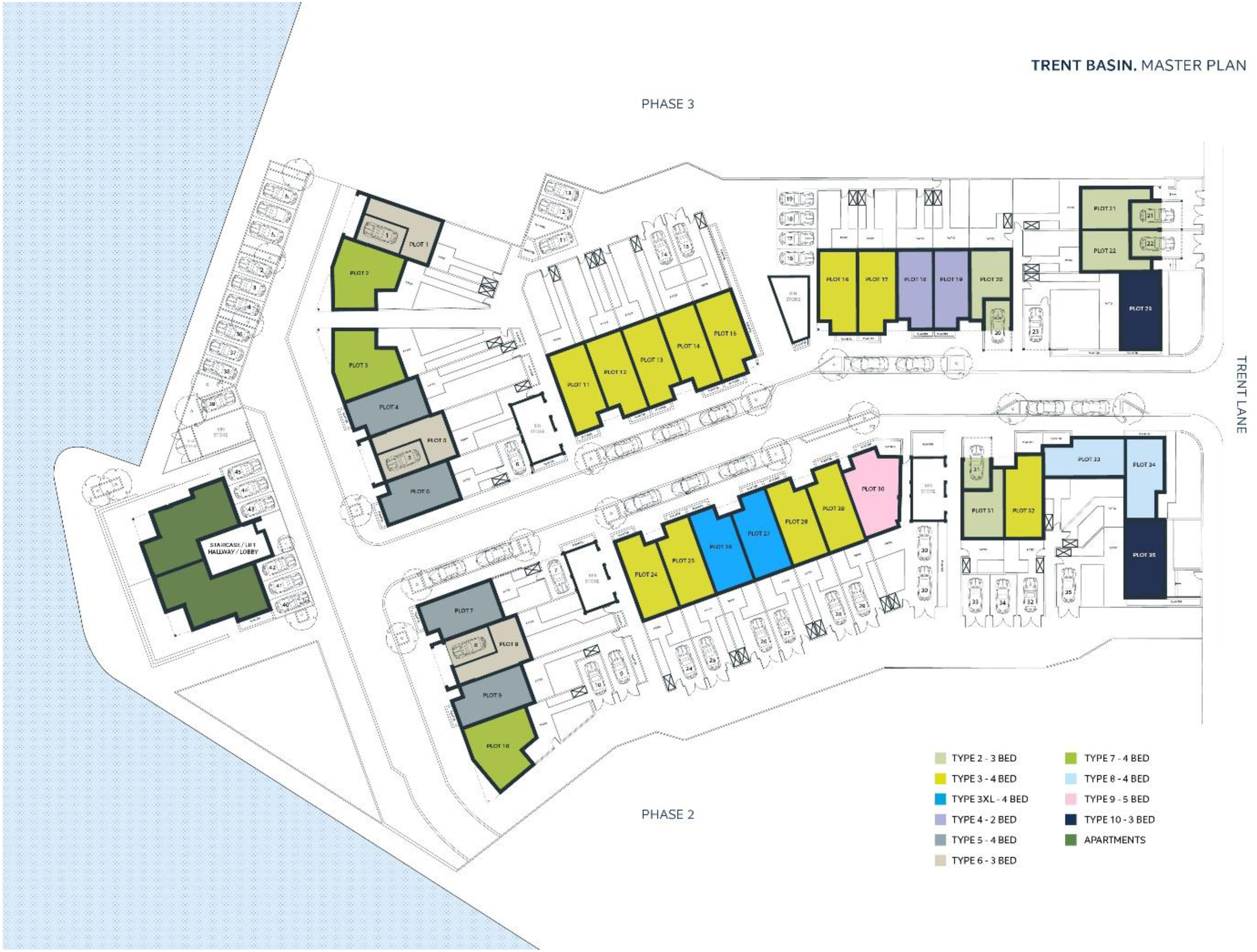
Plan of phase one of the Trent Basin development. Source: Blueprint Regeneration.
Footnotes
Acknowledgement
The authors would like to thank the Economic and Social Science Research Council (ESRC) for funding the research upon which this article is based through a series of research seminars on the theme of: ‘Green innovation: making it work’. This article originated as a presentation about the Trent Basin development given by a member of Blueprint Regeneration’s staff at one of the ESRC sponsored green innovation research seminars. The authors would like to thank the individual concerned for this important contribution, along with other members of Blueprint Regeneration’s staff who contributed to the development of this article. Professor Richard Blundel also provided valuable assistance and guidance.
Declaration of conflicting interests
The author(s) declared no potential conflicts of interest with respect to the research, authorship, and/or publication of this article.
Funding
The author(s) disclosed receipt of the following financial support for the research, authorship, and/or publication of this article: This work was supported by the Economic and Social Science Research Council (ESRC) (grant no. ES/M002292/1) upon which this article is based through a series of research seminars on the theme of: ‘Green innovation: making it work’.
