



Abstract
Entrepreneurial ecosystems (EEs), the set of forces that generate and sustain regional entrepreneurial activity, are a growing focus of scholars and practitioners. Studies are beginning to draw attention to the role of cultural artifacts, including narratives, in the functioning of EEs. However, the mechanisms driving narratives’ effects on ecosystem participants are unexamined. The purpose of this article is to develop theory that explains the influence of EE narratives on how information is processed by audiences. It is theorized that differences among ecosystems can, in part, be explained by differences in the properties of the narratives that take hold in them. Specifically, propositions are developed about four properties that represent sources of variation among ecosystem narratives: their ability to capture attention, influence the cognitive and emotional encoding of information, and be memorable. Further, it is argued that the maturity of the EE influences the novelty and potency of narrative effects. By integrating theories of cognitive and social psychology, narrative theory, and entrepreneurship, this article advances our understanding of how narratives about EEs influence audiences.
Keywords
Introduction
The linkages between entrepreneurial activity—the creation, recognition, and pursuit of innovative opportunities to generate value—and regional economic development are receiving growing interest from academics and policymakers (Acs et al., 2016; Audretsch et al., 2006; Baumol and Strom, 2007; Farja et al., 2017). Productive forms of entrepreneurship are lauded for driving innovation and technological advancement (Acs and Audretsch, 2003), increasing employment (Malchow-Møller et al., 2011), enacting societal change (Rindova et al., 2009), and stimulating economic growth (Abubakar and Mitra, 2013). Acknowledging the social and cultural embeddedness of these activities, researchers examining the intersection of entrepreneurship and economic development are shifting their focus away from studies of individual entrepreneurs to the creation and functioning of entrepreneurial ecosystems (EEs): the sets of actors, institutions, social networks, and cultural values that produce and sustain regional entrepreneurial activity (e.g. Acs et al., 2017; Auerswald, 2015; Berger and Kuckertz, 2016; Brown and Mason, 2017; Hechavarria and Ingram, 2014; McKague et al., 2017; Roundy et al., 2018; Spigel, 2017b). Established EEs, such as Tel Aviv, Singapore, Austin, and Bangalore, as well as emerging ecosystems, such as Chattanooga, USA, and Birmingham, UK, are the subject of intense scholarly and media attention (e.g. Brown, 2015; Clifford, 2013; Motoyama et al., 2016; Spigel, 2017a).
Studies of EEs tend to focus on identifying the core attributes of mature and thriving ecosystems rather than analyzing nascent, underdeveloped, or struggling ecosystems (e.g. Neck et al., 2004; cf. Roundy, 2017b; Saxenian, 1990 for an exception). The lack of comparative studies in ecosystems research leaves critical questions unanswered. Most notably, it is not clear why some EEs are perceived as being hotbeds of entrepreneurial activity and experience the economic and community benefits generated by this “buzz” (Bathelt et al., 2004), while others languish, remain in obscurity, or suffer declines. Structural variations between regions, such as differences in their population sizes, customers, and infrastructure, partly explain differences in entrepreneurial activity and economic development (Glaeser and Kerr, 2009). But there are other, less tangible, factors that also influence the vitality of regional economic systems.
In the 2017 Presidential Address of the American Economic Association, Nobel Laureate Robert Shiller drew attention to what he termed “narrative economics” and to the possibility that economic conditions, and particularly fluctuations in macroeconomic systems, are caused not only by the economic behaviors that have dominated past scholars’ attention but also by “the prevalence and vividness of certain stories” (Shiller, 2017: 3). Shiller called attention to “the spread and dynamics of popular narratives, the stories, particularly those of human interest and emotion, and how these change through time, to understand economic fluctuations” (p. 3). He argued that narratives can create a social epidemic (or contagion) of ideas that can be a source, not simply a reflection, of economic conditions and demonstrated how analyzing popular narratives can shed light on major economic events, such as the Great Recession of 2007–2009.
There is sparse, but growing, theorizing and evidence that narratives play an important role in other forms of economic activity including the emergence, growth, and functioning of EEs (Feldman et al., 2005; Roundy, 2016; Spigel, 2017b). For instance, Roundy (in press) studied three emerging EEs in the United States (Warren, Ohio, Youngstown, Ohio, and Chattanooga, Tennessee) and found that, for an EE to develop, “a narrative must take hold that allows participants to make sense of the new entrepreneurial activities and the changes to the region.” In Youngstown, for example, for decades the city was plagued by a “Rust Belt” narrative focused on past economic events (e.g. deindustrialization and plant closures). In the past 5 years, however, new narratives have emerged about the city and its budding EE and focus on the successes of local entrepreneurs, incubators, and entrepreneurial initiatives and on the city’s increasingly vibrant entrepreneurship community. Yet there is limited theory to explain narratives’ role in EEs and the specific cognitive and emotional mechanisms by which EE narratives influence audiences. Without a comprehensive framework detailing the mechanisms driving narratives’ impact, differences in the persuasiveness of EE narratives cannot be explained.
To address these omissions in EE research, this article integrates insights from cognitive psychology, narrative theory, and theories of information processing and attitude change to explain how EE narratives influence audiences (i.e. hearers of ecosystem narratives). We argue that differences in EEs can, in part, be explained by differences in properties of the narratives that are communicated and take hold in ecosystems. We develop propositions about how narratives shape the way that ecosystem information is processed through four mechanisms: narratives’ abilities to capture attention, influence the cognitive encoding and emotional encoding of information, and be memorable.
By drawing attention to the narratives of EEs, we contribute to the study of entrepreneurship by building on the rich literature examining narratives in other disciplines to explain how EE narratives shape the cognitive and emotional processes of audiences. By focusing on individual-level information processing, the theory generates insights into the micro-foundations of EEs and suggests that an important source of variation among ecosystems is differences in their narratives.
The remainder of the article is structured as follows. In the next section, research on EEs, narratives, and information processing is reviewed. Extended emphasis is given to the intersection of these literatures and the key omissions that the proposed theory addresses. The theoretical model is then presented. Finally, the implications of the model for scholars and practitioners and the directions for future research are discussed.
Literature review
Entrepreneurial ecosystems
To understand the spillover benefits of entrepreneurship, scholars are shifting their attention from individual- and venture-level activities to the study of EEs, the communities of interconnected forces that produce and sustain entrepreneurial activity (Mack and Mayer, 2016; Spilling, 1996; Stam, 2015). The focus of most work on EEs is the identification of their core components, such as large pools of early-stage investment capital (Mason, 2009), incubators, accelerators, and other support organizations (Roundy, 2017a), and dense networks of entrepreneurs (Motoyama and Knowlton, 2017). More recent studies examine how these components interact to influence the vitality of EEs (Motoyama and Knowlton, 2017) and how EEs evolve over time (Mack and Mayer, 2016).
Research focuses primarily on the physical production and manifestations of EEs, embodied in material artifacts such as technological and urban infrastructure, rather than on intangible cultural artifacts (cf. Spigel, 2013 for an exception). As a result, research and practitioner works are increasingly calling attention to the importance of cultural resources in EEs (e.g. Feld, 2012; Roundy, 2017a; Spigel, 2017b); however, the mechanisms through which such resources influence and are spread among ecosystem participants remain unexamined.
Narratives and EEs
Scholars are starting to examine a specific type of cultural resource, the shared narratives of EE participants (e.g. stories of recent entrepreneurship successes or from a region’s entrepreneurial history), and to evaluate the importance of the values, goals, and beliefs narratives communicate (Roundy, in press). For instance, Feld (2012) suggests that it is the “[s]tories of successful local entrepreneurs who found start-ups that [go] on to become large, global market leaders” that can “inspire younger entrepreneurs to undertake similar journeys” (Spigel, 2017b: 52). This statement suggests that one function narratives perform in EEs is spurring future entrepreneurial activity.
Roundy (2016) developed a typology of the types of narratives communicated in EEs, including success stories (e.g. high-profile exits such as IPOs), historical accounts (e.g. activities of the early entrepreneurs in an ecosystem), and future-oriented narratives (e.g. describing an EE’s economic trajectory). Roundy (2016) theorized that these narratives serve several ecosystem functions including transmitting culture, aiding sensemaking, constructing the ecosystem’s identity, legitimating the system, garnering attention for it, and charting the ecosystem’s future.
As the reviewed studies illustrate, research implicitly draws attention to two types of ecosystem narratives: “micro-narratives” focused on the stories of specific agents in an ecosystem (e.g. the success of an entrepreneur) and “macro-narratives” focused on stories about the ecosystem itself. However, beyond identifying that these narratives exist, research has not examined how they influence audiences or the mechanisms underlying their effects. Before theorizing about these mechanisms, it is necessary to provide a clear definition of “narrative.”
What is a narrative?
Informally, a narrative is “a simple story or easily expressed explanation of events that many people want to bring up in conversation […] because it can be used to stimulate the concerns or emotions of others, and/or because it appears to advance self-interest” (Shiller, 2017: 2). Narratives are also described as “major vectors of rapid change in culture, in zeitgeist, and ultimately in economic behavior” (p. 8) and as “human constructs that are mixtures of fact and emotion and human interest and other extraneous detail[s] that form an impression on the human mind” (p. 9). Although these descriptions of narratives shed light on intuitive understandings of the concept, for the purposes of concrete theorizing, it is necessary to introduce a more rigorous definition and one that does not include reference to “stories” (thus creating a tautology).
According to narrative theory (cf. Herman et al., 2010; Onega and Landa, 1995; Ricoeur, 1980), a narrative is defined based on both its structure and function. Structurally, a narrative is a form of communication comprised of a collection of events, actions, and experiences arranged in a temporal sequence and containing a causal explanation, or plot (Onega and Landa, 1995). Communication containing both characteristics—temporality and plot—is a “narrative” and is contrasted with nonnarrative communication (e.g. lists, technical arguments), which is missing one or both of the two co-occurring elements of narratives (Browning, 1992). In addition to structural definitions, narratives can also be defined based on their function, that is, how they are used in communication. From this perspective, a narrative is conceptualized as a communication tool used to shape one’s own understanding (i.e. sensemaking) or influence others’ understanding (i.e. sensegiving) of events or experiences (e.g. Brown, 1998). Since one of the primary aims of this article is to theorize about the specific structural properties and mechanisms that underlie the influence of narratives in EEs, the structuralist conceptualization of narratives, which focuses on differences in narratives associated with their temporality and plot structures, is emphasized. In the sections that follow, insights from cognitive psychology and theories of information processing and attitude change are used to develop a model that addresses the lack of attention in EE research to explaining how narratives influence audiences.
Theory development
Narratives develop about the entrepreneurial activities of cities and regions (e.g. Roundy, 2016). For instance, “success stories” are communicated that focus on an EE’s positive economic outcomes, like high-profile entrepreneurial exits (e.g. entrepreneurs within an ecosystem whose ventures are acquired for large sums) and entrepreneurs securing significant resources (e.g. closing rounds of investment from well-known venture capital funds). Narratives also draw attention to ventures with particularly innovative or disruptive technologies or that gained impressive traction in the marketplace. These narratives can be backward-looking, encapsulating entrepreneurial episodes from the history of a region, or forward-looking, communicating EE members’ visions of the future of the ecosystem. What is not clear from prior work, however, is how exactly EE narratives take hold in the minds of audiences. In the next sections, propositions are developed about the specific mechanisms through which narratives influence information processing.
A generalized model of information processing
As a form of communication, narratives are comprised of and convey information. Thus, to understand their influence it is necessary to examine how narratives shape the way information is processed. Studies of information processing, in business and other contexts, find that people, groups, and organizations process information in stages (cf. Ellis, 2006; Oppenheimer and Kelso, 2015; Souza and Oberauer, 2016). For example, in the context of strategic decision-making, Corner et al. (1994) argue that information is processed in three stages, consisting of attention, encoding, and storage/retrieval. Lord (1985) argues for a complementary, but more fine-grained, set of stages including attention, encoding, storage, retrieval, and judgment. Similarly, Ellis (2006) contends that the key stages are encoding, storage, and retrieval and that these general stages are applicable across individual and organizational levels. Although models of information processing differ in the number of stages they identify and in the labels assigned to them, virtually all models can be said to contain four, generalized stages: attention, cognitive encoding, emotional encoding, and memory (e.g. Bless and Greifeneder, 2017; Lachman et al., 2015; Walsh and Ungson, 1991).
Attention involves focusing on certain pieces of information and is generally treated as the first stage of information processing because information must capture attention before it can be processed and infused with meaning (Corner et al., 1994). After information is attended to it can be encoded. During encoding, which occurs cognitively and emotionally, information is interpreted, given meaning, and understood (Corner et al., 1994). The infusion of meaning that occurs during encoding is also conceptualized as sensemaking (Weick, 1995). Some information that is encoded becomes permanently preserved and is available through memory for later use (Corner et al., 1994).
Over the past several decades, theoretical and empirical research in attitude formation and persuasion has generated and refined various information processing models, since McGuire identified the fundamental cognitive processes involved with attitude formation and change (McGuire, 1968). Dual-process models like the elaboration likelihood model (Petty and Cacioppo, 1986) and the heuristic-systematic model (Chaiken et al., 1989) give central attention to the effort and ability that individuals devote to information processing. The unimodel (Kruglanski and Thompson, 1999), a single-process model, also predicts attitude formation and change as a function of ability and motivation, among other variables, as does Albarracin’s stage model (Albarracin, 2002). An overarching theme of these models is that individuals can be influenced by message contents. Influence and attitude change are significant because attitudes and associated beliefs have been shown to predict behavioral intentions and subsequent behaviors (Ajzen, 1991; Glasman and Albarracín, 2006). We draw upon these models and associated empirical findings in our discussion of narrative effects in the next section. Table 1 summarizes the theoretical model and describes the mechanisms through which we propose EE narratives impact audiences.
The influence of EE narratives on information processing.
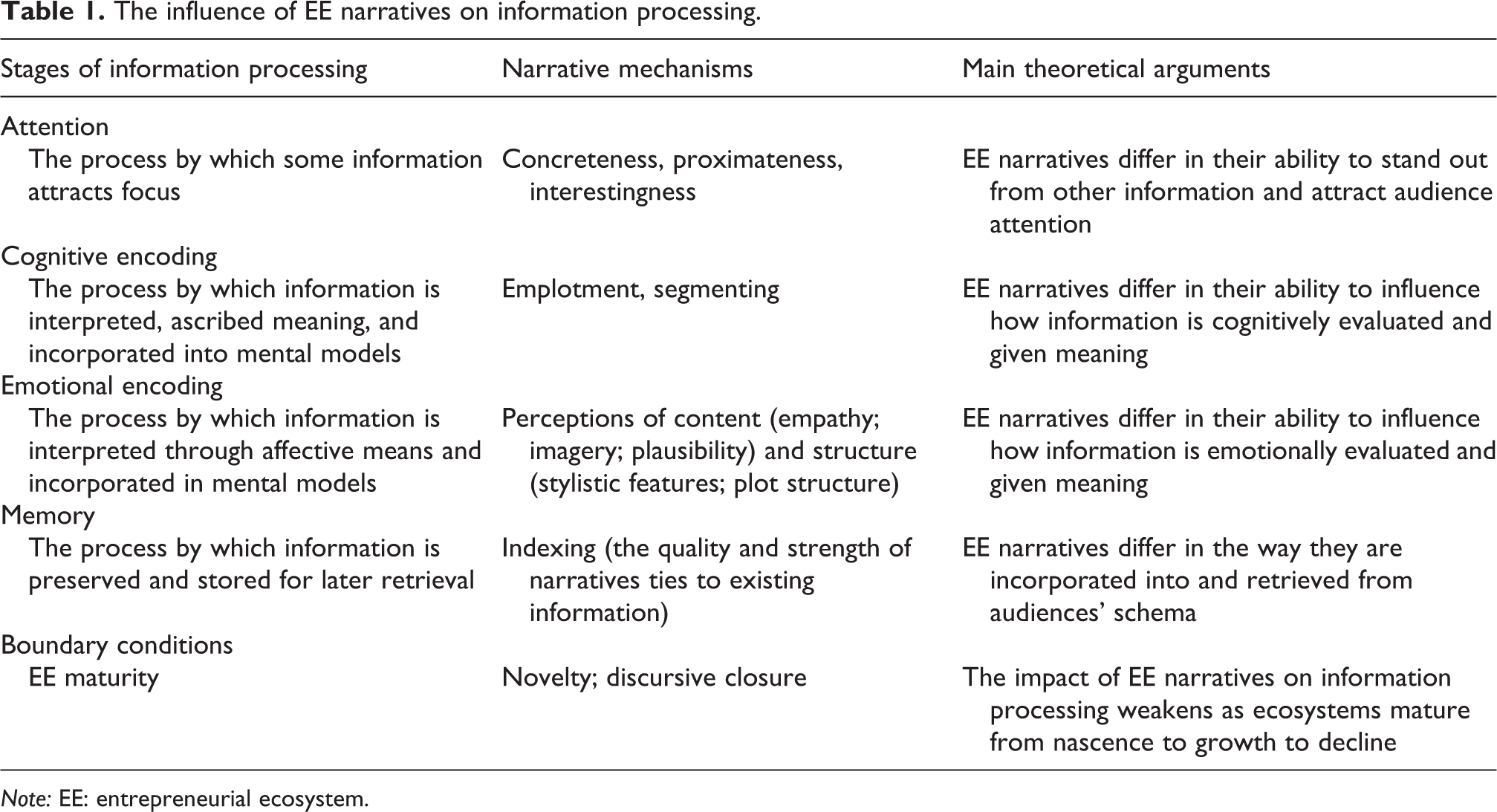
Note: EE: entrepreneurial ecosystem.
Narratives and information processing in EEs
In this section, theory is developed to explain the influence of EE narratives on four stages of information processing: attention, cognitive and emotional encoding, and memory.
Attention
A source of variation in EE narratives, and among narrative and nonnarrative forms of communication more generally, is the extent to which narratives attract and hold audience attention. In forming an impression about an EE (e.g. whether it is a munificent environment to found a business), audiences often face an overwhelming amount of data and must sift through an avalanche of multivocal, and even conflicting, communications (Edmunds and Morris, 2000; Kuvaas, 2002). Because of individuals’ bounded cognitive capacity to attend to and filter large amounts of information (e.g. Simon, 1982), the extent to which an EE narrative can “stand out” from the cacophony of other streams of communication and capture attention is key. Individuals engage in a filtering process whereby some narratives (and thus some information) is noticed and then considered further while other narratives remain outside the focus of attention (e.g. Finkelstein et al., 2008). For example, a region’s entrepreneurs are not able to devote attention to all of the economic narratives about a city. Their perceptions about, for instance, where to create a new business (in their current ecosystem or another location) are shaped by the narratives that capture their attention. Thus, for an EE narrative to have impact, it must be able to attract and hold hearers’ attention (McGuire, 1968).
The ability to capture attention is a function of several characteristics that are sources of variance among EE narratives and influence the attention they receive. First, EE narratives differ in their concreteness, which is the extent to which the information in a narrative is experienced directly by the senses (Paivio et al., 1968; Sadoski, 2001). Concreteness is itself a function of another narrative characteristic: imageability, or the ease with which mental images can be created about a narrative’s information content. Depending on their content, narratives can be highly imageable and have high image-arousing capacity (Sadoski, 2001). Imageability makes some narratives more likely to be perceived as concrete than others and makes narratives more concrete than nonnarrative forms of communication (Baesler and Burgoon, 1994). For example, a narrative about an EE that promotes the ecosystem as a “hotbed of entrepreneurial activity” or as “the place to found a business” is more likely to grab attention if it also features specific success stories of local entrepreneurs with concrete details about their achievements—information that can be readily imagined by audiences.
An EE narrative’s ability to capture attention also increases if it has another characteristic, proximateness, which is the extent that a narrative is perceived as close to, or “near,” an audience in a “sensory, temporal, or spatial way” (Nisbett and Ross, 1980). For example, an EE narrative may be perceived as more proximate to a local audience’s circumstances if it features entrepreneurs who were born and raised in the community rather than “transplants” from other geographic locations. Local audiences will be more likely to identify with such narratives because the backgrounds and experiences of the characters are proximate to their own experiences. Related research on persuasion and social identification has shown that when messages come from “ingroup” members, as compared to “outgroup” members, recipients pay closer attention and devote more effort to information processing (Wilder, 1990). EE narratives that are concrete and proximate will be more accessible to audiences than narratives without such characteristics. The easier it is for audiences to access the information in a narrative, the more likely the information will be attended to and the subject of further processing (Kazoleas, 1993; Kruglanski et al., 2007).
Third, EE narratives will differ in their ability to present content in a manner that is interesting. Interestingness is associated with high cognitive activation and engagement and makes it more likely that narrative content will be granted further attention (Hidi and Baird, 1986; Schank and Abelson, 1995). Related research in attitude formation shows that when message recipients are surprised by unexpected or novel arguments, they devote more effort and attention to careful information processing (Maheswaran and Chaiken, 1991). Some narratives are more interesting than others because they introduce novel information and/or defamiliarize existing information (Oatley, 2002). For example, in regions that have suffered extended economic decline, new narratives highlighting the entrepreneurial activities of the region are likely to be perceived as interesting and to capture attention because of their novelty (however, in this case, audiences will also likely assess their congruence with reality). If such narratives are rich in details, and particularly image-evoking details, this further increases their capability to arouse interest (Hidi and Baird, 1986).
Taken together, differences in the concreteness, proximateness, and interestingness of an EE narrative will cause some narratives to be more likely to receive attention than others. Since a narrative must first attract attention for a person to be directly influenced by it (McGuire, 1968), and since there may be multiple narratives competing for an audience’s attention, this suggests that for a person to be influenced by an EE narrative it must capture her or his attention.
The cognitive and emotional encoding of narratives
If EE participants grant attention to a narrative, then the information can be more fully processed. Cognitive and emotional encoding are dual activities that occur simultaneously during information processing (Mar et al., 2011). Each form of encoding is examined in turn.
Cognitive encoding
After granting an EE narrative attention, audiences engage in an analysis process through which the narrative is interpreted, ascribed meaning, and encoded into a hearer’s mental model about an ecosystem (e.g. Albarracin, 2002; Ellis, 2006; Weick, 1995). EE narratives differ in their ability to influence the encoding process through multiple mechanisms. First, there are differences in how much narratives create connections between audiences’ experiences and allow hearers to infer meaning from these connections. In this way, EE narratives differ in their effectiveness as sensemaking tools that allow audiences to understand their experiences.
EE narratives have a potent influence on cognition because during encoding they connect experiences by imbuing them with an overarching plot, a process referred to as emplotment (Pentland, 1999). Plots integrate loosely coupled and complex bundles of events into causally coherent wholes (Polkinghorne, 1988). The themes that plots provide are valuable because one purpose of information processing is to integrate new information with existing information and create an overarching structure (Weick, 1995); doing so makes the new information understandable in relation to what has already happened. For example, as EE participants process information, EE narratives can help them make sense of what is happening in their region and understand how seemingly unrelated events, such as venture foundings across a range of industries or community investments in particular technologies, are related to overarching efforts to increase entrepreneurial activities and to strengthen the region’s entrepreneurial community.
Second, in addition to connecting events to form a unified theme, EE narratives also facilitate the encoding of information through segmenting—or partitioning—events and experiences (Black and Bower, 1979; Wigren, 1994). Effective narratives are able to segment streams of experiences and events into units that form a discrete and bounded whole (Herman, 2003). Narratives “selectively distill a complex jumble of otherwise ambiguous and contradictory activities, pronouncements, and impressions into a simplified and relatively coherent portrait” (Ashforth and Humphrey, 1997: 53). Thus, narratives aid encoding by making it clear what experiences need to be made sense of and, conversely, what can be discarded. As an example, in the history of an EE and the region in which it is located, there are countless economic and entrepreneurial events and actions; however, an EE narrative describing, for instance, how the ecosystem emerged, will privilege a subset of events and discard others, thereby creating a coherent, but simplified, account.
Differences in the ease with which EE narratives can connect and segment experiences will shape narratives’ impact on EE participants because it is not sufficient for a person to be merely exposed to a narrative (i.e. for the narrative to attract attention), a person also must be able to process the narrative in a way that shapes cognition and is available for future use. A central tenet of persuasion and attitude change research, supported by empirical findings, is that when messages can be simplified and made sense of, recipients are enabled to devote careful effort to interpreting and assessing the contents of the message, instead of relying upon heuristics, non-message-related cues, and shortcuts that may leave them vulnerable to biased assessments (Chaiken et al., 1989; Kruglanski et al., 2007; Kruglanski and Thompson, 1999; Petty and Cacioppo, 1986; Petty et al., 1997). This suggests that for a person to be influenced by an EE narrative it must be cognitively encoded.
Emotion-based encoding
The processing of EE narratives and the potential impact they have on ecosystem participants is not purely cognitive (Coplan, 2004). Narratives also influence emotions, which are intense but relatively short-lived, affective reactions elicited by a particular target or cause (Barsade and Gibson, 2007). Much research in social psychology has demonstrated that affect can be conceptualized as a component underlying individuals’ attitudes, distinct from cognitive and behavioral intention components, and exerting independent influence on attitude formation and change (for a review of this literature, see Petty et al., 2003). Further, persuasion research has shown that emotional appeals tend to be most effective in altering attitudes with a primarily affective basis, while persuasive appeals based on cognitive arguments tend to work best at influencing attitudes based mainly in cognition (Fabrigar and Petty, 1999). In short, emotion matters for persuasion, attitudes, and attitude change (Forgas, 2008).
Emotion is one of the primary means through which narratives impact the processing of information (Miall and Kuiken, 2002). EE narratives differ in their ability to elicit emotional responses because of differences in their properties, such as their imagery, characters, intent, and diction. One way to organize these properties is the distinction between emotional responses tied to audiences’ perceptions of the content of an EE narrative and emotional responses resulting from perceptions of a narrative’s structure (Kneepkens and Zwaan, 1995). Both types of perceptions influence the processing of narrative information.
First, differences in EE narrative content—that is, what happens in the “world” of the narrative—spur varying levels of emotional responses. Characters are typically the most emotionally salient aspect of narrative content and can be individuals, groups, organizations, or any other entity that takes a primary and agentic role (Dijkstra et al., 1995). In EE narratives, the featured “characters” are, often, local entrepreneurs. Audiences have a direct emotional reaction to the qualities of the characters or to the actions and events in which they are engaged (Schneider, 2004). For example, a narrative describing how entrepreneurs managed to overcome dire circumstances, such as a natural disaster, to rebuild a city through entrepreneurial activities is likely to generate an emotional response in hearers (cf. Storr et al., 2015).
Audiences’ emotional response to the content in EE narratives depends on their perceptions of several narrative qualities (Dijkstra et al., 1995). As alluded to in the previous example, emotional reactions are more likely if an EE narrative causes audiences to empathize with the characters in the narrative and the situations they face (Schneider, 2004). Empathy results from vicarious responses to the perceived emotional experiences and contexts of the characters (Eisenberg and Strayer, 1987).
Empathetic responses are dependent on another characteristic of narrative content, its imagery (Goetz et al., 1993). Empathy is a function of a hearer’s ability to mentally represent what takes place in a narrative, such as what happens to its characters and in the situations they face. For instance, a narrative describing a city that is desperate for revitalization but that still struggles to adapt to the modern economy, resulting in high levels of urban decay and crime, is likely to produce empathy in audiences (and, particularly, in audiences with familiar circumstances). The more audiences can form mental images of narrative content, the more likely they will respond to a narrative’s characters, their situations, and the outcomes, which influences their empathy.
Finally, an EE narrative’s ability to convey plausibility also influences its likelihood of producing an emotional response in hearers (Hall, 2003). Plausibility is the extent to which a narrative agrees with the preexisting beliefs held by an audience about what is reasonable and accurate (Canter et al., 2003). A plausible narrative is one that “rings true” (Connelly and Clandinin, 1990) and seems possible. In contrast, a narrative lacking plausible content is more difficult to empathize with and imagine (Dijkstra et al., 1995). Thus, implausible narratives are less likely to engender emotional responses. For example, an EE narrative based on the assertion that a small, geographically-isolated town is “the next Silicon Valley,” is unlikely to be perceived as plausible; in fact, such narratives may generate a negative emotional reaction as audiences perceive them as absurd or even insulting.
In addition to an EE narrative’s content, stakeholders can also respond emotionally to perceptions of its structural components. Variations in structure are associated with how the narrative is constructed linguistically and fall into two categories: stylistic features and plot structure (Tan, 1995). The stylistic characteristics of a narrative are referred to as “foregrounding” (Miall and Kuiken, 1994) and exist at the phonetic, grammatical, and semantic levels (Miall and Kuiken, 1999). Variation in the literary devices used in a narrative, such as deviations in language use, metaphors, repetition, and syntax, influences audiences’ emotional responses (Dijkstra et al., 1995). One mechanism underlying the relationship between emotion and stylistic features is defamiliarization, which is produced from novelty in the stylistic components of a narrative, such as unusual syntax (Miall and Kuiken, 1994).
The plot structure and arrangement of an EE narrative influences its ability to create an emotional response in stakeholders. More specifically, structural affect theory (Brewer and Lichtenstein, 1982) suggests there are patterns in the structure of narratives that relate to distinct emotional processes. For instance, if an event leading to significant consequences (good or bad) for a character is presented early in a narrative, and if the consequences are not immediately presented, then this creates suspense (Brewer and Lichtenstein, 1982). An example is an EE narrative in which it is unclear if a city attempting to reinvent itself or pull itself out of economic decline will be successful in its efforts. Other variations in the temporal presentation of the events in an EE narrative evoke different emotions, such as curiosity or uncertainty. Together, differences in the emotionality of EE narratives, attributable to differences in the perceptions of narrative content and structure, influence the emotional processing of narratives.
The memorability of narrative information
After EE narratives are subjected to cognitive and emotional encoding, the information contained in them can be stored in memory (e.g. Black and Bern, 1981). However, narratives differ in their memorability because of differences in the way they are incorporated into hearers’ schema, or recurrent patterns of thought (cf. Bartlett, 1932), which include evaluative attitudes related to features of the narrative. A recurring theme in attitude and persuasion research has been examining the moderating role of attitude strength in attitude-behavior consistency, and one of the prime determinants of attitude strength is attitude accessibility, that is, the ability to recall attitudes from memory (Petty and Krosnick, 2014). The consistent finding in this research stream is that as attitudes become more accessible, they become more valid predictors of behavioral intentions and subsequent behaviors (for a review, see Fazio, 1995). This research strongly suggests that narrative memorability will have an impact on individuals’ attitudes (and subsequent behaviors).
The incorporation of narratives into memory occurs during indexing—a process in which information is attached to, or bundled with, elements of an individual’s existing schema (Fiske and Linville, 1980). Some narratives are more index-able than others because of the abundance of ties (or “links”) to the existing elements of an audience’s schema. Narratives with many potential ties allow the information they contain to be indexed to more elements in schema, which results in the information being more salient, and more deeply embedded, in memory. In addition to the number of potential ties, the strength of ties from narratives to schema can also influence memorability (De Wit et al., 2008). Specifically, some narratives result in a more detailed representation in memory (such narratives are said to leave a strong “memory trace”; De Wit et al., 2008). For instance, narratives that conjure a strong emotional response in encoding are also, typically, more memorable. Similar empirical results have been obtained in attitude strength research, where increased affective experience with an attitude object produced higher accessibility (Fazio, 1995; Fazio and Powell, 1992). The strength of a narrative’s ties to existing schema increases the chance that it will be recalled from memory. 1
In sum, the quantity and strength of EE narratives’ ties to existing schema, along with the ease and frequency by which narratives are recalled, influences the memorability of EE narratives and, in turn, the accessibility of associated attitudes (Ajzen, 1991). This suggests:
EE maturity and the effects of narratives
In the previous section, it is theorized that EE narratives influence the information processing of audiences; however, it cannot be assumed that the strength of this influence is the same in all settings. Identifying the boundary conditions of the proposed relationships can add important nuance to the theory of how ecosystem narratives affect audiences. A specific contextual difference that will play a potent role in the influence of EE narratives is the maturity of the EE. Studies of the emergence of EEs find that they develop from birth to maturity (Auerswald and Dani, 2017; Roundy et al., 2017). Specifically, over the course of their life cycles, EEs progress from nascence (when firm births start to be greater than firm deaths) to growth (when the components of the EE become more specialized and targeted toward entrepreneurship) to eventual decline (when firm deaths are significantly greater than births) (Mack and Mayer, 2016).
In the nascent (birth) stage of EEs, narratives’ influence on the information processing of audiences is the strongest, for several reasons. First, at the earliest stage in the life cycle of an EE, there is a limited number of narratives circulating about the ecosystem because entrepreneurial successes are limited (Mack and Mayer, 2016). The entrepreneurial events and activities that do occur are new and relatively rare and their novelty causes them to have a disproportionate influence on audiences’ information processing.
As an EE matures, however, the frequency of entrepreneurial activities increases (Mack and Mayer, 2016). One result is that there are more narratives about entrepreneurship in the EE, at the micro- and macro-levels, which compete with one another for attention. Each additional narrative is likely to be perceived as less interesting, unique, and novel and, thus, will be less likely to capture attention and shape cognition and emotion.
In addition to reductions in novelty, another related force associated with the maturity of an EE that limits the impact of EE narratives on information processing is “discursive closure”—when a dominant narrative emerges and “closes out” other narratives (Leonardi and Jackson, 2004). For example, in the 1980s a narrative took hold in Silicon Valley, California, describing the region as one of the most vibrant entrepreneurship communities in the world (cf. Kenney, 2000). This narrative is now the dominant narrative of the region, which limits the power of competing narratives and reduces the novelty—and potency—of new entrepreneurial narratives. For instance, a narrative of a technology firm going public in Silicon Valley is unlikely to attract significant attention or maintain the interest of audiences that have already internalized the dominant narrative about the ecosystem. An ecosystem like Silicon Valley has reached a point of diminishing marginal influence of narratives—each successive EE narrative has a minimal impact on the information processing of audiences.
Finally, if an EE reaches the decline stage, where the number of firm deaths greatly outpaces firm births (Mack and Mayer, 2016), the lack of entrepreneurial activity may reach a point where the EE narratives are replaced by other dominant narratives of the region. This is what occurred in the EEs in the US “Rust Belt.” From the late 19th to the mid-20th centuries, cities in the region were manufacturing and entrepreneurial powerhouses; but by the end of the 20th century, many cities became known more for their struggling economies, lack of new businesses, and increasing unemployment (High, 2003). Narratives about entrepreneurial successes became rare and if they were communicated they were unlikely to influence residents who had internalized the new narratives and had become cynical about the possibility that the EEs could produce entrepreneurial success. Thus, in regions where there is no longer a vibrant EE, narratives about the EE lose their influence. Taken together, these arguments suggest:
Figure 1 summarizes the theoretical model and illustrates the mechanisms through which EE narratives influence the information processing of audiences and the boundary condition of these effects.
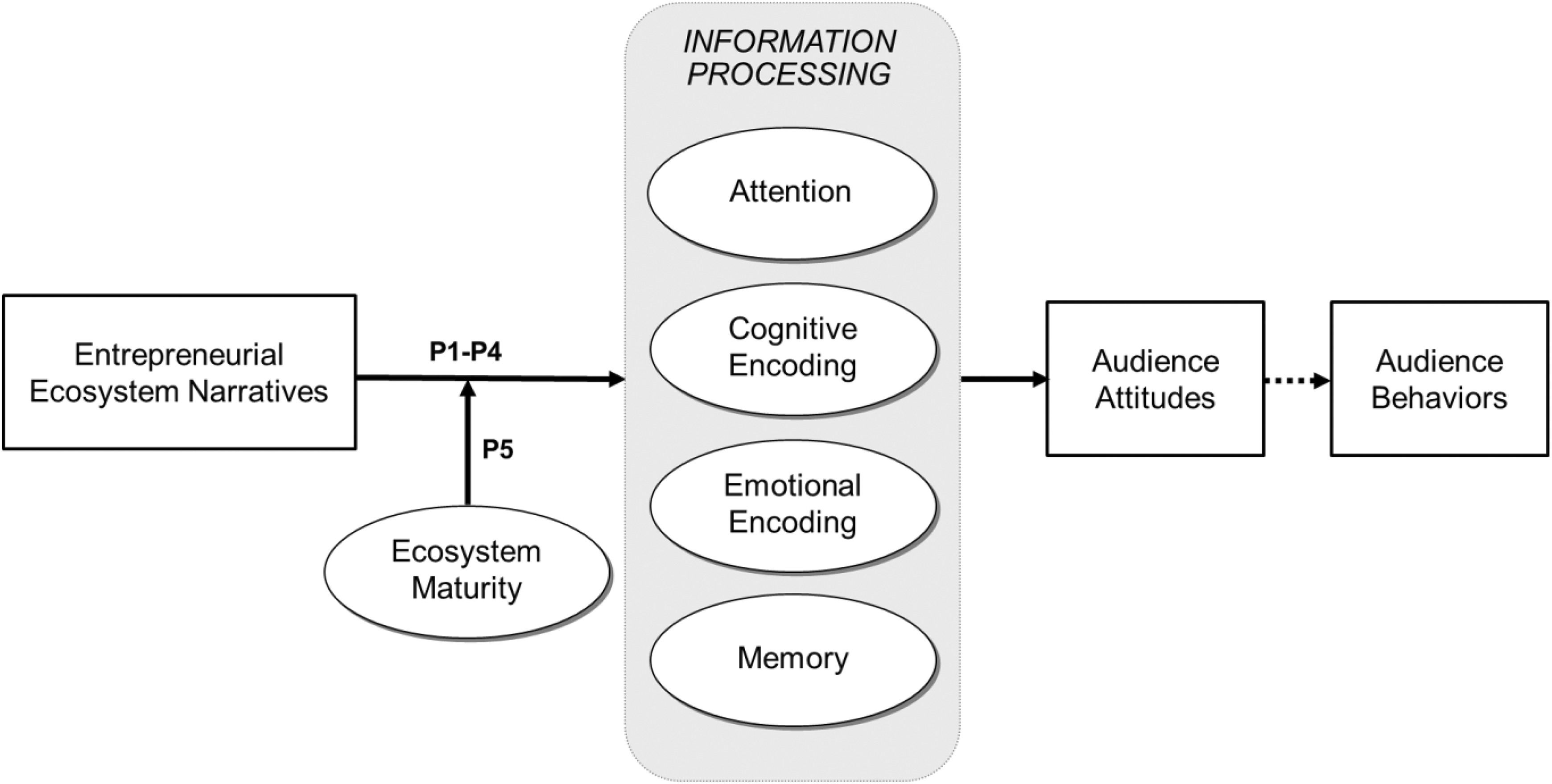
A model of EE narratives and audience information processing. EE: entrepreneurial ecosystem.
Discussion
A growing stream of research draws attention to the importance of narratives in shaping EEs and setting the economic trajectories of regions (Roundy, 2016; Theodoraki and Messeghem, 2017; WEF, 2013). Extending this work, this article integrates research from cognitive and social psychology, narrative theory, and entrepreneurship to clarify how EE narratives influence audiences’ information processing. We argue that information processing has a direct impact on audiences’ attitudes about an EE, which in turn, effects their intentions and behaviors. Although it was beyond the scope of our model to formally theorize about the specific behaviors that narratives influence, we speculate that narratives impact behaviors such as the decisions to invest or otherwise participate in an EE, to get more information about venture creation or investing opportunities, or to relocate to a region (as well as the opposites, i.e. decisions to cease operations or move away). Beyond these suggestions, the theory produces specific contributions for research on EEs, entrepreneurship discourse, and information processing.
Contributions to theory
Entrepreneurial ecosystems
The “entrepreneurial ecosystem” concept is a metaphor emphasizing the interconnected set of forces that promote and sustain entrepreneurship in a region (Neumeyer and Corbett, 2017). Despite the usefulness of the metaphor, EE research has received criticism that it is descriptive and under-theorized (Spigel and Harrison, 2018). The proposed theoretical model begins to address these concerns by proposing a mid-range theory to explain how audiences are influenced by EE narratives. As described, prior research draws attention to the function of narratives in EEs and suggests that the narratives constructed about an ecosystem can spur and hinder entrepreneurial activity (Roundy, 2016). However, scholars have not sought to tease apart the mechanisms underlying narratives’ influence. A consequence is that, although EE research acknowledges the importance of narratives, it has not yet incorporated the rich literature on narratives in other disciplines in the social sciences and humanities. Another ramification of the limited examination of EE narratives in prior work is that research treats EE narratives as homogeneous. As this article has argued, there are important differences among EE narratives in their content, structure, and influence. Identifying these differences and proposing theory to explain their influence help to make EEs more than simply a metaphor, but also a theoretical lens.
By providing a fine-grained theory of the mechanisms driving narratives’ influence on entrepreneurship audiences, this article’s theorizing draws attention to an important source of inter-ecosystem, and inter-region, variation. Our theory suggests that one explanation for why some EEs thrive while others struggle to encourage entrepreneurial activity is because the narratives used in thriving ecosystems are more effective (i.e. better able to capture attention, more memorable) than others and, thus, are more likely to influence EE participants. Moreover, our theory suggests that research seeking to understand the variance among EEs and the differences in perceptions, cognition, and behaviors of EE participants would be well-served to prioritize the examination of narratives because, as proposed, narratives can influence deep-seeded psychological processes, such as information interpretation, emotional response, and memory-related functions, which influence evaluation, attitudes, and behaviors (Voss and Van Dyke, 2001).
The theory also suggests that EE narratives are not merely “packaging” for the events they describe. They represent attempts at both sensemaking and sensegiving (cf. Cornelissen et al., 2012) and encapsulate understandings of how EEs work and evaluations of EE success. It was posited that differences in the structural and thematic characteristics of EE narratives can influence their processing and efficacy, which suggests that scholars seeking to fully explain the effects of communication in EEs must engage in analysis of its characteristics that go beyond surface-level analyses of narrative content. In addition, rather than simply claiming “narratives matter,” our theoretical model of narratives’ effects highlights the advantage of EE researchers being explicit about the constructs, relationships, and assumptions underlying their theories. The model also represents theory upon which future researchers can elaborate for empirical investigation. In this way, a well-codified theory of EE narratives is akin to an effective narrative in that it helps EE scholars organize their understanding of the phenomenon.
Entrepreneurial discourse and information processing
The theoretical model represents parallel contributions to research on entrepreneurial discourse and information processing. Both are long streams of work (cf. Clarke et al., in press), but have focused almost exclusively on the individual (and to a lesser extent) the organizational levels. Although our focus is also the information processing of individuals, our theorizing acknowledges the importance of the ecosystem of forces that form entrepreneurial discourse and, thus, influence information processing. These forces include individuals, organizations, institutions, networks, and values, and are related to the geographic, economic, social, and cultural elements of individuals’ contexts. In acknowledging this system of forces, our theory responds to calls for scholars to be more deliberate about incorporating the context in which theorizing takes place (e.g. Welter, 2011). We examine entrepreneurial discourse and information processing in a novel context, the EE, which is a type of meta-organization (cf. Gulati et al., 2012) that has received very little attention in discourse or information processing research.
Implications for practitioners
Practitioners and policymakers who craft EE narratives, often with the aim of changing an entrenched narrative that characterizes a region, should consider that the narrative characteristics discussed (e.g. emotionality, memorability, proximateness) can influence the extent to which new narratives spread and if these narratives influence audiences. That is, practitioners should recognize that in crafting an EE narrative it is imperative to not only consider the truth of the narrative, which impacts its believability and credibility (Yale, 2013), but also the other characteristics of the narrative’s content and structure. Thus, when constructing ecosystem narratives, “storytellers” would be wise to acknowledge that how EE narratives are composed and communicated matters. Because of the characteristics discussed, narratives will not be equally effective in influencing audiences’ information processing and, potentially, their behaviors. Developing narratives about an EE and its audiences is an activity that is not “just storytelling”—it influences the way information about the EE is processed and, thus, is an activity that should be engaged in purposefully.
Directions for future research
Building from the advances in this article, there are several theoretical and empirical next steps. First, although work on the effects of narratives hints at the active and agentic role played by so-called “cultural entrepreneurs,” who purposively and strategically craft narratives (Shiller, 2017), research is needed to explore exactly how this category of market actor constructs and communicates EE narratives. For example, EE narratives are often aimed at emphasizing a city’s heightened entrepreneurial activity and drawing attention to its entrepreneurial events. Yet it is not clear from prior research who are the most effective communicators of such narratives (e.g. local governments, entrepreneurs, support organizations) and in what mediums and settings these narratives are conveyed. In pursuing this line of inquiry, it is important to identify not only who is crafting EE narratives, but who is most persuasive in communication. It is also necessary to examine how ecosystem narratives spread among a communicating population and, specifically, among the social network of ecosystem participants (Motoyama and Knowlton, 2017).
The theorizing in this article focuses, primarily, on the influence of narratives on the information processing of individuals in EEs (and prospective EE members). However, EEs are also comprised of organizations, such as incubators, accelerators, new ventures, investment funds, and city governments (Isenberg, 2010; Roundy, 2017a). Even though there is some congruence in the stages of information processing among individuals, groups, and organizations (e.g. processing at all levels involves some form of attention, encoding, and memory), there are likely to be important nuances in how narratives influence these stages depending on whether the unit of analysis is the individual, the organization, or the system.
There also may be important cultural drivers of differences in recipients’ reactions to narrative messages. As research in influence and attitude formation has suggested, messages that emphasize individualism versus collectivism, that value or devalue status and power, and that promote individual expression versus harmony and social cohesion may “play” very differently in different parts of the world (for a recent review of this literature, cf. Albarracin and Shavitt, 2018). Therefore, we speculate that the same narrative might be interpreted and processed differently depending on the cultural backgrounds of audiences.
Another possible moderator of the influence of EE narratives, suggested by persuasion and attitude change research, is the “need for cognition” of the recipient of the narrative (Furnham and Thorne, 2013). Need for cognition is an individual difference, like a personality variable. A person high in need for cognition pays more attention and processes more carefully a narrative message, increasing the chances they will be influenced by it. A challenge EE builders may face, as storytellers, is that some audience members may have internalized hard-to-change narratives or may have individual differences (such as low need for cognition) that allow compelling EE narratives to “fall on deaf ears.”
The most obvious direction for future research is empirically verifying the proposed theory. The following is a rough sketch of how a future study might be designed to test the article’s theory. EE narratives can be collected from several sources. In addition to interviewing key participants, archival data are also a source of narratives. EE narratives could be culled from media reports (from outlets internal and external to the ecosystem) and other texts, such as city documents. In collecting EE narratives from these sources, entrepreneurship scholars could look to methods used in organizational research on the effects of media narratives on corporations (e.g. Pollock and Rindova, 2003).
Regarding the analysis of EE narratives, established and validated measures exist for narrative characteristics, such as concreteness and imageability (e.g. Bird et al., 2003). Furthermore, word-level features of narratives, such as their emotionality, can be measured using computer automated text analysis (i.e. CATA; cf. Tausczik and Pennebaker, 2010). However, there are limitations to using CATA methods and other automated techniques (e.g. latent semantic analysis) for analyzing texts when the goal is to study narratives in their entirety or to identify plot-level characteristics. Such analyses are more effective using qualitative, content analysis methods based on “hand” coding (cf. Saldaña, 2015).
To assess the influence of narratives on EE participants’ information processing an experimental design could be used. Lab-based experimentation, a methodology commonly used in narratives research in other disciplines but underutilized in entrepreneurship research (cf. Wieland et al., 2016), is well-suited for examining the role of narratives in EEs. For instance, study participants could be provided with ecosystem narratives about different cities. The narratives could be constructed to vary according to the characteristics of the proposed theory. Such an experiment could help tease apart the effects of specific mechanisms involved in the processing of narratives as participants evaluate, for example, the perceived desirability of a city’s EE. An experimental study could also include manipulations in the narratives to capture the boundary condition of ecosystem maturity.
Finally, regions are increasingly turning to the promotion of EEs as a means of adapting to rapid changes in the global economy and spurring economic development. The narratives that describe EEs, their participants, and their activities can represent a force that either aids a region in entrepreneurial revitalization or holds it back from experiencing the positive benefits of entrepreneurship. This article suggests that more work is needed on the mechanisms that cause some EE narratives to be more influential than others.
Footnotes
Declaration of conflicting interests
The author(s) declared no potential conflicts of interest with respect to the research, authorship, and/or publication of this article.
Funding
The author(s) received no financial support for the research, authorship, and/or publication of this article.
