




Abstract
Being social entrepreneurship (SE) the closest to Economy for the Common Good (ECG) principles, our work proposes to analyze the contribution of ECG model to SE. It is also intended to establish the relationship that exists between both concepts. Therefore, our specific objectives are to (1) identify the specific contributions of ECG principles to SE as well as their overlaps, (2) perform a literature review to analyze and quantify the number of research papers on SE and ECG, and (3) identify the possible existing gap. Through a double methodology, we (1) determine the potential contributions of the ECG model to SE, we propose to analyze the Common Good (CG) matrix and (2) empirical analysis on the existing literature body on SE and ECG. SE and ECG model share a number of principles and features which may be translated into some important overlaps in relation to both research bodies. So CG matrix can help to successfully launch and manage social ventures. This fact is mainly due to the fact that there is not a sufficiently large body of literature that relates models. In future research, it would be interesting to extend the bibliographic search to other databases.
Keywords
Introduction
Entrepreneurship is a powerful tool to create wealth for societies by promoting economic and social development (Corner and Ho, 2010; Wynn and Jones, 2019). However, wealth cannot be understood as merely economic value creation. On contrary, currently there is an increasing interest for social and environmental value creation as well as their balance in the entrepreneurial context. Promoting the equitable distribution of wealth is one of the goals of social entrepreneurship (SE). This way, SE contributes to the common good (CG).
On the other hand, Felber (2015) proposes the Economy for the Common Good (ECG) model whose main purpose is to achieve a full respect for human rights principles within companies worldwide and, thus, a more human run of firms based on cooperation and the prosecution of general interest. Hence, shedding light on the need to balance economic, social, and environmental outcomes.
In this sense, through the present work, the authors show that the entrepreneurial approach that better fits ECG model is SE, as SE has as primarily goal the creation of businesses with social purposes. SE, as socially driven businesses, contribute by means of their activity to the co-creation of economic, social, and environmental value. Therefore, they are businesses based on sustainability principles as the ones based on ECG model; that is, they can become a key driver for change (Bornstein, 2004; Roberts and Woods, 2005). According to some authors (Austin et al., 2006; Bacq et al., 2013), the differences between commercial entrepreneurship and SE are important enough to perform a different analysis of both realities.
Being SE the closest entrepreneurial model to ECG principles, the current work proposes to analyze the contribution of ECG model to SE through the education in values (Miller et al., 2012). Therefor its specific objectives are to (1) identify the specific contributions of ECG principles to SE as well as their overlaps, (2) perform a literature review to analyze and quantify the number of research papers on SE and ECG, and (3) identify the possible existing gap.
To achieve those objectives, the current work proposes a double methodology. On the one hand, with the aim of identifying which are the potential contributions that can be made from ECG model to SE, it analyzes the CG matrix (including its criteria, sub-criteria, and indicators) to determine which of them can lever SE initiatives or projects. To do so, the authors perform a comparative analysis of both models (ECG and SE) and identify the existing overlaps. On the other hand, with the aim of performing an assessment on the current state of the knowledge with regard to ECG model and SE, the authors perform a literature review from which they build up and analyze a database which contains the existing literature body. The authors selected the time period 2008–2017. The systematic review of the literature has been carried out following the methodology of Johnson and Schaltegger (2016). Through it, the authors’ aim is to propose a new approach to SE from scholarship and education (Howorth et al., 2012; Miller et al., 2012; Mirabella and Young, 2012).
The main contribution of the present work is the comparative analysis between SE and ECG model. There are already a number of studies which conceptualize and feature SE (Alvord et al., 2004; Dacin et al., 2011; Dees, 2001; Huybrechts and Nicholls, 2012; Light, 2006; Mair and Marti, 2006; Zahra et al., 2009). However, few of them analyze ECG model (Klaus et al., 2013) or the relationship between SE and ECG model (Priede et al., 2014). Notwithstanding the foregoing, both models share some elements that can contribute to give birth to sustainable business models which can become the base for a new approach in entrepreneurial education (Miller et al., 2012; Salamzadeh et al., 2013) as it allows to integrate the different outcomes of the entrepreneurial process: economic, social, and environmental.
The present work is structured into five sections. Following this introduction, the second section is devoted to the theoretical framework, the third section depicts methodology, the fourth section discusses the main findings, and the fifth section presents the main conclusions.
Theoretical framework
SE and ECG
In the precedent years, above all during the 2007 downturn, interest on SE has grown considerably (Saebi et al., 2019; Santos, 2012; Short et al., 2009). Such interest has also come from scholarship. So, since the beginning of the 21st century, there has been a rise in the number of published studies on SE (Huybrechts and Nicholls, 2012; Noruzi et al., 2010; Santos, 2013).
Some of these studies have focused on the design of theoretical frameworks for SE (Santos, 2012; Short et al., 2009); some others have focused on comparing SE and commercial entrepreneurship with the aim of showing the differences between them (Austin et al., 2006; Bacq et al., 2013; Roberts and Woods, 2005); finally, a third category has focused on featuring social entrepreneurs (Mueller et al., 2013). However, to date few studies have analyzed the relationship between SE and ECG model (Priede et al., 2014).
SE and ECG model show a number of aspects in common that facilitate their relation. ECG model, when applied to the entrepreneurial context, proposes new measurement instruments of success based on the co-creation of social and environmental value in addition to the creation of economic and financial value (Felber, 2015). Precisely, SE has as main goal the creation of socially driven business which involves social ventures to deliver not only economic value but also social and environmental value (Bacq et al., 2015). This way, the authors argue that the application of ECG model to the development of SE may facilitate the sustainability of social enterprises.
ECG model has as main goals the business contribution to the CG and cooperation instead of profit spirit and competition. From its point of view, economic growth and money are not goals by themselves, instead they are considered means to achieve human welfare and quality of life for people (Felber, 2015). ECG model values are, essentially, the universal and basic principles of human rights: human dignity, solidarity and social justice, ecological sustainability, and democratic participation and transparency.
Businesses are one of the basic agents in the operation of the economy, so in addition to the creation of economic and financial value, they must contribute through their effort to social development by creating social and environmental value. Hence, ECG model when applied to businesses and entrepreneurship makes a clear contribution to the design and implementation of business models that drive to corporate sustainability as it allows the integration of the three dimensions: economic (business viability), social (commitment to people and society), and environmental (Carroll, 1978).
Porter and Kramer (2011) also refer to the co-creation of economic, social, and environmental value as shared value, pointing to social enterprises as hybrid organizations (Kerlin, 2013). According to these authors, such hybrid organizations are those which, when creating social and environmental value, reinforce their ability to create economic value. In short, social enterprises are organizations with the capacity to create economic value through the creation of social and environmental value.
By its part, ECG model explicitly refers to some type of firms that, from their origins, base their operations on social and human values (Dey and Steyaert, 2010). These firms are the Social Economy firms and the cooperatives, which constitute an essential part of social enterprises as they prioritize social goals over economic goals (Dees et al., 2001b). In these firms, social and human rights are guaranteed as proposed by ECG model, as people and labor prevail over capital.
ECG model employs CG matrix as the tool to guide and measure the contribution of the business to the CG (Felber, 2015; Felber et al., 2019; Foti et al., 2017). In short, the CG matrix is the framework that the ECG model proposes to make compatible the creation of economic, social, and environmental value and, also, to measure the ability of the businesses to integrate the different types of value in their business model. This way, we argue that CG matrix can be considered as a tool to lever business models based on corporate sustainability.
ECG model (Felber, 2015) points to social enterprises as sample of companies for the CG, because these firms are the ones that better fit to the framework criteria described by means of CG matrix.
Furthermore, CG matrix is the base to assess businesses in terms of their contribution to the CG as it serves as the base to work out the Common Good Balance Sheet (CGBS). The CGBS is the tool that ECG model proposes to measure business success in terms of economic, social, and environmental impacts by means of scores. Felber et al. (2019) perform a statistical validation of the metrics employed in the CGBS and the CG matrix to measure the organizations’ contribution to the CG. To do so, the authors employed a quantitative approach. Thus, the authors tested the CGBS and the CG matrix measurement instruments by means of exploratory factor analysis based on principal component analysis. From an overall population of 400 European firms that implemented the ECG model by applying the CG matrix and producing the CGBS (being all these CGBS audited), the authors got a sample of 206 European firms from Germany, Austria, Switzerland, Italy, and Spain. This way, the authors validated the measurement instruments employed in the CGBS and the CG matrix. Therefore, they concluded that the CGBS resulted in an adequate tool to capture nonfinancial value creation.
The connection between social and economic spheres brought to the first conceptualizations of social entrepreneurs in the United States and the United Kingdom. Dees (2001a, 2001b) define social entrepreneur as a change agent that looks for a sustainable way to create social value (not only private value); the recognition and follow-up of new opportunities to deliver social value; a commitment with continuous innovation, adaptation, and learning; and the development of high levels of transparency and accountancy toward stakeholders (Brooks, 2009; Smith and Stevens, 2010; Weaver, 2018). According to Brooks (2009), a social entrepreneur is the leader that identifies a negative and static social situation which causes social exclusion, marginalization, or human suffering and fights against such unfair situation with his/her inspiration, direct action, creativity, courage, and strength by looking to create a new stable balance which involves permanent benefits for the whole society.
The conceptualization of SE in Europe is build up on empirical research developed by means of social enterprises case studies (Bacq and Eddleston, 2018; Seelos and Mair, 2005). Therefore, to define social entrepreneurs, Laville and Nyssens (2001) set up a series of social and economic criteria to be made compatible within social enterprises. Being the social criteria: (1) SE is the result of civil society actions; (2) the power to make decisions does not come from the amount of capital contributed, instead it is based on democratic principles; (3) setup participative dynamics which involve all the stakeholders in the decision-making process; (4) limitation to profits distribution; and (5) pursue an explicit goal to serve specific needs of local communities.
Such social criteria are to be made compatible with the following economic criteria (Hechavarría and Welter, 2015): (1) develop a continuous activity of goods and/or services production, (2) high autonomy and independence from public and political powers, (3) existence of a significant level of economic risk, and (4) existence of a minimum level of remunerated work.
From these criteria, we can deduce that social enterprises must pursue a triple goal (Hechavarría and Welter, 2015): social, economic, and sociopolitical. Social goal will consist of the work integration of people at risk of exclusion or, in general terms, the provision of quality services to specific social collectives (European Commission, 2011). Economic goal will consist of the operation of the business with appropriate levels of effectiveness and efficiency to guarantee the business viability. Finally, sociopolitical goal will consist of the achievement of the previously mentioned goals through a procedure which involves the social inclusion and the active participation of all the human collectives involved in the venture (Slimane and Lamine, 2017).
Consequently, we point the following elements as the common ones between ECG model and SE: Businesses should look for their balance through sustainability, hence value creation has to be faced from a triple dimension: economic, social, and environmental. Firms have to guarantee their economic viability (they have to achieve certain level of profitability), but they also have to contribute to social development (social commitment). Social enterprises are focused on the achievement of this balance. Firms should prioritize social purposes over economic or financial performance. Economic growth and profit have to play the role of means to ensure the values and principles of human rights, instead of being considered as the last purposes. In this sense, both models, SE and ECG, advocate for the reinvesting of the profits following social criteria instead of increasing the wealth of a minority of people, which in turn involves the increase of inequalities. Businesses should base their operation on the principles of cooperation, transparency, and democratic participation. People involved in the organization must relate each other by means of the values of mutual confidence and respect, which in turn implies the implementation of decision-making processes based on participatory direct democracy. It is also important to ensure social justice and equity through the existence of remuneration systems with minimal differences among people, promoting gender equality and the respect for functional diversity. In many social enterprises, workers are at the same time the business owners, which implies that they all share a similar level of power to make decisions; this way such firms ensure an equitable distribution of the income generated. The companies that contribute to the CG by creating social and environmental value through their ethically responsible behavior should be incentivized by public powers. The ECG model proposes such incentives in the same way that some countries incentivize SE. In the United Kingdom, for example, social enterprises are considered as Community Interest Companies and the Government puts in force tax incentives to promote these organizations (Priede et al., 2014). To further analyze some of the aspects previously pointed out, we proceed to decompose the CG matrix. Figure 1 shows the CG matrix in its 5.0 version.

The ECG matrix version 5.0. Source: https://www.ecogood.org/en/common-good-balance-sheet/common-good-matrix/ (accessed 15 March 2018). ECG: Economy for the Common Good.
Such matrix relates the firm’s behavior in terms of the general principles and values of human rights, grouped into four categories (“human dignity,” “solidarity and social justice,” “environmental sustainability,” and “transparency and codetermination”), to the stakeholders grouped into five categories (“suppliers,” “owners, equity, and financial services providers,” “employees,” “customers and business partners,” and “social environment”). Hence, CG matrix employs as one of its bases the stakeholders approach (Freeman, 1984) to measure the business contribution to the CG.
From the analysis of CG matrix criteria, sub-criteria, and indicators, the authors argue that it is possible to deduce some aspects that can drive to lever the development of SE initiatives. Hereafter, the authors proceed to analyze such aspects for every one of the stakeholders considered in the CG matrix (AECG, 2015).
According to ECG model, the relationship between the business and its suppliers should be based on the promotion of human dignity in the supply chain. In this sense, businesses have to be conscious of its responsibility over the value network in which they participate. So, the criteria to select suppliers are proper working conditions (wages and labor rights), environmental aspects (raw materials and sources of power employed), social effects on other groups, and regional alternatives. The model proposes the prioritization of regional, green, social suppliers to avoid carbon print, the control of risks (i.e. pollution) associated to products/services, and the payment of fair prices in origin (Rossiter and Smith, 2018). From an entrepreneurial point of view, we conclude that ECG model helps to lever local entrepreneurship due to the proximity criterion to select suppliers, this way it contributes to local economic development. Furthermore, given the prioritization of social criteria it also creates opportunities for local social enterprises.
ECG business behavior with regard to its funding is based on ethical financial management. To do so, businesses prioritize operation with ethical banking and invest their surplus in ethical and environmental sustainable projects. The matrix also advocates for strengthening self-funding and fostering the funding coming from commercial exchanges between businesses. Hence, we can conclude that ECG model drives to the implementation of a private financial system based on ethical and social values.
On the other hand, the relationship between ECG businesses and their employees is also based on an ethical management of human resources (HRM). This way, HRM must drive to ensure human dignity at the workplace through the creation of healthier working conditions based on freedom in the workplace and cooperation. The proposed criteria are workplace quality; equality; fair distribution of work loading; promotion of social, ethical, and environmentally friendly behavior among employees; fair distribution of the income generated; and keep internal democracy and transparency in the decision-making process.
In relation to the business relationship with its customers and competitors, ECG model advocates for fair sales management. The goal is to treat customers as business partners by putting into practice long-term relationships based on conscious consumerism and ethical buying practices. CG matrix proposes as criteria the use of social marketing practices, employee’s training in relation to fair commercial practices, employee’s compensation systems in relation to sales targets and customer’s participation in the business decisions related to the offer of ethical and green products/services. This way, ECG model promotes conscious consumerism and business sustainability not only in the business that applies the model but also in its customers’ behavior. This in turn enhance socially driven businesses as, for example, social enterprises.
Finally, ECG model also proposes an ethically driven environment management. In this sense, ECG businesses define themselves as citizen organizations socially responsible with a strong commitment with the social environment in which they operate (Heyworth-Tomas and Jones, 2019). To do so, CG matrix proposes the following criteria: human needs satisfaction assessment, return a part of the profits to the local community, reduction of the effects on the environment at the minimum possible level, minimize dividends distribution, and set up transparency and participation systems to ensure social codetermination and transparency. Managing the business relationship with social environment in this way allows to integrate some SE behaviors into ordinary firms when they apply ECG model.
Summarizing, we can conclude that the ethical and social behavior of firms when applying ECG framework drives them to integrate some SE behaviors inside the organizations. While, at the same time, outside the organizations it promotes the development of SE initiatives at different levels of the value network in which ECG firms operate.
Entrepreneurship education in values, literature review on the relationship between SE and ECG model
ECG model points to entrepreneurship education as being a key driver for change (Miller et al., 2012). In this sense, it advocates for shedding light on the special role that educational systems can play, as it is essential to secure the transmission of ECG values and principles to inspire the next generation of entrepreneurs. To do so, ECG movement proposes to change the current learning methodologies by integrating emotions management, preeminent role of ethical management, communication skills, democracy education, and environmental consciousness, among others (AECG, 2015). SE shares these aspects with ECG model, moreover according to Priede et al. (2014), educational system, mainly at the university level, must promote SE with the aim of favoring the setting up of businesses based on values.
In this sense, we argue that critical pedagogy and ECG model values can become an interesting methodological strategy to inspire entrepreneurial talent. Given that, entrepreneurial action requires not only face the passivity to start a new business but also the active exercise of citizenship which implies taking into consideration the ethical dimension of entrepreneurship.
Thus, making necessary the development of different and special competences in the people who will launch and develop new businesses based on social values (Perrini et al., 2010). Following this argument, ECG model points to the future leaders as being socially competent and responsible, develop a high level of empathy and sensibility and socially and environmentally conscious (AECG, 2015).
According to Priede et al. (2014), social entrepreneurs show these traits and become, as pointed by Dees (2001), agents for economic and social change who foster innovation in a wide sense. So, social entrepreneurs play the role of catalyst agents of ECG model and social enterprises become one of the keys upon which it is possible to build up this new entrepreneurial paradigm.
Research publications are essential to gain academic recognition on whatever field research. On the one hand, SE is currently a field research with wide recognition, despite of it for some authors it does not make sense to differentiate between SE and commercial entrepreneurship (Chell et al., 2016). Following Noruzi et al. (2010), the authors argue that such differentiation makes full sense, above all, in order to find the connections between SE and ECG model. In the authors’ opinion, ECG model tries to spread SE values and principles to the rest of businesses. Given these arguments, the authors propose:
On the other hand, as ECG model is a recent one it is likely that the number of publications is still scarce. Therefore, the authors propose:
Finally, due to the relative novelty of ECG model, we find that the research publications which relate SE to ECG model are likely to be nonexistent to date. Hence, the authors propose:
Methodology
To test these hypotheses, the authors have performed a literature review to identify and quantify the international research publications appeared in the last 10 years on the fields of SE, ECG model, and the relationship between SE and ECG model.
Thus, the field research under review were (1) SE, (2) ECG model, and (3) SE and ECG model.
The authors selected the time period comprising from 2008 to 2017, both included. The reason why the authors made the decision of beginning the search in 2008 was because in that year Felber presented the ECG model for the first time.
The systematic literature review consisted of five methodological steps (Johnson and Schaltegger, 2016; Petticrew and Roberts, 2006; Tranfield et al., 2003; Zapkau et al., 2017): (1) identification of keywords and creation of search strings based on the identified keywords, (2) selection of studies through relevant databases, (3) analysis of identified papers based on inclusion and exclusion criteria, (4) data extraction into a reference management database (in this case, Excel), and (5) data synthesis and reporting.
Table 1 below summarizes the combinations of search strings developed from the keywords. Note that all the search strings include a group of additional words denoting a tool, that is, “tool,” “instrument,” “concept,” or “system.”
Search string combinations for the literature search.

Each string was entered exactly the same way into the following six databases: EBSCO Business Source Premier, Emerald, JSTOR, Science Direct, Springer, and Wiley Online. In addition to these databases, a cross-check was conducted in Google Scholar in an attempt to find other academic influential publications outside of these databases (Johnson and Schaltegger, 2016).
Following Moustaghfir (2008), to narrow down the vast amount of available literature, the authors set up several inclusion and exclusion criteria. So that conference papers, working papers, technical reports, and practical handbooks were excluded. However, the authors decided to include peer-reviewed academic papers. Table 2 summarizes the inclusion/exclusion criteria applied in the search.
Inclusion and exclusion criteria for literature search.

Note: SE: social entrepreneurship; ECG: Economy for the Common Good.
Where possible, the search strings were entered into the six databases using advanced search options and filters, such as searching strictly for peer-reviewed journal articles and book chapters.
Findings
Initial search gave as a result 1201 papers and documents. Thereafter, the authors analyzed those papers and documents applying inclusion and exclusion criteria to their titles and abstracts. From this first screening, the authors excluded those publications whose main topic has nothing to do with the field research they were interested in. This procedure resulted in the identification of 435 publications for full review. Then the authors’ names and the titles of these documents were exported to an Excel file and the full papers were downloaded for further review.
After having performed a full review of those 435 publications, the authors concluded that only 124 of them fulfill the inclusion criteria depicted in Table 2. Then the authors performed a deeper analysis in two steps: (1) a basic meta-analysis including year of publication, type of publication, and type of journal; and (2) a thematic analysis for every one of the publications, including literature review, comparative analysis, entrepreneurship, social entrepreneur’s main traits and profile, case study and empirical research, and relation between SE and ECG model. Table 3 depicts search results.
Search results, fully reviewed papers and included papers.
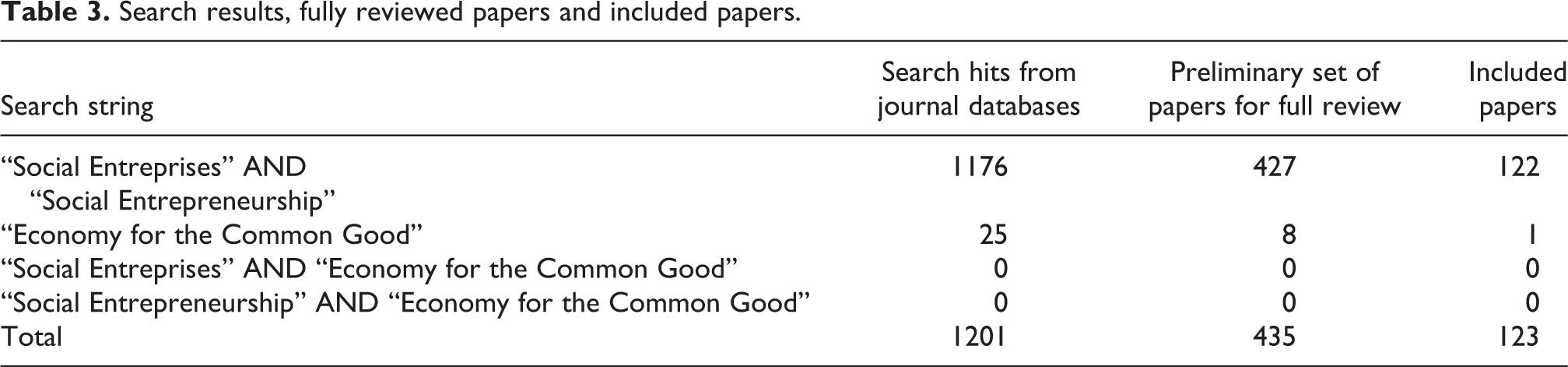
It is worth to say that only one of the identified publications that fulfilled the inclusion criteria was related to ECG model, as the other ones were books and book chapters. At the same time, the search did not identify any kind of publication that relates SE to ECG model. These findings show the existence of a significant gap in the current literature body in the field of ECG model and its relation to SE.
Thereafter, the authors analyzed in full detail the 124 selected publications, with 123 being focused on social enterprises and/or SE and only one on ECG model.
Figure 2 shows the number of publications by year on SE covering the last 10 years (2008–2017). As it is possible to see, the most productive years in terms of SE publications were the last three ones (2015–2017). The period 2015–2017 concentrated 54% of publications, above all the year 2016 was especially productive with 25% of the publications on SE of the last decade. These findings demonstrated that SE as field research has gained a widespread recognition, consolidating its position in the last years. Hence, the authors accepted hypothesis 1.

Number of publications by year (2008–2017) on SE. SE: social entrepreneurship.
By its part, publications on ECG model are still scarce as showed by the fact that the authors only have found one publication in 2017. Therefore, they accepted hypotheses 2.
Finally, none of the publications they find related SE to ECG model. Hence, the authors accepted hypothesis 3.
The authors also analyzed the journals that published peer-reviewed papers on SE in the last decade. To do so, they set up seven categories to classify the journals by their scope. The seven categories were SE, entrepreneurship, sustainability and business ethics, general management, business, organization, and others. Table 4 summarizes the results of this analysis.
SE and ECG model publications in journals (2008–2017).

Note: SE: social entrepreneurship; ECG: Economy for the Common Good.
As Table 4 shows, most of the papers published on SE in the last decade were published in management journals (42 (34%) in 18 different journals (39%)), of which the journal that published the highest amount of papers was “Academy of Management Learning & Education” with 8 papers. In a second term, the authors found journals focused on entrepreneurship with 21 papers (17%) in five different journals (11%), of which the journal that published the highest amount of papers was “Entrepreneurship and Regional Development” with 9 papers. In the third position, they found journals falling into the category of business with 19 papers (16%) in eight different journals (17%), of which 5 papers were published in the “Journal of Business Research.” It is worth to mention that the journal that published the highest number of papers on SE in the last decade was the “Journal of Business Ethics” with 12 papers.
Another finding that authors would like to emphasize is the nonexistence of any journal of the category of SE included in the JCR. Finally, the “Journal of Business Ethics” published the only existing research paper on ECG model in 2017, becoming a pioneer in this field research (Fremeaux and Michelson, 2017).
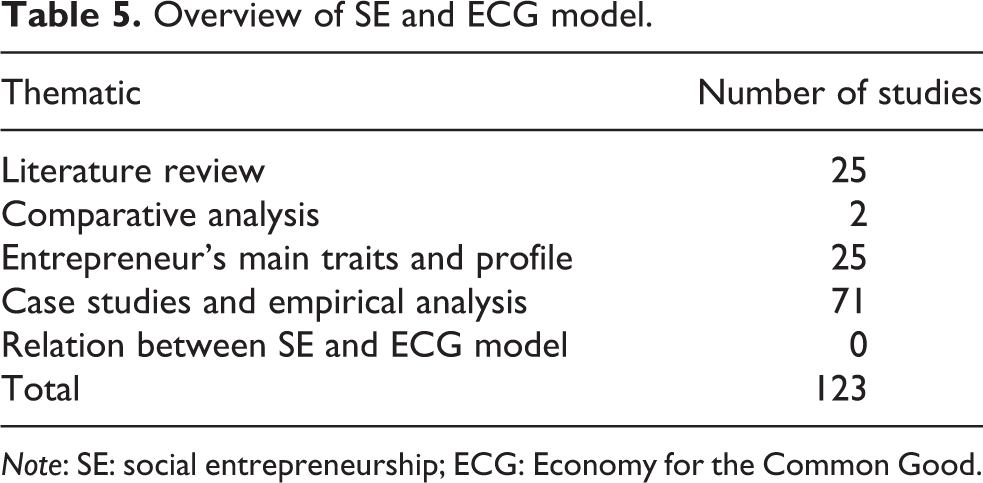
The second step of the analysis comprised the thematic analysis of the publications. To this end, the authors considered the following topics in order to classify every one of the papers according to the type of research they developed: literature review, comparative analysis, entrepreneurship, social entrepreneur’s main traits and profile, case study and empirical research, and relation between SE and ECG model. Table 5 shows the classification of the papers by type of research developed.
Overview of SE and ECG model.
Note: SE: social entrepreneurship; ECG: Economy for the Common Good.
As Table 5 shows, most of the publications on SE were research papers based on case studies and empirical research (58%). In a second term, the authors found research based on literature review and social entrepreneur’s main traits and profile (in both cases, 20%). It is worth to point that there was not any published research paper relating SE to ECG model and only two papers compared SE to other approaches. While the paper on ECG model falls into the research based on literature review.
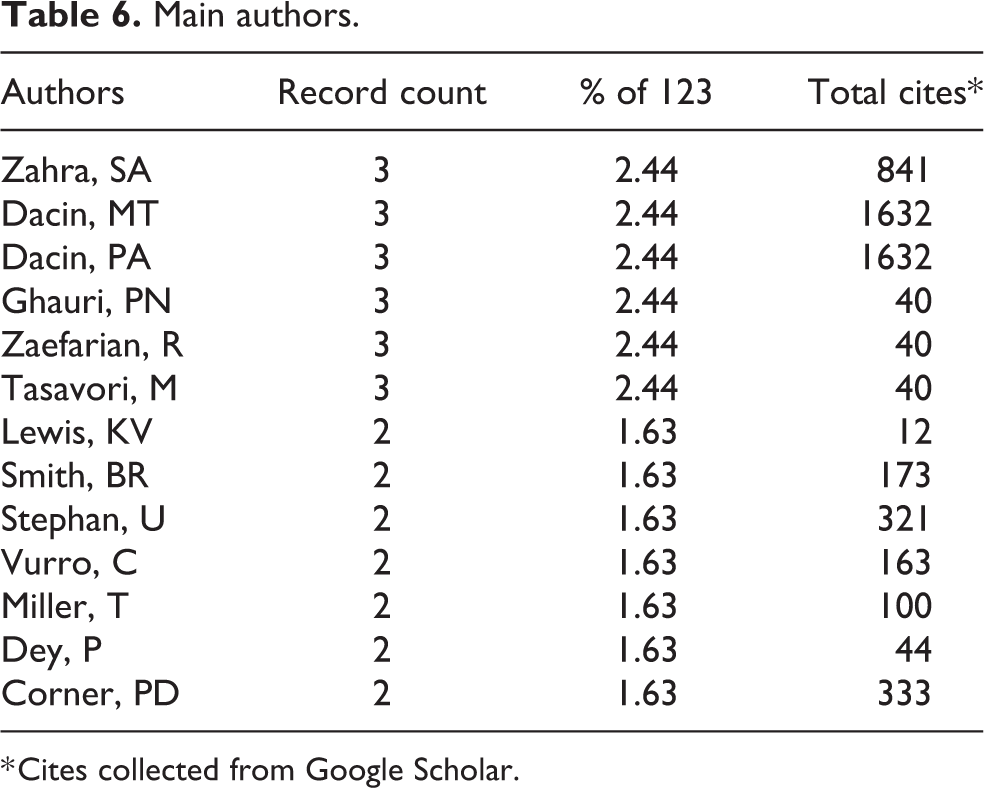
Finally, the authors have considered interesting to report on the most cited authors in the field of SE during the period 2008–2017. Table 6 shows the results.
Main authors.
* Cites collected from Google Scholar.
Conclusions
The authors find the business model derived from CG matrix and ECG model specially appropriated for the promotion of SE because it is based on the three dimensions of sustainability: economic, social, and environmental. The social and ethical management on which ECG model bases its relationships with stakeholders provides it with the essential features of SE. Consequently, from a theoretical point of view, it is possible to find multiple overlaps and connections between ECG model and SE that can be reinforced.
For that reason, the authors find necessary to perform studies in order to carefully analyze and quantify the relationship between both business models. Notwithstanding the above mentioned, the literature review they performed shows that there exists a gap in the literature as no peer-reviewed journal included in the JCR has still published any paper relating SE to ECG model. Despite this fact, there is only one published research paper on ECG model from a theoretical approach.
On the other hand, a number of papers on SE were published in the last 10 years as it is possible to find 123 papers on this topic published in high-impact journals, which demonstrates the consolidation of SE as field research. Most of these publications are case studies and/or empirical research which demonstrates the applied character of the research performed. The journals which published the highest amount of research papers on this field research between 2008 and 2017 were the Journal of Business Ethics, Entrepreneurship and Regional Development and Academy of Management Learning & Education. Then showing SE as being a field research with high interest. As of 2015, the number of published works increases; 2016 is the year in which the greatest number of work has been published.
However, the papers on ECG model are still scarce. Despite of this, it is necessary to take into consideration that ECG model began its application to the business sphere in 2010. So we are facing a relatively new business model. It is worth to say that in their search the authors found 25 publications on ECG model, of which only 1 fulfilled their research criteria, being most of them books and book chapters. Thus the authors conclude that scholars and academia are facing an incipient field research which will be further developed in the coming years. For that reason, they did not find any published paper that relates SE and ECG model.
The authors circumscribe this literature review in the framework of the research project they are enrolled in. Being ECG an emergent field research, the first step consisted of assessing the current literature body on ECG model to identify and feature the existing gap in the literature. The present study allowed authors to identify an emergent field research on which they are currently working. Future research on the ECG should apply quantitative methods to validate the measurement instruments employed in the CG matrix and in the CGBS to measure the firms’ creation of value.
On the other hand, at a global level more than 2,400 organizations are involved in the implementation of the ECG model. Consequently, the ECG model is seen by practitioners as a trend to lever the development of values-based corporate strategy.
In the authors’ opinion, research in the business sphere should be connected to the latest management trends at international level. Thus, practitioners and scholars can reinforce their knowledge. Being the implementation of ECG model an emerging management trend worldwide, the current study advances as it introduces the ECG model in the academia debate by means of performing a literature review and pointing to its ties with other research fields.
Footnotes
Declaration of conflicting interests
The author(s) declared no potential conflicts of interest with respect to the research, authorship, and/or publication of this article.
Funding
The author(s) received no financial support for the research, authorship, and/or publication of this article.
