



Abstract
This paper explores the entrepreneurial motivations of older entrepreneurs, specifically the importance of affective motivations and the influence of family and personal wellbeing on older entrepreneurs’ decisions to start-up and their subsequent business model choices. Departing from the extant literature examining the effects of family on firm and vice versa, the focus here is on the influence of family outside the boundary of the firm. Drawing on socioemotional selectivity theory (SST), the paper reports a study of older entrepreneurs who report motivations that prioritise family-based affective value external to the enterprise itself. As such, the paper contributes new knowledge on motivations for entrepreneurship and the embedded nature of family and business, particularly for older entrepreneurs.
Introduction
Most research on the interaction between business and family is underpinned by a presupposition that the family services the firm and in turn, the firm contributes income and employment to the family (Goel and Jones III, 2016; Bloemen-Bekx et al., 2019). Family involves relationships that exist outside of the boundaries of firms though, and roles and contributions in families vary from the material to the social and emotional. Critically too, these roles and contributions change over time as family dynamics, needs, and resources change (Alsos et al., 2014). To date, there is little exploration of the family as an influence on the choice to pursue enterprise rather than other types of employment beyond the ‘family business’. This paper engages with this gap in the literature to explore enterprise work that is prompted specifically to provide extramural service to family and where that priority shapes the ensuing and prevailing business model. We explore the interaction between business and family amongst a sample of older entrepreneurs, defined as those who start a business or become self-employed for the first time over the age of 50.
Over the last two decades, rates of older entrepreneurship have been increasing globally (Zissimopoulos and Karoly, 2007; Kautonen, 2013; Schøtt et al., 2017). There is evidence that this increase is attributable to two distinct antecedent drivers in western developed economies: first, a need for income to mitigate insufficient pension provision (Curran and Blackburn, 2001), and second, an age-specific desire for greater autonomy over work and life (Wainwright and Kibler, 2013). While there may well be overlap for some people of these background drivers, the specific focus of this paper is older entrepreneurs who assert their priority as some affective family-related value ambition. As such, we refer to socioemotional selectivity theory (SST) (Carstensen et al., 1999; Carstensen et al., 2003), which proposes that, as we age, motivations for material and future-oriented rewards reduce as emotional and present-oriented ones increase. Viewed through this lens, the paper explores the affective family-value that may be realised by enterprise creation in later life, and indeed, may have motivated it and continues to shape it through the business model and orientation of the enterprise activities pursued.
There is evidence of the importance of affective motivations and outcomes throughout business studies and the effect of these on subsequent business models and activities (Galloway et al., 2019). These include studies both of older entrepreneurship (Stirzaker et al., 2019) and of family business (Holt et al., 2017; Chirico et al., 2020). There is little exploration of if and how these may interact though. In this paper, we study how motivations for older entrepreneurship, which may emerge due to wider, temporal family strategies, inform perceptions of value in a business model. By widening the focus in this way, we include the potential for enterprise to act as a mechanism for the achievement of family-orientated outcomes. The central aim of this paper is to investigate older entrepreneurship that is prompted by and maintained in line with ongoing affective family considerations.
There are two key contributions. First, through the lens of SST, the paper provides evidence on how older entrepreneurship motivations may be prompted to realise specific age-related affective rewards that make contribution to both present personal and family wellbeing. Second, and relatedly, it provides evidence of the embedded nature of older entrepreneurship in terms of being a feature of, and contribution to, the improvement of personal wellbeing and family life through business model value decision making related to ongoing operations of older entrepreneurship that is deliberately shaped to make sure affective rewards are protected.
Affective motivations, socio-selectivity theory, and older age
Engaging in entrepreneurial action has often been understood to be motived by the desire for financial gain (e.g. Shapero and Sokol, 1982; Krueger, 2009), an almost exclusive focus that has been subject to some compelling critique (Tedmanson et al., 2012; Welter et al., 2017). Recent empirical studies have found that entrepreneurship occurs in response to multiple and overlapping drivers however (Williams, 2008; Dawson and Henley, 2012; Kapasi et al., 2021), and these are, in turn, influenced by antecedent conditions and circumstances idiosyncratically experienced (Galloway et al., 2019). The polymorphous nature of business motivations is also explored throughout the family business literature (Perry et al., 2015; Holt et al., 2017). Certainly, it is long established that intrinsic motivations may be prioritised alongside economic ambitions in family firms (El Shoubaki and Stephan, 2018), and indeed, may vary in peculiarly family-based ways from non-family firms (Berrone et al., 2012; Alsos et al., 2014; Llanos-Contreras et al., 2019). According to Mikušová et al. (2020), the socioemotional value created when family and business ambitions converge can positively influence firm performance. Alongside this, older age is observed to prompt pursuit of affective value via enterprise creation (Weber and Schaper, 2004; Kibler et al., 2015).
Accordingly, SST (Carstensen et al., 1999; Carstensen et al., 2003) proposes that the reasons for how behaviour is motivated changes over time. Specifically, SST posits that over the course of a life, perceived limitations on time lead to changes in motivation towards achieving emotionally meaningful goals (Carstensen et al., 2003). When time horizons are perceived as open ended, as in the earlier life stages of adulthood, individuals are more motivated to seek out a range of new knowledge, experiences, and social contacts that invest in future benefits. Alternatively, when individuals age, they will seek affective returns over capital-building ones. Rather, they prioritise immediate emotionally rewarding experiences as lifetime-horizons shorten (Baltes and Carstensen, 1999), such as positive emotional reinforcement environments with close social partners (Carstensen et al., 1999).
It is argued that the inherent flexibility of working time and the autonomy of enterprise-based work may allow older entrepreneurs to realise such atypical socio-emotional or affective benefits (Weber and Schaper, 2004; Wainwright and Kibler, 2013; Stirzaker and Galloway, 2017). Empirically, and specifically using an SST lens, Stirzaker et al. (2019) explain how some of the participants in their sample chose to engage in entrepreneurship for largely affective reasons, often prioritising socially and emotionally appealing factors over (and sometimes at the expense of) financial rewards. Elsewhere, Schepers et al. (2014) identify affective drivers for older entrepreneurs that relate specifically to family, including time with a spouse and extended family roles.
Family has been found to play an important role in business–related decision–making processes and their outcomes (Aldrich and Cliff, 2003; Cruz et al., 2010; Sieger and Minola, 2017). In part, family is evidenced to facilitate venture development through the provision of unique and valuable resources (Aldrich and Cliff, 2003; Hatak et al., 2016). For example, Hamilton (2006) finds that among these resources, emotional and social support are key contributions of family to firm processes and decision making. In the family business literature, non-financial affective values related to socioemotional wealth preservation have also been identified as shaping firm decision-making processes and outcomes (Berrone et al., 2012; Alrubaishi et al., 2021; Baixauli-Soler et al., 2021). DeTienne and Chirico (2013) highlight the importance of the CEO and family in charge of the firm as moderators between competing affective and financial goals and performance indicators, with focus and goal preferences changing depending on specific family circumstances. Thus, while research finds that family is important for enterprise, and the ensuing enterprise may impact the family, the rationale for the enterprise and its model is to generate business outcomes such as wealth and employment irrespective of creation context.
However, what if the enterprise and its model were designed to serve the needs of family? Throughout a life course people are subject to changing circumstances and evolution in their roles, responsibilities, motivations, and preferences. Roles and responsibilities in families change as we age, and indeed, do so in the context of changing perceptions of time horizons and the subsequent effect on behaviour as proposed by SST For example, there is much evidence that older people provide substantial amounts of service to families, often through the ‘free economy’ (Gibson-Graham, 2006), with Age UK (2018) reporting that up to five million grandparents regularly provide childcare enabling their own children to work, and Lunn (2019) estimates the net value of this to be upwards of £22 Billion. Such findings follow SST, whereby perceptions of “time left” change personal goals, redirecting them towards meaningful social interactions and preferences to be with important and close social partners (Carstensen et al., 1999; Carstensen et al., 2003). This is the context in which Singh and DeNoble (2003) and Kautonen (2012) argue that combining paid work and family roles may be particularly relevant to older entrepreneurship. Consequently, there is a rationale for the premise that some older entrepreneurs simultaneously realise (affective and/or economic) value for themselves, while also providing utility in the form of social and economic benefits for family. From this perspective, it seems reasonable to propose that some older entrepreneurship may be motivated, modelled, and operated in response to an affective desire to contribute services to the family beyond the boundary of the firm itself. The lack of studies that allow for this as a critical antecedent to older entrepreneurship suggests there is a gap in our knowledge.
A research agenda
Collectively family and other business and entrepreneurship studies have taken the economic unit of the business as the focus of research when exploring the contribution family can make to creating value; they consider the effect the family may have on business and the effect business may have on family. These are underpinned, however, by the constant premise that the family services the business. We assert here that this omits from the analysis the possibility that the business is created and modelled to enable wider service to the family. As such, there is a rationale for exploring beyond the business and its economic effect to include the family and its social and economic fortunes. Specifically, there is little acknowledgement of the potential for the choice to start a business to be driven by affective motivations as per SST and its anticipated wider utility for family. In addition, to date, there is no information in the literature about how this alternative driver of older entrepreneurship may affect the business models adopted and the trajectory of the enterprises created. To resolve this gap, we present in the next sections empirical findings from a sample of older entrepreneurs in the UK who claim to have started their enterprise to realise some specifically family-related affective outcome. We explore particularly the following research questions:
Methodology
The purpose of this study was to explore perceptions and experiences of enterprise as they are embedded within participants’ personal circumstances and as such sought to elicit in depth testimony about how individuals came to be in business and their experiences thereafter. The use of narrative approaches in qualitative research are well-documented as optimal for the generation of rich, context-specific, and idiosyncratic data (McCarthy et al., 2014). It allows for complex contexts to be investigated, including exploring for evidence of theorised knowledge while allowing for the emergence of new data (Gartner and Birley, 2002; Salkind, 2014). According to Bertaux (1981), the most appropriate way to obtain this type of data is by allowing individuals to relate their recollections and reflections – their stories – in their own words.
For this research, a specific two stage qualitative approach was employed. This included an initial larger qualitative study (Study 1) of 50 individuals over the age of 50 who had started a business or become self-employed. The original sample were recruited by purposeful sampling methods involving advertising through social media and approaching business support organisations and groups supporting older entrepreneurship. These organisations and groups advertised the study to self-selecting participants through their newsletters and social media accounts. While it was recognised that self-selection had the potential of bias in recruitment, it was valid for the explorative nature of study 1 as the focus was on gaining data from “information-rich cases” regarding the phenomenon of interest (Marshall and Rossman, 1999: 78). As this study sought in-depth data about a complex individual phenomenon, the approach was considered appropriate. Study 1 applied a narrative history methodology, which incorporated question prompts underpinned by theories of entrepreneurial motivation and business models (Appendix 1). Extended testimonies were obtained about what had motivated enterprise, the experiences of it, the value anticipated and realised from it, and the emotions and feeling states of the entrepreneurs related to enterprise. The in-depth interviews were conducted in a participant's home or public location, lasted between 60 and 90 min and were conversational in tone to encourage rapport and extended testimonies, including the facilitation of new, unanticipated themes to surface (Duff and Bell, 2002).
Data analysis was thematic and applied the stratified process described in Miles et al. (2014), comprising data reduction, data presentation and data explanation. To mitigate interpretation bias (Danermark et al., 2002), each author reviewed the transcripts and other data relating to the sub-sample individually and, with support from NVivo software to enhance data representativeness and thus rigour (Johnson et al., 2020), identified themes. Thereafter, the process of data reduction involved collaboration to distil each author's interpretations into communally identified themes. Relevant evidence was agreed by consultation and collaboration for data presentation. For the data explanation stage, consensus on interpretation of meaning was similarly achieved by discussion and agreement between the authors.
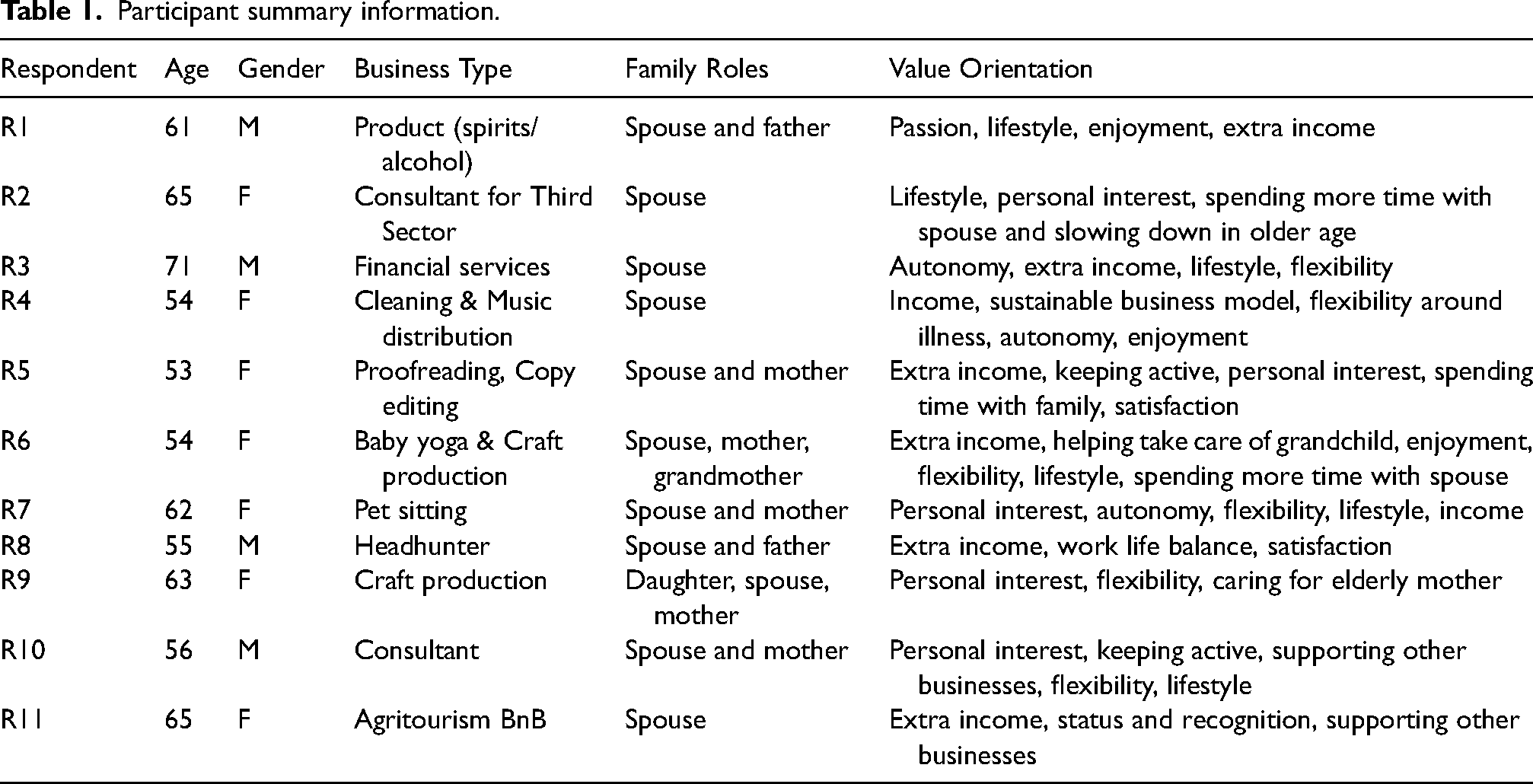
Family-related drivers that were peculiar to older age were identified within Study 1 as a significant theme worthy of further examination. Following this, Study 2 focussed on re-examining the data from a family business/SST perspective. Subsequently, 11 older entrepreneurs from the initial sample 1 who had made specific reference to their entrepreneurial motivation being informed by their age-related role in a family in some way were identified. The testimonies of these 11 were extracted as a subset and re-analysed, with specific focus on the value(s) sought from enterprise work, and how this related to family for these older entrepreneurs. Summary details of the participants in Study 2 are given in Table 1. Study 2 data were analysed through an SST informed theoretical lens following the same process as Study 1. Following qualitative inductive process as per Miles et al. (2014), Table 2 presents the hierarchical themes identified. Table 2 presents themes and example coding and evidence.
Participant summary information.
Data reduction codes and themes.
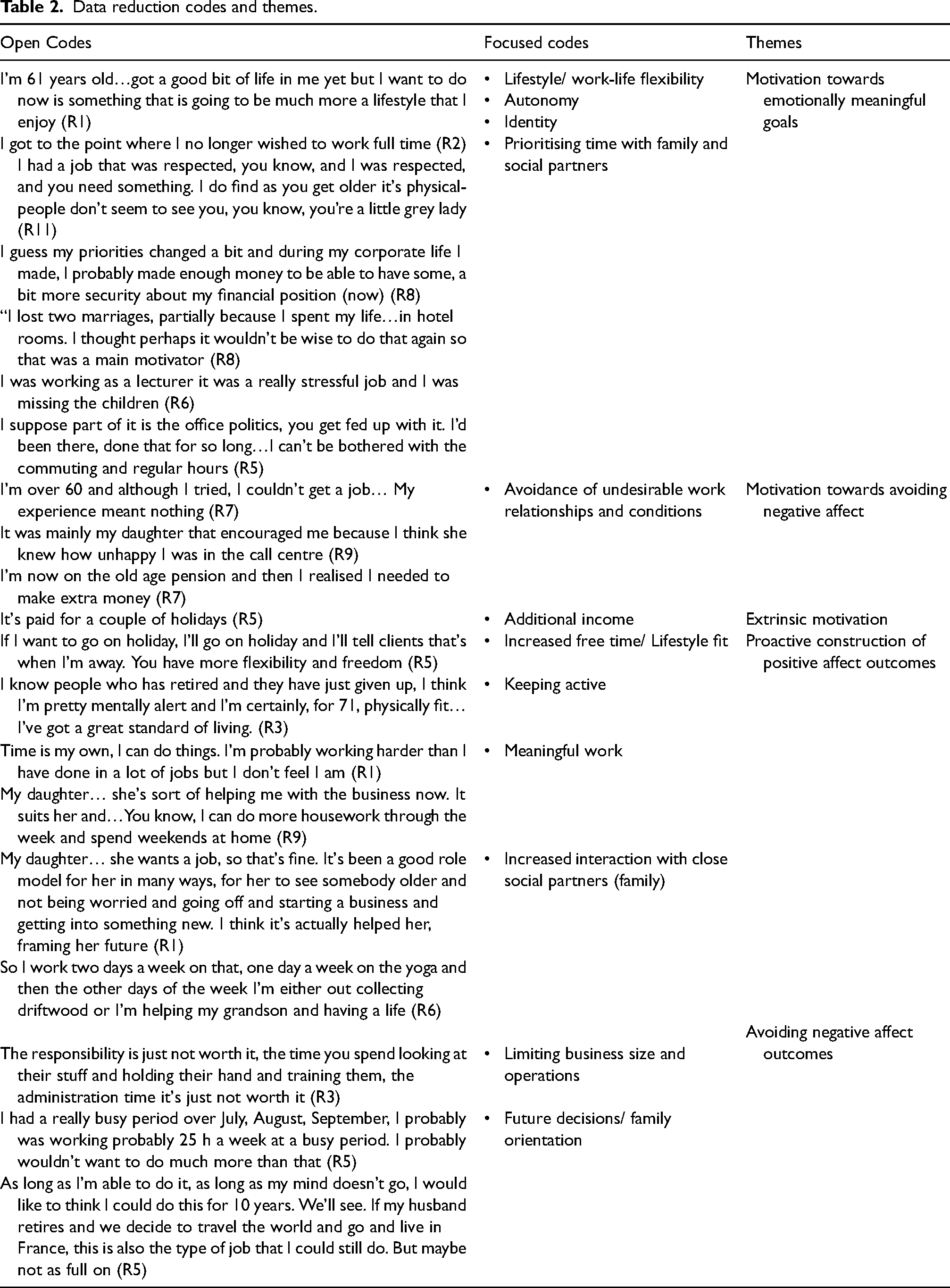
In addition, the research was underpinned by Lincoln and Guba’s (1985) criteria for trustworthiness, that is, credibility, transferability, dependability, and confirmability. The coherence of the perceptions and experiences expressed across the sample were indicative of a truth value of the data (Krefting, 1991) and thus, its credibility. The description of the data, with a focus on gathering and presenting rich data about the unique experiences of the sample and their perceptions and experiences of business creation, motivations, and affective value, facilitates comparison to other contexts and thus aids transferability. The variability of the experiences of the sample are expressed and captured in tables, enhancing data dependability (Cloutier and Ravasi, 2021). Confirmability is evident in the presentation of the data which conforms to truth value and transferability criteria (Krefting, 1991). Finally, working with deep and rich descriptive findings, underpinned by trustworthiness (Nowell et al., 2017), was the motivating decision for the stratified process of thematic analysis as established by Miles et al. (2014). With regards to the potential for bias within the study, as the research followed a qualitative enquiry approach, it was recognised that the interviews undertaken were a social interaction and steps were taken by the research team to understand and respond to the complexities of such, including recognising our role as reflexive researchers (Roulston and Shelton, 2015).
Findings
When asked about their motivations for engaging in enterprise, respondents gave complex responses around changing priorities given their life stage. As per SST, motivations centred on achieving emotionally meaningful goals in working and family life. Given shorter time horizons, respondents noted the importance of proactively avoiding engaging in activities that produce negative affect and proactively constructing enterprise to produce positive affect for themselves and close social partners (e.g. family). In the following sections, we set out the findings that explore these in greater depth.
Motivation towards emotionally meaningful goals and avoidance of negative affect
The evidence of affective goals included reference to commonly known, and not age-specific, intrinsic entrepreneurship drivers such as achievement and independence. In line with SST though, motivations expressed were specifically age-related and in opposition to future orientated goals of younger life. For example, for some the idea of more autonomy and freedom around life and work at a later life stage was found to be intrinsically rewarding: I’m 61 years old… got a good bit of life in me yet but what I want to do now is something that is going to be much more of a lifestyle or job that I enjoy (R1)
Respondents expressed that their life stage and financial security gained from a lifetime of fulltime employment had enabled a change in their priorities that focused on enjoying work in the present. With mortgages paid off and children grown, engaging in enterprise was a means to achieve both individual emotional and professionally orientated goals. These centred around being one's own boss and the autonomy enterprise enabled. Moreover, several respondents referenced the value of maintaining a professional role and identity in older age. R11 and R4 illustrate: I had a job that was respected, you know, and I was respected, and you need something. I do find as you get older it's physical – people don't seem to see you, you know, you’re a little grey lady (R11),
I admire those people that just carry on working. A lot of people feel worthless once they’ve retired and their whole identity's been taken away from them (R4).
Improved financial circumstances also enabled the opportunity to leave full-time employment, and enterprise was used to avoid undesirable work relationships and conditions experienced in respondents’ earlier working life. Enterprise was expressed as an age-specific route to pursuing enjoyable and meaningful work, avoiding professional activities that produce negative feelings, and having more freedom to choose hours worked, as R5 eloquently describes: I suppose part of it is the office politics, you get fed up with it. I’d been there, done that for so long. I can't be bothered with the commuting, and I can't be bothered with the regular hours… I mean I’ll do work…[But] I can get breaks and go out for a walk at lunch time if I want to. All that flexibility of being in charge of your own hours and your own things that you’re doing (R5).
In terms of drivers that relate specifically to family, as noted, Study 2 sample selection was based on participants’ assertion that family was at least a part of the rationale to start the business or become self-employed. Desire to contribute to close family relationships was cited by all, and for some it was the main reason for deciding to pursue entrepreneurship. R9, for example, was motivated to enterprise to allow her to spend more time with and care for her elderly mother, a role that was simultaneously considered a duty and emotionally rewarding. Similar affective desires to contribute were expressed across respondents who had roles as parents to grown-up children, and this was again expressed as both a responsibility and as a joy. In some of these cases the choice to pursue enterprise was based on a lack of flexibility in employment to fulfil this family role and the recognition of making more selective choices inside and outside of work. R6, for example, stated explicitly that she was driven to start-up as the jobs available in the market did not provide her with the flexibility that she needed to support her daughter with childcare or to spend quality time with her grandson.
The desire to spend more time with one's partner in older age was also referenced. In some cases, this reflected a desire for more time at home or leisure, such as R8 who wished to spend time at home with his new wife. He stated that his previous relationships had suffered due to his busy work schedule, having reflected on past events he decided to spend quality time with his partner as he believed “it wouldn't be wise to do that again so that was a main motivator” (R8). There was similar evidence of prioritising spousal relationships in older age with some respondents keen to work alongside their spouse. As per SST, this was a strategy used to increase affective value together through enterprise as well as contributing to the family unit financially, as exemplified by R4's comments: I think because we both want the same things; I think you keep each other going. I don't think either of us could do it separately. But because we’ve got that team effort it keeps us motivated…Working for ourselves is good and because we’re happy as a couple that makes a big difference (R4).
Alternatively, R11's enterprise was created to augment an existing family business (a farm) by diversification. However, it simultaneously afforded the ability to realise affective age-related personal value and fulfil other roles too. R11's agritourism business generated income, supplemented the wider family farm, and enabled her to be ‘on site’ to provide other contributions to farm operations and family life. She described the situation thus: Well, my husband was sixty-six and I was just sixty… So, we just went for it… But the idea is that I could help, I could buy a few cows or something like that, you know, kind of subsidize the dairy side of the business with any profits, and… be, you know, everything that goes with being a housewife. It's very hard to separate the two things (R11)
Extrinsic motives, which include financial concerns, were reported but were a priority for only two of the participants in the sample: R4 and R7. Even so, for R4 and R7 entrepreneurial motivations were balanced between the financial need of supplementary income and how this could be achieved whilst pursuing intrinsically rewarding pursuits. Given limited time horizons financial motivations were based on present needs and not on future orientated financial goals as may be the case in younger age, as R7 illustrates: I’m now on the old age pension and then I realized I needed to make extra money… It works for me because I’ll work when I want to work, and I’ll work for as long as I want to work […] I don't want to commit myself to five days or seven days (R7).
More often, income was described as supplemental to pension and ‘extra’ contributions that could be utilised for spending time with family, “Its paid for a couple of holidays” (R5) and providing financial support to adult children “It's just a bit of money that I can put to one side, and I can support both my daughters when they are at university” (R6).
In this study, enterprise motivations were reported as a means by which to increase positive affect or decrease negative affect whilst combining work and life in older age. This suggests consistency with SST in terms of observable affective drivers that are peculiar to older age and the specific choices made to enhance these emotional goals and reduce work activities that produced negative affect. These findings illustrate, among these participants, the ability to be of value and of service to family wellbeing (including each-other) was a key motivator of the choice to work in an enterprise context; wider family-related aspirations and roles were observable as entrepreneurial drivers. These findings provide additional, and important, nuance to understanding of older entrepreneurial motivations and their function in enterprise creation. The ongoing effects of this on the enterprise activities that ensued are discussed next.
Proactive construction of positive affect outcomes
Evidence in the testimonies of participants identify that the affective and family-based motivations that prompted enterprise as a work choice were also key shapers of the business model and ongoing operations. In terms of mode of work, all the participants described themselves as part-time and/or operating flexible working hours. The ability to control work effort and commitment, including the ability to alter these, was a recurrent assertion. For example, of her editorial business, R5 states: As long as I’m able to do it, as long as my mind doesn't go, I would like to think I could do this for 10 years. We’ll see. If my husband retires and we decide to travel the world and go and live in France, this is also the type of job that I could still do. But maybe not as full on (R5).
In addition, and contrary to conventional wisdom, there was testimony from most of the participants that asserted a wilful intention to limit business operations and growth. The following exemplify: I just try to keep everything within limits so I can enjoy doing the work and it doesn't become too much (R6)
I’m happy with what I’ve got. I know that I could let it grow a little bit… but I like doing a bit of sewing for myself and I like gardening and just pottering about… (R9).
Consistent with SST, these respondents specifically sought to reduce financial orientated future endeavours related to their enterprise and instead chose to enjoy present intrinsic and affective orientated outcomes by limiting business operations to enjoy work at their own pace. Corroborating this, some testimonies suggested that even when financial performance is weak, the will to maintain the firm prevails. In the case of R6, for example, although not particularly financially successful, she will maintain her business because of her personal enjoyment of the work: I won't ever let the business go completely. I’m only doing it one day a week at the moment and I’m looking to do festivals next summer…I enjoy the work so much that I don't want to let it go (R6).
Since R6's business was not generating profit or income commensurate with traditional interpretations of business, this appears to defy economic rationality. Nevertheless, R6 was working and trading and so while financial return was limited, her activities are still definable as business enterprise rather than a hobby or pastime. The value for R6 was measured entirely in affective ways with business activities constructed around achieving emotionally meaningful value.
Reference to family-based influences on business model extended to all participants in some way or other. All the enterprise undertaken by participants in this research was observed to be contributing to family. As outlined previously, R11's reasons for, and ongoing experience of, her agritourism business are entirely embedded in her family and family firm context. Consequently, the business model choice and ongoing operation are similarly embedded. Elsewhere, there was evidence that the desire to be with, and be of service to, members of family extended also to business model choice. The choice to maintain flexible hours and autonomy asserted by all participants, for example, most often referenced either an age-related fulfilment of family roles such as grandparent, or to spending time with a spouse, or both. There was evidence also of enterprise providing wider service to family. As an artisan distiller, R1 for example, explains how his wider family simultaneously contribute and benefit from his entrepreneurship: She's hugely supportive [his wife] and has got a fine palette of nose to help product development… My daughter also thinks it's great and she wants a job, so that's fine. It's been a good role model for her in many ways, for her to see somebody older and not being worried and going off and starting a business and getting into something new. I think it's actually helped her, framing her future (R1).
In all cases, the drivers and outcomes of the older entrepreneurship observed were a mixture of factors, and all were highly embedded in life, personal value, and family. R9's experience exemplifies the embedded and complex intertwining of work and life priorities that were facilitated. R9's craft production business afforded the ability to provide care for her elderly mother, facilitated leisure time at home and with her husband, and provided the opportunity to give her daughter (a student) work and work experience as “she's sort of helping me with the business now. It suits her.” R9 also enjoyed the work and felt fulfilled by the opportunity to be creative in a work context that she was able to control in terms of time and capacity, which enabled a balance between work and her other hobbies and interests, such as gardening. Consistent with SST, in her case, as with all the participants in this sample, the choice and experience of enterprise provided age-specific affective value and, by adopting a business model commensurate with her antecedent aims and conditions, it served both individual and the embedded family context well.
Discussion
This research sought specifically to answer the three key research questions:
As per RQ1, the value attributed to anticipated affective returns that motivated the choice to become an entrepreneur later in life were evident amongst this sample. Specifically, as per SST that proposes that attitudes, ambitions, and desires change as we age (Carstensen et al., 1999; Carstensen et al., 2003), there was evidence of this throughout the testimonies in this research. As R4 directly describes it: “As I get older, I find I want less and less belongings, less and less things. They’re not important. When you’re younger you want more, and you want the latest gizmos and things. It doesn't necessarily make you happier” (R4).
In turn, every participant drew a connection between affective rewards and their participation in older entrepreneurship, a finding which is supported by existing family firms literature (El Shoubaki and Stephan, 2018). To illustrate, Table 1 gives a summary of the value most prioritised for each participant. While R4 and R7 do include a need to achieve income to live on, like all the others, they chose enterprise as the means to do this because of the age-related affective benefits they might reap. The attitudes to their business, and evidence that capacity is deliberately small suggests the value of starting, and the value of prevailing, is not economic for the most part, supporting the critiques of economic orientation offered by Tedmanson et al. (2012) and Welter et al. (2017). For these older participants, there was clear suggestion that the affective value they could realise by enterprise represented a reprioritization of economic or financial value, and as per RQ2, it was family-based and other affective socio-emotional benefits that underpinned the creation and ongoing sustainability of business. Enterprise afforded them a quality of life whereby work/life balance, wellbeing, and other affective contributions to personal and family value could be realised. As such, the evidence also locates the value sought and realised well beyond the boundary of the firm, findings which resonate with the Theory of Venturing (Galloway et al., 2019), the work of Stirzaker et al. (2019), and move the conversation beyond some existing understandings of family entrepreneur motivations that prioritise financial value amongst others (e.g. Krueger, 2009; Goel and Jones III, 2016; Bloemen-Bekx et al., 2019). Thus, contrary to the presupposition that family services business for principally economic return, the research reported here shows there is value to exploring entrepreneurship as a vehicle for social and economic value and that value might refer to firm, to individual, and to family simultaneously.
In relation to RQ3, from a business models perspective, understood to mean how a business is structured to realise and release value, these older entrepreneurs often knowingly designed or ‘modelled’ their business around a core logic that enhanced affective emotional experiences and supported their immediate family-orientated socio-emotional wellbeing. In all cases, family was front and centre; in this study the socio-emotional drivers reported consistently overlapped with family-orientated goals, contributions, and outcomes. This would align with SST as personal goals are directed towards strategies to engage in activities that enhance positive emotional affect and meaningful interactions with close social partners (Carstensen et al., 1999; Carstensen et al., 2003). The multiple family-orientated contributions discussed by participants indicate the complexity of the way in which a business intersects with family requirements and outcomes sought. Thus, value was personally defined in relation to specific individual intrinsic and family-related drivers and these informed and shaped the business and its business model. Consequently, the enterprise as an entity was not the sole focus; rather, enterprise was designed to be inclusive of and responsive to extramural family interests, and business, life, and family were entirely embedded. This finding supports SST theory as the personal motivations for this sample were changed by their time horizons.
Implications for entrepreneurship theory and research
By applying Carstensen et al.'s (1999) socio-emotional selectivity theory to explore the orientation and contributions of the older participants included in this analysis, we depart from economic theory and suggest greater diversity of enterprise drivers is revealed which allow for alternative explanations and outcomes of older entrepreneurship. Corroborating Wainwright and Kibler (2013), there is a clear link between the changed priorities of these older individuals and their choice to become entrepreneurs in later life, and evidence of enterprise being prompted, at least in part, by affective age-related socio-emotional ambitions. Alongside affective drivers, SST also illuminates that the rewards sought and achieved by participants were based on an immediate positive affect and were acknowledged as age-specific and a departure from the types of rewards sought in earlier stages in life. In addition, there was repeated mention of relationships and enjoying one's life in older age, again consistent with SST The research in this paper thus corroborates previous studies that have explored enterprise through an SST-informed lens (e.g. Stirzaker et al., 2019). This research, therefore, presents new data that exposes that, for some older people, family-related influences and changed perceptions of time are embedded in the behaviours that underpin older-age entrepreneurship. For the older entrepreneurs in this research, the family-based affective value of their enterprise complemented and even transcended the value of financial self-interest or growth. This research demonstrates that the affective underpinning of some senior entrepreneurship is both prompted and informed by perceptions of, desire for and contribution of family roles in later life, such as carer, spouse, and grandparent.
Implications for policy and support
Policy and support currently assume that an economic rationale underpins all enterprise. This research finds that older entrepreneurship may be driven by and result in family-related and other affective outcomes that are prioritised in line with, or even above, financial returns. That being the case, support and policy that seeks to promote enterprise amongst older people may be informed in two important ways. First, whether financial returns are mandated for an older person who seeks to start a business, the likelihood is that it is selected at least in part because of its affective attractions. Second, since immediate positive experiences are given greater priority by older entrepreneurs than by entrepreneurs in other age-groups, a specific, tailored approach is implied. Most appropriate for some older entrepreneurs is policy and support that is cognizant of the reasons why enterprise is pursued, why it is maintained, and what value is being realised for the entrepreneurs and their families. This research suggests that even amongst those who are in it for the income, the affective outputs are of such value that any financial development potential may be of little interest and may be deliberately avoided lest it impacts negatively on socio-emotional family-based returns. If the point of an older entrepreneur's business is intended to service personal and family sustainability, there is little point in support and policy efforts that make exclusive focus on business growth and development.
Conclusion
The paper examines entrepreneurship motivations in older entrepreneurs and the importance of affective-motivations on business model value-related decision making. It makes two key contributions. First, by applying SST rather than an economic lens to the drivers and experiences of older entrepreneurship, the study finds in response to RQ1 and RQ2 that it is specific age-related affective rewards that make contribution to both personal and family wellbeing that are observed to have greatest priority. For the entrepreneurs in this study, enterprise was a means to construct their social environments in a way that maximises the potential for positive affect and minimises negative affect in work and family life at an older age. In fact, the findings of this research evidence that the choice to start a business can be driven by affective motivations, as per SST, as well as and its anticipated wider utility for family. Second, and in relation to RQ3, affective drivers are found to affect the business models adopted and the trajectory of the enterprises created. The embedded nature of the older entrepreneurship observed here in terms of being a feature of, and contribution to, personal wellbeing and family life informed business models and ongoing operations. Consequently, businesses were kept small and flexible in a deliberate attempt to make sure affective rewards were protected and so that contributions could be made beyond the boundaries of the firm. These contributions included support for family that was socio-emotional and, for some, indirectly economically contributory through providing access to work experience, or more frequently, ‘free’ caring labour and thus offering an illustration of Gibson-Graham's ‘free economy’ (2006).
Like all research, however, the study reported in this paper has several limitations. It is a cross-sectional snapshot of the experiences of a small group of older entrepreneurs in one national context. As such, findings cannot and should not be generalised. There is no suggestion that the experiences of the sample reported here are representative of anyone other than themselves. In particular, the current study included only two in the sample who were entrepreneurs because they required the income for maintaining a living. This does not imply that economic necessity is rare amongst older entrepreneurs, just that it was the case for only two people in this sample. Nevertheless, even for the two for whom financial necessity was a feature, the choice to pursue enterprise was underpinned by perceptions that they could be in work and achieve the affective family rewards they sought.
To conclude, the enterprise activities in this sample are structured in such a way as to provide the individual and their family with an idiosyncratic range of affective value. In a departure from previous understanding of the role of family in contributing to business modelling and success, this paper exposes a group for whom the circumstances were juxtaposed. In these cases, enterprise was prompted and modelled, at least in part, to enable service to the family, and the trajectory of contribution was that the business enabled personal and family outcomes, rather than the other way around as often presupposed.
Supplemental Material
sj-docx-1-iei-10.1177_14657503221114014 - Supplemental material for Organising family and business: Affective value prioritisation amongst older entrepreneurs
Supplemental material, sj-docx-1-iei-10.1177_14657503221114014 for Organising family and business: Affective value prioritisation amongst older entrepreneurs by Rebecca Stirzaker, Isla Kapasi and Laura Galloway in The International Journal of Entrepreneurship and Innovation
Footnotes
Declaration of conflicting interests
The author(s) declared no potential conflicts of interest with respect to the research, authorship, and/or publication of this article.
Funding
The author(s) received no financial support for the research, authorship, and/or publication of this article.

Supplemental material
Supplemental material for this article is available online.
References
Supplementary Material
Please find the following supplemental material available below.
For Open Access articles published under a Creative Commons License, all supplemental material carries the same license as the article it is associated with.
For non-Open Access articles published, all supplemental material carries a non-exclusive license, and permission requests for re-use of supplemental material or any part of supplemental material shall be sent directly to the copyright owner as specified in the copyright notice associated with the article.
