



Abstract
Despite increased importance of SEs in the global marketplace, limited research in social entrepreneurship addresses internationalization, and fewer from a behavioural perspective. We fill this gap by investigating the SE manager’s behavioural attributes and their influence on the decision of social entrepreneurs to become international social entrepreneurs (ISEs) through an exploratory design using content analysis and interviews. All social entrepreneurs were driven to address social change by a strong social conscience; however, this research finds that ISEs shared an urgent and personal call to action. This sense of urgency developed from transformative experiences that altered their views of the world and their place within it. Domestic social entrepreneurs were motivated primarily by their social conscience, shared background, and the timing of the social enterprise opportunity, factors previously identified in research.
Introduction
Organizations that create social value through innovative, market-based approaches are referred to as social enterprises (SEs) (Zahra et al., 2009) and are founded and managed by social entrepreneurs. SEs vary widely by size, scope, and legal definition and can be classified as non-profit or for-profit; however, they have become widespread in both research and practice (Bosma et al., 2015) and have been compared to the Economy for the Common Good (Campos et al., 2020), with its focus on balancing economic, social, and environmental outcomes.
SEs have a strong local community orientation and are embedded in their local context, often filling institutional voids (Mair and Marti, 2006); however, SEs impact not only local markets and social support services, but increasingly cross borders to engage with beneficiaries and consumers regionally (e.g., McKague et al., 2014) and globally (Chen, 2012). Globalization trends including free trade agreements and increased technology and communication allow for small and medium-sized businesses to participate in the global economy (Cavusgil and Knight, 2015); however, this is not only the case for for-profit businesses, but small and medium-sized social actors have also become active in the global marketplace where socially-oriented products and services are needed (Lundan, 2018). Therefore, international social entrepreneurship, as defined by Tukamushaba and colleagues (2011: 286) is “…creatively discovering and exploiting social entrepreneurial opportunities overseas, with the application of business expertise and market-based skills, with innovative social goods and services, either with or without profit orientation, but with the pivotal objective of creating societal value rather than shareholder wealth in the overseas territories where the enterprise functions”. The internationalization of business has tremendous risks involved, such as differences in language, culture, laws, and institutions (Yang and Wu, 2015). Such factors increase the level of uncertainty and potential for failure. As a result, internationalization can be an extremely risky and expensive undertaking. Thus, considering the limited size and resources of entrepreneurial endeavours, with the dual mission of the SE, it begs the question of why social entrepreneurs would seek international markets.
Although research on SE from an international perspective has recently received more scholarly attention, such as the 2020 special issue of the Journal of World Business, little is known about the internationalization of such organizations (Alon et al., 2020; Chen, 2012). In fact, in the introduction to the special issue, Alon and colleagues (2020: 1) note, “…research on SEs and their international activities is scarce and our understanding of various cross-border aspects of such organizations remains limited”; however, research on the behavioural drivers of international social entrepreneurs (ISEs) is even more scarce and warrants attention.
Earlier research suggests that SEs are created to support people from the same social backgrounds as the entrepreneurs (Bromiley, 2005); however, this may not explain the ISEs, unless they too had an international background from that country. In the behavioural tradition, Aharoni (1966) emphasizes decision-makers’ personal motives in the internationalization process, which has been identified as “highly relevant to SEs” (Alon et al., 2020: 2). Additionally, this behavioural approach found in much of international entrepreneurship literature “appears to be well-suited to explain why SEs internationalize their activities” (Alon et al., 2020: 2). The authors add that “there is a need for research that focuses on the entrepreneurs/managers of SEs and their cognitive qualities used to frame, identify and evaluate opportunities across borders” (2020: 3).
Thus, the purpose of this paper is to explore the behavioural influence on the internationalization of SEs. Specifically, our primary exploratory research question is:
What behavioural drivers influence social entrepreneurs to be international social entrepreneurs?
Using an exploratory research design, we conducted a preliminary content analysis of the behavioural dimensions of SE leaders’ profiles followed by a grounded theory analysis of key informant interviews with international and domestic SE leaders. We find that while both domestic and ISEs are driven by a strong social conscience and desire to make the world a better place (Dees and Elias, 1998), the ISEs were sensitized to the suffering of marginalized populations through a transformative experience, compelling them to react out of a deep sense of responsibility and urgency. In particular, the findings of this study indicate that there may be two pathways to social entrepreneurship: one domestic, where the social entrepreneur is driven by a social conscience, shared background, and timing of the opportunity, and the other international, where the ISE is driven by the urgency of the situation after being sensitized to suffering of distant others through a transformative experience. This research considers the micro-foundations and the various aspects of social consciousness of the international and domestic SEs.
Conceptual background
Social entrepreneur behavioral research: a brief review of the literature
Limited SE research addresses internationalization, particularly from a micro perspective. Thus, two relevant streams inform our research question. First, we turn to the literature on social entrepreneurship to inform our research on SE leadership. Second, we turn to the internationalization literature that has documented the many drivers, processes, and outcomes of internationalization, although these may vary due to the inherent differences between SEs and the for-profit organization
Social entrepreneurs are described as having continuous innovation, adaptation, and learning, acting boldly without being limited by resources currently in hand, and accountability to the constituencies served and for the outcomes created (Dees et al., 2002). While this appears to be consistent with domestic and ISEs alike, there is limited academic research on the ISE.
Early ISE researchers (Tukamushaba et al., 2011) propose that international social entrepreneurial behaviour is a result of cognitive and emotional attitudes, supported by a case study of a Ugandan SE. Other conceptual research categorizes social entrepreneurs based on the extent of the intended social impact (Zahra et al., 2009). These studies offer important insights into the field regarding the internationalization of SEs; however, additional research is needed to evaluate the internationalization decision from the micro perspective.
Other empirical research on SE leadership is outlined below according to their traits and characteristics, motivations, and resources. Much of the literature in this area focuses on traits and characteristics of social entrepreneurs (e.g., Cherrier et al., 2018; González and Martínez, 2020), the motivations of the social entrepreneur (e.g., Chikha and Jarboui, 2016; Estrin et al., 2016), or the resources, such as social networks (Servantie and Rispal, 2018), innovativeness (Hechavarría and Welter, 2015), and the use of bricolage (Bacq et al., 2015). The largest of these areas is that of entrepreneurial traits, unique competencies, personal values, and virtues (Cherrier et al., 2018; González and Martínez, 2020).
In summary, while research on the SE manager is growing and covers a range of important topics essential to SE research from social networks to country of origin, so far none has investigated the SE manager’s behavioural attributes as reflective of the internationalization of the SE.
SE internationalization
The most relevant research to SE internationalization remains conceptual and in need of empirical support, such as Chen’s (2012) conceptual framework using social exchange theory, or focuses on single-country studies. Zahra and colleagues (2008) speculate that social entrepreneurs internationalize out of a concern for the well-being of others around the world and indicate that there are five determinants of international social ventures, including the radicalness of the solution, the prevalence of the need, the relevance of the issue to the entrepreneur’s experience or skills, the urgency of the issue, and the level of difficulty of addressing the need through traditional mechanisms.
Empirical research on ISE focuses on the institutional logics perspective, including foreign entry and adaptive behaviours of the SE, such as their response to governmental, commercial, and social institutions in foreign markets (Stephan et al., 2015). Many researchers find that although global forces are at play, SEs operate in a locally embedded context and adapt to fit the specific local institutions (Cherrier et al., 2018; Stephan et al., 2015). Additional research finds that different factors influence social entrepreneurial intentions between Chinese and Americans (Yang et al., 2015). Others cite the local environment’s socioeconomic development (Méndez-Picazo et al., 2015) or female migration (Jones et al., 2018) as conducive to SE activity. Some also claim that the ability of SEs to respond to environmental and consumer changes is a precursor to success (Sharir and Lerner, 2006), while others have developed SE business models (Lee, 2015) and scaling factors (Walske and Tyson, 2015). However, while this research develops our knowledge of SEs in various contexts, none aids in our understanding of their internationalization.
Research on profit-focused business consistently finds support for traditional internationalization theories (e.g., Barney, 1991; Johanson and Vahlne, 1977); however, a basic assumption of this paper is that SEs are inherently different from profit-oriented companies as it relates to internationalization, and we provide several reasons for this assumption. First, this discrepancy lies in the profit- versus social-orientation of the two forms. SEs seek to create social value over increasing profits or decreasing production costs. Therefore, their motives for entering a new market are likely to be different from the economics and resource-based views in IB theory (Mersland et al., 2020). SEs may enter a new market out of the social need of that community, rather than the low cost of labour or access to natural resources.
Second, as has been evidenced from previous research, SEs have a variety of organizational forms (Barnard, 2019). Ranging from nonprofit SEs that bring “business expertise and market-based skills to the nonprofit sector” (Barnard, 2019: 2), to a profit-generating enterprise with a social focus, to a larger umbrella term where social change overshadows any legal or sector structure. Such a wide variety of ownership and governance structures would indicate different decision-making processes. Research shows that while most large nonprofit organizations do eventually internationalize, most go to countries of medium-level institutional strength to affect significant change while avoiding the most dysfunctional environments (Sirisena and Shneor, 2018). This contrasts with traditional MNC research, finding that MNEs prefer institutionally close locations over those that are more distant (Xu and Shenkar, 2002). Therefore, we expect that SE internationalization, as it relates to institutions, differs from that of profit-oriented companies.
Third, uncertainty avoidance and organizational learning, essential elements to the traditional Uppsala model of internationalization, likely do not have the same influence in SE internationalization. SEs may be more motivated to enter a new market based on the urgency or prevalence of the need (Zahra et al., 2008), regardless of the level of uncertainty or organizational experience.
The above research coincides with for-profit international entrepreneurship research suggesting that internationalization depends on factors including entrepreneurs’ knowledge and networks (Oviatt and McDougall, 2005), among other factors. However, social entrepreneurs are distinguished from commercial entrepreneurs is their motivations and intentions for doing good in society rather than by financial gains (Zahra et al., 2009). Therefore, because the SE literature lacks an answer to the internationalization question, we turned to the IB internationalization literature. However, this area of inquiry cannot adequately explain the internationalization of the SE either due to the differences outlined above in addition to the influence of the social entrepreneur herself.
In summary, while substantial research in management and entrepreneurial studies evaluates SEs and their founders (e.g., Estrin et al., 2016; Muñoz and Cohen, 2018), little attention has been given to the internationalization of SEs and their leaders. While research has found that personal experience with a particular social issue inspires social entrepreneurs (Mair and Noboa, 2006), most of the research in this area is context-specific. Many SEs cross borders; however, research does not attempt to explain why some social entrepreneurs choose to go international while others remain domestic.
Methodology
Because of the lack of research on the internationalization of SE, an exploratory qualitative research design is warranted (Edmondson and McManus, 2007). We conducted two stages of analysis to triangulate findings from different data sources. The first stage consists of exploratory content analysis of the online profiles of SE leaders to obtain initial assessment of possible relationships and concepts and to establish a basic framework for further analysis, which was triangulated in the second stage interviews with top decision-makers of domestic and international SEs in the United States. Research indicates that a nation’s institutional and socio-economic history are responsible for the model of SE employed in each country (Kerlin, 2012). The United States and European models differ significantly, with the European model focused primarily on issues of public services, and the U.S. model incorporating a more market-oriented social goal (Defourny and Nyssens, 2006). As this research attempts to develop an initial substantive theory for a specific phenomenon in a particular place (Locke, 2000), the sample for this content analysis was limited to SEs with their headquarters located in the United States. See Figure 1 for an overview of the methodological process.
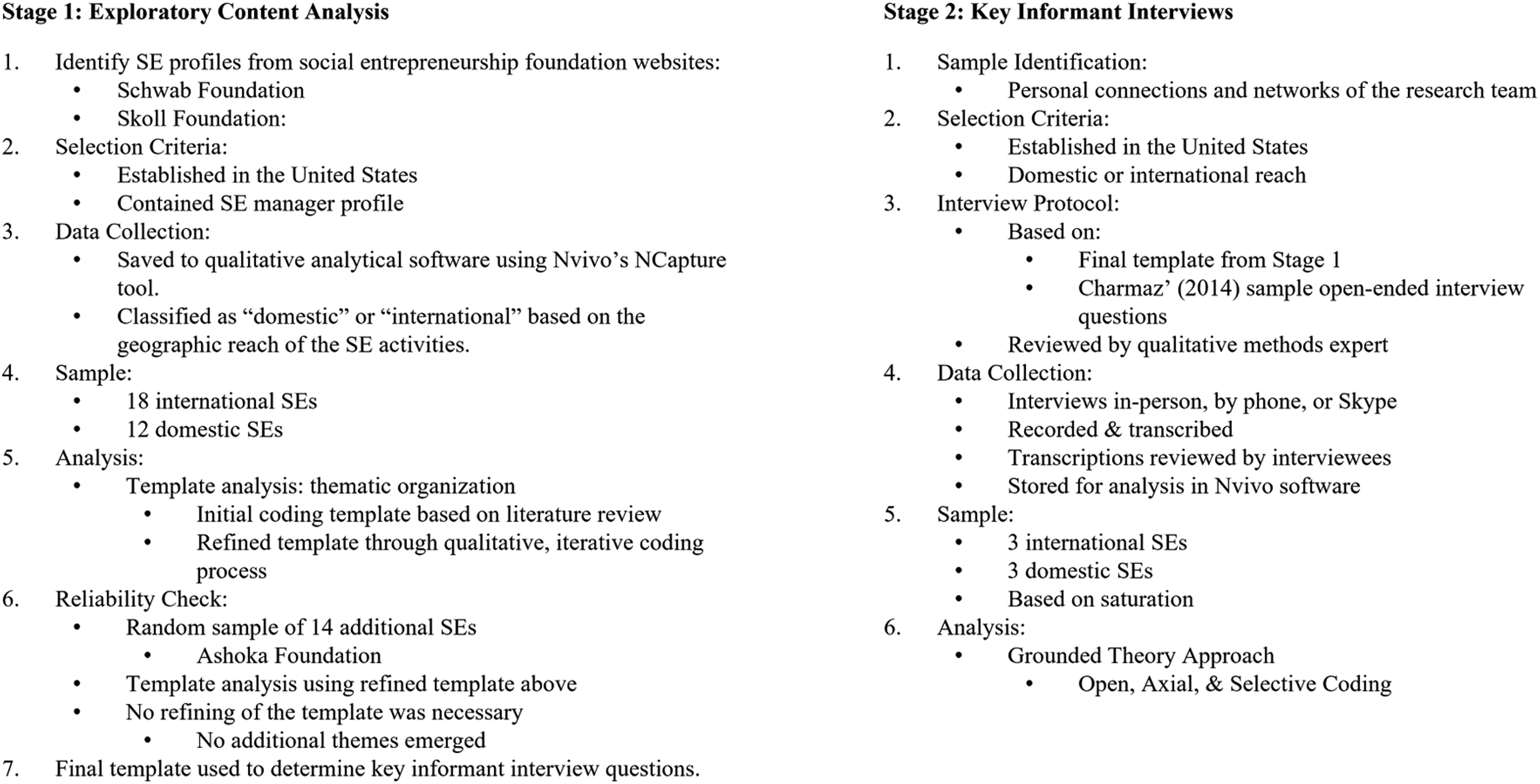
Methodological process.
Phase 1: exploratory content analysis
Because of the lack of research on the internationalization of SE, qualitative research design is warranted (Edmondson and McManus, 2007). We chose content analysis because we aimed to explore drivers of internationalization from a behavioural perspective (Nandy and Sarvela, 1997). An advantage of qualitative research is that it “can be used to obtain the intricate details about phenomena such as feelings, thought processes, and emotions that are difficult to extract or learn about through more conventional research methods” (Strauss and Corbin, 1998: 11). The results of the content analysis informed our interview questions with SE managers for the subsequent stage of analysis.
The profiles of SEs and their managers displayed on the websites of leading social entrepreneurial foundations (The Schwab Foundation and The Skoll Foundation) were chosen for this analysis as the data was easily accessible, contained profiles for domestic and ISEs, and provided a source ideal for identifying commonalities in the backgrounds of SE managers. All SEs headquartered in the USA were identified from the Skoll and Schwab Foundation websites for this analysis. Twenty-one international and 15 domestics fulfilled this criterion; however, six did not have sufficient information on the background of the manager and were removed from the analysis. In total, 18 international and 12 domestic SEs were examined.
An analysis using the template analytical framework (King, 2004) was utilized. Template analysis uses a list of codes, or template, based on prior research or theory, for “thematically organizing and analyzing textual data” (King, 2004: 256) in a “contextual constructivist approach” (King, 2004). Some codes were determined a priori and modified based on the reading and interpretation of text, while others are added or removed during this process (King, 2004). Concepts identified in our literature review inspired the initial template, which was revised with the collection and analysis of additional data through an iterative process. We worked through the text systematically identifying parts relevant to the research aims and coding them according to the initial template. Codes were added, removed, broadened, or narrowed until clarity and parsimony of the major themes were identified.
The exploratory content analysis resulted in an initial framework to inform and triangulate with interview questions with social entrepreneurs. The analysis of the managers’ profiles found support for the importance of personal experience to the SE, whether related to their upbringing and childhood, or later professional experience. In almost all cases a personal connection influenced the decision to become involved in the SE, regardless of the internationalization.
To validate and improve the reliability and triangulation of the initial findings of the content analysis, and to be sure that these findings would appropriately inform the interview questions, a random sample of 14 profiles from a third social entrepreneurship foundation, Ashoka Worldwide, was analysed using the final template approximately 2 months after the initial analysis. The SEs analysed in the second round also were founded in the United States and the original findings were largely confirmed; however, several new issue-areas were identified.
Findings of the content analysis are in Table 1. This finds support for the importance of personal experience with their activities with the SE, whether it was related to their upbringing and childhood, or later professional experience. In almost all cases a personal connection influenced the decision to become involved in the SE, regardless of the internationalization. On the other hand, we found that nearly all the international SE managers did share some commonalities, which we refer to as “international capital” and “global mindset”. For instance, most of the international SE managers either had some level of international background in their upbringing, such as being born in a different country or speaking another language, or they had had previous international work or volunteer experience. These individuals also shared what we describe as a global mindset, where they are motivated or influenced by the experiences of others who are from a different country or background.
Summary of content analysis findings.
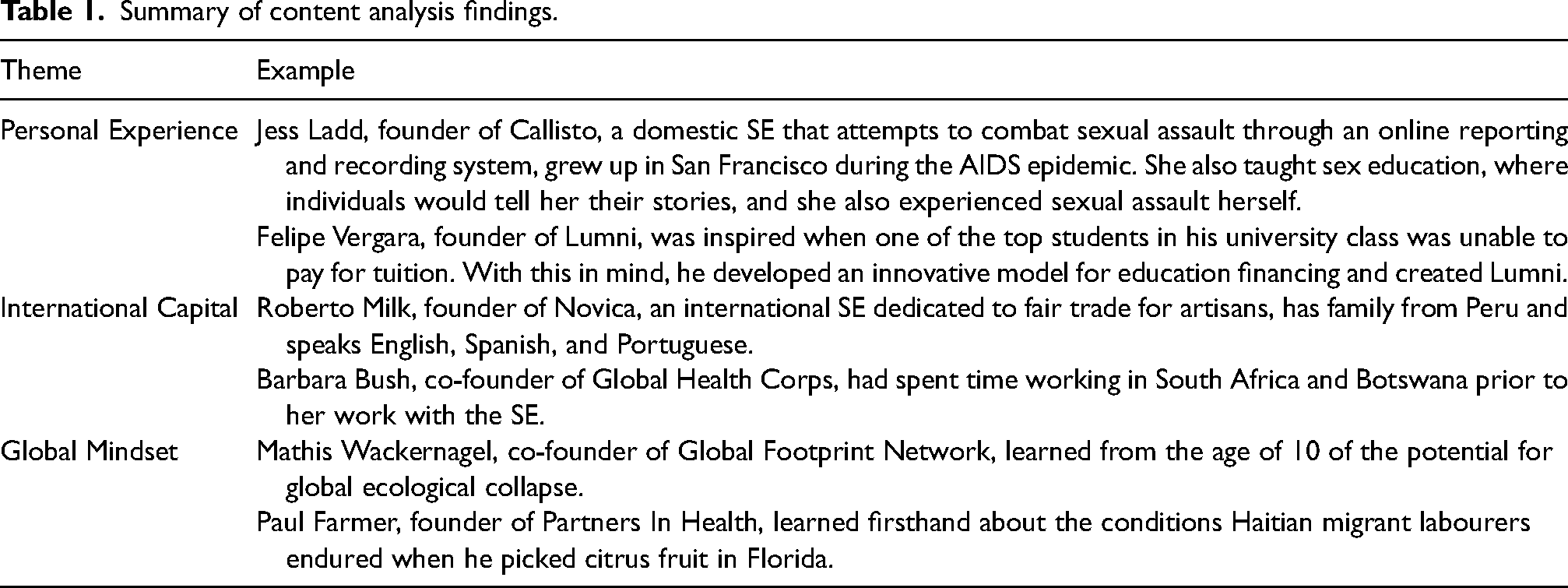
To summarize, we find that key elements of the managers’ lives and experiences influence the internationalization of the SE. Managers’ personal experience significantly influences their desire to help a particular social issue. Whether or not these experiences were international may lead to the internationalization of the SE.
Phase 2: qualitative interviews
In line with grounded theory research (Charmaz, 2014; Strauss and Corbin, 1998), the data for phase two comes from interviews with top decision-makers of SEs in the United States. Intensive interviews allow for flexibility and control, and the possibility for additional ideas and issues to develop and be followed up on. By communicating directly with those closest to the decisions, we gain depth of knowledge into the motivations and subjective bases for decisions.
Preparation for the interviews included reviewing the organization’s websites, as well as additional information about the SE manager that is publicly available online. Thirteen questions listed by Charmaz (2014), as well as relevant background information and the findings of the context analysis, were used to develop an interview protocol that allowed the interviewee to express his/her experience while also making sure to address the research topics of the study. The type and style of questions also changed as interviews were conducted and adjusted appropriately to suit the comfort and styles of the interviewees (Charmaz, 2014). An expert in grounded theory in Sociology was also consulted to further enhance the validity of the interview questions.
The sample consists of six SE managers, as individuals who have first-hand knowledge regarding the research topic (Charmaz, 2014). While some may argue that this is a small sample size, the appropriateness for a qualitative sample is, “a matter of judgment and experience in evaluating the quality of the information collected against the uses to which it will be put, the particular research method and purposeful sampling strategy employed, and the research product intended” (Sandelowski, 1995: 179). Furthermore, Kvale and Brinkmann (2009) emphasize that interview studies differ regarding the appropriate number of interviews necessary to address the research question, as well as the time and resources available; however, they note that most studies have around 15 + /- 10 interviews. Through the theoretical sampling procedures, beginning with domestic managers, followed by international managers, saturation was established as no new themes were garnered from additional interviews. Interviews were conducted in a semi-structured way to allow for depth, with the intent on capturing key elements related to the constructs of interest Interviews began with open-ended interview questions that could best answer the research questions, first with a broad-based approach, followed by narrower, more targeted questions (Charmaz, 2014). Examples of interview questions include: What contributed to the decision to go international? What were some key moments or key partnerships that significantly influenced the trajectory of the organization? Tell me about yourself, such as where you grew up, family life, education, or any other key people or issues that had a deep influence on you, as it relates to your work with the organization. Upon completion of the interviews, the digital recordings were transcribed, and a copy of the transcription was provided to each participant for his/her review.
A total of six leaders of SEs were interviewed. The social enterprise managers were mostly from, or connected to, the local area to facilitate in-person interviews and make use of the researchers’ personal networks and connections to reach these leaders. Selection criteria involved being a founder or top manager for an international or domestic social enterprise. Half of the sample was domestic, and half was international. Two of the managers were male and four were female, and ages ranged from mid-twenties to nearing retirement. The organizations varied in age, from over 100 years old, to only a few years old, and had a variety of missions, including healthcare, immigrant and refugee assistance, diverse books, clean water, conservation, and faith-based university student formation. See Table 2 for a summary of the sample information.
Descriptive information of interview sample.
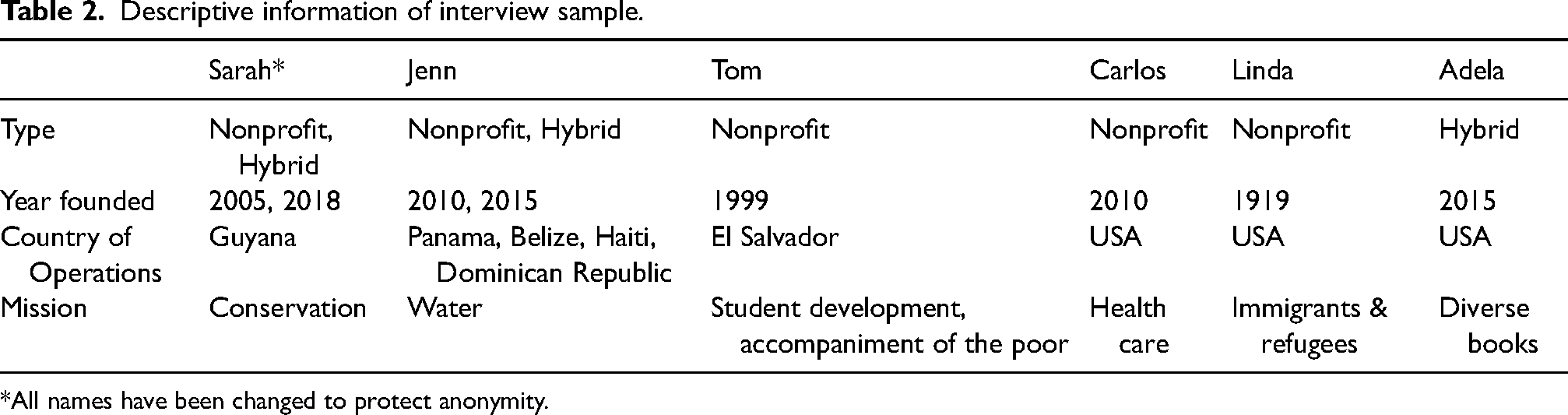
*All names have been changed to protect anonymity.
All interview data was examined and coded through a detailed, line-by-line analysis using NVivo software for data management and analysis. Attention was focused on statements relevant to the research questions, including attributes and motivations of the manager related to the SE. Next, in the axial coding process, larger categories were abstracted from the previous, naming the properties and consequences of each, and comparing and contrasting the domestic versus international SEs in constant comparison (Charmaz, 2014; Strauss and Corbin, 1998). Selective coding is done simultaneously with axial and open coding and its purpose is to identify the emerging core category that explains the behaviour under investigation. Here categories were integrated and refined, and concepts become interrelated and used to explain the phenomenon with a new theory. This stage identified the processes and relationships in the broader themes and questions. In this process, it is crucial to identify the core category, which has the power to “pull the other categories together to form an explanatory whole” (Strauss and Corbin, 1998: 146). The core category for this study was the urgency of the calling of the manager, which fulfils the above criteria.
Findings & discussion
International: transformative experience & urgent call to action
While our interviews covered a range of topics, including resources and skills of the managers, we found these issues to be less relevant to our research question. The international managers we interviewed had no previous experience or background in entrepreneurship or business administration, nor did they have extensive or influential networks to achieve their goals. Rather, through our grounded theory analysis we find the most substantive influence on this group of SEs was a transformative experience and urgent call to action.
A transformative experience with marginalized communities differentiates the ISEs from domestic SEs. All SE managers mentioned their upbringing and/or education that fostered a social conscience, which drove many of their daily life decisions; however, one factor that set apart the ISEs was the fact that they made a conscious choice to experience marginalized communities. Such experience aligns well with our content analysis findings of a “Global Mindset”, demonstrated by the ISEs’ interest in learning from people from a different background, and “Personal Experience”. Prior research on SEs indicates that social entrepreneurs share similar backgrounds with the communities served by the SE; however, this was not the case with the ISEs. Rather than sharing a similar background, the ISEs came from strikingly different backgrounds; however, they chose to explore marginalized communities during various parts of their lives. Each ISE indicated that those moments served as eye-opening events that transformed their way of viewing the world and their place in it. For instance, exemplifying the “International Capital” dimension of our content analysis, Jenn chose to go on a church mission trip to Panama as a teenager: And I went on a mission trip with my church, just like a really typical church mission trip. Like, built and painted houses, did Vacation Bible Schools, that kind of thing. -Jenn
International SE managers made a deliberate choice, in conjunction with the social conscience from their education and upbringing, that resulted in a transformative lived experience sensitizing them to the suffering and needs of others, particularly to those who are quite different from themselves. This sensitivity to the needs of others who often were not treated with common humanity, called the ISEs to urgent action despite no prior entrepreneurial or management experience.
Jenn described her reaction to learning that children in her Panamanian community often die before their fifth birthday due to lack of clean water and medical care, saying “it just didn’t sit with me”. The situations that they witnessed abroad, such as a lack of access to clean drinking water, would not likely be found in the United States without public outrage and people jumping to action. Here, Jenn is called to action based on her experience. She noted the effect of seeing children suffering from preventable diseases, and her use of the phrase, “it just didn’t sit with me” indicated the social conscience guiding not only her decisions but the way that she processed the experience. Jenn also was quite aware of her conscience and desire for change. She noted how she felt a strong desire to affect change upon witnessing an injustice. I cannot see something that is … unjust, and not do anything about it. I have to do something about it. Otherwise, I’m just like, have this tension built up, and I can’t be at peace about it. So that’s kind of how [it] started. It was that initial trip seeing that firsthand and feeling like, ‘I have to do something.’
Similarly, through her work efforts beginning with literacy and expanding into eco-tourism and home furnishings, Sarah became quite aware of the inequalities among the people she supported. She states, And these indigenous folks are a minority in their own country. They’ve been completely swallowed up by a colonial agenda. And … um, they have nothing. And, or next to nothing. And they have no status in their own country…
Thus, as she contemplated where to begin, she ultimately decided on literacy, as only one percent of students were able to graduate from primary school annually. However, as her programme succeeded, Sarah quickly realized the consequences of teaching people to read. She found that those who became educated needed jobs to stay in the local community, thus fulfilling the conservation mission. Therefore, she was compelled by her urgent mission to preserve the communities and influenced by her experience with these marginalized communities.
Despite lacking a shared background with the served communities, these leaders felt strong dedication to the communities that resulted from their lived experiences and the passion and sense of responsibility they feel for helping those in need. For example, Sarah lived and worked with the people; Jenn spent a period with her Panamanian community, and Tom, although he had not been to El Salvador, felt a shared identity with the country of El Salvador and the martyrdom of the Jesuit priests. Each of these events and experiences was deeply personal and inspiring to the interviewees. Such lived experiences made what was once abstract (the lives of marginal community members) into a concrete understanding with names and faces. Because of the personal connection to the specific location (Panama, Guyana, and El Salvador), these leaders started from the “ground-up,” first having been sensitized to the suffering of distant others through transformative experiences, and then driven by their sense of urgency and responsibility to help those in need, despite their lack of training and experience.
Domestic: shared background & opportunity
The domestic SE leaders from the grounded theory analysis also saw the communities they serve with common humanity, which, like the international group, was influenced by a social conscience. While these leaders’ were influenced by a social conscience and dedication to the communities they serve, they were not driven by the same urgency and personal responsibility as with the ISEs. Rather, the shared background, opportunity to fill a void, and the convenient timing of the opportunity seemed to be influential factors to this work. For example, Adela explained that she decided to start the SE due to her pregnancy with her first child, and the realization that she wanted something different for her children. She said, “I don’t want her to not have access to the same diverse stories that I didn’t.” On the other hand, Carlos and Linda seemed to have fallen into the work that they are in because of the job opening. For example, Linda explained, “And so when after college this job became available it seemed like a very logical step for me, from how I was raised, to how I was educated, and then eventually how I have worked.”
The domestic leaders shared a personal connection or experience with the communities they serve. For example, Carlos explained, “And so it gives me great satisfaction to now have a role to play here in people who’s, who the basic elements of their story are very much like my family’s story.” Linda, the daughter of an American father and Japanese mother, explained how she witnessed her mother’s adaptation to life in the United States, and how it aligned well with her work helping immigrant communities.
While these leaders had a personal connection to the communities they serve, this didn’t necessarily serve as the primary motivation for taking the job. For Carlos and Linda, it seemed to be a strengthening factor, rather than the core reason for working with the SEs. However, if anything, this personal connection to the community gave the leaders a sense of shared humanity with those being served, as they related to them, through their own experience, or through that of their family members. Thus, in contrast to the ISEs, the domestic SEs lacked a transformative experience that sensitized them to the suffering of distant others. They did not make a conscious choice to identify with the communities. Rather, they were naturally connected through their family backgrounds.
The element on the part of ISEs to consciously choose to learn more about and experience the communities, as compared with the domestic leaders’ predetermined connection to the communities provided a distinguishing factor between the two groups. While both groups shared a social conscience and sought to support the common humanity of their respective communities, for the international group it was the conscious choice to experience the marginalization that initiated their work, whereas the domestic group was influenced more by the combined community needs and timing, with the personal connection of the leaders as a supporting element, rather than one driving their actions. While the ISEs were developed through a transformative experience that sensitized them to the need for urgent action, the actions of the domestic SEs represented a convergence of a strong social conscience, personal connection to the community, and the timing of the opportunity.
Discussion & conclusions
This study brings together research from international business and management with educational research concepts to highlight the impact that personal experiences and backgrounds have on international SE managers. Building on previous conceptual literature in SE outlining different kinds of social entrepreneurs (see Zahra et al., 2009), this study finds evidence that extends these conceptualizations. For instance, Zahra and colleagues propose a typology that thoughtfully lays out three kinds of social entrepreneurs, including social bricoleurs, social constructionists, and social engineers, each with varying degrees of scale, scope, and timing. Social bricoleurs, according to these researchers, are small and local in scale and scope and they act to address a local need. Most of the domestic leaders interviewed could be classified into this category, as they address issues that are imminent in their communities; however, the international leaders who may appear to be social bricoleurs due to their limited scale (i.e., one location), in actuality may be classified as social constructionists or even social engineers. This is because, although they are working in a particular location, and are small in scale and scope, they are not “local,” meaning they are not originally from this location and do not necessarily have the expertise or resources to address the issues from the outset, as proposed by Zahra and colleagues. This study finds that these American social entrepreneurs are acting internationally in response to the structures and social systems that they have come to realize are unjust; however, their organizations are mostly localized to a particular community or region. Given this discrepancy that is not accounted for in the typology, this study highlights the importance of investigating the motivations and drivers of social entrepreneurs operating beyond a local connection, to become locally embedded in a small-scale international context.
A primary contribution of this study is understanding the resulting call to action for social entrepreneurs through a transformative learning experience. As defined by education research (Mezirow, 1997) transformative learning is “the process of effecting change in a frame of reference” (Mezirow, 1997: 5). At this time it does not appear that transformative learning has been incorporated into the SE literature beyond forums regarding educational development (e.g., Alden Rivers et al., 2015). The fact that all of the international leaders specifically highlighted experience with marginalized communities, such as a mission trip, working with the incarcerated, or working in slums, lends evidence to Mezirow’s theory that such disorienting experiences serve to adjust one’s frame of reference through which one makes sense of experiences (Mezirow, 1997). Despite the high level of risk and few resources available, such an experience drove individuals to become ISEs.
Another central finding of this research is the identification of a sense of personal responsibility and urgency as a distinguishing factor between international and domestic social entrepreneurs. This seemed to result from the transformative experiences as well. Domestic and ISEs work to improve various issues in their communities and around the world; however, the international sample exhibited a much more urgent call to action. In contrast, the domestic sample worked tremendously towards the pursuit of their missions; however, their experience with the SEs seemed to be less of a calling as the ISEs, and more as a response to the opportunities that were presented in their lives.
Conclusions
In sum, recognizing the lack of research on ISEs (Alon et al., 2020; Chen, 2012) this study builds on previous research on SEs as social value creators and the micro-level factors that differentiate international and domestic social entrepreneurs. This paper identifies additional factors that should be considered in international social value creation activities. Primarily, this study suggests that transformative learning experiences adjust individuals’ frames of reference to inspire a sense of purpose when a moral discrepancy is identified. This new frame of reference broadens the individual’s notion of what is familiar, including identifying action needed in international locations, where others without such experiences may not feel such a calling. In particular, the findings of this study indicate two pathways to social entrepreneurship: one domestic, dependent on reacting to opportunities and timing; and the other international, reacting to a sense of purpose that is previously influenced through a transformative learning experience.
Implications
The findings of this research have implications for both academics and practitioners. The tendency for SE managers to internationalize is the result of a process that begins with a personally transformative experience. Such an experience has implications for how a manager responds to international social issues, leading to a moral imperative to act, instilling him or her with a sense of purpose to remedy the injustice. Therefore, when researchers study SEs they must take into consideration the individuals leading such organizations and the experiences that have driven their career paths. The micro-foundations of the SE must be considered in the further development of theory in this emerging area of study.
While existing SE research consistently finds that social entrepreneurs act out of a genuine desire to make the world a better place (Carraher et al., 2016; Dees and Elias, 1998) and out of a social welfare logic (Wry and York, 2017), this is the first study to delve deeper into different aspects of social consciousness, with the unique findings of the influence of a transformative learning experience and the resulting sense of purpose.
Additionally, the insights from this research can lead to further resources for future SE managers. For instance, with the knowledge that a transformative experience plays a key role in later influencing the development of not only an SE, but an international SE, organizations and foundations that provide the opportunities for individuals to have experiences that may be transformative, such as the Peace Corps, Teach for America, Jesuit Volunteer Corps, and others, could further equip their participants for future opportunities to stimulate social impact by offering international management-related resources that may later be used in social entrepreneurial ventures.
Finally, while business schools around the world are beginning to incorporate courses related to SE, corporate social responsibility, and business ethics, only one of the SE managers that were interviewed had a business background. Therefore, other schools in universities, particularly those that have socially motivated students, such as social work, theology, sociology, health sciences, and education, for example, may consider collaboration and partnership with business schools to create more social value in the local and global community.
Limitations & future research
While every effort was made to improve the quality and validity of this research, several limitations exist which may lead to valuable areas for future research. First, the samples used in the content analysis and interviews are from SEs based in the United States. SEs from other parts of the world, particularly less developed or smaller countries that share closer borders may see different themes or may not be as impacted by marginalized communities. Future research should draw a sample from a variety of different countries.
Next, the interview sample represented SEs that reflected limited variation in size and social issue area. While the sample is small, saturation was reached through the data collection and analysis process, ending data collection when no new themes or categories emerged. However, future research should investigate the findings of the current research using a sample with a wider variety of SEs in size and issue area.
Finally, the paper demonstrates that a behavioural approach to the study of SE and a social approach to internationalization research is needed. While our interviews included questions related to networks and skills, our major findings did not delve into these areas. We recommend that future research incorporate social and behavioural dimensions into internationalization frameworks for a fuller understanding of SE internationalization, including the effects of proficiency in other languages, skills, and external networks of the social entrepreneur with SE internationalization.
Other fruitful areas of future research in this area should also include the feasibility of SE innovation to be replicated in international contexts.
Footnotes
Declaration of Conflicting Interests
The author(s) declared no potential conflicts of interest with respect to the research, authorship, and/or publication of this article.
Funding
The author(s) received no financial support for the research, authorship, and/or publication of this article.
