



Abstract
This article addresses the practice of disinterment in Guatemala City’s public cemetery. The city has grown too fast and too many people have been killed. The cemetery is now at its limits. There is no more room. This problem of space has meant a reimagining of liberal ideals in the midst of a neoliberal moment, making the cemetery’s disinterment policy ever more aggressive. And while disinterment has always been policy, it is the pace of disinterment today that is exceptional. Once a loved one fails to pay the cemetery dues, the body is disinterred. This event does not erase a corpse’s personhood so much as reconstitute it just enough to announce that the corpse no longer belongs. It is this concomitant reconstruction of personhood and of not-belonging (of exile, of marginality, of trash) that echoes key aspects of Guatemalan citizenship today. This is how and why the disinterred corpse both affirms and denies the liberal virtues of order and progress, of purity and danger, of security and space, with a harried, free market exchange of death for more death, of one body for another.
Photo by Benjamin Fogarty.
At the very front of the public cemetery, at the very front of the cemetery, I might have answered this minister if I knew then what I know now, you can sit on a gravestone and overlook Guatemala City’s surging death industry. It is such a powerful place for anthropological reflection – on cemeteries, on personhood, on insult. Centralized, squeezed into a few city blocks, one comes to the very center of Guatemala City (to Zone 3) to address the enduringly modern problem of dealing with the dead (Ariès, 1975; Baudrillard, 1975; Bloch, 1971). Cattycorner to the cemetery’s front gates, for example, sits Guatemala City’s central morgue, with tear-stained crowds forever lingering out front, as well as funeral homes, coffin distributors, flower markets, and workshops in which men and women make tombstones by the dozen – the air thick with powdered marble, the soundscape cluttered by constant drilling. At the front of the morgue, men stand in tattered blazers, cigarettes in one hand and business cards in the other. They approach those entering and exiting with a staged kind of empathy that only years of repetition can evoke. They quote aloud, oftentimes unprompted, cheap prices on coffins, on funerals, on tombstones. They push business cards into hands; they lean into restricted areas – places in the morgue reserved for immediate family members – just to make themselves known. Vultures in their own right, they circle the dead. ‘We need to eat, don’t we?’ One salesman answered my comparison, ‘I need to feed my family, don’t I?’ By defending his hustle while not denying the comparison, the salesman evoked, even if unintentionally, a dusty corner of Paul Lafargue’s work, one in which the Marxist admits that the vulture is a brutal beast but also, at least for the Egyptians, an iconic image of motherhood. The vulture has been known to tear the flesh from its own breast to feed its young (Lafargue, 1910). It is, Lafargue adds, a beautifully dark image, and one not hard to understand if one lingers at the very front of Guatemala City’s cemetery, or even if one perches atop a tomb at the very back of this cemetery. At either place, one can stumble upon moments of radical devotion, of passionate sacrifice and earnest scheming, offered amid postwar Guatemala City’s ever-changing relationship with death. Vultures, in all their cruelty and beauty, stagger about the city.
***
By an ‘ever-changing relationship with death’, I mean that Guatemala’s genocidal civil war (1960–1996) peppered the capital with violence in the 1960s and 1970s but by the 1980s moved la violencia to the rural areas – mostly to the indigenous highlands (Ball et al., 1999). There, state forces murdered men and women en masse, throwing bodies into clandestine gravesites: 200,000 murdered; 50,000 disappeared; 1 million displaced (CEH, 1999). Yet, only a decade after the signing of the 1996 Peace Accords, which formally ended Central America’s longest and bloodiest civil war, Guatemala’s peacetime murder rates began to match its wartime numbers. Transnational street gangs mixed with organized crime and drug cartels to make Guatemala one of the most dangerous countries in the Americas, with the capital city standing at the absolute center of this new kind of violence (O’Neill and Thomas, 2011). With fewer civilians killed in the war zone of Iraq than shot, stabbed, or beaten to death in Guatemala, some 17 murders occur daily in this small country, with the average criminal trial lasting more than four years and with less than 2 percent of homicides resulting in a conviction (Grann, 2011; Wilson, 2009). ‘It’s sad to say, but Guatemala is a good place to commit murder’, one observer remarked, ‘because you will almost certainly get away with it’ (Painter, 2007). The promise of postwar peace and prosperity – of citizenship, security, and solvency – now seems little more than a bloodied banner.
Yet, violence of this magnitude, to quote a historian of a different civil war from a different era, is ‘not simply a consequence of scale, of sheer numbers’ but rather of the way that violence ‘violate[s] prevailing assumptions about life’s proper end – about who should die, when and where, and under what circumstances’ (Faust, 2001: 4). Relatively unaffected by the genocide, middle-class capitalinos have now become the unwitting victims of street crime. Each resident of Guatemala City both knows and feels that anyone, at any time, could be next. Yet, unlike the civil war – in which paramilitary forces unceremoniously discarded the bodies of indigenous men and women – the families of those killed in the capital today expect a proper Christian burial. They make axiomatic consumption’s entangled relationship with ritual. They demand, as Michel Foucault irreverently writes, ‘a right to her or his own little box for her or his own little personal decay’ (1986: 25). The place of Guatemala’s dead has changed.
From the highlands to the city, from the indigenous to the middle class, from the killing fields to the cemetery – this changing relationship with death has (re)privatized and (re)individualized dead bodies. Funerals. Coffins. Gravestones. Cemeteries organized one burial plot at a time. This emerging relationship with death marks a shifting rapport between the state and its citizens in a postwar context. The most vivid example of this is the practice of disinterment in Guatemala City’s public cemetery. The city has grown too fast and too many people have been killed. The cemetery is now at its limits. There is no more room. This problem of space has meant a reimagining of liberal ideals in the midst of a neoliberal moment, making the cemetery’s disinterment policy ever more aggressive. And while disinterment has always been policy, it is the pace of disinterment today that is exceptional.
2
Once a loved one fails to pay the cemetery dues, the body is disinterred. It is evicted, deported, pitched into a mass grave. ‘It’s like when you rent an apartment’, quips one cemetery worker, ‘if you pay rent, you can live there. If not, I have to kick you out’ (see Figure 2). This event does not erase a corpse’s personhood so much as reconstitute it just enough to announce that the corpse no longer belongs. It is, in fact, this concomitant reconstruction of personhood and of not-belonging (of exile, of marginality, of trash) that echoes key aspects of Guatemalan citizenship today. For if ever there was a figure that typifies this country’s continued postwar move from a state-centric economy to the global free market, it is the disinterred corpse. And if ever there was an infrastructural predicament that epitomizes Guatemala’s postwar context, it is a public cemetery unable (simply incapable) of accepting one corpse without tossing another. This is how and why the disinterred corpse both affirms and denies the liberal virtues of order and progress – of purity and danger, of security and space – with a harried, free market exchange of death for more death, of one body for another.
Photo by Benjamin Fogarty.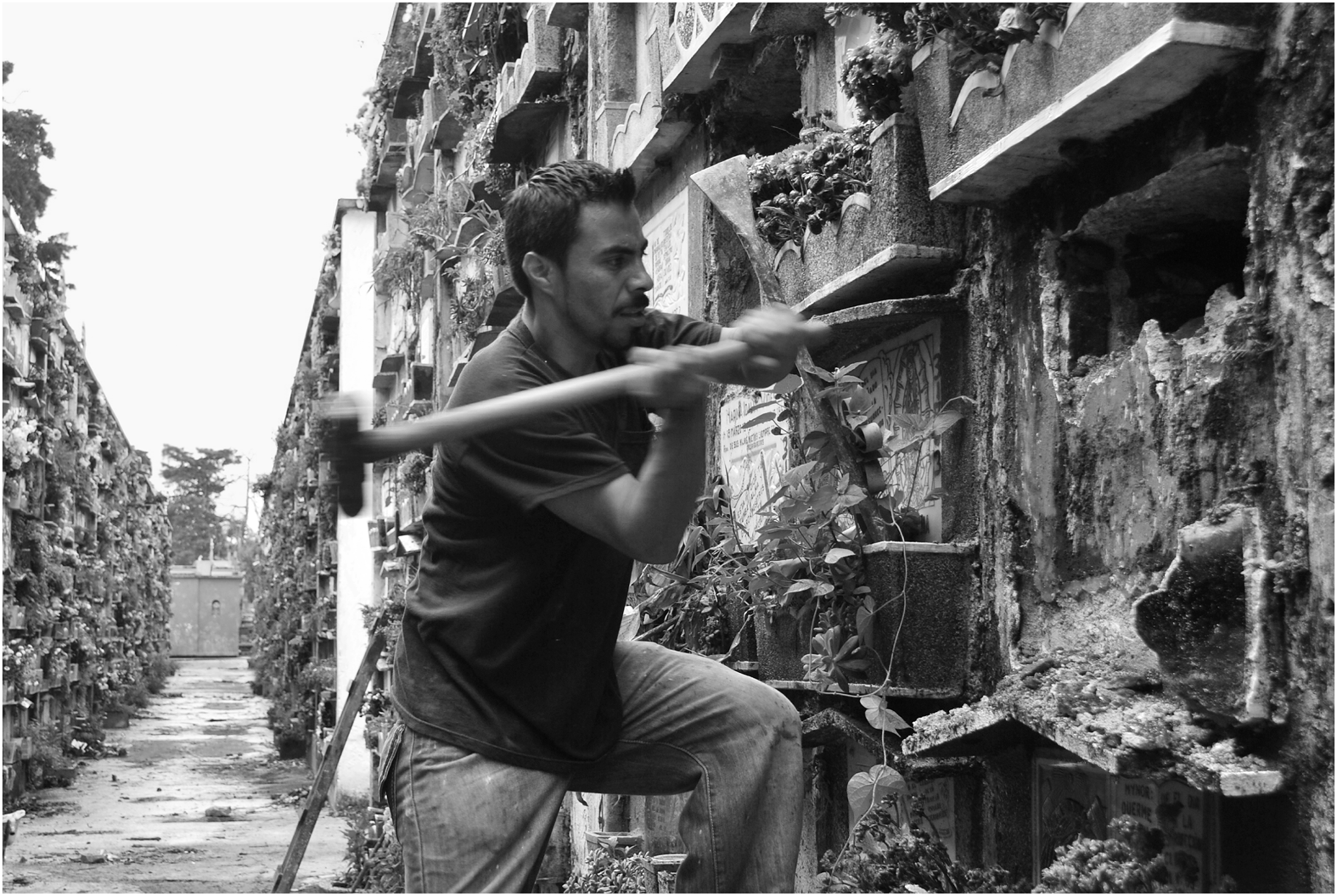
***
This article tracks the infrastructural violence that the public cemetery as planned space produces as well as the kind of abjection that this violence implies. A dense literature, to be sure, documents the effects of state violence in Latin America – of genocidal dictatorships and of US intervention in the forms of invasion, occupation, and covert operation. The literature on violence in Guatemala is thick (Carmack, 1988; Grandin, 2000, 2004; Green, 1999; Nelson, 1999, 2009). There is also a great deal written on the structural violence wrought there by sexism (Sanford, 2008), entrenched racism (Hale, 2006), structural adjustment policies (Fischer and Benson, 2006), abject poverty (Offit, 2008), and uneven efforts at democratization (O’Neill, 2010). The potential for comparison abounds between postwar Guatemala and postwar El Salvador (Moodie, 2009) or post-apartheid South Africa (Comaroff and Comaroff, 2006). But nearly nothing lingers on the infrastructural (Rodgers and O’Neill, 2012 – this issue) – on the observable fact that Guatemala City’s public cemetery is not simply a repository for the effects of postwar violence but also that the cemetery (by way of its infrastructural limitations) contributes to a kind of postwar violence that targets the dead body. Based on extended fieldwork in Guatemala City’s surging death industry, guided by the history of the modern cemetery, and troubled by a hastened disinterment policy, this article stitches together a series of images and observations to reflect on how disinterment strips the corpse of its right to belong, reducing the corpse, with a nod to Giorgio Agamben (1998), to ‘bare death’. Death may release one from what Achille Mbembe (2003) has called necropolitics but not from the politics of the necropolis, not from a kind of graduated citizenship (Ong, 2006) that governs not just everyone but every body. It is, in the end, a story about class and the ways in which capitalism codes citizenship such that some bodies belong and some do not – such that some maintain their place in society while others are rendered bare. Infrastructure facilitates this violence, these brutal class markers.
***
This article moves in four parts. Part one details the dominant image of the public cemetery as an immutable container for the effects of violence. Sections two and three counter this impression, stressing the modern cemetery’s active role in not just the production of social relationships but also postwar violence. Section two reflects on how the public cemetery extends personhood to the corpse, while section three pursues themes of disgrace, rejection, abjection; section three, in short, thinks infrastructurally about how disinterment offends (even abuses) such personhood. The final section glimpses loved ones left roaming the public cemetery (amid vultures, not unlike vultures) looking for those once buried (possibly still buried) in the cemetery. Their confused scavenger hunts in this new dump animate the effects of infrastructural violence in poignant ways. Infrastructure, this final section ultimately observes, can injure both the living and the dead, rendering their personhood wounded and disjointed. It is, in the end, an observation that begins in the cemetery but one that shuttles from the liberal to the neoliberal by way of the killing fields, ending (as do many of Guatemala City’s corpses) at the very bottom of a mass grave – a deep, dark ditch that echoes back when whistled into. At the bottom of this hole, to borrow from Hannah Arendt (1951), lie thousands of state-less bodies, as well as the practical limits of both personhood and citizenship in postwar Guatemala City.
A repository
Cemeteries have long been understood as places of peace and quiet – of rest and silence (Ariès, 1977; Fabian, 2004; Gorer, 1965). Those who have worked Guatemala City’s cemetery grounds the longest seem to substantiate this interpretation at every turn, noting that postwar violence takes place near and atop the cemetery while the effects of postwar violence rest deep inside the ground. Here, the cemetery is a neutral backdrop – a repository for the effects of postwar violence. While much of this article works hard to counter this interpretation, it is important to linger (albeit briefly) on its ethnographic salience. Take Javier, for example. He has polished mausoleums for more than 50 years. As a young boy, he worked alongside his father until he was old enough to take on his own clients. On a bright April day, one that made us squint at each other, we talked as he worked. ‘There are a lot of people here who have been killed. Gang members. Salvatruchas. They’re buried here. The people Salvatrucha killed. They’re here too. Buried throughout.’ He buffed a tombstone as we chatted, his comments competing with the sounds of gunshots and sirens. ‘Of course, much has changed [over the last 50 years] … Did you just hear that? The gunshots? Gunshots in El Gallito? You hear them all the time. We just heard some. We’ll hear sirens soon. That’s what you hear. Gunshots and sirens. Gunshots and sirens.’ He scrubbed, and I listened. Javier continued, ‘We fill sometimes 15 or 20 niches a day. They’re young. They’re women.’ His voice trailed off.
No stranger to death, Javier is nevertheless astounded by the numbers. He worked the cemetery after the 1976 earthquake. He tended to family plots throughout the civil war, especially those years when the violence peppered the capital. Yet now, he insists, the cemetery is busier than ever. ‘It used to be fistfights, you know? Fistfights in the streets. That’s what we used to have here. Punches and punches. Now they’ll come into your home and kill you. It used to be punches, but now they have guns. They’ll kill you.’ Javier then shifted his reflections to far more personal territory. ‘And they kill you for a cell phone. My daughter has had her phone stolen ten times. If the phone has a camera, they’ll kill you for it. They’ll kill you for a cell phone. The gangs know how much your phone is worth, and they’ll kill you for it. There have been a lot of women killed for their cell phones.’ Painting an image of the cemetery as a place where violence comes to rest, where bodies lie in state, Javier then paused, looking up into the sun. He held silent for a minute and then scrubbed a mausoleum just a little more, adding, ‘My wife was killed, you know? Almost a year ago. She worked for a private security company, and they robbed her for her gun. It’s been about a year. We have six kids. The violence here in Guatemala is terrible. It’s just so terrible … My wife’s just over there. She’s here in the cemetery.’ Javier’s focus faded, never answering my question about how it feels to work so close to his wife, never speaking at length about his loss, until he snapped back, ‘Did you hear that?!’ He heard more gunshots. I did not, I must admit, but sirens soon followed. ‘Typical,’ Javier sniffed.
Never before has so much death come to Guatemala City. Never before has so much violence spilled into the lives of capitalinos. From the center to the periphery, from the periphery to the center, death as migrant has come to the capital – to Zone 3, to its necropolis. A taxi driver, a man who migrated from the highlands to the capital during the civil war, leaned against his cab, allowing the public cemetery to serve as his backdrop. He waxed, ‘I’m from Quiche. It was normal to see cadavers in the streets. In the trees. But it was a civil war. You knew who was in danger. It was caused by something bigger. Now people are shot for cell phones. Everyone is a victim. It used to be that ten years ago people here in the city would be shocked by violence. Now people hear about people being killed and it’s not a big deal. They ask, how many? One? Two? Three? People aren’t shocked anymore.’ The bodies end up in the cemetery, the cab driver continued, not in the streets as they did during the war. Violence ends with the cemetery, he sighed. The cemetery marks the end of violence.
Located one block from the cemetery, the city morgue makes plausible the cemetery’s purported restfulness. The contrast between these two spaces is telling. There, forensic anthropologists piece together bodies that have been torn apart. The cemetery’s relative peace and quiet (one punctuated by the crack of gunfire) bears no resemblance to the morgue’s buzz of activity. They are of two different worlds. They divide along the lines of activity (the morgue) and passivity (the cemetery), along chaos (the morgue) and order (the cemetery) as well as along questions (the morgue) and answers (the cemetery). The morgue is no repository. It is a bustling point of transfer. ‘Over the weekend we did more than a hundred autopsies’, a forensic scientist explained as we toured the morgue. ‘Five of them were women who were quartered. Their arms and legs cut from their torso. There was one … There was one in which a gang member shot his girlfriend six times in the face because she wanted to break up with him.’ We walked from a chilled surgical theater to his office. ‘Another was a sixteen or seventeen year old girl. A beautiful young lady. Her cousin raped her and then stabbed her in the chest. He then cut slits at the ends of her mouth. I don’t know why but it made her look like she was smiling. Like the Joker. You know who I’m talking about? The Joker. From Batman.’ The forensic scientist calmly explained this to me as he opened his laptop, walking me through some of the morgue’s more recent and more technical photographs. ‘Here are three legs and three arms.’ Each rested on what appeared to be a plastic tarp, the camera’s flash flattening much of the limbs’ texture. ‘Our job is to match any of these [parts] to this torso.’ He forwarded the digital slideshow to a massive stump of flesh. All of these body parts were evidently found together but apart, discarded in the same location but without any real clue as to what leg belonged to what arm and so on. ‘We look at the articulations, the kinds of cuts made.’ He continued, ‘With this leg, you can see that the bone was broken. Maybe by a machete. But with this leg, the bone looks sawed. This suggests two different bodies. Two different instruments. This helps us match them up.’ The forensic anthropologist, shuttling between the photos and the numbers, between the raw evidence and the big picture, added, ‘In the first three months of 2009, we did more than 1300 autopsies. Over 90% turned out to be criminal cases. We did over 1300 autopsies in three months in Guatemala City. Not in Guatemala but in Guatemala City. A colleague of mine in Panama says Panama – the country, not the city – has never seen that many in a year.’ The doctor then returned to his slide show, guiding me through the cold science of matching limbs to torsos and hands to wrists before responding to my simple question. Where do these materials end up? The cemetery, he answered. The cemetery is their last stop.
Burying personhood
Both this personhood and this potentiality make sense when one remembers that mass graves were standard until the early 19th century (Ariès, 1991). In Paris, circa 1790, amid the French Revolution, Bernardin de Saint-Pierre wrote (with obvious disapproval) about the ways in which his countrymen – those who lived in the ‘rich and ostentatious capital’ – used only four pine boards for a funeral. The effort appeared shallow to the author, morally bankrupt from a certain perspective – without deference, without dignity, without consideration. Saint-Pierre continued, ‘With these boards and some nails we make an oblong box in which we place the body of our relative wrapped in a threadbare sheet; next, the body is transported, unaccompanied, to a quarry where a vast and deep pit has been dug. The body is thrown into this abyss among a mass of other bodies of both sexes and all ages’ (Denton, 2003: 204). Discarded like trash, unkempt and uncared for, corpses decomposed alongside other corpses, destabilizing the biblical (and ever consoling) metaphor of death as sleep. Saint-Pierre, one might imagine, shook his head at such disregard.
The North American travel writer John Lloyds Stephens, writing just decades after Saint-Pierre but with similar concerns, narrates the burial of a young Guatemalan child who was laid to rest (as per custom) inside a local church. In an era when Mariano Gálvez’s liberal presidency worked to disseminate French notions of public health throughout Guatemala, radically altering how Guatemalans dealt with their dead, Stephens stumbled upon an event that existed just beyond the reach of Gálvez’s reforms – one that provoked a reaction remarkably familiar to Saint-Pierre’s moral disgust. Stephens writes, ‘The sexton laid the child in the grave, folded his little hands across its breast, placing there a small rude cross, covered it with eight or ten inches of dirt, and then got into the grave and stomped it down with his feet.’ The concern, Stephens explains elsewhere, was principally structural – bodies buried in the church would eventually weaken its foundation. As corpses decomposed, pockets of air formed, making churches fold in on themselves. The dirt needed to be packed tightly. This is why, Stephens continues, the father of this young child ‘brought back a pounder … and, taking his place in the grave, threw up the pounder to the full swing of his arm, and brought it down with all his strength over the head of the child.’ With painstaking detail, Stephens narrates the father’s effort. He notes the beads of sweat that gathered on the father’s back as he labored, the force with which he drove the pounder atop his son, and the pride he wore for having the means to bury his child in such a manner. Stephens concludes, ‘I never beheld such a brutal disgusting scene. The child’s body must have been crushed to atoms’ (Sullivan-González, 1998: 36). This burial, Stephens later adds, left him nauseous and trembling.
Such disapproval, be it from France or Guatemala, is worth appreciating – not empathetically but anthropologically – for it marks a relationship with dead bodies that congealed amid 19th-century efforts at industrialization, liberalization, and democratization, with public health initiatives that began on the Continent but soon traveled to Guatemala by way of Francophile reformers. Guatemala’s liberal presidents, such as Mariano Gálvez and Justo Rufino Barrios, considered themselves students of this new thing called public health – an intellectualized form of nationalism rooted in Auguste Comte’s positivism (Ariès, 1975). They quoted the latest books while also modeling their legislation after Europe’s more ‘enlightened’ policies. At the very heart of Stephens and Saint-Pierre’s disapproval, in fact, sits an anthropology that says something about life’s relationship with death, where and how the dead should be stashed, and what one’s final resting place should look like (McManners, 1981; Outram, 1989). This mutual disgust signals an emerging sense that the corpse (as a kind of person) must be respected as a person and that this person can be injured and insulted (Ben-Amos, 1991; Kselman, 1993). Implicit in their rumblings is a vision of the modern cemetery not simply as a rejection of mass graves and mashed remains but also as a final resting place that provides a design for life – ‘a model milieu for living’ (Johnson, 2008: 777).
Public health concerns, principally speaking, located the modern cemetery on the margins of major and minor cities. This is because rapid industrialization generated tons of filth while liberalism advanced a system of thought that could begin to assess the moral and epidemiological dangers of such refuse (Corbin, 1988). The proliferation of decaying organic matter – rivers of feces, piles of rotting animals, mountains of garbage – defined life in booming 19th-century cities. New York City, a surging metropolis whose public transportation ran on horsepower, was home to some 200,000 steeds – with each animal dropping 24 pounds of manure every day and with some 20,000 horses dying on the job each year (Farland, 2007). Nineteenth-century New York City, like so many other major metropolises, smelled of death and decay. Guatemala City, although much smaller in scale, fared no differently, especially as cholera epidemics riddled the country (Sullivan-González, 1998). Guatemalans of all ages struggled hopelessly against intestinal bacterial infections, succumbing ultimately to death by diarrhea. Those who did survive lived with grotesque disfigurements – with sunken, pale, and cadaverous faces (Burrell and Gill, 2005; Watts, 1999).
The number of dead people outpaced what communal burial grounds in Guatemala could handle. Cramped public spaces began to bubble with bodies, and once-flat graveyards undulated with the rise and fall of pits that had been filled past capacity. Shallow, overcrowded graves, moreover, led to uncomfortable scenes, ones in which stray dogs would trot down major thoroughfares with a loved one’s femur or hand (Chajón and Barco, 2008). Death was everywhere. Yet, an irresolvable tension eventually arose between stench and security – between the dead and the living. This tension heightened as 19th-century scientists grew more convinced that there existed a causal relationship between environmental waste and human illness. The doctrine of miasma, the very one used to explain the spread of cholera in both London and Paris, suggested that noxious air, the kind that decomposing bodies belch, is a lethal contaminant. The stench signals airborne particles that nest atop and inside of people, rendering them sick. Predictable feelings of insecurity accompanied this hypothesis. Death became public enemy number one.
Writing in a way that would certainly give Mary Douglas (1966) pause, an anxious Walt Whitman noted of his beloved New York City, ‘The unnamable and immeasurable dirt that is ever, ever, ever filtered into the earth … Think of this delectable mixture being daily and hourly taken into our stomachs, our veins, our blood’ (Farland, 2007: 804). A precursor to today’s germ theory of disease, but lacking pocket-sized antidotes such as hand sanitizer and antibacterial wet wipes, this dominant (and soon to be dominating) public health discourse followed a certain kind of rationale that suggested if one could just localize the stench of decaying matter, then one could secure a population (Camus, 1947/1975; Scanlan, 2005). It is a logic that took hold, guiding the formation of the modern cemetery into what Jean Baudrillard would call ‘the first ghetto’ (1993: 126; see also Walter, 1991).
Dead bodies moved from the center to the periphery, from inside churches and alongside convalescents to the very outskirts of town (Osborne, 1996; Vernes, 1975). With cemeteries perched atop hills, ones that often overlooked the city itself, the expectation was that as stench rose from the grave, cleansing winds would drive impurities away. This move meant that death quickly dropped out of sight; in a matter of years, death shifted from something that one lived alongside to ‘a delinquency, and an incurable deviancy’ (Baudrillard, 1993: 126), to something ‘shameful and forbidden’ (Ariès, 1975: 85), to a subject of ‘pornographic’ proportions (Gorer, 1965). In Guatemala City, amid cemetery revolts that pushed against ideologies of progress (Sullivan-González, 1998), the genteel welcomed this erasure as a step towards modernity. Several of the city’s hospitals, for example, bordered small graveyards, which patients could see from their windows. As the sick lay in their beds, teetering between life and death, they would often watch bodies buried, sometimes ‘crushed to atoms’, affecting severely (one might imagine) their will to live (Álvarez, 1998). For many, but certainly not all, a close proximity to death would not be missed.
Through a series of public health reforms, Guatemala City’s public cemetery took shape in the 1870s (Álvarez, 1998). Reformers placed the cemetery just outside of the capital’s oldest and most historic city center. Inspired by theories of personal hygiene and urban development as well as ideologies of democracy and progress, this cemetery acquired spatial characteristics that celebrated some of liberalism’s most enduring virtues, such as individuality and freedom as well as citizenship and security (Joyce, 2003). From the mass grave came a gridiron that recognized and respected the individuality of each corpse. Avenues ordered the necropolis into a manageable grid; a simple but sound drainage system efficiently pulled rainwater from graves and into a nearby ravine (Osborne, 1996). The plots themselves obeyed a geometrical, deeply analytical logic – an observable economy of space – so that each corpse would have a precise location; every citizen could find a loved one with the same ease and efficiency as he or she could find a book shelved in the local library (Joyce, 2003). As each corpse retained its status as an individual (with a place to call its own), trees lined the necropolis – not for show but for security. With 19th-century scientists convinced that deleterious gases escaped from each grave, no matter how deep one buried a body, many argued that plant life, such as flowers and trees, helped to filter the air, purifying an otherwise impure atmosphere (Howard, 1965; Worpole, 2003).
True to liberal ideals of personhood, the cemetery also remained open to all Guatemalans. Predictably, moreover, the cemetery reproduced many of the contradictions inherent to society. Wealth allowed certain corpses to gain elevated standing, while poverty pushed the pauper’s corpse to the unmarked grave. Presidents and generals, with mausoleums crafted by some of Guatemala’s most celebrated artists, thus rested only meters from the poor and the destitute, only paces from unmarked graves (Chajón and Barco, 2008). As Patrick Joyce notes, this individuation of the corpse related to ‘a whole new series of meanings given to the term public’ (2003: 91). The public, in this sense, expanded to include the corpse, enlarging the social body to include the dead body. This is why, in the name of public health, for the sake of the nation, citizens buried their dead in the public cemetery, affirming that the corpse belonged to and for the nation – not as irrelevant material that could be trashed (or treated like trash) but as politically significant persons that needed to be tracked, ordered, and observed.
Yet, this liberal relationship with death established the idea that each corpse maintained a form of personhood that was politically significant as well as culturally relevant. The corpse had the right to belong, to rest, to be remembered as well as to sleep alongside his or her countryman as a citizen of not simply the necropolis but also the nation. The corpse, in this sense, became a curious emblem of modernity in and through ‘the modern idea that the dead person should be installed in a sort of house unto himself, a house of which he was the perpetual owner or at least the long term tenant, a house in which he would be at home and from which he could not be evicted’ (Ariès, 1975: 22). The public cemetery, as planned space, generated the potential for insult and injury.
Bare death
Stanley Brandes reports on a sad story of irreversible loss (2001). As he tells it, an undocumented Guatemalan died on 11 December 1994 in the San Francisco Bay Area. He was hit by a car and died instantly. The young man’s sister, also in California at the time, contacted her family in rural Guatemala and, with much financial difficulty, planned to ship her brother’s body back home for a proper burial. Yet, when the sister collected the body for shipment, the authorities presented her with the wrong corpse. The body before her, she insisted, was not her brother. There had been a terrible mix up, it turns out. A funeral parlor mistook one body for another, accidently cremating her brother earlier in the week. A lawsuit quickly followed, with undue hardship rising to the top of the claimant’s list of transgressions. While the funeral parlor eventually settled for an undisclosed amount of money, it became clear that cremation was the source of great emotional distress. ‘In Guatemala’, Brandes writes, ‘the very idea of cremation is repulsive.’ His informants continued, ‘It’s the way you treat a dog … It’s a sin’ (p. 112). ‘It is sinful’, Brandes observes, ‘not only for those who carried out the deed, but also for [the young man who died], despite his innocence in the matter’ (p. 113). His soul is suffering, the family grieved. The young man – as corpse – suffers. Cremation stripped the young man of his personhood, reducing him (i.e. the corpse) to the status of a dog.
By 1994, the year of this horrible mistake, much of rural Guatemala had become more than familiar with this kind of insult. Guatemala’s 36-year genocidal civil war, a conflict with roots that reach back into the 19th century, continually upset the living’s relationship with the dead. The war obliterated these social relationships. Massacres committed under a different ideology of security discarded bodies with less deference than either Bernardin de Saint-Pierre or John Lloyd Stephens could have considered. Only half of the genocide’s survivors knew where their relatives were buried and only one-third were able to hold a funeral service or burial (REMHI, 1999). The Guatemalan army’s Counterinsurgency Manual even goes so far as to instruct soldiers to discard dead civilians ‘as quickly as possible to keep subversive elements from using them for purposes of provocation or propaganda’ (REMHI, 1999: 18). At the same time, the army also left many of those murdered to decompose in the open air. One survivor notes, ‘The ones who died there rotted. There they remained. No one collected them; no one buried them.’ ‘Anyone who picked them up or went to see them’, another notes, ‘would be killed right there. Whoever buried them was one of them’ (REMHI, 1999: 19). The not-knowing – the absence of closure – pushed down on those who survived. ‘Even now I don’t know what happened to them – if some animal or dog ate them. I don’t know. That is the violence that my mother and father suffered. There is a constant ache in my heart’ (REMHI, 1999: 19). In terms of death, in regards to death’s relationship to life, the civil war turned everything around, upside down, inside out, and backwards. To be left to the dogs, to be eaten by dogs – ‘that is the violence that my mother and father [as corpses] suffered’.
This kind of insult and injury – this kind of violence – continues in the postwar context, albeit under a different set of circumstances. From the highlands to the city, from the indigenous to the middle class, from the killing fields to the cemetery – insult and injury now affront the dead. This is because there is no more room in the public cemetery. Javier and Marco mentioned this to me, and management confirmed it. Too many people have been killed, and the cemetery is now at its limits. The administration itself speaks in rushed, somewhat frantic tones: ‘There’s no more space. There’s no more space for the dead. All the cemeteries are full. They’re completely saturated.’ A curvy line of graves now teeters on the very cliff that separates the public graveyard from the main garbage dump. The two have even begun to blur into each other, crumbling over and atop one another. Vultures further obscure this line, squawking about this border in greedy gaggles – wings flapping, beaks snorting. This problem of space has not meant a return to church plots or mass graves, of course, but rather a tightening of liberal ideals in the midst of a neoliberal moment, making more aggressive the cemetery’s disinterment policy. Death as image, as spectacle, is everywhere; death now lies naked, half-decomposed, next to (not inside of) graves (see Figure 3).
Photo by Benjamin Fogarty.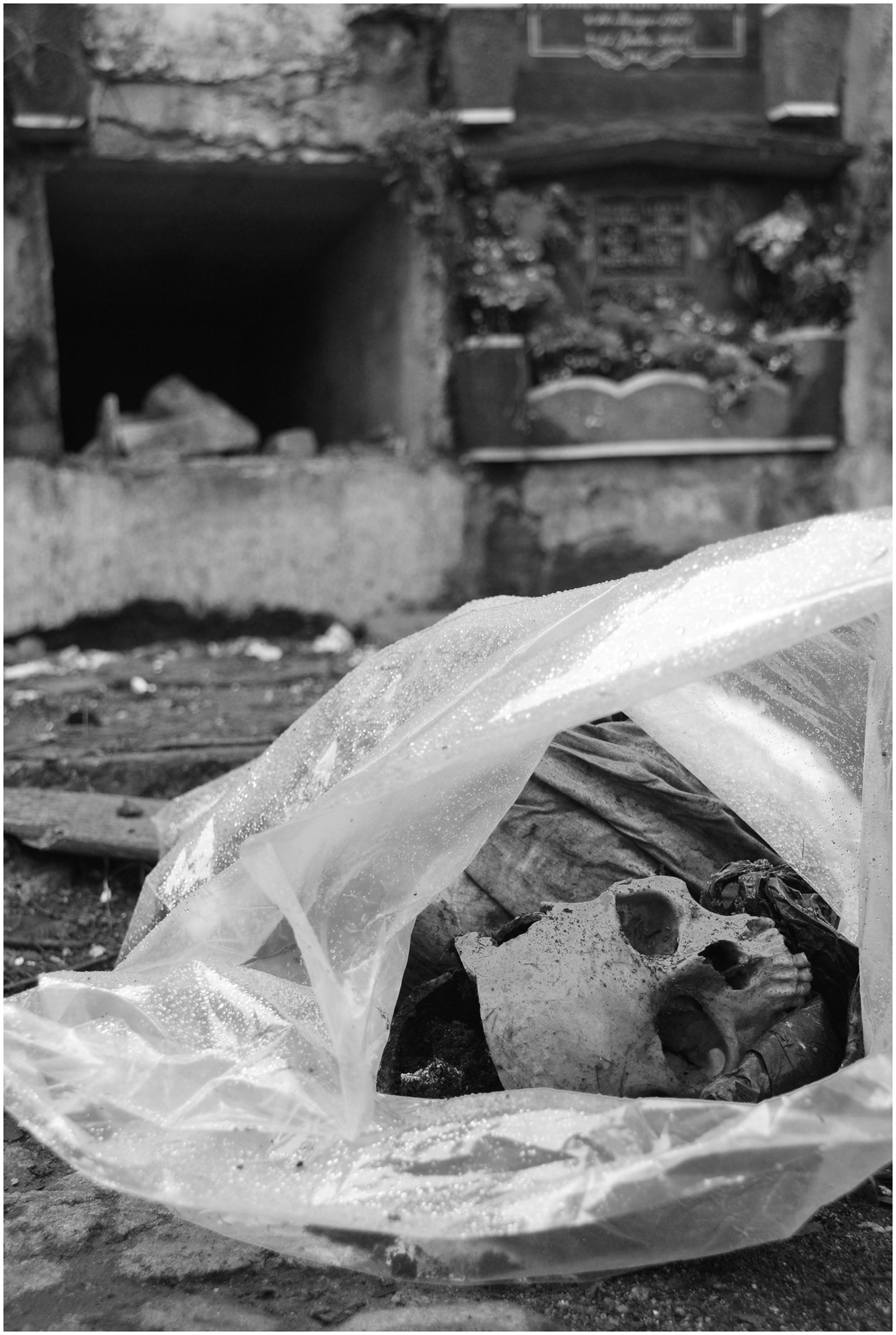
Guatemala has several private cemeteries. But they are expensive and, thus, exclusive. They take on private clients. The graves cost around Q30,000 (USD 3900). The public option, the one that poor indigenous capitalinos take, is much more manageable. According to cemetery rules, relatives pay Q200 (USD 25) for the initial burial. Six years later, they must pay Q180 (USD 22) to renew permission for another four years. They can then pay another Q200 (USD 25) for another four years. Once payment has ceased, however, Guatemala’s Ministry of Public Health makes a perfunctory effort to contact the family. A letter is sent, a phone call is made, sometimes an announcement is placed in one of Guatemala’s dailies. And, after a grace period of at least three months, and sometimes much longer, the body is disinterred, and the remains slid into the cemetery’s mass grave. This has been the official protocol and narrative since the cemetery’s inception. A cycle of life and death, of remembrance and amnesia, has allowed the graveyard to absorb and then release the capital’s dead with a certain kind of grace. Bodies in; remains out.
No longer is this the case. Guatemala’s necropolis has become littered with the dead, with disinterment efforts unable to keep pace with burials – with half decomposed bodies, stiff as boards, propped up against graves marked for removal. The city is now too large and too violent. The cemetery cannot keep pace. Planned over a century ago, for a city less than half the size of what the capital is today, infrastructural problems have emerged. And, while the new public cemeteries absorb some of this excess and while the well off seek a private option, something has had to give. Initially, this meant raising the cost of interment. From 1984 to 1991, it cost Q7 to inter a body. From 1992 to 1997, it cost Q40 to inter; from 1998 to 2001, it cost Q60 to inter. From 2002 onwards, it has cost Q180. Even with notable spikes in inflation, during the mid 1980s and early 1990s, this marks significant obstacles to access. But demand nonetheless outpaced supply. This is why every effort has been made to make room for the inevitable. This is why, at dusk, just before sunrise, government workers, with shovels in hand and wheelbarrows in tow, walk about the cemetery. They evict, one by one, those that have been forgotten to make room for those who have not yet been remembered.
Disinterment, to be sure, is not an overly scientific process. It is mundane. It is tedious. It is the movement of dusty materials from one location to another. It is the sound of pick striking concrete. It is the noise of dustpan pinched against brick. Those who disinter bodies have very little to say about it. It is work. To linger with these men as they labor is not to sit in solemn observance but rather to trip into Act V, Scene 1 of Shakespeare’s Hamlet (c. 1601/1818). Just as two gravediggers raucously dig a hole for Ophelia, just as Shakespeare’s own stage directions designate these two men as ‘clowns’, disinterment in postwar Guatemala tends to be a rather unholy practice, colored by morbid humor and a string of dick jokes. Silly accusations exchanged at a casual clip, of workers supposedly fucking the dead, of workers supposedly living half dead lives – this is the feel of disinterment. This is what allows these men to turn skulls into puppets, if only for a minute. ‘It’s just a pile of bones’, one worker notes. This is why disinterment, an oddly jovial kind of labor, oftentimes completed before mourners visit the cemetery, can be read as an event, as a rupture in the established order of things, as an appearance of a truth (Badiou, 2005). The truth that disinterment as event reveals is the kind of insult and injury that such an eviction yields. Each disinterment embodies an event in its own right, a rupture in the order of things – a string of insults and injuries hurled at persons who once belonged but now do not. They depict a kind of offense that might best be understood as ‘bare death’.
Understanding bare death begins with Giorgio Agamben’s notion of bare life (1998). For Agamben, life takes at least two forms. The first is biological (zoë). The second is political (bios). When biological life loses political significance, Agamben argues, bare life emerges – as in the Nazi concentration camps that stripped Jews of political life, rendering them alive (zoë) but without significance (bios). The subtle complexity of this observation continues to influence the theorization of life. Yet, Agamben’s point also holds for death, it would seem. Much like life, death can take two forms: the biological and the political. The modern cemetery, in and through a nationalized public health discourse, extends political significance to biological death – in that the modern cemetery announces (infrastructurally) that the buried corpse has a right to belong, to rest, to be remembered as well as to sleep alongside his or her countryman as a citizen of not simply the necropolis but also the nation. Yet, Guatemala City’s public cemetery today has entered into what Agamben (2005) might call a state of exception. There is no more room, which is why the state pulls corpses from their niches and tosses them into mass graves. Rendered bare, death litters the cemetery (see Figure 4). Abandonment as political relation now defines Guatemala City’s public cemetery.
Photo by Benjamin Fogarty.
The violence of bare death rests with the force of abjection. While many have theorized abjection in a number of ways, the word’s literal definition as well as its most common connotation are strikingly apposite. Abjection means ‘the state of being cast off’. In this sense, abjection perfectly captures the disinterred corpse as bare death. Yet, Julia Kristeva’s theorization of abjection as ‘something alive yet not’ (1982: 3) also resonates deeply with the disinterred corpse’s ambiguous personhood. Again, dying is not quite dying (Desjarlais, 2003). Abjection as the violent consequence of infrastructure explains the visceral kind of offense that comes with corpses that are discarded like trash, that are pushed into a mass grave. Over and against the modern cemetery’s rhetoric of equality, of extending the public to include every body, biological death now loses political significance at the very moment payment stops. Exchanging liberal ideals for neoliberal means, political significance (personhood itself) now has a price tag. Money complemented by personal responsibility glues political and biological significance together. Once loved ones default, however, a different kind of accounting takes hold and biological death loses its political moorings, quickly emerging as bare death.
In the postwar context, however, dead bodies shuttle from the morgue to the public cemetery at such a frenzied pace that the body can easily become something set aside and hauled through the streets like trash. Burial reconstitutes personhood with its individualizing accoutrements: tombstones adorned by names, biblical passages, birth and death dates, handwritten notes, and flowers. The public cemetery itself – its architecture, its infrastructure, its very raison d’être – also individualizes the corpse, setting it aside as something other than trash. Yet, the systematic disinterment of corpses disassociates biological death from its political significance. These are bodies stripped of significance and pitched into a well. Abjection in all of its violence renders death bare; it forces loved ones to scramble about the cemetery. The violence of abjection reduces persons to vultures.
Vultures
‘Excuse me, sir. Do you know how I can find my brother?’ I was walking about the public cemetery when a young man and his girlfriend asked me this question. ‘I’m not sure if they’ve thrown him away yet.’ I first asked if he knew where his brother was interred but the young man simply shrugged. He thought he knew, but he is not there. Or, he admitted, maybe he has the wrong place in mind. It’s easy to get lost in the niches, he said in frustration. ‘They throw the bodies away, you know?’ The young man pointed towards the garbage dump as he mentioned this to me. I told them that they don’t throw them in the dump but rather in a mass grave. In an effort to make this distinction, I found myself pointing in the same direction as the young man (since the mass grave borders the dump). This only made it seem like we were debating the dump’s proper name rather than where his brother might be at that moment. After suggesting that he speak with the main office and after the young man explained that no one was there (that no one had been there for quite some time), I wished him luck as he wandered back into a maze of niches peppered by dozens of vultures.
Disinterment delivers to the corpse a kind of indignity that the modern cemetery as infrastructure makes possible. Built a century ago, for a city not nearly as big and for a society not nearly as violent, there is now no more room. Passive as it is violent, the cemetery’s infrastructural limitations have sparked a new era of disinterment that ultimately renders the corpse bare – that strips the corpse of any political significance. Yet, disinterment also insults the living, reducing loved ones to walk about vultures as well as to becoming a kind of vulture, one that picks and pecks about the dead in search of their loved one. These are indignities that remain indicative of a postwar context in Guatemala in which personhood as well as political membership have become a zero sum game. Those with the means to buy into society – be it the polis or the necropolis – maintain their personhood. They maintain their right to belong. They keep their political significance. Those without the means to pay (or to pay on time) find themselves evicted from their homes or forced to putter about the margins of society in search of what is rightfully theirs. Following the violence that imbues contemporary Guatemala in all of its infrastructural complexities thus begins a conversation not only about life and death and the relationships that exist between the two, but also about the broader political economy of the society. To this extent, as Katherine Verdery (1999: 2) has pointed out, ‘a modest set of bones can open up the world’.
And open up the world they do. For as one stands at the edge of the cemetery, at the lip of the dump, one finds hundreds of men and women, hundreds of children, picking through the garbage – for items to resell, recycle, reclaim. Many work the very edge of the cemetery, the very edge of the dump, because the practice of disinterment collects only the bones. The cemetery workers heave the rest into the dump. Coffins, robes, and personal items – these items pile up as men and women pick through them, competing (literally) against the very vultures they have become. This is another abuse of personhood, to be sure, made possible by abject poverty and a radically unjust distribution of wealth. But the cemetery as built space adds insult to injury. Men reduced to vultures as death gets rendered bare by a public cemetery once committed (at least in principle) to public access, to making sure that each body belongs to and for the nation. Now access comes at a price just as personhood comes at a price. To quote again a cemetery worker, ‘It’s like when you rent an apartment. If you pay rent, you can live there. If not, I have to kick you out.’ The solvent secure citizenship while the rest pick through the trash.
Footnotes
Acknowledgements
This article draws on fieldwork in Guatemala City across a variety of settings. The names and some details mentioned in this article have been changed significantly to protect the identity of my informants. Fieldwork was supported by the Wenner Gren Foundation (2006–2007, 2010–2012), the Harry Frank Guggenheim Foundation (2010–2012), the Social Science Research Council (2011–2013), and the Social Science and Humanities Research Council of Canada: Research Development Initiative (2010–2012) and Standard Research Grant (2010–2013). Special thanks to Benjamin Fogarty, Rebecca Bartel, and Basit Kareem Iqbal for research and editorial assistance. Special thanks also to Dennis Rodgers and Bruce O’Neill for their tireless work on this special issue.