



Abstract
The field–fieldworker encounter in the contemporary ethnographic circumstances creates moving fields where the archetypal Malinowskian conventions have been experienced as insufficient practices. Calls were made for theoretical reconfiguration of a fieldsite from bounded single site to a multi-sited one. This paper draws on a multi-sited ethnographic study conducted in an abandoned village, demonstrating how a fieldsite circumstantially oscillates from online to offline, factual to imaginary when attachment is still resilient and the desire to return is still alive. Its contribution to literature is twofold. Firstly, it demonstrates how to adjust the academic qualitative inquiry to ensure a move towards the desired social changes by cultivating the role of the ethnographer from participant observer to a participant in action in the era of ‘public-or-perish’. Secondly, it adds an important dimension to multi-sited ethnography: a new ‘future’ site, a new stroke to George E. Marcus’s ‘spatial canvas’ in the process of place-making.
Keywords
Introduction and background of the study
I walked, I kept walking, I saw, heard, felt, and imagined. I kept imagining backward and forward in time, in space: I moved among the remnants of the abandoned village to make sense of it. Our mobility decisions, Jungnickel (2014) says, are ‘multi-sensory portals through which we make sense of the world’ (p. 647), and this paper is an attempt to demonstrate such makings of sense, of meaning, of knowledge and of change. It is a reflexive account drawing on my ‘on hold’ multi-sited ethnographic fieldwork in Cyprus, examining the movement of displaced villagers from the place they abandoned more than four decades ago to the relocation, then to the non-located virtual one they have created almost a decade ago to enliven the spirit of community. To analyze the ways of strengthening place attachment in a context of displacement as the aftermath of the 1974 war, data were collected via a qualitative research method: an eventual multi-sited ethnography including ethnography of ruination, of social media triangulating with both online and offline in-depth interviews. The research is on Artemi (pre-1974 name)/Arıdamı (post-1974 name), 1 an abandoned small village in the northern part of Cyprus. Located in the Famagusta District, it is 9 km away from Lefkoniko (pre-1974)/Geçitkale (post-1974), a former Greek village, where the Artemi people have been relocated, still in the northern part of Cyprus. The inhabitants started abandoning their village after the war of 1974 due to the lack of maintenance for survival needs (water, electricity, transportation, etc.). Eventually, the village has become completely emptied and taken its present status as one of the abandoned Turkish villages in the northern part of Cyprus since 1974.
Begun as ruination ethnography in April 2017, this research has evolved into a multi-sited one, expanding to encompass the virtual site too. During the in-depth face-to-face interviews in the resettlement, the participants revealed their desire to re-enact their home village and explained their already initiated plans for the future. Reinforcing their attachment to that abandoned place, they have created a Facebook page where they post photographs from their lives once lived in the village before 1974, comment on them, and make plans to meet and strengthen the spirit of community, the sense of belonging in Artemi. Although the posts discontinue from time to time, the already shared archive on the page demonstrates the abandoned field as still functional as it is the meeting venue for the villagers to spend time together. The archive also reveals the future orientations towards the renovation of the village and the actions already taken towards that endeavor. It is their intention of re-enactment of the field that keeps the ethnographer of this study ‘on hold’ to embrace this potential future-site as well, whenever appropriate.
A recent Facebook inbox correspondence (November 2018) with one of the participants asking for help in taking the initiations of re-enactment further is a push for a new move. That move re-situates the ethnographer to become involved in the action, hence, taking this ‘on hold’ ethnographic research to a new stage from participant observation to participant action(-to-be). Upon recent road constructions by the municipality as preparations for the possible renovation of the village, the ethnographer now is not only to be a participant observer of such probable spatial and social change, but the participants see her as the potential driving force in that desired change as well. Carrying the torch and descending from the Ivory Tower, the contribution of this particular study is twofold. First, it demonstrates how to adjust the qualitative inquiry to take effect not only for the academic good, but also for the public good as a venture towards the desired social changes (Denzin and Giardina, 2016, 2018; Burawoy, 2005; Said, 1996; Chomsky, 1967). Secondly, this study adds an important dimension to the practices of multi-sited ethnography by adding on a new ‘future’ site to George E. Marcus’s ‘spatial canvas’ (1995: 98). It affirms the multi-sited field as a patchwork under construction and the ethnographer as the constant weaver uniting the sites with various textures from online to offline, from present to future in the process of ethnographic place-making. Supporting the potentially continuous circumstantial shiftiness of ethnographic fields and thus situating the ethnographer as a ‘circumstantial activist’ (Marcus, 1995: 113), I argue that when the field itself dictates a future site, it is practically unavoidable for the ethnographer not only to move as inspired by the features of the field under investigation. S/he is also to be ‘on hold’ to embrace the impending future site, the impending setting of life, the impending spatial and social changes whenever applicable.
In the vein of the practitioners of multi-sited ethnography designating field from a geographical space to be entered to a ‘conceptual space’ to be constantly constructed (Amit, 2003; Appadurai, 1995; Coleman and Hellermann, 2012; Falzon, 2016; Gupta and Ferguson, 1997; Horst, 2009; Jungnickel, 2014; Rajan, 2012; Strathern, 2005), this study exemplifies the ethnographer’s subsequent movements from site to site (spatial and/or conceptual places – abandonment and/or multi-sited field), mode to mode (resources for representations – photographs), medium to medium (means for distribution of these representations – social media) (Kress, 2005: 6–7). Its eventual design is in line with multimodal meaning-making methodologies ‘in which, meaning is produced through the inter-relationships between and among different media and modes’ (Kress and Van Leeuwen, 2001: 22), describing an improvised, experiential and reflexive process of ethnographic place-making. This process does not only refer to the flowing among multiple sites but to the making of routes for such flows among these sites with various textures too. Klausen (2012: 567) claims that ‘Marcus’ multi-sited ethnography only delivers part of the methodological framework needed. Multi-sited ethnography focuses on the sites themselves and pays little or no attention to the routes connecting the multiple sites’ (emphasis added). Inspired by this framework of multi-sitedness and its further embrace of the spatial and conceptual routes between and among the sites, this study is an improvised process of epistemological expansion of ethnography from single site to multiple, from present to future, from academic to public.
The sections below first revisit the methodological debate around the practices of multi-sited ethnography to contextualize the contribution of that study. Then, the process of place-making is described, following the ethnographer’s physical, virtual, visual and mental steps as a multimodal meaning-making practice: ethnographies of ruination and of social media. Photography and imagination are presented as constructed routes making the ethnographic commuting possible among the sites and inspiring tools for further steps to be taken to comprise the ‘future site’ as well. The last section shows how this embrace takes this qualitative inquiry eventually away from the Ivory Tower of academia and brings it closer to the public as the participants of that research ask the ethnographer to act with them in the process of re-enactment of their village not only as a participant observer of their actions, but as one of them participating in, even leading, their actions.
Multi-sited ethnography: Revisiting the methodological debate
Whilst the conventions of traditional ethnography have been experienced as insufficient practices in the process of the ethnographic mode of knowledge production and place-making, Marcus (1995) advances a critical concern of how to epistemologically reconfigure the archetypal Malinowskian tradition of doing ethnography. Appadurai (1996), as well, questions the nature of locality as a lived experience in a de-territorialized world and argues how ‘ethno in ethnography takes on a slippery, non-localized quality, to which the descriptive practices of anthropology will have to respond’ (p. 52). Marcus’s attempt to theorize what was already occurring when Malinowski followed the Kula ring, demanding multi-local movements (Malinowski, 2005 [1928]), is that kind of response suggested by Appadurai (1996) to encourage creative ways of redrawing the frame of the field to enable multi-sited embracement. Such experimentations bring a number of methodological anxieties in relation to the traditional imperatives of ethnography, such as depth and holistic representation.
Along with ‘strategies of quite literally following connections, associations, and putative relationships … at the very heart of designing multi-sited ethnographic research’ (Marcus, 1995: 97), Marcus discusses the methodological anxieties of multi-sited ethnographers and lists concerns of the fieldwork losing its conventional depth-related power when distributed on multi-sites as one of such fears. In a defensive manner, Marcus underlines that ‘although multi-sited ethnography is an exercise in mapping terrain, its goal is not holistic representation’ (Marcus, 1995: 99). Therefore, he challenges the ‘myth of holism’ (Postill and Pink, 2012: 126) and brings Robert Thornton’s discussion on holism to light. In Thornton’s words, ‘[the] imagination of wholes is a rhetorical imperative for ethnography since it is the image of wholeness that gives the ethnography a sense of fulfilling closure’ (Thornton, 1988: 285, emphasis added, cited in Marcus, 1998: 35). However, as Marcus warns, ‘you can’t really say it all; all analyses … are partial’ (1998: 37, emphasis in original), but only ‘try for a comprehensive display of levels of analysis, of epistemological angles’ (1998: 37). This suggests, despite its rhetoric whole, the field has to be considered under construction similar to the potential of a patchwork, compelling divergent ‘modes of construction’ (Marcus, 1995: 105) and their continual follow-up by the multi-sited ethnographer aiming to increase the comprehensibility of the analysis to its utmost when/if the field dictates a potentially future-oriented spatial and social change. The exemplifying fields can be defined as abandoned places, military zones, refugee camps, earthquake areas, etc. 2
Marcus (2012) keeps warning that ‘multi-sited ethnography does not mean mere extensions of them into added-on sites but more a theoretical rethinking of fieldwork itself’ (p. 21). During the ethnographic act of field construction, ‘it is the circumstance which defined the method rather than the method defining the circumstance’ (Amit, 2003: 11). With such an approach to an ethnographic field of ‘world systems’ since the 1970s and of ‘globalization’ since the 1990s (Candea, 2007), Marcus received contrasting criticisms. On the one hand, there are those in the ‘nothing new under the sun’ camp, who – usually privately – tend to shrug it off as much ado about nothing. On the other hand, it has fired the spatial imagination of a generation of social scientists. (Falzon, 2016: 2)
Hage’s (2005) inflexible refusal of a multi-sited ethnographic mode of research undermines the principal asset of this methodology: its malleability. The strength of this form of fieldwork is the leeway it allows for the ethnographer to respond and adapt flexibly to social circumstances as these arise, to be open to a wide variety of different types of relationships and interaction. (Amit, 2003: 10)
As the designer of such a research, the ethnographer can only leave certain fields impregnating change under construction. Candea’s (2007: 168) proposal on taking ‘the path of self-limitation rather than the path of expansion’ to avoid methodological discomfiture is advanced into an exemplary merging of both. That is to say, while multi-sitedness is a research model suggesting expansion within ‘distributed knowledge systems’, it is the self-limitation mostly dictated by the circumstances of the field itself and practiced by the ‘activist’ ethnographer. The act here is to leave the field under construction in a fulfilling research that its design is accomplished a posteriori, ‘recaptur[ing] the value of not knowing certain things’ (Candea, 2007: 181), but simultaneously, being theoretically ready to retouch the ‘spatial canvas’ of its patchwork/fieldwork when the practice calls for it. This paper is a sample of answering such a call for action(-to-be) as well.
In line with Marcus’s inspirational notions of spatial practices, Pink’s call for being ‘open to multiple ways of knowing and to the exploration of and reflection on new routes to knowledge’ (2009: 8; emphasis added) resonates in Horst’s (2009) call for moving beyond the conventionally perceived fieldsite as a bounded single whole and thus for being aware of the shift to the multiplicity of continuously connected sites shaping and shaped by the globalized movements. Such movements have attracted many transnational studies (Olwig, 2003) of multi-sited ethnography. Ethnographic studies constructing the multiplicity of the field by weaving online–offline sites (Jungnickel, 2014) that I call trans-dimensional studies, are also inspired by the call for epistemological expansion of ethnographic knowing. Alongside his suggestion of leaving aside the methodological anxieties caused by the multiplicity of the field and conquering movements of the trailing ethnographer, Horst (2009) claims that the consequences of this change have to be the concern of an ethnographic knowledge-making process that is simultaneous to the ethnographic place-making. In other words, such ‘awareness allows us to move beyond concerns with “depth” and ask new questions on the challenges of doing multi-sited research, and on the implications for ethnography of applying new strategies to overcome some of these challenges’ (Horst, 2009: 130). This study, hereafter, proposes to intensify the methodological debate initiated by Marcus’s proposition since 1995 by exemplifying how the multi-sited ethnographer moves in an improvised, experiential and reflexive manner when challenged by the topographies of the field under the ethnographic gaze.
To elaborate on the previously mentioned questions, what if, this paper asks, unlike the transnational, geographically dispersed cases the field is an abandoned village, and its once-inhabitants had resettled 9 km away in the same part of the same country but kept the connection with their village by their various gatherings there? Is this not already a multiplied site for an ethnographic study? With the advance of technological conveniences, what if these villagers have created a virtual site to substitute a once localized but abandoned place with this non-localized virtual place? What if these villagers stated their wish to re-enact their village before it is totally reclaimed by nature and bring a kind of social life back to their village in a relatively near future? What if they have already acted upon their wish and initiated preparations for possible return despite the very slow pace of bureaucracies in Cyprus? What is the role of the ethnographer under such circumstances? What about the research design when all these circumstances can only reveal themselves in the process of ethnographic knowledge-making?
Experimenting with multi-sited ethnography in such a field with its future orientations and already stated concerns of potential ‘home returning’ that would create a new social fabric throughout the re-construction of its ‘locality’ in the unknown future, I argue that the ethnographic mode of knowledge-making has to ‘confront the radical continuity of life’, in Thornton’s words (1988: 298). This confrontations would bring the ‘cultural truths’ closer to their utmost but unreachable completeness with coherent intensities of analysis, thin and thick, as Marcus (1998) defines. The theoretical re-thinking of the Malinowskian conventions of ethnography is generated by the field–fieldworker encounter in contemporary circumstances, creating ‘moving fields’ followed by ‘moving ethnographers’. Having re-visited the theoretical and practical foundations of a multi-sited ethnography, the paper now moves onto my reflexive account where the flow of field construction as a multi-sited one compelling multiple ethnographies, constructing routes and the transition between the sites are discussed, challenging the ideally bounded field of traditional ethnography. The succeeding sections follow the ethnographer’s physical, virtual, visual and mental steps in an ‘improvisatory fashion’ (Edensor, 2007: 217) as a practice of multimodal meaning-making of a place, as a practice of multi-sited ethnography.
The ethnographer and the multimodal process of place-making
Ruination ethnography
The first encounter of the field and the ethnographer reveals the circumstances of the fieldwork and situates the ethnographer as ‘circumstantial activist’ (Marcus, 1995: 113). Encountering the remnants of the derelict village initiates my fieldwork and inspires its expansion to multiple sites. In an attempt to make meaning of the ruins as settings of a life abandoned more than four decades ago, my first act is to situate myself as a Cypriot autobiographically in the history of Cyprus to explain my inclinations towards such places, to ethnographically interpret the nature of the transformation of these settings of life into ruins in relation to the possible re-enactment of them. Simmel states (1958): in the ruins what has led the building upward is human will; what gives it its present appearances is the brute, downward-dragging, corroding, crumbling power of nature … nature has transformed [human creation] into material for her own expression. [Such abandoned places] sinking from life, still strike us as settings of life [emphasis added]. (p. 381)
During one such visit to the abandoned village of Artemi in the northern part of Cyprus in a serendipitous mode of research, my multi-sited ethnographic experience had already started before I knew it. Holding my camera up in search of frames to catch the remnants of life, I did not know that my walk through this ruination would take me to the multiple sites where the villagers have been relocated. Here is the impetus initiating my research with which I identify: ‘The only sounds out here are of dried grass moving against my jeans and the constant rush of the prairie wind in my ears. There are no human sounds, only the noises of an uninhabited place, noises that take over abandoned spaces just like the grasses that have colonized and cracked the sidewalks and streets of an emptied town, a town of specters’ (Armstrong, 2010: 243), except that in my case it was not a town but a village. There were no sidewalks, or at least there was no remnant of any sidewalk, yet it was still possible to recognize a street where a few families used to live as neighbours, or so I imagined (see Figure 1).
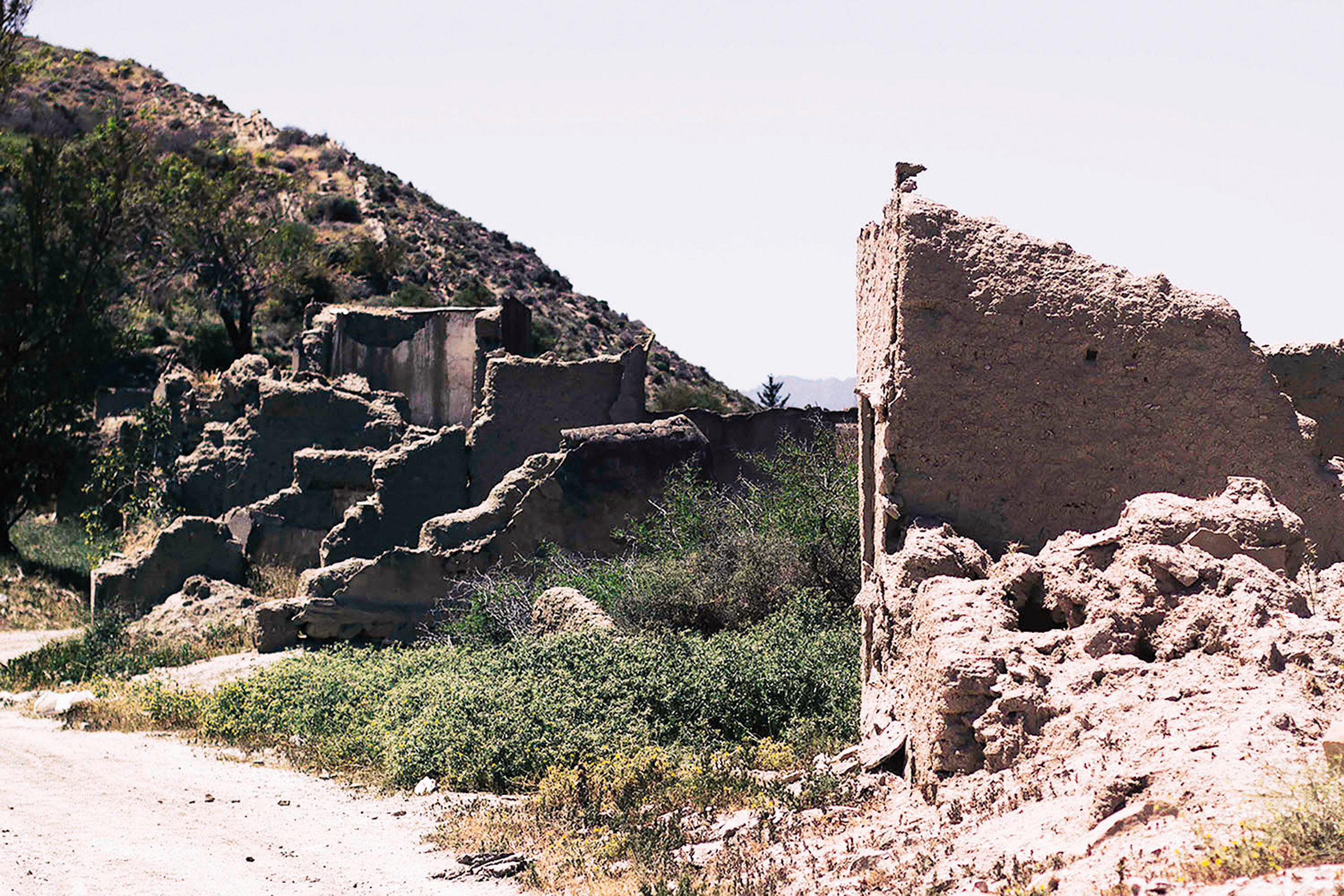
Remnants of a street in Artemi, Northern Cyprus, 2017. Photo: Nafia Akdeniz.
Imagination as and beyond ethnographic commuting
I kept walking amid these ‘spectral imprints’ imagining the invisible memories positioning themselves like intense mist through the remaining frames of what were once windows into the rooms with no ceilings and eventually finding my way out through the stairs. I imagined a little girl with two braided side ponytails tied with green hair ribbons swinging up and down as she was jumping to her grandmother’s rhythm of clapping, and stepping on a broken stair, falling down and standing up again with a bleeding knee (see Figure 2).
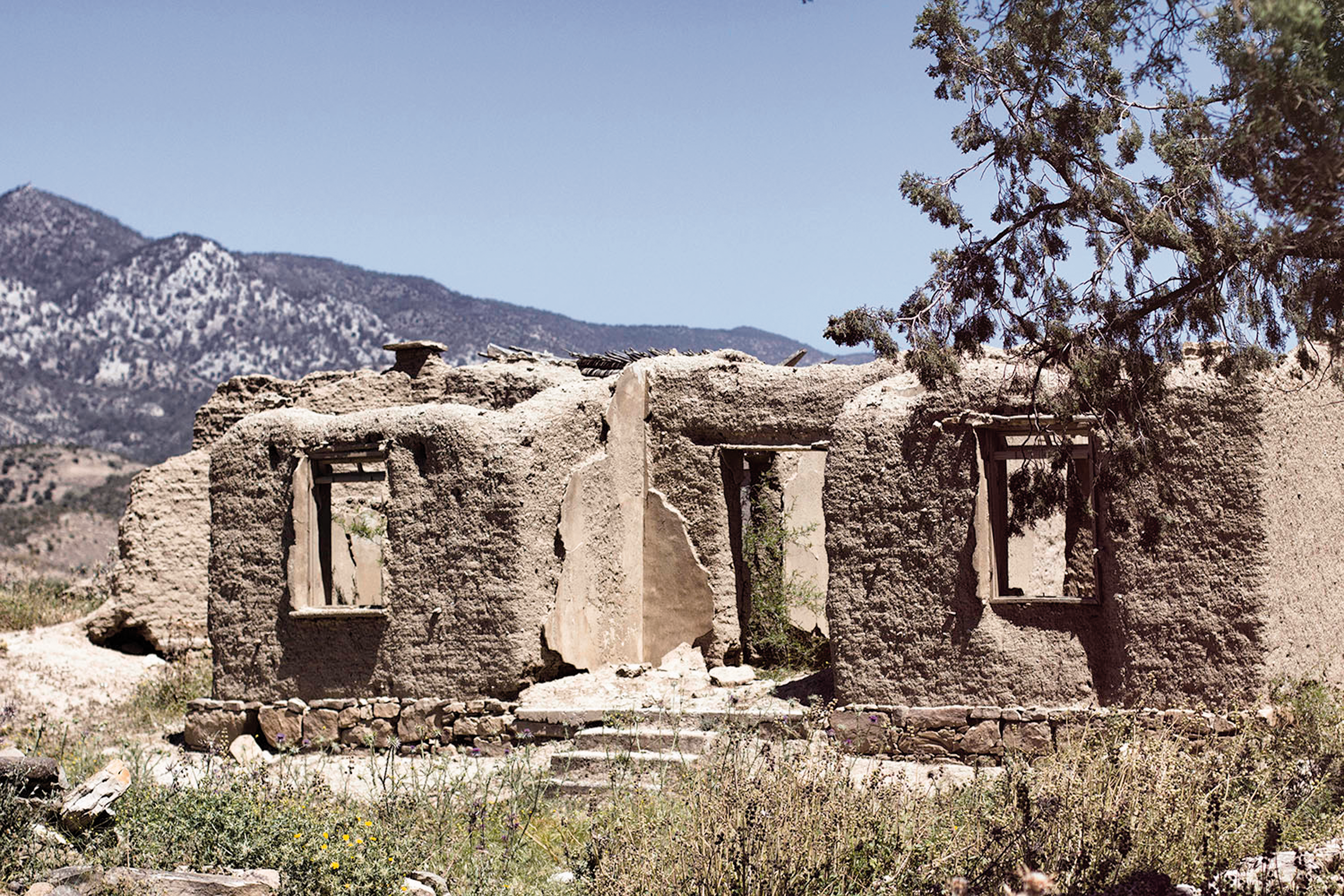
Stairs of an abandoned house in ruins in Artemi, Northern Cyprus, 2017. Photo: Nafia Akdeniz.
I wanted to know how my imagination could reflect the memories of the departed inhabitants and in what ways this departure had an effect in reformulating their lives in their relocation then and now. Above all, I wanted to know how they define such displacement from their perspective. My ethnographic curiosity triggering my imagination and vice versa grounds the process of knowledge production where ‘anthropology and autobiography merge’ (Okely and Callaway, 1992). Hastrup and Hervik (2003: 1) add: [w]hile acknowledging the indubitable significance of autobiography and the situatedness of the anthropologist, the starting-point is not the self, but the field into which the ethnographer invests her powers of imagination (emphasis added). Through this investment, the ethnographer arrives at an understanding not only of ‘culture’ or ‘society’, but more importantly of the processes by which cultures and societies are reproduced and transformed.
Pink (2013 [2011]) debates that ‘we might reflexively draw on our own existing biographical experiences … in order to imagine and recognize our sensory embodied responses to other people, objects, textures’ (p. 266). Such reflection on my imaginary interview with the imaginary girl was my sensory embodiment of the ruins referring to my memories with my own grandmother in a similar house typical of the old Cypriot way of living. Inspired by the ruins, I allowed these ‘ghost texts’ to be written over the grass of many tones of green and yellow, be it the view of an abandoned house in the middle of vastness (see Figure 3) in the scale of a little girl or be it the site of my initial research design in the scale of an ethnographer with ‘multi-sited sensitivity’ (Rajan, 2012: 183).

View of an abandoned house in Artemi, Northern Cyprus, 2017. Photo: Nafia Akdeniz.
Referring to Kant’s depiction of imagination in relation to sensory experiences, Wardle (2015: 278) states: … the mind always meets its sensory experiences or ‘intuitions’ armed with prefigured analogies concerning what the world is like; if it were not so, understanding anything in particular would be impossible. For Kant, imagination is the mode in which we humans, as fundamentally social creatures, engage with sensory experience; how, in particular, we make what is absent present (emphasis added), constituting the now of our experience in awareness of our memories and hopes. It is impossible to measure the ‘ethnographicness’ of an image in terms of its form, content, or potential as an observational document, visual record or piece of ‘data’. Instead, the ‘ethnographicness’ of any image or representation is contingent on how it is situated, interpreted and used to invoke meanings and knowledge that are of ethnographic interest.
I felt an instant urge to call the departing ‘dinghy’ back from Malinowski’s iconic scene of encounter with his fieldwork,
4
as the subjects of my research had not been ‘home’ for a long time and, having photographed the traces of their lives then, I felt the need to follow them up to know about their lives now. As Fumanti (2015: 123) states, referring to his own ethnographic study: without the direct experience of my informants’ lives, the knowledge of their biographies and without my engagement with their imagination I would have not been able to make sense of the world around me simply through the work of my imagination.
How about ethnographic commuting (Jungnickel, 2013: 446)? How to move from the abandoned site, Artemi, to the resettlement, Lefkoniko? How to get there? How to gain entry (Hine, 2000; Pratt, 1986) to this relocated community? Who might be the gatekeepers? I simply posted my photographs on my personal Facebook account and the next day a student of mine said to me: ‘Miss, I have seen your photographs of Artemi, my family is from that village, we sometimes go there for a walk, sometimes for a picnic…” (extract from office corridor conversation). And here I was given names of some people who would like to talk to me about their experiences of displacement, relocation and the kind of life they have been living since then. A few days later, driving my car in the streets of Lefkoniko together with one of the participants, Ceyda, 5 she said, ‘Drive very slowly here. You see that street? All the people living in that street were living in the same street once in Artemi before they left the village’ (extract from an unofficial interview). As she was talking to me, my mind was referring back to my imaginings during my walks in the village to the street where the remnants of the houses were barely revealing a street. In a manner of reflexivity, mentally commuting between the ruins in Artemi and the resettled houses of Lefkoniko was my way of constructing the route between these two sites. In other words, my imaginary ethnographic acts functioned so as to construct the symbolic routes, to take ‘mental steps’ (Jungnickel, 2014: 642) for ethnographic commuting between the multiplied sites and to re-position myself, the ethnographer, at different sites of fieldwork. This ‘mental wandering’ (Fetterman, 2009) generated the idea of using the album of the abandonment photography I took to construct visually-triggered mental routes for my participants to elicit ethnographic descriptions of life settings they have experienced pre- and post-abandonment.
Photography as and beyond ethnographic commuting
‘… but your album lacks the photo of something very important for our village,’ said Emine, ‘the village fountain!’ Ceyda joined the interview, explaining ‘this village fountain is very symbolic for the villagers. My uncle saw his wife there for the first time washing her feet and fell in love with her, for example’ – and everybody starts laughing in the room. It was a surprise for me to realize that having interviews with photographs in a room ‘always caused a conglomeration of other people in that place’ (Canal, 2004: 28), and they never hesitated leaning in and overhearing the interview. Over the shoulder of the interviewee, they were all trying to see the photographs in the album and asking me why I had failed to photograph the fountain. Although focus group interviews were not intended, I let it happen because observing them interacting with each other to get confirmations of what they remember or to feel inspired to share more and complement each other’s narrations was a symbolic scene referring to my ethnographic endeavor of making knowledge – making knowledge of a place and making place itself in a multimodal improvisatory fashion.
The album highlights what it lacks and becomes an ethnographic tool to create routes of eliciting data. Similarly, photographs themselves highlight what is lacking. Berger (1972), referring to a photograph, states that ‘whilst recording what has been seen, always and by its nature refers to what is not seen. It isolates, preserves and presents a moment taken from a continuum’ (p. 2). What is seen triggers memory of what is not seen in the photograph. Just like the ruins as pieces of a whole, photographs are moments of a continuum; that is the basis of enthrallment they create. I, photographing the ruins, then, created moments (images) of partials (ruins) to be explored in/expanded to the continuum of my multi-sited ethnography-to-be. The visual documentation of the current state of the abandoned village was the first data I collected through photographing, and this data functioned in later stages of the study as a tool for further data gathering as well (Rose, 2016).
Harper (2002) argues that ‘the parts of the brain that process visual information are evolutionarily older than the parts that process verbal information. Thus, images evoke deeper elements of human consciousness’ (p. 14); deeper to an extent that would lead to ‘unexpected revelations’ (Schwartz, 1989: 143) throughout my ethnographic inquiry. To my surprise again, the visually stimulated in-depth interviews reveal another element of sensory ethnography (Pink, 2015): auditory. During the interview in the resettlement area, Lefkoniko, Nazlı goes through the album of photographs and she recalls a particular sound of a memory during one of the compulsory summer-day naps dictated by her aunt against her wishes in her hanay (two-story house): ‘I never forget, there were wooden shutters in the past … you know with locking hooks … When I was in bed, I was hearing its grinding sound. I was perhaps falling asleep as I was listening to this’ (extract from an official interview) she said, and it brought ‘sensual knowledge’ (Jungnickel, 2014: 648), the auditory dimension, to our photo-interview, to my multimodal ethnographic place-making. Imagining that grinding sound, I wanted to see the house and asked for its photo (see Figure 4) before I went back to the abandoned field to look for it. ‘It’s on our Facebook page’ she said, sending me to the virtual one first. She, thus, initiated an expansion of my ethnographic movement and I continued the weaving of the ethnographic place-making with another site, which is the Facebook page (https://www.facebook.com/groups/67970747127/?ref=br_rs). There, the villagers revive the memories of their lives before 1974 on a virtual platform and they even exchange ideas on how to re-enact their village. As I was leaving the room, she added, ‘you can also find the photo of the village fountain on our page’. And I did! (see Figure 5).
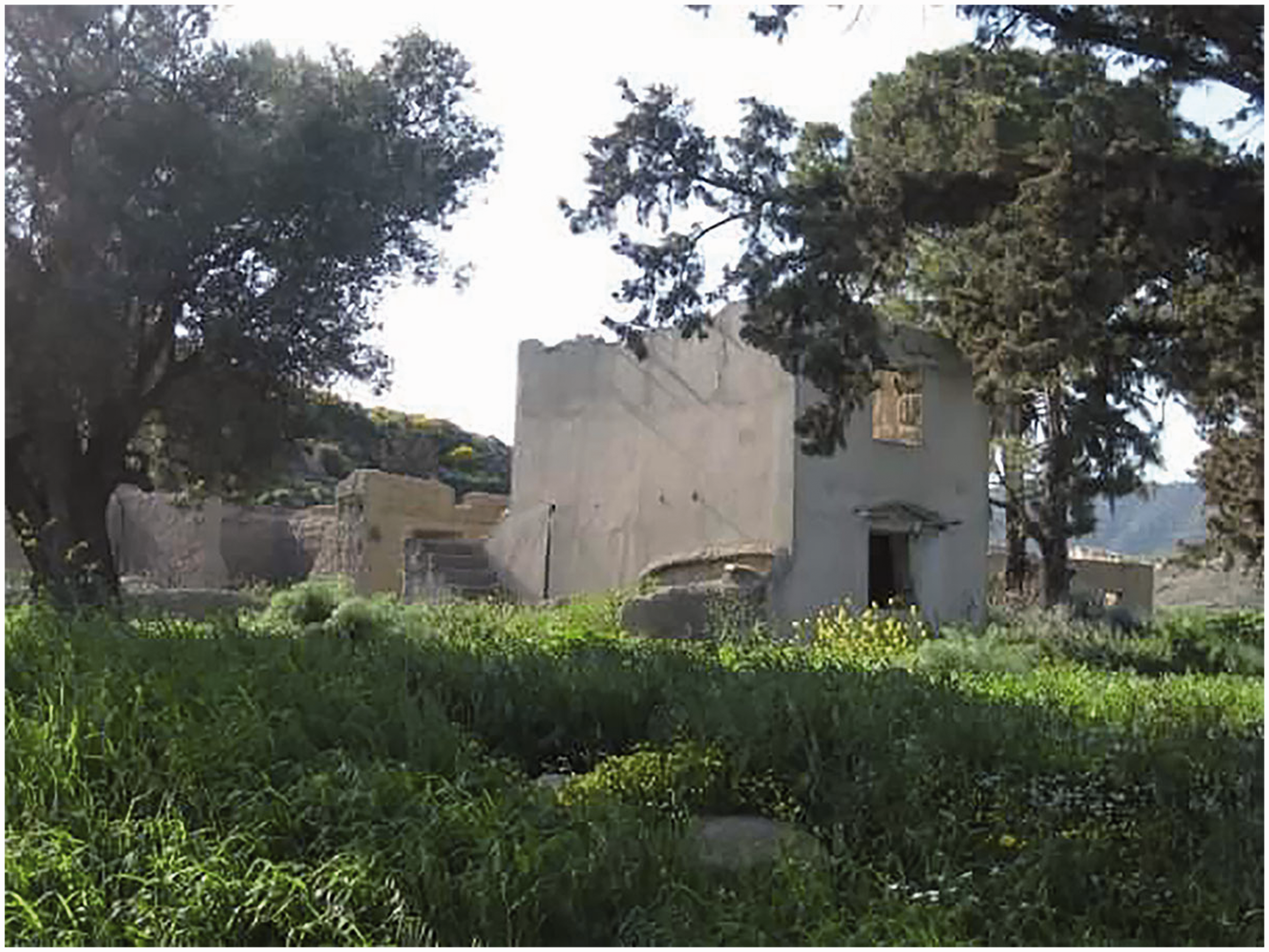
Hanay (two-story house) in ruins, Nazlı's summer house, Northern Cyprus, 2017. Photo: courtesy Nazlı.

The village fountain in Artemi, Northern Cyprus, 2017. Photo: courtesy Nazlı.
Social media ethnography
Our page, they say, for the Facebook page of their village. Since its foundation in 2004 by Mark Zuckerberg together with his roommates and students at Harvard University, Facebook has evolved into an interactive social media platform with diverse and constantly modified features enabling numerous activities for countless needs (sustaining and/or constructing), but one feature has stayed the same: it creates group dynamics that can be extended to advance into a group of people with a sense of community and belonging due to the ideologies they create and/or preserve. Some groups are already communities but lack a ‘place’ to practice being a community. Despite the place of resettlement, Artemi people are such, and they have created a virtual non-location to place their sense of being Artemili, from Artemi: a Facebook page where they virtually practice being from that particular community as a nostalgic extension of pre-1974 life and/or a futurist expansion of a kind of ‘home-returning’. The ethnography of Facebook has been a focus as an area of inquiry (Jungnickel, 2014; Baker, 2013; Miller, 2011; Postill and Pink, 2012), and ethnography of the internet is suggested to involve ‘hybrid research techniques, like face-to-face and online interviews’ (Mare, 2017: 650, emphasis added).
Within its hybrid framework, this multi-sited ethnographic practice involves the process of place-making with the multiple sites and routes for ethnographic commuting between and among these sites: the imaginary and the visual. The process is triangulated with in-depth interviews: online and offline. Therefore, it demonstrates a modified understanding of a fieldsite as a multimodal ‘network of interlinked encounters’ (Horst, 2009: 129) rather than a single bounded place idealized by the traditional ethnography. Such encounters during the process of this ethnographic study, both online and offline, reveal how this multiplied network creates forms of continuity as an attempt to reinforce the sense of community and attachment to it. Sample online behaviors are confirming identities and family relevancy through photograph-sharing, commenting and making arrangements to meet there, in the abandoned village. Although it is ‘geographically scattered’ (Craith and Hill, 2015: 46) because of its people’s relocation to somewhere else and its being reclaimed by nature, this field cannot be considered as a ‘geographically discontinuous field’ in Hage’s (2005) terms.
The former inhabitants still inhabit their village for social gatherings (though not on a regular basis) and use the Facebook page, functioning as their virtual village for such calls: ‘Dear villagers, let’s decide on a date to gather and meet, introduce our kids to each other. Let’s set a date and get together in our village’ 6 (posted on the Facebook page). The observed intention to introduce the kids to each other bares their desire to keep, strengthen and transfer the ‘spirit of community’ (Ward, 1999) to the new generations. This strengthening of the sense of community is what sutures fields together – the abandoned and the virtual – for my participants, the villagers, and for me, the ethnographer. I follow the pattern of that construction of sensual continuity as the participant observer of their online ‘digital interaction’ (Hallett and Barber, 2014: 325). Besides the virtual one, the face-to-face interviews in the field of resettlement uncover another form of continuity – physical: ‘I go to my village and farm my land’ says Davut, an Artemi villager when he states how he had built his house just a year before the 1974 war and he ‘could not even live in it for a year’. This exemplifies how, in Mare’s words (2017: 646), ‘making sense of online interactions’ is confirmed and stretched throughout the face-to-face in-depth interviews. It is also an eventual confirmation of the multi-sited fieldwork as an online-offline ethnography of ‘cultural context’ (Hine, 2005: 7), which ‘is always interactively and collaboratively constructed’ (Dong, 2017: 224), with the multimodal process in that particular study. During this process, be-friending my participants with Facebook accounts helped me ‘maintain social relationships with them’ (Mare, 2017: 654), which was operative during the later stages of the research as a ‘consistent communicative pathway’ (Baker, 2013: 141).
Future orientation of the present field/the future site
My concern about what will happen to that particular village was fired by the digital interactions the villagers had on their social networking site and during the interviews I have employed in the re-located one. A member of the once abandoned now virtual village made me consider the field as a potential future site by stating that they should ‘form a union and elect a president … collect signatures to request the construction of the road and water supply’ (posted on the Facebook page). The interview I had with one of my participants further intensified the idea that field construction within a multi-sited research design is always incomplete and out of reach, though fulfilling with its ‘comprehensive levels of analysis’. It should theoretically be left open-ended to embrace the unknown future practices. I extensively quote one of the participants, Ceyda’s perspective, together with my own, the ethnographer’s theoretical contribution to the pre-planning of the potentially possible site: Ceyda: We would like to regenerate our village … I got this idea after I visited Lefkara.
7
I thought why not create the same in our region, why not reclaim it? My uncle and his family, for example, had newly constructed their house, and lived there for a year. They may even not have legal titles. The title deeds and everything related to them should be investigated and revealed … Today, when the value of properties with a Turkish title have high economical value, why not reclaim and re-enact our village? Nafia: … You have initiated a project. I hope you make it happen. Ceyda: Thank you very much. Your findings may light our way, and I believe it will. Our memories … I really had emotional moments, seeing my mother’s photographs at school, my grandmother’s, and donkeys … I always have these in my memories … Nafia: We may include photography in your project … feeling inspired by these old photographs, we may include the photographs of the current state of the village, photographs of the post-restoration state and photographs of the pre-1974 state representing your memories … A photography exhibition displaying all … Just an idea. Ceyda: That would be great! (Extract from an official interview)
By way of a conclusion
Nineteen months later…
The Facebook inbox message I received from Ceyda, one of the participants of my ‘on hold’ study of multi-sited ethnography on the abandoned village Artemi in the northern part of Cyprus, is the spark for the upcoming change. She first shared the news about the latest environmental arrangements by the municipality and she added: ‘I would like to make an appointment with the mayor to talk about the possible restoration of our village. Would you like to join me? Shall we do it together? Would you help us prepare a renovation project of our village for the European Union? Shall we do it together?’ 8 she repeated. Having considered the future site as another domain of the ‘distributed’ culture of Artemi within the scope of a multi-sited ethnographic process of knowledge-making before I left the fieldwork open months earlier than this latest call for participating in action, I, of course, said ‘yes, we shall do it together!’ That was an opportunity for me to re-consider my already thought-through questions recorded in my field notes and eventually answer one in particular: What is the value of my research for the public? Is this academic qualitative inquiry valuable at all for these villagers unless I, as the researcher, go beyond the ‘ephemeral sense of wanting to contribute to social justice and social change in concrete and productive ways’ (Denzin and Giardina, 2018: 2) and make my research matter?
I experimented with multi-sited ethnography with a ‘future site’ that would create a new social fabric through the re-construction of its ‘locality’ in the unknown future. With the theoretical re-thinking of the Malinowskian conventions of ethnography, I argued that the field–fieldworker encounter in contemporary circumstances is also an encounter with the ‘continuity of life’, that requires the ethnographer to move beyond the academic good towards the public good. The ethnographer, now, in that particular study, has reached a stage of cultivating the meaning of ‘circumstantial activist’ by re-defining the role of ethnographer from participant observer to a participant in action, which is a new brush stroke in Marcus’s spatial canvas, which is the upcoming future ‘in the era of go-public-or-perish’ (Leavy, 2012: para 3).
A lesson learned: Imagine. Imagine further. Because ‘facts are simultaneously products of empirical experience and of active human imagining; that these two are an interwoven pair, not opposites’ (Wardle, 2015: 278). Imagine like Malinowski was asking you to imagine entering a place on the south coast of New Guinea in the Trobriand Islands: ‘Imagine yourself … all alone on a tropical beach close to a native village’ (2005 [1928]: 3). Imagine like I am asking you to imagine entering a place in the northern part of the island of Cyprus: Imagine yourself visiting a renovated village, Artemi.
To be continued …
Footnotes
Acknowledgements
I initiated this ethnographic fieldwork as a requirement of the graduate course, COMM 611: Ethnographic Research Methods, designed and offered by Assoc. Prof. Dr. Bahire Efe Özad. I appreciate the opportunity. I would like to thank the senior researcher Mete Hatay for his preliminary consultancy about the village, Artemi. I also thank Prof. Rebecca Bryant for reading and commenting on the earlier version of this paper. I am grateful to Asst. Prof. Dr. Hatice Bayraklı for her unfailing, encouraging and appreciating support with her word-by-word readings of this paper. My greatest gratitude goes to Assoc. Prof. Dr. Şefika Mertkan, who has taught me how to construct the spine of an academic article and kindly guided the editions of this particular one in that endeavor. I also want to thank the two anonymous peer reviewers for their constructive criticism. Without 24/7 guidance and service of the librarian Canay Ataöz, the sources of this paper would have been much weaker.
Declaration of Conflicting Interests
The author(s) declared no potential conflicts of interest with respect to the research, authorship, and/or publication of this article.
Funding
The author(s) received no financial support for the research, authorship, and/or publication of this article.
